garden

Dawn Watering

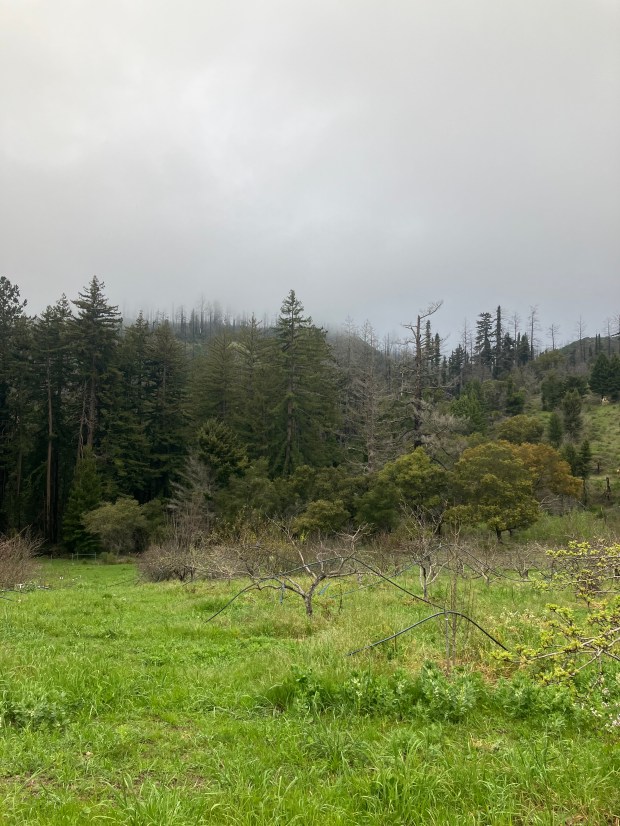
It has become imperative to start the days early, like every year during this season. Fattening fruit demands water. Micro-sprinklers hiss and twirl fine sprays that blow away or evaporate during the windy, sunny part of the day. Early mornings (before dawn, even) is the best watering time, when it is still and foggy. The first inkling of light wakes me into a routine of donning warm clothes and a jacket. The dimly lit, peaceful saunter downhill to the orchard unfolds new wonders every day. Turkeys awkwardly hasten away, great strides, giant bodies rocking back and forth. Ravens glance up from their ground-gazing meditations. An alert doe leads her two spotted fawns a little farther away, slowly. A bout of tiny droplet drizzle cools my face. When the chain latching the orchard gate clinks, the sound seems to carry far, silencing the already quiet chatter of birds. I wrest the big valve open and water gushes down the shaking pipe to the smaller laterals. Sprinklers begin bubbling, then spin. I must take a look at each of the sprinklers – 180 each round – to assure each is working, tracing the flexible tubes feeding them to spot any leaks, ears alert to irregular noises that indicate punctures from rodents or errant hoes. All checked and fixed, hands muddied and pants soaked, the morning grows lighter and I climb the hill back home with a satisfied smile knowing that the thirsty trees are happy, too.

White roses grace the hedgerow near the Apple Orchard

The Fog

Each day starts with fog, either obscuring the ridgelines or right down to the ground, soaking. There have been stretches of days with no sun at all but recently the fog has retreated oceanward midday, replaced by sun and episodic breezes. 52F at sunrise and the warmest part of the day gets to 71F; the sun feels warm but the wind makes chill. Really, when the sun comes out the temperature is pure heaven. 

The Last Mow

Celebrations and hard work with the drying of grass. Over many years and with lots of effort, we have converted nearly 20 acres to grassland from scrubland or old farm fields. Grassland is better for fire safety and restores wildlife that depend on it. Western bluebirds, harvest mice, voles, grassland butterflies (buckeyes!), and so much more are abundant now as the red-tailed hawk regularly wheels overhead seeking grassland prey. So much grassland demands hours of mowing Right Now. Five foot thick dry grass gets ground into three inches of mulch, reducing flame lengths and the heat of wildfire. Swallows delightfully swarm behind and around the mowing tractor. Brewers blackbirds pounce and dance on insects uncovered in the new cut straw, beaks full of white moth wings. Afterwards, the shortened sward attracts regular attention from bluebirds swooping to catch insect snacks: these birds really require short grass to find their food. Somehow, the native grass rebounds even after this late mow and in a month the tawny, dust churned mulch will start to green. Poppies will emerge to blossom in mid-September through the decomposing thatch.

A herd of buck-deer, some with large antlers, near the Farm on a 2020 burned slope

Big, Fat Rodent Mounds

The mowing was differently dusty this year. What used to be the more or less consistent roar of the flail mower was interrupted by a bogged down engine and the churn of dirt: ground squirrel burrows! Huge swirls of dust erupted behind the mower, sometimes sent aloft by a breeze. Once, rising heat and a breeze created a dirt vortex that spun in place, a brown twisting spellbound ghost.

Those squirrels had been hiding. Now, they are out in the open, flattening themselves as they grub and graze. Their loud whistle-chirps are more common, as waves of the rodents scatter back to their burrows in alarm. Hawk! Human! Run!! Four to six half-size, big-eyed, skinny young squirrels flock not far from their family’s burrow entrances. Some burrows are quickly being excavated, three foot wide, one foot deep fans of bare, dry soil…and rocks! Mower blades will dull faster next summer and the air will get more dusty.

The Fog, a regular morning phenomenon

Farming

Crop plants have become adults. Our community celebrated its first red tomato last weekend and the vines are getting fuller with green fruit. Apples have surpassed the silver dollar stage and are coloring up. Pears aren’t far from being ripe. Meyer and real lemons are coming on as are the bacon avocados. It looks likely that we’ll get a summer crop of limes in six weeks. Our first substantial passion fruit crop won’t be ripe until September. 

Judy’s first sunflowers are open and she’s been distributing the coveted silky smooth dark green zucchini. Two Dog Farm’s grapes are neatly trellised with bunches of promising fruit. Two Dog (really, truly!) dry farmed winter squash has just fully blanketed the field, giant green leaves, some patches with beautiful silver veins, all dotted with big yellow-orange flowers. The crews have done their major weeding, now we wait for the ripening of fruit and the promised burgeoning harvest.

Planning

Though the season of long days and hard work are made more enjoyable by the beatific clime, we’re taking the unusual turn of long term planning during the height of the work year. Everywhere you look at ‘outdoor work,’ there is an inter-generational transfer crisis. The hard-working trades of forestry, livestock, land management, wildland firefighting, and farming are struggling to attract young talent. We wonder how to continue the tomatoes and row crops of Molino Creek Farm. Who will manage Santa Cruz County’s North Coast agricultural fields in a decade or so? Will we ever again experience the amazingly diverse, delicious organic crops of Route One Farms from the 1990’s? It takes real skill and hard work to keep each crop growing enough to support the workers. And so, we meet in the large, lonely upstairs room in our Barn and ponder…

Happy Summer Solstice 2026!

Apples

It’s a common question: what do you do with all of the apples? We ask ourselves that, too. We’ve got this issue with oscillation: alternate bearing years having most recently been spurred by the Fire of 2020. Post fire 2021-few; 2022-lots; 2023- few; 2024 – lots; 2025 – few; and guess what…2026 looks like another ‘lots’ year.  Other things contribute to changing harvest numbers, such as burnt up trees, age of trees, pests, heat wave apple roasts, lack of chill hours, etc. Nevertheless, in this macro harvest year we will (probably!) have to ask and answer the Big Question again, and we already know the answer: more juice, and more hard cider!

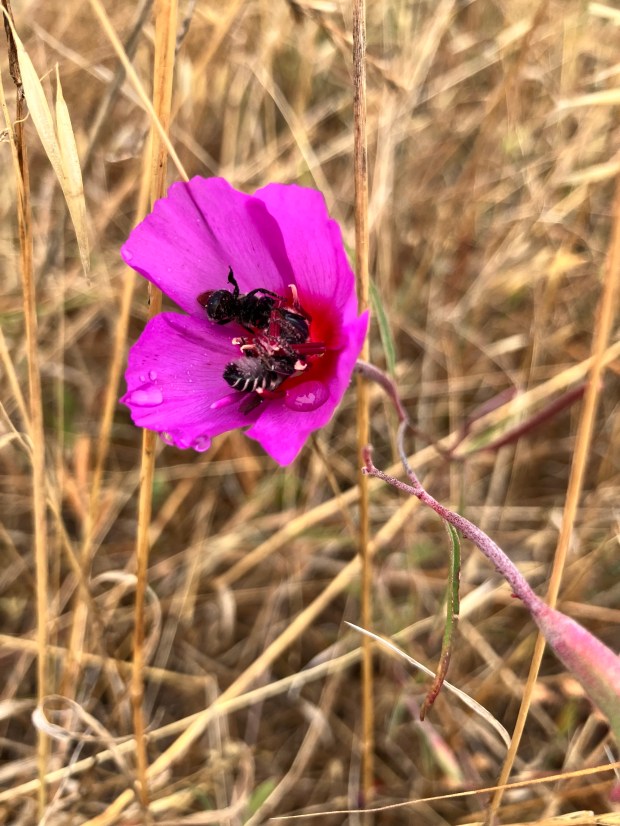
A farewell to spring flower in our grasslands replete with 2 native sleeping bees, droplets of drizzle.

My calculation for this year’s harvest is a record 11,000 pounds, nearly 6 tons. We’ll probably sell 2500 pounds to put up some capital for compost, irrigation supplies, and things we need to keep the orchard running. And, we’ll probably give 2500 pounds to the Pacific School and other charities. That leaves 6,000 pounds of ‘seconds’ apples going to either juice or into the deer-feeding (eg., pest destroying) compost piles. If we can manage the pressing power, that means we could make a record 250 gallons of hard cider! Last I checked, we have 5 cider makers in our midst and we’ll need everyone to pitch in, pick, haul, wash, sort, grind and press this year to make it work. Watch out for October! 

Avocados

The other fruit to celebrate is the oily green avocado. The repercussions of the fire also play out here, and this is the first year since 2020 that we have much to harvest. Our Community Orchard is bringing home the Bacon, with thin-skinned avocado fruit on the less oil content side of things but still delicious. About a third of our 100 trees are Bacon and only 4 of the oldest trees are bearing this year. The warm, dry March and a plethora of pollinators made a big crop that will be ready next year. Meanwhile, we watch and wait. The other types we expect larger crops from next year are Reed and Lamb Haas, but we also have a few Gwen, Pinkerton, and Carmen Haas sprinkled in the groves. Bacon avocadoes are the fastest- ‘only’ 16 months to ripen; others take almost 2 years. The ground squirrels and gray fox are already sharing the harvest. One day soon we’ll learn how to cook with the leaves and in a few years maybe we’ll figure out how to extract the oil.

Does it count that we add other plant diversity with this invasive poison hemlock?

Organic AND Regenerative

Another frequent question we are asked is ‘Are You Regenerative?’ That’s a loaded question because there’s not really any way of measuring or verifying such things…not like our organic certification with CCOF. Sure, you can fill out a self-assessment checklist, and proudly attest to your professed stellar farm care, but what thinking third party goes for such balderdash? Anyway, we resonate with some of the apparent principles of the regenerative agriculture movement such as building soil organic matter, creating conditions for increasing (especially native) plant diversity within the orchard understory, and integrating animals into the orchards. 

That latter one is a bit of a chuckler. ‘Chickens? Sheep?’ you might ask. Nay, much better: voles and turkeys, fox and squirrel, woodpecker and robin! Some may squint, “Are you serious?!” Yes- and we have evidence that anyone can see. Most recently, we’re seeing one large, fresh, glistening turkey turd every 5 square meters. We don’t need to care for those wild turkeys, they are self-sustaining! And, they are eating weed seeds, mopping up pests, cleaning up fallen fruit, and turning all of that biomass into fertilizer deposited right onto the fungal web that feeds the orchard trees. Plus, they are entertaining. And, if a coyote eats one of our understory flock, we don’t cry or call the wildlife department for a depredation permit nor do we raise apples to pay the bills for guardian dogs. If any of you readers know of any way we can help the turkeys feel more at home in our orchard, please let us know. And, if you are wondering about our other orchard understory animals…stay tuned for more fascinating Regenerative Agricultural Stories about integrating animals into cropping systems.

We’re good at raising lots of poison oak

Noise

What’s the noise around the farm? Vegetation control. Up above the farm, on San Vicente Redwoods land, the masticators are roaring and the saws are revving: they are doing more post fire forestry to make the redwood stands more resilient, to better protect Bonny Doon from the next inferno. On the Farm itself, the noise is mowers. Our discerning gaze turns to the color of grass: is it tawny, is it dead? There are complex calculations involving percent dead grass, relative humidity, nesting birds, proximity to infrastructure, and time left to mow before July 1 spurring us out the door, onto (or behind!) the tractors, and pointed in the right direction. Back and forth, strip by strip of cutting. 

More Wild Birds

The size of a couple of bird flocks deserve mention. The goldfinches! Will somebody teach me the difference between the species? Whatever type of goldfinches they are, there are commonly flocks of 30 noisily descending on patches of the non-native dandelion seed heads. Rough cats ear seeds are apparently scrumptious to these seedeaters. 

Equally noisy, equally numerous flocks of wrentits are visiting the oaks around the farm. The trees seem to squeak with a bit of an energetic russle then a confetti of tiny birds erupts, fluttering to the next oak. They sure seem to be having fun.

Farewell, Spring!

Here we are, on the advent of Summer and just at the right time this year we can say ‘farewell to spring’ with the namesake flower, which is in full glory right now in patches around our well stewarded grassland. Deep pink-red, large four-petaled flowers open with the sun and close with the night, creating safe sleeping spaces for the cutest of native bees, their pollinators. In other places, the summer bloom is on- tarplants with their resinous, odiferous leaves and yellow sunflowers brighten and scent the midday prairie. As we progress into summer, there will be more miraculous flowers dotting the landscape despite the lack of rain and the bone-dry soil. Week by week, the flowerscape changes. We hope for a mild summer without smoke or fire.

Happy Solstice!

This mother and fawn are almost tame

A Babyness of Plants

The highlight of the week has been PLANTING. Two Dog Farm has a huge patch of peppers taking root in beautifully prepared beds with drip tape efficiently irrigating the tiny baby seedlings into their new life in the real world: what promise! Molino Creek Farm has a patch of newly planted really, truly dry farmed tomatoes thanks to a close collaboration with the Two Dog Farm’s generous Bartle couple. Judy also had some help planting row upon row of onions this past week. And, those Bartles planted their winter squash seeds, the beginning of the annual unfolding of the Miracle where something appears (prolifically!) where nothing was, without any added water. There’s also Sylvie’s endeavors in some beautiful big patches…dry farmed beans, anyone? What experiments will this expert plant person reveal to us this year? 

Hundreds and hundreds of new plants are gracing the fields of our most magnificent farm. Tiny green dots in a sea of freshly tilled rich brown soil. What a sight!

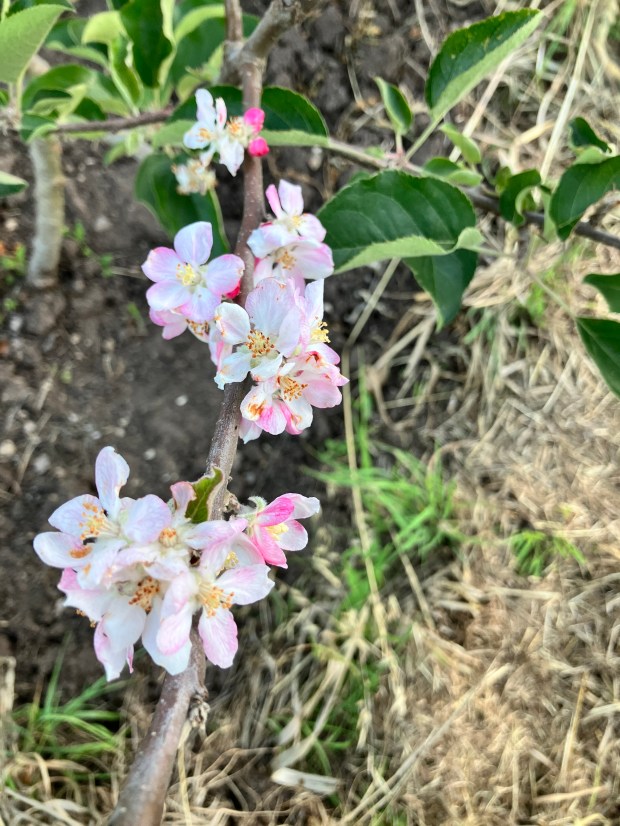
Each of these flowers will probably make a fruit!

Anti-Apple-Babies

On the other hand, there is the great procession against too many apples. So nice to have many hands’ help snipping or twisting off the too, too many baby apples. We are thinning the fruit. This year, it is time to hone our thinning skill, keeping more fruit on the apple varieties that would otherwise make “Whole Meal Apples” – as with Mutsu or Braeburn. With some apple types, you’d need a cart to carry a fruit to lunch if they were ‘properly thinned,’ and no one would enjoy a ‘lunchbox apple’ without leaving more apples per stem. The ground is getting littered by hundreds of marble-sized apple kids. Up on the stems: one apple per cluster where there used to be 5+. Long each bough: one apple every 4 – 6 inches! Those are our goals: high hopes!

And….here’s what a cluster of flowers turns into- a mess of fruit!
Thinned apples look like this- nicely spaced, and not squinched into a clusters

More Cool Weather

This past week has been another ‘the sun sure feels nice’ kind of weather. It has been creeping up to maybe a low 70F hour or two with nights in the low 50s. Foggy mornings, mostly. When the fog clears, the air feels a bit oddly dry. Perhaps the cold soil condenses out what moisture was in the air. “They” say it might get warm this coming weekend.

Baby Trees

Believe it or not, we are still rejuvenating our orchard…through grafting! The 2020 Fire still is echoing- the trees that inferno fried still have promise. Sylvie has taken to grafting desireables onto the few remaining post-fire rootsuckers. Here and there you encounter her artistry- grafting tape at the base of a rapidly sprouting scion. One graft from last year, a persimmon right inside the main gate to the apple orchard, is especially luscious with its bright green, glossy, big leaves. The many, many cherry trees Drake grafted onto rootsprouts from fire kill, in 2021, right after the fire, are getting to look more like adult trees than babies.

In 2025, Sylvie Childress grafted this beautiful persimmon onto some rootstock that had turned into a tree post 2020 Fire

Native Grass Seed

Judy, Sylvie, and I harvested a few pounds of native grass seeds recently. Hanks of seed slowly cure and dry in paper grocery bags warmed by midday sun. We have tens of thousands of California bromegrass seeds, the dominant grass on the Farm which has been getting ripe lately. This is restoration material. The farm has already been transformed in many places from thistles and other weeds to native grass swards. We’ll do more of that as we turn brush fields into prairie just by tossing seeds from one place to the next. If there is a prescribed fire this year, this pile o’ seeds will do just fine.

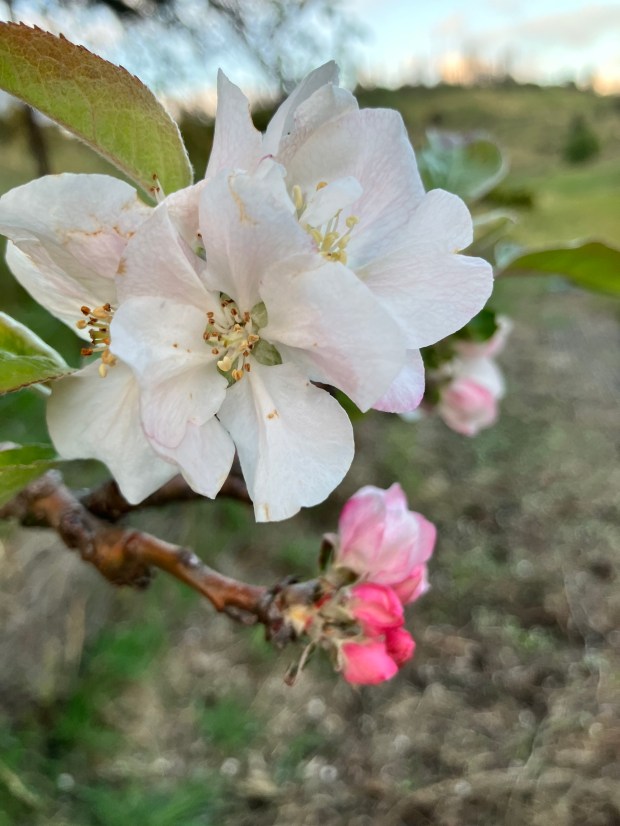
close up of a cluster of apple flowers and pink buds

Upside Down Spring

In our Mediterranean Spring, it is supposed to stop raining and the flowers bloom. This year, it stopped raining, the flowers blossomed and then it started raining again. Purple needlegrass has already bolted and set seed. Sky lupines and poppy are more pod than bloom. It is downright gushy out there: m-u-d spells mud. Spring mud. This late rain makes it very unlikely that wildfire will plague us this year, at least close by. Official reports from the surroundings put us at ‘normal’ rainfall with this past storm. How we got to that is quite a story: rain in November then none for most of December then a bit more into the New Year, then a fairly hot January…a few storms to wet things again through February and then No Rain March (and hot!) and then here comes all this rain in April.  Topsy Turvey.

Potentially, this is a Valencia orange tree- not quite ripe, yet.

Oranges

We have Washington, Cara-Cara, Robertson, and Lane Late navel oranges as well as one unknown navel type and a tree full of what look like Valencia oranges. We should mention the bitter orange, Seville?, tree that bears quite a few fruit each year. We have enjoyed the fruit from the two 7-year old Cara-Cara so much that we planted six more last year, and we must wait a long while until we get lots of those fruit. Cara-Cara oranges are red from the same compound that makes tomatoes red, Lycopene, so it makes sense that we grow lots of them on this here tomato farm. 

It takes a bunch of work to establish citrus trees; they aren’t happy with weed competition, so we have to keep them weeded frequently…like 4 times a year, for their first 3+ years. This is orange season: the fruit has been hanging for a year and is starting to get sweet. The various Mandarin varieties have a lead on them, so we haven’t been wanting for sweet citrus for a bit.

The Deer would love to eat this cabbage seedling, but maybe they won’t

Deer Report

We chatted about The Deer a bit this past week. Mark Jones reports frequently seeing more than 20 deer. By flashlight, the many pairs of glowing deer eyes are a bit surprising. One can glimpse grazing deer whenever one wants. They scamper or saunter about- normally they are quite shy and run, but not always. We should be pleased for the grazing of the plants, which would otherwise be fuel for summer fires, but some people grumble about all the deer: “landscaping” damage is probably the foremost complaint. With all the deer, one would expect some happy mountain lions, but alas the sign of the cougars is rare, still. 

The varied habitats at Molino Creek Farm provide for great bird diversity

Bird News

This past week brought yet more neo-tropical migratory songbirds. A lazuli bunting is high-squeaking right through midday. Black headed grosbeak song is also wonderous. The background noise of bicolor blackbirds, song sparrows, and golden crowned sparrows is ubiquitous. One is occasionally startled by the vast rush of a startled quail covey. Their cousins of the sky, band tailed pigeons, are quite active flapping from walnut tree to walnut tree. Today’s discovery was a female turkey clucking quite loudly for who-knows-what reason. The turkey flock seems to have dwindled to one hen, a young tom, and an older, dominant tom. Just 3 turkeys – maybe the other hens are sitting on nests or perhaps they were eaten…piles of feathers were here and there the last few weeks and a coyote was close by.

Squirrels

We used to have Western Gray Squirrel, but now we only have ground squirrels. The gray squirrels were before the fire – they supposedly are fond of truffles, so maybe that food source changed. We have a local gray squirrel type without a common name, Sciurus griseus ssp. nigripes, which only occurs along the coast between here and San Luis Obispo. I hope they come back!

The latest on our ground squirrels: have you ever looked carefully at their color patterns? They have the most amazing white eye liner, making their eyes oh-so cute! Their back fur also has cute, cute dots. Their hands are quite agile- today I watched one grab grass stalks so it could get at the seeds, which otherwise were above its head. This squirrel was feasting on ripgut brome seeds, a bad weed with heavy weight seeds that are quite rough to touch – good, brave squirrel with strong seed-eating teeth!

An April sunset above Molino Creek Farm

 Mechanical Chewing

Speaking of tearing things apart – we are seeing more of Mr. Matthew Todd’s expertise with his brush mastication machine. Huge thistle and French broom patches are being chewed up into tiny pieces as we attempt to reclaim coastal prairie patches collaboratively across property boundaries with our neighbors managing the San Vicente Redwoods property. This will be Part 2 of the recipe to try to get rid of the broom: last Fall was Part 1, then there will be this Fall to hit it again…and the next 2 Falls, too, before we expect to see a reduction in this weed.

Annual Penultimate Post for Molino Creek Farm

-I post nearly weekly from Valentine’s Day until Thanksgiving a blog about Molino Creek Farm. So, this is the second to last post for 2026.

Rain. Every vignette, each part of the farm…the entire region…is being wetted. This rain drives the moisture deeper into summer-dried soil awakening new life for the winter season.

Forest Drops

The rain is captured and concentrated in the high boughs of redwoods and firs. Drizzle coalesces into big drops plummeting, sometimes making sharp smacks against limbs, shattering. Mostly, though, the raindrops are muffled quietly diffusing into deep, fluffy needle duff. Giant bananaslugs scoonch across trunks leaving silvery slime trails. 

Scrub Soak

Resinous coyote bushes slump, covered with white fresh seed fluff made heavy with water. The bushes densely glisten even under cloud-capped sky. Exploring newly emerging liverworts or mushrooms, you dare not squeeze between those hulking shapes: brushing up against one instantly soaks. Edges of shrubby patches will have to do for the liverwort expeditions. Alarm squeaks resound: families of golden crowned sparrows flush deeper into cover.  They are the cryptogam farmers.

Flushing Grasses

Gopher mounds bristle like alarmed hedgehogs. Although dense, the single first leaves of 2” tall grass seedling spikes haven’t covered the moist, deep brown soil. Ferny blue-green rosettes of California poppy catch droplets that magnify and distort their otherwise tidy appearance. The arched dense cover of perennial grass blades dance and bob in heavy downpours.

Tilled Mud

Furrows of loose soil, freshly plowed or harrowed flatten gradually as they saturate. Mud puddles form in tire tracks. Liquified dirt flows in rivulets, down rodent holes, backing up against obstacles, painting one color what had been complex hues of soil surface-chopped plant residue. In between showers, these tilled areas waft thick and sweet soil scent.

Puddled Roads and Trails

Cows lower their massive noses to road puddles – convenient drinking areas far from the trough. Birds delight in the ubiquitous baths, wings splashing, heads scooping, beaks open sucking up sweet fresh rainfall. Every trail and road is dotted with puddles.

End of the Season

The last Palo Alto Farmer’s Market of the season for Molino Creek Farm this Saturday. Bodhi powered the tractor across the fields, discing and planting cover crop into the night Tuesday. Orchard cover cropping progressed with whatever hours I could spare, however many hours my body could muster – alas, only half done before this week’s rainstorm! Imagining the swelling of bell bean seeds, licked by snails, prodded by earthworms in the freshly turned soil.

Strong dark wax boxes of winter squash are stacked high and curing just inside the south-facing doorway of the Two Dog Farm greenhouse. 

Farmers wend their way slowly one more time down the rows of tomatoes, happily surprised to be harvesting tomatoes this close to Thanksgiving.

Heavy shoulder bags of apples filled on the steep orchard hillside and hoisted onto the sorting table. Fuji and Braeburn are the last varieties this year to go to market. Sweet and juicy but each having their own very unique flavor, vastly different. We will too soon miss the crunch of that wonderful fruit. A reminder to relish the appreciation of what you have before its gone. I take extra-long to finish a fresh-picked apple nowadays, making sure to chew and taste while gazing at the skin and flesh…the juice…the release of complex aroma upon each crisp bite.

Rumblings Afar

The bounty is upon us. The Horn of Plenty gushes forth a profound plethora of food as Fall begins. The Equinox returns old bird friends to the farm’s ongoing bird drama, including many galliformes. The meso-predators – fox and skunk, especially – roam and hunt each evening. Farmers sweat in frequent heat, weeding and harvesting. We are thankful the lightning has skipped us, yet, but WHAT’s WITH THE STORMS??!!

Farm Overview at Sunset – Color thanks to Tropical Storm Mario

Rumblings Afar

Last week it was Tropical Storm Mario, this week an unnamed spiraling monstor. Mario spewed a swarm of lightning bolts 30 miles offshore, jetting up the coast and not, as predicted, coming onshore. The unnamed storm spun arms of poofy clouds and hundreds of lightning bolts, mostly around Lompoc and the southern San Joaquin Valley. It, too, was predicted to come ashore with that violent weather this past Tuesday night but then, once again, it skipped us: the only a hundred or so lightning strikes were inland, in the foothills of the Central Valley. Tense times, these.

The mugginess, daytime heat, and even balmy evenings are unusual for us. Luckily, it hasn’t been scorchingly hot – the apples aren’t getting sunburn. And, happily for tomato farmers, there hasn’t been enough rain to even start to wet the ground – dry farmed tomatoes split with rain!

And, oh how those tropical storm clouds color our sky at sunrise and sunset. Brilliant orange hues are the dominant evening entertainment, dazzling near the horizon and all mixed up with purples and blues higher up, sprayed across cloud puffs or ethereal mists.

The Toil

Amidst the episodic heat, farmers work and sweat. The weeding never ends. One starts early to avoid the worst of it, but that early starts later…hoes hit the ground at 6:45 if we’re lucky. And the harvest takes hours through the day while the sun pushes prickles and wilting heat right through you. The sweat would drip except it is so very dry, salt cakes on the skin roughly mixing with dust. Harvesting tomatoes bent fully over, gingerly stepping between sprawling plants and peering into the dense foliage for hidden fruit, carefully extracted…boxes and boxes of big swelling fruit emerging from so little ground – it is an epic year! What a contrast to last year’s crop failure.

Two Dog Farm dry farmed winter squash, each year a stunning miracle from such seemingly dry ground

Fruit Ripens

In the orchard, the apples ripen with lemon harvest still in swing. Eureka lemons get ripe by the day, our first year of sending them for weeks to market. These lemons are popular among our Community Orchardists, too – they are catching on – so, the ‘seconds’ lemons are getting claimed voraciously. About 50% of the lemons aren’t perfect enough for market, and so 25 pounds a week are getting distributed. It seems like next year we’ll have surplus for the Pacific School, once they return from the summer. Our lemon trees have just past 10’ tall, a bit lanky and need of some shaping – sharp spines make portions of the getting-dense trees hard to harvest. It is surprising how difficult it is to discern the varying shades of yellow on the fruit, sometimes with hidden tinges of green, to harvest the ripe ones as they turn ever-so-slightly deeper colored.

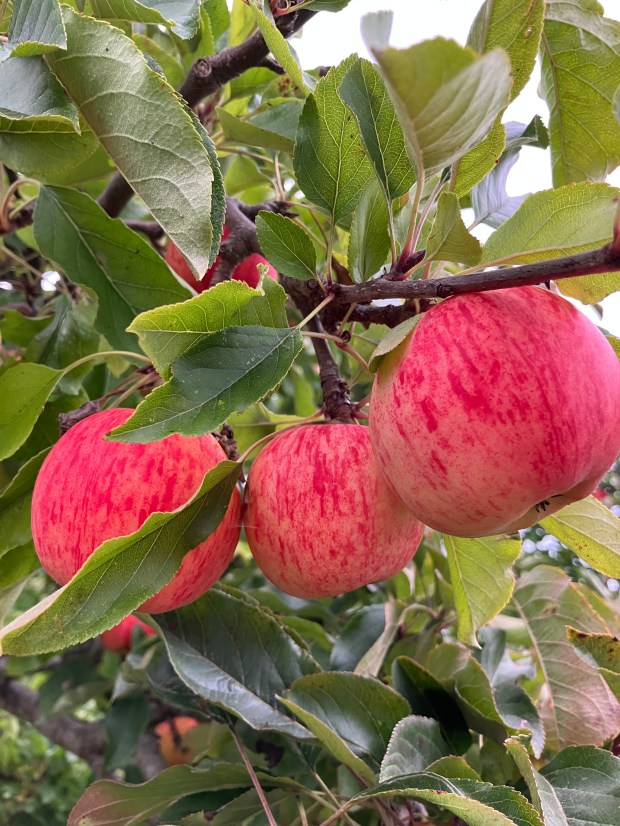
Gala apples are the first to ripen: we sent our first box to market out to the Community this past week. The background peach color, beneath the red streaks, is so obviously a sign of ripeness. They are gorgeous when ripe.

Ripening Gala apples in our Community Orchard

Reclaiming the Land

We are so thankful to our various partners for their assistance in restoring the natural areas of Molino Creek Farm. Last year, the Central Coast Prescribed Burn Association’s (CCPBA) massive network of volunteers and dedicated staff put Good Fire on the ground, nudging our scrub invaded systems back to coastal prairie. Their work also makes our farm safer from wildfire, which has been much on our minds of late. This fire break augments a many miles long regional firebreak that runs on our border and protects Bonny Doon and then Santa Cruz further down the fire-shed.

This week, the new President of the CCPBA, Matthew Todd, has been using his expertise and big, expensive tool to take that burning a bit further. His Bobcat runs a masticator, and he’s mowing down huge patches of the invasive French broom which sprung up after the 2020 fire. Alongside that broom are acres of brush that has taken over super-diverse prairies that were dominant in photos as recent as 1988. Matthew is a landscape artist – it is looking so great and we are much-relieved to have his help bashing broom…and jubata grass…and coyote brush. Broom control protocol calls for several years of mowing in the Fall, like we’re doing now, and we are going to do just that – maybe with a bit of Rx Fire thrown in there.

Rumor has it that CalFire will do a training burn in a few weeks (after grape harvest), so more to come.

Matthew Todd on his masticator, taking care of prairie one strip at a time: Thank YOU!

Natural Production

While our Farm Fruit is abundant, so is the fruit of the woods. Jays and Acorn Woodpeckers have turned their attention to the acorns, which have swollen and started to drop. On the ridgelines above the Farm, the manzanita bushes have their first massive berry production since the 2020 fire. The seeds have tasty dry, sweet pulp and hard as rock seeds. Some critter has been feasting on them and then pooping out the remains in our apple orchard – a long haul, but someone has a circuit.

Critterland

It is easy to see a fox at night if you just go looking. We must have a large population. They bark and yowl. You can’t hear them, but you can certainly smell them … skunks are prowling farm-wide. The hayfields are full of their nuzzling holes where they seek mice or crickets. The bunchgrasses we’ve been nurturing in our hayfields have turned green and since we didn’t harvest the hay, there is plenty of hunting ground for skunks.

Native bunchgrass, California brome (Bromus carinatus) hay field with skunk hunting sign

Welcome Back Sparrows! And…

Golden-crowned sparrows returned, as usual, with the Equinox. In the dark of the night on 9/19, hundreds of these winter birds dropped out of the sky and started feasting on what seeds remain from the entire summer of feasting of the other birds. They were quiet and shy at first, maybe a bit tired from their journey, but now they are feisty and squeaky. 

At the same time, other types of birds arrived. The meadowlarks landed in the meadows lower down and closer to the ocean. And, the blackbirds – Brewer’s and bicolored – have suddenly formed their cacophonous flock at the top of the trees around the periphery of the farm fields.

Gallinaceous Bird Drama

The turkey flock was attacked in the forest, what a terrible noise, and only the male has been about. Seems like a good idea to go to that place of turkey noise and see what happened. A coyote or even a pack of coyotes would stand quite a challenge against such powerful birds: maybe it was a lion? Tracking is in order.

Massive quail coveys flush and whirr at every turn. They are Very Jumpy because there is a Very Good Hunter about: Cooper’s hawk is energetically flying about. Do kestrels eat quail? There’s one of those around, too.

Swings

Prickly, skin burning sun gives way a day later to chilly overcast drizzle. As the planet warms, the extremes get more extreme; I don’t recall that kind of pendulum, but who knows? Monday’s sunny high at Molino Creek Farm was in the low 80’s, Tuesday a little cooler (but not much), and Wednesday it was in the low 60’s and drizzling. Let’s go back to the moment it switched: Saturday. We gathered our Community Orchardists just as the day went from somewhat cloudy and cool to crystal clear and warmer – the kind of beautiful where it feels like someone dropped a psychedelic dome over the big green earth, emphasizing color and clarity. Shimmering, exquisite beauty.

Cherry Blossoms

Fruit for the People!

The working bee rocked- cheerful chatter and hard workers knocking out pruning, weeding, fertilizing and cleaning branches & props. It was enough to turn around whatever doubt we might have had that this season is a turning point. We came together around food with toasts and kind words of appreciation for the community we create around growing Fruit for the People! Speaking of which…our Community Orchardists have delivered their first crop of Robertson navel oranges to our favorite outlet: the Pacific Elementary School‘s Food Lab in Davenport. Somewhat shy of 100 pounds of juicy, brightly colored, thin skinned oranges are making people happier and healthier. This kicks off 2025’s food donations to this important program.

Oh- and By the Way…many thanks to our dedicated readers and their forays to the Food Bin. They sold out of our tasty Bearss Limes and had to call us up to get more – vocal demand was the key. We are happy to help more people to shop local – this is The Locally Owned Grocery Store on this side of town. Go on back, now- they have a new batch of our limes, the best limes in town.

Aisle cover crop: bell beans; under tree permanent cover crop: Iberian comfrey

Terroir

We imagine we taste it in our limes, maybe in our oranges, too. But, the terroir comes out especially in our cider and wine. Cassandra Christine pointed it out first and now we are all grooving on the unique taste our soil imparts into our fruit. You’ll have to wait a bit to purchase Two Dog Farm’s chardonnay, but we are wishing them well in getting a big harvest this year after so carefully tending the vines.

Italian Prune Bark

This Land is Bird’s Land

There are so many birds at Molino Creek Farm right now – it is teeming with feathered friends. A few of us counted the bicolor blackbirds singing in a dead, bare-branched fir tree above the orchard. The number is the same as previously reported 35-40: that’s our flock.

There are hundreds more golden crowned sparrows, which are getting ready to take off to Alaska. I have some observations to share about these buddies. The sparrows around my home have accepted me as a friend and do not flee until I get around 5 feet away if I move slowly. As I walked around the garden the other evening, I approached the cherry tree, which had just started flowering. A golden crowned sparrow was happy about that – he was furtively plucking petals and pecking at buds, feasting away as fast as he could, ecstatic. This had mixed effects on me: on one hand, I was excited to realize that this species eats flowers; on the other hand, I wasn’t pleased that this bird was potentially causing loss of my favorite fruit. I talked to this guy about it, telling him that I really wished he wouldn’t eat my cherry flowers, but he didn’t seem to understand. I told him I’d get out the bird seed and feed his brethren seed if he let the cherry blossoms along. A moment later, he left and I haven’t seen sparrows in the tree again: good! I put seed out in the front yard and, looking out my sliding glass door this morning, I saw the flock of golden crowned sparrows, some of whom were eating the seed. I noticed that others, closer to the window, were eating weeds…and one was eating the petals of a California poppy. Just as I felt the rush of another discovery, yet another piled on: the poppy petal eating sparrow fed a luscious mouthful of petals to its friend, as if to say – “YES! It IS delicious!”

One more note…the golden crowned sparrows are also eating radish leaves, but not just any radish leaves – they find certain tasty radish plants and strip them to leaf midveins while completely ignoring a neighboring, probably less tasty plant.

We will miss these friends when they leave for Alaska…any day now.

Austrian Pea – a resprouting cover crop plant in a sea of chopped up calendula

Scents of Spring

Sweet smell of plum blossoms, pungent-bitter scent of calendula crushed underfoot, the perfume of fresh cut grass…and, the acrid-poopy smell of rotting radish. The Farm planted daikon radish as a cover crop and it does quite well. Grind it up with the mower and, well, it rots. To me, it didn’t smell so nice even as a live plant. I don’t really like that crucifery stench, but others apparently do: a recent UCSC class visit taught me that humans can have vastly different experiences with the mustard green smell. Good thing. A bit more rain (its coming!) and a bit more mowing and that rotting daikon scent will be ubiquitous. About that time, the rotting radish smell will mix with the freshly applied compost and melting down feather meal scents and the Farm will smell….richly stinky!

First Quince Flowers

The Sounds of Late Winter

Behind the bird chorus, waves pound. Finches crazy whistling, goldfinch squeaks, robin operas, junco twittering, bluebird sonnets, and so many other bird songs fill the air at dawn and dusk…and sporadically all day long. Lately, the waves have been very loud, rolling roars pulsing, occasionally cracking high on the rocks and sending an attention note into the hills. Gusts sing in the trees and whistle through the winter’s last dead hemlock stems, rocking.

Here goes another growing season, folks! We’re digging in deep.

2020 Fire starting to disappear to new redwood bark regrowth

Welcome Fall

We woke on the Equinox, September 22, to the song of night’s arrival – golden crowned sparrows. Somehow, they know the right day and arrive the same moment each year, ending their long travel south from Alaska. With the changing world, it seems odd that some things remain constant. These pesky birds promise hours of entertainment as their pecking order is as animated as chickens and they are far more numerous. Their aggression is correlated by the brightness of gold on their heads, but they still love each other: they have tight-knit family groups and larger tribes and they are settling into the same cluster of shrubs they called home last winter. They must be pleased to have so many seeds: last winter’s bounteous precipitation made the seeds rain more than even the huge coveys of quail can keep up with. When it rains, there will still be millions of seeds to germinate and the sparrows will start grazing the lush turf.

More Typicality

Just as last year, the winter battles summer this time of year. Some of us celebrated one more Warm Night: unusual in these parts. The warm night was sandwiched between two pretty hot days and then the Fog returned: moisture rolling off rooves at sunrise, dripping from leaf tips, coloring the dust on the road beneath wetted trees. The see-sawing of temperatures was the cue the apples needed to get that much closer to ripe, but the bouts of fog enshrouded days make it difficult to keep up with the watering…solar pumps don’t produce much when there’s too few photons. It would be better to water the orchard before it gets really hot, but the hot has recently been when the sun comes out. Dynamism and daily adaption is the way of the farmer. The question now…will it be truly typical and rain an inch, our first ‘big storm’ in the middle of October? Whoah! That’s just two weeks away!!

Dry farmed tomatoes- yum!

Fields of Tomatoes

The bouts of heat and the progression of the season coalesced to create a grand glut of tomatoes. In this house, we’ve processed a hundred pounds into jars and jars of sauce to brighten the meals in seasons far from summer. Another household dried 200 pounds. The smell of tomato fruit hangs in the air on still warm evenings. The warmth and dust-loving russet mites have ravaged many plants, leaves withered and crispy: they’re time is up, but there are many more healthy plants in some patches, especially in the ‘diagonal field’ with deeper soil, upwind of the road dust. That’s where the future lies…we need tomato production through Thanksgiving for a truly prosperous year.

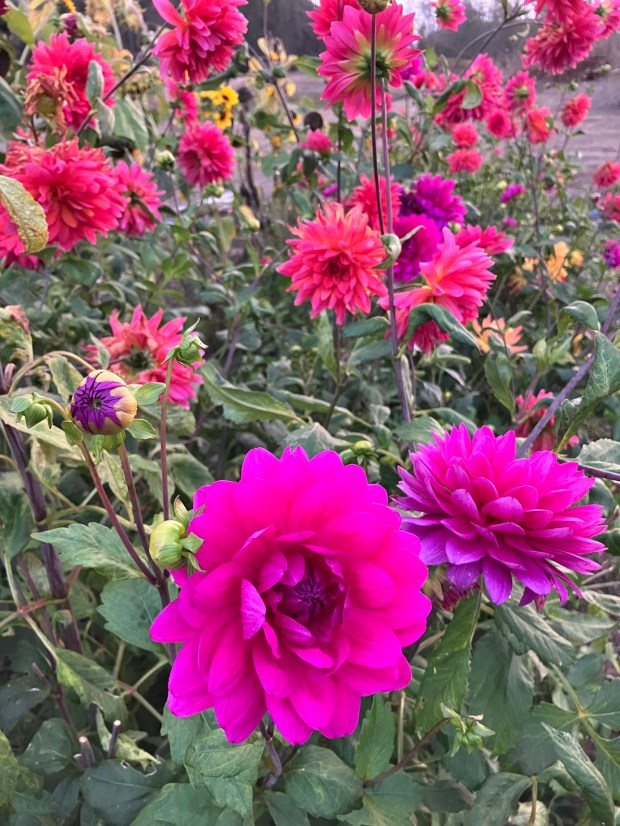
One of Judy’s wonderful dahlias

Flowers

This is truly the driest time of year as we’ve had no rain since April. The hillsides are crispy dry and most shrubs, flowers, and grasses are dormant. The exception is the unbelievably bright green pine-scented coyote bush…just starting to flower. Want to tell the girl from the boy coyote (bushes)? Now’s the time. I mark the coyote bush female plants and eradicate them preferentially- they are the existential threat to us folks who like to keep grasslands, grasslands and let the wildflowers have the wide open space. For now, the coyote bush is keeping the pollinator community well fed. Butterflies flock, flies buzz, and wasps hop from cluster to cluster of the pollen and nectar rich flowerheads.

In the irrigated garden, it is Dahlia time! Big poofy, luscious flowers of the most unbelievable colors pop and spangle in a scant row among cucumber, beans, and squash. Sunflowers are still going, cut for each of the 3 farmer’s markets we are going to nowadays (Aptos/Cabrillo-Saturday, Downtown Santa Cruz-Wednesday, and Palo Alto-Saturday).

It makes nice fall color, even if poison oak is terrible to some

Fall Color

The walnuts and garden birches have only the slightest tinge of the beginnings of yellow. Same with the maples in the wild canyons. At the edge of the forests and on steep hillsides, poison oak is further along with its remarkable streaked purple-reds. Rumor has it that the aspen leaves are turning in Eastern California where ‘leaf peepers’ are drawn to fall glory.

More Return of the Birds

Besides the golden crowned sparrows, other birds have returned from afar for their winter haunts. Cassandra and I have both seen an unusual feathered friend: Western meadowlarks visiting the Farm! Their bright yellow, black-spotted bib and dangerously long stout bills give them away. I guess our grasslands have reclaimed enough shrub ground to look like viable meadowlark habitat – that’s new!

Another bird sighting – an osprey! Around 2012 this time of year, two ospreys would fly over the farm each evening at dusk, west to east. One is flying now. Someone says that they saw it carrying a fish…a little late for fledglings, don’t you think? Still, this is an odd thing and someday someone’s going to have to follow that sea hawk and see where its going.

The beginnings of our haystacks

Hey Rick, hay rick!

Last weekend at our work party, Jen, Mike, and Roland rolled up the hay near Cherry Hill. Tons of the dry grassy stuff is cut, getting raked, and being placed in our rudimentary hay ricks. If we had pines nearby, we could put some needles in our haystacks, but as it is they are full of weeds. This is a new adaption from the bad idea of old…placing dry hay under perfectly innocent trees during fire season. Now, we stack the hay, let it molder, and wait until the end of fire season to swoosh it under the trees to suppress weeds, add nutrients and organic matter, and provide cozy homes for VOLES who do such a good job of ridding the orchards of gophers.

Perhaps we’ll rediscover the way of stacking the hayrick…a profession of years ago with expertise and methods long lost.

Real Pro Haystacks

Equinox

Three layers of clouds moving in different ways for different reasons woof in the soon-to-be rainy season. Time to put up firewood and stuff.

Sunset peach clounds dance above the barn, fields falling into darkness. The day’s last colors.

Another cool night pinches the sweetness into the many ripening apples.

This week spells big transitions for the Farm in another way. Day by day, each morning the chainsaws got closer and finally they emerged from Above to Here this week.

Burned Tree Control along Warrenella, Thanks to San Vicente Redwoods Conservation Partnership, photo by Sylvie Childress

Changes on the Land

We have made great progress each year after the 2020 CZU Lightning Complex Fire blasted its way into our lives and across the property. The Big Leap recently was the clearing of hundreds of dead trees along the most proximate stretch of Warrenella Road. Our Good Neighbors have found the capacity to clear the trees that were killed or badly damaged by the fire…each and every tree that could have otherwise fallen across our road is now on the ground. Massive numbers of tree skeletons suddenly lying on their sides. (that particular area carpeted with a kind of yellow-flowering groundcover deer brush last spring).

Several close calls with waves of rain from the North this past week help the Fear of Fire fade, but it hasn’t yet become wet enough to allow the relaxation of winter rains’ wildfire reprieve.

Tomatoes!

The lack of rain relieves the tomato growers because wet tomato plants can undergo late season fungal and other blight disease melt down. The acres of tomatoes lie heavy with juicy red ripe fruit that we can’t really keep up with harvesting: too many tons all at once, and where would we sell them all anyhow? Pots full of sauce ladled into canning jars. Humming hot blowers from dryers, trays of tomatoes shrinking. Sweet, sweet tomatoes! Our favorite season. Comparing what each other can DO with them: a tasty half-dry/reduced chopped tomato relish brightened with Calabrian pepper oil a recent favorite from fabulous cook Mark Kuempel (thanks!).

Sunset on the Farm

The Deer

The Deer are (still) busy eating up apple culls. A GIANT buck proudly stands tall with excellent contrasting patches of remarkable white and black. Sylvie’s ear caught the Most Curious of Deer noises: ‘a whirly-gig’ she said. Here’s a link to the surprising noise, in the first few seconds. OH! How odd the rutting season!! We have never had so many bucks so close up; perhaps the fire made a lot of deer food and the population is headed high.

Apples

During our regular, well-attended working bee, we had an ad hoc apple tasting last weekend and found some pretty surprising results. The Cox’s Orange Pippin was almost ripe and ripe enough to cause yummy noises as well as some picking. An offspring of hybridization of that one, the Rubinette, also to a lesser degree caused some ‘oohing’ and taking of almost ripe fruit home. Areas of Fuji were getting nearly as ripe as the Galas, both at least a week away. The frightening part of this news is….there is a good chance that most of the 9,000+ pounds of fruit we have in front of us will ripen nearly simultaneously. Here comes the juice….a jolly pressing matter.

Harvest

So, yes, this is the season of harvest. Out in the fields gathering, hauling boxes and buckets back to the Barn for packaging for market, driving vehicles weighted down with food miles and miles to sell. Out early back late, hefting sore muscles balanced by glowingly thankful faces, friends, strangers all in awe of the best food on Earth. Molino Groupies. Two Dog Groupies. Unbelievable! People with Molino Creek Farm Tee shirts from years and years ago, hefting Molino Creek bags. Cheering friends welcoming the food we continue to produce from this verdant land. The harvest won’t last long. We are lucky if the food keeps coming in until Thanksgiving: just 2 more months if the weather holds! This is why we try to preserve the season’s flavorful foods by straight up canning, or roasting and then canning. Dried or canned tomatoes shifting to dried apples or canned applesauce. The prunes, however, aren’t so numerous and the competition for the best prune desserts is ON around the Farm.

Harvest Company

Whatever one does outside, one has company. Face flies and other summer flies are at their zenith. The newly born and mother cows on our drive out are covered with them, but we are just annoyed. The buzzing buggers dive over and over into your ear or make your eyes continually squint and blink as they bombard, zig-zag, or dive for a taste of you. Battling those annoying flies are the legions of dragonflies patrolling the air in patches; we could use more to vacuum up the more annoying flies.

Full Moon, Equinox Coming

This coming Sunday at about half past 5 in the morning we will cross the line where day length is equal to the hours of night. Fall Equinox marks the turn towards night, towards the long cold, onto California’s rainy season. One more month, October 15 is the date of the average commencement of rainstorms. Sometimes we can get a lot of rain just before then. Approaching this High Holiday was the Full Moon we just passed making the sky glow like day all night long.

We hope you had a Good Full Moon and will take some time on Sunday to reflect on the changing times.

The Slowness of Extreme Heat

Happy Interdependence Day! I’m happy not to live under the tyranny of a monarchy AND I’m glad to be part of a community that recognizes the centrality of interdependence. The Molino Creek Farm Community relies on one another, exercising our various strengths to foster healthy farm life at its center. We include teachers, woodcrafters, a midwife, farmers, orchard tenders, bookkeepers and administrators, activists, road technicians, and natural lands managers. Many others join, from near and far. Together, we make this land sing: it depends on us, we depend on it, and everyone depends on each other. Nearly 4 years after the last wildfire, we feel that interconnectedness more than ever.

Name that shrub: one of our many hedgerow plants

Evening Scents

Each evening and early in the morning, the air is filled with the “seminal” smell of the male flowers of tanoak. It hits you strongly, suddenly: the pollen must release all at once after the evening arrives. As the sun was beginning to set, before the emanation of the heavy tanoak smell, there was a more subtle, pleasant, sweet aroma: thousands of white flowers unfurled from the field bindweed, a ground-hugging invasive morning glory- like vine of the tilled fields. There’s no detectable smell from a single bindweed flower, but en masse they sure smell pretty.

Summer Fruit

There is a pinkish blush on the first dry farmed tomatoes, but other fruits are riper. The 2 trees are young yet, but the first aprium crop is coming on: it looks like we might get 20 pounds to share among our community orchardists. They are delicious and almost make up for the lack of real apricots, which we can’t seem to produce in our cool coastal clime. The star of the show is cherries, but again too few to get to market: we anticipate 300 pounds of fat, dark red sweet cherries from the 18 trees that the fire spared. The 25 other recovering cherry trees in that block, grafted onto resprouting rootstock, will make their first sizeable harvest next year…starting in 2026, we’ll be back to ‘normal’ with 3,000 pounds plus of annual production if the stars align.

Next up this season…plums and prunes! The apples are silver dollar sized, at least, and growing. And, the avocado fruit have just set – if we can keep them moist enough, we’ll have a crop starting next January.

Sweat Investment

Even the mornings are hot as we greet the dawn ready for chores. First up: fuels reduction! Clipping, raking, and hauling the dry vegetation away from the buildings, water tanks, solar arrays, and pipes. Piles grow in the fields far away from danger…5 months from now and we’ll set them ablaze in the mist and drizzle. Today’s fuel will be tomorrow’s shrub-eradicating fire, each pile moved on top of a plant we want to eradicate.

The roar of mowers, whine of weedeaters, and buzz of saws soon obliterate the extended dawn bird chorus. When our own machinery isn’t running, we can still hear the neighbors working downhill towards us, maintaining the regional shaded fuel break along Warrennella Road. This past week we thank Brion Burrell for his artistic machinery management to reduce acres of French broom and other fire dangers to nothing, making the land around us healthier and more resilient.

Neighbors and Farm partnered in clearing French Broom and fuels away from water tanks
San Vicente Redwoods cleared an ancient meadow of post-fire French broom pulse high above the Farm

Early morning still: trucks trundle and people amble towards the irrigation controls. We reach down to turn valves, starting water flowing. Then we pace the water lines, inspecting for leaks. Earlier, ravens or mice have made holes in the plastic irrigation tubes, and out pours too much water, hissing loudly, spitting into the air, creating mud and disaster. Repair kits, a thorough soaking, and a bit of work later things return to normal and the cycle of wetting has begun on one more patch, once again. We are applying 45,000 gallons of solar pumped irrigation water from our well each week to grow orchard trees and row crops. That water makes tens of thousands of dollars of income and thousands and thousands of pounds of delicious food. And it takes lots of attention, coordination, and work to manage.

Wild Life

Those dawn treks for irrigation reveal fresh snake tracks, coyote scat, and weasel footprints. Gone are the days when you could easily see snakes, but they are still active around the farm. This past week must have been the right moon phase for reptiles to shed their skin. Fence lizards are still flakey. Shed snake skins have appeared, always trailing into gopher holes.

Gopher snake skin- as typical, entering gopher burrow

The regularly yipping coyotes are feasting on a big crop of juicy blackberries, as seen in their purple, seed-filled scat. Weasels are feasting on mice, and we hope they soon eat the surprising, sudden appearance of ground squirrels.

Very late but they finally appeared: dozens of California quail fluffies. The quail babies peep like easter chicks as they tumble and run along dusty trail and road, proud parents standing guard. The first younglings can fly, but most are still too young. A mother turkey is also shepherding a second round of just 3 much larger, still flightless and fluffy babies. High on the ridge, the purple martin chicks are in the air, noisy moist-sounding deep chirp-whistles give them away. They’ve done well this year. Maw and Caw greeted a third raven…a child from the past?…this morning – sometimes that one sticks around a few weeks, we’ll see.

Noise From Below

With the heat and extreme dry, we hope that no one sets the world on fire with fireworks at the beach tonight. The week leading up to this evening has been sporadic with preparatory explosions. The King Tides have made the beaches narrower, and the signs and Sheriff shoo people away, but still we wait with trepidation. May all we hear is the continued crash of the large ocean waves, lulling us to sleep with all of the windows open on these warm summer nights.