black tailed deer

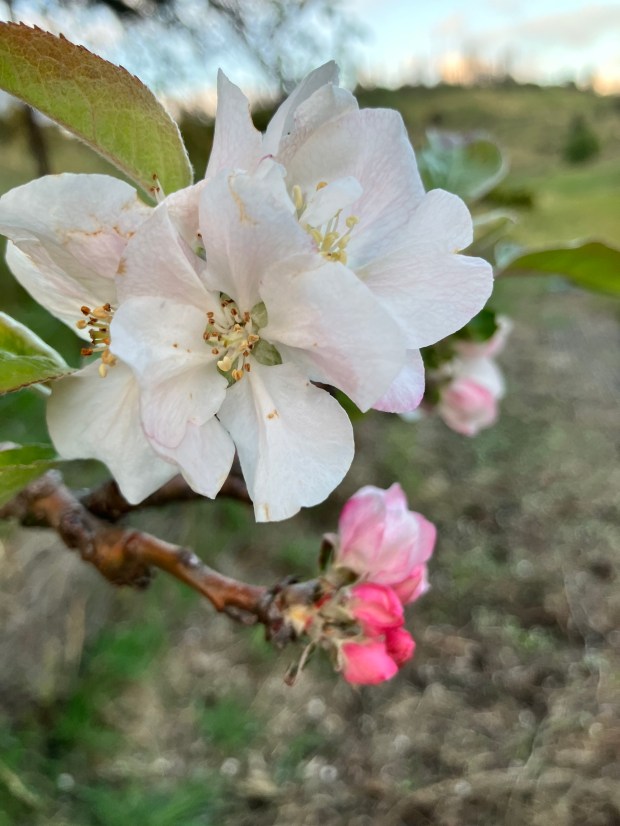
close up of a cluster of apple flowers and pink buds

Upside Down Spring

In our Mediterranean Spring, it is supposed to stop raining and the flowers bloom. This year, it stopped raining, the flowers blossomed and then it started raining again. Purple needlegrass has already bolted and set seed. Sky lupines and poppy are more pod than bloom. It is downright gushy out there: m-u-d spells mud. Spring mud. This late rain makes it very unlikely that wildfire will plague us this year, at least close by. Official reports from the surroundings put us at ‘normal’ rainfall with this past storm. How we got to that is quite a story: rain in November then none for most of December then a bit more into the New Year, then a fairly hot January…a few storms to wet things again through February and then No Rain March (and hot!) and then here comes all this rain in April.  Topsy Turvey.

Potentially, this is a Valencia orange tree- not quite ripe, yet.

Oranges

We have Washington, Cara-Cara, Robertson, and Lane Late navel oranges as well as one unknown navel type and a tree full of what look like Valencia oranges. We should mention the bitter orange, Seville?, tree that bears quite a few fruit each year. We have enjoyed the fruit from the two 7-year old Cara-Cara so much that we planted six more last year, and we must wait a long while until we get lots of those fruit. Cara-Cara oranges are red from the same compound that makes tomatoes red, Lycopene, so it makes sense that we grow lots of them on this here tomato farm. 

It takes a bunch of work to establish citrus trees; they aren’t happy with weed competition, so we have to keep them weeded frequently…like 4 times a year, for their first 3+ years. This is orange season: the fruit has been hanging for a year and is starting to get sweet. The various Mandarin varieties have a lead on them, so we haven’t been wanting for sweet citrus for a bit.

The Deer would love to eat this cabbage seedling, but maybe they won’t

Deer Report

We chatted about The Deer a bit this past week. Mark Jones reports frequently seeing more than 20 deer. By flashlight, the many pairs of glowing deer eyes are a bit surprising. One can glimpse grazing deer whenever one wants. They scamper or saunter about- normally they are quite shy and run, but not always. We should be pleased for the grazing of the plants, which would otherwise be fuel for summer fires, but some people grumble about all the deer: “landscaping” damage is probably the foremost complaint. With all the deer, one would expect some happy mountain lions, but alas the sign of the cougars is rare, still. 

The varied habitats at Molino Creek Farm provide for great bird diversity

Bird News

This past week brought yet more neo-tropical migratory songbirds. A lazuli bunting is high-squeaking right through midday. Black headed grosbeak song is also wonderous. The background noise of bicolor blackbirds, song sparrows, and golden crowned sparrows is ubiquitous. One is occasionally startled by the vast rush of a startled quail covey. Their cousins of the sky, band tailed pigeons, are quite active flapping from walnut tree to walnut tree. Today’s discovery was a female turkey clucking quite loudly for who-knows-what reason. The turkey flock seems to have dwindled to one hen, a young tom, and an older, dominant tom. Just 3 turkeys – maybe the other hens are sitting on nests or perhaps they were eaten…piles of feathers were here and there the last few weeks and a coyote was close by.

Squirrels

We used to have Western Gray Squirrel, but now we only have ground squirrels. The gray squirrels were before the fire – they supposedly are fond of truffles, so maybe that food source changed. We have a local gray squirrel type without a common name, Sciurus griseus ssp. nigripes, which only occurs along the coast between here and San Luis Obispo. I hope they come back!

The latest on our ground squirrels: have you ever looked carefully at their color patterns? They have the most amazing white eye liner, making their eyes oh-so cute! Their back fur also has cute, cute dots. Their hands are quite agile- today I watched one grab grass stalks so it could get at the seeds, which otherwise were above its head. This squirrel was feasting on ripgut brome seeds, a bad weed with heavy weight seeds that are quite rough to touch – good, brave squirrel with strong seed-eating teeth!

An April sunset above Molino Creek Farm

 Mechanical Chewing

Speaking of tearing things apart – we are seeing more of Mr. Matthew Todd’s expertise with his brush mastication machine. Huge thistle and French broom patches are being chewed up into tiny pieces as we attempt to reclaim coastal prairie patches collaboratively across property boundaries with our neighbors managing the San Vicente Redwoods property. This will be Part 2 of the recipe to try to get rid of the broom: last Fall was Part 1, then there will be this Fall to hit it again…and the next 2 Falls, too, before we expect to see a reduction in this weed.
Equinox

Three layers of clouds moving in different ways for different reasons woof in the soon-to-be rainy season. Time to put up firewood and stuff.

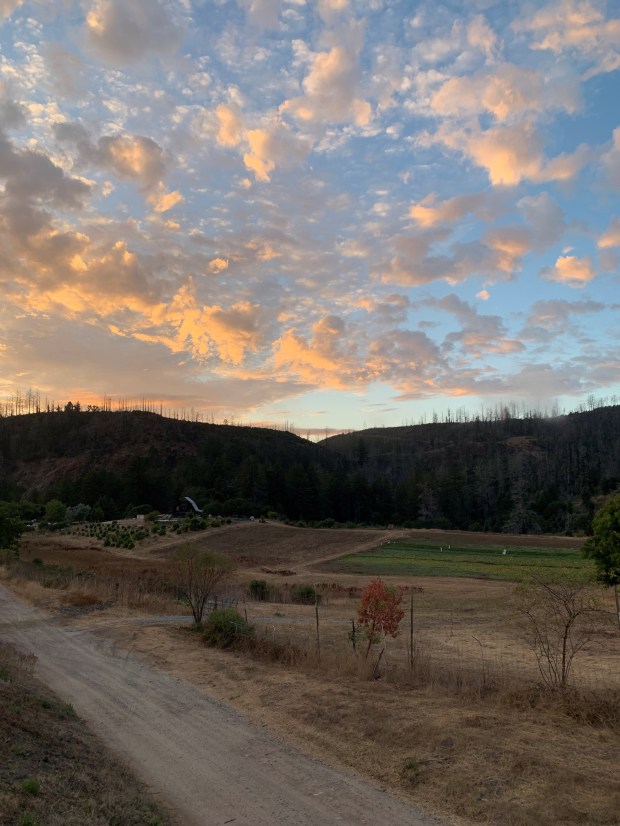
Sunset peach clounds dance above the barn, fields falling into darkness. The day’s last colors.

Another cool night pinches the sweetness into the many ripening apples.

This week spells big transitions for the Farm in another way. Day by day, each morning the chainsaws got closer and finally they emerged from Above to Here this week.

Burned Tree Control along Warrenella, Thanks to San Vicente Redwoods Conservation Partnership, photo by Sylvie Childress

Changes on the Land

We have made great progress each year after the 2020 CZU Lightning Complex Fire blasted its way into our lives and across the property. The Big Leap recently was the clearing of hundreds of dead trees along the most proximate stretch of Warrenella Road. Our Good Neighbors have found the capacity to clear the trees that were killed or badly damaged by the fire…each and every tree that could have otherwise fallen across our road is now on the ground. Massive numbers of tree skeletons suddenly lying on their sides. (that particular area carpeted with a kind of yellow-flowering groundcover deer brush last spring).

Several close calls with waves of rain from the North this past week help the Fear of Fire fade, but it hasn’t yet become wet enough to allow the relaxation of winter rains’ wildfire reprieve.

Tomatoes!

The lack of rain relieves the tomato growers because wet tomato plants can undergo late season fungal and other blight disease melt down. The acres of tomatoes lie heavy with juicy red ripe fruit that we can’t really keep up with harvesting: too many tons all at once, and where would we sell them all anyhow? Pots full of sauce ladled into canning jars. Humming hot blowers from dryers, trays of tomatoes shrinking. Sweet, sweet tomatoes! Our favorite season. Comparing what each other can DO with them: a tasty half-dry/reduced chopped tomato relish brightened with Calabrian pepper oil a recent favorite from fabulous cook Mark Kuempel (thanks!).

Sunset on the Farm

The Deer

The Deer are (still) busy eating up apple culls. A GIANT buck proudly stands tall with excellent contrasting patches of remarkable white and black. Sylvie’s ear caught the Most Curious of Deer noises: ‘a whirly-gig’ she said. Here’s a link to the surprising noise, in the first few seconds. OH! How odd the rutting season!! We have never had so many bucks so close up; perhaps the fire made a lot of deer food and the population is headed high.

Apples

During our regular, well-attended working bee, we had an ad hoc apple tasting last weekend and found some pretty surprising results. The Cox’s Orange Pippin was almost ripe and ripe enough to cause yummy noises as well as some picking. An offspring of hybridization of that one, the Rubinette, also to a lesser degree caused some ‘oohing’ and taking of almost ripe fruit home. Areas of Fuji were getting nearly as ripe as the Galas, both at least a week away. The frightening part of this news is….there is a good chance that most of the 9,000+ pounds of fruit we have in front of us will ripen nearly simultaneously. Here comes the juice….a jolly pressing matter.

Harvest

So, yes, this is the season of harvest. Out in the fields gathering, hauling boxes and buckets back to the Barn for packaging for market, driving vehicles weighted down with food miles and miles to sell. Out early back late, hefting sore muscles balanced by glowingly thankful faces, friends, strangers all in awe of the best food on Earth. Molino Groupies. Two Dog Groupies. Unbelievable! People with Molino Creek Farm Tee shirts from years and years ago, hefting Molino Creek bags. Cheering friends welcoming the food we continue to produce from this verdant land. The harvest won’t last long. We are lucky if the food keeps coming in until Thanksgiving: just 2 more months if the weather holds! This is why we try to preserve the season’s flavorful foods by straight up canning, or roasting and then canning. Dried or canned tomatoes shifting to dried apples or canned applesauce. The prunes, however, aren’t so numerous and the competition for the best prune desserts is ON around the Farm.

Harvest Company

Whatever one does outside, one has company. Face flies and other summer flies are at their zenith. The newly born and mother cows on our drive out are covered with them, but we are just annoyed. The buzzing buggers dive over and over into your ear or make your eyes continually squint and blink as they bombard, zig-zag, or dive for a taste of you. Battling those annoying flies are the legions of dragonflies patrolling the air in patches; we could use more to vacuum up the more annoying flies.

Full Moon, Equinox Coming

This coming Sunday at about half past 5 in the morning we will cross the line where day length is equal to the hours of night. Fall Equinox marks the turn towards night, towards the long cold, onto California’s rainy season. One more month, October 15 is the date of the average commencement of rainstorms. Sometimes we can get a lot of rain just before then. Approaching this High Holiday was the Full Moon we just passed making the sky glow like day all night long.

We hope you had a Good Full Moon and will take some time on Sunday to reflect on the changing times.

Two Young Deer and the Pending Summer

Two fawns are losing their spots, following their healthy mother with her shiny coat and her healthy, full, and muscular body. She watches us carefully as we traverse the farm, walking carefully to a safe distance, the young twitchy and nervous, sprinting and hopping when we approach. Often, there is food sticking out of their chewy mouths. The other day, I saw one of the fawns walking around on two feet, not just for seconds but for a good while. WHAT? Oh, that one was eating high up walnut leaves: what a trick!

Molino Creek Farm’s Dry Farmed Tomatoes

Fruit

The tomatoes, apples, onions, pears, and peppers are getting bigger and bigger by the day. The apples are gaining color.

Dry Grass: what next?

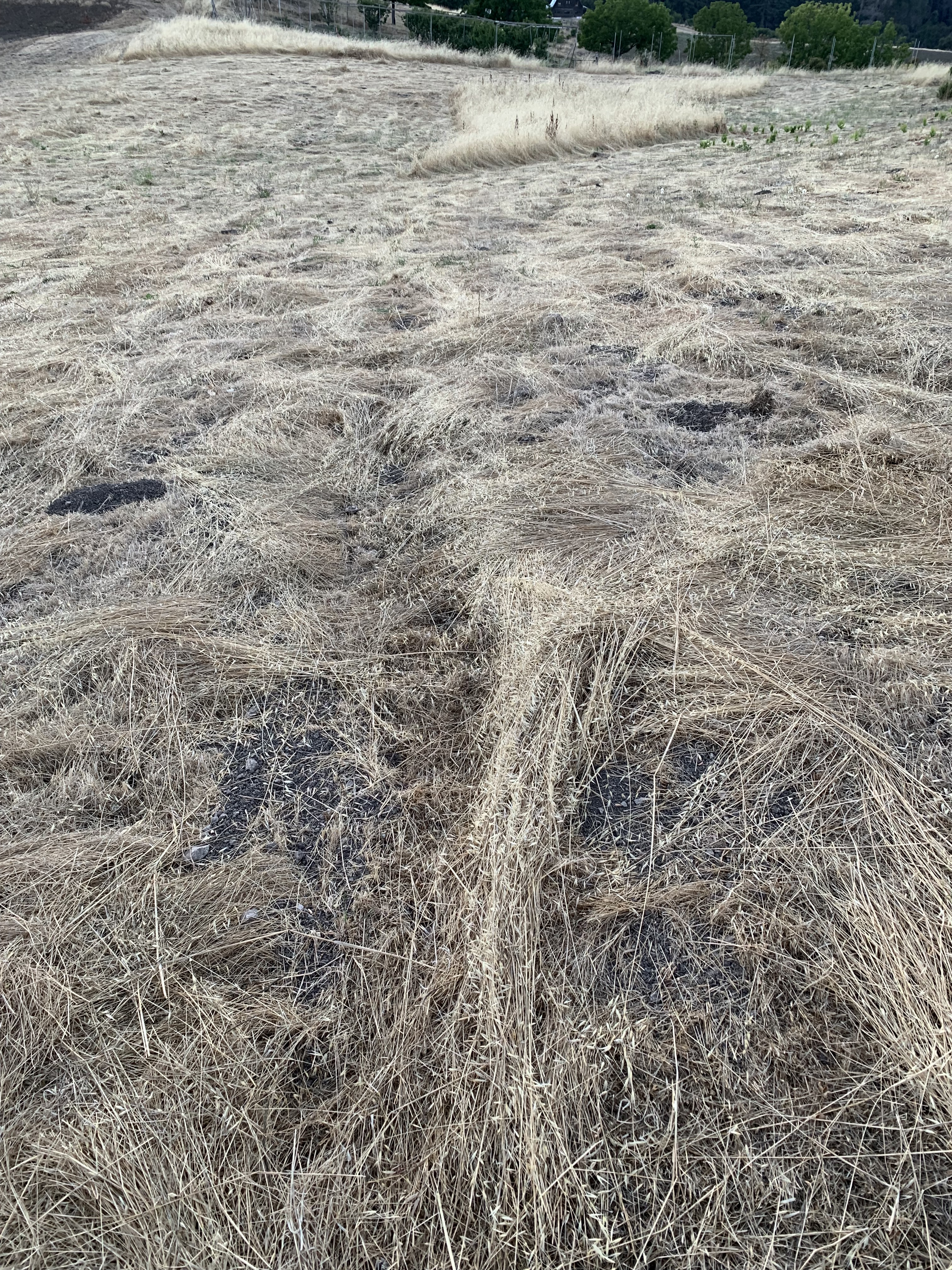
It is mowing and mulching time. The lads are swinging weed eaters a’buzzing. They protect the roadsides, the wells and generator houses. The sickle bar is on the bigger BCS walk-behind tractor, the hay is falling and curing, the mulch cart is rolling, and deep dish ’apple fritters’ of mulch a’forming under the orchard trees.

Patterns of cut hay and uncut hay (where the wasp nests are). Mulch 2 B

Drips

It rained this morning. A light sprinkle, very off-season, enough to calm the dust for a moment. A pitter patter falling from the rooflines. Birds sipped droplets from sparkling leaves as the sun broke through the clouds late morning. Beautiful.

Martins

A flock of nesting purple martins wheel and chirp high in the sky above the highest point of the farm. The fierce males’ battle cries ring out against the prowling hawks. These are rare birds around here- glad to host them in cavities in burned trees from the 2009 fire. The snags from the more recent fire will support nesting generations to come.

Wildflowers of Summer

Little white puffs emerge from drying grass, among the post-fire thistles and between resprouting coyote bush. The complexly sweet smell of the native perennial cudweeds drifts on the gentle breezes. The clusters of bright white flowers fade to straw white that feel papery when rubbed to check out their scent (recommended).

Cudweed!

We hope you are enjoying the entrance of summer with its warm spells, foggy beaches, and occasional whiffs of dry grass and resiny sagebrush.

-from my near weekly postings at Molino Creek Farm’s webpage.