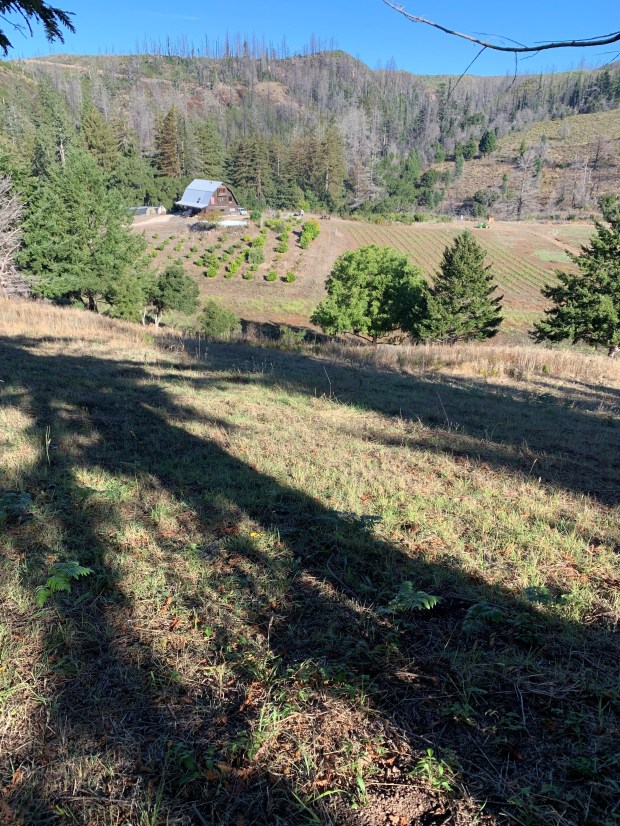
avocado

Happy Summer Solstice 2026!

Apples

It’s a common question: what do you do with all of the apples? We ask ourselves that, too. We’ve got this issue with oscillation: alternate bearing years having most recently been spurred by the Fire of 2020. Post fire 2021-few; 2022-lots; 2023- few; 2024 – lots; 2025 – few; and guess what…2026 looks like another ‘lots’ year.  Other things contribute to changing harvest numbers, such as burnt up trees, age of trees, pests, heat wave apple roasts, lack of chill hours, etc. Nevertheless, in this macro harvest year we will (probably!) have to ask and answer the Big Question again, and we already know the answer: more juice, and more hard cider!

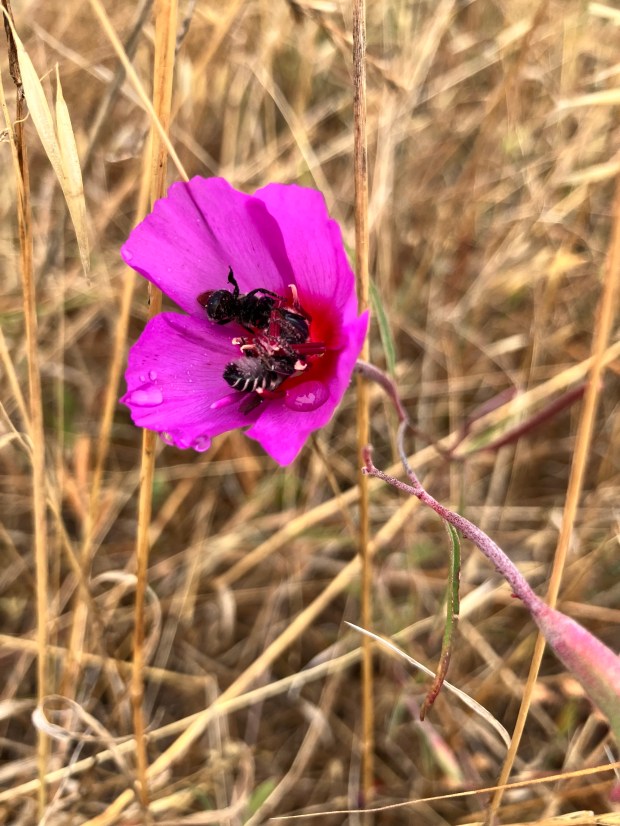
A farewell to spring flower in our grasslands replete with 2 native sleeping bees, droplets of drizzle.

My calculation for this year’s harvest is a record 11,000 pounds, nearly 6 tons. We’ll probably sell 2500 pounds to put up some capital for compost, irrigation supplies, and things we need to keep the orchard running. And, we’ll probably give 2500 pounds to the Pacific School and other charities. That leaves 6,000 pounds of ‘seconds’ apples going to either juice or into the deer-feeding (eg., pest destroying) compost piles. If we can manage the pressing power, that means we could make a record 250 gallons of hard cider! Last I checked, we have 5 cider makers in our midst and we’ll need everyone to pitch in, pick, haul, wash, sort, grind and press this year to make it work. Watch out for October! 

Avocados

The other fruit to celebrate is the oily green avocado. The repercussions of the fire also play out here, and this is the first year since 2020 that we have much to harvest. Our Community Orchard is bringing home the Bacon, with thin-skinned avocado fruit on the less oil content side of things but still delicious. About a third of our 100 trees are Bacon and only 4 of the oldest trees are bearing this year. The warm, dry March and a plethora of pollinators made a big crop that will be ready next year. Meanwhile, we watch and wait. The other types we expect larger crops from next year are Reed and Lamb Haas, but we also have a few Gwen, Pinkerton, and Carmen Haas sprinkled in the groves. Bacon avocadoes are the fastest- ‘only’ 16 months to ripen; others take almost 2 years. The ground squirrels and gray fox are already sharing the harvest. One day soon we’ll learn how to cook with the leaves and in a few years maybe we’ll figure out how to extract the oil.

Does it count that we add other plant diversity with this invasive poison hemlock?

Organic AND Regenerative

Another frequent question we are asked is ‘Are You Regenerative?’ That’s a loaded question because there’s not really any way of measuring or verifying such things…not like our organic certification with CCOF. Sure, you can fill out a self-assessment checklist, and proudly attest to your professed stellar farm care, but what thinking third party goes for such balderdash? Anyway, we resonate with some of the apparent principles of the regenerative agriculture movement such as building soil organic matter, creating conditions for increasing (especially native) plant diversity within the orchard understory, and integrating animals into the orchards. 

That latter one is a bit of a chuckler. ‘Chickens? Sheep?’ you might ask. Nay, much better: voles and turkeys, fox and squirrel, woodpecker and robin! Some may squint, “Are you serious?!” Yes- and we have evidence that anyone can see. Most recently, we’re seeing one large, fresh, glistening turkey turd every 5 square meters. We don’t need to care for those wild turkeys, they are self-sustaining! And, they are eating weed seeds, mopping up pests, cleaning up fallen fruit, and turning all of that biomass into fertilizer deposited right onto the fungal web that feeds the orchard trees. Plus, they are entertaining. And, if a coyote eats one of our understory flock, we don’t cry or call the wildlife department for a depredation permit nor do we raise apples to pay the bills for guardian dogs. If any of you readers know of any way we can help the turkeys feel more at home in our orchard, please let us know. And, if you are wondering about our other orchard understory animals…stay tuned for more fascinating Regenerative Agricultural Stories about integrating animals into cropping systems.

We’re good at raising lots of poison oak

Noise

What’s the noise around the farm? Vegetation control. Up above the farm, on San Vicente Redwoods land, the masticators are roaring and the saws are revving: they are doing more post fire forestry to make the redwood stands more resilient, to better protect Bonny Doon from the next inferno. On the Farm itself, the noise is mowers. Our discerning gaze turns to the color of grass: is it tawny, is it dead? There are complex calculations involving percent dead grass, relative humidity, nesting birds, proximity to infrastructure, and time left to mow before July 1 spurring us out the door, onto (or behind!) the tractors, and pointed in the right direction. Back and forth, strip by strip of cutting. 

More Wild Birds

The size of a couple of bird flocks deserve mention. The goldfinches! Will somebody teach me the difference between the species? Whatever type of goldfinches they are, there are commonly flocks of 30 noisily descending on patches of the non-native dandelion seed heads. Rough cats ear seeds are apparently scrumptious to these seedeaters. 

Equally noisy, equally numerous flocks of wrentits are visiting the oaks around the farm. The trees seem to squeak with a bit of an energetic russle then a confetti of tiny birds erupts, fluttering to the next oak. They sure seem to be having fun.

Farewell, Spring!

Here we are, on the advent of Summer and just at the right time this year we can say ‘farewell to spring’ with the namesake flower, which is in full glory right now in patches around our well stewarded grassland. Deep pink-red, large four-petaled flowers open with the sun and close with the night, creating safe sleeping spaces for the cutest of native bees, their pollinators. In other places, the summer bloom is on- tarplants with their resinous, odiferous leaves and yellow sunflowers brighten and scent the midday prairie. As we progress into summer, there will be more miraculous flowers dotting the landscape despite the lack of rain and the bone-dry soil. Week by week, the flowerscape changes. We hope for a mild summer without smoke or fire.

Happy Solstice!

This mother and fawn are almost tame

Misty Stillness

After work it is time to walk around the farm, legs swishing through soaking grass. Each one I touch lets loose a shower and, lightened, the stems straighten for a bit until more mist collects. Where I walk today and where I walked yesterday will remain evident for weeks: tall, lax vegetation flattened and so fat with moisture as to be unable to get back upright. Above the tall boots my pants still get wet; the grass is 3’ high. The mist muffles sound like snow, and it is very still. The moist chill has hushed the birds, the only sounds my feet and the dripping of a million drops.

Native brome grass and poppy, laden with moisture

Composting Fields

The brief drying and warmth allowed everyone a chance to mow and till, but there was still not enough time. Some fields got more thoroughly tilled than others. A sweetish funk of rotting cover crop hangs in the air near turned up earth. Topsy turvy pieces of cover crop stick out of the mud, the finer leaves and stems melting into mush. The tiny pieces of ground up punk will enrich the soil, hold moisture, feed microorganisms, and nutrify plants. “Green manure.”

Freshly tilled, ‘Pepper Field’

Standing Crop

In the orchards, the cover crop gets cut but we don’t till. This year, in the poorer soiled areas between trees, I ran the flail or mulching mower, grinding up the cover crop to feed the soil right where it grew. Where the fava beans are towering taller, it’s the dance with the sickle bar mower, cutting the tall plants, which fall in rows to dry and then get raked as mulch under the trees.

I keep the orchard mower regularly running not just for exercise but to ‘keep up’ with re-growth. It is nice to get March rains after the cover crop is cut. The ongoing moisture allows the soil to digest the shed off nitrogen rich cover crop roots and make that food available to wakening trees. It is becoming critical to mow the last of the fava beans, but there is never enough time. The Avocado Bowl and Cherry Hill cover crops are going to be 4’ tall soon, thousands of flowers feeding hummingbirds and bumblebees. I hate to deprive those friends of their nectar.

A sea of fava beans (and vetch!) surrounding the Avocado Bowl

Cherry Buds Swelling

The cherry trees are about to flower. Buds are showing color and the sleek red bark is taught from running sap. It is the last moment to observe the bare tree architecture and envision summer pruning. The old, fire-damaged trees are hanging in and the ones that died, root sprouts grafted, hold lots of promise to become more tree-like this year. The piles of grass mulch the Orchardistas hauled and stacked last June have almost entirely melted away but not too soon: there are few weeds where those mulch piles sat at the beginning of winter.

Lapins cherry buds nearly bursting
Old, fire damaged cherry trees (left) and the sprouted Colt rootstock grafted (right)

Native Wildflower Spring

The Community Orchardists not only steward trees but also the mulch fields, some of which are becoming amazing and beautiful native grasslands. Molino Creek Farm was a hay farm in the early 1900’s. It still makes fine hay and those hayfields are alive with many flowers and lots of wildlife action.

Our farm has a curious pattern of shallow-soiled knolls surrounded by pockets of deep soil. The rolling landscape provides for diversity in crops and native habitats. It seems that cutting hay (at the ‘right’ time) and hauling it to the trees as mulch has helped wildflowers proliferate. We are at the onset of poppy spring and two types of lupines are soon to glow. After that, rafts of tiny tarplants will flash yellow each morning. The brome grass has already started and will keep producing seeds at the end of waving graceful arched stems, towering over the wildflowers. Blackbirds march noisily across these fields in lines, scaring up the bugs that find feast in grassland diversity. A giant mound indicates gopher action, a few seedling poppies germinating on the fresh, moist soil. Networks of pathways and open burrow entrances means voles are active. Deeper, bigger holes with fresh claw marks – coyotes at work digging up furry late-night dinners in the hay fields. Where we don’t collect and manage for hay, those fallow fields are humpy with thatch and scattered with shrubs and poison hemlock: a different type of habitat…one which we hope we can muster new energy to manage. More orchards- and more need for mulch…the fate lies with the capacity of Community Orchardists.

Poppy, brome, bicolor lupine and madia- cutting hay creates knoll diversity!

Falling leaves and moist winter chill

Fallen leaves blown across the forest path, under foot while walking, go “swoosh, swoosh, swoosh.” The sound of moist leaves (not crisply crunchy), an early rain and cool nights softened the landscape, removed the dust, made things gentle again. We are relaxing, slowly shedding the stress of the Fall’s potential for wildfire made more real these past many weeks by wind-carried smoke from prescribed fires across the entire state, even nearby at Wilder Ranch.  

Breezes carry in the clouds and then clear the clouds, waves after waves of clouds and then sun alternate as the dry summer plays with the wet winter, back and forth. This week, winter won with a bit of rain, shy of an inch and not yet wetting the soil more than superficially. After the rain, some sunny warmth and then the wind, fog, and another front , and it got chilly. Tuesday evening fog piled up on the other side of the prominent ridge across Molino Creek and poured over it, falling like a ghostly waterfall backlit by the evening sun. Beautiful!

Neither the rain nor the subsequent drippy fog has been enough to release the cedar-scented petrichor, much anticipated.

we do grow olives…for locals only olive oil!

Big swell, seasonal scents

Last night’s goose bump chill sent us to close the windows, put on sweaters, and some even built their first wood stove fires. And today’s cool air reminded me of how I’ve been taking the sun’s warmth for granted and how I’ll miss that deeply warm sense for a long time soon. The cool air, moisture, and gusty breezes accentuate the piney, resinous smells of redwood, Douglas fir, and coyote brush. Winds across the ocean pushed up an epic swell recently. Roaring and thumping waves reverberated across the landscape, but now there’s just a low more consistent hum. The patterns of breezes with long lulls awaken the senses, especially when it is peaceful on the farm but the trees on the ridge start talking, telling us a big gust is coming.

Feathered visitors

Geese, Canada and white fronted, are honking their melodies overhead near sundown. They are making their way to their winter grounds.

The newest birds are blackbirds, strutting around the fields in flocks, their heads moving curiously straight back and then straight forward with every stride. This evening, the light was catching the glean off the backs of a flock of Brewer’s blackbirds, reflecting the iridescent deep purple-blue of their gorgeous plumage. They let me get close but eventually alighted to show me the bicolor blackbirds in their midst. There are around 50 of this mixed flock and more may still arrive. They love to eat the grass seeds in the cover crop. They might even be anticipating it.

Other wildlife

Otherwise, the wildlife report is all about the Very Big Buck, coyotes, and chirping bright blue bluebirds. Perhaps there’s more than one Very Big Buck, but people are talking about an extraordinarily large, very impressive male deer from here to Davenport and north to Swanton. This creature stands very smart and tall with a giant set of antlers nearly 3’ across. He stood in the roadway looking intently north where he couldn’t traverse without going around the deer fence. He hesitated, looked north again, and then sauntered uphill following the fence line, somehow seemingly begrudgingly.

Nearly nightly, the coyotes sing. They aren’t doing the long musical numbers with multiple animals yipping and howling, but rather it’s a series of solos of the one coyote couple. One evening, they were calling from way up the Molino Creek canyon. Another evening, they sang right outside the window. Each night they try making some song from a different place, perhaps checking out the acoustics: the echoes are always fun.

The throaty, watery chirps of western bluebirds grace our midst. The brilliant blue flashes from the males’ zig-zaggy flights are breathtaking. There were seven birds, up a couple from last count. With that plumage, one wonders if they are considering breeding early…

The fading row crops will soon be tilled in and cover crop will grow, instead

Fall farming

We’re not quite ready to cover crop. There are still 10 days of tomatoes to harvest and the apple harvest is in full swing. The floral crisp sweet Gala apples are almost all gone; we will pick no more for market. Last weekend, we picked all the remaining Mutsu apples which had been devastated by the apple scab disease that enjoyed our late wet warm spring. Next up are the Fuji apples, and there are plenty of those! Plus, there are Golden Delicious, an underappreciated long storing apple of extraordinary flavor. In the Barn there are hundreds of pounds of culled apples that we’ll soon be juicing for cider. And so, we pick, pick, pick…sending on the perfect apples to market. Between picking spells, we spread compost and mow to prepare for harrowing in the bell bean seeds.

those rusty brown tentacles….avocado roots poking up into the loose, month-old compost!

Tentacles in the compost

The Community Orchardists have been spending the last many weeks spreading compost under many trees. Around a month ago, we spread compost under the avocados on Citrus Hill. After that little bit of rain, I noticed those avocadoes looked particularly perky and vibrantly green. So, today I pushed around the compost to see if the avocado roots had invaded it: they had! It is so curious to me that avocado trees push pointy tenacles of roots straight up, out of the soil into mulch. How do those thick pokey roots feed off the mulch? Such a mystery.

young avocado trees are growing fast!