Apples
It’s a common question: what do you do with all of the apples? We ask ourselves that, too. We’ve got this issue with oscillation: alternate bearing years having most recently been spurred by the Fire of 2020. Post fire 2021-few; 2022-lots; 2023- few; 2024 – lots; 2025 – few; and guess what…2026 looks like another ‘lots’ year. Other things contribute to changing harvest numbers, such as burnt up trees, age of trees, pests, heat wave apple roasts, lack of chill hours, etc. Nevertheless, in this macro harvest year we will (probably!) have to ask and answer the Big Question again, and we already know the answer: more juice, and more hard cider!

My calculation for this year’s harvest is a record 11,000 pounds, nearly 6 tons. We’ll probably sell 2500 pounds to put up some capital for compost, irrigation supplies, and things we need to keep the orchard running. And, we’ll probably give 2500 pounds to the Pacific School and other charities. That leaves 6,000 pounds of ‘seconds’ apples going to either juice or into the deer-feeding (eg., pest destroying) compost piles. If we can manage the pressing power, that means we could make a record 250 gallons of hard cider! Last I checked, we have 5 cider makers in our midst and we’ll need everyone to pitch in, pick, haul, wash, sort, grind and press this year to make it work. Watch out for October!
Avocados
The other fruit to celebrate is the oily green avocado. The repercussions of the fire also play out here, and this is the first year since 2020 that we have much to harvest. Our Community Orchard is bringing home the Bacon, with thin-skinned avocado fruit on the less oil content side of things but still delicious. About a third of our 100 trees are Bacon and only 4 of the oldest trees are bearing this year. The warm, dry March and a plethora of pollinators made a big crop that will be ready next year. Meanwhile, we watch and wait. The other types we expect larger crops from next year are Reed and Lamb Haas, but we also have a few Gwen, Pinkerton, and Carmen Haas sprinkled in the groves. Bacon avocadoes are the fastest- ‘only’ 16 months to ripen; others take almost 2 years. The ground squirrels and gray fox are already sharing the harvest. One day soon we’ll learn how to cook with the leaves and in a few years maybe we’ll figure out how to extract the oil.

Organic AND Regenerative
Another frequent question we are asked is ‘Are You Regenerative?’ That’s a loaded question because there’s not really any way of measuring or verifying such things…not like our organic certification with CCOF. Sure, you can fill out a self-assessment checklist, and proudly attest to your professed stellar farm care, but what thinking third party goes for such balderdash? Anyway, we resonate with some of the apparent principles of the regenerative agriculture movement such as building soil organic matter, creating conditions for increasing (especially native) plant diversity within the orchard understory, and integrating animals into the orchards.
That latter one is a bit of a chuckler. ‘Chickens? Sheep?’ you might ask. Nay, much better: voles and turkeys, fox and squirrel, woodpecker and robin! Some may squint, “Are you serious?!” Yes- and we have evidence that anyone can see. Most recently, we’re seeing one large, fresh, glistening turkey turd every 5 square meters. We don’t need to care for those wild turkeys, they are self-sustaining! And, they are eating weed seeds, mopping up pests, cleaning up fallen fruit, and turning all of that biomass into fertilizer deposited right onto the fungal web that feeds the orchard trees. Plus, they are entertaining. And, if a coyote eats one of our understory flock, we don’t cry or call the wildlife department for a depredation permit nor do we raise apples to pay the bills for guardian dogs. If any of you readers know of any way we can help the turkeys feel more at home in our orchard, please let us know. And, if you are wondering about our other orchard understory animals…stay tuned for more fascinating Regenerative Agricultural Stories about integrating animals into cropping systems.

Noise
What’s the noise around the farm? Vegetation control. Up above the farm, on San Vicente Redwoods land, the masticators are roaring and the saws are revving: they are doing more post fire forestry to make the redwood stands more resilient, to better protect Bonny Doon from the next inferno. On the Farm itself, the noise is mowers. Our discerning gaze turns to the color of grass: is it tawny, is it dead? There are complex calculations involving percent dead grass, relative humidity, nesting birds, proximity to infrastructure, and time left to mow before July 1 spurring us out the door, onto (or behind!) the tractors, and pointed in the right direction. Back and forth, strip by strip of cutting.
More Wild Birds
The size of a couple of bird flocks deserve mention. The goldfinches! Will somebody teach me the difference between the species? Whatever type of goldfinches they are, there are commonly flocks of 30 noisily descending on patches of the non-native dandelion seed heads. Rough cats ear seeds are apparently scrumptious to these seedeaters.
Equally noisy, equally numerous flocks of wrentits are visiting the oaks around the farm. The trees seem to squeak with a bit of an energetic russle then a confetti of tiny birds erupts, fluttering to the next oak. They sure seem to be having fun.
Farewell, Spring!
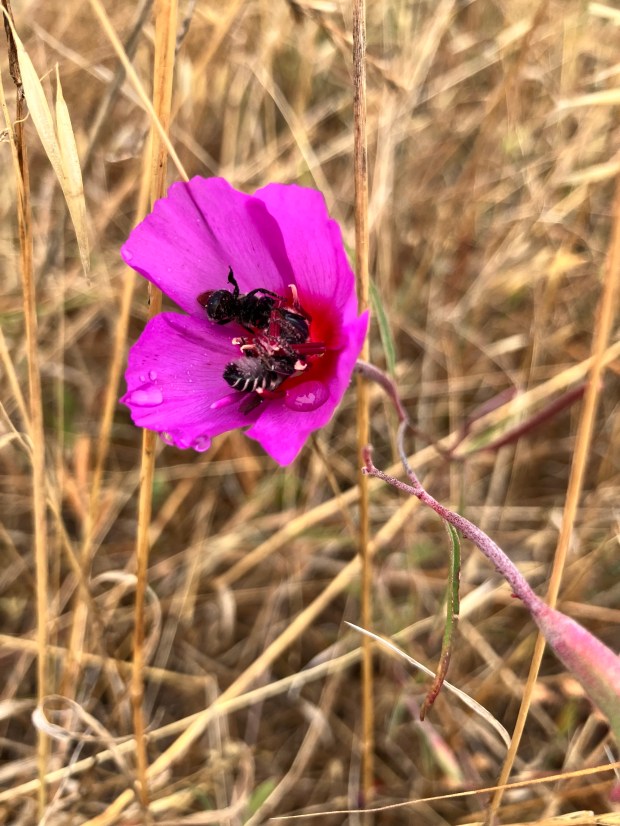
Here we are, on the advent of Summer and just at the right time this year we can say ‘farewell to spring’ with the namesake flower, which is in full glory right now in patches around our well stewarded grassland. Deep pink-red, large four-petaled flowers open with the sun and close with the night, creating safe sleeping spaces for the cutest of native bees, their pollinators. In other places, the summer bloom is on- tarplants with their resinous, odiferous leaves and yellow sunflowers brighten and scent the midday prairie. As we progress into summer, there will be more miraculous flowers dotting the landscape despite the lack of rain and the bone-dry soil. Week by week, the flowerscape changes. We hope for a mild summer without smoke or fire.
Happy Solstice!


