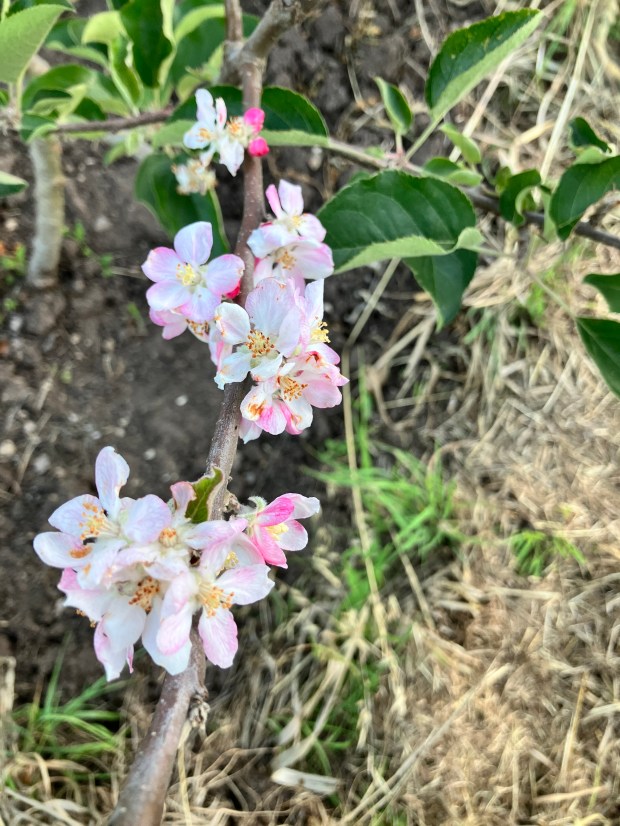
apple blossom

Chill, Long Days

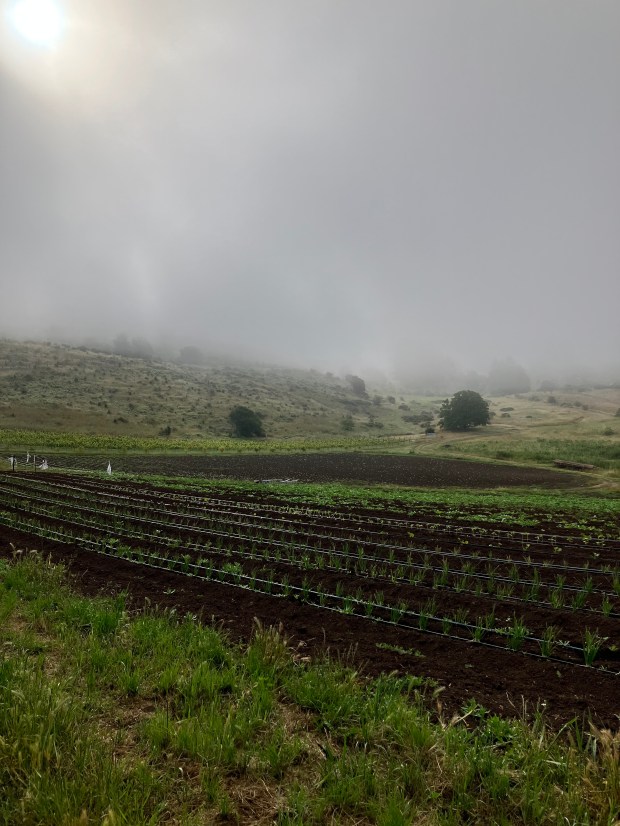
The days slowly emerge from fog. Many mornings we wake to misty fog close at hand. The silvery blue fog is backlit by the rising sun. It ever so slowly melts away, downhill, into Molino Creek canyon or towards the ocean as patches of pale blue sky emerge…around 10 or 11 in the morning. Grass is wet to shoe-soaking into the early afternoon. The days have never really warmed that much:  it was 46F one recent morning at dawn.

The days get light early (5 a.m.) and stay light late (8:45 pm). Solstice is close. One is easily tempted to stay outside too late doing chores, then dinner is late and it is hard to get a full night’s sleep.

Molino Creek Farm – really, truly dry farmed!

Adolescent Plants

Two Dog Farm winter squash plants haven’t started sprawling, but they are starting to cover the ground. Molino Creek Farm’s tomatoes are getting weeded, but will we keep up with the weeds? Parts of the tomato field are covered with huge rosettes of lush daikon radish, the cover crop that went to seed early this year. Those hunker roots will be difficult to arrest from the soil and meanwhile they drink up the soil moisture which had been destined for tomatoes. In other areas, rows of tiny onion and pepper plants decorate the still evident and rich soil.

The Two Dog Farm crew was assiduously weeding their “Roadside” field this past week. So much work is made more inevitable by the recent weed-germinating rain. Mark Bartle weeded large areas with the tractor, leaving only close to the plants to finesse weed-free.

Two Dog Farm’s beautiful dry farmed winter squash

Tweetings

The remarkable thing about this past week has been The Birds. Three days running, Saturday – Monday, the entire region’s bird songs erupted in glory. Bonny Dooners reported it and it was obvious at Molino Creek Farm. The birds were singing like it was dawn all day long. Was it the amazing temperature, the moon cycle, or Spring: who knows? Here’s a list of the birds we can see every day, easily, around the farm: 2 ravens, 1 kestrel, 1 red tailed, 8 bluebirds, ash throated flycatcher, olive sided flycatcher, robin, dark eyed junco, goldfinch, pine siskin, purple martin, violet green, barn, & tree swallows, great horned owl, scrub and stellar jay, band tailed pigeon, lazuli bunting, song sparrow, black headed grosbeak, pileated woodpecker, turkey, California quail, spotted towhee, California towhee, Bewick’s wren and finches….probably more! And, they are all singing, all day long for unknown reasons. Pure joy?

Along the Boundaries

In 2010, Molino Creek Farm established a 1600-foot hedgerow along our main road’s northern fenceline. The NRCS funded the project, enabling us to put in a water line and to purchase plants and root cages. All of the plants burned to the ground in 2020 but are standing tall once again this year. Valley oaks from Felton acorns, Oregon oak from Annadel State Park acorns, hazelnut bushes & flowering currant from nearby stock, and many elderberries from the Work Ranch in southern Monterey County…and many more species are growing (soon to be intertwined?) in the long, linear row. Birds love it.

We have also been planting even more floriferous bushes along the orchard fenceline, and that fence needs more flowering shrubs. Anyone want to donate some beauties to fill that out? There is another 100 feet to plant along that area. We love the 4 types of rose bushes there, each with its own unique color, scent, and seasonality of bloom. There’s also a patch of spreading, rhizomatous ‘swamp sage’ with beguiling sky-blue flowers – we may uproot some and spread it around. Add in a mallow, buttonbush, and butterfly bush and you have most of it.

Several floriferous species at the ochard hedgerow

In The Orchard

The Community Orchard is making fruit! This will be the first harvest of avocados since 2020 and the Big Fire. It looks like we have 100+ pounds of bacon avocado fruit rapidly getting ripe right now. We are also hauling in bags of Valencia oranges for juice. The Satsuma mandarin branches have collapsed with the weight of ripe fruit. Meyer lemons are keeping a pace with the harvest. A few limes linger, and the Eureka and Lisbon lemons are just starting to ripen. This will be the first in many years with no prunes, missing due to unknown reasons. Apple trees have enlarging fruit at the same time they are still flowering: odd!

The Work

I already mentioned the weeding, but there is also the mowing. Alas, 2 of the 3 active mowers are down right now. The DR done drowned, having been left out in the freak rain storm and now probably flooded with water in places water should not be: it won’t keep running. The Kubota mysteriously developed a cripplingly bent steering rod. Sometimes, it seems like we need a full-time mechanic! And still… the BCS keeps running, and much more mowing is needed. Now to find the time to walk behind that machine, wrangling it around corners and on steep hillsides.

We are in the midst of fruit thinning for the apples, thousands of tiny fruit littering the ground and thousands more needing plucking. Some fruit rolls off with a twist, but the Fuji and some others are more stubborn, requiring clippers. 

Wild LifeSlinking away from the house…a gray fox. Fox poop is everywhere, thank goodness. Coyote scat is also evident but they stopped singing a while back. Deer antlers are getting longer but still thick and velvety. No sign of mountain lion. Bobcat tracks are around but not that common. No skunks. No raccoons. No recent weasel sightings. There are (a few) bats

A typical foggy morning, recently

A Babyness of Plants

The highlight of the week has been PLANTING. Two Dog Farm has a huge patch of peppers taking root in beautifully prepared beds with drip tape efficiently irrigating the tiny baby seedlings into their new life in the real world: what promise! Molino Creek Farm has a patch of newly planted really, truly dry farmed tomatoes thanks to a close collaboration with the Two Dog Farm’s generous Bartle couple. Judy also had some help planting row upon row of onions this past week. And, those Bartles planted their winter squash seeds, the beginning of the annual unfolding of the Miracle where something appears (prolifically!) where nothing was, without any added water. There’s also Sylvie’s endeavors in some beautiful big patches…dry farmed beans, anyone? What experiments will this expert plant person reveal to us this year? 

Hundreds and hundreds of new plants are gracing the fields of our most magnificent farm. Tiny green dots in a sea of freshly tilled rich brown soil. What a sight!

Each of these flowers will probably make a fruit!

Anti-Apple-Babies

On the other hand, there is the great procession against too many apples. So nice to have many hands’ help snipping or twisting off the too, too many baby apples. We are thinning the fruit. This year, it is time to hone our thinning skill, keeping more fruit on the apple varieties that would otherwise make “Whole Meal Apples” – as with Mutsu or Braeburn. With some apple types, you’d need a cart to carry a fruit to lunch if they were ‘properly thinned,’ and no one would enjoy a ‘lunchbox apple’ without leaving more apples per stem. The ground is getting littered by hundreds of marble-sized apple kids. Up on the stems: one apple per cluster where there used to be 5+. Long each bough: one apple every 4 – 6 inches! Those are our goals: high hopes!

And….here’s what a cluster of flowers turns into- a mess of fruit!
Thinned apples look like this- nicely spaced, and not squinched into a clusters

More Cool Weather

This past week has been another ‘the sun sure feels nice’ kind of weather. It has been creeping up to maybe a low 70F hour or two with nights in the low 50s. Foggy mornings, mostly. When the fog clears, the air feels a bit oddly dry. Perhaps the cold soil condenses out what moisture was in the air. “They” say it might get warm this coming weekend.

Baby Trees

Believe it or not, we are still rejuvenating our orchard…through grafting! The 2020 Fire still is echoing- the trees that inferno fried still have promise. Sylvie has taken to grafting desireables onto the few remaining post-fire rootsuckers. Here and there you encounter her artistry- grafting tape at the base of a rapidly sprouting scion. One graft from last year, a persimmon right inside the main gate to the apple orchard, is especially luscious with its bright green, glossy, big leaves. The many, many cherry trees Drake grafted onto rootsprouts from fire kill, in 2021, right after the fire, are getting to look more like adult trees than babies.

In 2025, Sylvie Childress grafted this beautiful persimmon onto some rootstock that had turned into a tree post 2020 Fire

Native Grass Seed

Judy, Sylvie, and I harvested a few pounds of native grass seeds recently. Hanks of seed slowly cure and dry in paper grocery bags warmed by midday sun. We have tens of thousands of California bromegrass seeds, the dominant grass on the Farm which has been getting ripe lately. This is restoration material. The farm has already been transformed in many places from thistles and other weeds to native grass swards. We’ll do more of that as we turn brush fields into prairie just by tossing seeds from one place to the next. If there is a prescribed fire this year, this pile o’ seeds will do just fine.

Spring Heat then Rain Returning

The warm spring sun began feeling prickly to my skin, and so it was sunscreen and sunhats to go outside. It had been a long time: a long cold, rainy winter. Suddenly, spring pollen dusted everything, everyone sneezing across the farm and into town, sneezes in parking lots, bike paths and in lines at the store. ACHOO!

Spring warmth triggered grass to bolting, really toweringly bolting grass flower heads arching and poking up high, waving pollen from dancing wands ladening the ever present breeze.

A Sudden Dryness

It seemed like the rain was over, as it normally would have been, but we were in for a surprise. Us orchardists hustled to get the irrigation set up, discovering mouse-chew leaks to repair, stuck valves, broken sprinklers – the perennial time-consuming setup always seems to come too late. The ground was DRY…very dry! Cover crop was wilting, bent over in the springtime heat. Digging weeds out from under orchard trees became a hassle, shovels and hoes striking hard ground, ringing metal sounds. It was dry not only on the surface but a foot down into the soil. Last Saturday, I asked my fellow weeder, “anyone discovering any soil moisture?” The answer was a disbelieving ‘No!’ Someone said, ‘It calls for rain.’ Yeah, right. It seemed somehow impossible.

Wind to Rain

The wind picked up strongly that evening and the next day it was blowing trees and branches down, hard gusts joining a steady stiff wind from the northwest. A little drizzle followed. Then there was a shower with quite big drops. A few hours later, another shower, that one longer, also with big raindrops. And then it poured on and off for many hours late through the night. Afterwards, still the soil is only wet about six inches down, but its moist down a foot. That much water will get used up in a few days when the sun shines again. And, it is enough to spur the grass growth (and pollen). What a surprise! At least it will be easier to weed for a few days.

A May Storm at Molino Creek Farm

The Resulting Flowers

The flowers are out. Poppies and lupines in peak flower. Cassandra reports binocular-spying a strikingly bright patch of solid lush orange California poppies high on the steep slope across Molino Creek canyon. The coast live oaks, tassels fading, are dense with shiny new leaves, a rich array of greens, each tree its own unique shade. On oak twigs, the tiniest of acorn babies have been born. Forest edge madrone trees display giant pom-poms of white flowers, a celebration of the moist winter. Big yellow blankets of post-fire germinated French broom sweeten the breeze but make my muscles tense with the stress of the seemingly hopeless weed invasion on our farm’s otherwise beautifully diverse hillsides. Redwood sorrel carpets the forest understory with strikingly pink blossoms. The wild iris has begun its colorful parade, trailside through the woodlands.

Two Lupines: Lupinus nanus (sky lupine) and Lupinus bicolor (miniature lupine) side by side

And Bryophytes

The return of rain also reawakens mosses and lichens. The black walnuts and oaks host a wealth of moss, growing thicker on the older branches and on the shady side of trunks. Summer comes and their thick green piles shrink and fade. Just as quickly, with dense fog (or this rain), they brighten and grow plush once again.

A Diversity of Ephiphyes…Rain Soaked and Glorious. On one of the Farm’s black walnut trees

A Deer

An adolescent buck with the faintest of felty nubbins jutting from its forehead warily considered me during a recent walk. At first, its giant pointy ears tilted towards me like satellite dishes honing in on my approach. Each time I get close to deer, I talk to them, gently letting them know that I am no threat. Generally, this slows their retreat, but this one was suspicious. It took off, energetically bounding with all four feet high in the air between pounces. Reaching a good distance, its ears were once again on alert, pointed at me as I tried urge it, ‘don’t worry.’ I looked down and up again. He was gone. Why so concerned, deer? This one was new to the neighborhood, maybe just passing through. People still hunt deer in these hills, so wariness is warrented.

Lapins Cherry Fruit – seems to be setting thickly, but we have to wait to see..they often drop off later

Fruit Forming

Bright white citrus blossoms unfold sweetly while cherry petals drop to reveal shiny fruit. The apple orchard has entered peak bloom. The freshly clipped understory, not long ago was ugly stubble, but now it’s turning green, resprouting through the mown mess. The faint rose smell of apple blossoms is temporarily overpowered by a rain-fetched dank compost smell, hints of the bitterness of rotting chopped up weedy mustards and radishes. At the base of the apple flowers, furry hints of apples to be. Down the hill from the apples, fruit grows fast in our stonefruit grove- mostly various apriums and pluots, a hybrid swarm that also includes the parents, plums and apricots. Those fruits are mostly silver dollar sized, hard as rocks and green. The wild hazelnuts of our hedgerow have set fruit, bracts swelling. Elderberry flower clusters are a curious near-black, their buds forming.

Birds

Barn swallows have formed pairs, their mates arrived sometime in the last couple of weeks. They dive and swoop right past my face, closer than ever, as I mow the orchard. Maybe these are my porch swallows, and they are comfortable with me, and so the proximity. It seems I can feel their wingbeat wind on my cheeks they swoop so close.

The band tailed pigeon flock is back to its more normal farm size: 18 (ish). There were many more last week, but some moved on. As always, they scare easily from the walnut trees where they feast on catkins. Their clapping wings send them quickly skyward where they wheel about in a flock that eventually alights in a tall tree awaiting a safer moment to glide back down to their feast. How many times a day do they make this circuit? Sometimes, we hear them cooing deeply, at times answered by the higher, more sad sounding mourning doves that strut on the ground in pairs across the moist freshly tilled farm soil.

In the understory of the orchards, there are bunches of sharp-billed robins.

Somewhere nearby, there is the call and response sing-song of grosbeaks. In the woods, a flycatcher serenade joins the flute-like Swainson’s thrush song.

There are many other birds making lots of noise. Such is spring on our beautiful, diverse, wildlife friendly organic farm. We are so thankful.

-my weekly blog for Molino Creek Farm simultaneously published here.