Regenerative agriculture

Summer at Molino Creek Farm

Only a bit on recent Farm highlights and then off on a tangent about production….

Fall color on one of the Community Orchard’s apricot trees

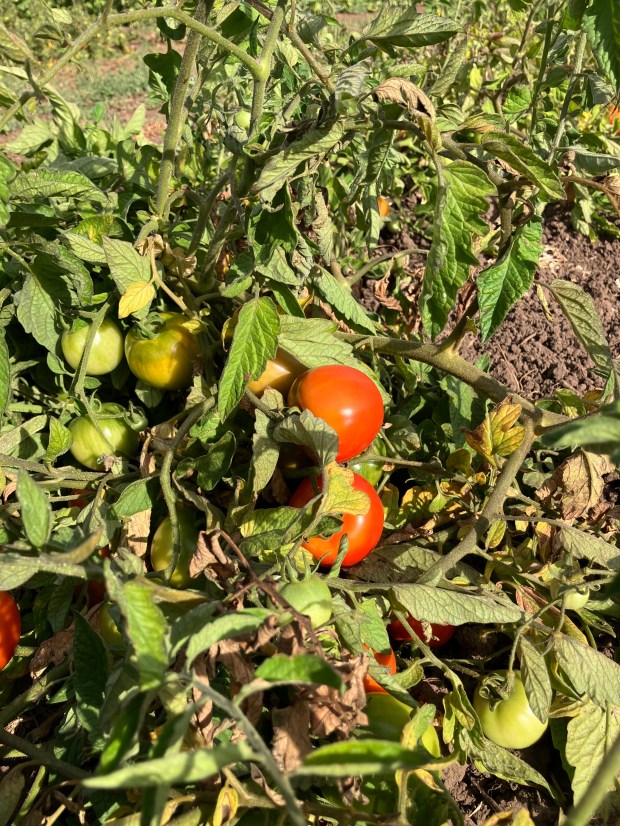
Fall is appearing across the farm- the wannuts and apricots are changing color! Tomatoes are also changing color- but for the ripening….lots and lots suddenly coming on. 

Bodhi reports regular Great Horned Owl activity and another owl, with a screechy-noise…that is a whiny underaged great horned owl making its terrible youngster noise.  He also reports the oddity of Bonny Doon skunks and opossums in the middle of the road on the night after full moon- whatsup with that?

Sylvie spotted an amazing coast garter snake wandering the grounds as well as a huge praying mantis in her beans.

A Praying Mantis in Sylvie’s Beans – Photo courtesy of S. Childress

Folks are taking home giant, 1 pound lemons as well as the last of the Persian limes and oranges….testing the first of the lamb haas avocados (are they ripe, yet?).

The hot weather broke and then we got cool weather, even drizzle. The apples are growing big- two more weeks before the harvest begins!

 – The Aforementioned Tangent – 

Recently, I’ve been wondering how to quantify the sum total of what is produced and processed on these Molino Creek Farm acres in terms of food, poo, and biomass. Here’s a summary.

Coyote Poo? Full of Chardonnay grapes…etc

Poo

One hundred thirty seven acres of land rich with wildlife makes a lot of poo, every year. The assimilative capacity of the land for animal excrement is astounding – otherwise, we’d be up to our neck in it! A pigeon makes 25 pounds of excrement a year, and I assume smaller birds some fraction thereof. Our farm has around 30 wild, naturally occurring pigeon-sized birds (band tailed pigeons and mourning doves) throughout the year. We have 140 California quail, say half pigeon sized. And, there are easily 80 goldfinches and 400 other small birds, mostly juncos, sparrows, towhees, etc…say one quarter pigeon sized. Bird feces on our land per year: around 6,000 pounds- 3 tons! 

Furry animals vary on poo production. We have 10 deer year-round; a deer makes 1200 pounds of poo a year. A mouse makes 20 pounds of poo per year and a low estimate for our part of California is 10 mice per acre: 28,000 pounds of poo! (The whole wild world of the North Coast of Santa Cruz County smells like rotting mouse poo after the first rains.). Add in 50 squirrels (40#/year) and a low ball 200 gophers (30#/year) on our farm, and you get 8,000 more pounds of animal poo. So, our 137 acres of critters makes around 54,000 pounds (27 tons) of animal poo per year. That’s 4 dump truck loads! All of this poo gets assimilated into the land and helps to grow what we see around us.

Black Beans? Nay! Deer Poo – oh, so fresh…
Turkey Poll – is everywhere!

Non-Animal Production

 Our farm is a mixture of natural areas and cropland – each has its own story to tell in terms of production.

In terms of produce, within the 6-8 row crop acres and the 3 acres of orchards, we can make 12,000 pounds a year of a combination of apples, citrus, and avocados, 6,000 pounds of dry farmed tomatoes and 10,000 pounds of dry farmed squash…along with a few irrigated crops like peppers and onions. In the winter, the 25 acres of crop lands make another average 4,000 pounds/acre of biomass in cover crops: 100,000 pounds of biomass that gets tilled into the ground for extra fertility and soil building.

In the wildlands, there is still more production going on. Our 20 acres of redwood forest puts on around 1800 pounds of dry mass per year per acre, so 36,000 pounds. An additional 60 acres of shrubland and grassland makes another 330,000 pounds of biomass per year. So, wildlands are growing 366,000 pounds of dry biomass annually. Not all of that biomass represents sequestered greenhouse gases, but certainly some of it is. As our redwood trees get bigger, and as we help to protect them from catastrophic tree-killing wildfire, they will sequester more and more carbon.

Imported Additions

Farms often import soil amendments, and Molino Creek Farm is no exception. Some years, we bring in a couple of dump trucks of compost. Many years, we are adding feather meal or some other form of organic fertilizer to help grow food. Recently, we imported what looks like charcoal – ‘biochar’ – from the disposal of dead trees from the surrounding conservation land’s efforts to reduce future wildfire impacts. These inputs are not cheap and it takes time/effort to spread them where they need to go. And so, we like to rely more on cover crops than imported additions, but still our soil tests tell us we need to add some more nitrogen. Total pounds of inputs on average – around 35,000 pounds.

I would be remiss if I didn’t add that we do also import diesel fuel to run tractors, around 200 gallons per year. Our well water for irrigation is pumped via solar power to tanks and then gravity fed through water wise drip systems. The groundwater has to be seen as another ‘imported addition.’

Teeming with Life

The bounty of living things, the manure it creates, the human-captured or wild productivity, and the minimal imported farm additives is fascinating on this small farm. Another small farm has been popularly featured in the film “The Biggest Little Farm.” The film helps people understand what is possible with careful farm management working with wild creatures, growing organically. What do we compare these small farms with? City land? Conventional, large scale agriculture? Wild lands in parks?

I visit all of those other land use types and rarely do I see the kind of bounty that I’ve experienced on small farms that allow nature space and work with nature in the crop lands. If you haven’t visited Statton Island’s rice farms near Davis, California in November and December, you are missing a breathtaking experience – more birds than you would imagine could land in one place…big birds: cranes, geese, and many more. 

I’ve also experienced the devastating effects of ‘other’ types of farming. A recent drive across the pesticide-reeking Central Valley had almost zero bugs smashed on my car, contrasting with 20 years ago where it was thick with insect spattering…what happened? Huge crop fields up the Salinas Valley are seemingly lifeless, just like farmers like…so they don’t have to worry about insect damage or bird dropping contamination. 

How you spend your grocery money…who you support and why…can make a big difference in wildlife conservation. Why not make wise choices?
Swings

Prickly, skin burning sun gives way a day later to chilly overcast drizzle. As the planet warms, the extremes get more extreme; I don’t recall that kind of pendulum, but who knows? Monday’s sunny high at Molino Creek Farm was in the low 80’s, Tuesday a little cooler (but not much), and Wednesday it was in the low 60’s and drizzling. Let’s go back to the moment it switched: Saturday. We gathered our Community Orchardists just as the day went from somewhat cloudy and cool to crystal clear and warmer – the kind of beautiful where it feels like someone dropped a psychedelic dome over the big green earth, emphasizing color and clarity. Shimmering, exquisite beauty.

Cherry Blossoms

Fruit for the People!

The working bee rocked- cheerful chatter and hard workers knocking out pruning, weeding, fertilizing and cleaning branches & props. It was enough to turn around whatever doubt we might have had that this season is a turning point. We came together around food with toasts and kind words of appreciation for the community we create around growing Fruit for the People! Speaking of which…our Community Orchardists have delivered their first crop of Robertson navel oranges to our favorite outlet: the Pacific Elementary School‘s Food Lab in Davenport. Somewhat shy of 100 pounds of juicy, brightly colored, thin skinned oranges are making people happier and healthier. This kicks off 2025’s food donations to this important program.

Oh- and By the Way…many thanks to our dedicated readers and their forays to the Food Bin. They sold out of our tasty Bearss Limes and had to call us up to get more – vocal demand was the key. We are happy to help more people to shop local – this is The Locally Owned Grocery Store on this side of town. Go on back, now- they have a new batch of our limes, the best limes in town.

Aisle cover crop: bell beans; under tree permanent cover crop: Iberian comfrey

Terroir

We imagine we taste it in our limes, maybe in our oranges, too. But, the terroir comes out especially in our cider and wine. Cassandra Christine pointed it out first and now we are all grooving on the unique taste our soil imparts into our fruit. You’ll have to wait a bit to purchase Two Dog Farm’s chardonnay, but we are wishing them well in getting a big harvest this year after so carefully tending the vines.

Italian Prune Bark

This Land is Bird’s Land

There are so many birds at Molino Creek Farm right now – it is teeming with feathered friends. A few of us counted the bicolor blackbirds singing in a dead, bare-branched fir tree above the orchard. The number is the same as previously reported 35-40: that’s our flock.

There are hundreds more golden crowned sparrows, which are getting ready to take off to Alaska. I have some observations to share about these buddies. The sparrows around my home have accepted me as a friend and do not flee until I get around 5 feet away if I move slowly. As I walked around the garden the other evening, I approached the cherry tree, which had just started flowering. A golden crowned sparrow was happy about that – he was furtively plucking petals and pecking at buds, feasting away as fast as he could, ecstatic. This had mixed effects on me: on one hand, I was excited to realize that this species eats flowers; on the other hand, I wasn’t pleased that this bird was potentially causing loss of my favorite fruit. I talked to this guy about it, telling him that I really wished he wouldn’t eat my cherry flowers, but he didn’t seem to understand. I told him I’d get out the bird seed and feed his brethren seed if he let the cherry blossoms along. A moment later, he left and I haven’t seen sparrows in the tree again: good! I put seed out in the front yard and, looking out my sliding glass door this morning, I saw the flock of golden crowned sparrows, some of whom were eating the seed. I noticed that others, closer to the window, were eating weeds…and one was eating the petals of a California poppy. Just as I felt the rush of another discovery, yet another piled on: the poppy petal eating sparrow fed a luscious mouthful of petals to its friend, as if to say – “YES! It IS delicious!”

One more note…the golden crowned sparrows are also eating radish leaves, but not just any radish leaves – they find certain tasty radish plants and strip them to leaf midveins while completely ignoring a neighboring, probably less tasty plant.

We will miss these friends when they leave for Alaska…any day now.

Austrian Pea – a resprouting cover crop plant in a sea of chopped up calendula

Scents of Spring

Sweet smell of plum blossoms, pungent-bitter scent of calendula crushed underfoot, the perfume of fresh cut grass…and, the acrid-poopy smell of rotting radish. The Farm planted daikon radish as a cover crop and it does quite well. Grind it up with the mower and, well, it rots. To me, it didn’t smell so nice even as a live plant. I don’t really like that crucifery stench, but others apparently do: a recent UCSC class visit taught me that humans can have vastly different experiences with the mustard green smell. Good thing. A bit more rain (its coming!) and a bit more mowing and that rotting daikon scent will be ubiquitous. About that time, the rotting radish smell will mix with the freshly applied compost and melting down feather meal scents and the Farm will smell….richly stinky!

First Quince Flowers

The Sounds of Late Winter

Behind the bird chorus, waves pound. Finches crazy whistling, goldfinch squeaks, robin operas, junco twittering, bluebird sonnets, and so many other bird songs fill the air at dawn and dusk…and sporadically all day long. Lately, the waves have been very loud, rolling roars pulsing, occasionally cracking high on the rocks and sending an attention note into the hills. Gusts sing in the trees and whistle through the winter’s last dead hemlock stems, rocking.

Here goes another growing season, folks! We’re digging in deep.

2020 Fire starting to disappear to new redwood bark regrowth

Beginning of Burgeoning

Plants and animals are awakening to the waning Winter and the approaching Spring. Spring Equinox is March 20, 2:01 a.m.; daylight savings starts March 9. The days are getting longer and, recently, warmer. On an afternoon walk recently, a new level of bird song filled the air: the birds feel the changing season. Robins, finches, goldfinches, thrashers, towhees, sparrows, blackbirds and juncos were simultaneously raucously singing, each song distinct, each clearly audible from anywhere on the farm.

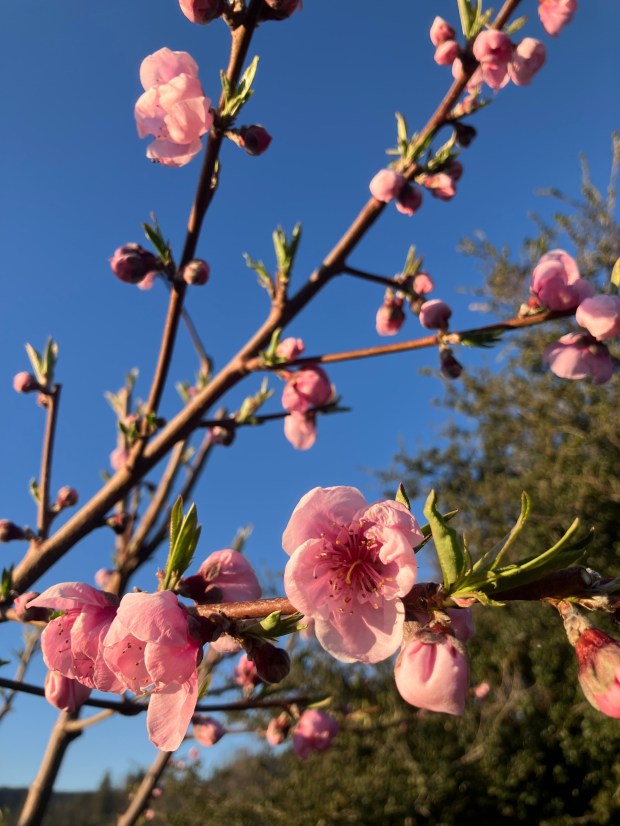
Lucious peach blossoms, so early in the season!

The dominant song, the loudest and most enthralling, is the flock of 50 or so California bicolored blackbirds (Agelaius phoeniceus californicus). This flock hunts in hopping flanks across the fields, scaring up food, or lights into a tree from which it hemi-melodiously erupts into cacophonous orchestration. During this group song, individual birds will take to the sky above the flock, display and glide-flit back down into the tree with a pattern much like falling leaves. Sometimes several birds will do this at once, sometimes only one. It is like a dance floor in 3D. I highly recommend spending time observing this species’ behavior – it is fascinating to watch and mesmerizing to hear.

Greening

Meanwhile, down on the ground plants are starting to get taller. Grass is one foot tall, poppies 6 inches, bee plant two feet with its vigorous stalks and huge dark green toothed leaves. Soon, all that herbaceous stuff will be knee high and difficult to negotiate on foot: this is our last chance to readily romp through lush fields and meadows.

The winner of the green growth height race is, and always was and will be, wild cucumber aka womanroot, so named because the starchy root is the size of a woman, albeit a smaller one. That starch allows the plant to hurdle forward with long reaching vines and twining tendrils, simultaneously flowering and more slowly forming leaves. On a warm, still day, you might catch the cucumber scent of the flowers. Don’t stand still too long or one might grab you!

Marah fabacea, aka womanroot

Flowers

Our Earlitreat peach trees are in bloom. They have to be early to set fruit for harvest by Mid May (!), so sweet and tasty. The large pink flowers are pure eye candy, and the bees are loving them. We are happy for the hot dry spell right now to help the leaves not get too much peach leaf curl, which is problematic with this early variety.

In the uncultivated areas, California poppy flowers are opening. As always each spring, the first flowers are the size of tulip flowers and show more the inland poppy traits: pure orange petals. These were planted from seed brought in and have naturalized. The local poppy blossoms later and so the two races keep separate niches and maintain their flower color and different leaf morphologies right alongside one another.

Frogs and Bats!

Our concrete pond filled early and has stayed full for the winter, attracting chorus frogs. This is the first year in more than a decade that chorus frogs are hopping through the fields, along the trails, and under the orchard trees. They go to the pond at night to sing and play but then out into the fields they go to feed on bugs for full tummies to get them through the night of frenzied singing socializing. The pond is rife with frog egg masses but last I checked no tadpoles. One newt floated around and will be feasting on eggs and, soon, tadpoles, too.

Another thing a pond does is attract bats. All at once, a gaggle of small bats poured out of the ‘horse barn’ roof edge last Saturday at dusk. This evening just after sunset, a larger singular bat was energetically gliding and flapping around the farm. All this bat action but no real evident evening time bugs…but, who am I to say…they are much better at assessing that situation.

Citrus Harvest

Have you been to the Food Bin where Molino Creek Farm limes have been on sale? Everyone says that these are the tastiest limes, thin skinned and juicy. We’re getting ready to harvest another large batch- they ripen gradually and in pulses with the warm spells. Our Community Orchardists went on a citrus harvesting stroll last Saturday after our work party, loading up on limes (Bearrs and Key), mandarins (mostly Honey), Meyer lemons (no one took many), Seville oranges (for marmalade), and navel oranges (mostly Robertson but some Lane’s Late…Cara Cara and Washington a bit slower). Some enterprising souls also are experimenting with the first possibly ripe Pinkerton avocados…we hope for reports back! More different mandarins are ripening…soon!  Another couple of years and we may have too many mandarins and be able to send some to market or to charity or somewhere, we’ll see. But first, how will we do this year with making use of the many pounds of navel oranges on the trees – everyone is reporting large orange harvests this year!

Hoping you have a great week and enjoy some seasonal, local citrus to spice up your life and give you the Vitamin C you crave.

-this post co-published at the other site I maintain for Molino Creek Farm

Gish Gallop

Has it always been so common, or is it just more apparent because it has become so prevalent in mainstream politics? The Gish Gallop is a method of debate where one streams together so many unsubstantiated points that it becomes difficult to track, and rebut, them all. Perhaps the easy swipe of social media or the increased speed of emerging news have helped to wire us to be more receptive to the full-steam-ahead BS argument technique. Here, I try my hand at making a speech using the Gish Gallop technique with a collection of commonly held nature fallacies:

A Gish’ing Example

Nature is dangerous! For instance, all sorts of snakes and spiders are venomous, and people die from their bites all the time. You have to be especially careful of mountain lions, which are increasingly attacking people across California. If environmentalists have their way, there will also be wolves roaming everywhere across the Western USA- once established, they will become habituated to eating livestock and they’ll be coming after people, too. Just outside your door trying to get into your trash are very dangerous rabid opossums. You don’t even have to go outside for nature to get you. There are spiders hiding in your house, and an average of six a year drop into sleeping people’s mouths. I heard just the other day about another venomous snake crawling out of someone’s toilet. Some crazies want to blame so many things like this on global warming, which is just hype from crackpots trying to control our lives. They claim burning fossil fuels is going to kill us all, but that’s not true! Change happens, for God’s sake, there have always been natural disasters and there always will be, just get used to it, you snowflakes!

Does that kind of diatribe sound familiar? It should, and its not just coming from the political right[1] – watch out for it coming from just about any political direction, in just about any social situation. You can tell a real Gish Gallop addict by picking out just one of their tidbits and trying to follow up with a more involved conversation. If they are a galloping gish o’phile, they’ll be unable to stick to that topic and will hit you with another round of Gish Gallop before you can yell ‘stop!’ I don’t know if its just my circles of company, but I venture to guess that 1 out of 10 of my conversations encounter something amounting to Gish Gallop.

Toilet Snakes

Let’s take a look at just one of the parts of the above parade d’ BS: toilet snakes. Mention the phrase ‘toilet snake’ during a party, and it may well take root in conversation with anecdotes just as lunatic, or even substantiating evidence of this profoundly unlikely scenario. Was it Voltaire that said absurdities beget atrocities? One step leads to the next. Who are we to deny the frequency of toilet snakes, anyway? I’m sure it has happened once or twice! It may even be getting more frequent with global warming, invasive species, collapsing and outdated infrastructure, and the loss of skilled labor attracted to public works jobs. See? How familiar is that? That’s how it goes…

Turning This Around: The Antidote

How good are you at stemming the tide of verbal diarrhea? How do we collectively alter this rotten social habit? It is time to infuse more meaningful dialogue into the world. I am particularly advocating for better dialogues about nature and hoping that we carry with us enough fascinating stories that we can knit deeper and deeper oral traditions into a regionally-oriented social fabric. As we do that, I encourage us to use science as our guide, so that we have a method of building out truth, of going deeper and deeper into nature, and to add those discoveries into our stories.

The Fate of Snakes

My essay ‘Snakes on the Monterey Bay’ is one of the most popular reads on my website. I suspect that there are widespread positive sentiments about native snake species. But there are also widespread popular beliefs, well supported in social circles, that snakes are all very dangerous. Snake phobia, even nature phobia, is far too common. I well recall a time when I was working with a farm labor crew to machete poison hemlock, an invasive species that had taken over much of Younger Lagoon Reserve that I was stewarding for the University. One of the crew spotted a garter snake: quickly three were chasing it and proudly hacked it to pieces in moments before I could stop them. They seemed astounded that I was angry at their actions. I’m sure that they still think that I was acting insanely to be defending SNAKES! Why? Many people believe snakes are dangerous, and this is one of the many subjects that we can work on to improve human-nature relations.

Might you find out a bit about one of our native snakes and start a conversation about it with your friends? Such conversations could change the world for the better.

-this column slightly modified (with The Guardian link) from that which I posted via BrattonOnline.com, Bruce Bratton (and team)’s wonderful source for news. Subscribe now and save (it is free, but donations are welcome)


[1] Although some admit that this is their favorite method of oratory.

Perennial Grasses and Healthy Soil

Isn’t it amazing how marketing pitches can formulate the foundations for societal dialogues? Somehow, forest management gets ridiculed with the phrase ‘raking the forest,’ aiding the politics of defunding the US Forest Service at a time when we really do need widespread restoration of prescribed fire…not raking, but effectively the same thing. And ‘forgiving student debt’ gets bandied about, helping to steer conversations/media away from the more difficult subjects of: better funding/better outcomes of public education; training young adults about contractual obligations and financial planning, and; regulating financial institutions to make student loans more affordable. I’m sure each area of human dialogue has its ‘short hand’ statements that one sector uses to manipulate others. The one I’m faced with currently is the jingo ‘healthy perennial grasses make for healthy soil.’ Let’s take a closer look at that phrase.

Bunchgrass Paradigm

Long ago, a preeminent ecologist traveled to California and ‘discovered’ something that formulated the basis of myriad dialogues continuing through today. Frederic Clements described ‘natural succession’ where nature transforms itself from one habitat to the next in a logical and predictable order. You may recall the diagram that still sticks with me where a pond becomes a marsh becomes a bog becomes a meadow becomes shrubland, culminating in the ‘climax’ community…a forest. In examining California’s grasslands, Dr. Clements found a patch of ‘pristine’ grassland, one of the few that had escaped the plow, along a railroad right of way. That ‘pristine’ grassland was dominated by a perennial bunchgrass, purple needlegrass: this, he said, was how all California’s grasslands should look. Many people still believe this. What about the hundreds of species of wildflowers, such as those cited by John Muir as creating carpets across the Central Valley, and those which provided food for indigenous peoples for generations? Those holding dear to the ‘bunchgrass paradigm’ will say those species grew only in between the bunchgrasses where weeds now proliferate.

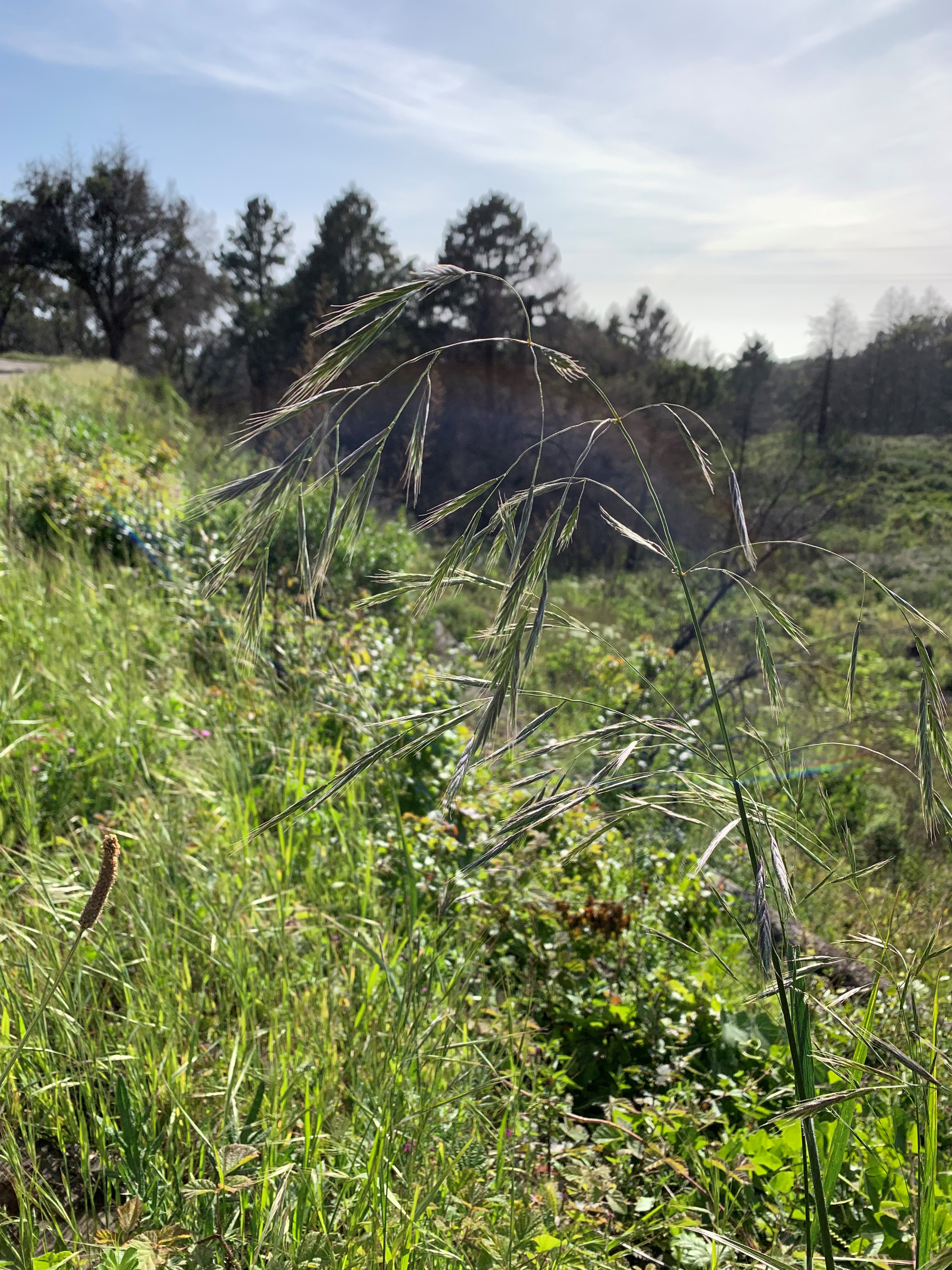
Blue wild rye, a native perennial bunchgrass common to coastal prairies in California

Perennialization Bandwagon

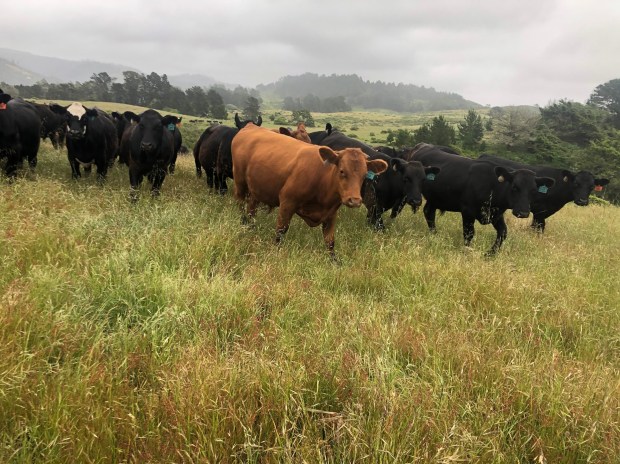
As the bunchgrass paradigm has been perpetuating, another popular movement has been building, a desire to transform agriculture from annual plants into perennial plants with little to no tilling, which purportedly ‘destroys’ soil health. Despite being disproven as effective over and over again, farmers are still attempting to grow lettuce, carrots, broccoli, etc, on ground without tilling. Meanwhile, rangeland managers are repeating a similarly disproven hypothesis that all California grasslands would be better off if ‘restored’ to perennial grasses. Buoyed by science papers that suggest the importance of cattle grazing to help establish/maintain perennial grasses, livestock managers have found good use of this message to gain credibility and increase their land base.

The “Perennial Grasses Have Bigger Roots” Myth

Add the two previously described popular myths together and you encounter another emergent, oft-repeated myth: perennial grasses restore soil health because they have larger masses of roots (in comparison with annual grasses). Central to this popular misconception are comparison photos from the Midwest showing profiles of annual wheat versus perennial wheat including both above and below-ground portions of the plants.  The idea being promulgated is that larger root systems add more organic matter to the soil, break up soil compaction, and allow for better water infiltration. Most recently, proponents of this myth point out that the increased below ground organic matter of the larger rooted perennials means that more carbon is being sequestered, helping to address climate change.

California’s Grasslands: Not Naturally Perennial

California is mostly a Mediterranean state with a long history of ecological disturbance: grazing, fire, drought, inundation, etc. That ecological situation does not naturally produce widespread perennial grass dominated prairies. Even where there are perennial grasses present in a given area of prairie, they are rarely naturally ubiquitous: species seem specific to soils, steepness of slopes, wetness, nutrients, and so on. There are many more annual species than perennial, and many more wildflowers than grasses. Some of the most emblematic grasslands in California are naturally annual plant dominated, such as the wildflower-display rich Carizzo Plains, the rolling hills over the Altamont Pass, and the flower-filled savannahs of the southern, low-elevation Sierra Nevada. On the other hand, large swaths of the former wetlands of the Great Valley were probably once dominated in wide swaths by perennial rushes, sedges, and tall native, rhizomatous (not bunch) grasses.

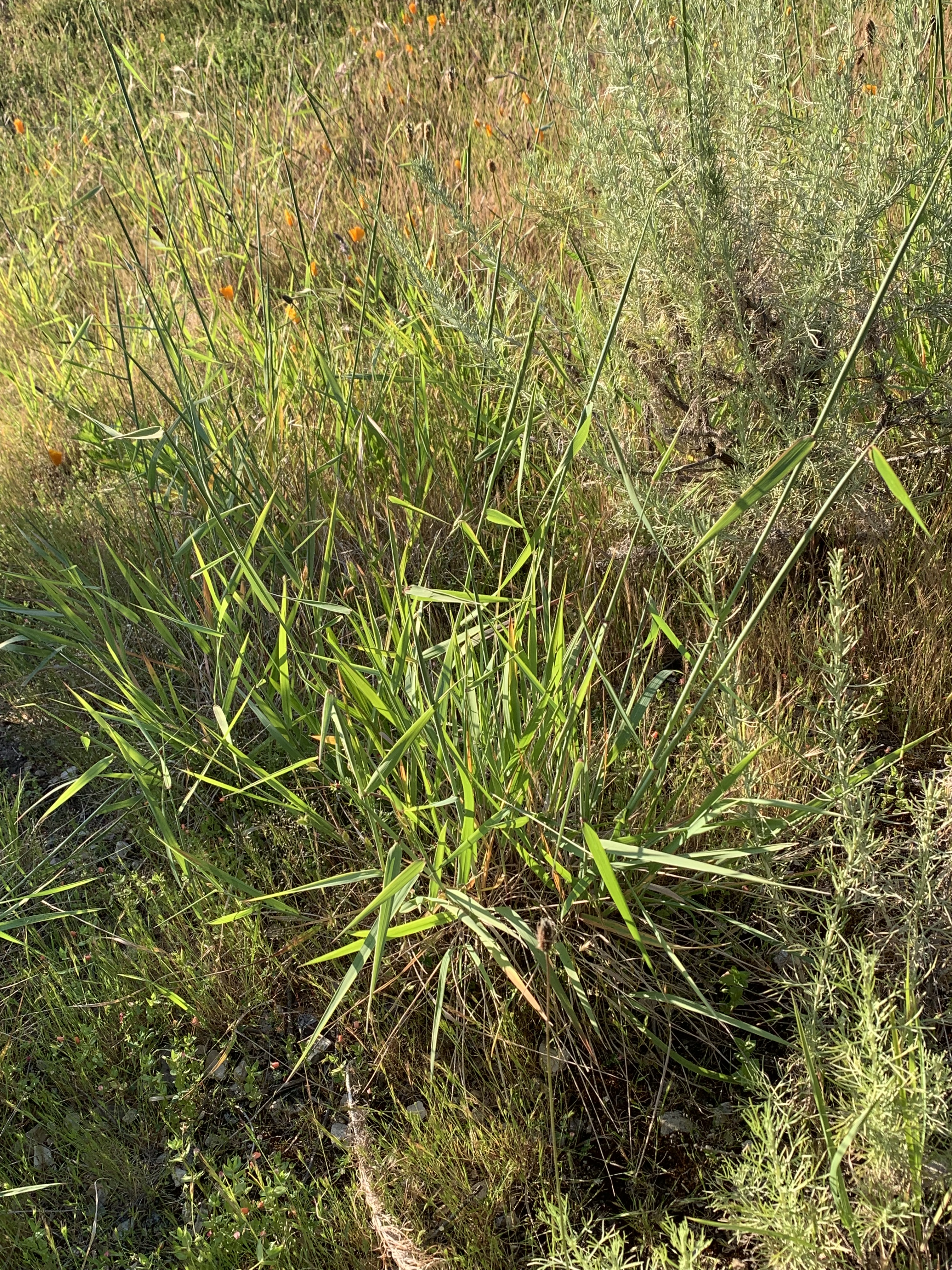
California brome grass, a perennial bunchgrass common to California’s coastal prairies

Myths of the Perennial Life Form

Let’s examine the “Perennial Grasses Have Bigger Roots” myth for a moment. The most widespread native perennial grass in California is pine bluegrass, a diminutive grass that often has leaves a mere inch or two high and a flower stalk reaching a foot or so into the air. This species likes it hot, dry, and shady, growing in interior oak savannahs. With the first rains, it turns green, later sends up flower heads, and then dries by late spring. There is no reality in which this species has longer roots, or a bigger root system, than the often 4’ tall European oatgrass. Around here, that European oatgrass is more comparable to the perennial California brome grass. This brome, in some soils, alongside European oats similarly continues growing, flowering, and seeding well into summer. In wet areas, a common native perennial grass is meadow barley. Meadow barley is relatively small and short-lived, and goes dormant very early in the season, when it is replaced by the proliferate annual Italian ryegrass, which is larger by far. Most people surveying for perennial bunchgrasses have overlooked meadow barley altogether as it disappears so early in the season.

Yes, there are smaller annual grasses and larger perennial grasses, but my point is that the generality that ‘perennial grasses have bigger roots’ is untrue and not that useful as a generality.

Regenerative Ranching: Regenerating What?

Although the definition of ‘regenerative ranching’ is elusive, it seems most proponents are gravitating towards suggesting that they are ‘restoring healthy soil.’ The idea here is that soil has been in some way degraded and must be returned to its primeval state. Often, the soil degradation concern is ‘compaction.’ To restore soil health, proponents rely heavily on the myths described above overlaid with management hypotheses that using livestock can mimic evolutionary disturbance regimes last encountered with the Pleistocene megafauna, 10,000 years ago. Regenerative ranchers really believe that such approaches work and are full of anecdotes about what they’ve witnessed, though changes in soil health are notoriously slow and always soils-specific.

Compared to What?

I’m pleased that there is a conversation about how to best manage California’s prairies, but concerned about bandwagons, slogans, and misinformation. Humans are really, really good at pairwise comparisons, but their attraction to such must be tempered. Perennial vs. annual grasses: nonsensical! Livestock grazed vs. ungrazed: not helpful! We can try really hard or spend a lot of money trying to ‘restore’ soil health, but what are we restoring it to? There is the possibility for a great collaboration in this conversation. The USDA NRCS has a long-running research project that fits nicely: their ‘ecological site description’ project would do well to help define which sites are best compared with one another, based on soil types. When having these conversations, we would do well to have great respect for the state of the science, referencing a rich literature and how it does, or doesn’t pertain. And, in our pairwise comparison analysis, let’s always try to compare what we are doing, regenerative or otherwise, with someone else’s approach: what is working better, and why? We must always make these conversations very site-specific…variability across sites is the rule.

Meanwhile, beware of definition-less terms without a systematic third party certification program: ‘natural,’ ‘grassfed,’ or ‘regenerative’ labels hope to entice you to pay more, have higher respect, adhere to brand loyalty, or just plain ‘believe’ you are doing the right thing by supporting such verbiage. With this and other jingo-based bandwagons, let’s get a tad more critical so that we support what is worth supporting with greater clarity on WHY.

-this post originally appeared as part of Bruce Bratton’s weekly blog at BrattonOnline.com