gray fox

Wind and Cold

March…the warmest and driest in decades. Might May be the coolest? The heat’s gone to Europe and the East Coast where the poor folks roast and sweat. Will the cold, windy May place at more distance Summer’s wildfire? Nay, this topsy turvy human-driven climate change world gives us dizzying unpredictability. Just out of sight, out on the horizon, who knows what lurks? For now, this week, fog and drizzle rule.  

Two layers of clouds roll downcoast: wispy white puffs rapidly curl and pout in the sky over the farm, and an unbroken wall of fog, dark gray and more oceanward is more ponderous and slow in its southward march. The wind’s sudden roar bends trees, flattens grasses. I glance towards the ridges far above our land where scantly needled (post fire) firs and redwoods move more subtly, boughs flexing, tree tops swaying. Birds dart low lest they be pitched downwind by the gusts. Tuesday this week was a day to be inside. Luckily, it lasted only one day. And still the chill remains. Ah- surprises! Rain! Tomorrow!! Maybe a half inch…

Three Bucks

Feisty Animals

We sneeze loudly outside (the pollen is thick and swirling) and turkeys gobble back. These foggy days lengthen the bird chorus from dawn to midday. A pair of white throated swifts called their sharp tee-tee-tee-tee-tee-tee for a bit this morning – perhaps drinking at the pond and then playfully departing, wheeling through the swallow and martin flock. Antlers fat and velvety, the brood of deer is moving less furtively away. A two-foot-long Santa Cruz aquatic gartersnake spends mornings on the cement front porch, preparing to molt. One eye is blind: from shedding skin or from old age? This one is far from its aquatic home…old and big.

Sylvie caught a fox and bobcat standoff in the deep, dark night this past week. The sound recording is awesome and harsh. Those screaming and hissing critters were doing their level best to avoid each other’s’ teeth and claws through loud ‘diplomacy.’

Santa Cruz Aquatic Gartersnake basking on the front porch

Liquid Sunshine

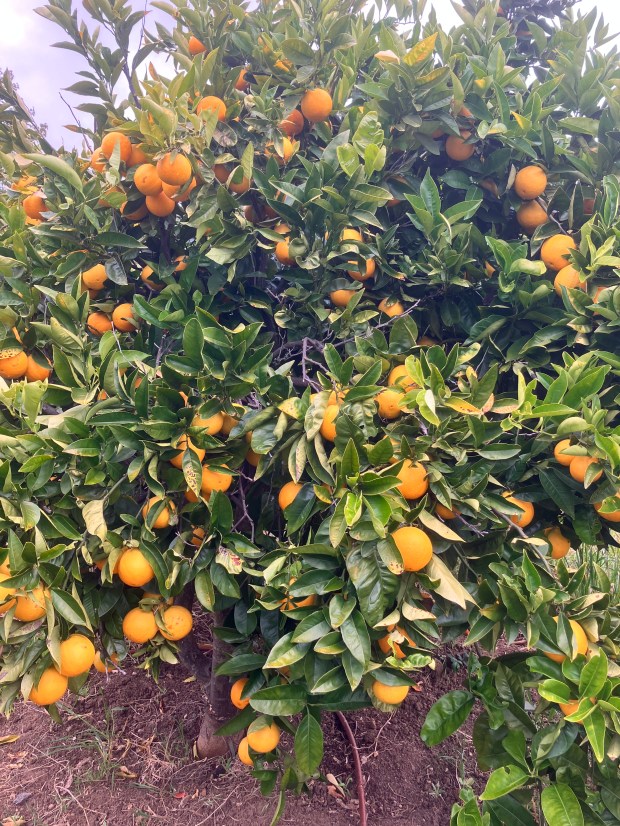
We celebrate the fruit, which becomes more numerous and tastier each year. The pride of the orchard recently has been citrus. There are still some (very few) Persian limes. Lisbon lemons are ripening and a few Meyer “lemons” are ready every day or so. Two Valencia orange trees, one much larger than the other, bear juicy, thin skinned, sweet fruit: 3 of those will make an 8-ounce glass of liquid sunshine. Thanks goes to Chuck Overley for planting those and more thanks to the legions of Community Orchardists for nurturing them to bear such mighty crops.

Valencia orange in full fruit

The Wetting

We are officially on the irrigation routine, no turning back until the winter rains next October. Just in time, our second solar-powered well pump is on line for this dry season. The sun allows us to keep the irrigation going to meet the needs of hundreds of trees. 9 more irrigation lines need to be ‘renewed’ before the whole system is ready to roll. We have a total of just over 100 irrigation lines feeding the orchard and each one needs looking after (some- a lot) at the outset of the watering season. That’s a 20 hour job, and it sure is nice to be 90% of the way. But oh my gosh did portions of the orchard get dry before the water flowed! We hope the trees forgive us.

Jen and Ian donated a weed eating crew and look what happened: nice understory to Wickson Crabs!

Mow, Mow, Mow

The first mowing is almost done in the orchard and nowhere is the last mowing taking place. A donation from Jen and Ian brought forward a paid, Highly Skilled weedeating crew to make short work of nearly 25% of the orchard, a thick late Spring tangle on the steepest part of the North Orchard hill. That part hasn’t looked that nice for years! Uplifting!

The mowing machine had chopped and ground up head-high bell beans between the orchard tree rows, and then they resprouted and are flowering 2’ tall, again. Where they grew thickly, regrowth is deep green: the nitrogen those beans created is in evidence and we are thankful. Now to mow the resprouting things to keep the cycle going: second mowing, anyone? Some years it takes 4.

Aster chilensis – native perennial late spring aster!

Floral Report

Ah, where to start with the flowers? Our local version of the perennial bush lupine has its lavender flowered charm and is in peak blossom, especially evident roadside. Native summer aster has started flowering, spikes of many petaled stars. Poppies still color field and hillside, but it has become difficult to find a single annual sky lupine. The farewell to springs opened their magenta petals this past week, joining the late spring tarplants.

Most citrus blooms have past but apple flowers persist. Deep purple, pale blue and many shades in between – vetch, twining and matting, is having its flowering heyday.

Bluebirds Now, Acorns Later

The bluebirds’ wet warbles call from fence lines, the birds swoop, scooping up grasshoppers from the dusty ground, picking off caterpillars from stalks of dry grass. Acorns fatten on the oaks, not yet ripe, not yet falling. The days shimmer from bright sunshine and a clear dark blue sky. It is nearly half way between the summer solstice and the fall equinox; the days are becoming noticeably shorter, the nights sometimes warmer, the cricket songs more diverse and louder. And, full moon is tomorrow.

Citrus Hill, now with oodles of new avocado trees growing up fast

The Silence of the Birds

The jays and acorn woodpeckers are more silent. Most of the birds have quieted considerably. Cooper’s hawk is terrorizing the entire range of bird life, but the quail are its favorite game. It is everywhere: flying through the apple orchard, winging around corners of buildings, soaring above the fields…full of the energy of the hunt. The northern harrier is more surprising, returning for stints and then disappearing for a day or hours – its hunting ground extends beyond Molino Creek Farm. Two red tailed hawks are constantly but less energetically hunting, sometimes soaring, often perched, watching, waiting. The night brings the barn owls’ metallic screech; these are as commonly calling as the great horned owls- the fire may have favored the return of barnies because there is less of the great horned’s favorite dense tall forest cover. There’s even a barn owl baby calling in the San Vicente creek canyon just over the ridge. I worry, though, since there are great horned owls…when will we find a pile of barn owl feathers in the field- that’s a repeating pattern: the great horned owls always seem to win.

Sunflower Show

 Judy’s sunflowers are making quite a show. What skill to keep a batch always coming into bloom through the entire farming season, making bouquets for farmers’ markets each week. Bright yellow cheerful sunflower heads…the dominant cut flower in the irrigated field alongside onions, zucchinis, cucumbers, and pole beans. She grows a lovely small patch of diverse market crops.

Sunflowers – for sale at local farmers markets

Apples A’ Hoy

Meanwhile, in the apple orchard the burgeoning crop of fruit is unbelievably large. Almost every branch of every apple tree is bent with full weight of fattening fruit, props holding them from breaking or resting on the ground. The frequent zipping by of the hawks have substantially decreased bird damage to apple fruit. Gala apples are always the winners: last to set and first to ripen. We recalled that the second week of September is the week of gala, but it might be early…

Oranges at Molino? Moooo

On Citrus Hill, near the Barn, we have been plucking cara cara oranges from the two trees we planted a few years back. The first substantial crop of cara cara has been wonderfully juicy and sweet: Score! Cara cara navel oranges are crosses between ruby red grapefruit and navel orange. Its flesh is redder than normal oranges. We are very very stoked to be able to grow a tasty orange: the others we’ve tried make okay juice, but they aren’t that good to eat just plain- cara cara oranges ARE good.

The view downhill of Molino…down Molino Creek Canyon to the coast

Night Walks

Shorter, hotter days create conditions for night watering of the orchard, leading to late night walks to turn off irrigation valves. This leads me to unavoidable opportunities for nurturing the nocturnal naturalist in me. Tonight’s observation: black widow spiders aka Molino farm road median lurkers. Over and over again I witnessed (for the first time!) black widow spiders busily building web networks 4” or less from the soil surface on the unimproved road median strips, emanating from web encrusted gopher holes that must be their lairs. Another nocturnal roadside observation: the emergence of many brown field crickets, now evident in the chorus from various areas. Also, slender shiny dark brown ‘night ants,’ tiny cockroaches, big greasy looking black field crickets, and a myriad of different spiders. No mammalian eye shine gave something away with my bright headlamp, darn.

Rodent Fiasco

The fact that this is an epic Rodent Year still is in force. Mark Jones reports hundreds of rodents fleeing the path of the mower. Every inch has been rototilled by gophers. Farmers are losing crops. Orchardists are seeing girdling, making for more urgent trunk clearing. Every storage shed reeks of mice. A family of 10 mickey mouse deermice greeted me when opening up the small orchard tool storage shed. The bunnies have proliferated in areas, as well. And that fox which we had been seeing down the road a bit…well, its moved onto the farm! Prints in the dust, leaping fox scattering to hide: welcome back Gray Fox!

Hoping you get some warm weather basking!

-this is from my weekly blog at Molino Creek Farm’s webpage