Community Orchard

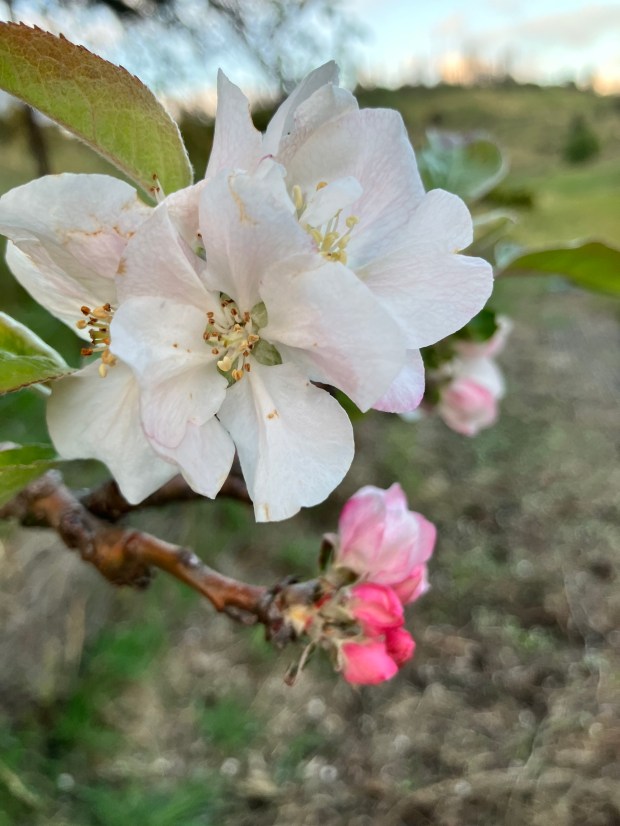
close up of a cluster of apple flowers and pink buds

Upside Down Spring

In our Mediterranean Spring, it is supposed to stop raining and the flowers bloom. This year, it stopped raining, the flowers blossomed and then it started raining again. Purple needlegrass has already bolted and set seed. Sky lupines and poppy are more pod than bloom. It is downright gushy out there: m-u-d spells mud. Spring mud. This late rain makes it very unlikely that wildfire will plague us this year, at least close by. Official reports from the surroundings put us at ‘normal’ rainfall with this past storm. How we got to that is quite a story: rain in November then none for most of December then a bit more into the New Year, then a fairly hot January…a few storms to wet things again through February and then No Rain March (and hot!) and then here comes all this rain in April.  Topsy Turvey.

Potentially, this is a Valencia orange tree- not quite ripe, yet.

Oranges

We have Washington, Cara-Cara, Robertson, and Lane Late navel oranges as well as one unknown navel type and a tree full of what look like Valencia oranges. We should mention the bitter orange, Seville?, tree that bears quite a few fruit each year. We have enjoyed the fruit from the two 7-year old Cara-Cara so much that we planted six more last year, and we must wait a long while until we get lots of those fruit. Cara-Cara oranges are red from the same compound that makes tomatoes red, Lycopene, so it makes sense that we grow lots of them on this here tomato farm. 

It takes a bunch of work to establish citrus trees; they aren’t happy with weed competition, so we have to keep them weeded frequently…like 4 times a year, for their first 3+ years. This is orange season: the fruit has been hanging for a year and is starting to get sweet. The various Mandarin varieties have a lead on them, so we haven’t been wanting for sweet citrus for a bit.

The Deer would love to eat this cabbage seedling, but maybe they won’t

Deer Report

We chatted about The Deer a bit this past week. Mark Jones reports frequently seeing more than 20 deer. By flashlight, the many pairs of glowing deer eyes are a bit surprising. One can glimpse grazing deer whenever one wants. They scamper or saunter about- normally they are quite shy and run, but not always. We should be pleased for the grazing of the plants, which would otherwise be fuel for summer fires, but some people grumble about all the deer: “landscaping” damage is probably the foremost complaint. With all the deer, one would expect some happy mountain lions, but alas the sign of the cougars is rare, still. 

The varied habitats at Molino Creek Farm provide for great bird diversity

Bird News

This past week brought yet more neo-tropical migratory songbirds. A lazuli bunting is high-squeaking right through midday. Black headed grosbeak song is also wonderous. The background noise of bicolor blackbirds, song sparrows, and golden crowned sparrows is ubiquitous. One is occasionally startled by the vast rush of a startled quail covey. Their cousins of the sky, band tailed pigeons, are quite active flapping from walnut tree to walnut tree. Today’s discovery was a female turkey clucking quite loudly for who-knows-what reason. The turkey flock seems to have dwindled to one hen, a young tom, and an older, dominant tom. Just 3 turkeys – maybe the other hens are sitting on nests or perhaps they were eaten…piles of feathers were here and there the last few weeks and a coyote was close by.

Squirrels

We used to have Western Gray Squirrel, but now we only have ground squirrels. The gray squirrels were before the fire – they supposedly are fond of truffles, so maybe that food source changed. We have a local gray squirrel type without a common name, Sciurus griseus ssp. nigripes, which only occurs along the coast between here and San Luis Obispo. I hope they come back!

The latest on our ground squirrels: have you ever looked carefully at their color patterns? They have the most amazing white eye liner, making their eyes oh-so cute! Their back fur also has cute, cute dots. Their hands are quite agile- today I watched one grab grass stalks so it could get at the seeds, which otherwise were above its head. This squirrel was feasting on ripgut brome seeds, a bad weed with heavy weight seeds that are quite rough to touch – good, brave squirrel with strong seed-eating teeth!

An April sunset above Molino Creek Farm

 Mechanical Chewing

Speaking of tearing things apart – we are seeing more of Mr. Matthew Todd’s expertise with his brush mastication machine. Huge thistle and French broom patches are being chewed up into tiny pieces as we attempt to reclaim coastal prairie patches collaboratively across property boundaries with our neighbors managing the San Vicente Redwoods property. This will be Part 2 of the recipe to try to get rid of the broom: last Fall was Part 1, then there will be this Fall to hit it again…and the next 2 Falls, too, before we expect to see a reduction in this weed.
Tranquility

Most days there are two daybreaks. First, illumination transforms the dark night of the fog-hidden slight moon. Much later, it brightens again to blue sky and sunshine. Every morning is chill: the kind of damp cold that necessitates thick socks, sweater and jacket. Most want a shared lament, “How’s it going?” “well, the darned fog and cold and where is summer!?” Some of us still smile. “Ahhh! The cool fog!” “Glad there’s no wildfire!” We are grateful for wonderful wet smells, easy on the nose, deep breaths of fresh air.

Droplets glint from leaf tips, spider webs, and fence lines. Slightly muffled fog drip patters through tree canopies tumbling to make dents on the dusty ground. I join the quail and other birds to avoid wet weeds, wending our way along the trampled short-grassed pathways to avoid getting soaked and cold. The quail covey scratches and struts, making low whistles, talking. I gaze at them, at the distant alert-eared deer, at the obscured horizon, dark ridges and trees, there and gone again in the procession of low gray clouds.

Seedeaters

The farm is teeming with seed eating birds. Finches and goldfinches, juncos and sparrows. A roiling, chirping wave of songbirds retreats, keeping a comfortable distance from cars on the road or walkers sauntering down trails. There are shrill begging young birds and calmer chittering groups of adults. Most are intent with continuous beak probing of turf, pecking and scratching, sometimes lighting on low branches for breaks, polishing their dusty bills.

Hoes Out

As the young crops continue to mature, it is weeding time. Up to a half dozen people on any given day are hard at work obliterating unwanted pests, eyes bent on the ground, precision hoeing, thousands and thousands of plants uprooted. Success looks like a blanket of wilting plants, shriveling into dry crispy leaves and fading into nearly unnoticeable skeletons. Only the bindweed resprouts in the dry farmed deeply dusty fields but the irrigated fields will continue to flush new weeds for many weeks to come, complicating time budgets with both harvest and maintenance.

To Market!

We took food to the downtown Santa Cruz Farmer’s Market today, first market of the season. After months of tending with no cash flow, things are starting to pay off. Sunflowers, zucchini, and maybe some lemons…much more to come, more every week for a long while yet.

The beginning of the return of the Barn Party

Camp Molino aka Boomer Fest

From its founding in the early 1980s until the mid 1990’s, there was a traditional barn party at Molino Creek Farm. After a long hiatus, the event returned this past weekend. A slow trickle of incoming visitors wandered onto the farm. New generations followed older returnees. So many fine greetings, hugs and smiles. Tents colored knoll and meadow. Groups and gaggles wandered the farm, laughing and talking. 

Many joined the Community Orchard working bee. Then, a prolonged after-orchard-work-party melded into dinner followed by divine, deluxe rock and roll, dancing in the barn. It was all lit up and alive, booming bass and melodic electric guitars so expertly played.

The next morning was slow and the day brought more farm walks and friendly chatter before people returned home and the farm was quiet once again.

Molino Creek Farm Community Orchardists hard at work on Citrus Hill

Orchard Progress

The large gathering resulted in an amazingly good volunteer turnout to tend the orchard. The group took on summer maintenance of 105 trees on Citrus Hill (see photo). First in the progression, a group pruned up trees so the next in the progression could rake out the dry spent leaves (wildfire damage prevention) with the weeding team close behind them. Others cleared plastic irrigation risers and some harvested lemons. We have never achieved so much in such little time. This, one of three blocks of trees, is looking so very good.

Elsewhere in the Trees

The apples are turning red. The first trees to greet you when you walk into the North Orchard are the Gala apple trees. Their cheery red fruit create the quintessential festooned apple tree forms starting this past week and on through late September during harvest. There are not too many fruits this year: the trees spent themselves last year and are taking a bit of rest. Still, there will be enough “Fruit for the People!” The juice will still flow.

-this simultaneously published on the Molino Creek Farm webpage