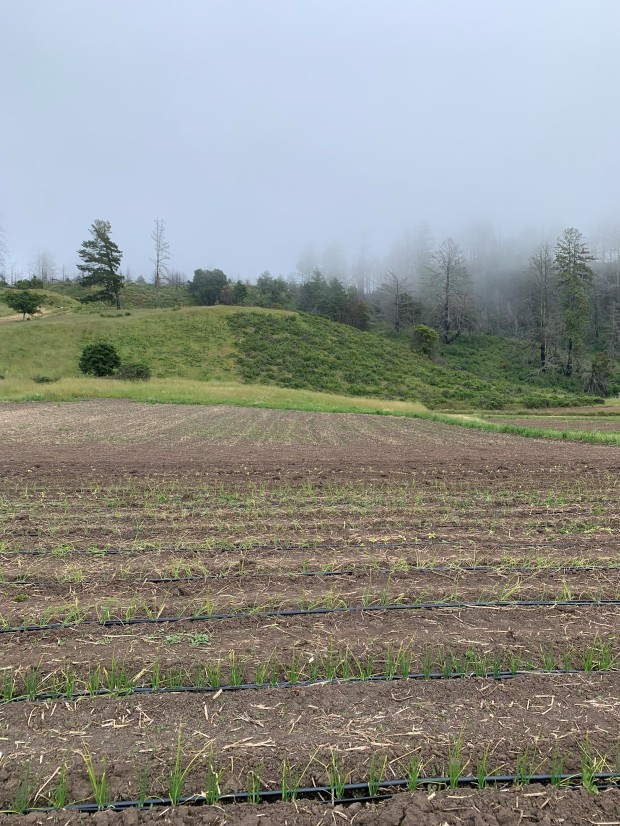
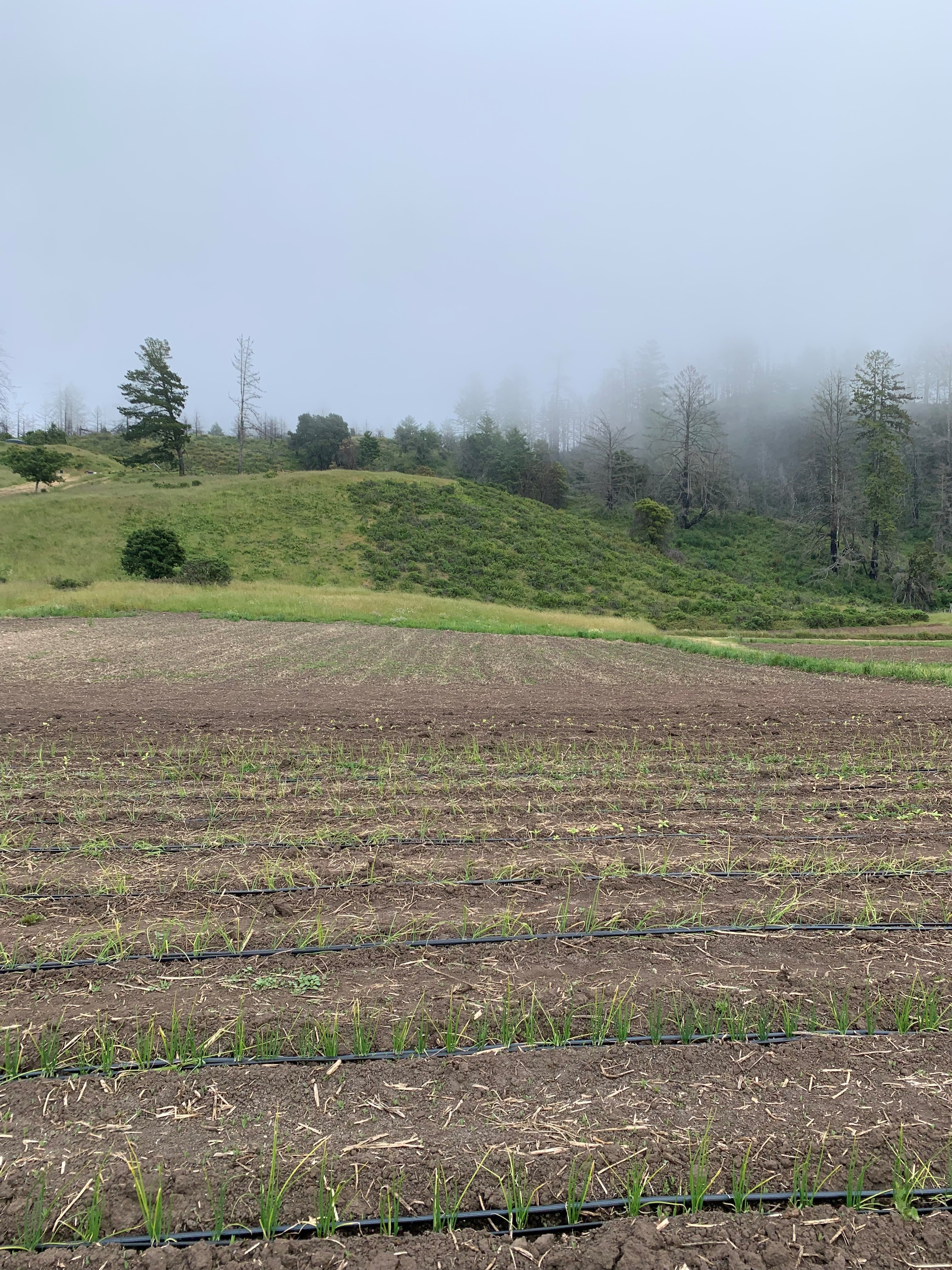
fog

Dawn Watering

It has become imperative to start the days early, like every year during this season. Fattening fruit demands water. Micro-sprinklers hiss and twirl fine sprays that blow away or evaporate during the windy, sunny part of the day. Early mornings (before dawn, even) is the best watering time, when it is still and foggy. The first inkling of light wakes me into a routine of donning warm clothes and a jacket. The dimly lit, peaceful saunter downhill to the orchard unfolds new wonders every day. Turkeys awkwardly hasten away, great strides, giant bodies rocking back and forth. Ravens glance up from their ground-gazing meditations. An alert doe leads her two spotted fawns a little farther away, slowly. A bout of tiny droplet drizzle cools my face. When the chain latching the orchard gate clinks, the sound seems to carry far, silencing the already quiet chatter of birds. I wrest the big valve open and water gushes down the shaking pipe to the smaller laterals. Sprinklers begin bubbling, then spin. I must take a look at each of the sprinklers – 180 each round – to assure each is working, tracing the flexible tubes feeding them to spot any leaks, ears alert to irregular noises that indicate punctures from rodents or errant hoes. All checked and fixed, hands muddied and pants soaked, the morning grows lighter and I climb the hill back home with a satisfied smile knowing that the thirsty trees are happy, too.

White roses grace the hedgerow near the Apple Orchard

The Fog

Each day starts with fog, either obscuring the ridgelines or right down to the ground, soaking. There have been stretches of days with no sun at all but recently the fog has retreated oceanward midday, replaced by sun and episodic breezes. 52F at sunrise and the warmest part of the day gets to 71F; the sun feels warm but the wind makes chill. Really, when the sun comes out the temperature is pure heaven. 

The Last Mow

Celebrations and hard work with the drying of grass. Over many years and with lots of effort, we have converted nearly 20 acres to grassland from scrubland or old farm fields. Grassland is better for fire safety and restores wildlife that depend on it. Western bluebirds, harvest mice, voles, grassland butterflies (buckeyes!), and so much more are abundant now as the red-tailed hawk regularly wheels overhead seeking grassland prey. So much grassland demands hours of mowing Right Now. Five foot thick dry grass gets ground into three inches of mulch, reducing flame lengths and the heat of wildfire. Swallows delightfully swarm behind and around the mowing tractor. Brewers blackbirds pounce and dance on insects uncovered in the new cut straw, beaks full of white moth wings. Afterwards, the shortened sward attracts regular attention from bluebirds swooping to catch insect snacks: these birds really require short grass to find their food. Somehow, the native grass rebounds even after this late mow and in a month the tawny, dust churned mulch will start to green. Poppies will emerge to blossom in mid-September through the decomposing thatch.

A herd of buck-deer, some with large antlers, near the Farm on a 2020 burned slope

Big, Fat Rodent Mounds

The mowing was differently dusty this year. What used to be the more or less consistent roar of the flail mower was interrupted by a bogged down engine and the churn of dirt: ground squirrel burrows! Huge swirls of dust erupted behind the mower, sometimes sent aloft by a breeze. Once, rising heat and a breeze created a dirt vortex that spun in place, a brown twisting spellbound ghost.

Those squirrels had been hiding. Now, they are out in the open, flattening themselves as they grub and graze. Their loud whistle-chirps are more common, as waves of the rodents scatter back to their burrows in alarm. Hawk! Human! Run!! Four to six half-size, big-eyed, skinny young squirrels flock not far from their family’s burrow entrances. Some burrows are quickly being excavated, three foot wide, one foot deep fans of bare, dry soil…and rocks! Mower blades will dull faster next summer and the air will get more dusty.

The Fog, a regular morning phenomenon

Farming

Crop plants have become adults. Our community celebrated its first red tomato last weekend and the vines are getting fuller with green fruit. Apples have surpassed the silver dollar stage and are coloring up. Pears aren’t far from being ripe. Meyer and real lemons are coming on as are the bacon avocados. It looks likely that we’ll get a summer crop of limes in six weeks. Our first substantial passion fruit crop won’t be ripe until September. 

Judy’s first sunflowers are open and she’s been distributing the coveted silky smooth dark green zucchini. Two Dog Farm’s grapes are neatly trellised with bunches of promising fruit. Two Dog (really, truly!) dry farmed winter squash has just fully blanketed the field, giant green leaves, some patches with beautiful silver veins, all dotted with big yellow-orange flowers. The crews have done their major weeding, now we wait for the ripening of fruit and the promised burgeoning harvest.

Planning

Though the season of long days and hard work are made more enjoyable by the beatific clime, we’re taking the unusual turn of long term planning during the height of the work year. Everywhere you look at ‘outdoor work,’ there is an inter-generational transfer crisis. The hard-working trades of forestry, livestock, land management, wildland firefighting, and farming are struggling to attract young talent. We wonder how to continue the tomatoes and row crops of Molino Creek Farm. Who will manage Santa Cruz County’s North Coast agricultural fields in a decade or so? Will we ever again experience the amazingly diverse, delicious organic crops of Route One Farms from the 1990’s? It takes real skill and hard work to keep each crop growing enough to support the workers. And so, we meet in the large, lonely upstairs room in our Barn and ponder…
June Gloom

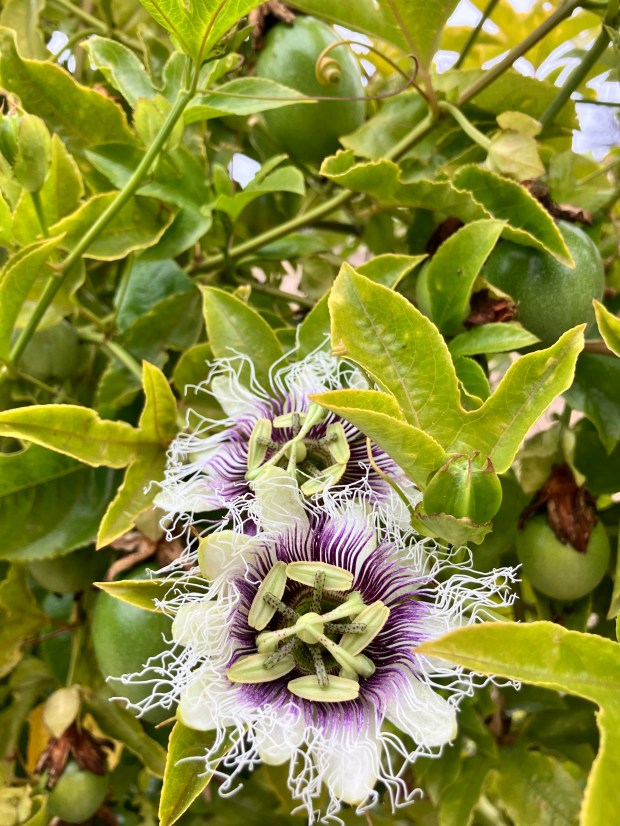
Frederick, a variety of passionfruit that does well here – exploding into glory for Interdependence Day

Happy Interdependence Day!

The sky has been a uniform textureless gray. Every day, throughout the day, high, dense relentless fog caps over the Farm. We awake to a dimly lit 55 Fahrenheit, 85 percent humidity and the day peaks in the mid 60s – no blue sky, little breeze…a still, sullen, quiet day that only turns a bit brighter midway through, slowly trailing into darkness in the evening as fog grows even thicker.  Nighttime, no stars, but the huge moon brightly illuminates a big patch of sky a little more than the rest. 

The odd cold cricket tentatively chirps. A single owl hoots in the distance. Sneaky coyote and sly fox silently roam, leaving tracks and little other sign to know that they were there.

Dawn comes with a middling bird chorus – too cold to be motivated, but still doing their duty. 

Turkey Fight!

Recently, Sylvie chronicled a turkey brawl, awakening to ‘very distressed’ turkey noises. They were in a ‘serious fight,’ ‘using their mouths to grab each other’s mouths or necks and careening around.’ Her photo taking frightened them and they broke it off with one chasing the other up the hill. Check it out- there are numerous web movies of this kind of thing. One more type of turkey noise explained, but they have a huge vocabulary. The 3 hens and 2 chick group is still hanging out together, and I noticed that one of the adults is a particularly dark morph. Not sure why, but a turkey clan left a pile of feathers next to the orchard gate- wondering if it got away from coyote or what happened? Did you know that there are albino turkeys (not here!)? Woah. Every day, new turkey drama.

Speaking of birds, the quail babies are all flying now. Tiny, but flying!

Solar Power

The bigger array, the more power. That’s the lesson of these foggy days. Increasingly, we rely on solar power to pump our irrigation water. Our crops need water even when the sun doesn’t shine, but the solar power for the well pumps tapers off. This makes us even gladder for the larger solar array that the Resource Conservation District of Santa Cruz County hooked us up with this past year: it pumps even when there’s the weakest sun hiding behind the thickest of fog! So, we keep up with filling our water tanks, just barely.

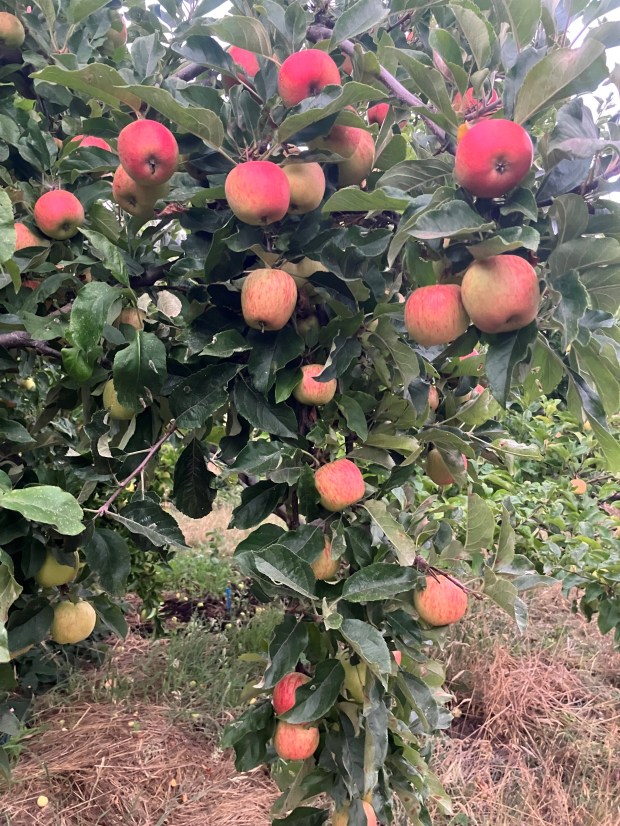
Tons of Golden Delicious apples, like most trees…loaded and growing fast.

Jillions of Apples

The notion of apples bearing fruit in alternate years seems a bit abstract until one sees a Big Year (and last year was puny). This year is really, really big. The birds know it- count the 15 jays and 10 acorn woodpeckers hacking away at the apples every minute of every day. And still there will be many, many fruit. Every branch of every tree is weighted with silver dollar sized fruit that is quickly growing. This is part of the watering issue- fruit-filled trees are very thirsty, making it difficult to keep up. Apple roots are soaking up the water and sending it to fruit production just about as fast as we can irrigate them. Water all day and still the soil doesn’t get very wet. SLURP! I had estimated 11,000 pounds of apples to harvest and I’m starting to think that’s low. It is propping time- branches will break soon!

Molino Creek Farm’s dry farmed tomatoes are getting BIG!

Early Mowing

We started mowing when we should have, 2 months ago and those early-mowed areas are filled with colorful poppies and bright green grass. Mowing early conserves soil moisture, especially in a late rainfall year like this one. The method of slowing plant transpiration of soil moisture is a central factor in successful dry farming (tomatoes, squash) and is evident even in the fallow or hay fields. Those early-mowed fields are lush and the early mowed material is breaking down leaving bunchgrasses and poppy plants brightly burgeoning.

The Olive Collective is watching the fruit grow as the olive press greenhouse gets built

The Last Mow

Except for those early mowed areas, we are in a marathon to complete the Last Mow of the season. The head-high grasses of the unmowed fields and margins are turning tawny, throwing oodles of seed, hiding legions of snakes and mice. We edge into the dry grasses a little at a time to give the critters fleeing space. The cut grass mulch is a dense six inches thick with little chance of decomposing now that the dry summer is upon us. It will be et by grasshoppers, mice, and such. And, it will provide the best seed germination medium and erosion control mat for the next rainy season. The mower growls and dust flies as the farm prepares for fire season.

Two Dog Farm’s beautiful dry farmed winter squash is looking good…

Meanwhile, Vegetables

The mild spring makes for giant cropping systems. The carpet of Two Dog Farm dry farmed winter squash is extravagant. The rows of peppers, luxuriant. Row upon row of dry farmed Early Girl tomatoes is awesome. The unfurling of 2 Dog chardonnay grape vines is magnificent. Everywhere we look, lush, healthy crops. Astounding start to the summer. What’s next?

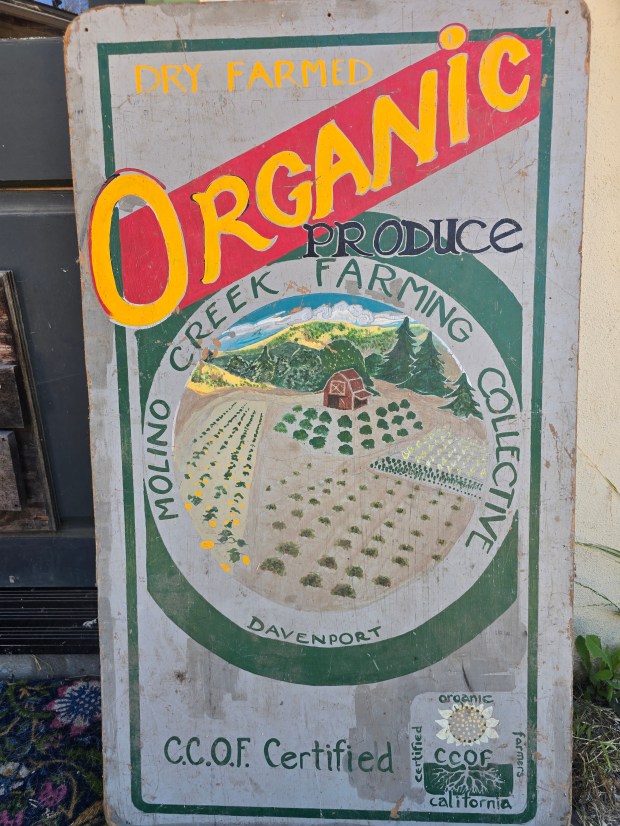
Amazing array of food being grown right now at Molino Creek Farming Collective

Junuary’s Humdrum Ho Ho Ho

Wild azalea – the last flower of the season. Photo from a nearby forested seep

Dry farming in a wet spring followed by June Gloom brings weeds and big growth. Dressed like a hoer? Gloves, a sun hat, long sleeves and long pants – all necessary parts of the kit. Hoers are a most common sight nowadays in these expansive rich soiled crop fields. One might even sing “On the 4th day of Solstice, my true love brought to me four hoers hoing…etc”: every farmer’s dream! Late season rains make for extra germination of seeds that might have (in a ‘normal’ year) been left ‘high and dry’ in the dry farmed tomato and squash patches. The unusually late precipitation makes for crops growing big and fast, as do the weeds, which must have their roots separated from the soil lest they compete and use up the moisture. The most common weed in Molino Creek Farm patches: daikon radish, left over from cover crop let go to seed. Two Dog Farm has its own suite of pestiferous plants, a weedy amaranth being chief among them. Despite Santa’s continual bowl full of jelly Ho Ho’ing, these weeds are no joke.

We dub this drizzly, cold, and sometimes breezy month: Junuary!

Drippy Roadsides, Scooting Quail, Turkeys (redux)

When dew and mist hang heavy from every grassblade and shrub leaf, there is no place for quail to go. They must stay on the road to avoid hypothermia. So, we drive or walk slowly watching the ground birds weave and scuttle trying to find a dry path off the gravel road. The first baby quail emerged in the past week or so; the oldest hatchlings are able to fly already. Nervous quail parents try to herd their frenetic fluffball chicks one way or the other but they sometimes scatter anyhow. It takes quail parents a long while to gather their covey once it flushes. High delicate peep peeps whine from under bushes, hoping for the deep cluck cluck of parents calling them back to their nomadic homes. The adult quail would love it if the babies could take to the air especially for the night roost up in thick trees farther from marauding predators.

We look for turkey patterns, anything to make sense of what these large birds are up to. One group of turkeys has 2 adolescents, ¼ the size of the rest of the flock, which has 4 females tending to the emergent young: thanks, aunts!

Some small percentage of Ceanothus thyrsiflorus, blue blossom, survived after an epic seed flush due to the 2020 fire. Those that didn’t survive are now a world of kindling for the next wildfire.

Fuel, Fire

What does one do to prepare for a Super El Niño? The 2020 CZU fire was spurred by remnants of a hurricane which started fires across much of the State. Hurricane predictors have warned to expect many more hurricanes this coming season in the Pacific…so, chances of a piece of hurricane hitting California in the middle of our dry, dry summer are increased. I recently surveyed Molino Creek Farm’s and nearby Bonny Doon’s fireshed: it is ripe to burn. There are miles of dead and damaged trees dropping bone dry limbs onto the awaiting dead shrub understory. The Ceanothus that came up after the fire is 12’ tall but only one in 30 of the shrubs survive, leaving stacked dead shrubs with lots of air between them: a legion of kindling to light the shed limbs and dead trees. Terrifying. It could happen this summer. That next wildfire will not be like anything anyone alive has experienced in the Santa Cruz Mountains. When it lights up and the fire runs from north to south and if there’s any wind behind it, the fire storm will have enough momentum to head into the San Lorenzo Valley and possibly into UCSC and Santa Cruz. Beware Felton! 

The late gloom and drizzle helps…but, the heat waves aren’t normally until August with the two last fires leaping in the middle of that month.

Are we acting like we’ve got 6 weeks left before things are crispy and ready to ignite?

Scents

Freshly mowed grass and apples tickle our noses. The mowing has to happen, despite the grass still being green. It is green grass that gives off the freshly mown lawn smell: spicy/sweet and somewhat moldy. That delightful scent is everywhere as we drive tractors up and down every farm roadside. 

In the orchard, the surprising first scent of apples…at the bottom of the orchard, in the new Gravenstein apple grove. That type of apple has a distinct sour-floral smell and those trees bear early, which is why we planted a grove. It is the first year we’ll get many from those trees, and I’m looking forward to that harvest. Their flesh turns punky quickly, so timely harvest is key. Their waxy-semi-oily skin seems to be where the distinct almost skunky scent arises. What apple diversity we have!

In the forested springs and on creeksides through the mountains…the last of the wild azaleas are blossoming. A little more complex than jasmine but just as sweet, a bit dusty with a hint of orange-citrus. The scent caries a long way. The flowers are beautiful. If you haven’t caught them this year, you’ll have to wait for next: they might already be gone.

The next warmish night…should we ever have one…will make us smell tanoak pollen. Ugh.

Sounds

Marty’s recent stay in the Barn reminds us of the noise of chorus frogs from the cement pond. Those noisy amphibians call through the night and us locals apparently have put that sound out of mind. Ear plugs are necessary for guests to allow them to sleep past the nature noises.

As the fog lifts, when it lifts, there are zephyrs and slight gusts. Muted long drippy mornings are interrupted by a sudden rustling of leaves. A dust devil appears with a whoosh next to you on the road.

The quiet nights carry wave roar, echoing loud sets interspersed with patterns of fewer, smaller waves.

The lowing of cows on the prairies far below the farm.

Hoots of great horned owls.

Molino Creek Farm lies down below these chaparral covered ridges and beyond it, fog and the Monterey Bay.

Tranquility

Most days there are two daybreaks. First, illumination transforms the dark night of the fog-hidden slight moon. Much later, it brightens again to blue sky and sunshine. Every morning is chill: the kind of damp cold that necessitates thick socks, sweater and jacket. Most want a shared lament, “How’s it going?” “well, the darned fog and cold and where is summer!?” Some of us still smile. “Ahhh! The cool fog!” “Glad there’s no wildfire!” We are grateful for wonderful wet smells, easy on the nose, deep breaths of fresh air.

Droplets glint from leaf tips, spider webs, and fence lines. Slightly muffled fog drip patters through tree canopies tumbling to make dents on the dusty ground. I join the quail and other birds to avoid wet weeds, wending our way along the trampled short-grassed pathways to avoid getting soaked and cold. The quail covey scratches and struts, making low whistles, talking. I gaze at them, at the distant alert-eared deer, at the obscured horizon, dark ridges and trees, there and gone again in the procession of low gray clouds.

Seedeaters

The farm is teeming with seed eating birds. Finches and goldfinches, juncos and sparrows. A roiling, chirping wave of songbirds retreats, keeping a comfortable distance from cars on the road or walkers sauntering down trails. There are shrill begging young birds and calmer chittering groups of adults. Most are intent with continuous beak probing of turf, pecking and scratching, sometimes lighting on low branches for breaks, polishing their dusty bills.

Hoes Out

As the young crops continue to mature, it is weeding time. Up to a half dozen people on any given day are hard at work obliterating unwanted pests, eyes bent on the ground, precision hoeing, thousands and thousands of plants uprooted. Success looks like a blanket of wilting plants, shriveling into dry crispy leaves and fading into nearly unnoticeable skeletons. Only the bindweed resprouts in the dry farmed deeply dusty fields but the irrigated fields will continue to flush new weeds for many weeks to come, complicating time budgets with both harvest and maintenance.

To Market!

We took food to the downtown Santa Cruz Farmer’s Market today, first market of the season. After months of tending with no cash flow, things are starting to pay off. Sunflowers, zucchini, and maybe some lemons…much more to come, more every week for a long while yet.

The beginning of the return of the Barn Party

Camp Molino aka Boomer Fest

From its founding in the early 1980s until the mid 1990’s, there was a traditional barn party at Molino Creek Farm. After a long hiatus, the event returned this past weekend. A slow trickle of incoming visitors wandered onto the farm. New generations followed older returnees. So many fine greetings, hugs and smiles. Tents colored knoll and meadow. Groups and gaggles wandered the farm, laughing and talking. 

Many joined the Community Orchard working bee. Then, a prolonged after-orchard-work-party melded into dinner followed by divine, deluxe rock and roll, dancing in the barn. It was all lit up and alive, booming bass and melodic electric guitars so expertly played.

The next morning was slow and the day brought more farm walks and friendly chatter before people returned home and the farm was quiet once again.

Molino Creek Farm Community Orchardists hard at work on Citrus Hill

Orchard Progress

The large gathering resulted in an amazingly good volunteer turnout to tend the orchard. The group took on summer maintenance of 105 trees on Citrus Hill (see photo). First in the progression, a group pruned up trees so the next in the progression could rake out the dry spent leaves (wildfire damage prevention) with the weeding team close behind them. Others cleared plastic irrigation risers and some harvested lemons. We have never achieved so much in such little time. This, one of three blocks of trees, is looking so very good.

Elsewhere in the Trees

The apples are turning red. The first trees to greet you when you walk into the North Orchard are the Gala apple trees. Their cheery red fruit create the quintessential festooned apple tree forms starting this past week and on through late September during harvest. There are not too many fruits this year: the trees spent themselves last year and are taking a bit of rest. Still, there will be enough “Fruit for the People!” The juice will still flow.

-this simultaneously published on the Molino Creek Farm webpage

Suddenly Crickets

The long days have become warm. Some people were even growly about the chill, the fog, and the drizzle that have become our most frequent visitors as this long Spring crescendo slowly approaches Summer. The complaining people were particularly happy about today, and tomorrow will even be warmer. But this cool, moist spring has spread a vibrancy rarely seen across California’s central coast. The biggest grasshopper I’ve ever seen around here plopped onto the ground in front of me today and tonight the crickets have at last begun the summer’s starlight orchestra. The warmth of the day quickly fades as the night grows dark, and cricketsong wanes, replaced by a rare silent night, peculiar to the particularly cool spring. There is no wind, no echoing waves, no trilling crickets, and only a few sporadic hoots exchanged by scattered great horned owls.

Late Morning, Fog Dispersing

Sunny, bright sunrises are rare. Mostly there is the muteness of first light, glowing through dense fog. Wet grass. Puffed up quail sitting in pairs, barely moving. Slow motion rabbits tentatively beginning their daytime nibbling. The sun brightens, the fog grows thinner, and gradually bird songs escalate, becoming more diverse, varied, louder. The first bright rays carry sudden warmth, sending birds into the sky: hawks soaring, ravens patrolling, swallows chattering, swerve. The purple martins carry such huge wads of grass to line their nest cavities that they can barely fly.

As the sun takes full charge, it evaporates the dew, and a young coyote yaps and howls first from the forest edge, out of sight. She seems dissatisfied with her vantage point and trots out into the middle of a field to yowl and bark some more, glancing furtively about after each vocal session. This sets the neighborhood dogs to barking, and our coyote friend glances over her shoulder, seemingly annoyed at her domestic cousins’ primitive and unmusical repetition. Eventually, she moves on, and the morning noises go back to being dominated by bird song. Noon approaches.

Contrast of mowed, green and unmowed, brown

Drying

At every glance, there are contrasts between drying and still wet, gold versus green. Where we passed once with a mower through a grassy field, the cut area evaporated less water and is still wetly green whereas the surrounding tall grass absorbed the soil moisture and is already drying. Five foot tall tawny grass stands or falls over, crisscrossing, heavy with seed. A million things are hidden in that meadowy mess: snakes, rodents, bugs, spiders, and bird nests present a gallery of surprises as I collect native grass seed for restoring areas of the farm. The seed must dry in paper bags to be stored until first rains, to be tossed into the footprint of prescribed fire or along the tracks of mowers.

Vetch is flowering in our fallow fields

Flowers Still

Despite the drying, it remains a very floral spring. Different types of vetch have only just entered their peak bloom. Poppies are in full display, big orange patches, rabbits eating their flowers. Monkeyflower is also in peak color, whole hillsides glowing peach-orange. Nearby, the post fire chaparral giant yellow bush poppies are blossoming, creating a peculiarly sweet, cucumber scent. That chaparral air is thick with resinous blueblossom odor accentuated sometimes by the bitter-sweet yerba santa, which is displaying clusters of lilac flowers. The forest understory is bejeweled with rosey globe lilies, bobbing and lush. The last native iris flowers are fading.

Ah, the promise of Lapins cherries for late June (nets up soon!)

Fruity Promises

The orchards are producing ripe citrus while thousands of other fruit grow marble- to golf ball-sized. We compare different types of navel oranges, contrasting them with Valencia, complimented by sweet Honey mandarins. The last of the limes are coveted. In the apple orchard, the fruit has set and is rapidly growing; it is fruit thinning time! Some of our apricot relatives are thickly laden with young fruit. The bigger patch of Lapins cherry trees will soon need netting. We peer into the canopies of avocado trees, hoping to glimpse at least some fruit set; last year was grimly non fruitful…these trees are notoriously unpredictable.

Watering

To keep the fruit fattening, we have started rounds of irrigation. That routine keeps us on our toes, especially the first cycles of water flow as the need for repairs are numerous. Inadvertent mower damage, winter rodent gnawing, or just plain mysterious breaks makes for geysers, gushers, and pouring leaks that must be detected before large tanks are drained. We seek leaks by noise more than sight. This was the first week that water flowed to most orchards as well as the 2 Dog vineyard. The irrigation will run through November, tens of thousands of gallons each week…mostly pumped silently by solar power. Irrigation efficiency has us using around half of what would be considered normal, let alone that a sizeable portion of our produce is dry farmed with no irrigation at all!

We are looking forward to the summer…and hoping not to get Too Much Heat (or fire!).

Dry, tall grass – a tangle that includes Calfifornia brome grass for restoration seed

Fog, and Fog Lifting

Tall black burned tree trunks hazily emerge into view through the thick fog. Days upon days of fog prevalence make many scenes more mysterious. That eerie scene of black tree poles joins other fog-induced memories this past week: puffs of blowing dense fog hiding and then revealing drippy, dark groves of live oaks; awakening to a wall of silver cloud obscuring everything beyond the window ledge, and one evening’s approach of fog…suddenly pouring over the farm’s western ridge and down the hillsides towards the farm like a wave of terrifying suddenly-released floodwater. Each morning every spider web is illuminated by silver moisture, every leaf and blade adorned by shiny droplets.

Us Moist Critters

The dawn bird chorus is delayed and the songs fewer because all animals are made chilled and sleepy, enveloped in low clouds. The brush rabbits shake the wetness from their pelts between bouts of meandering nibbles. Extended families of quail wander slowly along roads to avoid vegetation soaking their feathers. In the absence of bird song, there is a more peaceful constant patter of dripping. Sweaters, jackets, and long pants are in order for spending time outside. The richly humid air makes breathing feel refreshing and helps accentuate late spring farm scents.

Peak Perfume

The transition between spring and summer is the season of peak perfume. Eight foot tall bolting poison hemlock emits its telltale dusty, bitter odor, which carries far in the fog-moist air. When the clouds lift and the day warms, sweeter, resinous scents are released from the sage, coyote brush, and fir. Fresh-cut-hay smell is omnipresent across the fields and down the roads as mowers constantly challenge the burgeoning grass. Warmer days bring surprising clouds of sweetness, begging for a pause to ponder the origins of scent: madrone, French broom, lilac or lupine could be the source, but maybe there’s something new to discover. I squint to the distance, upwind for patches of flowers, then shift my gaze closer to see if there are bunches of hidden flowers. There it is! –  clusters of tiny poison oak blossoms sparkling with nectar and wafting notes of clove and citrus.

Fog recently drapes the ridges surrounding Molino Creek Farm

Drying

The drippy fog does little to keep the inevitable drydown at bay. Deep soil cracks split and widen. Dust cakes vehicles and brush along the roads. This is the first week that the farm must irrigate everything or the plants will wilt and begin to die. The solar well pump runs continuously and the diesel generator will start shortly to push greater volumes of water to the grapes and storage tanks. The summer pattern of orchard watering commences: zig-zagging across acres of trees, digging 8” deep into the soil to test moisture, adjusting irrigation strategies, turning valves, recording data, monitoring storage tanks, and communicating between many farmers to assure smooth operations. For now, cool days keep this work less hectic, but one eyes the forecast and makes plans for hotter spells.

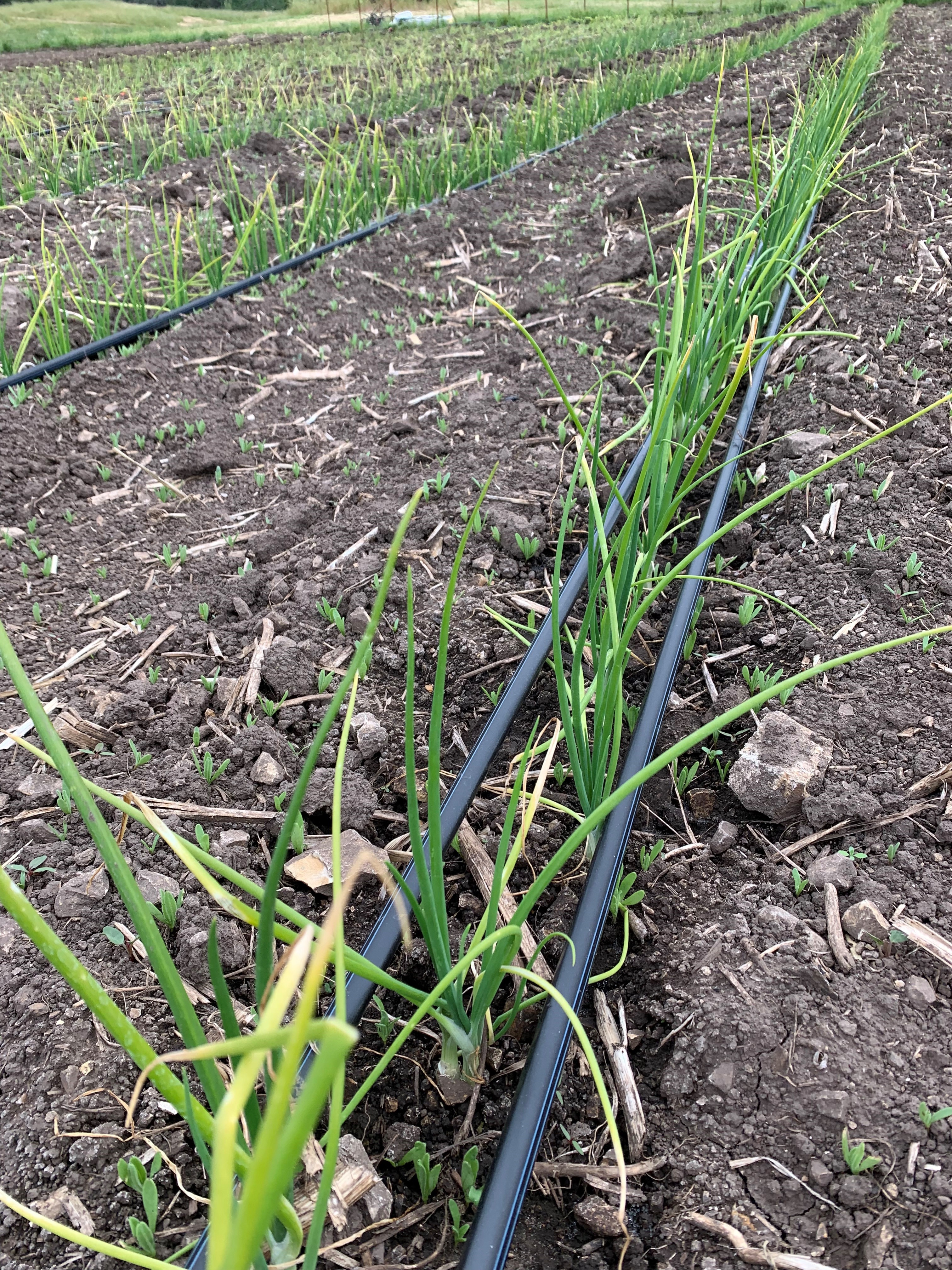
Molino Creek Farm’s amazing onions, freshly planted and regularly irrigated

Snakes, a Month Late

April is normally snake month, but the cool, wet start of this season delayed the emergence of our slithery friends. Sylvie and her brother Isaac reported a surprising night time rubber boa, crossing the road despite the drippy fog. Smooth, fresh snake tracks cross the dusty roads, always wisely perpendicular. An irate hissing baby gopher snake lunged at my leather gloves from a patch of freshly pulled weeds. We are constantly surprised by scaled creatures jetting away from disrupting orchard management: a swift yellow-bellied racer snake, head held high, escaping…giant alligator lizards making for safer ground away from hoeing. Wherever we look there are oodles of lizards and snakes, an homage to organic tilth, the diversity of plants, and the wealth of prey that result from good land management the collective respect for nature found at Molino Creek Farm.

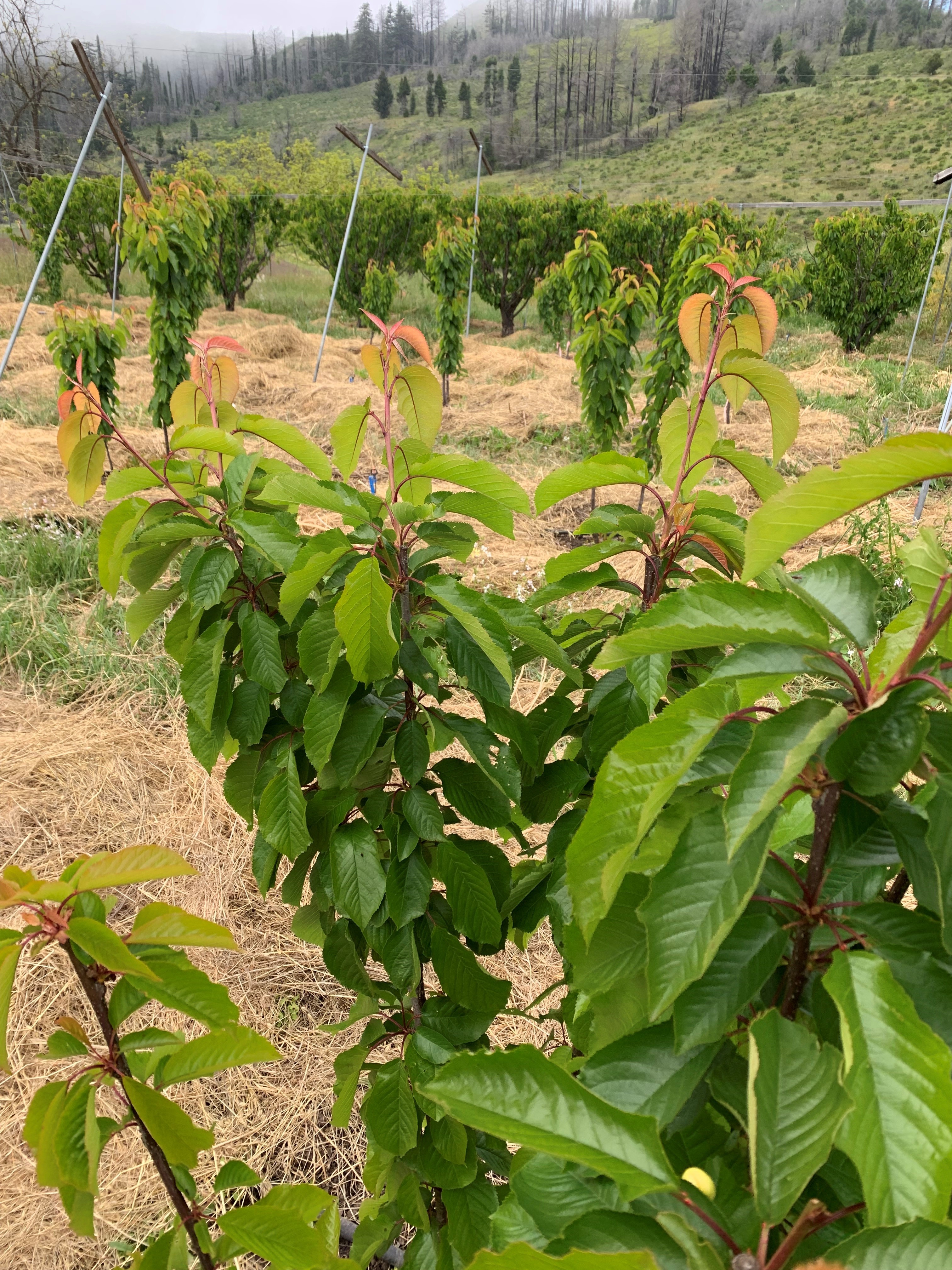
Cherries, lushly growing with irrigation and nestled in fog drip

An Unusual Dreariness of Spring

Drizzle and fog surprised us this past week as dew-covered wildflowers blossomed, buried in tall soggy grass. The weather forecasters had said it would be sunny, but something changed and suddenly the outlook went to partly, and then mostly, cloudy. Gusts blew tiny misty droplets against the windows. Trees caught the mist, making showers in rings, illustrating ‘driplines’ on the previously dusty roads.

Drying

But the mist and drizzle were not enough. The soil is drying. The 2 inches of late rain two weeks ago can no longer forestall the normal drying of our Mediterranean summer. A day of stiff, dry winds from the north wicked away the moister 2” down into the soil and the drying keeps reaching deeper. The long days keep the plant transpiration pumps pumping. The prairies won’t be green much longer. The orchard trees need water starting now.

Eye Hurtingly Beautiful

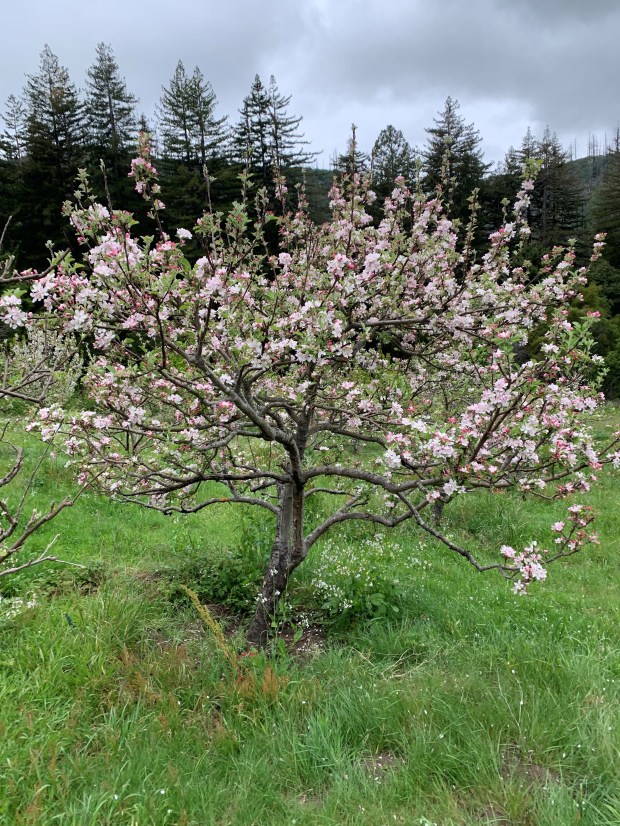
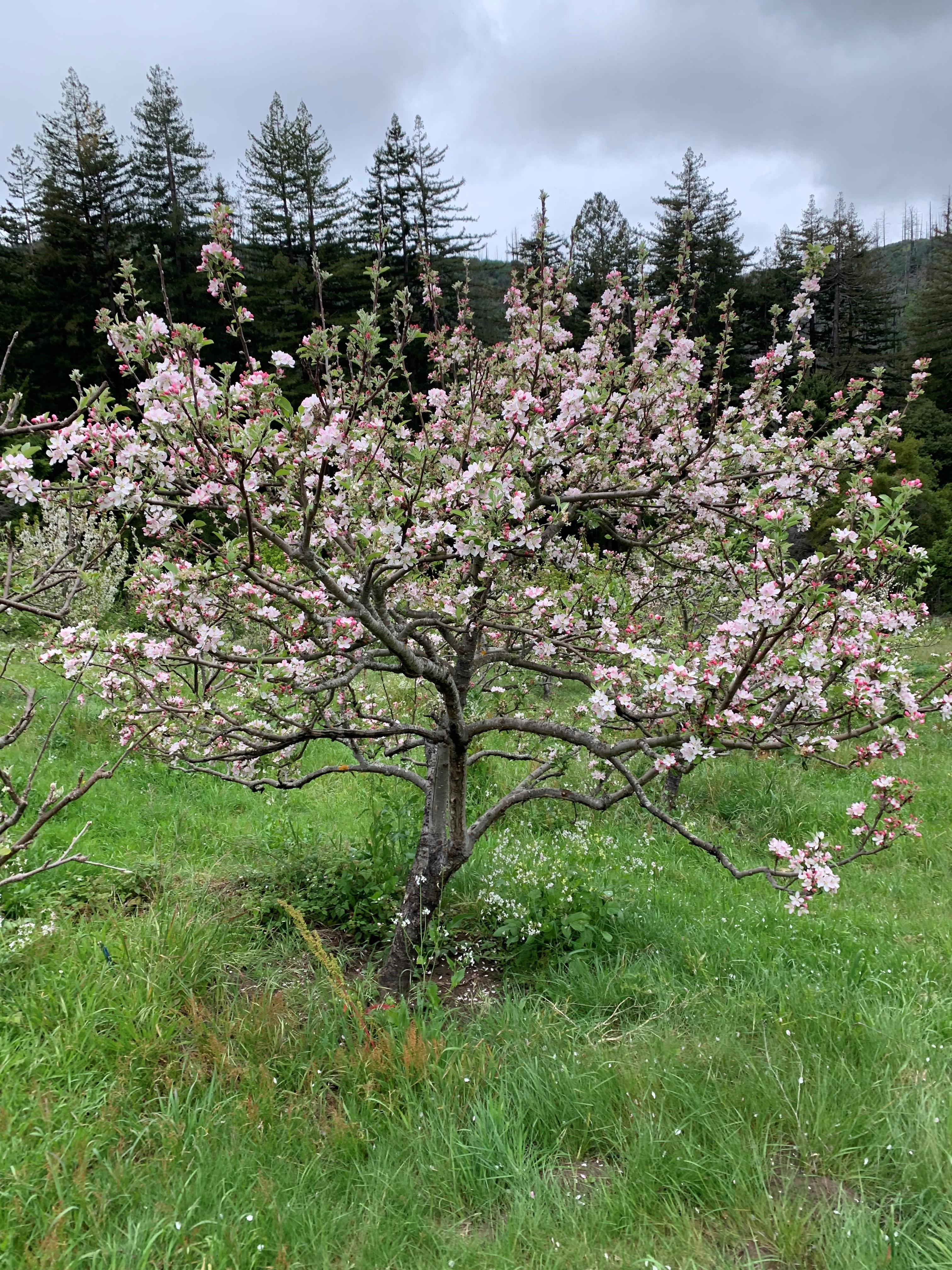
The flowers bursting forth in the apple orchard are stunning. Artists! Ganderers! It is time to bask in the dizziness that only a grove full of apple blossoms can impart. Sauntering around the farm, I take what I expect will be the normal short tangential turn into the apple orchard. Soon, I am stumbling around, not paying enough attention to footing, going from tree to tree, from one palette of pink and white and red blossoms to another, slightly more white or slightly more pink…some petals more lush, some clusters more diffuse…some flowers displayed in widely spaced massive shelf platforms…others arranged in small, tightly spaced clusters of polka-dot-like puffs for long distances along branches. Petals falling like snow on the breeze. Pale green points of new leaves poke forth from buds. Lush grass and flowers in understory tufts. Bees, hummingbirds, and flocks of tiny peeping juncos dart and dance with the beauty. An hour later, driven out by the dwindling daylight, I emerge from the orchard bedazzled and grinning from the ‘short tangent’ of my evening walk.

Soil Fields

In stark contrast to the orchard full of life are acres of brown, tilled ground. Life there is under the surface among clod and crumb where worms and millipedes and a million tinier things wriggle and crawl. It is cool and damp below the plowed surface where no plant now grows. We conserve a winter of rain by making the top foot of soil into mulch, and it takes a lot of turns of the tractor to make that happen. And so we set the stage where the drama of dry farming tomatoes is starting to take place.

First Tomato Day

The greenhouse grown tomato seedlings are tall and lanky and so take delicate hands to carefully place them in holes dug deep through the loose, tractor worked ground. The first seedlings went in the ground today, April 24, 2024! There are so many more plants to nestle into their homes. The big empty fields fill slowly, thousands of deep knee bends, hours of meditative labor, months before getting any income from this year’s crop. Such is the gamble and the hope.

Our First Ground Squirrel

Ground squirrels have been spreading across the landscape. They probably were here before and probably were effectively poisoned out when poisoning the landscape was in vogue. A single ground squirrel bounds across the road into various hiding places down by the big walnut tree many times a day, seen by many people. This squirrel is a keystone species for our prairies, making deep burrows that are critical for other creatures to make it through the hot, dry summer, and through fires, too. Burrowing owls need those holes for nests. Golden eagles’ and badgers’ favorite food is ground squirrels. Ground squirrel burrow complexes also may assist with groundwater recharge. The squirrels make habitat for wildflowers as they graze down invasive grasses. Bubonic plague is ubiquitous in ground squirrel populations, too! And, they undermine houses and roads with those burrows. Farmers and ranchers think of ground squirrels as pests for eating their crops. What are we to do with this first explorer of an astronaut squirrel?

The Individuality of Trees

Just as every apple tree has character, the live oaks too show individuality. We are fortunate to have several groves of live oaks on the farm that survived the 2020 wildfire. One grove thrived because we had mowed around it and then were vigilant with wetting them with fire hoses when the fire raged – it was too close to the barn and other buildings to allow it to burn. The various trees of this grove are displaying the range of traits typical of coast live oaks. New leaves are flushing: these ‘evergreen’ oaks nevertheless mostly replace last year’s leaves around now. The fresh leaves are emerging at different times and in different shades of green, depending on the individual tree. Some are already in bloom, long pollen bearing tassels waving in the wind. Other trees haven’t shown any blossoms yet at all. The lush new growth is forming densely green, bushy canopies, These deep-rooted trees will continue to be that kind of vibrantly alive for a few more months…long after the grass has dried brown.

Lupines!

Each year, as a result of our careful stewardship, we get more and more sky lupines. This year is the biggest year yet. Patches of sky lupines are mostly mixed with California poppies. There is something so very right about the mix of wide-petaled, fiery orange poppy flowers mixed with lines and waves of spikes of whorled blue-and-white lupine flowers. It hasn’t yet been warm and still long enough to get the grape bubble gum scent clouds emanating from the lupine patches. Between these fields of wildflowers and the orchards full of blossoming trees, the bees have lots of choices. We are glad they are getting enough food to grow big families on our farm, a haven for pollinators.

Changes Slowly Emerging

The calendar says it is almost fall, just a couple of weeks away. But, the temperatures and dryness suggest it is more like midsummer. The days wake up mostly sleepy, fog having rolled in during the night. Everything glistens with dew in morning’s first light. Sunrises are muted with tones of gray and silver across the shadowless and chill landscape. There is no dawn chorus, only a few peeps when the birds warm, late. The morning crawls on as the fog slowly breaks. It brightens more, bit by bit, until there is mostly blue sky by about noon. Then, barn swallows take noisily to the sky. The afternoons slowly warm until the sun gradually fades, a shadow line edging across the fields as the sun disappears behind the ridge to the west. This past Friday, the fog was so heavy and long lasting that it drizzled enough moisture to wet and settle the road dust.

Pattern Recognition

Last year, we would have been about to get our first inch of rain. That September storm produced what we call the germinating rain, and the early timing was extremely unusual. After that, there was another Big Storm in October – more expected timing. A bit later, all heck broke loose in December through January when we got atmospheric river after atmospheric river. None of that was predicted. In fact, as late as October, our national weather service climate scientists were saying it was going to be a dry winter, a La Niña situation! Right now, those same experts are saying there are strong El Niño conditions and that there is a 95% chance of those continuing through February of 2024. Compared to the last 12 years of data, this year looks comparable only to 2015, a year that brought some hefty rains to our part of California. With last winter’s deluges fresh in memory, it is easier to prepare though the really rainy times should be months away. So, we are able to chip away at the chores: an armload of firewood here, a bit of road drainage improvement there.

Nature’s Patient Changes

The nature around us also patiently transitions. The monkeyflower bushes leaves fade from top to bottom from their sticky dark glossy green to a crisp and withered black. This year, even those drying bushes still sport flowers feeding hummingbirds and bumblebees as they make their daily rounds. Madrone leaves and shreds of bark fall bit by bit, day by day, refreshing a layer to keep the footpaths only a bit crunchy. The grass, once shiny golden as it started to dry, is now almost gray with age, falling over and covered with dust. It will bend still until it is all in broad arcs and pillows in the unmown areas. The mounds of dry grass resist herbivory in that elevated state. In areas we mowed and the chopped grass touches the ground, herbivores feast on hay: insects, mice, and gophers are fast eliminating this year’s productive crop. Crickets in particular are having a good year.

Cricket Families

The night walks reveal new generations of crickets alongside the older, bigger adults. There are many sizes of crickets from the tiniest of young to sub-adult adolescents to honking adults. The adults are surprisingly large, especially the black field crickets which are the bravest, barely moving from the examining beam of my flashlight. One large adult sings from every 3 square yards, and I haven’t seen two of those large adults more in proximity, so from whence the young? Ah, something more to learn…

One of our many odd comice varietie- all ripening differently though contiguous

Abundant Life

Life’s young are growing in other species. Coyote parents follow their adolescents’ lead for the yelping chorus. Judging from their plentiful and frequent scat, they are enjoying scavenging lots of farm fruit. Momma deer has two growing young in tow; they might not realize that she is pregnant again and so will share the space with a new sibling or two before very long. It has been a few weeks since I saw the latest puffball young quail, and there are currently huge groups with lots of curious nearly grown young learning the techniques to avoid being the meal of so many predators. Those quail groups are so large as to seem to flow like liquid from bush to bush as they shuffle and scuttle through their days. Tiny fence/blue bellied lizards have recently emerged, inch long babies that are much more energetic and jumpy than their older counterparts. They leap impossible distances and dart down holes at the slightest movement. There are no intermediate sizes, so a simultaneous hatching seems logical. Medium sized snakes, now that’s a thing! Foot or so long gopher snakes share paths with similarly sized yellow bellied racers. I wouldn’t want to be a mouse right now given the snake abundance.

Organic Gala Apples Hanging Heavy, Soon to Pick

Fruit Developing

The fruit are also growing up. This past week, we reached the saturation point for pears: there are 60 pounds of pears sitting under one comice pear tree waiting to be scavenged; more pears are on their way with boughs bending under the weight of so many fruit. The Gala apple crop hangs heavy, too, and has just started gaining its peachy blush that indicates ripeness. Fuji apples are farther behind, still green with the slightest of red blush just appearing where the sun hits the fruit.

Organic Fuji Apples, a ways off… until ripe!

Noticing

Fog, then sun, then night…fog ebbs and flows. The recent super blue moon fades gradually, night by night. The Milky Way gains prominence. The roar of waves crashing creates the baritone and bass notes of the cricket-filled soundscape of Molino Creek Farm. Long still nights beckon sleep. The first subtle light of dawn is the call to chores abounding. Each day flows into the next, an unending cycle of light and dark, coolness and warmth, and the chance to curiously glance up to see who else is watching the play of light as the sun travels the sky’s glorious arc.

I hope you are.

For Fruit’s Sake!

The Longest Winter

Through late last week and into this one, waves of unseasonal rain kept sweeping across the sky: shower after shower, sheets of drizzle, or a splattering of only a few big raindrops. It was mostly cold rain, and any remaining heating firewood is gone – the longest, coldest, rainiest winter in memory. Wearing sweaters and hats inside, we wonder when the transition to summer will come. Perfectly reasonable people are now complaining about rain, even arguing with an emphatic, ‘enough!’ when reminded about the contrasting potential for heat, dryness, and fire. Some of us will never complain about rain again, but perhaps that’s just the indelible memory of dangerously close-at-hand wildfire.

The Scents and Sound of Weighty Fog

Is that fog now? The sky is still capped but ragged bright blue holes appear in the clouds by midday. The sounds of gusty winds mix with the echoing roar of big waves. The air smells sweet from vegetal spring mixed with salty ocean spray and dusty pollen.

At the end of the rainy period, before the winds, there was a still morning and both the canyons and ridges were draped in clouds. Dampness coated every surface, leaves glistening with droplets. I could hear the nearby waterfall song and a bit of the creek below. It was so peaceful. Then, <<CRACK, CRASH!!>> another big tree fell down somewhere near our boundary in the Molino Creek canyon.

Colors Splashing

Besides the spectacularly blossoming apple orchard, there are dots and pools of color popping out from the mostly grass-green landscape. There are striking large powdery blue patches of wild California lilac, both large shrubs that escaped the 2020 fire and a sea of smaller ones that emerged after that fire. Whorls of sky lupine flowers brighten shallow soiled nobs and ridges, aided by our firewise mowing. On the rare occasion that sunrays warmed their petals, California poppies open with their flame-orange shiny glow. It takes a curious eye and intrepid soggy walking to spot some flower colors: buried in the thick grass are hiding patches of blue-eyed grass, a miniature deep-blue-blossomed iris relative.

Hello Yarrow!

Standing up high among the tall grass, bright white patches of yarrow just started flowering. Like so much of the farm’s color, this one is a result of intention. In 2008, there was no native yarrow on the farm. But, there were a few patches of yarrow poking through the roadside shrubs nearby. In the dusty summer heat, we paced those roadsides, shaking yarrow seedheads into paper bags. Then, as winter rains approached, we shook the seed from those bags in the areas we were mowing for fire safety. Now, there is yarrow proliferating and butterflies alighting on their flat-topped pollen-rich platforms of white flowers.

Random Acupuncture

Everyone who is anyone is controlling thistles. On hikes and impromptu field meeting strolls, we pause to pound our heels into the ground, trying to uproot invasive thistles. When we stroll through anywhere that hasn’t been mowed within a week, we get poked by needle-sharp thistle spines. Italian thistle is the main culprit, but there are also pokey giant lush leaves of milk thistle with which to contend (in the moister spots). If we wanted to wait a bit to mow, there can be no more waiting – there is an urgency about the timing. Seeds will soon be forming then taking flight on thistle-down gossamer parachutes, creating next year’s problems.

Younglings

Baby turkeys, baby bunnies. The thick tall grass nearly hides the adults and completely veils their newborn young. Turkey young, too small to fly, struggle through dense forests of oat grass. They don’t have to venture far with tasty grass seeds presenting so thickly. They have already learned mother’s beak precision to pick individual seeds from grass inflorescences. At the boundary of shrubs and grass, tiny newborn rabbits are also gazing at their parents for lessons, from when to scurry from danger to what to eat and where. It is fattening time for coyote, fox, and bobcat.

Farming

The unexpected late soak changed the farming routine. We stopped our panicking irrigation setup, grabbed hoes and went to work on the easily removed weeds. The big field hoe pries giant radish roots from the wet soil. Glove protected hands yank clusters of grasses that grow too close to tree trunks for the hoe. Either way, hoe or glove, the spring has presented the opportunity for building forearm muscles and body core strengthening.

A new generator arrived and will provide backup power for our normally solar-powered well. The well has been mostly idle for months because of the rain, but soon will be running every daylight hour to keep up with irrigation needs. Should smoke shroud the sun with the onset of wildfire, we’ll need the generator to keep our fire fighting water replenished.

The sounds of powerful diesel engine tractor tilling, weedeater droning, and the lower growl of mowers fill the air most days. The early mornings and the longer evenings provide respites from farm noise. Then, the air is filled with spring bird song.

Stillness and Contrast

Stillness. The air barely moves, and each day darkens into hushed, unstirred nights. The still air phenomenon carries from one day to the next so that now it seems normal, almost beyond comment. It has been weeks since any kind of substantive breeze has blown across the farm. Fall leaves pile directly below trees. Dust hangs along gravel roads for long moments after a farm truck interrupts the windless tranquility.

Dark = Chill

Monday evening, the fog retreated offshore and bright stars twinkled by the billions in the suddenly clear sky. There had been days of fog, sometimes drizzly fog where subdued daylight was muffled by blankets of thick, low clouds. Downtown and at the farm, people stoked the season’s first wood fires to ward off the dank chill.

The chill and darkness combined with the harvest of many apples gifted us our first taste of reprieve from watering the orchard. Once trees lose their fruit, they aren’t as thirsty. This is especially welcome because we pump water with solar power, and there was no pumping potential with the days with such limited sunshine.

Solar powered well water – sustains our homes, orchards, and crops…so glad for good water!

Talon

How does the lack of rustling wind affect raptor hunting? The kestrel reels and screams. The Cooper’s hawk more stealthily turns acrobatically around trees and shrubs, sending our big quail coveys scurrying. Two red tailed hawks have little lift from updrafts; they sit on low perches hoping to pounce on nearby prey. The vultures haven’t been sailing by.

Placid nights echo across the landscape with many great horned owl hoots and barks. Owls scamper and hop on my roof through the night, scanning the rodent filled yard for their meals. Some neighbors suggest the rodent population has (finally!) started declining, but I’m less sure. There is a new, the first, bunny burrow nearby and a new bunny joined the last old and skinny individual remaining. Last year, there were 10 brush bunnies in that same space.

Ripening Harvests

Apples become ripe with surprising suddenness. We bite and compare: is this type ripe enough for harvest? Plewy- the arguments sputter! ‘That Braeburn is a week or more off!’ ‘No it isn’t’ ‘Here, try another one!’ ‘The skin is bitter and tough, its not sweet enough yet…look the seeds are still light brown’ We settle down and wait if anyone is adamant enough. Then, three days later, the Braeburn is indeed inarguably ripe. Same with the Fuji apples. Suddenly, when we thought there was a lull in the harvest and we’d have to skip markets…there are lots of ripe apples again.

Gone are the Gala, Jonagold, Wickson Crab, and Mutsu. Here come the Fuji and Braeburn! After those…we’ll get some rest: three more weeks of bigger harvests!

Meanwhile, 2 Dog Farm eyes its ripening dry farmed winter squash, increasingly coloring the fields. Squash with no irrigation?! Yes! Yummmm!!!

Two Dog Farm Dry Farmed Butternut Squash – the Very Best…and at the market soon!

Orchard Hygiene

A key to successful apple growing is keeping the orchard clean. Stand quietly in the orchard for 15 minutes even on these still days and…thump! There goes another apple falling from a tree. Quickly, the ground is covered with bruised windfall apples. Gophers drag the fruit nearer their holes, gnaw into the flesh, hollowing out the orb from below. Dwayne Shaw from Maine visited and neatly stacked the better windfalls in piles and we haul them to the press. He pitched the nastier ones into the wheelbarrow for disposal; soon, the barrow was teeming with yellow jacket wasps, which clean up the apples as quickly as possible. Those wasps also like to eat soft bodied insects, so mop up the apple pests, the core of the problem which spurs us to clean things up. Thanks waspies!

Chill Turns to Heat

With the clearing fog came a sudden heat. For weeks it barely crested 70F but today it was 85F. At dusk, toasty warm air wafted (slowly) in from the east. Crickets sing again this warm evening. Three days of warmth and it is time to water the orchard again. May the solar array help pump water once again!

The past 2 years have produced an October and then a November heat wave. The heat broke both years when the first real rainy storm soaked things on Thanksgiving. Will we wait that long this fall? It calls for sprinkles next week…fingers crossed! It would be nice to keep the grass greening and the fires at bay.