Only a bit on recent Farm highlights and then off on a tangent about production….

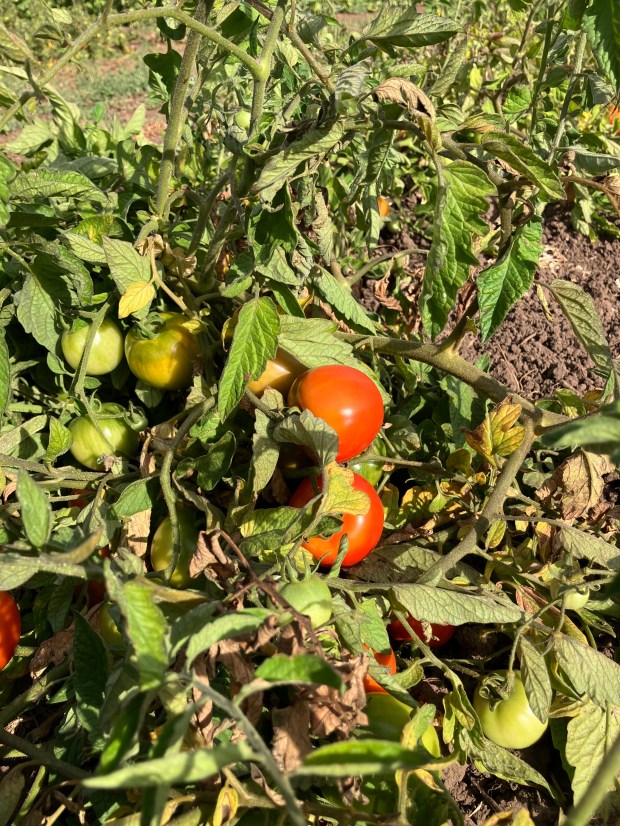
Fall is appearing across the farm- the wannuts and apricots are changing color! Tomatoes are also changing color- but for the ripening….lots and lots suddenly coming on.
Bodhi reports regular Great Horned Owl activity and another owl, with a screechy-noise…that is a whiny underaged great horned owl making its terrible youngster noise. He also reports the oddity of Bonny Doon skunks and opossums in the middle of the road on the night after full moon- whatsup with that?
Sylvie spotted an amazing coast garter snake wandering the grounds as well as a huge praying mantis in her beans.

Folks are taking home giant, 1 pound lemons as well as the last of the Persian limes and oranges….testing the first of the lamb haas avocados (are they ripe, yet?).
The hot weather broke and then we got cool weather, even drizzle. The apples are growing big- two more weeks before the harvest begins!
– The Aforementioned Tangent –
Recently, I’ve been wondering how to quantify the sum total of what is produced and processed on these Molino Creek Farm acres in terms of food, poo, and biomass. Here’s a summary.

Poo
One hundred thirty seven acres of land rich with wildlife makes a lot of poo, every year. The assimilative capacity of the land for animal excrement is astounding – otherwise, we’d be up to our neck in it! A pigeon makes 25 pounds of excrement a year, and I assume smaller birds some fraction thereof. Our farm has around 30 wild, naturally occurring pigeon-sized birds (band tailed pigeons and mourning doves) throughout the year. We have 140 California quail, say half pigeon sized. And, there are easily 80 goldfinches and 400 other small birds, mostly juncos, sparrows, towhees, etc…say one quarter pigeon sized. Bird feces on our land per year: around 6,000 pounds- 3 tons!
Furry animals vary on poo production. We have 10 deer year-round; a deer makes 1200 pounds of poo a year. A mouse makes 20 pounds of poo per year and a low estimate for our part of California is 10 mice per acre: 28,000 pounds of poo! (The whole wild world of the North Coast of Santa Cruz County smells like rotting mouse poo after the first rains.). Add in 50 squirrels (40#/year) and a low ball 200 gophers (30#/year) on our farm, and you get 8,000 more pounds of animal poo. So, our 137 acres of critters makes around 54,000 pounds (27 tons) of animal poo per year. That’s 4 dump truck loads! All of this poo gets assimilated into the land and helps to grow what we see around us.


Non-Animal Production
Our farm is a mixture of natural areas and cropland – each has its own story to tell in terms of production.
In terms of produce, within the 6-8 row crop acres and the 3 acres of orchards, we can make 12,000 pounds a year of a combination of apples, citrus, and avocados, 6,000 pounds of dry farmed tomatoes and 10,000 pounds of dry farmed squash…along with a few irrigated crops like peppers and onions. In the winter, the 25 acres of crop lands make another average 4,000 pounds/acre of biomass in cover crops: 100,000 pounds of biomass that gets tilled into the ground for extra fertility and soil building.
In the wildlands, there is still more production going on. Our 20 acres of redwood forest puts on around 1800 pounds of dry mass per year per acre, so 36,000 pounds. An additional 60 acres of shrubland and grassland makes another 330,000 pounds of biomass per year. So, wildlands are growing 366,000 pounds of dry biomass annually. Not all of that biomass represents sequestered greenhouse gases, but certainly some of it is. As our redwood trees get bigger, and as we help to protect them from catastrophic tree-killing wildfire, they will sequester more and more carbon.
Imported Additions
Farms often import soil amendments, and Molino Creek Farm is no exception. Some years, we bring in a couple of dump trucks of compost. Many years, we are adding feather meal or some other form of organic fertilizer to help grow food. Recently, we imported what looks like charcoal – ‘biochar’ – from the disposal of dead trees from the surrounding conservation land’s efforts to reduce future wildfire impacts. These inputs are not cheap and it takes time/effort to spread them where they need to go. And so, we like to rely more on cover crops than imported additions, but still our soil tests tell us we need to add some more nitrogen. Total pounds of inputs on average – around 35,000 pounds.
I would be remiss if I didn’t add that we do also import diesel fuel to run tractors, around 200 gallons per year. Our well water for irrigation is pumped via solar power to tanks and then gravity fed through water wise drip systems. The groundwater has to be seen as another ‘imported addition.’
Teeming with Life
The bounty of living things, the manure it creates, the human-captured or wild productivity, and the minimal imported farm additives is fascinating on this small farm. Another small farm has been popularly featured in the film “The Biggest Little Farm.” The film helps people understand what is possible with careful farm management working with wild creatures, growing organically. What do we compare these small farms with? City land? Conventional, large scale agriculture? Wild lands in parks?
I visit all of those other land use types and rarely do I see the kind of bounty that I’ve experienced on small farms that allow nature space and work with nature in the crop lands. If you haven’t visited Statton Island’s rice farms near Davis, California in November and December, you are missing a breathtaking experience – more birds than you would imagine could land in one place…big birds: cranes, geese, and many more.
I’ve also experienced the devastating effects of ‘other’ types of farming. A recent drive across the pesticide-reeking Central Valley had almost zero bugs smashed on my car, contrasting with 20 years ago where it was thick with insect spattering…what happened? Huge crop fields up the Salinas Valley are seemingly lifeless, just like farmers like…so they don’t have to worry about insect damage or bird dropping contamination.
How you spend your grocery money…who you support and why…can make a big difference in wildlife conservation. Why not make wise choices?

