Advocates for Wildlife Protection: Where?

When was the last time you heard about someone advocating for wildlife protection in our Monterey Bay region? Who was it? Why?

I am disturbed by the lack of advocates for wildlife protection and I wonder why that might be. Here are some reflections.

A Plea for Help

Occasionally, I find a need to call out for help for wildlife protection advocacy. My most recent call for assistance was a seeming ‘no brainer.’ There was a clear need for wildlife advocates to ask the State of California office of the US Bureau of Land Management to consider a science-supported update of their statewide sensitive wildlife species list. The one BLM has been using doesn’t protect a bunch of State listed wildlife species, as it should. And, the BLM is required to work with our State Wildlife agency to do just that. This is one of the most straightforward issues I’ve faced: the facts are easy to illustrate and quick to research. And so, I reached out to the obvious pro-wildlife advocacy organizations. Who comes to mind when I say that? Pause, don’t read on…think: who would that be?

The Sierra Club

If you are a pro-wildlife advocate, the Sierra Club seems a great place to work. Well, it could use some help. My pleas to the Santa Cruz Group of the Ventana Chapter of the Sierra Club went unanswered. The one or two in the group who are apt to answer such requests are totally stretched. A while back, the local club was taken over by the pro-bicycle lobby, a group that has little regard for wildlife conservation. It should be telling that Santa Cruz doesn’t even have its own Sierra Club chapter: the local one is a sub-group of the Ventana Chapter, based in Monterey where most of the pro-environmental activism has been traditionally located.

The Wildlife Society, San Francisco Bay Area Chapter

Another far flung chapter of an organization that is supposed to represent Santa Cruz County’s wildlife conservation concerns is the SF Bay Chapter of the Wildlife Society. Unlike the Sierra Club, this Chapter did return my queries. However, after a long wait they wrote me that they were uncomfortable advocating for this issue. They actually told me that they weren’t an advocacy organization, despite their website saying that they “work to ensure that wildlife and habitats are conserved” by “advocating for effective wildlife policy and law.” It seems like whoever is active in the organization right now is uncomfortable being advocates. Luckily, their parent organization was a much better help.

The Western Section of the Wildlife Society

Even more far flung than the SF Bay Chapter, the Western Section of the Wildlife Society was a great help. Their leadership, though obviously overworked, were enthusiastic and helpful with the straightforward request for assistance. They did due diligence and had adult conversations about the need for advocacy and wrote an amazingly strong letter on the issue. If you want to support a good (local?) organization for wildlife advocacy, this is a logical choice. Unfortunately, they probably won’t be proactively monitoring our local situation and helping out without us asking.

Audubon Society

Not so far flung, the Santa Clara Valley Audubon Society is very active and quite influential…just over the hill. When approached, their overworked volunteers can sometimes be enticed to help with local conservation. I have to give them a call on this one.

Land Trusts

The Land Trust of Santa Cruz, Sempervirens Fund, Save the Redwoods League, Peninsula Open Space Trust and others…clearly all competing with one another with no unified messages or strategy for region-wide wildlife conservation. Instead, they are as likely to be public-forward with pitches for increased recreation in natural areas, which runs counter to wildlife conservation. With this contradiction, none of these organizations are able to build credible coalitions to advocate for wildlife conservation.

Wildlife Biologists

I have long approached local wildlife biologists for assistance, with mixed results. This time, I reached out to a few and was surprised. What I was asking experts to do was to do a bit of analysis  so that their opinions about adding species to the BLM’s list were well supported. A handful of wildlife biologists said that they would consider advocating for this cause, but only if paid for their time for analysis. One biologist, Jacob Pollock, stepped up as a volunteer. Dr. Pollock is a steadfast advocate for science-supported wildlife conservation. He has an inquisitive mind and powerful analytical abilities. He deserves recognition and thanks for his wildlife conservation volunteerism. This is apparently quite rare. He will shortly offer up a methodological approach to updating the BLM’s State Special Status Wildlife Species list with an example from a statewide analysis of the rarity of American badger, including BLM’s contribution to its recovery.

The rarity of such volunteers was recently emphasized when a community organization contacted me to speak at a public forum considering a potentially wildlife-impacting regulation. I couldn’t speak and couldn’t think of another wildlife advocate to do that speaking engagement. Have you seen an inspirational wildlife conservation advocate who regularly speaks to local threats to wildlife and solutions for conservation?

Why So Few?

What has created this dearth of local wildlife advocates? We have no reliable analysis about what has happened. One day, maybe I’ll find the time to do some investigative work about what went on with the local Sierra Club. Meanwhile, I suggest that mere intelligent leadership in our community would result in that person getting elected to the Santa Cruz Group. However, that person would be lonely without a couple or three more such people to make a majority vote happen in favor of wildlife…and, a group of such volunteers would be necessary to pick up the workload for responsible advocacy.

Cost of living might have something to do with the situation. The Monterey Bay area is very expensive to live in, so wildlife biologists must work hard to pay their bills, leaving no time for volunteer work. And, when professional wildlife biologists do advocacy, they threaten some of their employment opportunities, so there’s further disincentive.

Parallels with Environmental Educators

If there are any social scientists out there, read this other post and compare the notes with this one – I think there are parallels. Besides wildlife biologists, why are so few environmental educators meshing conservation advocacy with their work?  Is it likewise the threat to income? Or, is there something cultural going on here? There might be some redundancy with this issue as perhaps a large number of environmental educators are also wildlife biologists.

What Are We To Do?

I heard recently that progressives might be getting some funding to support a revitalization to allow improved political campaigns in Santa Cruz. Perhaps there is a similar need in wildlife advocacy. It does seem that we need a new organization to advocate for wildlife in our region. How would one go about setting it up for success? I imagine it starts with funding the set up and also creating an endowment for some staff positions. The mission would need to be building a supportive, diverse, and active public. I am looking for such change.

-this post slightly adapted from the one published by Bruce Bratton at his impactful BrattonOnline.com blog site where there is often lots of good information from some brainy characters. A great source of news.

What Do I Want for Wildlife?

We might ask ourselves, “What do I want?” This important reflective question is a good one and becomes even more poignant in those moments of realization that we have limited time on Earth. There’s a fairly malignantly overused neural pathway of “What do I want?” used for shopping and consumption, but let’s try to dismiss that one and turn our focus on another. “What do I want” from the world around me, the world less likely to be affected by my purchases? For instance, ask yourself what do I want my experience to be when I go for a walk, or what do I want from the natural world: for the forests and streams? What do I want for wildlife? What do I want for my family and friends…for my neighbors…for my community? As we look outside of ourselves and express our desires for the larger world, we encounter our social potential: what can we do as members of a community? How can we influence the world to be a better place? Most people know that we influence those closest to us the most and come to know our circle of influence better with age. Some people work to broaden their circle of influence, some to narrow it. If we feel frustration towards the state of the world, we might explore politics at the local level to see how we grow our influence to make a better world. How does this work for what we want from Nature?

I Want Healthy Wildlife Populations

The majority of Americans want wildlife to thrive, to know that humans are well stewarding, even restoring, wildlife populations: this is something with which both liberals and conservatives agree. As I’ve addressed many times in this column before, that sentiment largely lacks evidence in local politics. Our City and County elected officials fail almost every time they are given a choice to better protect wildlife. We live in an area with a very high number of rare and endangered species, and those are only protected because State and Federal officials step in to enforce protections. How can this be the case with the local legacy of environmentalism and environmental education?

The “Teach Them and They Will Care” Fallacy

While people may say “I want healthy wildlife populations!” they apparently favor the sentiment of “I want money” as they keep electing pro-business officials who (mistakenly) believe that environmental protection comes at unacceptable costs to social welfare. And still, the local environmental education community unanimously embraces the fallacy that if you teach them about the environment, they will care enough to protect it. The corollary fallacy is ‘if you give them access to nature, they will care about nature and so nature will be protected.’ These are convenient fallacies because both allow the environmental education and trail building communities to raise funding from the wealthy, pro-business elite; that funding is crucial to keeping their organizations operable. With the “carrot or the stick” dichotomy for environmental protection, there goes the carrot. What about the stick?

Environmental Protection has Become Non-Local

Over the past 20 years, local environmental protection owes much to State and Federal legal ‘sticks.’ Twenty years ago, we made headway with environmental battles via the Coastal Commission’s authority to protect sensitive habitats at Terrace Point, the University, on City Greenbelt lands, and in State Parks. That agency has since abandoned its environmental protection arm, but the US Fish and Wildlife Service and National Oceanic and Atmospheric Administration have since helped protect what they could from a federal perspective. The California Department of Fish and Wildlife (CDFW) has only occasionally helped protect the environment on the Monterey Bay, more commonly turning a blind eye to environmental impacts that are clearly within their jurisdiction. However, even so, CDFW has done more than local authorities to protect wildlife. In short, we apparently respond more positively to ‘sticks’ than ‘carrots’ when it comes to caring for wildlife around the Monterey Bay. Ask yourself if this approach aligns with your political beliefs? Do you want more State and Federal enforcement of wildlife protections? Or, would you rather believe that people only need ‘carrots’ to do the right thing for protecting wildlife? If the latter, how do you see things changing, socially or politically, to make that happen? If the former, how is it that you are actively supporting State and Federal agencies who are using sticks to protect wildlife?

Uh-Oh, Wildlife Protections in State Parks?

A while back, Californians realized that State Parks needed better planning to protect wildlife. And so, politicians created a rule that every park must have a plan that addresses wildlife protection, even specifying that those plans have what is called a carrying capacity analysis. Carrying capacity analysis defines an approach to determining how to design park access so that wildlife populations remain healthy. Locally, because of repeated negotiations with environmentalists, State Parks has evolved its approach to such analyses, though they have more recently apparently given up on creating plans for parks, altogether. The General Plan for Castle Rock State Park illustrates how landscape architects very badly approached their mandate for good carrying capacity analysis. In that plan, planners who were inadequately trained in wildlife protection sharpened their crayons and shaded huge bubbles across the park, vaguely labeled as high, medium, and low intensity use. This vague and unenforceable planning conveniently allowed unbridled access everywhere. Now, visitors are degrading very rare wildlife habitat associated with rock outcrops and regionally unique wildlife habitat associated with a black oak forest. Because of the terrible approach outlined in the General Plan, an environmental non-profit was able to construct a visitor center in close proximity to these very sensitive wildlife habitats.

A Curious Evolution

Realizing that people wanted State Parks to do more for wildlife protection, the more recent General Plan for Big Basin State Park improved a smidge on their carrying capacity analysis. That plan well reflects the modern principles of analyzing carrying capacity for wildlife protection, but curiously falls very much short of being meaningful. The Big Basin plan rightly says that it is important to address negative impacts of visitors on wildlife by defining science-based thresholds which would be monitored and, if surpassed, would trigger management actions. However, the plan then (very curiously) fails to define such thresholds.

Aiding and Abetting

The same environmental group that built a visitor center precisely where it would be most likely to negatively impact the most sensitive wildlife habitat at Castle Rock State Park is now proudly advertising a similar approach at Big Basin. Instead of helping the People get what they want (wildlife protection), they are doing a great job of raising capital to support their organization through a campaign of increasing access to Big Basin without a viable method of protecting wildlife at that park. In such a way, the organization illustrates its embrace of the fallacy that increased access somehow increases wildlife protection. As you might suspect, this same organization also embraces the fallacy that milktoast environmental education somehow increases wildlife protection. They are funding the interpretive signs for the planned entrance at Cotoni Coast Dairies; the signs, no doubt, will fail to provide visitors with either the inspiration or information needed for them to take meaningful actions to improve the Bureau of Land Management’s stewardship of wildlife at that park. Wait and see.

What Do You Want?

As you consider Big Basin State Park, Castle Rock State Park, or Cotoni Coast Dairies, ask yourself ‘what do I want for the wildlife of these parks?’ How would you know that you are getting what you want? In no case will you, or the managers of those parks ever know…unless things drastically change. That change will only occur if enough of the right people decide that what they want is important enough to act. In the meantime, please know that all visitor use of parks causes negative impacts to wildlife. If we want to conserve wildlife in parks, it will take a new level of dedication of parks managers to perform adequate carrying capacity analysis, monitoring, and adaptive management. That dedication will only occur with the ‘sticks’ that are luckily available to the citizens who are willing to use them.

Fog, and Fog Lifting

Tall black burned tree trunks hazily emerge into view through the thick fog. Days upon days of fog prevalence make many scenes more mysterious. That eerie scene of black tree poles joins other fog-induced memories this past week: puffs of blowing dense fog hiding and then revealing drippy, dark groves of live oaks; awakening to a wall of silver cloud obscuring everything beyond the window ledge, and one evening’s approach of fog…suddenly pouring over the farm’s western ridge and down the hillsides towards the farm like a wave of terrifying suddenly-released floodwater. Each morning every spider web is illuminated by silver moisture, every leaf and blade adorned by shiny droplets.

Us Moist Critters

The dawn bird chorus is delayed and the songs fewer because all animals are made chilled and sleepy, enveloped in low clouds. The brush rabbits shake the wetness from their pelts between bouts of meandering nibbles. Extended families of quail wander slowly along roads to avoid vegetation soaking their feathers. In the absence of bird song, there is a more peaceful constant patter of dripping. Sweaters, jackets, and long pants are in order for spending time outside. The richly humid air makes breathing feel refreshing and helps accentuate late spring farm scents.

Peak Perfume

The transition between spring and summer is the season of peak perfume. Eight foot tall bolting poison hemlock emits its telltale dusty, bitter odor, which carries far in the fog-moist air. When the clouds lift and the day warms, sweeter, resinous scents are released from the sage, coyote brush, and fir. Fresh-cut-hay smell is omnipresent across the fields and down the roads as mowers constantly challenge the burgeoning grass. Warmer days bring surprising clouds of sweetness, begging for a pause to ponder the origins of scent: madrone, French broom, lilac or lupine could be the source, but maybe there’s something new to discover. I squint to the distance, upwind for patches of flowers, then shift my gaze closer to see if there are bunches of hidden flowers. There it is! –  clusters of tiny poison oak blossoms sparkling with nectar and wafting notes of clove and citrus.

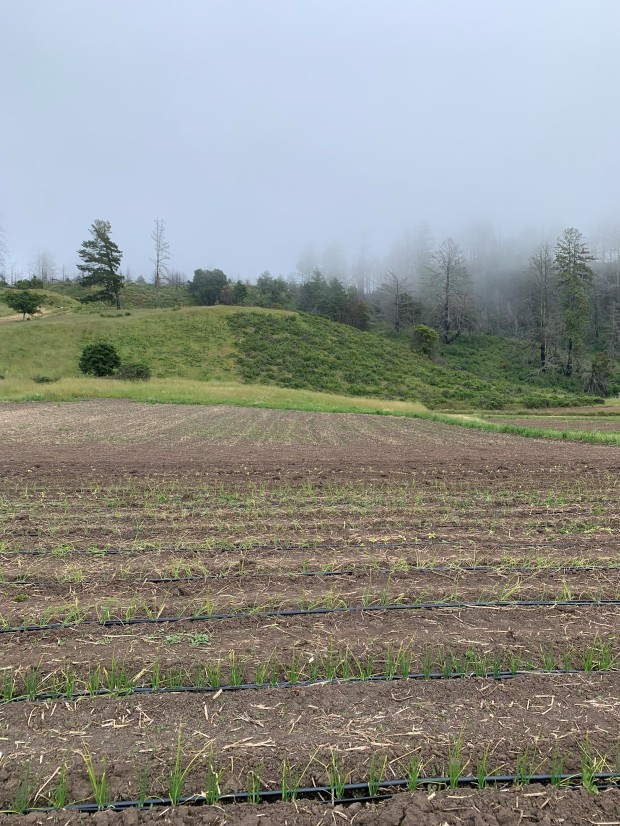
Fog recently drapes the ridges surrounding Molino Creek Farm

Drying

The drippy fog does little to keep the inevitable drydown at bay. Deep soil cracks split and widen. Dust cakes vehicles and brush along the roads. This is the first week that the farm must irrigate everything or the plants will wilt and begin to die. The solar well pump runs continuously and the diesel generator will start shortly to push greater volumes of water to the grapes and storage tanks. The summer pattern of orchard watering commences: zig-zagging across acres of trees, digging 8” deep into the soil to test moisture, adjusting irrigation strategies, turning valves, recording data, monitoring storage tanks, and communicating between many farmers to assure smooth operations. For now, cool days keep this work less hectic, but one eyes the forecast and makes plans for hotter spells.

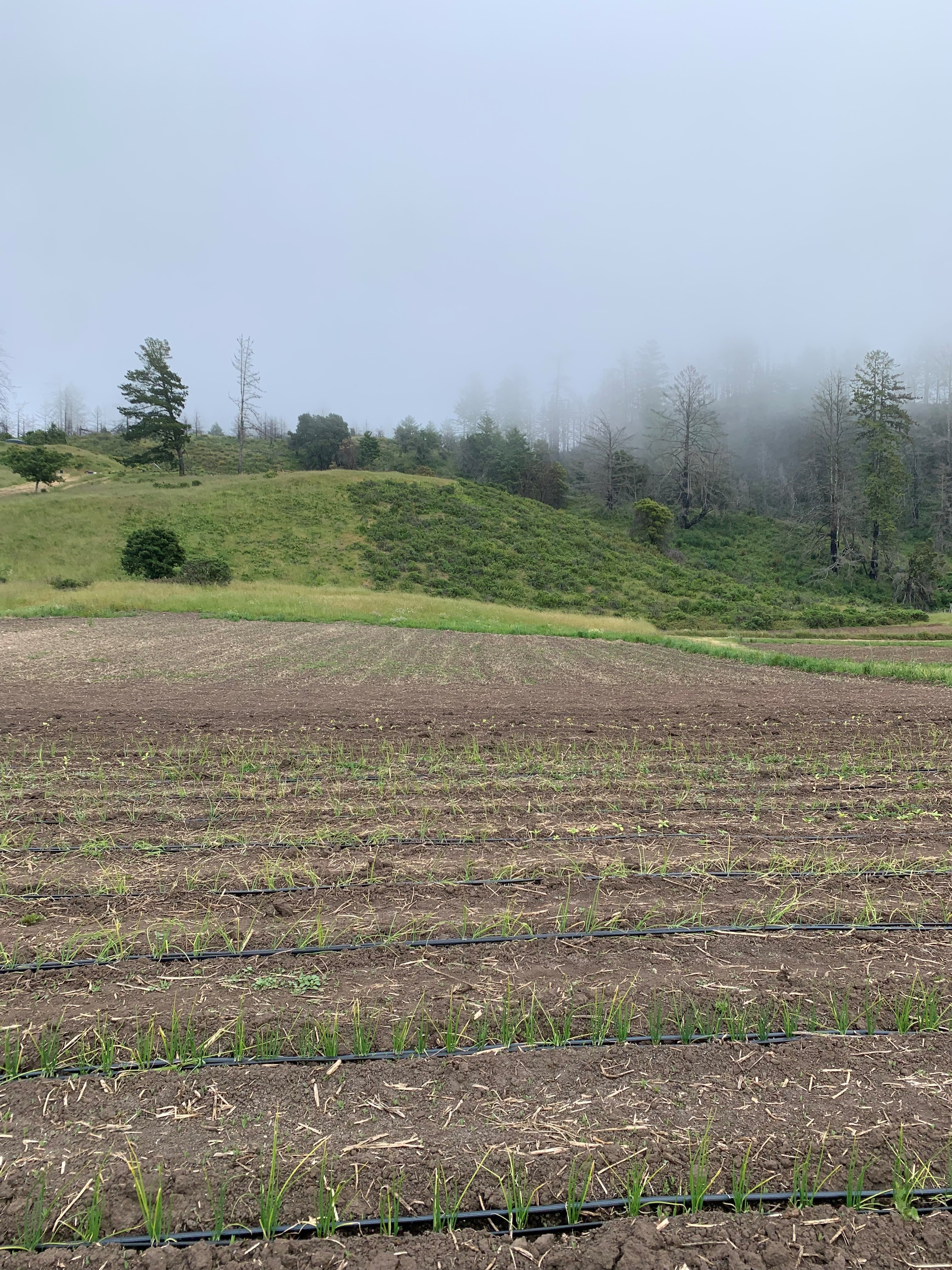
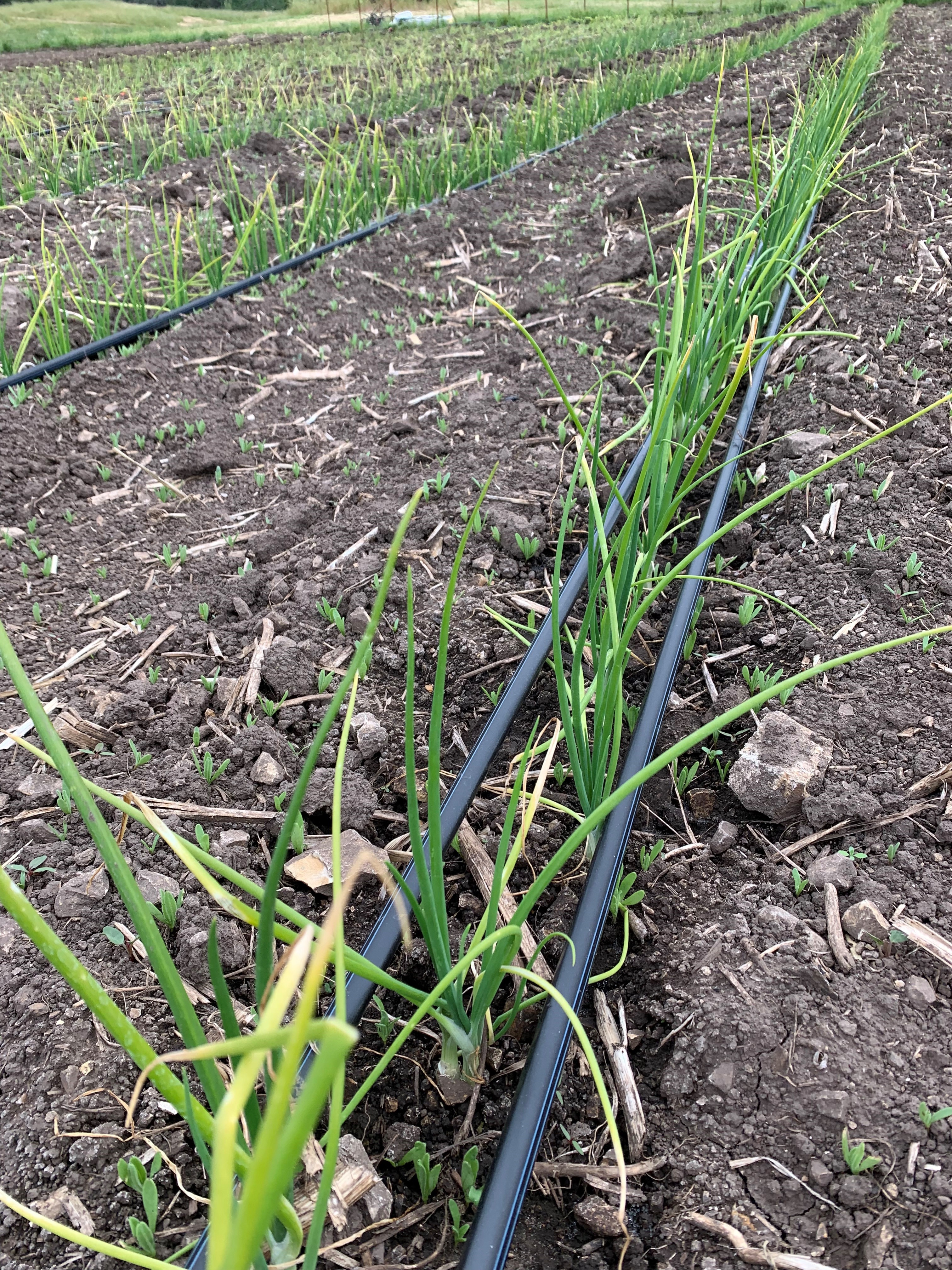
Molino Creek Farm’s amazing onions, freshly planted and regularly irrigated

Snakes, a Month Late

April is normally snake month, but the cool, wet start of this season delayed the emergence of our slithery friends. Sylvie and her brother Isaac reported a surprising night time rubber boa, crossing the road despite the drippy fog. Smooth, fresh snake tracks cross the dusty roads, always wisely perpendicular. An irate hissing baby gopher snake lunged at my leather gloves from a patch of freshly pulled weeds. We are constantly surprised by scaled creatures jetting away from disrupting orchard management: a swift yellow-bellied racer snake, head held high, escaping…giant alligator lizards making for safer ground away from hoeing. Wherever we look there are oodles of lizards and snakes, an homage to organic tilth, the diversity of plants, and the wealth of prey that result from good land management the collective respect for nature found at Molino Creek Farm.

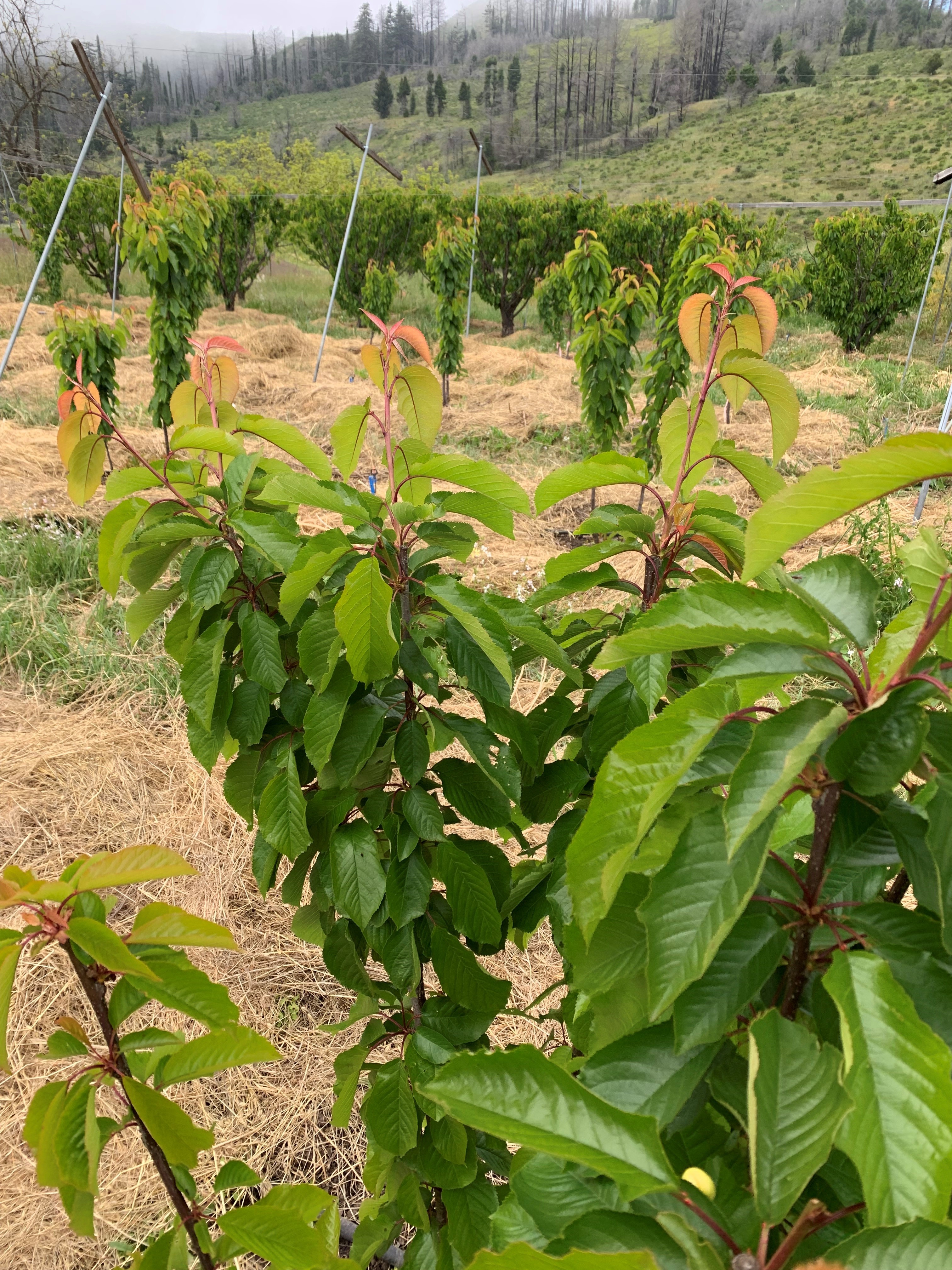
Cherries, lushly growing with irrigation and nestled in fog drip

Night shifts to dawn

At first darkness yields only very slightly and the first bird to sing is quiet, murmuring a few quizzical, uncertain, almost apologetic notes. A few minutes later, that same bird sings the same few notes, sounding a little more certain. A second bird joins a little while later, more certain still. Dark turns slowly to gray and more birds start singing. Soon, dawn rushes on, the sky lightens, and many birds start singing, no gaps between songs, many species, many notes. The cheerful Spring dawn chorus fills the chill morning air as color begins to spread across the landscape in advance of the rising sun. By the time the first rays brightly illuminate the ridges, the bird orchestra is loud across the farm and as far as you can trace sound. Each taller shrub and at the top of many trees there are tilting, perky birds, beaks outstretched, singing away.

Spring Antics

As it warms, bluebirds and black phoebes flit about, catching bugs. Barn swallows warm on perches awaiting a brighter sun before taking to the air. Towhees strut through short grass, darting at one another, chasing for fun or territoriality. As the dew dries, one of the yard bunnies hops inquisitively towards another. The wide-eyed approached one suddenly flattens itself hugging the ground, snaking forward slowly and then faster on a pathway through the low grass, ears back, while the other hops again and again over its pancaked friend: what oddness! Spring morning antics.

Big Oaks in the background, Green Fields in the foreground. Life is a Rich Green

Green

Bolting grasses dry from the tops and from the bottom. The tallest grasses turn tawny above still-green fields. The grassy understory is browning, too. A gust carries dust clouds away from the road and across the fields. Despite the drying, overall a lush green prevails. Big bushy oaks shimmer life above pulsing green fields. The morning warmth massages a sweet perfume from the grass, which changes with the drying day to the scent of dusty pollen. Middays have become quite warm, though sometimes breezy. Cheerful bird solos continue right through the day.

Birds in Air

The afternoon breeze carries soaring red-tailed hawks, loudly screaming, one following the other in broad circles, high across the sky. The ravens, too, enjoy soaring on the wind but more in long arcs from one side of the farm to the other, loudly beating their wings and furtively glancing about for something to scrounge. Something startles a flock of band tailed pigeons, and they take flight but not so high in the sky, making for one patch of trees, then suddenly veering to another. One pigeon isn’t paying attention, gets too far ahead of the others, which have turned for another destination; it panics and wheels about, making lots of strong and rapid wing beats to catch up to its family.  The standard number of pigeons is 14, but the flock was 30 for a brief bit…some apparently were just passing through. The regular flock patrols the walnut trees hoping for ripening catkins which will shortly make them fat and happy. I’m not sure what keeps them fed in the meanwhile- there doesn’t seem to be much to eat for those big birds.

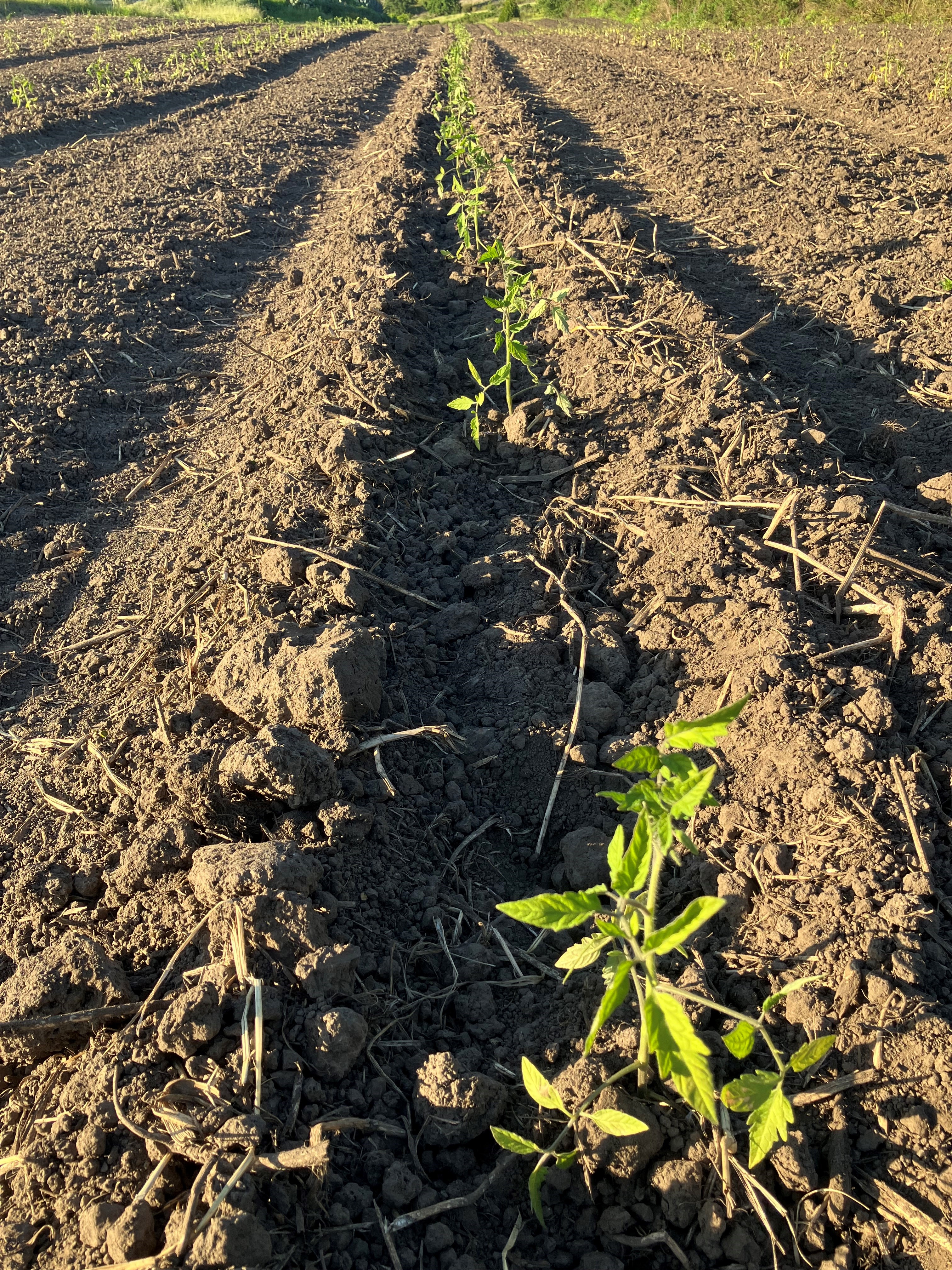
Molino Creek Farm’s Dryfarmed Tomatoes – Just planted this week

Planting

Bodhi and Judy have been planting the summer crops. Long rows of tomato seedlings are settling in nicely, in less than a week already overcoming transplant shock with perky new leaves facing skyward. Succulent leaves of freshly planted onions contrast greatly with the deep brown soil, poking up from row after freshly planted row. Green crop seedlings are hard to see in the broad swaths of brown, tilled soil, striped in rows of tractor tire tracks.

Lapins Cherry Trees – Thanks, Drake Bialecki for the grafting!

Peak Bloom

The orchards are in peak bloom. Though the cherries are just a bit past peak, on average the various varieties of other fruit trees make for the most floriferous moment in orchard bloom. With so many flowers, the trees have created a thick blanket of pink across the hillsides. The avocado spring is more subtle, but still their masses of tiny yellow-green flowers overshadow both the broad, old green leaves and the emerging spikes of purple-bronze leaflets. I was pleased to find honeybees on the avocado flower clusters today- the first time the hive has turned its attention to this essential service. Peak bloom, however it appears, is beautiful, the blossom parade a constant show of dancing pollinators one type arriving after the next. As the day progresses, the afternoon warmth waves clouds of ecstatic perfume into the aisles. Gradually, the day cools and the scent changes back to grass and mold and dew.

Two Dog Farm Chardonnay – SPRING!

Evening

The light fails and great horned owls glide silently out of the tall trees on the canyon edge, across the farm fields. They perch on fence posts and trees closer to the rodent-filled grasses and weeds. When the sun disappears behind the ridge, the evening turns quickly colder. As the setting sun finishes raking the higher hillsides with its golden glow, we retreat home for sweaters and wool hats. Chores demand further outdoor time until the light completely fails, now at almost half past eight. Burr! It turns cold with the darkness and gets chillier all night. Recently, it got down to 44F by dawn. Some fruit trees long for hundreds of chill hours, leafing out only after arriving at their total: their clocks are still gathering those hours, and the (shortening) cold nights keep them snoozing and gathering strength for their (eventual) leafy season.

Sky lupine and purple needlegrass on one of the Farm’s ridges
Bicolor lupine and more on a knoll on the Farm

Wild Flowers

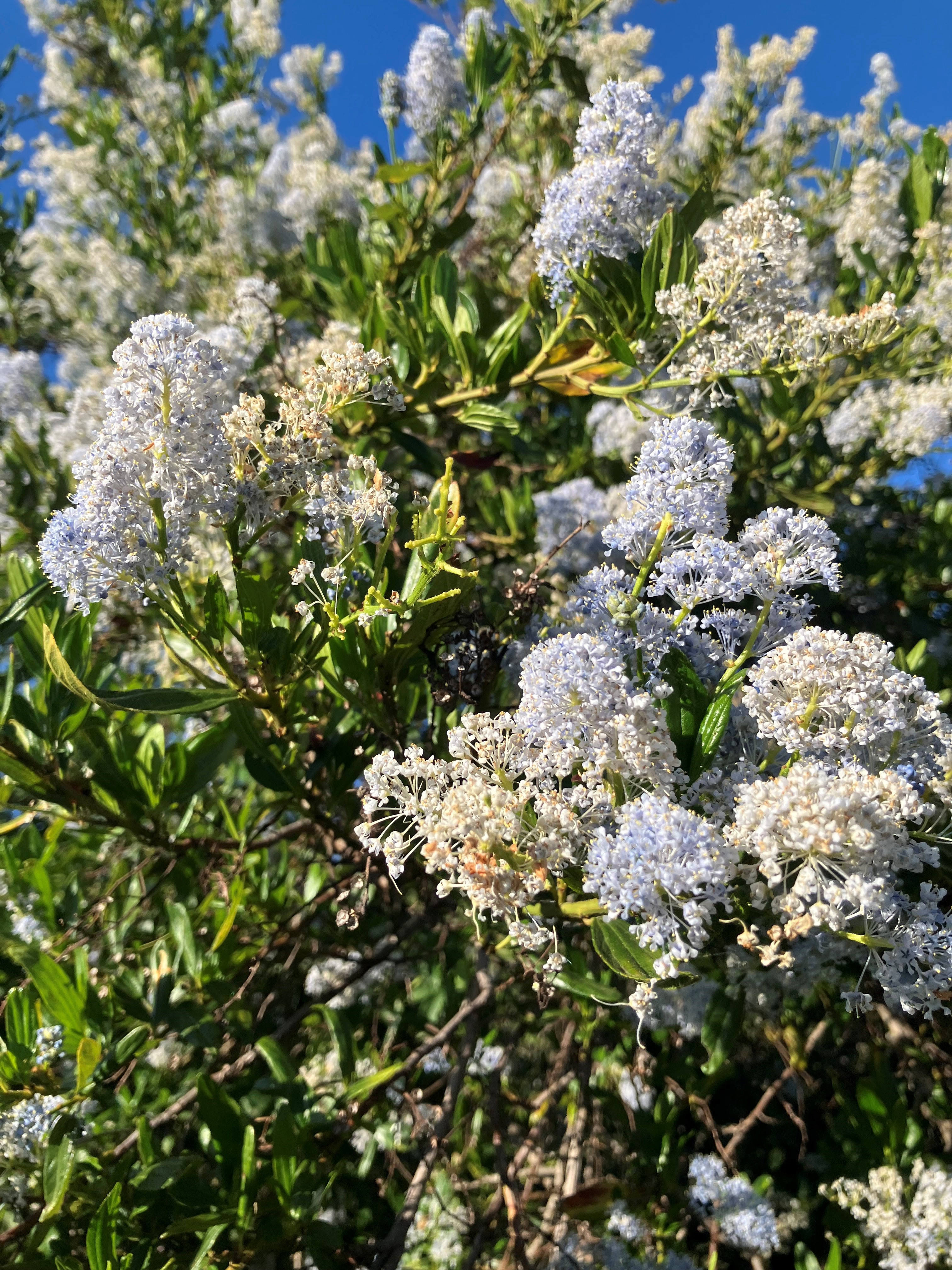
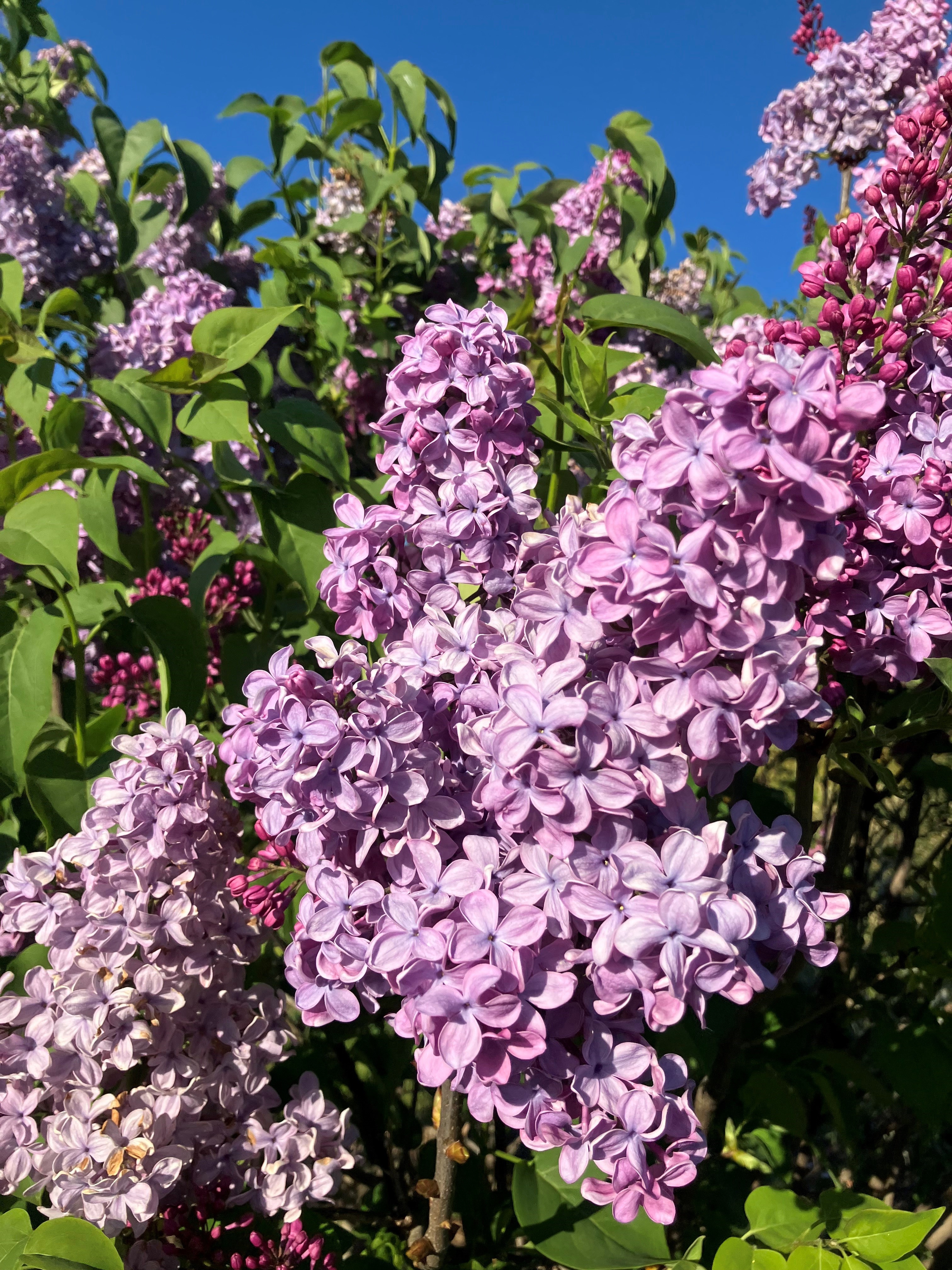
The wildlands are blooming spring. Two types of lupine, the big and the small, as well as poppy, tarplant, blue eyed grass, vetch, and purple sanicle have burst into flower and paint big patches with crazy color mixes and fascinating patterns. In the forest, white starburst panicles of fat false Solomon’s seal and the simpler four petals of purple-white milk maids brighten road cuts above Molino Creek Farm. More than anything, miles of the fire-following shrub California lilac throw rafts and sprays of pale blue blossoms, drowning out their shiny green leaves. The scent of this blueblossom is heady and sweet, but only faintly like the more-sweet perfume of the old-world traditional lilac which also has much more showy flowers.

California lilac
Old World Lilac

An Unusual Dreariness of Spring

Drizzle and fog surprised us this past week as dew-covered wildflowers blossomed, buried in tall soggy grass. The weather forecasters had said it would be sunny, but something changed and suddenly the outlook went to partly, and then mostly, cloudy. Gusts blew tiny misty droplets against the windows. Trees caught the mist, making showers in rings, illustrating ‘driplines’ on the previously dusty roads.

Drying

But the mist and drizzle were not enough. The soil is drying. The 2 inches of late rain two weeks ago can no longer forestall the normal drying of our Mediterranean summer. A day of stiff, dry winds from the north wicked away the moister 2” down into the soil and the drying keeps reaching deeper. The long days keep the plant transpiration pumps pumping. The prairies won’t be green much longer. The orchard trees need water starting now.

Eye Hurtingly Beautiful

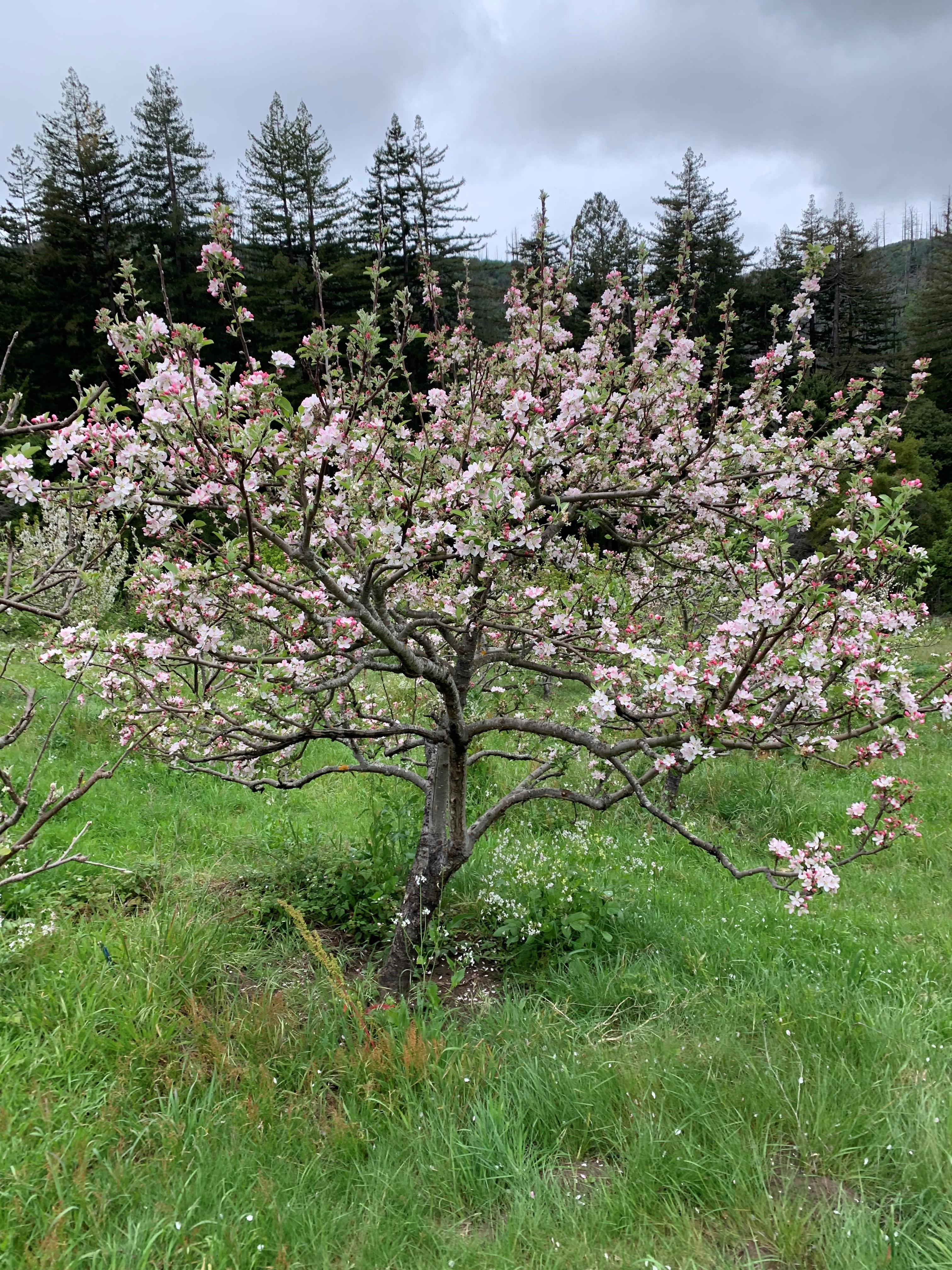
The flowers bursting forth in the apple orchard are stunning. Artists! Ganderers! It is time to bask in the dizziness that only a grove full of apple blossoms can impart. Sauntering around the farm, I take what I expect will be the normal short tangential turn into the apple orchard. Soon, I am stumbling around, not paying enough attention to footing, going from tree to tree, from one palette of pink and white and red blossoms to another, slightly more white or slightly more pink…some petals more lush, some clusters more diffuse…some flowers displayed in widely spaced massive shelf platforms…others arranged in small, tightly spaced clusters of polka-dot-like puffs for long distances along branches. Petals falling like snow on the breeze. Pale green points of new leaves poke forth from buds. Lush grass and flowers in understory tufts. Bees, hummingbirds, and flocks of tiny peeping juncos dart and dance with the beauty. An hour later, driven out by the dwindling daylight, I emerge from the orchard bedazzled and grinning from the ‘short tangent’ of my evening walk.

Soil Fields

In stark contrast to the orchard full of life are acres of brown, tilled ground. Life there is under the surface among clod and crumb where worms and millipedes and a million tinier things wriggle and crawl. It is cool and damp below the plowed surface where no plant now grows. We conserve a winter of rain by making the top foot of soil into mulch, and it takes a lot of turns of the tractor to make that happen. And so we set the stage where the drama of dry farming tomatoes is starting to take place.

First Tomato Day

The greenhouse grown tomato seedlings are tall and lanky and so take delicate hands to carefully place them in holes dug deep through the loose, tractor worked ground. The first seedlings went in the ground today, April 24, 2024! There are so many more plants to nestle into their homes. The big empty fields fill slowly, thousands of deep knee bends, hours of meditative labor, months before getting any income from this year’s crop. Such is the gamble and the hope.

Our First Ground Squirrel

Ground squirrels have been spreading across the landscape. They probably were here before and probably were effectively poisoned out when poisoning the landscape was in vogue. A single ground squirrel bounds across the road into various hiding places down by the big walnut tree many times a day, seen by many people. This squirrel is a keystone species for our prairies, making deep burrows that are critical for other creatures to make it through the hot, dry summer, and through fires, too. Burrowing owls need those holes for nests. Golden eagles’ and badgers’ favorite food is ground squirrels. Ground squirrel burrow complexes also may assist with groundwater recharge. The squirrels make habitat for wildflowers as they graze down invasive grasses. Bubonic plague is ubiquitous in ground squirrel populations, too! And, they undermine houses and roads with those burrows. Farmers and ranchers think of ground squirrels as pests for eating their crops. What are we to do with this first explorer of an astronaut squirrel?

The Individuality of Trees

Just as every apple tree has character, the live oaks too show individuality. We are fortunate to have several groves of live oaks on the farm that survived the 2020 wildfire. One grove thrived because we had mowed around it and then were vigilant with wetting them with fire hoses when the fire raged – it was too close to the barn and other buildings to allow it to burn. The various trees of this grove are displaying the range of traits typical of coast live oaks. New leaves are flushing: these ‘evergreen’ oaks nevertheless mostly replace last year’s leaves around now. The fresh leaves are emerging at different times and in different shades of green, depending on the individual tree. Some are already in bloom, long pollen bearing tassels waving in the wind. Other trees haven’t shown any blossoms yet at all. The lush new growth is forming densely green, bushy canopies, These deep-rooted trees will continue to be that kind of vibrantly alive for a few more months…long after the grass has dried brown.

Lupines!

Each year, as a result of our careful stewardship, we get more and more sky lupines. This year is the biggest year yet. Patches of sky lupines are mostly mixed with California poppies. There is something so very right about the mix of wide-petaled, fiery orange poppy flowers mixed with lines and waves of spikes of whorled blue-and-white lupine flowers. It hasn’t yet been warm and still long enough to get the grape bubble gum scent clouds emanating from the lupine patches. Between these fields of wildflowers and the orchards full of blossoming trees, the bees have lots of choices. We are glad they are getting enough food to grow big families on our farm, a haven for pollinators.

Earth Day

How do you feel about Earth Day, both in Santa Cruz and throughout the USA? The first Earth Day was in 1970 and was organized by Wisconsin’s Senator Gaylord Nelson to be a massive public demonstration to restore the environment. Estimates are that 20 million people took to the streets in protest. They say that the Environmental Protection Agency (EPA) was founded because of those first Earth Day demonstrations.

Imagine so many people demonstrating because of environmental degradation in the United States! While some things have improved since 1970, we are now facing the greatest threat to the planet ever due to greenhouse gases and climate change. Earth Day nowadays is tamer, perhaps too tame. What are we going to do to better celebrate Earth Day?

Earth Day Learning Back in 2023

The best things I find to do on Earth Day in the Monterey Bay area last year, in 2023, were about learning. My favorite educational attractions for Earth Day are being offered in conjunction with Earth Day Santa Cruz. Mainly, I suggest that you check out the free admission to the Museum of Art and History where the main feature is the Bay of Life exhibit. Chris Eckstrom’s and Frans Lanting’s Bay of Life project is very important- a way for more of the Monterey Bay’s people to learn how we live in an epically special place. The photos at the exhibition are more than memorable…they are inspirational, and the project aims to mobilize people, much as Earth Day did at its origin.

Earth Day Reading

For Earth Day every year, I highly recommend people read the book Ishmael by Daniel Quinn. The book is full of wisdom about how to live better on this planet. If you are interested in what your find in Ishmael, take the next step and read Derrick Jensen’s Endgame. Both books will point you in the right direction in many ways. A lot of what Derrick Jensen has to say is pretty important.

Learning is Not Enough

Environmental education is only valuable if it helps nurture pro-environmental behavior.

Give or Take?

In Quinn’s Ishmael, we are asked to reflect on if we are taking too much or just what we need from Earth. I take that another step to ask what we are giving back to Earth. Very few of the events I find about Earth Day every year in the Monterey Bay area are about taking less, not giving back to Mother Earth. Some of the events are downright greenwashing or irrelevant. Ecological restoration is the main way I see that we can give back to Earth, but I can’t find a single opportunity to help with ecological restoration associated with Earth Day near Santa Cruz.

I know of five organizations in Santa Cruz that help people give back to Earth. The California Native Plant Society, through its habitat restoration projects. The Coastal Watershed Council through its River Health programs. The Santa Cruz Museum of Natural History with its habitat restoration volunteer opportunities. Groundswell Coastal Ecology has The Most Regularly Available opportunities to help restore areas around Santa Cruz. One might consider committing to helping these efforts as a pledge on Earth Day and then following up at one of their next events. Last, Watsonville Wetlands Watch also (rarely) has opportunities to help restore areas in south county.

Don’t be Fooled: This and other Earth Day events aren’t necessarily good for Mother Nature

Greenwashing Earth Day

In 2023, I noticed one event that brought greenwashing to local Earth Day celebrations. Building new trails is not a pro-environmental behavior, especially when it comes to building those trails at Cotoni Coast Dairies. As I have mentioned in previous essays, that property has not experienced the kind of planning for trails that is necessary to conserve our extraordinary biodiversity, especially that land’s sensitive wildlife species and the species protected through its National Monument status. That hasn’t stopped the Mountain Bikers of Santa Cruz (aka Santa Cruz Mountain Trail Stewardship) from advertising an Earth Day event that focuses on habitat degradation. At their ‘Dig Day,’ volunteers will be unwittingly paving the way for unnecessarily wildlife disturbing activities. Earth Day volunteers will be helping folks rich enough to afford both a car and the gas to get to that park to bring their mountain bikes to have a ‘rad time’ on trails too narrow to be comfortable for bombing bikers and families going for a walk to use at the same time. To assure mountain bikers rule the trails, BLM has proposed rules that would make it illegal to step off of the narrow trails. It’s a pity that the Bureau of Land Management has had such a special relationship with this group, allowing them so much access to the closed park while turning away ecologists who would help better understand the plants and wildlife that need protection.

Illustration by DeCinzo

Outdoor Industry Lobbying Infects Earth Day

This Earth Day let’s renew our dedication to vigilance in protecting our public lands from well-funded special interest groups. In California as elsewhere, there are coalitions of businesses organizing to lobby for “increased access”(read wildlife habitat destruction). Their job is to “streamline regulations and policy affecting the active outdoor industry” (read stop public lands managers from protecting wildlife in favor of outdoor recreation). The clout of the Outdoor Industry Association is affecting politics, apparently trickling down right here on our North Coast.

Earth Day is Every Day

In closing, I hope you can sort through the Earth Day hype to find something meaningful to do. If you seek educational programs, may your experience lead in in the direction of actions that you can take to not only reduce your footprint on Earth but also to help improve wildlife conservation in and around the Monterey Bay. May we all think about that impactful, original Earth Day and how we might soon mobilize to push for the changes needed to avert the catastrophes of climate change. We are gathering together to make a difference, and our might will be felt in the near future.

-this post slightly edited from the original part of Bruce Bratton’s BrattonOnline.com weekly blog.

Suddenly Spring Sprung

The Spring Equinox was a few weeks ago, and the natural world around the Monterey Bay is full of signs of the season. From wildflowers to birds, from the gophers to the grass, life is waking up. Forest bathing or any sort of time in nature is good for the soul and actively seeking out personal interactions with the signs of the season allows us to stay in touch with ancient rhythms of life…slowing down…nurturing our roots in this wonderful place.

California popply in a sea of Madia, which flowers later. There is lupine and brome grass, too

Wildflowers

We’re already past the first wildflowers of the year, but we haven’t missed many. Footsteps of spring is still in bloom- patches of bright yellow color splash across shallow soiled areas in grasslands. Nearby in those same grasslands and in the adjoining shrubby areas, you can see peopleroot, aka wild cucumber, a romping vine pushing up spikes of wonderfully scented cream-colored flowers. Still in those grasslands, poppy flowers have opened: the first ones are always the biggest, tulip sized! Santa Cruz’ Moore Creek greenbelt, Monterey’s Point Lobos, and the grasslands at Fort Ord are all good places to see grasslands’ unfolding spring wildflowers.

Get to some chaparral and you can see the first Ceanothus flowers alongside the waning honey-scented manzanita bloom. Fort Ord is a fine place to see a rare type of chaparral with unusual manzanitas and ceanothus species. Henry Cowell and Wilder Ranch State Parks have some nice patches, too. Report back on the state of the wildflowers in chaparral or grasslands, please!

Swallow Arrival

The first barn swallows returned to Santa Cruz County’s North Coast on March 19, 2023. They traveled from somewhere way south – the tropics where they spent the winter getting fat on different types of bugs. They arrived just in time to eat the early season bees, mosquitoes, and moths. They left when this place was dusty and dry and returned to a vibrant, green, moist landscape. They are just settling in and will soon be scooping up mud to repair or build new nests. I haven’t seen any other swallow species, yet- have you?

Furry Critters

Gophers are throwing soil with gusto, having just woken up for the Spring. The voles have been awake and active for a while, already. Baby voles are dispersing into new areas, and the very violent interactions between voles and gophers has commenced.

Young brush bunnies emerged from their birth dens about 2 weeks ago, half the size of the adults and so very cute. About a month ago, I encountered an adult brush bunny ‘thumping’ – something I’d read about as a youth in Richard Adams’ book Watership Down. An anxious-looking bunny was rushing between shrubs, ducking under cover and then thumping its hind legs onto the ground so hard as to make a drumming noise. It had its eyes on me-  very odd, since I thought I had previously had a fairly trusting relationship with the local bunny families. Perhaps this individual was an interloper from another family as this behavior was a one-time thing.

Long tailed weasels are feeding on gophers, voles, and young rabbits as are coyotes and bobcats. It had been a long time since I saw any bobcats, but two appeared in the area in the last month, so maybe their population is rebounding around Davenport.

California buttercup

Grass

It is the season of grass. Get to a weedy wet patch and you’ll see the most remarkable bright shiny green of Italian ryegrass, an invasive species that reflects light brightly from its leaf blades. The cold nights have tinged some grasses red or purple. Disease from the moist winter makes other grasses turn yellow or orange. The first grass flowers are emerging, but most are a ways away. I was surprised to see some foxtails already, normally a later spring grass flower. How tall with the grass grow? You can see it gain height by the day right now, but not long ago it just got slowly thicker across the ground. The longer and warmer days make for rocketing grass growth. Later rains keep it getting taller, but without rain grass drinks up the soil moisture and patches start to brown on shallow soil quickly after warm spells.

Bromus carinatus, California brome grass

Trees

This is the moment of Spring where we can enjoy the colorful signs of the genetic diversity of coast live oaks. Some coast live oaks unfurl their spring leaves earlier, some later. Examine patches of coast live oaks and see the personalities shine with varying leafing out timing, and even varying colors of new leaves. I like the more maroon new leaves, but the paler spring green trees are also wonderful.

Buckeyes and big leaf maples are breaking bud. Rare in our area, patches of black and valley oaks are also starting to think about leafing out. I recently travelled through the Sierra Nevada foothills and saw the blue oak forest waking up. I love to catch blue oak bud break as patches of that forest turn the most amazing purple-blue right as their leaf buds start to swell, before the leaves unfurl. Now is that time.

Time Passing

The moments of Spring pass quickly, so that if you miss visiting natural areas a few weeks in a row, you will miss an entire sub-portion of the season. The birds will come to you, though – keep an eye out for the swallows wheeling in the air, harbingers of spring! If you haven’t planned on visiting your favorite lupine patch, start planning: they are a few weeks away, but a spring without lupines isn’t ever quite the same.

-this post originally published by Bruce Bratton at his wonderful weekly blog, BrattonOnline.com – donate, subscribe, and so forth and you’ll be regularly in touch with so much around the Monterey Bay

Misty Stillness

After work it is time to walk around the farm, legs swishing through soaking grass. Each one I touch lets loose a shower and, lightened, the stems straighten for a bit until more mist collects. Where I walk today and where I walked yesterday will remain evident for weeks: tall, lax vegetation flattened and so fat with moisture as to be unable to get back upright. Above the tall boots my pants still get wet; the grass is 3’ high. The mist muffles sound like snow, and it is very still. The moist chill has hushed the birds, the only sounds my feet and the dripping of a million drops.

Native brome grass and poppy, laden with moisture

Composting Fields

The brief drying and warmth allowed everyone a chance to mow and till, but there was still not enough time. Some fields got more thoroughly tilled than others. A sweetish funk of rotting cover crop hangs in the air near turned up earth. Topsy turvy pieces of cover crop stick out of the mud, the finer leaves and stems melting into mush. The tiny pieces of ground up punk will enrich the soil, hold moisture, feed microorganisms, and nutrify plants. “Green manure.”

Freshly tilled, ‘Pepper Field’

Standing Crop

In the orchards, the cover crop gets cut but we don’t till. This year, in the poorer soiled areas between trees, I ran the flail or mulching mower, grinding up the cover crop to feed the soil right where it grew. Where the fava beans are towering taller, it’s the dance with the sickle bar mower, cutting the tall plants, which fall in rows to dry and then get raked as mulch under the trees.

I keep the orchard mower regularly running not just for exercise but to ‘keep up’ with re-growth. It is nice to get March rains after the cover crop is cut. The ongoing moisture allows the soil to digest the shed off nitrogen rich cover crop roots and make that food available to wakening trees. It is becoming critical to mow the last of the fava beans, but there is never enough time. The Avocado Bowl and Cherry Hill cover crops are going to be 4’ tall soon, thousands of flowers feeding hummingbirds and bumblebees. I hate to deprive those friends of their nectar.

A sea of fava beans (and vetch!) surrounding the Avocado Bowl

Cherry Buds Swelling

The cherry trees are about to flower. Buds are showing color and the sleek red bark is taught from running sap. It is the last moment to observe the bare tree architecture and envision summer pruning. The old, fire-damaged trees are hanging in and the ones that died, root sprouts grafted, hold lots of promise to become more tree-like this year. The piles of grass mulch the Orchardistas hauled and stacked last June have almost entirely melted away but not too soon: there are few weeds where those mulch piles sat at the beginning of winter.

Lapins cherry buds nearly bursting
Old, fire damaged cherry trees (left) and the sprouted Colt rootstock grafted (right)

Native Wildflower Spring

The Community Orchardists not only steward trees but also the mulch fields, some of which are becoming amazing and beautiful native grasslands. Molino Creek Farm was a hay farm in the early 1900’s. It still makes fine hay and those hayfields are alive with many flowers and lots of wildlife action.

Our farm has a curious pattern of shallow-soiled knolls surrounded by pockets of deep soil. The rolling landscape provides for diversity in crops and native habitats. It seems that cutting hay (at the ‘right’ time) and hauling it to the trees as mulch has helped wildflowers proliferate. We are at the onset of poppy spring and two types of lupines are soon to glow. After that, rafts of tiny tarplants will flash yellow each morning. The brome grass has already started and will keep producing seeds at the end of waving graceful arched stems, towering over the wildflowers. Blackbirds march noisily across these fields in lines, scaring up the bugs that find feast in grassland diversity. A giant mound indicates gopher action, a few seedling poppies germinating on the fresh, moist soil. Networks of pathways and open burrow entrances means voles are active. Deeper, bigger holes with fresh claw marks – coyotes at work digging up furry late-night dinners in the hay fields. Where we don’t collect and manage for hay, those fallow fields are humpy with thatch and scattered with shrubs and poison hemlock: a different type of habitat…one which we hope we can muster new energy to manage. More orchards- and more need for mulch…the fate lies with the capacity of Community Orchardists.

Poppy, brome, bicolor lupine and madia- cutting hay creates knoll diversity!

Public Testimony: Pathogen Response Process

What happens when a member of the public raises a concern about ecological pathogens to conservation lands managers during a public testimony process? This is a story that unfolded not long ago on the North Coast of Santa Cruz County concerning BLM’s management planning for Cotoni Coast Dairies.

Recall Last Week’s Column

If you haven’t already read my column from last week, it would be best to give it a quick read to put this essay into context. In brief, I outlined the devastation caused by reckless human movement of invasive, non-native pathogens affecting native plants and wildlife. The process introducing and spreading such pathogens is ongoing, despite the dangers being common knowledge. At the end of the essay, I pointed to the root cause of this issue, human greed, and outlined the common knowledge about the solution: slowing global trade enough so that we can take the time to be more careful. What I didn’t outline is what we can do more locally to address already introduced pathogens that have yet to spread across our conservation lands.

Conservation Lands Managers’ Pathogen Abatement Responsibilities

What responsibilities do conservation lands managers have for the wildlife and plants that occur on the lands they oversee? I’m betting you can guess one of those managers’ responsibilities…but not to wildlife and plants. Public access is often a conservation lands manager’s ‘responsibility.’ Consider the term ‘conservation lands’ for a moment and know that public access comes at a cost to conservation. So, part of those managers’ responsibilities is mitigating and avoiding the impacts of public visitors on wildlife and plants. And, those public visitors bring with them a variety of pathogens that can have grave negative impacts. While planning for public access at Cotoni Coast Dairies, unknown BLM staff wrote many statements acknowledging the danger of proposed recreational use and the spread of pathogens.

BLM Staff List Public Access Pathogen Dangers

Unknown BLM staff wrote extensively in the management plan for Cotoni Coast Dairies about the dangers of recreational use increasing plant and wildlife pathogens. They noted that recreational users “increase introduction of pathogens” (Chapter 4, pp. 5 and 11), which “pose risks to sensitive species,” impact native wildlife, and are “anticipated to impact aquatic species including special status fish species” (Chapter 3, p. 22; Chapter 4, pp. 18, and 32). BLM staff also addressed introduced plant pathogens using sudden oak death as an example. They noted that recreational trail use has been documented as being a significant source of the spread of plant pathogens (Chapter 4, p. 6). In addition, BLM staff also specifically addressed the spread of pathogens to wildlife from domesticated animals, warning that bobcats, grey foxes, dusky footed woodrat, and badgers are all known from Cotoni Coast Dairies and could all be negatively impacted by such diseases (Chapter 4, p. 19). The BLM staff went on to note that domestic dogs carry ‘hundreds’ of pathogens that can be spread to wildlife, including rabies, canine distemper, and canine parvovirus (Chapter 4. p. 21). Finally, the anonymous BLM staff also noted the dangers of introduced amphibian pathogens, including chytrid that is a major concern for California red-legged frog conservation (Chapter 4, p. 30), noting that recreational users spread such diseases (Chapter 4, pp. 35 and 36).

In sum, the BLM staff who wrote the governing management plan for Cotoni Coast Dairies articulated many of the concerns about introduced pathogens affecting the biota of that high-value conservation property. But, how did that knowledge affect their management? Very, very little.

BLM’s Management Response to Environmental Pathogens

After that litany of concerns, one might expect BLM staff to write appropriate management responses. Here are the two responses:

In response to the danger of domestic animals spreading pathogens to wildlife, they state:

“Therefore, BLM will not authorize or condone free-ranging dogs, or any other free-ranging domesticated animals or pets to utilize C-CD. (Chapter 4, p. 21)”

In response to the danger of recreationists spreading pathogens into the freshwater systems, they state:

“Therefore, BLM will seek to educate members of the public on this topic whenever possible. Appropriate signage may aid in reducing the potential for this to happen at C-CD. (Chapter 4, p. 36)

Note that the BLM staff avoided producing management measures that address the majority of the impacts of pathogens spread through the recreational activities they propose. This is particularly troubling because the foundational principle governing management of Cotoni Coast Dairies is not providing recreation, it is conserving the ecology of the property. Instead of outlining management to avoid or mitigate the spread of the pathogens, BLM staff favor recreational uses that they document increasing pathogen risk.

Pride, Prejudice, Ignorance, Overwork, or Institutional Policy?

Given the perplexing approach to increasing the danger of recreationists spreading pathogens that endanger the plants and wildlife of Cotoni Coast Dairies, it is reasonable to ask: WHY? The answer to that question seems to be ‘we will never know.’ Let’s examine some of the potential explanations.

On my documentation of planning shortcomings, one BLM staff person passionately and confidently proclaimed that their team had completely and professionally addressed all comments raised during the public comment period on the management plan. It could be that they were proud of their work and it could be that they were proud of the work of the other staff in their agency. And, given the clear shortcomings of the responses to my concerns about pathogen spread, it also appears that they might be prejudiced about the professionality of their agency. It might be that they are ignorant of the many solutions and mitigations available to stem the spread of pathogens on conservation lands. Another possibility is that staff are so overburdened with a multitude of responsibilities that they are unable to adequately address their planning responsibilities. Or, it might be institutional policy to avoid committing to certain types of management measures, whether due to cost, ease, or interference with recreation or other management preferences of prejudiced staff within the institution.

But, again, we will likely never know the reasons for these oversights. It is likely that BLM staff writing such plans will remain anonymous, so we won’t be able to ask individuals. When I’ve asked staff to refer me to the individuals responsible for decisions so that I could ask them about their rationale, they’ve refused. When BLM suggests that they ‘welcome public input,’ or are ‘seeking public input,’ such as with their latest proposal for a parking lot at Cotoni Coast Dairies, you have to wonder if your time is being well spent providing that input, given the hypotheses presented here. All we can do meanwhile is investigate and hypothesize: is it pride, prejudice, ignorance, overwork, or institutional policy that will lead to recreationists spreading the pathogens  that will kill the wildlife and plants at Cotoni Coast Dairies?

– this essay slightly modified from that which was presented by the esteemed Bruce Bratton at his laudable BrattonOnline.com weekly blog.