California state parks

Don’t Look Back! State Parks Forward?

Press is rolling unveiling what might seem like a ‘new’ initiative, obscuring and ‘moving on’ from some really UGLY past issues with California State Parks. But, hey- we all want to move on, keep moving forward…especially those with criminal records or histories of abuse.

Parks Forward: a brief history

The origin of the Parks Forward initiative was a crushing blow in 2012, an event that should make every Californian, especially those dedicated to natural areas access and conservation, doubt whether the California Department of Parks and Recreation can be trusted. Some may recall the closing of many State Parks supposedly due to budget shortfalls, which some of us recognized at the time as being a political ploy to pressure the California legislature into increasing Parks’ budget. Sure enough, ‘fiscal irregularities’ (as stated euphemistically in Parks’ subsequent report) were discovered, but only after the panicky scuttling of thousands of volunteers, non-profit organizations, and private donations to keep parks from closing down. Many nonprofits made good money from this fundraising boon, which also cemented their cache with the public.

The Bigger History

The State Parks corruption boondoggle in 2012 needs to be put into context with a larger history for a wholistic understanding of the situation. Since its inception, State Parks has been the recipient of lands purchased by private organizations. It has been typical that ‘conservation’ organizations use private donor funds to purchase properties while lobbying for public bond initiatives earmarked in such a way that they profit by subsequently selling those properties to the State. This process violates all sorts of legal and moral codes such as illicit 501(c)3 lobbying, private organizations setting State priorities, adding land to an agency already unable to manage the lands it holds, etc. Conservationists recognize that purchasing and ‘setting aside’ land for ‘protection’ is the relatively easy and affordable first step- the real work is sustaining species on those lands in perpetuity. For a while, recognition of these ‘irregularities’ put a halt to adding more land to the State Parks system.

Santa Cruz County Parks History

Much of that ‘bigger’ history is reflected in what has been occurring in Santa Cruz County where a disproportionate percentage of land is owned by State Parks. State Parks General Planning processes were successfully challenged for Castle Rock State Park, Nisene Marks State Park, and the Gray Whale Ranch addition to Wilder Ranch State Park. In each instance, private organizations were instrumental in transferring land to State Parks while State Parks was unable to either plan for or manage those properties in alignment with California law. And yet, each park welcomes visitors, pouring funding into private businesses at the expense of biodiversity protection and visitor experience. Henry Cowell State Park and the State Park beaches at Cotoni Coast Dairies were opened and remain highly used without any planning, whatsoever. The General Plan for Wilder Ranch State Park, a mecca for mountain bikers, does not allow mountain biking and private recreational businesses openly operate mountain biking concessions. Yet, Parks rangers have been ordered not to enforce prohibitions against either mountain bikers or their unpermitted concessions.

The ‘New’ Parks Forward Initiative

Surrounding Earth Day 2026, there has been much press about the Parks Forward initiative. One might even think it was ‘new.’ More new parks were added to the network of State Parks and some parcels were added to expand certain existing State Parks. In some cases, the press releases note property was ‘donated’ and in other cases, the situation is far opaquer. Nowhere in the press releases is there any mention of species conservation- it is all coached in ‘more access.’ Both access and conservation are expensive to do correctly, are not being done correctly in any State Park currently, and are conflicting uses with vast tradeoffs that go unanalyzed by Parks’ mandated General Plans and concomitant ‘carrying capacity analysis.’

Symptoms Make Sense

This new roll out of “Parks Forward” is quite predictable given public amnesia, popular myths, and the level of oversight from the Parks Forward Commission. Apparently, the public has forgotten about the origins of the Parks Forward initiative: if citizens remembered, there would be some acknowledgement in the many press releases. Overriding the grave concerns of the past is a fervor for more public access to natural areas. The myth, echoed by everyone touching this new version of the Parks Forward initiative, is that ‘more people accessing more natural areas is good for conservation.’ This balderdash flies in the face of science and common sense. The logical conclusion of this thinking is that if every human accessed every last piece of nature then every species would be conserved…the opposite is true. But, conservation organizations want to make money from donors and State politicians want to look successful, so enter the echo chamber of the deeply mistaken myth, which is doing permanent damage to the potential for wildlife conservation in California.

It is amazing to me that there is a Parks Forward Commission with smart people allowing such misguided endeavors to continue within State Parks. Perhaps they, too, accept the mythology. The symptoms of their complicity were present many years back when the Commission swallowed the poison of the progress report in year 2 of their formation. That report includes ‘four strategic focus areas’ with no metrics for success and two incredibly tiny ‘natural and cultural pilot efforts underway,’ which likewise have no metrics for conservation success. The apparent acceptability of these puerile efforts to the Commission point to an inability of the Commission to provide substantive oversight and input into the broken State Parks system.

Ask, Please

With the unveiling of new parks and new land ‘protections,’ we must ask: is there any additional funding for long term stewardship for biodiversity conservation, or are these new areas merely to continue the silent death of species to the overwhelmingly poorly managed public access/private inurement money machine?

Has California State Parks apologized to the People for the lies and manipulation it promulgated in 2012? Does that apology include details of what they will do to change this sordid past? Can we identify specific individuals who were responsible for those actions? Is there new management? Or, is this situation much like that exposed by the Epstein situation, where the abusers are still in charge? Abusers – is that too much to say? Well, in this case the victims do not have voices and will never speak out…the wildlife will simply go away while the abusers will vocally claim victory with their empty promises of conservation alongside public recreation and access to natural areas.
 Final Transformation Progress Report

This report published by the California Department of Parks and Recreation in 2017 was downloaded on April 30, 2026 from https://www.parks.ca.gov/pages/24689/files/DPR’s%20Final%20Transformation%20Progress%20Report.pdf

Natural Resources Management Strategy

The report says “California’s state parks are endowed with globally, nationally and regionally significant natural resources. The Transformation Team’s Natural and Cultural Resources Committee developed a guiding vision for DPR’s natural resources efforts to assist in the long term and sustainable stewardship of these representative and outstanding examples of California’s natural values.

In furtherance of this vision, the department’s natural resources management efforts will be aligned with four strategic focus areas:

  • Stewardship at Scale: Play a leadership role in resource protection at landscape and ecosystem levels as a cornerstone landowner and convener of protection, restoration and management actions.
  • Resilient and Sustainable Resources: Promote long-term sustainability by building climate change considerations into all that we do to manage our resources over the long term.
  • State of the Art Management: Use the latest science-based approaches and best practices to manage our natural and cultural resources consistent with our mandates and mission.

  • Innovative Collaborations: Promote new types of collective engagement to foster innovation, create a shared commitment to stewardship, and harness complementary skills, capacities and support.”

Governor Newsom Unveils Bold Vision for Biggest Expansion of State Parks in Decades, Adding Three New State Parks and Thousands of Acres to Existing Parks

This press release was available via this url https://www.parks.ca.gov/NewsRelease/1504 on 4/29/2026.

Parks Forward Commission

This was downloaded from this url: http://parksforward.com/meet-the-commission on April 30, 2026. This is a list of the Parks Forward Commission appointed in 2015 to address grave mishaps by California State Parks- aka ‘fiscal irregularities’ – leading to unnecessary parks closures in 2012.

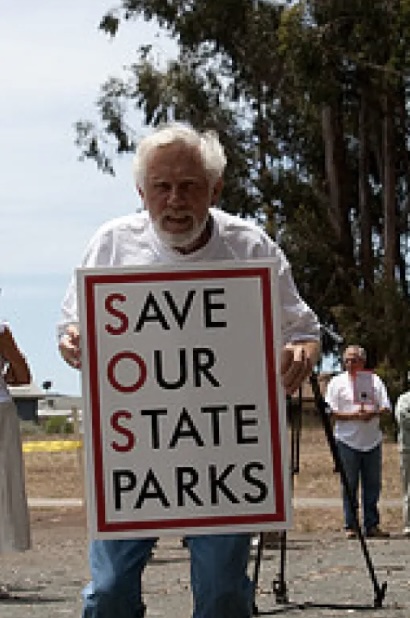
man holding sign saying 'save our state parks'

A New Vision for California State Parks

A report published without including either attribution or date, ostensibly by the Parks Forward Commission (though some citations suggest the group was only officially appointed in 2015) in February 2015. In April 2026, this link worked but I make it available here in case it otherwise disappears.

What Do I Want for Wildlife?

We might ask ourselves, “What do I want?” This important reflective question is a good one and becomes even more poignant in those moments of realization that we have limited time on Earth. There’s a fairly malignantly overused neural pathway of “What do I want?” used for shopping and consumption, but let’s try to dismiss that one and turn our focus on another. “What do I want” from the world around me, the world less likely to be affected by my purchases? For instance, ask yourself what do I want my experience to be when I go for a walk, or what do I want from the natural world: for the forests and streams? What do I want for wildlife? What do I want for my family and friends…for my neighbors…for my community? As we look outside of ourselves and express our desires for the larger world, we encounter our social potential: what can we do as members of a community? How can we influence the world to be a better place? Most people know that we influence those closest to us the most and come to know our circle of influence better with age. Some people work to broaden their circle of influence, some to narrow it. If we feel frustration towards the state of the world, we might explore politics at the local level to see how we grow our influence to make a better world. How does this work for what we want from Nature?

I Want Healthy Wildlife Populations

The majority of Americans want wildlife to thrive, to know that humans are well stewarding, even restoring, wildlife populations: this is something with which both liberals and conservatives agree. As I’ve addressed many times in this column before, that sentiment largely lacks evidence in local politics. Our City and County elected officials fail almost every time they are given a choice to better protect wildlife. We live in an area with a very high number of rare and endangered species, and those are only protected because State and Federal officials step in to enforce protections. How can this be the case with the local legacy of environmentalism and environmental education?

The “Teach Them and They Will Care” Fallacy

While people may say “I want healthy wildlife populations!” they apparently favor the sentiment of “I want money” as they keep electing pro-business officials who (mistakenly) believe that environmental protection comes at unacceptable costs to social welfare. And still, the local environmental education community unanimously embraces the fallacy that if you teach them about the environment, they will care enough to protect it. The corollary fallacy is ‘if you give them access to nature, they will care about nature and so nature will be protected.’ These are convenient fallacies because both allow the environmental education and trail building communities to raise funding from the wealthy, pro-business elite; that funding is crucial to keeping their organizations operable. With the “carrot or the stick” dichotomy for environmental protection, there goes the carrot. What about the stick?

Environmental Protection has Become Non-Local

Over the past 20 years, local environmental protection owes much to State and Federal legal ‘sticks.’ Twenty years ago, we made headway with environmental battles via the Coastal Commission’s authority to protect sensitive habitats at Terrace Point, the University, on City Greenbelt lands, and in State Parks. That agency has since abandoned its environmental protection arm, but the US Fish and Wildlife Service and National Oceanic and Atmospheric Administration have since helped protect what they could from a federal perspective. The California Department of Fish and Wildlife (CDFW) has only occasionally helped protect the environment on the Monterey Bay, more commonly turning a blind eye to environmental impacts that are clearly within their jurisdiction. However, even so, CDFW has done more than local authorities to protect wildlife. In short, we apparently respond more positively to ‘sticks’ than ‘carrots’ when it comes to caring for wildlife around the Monterey Bay. Ask yourself if this approach aligns with your political beliefs? Do you want more State and Federal enforcement of wildlife protections? Or, would you rather believe that people only need ‘carrots’ to do the right thing for protecting wildlife? If the latter, how do you see things changing, socially or politically, to make that happen? If the former, how is it that you are actively supporting State and Federal agencies who are using sticks to protect wildlife?

Uh-Oh, Wildlife Protections in State Parks?

A while back, Californians realized that State Parks needed better planning to protect wildlife. And so, politicians created a rule that every park must have a plan that addresses wildlife protection, even specifying that those plans have what is called a carrying capacity analysis. Carrying capacity analysis defines an approach to determining how to design park access so that wildlife populations remain healthy. Locally, because of repeated negotiations with environmentalists, State Parks has evolved its approach to such analyses, though they have more recently apparently given up on creating plans for parks, altogether. The General Plan for Castle Rock State Park illustrates how landscape architects very badly approached their mandate for good carrying capacity analysis. In that plan, planners who were inadequately trained in wildlife protection sharpened their crayons and shaded huge bubbles across the park, vaguely labeled as high, medium, and low intensity use. This vague and unenforceable planning conveniently allowed unbridled access everywhere. Now, visitors are degrading very rare wildlife habitat associated with rock outcrops and regionally unique wildlife habitat associated with a black oak forest. Because of the terrible approach outlined in the General Plan, an environmental non-profit was able to construct a visitor center in close proximity to these very sensitive wildlife habitats.

A Curious Evolution

Realizing that people wanted State Parks to do more for wildlife protection, the more recent General Plan for Big Basin State Park improved a smidge on their carrying capacity analysis. That plan well reflects the modern principles of analyzing carrying capacity for wildlife protection, but curiously falls very much short of being meaningful. The Big Basin plan rightly says that it is important to address negative impacts of visitors on wildlife by defining science-based thresholds which would be monitored and, if surpassed, would trigger management actions. However, the plan then (very curiously) fails to define such thresholds.

Aiding and Abetting

The same environmental group that built a visitor center precisely where it would be most likely to negatively impact the most sensitive wildlife habitat at Castle Rock State Park is now proudly advertising a similar approach at Big Basin. Instead of helping the People get what they want (wildlife protection), they are doing a great job of raising capital to support their organization through a campaign of increasing access to Big Basin without a viable method of protecting wildlife at that park. In such a way, the organization illustrates its embrace of the fallacy that increased access somehow increases wildlife protection. As you might suspect, this same organization also embraces the fallacy that milktoast environmental education somehow increases wildlife protection. They are funding the interpretive signs for the planned entrance at Cotoni Coast Dairies; the signs, no doubt, will fail to provide visitors with either the inspiration or information needed for them to take meaningful actions to improve the Bureau of Land Management’s stewardship of wildlife at that park. Wait and see.

What Do You Want?

As you consider Big Basin State Park, Castle Rock State Park, or Cotoni Coast Dairies, ask yourself ‘what do I want for the wildlife of these parks?’ How would you know that you are getting what you want? In no case will you, or the managers of those parks ever know…unless things drastically change. That change will only occur if enough of the right people decide that what they want is important enough to act. In the meantime, please know that all visitor use of parks causes negative impacts to wildlife. If we want to conserve wildlife in parks, it will take a new level of dedication of parks managers to perform adequate carrying capacity analysis, monitoring, and adaptive management. That dedication will only occur with the ‘sticks’ that are luckily available to the citizens who are willing to use them.