Swings

Prickly, skin burning sun gives way a day later to chilly overcast drizzle. As the planet warms, the extremes get more extreme; I don’t recall that kind of pendulum, but who knows? Monday’s sunny high at Molino Creek Farm was in the low 80’s, Tuesday a little cooler (but not much), and Wednesday it was in the low 60’s and drizzling. Let’s go back to the moment it switched: Saturday. We gathered our Community Orchardists just as the day went from somewhat cloudy and cool to crystal clear and warmer – the kind of beautiful where it feels like someone dropped a psychedelic dome over the big green earth, emphasizing color and clarity. Shimmering, exquisite beauty.

Cherry Blossoms

Fruit for the People!

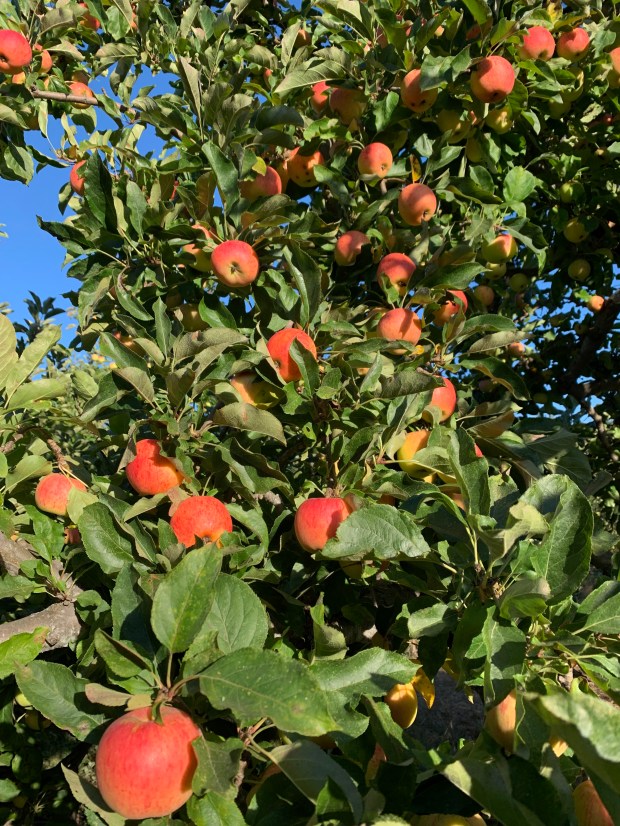
The working bee rocked- cheerful chatter and hard workers knocking out pruning, weeding, fertilizing and cleaning branches & props. It was enough to turn around whatever doubt we might have had that this season is a turning point. We came together around food with toasts and kind words of appreciation for the community we create around growing Fruit for the People! Speaking of which…our Community Orchardists have delivered their first crop of Robertson navel oranges to our favorite outlet: the Pacific Elementary School‘s Food Lab in Davenport. Somewhat shy of 100 pounds of juicy, brightly colored, thin skinned oranges are making people happier and healthier. This kicks off 2025’s food donations to this important program.

Oh- and By the Way…many thanks to our dedicated readers and their forays to the Food Bin. They sold out of our tasty Bearss Limes and had to call us up to get more – vocal demand was the key. We are happy to help more people to shop local – this is The Locally Owned Grocery Store on this side of town. Go on back, now- they have a new batch of our limes, the best limes in town.

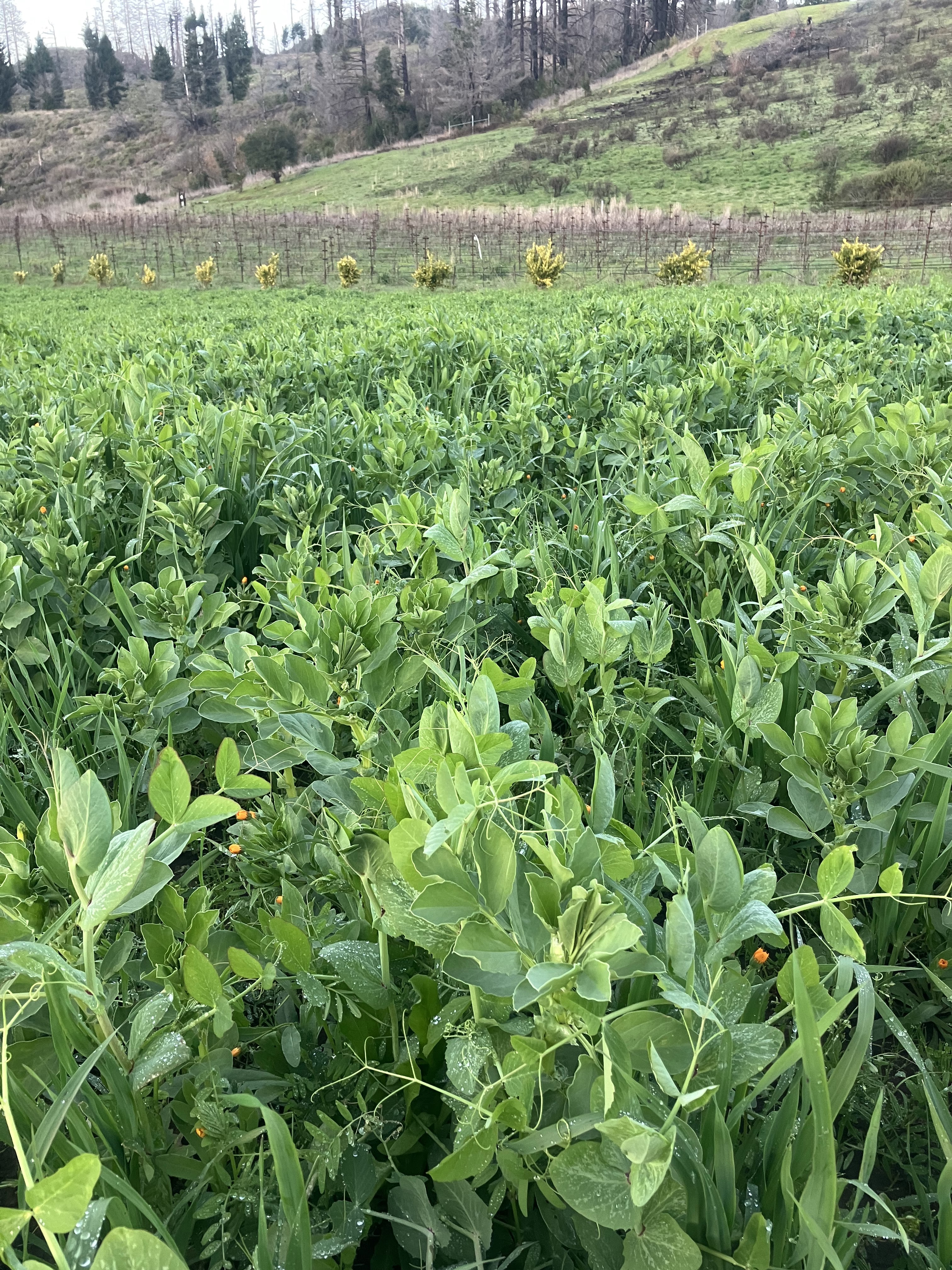
Aisle cover crop: bell beans; under tree permanent cover crop: Iberian comfrey

Terroir

We imagine we taste it in our limes, maybe in our oranges, too. But, the terroir comes out especially in our cider and wine. Cassandra Christine pointed it out first and now we are all grooving on the unique taste our soil imparts into our fruit. You’ll have to wait a bit to purchase Two Dog Farm’s chardonnay, but we are wishing them well in getting a big harvest this year after so carefully tending the vines.

Italian Prune Bark

This Land is Bird’s Land

There are so many birds at Molino Creek Farm right now – it is teeming with feathered friends. A few of us counted the bicolor blackbirds singing in a dead, bare-branched fir tree above the orchard. The number is the same as previously reported 35-40: that’s our flock.

There are hundreds more golden crowned sparrows, which are getting ready to take off to Alaska. I have some observations to share about these buddies. The sparrows around my home have accepted me as a friend and do not flee until I get around 5 feet away if I move slowly. As I walked around the garden the other evening, I approached the cherry tree, which had just started flowering. A golden crowned sparrow was happy about that – he was furtively plucking petals and pecking at buds, feasting away as fast as he could, ecstatic. This had mixed effects on me: on one hand, I was excited to realize that this species eats flowers; on the other hand, I wasn’t pleased that this bird was potentially causing loss of my favorite fruit. I talked to this guy about it, telling him that I really wished he wouldn’t eat my cherry flowers, but he didn’t seem to understand. I told him I’d get out the bird seed and feed his brethren seed if he let the cherry blossoms along. A moment later, he left and I haven’t seen sparrows in the tree again: good! I put seed out in the front yard and, looking out my sliding glass door this morning, I saw the flock of golden crowned sparrows, some of whom were eating the seed. I noticed that others, closer to the window, were eating weeds…and one was eating the petals of a California poppy. Just as I felt the rush of another discovery, yet another piled on: the poppy petal eating sparrow fed a luscious mouthful of petals to its friend, as if to say – “YES! It IS delicious!”

One more note…the golden crowned sparrows are also eating radish leaves, but not just any radish leaves – they find certain tasty radish plants and strip them to leaf midveins while completely ignoring a neighboring, probably less tasty plant.

We will miss these friends when they leave for Alaska…any day now.

Austrian Pea – a resprouting cover crop plant in a sea of chopped up calendula

Scents of Spring

Sweet smell of plum blossoms, pungent-bitter scent of calendula crushed underfoot, the perfume of fresh cut grass…and, the acrid-poopy smell of rotting radish. The Farm planted daikon radish as a cover crop and it does quite well. Grind it up with the mower and, well, it rots. To me, it didn’t smell so nice even as a live plant. I don’t really like that crucifery stench, but others apparently do: a recent UCSC class visit taught me that humans can have vastly different experiences with the mustard green smell. Good thing. A bit more rain (its coming!) and a bit more mowing and that rotting daikon scent will be ubiquitous. About that time, the rotting radish smell will mix with the freshly applied compost and melting down feather meal scents and the Farm will smell….richly stinky!

First Quince Flowers

The Sounds of Late Winter

Behind the bird chorus, waves pound. Finches crazy whistling, goldfinch squeaks, robin operas, junco twittering, bluebird sonnets, and so many other bird songs fill the air at dawn and dusk…and sporadically all day long. Lately, the waves have been very loud, rolling roars pulsing, occasionally cracking high on the rocks and sending an attention note into the hills. Gusts sing in the trees and whistle through the winter’s last dead hemlock stems, rocking.

Here goes another growing season, folks! We’re digging in deep.

2020 Fire starting to disappear to new redwood bark regrowth

Cotoni Coast Dairies, 2064: A Dystopia 

I invite you to immerse yourself for a few moments into my nightmare of the future of Santa Cruz’ North Coast. How will Cotoni Coast Dairies fare in the future, for instance in 2064? During the past year, many things have aligned to push my nightmare closer to reality. Note, this essay is the opposite view of my prior utopian sketch published here.

Wilder Ranch 2064
State Parks held off the Populists for a while, but California relented

The Recipe

Extreme factions of the far right have expertly wrangled a successful populist movement, gaining control of all three branches of the US government. Swiftly, we see dismantling of conservation including parklands staff and environmental protections for wildlife, clean water, and clean air. We recall Brazil’s Bolsonaro regime and their treatment of the precious natural areas of the Amazon and its inhabitants: park boundaries ignored and rapacious resource development encouraged, including illegal settlements. This story has been repeated in many places around the world as populist national political interests are imposed. These trends repeat: abandoning local interests with the establishment of the parks at the outset and continuing alienation of local people post parks development. As ecologists and conservationist Dan Janzen has wisely noted, it is important that the most local people see their own interests reflected in conservation lands, so that they will play an active role in protecting those lands.

What’s Coming

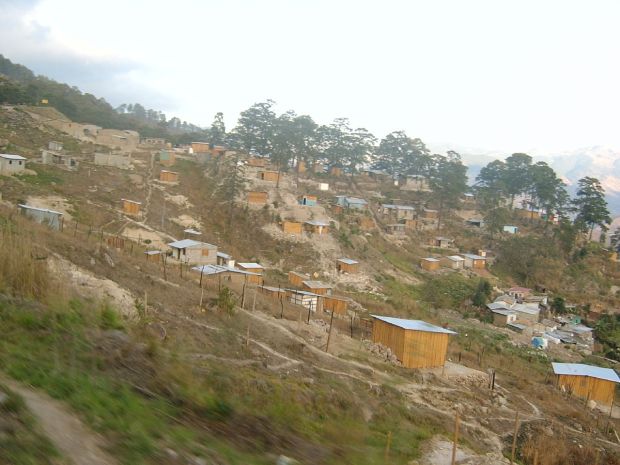
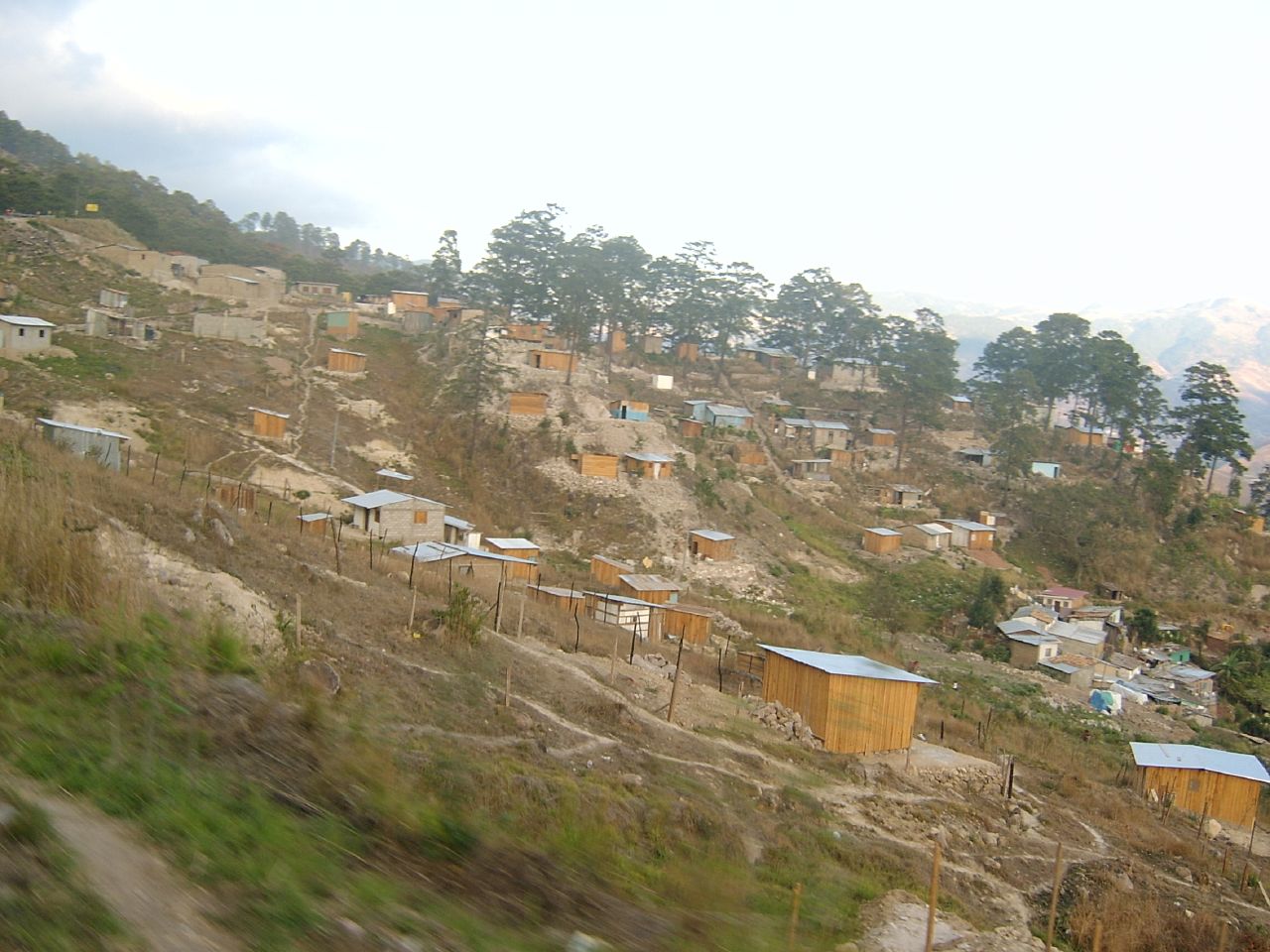
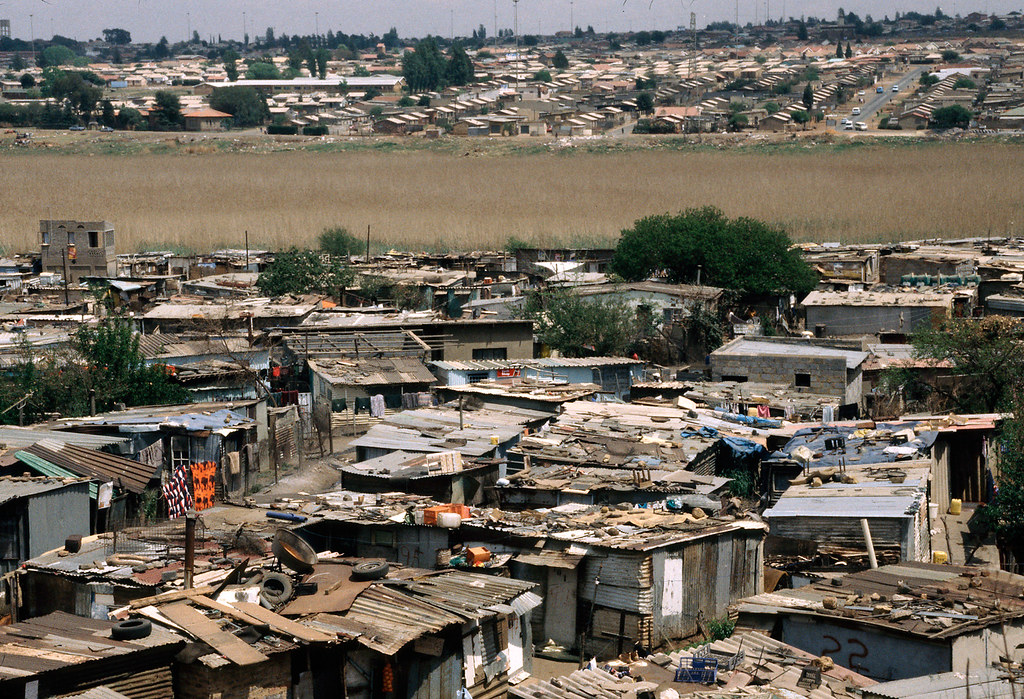
It is 2064, the 50th anniversary of Cotoni Coast Dairies becoming public land, and none of the hundreds of shanty inhabitants living on the property are reminded of the significance of this milestone. Parking areas and trails, once developed for the recreational elite, are covered with trash and lean-to cardboard and tin shelters, which started during the Hard Times of the 2030’s. Presidential Administrations have opened most federal lands, especially Bureau of Land Management lands, to settlement, promising to alleviate housing shortages. Millions had been displaced by extreme heat and epic storms, driven by climate change in the quickly uninhabitable interior USA. The squalor of the hastily erected federal land climate refugee camps contrasts only slightly to those on the nearby State Parks lands, which were opened by the Governor a little later and had ad hoc administrators that attempted (at first) to organize them. 

Missing Wildlife

By 2050, wildlife on the North Coast existed only as a fond memory of most settlers, who longed for the first decades of feasting on their tasty flesh. Even the smallest birds have succumbed to cooking fires, and the land is silent, without bird song. Tide pools have been scraped clean of limpets and mussels and people comb post-storm beaches for kelp and other marine vegetables, otherwise out of reach from harvest.

Cotoni Coast Dairies 2064: “House Everyone!!” The President cried, and BLM was the first to comply

Wildfire

Fires have become tamer after the raging infernos of the 20’s and 30’s consumed the last of the mature trees and, eventually, even their memories…the blackened snags and stumps. Storms come almost every summer, and it is rare that lightning fails to ignite a hundred fires between Santa Cruz and Half Moon Bay. These run quickly across the mountains in the regularly howling winds, consuming whatever diminutive weeds survive. Hundreds of people succumb to wind-driven infernos, but more replace them. As bad as it seems, there is no better place remaining: the seasons are still relatively mild compared to anywhere else in the country.

The Water 

The much-feared Water Guard and their families are the richest among the abject poor, for the cost of this scarce commodity cannot be avoided. They maintain and guard impoundments in the few streams that still provide water: Waddell, Scott, San Vicente, and Laguna Creeks. The other streams disappeared by 2050, now only scorched, mud-filled, lifeless canyons. The dams in the remaining creeks are maintained at high cost and much labor. Deluges are followed by flash floods carrying boulders, silt and debris that easily fill the tiny reservoirs. The stronger people earn water credit in trade for their labor rebuilding the dams, cleaning out storage pools, and replacing distribution pipes leading to water sales locations. Others earn their water by guarding this system day and night, sometimes with their lives. Water is life!

The Realization of This Nightmare

This dystopia is closer than most realize. It is a choice. It is everyone’s choice to avoid, but no one chooses the leadership necessary to do so. Instead, we keep electing representatives to take the place of the parents we wish we had had. Mother and daddy know best, we just want to be told to hush and to trust and that everything will be okay, but it never works out that way.

The pathway to this nightmare has been paved in so many ways. The back-room-deal-type Environmental Saviors responsible for the federal presence, for the Bureau of Land Management (of all agencies!) takeover of Cotoni Coast Dairies not that long ago fought local conservationists in court and won, then counter-sued the conservationists for their expenses. Those types are still working behind the scenes to make this deal seem palatable and good by succoring wealthy outdoor recreation types and funding their trail-building enablers. They have long abandoned partnerships with local community interests and even the more wide-ranging and very popular wildlife conservation movement. Alienation of those interests leaves the door wide open for the populists to overrun these lands which they portray as empty, pretty landscapes ready for settlement. It has always been so.

What You Can Do

The frustration we feel at the trends we have seen too late emerging can be put to good use. We can give money to the Center for Biological Diversity, a last bastion effectively using the legal system to protect wildlife, even around the Monterey Bay. We can vote for different representatives who primarily recognize the importance of the environment and the need to engage, enlighten, and empower those people who care about nature, which is everyone. We can speak up against the local lack of justice. We have more influence in local politics than national: this is the place we create the political movements that make a difference. This is the place we nurture the leaders of tomorrow’s State and Federal governments.

-this essay originally appeared alongside those of my Most Excellent Colleagues at BrattonOnline, a weekly e-newsletter covering the arts, history, ecology, politics, foreign affairs, and more.

Autocracy Continues to Build

I have long labored in this column to outline the frustrating situation all biologists feel in this world as our interests are destroyed by increasingly autocratic tendencies of the government. And no, I have never been partisan about this situation. Both parties are to blame in creating the country we find ourselves in right now, facing a perilous future where generations will not only not be able to enjoy the standards of living we do today but will suffer to keep a standard of living with any comfort at all. 

Will we see lush cover crops and small farms in the future USA?

I am not surprised, however, to find many people freaking out about a government bent on destroying social programs. After all, many voters have long been fed a thin gruel diet of small social program ‘wins,’ so that they will overlook that their future is being stolen by the 1% who are paying for both political parties, allowing them to extract wealth and power by destroying Life on Earth.

Tinkering Around the Edges

I was recently listening to the Bay Area’s own brilliant journalist Kara Swisher interviewing Rahm Emanuel, a person who seems like a reliable voice of mainstream Democratic politics. Ms. Swisher pressed Mr. Emanuel on what the Dems should do at this juncture, and his responses were along the lines of ‘messaging the voters’…’adopting a new platform or two’…etc. There was zero reflection about the way politics is using people to enrich the 1% while destroying the environment and no reflection on how to engage and involve citizens in their own governance.

All Politics Is Local

National government tactics are repeated here in California and all around the Monterey Bay. If you think that the current use of Executive Orders is unusual, check out the far-reaching litany of executive orders from California’s governor, who is proud to reduce environmental protections as part of these moves, none of which is primarily directed at environmental conservation. 

In Santa Cruz, I see politicians and government staff baselessly blaming and attacking people who are trying to protect the environment, including other columnists who write for Bratton Online. These local politicians and staff have long supported the roughshod environmental analysis of many projects before them as long as the project serves some social good and/or is economically attractive. For instance, many pointed out the inadequacy of the Regional Transportation Commission’s analysis on the estimated numbers of tourists attracted by the new North Coast Rail Trail, but politicians didn’t care enough to direct better work. I have witnessed this same political hunger for other projects that badly impact the environment at Arana Gulch (recreational development), Pogonip (recreation and agricultural developments), Glenwood (housing and school development), Santa’s Village (housing development), Seascape (housing development), Wilder Ranch (recreational development), UCSC (housing development), Terrace Point (educational buildings), Nisene Marks (recreational development), Cotoni Coast Dairies (tourism development), and Neary Lagoon (transportation development).

Up Close and Personal

I have had occasion to be privy to the autocratic decision making that creates the results where the environment, and conservationists, end up losing and here’s how it goes. First, someone who wants to develop and negatively impact nature works with an expert at navigating the review process so that they get just what they want. Second, once they have a plan for meeting regulatory demands (aka “jumping through the hoops”), they meet with one or two of the politicians whose vote they’ll need. Then, they make a deal of some sort to guarantee the votes. Then, the person proposing negatively impacting the environment meets with the bureaucrats who also get calls from the politician, and then they, too, make a deal. Finally, after everyone’s approval to the plans and approach, the project proponent goes through the motions of a public process, taking and ignoring input and moving forward with what they wanted to do in the first place. When pressed about why not do a more authentic public process, anyone that was part of those deals will tell you, “why bother?”…”it just makes more trouble”…”we know best and came up with the best solution.”

Do those trends sound familiar at a national level right now? We have far more potential to affect political change closer to home than further away.

Why Aren’t the Dems Fighting?

Some people who are concerned about the Administration’s actions nowadays ask ‘why aren’t the Democrats fighting?’ The answer is that everyone in power is in awe of what they, too, might get away with one day. Plus, some of what is being highlighted as shocking power grabbing is the same stuff that all politicians have been doing for some time now, but perhaps less bombastically.

During the first round of this administration, there was a surprising assertion that we were suddenly going to war with Iran, a country with about the same number of military as the USA. NPR picked one of their preferred retired generals to interview about the wisdom of this decision and that general said that he could not condone the action because ‘Americans have not been prepared for this war.’ That is, the military demands that politicians prepare citizens for war, presumably so that the funding will keep flowing to support the war effort once it is started.

I believe it has become equally normalized that it is the politicians’ job, in working for their biggest donors, to keep citizens constantly prepared for environmental degradation. And, it is my experience that the staff people of governmental agencies look at legally mandated disclosure and environmental review interactions with citizens as a burden and a waste with no chance of improving the agency’s work and better protecting the environment.

Is It Any Surprise?

Given what I’ve just outlined, I am not surprised by what I’m witnessing at a national level. As a nation, we have prepared ourselves well for this situation to work out excellently for the 1%. I am not happy that many more people get to experience the exasperation that conservationists have been feeling for decades, but so it goes. Perhaps this is the best chance we have had to start working together.

How can we organize an alternative in local politics where the people are prepared for a Monterey Bay that is protected by its citizens for the next 1,000 years? The answer lies with more permanence of residency, sustainable and vibrant economies, and removal of any environmental impacts of growth, but those things are at odds with our current societal structure. And yet, these things (and more) are sorely needed. If we can make it work here, the goodness will spread. It starts with developing leadership and engaging many more people. You’re right there with us, right now. 

-this essay originally posted at BrattonOnline, a weekly roundup of all thing local and sometimes global affecting the Monterey Bay. Read it and keep in touch!

Rain, Mushrooms, Fire, and More

Another round of rain enlivens the vibrant living system that is Molino Creek Farm. Citrus ripens, quince/hazels/milkmaids/houndstongue blossom, and grass and herbs thicken and deepen in every field. Sun returns, wind…the cycles back-and-forth unfold into spring and (too) soon the epic dry summer. The Earth drinks now in preparation for the long parch ahead.

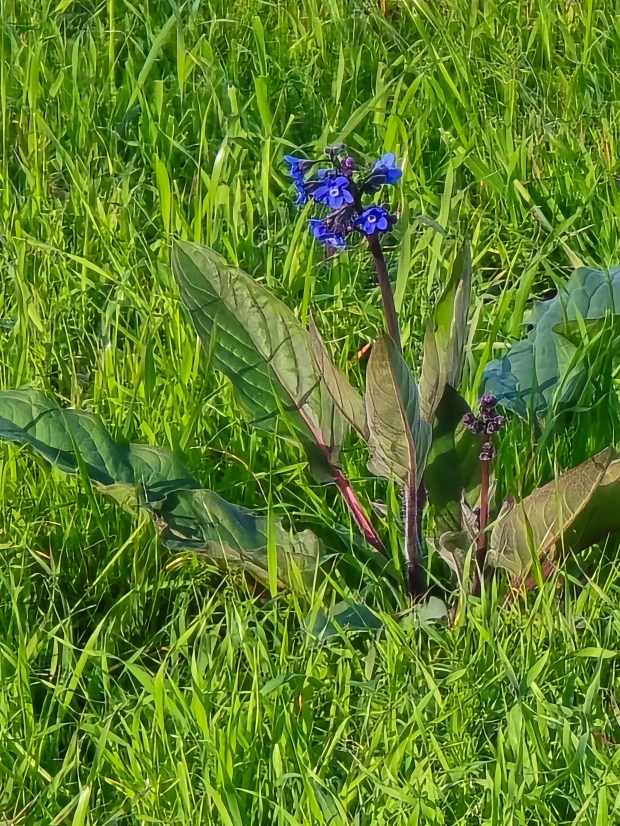
Hound’s Tongue by Cassandra Christine

Water

It rained so much a few weeks back that the Bottomlands pond quickly filled. And, it as rapidly disappeared: not long enough, or deep enough to attract the ducks of yesteryear. Then it was sunny and warm. And then the rain returned, mists and drizzle and the occasional shower. The wetting brought back the chanterelles and beaucoup mushrooms, which had previously pulsed in December only to dry and disappear during the long dry January. Parasols and puffballs poke up from grass and leaves, a variety of colors and textures. Feasts of fresh-picked mushroom risotto return to the menu. The waterfall on the unnamed tributary of Molino Creek spatters and sings, a newly reopened path leads to the overlook. A long glistening wet wall, profusely dripping, towers over the far side of the lively creek channel, hanging thick with wild ginger and ferns. Downstream, the main creek makes even louder creek noises with pool, fall, and rock pile riffles.

A LBM, Little Brown Mushroom, by Cassandra Christine

Fire

Does it ever get too old to talk about Fire? 2020 seems to be fading into the past; 4 ½ years past the catastrophic fire that destroyed so much and changed our landscape forever. Soon, we hope, the Bartles move into their rebuilt home. Our Good Neighbors at San Vicente Redwoods meanwhile continue their excellent post-fire restoration and management. This past week, their crews burned many, many piles of fuel that they had cleared alongside our shared road, including adjacent to the Big Hill. One moment there were stacks of Douglas fir longs and brush, the next moment only charcoal and ash. If a wildfire had raged up that small canyon, it would have been spectacular, dangerous, and destructive, but this controlled pile burn left a smaller footprint with more beneficial outcomes. We are safer. Nature is better off.

Restoration

Our work post fire and overall is evident with the wildflowers. Shucking seeds with our bare hands from nearby wildflowers and Hucking those seeds into the right places throughout the farm creates promise. For instance, a couple of roadside hound’s tongue plants popped up several years ago and have been seeding into the surrounding fire safety mowing zone. Now, there are 10 new seedlings…the patch is growing…the flowers beautiful and there will be more.

Elsewhere, strewn poppy seeds, ant-dispersed footsteps of spring, and grass seeds cast about are manifesting as big patches of increasing species diversity. Besides the rich hound’s tongue blue, there are already splashes of early spring yellow and loud bangs of poppy orange. Bunchgrass tufts throw up panicles of flowers above the meadow sward. Blackberry vines are flashing cascades of white star flowers along fencelines. Trimmed up oaks will survive the next fire, shading a short, fire-safe understory.

Working Fields and Orchards

Mark Bartle steered the 2 Dog tractor in rows across the Roadside Field, mowing cover crop, sending the season’s first cut grass smell to thickly scent the air. A legion of helpers cleared the youngest trees of weeds, saving them from voles. The orchard cover crop is growing tall or just plain growing, depending on whether it was sown early or late; the voles should be going into those rows and feasting on vetch, or bell bean, or oats…soon their litter strewn trails will be evident as they graze and poop and pee and serve as they key component of our regenerative animal impact integration. The owls and coyotes and hawks are thanking us, too.

The oscillating weather still allows for citrus ripening, trees hanging heavily with rain filled yellow, orange, and green fruit. New leaves are sprouting, spikey branches elongating, and older leaves falling to make dense mulch. It still amazes me that we can make this fruit, and we seem to have escaped the frosts of another potentially devastating winter.

Buds swell and the first orchard blossoms have appeared. Quince petals decorate the haphazardly growing bushes near the entrance of the orchard. Apple buds swell on some varieties while others’ buds remain tight and small. Hazelnut catkins dangle and sway in the breeze. Pointy green elderberry leaf tips begin to emerge. The multitude of orchard trees are patient overall in their response to approaching spring.

Waterfall at Molino Creek Farm by Cassandra Christine

Trails Through the Woods

What could possibly be wrong with trails through the woods? Ad hoc, unsanctioned, illegal, illicit, unapproved…choose your adjective to precede the ‘trails through the woods’ phrase and then ask ‘what could possibly be wrong with unsanctioned trails through the woods?’ While we’re at it, let’s ask the question, ‘what type of person would build and maintain unsanctioned trails through the woods?’ Let’s hypothesize for a moment.

Law Abiding Citizen

There’s a lot going on in our nation with people’s attitudes about abiding by laws. Some people are as apt to decry a convicted felon in the White House as they are to cite the horrors of the justice system, saying it is utterly failing most of the poor souls who face the courts. How does that work, logically? I’m not sure it does. But, are we saying at the same time that we should question the laws, as well? Has ‘law abiding citizen’ become an anachronism or just plain laughable? Or, maybe our culture has become accepting of individual interpretation of laws, but not in all cases. For instance, who in their right minds would support widespread law breaking with hit and run drivers, armed robbery, or homicide? But, say how about the lesser offences of shoplifting, forgery, assault, or libel? Are we getting to your more acceptable level of crimes, yet? How about….driving 20 mph over the speed limit, selling alcohol to minors, extortion, or petty theft? And then, somewhere down the line you encounter the laws against damaging public property, trespass, entering closed areas of public land, visiting public parks when they are closed, and violating federal and state clean water laws or endangered species regulations. How are we feeling about the types of citizens who break those laws? Are we giving them a pass? Someone is. A lot of people are. Hundreds and hundreds of people in our community have decided that the criminals committing that last litany of crimes are ‘okay people’ undeserving of one iota of investigation that might result in at most a warning, and almost never prosecution.

Anarchists I know would scoff at the legal argument here. Many who know how broken the justice system is would also shrug off the legal arguments, as well, understanding that without justice there can be no reasonable pursuit of legal matters. So, perhaps we must turn to ethics to examine the truer nature of those who would participate in unsanctioned trail building and maintenance.

A Matter of Ethics

Should we consider the consequences of illegal trail building? Or, is it enough to ask if rogue trail building is good? Is building an unsanctioned trail in and of itself causing harm to other people? Is maintaining a rogue trail respectful of all people? These are the types of questions one must ask in seeking answers outside of legal context. As I have posed these questions over the years, the most common answer is “I don’t know.” So, we must ask another question of morality: is it unethical for an illicit trail builder to create new trails if they are ignorant of the consequences or context of their actions? 

Consequences, Respect

The consequences of constructing and/or maintaining rogue trails are well known, or at least readily available. The most glaring impact of rogue trails is on wildlife. Conservation lands managers have a difficult time providing for some trail access while also conserving wildlife: the two goals are mutually exclusive. Park users disturb wildlife, so one must plan around that to have healthy wildlife populations. Trails constructed outside of that planning process scuttle attempts at nature conservation. 

And so, rogue trail builders either have contempt for parks managers’ planning processes or do not care about wildlife or both.

The same sets of arguments also apply to conservation of flora, fungi, soil, and clean water. 

And again, it would stand to reason that those who construct illegal trails have contempt for park oversight personnel’s work/expertise and also do not care about conserving native plants or mushrooms and don’t care if soil erodes, that we have clean running streams, or that natural areas provide for drinking water.

Let’s extend these logical frameworks to the element of respect. Morals often refer to respecting others: their lives, their pursuits, safety, happiness, etc. All groups with which I have interacted in the past few decades readily recognize that humans need all species to continue existing for our own survival. And so, those who create and maintain unsanctioned trails score quite low on the ‘respect others’ morality scale with that first test. The majority of USA citizens support wildlife conservation; second test strikes against those who would build trails without the careful planning that parks managers use to weigh the pros and cons of new trails. We could go on…

In Sum

In kind words, how would you summarize the findings above to describe those people who make it a habit to create, or maintain, unsanctioned trails? Excluding nihilism, one would need to start with the term ‘criminal,’ but that would not be enough. The word ‘selfish’ sounds unkind, eh? And, even so, just ‘criminal, selfish…’ lacks something. 

Most of the social circles with which I have discourse include short hand lines of reference to describe types of people who love fun just a little too much. You know, when fun overrides respect for others? The term ‘fun-loving’ falls short of describing the types of people referenced in these conversations; the people being referenced generally have problems, which is why they are being discussed. Such conversations generally end in head shaking…no great solutions…sighs and ‘I hope they figure it out….’ or ‘maybe so-and-so (someone possibly close to them) can have a chat with them.’ I think we are getting closer to understanding the types of people we are dealing with. 

Next time you take a walk in nature, watch for the many trails veering from the signed, sanctioned one you are hiking. Ask yourself how much traffic that trail must get to be so well rutted and then think about how far that trail must travel, how much work it takes to chainsaw (at night) those trails open after trees fall. What a massive effort by _______ types of people (fill in the blank)! Think about the conversations they must have with one another and their networks… and how that is influencing the goodness of our community.

– this post originally published in the weekly e-news for the Monterey Bay, BrattonOnline – if you don’t already know it, now’s a good time to subscribe.

Beginning of Burgeoning

Plants and animals are awakening to the waning Winter and the approaching Spring. Spring Equinox is March 20, 2:01 a.m.; daylight savings starts March 9. The days are getting longer and, recently, warmer. On an afternoon walk recently, a new level of bird song filled the air: the birds feel the changing season. Robins, finches, goldfinches, thrashers, towhees, sparrows, blackbirds and juncos were simultaneously raucously singing, each song distinct, each clearly audible from anywhere on the farm.

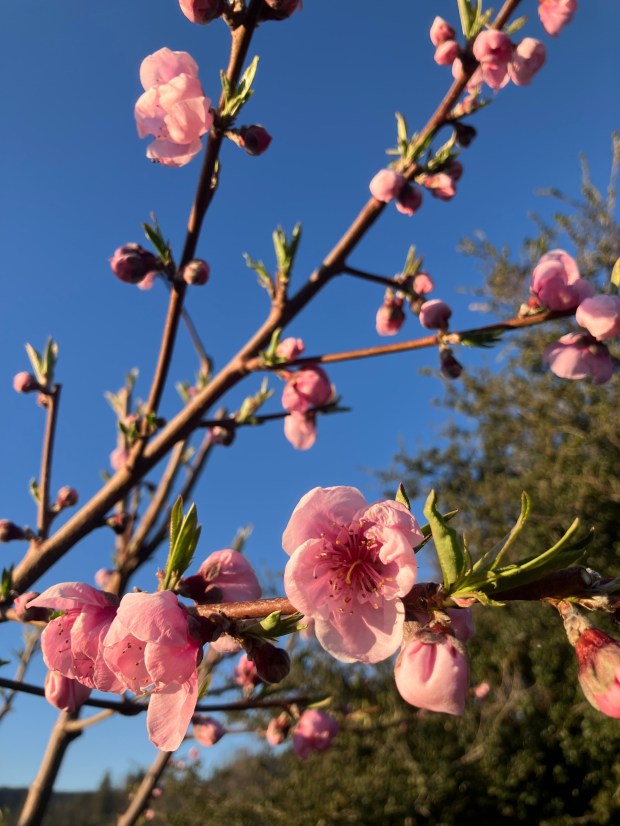
Lucious peach blossoms, so early in the season!

The dominant song, the loudest and most enthralling, is the flock of 50 or so California bicolored blackbirds (Agelaius phoeniceus californicus). This flock hunts in hopping flanks across the fields, scaring up food, or lights into a tree from which it hemi-melodiously erupts into cacophonous orchestration. During this group song, individual birds will take to the sky above the flock, display and glide-flit back down into the tree with a pattern much like falling leaves. Sometimes several birds will do this at once, sometimes only one. It is like a dance floor in 3D. I highly recommend spending time observing this species’ behavior – it is fascinating to watch and mesmerizing to hear.

Greening

Meanwhile, down on the ground plants are starting to get taller. Grass is one foot tall, poppies 6 inches, bee plant two feet with its vigorous stalks and huge dark green toothed leaves. Soon, all that herbaceous stuff will be knee high and difficult to negotiate on foot: this is our last chance to readily romp through lush fields and meadows.

The winner of the green growth height race is, and always was and will be, wild cucumber aka womanroot, so named because the starchy root is the size of a woman, albeit a smaller one. That starch allows the plant to hurdle forward with long reaching vines and twining tendrils, simultaneously flowering and more slowly forming leaves. On a warm, still day, you might catch the cucumber scent of the flowers. Don’t stand still too long or one might grab you!

Marah fabacea, aka womanroot

Flowers

Our Earlitreat peach trees are in bloom. They have to be early to set fruit for harvest by Mid May (!), so sweet and tasty. The large pink flowers are pure eye candy, and the bees are loving them. We are happy for the hot dry spell right now to help the leaves not get too much peach leaf curl, which is problematic with this early variety.

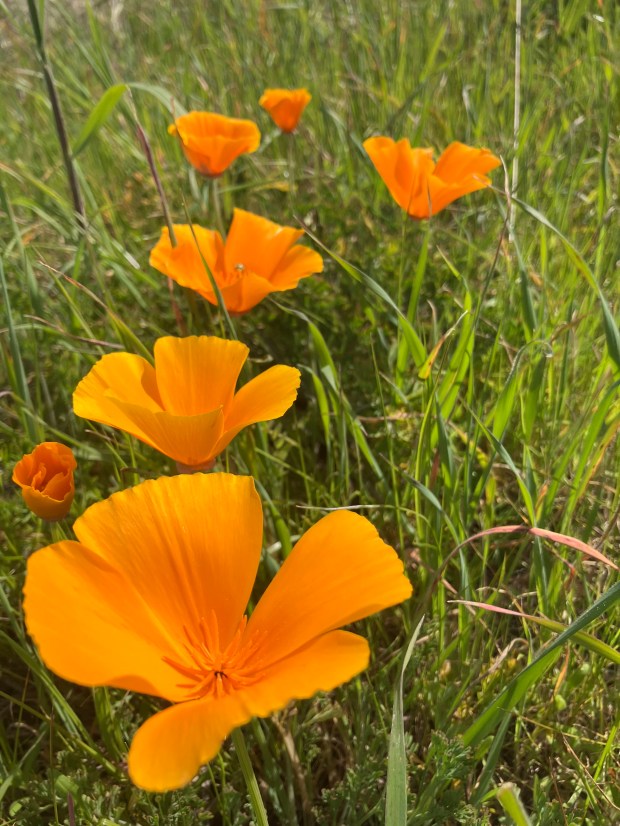
In the uncultivated areas, California poppy flowers are opening. As always each spring, the first flowers are the size of tulip flowers and show more the inland poppy traits: pure orange petals. These were planted from seed brought in and have naturalized. The local poppy blossoms later and so the two races keep separate niches and maintain their flower color and different leaf morphologies right alongside one another.

Frogs and Bats!

Our concrete pond filled early and has stayed full for the winter, attracting chorus frogs. This is the first year in more than a decade that chorus frogs are hopping through the fields, along the trails, and under the orchard trees. They go to the pond at night to sing and play but then out into the fields they go to feed on bugs for full tummies to get them through the night of frenzied singing socializing. The pond is rife with frog egg masses but last I checked no tadpoles. One newt floated around and will be feasting on eggs and, soon, tadpoles, too.

Another thing a pond does is attract bats. All at once, a gaggle of small bats poured out of the ‘horse barn’ roof edge last Saturday at dusk. This evening just after sunset, a larger singular bat was energetically gliding and flapping around the farm. All this bat action but no real evident evening time bugs…but, who am I to say…they are much better at assessing that situation.

Citrus Harvest

Have you been to the Food Bin where Molino Creek Farm limes have been on sale? Everyone says that these are the tastiest limes, thin skinned and juicy. We’re getting ready to harvest another large batch- they ripen gradually and in pulses with the warm spells. Our Community Orchardists went on a citrus harvesting stroll last Saturday after our work party, loading up on limes (Bearrs and Key), mandarins (mostly Honey), Meyer lemons (no one took many), Seville oranges (for marmalade), and navel oranges (mostly Robertson but some Lane’s Late…Cara Cara and Washington a bit slower). Some enterprising souls also are experimenting with the first possibly ripe Pinkerton avocados…we hope for reports back! More different mandarins are ripening…soon!  Another couple of years and we may have too many mandarins and be able to send some to market or to charity or somewhere, we’ll see. But first, how will we do this year with making use of the many pounds of navel oranges on the trees – everyone is reporting large orange harvests this year!

Hoping you have a great week and enjoy some seasonal, local citrus to spice up your life and give you the Vitamin C you crave.

-this post co-published at the other site I maintain for Molino Creek Farm

Living by Principles

What comes to mind when you hear someone say something like, “She is a principled person?” If you trust the source of the statement, perhaps you will think more highly of the person being referenced, which is curious because you don’t have any idea of the nature of her principles. Perhaps merely having principles and acting upon them makes you more predictable, and that predictability is an asset. It seems that this might be a good time to reflect on principle-based living.

Social Principles

I posit that most religions are based on social principles of great value. Kindness, fairness, gratitude, generosity, and attentiveness are some such principles, stated positively. Some principles are stated in the negative such as “evil” including murder, greed, vengeance, gluttony, etc. It is a mystery to me that discussion of such principles is not the primary driver of political discourse. Perhaps we get confused when juxtaposing wealth redistribution as both generous (to the poor) and greedy (against the rich)? Or, maybe we wonder if it might or might not be kind to murder someone for heinous crimes? These are heady questions.

On a national level, we might feel ready to label presidents, members of the house and senate, or even Supreme Court officials as ‘principled’ or ‘unprincipled,’ but how would we take such labels to more definition? What precise principles would you suggest your favorite national politician has had or has lacked? So much media hype focuses on either fallabilities or exhilarating roaring successes of our so-called ‘leaders,’ and yet that question may be difficult to answer. I challenge you to try.

I suggest that everyone has some familiarity with social principles and that most people, if asked, would be able to speak to their personal framework. However, beyond that, I wonder how much people are guided by principles for their work, their homes, or their relationship with the environment. 

While I challenge everyone to think about what principles they operate on at the workplace or in their homes, I am more interested here in elaborating on some environmental principles that you might consider.

Ecological Principles  

There are principles that could guide humans in better forming their relationship with the environment, creating increased benefit for future generations. The root of all evil is said to be greed, and what better test of an environmental principle than just that – greed? 

One of the key attributes of greed is to seek only to take, without giving. For thousands of years, indigenous peoples understood that humans should be very mindful about what they took from nature, and also they should give back. Frugality is a central principle for humans’ relationship with the environment. The less stuff we buy, the more pro-environmental we are. Last I checked, it cost a liter of crude oil every time a dollar was exchanged. 

Giving Back to Nature

What is ‘giving back’ to nature? An indigenous person asked our community once why we were burning our prairies without seeding after the fire. Perhaps that is one way of giving back. We still aren’t doing that. Another way to give back would be to control the invasive plants and animals that are so terribly affecting nature. Please write to me if you can think of any other ways that Monterey Bay residents might give back to nature.

Energy Expenditure Principle

The way we create energy makes a difference and serves as a ripe area for environmental principle formation. Is the principle to create the most energy from the least impactful source? If so, how are we getting reports on how we might help?

The havoc being wrought by climate change has convinced many to be more mindful about what we take from nature, but most people have a very shallow understanding about that. Burning fewer fossil fuels is a Big Problem for life on Earth, but I hear very little about the impacts of alternate energy solutions on nature. Nuclear energy has a great environmental impact not normally described, same with solar panel production and concrete/steel installations for the bases of wind turbines. We might all benefit from getting more information about trade offs for various types of energy production. That way, we can shape our political or consumer voices to help create the best solutions. Plus, what are we hearing about using less energy, altogether? Long gone are the energy saving public service announcements of the now-lauded Jimmy Carter years.

Species Conservation Principle

Fossil-fuel burning-caused climate change is the number one threat to the environment, but there are other threats, and the core concern I believe we should have is about species conservation. I suggest that we should weigh human decisions on how well we can guarantee that all species continue to thrive. I have yet to speak with anyone that discounts this principle’s importance, but I have also seen many decisions made with too little information to adequately assess this principle. How is a regular person to evaluate whether or not a decision favorably affects species conservation? Luckily, we have public disclosure laws and people considering impacting the environment are required to analyze and disclose impacts on species. So, one would expect things like disclosure of species that might be impacted and how the impacts would affect their future chances of survival under the varied alternatives project proponents are required to analyze. If you don’t see such analysis, you should be careful about supporting such proposals.

For further thought on this, consider author Gregory David Roberts’ assertion in the novel Shantaram of the principle of complexity conservation. He would say that we should weigh the good of an action on whether it creates more or less complexity in the future…more complexity is the goal.

Go ahead- try using these pro-environmental principles or come up with your own! Let me know how it goes.

This article originally posted at BrattonOnline– try it, it’s FREE! Plus, very smart people contribute important news there- please do check it out and keep checking back, for substantive, real news.

First Bloom, Maritime Chaparral

Santa Cruz manzanita in full bloom!

The ridgeline expanse of chaparral lay dormant, wafting resinous scents, clicking and crackling as the morning sun’s first rays dried the maroon, shredding bark strands which hang peeling from the skin-smooth twisty manzanita trunks. Through the late summer and fall, each day brought the same routine, sometimes hotter days, sometimes nights bringing fog, dripping and awakening lichen which festoon branches and carpet the ground, nestled into lichens and patches of rabbit poop. Then, the rain came, soaking the rocky ground. Now, months later, maritime chaparral awakens with its first bloom.

Recently, on an early morning drive to the trailhead we encountered huge white, slippery frost patches along the spine of Ben Lomond Mountain where Empire Grade bisects high chaparral, towering oak forest, and miles of burned conifer trunks. We were off to Big Basin not for lingering in the recovering redwood forest as much as to spend time in the warmth of chaparral. Once on the trail, my cheeks and nose were numb with cold, as we descended from magnificent wet old growth forest onto drier rocky ocean view ridges with a different type of snow…petalfall. 

The 3 types of manzanitas at Big Basin and Butano State Park have already been blooming since December. The best show is from a shrub that only grows in the southern part of the Santa Cruz mountains, but there are two other species of manzanita also flowering. The woodland edge manzanita, a species that can get 20’ tall, is aptly called Santa Cruz manzanita; it gets large clusters of obviously pinkish flowers. Glossy leaf manzanita with its small dark green boxwood-like leaves form the neatest of dense bushes with tiny white flowers. Giant woody burls of brittle leaf manzanita send out much less organized clusters of trunks, intertwining with other shrubs to add to the branchy complexity of impenetrable scrubland. In the chill shade below manzanita bush canopies, a carpet of white…the snow of spent blossoms covers moss mats and gravelly barrens.
undefined

More Unfolding

The manzanitas are first, but other chaparral shrubs are also awakening. We saw the first dusty, dark blue flower clusters of the pine-scented, warty-leaved wild lilac. Milk maid’s simple four petaled flowers adorned the trailsides where we walked along with the very first boisterous redwood sorrel blossoms emerging from a lush carpet of shamrock leaves. I look forward to hiking in chaparral in a month or so, when there will be an even more impressive profusion of flowers.

Next: Flowering Hillsides

We will soon encounter the 5th spring after the 2020 CZU Lightning Complex Fire, and the burned hillsides promise a Big Show. First up in the pageant: blue blossom, or wild lilac. They have just begun, but in 6 weeks there will be thousands of acres of sky blue flowers covering 10’ tall glossy leaved shrub-trees. Fire-following bush poppies are next, in June: 2” wide, cheery yellow flowers smiling from the startling silvery blue-green canopies of six foot tall leggy shrubs. Magenta flowering and very poky chaparral pea, twisty white flowers of twining wild morning glory, and white spikes of chamise. For more than half the year, maritime chaparral is a colorful show with patches of yellows, splashes of blue, rafts of white and pink, and dots of red set in cushions of diverse blue-green mounds of shrubs, sometimes towered over by occasional pines or redwoods.

Misplaced Scorn, Not Enough Love

These shrubby ecosystems are being disrespected (again) right now, but we should show them more love. News and talk shows about the fires in southern California frequently include scorn of the shrubby landscape which carries fire so fiercely. ‘Control that vegetation!’ some say. ‘Cut down those shrubs!’ others exclaim. At the top of Loma Prieta, cell phone tower owners mow down many acres of the most beautiful chaparral. Even local parks have started destroying chaparral along trails and fire roads. Few note that no matter how much energy you put into messing up that habitat, what comes up will still be flammable, and probably badly so. 

On the other hand, chaparral blankets and protects the poorest of soils allowing rain to replenish the groundwater. In places where humans have tried hard to convert chaparral to something else, they manage to create a terrible weedy patch – fine fuels that carry fire fast. And, in those places, the hillsides give way in heavy rains and fill streams with sediment, creating flooding and debris flow problems.  Where these amazingly drought tolerant chaparral shrubs are given a chance, they hold incredibly steep poor soils in place allowing rainfall to soak in without landslides. 

Now, Go!

If you can find some time to spend with chaparral, try taking a few trips to the same place in the next few months to watch the flower display change and unfold. Those ridges in Butano and Big Basin State Parks are great chaparral displays. Summit Road near Loma Prieta is also quite nice. Despite fuels management and long intervals without fire, some patches of chaparral persist in Wilder Ranch and in/around Nisene Marks, both State Parks. Montara Mountain in San Mateo County is my favorite chaparral trekking location…amazing views, too.

When you go to these places, here are some questions for the trip:

  • How many Ceanothus, aka blue blossom or wild lilac, do you see? Is there variation in flower color? What’s your favorite?
  • What kind of rock is the chaparral anchored into? Do you see any soil? How do these shrubs get water?
  • How long has it been since there was a fire in that patch of chaparral? Is there a lot of dead fuel build up? Are there young or old pines, which might indicate how old the stand is? 
  • Is the chaparral well managed by people? Are invasive plants under control or spreading? Are the roads and trails eroding or well maintained? Are the nearby houses, power lines, and roads sensitively integrated into the system?

After your return from your chaparral tour, please keep this conversation alive. Talk to your friends and family about chaparral. Read more about it. Vote as if chaparral mattered: political candidates should have opinions about how to protect rare habitats given the constant onslaught of poor human behavior.

This column originally published as part of BrattonOnline, a weekly news publication to keep our community informed about pressing matters at home and abroad – check it out! Subscribe! READ!

Cattle Grazing on Public Lands

A recent negotiated settlement at Point Reyes National Seashore is the latest example of how controversy over cattle grazing on public land gets resolved. The polarity is typical. On one ‘side’ are ranchers, their families and workers, and the broad community that supports family farms, local agriculture, and organic or nowadays regenerative agriculture. On the other ‘side’ are environmentalists, pro-species, pro-clean water, pro-wildlife, and anti-livestock where there’s profit on public lands. The battle at Point Reyes is just one in this war across the U.S. West, and it has been going on for decades. At least at Point Reyes, the two sides don’t neatly align in the expected ways between the two mainstream political parties. Why did it get so bad at Point Reyes that legal action and tens of millions of dollars were needed to settle the issues? Could this kind of thing occur on public lands closer to the Monterey Bay? Let’s look closer to see.

The Vast Gulf

Conflicts with recreation, water quality concerns, and impacts on native plant and wildlife species are the issues most commonly raised when there are concerns about cattle grazing on public land. And, there is good science to support the value of carefully planned cattle grazing to reduce wildfire impacts while promoting native plant and wildlife conservation. In addition to these types of issues, there are pro- and anti- cattle advocates out there, on one hand in support of agriculture or cute critters for children to adore; and, on the other hand, wanting only native animals on the land or against meat eating, methane producing, and otherwise cruel corporate cattle corporations.

Radical Center

There are many of us who are experiencing the beauty of collaboration between livestock managers and conservationists: we are achieving more emergent success than anyone thought possible 30 years ago. Chief among these collaborative networks’ concerns has been development and sprawl…greed that replaces private ranches with housing tracks and shopping malls. In California, we also have shared concerns about the vitality of ranching economics, water provision, wildlife conservation, and catastrophic wildfire. Each of these issues has seen progress because a respectful, trusting network keeps showing up and working together. It takes everyone who has an interest in land management to create innovative solutions: ranchers, conservationists, researchers, land managers, regulatory agencies, community members, resource advisors and consultants, and planners. But, each of these groups has unique interests, different languages, different cultures. We get past these differences by gathering together and learning from one another in well planned, moderated dialogues. The Quivira Coalition is the first group I know to start these discussions, and many followed. The Central Coast Rangeland Coalition (CCRC) is working on this stuff locally, and is celebrating its 20th Anniversary in 2025. I copy here the pledge from the Quivira Coalitions website (link above), a pledge that mirrors the work of other groups like the CCRC:

“We pledge our efforts to form the `Radical Center’ where:

  • The ranching community accepts and aspires to a progressively higher standard of environmental performance;
  • The environmental community resolves to work constructively with the people who occupy and use the lands it would protect;
  • The personnel of federal and state land management agencies focus not on the defense of procedure but on the production of tangible results;
  • The research community strives to make their work more relevant to broader constituencies;
  • The land grant colleges return to their original charters, conducting and disseminating information in ways that benefit local landscapes and the communities that depend on them;
  • The consumer buys food that strengthens the bond between their own health and the health of the land;
  • The public recognizes and rewards those who maintain and improve the health of all land; and
  • All participants learn better how to share both authority and responsibility.”

Who is Showing Up, Who is Not

Where do you see cows on public land; how is it working; how do you know? There are cattle grazing on Midpeninsula Open Space, Santa Clara Open Space, State Parks (Pacheco State Park), BLM (Ft. Ord, Cotoni Coast Dairies), POST, and on City of Santa Cruz (Moore Creek, Arana Gulch). Of these, MidPen, POST, and Santa Clara regularly show up to work with the CCRC. I believe that these are the organizations that are most apt to succeed and least likely to end up in the terrible situations that Point Reyes has been experiencing. Why do some show up and not others? I suggest that the third bullet is as important as the next-to-last. It takes the oversight agency’s interest in results as well as the public’s engagement to nudge public land managers to the table.

My Experience at Point Reyes

I am an unabashed native plant conservationist, have researched and visited coastal prairie habitat at Point Reyes for many years, and I have NOT been impressed. Two of the science papers that got me started on my doctoral research were from Point Reyes. One told the story of a rare wildflower that was protected to death when cattle grazing was removed from its wetland habitat. The other illustrated how another rare wildflower thrived because of an appropriate cattle grazing regime. I consequently surveyed across fencelines at Point Reyes and found native annual wildflowers to be more diverse and abundant on the cattle grazed side of the fence, as opposed to the side where grazing had been excluded. In fact, I found the very rare San Francisco Owl’s clover in abundance in the areas with, and not so much without, cattle grazing. I have subsequently made many returns to Point Reyes to learn about what is going on. During one field trip, I found out that the cattle ranchers and park managers had only the most rudimentary ability to discuss a topic that had long been a priority, common interest: the encroachment of brush onto coastal prairies. During another excursion to explore the health of the very endangered Point Reyes Horkelia, park employees indicated that not only did they not have any data to share about the health of this species, but also that I was not permitted to monitor the species without extensive paperwork, even in areas open and easily accessible to the public (see bullet point above, re: defense of procedure vs. production of results). Nevertheless, I found that the cattle grazing regime had hammered nearly to obliteration this rare species whereas adjoining cattle excluded areas still had a few individuals which were on the verge of being obliterated by weeds, especially iceplant, a species that is relatively easy to eradicate in such instances where it is a local threat to an endangered species. I’m sure that the cattle rancher had no idea about rare species and I’m sure that the Park employees had never considered talking to the rancher about its conservation. In my experience, such communication is essential to improved success.

Where From Here?

Reflecting on my experience at Point Reyes, I am unsurprised about the recent outcome, but I am undeterred to keep helping the Central Coast Rangeland Coalition avoid such unproductive mayhem wherever possible. I challenge the Bureau of Land Management, State Parks, the City of Santa Cruz, and all other land stewardship entities to take the above pledge, joining constructive dialogues that demonstrate success at taking care of our lands. And, I challenge everyone else who is reading this to take the portion of the pledge that applies to you. I especially challenge the “Conservation Architects” (you know who you are)…including those who think highly of the concept of a “Great Park” designed to encompass most of the Santa Cruz Mountains…to now doubly consider what kind of baby-sitting federal agencies need to achieve conservation success. Together, we can make a difference. But, we need the principles of Radical Center-based collaboration (as articulated above) to take root in all places before we will see the harvests we so desperately need.

-this article originally published as part of the ongoing BrattonOnline news service, covering the Monterey Bay and Beyond. Subscribe and win!

What’s In the Air?

Have you heard the question “What’s in the water?” I’ve encountered that question recently posed in the context of a situation when odd, inexplicable things had been happening at an organization. Then, new, seemingly fresh and rational personnel are hired, but those people quickly seem just as odd and inexplicable, less fresh and innovative and then things just stay the same kind of weird. How can that possibly happen?! And we exclaim, “What’s in the water?” It’s as if people are being medicated through their drinking water into a kind of sub-par state of being. “They drank the Kool-Aid” is another way of saying that same thing, I guess, except less innocuously referencing a terrible tragedy in South America some time ago. Judging by the amount of filtered water, bottled water, and such that people purchase, it does seem as if we are very, very concerned about what is in our water. What about the air? What’s in our air?

The Direction of the Wind

In my daily routine, each time I walk outside I try to pay attention to the wind. Which way is the wind headed? I feel the breeze on my skin or watch the swaying of the grass and trees. I tilt my body until I face straight into it, to know best the precise direction. Ialso ask how is the wind blowing right where I am versus farther away? Sometimes the wind is gentle close but raging nearby, on higher ground, where trees ‘talk’ and sway. 

The directions of the wind can be predictable, but it is becoming less so. Winds around the Monterey Bay are often from the north or northwest, mainly cool breezes. Winter storms especially sweep in with gales from the northwest. Bomb cyclones come from that way. Atmospheric rivers tilt the direction more from the west. Especially cold storms come more from the north. Once the breeze starts coming from those other two ways, things get weird.

CZU Lightning Complex Fire – The air looked like this for days

The downslope, Santa Ana winds of southern California (aka devil winds) make things really weird to our south. Those winds are from the east and can be very strong; fires rage, people freak out. Luckily, that phenomenon doesn’t happen here, but we do get occasional winds from the east. I swear I can smell the desert on those winds, the smell of creosote bush. Those breezes are warm and dry just like the winds from the south. I can very well recall the stormy winds from the south: those brought us the CZU Lightning Complex Fire as well as a couple other tattered hurricane remnants that created havoc across the state. When winds come from the south or east, beware of fire and keep your eye out for the odd human behavior associated with Santa Ana winds in southern California. We might also be concerned about the better-documented situation where those breezes carry the spores of fungi that cause Valley Fever, an air quality concern…borne on the wind as they say.  

Air Quality

Once you recognize the direction from which the wind blows, the next question becomes what is that air carrying? When the wind blows ‘just right’ (from the northeast), we get a nasty soup of smog hanging out to sea, blown out of the Golden Gate and then generally downcoast where you get to appreciate that the Bay keeps us a bit sheltered and inland from those toxic breezes. Northeast winds are rare, but that smog carries lots of ugly chemistry. There’s stuff you don’t want to breathe for its toxicity, but there is also lots of fertilizer from car exhaust. Catalytic converters do a good job of turning exhaust into readily available nitrogen compounds that are fertilizing the landscape. Healthy? Nay. Fertilizer makes habitats more weedy, weeds grow bigger and make a bigger wildfire danger when they dry. The tall weeds outcompete native wildflowers. Fires carried by those weeds are devastating California’s deserts, endangering things like Joshua trees. The Golden Gate (NE wind) is one of our passages for nitrogen-laced air pollution, the other is the Pajaro Valley, belching out smog pushed by the more northerly breezes passing down through the southern end of the Silicon Valley.

Those ‘Fresh’ Westerlies

If you are like me, you feel lucky to have that great expanse of clean ocean air to keep us breathing well. Think again. We are seeing more and more pollution from China reaching our shores. Those giant cargo containers full of ‘stuff’ isn’t the only thing coming from the east. Coal fired power plants are making a yuckola mess of chemicals that are polluting California’s air. But, let’s not rest all of the blame on human’s insatiable appetite for stuff in the present. Some of the toxic air particles are from greed of the deep past: gold mining. Mercury was used in processing gold in California. That mercury flowed downstream and into the ocean; it is now being carried back to land in fog and rain, concentrating up the food chain and poisoning mountain lions in the Santa Cruz Mountains.

Famous Air Quote

“We have some incredibly talented people that know environment and what we’re doing probably better than any people on Earth.

From day one, my administration has made it a top priority to ensure that America has among the very cleanest air and cleanest water on the planet.  We want the cleanest air.  We want crystal-clean water, and that’s what we’re doing and that’s what we’re working on so hard.”

I’m guessing you know the source of this quote by now. If not, you can probably guess from the recognizable style. We hope that President Trump, like all politicians, recognizes how much the vast majority of citizens value clean air, so that there is ample motivation to do something about it. If politicians don’t act on these things, we all suffer. Unfortunately, few journalists hold any politician accountable to their clean air record: after all, it is anti-business to do so, and the news needs money.

Our Work

Vote. Get an air purifier for your house. Buy less. Go outside and think about the breeze…the direction of the wind…the strength of the wind…and what is carried on those breezes. 

-this post originally published as part of BrattonOnline.com – check it out! Updated weekly with keen insights into Monterey Bay and beyond.