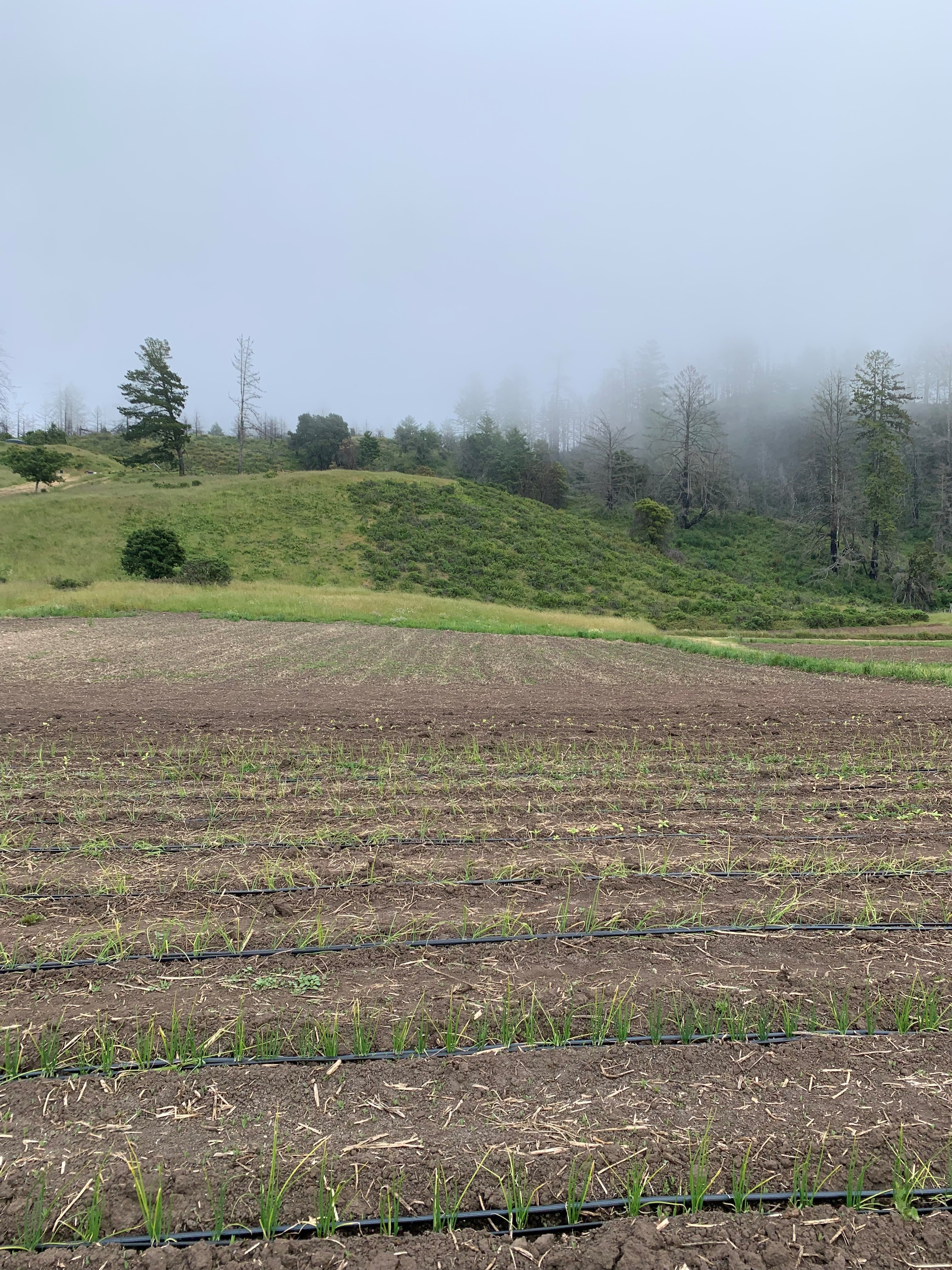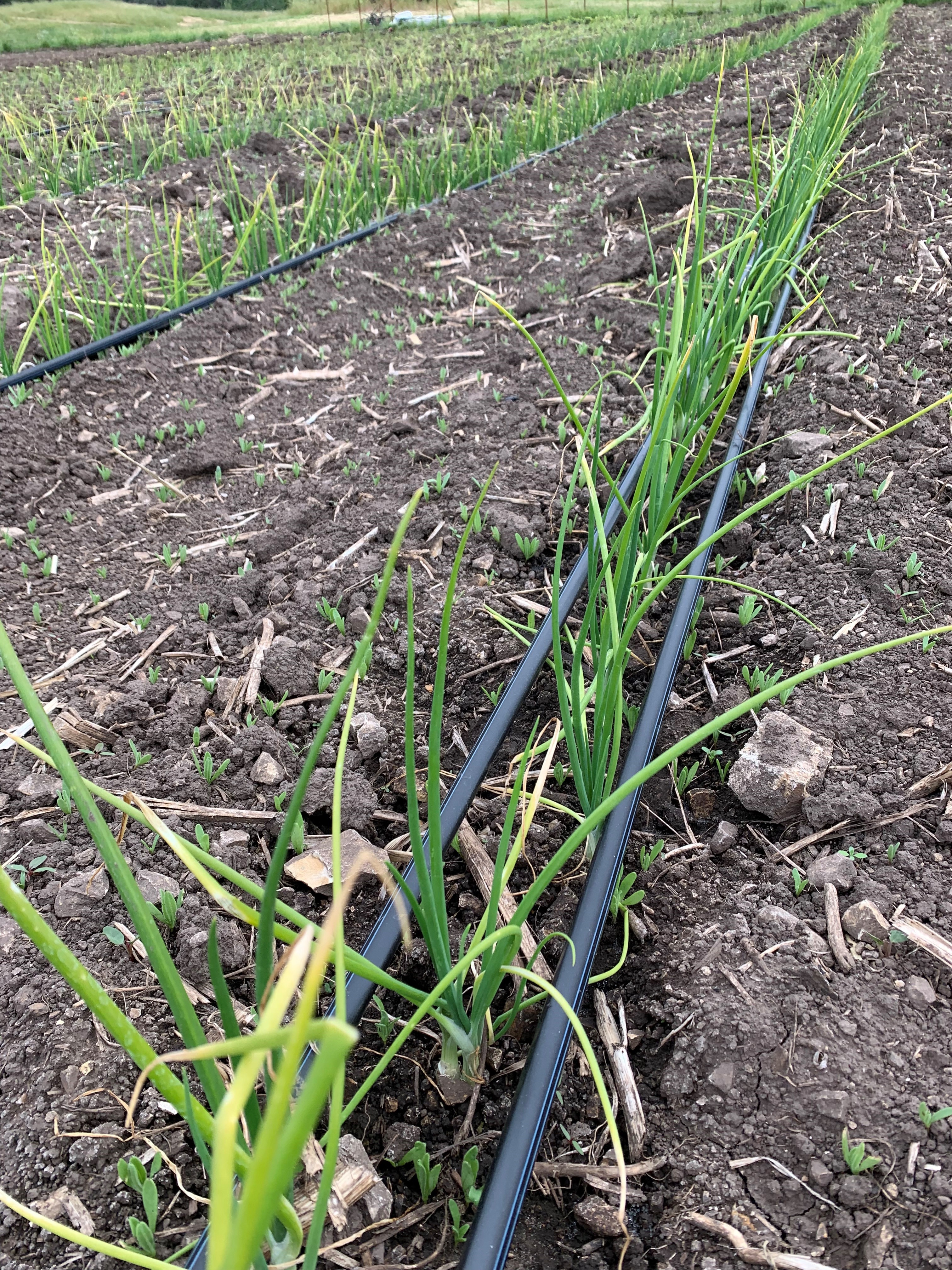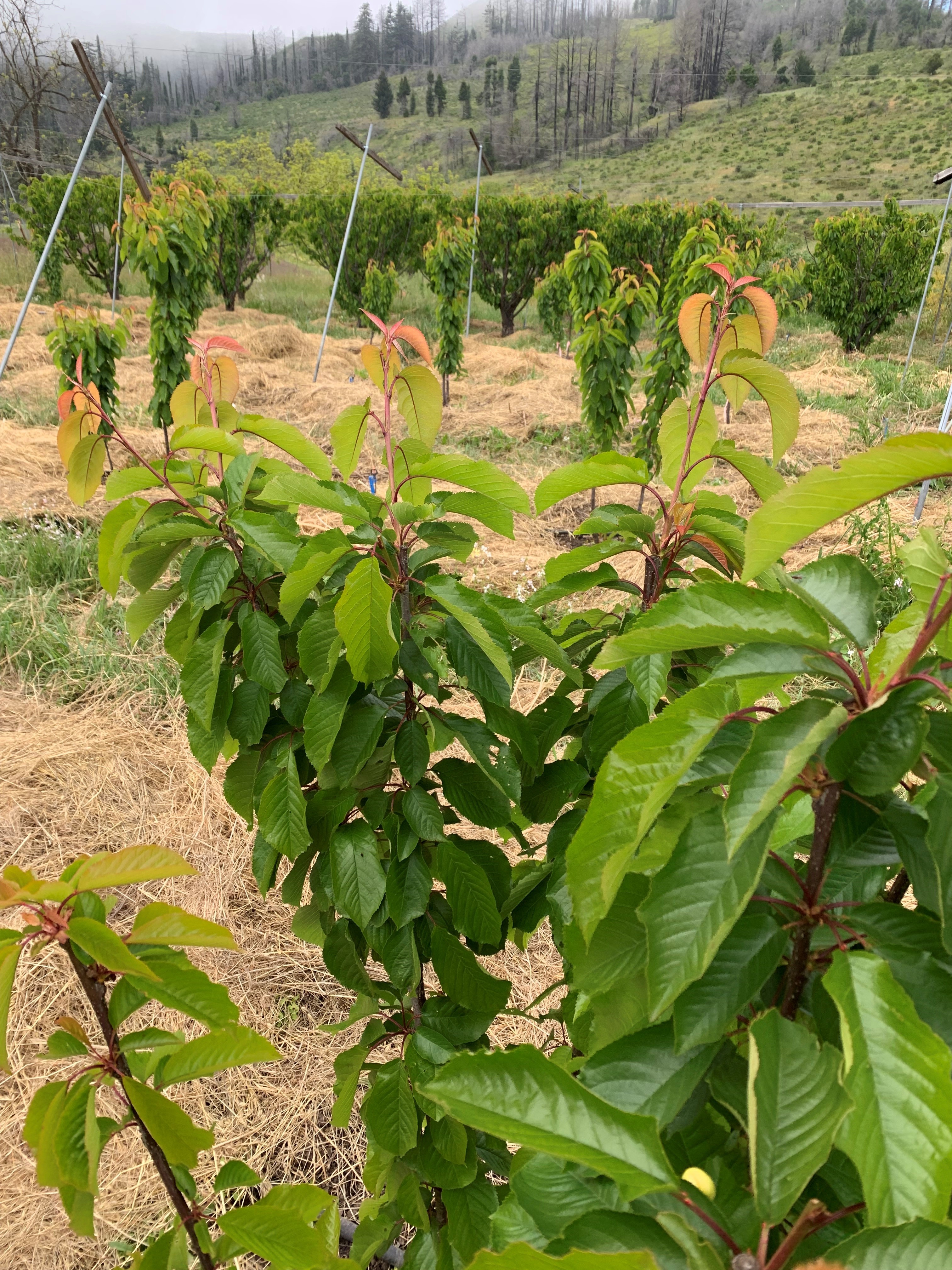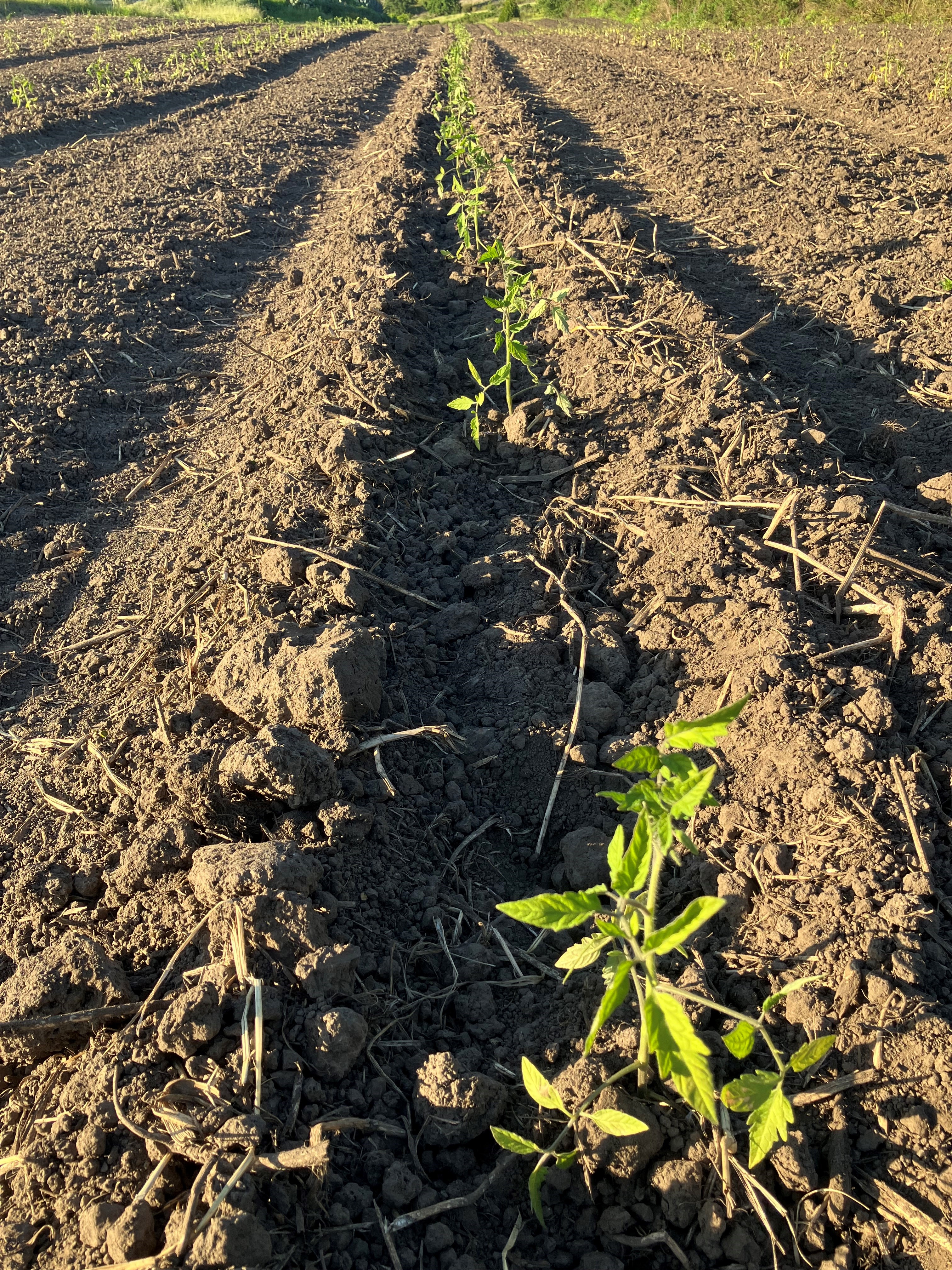
After work it is time to walk around the farm, legs swishing through soaking grass. Each one I touch lets loose a shower and, lightened, the stems straighten for a bit until more mist collects. Where I walk today and where I walked yesterday will remain evident for weeks: tall, lax vegetation flattened and so fat with moisture as to be unable to get back upright. Above the tall boots my pants still get wet; the grass is 3’ high. The mist muffles sound like snow, and it is very still. The moist chill has hushed the birds, the only sounds my feet and the dripping of a million drops.
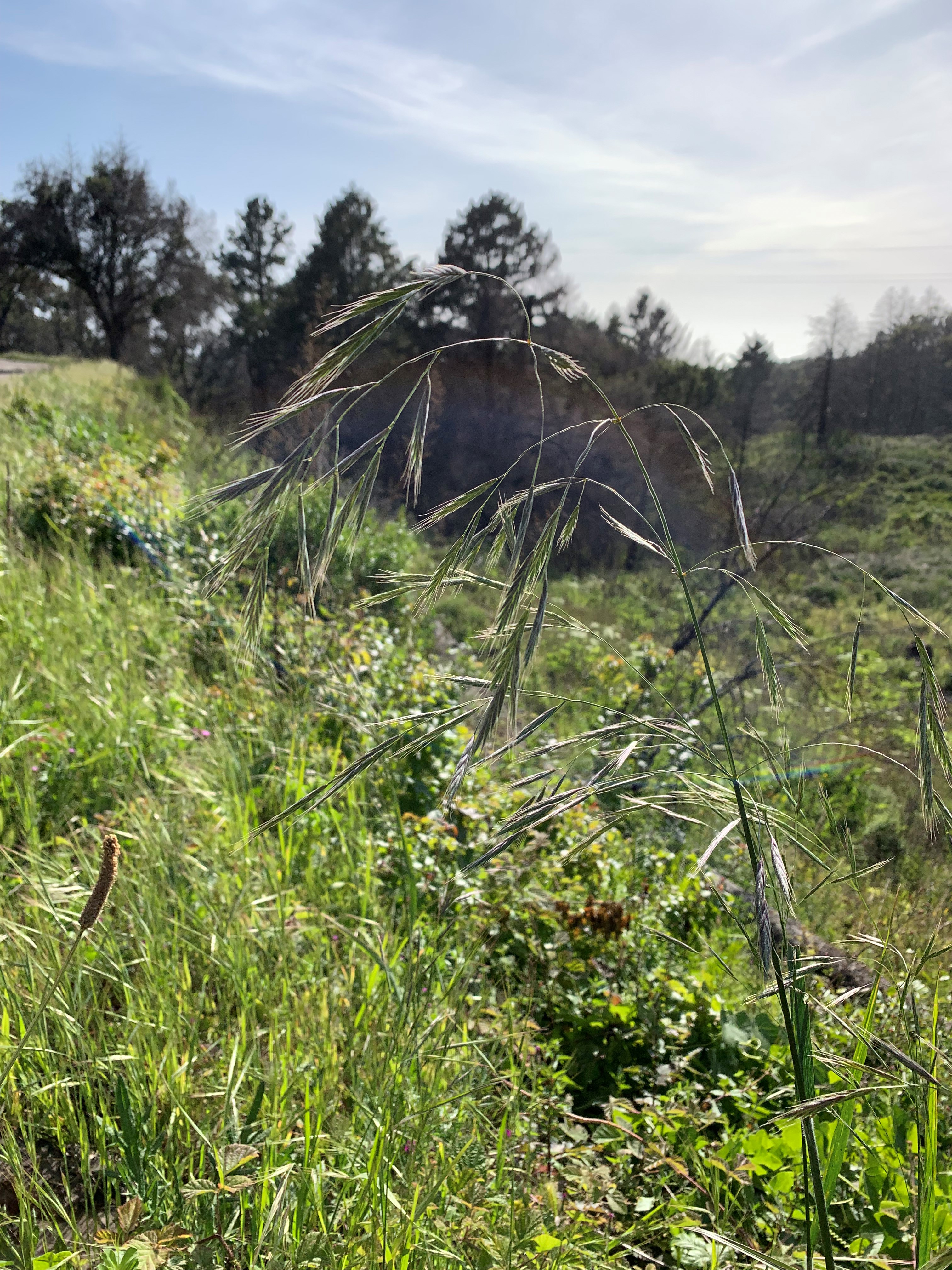
Native brome grass and poppy, laden with moisture
Composting Fields
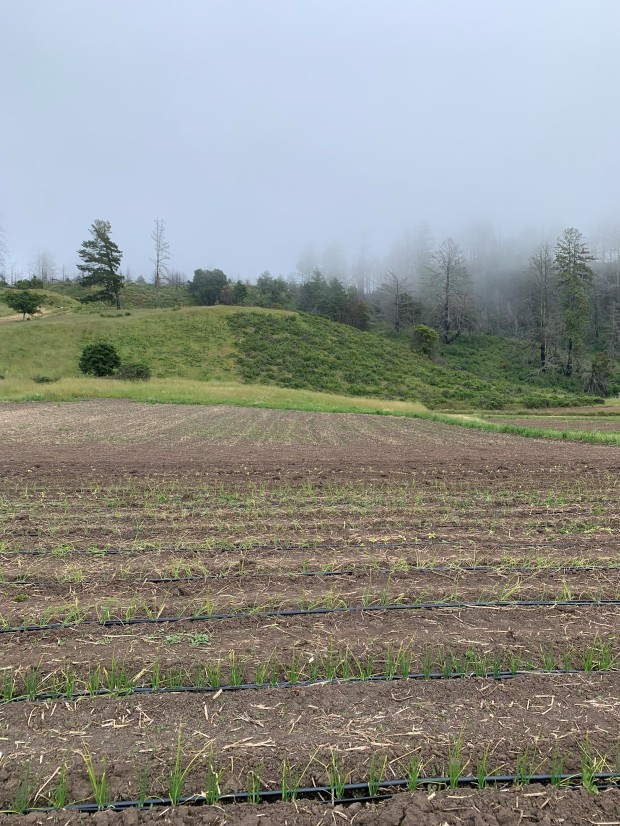
The brief drying and warmth allowed everyone a chance to mow and till, but there was still not enough time. Some fields got more thoroughly tilled than others. A sweetish funk of rotting cover crop hangs in the air near turned up earth. Topsy turvy pieces of cover crop stick out of the mud, the finer leaves and stems melting into mush. The tiny pieces of ground up punk will enrich the soil, hold moisture, feed microorganisms, and nutrify plants. “Green manure.”
Freshly tilled, ‘Pepper Field’
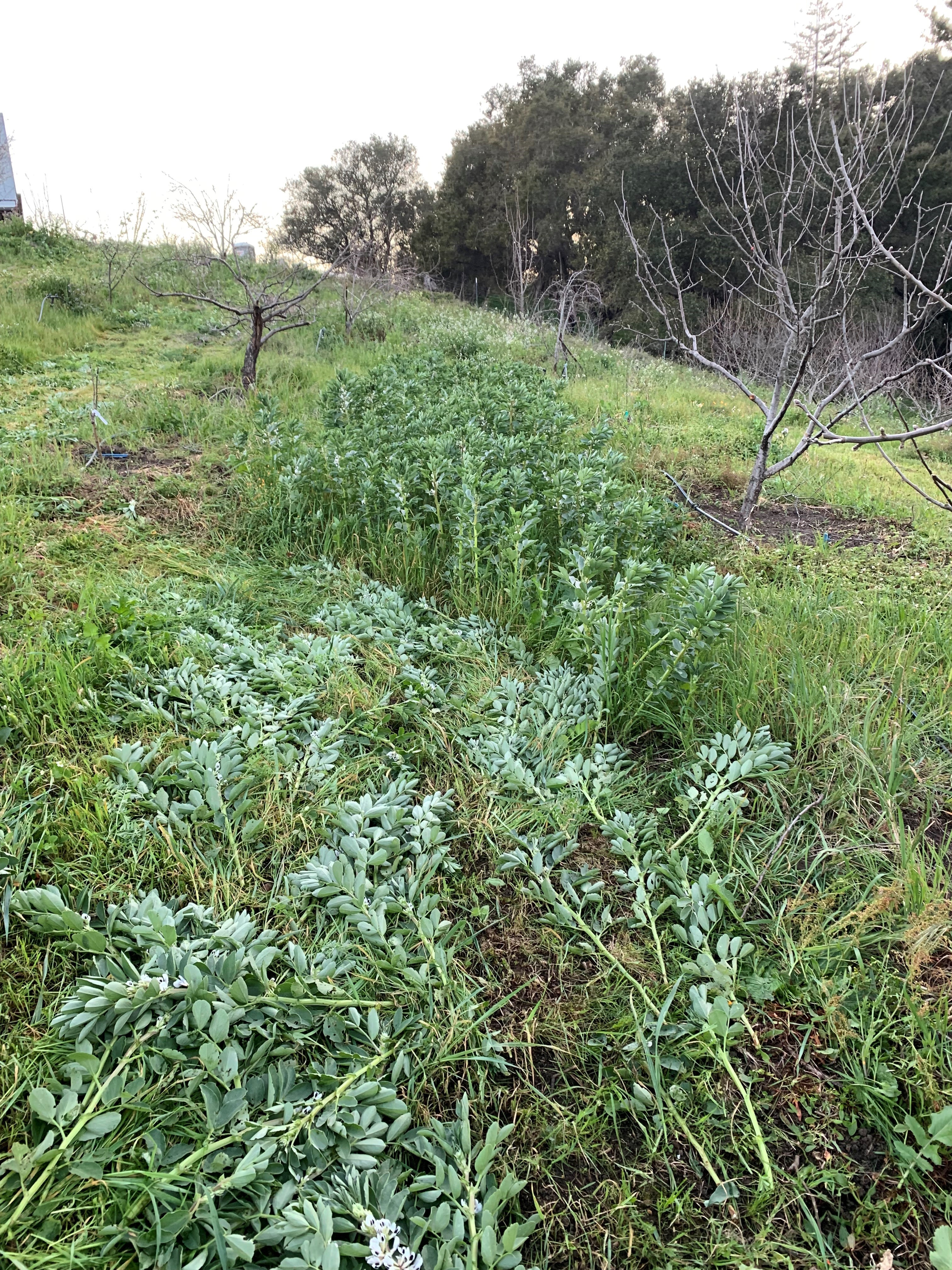
Standing Crop
In the orchards, the cover crop gets cut but we don’t till. This year, in the poorer soiled areas between trees, I ran the flail or mulching mower, grinding up the cover crop to feed the soil right where it grew. Where the fava beans are towering taller, it’s the dance with the sickle bar mower, cutting the tall plants, which fall in rows to dry and then get raked as mulch under the trees.
I keep the orchard mower regularly running not just for exercise but to ‘keep up’ with re-growth. It is nice to get March rains after the cover crop is cut. The ongoing moisture allows the soil to digest the shed off nitrogen rich cover crop roots and make that food available to wakening trees. It is becoming critical to mow the last of the fava beans, but there is never enough time. The Avocado Bowl and Cherry Hill cover crops are going to be 4’ tall soon, thousands of flowers feeding hummingbirds and bumblebees. I hate to deprive those friends of their nectar.
A sea of fava beans (and vetch!) surrounding the Avocado Bowl
Cherry Buds Swelling
The cherry trees are about to flower. Buds are showing color and the sleek red bark is taught from running sap. It is the last moment to observe the bare tree architecture and envision summer pruning. The old, fire-damaged trees are hanging in and the ones that died, root sprouts grafted, hold lots of promise to become more tree-like this year. The piles of grass mulch the Orchardistas hauled and stacked last June have almost entirely melted away but not too soon: there are few weeds where those mulch piles sat at the beginning of winter.
Lapins cherry buds nearly bursting
Old, fire damaged cherry trees (left) and the sprouted Colt rootstock grafted (right)
Native Wildflower Spring
The Community Orchardists not only steward trees but also the mulch fields, some of which are becoming amazing and beautiful native grasslands. Molino Creek Farm was a hay farm in the early 1900’s. It still makes fine hay and those hayfields are alive with many flowers and lots of wildlife action.
Our farm has a curious pattern of shallow-soiled knolls surrounded by pockets of deep soil. The rolling landscape provides for diversity in crops and native habitats. It seems that cutting hay (at the ‘right’ time) and hauling it to the trees as mulch has helped wildflowers proliferate. We are at the onset of poppy spring and two types of lupines are soon to glow. After that, rafts of tiny tarplants will flash yellow each morning. The brome grass has already started and will keep producing seeds at the end of waving graceful arched stems, towering over the wildflowers. Blackbirds march noisily across these fields in lines, scaring up the bugs that find feast in grassland diversity. A giant mound indicates gopher action, a few seedling poppies germinating on the fresh, moist soil. Networks of pathways and open burrow entrances means voles are active. Deeper, bigger holes with fresh claw marks – coyotes at work digging up furry late-night dinners in the hay fields. Where we don’t collect and manage for hay, those fallow fields are humpy with thatch and scattered with shrubs and poison hemlock: a different type of habitat…one which we hope we can muster new energy to manage. More orchards- and more need for mulch…the fate lies with the capacity of Community Orchardists.
Poppy, brome, bicolor lupine and madia- cutting hay creates knoll diversity!
What happens when a member of the public raises a concern about ecological pathogens to conservation lands managers during a public testimony process? This is a story that unfolded not long ago on the North Coast of Santa Cruz County concerning BLM’s management planning for Cotoni Coast Dairies.
Recall Last Week’s Column
If you haven’t already read my column from last week, it would be best to give it a quick read to put this essay into context. In brief, I outlined the devastation caused by reckless human movement of invasive, non-native pathogens affecting native plants and wildlife. The process introducing and spreading such pathogens is ongoing, despite the dangers being common knowledge. At the end of the essay, I pointed to the root cause of this issue, human greed, and outlined the common knowledge about the solution: slowing global trade enough so that we can take the time to be more careful. What I didn’t outline is what we can do more locally to address already introduced pathogens that have yet to spread across our conservation lands.
What responsibilities do conservation lands managers have for the wildlife and plants that occur on the lands they oversee? I’m betting you can guess one of those managers’ responsibilities…but not to wildlife and plants. Public access is often a conservation lands manager’s ‘responsibility.’ Consider the term ‘conservation lands’ for a moment and know that public access comes at a cost to conservation. So, part of those managers’ responsibilities is mitigating and avoiding the impacts of public visitors on wildlife and plants. And, those public visitors bring with them a variety of pathogens that can have grave negative impacts. While planning for public access at Cotoni Coast Dairies, unknown BLM staff wrote many statements acknowledging the danger of proposed recreational use and the spread of pathogens.
BLM Staff List Public Access Pathogen Dangers
Unknown BLM staff wrote extensively in the management plan for Cotoni Coast Dairies about the dangers of recreational use increasing plant and wildlife pathogens. They noted that recreational users “increase introduction of pathogens” (Chapter 4, pp. 5 and 11), which “pose risks to sensitive species,” impact native wildlife, and are “anticipated to impact aquatic species including special status fish species” (Chapter 3, p. 22; Chapter 4, pp. 18, and 32). BLM staff also addressed introduced plant pathogens using sudden oak death as an example. They noted that recreational trail use has been documented as being a significant source of the spread of plant pathogens (Chapter 4, p. 6). In addition, BLM staff also specifically addressed the spread of pathogens to wildlife from domesticated animals, warning that bobcats, grey foxes, dusky footed woodrat, and badgers are all known from Cotoni Coast Dairies and could all be negatively impacted by such diseases (Chapter 4, p. 19). The BLM staff went on to note that domestic dogs carry ‘hundreds’ of pathogens that can be spread to wildlife, including rabies, canine distemper, and canine parvovirus (Chapter 4. p. 21). Finally, the anonymous BLM staff also noted the dangers of introduced amphibian pathogens, including chytrid that is a major concern for California red-legged frog conservation (Chapter 4, p. 30), noting that recreational users spread such diseases (Chapter 4, pp. 35 and 36).
In sum, the BLM staff who wrote the governing management plan for Cotoni Coast Dairies articulated many of the concerns about introduced pathogens affecting the biota of that high-value conservation property. But, how did that knowledge affect their management? Very, very little.
BLM’s Management Response to Environmental Pathogens
After that litany of concerns, one might expect BLM staff to write appropriate management responses. Here are the two responses:
In response to the danger of domestic animals spreading pathogens to wildlife, they state:
“Therefore, BLM will not authorize or condone free-ranging dogs, or any other free-ranging domesticated animals or pets to utilize C-CD. (Chapter 4, p. 21)”
In response to the danger of recreationists spreading pathogens into the freshwater systems, they state:
“Therefore, BLM will seek to educate members of the public on this topic whenever possible. Appropriate signage may aid in reducing the potential for this to happen at C-CD. (Chapter 4, p. 36)
Note that the BLM staff avoided producing management measures that address the majority of the impacts of pathogens spread through the recreational activities they propose. This is particularly troubling because the foundational principle governing management of Cotoni Coast Dairies is not providing recreation, it is conserving the ecology of the property. Instead of outlining management to avoid or mitigate the spread of the pathogens, BLM staff favor recreational uses that they document increasing pathogen risk.
Pride, Prejudice, Ignorance, Overwork, or Institutional Policy?
Given the perplexing approach to increasing the danger of recreationists spreading pathogens that endanger the plants and wildlife of Cotoni Coast Dairies, it is reasonable to ask: WHY? The answer to that question seems to be ‘we will never know.’ Let’s examine some of the potential explanations.
On my documentation of planning shortcomings, one BLM staff person passionately and confidently proclaimed that their team had completely and professionally addressed all comments raised during the public comment period on the management plan. It could be that they were proud of their work and it could be that they were proud of the work of the other staff in their agency. And, given the clear shortcomings of the responses to my concerns about pathogen spread, it also appears that they might be prejudiced about the professionality of their agency. It might be that they are ignorant of the many solutions and mitigations available to stem the spread of pathogens on conservation lands. Another possibility is that staff are so overburdened with a multitude of responsibilities that they are unable to adequately address their planning responsibilities. Or, it might be institutional policy to avoid committing to certain types of management measures, whether due to cost, ease, or interference with recreation or other management preferences of prejudiced staff within the institution.
But, again, we will likely never know the reasons for these oversights. It is likely that BLM staff writing such plans will remain anonymous, so we won’t be able to ask individuals. When I’ve asked staff to refer me to the individuals responsible for decisions so that I could ask them about their rationale, they’ve refused. When BLM suggests that they ‘welcome public input,’ or are ‘seeking public input,’ such as with their latest proposal for a parking lot at Cotoni Coast Dairies, you have to wonder if your time is being well spent providing that input, given the hypotheses presented here. All we can do meanwhile is investigate and hypothesize: is it pride, prejudice, ignorance, overwork, or institutional policy that will lead to recreationists spreading the pathogens that will kill the wildlife and plants at Cotoni Coast Dairies?
– this essay slightly modified from that which was presented by the esteemed Bruce Bratton at his laudable BrattonOnline.com weekly blog.
This is the hardest-work season for the farm. Everything needs doing, and it needs doing all at once: mowing, tilling, planting, pruning, burning, weeding. It’s a race. We’re racing to keep the fields mowed before the birds invest in nests amongst the tall, inviting cover crops. A tractor changes from a purr to a rattle or a high screaming whine: oops! It broke. Backup tractors and backup tools come out- there’s not time to fix things! We chase the weeds and cover crops, tractor-chopping them into little pieces before they set seed.
New Farmer!
Its Bodhi Grace’s first year actively farming at Molino Creek Farm as he takes the helm of the big fading orange, old Kubota tractor: back and forth, back and forth. We manage to have two generations as members of the Collective: what a celebration! Go Bodhi! His infectious smile cheers us all. Good posture on the tractor seat, he rocks out with music through headphones that somehow manage above the din of the tractor mowing. For the first time, the tractor has a big colorful umbrella for shade.
Mowing the Fava Bean Cover Crop in the Old Apple Orchard
Drying, Tilling
The fields are nearly mowed, but still things resprout until the soil gets turned. We poke at the ground to make sure its not too wet to till as we don’t want to compact the soil and we don’t want the drag behind disc to churn up big mud clumps. A couple of weeks of dry warmth and already the mower throws up a few puffs of pale brown dust from the shallow-soiled portion of a field.
Birdsong
Spring’s bird songs have flourish, notes elongated and fancier than wintertime conversational peeps. The first male barn swallows returned last Saturday night, greatly changing both the soundscape and the visual show. Now, fence posts and rooflines emit the swallows’ metallic squeaks and burbling. Crisscrossing the sky, jetting swallow silhouettes grab attention mostly because of the absence of many months. The swallow women were weeks behind the guys last spring; I’ll count this time.
Bluebird’s flashy blues and finch’s purple reds are especially vibrant with breeding plumage. Beaks agape, heads thrown back, song sparrows furiously belt out long and complex solos from atop the tallest white-flowering radishes. Are they proclaiming nesting territory, or are they just celebrating the longer days and the finally warm sun? It has been a long, wet, cool, blustery winter. The unusually poor weather undoubtedly claimed lives.
Late Winter Harvest
Even this time of year, there’s a harvest going on: citrus! Each day presents a few more ripe fruit from the 250 pound harvest of seedless, somewhat surprisingly sweet Persian limes. These limes are yellow-when-ripe, and that is surprising to many. We’ll first distribute to the Community Orchardists and then to Two Dog Farm, who take them to market or to their chef who jars delicious lime marmalade.
Oranges, too, are coming ripe. Navels, Velencias, day by day a little sweeter, a little more juicy.
Sun to Rain
The week’s dry heatwave will break the day after tomorrow and the world will transform for many days to clouds and drip. Mist will blow across the fresh-mowed fields and showers will soak the already thirsting ground. Puddles will fill for already longed-for bird baths, and the newts will march once more, moving towards creek or grassy tunnel system.
An Unknown Bee Visits Flowering Currant, a hedgerow plant at Molino Creek Farm
Bees
Petals close and nectar slows with cooler, cloudy weather. Bumble bees will be hungry. Flowering patches and warm days create quite a buzz. I’m a newfound bee watcher and notice a new bee every few days; today, it was loudly buzzing, honeybee-sized, gray, furry bees… shy and furtive, and very fast. The first bees of spring are still around- giant bumblebees either gracefully bopping between flowers or klutzily fumbling in the grass, seeking burrows for raising brood.
We hope you enjoy the emerging spring.
-this post simultaneously made on Molino Creek Farm’s website
We humans move bad things around, and Nature quickly suffers. But I am not one of those people that believes that everything humans do is bad for Planet Earth. To the contrary, I have researched and written much about the things we do that are essential to restoring and maintaining Nature. We do lots of good work, we should do a lot more, and things would not be altogether better without people. However, humans’ propensity to carelessly move living things great distances is not one of the good things we do. After recently learning about the cause of the disappearance of certain species of local bumblebees, I have been focusing on the pathogens that humans are transporting around the globe.
Plant Pathogens
We don’t have to explore far, or think back very far in history, to see the signs of human mistakes in the kingdom of plants. In the 1990’s, I drove past Waddell Creek on Santa Cruz’s North Coast and gasped when I saw huge patches of tree skeletons – dead and dying Monterey pine trees succumbing from the introduced pine pitch canker disease (Fusarium circinatum – origin Mexico and/or Eastern US). In the last decade, I’ve been similarly shocked at hillsides of brown leaves as forests of tanoaks and live oaks died due to sudden oak death (Phytophthora ramorum – origin East Asia). These are the most recent and widespread results of human carelessness and greed.
Millions upon millions of dead trees are piling up across the world right now due to people vectoring plant disease around the world. Especially with climate change, this is not the right time to be killing trees. Without recalling history, we are doomed to repeat it. We should have learned by now as those recently introduced plant plagues are repeating the devastation of the not-so-distant past. The eastern US lost its dominant forest tree, millions of American chestnuts, to chestnut blight (Cryphonectria parasitica – origin East or Southeast Asia) starting around 1900. A little later, wave after wave of Dutch elm disease (Ophiostoma ulmi 1910 and O. novo-ulmi 1965 – origin Asia) killed millions of elm trees in Europe. No one living recalls the forests of old; soon, no one will recall the beautiful tanoak forests of Central California.
Animal Pathogens
Similarly, human carelessness (and greed) is causing misery and death to many of our wildlife friends. Brucellosis (Brucella ssp. – origin Mediterranean) causes big grazing animals to get sick and sometimes abort their babies. Cattle ranchers worry about the proximity of wild grazing animals that carry the disease. Conservationists are concerned about ranchers wanting to cull wildlife that infect cattle herds. Besides through unregulated hunting, elk, bison, and bighorn sheep populations have probably been depleted through brucellosis and other introduced diseases. This disease also affects humans who become infected through unpasteurized milk or undercooked meat from infected animals.
Another animal disease that humans spread to the detriment of many other species is called chytrid. One type of chytrid (Batrachochytrium dendrobatidis) has caused serious decline and even extinctions in toads and frogs. This disease spread from African clawed frogs imported into the US for the first generation of human pregnancy tests (1930s – 1960s): inject urine into the frog’s skin and it made bumps if you were pregnant – easy, accurate….and a complete disaster for the frogs and toads of the New World. In the late 1980’s, I saw the last of the Golden Toads, a beautiful orange-gold species native to a small patch of cloud forest in Costa Rica. Chytrid found its way into even that remote location, as it found its way into many other seemingly unlikely far-away places, killing off millions of beautiful and sometimes narrowly geographically restricted species. Long-term monitoring plots in Costa Rica and elsewhere in the tropics plummeted in diversity and abundance of frogs. The disease also caused the decline of our local California red-legged frog as well as the frightening annihilation of the Sierran yellow-legged frog, both of which nevertheless survive.
Resistance To … Change or Learning?
My most recent lesson in invasive pathogens was recently with bumblebees. As I engage in restoration and land management across the Central Coast, I recently received notification that the Western bumblebee has disappeared from much of its historic range and now is being seriously considered to be listed as threatened or endangered by the State of California. If you pay attention to environmental media, you no doubt have heard about the effects of pesticides on pollinators. So, hearing about the local extinction of Western bumblebee, you might wonder how pesticides have affected local bumblebees even across the vast areas of parkland and forest where there doesn’t seem to be widespread pesticide application.
While we can’t dismiss the danger of pesticides in affecting pollinators, the more likely culprit for the far-ranging disappearance of this local species of bumblebee is Nosema bombi, a ‘microsporidia’ belongning to group of organisms that might be protozoa or fungi. A bunch of these types of organisms infect humans, but the species infecting, and the effects on, humans is ‘an emerging field.’ Meanwhile, that particular species has been a very serious problem for many bumblebees of the United States. How did it get here? The story again….greed and carelessness: you’d think we should know better by now.
The origin of this bumblebee-killing plague was Europe. Specifically, upstart profit-motivated companies seeking a market in alternative pollinators took our native bumblebees to Europe for breeding, mixed them with diseased European bumblebees, and then brought the disease back to the USA. In the mid-1990s! Companies are applying to do more of this kind of thing right now.
What’s To Be Done?
Each one of us can make a difference to thwart the greed and ignorance at the root of the ongoing introduction of pathogens to the US. I illustrated a very small percentage of instances: there are hundreds or thousands of other examples, even without addressing the pathogens mainly affecting humans (we are all too familiar with recent difficulties of global Covid spread). If even left-leaning media stories included mention of the possibility that pathogen spread has been weaponized for economic warfare, more politicians might be forced to address these issues, which are, after all, national security concerns. National security concerns get bigger pots of federal funding when the voting public gets concerned about them. So, click away at any media story featuring invasive species, introduced pathogens, crop pests, etc: the more literacy we build about these issues, the better. Also…vote for environmentally savvy candidates (if you can find them!). But what do we tell the politicians to do? We tell them to address greed by slowing global trade.
At this point in our knowledge base, we can’t blame ignorance: pathogen introduction is a result of greed. People want money, and they want it now. We have processes in place to detect things we don’t want to come across our borders, but we don’t use them enough to prevent new pathogens from entering. There is no national crisis driving speedy trade in insects, plants, and animals: we can slow down and be more careful. If the politician you support doesn’t understand this, they should. If a politician can’t say that they support a ‘slowing of global trade’ to protect humans and the species that they rely on…that’s a red flag.
-this post originally “printed” in Bruce Bratton’s amazing weekly online blog BrattonOnline.com – check it out!
In the future, it looks like there will be a lot of fire in California. Whether that is Good Fire or Bad Fire depends on you…depends on each and every one of us. Although it might not be ‘natural,’ we need Good Fire because we messed up a long time ago by driving ungulates extinct. Can we rewind? Let’s see.
Infernal Invitation
Our part of Planet Earth is constantly producing tons of fuel for the next wildfire. The coastal prairies are the most productive grasslands in California, creating 4 tons of dry grass per acre every year. Oaks, madrones, redwoods, and Douglas fir grow fast and tall around here. Shrubby plant communities go from nothing to impenetrable, dense thickets in just six years, ready to carry another inferno shortly thereafter.
With plenty of plant biomass to burn, and because of climate change, it is only a matter of time and the right fire weather to set things ablaze across our landscape. Local tribes could get fires to carry through the forests every 4-6 years: that’s how quickly fuel builds up to carry flames. About 6 years after the last fire, we should start expecting the next one, especially if there’s the right conditions. 2 consecutive years of drought makes parts of plants die, creating the dry wildfire kindling. Next up…heat waves….and then wind….and then all that is needed is ignition. We expect more summer lightning to do the job of starting fires as climate change destabilizes weather patterns and sends parts of hurricanes spinning across California.
Compost Happens
People are wrong if they imagine that once plant leaves and stems fall, they quickly decompose into the soil. Lots of folks I talk to think that things rot…mushrooms break down plant parts, after all, right? The cycle of life is all about death, decay, and rebirth! In miniature experiments, many people work this cycle with compost piles, or at least they purchase compost and add it to their gardens. Compost is nature’s proof that decay happens, so it must be the same in the plant communities around here, right?
Mediterranean Mummies
Rot misconceptions are founded in moisture preconceptions. Half of the year, the hot part, is dry: no rain. The wet part of the year is cool. The combination slows decay. In the forests, from what I’ve seen no stem, branch, or trunk larger than 2”diameter will fully decay before it burns in the next fire. Rot resistant redwood needles accumulate in a thick mulch that carries smoldering fire. Grass stems in our prairies last 3-5 years if they don’t touch the ground or are grazed, so there’s lots of accumulation there, too. In shrubby areas, plants are so closely packed that nothing tips over onto the ground, so dead stems and whole dead bushes are held upright for years awaiting the next blaze.
Drier, Hotter, and Few Big Creatures
It hasn’t been this fire dangerous for very long in these parts. This coast was moister and cooler just 15,000 years ago. Pollen records show the departure of grand fir and the arrival of coast redwood around that time on the Santa Cruz coast. On the larger scale, California has been getting drier and hotter since the Rocky Mountains and the Sierra Nevada started blocking summer rain that came from that away. About 15,000 years ago, huge herds of animals went extinct here: elephant relatives, horse and camel relatives, bison, and many more grazing critters roamed in massive herds, grazing and browsing the landscape. This would have profoundly affected fuel accumulation and plant community structure. In that kind of situation, wildfire would have been much more patchily intense. Big grazing creatures crush brush, eat leaves, topple trees. Bears and ground sloths tear apart tree trunks. Dead plant parts plus big creature impacts plus moisture conditions would have made composting much more natural.
What Now?
Okay, so change is happening: what do we do now? Good Fire is the answer, and to make that happen will take everyone’s cooperation. Good Fire involves careful planning and enough labor to set ablaze large areas of nature…at the right time…at the right intensity…at the right season and interval. We will have to feel safe when people tend fires in our forests and grasslands, right up next to roads and homes. Not many people feel that sense of safety right now, but we are still learning and training, and getting better at working together and building trust.
Meanwhile
Meanwhile, how do we live around such a flammable and dangerous landscape? I see people clearing vegetation and trying all sorts of ways of disposing of dead plant parts. As fewer people burn wood for heat or cooking, that is decreasingly a means of wood disposal. People seem enamored with wood chip additions to landscaping, but wood chips only slowly decay and are a fire hazard for years. Some folks are ardent about hügelkultur and composting, but these systems are of limited potential, requiring intensive management and, often, summer irrigation to speed decay. I see many people attempting clearing and biomass addition – mulching, composting, and even summer irrigation – in our poor-soiled chaparral communities. These practices destroy epicenters of biodiversity, type converting precious habitat to flammable weeds and increasing the potential for pathogens to spread into the adjoining habitat. Better to carefully thin and prune back chaparral vegetation where necessary and have low-intensity wintertime burn piles.
In many other situations, wintertime burn piles seem a fitting solution while we await better alternatives, such as Good Fire. Burning piled up biomass takes skill and careful planning to do it right. There are good regulations which get you started on the right path to pile burning: they require not too big of pile and that the biomass is dry so as to create not too much smoke. Permissible burn days assure smoke doesn’t too badly affect human health. I suggest a few other items to the list of things to pay attention to when pile burning. First, don’t burn a pile where it sits: a fox skeleton was the first sign that taught me that. Poor fox, cowering in the pile of brush hoping we’d go away only to be set on fire! There are lots of other critters living under that pile of dead plants! Also, why not use that burn pile to do something else useful? For instance, use the heat to kill an unwanted tree, shrub, or weed. French broom seedbanks might be devastated by a burn pile. A jubata grass plant could be eradicated. A coyote bush that would otherwise start to invade a meadow could be taken out. Also, one might have a group around the bonfire for a social occasion. And, think about how the nutrients and burned bare patch might affect the natural situation: weeds (or natives) will grow stronger, fire-following plants might germinate along the perimeter!
Here’s to learning how to live in a new era on this wonderful landscape. Join a bonfire this winter and pitch some biomass onto the flames to make our community safer!
-this post originally published by Bruce Bratton in his laudable weekly blog at BrattonOnline.com
Will you vote on March 5th 2024 for Nature? How? It is a good time to do some research, ask some questions of candidates, and prepare to be an informed citizen when you cast your vote.
Situation Description – The Upcoming Election
There is a wide field of candidates running to be our Federal Senate representative. Senators are a Big Deal. Once elected, they can stay a long time in the office and there are many fewer of them than House representatives, so they are more powerful as individuals. As I often say in this column: I hope you cast your vote with careful consideration of the environmental platform of the candidates.
Three candidates stand out as particularly interesting in the lineup: Barbara Lee, Katie Porter, and Adam Schiff. Things are a little odd this election because we are voting twice for this same Senate seat. The first vote is the PRIMARY for the full, 6-year term for senator. The top two vote getters will be the ones we get to choose between in November. The second vote we cast for senator is for someone to serve just until January 3, 2025, when Diane Feinstein’s term would have ended. They say that these types of things cause voter confusion and errors. Seems simple enough…
A Brief History
The seat up for election is the seat that Diane Feinstein had held for 31 years until her death while in office, 1992-2023. After Senator Feinstein died, Governor Newsom appointed Laphonza Butler to the position; Senator Butler is not running this election for that seat. This is the first time that the seat has been opened for an election since 1982, when Pete Wilson won it from Mill Valley’s Samuel Hayakawa. Pete, you’ll recall, went on to become the State’s Governor, setting up a situation that made it possible for Diane Feinstein to win the special election to finish his term. Once ensconced, it is difficult to unseat a Senator. (Some argue for term limits, but I can’t agree, preferring folks who get good at their work to stay put and do that well-practiced job even better for those they represent.)
Vote for the Environment!
Ask yourself if you know one single thing about the environmental voting record of…Diane Feinstein….Adam Schiff….Barbara Lee….or Katie Porter. I highly recommend the VoteSmart website to examine environmental voting records, endorsement ratings (many years back), and records of top funders. In short, Diane Feinstein scores higher than any other candidate trying to take her place on environmental issues, and she had a long record to chart.
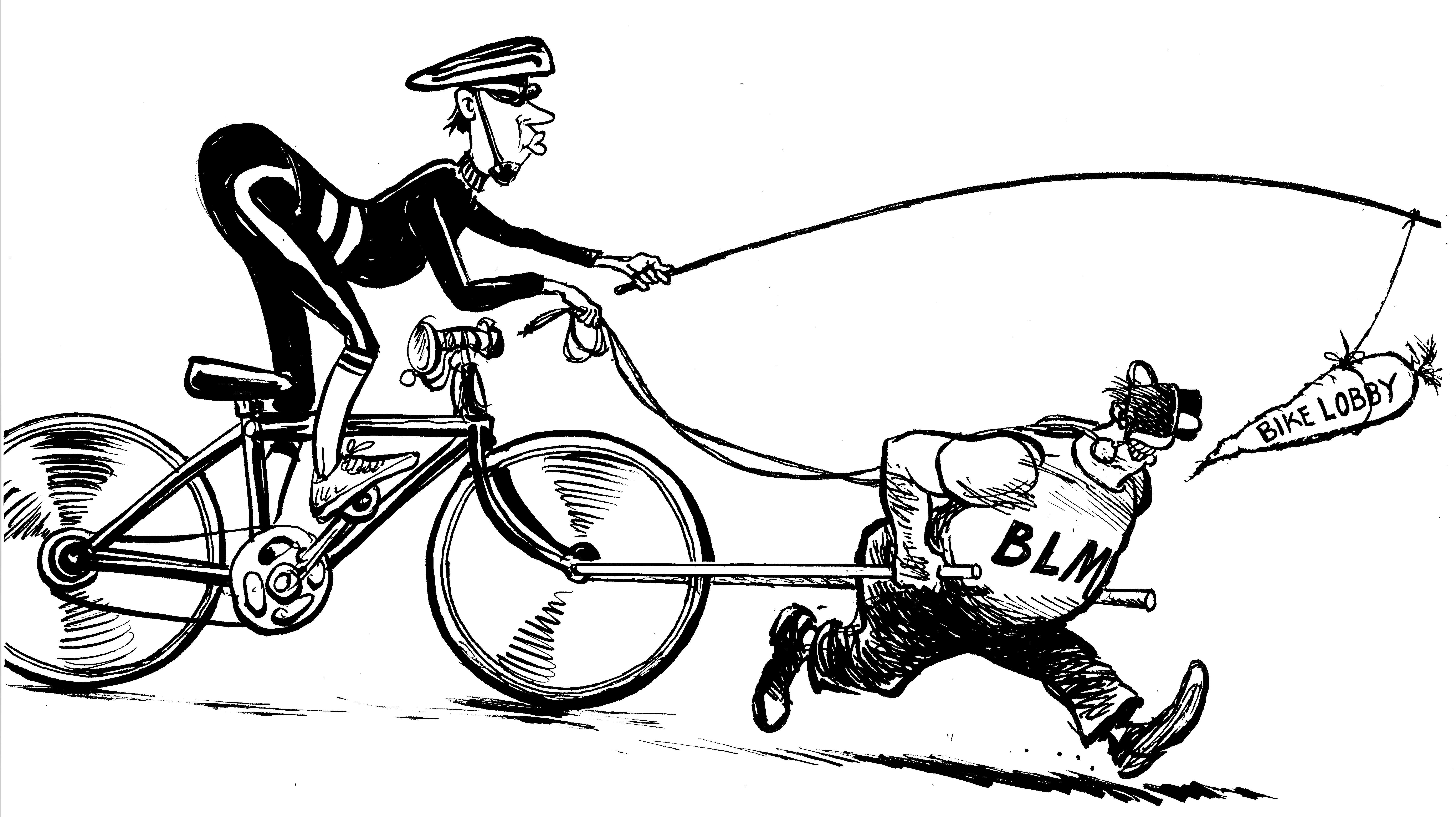
When you examine ratings by the various environmental groups, think about who they are. I look to two organizations in particular: the Center for Biological Diversity Fund and the Defenders of Wildlife Action Fund. These two organizations have not been corrupted by the Outdoor Industry Association and their ilk, as have so many other so-called environmental organizations. Too many ‘environmental’ groups are professing that all of nature’s problems are best solved by e-bikes and unbridled public access to every square inch of conservation land; the passionate people in these movements frequently overlook the central importance of species conservation to life on Earth.
A Common Voter Conundrum
We often look to polls to determine who is the ‘most electable’ before casting our vote. We want to be on the winning side. The problem is that even those who are being polled are influenced by the media portrayal of who is most electable, but where does the media get that information? Inch by inch, voters gravitate towards who they feel others would vote for, not who they prefer. The result is that people get elected who weren’t the heartfelt choice of the majority of voters. How sad!
Environmental Records, Compared
Of the three candidates I’m discussing, Adam Schiff’s environmental voting record is the worst, Barbara Lee’s the best, and Katie Porter in between. Adam Schiff’s environmental voting record is different from the other two candidates with one recent vote in particular: he voted ‘no’ on legislation (Save Oak Flat from Foreign Mining Act) that would have blocked a Trump-era midnight deal that transferred sacred Native American land from the US Forest Service to a foreign-owned mining corporation. Why Representative Schiff thought it was a good idea to vote in favor of one of Trump’s corporate, anti-nature blunders is dumbfounding. Barbara Lee and Katie Porter both knew better.
However, all three candidates refused to co-sponsor the Keep it in the Ground Act of 2021. That legislation would prohibit further oil exploration of the outer continental shelf and would stop our friends at BLM from issuing, renewing, reinstating, or extending any onshore fossil fuel leases that are not now productive. So, you can see that all three candidates are somehow firmly in the court of the Oilogarchy, as are so many politicians….all of whom are driving species to extinction by heating the planet.
The Endorsements That Matter
The Center for Biological Diversity and its associated Action Fund align fairly well with my values, and their website has easy-to-navigate comparisons of the candidates, so that you can see why the Center endorses Barbara Lee and not the other two.
Other endorsements are interesting. For instance, it is very interesting, given the contrasts that I outlined above, that the Sierra Club has failed to endorse one of the candidates for this Senate seat. Another group I follow is the League of Conservation Voters; again, given the contrasting votes outlined above, it is interesting to see that the three candidates are given pretty much identical scorecards.
Ask! Look!
What they say is as important as what they don’t say. Check out Adam Schiff’s website and you’ll see in BIG BOLD LETTERS the heading “PROTECTING WILDERNESS LANDS AND PRESERVING ENDANGERED WILDLIFE” – and then a big fat nothing about endangered species in the words below. You must dig a lot to find something, anywhere with anything he has done to protect endangered wildlife. Good luck finding any legislation that he originated that addresses the many shortfalls of species protection. Barbara Lee’s website contains this statement in favor of keeping the Endangered Species Act (ESA) as it is, which harkens back to the first answer I ever got from a candidate on this subject. When I asked their campaigns about their endangered species platforms, Obama’s staff wrote back to me that he wanted to keep the ESA as it was whereas Hillary Clinton’s staff wrote me and said merely that she opposed drilling for oil in the Alaska National Wildlife Refuge. Barbara Lee’s website mentions the problematic theme that she “is committed to protecting endangered animals and preserving and increasing public access to our national parks and public lands.” Increasing access??!! That’s a coded nod to the Outdoor Industry Association and their lackies who are trying to turn our parks into playgrounds to the detriment of wildlife.
You can view a moving video of Katie Porter speaking eloquently about the need to pass the Recovering America’s Wildlife Act of 2023; Ms. Porter is on the House Natural Resources Committee, which suggests her passion for, and knowledge about, environmental matters.
I hope you’ll spend a little bit of time following this course of questioning and even drop a line to the Senatorial candidates asking them about their positions on the environment, and species conservation specifically. Those things make a difference. And, hopefully, you’ll be casting your vote for the environment in this coming election!
-this column originally appeared as part of Bruce Bratton’s BrattonOnline.com blog – check it out!
It has been blowing and blustery with so much rain that the ground is oozing and bubbling, and newfound springs are pouring from gopher holes across the entire landscape. The creeks do more than murmur: they rush and shout. The ocean has been loudly roaring with unfathomably massive waves, more foam showing than water. People tire of no sun, but all are thankful for the rain, we will perhaps never again complain of rain…lucky us for the wetness, for hydration of the ground, moistening of the forest duff, the slicking of the rocks and mud, and the paddling of the 11 ring necked ducks across Lake Molino.
An enlarging moon rises above Molino Creek Farm and some of its cover-cropped fields
Moon Growth
Last night, the cloud cover slackened, and the moon was as bright as the sun has been for many days. Moonglow shining through drizzly fog. Owls hooting. Deciduous trees awaken even at night, the quickening of sap, the fattening of buds.
Dazzling Green
We all this sprinter. The trees are bare and the grass is turning Electric Green. The meadows around Molino will get 6’ tall this spring, if we let them. In the past week, in the aisles between the orchard trees and the margins of the farm fields the grass doubled to 2’ tall. It has become unbearably wet to trod off trail or road, shoes and pant legs quickly soaked, even when it hasn’t rained for hours (rare).
Sprinter- the trees are still bare, but the grass is turning electric green
Flowers Unfurling
The first orchard trees are in bloom – the first plums are a’flowerin’. The quince bushes aren’t far behind. The orchard understory is thick with 2’ tall (!) someplaces lush cover crop: fava beans, oats, and vetch. The wide, blue-green fava bean leaves are lush and heavy, nodding as the first white flowers emerge in whorls along the stems. Under the trees, the Iberian comfrey is in full bloom, tempting the bumble bees, preparing them for the Big Bloom when we really need them. Borage, native strawberries, and weedy radish are also offering nectar in the understory. Sprinter – a time for the vibrancy and lushness of the herbaceous world.
Pile It Up
There’s not much going on with the farming, but the Molino folks have been ‘at it’ with land management. We’re not quite done burning all the biomass we piled up this last and the prior year, but we’re close. Fourteen piles ate up lots of stuff into relatively nothing, doing work at the same time. We made the burn piles on top of brush that we didn’t want, so the stumps were thermically removed, saving future work. Often, these piles went through both weekend days with shifts of energetic people tending and adding to them. Each branch we torch is one less to add to the future wildfire, and we work apace to make the farm more fire safe with the understanding that next summer could challenge us once again with an uncontrolled inferno. Meanwhile, we get soaked in the rain while the bonfires steam our clothes dry and keep us warm.
The ridge has fewer trees: dozens fell in the 75mph winds a few weeks back
Chores
We can no longer rest. Although the short, dark, wet days still make us lazy, we must awake and enliven and get to work. After a 2-year hiatus, the meadow voles are back- good news for the riddance of gophers but bad news for the sweet bark of the young trees. Time to make bare the area around young tree trunks- the only way to keep the voles at bay. Also, many young trees pitched sideways must be propped. And…The Pruning! The Grafting! The Planting! Wow, is it ever time to catch up.
Shall we all agree? Injustice shall not stand! But what are the ultimate measures of environmental injustice, and how do we make those responsible for violating those measures more accountable? Shouldn’t these be the primary questions we pose as ethical humans concerned with the welfare of future generations? As the which came first the chicken-or-the-egg statement goes, ‘no peace, no justice.’
Species Loss and Soil Loss
I posit that the loss of species is the primary measure of environmental injustice. And I would suggest that soil loss is, as a measure, just as important. It is sometimes difficult to make the case that a given species is critical to the welfare of humans. But any informed, rational conversation on the subject will eventually conclude that the most justice is served by ensuring all species survive. It is similarly difficult for most people to understand and discuss the importance of keeping soil in its rightful place. And again, if people take the time to have informed rational discussions on this matter, they will conclude that is absolutely critical that humans do everything in their power to ensure that soil is not lost…from any place.
Measuring Success
Humans have become expert at measuring things, and there are easily available metrics for monitoring species and soil health. The federal government of the United States has an Endangered Species Act and a Marine Mammal Protection Act and the State of California has its analogues. These two very powerful pieces of legislation demand a science-based approach of measuring the degree to which species are approaching extinction, publishing lists of species which have entered that trajectory, and demanding humans take the actions necessary to recover those species back to healthy populations. With those rules, we have progressed well in our species health measurements, database management, analyses, and predictions – oodles of very smart humans’ careers are spent on these issues. The US Fish and Wildlife Service, National Marine Fisheries and California Department of Fish and Wildlife are the authorities responsible for protecting species.
Similarly, both the federal government and the State of California have strong legislation to address soil loss. The federal Clean Water Act and the state Porter-Cologne Act both address soil loss where it can most easily be shown to affect human welfare: in wetlands, streams, and rivers. Again, humans have become adept at measuring soil (aka ‘sediment’) levels in our wetlands and waterways. The acting authority for both pieces of legislation is the State Water Quality Control Board, acting with Regional Water Quality Control Boards…ours being the Central Coast office based in San Luis Obispo.
Photo by Vince Duperron
Progress?
We have had some success, but mostly we are failing to address species decline and soil loss. The Monterey Bay region has excellent examples of both the limited successes and abject failures with both issues. If you get to Moss Landing or Monterey and hop on a whale watching boat (and I hope you do!), you can predictably view endangered species that, due to legal protections, measurements, and adaptive management, have recovered somewhat from extinction. Hike at the Pinnacles, and you can see California condors which most people feared would go extinct not that long ago. Walk on some of our local beaches and you might see a snowy plover…another species who owes its survival around here to the Endangered Species Act. Same with the southern sea otter, marbled murrelet, and the central coast populations of steelhead and coho salmon. If I’m convincing you of humans’ ability to reverse species extinction, you are being premature. All of those species, and dozens more endangered animal species remain on the federal and state lists of imperiled species because they have not been recovered. And, many, many more species qualify for listing under the state and federal endangered species acts but the authorities haven’t spent the time to analyze them. Locally, only the peregrine falcon has been ‘delisted’ – no small feat! The reason so many species are so tenuously holding onto their existence: lack of accountability.
Accountability
Holding people accountable begins with measuring their success. After legal action by the Center for Biological Diversity, the US Fish and Wildlife Service has been dutifully publishing 5-year reviews of the status of each federally listed species; the stories in those reports are not good, but their reports fail to go so far as to hold anyone accountable. Turning to our much-vaunted free press, The Intercept recently published an exposé that illustrates who should be held accountable for the lack of protection afforded endangered grizzly bears. That story, and similar stories I’ve documented from around the Monterey Bay, point to problems with the justice system. If you haven’t figured it out yet, the US justice system is seriously in trouble: there is no justice in the USA! As shown in that Intercept article, anyone can destroy the habitat of, or kill individuals of, any endangered species and easily get away with it.
Point Reyes Horkelia: another species about to be listed as Endangered due to bad public lands management decisions
Local Examples – Endangered Species
Whale species, snowy plovers, Ohlone tiger beetles, California red-legged frogs – all local endangered species with good documentation of legal infractions that have gone unanswered. There are films, witnesses, and reliable first-hand accounts (including by legal enforcement personnel) showing boat captains purposefully pursuing and interfering with the movement of – harassing – legally protected whales on the Monterey Bay…and these are ongoing situations. When interviewed, Federal enforcement personnel say that it is hopeless to enforce such infractions because they report to too few legal personnel and those personnel say such cases don’t stand any hope of holding up in court. Similarly, State enforcement personnel say that unless they catch, film, and have witnesses of someone in the act of killing an endangered sea otter (with ‘blood on their hands’ and a ‘body in their trunk’) there is no hope of legal enforcement of the many more frequent (and well documented) situations of human behavior negatively impacting that imperiled species. Again, they say this is due to limited legal bandwidth within their agency and the hopeless nature of the justice system in convicting anyone. In Florida, there is good legal precedent for finding parks agencies responsible for allowing visitors to trample endangered sea turtle nests. In Florida, as with California, state parks personnel are required to plan for such endangered species protection, even on popular beaches. Around the Monterey Bay, parks agencies routinely allow visitors to trample endangered snowy plover nests and squish endangered Ohlone tiger beetles: there’s documentation aplenty with both situations. As recently as this past year, park agency personnel have destroyed wetlands occupied by California red-legged frogs to ‘improve’ trails. In past years, park agencies have graded and graveled trails, destroying Ohlone tiger beetle habitat. When reports reach federal officials, they respond that they contact parks personnel, admonish them, receive apologies, and then they forget it…there is not one bit of justice served!
Local Examples – Soil Loss
I could, and will in a future essay, provide a similar litany of examples where responsible agencies have failed to enforce regulations designed to address soil loss. The San Lorenzo River is ‘listed’ as impaired by sediment- soil loss in that watershed is rampant and largely unaddressed. There is more to come on this.
Upper- and Lower-Level Accountability
What do we do? If voters don’t demand that District Attorneys enforce environmental crimes, they won’t. If we don’t demand that our politicians have environmental platforms, they won’t work to improve the justice system so that it protects species and soils. But is the fault really way up there at those ranks? Can’t we demand accountability at lower levels? After all, unless we work together at every level, we won’t succeed.
If you see something, say something. We must have compassion for the enforcement personnel who so want to do their jobs but feel disempowered. And let’s learn how to be good witnesses, how to provide the right reports, and how to help document the two primary root environmental justice issues. Evidence must mount from more people more frequently. We must also make sure that the evidence is well stewarded: I look forward to annual reports from enforcement agencies about the frequency of infractions that remain unenforced.
Finally, why do we allow parks agencies to keep operating so that visitors are destroying the endangered species that those parks were designated to protect? Why do parks personnel allow so much soil loss from roads, trails, farms, and buildings? This goes beyond enforcement. This is a political issue. No one wants such injustice.
-this essay originally posted by the wise Bruce Bratton, who aligns some of the areas’ best minds to post in his weekly blog at BrattonOnline.com – why not subscribe today?
When I can muster it, I travel to the American tropics to experience an even greater degree of species diversity than California. I’d like to share some of what I noticed in the contrasts between the people and places I experienced this December in Ecuador, perhaps the most species rich place on Planet Earth.
A indigenous guided Amazonian river tour in Ecuador, one of hundreds available
Oh, the Riches
One of the most interesting conversations I had while traveling in Ecuador was during the taxi ride back to the airport as I was departing for California. I mentioned to the taxi driver some of the things I’d noticed in Ecuador that contrasted with California. For instance, the roadways were clean – no litter! Also, I hadn’t seen any homelessness during my travels, though I frequented areas where entire people had no obvious means of employment. Everyone I encountered during my 3-week stay had been more than polite – outgoingly kind more like it. And, those with whom I interacted seemed to appreciate and even understand a lot about the biological richness of their country. I told the taxi driver that these things were surprising to me as Ecuador was supposed to be such a poor country. He shook his head and corrected me – Ecuador is a rich country, quoting Friedrich Wilhelm Heinrich Alexander von Humboldt, “Ecuadorians are rare and unique beings: they sleep peacefully in the midst of crisp volcanoes, live poor in the midst of incomparable riches and rejoice with sad music.” He then asked me if the United States was also a rich country, and how well did the people of the USA sleep? I didn’t know quite how to answer. (It turns out that one-in-five US citizens take sleep medication regularly).
Tourism Economy
It is interesting that both Santa Cruz County and the country of Ecuador generate approximately the same amount of cash due to tourism: $1.1 billion annually. It is there that the similarities end. The Beach Boardwalk is the driving force for Santa Cruz County tourism. Experiences in nature are what drives tourists to Ecuador; they go to experience Darwin’s discoveries in the Galapagos Islands or to see the rich jungles, volcanos, mountains, and the plethora of wildlife. Everywhere you go in Ecuador there are lodges hosting people whose destination is Nature. Lodges are gateways to the Parks, and each lodge has a cadre of nature guides trained to help tourists see the richness around them. Nature guides study for years to become certified to lead tours in the parks. The guides I met could identify hundreds of birds by their songs, knew a bit about most of the plants we encountered, could identify tracks in the mud, and could talk about the distribution of species across the country and beyond. There are hundreds and hundreds of such guides in that country, which is the size of Colorado.
What a Contrast!
As I returned home, I wracked my brain to think of a single lodge in the Monterey Bay that caters to nature tourists and has any nature guides at all. The San Francisco Airport toilets were much nastier than the toilets in the Quito airport. Trash litters Highway 1. The homeless population was not sleeping peacefully, though others might have been, back in my hometown of Santa Cruz. I’m not sure how many of my culture were rejoicing, with sad music or otherwise: joyfulness is not a phenomenon I equate with this culture. Certainly, most of us living around the Monterey Bay aren’t living poor, but we, like Ecuador, dwell ‘in the midst of incomparable riches.’
Miles of beautiful coast and not an eco-lodge or terrestrial biodiversity guide to be found
When is a Tourist Just a Tourist?
What does it matter that tourists go to the Boardwalk versus taking a walk with a nature guide? They come, they spend, they go home…its all good for the economy, right?
Between guided hikes at an Ecuadorian lodge at 9,000’ I sat by a fireplace looking through the reading material on the coffee table. There, among giant, full-color books published by the Ecuadorian government about the nation’s biological richness, I saw a magazine published by the American Bird Conservancy. That group, and the Audubon Society are two fairly mainstream conservation groups working to save birds from extinction. Many of the tourists supporting Ecuador’s lodges are birders. There is a natural connection between tourism and conservation. The same cannot be argued about Beach Boardwalk visitors.
So, why isn’t there an economy of immersive nature tourism around the Monterey Bay?
The Thrill Isn’t There and We Just Don’t Care
Thrilling, isn’t it? Roller coasters…rides…the children won’t be bored. Once the children grow up, the adults head overseas to see birds and nature: why not sooner? What is it about Nature that makes experiencing it so family unfriendly?
Even a drive along Highway 1 is so unenthralling as to invite so much littering.
Do we care so little about impressing the tourists, do we have such little pride, that we don’t bother keeping our airport toilets and roadsides clean? Aren’t we richer than that? Or, are we really quite poor?
What would Humboldt say of those currently living around the Monterey Bay? “They are just normal beings: they sleep fitfully in the midst of isolation and crime, living poorly in the midst of incomparable riches and rejoice in violent movies.”
Hoary manzanita, Arctostaphylos canescens – on granodiorite, ridgeline south of Loma Prieta
Awake! The Unfolding is Nigh
Now the rain has wetted the green hills, flowers are bursting, birds are singing spring songs, and streams are noisily dancing. The solution is at hand. Toss aside the social media, decline the invitation to the movies, take the trail and saunter. Invite someone to join you, someone with whom you can adventure and discover the amazing life unfolding around the Monterey Bay. First on the list: the manzanitas! A dozen species within a short drive – discover them all, their beautiful bark, their honey-scented flowers with hummingbirds and bumble bees aplenty. Jackrabbits and brush bunnies, roadrunners and quail, coyote and mountain lion tracks around every corner. Need a guide? Sign up for a walk if you can find one: ask me if you can’t. The Monterey Bay’s ecotourist economy and resulting conservation start with you, now and tomorrow. Let’s make Ecuador a sister country to the Monterey Bay – biodiversity hotspots with plenty of inspiration to share.
-this post originally appeared as part of Bruce Bratton’s laudable BrattonOnline.com weekly blog: check it out! Subscribe! Support! It is The Place for news on the Monterey Bay. No other outlet supports a regular environmental column. Other outlets have SUBPAR environmental reporting.