plants

The Chaparral of Santa Cruz County’s Highest Neighboring Mountain: Loma Prieta

Essay originally published in Bruce Bratton’s weekly online blog BrattonOnline.com.

Many of us are drawn to mountain tops if not physically at least visually, some even spiritually. Botanists go to see the unique flora. Some botanists are “peak baggers” along with many others. There is no “bagging” Loma Prieta, but the flora around it is very special. And the peak has been sacred to some but has been defiled by others, now buzzing with communications towers that make you want to stay far away.

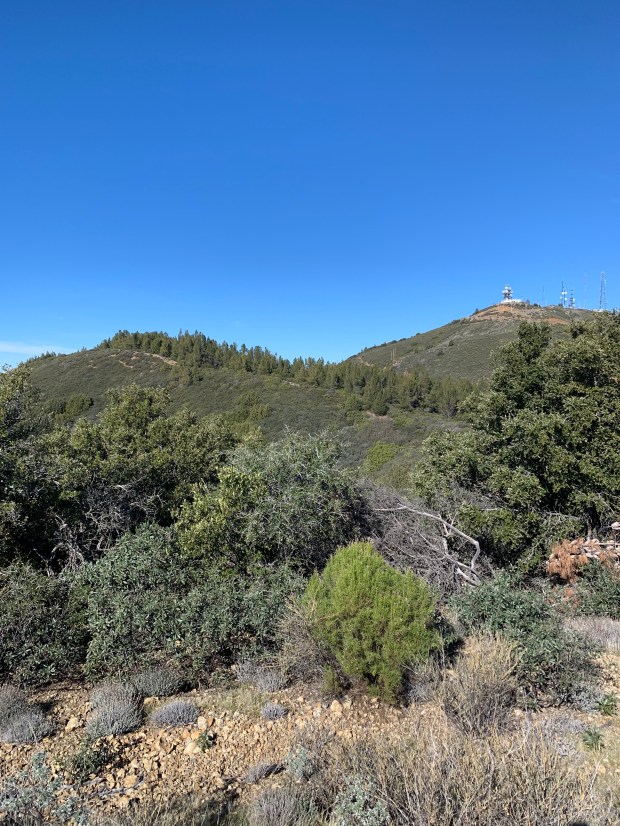
At 3,790’ Loma Prieta towers above Santa Cruz, the highest peak of the Santa Cruz Mountains. The mountain is near the Santa Clara/Santa Cruz County Line and looks over the nearby San Andreas Fault. More people know the name of the peak from 1989 Loma Prieta Earthquake – the epicenter was just west of the mountain.

Recharge

It snows up there almost every year and the rain falls in torrents because the highest peaks catch the most rain. There is little soil near Loma Prieta, but lots of well drained rock. There are patches of sandstone surrounded by a massive amount of mudstone. Craggy dark sandstone outcrops accent the slopes near Loma Prieta. Roadcuts reveal fascinating patterns formed by the nearby faulting. The mudstone and sandstone rocks were created by sediment washed into the Pacific from ancient California’s rivers, laid down in layer after layer, with different layers of slightly different colors, textures, and thicknesses. Tectonic movement has pitched those layers this way and that, sometimes in great undulating waves, other times tilted this way and that. The roadcut rock is fascinating mosaic art.

Rain soaks through these fractured stones, bubbling out below to form the headwaters of streams that provide drinking water for hundreds of thousands. Looking out from the mountain, you see the steep and thickly wooded Soquel Creek canyon or turn towards the other side and look down Uvas Creek that leads to the Uvas Reservoir and onto the Pajaro River, or gaze north into streams headed to the Lexington Reservoir.

Views

I try to visit the area’s peaks once a year to get my bearing and appreciate this place. And, I can see most of those peaks from Loma Prieta: Mount Diablo, Mount Hamilton, Fremont Peak, Devil’s Peak, and Ben Lomond Mountain are visible from there. A while back, I would visit Loma Prieta to get a good view of the region’s fireworks on July Fourth. Back then, the shoreline of the Monterey Bay was lit by many displays and there were many displays in towns all the way to San Francisco and beyond. It is a delightful place to see the entire Monterey Bay and a huge expanse of the sparkling Pacific Ocean. But really, I go for the plants.

This Chaparral’s Shrub Diversity

My favorite plants to visit up that way are two subspecies of at type of manzanita that is normally found a long ways north, but which have outlying patches on sandstone near Loma Prieta. The Hoary (A. canescens ssp. canescens)and Sonoma (A. canescens ssp. sonomensis) are beautiful silvery shrubs with smooth red bark so dark it is almost black. I visited last weekend and it was just starting to blossom, some shrubs had pure white and others very pink flowers.

This is a very shrub diverse area. In a short distance, in addition to the above, you can find three other manzanitas: Santa Cruz manzanita (A. andersonii) and brittle leaved manzanita (A. crustacea ssp. crustacea) and Rose’s manzanita (A. crustacea ssp. rosei). And, the ceanthus that normally accompany manzanitas are equally diverse with 5 species also occurring in close proximity to Loma Prieta: warty leaved ceanothus (C. papillosus); blue blossom (C. thrysiflorus var thrysiflous), wavy-leaf ceanothus (C. foliosus var. foliosus), buck brush (C. cuneatus var. cuneatus) and Jim brush (C. oliganthus var. sorediatus). More shrubs still include 3 species of silk tassel – bear brush (G. fremontii), silk tassel (G. eliptica), and ashy silk tassel (G. flavescens), mountain mahogany, pitcher sage, chaparral pea, bush poppy, coffee berry, coyote bush, and on and on. With this menagerie of chaparral shrubs, the scents are awesome as the sun warms the millions of resinous leaves.

…and Tree Diversity

Trees are super diverse up there, too. It is surprising to see a rare local conifer California nutmeg emerging from the chaparral. The canyon live oaks are everywhere in multi-trunked patches resprouting from multiple fires. There is also interior live oak, foothill pine, and knobcone pine. Some trees are odd: the madrones have paler orange bark than normal, the bay trees have more flakey bark, and the tanoaks have longer and or smaller more toothed leaves. The patches of trees are especially thickly festooned with beards of mosses and dense carpets of lichens.

Clearing the Shrubs – the March of Weeds

With the exception of a few patches managed by public parks, most of the area is privately owned, and it shows. A County Planner has told me on many occasions that the County’s policy is to not allow clearing of this rare chaparral type. And yet, you can see the expansive clearing from Highway One. There are immense mansions and squalid trailers, many with massive fire clearance zones. And, there are acres and acres of vineyards and horse corrals as well as sprawling greenhouses.

This network of development and the roads that serve them has badly fragmented this beautiful chaparral, especially in the last 15 years. Human incursions are made evident by aisles and acres of weeds: jubata grass, Scotch and French broom, and acacia are the most evident.

Even with all of the clearing but especially with the influx of flammable weeds along the roads, this area seems likely to burn badly one day.

A History of Fires

Many areas around Loma Prieta have not burned in a long, long time; but there have been recent fires. North and West of Loma Prieta, there are some of the oldest, largest knobcone pines I’ve ever seen, evidence that it has been a long time since fire. South and East of Loma Prieta, are miles of skeletons of trees and shrubs that belie more recent fires. The 2008 Summit Fire (4,200 acres), the 2009 Loma Fire (435 acres), and then the 2016 Loma Fire (4,470 acres) all have scorched areas around Loma Prieta, and all were human caused.

How to Visit

You can visit patches of this unique chaparral in a few parks. Some of this type of chaparral is at Mount Madonna County Park. The more shrub-diverse type is found in the Sierra Azul Preserve managed by the Midpeninsula Regional Open Space District at Mount Umunhum, the next peak north of, and not far from, Loma Prieta. The top of Santa Clara County Park’s Uvas Canyon County Park touches the shoulder of Loma Prieta south of the peak. This type of chaparral gets less interestingly diverse but still remains expansive in the upper areas of Nisene Marks State Park, say along the top of Aptos Fire Road.

The Early Winter Prairie

This is a slightly edited reprint of my recent column at Bruce Bratton’s online weekly, to which I strongly suggest you subscribe.

Each season life in the coastal prairie changes in hue and character. The many inches of rain and the cold nights fashion the winter’s prairie now turning bright green with life that is gradually emerging from quiescence. Most annual plants have germinated; both annuals and perennials are growing slowly, the sward just 4 inches tall. The first flowers are blossoming, swales and pools abound with water, gophers throw muddy balls out their desperate breathing holes, and frost ices leaf edges, wilting tender new growth. Newborn calves follow their hungrily grazing mothers far to find enough food. Recreational trails through the prairies are frequently stirred muddy messes, destroying life while eroding ancient soils onto the few remaining prairies; bicyclists proudly sport their muddy equipment and clothes. Some signs of early winter prairie are ancient, while others are quite new.

Pop Goes the…

The first native coastal prairie wildflowers are related to broccoli and celery. Popweed and peppergrass are in bloom, relatives of broccoli. These are a tiny plants on shallow soil or along trails and the sparrow-grazed edges of shrubs…or on last year’s badger or gopher mounds. They have little white flowers with 4 petals that seem to twinkle almost like glitter brightening the prairie. After flowering, popweed makes elongated pods that dry and then ‘pop’ sending seeds further than you might think possible from such a small plant. The U.S. gave popweed to the rest of the world…as a pest! You are probably more likely to encounter both of these plants in sidewalk cracks or (popweed) in potted plants in town. I’ve had the unpleasant experience of getting popweed seeds in my eye more than once, a victim of the barrage of flinging seeds from one of these weeds hiding in a pot that I was moving in my nursery.

Who Spilled the Yellow Paint?

The other very early prairie wildflower is starting to show color. It is called ‘footsteps of spring.’ It has the botanical name Sanicula arctopoides – that last word of its name being a botanical pun: “arcto” for bear and “poides” for foot: barefoot (harr harr!) footsteps (guffaw!) of spring … chuckle-chuckle go those goofy botanists. The name seems right somehow if you think Spring leaves footprints when she arrives: the first really bright thing is this plant- the entire 8” across flat plant turns a surprisingly vibrant yellow framing similarly yellow clusters of flowers. These wildflowers tend to make patches on shallow-soiled ridgelets and outcrops in the prairie. And so, Spring seems to have left footprints with her arrival as she danced from ridge to ridge and across rocky pathways to awaken the prairie from its moist green wintery slumber.

Prairies as Wetlands

Many people are surprised that many of our prairies are wetlands, but if you wander out there now, you’ll become a believer. Coastal Terrace Prairies are on flat ground, mostly along the ancient wavecut and uplifted coastal terraces within a few miles of the coast. Housing and agriculture cover most of the first terrace, the one right above the ocean, but there are extensive prairies on the second, third, and fourth terraces. Look uphill and inland of Highway 1 on the North Coast, for instance. Being flat, coastal terraces don’t drain well and so are apt to have long periods of saturated soil, which is a key attribute of wetlands. In some places, there’s water pooled across the soil surface, but mostly the soil is just so wet that only plant species adapted to wetlands can survive. Walk across these areas and you’ll find shimmering rivulets snaking among the grasses downhill to add water to creeks. Along the edges of these squishy grasslands are seeps and springs oozing and gushing with plentiful water now and remaining green late into spring. In mima mounds and on rocky areas on the terraces, you might find vernal pools- small ephemeral ponds with chorus frog or toad tadpoles, festooned with curious alga and teeming with zooplankton.

Grassy Carpet

Looking broadly across the prairies, grasses are mostly what you see, but slimy things are hiding underneath. Perennial grasses, many of them million-year natives, are waking underground with only the slightest sign in their leaves; their tiny leaves are green, but their new white roots have already grown inches into the surrounding soil, quickly claiming as wide an area as possible. They compete against quicker-growing annual grasses, most of them here for just a few hundred years; these get tall faster and shade natives, inhibiting many native plants from establishing from seed. Without something like the ancient megafaunal grazing regimes, the non-native annuals create a (relatively) towering canopy protecting slugs and snails from bird. Under the grassy protection, mollusks devour the nutrient-rich native annual wildflower seedlings before they stand a chance.

Cows = Flowers

In some places, cattle graze the prairies, maintaining some semblance of the evolutionary disturbance regimes that coastal prairie diversity requires. Betting on a better yearling market, some local cattle ranchers set the bulls free among the heifers at a time that makes for calves right now. This is a difficult time for raising a calf – despite the slow growing lush grasses, there’s very little protein in those leaves. To make enough milk, the mothers must constantly graze, cropping the prairie short. Flocks of birds follow the cattle for the food they expose along the way. Research UCSC Professor Karen Holl and I have performed over the past many years has shown that cattle grazing in coastal prairie creates more abundant and more diverse native annual wildflowers than adjoining ungrazed areas. Cattle grazing, cow trails and the lightly driven ranch roads that accompany livestock also make for excellent habitat for the rarest of beetles…the Ohlone tiger beetle.

OTB

The Ohlone tiger beetle is emerging from its burrows now, bright metallic green-blue carapaces like finest jewels of our local prairies. This species is only found in a handful of grasslands near Santa Cruz. On sunny, warmer days, it forages for invertebrates along open trails in only the most diverse coastal prairies. Those sunny warm days also attract mountain bikers who cruise so swiftly along the trails – including miles of trails that are not sanctioned by the landowners – as to smash innumerable of these endangered insects. Just last week, a colleague visited the Mima Meadow at UC Santa Cruz to find many smashed, most probably killed by fast-moving bicyclists. The carcasses were on a trail not sanctioned for bicyclist use and even in an area the University, as a legal mandate from the US Fish and Wildlife Service, has set aside expressly for beetle conservation. If court cases from Florida are any precedent, the University could be held liable for the death of a federally protected endangered species…and penalized. Perhaps that’s what it would take for the University to enforce the protection of this area.

Muddy Mess

Perhaps one could understand a University’s difficulty in managing natural areas, but what about our State Park managers? Many of the coastal prairie trails at Wilder Ranch State Park once had Ohlone tiger beetles, but State Parks destroyed much of that habitat by dumping tons of gravel to ‘harden’ the trails as a ‘solution’ to allowing recreational access during the muddy winters. Parks staff subsequently decided to manage a small remnant area (successfully) for this endangered species. Even so, coastal prairie trails are a muddy mess these days, and use only stirs up that mud, loosening it so that it washes off into the surrounding grasslands. Those extra nutrients spur weedy growth and destroy wildflowers. Meanwhile the incising and eroding trails serve to drain the surrounding wet meadows, an alteration that also degrades the habitat. Shame on users and managers alike for destroying eons of evolution and a legacy for future generations! If you see the (rare) ‘trails closed’ signs…which are almost always (if present) defaced and thrown aside…please prop them back up and go for a forest walk, instead.

Provocative Eucalyptus

This is reprinted from my weekly post as part of Bruce Bratton’s excellent weekly brattononline.com This post was modified from the original in response to critique by Gillian Greensite who has followed this issue for many years. My content was largely informed by a science conference on the subject, with a record of many materials here.

Many Californians have opinions about Eucalyptus. Either you are for them or against them. Its a subject like politics or religion that you hesitate to bring up at the dinner table. As with Covid-19 vaccination, you can’t predict who’ll be on what side (or why) – people of any political persuasion can surprise you with their beliefs. I’m betting that you know what I’m talking about…I didn’t even need to mention which of the hundreds of species of Eucalyptus I am talking about.

Eucalyptus Bad

The most common concern I hear about blue gum (Eucalyptus globulus) in California is how fire-dangerous it is. Locally, some recall the 2008 Trabing Fire just north of Watsonville, ignited on a hot day by a poorly running vehicle backfiring, and spitting out fire balls along Highway 1. Grass caught fire and quickly spread into nearby invasive pines, acacia and Eucalyptus (those have since regrown denser than before). That fire surprised fire-fighting professionals from how high embers were flying…hitting their fire monitoring planes at altitudes previously thought safe. They cited the architecture of Eucalyptus forests…the tall, close very vertical trunks create chimney-like conditions, hurling fiery brands much further than expected. Leaves with volatile oils and large amounts of bark and branches accumulated in the understory are other reasons for fire concern.

Eucalyptus Good

The most common defense of Eucalyptus I have encountered is its beauty. Our cityscapes have surprisingly few trees, but there are almost always huge Eucalyptus nearby. Many are fond of their massive trunks, shaggy bark, and towering, spreading canopies, shimmering with blue green leaves. I have seen many painters capturing the alluring patterns of rows of old Eucalyptus trees in many seasons, in many shades of light. A few people will dedicate their spare time and energy to protect big old Eucalyptus city trees from the too-frequent human desire to cut down trees.

What Do the Birds Say?

If birds are any indicator, Eucalyptus is good in some places and bad in other places. Birds like city trees including Eucalyptus. Eucalyptus adjacent to larger bodies of water are attractive to birds. You may have seen masses of herons and egrets using Eucalyptus as ‘rookeries’ where they raise their young. Trees near the Santa Cruz Yacht Harbor are roosting areas for herons. The Eucalyptus grove south and inland of the Elkhorn Slough Bridge in Moss Landing has a huge rookery, with so many birds that their guano is killing the trees. Peregrine falcons were using the talk Eucalyptus near the river mouth for a while. Raptors like the tallest trees for nests and perches.

Gum Gone Wild

Eucalyptus in our area is considered to have a moderate threat of invasiveness, with regionally specific higher rate of spread in foggy areas and in areas with more water availability, especially along the Central Coast. As with so many Eucalyptus issues, this was once a source of controversy before Eric Van Dyke at the Elkhorn Slough Reserve demonstrated an 8 foot per year rate of spread of groves in northern Monterey County. Since then, many other examples of the species’ ability to spread in our region have been documented. Where Eucalyptus spreads into streamside habitats, there is a particularly bad impact for bird conservation.

River Gum Bad

Riverside or streamside (aka ‘riparian’) habitats are by far the most crucial targets for bird conservation in California. Most of these habitats have been highly altered and are no longer good habitat for wildlife. Many migratory birds visiting from the tropics nest in those habitats. The loss of riparian bird habitat compounds with the loss of tropical forests, and so these birds are particularly imperiled. Riparian ecosystems host many cavity nesting birds that favor holes in the soft wood of riparian trees like willows, cottonwoods, and alders. Eucalyptus trees quickly invade and transform diverse riparian forest, and cavities become much less common. Bird conservationists say that controlling Eucalyptus in riparian areas should be a ‘no brainer.’

Euc Pests

Some types of birds have recently been newly attracted to Eucalyptus because they like at least one of its natural pests that found its way to California. The blue gum psyllid is apparently tasty for birds such as warblers. I’m less sure if birds are eating other ‘new’ Eucalyptus pests: apparently a number of blue gum eating pests recently found their way to California. It used to be that Eucalyptus leaves were perfectly shaped, no damage- nothing ate them! Now, those leaves look like someone took a paper punch to them. Eucalyptus tortoise beetle are eating blue gum leaves – does anyone know if birds like to eat it or other of the new Euc pests?

The Arrival of Eucalyptus

Eucalyptus has a long history in California. It was widely planted in the 1870’s to address the ‘hardwood famine.’ Hardwood was becoming scarce because of its use as fuel for steam engines and heat, so there was a Eucalyptus planting boom. Eucalyptus was soon advertised as the solution to many problems: a fast-growing hardwood for fuel, people thought its wood could be used for railroad ties and other lumber, people said the tree would dry up wetlands and reduce mosquitoes, and its fast growth attracted people to plant it for windbreaks. People were buying large numbers of seedlings. Some advertised, promising investors good returns from productive Eucalyptus wood lots.

Hardwood, though, eventually lost favor to petroleum in California. But, if you travel to Central or South America, where hardwood is still important for fuel, you will notice many areas managed for Eucalyptus firewood.

Heavy and Twisty

It turned out that Eucalyptus wood twists and buckles when drying, so it was eventually recognized as useless for lumber. Well, almost. 15 years ago, someone claimed they had a process for drying Eucalyptus “correctly” so that it could be used lumber, including for picnic tables. They donated one to the organization I worked for…it weighed 250 pounds and took 4 people to move! After a couple of years it was impossible to use. It was so warped that when people sat on it, it rocked wildly about, and created a balancing challenge with people bobbing around spilling their drinks at vastly different elevations.

Perhaps this would be different if the wood were kept dry, indoors. Woodlots for Eucalyptus hardwood are still around, but you are more likely to see Eucalyptus spreading from old, planted windbreaks. Look carefully for the oldest biggest trees in a row with many generations of younger trees spreading from there. One thing remains true from the old hype: Eucalyptus does well at drying wetlands!

Drink it Up

With its huge canopy thick with leaves, Eucalyptus is known globally for its thirsty nature. Deforestation in its native home in Australia led to salinization of the soil from the evaporating heightened water table. Here in California, people note the loss of springs where Eucalyptus grows. Although closer scrutiny is needed, using transpiration rates from Eucalyptus elsewhere in similar climates, it is likely that a grove of Eucalyptus drinks most of the rainfall falling on it along our coast. This is much more water than native trees use. One day, one mitigation for new development that demands more water might be investment in Eucalyptus control.

Thinning and Containing

Given the fire danger and negative ecological and water impacts of most Eucalyptus groves, it is sad that they are still proliferating. To be sure, Eucalyptus control is an expensive proposition. Having felled several large trees, I can attest to the work it takes to clean up a fallen tree properly. The wood makes great firewood and is easy to split if you split it soon after felling. But there is an enormous amount of slash to deal with…chipping or burn piles- either way a lot of work. The stand-out organization for Eucalyptus control locally is State Parks. They are ‘thinning and containing’ some groves that people like to look at while obliterating others in ecologically sensitive areas. They realize that Eucalyptus control will cost more each year they wait, so they do what they can with the (too few) resources that our elected officials budget for them.

Fer it or Agin it?

After reading this, maybe you will have a more informed opinion about this provocative tree. It is my hope that you be ‘for’ the ones that grow near bodies of water or are city trees and ‘against’ the ones in riparian areas or spreading through our other precious native ecosystems.

Douglas Fir Forests

– this is another of my weekly posts reprinted from Bruce Bratton’s admirable weekly e-news publication at brattononline.com

According to tradition, people are hauling Douglas fir trees into their homes and decorating them for annual winter rituals. Some purchase dense, pruned trees, while others harvest spindly saplings from the woods (aka “Charlie Brown trees”). Soon, strings of lights cast needle shadows on the walls and ceiling, infants gurgle and sputter with delight, wide eyed at the beauty. The unique Douglas fir scent fills the air – a bright lemony pine smell. Hallways are festooned with ribboned Douglas fir garlands and people weave fir wreaths to decorate doors. In breaks between storms, on crisp cool days, we saunter into the forest, catching fresh fir scent moist with rain, sparkling in the foggy, low-angled sun rays.

Mouse Tales

Douglas fir is not a real fir- it’s a pseudo-fir, creating cones distinguished from genuine fir cones by having “the tail ends of mice” sticking out the cone. Check it out sometime- there really are what looks like two back legs with an accompanying tail poking out, so cones look like a bevy of mice are feasting on Douglas fir seeds.

The cone decoy seems to have worked, evolutionarily speaking. From Northern California though Canada, Douglas fir is the sole home of red tree mice. These mice live high in canopies and feed on only on needles. On huge branches among the complex old growth Douglas fir canopy, they maintain long lived, wickedly well-designed homes that include rooms with specific uses. If they aren’t careful while they are out harvesting needles, a spotted owl will eat them – red tree mice are a favorite and important food for this equally endangered bird. We’re apparently too far south for the red tree mouse- Santa Cruz is the near the southern end of Douglas fir’s range, and maybe there aren’t enough thick forests, or too frequent of fire, for these little critters.

Northward Ho!

Moisture-loving conifers have been retreating northward for a few thousand years, and Douglas fir may also be headed that way. There are layers of grand fir pollen up until just 15,000 years ago in the sediments of a pond in northern Santa Cruz County. The nearest grand fir is in Sonoma County, nowadays. South of here, if you look at the forest on either side of highway one south of Freedom Boulevard, you’ll see a few widely spaced straggly Douglas firs – those trees look like similar to those in the hills above Elkhorn. And that’s as far south as they go along the coast. But, north of there you’ll notice that they don’t appear to be having trouble making thick forests.

Rock Scissors Paper (Douglas fir wins)

In the rush to capture the sun, Douglas fir quickly wins against all but the coast redwood around here. Look at most any of our majestic coast live oak forests, and you’ll see Douglas fir trees winding their flexible leaders between old oak branches. Play that forward, and those oak trees will be toast, shaded and outcompeted for water by these highly invasive conifers. Douglas firs are also invading coastal scrub and coastal prairie.

Pull ‘em Up, Chop ‘em Down

Kat Anderson reported to me documentation that tribal peoples have long pulled Douglas fir seedlings as part of their tending of oak groves. The tribal peoples took over from the tree-invasion prohibiting Pleistocene megafauna. Just north of here, a remarkable recent turn of events saw reintroduction of native people land stewardship with collaboration between the Amah Mutsun and State Parks. The Quiroste village site was once in a matrix of super diverse, well-tended coastal prairie framed by managed oak woodlands, but for the last hundred years, without stewardship, those systems succumbed to Douglas fir invasion. After careful planning, and with some controversy, the tribe and State Parks have been restoring the site by clearing Douglas firs…almost like the old days, but the trees got bigger and so it takes saws and a lot of work to remove them. With their work, the area is becoming more species rich and more fire safe.

Doug Fir, Associates

While coastal prairies and coast live oak forests are much more species rich, Douglas fir forests do have their own set of interesting species associates. Instead of tree mice harvesting Douglas fir needles around here, we get ants. Anywhere there are Douglas firs in the Santa Cruz Mountains, you’ll find 2’ tall piles of needles teaming with ants. These are Formica integroides, a mushroom farming ant, growing their fungi food in piles of Douglas fir needles. This needle harvesting critter forms armies of harvesters walking in long and sometimes wide lanes across and down human trails: watch out…don’t be rude by stepping on them!

Orchids also seem to like growing in Douglas fir forests. Also at its southern range limit, the gorgeous Calypso orchid has been documented with ephemeral populations at UCSC and near Davenport (both gone now), but has a somewhat famous large population under a north-facing Douglas fir forest in Butano State Park. Coral root orchids also seem to prefer Douglas fir forests. Curiously, ground nesting ‘yellow jacket’ wasps seem to key into coral root populations under Douglas fir. So, maybe look very carefully before walking off trail to get a closer look at the subtle but beautiful colors of coral root orchids.

Timber!

“Douglas fir doesn’t pay for itself to harvest.” That’s what local foresters tell me. By the time they do the timber harvest planning, go through the regulatory process, carefully fell the trees, trim and haul the few logs they find that aren’t damaged/diseased, mill and dry the wood, they can’t recoup their investment because someone elsewhere has produced a similar board, cheaper. The Pacific northwest and Canada, with more lax forestry regulations and healthier Douglas fir trees, are creating cheaper Douglas fir (and similar) 2x4s for sale. So, for many years, we’ve been growing some large Douglas firs on the area’s timber lands.

Then came the CZU fire…now, there are thousands of large and small standing dead Douglas fir trees: what should we do? If left, these trees will gradually fall over and create a Giant Fire Hazard. The next fire, spreading through those hundreds of acres of log piles, will be very intense, torching whatever trees tried to recover and scorching the soil badly. It will be a hot fire storm, to a great extent our fault.

Biomass Fuels?

If you have toured the CZU Lightning Complex Fire area, you have probably noticed piles and piles of logs. Burned up trees are dangerous to houses, roads, and power lines, so they must be felled and hauled away. “Away” is an odd word…mostly it means a landfill (another odd word). Ever throw something away? It is instructive to visit ‘away’ at the end of Dimeo Lane or near Buena Vista. We must find a new ‘away’ soon, but no one wants ‘away’ near their homes or over their groundwater. Piles of post fire logs will fill up landfills quickly, especially with more frequent fires. Why not use modern technology and turn those logs into electricity? There are new carbon-neutral, mobile wood-fired power plants that burn wood, make electricity, and create ‘biochar’ that has been shown to be a useful soil amendment for agriculture. Keep your fingers crossed that we might get one of these at one of our local landfills sometime soon. That way, when you throw something ‘away’ that can be safely burned, you’ll be making your own electricity and enriching agricultural soils.

Brittle-leaved manzanita chaparral

– This is another of my posts from Bruce Bratton’s (highly recommended!) weekly at brattononline.com

The rains bring alive chaparral, so this is the beginning of a series featuring local types of “hard chaparral.” The term chaparral is confusing, so I use the term ‘hard chaparral’ to denote chaparral dominated by manzanitas, chamise, and ceanothus. Hard chaparral is so thick and dense and strong as to tear the clothes off of you if you are strong enough to try to walk through it. Rarely, you might crawl beneath the hard chaparral canopy. Nothing grows in the understory – there is only a light dusting of leaves – but you must squinch low while crawling…to 1 ½ feet… and wiggle down on the ground in tight spots; wearing a hat helps so that your hair doesn’t get caught and pulled out by manzanita’s stiff twigs.

Hard chaparral is different than ‘soft chaparral’ – also known as coastal scrub – which is dominated at first by coyote bush, then, later in life, poison oak, monkeyflower, and sagebrush. Soft chaparral generally grows on richer soils, closer to the coast. Hard chaparral grows on the poorest of soils, often with no discernable soil at all. Ridgelines and steep slopes mostly away from the immediate coast are home to hard chaparral.

In hard chaparral, along with the manzanitas you will find many other shrubs and an overstory of pines. Sometimes sparse, sometimes dense, knobcone pines are the more common pine, but there’s a Monterey pines overstory near Año Nuevo. Oaks and Douglas firs slowly invade brittle-leaved manzanita chaparral until you eventually get a few forlorn dying shrubs or even just old barely recognizable skeletons that tell you the chaparral is gone, for now (awaiting fire!).

Brittle-leaved Manzanita Chaparral

Brittle-leaved manzanita is the dominant species of most of Santa Cruz’ hard chaparral. Smooth maroon skin with sinewy muscle-like ripples down thick, strong stems – that’s what most people remember about brittle leaved manzanitas, but the flowers and burls also give them away.

If they aren’t already in bloom, they will be soon. They have clusters of pure white to pink jewel flowers – upside down urns with windows to capture and magnify light, so the flowers glow on even foggy-cloudy days. Bopping from one cluster of flowers to the next…hundreds of bumble bees delight in the winter nectar feast. Hummingbirds, too, zip around sipping from the flowers. On warm days in December and January, brittle leaved chaparral smells strongly of honey, a scent which enchantingly wafts far afield, down into the woody canyons below.

Burly Shrubbies

Of the nine taxa of manzanitas found in Santa Cruz County, brittle leaved manzanita (Arctostaphylos crustacea subspecies crustacea) is the most common and one of only two that have ‘basal burls’ or lignotubers. The other burly manzanita is a different subspecies of the same species (Arctostaphylos crustacea subspecies crinita), that is mostly found at the top of Ben Lomond Mountain, from the Bonny Doon Airport north to Lockheed. To see burls on these manzanitas, look at the base of the stems for a swelling, sometimes quite large, of lumpy wood. These are very easy to see after a fire, because that’s where these manzanitas sprout new shoots. That’s their magic: the ability to get hotly scorched, fire removing all of the branches, and still live. Up pop the shoots as soon as the rains come…and three years later, there’s a Big Shrub once again where the last one stood.

Locations and Co-Occurring Treats

The tops of our parks are great places to visit this type of chaparral. The top of Wilder Ranch State Park, in what used to be known as Gray Whale Ranch, and into upper UCSC, has patches of brittle leaved manzanita chaparral. The top of Nisene Marks State Park also has stands of this chaparral type. Other places include Mount Madonna County Park, as well as Big Basin and Castle Rock State Parks. From the edges of trails, a wintertime treat will also be Indian warrior, a bright maroon perennial wildflower which forms large mats. Shooting stars and various rein orchids also sprout trailside in clear patches of this type of chaparral.

Another thing about wintertime chaparral visits that is intriguing are the lichens, mosses, and liverworts that color and texture the chaparral. Liverworts, in this dry habitat?? Yes! Get off your bike and kneel at that bare-soiled edge adjacent to the chaparral…look carefully…and you’ll see liverworts (and hornworts!) hugging the ground in between mosses and ground-hugging lichens. The intrepid will get to see more and more species by counting the number of different types of tiny things in those patches, which are kept bare by the golden crowned sparrows who retreated when you came their way.

Critters

Sure, chaparral is for the birds, and that’s not a bad thing. And yet, it’s not just for birds. Wrentits are the quintessential shrub habitat bird, and I also like watching the large-curved billed California thrasher. Wrentits bop around below the canopy, mostly, but pop up out on a branch to make their subtle descending ping-pong ball bouncing song. California thrashers, also understory creepers, sometimes jet out onto a high point in a chaparral patch and sing their hearts out with operatic glory.

The San Francisco Dusky Footed Woodrat makes homes on the outer periphery of brittle leaved chaparral patches. It seems this packrat likes oaks and coffee berry more than manzanitas, but manzanitas keep coyote at bay, so having that habitat at their backs is a preferred location. Ratttlesnakes like wood rats…and the summer heat of chaparral…so, that’s a good snake species to associate with hard chaparral. Rats and rattlesnakes….?

What Good Is It?

Brittle-leaved chaparral is good for lots, but unfortunately it is getting destroyed very quickly nowadays. Nutrient poor soils lost their nutrients because they are well drained. Well drained soils are important for recharging the groundwater, keeping our streams flowing and drenching our thirst. Because this hard chaparral can thrive in nutrient poor soils, it is responsible for keeping those slopes from washing into the creeks and for keeping our groundwater infiltration areas infiltrating. Those sprouting burls…they send roots out on steep slopes after fire, preventing landslides and debris flows from destroying homes and roads.

Mowing It Down

Despite ostensibly being protected, brittle leaved manzanita chaparral is getting hacked up at an alarming rate. Now that fire has our attention, bulldozers are hard at work ripping up manzanita burls to make ‘fire safe’ areas. Crushers, masticators, and saws whittle away manzanitas as if they were enemies. When asked, County Planners have said that they have policies to protect this habitat type- they don’t allow development activities within it. The California Coastal Commission also ostensibly protects this type of ‘maritime chaparral’ as an endangered ecosystem, disallowing any destruction. And yet, even from Highway 1, you can see vast patches of chaparral being destroyed on the ridges above Watsonville. Parks organizations are mowing it down even on conservation lands to be doing ‘their part’ with fire safety. From Southern California, we have learned that treating chaparral this way isn’t a solution to wildfire: it generally grows up patches of weeds, which are even more flammable, less able to hold slopes in place, and no replacement for the habitat value of hard chaparral.

What I hope for is more people showing others how to live safely, and sustainably, alongside manzanita chaparral that is well cared for. If you know of any places, please let me know.

Rain Awakes the Prairie

– from my 10/27/21 column at the highly recommended Bratton Online site

The rain is awakening the prairies; it is also time we awoke to the preciousness of these grassland habitats. Already, enough rain has fallen to wet the ground and trigger seed germination in the local meadows. Perennial flowers and grasses have also quickly flushed with new green shoots. The rains have brought migrating winter wildlife, increasingly threatened because, each year, there are fewer acres of grassland to which to return. It is because native peoples tended prairies that we have any prairies at all in our region. Now, together with indigenous peoples, we are relearning how to restore meadows. With attention and intention, we may one day witness the restoration of healthy populations of badger and burrowing owl living in flowered-filled meadows across the Central Coast. For this to succeed depends on more people sharing more coastal prairie wisdom. With that wisdom, together we can build and pass on new stories to future generations (and new arrivals) so that we might maintain grasslands and their many associated species.

Meadow Showers

Rain is soaking in, darkening the rich prairie soil with newfound moisture. Green patches of seedlings first appear along trails, on gopher mounds and other areas with less thatch. Soon, seedlings will also emerge from under the thick skeletons of prior years’ dead plants. Inhale the moist, cool air slowly, and you may detect new rainfall-induced scents. The first that strikes me is the pungent smell of mouse pee. Grasslands are thick with rodents and, for six months, mouse urine has been drying and concentrating on the soil surface. Now, that nutrient source has been re-wetted and is being soaked into the root zone, and it smells strongly throughout meadows. Beyond that scent, there is petrichor, the complex ‘fresh rain’ smell made up in part by compounds related to the scent essences of both cedar and beet root. With the new rain, I detect another smell…wet hay. When rain first falls, there’s a strong smell of newly moistened hay, and that scent turns quickly and sharply mushroomy. After a week of the first big rains, if you grab ahold of a thick mat of dead grass and pull- it will easily peel from the soil surface only clinging to a little soil. It will be held together with what look like bright white roots. These are fungal threads, soon to be better evidenced by their more familiar “fruiting bodies” – especially the familiar grassland types…puffballs and other fairy ring mushrooms. As if anticipating the quickly emerging life, new bird species arrived in the meadows just prior to the rains.

The Grassland’s Wet Season Birds

I had travelled a hundred times through one particular and expansive grassland and was startled to be reunited one morning with my favorite grassland bird: the meadowlark! These birds are almost as big as robins and have long stout pointy bills, yellow undersides and have long streaks combining yellow, brown, and black on their upper bodies. Their songs are loud and distinct – a signature noise of grasslands throughout the United States. Meadowlarks nest, eat, and sleep in wide open prairies. The flock I encountered that first day of their return was about 40 birds. Last I counted, three weeks into their winter stay, this tribe remained around that number. My bird guidebook’s range map suggests that western meadowlarks reside year-round around here, but that’s a national map evidently without fine enough scale for our particular rsituation. This local meadowlark group must nest elsewhere, in the spring and summer. In winter, our meadowlark clans join another very special winter-only prairie bird: the burrowing owl. Burrowing owls don’t dig, but they live in holes. Every winter, they surprise me as they flush from different kinds of holes: ground squirrel burrows, road culverts and agricultural pipes. When UCSC’s Seymour Center rat Terrace Point was still mostly surrounded by open meadows, burrowing owls could easily be seen in ground squirrel burrows on the berms piled up when someone was kind enough to try to hide the buildings. Those berms have been since bulldozed. UCSC also rousted burrowing owls from their last local nesting location when they paved the ‘remote’ parking lots. Given the chance, UCSC will continue paving over the increasingly endangered burrowing owl meadow habitat. Get it while you can, Regents! Your actions will literally pave the way for burrowing owls to become so rare they must be protected as endangered species by the State and Federal governments…saddling private landowners with even more regulatory burden. Meanwhile, we are lucky to have this owl, with tall yellow legs and huge, cute eyes; they can be found in the winter at UCSC and across the North Coast’s grasslands. Look for it vigorously bobbing its whole body while staring at you from quite a distance while it guards its precious sleeping hole.

Upland Newts??

The recent rains also bring another grassland critter to our attention: newts! Hiking over the freshly greening grass, I glanced into the mouth of a gopher hole: surprise! Looking back at me were the golden cat eyes of a rough skinned newt. Hands forward, this critter is like Dracula awaiting sun set to mosey out off its underground lair. That night, with the rain pattering down, it walked half a mile across the meadow, before sniffing out another unoccupied hole for the next day. Nocturnally travelling with uncanny directionality it joined an increasingly large group of its brethren, creating a river of newts, some of which made it across the road before sliding down the bank into a large breeding pond. Newts love the dry grasslands- that’s where they live most of the time, foraging all summer long in the cool darkness of rodent burrows. We think of them as stream or pond organisms, but mostly they are grassland creatures.

An Abbreviated Grassland Management History

Our local grasslands and their associated wildlife owe their presence to thousands of years of tending by native peoples. Without that tending, there would have been no ‘pasture’ for the invading old world cultures to graze livestock on. Indigenous cultures honed complex management activities to steward grasslands species. They used prescribed fire in small and large patches, at varying times and intensities to favor their desired outcomes. They cultivated plant species without our modern (gross) tractor tools.  They enjoyed a legendary favorite prairie feast that we can relate to involving prairie grown greens- salads full of diverse, freshly gathered tasty leaves and flowers especially from clovers. Their meadow tending created new cultivars and species. Plants provided food, medicine, basketry materials, clothing, tools, art, and so much more. Their management activities not only focused on plants but also wildlife management. Many of us would dearly love to have seen those prairie gardens.

After the Fall

After the genocide of the indigenous peoples, ranchers were responsible for maintaining open grasslands. Ranchers still manage many of the grasslands, but many are increasingly owned by public or private open space managers. Most recently, we have been moving towards relearning how to keep our prairies healthy. California native grasslands are one of the top ten most endangered ecosystems in the United States. More coastal prairie (grasslands in the fog belt) have been lost to pavement (‘urbanization’) than any other habitat in the USA. And coastal prairies are the most species-rich grasslands in North America. There are 80 plants species that only live in California’s coastal prairies. One third of all rare plant species in California are found only in grasslands. There are many plant and wildlife species in our local grasslands that are already recognized as endangered, and many more qualify for inclusion on state or federal endangered species lists.

Relearning

Amah Mutsun stewards are relearning alongside many others how to steward prairies. Far up the North Coast, the Amah Mutsun have been working with State Parks to remove shrubs and trees that have invaded ancient meadows. Elsewhere, State Parks has long had a prescribed fire program to restore prairie habitats. While the City of Santa Cruz effectively destroyed the meadows at Arana Gulch by fragmenting them with roads, City Parks staff are experimenting with prairie management regimes including grazing. The Land Trust of Santa Cruz County is working hard to restore and maintain the Scotts Valley grasslands at Glenwood Open Space Preserve. For decades, weed warriors with the Ken Moore’s Wildlands Restoration Team, the California Native Plant Society and the Land Trust have been responsible for rescuing meadows from weeds, especially French broom. We are making great progress and learning a lot. Grassland restoration is extremely rewarding because you can so quickly see a positive response. But, we must do more…

Please discuss some of this essay with someone while its fresh in your mind, say in the next week. Without more awareness, we will have no grasslands to restore and poor badger and burrowing owl, meadowlark and newt won’t have homes anymore.

One Year After Our Big Fire

Since the firestorm of 2020, I’ve witnessed both the rebounding resilience of nature as well as post-fire human responses that have ranged from truly awe-inspiring to bewildering. When the fire first struck, I had a harrowing 10-day amateur-firefighting experience. I well recall the panic – and the portentous moment when toasted tanoak leaves floated down from the smoke-darkened sky. Soon thereafter, the march of head-high flames incinerated everything on our farm that we couldn’t save with just us two people and our heavy fire hoses. After the smoke and flames – and through the entire year since – there’s been so much change.

This story starts last August, when we endured three days of wilting heat. Then, a hurricane hundreds of miles south of us went rogue, splitting in two, half of it raking quickly across the length of California. I woke to that half a hurricane – a massive silver-gray cloud-wall steaming and rolling north along the coast and a 10-minute-long 70-mph wind gust accompanying devilish sheets of whole sky-enveloping lightning and unbroken thunder. Soon, lightning-ignited small fires in too-remote areas joined together into a monstrously huge and fast-moving firestorm. State firefighters could not gather resources quickly enough to fight it and called for evacuations, and all but one person escaped with their lives. Non-humans fared less well. The smoke and flames took a month to dissipate, allowing thousands of evacuees to return to what, if anything, might be left of their homes.

The fire left a landscape of blowing ash and a hundred shades of charcoal gray with sporadic patches of toasted brown vegetation and very few areas of green plants that somehow escaped the flames.

Before the fire, lush redwood forests had dripped fog onto carpets of ferns and sorrel. Under high conifer canopy, Pacific wrens whistled away the days in brilliant, wandering sunrays. Daylight transitioned into forest-hushed nights with owls hooting and woodrats rattling their fleshy tails. Those same forests, after the fire, were spires of high, blackened, tree-trunk pillars with few branches remaining. These towered over ankle-deep, white, fluffy ash and patches of crunchy charcoal. All the animals were gone … many had roasted alive.

Before the fire, the ridgelines above those forests had been dense chaparral. There were millions of 10-foot-tall, lush, green pines erupting through rafts of shorter shrubs – a dazzling array of colors with resinous and sweet scents and a multitude of textures. Eleven years previous, the Lockheed Fire had burned much of this chaparral, and all this life had since rebounded. In the wake of that fire – a timebomb: criss-crossed, 6–12-inch-diameter logs from killed and gradually falling pines piled up hip-high for thousands of acres and miles around. During last year’s firestorm, those logs burned so hot they left impressions criss-crossing the hillsides, each outlined in white ash and vaporizing what little soil there was into red brick. That heat cleared ridge after ridge down to the stone we call “chalk rock,” a fractured mudstone crushing easily or making metallic, pottery-shard noises when you walk across it. For months after the fire, peering closely, nestled in piles of charred rock, you could find little fingers of burned stems and twisted fists of stump-like burls, all black, seemingly lifeless.

Among these forests and in the chaparral, people were living in neighborhoods and rural properties large and small. Since the early 1900s, neighborhoods had gradually developed, woven in between natural areas and parks set aside for redwood conservation and recreation. The fire destroyed the remote Last Chance neighborhood and badly affected other neighborhoods in the hills above Boulder Creek. The fire also tore through the Swanton community and then much of Bonny Doon. These communities contained layers of history. Generations-old families shared this landscape with the newest wave of neighbors from the wealth machine of Silicon Valley. University of California administrators and professors, along with student renters, were living alongside old hippies and back-to-the-landers of all political persuasions. There were also many blue-collar tradespeople, teachers, and retailers. This was a mixing pot of politics, perhaps with more left-leaners, and all united by a love of rural living. They found ways to be good neighbors from sharing news to clearing roads and helping newcomers figure out how to settle in comfortably with the various issues unique to this part of the Santa Cruz Mountains.

The fire burned homes new and old, whether they were owned by the super-rich or the very poor. There were dilapidated, barely habitable shacks surrounded by old cars, tattered furniture, and storage sheds with recyclables overflowing into the surrounding forest. And then there were the fancier estates – polished redwood decks, outdoor kitchens with marble countertops and brick pizza ovens, fancy hot tubs, and English gardens with statuary. These varied developments were all mixed up in the matrix of shrubs and trees, chaparral, and forest – one of the two most diverse natural landscapes of North America. The fire made the patches of human stuff into the same types of ash and waste: deep piles of charcoal and blowing nasty ash accented in places by unrecognizable twisted metal and piles of collapsed brick. New cars or old – it was hard to tell from the burned-out, fire-wasted frames. It was impossible to tell where the landscaping stopped, and the wild places began.

People’s responses to the fire were even more varied than their ways of life had been prior to the fire. During the peak of the fire and for the long period of smoldering and even longer evacuation period, the few brave and stalwart worked hard protecting their homes, their neighbors’ homes, their pets, and human friends wherever possible. On the edges of retreating flames, packs of looters swept in, stealing from houses burned and those that were spared. A standoff between the stalwart stay-behinds and looters resulted in a looter getting shot in the leg. Someone who lost nearly everything set aside some mementos at dusk, only to find them gone the next morning. A year later, strangers still lurk around the burned areas looking for stuff to steal. As if the fire itself weren’t enough.

The many who lost their homes were scattered. A few quite visible ones took up trailer homes along the highway in Davenport. Many moved to rentals or into homes with friends, adding to the crowded town. After a few, seemingly long months of waiting, the government-run cleanup started: giant machines scooping and scraping the charred piles of debris into convoys of trucks, hauling the stuff “away.” We were impatient and then happy for the efficiency, strength, and scale of this enterprise. No one asked and there was no news about where that stuff went, what the communities and land think of how we disposed of it, far away from here. After cleanup, some people sold out while others stayed put. It was a sellers’ market, but that meant those selling out faced grim realities for purchasing anything else in the area, and some were forced to leave. Slowly house trailers appeared on wrecked properties. A small fraction found the means to start rebuilding.

Between the remaining homes or the burned-up human stuff, some people (like me) were fascinated and relieved by the resilience of nature, bolstered by its ability to heal and rebound. To others, nature was too slow—they wanted a kind of speed healing and found many ways to apply Band-Aids to cover the fire’s wounds. Some know nature heals but wanted to help it along. Others had no sense of nature and acted like alien gardeners on some other planet. Others were never much at tending the land: they had never been much interested in such things. County-hired contractors hydroseeded burned building sites and surrounded them with straw bundles to contain toxic runoff. RCD employees were heroes, working ceaselessly to help stunned property owners prepare for post-fire rains, erosion, and slope failure. Meanwhile, people were tossing around native wildflower seed mixes to hopefully brighten land. Others, wanting more instant and positively perky landscapes, dug in thousands of roadside daffodil bulbs to persist and spread for centuries, a long-lasting and sad legacy spurred on by a well-meaning community leader.

Along roadsides and powerlines, orange-vested, hard-hatted officials spray-painted numbers on thousands of dead or damaged trees, and then the saws and grinders got going. Months of chainsaws and chippers whined and roared, shaking the earth and sky, filling hundreds and hundreds of trucks, hauling more stuff to yet unknown fates and destinations: “away.” People already traumatized by burn damage faced another shock as workers removed patches of forest in what was left of their yards, forever changing their historic views, removing their remaining privacy … all in the name of road or utility safety … or perhaps liability.

The first spring after the fire, the forest surged with life. Most redwood and oak trees that had burned resprouted. Some sprouted from their charred trunks, while others sprouted only from their bases. Understory herbs filled the spaces between the trees – twining vines, prickly thistles, and carpets of wildflowers. In many places, the forest floor was brighter than we had ever witnessed – dazzling flowers! Splashes of cream or blue iris bloomed profusely alongside extensive rafts of pale pink globe lilies. Animal life returned, too. Hungry deer shortened tanoak sprouts by the mouthful. Fish biologist “snorkel surveys” spotted surprising numbers of steelhead in the burnt and newly sun-brightened streams. Shortly after the fire, great horned owls hooted from recently cooled trees. A few more healing months and then pygmy owls also were cheerfully hooting away from the scorched forest.

The chaparral mostly rebounded, too. First there were many bush poppy sprouts…and many, tiny seedlings. Then, very slowly, the many fewer manzanita burls began pushing up sprouts. Chaparral oaks, madrones, and chinquapin joined the resprouting. In late April, the diverse fire-following flowers were starting their famous post-fire show. Massive patches of whispering bells carpeted hillsides – ferny foliage and pale-yellow bell-shaped flowers along with an odd scent that some people enjoy. An intrepid bunch of botanists I hiked with discovered a new population of small-flowered blazing star. And, we found previously undocumented areas of pink-purple stinging lupine, as well as sweetest-scented, tiny phacelia with yellow and pink flower mounds, and one new patch of the sapphire blue–flowered twining snapdragon. By midsummer, I could still walk easily through extensive areas of chaparral in the bare spots between resprouted 2-foot-tall shrubs and trees. Big patches of bright yellow bush poppies were feeding innumerable bees.

I could find only a very few pine and manzanita seedlings, so the chaparral will look a little different in the wake of this fire compared with the last fire. The cooler burning Lockheed Fire created massive thickets of knobcone pine seedlings – extending for miles outside of the fire footprint, where seeds were blown on the fire wind. With the very dry winter following this more recent fire, along with fewer pine cones and a short-lived seedbank, many fewer knobcone pines may regenerate this time around. With the aforementioned piles of Lockheed Fire–killed knobcone logs, the ground temperature got so hot that many ancient manzanita burls were destroyed. So, now fewer manzanitas and perhaps more open space (more weeds, more grasses or wildflowers?) will characterize the next generation of this chaparral.

Wildlife has recovered in the chaparral areas. The deer were most evident – I found bedding areas nestled into the protective, denser patches of burned-out pine shoots; they had also been browsing off the diversity of resprouting shoots. I was surprised to see gopher mounds – they must have been hungry for a long while awaiting something fresh to eat! Solitary bees were creating patches of burrows in the rare areas with soil, in between the chalk rock. Other pollinators were buzzing busily between the many post-fire wildflowers.

I am wondering now … what will happen next? In the hominid realm, I predict that this fire is in the process of creating a shift in the hill cultures. Cultural shifts occurred in Santa Cruz after the University opened in 1965, then again after the 1989 earthquake, and again after UCSC admissions policy changes in the late 1990s, and yet again with Silicon Valley gentrification accentuated by COVID remote-working policies. And, while the fire changed some minds as to attractiveness of rural living, it also has probably permanently displaced people who were economically marginal before the fire. Like downtown and the University, these rural areas are already taking a giant step towards having less “character” – the numbers of tinkerers, artists, and oddballs will plummet to be replaced by “normal” people of much greater economic means. I hope there will be enough critical mass of those people staying to continue the culture of rural, peaceful living, and cross-cultural welcoming and kindness. Already, I see people helping others in recovery, in bearing through the many jumpy instances – tedious smoke scares, power outages, and road closures. Our farm is so grateful for the outpouring of donations and physical support for recovery; many others have experienced the same generosity.

I predict that the attitude towards nature in general will shift from what has been more natural towards the more manicured, non-native, unnatural landscapes currently found more often in suburban Southern California. This trend started with the mass plantings of “cheerful” daffodils and will continue with greater numbers of fire-proof “garden beds” full of red lava rock gravel, trucked from torn apart hillsides miles away, accented by well-spaced foreign, pink-flowering daisy bushes … trellis arches of bougainvillea pouring over hummingbird feeders by tiled patios with huge propane grills and circles of ornate metal lawn furniture. More of our endangered chaparral will be bulldozed to dirt, forests will be chainsawed farther away from “civilization.” Where once red-trunked manzanitas were festooned by honey-scented clusters of pink flowers through winter, where once there were sprawling, lichen-covered live oaks full of birdsong, there will be lifeless mats of 2-inch weed stubble, the product of three or four times a year of mowing, for fire safety. These weeds will carry fire quickly nevertheless, when comes the day that fire returns.

I find the predictable response of the general population only somewhat offset by a few people with greater things in mind. This past year, I’ve seen signs of more of my community learning to live in this fire-prone place during these increasingly hot and dry times. Friends I visit are doing more safety clearance around their homes. I see Bonny Doon Firesafe Council’s and others’ advertisements of well-attended workshops for “home hardening” – an odd term that means making it harder for fire to burn your house. Across our region, volunteers are training together to use “good fire” to clear fuels that would be more dangerous during uncontrolled wildfire. The Central Coast Prescribed Burn Association has even started burning areas using well-trained volunteers who are gaining more experience. Just this past year it has become common knowledge that the only way to really live in this state is to use prescribed burns over millions of acres, and that’s going to take a lot of work.

Fire is part of ecological restoration in California, but forests that haven’t been tended since Native People’s times require a lot of fuels reduction before “good fire” can hit the ground. Conservation lands managers with the San Vicente Redwoods, State Parks, and Swanton Pacific Ranch have all been awarded State funding to prepare their forests for prescribed burns. In the coming few years, we will be able to witness the largest-scale restoration work our area has experienced in more than 200 years, since the native peoples were forcibly removed from this land.

We can all take part in this restoration effort. We can volunteer with the Prescribed Burn Association or with invasive plant control teams. Neighbors to wildlands can do their part to protect their homes and to keep fire from spreading from built areas into the wildland while still restoring native species. Through these coming times, if you have the wherewithal, it is important to document what happens. The year before this past fire, I began organizing a “ten-year retrospective” from the Lockheed Fire. I searched to find anyone who could speak to what we had learned or what (even more simply) change they had documented over that decade. I could find no scientific studies, no documentation at all. Jim West took hundreds of photos immediately post-fire in the Swanton area, but no one followed up to see how those scenes changed over time. Without documentation, without trying to learn from our experiences, how can we improve how we live on the land, how we restore nature, or how we respond the next time fire scorches the landscape?

With this fire, though, I know people who have initiated post-fire research. For instance, there are now two studies examining fire effects on our local forest soils. And, mainly because of the Montecito landslides, teams from United States Geological Survey and the California Geologic Survey mobilized quickly, before last winter’s rains, to learn how to better predict slope failure and debris flows. Ongoing marbled murrelet and mountain lion research will no doubt incorporate fire effects into their analyses. The Federal Fish People have been studying how salmonid populations changed after the fire. This post fire report after the fire is all I have seen that analyzes firefighter response; there may be other internal studies.

What’s next with our rebound from the CZU Lightning Complex Fire? Timelines for rebuilding will necessitate a continuation of the housing problems – people in trailers or displaced to rentals while they organize for rebuilding. Hundreds of people who had no prior experience with home building, and all of the permitting involved, will continue their steep learning curves and patience development. They are lucky for the leadership shown by the Community Foundation who sponsored a fire-wide debris flow study, which would have otherwise been burdens on each individual landowner to fund, separately, for each house rebuild. The County has enacted some building review and permit streamlining processes, but experiences have been mixed.

While we really want more rain this winter, we will worry about landslides. The winter rains will bring lush regrowth in the burned areas – any remaining patches left bare by the fire will be covered with luxuriant plants. Rebounding and lush, miles of newly sprouting shrubs mean lots of food for lots more deer … which will be good food for mountain lions. The blue-blossom ceanothus that sprouted from millions of seeds after the fire will bloom this spring, creating drifts of sweet-smelling lilac flowers and clouds of bees. Some woodpecker populations will skyrocket, but acorn woodpeckers will be having a hard time from the loss of all the oaks. With much of the hazardous trees removed along roads and utility lines, that kind of noise will be slowly replaced by hammering and sawing of anything that can be rebuilt.

The future is uncertain. I wish the best for nature and for those who need to heal, to rebuild, to settle into their new communities, to fall in love again with new pets, to learn to live with new neighbors and new landscapes, to learn and grow from past trauma and new fear. I also am so happy to be a part of a community of brave and stalwart protectors, skilled makers, musicians, healers, restorationists, cooks, and land-tenders. I wish my community the best, to live long healthy lives and to stick around, working together to settle into becoming indigenous with this beautiful land.

Note: if you have observations from the post fire Aug 2020-Aug 2021 to share, please leave them as a comment here. I want to collect stories of what we’ve seen.
Monument Proclamation for Cotoni-Coast Dairies Adds Significant Protections for Biota

The President’s Proclamation adding the Cotoni-Coast Dairies to the California Coastal National Monument has created protections for many biota, helping to guarantee a balanced approach between public access and preservation. The property’s managers, the federal Bureau of Land Management (BLM), had previously demonstrated disregard for all but federally listed species of plants and animals, which are few on the property. The Proclamation now obligates BLM to manage for 24 species as well as 13 biotic communities that are not otherwise federally protected.  The Proclamation guarantees some public access for the property only after the completion of a management plan that is ‘consistent with the care and management’ of these resources.

The following non-federally protected species (24) probably would not have received attention by BLM had this Monument proclamation not included their mention:

  • Wilson’s warbler
  • Orange-crowned warbler
  • Downy woodpecker
  • Black swift
  • Tree swallow
  • Cooper’s hawk
  • American kestrel
  • California vole
  • Dusky footed woodrat
  • Black-tailed jackrabbit
  • Gray fox
  • Bobcat
  • Mountain lion
  • Mule deer
  • California buttercup
  • Brown-headed rush
  • Redwood sorrel
  • Elk clover
  • Madrone
  • California bay
  • Monterey pine
  • Knobcone pine
  • Douglas fir
  • Coast live oak


The following biotic groups/communities (13) must now be protected and managed for by BLM:

  • California sagebrush
  • Coyote brush scrub
  • Amphibians and reptiles
  • Bats
  • Red alder forests
  • Arroyo willow forests
  • Riparian areas
  • Riparian corridors
  • Wetlands – in riparian areas as well as meadows and floodplains
  • Grasslands
  • Scrublands
  • Woodlands
  • Forests

The following federally listed species (4)were also mentioned in the Proclamation:

  • Tidewater goby
  • Steelhead
  • Coho salmon
  • California red-legged frog

The following species (2) are listed in the Proclamation and are also listed by BLM California as requiring protection on BLM lands. These species might not have been protected in perpetuity, though, as that BLM list changes with administrations.

  • White tailed kite
  • Townsend’s big-eared bat

Saving the Coastal Prairie on the Santa Cruz North Coast, Thanks to California State Parks Ecologists

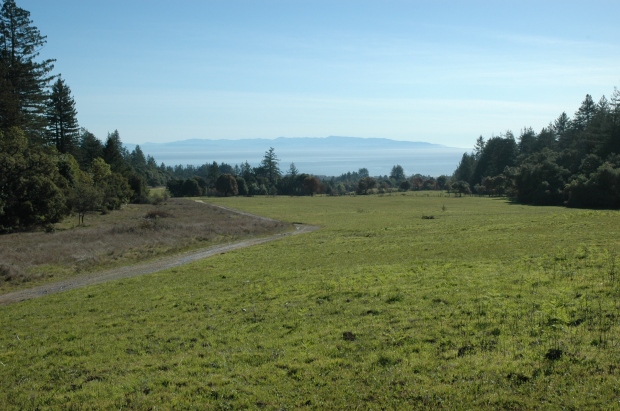
On Tuesday, December 27th I hiked onto the Gray Whale section of Wilder Ranch to see the prairies where the smoke was coming from back in October. I first visited these meadows in the late 1980’s while the property was privately owned; cattle were grazing the meadows, and there were abundant native grasses and wildflowers. Santa Cruz preservationists fought hard to protect the property from a proposed housing development, it went to State Parks, which removed the cows and took many years to start managing the prairies, which were starting to disappear to weeds, shrubs, and trees. Luckily, things were to change…

dsc_0156

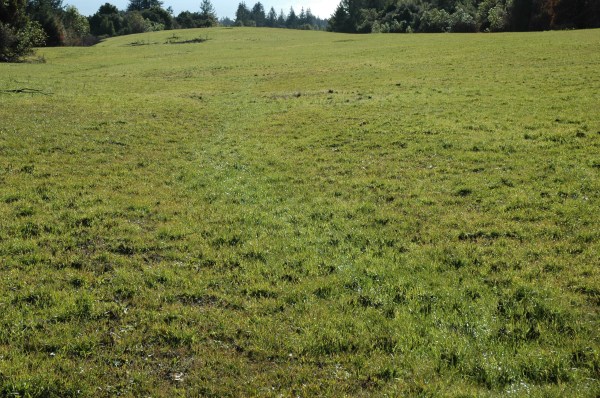
Postburn strikingly green meadows.

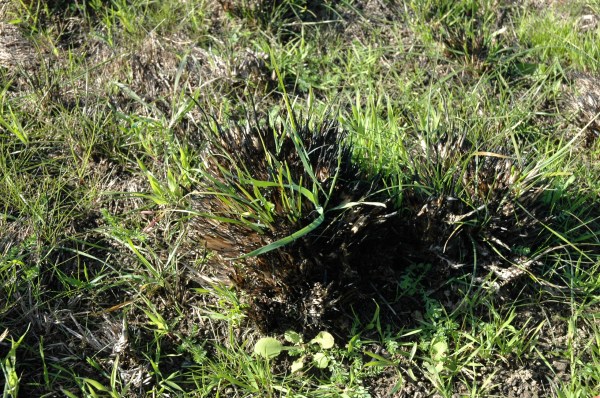
This past October, I knew that big plume of smoke I saw while driving on Highway 1 meant that State Parks was continuing their work at maintaining the meadows that I love so much. Fellow ecologist Jacob Pollock and I hiked from Twin Gates on Empire Grade down the Long Meadow ‘trail’ and into the strikingly bright green resprouting native grasses and wildflowers growing from the charcoal blackened ground. We found many types of native grass and a few wildflowers in the burned areas. Purple needlegrass, California’s State Grass, dominated the burned area, its dark green, rough leaves now 6” long and ubiquitous- a plant every square foot! These bunchgrasses promise a beautiful spring of silvery-purple flowers swaying 2’ high in the breeze. Patches of California oatgrass were less plentiful in the burn area than in the adjoining unburned area. This is the wet meadow loving indicator species of coastal prairie, and, in the many years after grazing and before the fires, it’s bunches grew taller to get to the sun- these tall bunches are susceptible to fire, but some survive.

dsc_0162

Fire recovery of California oatgrass

Patches of the leaves of wildflowers dotted the meadow and promise much more in the months ahead. Most abundant were sun cups, purple sanicle, and soap plant all long-lived perennials with nice flowers. Sun cups will be the earliest to bloom, maybe as early as late February, with simple, 4-petaled yellow flowers. Purple sanicle will be next to bloom in earl April with it’s small, purple spherical clusters of flowers. Soap plant blooms in late spring with evening blooming, white flowers that attract a variety of bumblebees.

Besides the obvious revitalization of the meadow plants, we marveled at other aspects of the handiwork of State Parks’ expert ecologist land stewards. Unlike many of our area’s meadows, there wasn’t a single French broom plant, a super-invasive non-native shrub that obliterates meadows, overruns trails, and is a major fire hazard. A many year program with State Parks partnering with volunteer groups has controlled that and other weed species at the park. We also saw dead coyote brush both in and out of the burn area- this native shrub can completely overrun meadows, closing bush-to-bush canopy in 15 to 35 years, depending on the soil. State Parks killed the coyote bush to maintain the prairie, and then burned the skeletons of the bushes so that there are now wide opened expanses of meadows, which are attractive to hawks, owls, coyotes, bobcats, and prairie-loving songbirds like meadowlarks. The ecologists also sent the fire into the adjoining and invading forests, maintaining the sinuous coast live oak ecotone that so beautifully frames the meadows.

dsc_0148

Fire maintains prairie ecotone

Today, I’m celebrating environmental heroes- 2-3 State Park Ecologists who manage over 18,000 acres in Santa Cruz County. They are motivated and hardworking. They need more support, more staff, more funding- please tell your State Assemblyperson/Senator! Without their dedication, our prairies would disappear. Thank you!

June 2017 Addendum: Portia Halbert sent me this photo (from State Parks Ecologist Tim Reilly), taken recently. The unburned portion of the coastal prairie in Long Meadow turns out this year to be dominated by Italian thistle, an invasive plant, whereas the fire from last fall seems to have more-or-less obliterated the species in the adjoining meadow. Thistles are especially bad this year in many meadows that haven’t been well stewarded. This discovery, that fire might help with thistle invasion, is a complete surprise to me- it deserves some careful scientific investigation! Long meadow italian thistle

True or False: National Monument Designation Will Confer Additional Natural Resource Protection to Cotoni Coast Dairies?


-Part 1-

Our government designates National Monuments in order to protect them, but would a National Monument designation for Cotoni Coast Dairies really better protect these lands? An informed answer requires an examination of the protections already in place, the language of the monument designation, and how the public and US Bureau of Land Management (BLM) follow through after monument designation. Today we will examine the first two of those three subjects with a subsequent essay that will cover the last subject.

Through decades of public effort, natural resource protections in place at Cotoni Coast Dairies were already very strong when the BLM took possession in 2014. The owners before BLM – the Trust for Public Land (TPL) – created two sets of deed restrictions that incorporated private and public funders’ interests as well as protections imposed by the California Coastal Commission. These deed restrictions require future managers to accommodate public recreation without sacrificing protected endangered species or endangered species habitat. The restrictions also prohibit mining, commercial timber production, and use of off-road motorized vehicles. The TPL and the California Coastal Commission both have standing to enforce these deed restrictions in perpetuity. Since these restrictions serve to protect the Cotoni Coast Dairies property’s natural resources in most of the ways Federal National Monument status normally affords, the question is: what additional natural resource protections might National Monument status afford?

Interestingly, National Monument designation doesn’t necessarily guarantee any specific types of natural resource protection. Those that exist are entirely subject to the discretion of Congress or the President. There are different regulatory guidelines for Congress versus the President in establishing National Monuments. Congress has constitutional authority to declare an area a National Monument; the Constitution allows Congress to make whatever rules it wishes for such land. For example, Congress can allow off road vehicles and commercial timber production on National Monuments, or Congress can prohibit human visitors, altogether. Alternatively, the Antiquities Act of 1906 allows Presidents to designate an area as a National Monument. The President is limited by the Antiquities Act which requires the size of the Monuments is ‘smallest area compatible with proper care and management of the objects to be protected.’

In 2015 two US Congresswomen and both US Senators from California co-sponsored a measure to add the Cotoni Coast Dairies property to the California Coastal Monument. The proposed addition lacked any substantive natural resource protections and ultimately failed to motivate sufficient support to make it to a floor vote. In accounting for the omission, aides to both the House and Senate sponsors have directly claimed that such language was ‘inappropriate’ because the representatives believe that Congress should not exert political influence on federal agencies’ land management decisions. In keeping with this policy, other Monument legislation in California from this era has contained little natural resource protection language.

As early as February 2016, in the wake of the failure of the California proposal, Congressional proponents met with the Obama administration on numerous occasions to urge designation of Cotoni Coast Dairies as a National Monument via an Executive Order under the Antiquities Act. We know little about what if any natural resource protections those Congressional offices lobbied for in their negotiations with the President, because this information is not available to the public. But when Congressional designation of National Monuments failed in the past, subsequent Presidential Antiquities Act proclamations of Monuments have had a regrettably mixed record of inclusion of natural resource protection language.

No discernible pattern exists –not one informed by policy or ‘pragmatism’– to account for the variable inclusion of natural resource protections in Presidential National Monument declarations. Most often, local grassroots conservation efforts motivated Presidents to designate lands as National Monuments. In most of those designations, grassroots organizations proactively provided Presidents with the information necessary to inform specific natural resource protection language in their Monument proclamations. This language often provided for protections above and beyond the federally listed species protected on federal lands by including mention of state-listed, rare, and unusual species.

The following Presidential Antiquities Act proclamations declaring National Monuments all had language protecting natural resources above and beyond what would have been protected had these areas not been declared Monuments:

  • Carrizo Plain
  • Berryessa Snow Mountain
  • Giant Sequoia, and
  • the Pt. Arena Stornetta boundary enlargement of the California Coastal National Monument (of particular relevance).

Presidential Antiquities Act proclamations for these Monuments each called out protections for a number of rare or state-listed species not otherwise protected on Federal lands (Appendix 1). Here is a tally of the numbers of non-federally listed plants and animals in these proclamations:

  • Carrizo Plain National Monument – 8 plants, 3 mammals
  • Berryessa Snow Mountain National Monument – 17 plants
  • Point Arena-Stornetta Unit, California Coastal Monument – 1 plant, 4 animals
  • Giant Sequoia National Monument – 3 animals

On the other hand, some Presidential monument proclamations had little or no such language. For instance, the proclamations creating the Santa Rosa/San Jacinto and Fort Ord National Monuments did not include mention of any specific non-federally listed species.

When non-federally listed species and other natural resource protection language is included in Antiquities Act proclamations of National Monuments, land managers must explicitly manage for those resources. If no natural resource protection language is included in proclamations the managers need never exceed baseline practices of natural resource protection. In my next post I will provide details on how land managers for the above listed Monuments adjusted their management to account for National Monument status, answering in the main the ‘what happens when’ question. For our purposes here suffice it to say that natural resource protection language in Monument designations has correlated with additional protection of those natural resources.

The nut of our position is this: Cotoni Coast Dairies is already largely protected in the ways that National Monument status would confer. If National Monument status is meant to increase protection of Cotoni Coast Dairies –as advocates for Monument status have suggested– the only sure way is if the President’s proclamation includes specific natural resource protections.

————————————————————————–

Appendix 1: Recent, Antiquities Act created Californian National Monuments and the sensitive natural resources that the Presidential proclamations protected.

Monument Species Listing Status
     
Carrizo Plain San Joaquin (Nelson’s) Antelope squirrel State of California Threatened
Pale‐yellow layia

Carrizo peppergrass

Lost Hills saltbush

Temblor buckwheat


California Rare Plant Rank 1B
Hoover’s woolly‐star

Forked fiddleneck

California Rare Plant Rank 4 “Watch List”


Pronghorn antelope

Tule elk


Unlisted
Berryessa Snow Mountain


Indian Valley brodiaea

Red Mountain catchfly


State of California Threatened


Bent flowered fiddleneck

Brittlescale

Brewer’s jewelflower

Snow Mountain buckwheat

Coastal bluff morning glory

Cobb Mountain lupine

Napa western flax


California Rare Plant Rank 1B
Purdy’s fringed onion

Serpentine sunflower

Bare monkeyflower

Swamp larkspur

Purdy’s fritillary


California Rare Plant Rank 4 “Watch List”


Musk brush

MacNab cypress

Leather oak


Not listed
Point Arena-Stornetta


Humboldt Bay owl’s clover


California Rare Plant Rank 1B
Black oystercatcher

Yellow warbler

Black-crowned night heron

Brown pelican


Not listed
Giant Sequoia Great gray owl


State of California Endangered


Northern goshawk


State of California

Species of Concern


American marten


Not listed