nature

Trails Through the Woods

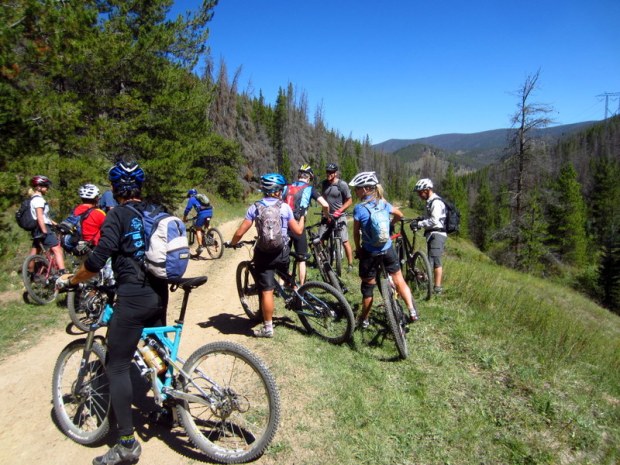
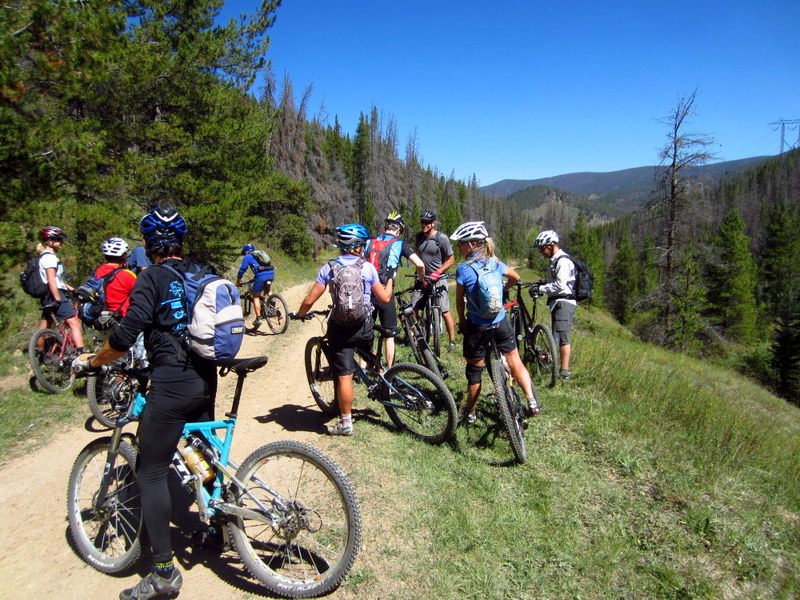
What could possibly be wrong with trails through the woods? Ad hoc, unsanctioned, illegal, illicit, unapproved…choose your adjective to precede the ‘trails through the woods’ phrase and then ask ‘what could possibly be wrong with unsanctioned trails through the woods?’ While we’re at it, let’s ask the question, ‘what type of person would build and maintain unsanctioned trails through the woods?’ Let’s hypothesize for a moment.

Law Abiding Citizen

There’s a lot going on in our nation with people’s attitudes about abiding by laws. Some people are as apt to decry a convicted felon in the White House as they are to cite the horrors of the justice system, saying it is utterly failing most of the poor souls who face the courts. How does that work, logically? I’m not sure it does. But, are we saying at the same time that we should question the laws, as well? Has ‘law abiding citizen’ become an anachronism or just plain laughable? Or, maybe our culture has become accepting of individual interpretation of laws, but not in all cases. For instance, who in their right minds would support widespread law breaking with hit and run drivers, armed robbery, or homicide? But, say how about the lesser offences of shoplifting, forgery, assault, or libel? Are we getting to your more acceptable level of crimes, yet? How about….driving 20 mph over the speed limit, selling alcohol to minors, extortion, or petty theft? And then, somewhere down the line you encounter the laws against damaging public property, trespass, entering closed areas of public land, visiting public parks when they are closed, and violating federal and state clean water laws or endangered species regulations. How are we feeling about the types of citizens who break those laws? Are we giving them a pass? Someone is. A lot of people are. Hundreds and hundreds of people in our community have decided that the criminals committing that last litany of crimes are ‘okay people’ undeserving of one iota of investigation that might result in at most a warning, and almost never prosecution.

Anarchists I know would scoff at the legal argument here. Many who know how broken the justice system is would also shrug off the legal arguments, as well, understanding that without justice there can be no reasonable pursuit of legal matters. So, perhaps we must turn to ethics to examine the truer nature of those who would participate in unsanctioned trail building and maintenance.

A Matter of Ethics

Should we consider the consequences of illegal trail building? Or, is it enough to ask if rogue trail building is good? Is building an unsanctioned trail in and of itself causing harm to other people? Is maintaining a rogue trail respectful of all people? These are the types of questions one must ask in seeking answers outside of legal context. As I have posed these questions over the years, the most common answer is “I don’t know.” So, we must ask another question of morality: is it unethical for an illicit trail builder to create new trails if they are ignorant of the consequences or context of their actions? 

Consequences, Respect

The consequences of constructing and/or maintaining rogue trails are well known, or at least readily available. The most glaring impact of rogue trails is on wildlife. Conservation lands managers have a difficult time providing for some trail access while also conserving wildlife: the two goals are mutually exclusive. Park users disturb wildlife, so one must plan around that to have healthy wildlife populations. Trails constructed outside of that planning process scuttle attempts at nature conservation. 

And so, rogue trail builders either have contempt for parks managers’ planning processes or do not care about wildlife or both.

The same sets of arguments also apply to conservation of flora, fungi, soil, and clean water. 

And again, it would stand to reason that those who construct illegal trails have contempt for park oversight personnel’s work/expertise and also do not care about conserving native plants or mushrooms and don’t care if soil erodes, that we have clean running streams, or that natural areas provide for drinking water.

Let’s extend these logical frameworks to the element of respect. Morals often refer to respecting others: their lives, their pursuits, safety, happiness, etc. All groups with which I have interacted in the past few decades readily recognize that humans need all species to continue existing for our own survival. And so, those who create and maintain unsanctioned trails score quite low on the ‘respect others’ morality scale with that first test. The majority of USA citizens support wildlife conservation; second test strikes against those who would build trails without the careful planning that parks managers use to weigh the pros and cons of new trails. We could go on…

In Sum

In kind words, how would you summarize the findings above to describe those people who make it a habit to create, or maintain, unsanctioned trails? Excluding nihilism, one would need to start with the term ‘criminal,’ but that would not be enough. The word ‘selfish’ sounds unkind, eh? And, even so, just ‘criminal, selfish…’ lacks something. 

Most of the social circles with which I have discourse include short hand lines of reference to describe types of people who love fun just a little too much. You know, when fun overrides respect for others? The term ‘fun-loving’ falls short of describing the types of people referenced in these conversations; the people being referenced generally have problems, which is why they are being discussed. Such conversations generally end in head shaking…no great solutions…sighs and ‘I hope they figure it out….’ or ‘maybe so-and-so (someone possibly close to them) can have a chat with them.’ I think we are getting closer to understanding the types of people we are dealing with. 

Next time you take a walk in nature, watch for the many trails veering from the signed, sanctioned one you are hiking. Ask yourself how much traffic that trail must get to be so well rutted and then think about how far that trail must travel, how much work it takes to chainsaw (at night) those trails open after trees fall. What a massive effort by _______ types of people (fill in the blank)! Think about the conversations they must have with one another and their networks… and how that is influencing the goodness of our community.

– this post originally published in the weekly e-news for the Monterey Bay, BrattonOnline – if you don’t already know it, now’s a good time to subscribe.

First Bloom, Maritime Chaparral

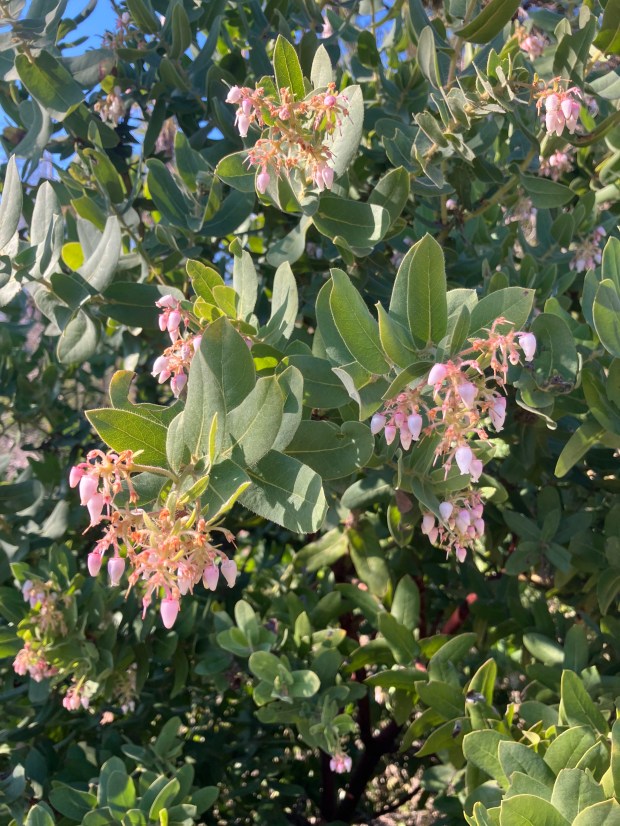
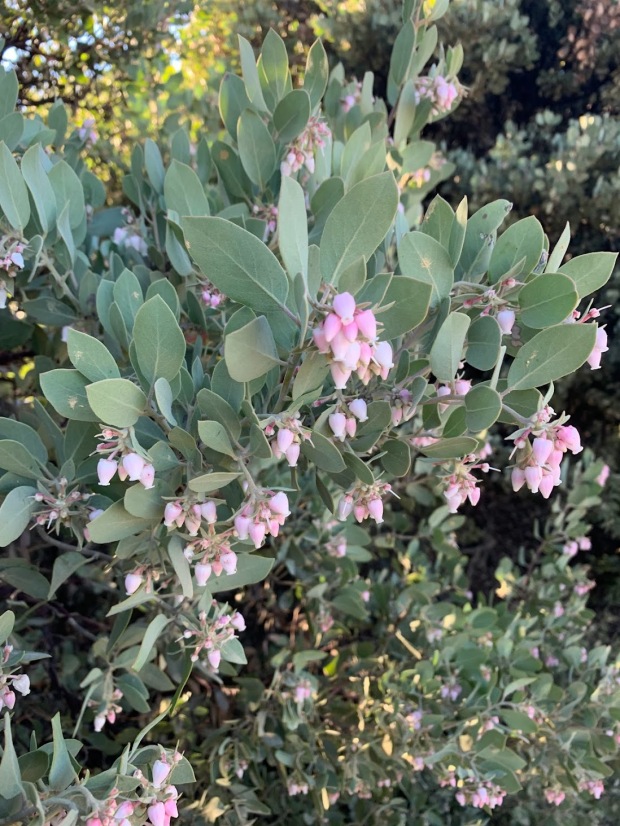
Santa Cruz manzanita in full bloom!

The ridgeline expanse of chaparral lay dormant, wafting resinous scents, clicking and crackling as the morning sun’s first rays dried the maroon, shredding bark strands which hang peeling from the skin-smooth twisty manzanita trunks. Through the late summer and fall, each day brought the same routine, sometimes hotter days, sometimes nights bringing fog, dripping and awakening lichen which festoon branches and carpet the ground, nestled into lichens and patches of rabbit poop. Then, the rain came, soaking the rocky ground. Now, months later, maritime chaparral awakens with its first bloom.

Recently, on an early morning drive to the trailhead we encountered huge white, slippery frost patches along the spine of Ben Lomond Mountain where Empire Grade bisects high chaparral, towering oak forest, and miles of burned conifer trunks. We were off to Big Basin not for lingering in the recovering redwood forest as much as to spend time in the warmth of chaparral. Once on the trail, my cheeks and nose were numb with cold, as we descended from magnificent wet old growth forest onto drier rocky ocean view ridges with a different type of snow…petalfall. 

The 3 types of manzanitas at Big Basin and Butano State Park have already been blooming since December. The best show is from a shrub that only grows in the southern part of the Santa Cruz mountains, but there are two other species of manzanita also flowering. The woodland edge manzanita, a species that can get 20’ tall, is aptly called Santa Cruz manzanita; it gets large clusters of obviously pinkish flowers. Glossy leaf manzanita with its small dark green boxwood-like leaves form the neatest of dense bushes with tiny white flowers. Giant woody burls of brittle leaf manzanita send out much less organized clusters of trunks, intertwining with other shrubs to add to the branchy complexity of impenetrable scrubland. In the chill shade below manzanita bush canopies, a carpet of white…the snow of spent blossoms covers moss mats and gravelly barrens.
undefined

More Unfolding

The manzanitas are first, but other chaparral shrubs are also awakening. We saw the first dusty, dark blue flower clusters of the pine-scented, warty-leaved wild lilac. Milk maid’s simple four petaled flowers adorned the trailsides where we walked along with the very first boisterous redwood sorrel blossoms emerging from a lush carpet of shamrock leaves. I look forward to hiking in chaparral in a month or so, when there will be an even more impressive profusion of flowers.

Next: Flowering Hillsides

We will soon encounter the 5th spring after the 2020 CZU Lightning Complex Fire, and the burned hillsides promise a Big Show. First up in the pageant: blue blossom, or wild lilac. They have just begun, but in 6 weeks there will be thousands of acres of sky blue flowers covering 10’ tall glossy leaved shrub-trees. Fire-following bush poppies are next, in June: 2” wide, cheery yellow flowers smiling from the startling silvery blue-green canopies of six foot tall leggy shrubs. Magenta flowering and very poky chaparral pea, twisty white flowers of twining wild morning glory, and white spikes of chamise. For more than half the year, maritime chaparral is a colorful show with patches of yellows, splashes of blue, rafts of white and pink, and dots of red set in cushions of diverse blue-green mounds of shrubs, sometimes towered over by occasional pines or redwoods.

Misplaced Scorn, Not Enough Love

These shrubby ecosystems are being disrespected (again) right now, but we should show them more love. News and talk shows about the fires in southern California frequently include scorn of the shrubby landscape which carries fire so fiercely. ‘Control that vegetation!’ some say. ‘Cut down those shrubs!’ others exclaim. At the top of Loma Prieta, cell phone tower owners mow down many acres of the most beautiful chaparral. Even local parks have started destroying chaparral along trails and fire roads. Few note that no matter how much energy you put into messing up that habitat, what comes up will still be flammable, and probably badly so. 

On the other hand, chaparral blankets and protects the poorest of soils allowing rain to replenish the groundwater. In places where humans have tried hard to convert chaparral to something else, they manage to create a terrible weedy patch – fine fuels that carry fire fast. And, in those places, the hillsides give way in heavy rains and fill streams with sediment, creating flooding and debris flow problems.  Where these amazingly drought tolerant chaparral shrubs are given a chance, they hold incredibly steep poor soils in place allowing rainfall to soak in without landslides. 

Now, Go!

If you can find some time to spend with chaparral, try taking a few trips to the same place in the next few months to watch the flower display change and unfold. Those ridges in Butano and Big Basin State Parks are great chaparral displays. Summit Road near Loma Prieta is also quite nice. Despite fuels management and long intervals without fire, some patches of chaparral persist in Wilder Ranch and in/around Nisene Marks, both State Parks. Montara Mountain in San Mateo County is my favorite chaparral trekking location…amazing views, too.

When you go to these places, here are some questions for the trip:

  • How many Ceanothus, aka blue blossom or wild lilac, do you see? Is there variation in flower color? What’s your favorite?
  • What kind of rock is the chaparral anchored into? Do you see any soil? How do these shrubs get water?
  • How long has it been since there was a fire in that patch of chaparral? Is there a lot of dead fuel build up? Are there young or old pines, which might indicate how old the stand is? 
  • Is the chaparral well managed by people? Are invasive plants under control or spreading? Are the roads and trails eroding or well maintained? Are the nearby houses, power lines, and roads sensitively integrated into the system?

After your return from your chaparral tour, please keep this conversation alive. Talk to your friends and family about chaparral. Read more about it. Vote as if chaparral mattered: political candidates should have opinions about how to protect rare habitats given the constant onslaught of poor human behavior.

This column originally published as part of BrattonOnline, a weekly news publication to keep our community informed about pressing matters at home and abroad – check it out! Subscribe! READ!

People for Fire

Nature around the Monterey Bay has been adjusting to changing wildfire regimes; we should expect that to continue, but how that happens is up to us in many different ways. Very recently, we are putting purposeful, good fire back onto the land. This may help restore the land while protecting human infrastructure from catastrophic damage, but there are too few projects to learn from…we must learn more!

Burning History

The Monterey Bay area has been getting hotter and drier for 20,000 years, which coincides with the era of fire-lighting humans. Laguna de las Trancas is an ancient pond that lies on a geological fault on the North Coast. Ancient ponds record the history of their place in strata. Scientists have taken sediment cores from that pond and recorded layers of pollen and volcanic ash, going back through time as the deeper sediment is older. Volcanic ash has properties that allow us to know from which volcano it originates and scientists have used various methods to chart the age of ancient volcanic eruptions. So, volcanic ash serves as milestones marking known years in the sediment’s past. This is how we know that this region changed to a much more fire-prone landscape around 12,000 years ago, consequent with the widespread archeological evidence of humans. Before that, the dominant forest trees were firs; after that, fire-adapted redwoods came to dominate. More recently, for the past 1200 years, fire scars on ancient redwoods illustrate a 4-6 year burn return interval. Indigenous people likely managed the fires sweeping frequently through redwood forests, but their fire tending of this landscape tragically ended during the genocidal colonist period. Purposeful fire has been almost entirely absent on most of this landscape for 230 years. In its place, long-interval catastrophic wildfires have caused all sorts of mayhem and loss of life.

Indigenous Pyro Management 

Oral history, written accounts at the time of colonist contact, pollen records in ponds, burn scars on ancient trees, and vegetation patterns on this landscape are things that can teach us bits about thousands of years of intentional use of fire by humans. One early written account from early Old-World colonist explorers notes that many of the meadows around Monterey Bay were burned black. We know now that without burning and/or grazing all of this region’s prairies change quickly into forests, so fire must have been maintaining meadows for a very long time, in the absence of grazing and tree-pulling by the Pleistocene megafauna. The blackened meadows hampered the progress of invading Old-World explorers because they had trouble feeding their horses, which they relied on for transport. In this case, we might contemplate the use prairie fire as self-defense, but we also know that indigenous peoples used fire to cultivate native plants that served as medicine, salad greens, grain, basket materials and much more.

Good Fire Emerging Now

California’s governor has set a goal of using prescribed fire on a half million acres a year. It has been 1/10th of that for too long but indigenous folks probably burned more like 3 million acres (or more) a year previously.  

Most people do not see the natural landscape as their pharmacy, grocery store, or fibershed, but many people look to the hills and know the danger of wildfire. Purposeful, good fire is starting to address this last concern and one day will help people reunite with the land in those other ways. 

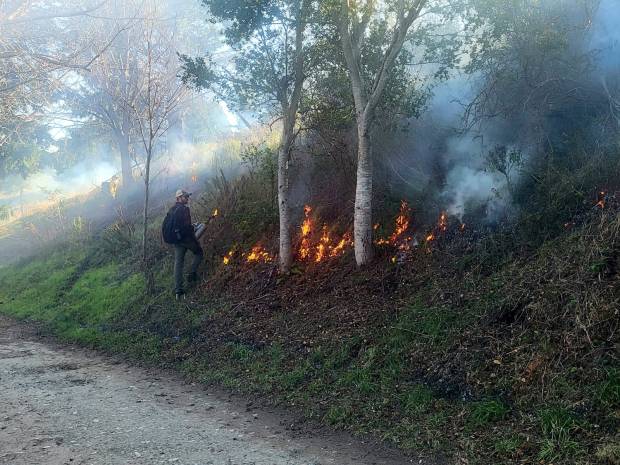
I was recently fortunate to interact with the Central Coast Prescribed Burn Association as they purposefully burned big patches of brush on Santa Cruz County’s North Coast. After much planning and preparation, forty volunteers gathered one Saturday to light big patches of hillside on fire. The goal was to restore coastal prairie and to train more wildland fire lighters in order to expand our region’s capacity to reintroduce fire on the landscape. These volunteer groups are growing around the world, including here in California. We have learned that their work is essential for everyone’s safety, and for the stewardship of the land, which provides us so much: water, timber, livestock, recreation, clean air, food, health, and solace.

Value-Added Fire

As we realize the importance of good fire in natural lands, entrepreneurs are envisioning profit. People are cashing in on the wildfire crisis by managing wildland fuels to power electrical generators. Some are seeing a potential to power electrical land stewardship equipment with generators fired by the fuel that equipment is removing. Others are already hauling wildland fuels to generation facilities supplying regions in Northern California with power. New technology allows burning wildland fuels to create charcoal, which is added to agricultural areas improving water holding capacity and maybe even soil fertility. That carbon is captured to mitigate greenhouse gas emissions. The machines are called ‘carbonators’ and they use thousands of gallons of water a day to keep them cool, which is the trick to making charcoal.

There was a lull for a bit, fand now there’s a rejuvenation of wood fired heaters for rural homes. The new woodstoves are engineered to be very efficient with very low air particulate output. Greenhouse gas (carbon) output is from recently grown wood rather than ancient fossil fuels.

The Future?

I envision a time when robots harvest biomass for fuel, farming every square inch of Planet Earth for energy. Imagine micro technology…ant-sized robots that prune plants in cultivated landscapes and natural areas, hauling bits of biomass back to larger robots which haul it to biomass energy production facilities…one big conveyor belt of fuel stolen from natural food webs. I do not like that future, but it seems inevitable in our ‘civilized’ world. How far off is that future? Without another way of managing wildfire, the day of that scenario is coming closer, quickly. The alternative is for more people to be involved with community groups managing purposeful, good fire across large areas, like the Monterey Bay region.

Your Role

Each of us has a role in helping Good Fire gain traction. Start with getting an air filter for your house: you need one anyway for wildfire smoke. Air pollution is a great concern, even with purposeful fires. The recent burning exercise I was a part of was delayed a week because of air quality concerns, and that week delay caused a bunch of issues with people’s schedules, wasted catering food, etc. If we can all be better prepared for smoke, it will be easier to get Good Fire on the ground. If you are able, help to figure out a way to get air filters to folks who can’t afford them!

We can’t expand Good Fire unless everyone feels safe in their homes. So, helping people get safe in their homes is an important thing. And, even when those homes are well secured against wildfire, people still need to be talked to, shown Good Fire, and helped to shed their fears. We can try to experience purposeful fire and see how well it is managed and then tell those stories to more people: there is a lot of fear about even professionally managed, purposeful fire.

The last thing I think more people might do: volunteer to help! The Prescribed Burn Associations could use more volunteers. Learning to manage purposeful fire is hard work and many people are needed.

-this column originally posted in the very informative weekly blog, BrattonOnline – please subscribe, like, and spread the word!

Land Atonement

Very slowly, we must move in the direction of becoming at one with the Land. All that we eat, all that we breathe, all that we drink comes from the Land.

What is your opinion of how people have treated the land around us?

Have we damaged it, or made it better? How do you know?

Big Sur: Whole or Shattered?

The Santa Lucia Mountains…Big Sur, to our South. On one hand, we see picturesque beauty, “wilderness,” a rugged, sparsely settled landscape, millions of flowers, huge trees, and a rich marine environment. On the other hand, there is a land devoid of much of the wildlife that once called that place habitat, the native peoples that called it home and stewarded that place are mostly gone (but still there!), wildfires ravage the landscape too hot and too frequently, roads and other development bleed soil and pollution into streams, and hordes of poorly managed visitors negatively impact the richest ecology, where the land meets the sea.

Monterey Peninsula: Zombie Ecosystems or Well-Managed Parks?

An ecological treasure, the Monterey Peninsula has rare pine and cypress forests, chaparral, and coastal prairies. Millions of humans visit to play golf, shop, drive fancy cars, visit art galleries, taste wine, or do tourism at an aquarium and historic sites. Nature there is fragmented into isolated parks which have no chance of long-term health. With lots of exposure to disease and human disturbance, with no chance of natural interactions with wildlife or fire, the parks represent zombie ecosystems, seemingly alive but really walking dead as they slowly decline with species after species winking out.

Tilled Valleys, How do You Fare?

The Salinas and Pajaro Valleys frame the central Monterey Bay, rich alluvial soils that support Agriculture, the nation’s salad bowl. Farming is an economic engine, sustaining jobs and communities and feeding people vegetables, never enough helpings per capita in any given day. The effluent flowing out of that engine creates the most polluted surface water in the US, pools of eutrophic, stinking rot. Ancient rich soil is disappearing, lost with the rain, in floods, and in the wind. Groundwater is being contaminated with pollution or by sea water intrusion caused by over pumping groundwater.

Santa Cruz and the North Coast, Loved and Smothered

On the other side of the Bay lies Big Sur North, a tamer landscape, thickly inhabited, worn. Tourism, Silicon Valley settlement, and education rule here. Surf and mountain bike culture are ‘natural’ tourism while hordes of cotton candy fueled tourists amble in the relatively cool beachy haven that contrasts so readily with the increasingly baking inland. Millions of feet pummel the beach sand substrate, crushing the food chain of flocks of would-be shorebirds; the remaining birds scatter, no longer comfortable foraging on these overrun beaches. Similarly, most meadows and canyons zip with such continual disturbance that wildlife families flee….fewer places left to hide. In the built areas, hundreds of fossil fuel formulations leak from engines, pesticides ooze from landscapes, headwater rivers and streams are diverted for toilet flushing and carwashes, downstream they receive and convey pollutants into our treasured Bay.

How do We?

How do we atone for the ongoing damage we are causing to the land around us? In ecological terms we call this restoration. In social terms, we call this reparation. In economic terms, we call this re-investment. Do you see enough of this going on? I cannot believe that you do.

Ecological Restoration

We must make room for all of the species of plants and wildlife to flourish if we ourselves are to survive. We read such things, but do we believe them? Do we act on them? Are there things individuals can do to make this happen? Many of us can vote for those who have this vision. Many of us can learn about ecological restoration and tell others about the ways forward around here. There is good fire to put back on the landscape. There are ecological linkages to restore, across roads, through development. There are invasive species to control. And, there are many species of wildlife that need to be better managed, monitored, and restored with the California Department of Fish and Wildlife at the helm.

Reparations

We live on unceded lands. We are surrounded by people displaced by greed-fueled governmental policies, including war. The nation owes its current wealth to people terribly taken advantage of for generations. What are we doing for reparations? Anything at all?

Re-Investment

The way we do it, every new home, every new development creates a heavier burden on our already strapped local municipalities. The way we have done it for generations, businesses have profited from extraction from Nature, most recently including agriculture, water use, and tourism in natural areas. Some suggest it is time to increase the taxes of landowners to enable more tourists to overrun our natural areas…’investing” in new trails and repairing old trails degraded by millions of tourists to keep local businesses thriving. How did this become part of a re-investment proposal? 

A Path Forward

Whether you take part in restoration, reparations, or re-investment, each of us must do our part. I’m sure that none of us want to leave the world worse off than it was before we enjoyed the water, the air, and the food that Nature made possible. We regularly eat meals…taking. We regularly drink water…taking. We regularly travel through Nature…taking. We regularly purchase things and throw away things…taking. What are we regularly doing to give back, to atone for all that we are taking from Nature, from each other?

I hope that you will think about that debt when you vote this Fall. And, I hope that you will plan at least one activity in the next little while that gives something back. Make such giving a regular practice, please.

-this column brought to you in part by Bruce Bratton, who graciously publishes my work weekly at BrattonOnline.com Sign up, donate, and read it- a great way to catch up on what is going on around the Monterey Bay, and beyond.

Whence SCruz Enviros?

I continue to ask myself this question: where has the environmental movement gone in Santa Cruz? I have several hypotheses. This is not to deny the tireless work of various individuals who have helped on many fronts, but I sense a loss of momentum, of any organized movement of the type of conservationists that have been so crucial in the past in providing the Santa Cruz area with much of which it is now proud: Lighthouse Field, the City’s Greenbelt, Wilder Ranch, and Gray Whale Ranch come to mind, is there any kind of movement now that could achieve such success?

Questionable Rationality

One of the age-old issues with working with coalitions is the rationality factor, and the environmental conservation movement has had its share of associates who defy the laws of rational discourse. There is strength in numbers, but as those numbers grow the community will include people who are vocal about some pretty wild, unsubstantiated things. Those people sometimes have a fairly strident way of expressing themselves. Whether it is a tactic, or perhaps they believe it, the opposition to conservationists will say ‘look at that lunatic fringe group!’ They lump perfectly rational people in with the less-than-rational minority. The less-than-rational folks will also say ‘Look! I have credibility! I am associated with these rational people!’ That fringe element has driven more than a few of my colleagues away from advocating for conservation.

Oppositional Idiocy

Problems with rationality aren’t just internal to conservationists: there are many irrational people to face in the opposition. There is increased reliance on very poor methods of discourse: tu quoque, black-and-white and straw man arguments are very common, and conservationists aren’t always prepared to rebut such vacuous methods of dialogue. We often don’t even recognize them as such. As I wrote recently, add those types of arguments to a long list of unsubstantiated ‘facts’ and you have the gish gallop making it impossible to address any particular thing.

Conflict Avoidance

Poor discourse and barely rational coalition members may have contributed to the next reason I hypothesize for the demise of the local conservation movement: conflict avoidance. One thing that seems on the upswing with the younger generations is conflict avoidance, but this issue has long been a problem to conservationists. Politicians and other would-be mediators of environmental conflict have often tried problem solving by attempting solutions through compromise. That is, they see two sides – conservation versus development – and say “we can find a middle ground.” The problem with that is that often the conservation issues associated with the proposed development aren’t addressed by this middle ground: biology doesn’t work that neatly. This concept has oozed its way into the general populace where many want to solve things by reaching an imaginary happy spot – ‘half way’ between what is portrayed as two divergent points of view. Even that half-way point is difficult for most to imagine negotiating.

Those who are proponents of nature destruction are well seasoned negotiators, new public conservation advocates not so much. New recruits into conservation often balk at the need to negotiate with often well-paid consultants who are so good at their game. These new conservationists also often feel shy about hiring professionals, especially lawyers to help with the conflict: for some reason many feel like seeking that method of solution is ‘too much.’ And, then again, lawyers are expensive.

Legal Defense, Legal Bills

If somehow a group of conservationists can come to the conclusion that a lawyer would help, raising money for legal defense funds for conservation around Santa Cruz is not easy. Lawyers are expensive and their work takes time. Can you remember the last time a local conservation group asked for funding for legal defense? It has been a long time.

And yet, legal defense has often been essential to resolving many important environmental conflicts, everywhere. Especially here in California, the laws protecting the environment are strong and broad ranging. Those proposing to destroy nature fear enforcement of those laws. With my conservation advocacy, I often cite legal language and so have been called ‘litigious’ by a handful of nefarious truth-stretchers: I have never retained legal counsel to sue anyone. It is very important for conservationists to understand laws and regulations and to cite those as well as case law whenever making their point. And yet, fewer and fewer locals are forming coalitions to retain legal assistance to protect nature.

Legal Reprisals

Some conservationists have avoided the milieu of conflict because they fear that the often well-funded anti-nature crowd might sick their lawyers on them. There are Strategic Lawsuits Against Public Participation (SLAPP) where the pro-development types intimidate conservation advocates by suing them…often for libel but for lots of other things. Also, some conservation advocates have been named in lawsuits by nature destroyers. For instance, our ‘friends’ at the Trust for Public Land sued local conservationists to recover expenses the group said they used to defend themselves in court actions aimed at better protecting the Cotoni Coast Dairies property.

No Peace, No Justice

The last issue hobbling local conservationists is their inability to adequately form coalitions with environmental justice movements, which have perhaps gained more wide support and recognition. This piece well summarizes the issue, and rests with the ‘no brainer’ intersection of the two movements: climate change. In this regard, Santa Cruz might be doing okay, but we are leaving behind other conservation issues of the highest importance: conservation land management, endangered species conservation, clean water and wetlands protections, and natural areas visitor management. Each of those issues has meaning for environmental justice proponents, but conservationists have done little to make that bridge.

What Can You Do?

I urge more people to become actively involved with local conservation groups. And, when you do, help those groups to become better through your mentorship and skill. We need to train one another to be good at conservation before the next big issue threatens species, habitats, or the relationship between humans and nature in our region.

-this post originally published as part of Bruce Bratton’s long-running informative blog at BrattonOnline.com, a place you should turn for all that you need to know around the Monterey Bay (and beyond).

Gish Gallop

Has it always been so common, or is it just more apparent because it has become so prevalent in mainstream politics? The Gish Gallop is a method of debate where one streams together so many unsubstantiated points that it becomes difficult to track, and rebut, them all. Perhaps the easy swipe of social media or the increased speed of emerging news have helped to wire us to be more receptive to the full-steam-ahead BS argument technique. Here, I try my hand at making a speech using the Gish Gallop technique with a collection of commonly held nature fallacies:

A Gish’ing Example

Nature is dangerous! For instance, all sorts of snakes and spiders are venomous, and people die from their bites all the time. You have to be especially careful of mountain lions, which are increasingly attacking people across California. If environmentalists have their way, there will also be wolves roaming everywhere across the Western USA- once established, they will become habituated to eating livestock and they’ll be coming after people, too. Just outside your door trying to get into your trash are very dangerous rabid opossums. You don’t even have to go outside for nature to get you. There are spiders hiding in your house, and an average of six a year drop into sleeping people’s mouths. I heard just the other day about another venomous snake crawling out of someone’s toilet. Some crazies want to blame so many things like this on global warming, which is just hype from crackpots trying to control our lives. They claim burning fossil fuels is going to kill us all, but that’s not true! Change happens, for God’s sake, there have always been natural disasters and there always will be, just get used to it, you snowflakes!

Does that kind of diatribe sound familiar? It should, and its not just coming from the political right[1] – watch out for it coming from just about any political direction, in just about any social situation. You can tell a real Gish Gallop addict by picking out just one of their tidbits and trying to follow up with a more involved conversation. If they are a galloping gish o’phile, they’ll be unable to stick to that topic and will hit you with another round of Gish Gallop before you can yell ‘stop!’ I don’t know if its just my circles of company, but I venture to guess that 1 out of 10 of my conversations encounter something amounting to Gish Gallop.

Toilet Snakes

Let’s take a look at just one of the parts of the above parade d’ BS: toilet snakes. Mention the phrase ‘toilet snake’ during a party, and it may well take root in conversation with anecdotes just as lunatic, or even substantiating evidence of this profoundly unlikely scenario. Was it Voltaire that said absurdities beget atrocities? One step leads to the next. Who are we to deny the frequency of toilet snakes, anyway? I’m sure it has happened once or twice! It may even be getting more frequent with global warming, invasive species, collapsing and outdated infrastructure, and the loss of skilled labor attracted to public works jobs. See? How familiar is that? That’s how it goes…

Turning This Around: The Antidote

How good are you at stemming the tide of verbal diarrhea? How do we collectively alter this rotten social habit? It is time to infuse more meaningful dialogue into the world. I am particularly advocating for better dialogues about nature and hoping that we carry with us enough fascinating stories that we can knit deeper and deeper oral traditions into a regionally-oriented social fabric. As we do that, I encourage us to use science as our guide, so that we have a method of building out truth, of going deeper and deeper into nature, and to add those discoveries into our stories.

The Fate of Snakes

My essay ‘Snakes on the Monterey Bay’ is one of the most popular reads on my website. I suspect that there are widespread positive sentiments about native snake species. But there are also widespread popular beliefs, well supported in social circles, that snakes are all very dangerous. Snake phobia, even nature phobia, is far too common. I well recall a time when I was working with a farm labor crew to machete poison hemlock, an invasive species that had taken over much of Younger Lagoon Reserve that I was stewarding for the University. One of the crew spotted a garter snake: quickly three were chasing it and proudly hacked it to pieces in moments before I could stop them. They seemed astounded that I was angry at their actions. I’m sure that they still think that I was acting insanely to be defending SNAKES! Why? Many people believe snakes are dangerous, and this is one of the many subjects that we can work on to improve human-nature relations.

Might you find out a bit about one of our native snakes and start a conversation about it with your friends? Such conversations could change the world for the better.

-this column slightly modified (with The Guardian link) from that which I posted via BrattonOnline.com, Bruce Bratton (and team)’s wonderful source for news. Subscribe now and save (it is free, but donations are welcome)


[1] Although some admit that this is their favorite method of oratory.

Protecting Our Most Precious Spots

The most highly protected terrestrial areas around California’s Monterey Bay are designated as “Natural Preserves” by the California Department of Parks and Recreation and as “Ecological Reserves” by the California Department of Fish and Wildlife. Let’s explore where those places are, and how the State’s premier land management agencies are directed to protect areas with these designations.

CDFW Ecological Reserves

The California Department of Fish and Wildlife (CDFW) manages 1.1 million acres of land in California. Unfortunately, CDFW does not publish summary statistics about how many of those acres are designated as Ecological Reserves, which have the highest protection of any state-owned public lands, as reflected in the following regulatory language:

“….ecological reserves are maintained for the primary purpose of …..protection of rare, threatened, or endangered native plants, wildlife, aquatic organisms, and specialized terrestrial or aquatic habitat types. Visitor uses are dependent upon the provisions of applicable laws and upon a determination by the commission that opening an area to such visitor use is compatible with the purposes of the property.” (Cal. Code Regs. tit. 14 § 630Additional Visitor Use Regulations on Department Lands Designated as Ecological Reserves).

Note the stress on maintaining these properties for species and habitat conservation, first and foremost. And note that it takes a vote by the California Fish and Game Commission to allow any visitors to use those properties. Any such vote must be supported by an analysis of the impacts of such visitation on the species and/or habitats that the Ecological Reserve was designated to protect.

Local Ecological Reserves

The two CDFW Ecological Reserves that people regularly visit around the Monterey Bay are the Elkhorn Slough Ecological Reserve and the Bonny Doon Ecological Reserve. The two other CDFW Ecological Reserves do not allow public access without special permission: Quail Hollow and Watsonville Slough.

The Elkhorn Slough regularly has many visitors. The Fish and Game Commission appears to have at some point voted to approve visitor use at that property. However, a Commission-approved Elkhorn Ecological Reserve Management Plan outlining how visitor use is compatible with the conservation purposes of the property is not readily available. So, unfortunately, I can’t tell you what ‘conservation purposes’ were designated when the property was afforded such a high level of protection.

The other CDFW Ecological Reserve that the public visits was founded with the conservation purposes, according to their approved management plan, from 2003:

“The Bonny Doon Ecological Reserve (BDER) contains the largest and most pristine remaining occurrences of several rare plant communities which are limited to ancient marine sand deposits in Santa Cruz County. These communities contain three plant species which are considered to be rare or endangered: Santa Cruz cypress (Cupressus abramsiana) and Santa Cruz wallflower (Erysimum teretifolium), both listed as Federal and State endangered at the time of acquisition; and Ben Lomond spineflower (Chorizanthe pungens var. hartwegiana), which has subsequently been listed as Federal endangered….The BDER acquisition represented a unique opportunity to preserve a comparatively large area of rare habitat in nearly pristine condition”

In contravention to the regulation cited above, CDFW has allowed public use despite the Fish and Game Commission never having approved visitor use according a plan analyzing the compatibility of visitor use and protection of the Bonny Doon Ecological Reserve. Moreover, such a plan would also be required to have a Coastal Development Plan, approved by the California Coastal Commission. The 2003 management plan alludes to the need for a trail plan, but it is not clear if the plan’s environmental impact sufficiently addressed issues associated with the vague plans outlined in the document. The plan did, however, require creation of a monitoring program that designed to trigger changes in visitor use and trail maintenance. {ask for monitoring reports}

State Parks Natural Preserves

The California Department of Parks and Recreation manages 1.6 million acres of land. As with CDFW, Parks does not publish how many acres are designated as Natural Preserves. Natural Preserves have the highest protection of any State Parks managed lands, as reflected in the following policy language:

“… natural preserves will be established to give full protection to environmental and ecological integrity, from the standpoints of watershed influences, scenic and visual unity, cultural values, and other appropriate environmental factors.

Developments in natural preserves are limited to trails and interpretive facilities required to make possible the visual and sensory enjoyment of the resources by visitors. Vehicle access and parking are not appropriate; visitor centers, restrooms, structures, and facilities other than signs shall be placed outside natural preserves.

Bicycles are allowed only on paved roads in…Natural Preserves.”

Note the language, as with CDFW, stressing the primary importance of these State Parks areas for ecological conservation, and how Parks adds to this designation watershed processes and areas of cultural significance.

Local Natural Preserves

There are 5 Monterey Bay spots with State Parks Natural Preserve designation: Wilder Beach Natural Preserve (small, Wilder Ranch State Park); San Lorenzo Headwaters Natural Preserve (1800 acres, Castle Rock State Park); Theodore Hoover Natural Preserve (23 acres, Big Basin State Park); Año Nuevo Coast Natural Preserve (925 acres, Año Nuevo State Park), and; Point Lobos State Natural Preserve (550 acres). A large portion of the Año Nuevo Coast Natural Preserve has restricted public access and there is no public access allowed at Wilder Beach. The other spots allow public access, but, as noted in the above policies, no one is allowed to leave trails in areas with this designation, and bicycles are not permitted except on paved roads.

One Natural Preserve is missing from State Park’s list: the one that was to be designated for the coastal prairies in upper Wilder Ranch. During the process of approving use of that part of the park, Parks was discussing designation of vast areas of the diverse grasslands as a Natural Preserve. However, it turned out that Parks never updated the Wilder Ranch General Plan and so didn’t pursue such a designation, possibly due to opposition from mountain bikers.

How Are They Doing?

Many people reading this will be familiar with at least some of the areas listed above, places afforded the highest levels of conservation protection. For each spot, ask yourself: how are the managers doing? Do those areas seem to be better managed for conservation than other places? In the case of Wilder Beach, are snowy plovers nesting there…do people get away with trespassing there? In the case of the Bonny Doon Ecological Reserve, is visitor use truly compatible with protecting the many species and habitats, which includes the most endangered ecosystem in North America? How can we tell these stories and help the managers elevate these very special places to give them the protection they deserve?

-this essay revised with new information from that which appeared in June 2024 at Bruce Bratton’s inimitable Monterey Bay news source at BrattonOnline.com

Suddenly Crickets

The long days have become warm. Some people were even growly about the chill, the fog, and the drizzle that have become our most frequent visitors as this long Spring crescendo slowly approaches Summer. The complaining people were particularly happy about today, and tomorrow will even be warmer. But this cool, moist spring has spread a vibrancy rarely seen across California’s central coast. The biggest grasshopper I’ve ever seen around here plopped onto the ground in front of me today and tonight the crickets have at last begun the summer’s starlight orchestra. The warmth of the day quickly fades as the night grows dark, and cricketsong wanes, replaced by a rare silent night, peculiar to the particularly cool spring. There is no wind, no echoing waves, no trilling crickets, and only a few sporadic hoots exchanged by scattered great horned owls.

Late Morning, Fog Dispersing

Sunny, bright sunrises are rare. Mostly there is the muteness of first light, glowing through dense fog. Wet grass. Puffed up quail sitting in pairs, barely moving. Slow motion rabbits tentatively beginning their daytime nibbling. The sun brightens, the fog grows thinner, and gradually bird songs escalate, becoming more diverse, varied, louder. The first bright rays carry sudden warmth, sending birds into the sky: hawks soaring, ravens patrolling, swallows chattering, swerve. The purple martins carry such huge wads of grass to line their nest cavities that they can barely fly.

As the sun takes full charge, it evaporates the dew, and a young coyote yaps and howls first from the forest edge, out of sight. She seems dissatisfied with her vantage point and trots out into the middle of a field to yowl and bark some more, glancing furtively about after each vocal session. This sets the neighborhood dogs to barking, and our coyote friend glances over her shoulder, seemingly annoyed at her domestic cousins’ primitive and unmusical repetition. Eventually, she moves on, and the morning noises go back to being dominated by bird song. Noon approaches.

Contrast of mowed, green and unmowed, brown

Drying

At every glance, there are contrasts between drying and still wet, gold versus green. Where we passed once with a mower through a grassy field, the cut area evaporated less water and is still wetly green whereas the surrounding tall grass absorbed the soil moisture and is already drying. Five foot tall tawny grass stands or falls over, crisscrossing, heavy with seed. A million things are hidden in that meadowy mess: snakes, rodents, bugs, spiders, and bird nests present a gallery of surprises as I collect native grass seed for restoring areas of the farm. The seed must dry in paper bags to be stored until first rains, to be tossed into the footprint of prescribed fire or along the tracks of mowers.

Vetch is flowering in our fallow fields

Flowers Still

Despite the drying, it remains a very floral spring. Different types of vetch have only just entered their peak bloom. Poppies are in full display, big orange patches, rabbits eating their flowers. Monkeyflower is also in peak color, whole hillsides glowing peach-orange. Nearby, the post fire chaparral giant yellow bush poppies are blossoming, creating a peculiarly sweet, cucumber scent. That chaparral air is thick with resinous blueblossom odor accentuated sometimes by the bitter-sweet yerba santa, which is displaying clusters of lilac flowers. The forest understory is bejeweled with rosey globe lilies, bobbing and lush. The last native iris flowers are fading.

Ah, the promise of Lapins cherries for late June (nets up soon!)

Fruity Promises

The orchards are producing ripe citrus while thousands of other fruit grow marble- to golf ball-sized. We compare different types of navel oranges, contrasting them with Valencia, complimented by sweet Honey mandarins. The last of the limes are coveted. In the apple orchard, the fruit has set and is rapidly growing; it is fruit thinning time! Some of our apricot relatives are thickly laden with young fruit. The bigger patch of Lapins cherry trees will soon need netting. We peer into the canopies of avocado trees, hoping to glimpse at least some fruit set; last year was grimly non fruitful…these trees are notoriously unpredictable.

Watering

To keep the fruit fattening, we have started rounds of irrigation. That routine keeps us on our toes, especially the first cycles of water flow as the need for repairs are numerous. Inadvertent mower damage, winter rodent gnawing, or just plain mysterious breaks makes for geysers, gushers, and pouring leaks that must be detected before large tanks are drained. We seek leaks by noise more than sight. This was the first week that water flowed to most orchards as well as the 2 Dog vineyard. The irrigation will run through November, tens of thousands of gallons each week…mostly pumped silently by solar power. Irrigation efficiency has us using around half of what would be considered normal, let alone that a sizeable portion of our produce is dry farmed with no irrigation at all!

We are looking forward to the summer…and hoping not to get Too Much Heat (or fire!).

Dry, tall grass – a tangle that includes Calfifornia brome grass for restoration seed

Advocates for Wildlife Protection: Where?

When was the last time you heard about someone advocating for wildlife protection in our Monterey Bay region? Who was it? Why?

I am disturbed by the lack of advocates for wildlife protection and I wonder why that might be. Here are some reflections.

A Plea for Help

Occasionally, I find a need to call out for help for wildlife protection advocacy. My most recent call for assistance was a seeming ‘no brainer.’ There was a clear need for wildlife advocates to ask the State of California office of the US Bureau of Land Management to consider a science-supported update of their statewide sensitive wildlife species list. The one BLM has been using doesn’t protect a bunch of State listed wildlife species, as it should. And, the BLM is required to work with our State Wildlife agency to do just that. This is one of the most straightforward issues I’ve faced: the facts are easy to illustrate and quick to research. And so, I reached out to the obvious pro-wildlife advocacy organizations. Who comes to mind when I say that? Pause, don’t read on…think: who would that be?

The Sierra Club

If you are a pro-wildlife advocate, the Sierra Club seems a great place to work. Well, it could use some help. My pleas to the Santa Cruz Group of the Ventana Chapter of the Sierra Club went unanswered. The one or two in the group who are apt to answer such requests are totally stretched. A while back, the local club was taken over by the pro-bicycle lobby, a group that has little regard for wildlife conservation. It should be telling that Santa Cruz doesn’t even have its own Sierra Club chapter: the local one is a sub-group of the Ventana Chapter, based in Monterey where most of the pro-environmental activism has been traditionally located.

The Wildlife Society, San Francisco Bay Area Chapter

Another far flung chapter of an organization that is supposed to represent Santa Cruz County’s wildlife conservation concerns is the SF Bay Chapter of the Wildlife Society. Unlike the Sierra Club, this Chapter did return my queries. However, after a long wait they wrote me that they were uncomfortable advocating for this issue. They actually told me that they weren’t an advocacy organization, despite their website saying that they “work to ensure that wildlife and habitats are conserved” by “advocating for effective wildlife policy and law.” It seems like whoever is active in the organization right now is uncomfortable being advocates. Luckily, their parent organization was a much better help.

The Western Section of the Wildlife Society

Even more far flung than the SF Bay Chapter, the Western Section of the Wildlife Society was a great help. Their leadership, though obviously overworked, were enthusiastic and helpful with the straightforward request for assistance. They did due diligence and had adult conversations about the need for advocacy and wrote an amazingly strong letter on the issue. If you want to support a good (local?) organization for wildlife advocacy, this is a logical choice. Unfortunately, they probably won’t be proactively monitoring our local situation and helping out without us asking.

Audubon Society

Not so far flung, the Santa Clara Valley Audubon Society is very active and quite influential…just over the hill. When approached, their overworked volunteers can sometimes be enticed to help with local conservation. I have to give them a call on this one.

Land Trusts

The Land Trust of Santa Cruz, Sempervirens Fund, Save the Redwoods League, Peninsula Open Space Trust and others…clearly all competing with one another with no unified messages or strategy for region-wide wildlife conservation. Instead, they are as likely to be public-forward with pitches for increased recreation in natural areas, which runs counter to wildlife conservation. With this contradiction, none of these organizations are able to build credible coalitions to advocate for wildlife conservation.

Wildlife Biologists

I have long approached local wildlife biologists for assistance, with mixed results. This time, I reached out to a few and was surprised. What I was asking experts to do was to do a bit of analysis  so that their opinions about adding species to the BLM’s list were well supported. A handful of wildlife biologists said that they would consider advocating for this cause, but only if paid for their time for analysis. One biologist, Jacob Pollock, stepped up as a volunteer. Dr. Pollock is a steadfast advocate for science-supported wildlife conservation. He has an inquisitive mind and powerful analytical abilities. He deserves recognition and thanks for his wildlife conservation volunteerism. This is apparently quite rare. He will shortly offer up a methodological approach to updating the BLM’s State Special Status Wildlife Species list with an example from a statewide analysis of the rarity of American badger, including BLM’s contribution to its recovery.

The rarity of such volunteers was recently emphasized when a community organization contacted me to speak at a public forum considering a potentially wildlife-impacting regulation. I couldn’t speak and couldn’t think of another wildlife advocate to do that speaking engagement. Have you seen an inspirational wildlife conservation advocate who regularly speaks to local threats to wildlife and solutions for conservation?

Why So Few?

What has created this dearth of local wildlife advocates? We have no reliable analysis about what has happened. One day, maybe I’ll find the time to do some investigative work about what went on with the local Sierra Club. Meanwhile, I suggest that mere intelligent leadership in our community would result in that person getting elected to the Santa Cruz Group. However, that person would be lonely without a couple or three more such people to make a majority vote happen in favor of wildlife…and, a group of such volunteers would be necessary to pick up the workload for responsible advocacy.

Cost of living might have something to do with the situation. The Monterey Bay area is very expensive to live in, so wildlife biologists must work hard to pay their bills, leaving no time for volunteer work. And, when professional wildlife biologists do advocacy, they threaten some of their employment opportunities, so there’s further disincentive.

Parallels with Environmental Educators

If there are any social scientists out there, read this other post and compare the notes with this one – I think there are parallels. Besides wildlife biologists, why are so few environmental educators meshing conservation advocacy with their work?  Is it likewise the threat to income? Or, is there something cultural going on here? There might be some redundancy with this issue as perhaps a large number of environmental educators are also wildlife biologists.

What Are We To Do?

I heard recently that progressives might be getting some funding to support a revitalization to allow improved political campaigns in Santa Cruz. Perhaps there is a similar need in wildlife advocacy. It does seem that we need a new organization to advocate for wildlife in our region. How would one go about setting it up for success? I imagine it starts with funding the set up and also creating an endowment for some staff positions. The mission would need to be building a supportive, diverse, and active public. I am looking for such change.

-this post slightly adapted from the one published by Bruce Bratton at his impactful BrattonOnline.com blog site where there is often lots of good information from some brainy characters. A great source of news.

Fog, and Fog Lifting

Tall black burned tree trunks hazily emerge into view through the thick fog. Days upon days of fog prevalence make many scenes more mysterious. That eerie scene of black tree poles joins other fog-induced memories this past week: puffs of blowing dense fog hiding and then revealing drippy, dark groves of live oaks; awakening to a wall of silver cloud obscuring everything beyond the window ledge, and one evening’s approach of fog…suddenly pouring over the farm’s western ridge and down the hillsides towards the farm like a wave of terrifying suddenly-released floodwater. Each morning every spider web is illuminated by silver moisture, every leaf and blade adorned by shiny droplets.

Us Moist Critters

The dawn bird chorus is delayed and the songs fewer because all animals are made chilled and sleepy, enveloped in low clouds. The brush rabbits shake the wetness from their pelts between bouts of meandering nibbles. Extended families of quail wander slowly along roads to avoid vegetation soaking their feathers. In the absence of bird song, there is a more peaceful constant patter of dripping. Sweaters, jackets, and long pants are in order for spending time outside. The richly humid air makes breathing feel refreshing and helps accentuate late spring farm scents.

Peak Perfume

The transition between spring and summer is the season of peak perfume. Eight foot tall bolting poison hemlock emits its telltale dusty, bitter odor, which carries far in the fog-moist air. When the clouds lift and the day warms, sweeter, resinous scents are released from the sage, coyote brush, and fir. Fresh-cut-hay smell is omnipresent across the fields and down the roads as mowers constantly challenge the burgeoning grass. Warmer days bring surprising clouds of sweetness, begging for a pause to ponder the origins of scent: madrone, French broom, lilac or lupine could be the source, but maybe there’s something new to discover. I squint to the distance, upwind for patches of flowers, then shift my gaze closer to see if there are bunches of hidden flowers. There it is! –  clusters of tiny poison oak blossoms sparkling with nectar and wafting notes of clove and citrus.

Fog recently drapes the ridges surrounding Molino Creek Farm

Drying

The drippy fog does little to keep the inevitable drydown at bay. Deep soil cracks split and widen. Dust cakes vehicles and brush along the roads. This is the first week that the farm must irrigate everything or the plants will wilt and begin to die. The solar well pump runs continuously and the diesel generator will start shortly to push greater volumes of water to the grapes and storage tanks. The summer pattern of orchard watering commences: zig-zagging across acres of trees, digging 8” deep into the soil to test moisture, adjusting irrigation strategies, turning valves, recording data, monitoring storage tanks, and communicating between many farmers to assure smooth operations. For now, cool days keep this work less hectic, but one eyes the forecast and makes plans for hotter spells.

Molino Creek Farm’s amazing onions, freshly planted and regularly irrigated

Snakes, a Month Late

April is normally snake month, but the cool, wet start of this season delayed the emergence of our slithery friends. Sylvie and her brother Isaac reported a surprising night time rubber boa, crossing the road despite the drippy fog. Smooth, fresh snake tracks cross the dusty roads, always wisely perpendicular. An irate hissing baby gopher snake lunged at my leather gloves from a patch of freshly pulled weeds. We are constantly surprised by scaled creatures jetting away from disrupting orchard management: a swift yellow-bellied racer snake, head held high, escaping…giant alligator lizards making for safer ground away from hoeing. Wherever we look there are oodles of lizards and snakes, an homage to organic tilth, the diversity of plants, and the wealth of prey that result from good land management the collective respect for nature found at Molino Creek Farm.

Cherries, lushly growing with irrigation and nestled in fog drip