Fire

The advent of human control of fire was a pivotal moment in the development of our species. Human use of fire has been changing in some ways and remains steady in others. Recently, it seems that the use of fire is becoming more and more remote for more and more people. Is that good or bad? Join me for a few moments to examine the state of human relationship with fire.

In the millennia of humans’ past and on into our present, we have used fire for heating, cooking, pest control, trash disposal, transportation, and war as well as for the creation of food and fiber. I intend to revise this essay and welcome suggestions about other major uses for fire. Fire is a powerful tool.

Fire for Heating

Consider the evolution of using fire for heating: from the first flame to the storage of heat in stone, masonry fireplaces and chimneys, metal wood stoves, furnaces and, most recently, forced air central heating. Do I understand correctly that conversion of wood to fire for heat, even with super-efficient, clean burning woodstoves, is no longer legal for new construction in Santa Cruz County? Soon, even mountain folk will lose their expertise and familiarity with keeping their homes warm using locally produced fuel, easily produced as a land management byproduct making for improved wildfire safety.

Cooking Fires

My host gently wiggles and pushes three-foot branches, 3” in diameter into the fire to renew the steady heat beneath a tortilla-cooking comal. Smoke rushes out through the roof. Mayan peoples in Belize showed me this indoor cooking method, which is similar to that which many tropical and subtropical cultures have relied for generations. Elsewhere, grills over charcoal, “spits” turning above flames, and wood-fired ovens are other methods for fire-cooking food. Cast iron wood-fired cook stoves are antiques. I haven’t seen one used for a decade.

Have we entered a new era for cooking with fire? Can anyone confirm the rumor that gas stoves are no longer permitted with new construction? I understand that there are concerns about indoor air pollution as well as thoughts that such methods will unduly contribute to greenhouse gas emissions.

One of the last cooking fires in our region is employed by those ‘roughing it’ using portable gas-fired stoves, some of which have become ultra-lightweight and highly efficient. I would be remiss not to also mention wood-fired appropriate technology cooking units, fed by surprisingly small handfuls of branches to prepare family meals. These have been targeted to developing countries with increasing shortages of fuel wood.

Pest Control

A member of Sonoma’s Kashia Pomo tribe recently spoke to a group I was with about the importance of burning the understory of oaks for pest control. He pointed out insect holes in an empty acorn shell and noted that his ancestors would have burned the understory of oak forests to reduce this damage and improve the acorn crop. I’ve heard similar things about pine nut pest management.

How many other pests might have been once controlled by different uses of fire?

Food Production

Precluding the use of fire for pests, fire has been, and is still being, used for other aspects of food production. Tribal peoples use fire to increase productivity of seed crops. Burning releases nutrients trapped in dead vegetation into the soil, increasing plant growth. Native ryegrass and brome grass stands that are burned produce more, heavier seeds. Burning meadows increases the amount of clover and other wildflowers which serve as either salad greens or seed crops.

The principle of fire releasing nutrients for the next crop also applies to rice farmers in California. Burning rice fields was once a more common method of returning nutrients from “crop residue” to the soil. Some farmers have turned to selling rice straw or flooding fields so that waterfowl help break down crop residue.

Other fire-prepared food crops include morels, beef, and grasshoppers. Morels are especially numerous after fire-spurred nutrient release. Ranchers have long used fire to reduce the cover of unpalatable shrubs and increase herbaceous forage to benefit livestock production. Perhaps fire is still used to round up grasshoppers that are subsequently roasted and coated in chili powder and salt for a tasty, crunchy, protein-rich snack.

Fire-Grown Fiber

I haven’t encountered anyone burning for fiber production, but have a few ideas. Burning to reduce shrub invasion into grasslands would make those areas more productive for sheep, and, hence, wool (fiber) production.

Native peoples have burned various plants in various ways to increase fiber production. Around our region, hazel, willow, and iris burned in the right way would make it possible to harvest more and better fiber for cordage and basketry.

Trash Disposal

Travel in rural areas of the Americas and you’ll no doubt encounter the distinct smell of incinerating trash. Especially unctuous is the dioxin-tainted odor of burning plastic. I know of a certain gentleman who very recently was regularly burning 50 gallon oil drums of trash including plastic baby diapers, polluting an otherwise pristine area of Big Sur. I wonder how common the practice is at this moment in the USA? Burning plastic creates a very dangerous chemical called ‘dioxin’ – if you think it quaint when someone burns such trash, think again. This practice is on the rise and killing people.

Fire for Wildfire Fuel Reduction

Carefully planned pile burns or broadcast burns are increasingly being used to dispose of vegetation that would have otherwise been a fire hazard. I’ve written more about these practices in this and this essay.

Riding the Fire

Internal combustion engines burning fossil fuels, releasing ancient carbon, and powering vehicles is a leading cause of global warming in our nation. Not long ago, the hungry burning work of steam engines propelled society ‘forward,’ destroying forests for fuel, leading to California’s hardwood crisis in the late 1800’s. Quieter, fireless electric engines are a revolution at hand, but there’s a sound like distant thunder propelling people in much different ways.

War Fire

Sanctions aside, war is mainly a fiery affair. Bombs, bullets, flame throwers, and napalm are the fire-based war weapons of modern soldiers. No doubt too many of us have been exposed to media portrayals of more ancient warfare involving flaming projectiles meant to kill or destroy property. The most ‘modern’ of fiery death, atomic warfare, is too close at hand with entirely different types of flames.

Could war really be over if we wanted it enough? Let’s quell those violent flames starting by putting out those types of fires closer to home.

Fire – For Better or For Worse

Next time you light a candle, if you even do that anymore, take a moment to reflect on the use of good fire or bad fire. As humans become more distant from their roots, more unfamiliar with tools that we have long used to steward our world, it seems we need to make a greater effort to raise future generations to be comfortable using fire in the best of ways. We must also learn to turn aside from the power of less productive flames, as tempting as that power might be. Burn brightly! Burn well.

-this essay modified from the one originally published at BrattonOnline.com, a weekly blog from Bruce Bratton and team: sign up or miss out!

Protecting Our Most Precious Spots

The most highly protected terrestrial areas around California’s Monterey Bay are designated as “Natural Preserves” by the California Department of Parks and Recreation and as “Ecological Reserves” by the California Department of Fish and Wildlife. Let’s explore where those places are, and how the State’s premier land management agencies are directed to protect areas with these designations.

CDFW Ecological Reserves

The California Department of Fish and Wildlife (CDFW) manages 1.1 million acres of land in California. Unfortunately, CDFW does not publish summary statistics about how many of those acres are designated as Ecological Reserves, which have the highest protection of any state-owned public lands, as reflected in the following regulatory language:

“….ecological reserves are maintained for the primary purpose of …..protection of rare, threatened, or endangered native plants, wildlife, aquatic organisms, and specialized terrestrial or aquatic habitat types. Visitor uses are dependent upon the provisions of applicable laws and upon a determination by the commission that opening an area to such visitor use is compatible with the purposes of the property.” (Cal. Code Regs. tit. 14 § 630Additional Visitor Use Regulations on Department Lands Designated as Ecological Reserves).

Note the stress on maintaining these properties for species and habitat conservation, first and foremost. And note that it takes a vote by the California Fish and Game Commission to allow any visitors to use those properties. Any such vote must be supported by an analysis of the impacts of such visitation on the species and/or habitats that the Ecological Reserve was designated to protect.

Local Ecological Reserves

The two CDFW Ecological Reserves that people regularly visit around the Monterey Bay are the Elkhorn Slough Ecological Reserve and the Bonny Doon Ecological Reserve. The two other CDFW Ecological Reserves do not allow public access without special permission: Quail Hollow and Watsonville Slough.

The Elkhorn Slough regularly has many visitors. The Fish and Game Commission appears to have at some point voted to approve visitor use at that property. However, a Commission-approved Elkhorn Ecological Reserve Management Plan outlining how visitor use is compatible with the conservation purposes of the property is not readily available. So, unfortunately, I can’t tell you what ‘conservation purposes’ were designated when the property was afforded such a high level of protection.

The other CDFW Ecological Reserve that the public visits was founded with the conservation purposes, according to their approved management plan, from 2003:

“The Bonny Doon Ecological Reserve (BDER) contains the largest and most pristine remaining occurrences of several rare plant communities which are limited to ancient marine sand deposits in Santa Cruz County. These communities contain three plant species which are considered to be rare or endangered: Santa Cruz cypress (Cupressus abramsiana) and Santa Cruz wallflower (Erysimum teretifolium), both listed as Federal and State endangered at the time of acquisition; and Ben Lomond spineflower (Chorizanthe pungens var. hartwegiana), which has subsequently been listed as Federal endangered….The BDER acquisition represented a unique opportunity to preserve a comparatively large area of rare habitat in nearly pristine condition”

In contravention to the regulation cited above, CDFW has allowed public use despite the Fish and Game Commission never having approved visitor use according a plan analyzing the compatibility of visitor use and protection of the Bonny Doon Ecological Reserve. Moreover, such a plan would also be required to have a Coastal Development Plan, approved by the California Coastal Commission. The 2003 management plan alludes to the need for a trail plan, but it is not clear if the plan’s environmental impact sufficiently addressed issues associated with the vague plans outlined in the document. The plan did, however, require creation of a monitoring program that designed to trigger changes in visitor use and trail maintenance. {ask for monitoring reports}

State Parks Natural Preserves

The California Department of Parks and Recreation manages 1.6 million acres of land. As with CDFW, Parks does not publish how many acres are designated as Natural Preserves. Natural Preserves have the highest protection of any State Parks managed lands, as reflected in the following policy language:

“… natural preserves will be established to give full protection to environmental and ecological integrity, from the standpoints of watershed influences, scenic and visual unity, cultural values, and other appropriate environmental factors.

Developments in natural preserves are limited to trails and interpretive facilities required to make possible the visual and sensory enjoyment of the resources by visitors. Vehicle access and parking are not appropriate; visitor centers, restrooms, structures, and facilities other than signs shall be placed outside natural preserves.

Bicycles are allowed only on paved roads in…Natural Preserves.”

Note the language, as with CDFW, stressing the primary importance of these State Parks areas for ecological conservation, and how Parks adds to this designation watershed processes and areas of cultural significance.

Local Natural Preserves

There are 5 Monterey Bay spots with State Parks Natural Preserve designation: Wilder Beach Natural Preserve (small, Wilder Ranch State Park); San Lorenzo Headwaters Natural Preserve (1800 acres, Castle Rock State Park); Theodore Hoover Natural Preserve (23 acres, Big Basin State Park); Año Nuevo Coast Natural Preserve (925 acres, Año Nuevo State Park), and; Point Lobos State Natural Preserve (550 acres). A large portion of the Año Nuevo Coast Natural Preserve has restricted public access and there is no public access allowed at Wilder Beach. The other spots allow public access, but, as noted in the above policies, no one is allowed to leave trails in areas with this designation, and bicycles are not permitted except on paved roads.

One Natural Preserve is missing from State Park’s list: the one that was to be designated for the coastal prairies in upper Wilder Ranch. During the process of approving use of that part of the park, Parks was discussing designation of vast areas of the diverse grasslands as a Natural Preserve. However, it turned out that Parks never updated the Wilder Ranch General Plan and so didn’t pursue such a designation, possibly due to opposition from mountain bikers.

How Are They Doing?

Many people reading this will be familiar with at least some of the areas listed above, places afforded the highest levels of conservation protection. For each spot, ask yourself: how are the managers doing? Do those areas seem to be better managed for conservation than other places? In the case of Wilder Beach, are snowy plovers nesting there…do people get away with trespassing there? In the case of the Bonny Doon Ecological Reserve, is visitor use truly compatible with protecting the many species and habitats, which includes the most endangered ecosystem in North America? How can we tell these stories and help the managers elevate these very special places to give them the protection they deserve?

-this essay revised with new information from that which appeared in June 2024 at Bruce Bratton’s inimitable Monterey Bay news source at BrattonOnline.com

A Bun Dance

What do you do when there’s so much fruit that you can barely hold still? A Bun Dance!

What do you do in anticipation of a Great Big Harvest? A Bun Dance!

What does Mother Nature create when you take good care of the land? A Bun Dance!

(This poem built from Brock Dolman’s original notion of A Bun Dance)

A climbing rose in the Orchard hedgerow: full of clove scent!

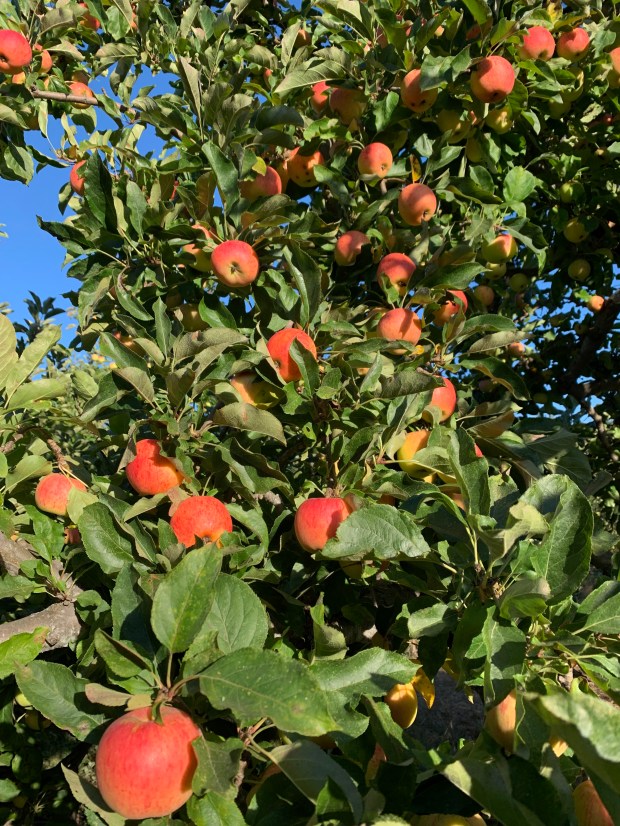
Abundance is what we have. Perhaps over-abundance. It is fruit thinning time. Apples, pears, and plums all make more fruit than their branches can hold or that the market can bear. People like big tasty fruit: thinning makes the few bigger. Our pollinators do such a good job, there’s too many fruit for the branch strength. The meditative stroll into the orchard to inspect, fix water lines, and bask in the beauty suddenly changes: SNAP! Oh Shoot! A quarter tree has broken off, the top tilts onto the ground, a big ugly splintery break shines bright with freshly exposed, blond wood. We don’t want to see that, and too often we DO – budding orchardists must get better at their thinning jobs, “For the Sake of the Trees,” so we can do A Bun Dance.

A cluster of apples needs thinning
Apples on a new tree that has already been thinned, Schwew!

Heat and Drying

Suddenly, there was heat. The transitions between the seasons have been sporadic and forgiving. Winter faded into Spring with not a sudden cessation of rain but stops and starts of dry periods, rain storms coming farther and farther apart (“Sprinter”). Now, we have no expectation of further rain. Likewise, the transition from Spring into Summer brought us a bit of warmth and then really chilly, foggy spells (“Sumring”). This past week, we had Real Heat: up into the 80’s for the first time yet. The wind blew and blew from the East and then the North East – very unusual directions, carrying the dry Basin and Range or Desert air through to the Coast. You could almost smell the sagebrush and creosote bush (and sometimes you can). Just like that, things dried right up. The grass got straw colored, the soil got dusty, the orchard trees where the irrigation had not yet run started to wilt.

New Songs

With the onset of heat, still more migratory birds have arrived: the brilliant sky-blue lazuli buntings and red-marked black-headed grosbeaks have added their serenades to the morning air. The warmth also brightened the dawn chorus, now a melodious orchestra right at first light, nary a gap between song, bird talk filling the air, overlapping, notes complimenting and colliding, no conductor beyond Pure Joy itself. Windows open to welcome the cool night air, this chorus is made more clear and delightful.

The Struggle with Weeds

Farmers have planted the crops, weed battling commences. Some say that the great Central American civilizations collapsed because they couldn’t keep up with the weeds. A Monsanto representative who grew up in Sub-Saharan Africa argued with my opposition to Roundup herbicide, exclaiming: “What would you have us do…break our backs manually controlling weeds?!!? That’s inhumane!! That’s going BACKWARDS!!” Cheerful chatter floats up from the fields below as a crew with scuttle hoes carefully weeds between 2 Dog Farms’ just-germinating dry farmed winter squash. Organic farming shuns the synthetic chemical herbicides: not welcome, not allowed! The weeding crew here instead wields long-handled hoes with good posture and big hats, and they are full of conversation and laughter. At the same time we all get pumped to see the millions of weed seedlings quickly growing right next to the crops: time to get to work!

Suddenly Crickets

The long days have become warm. Some people were even growly about the chill, the fog, and the drizzle that have become our most frequent visitors as this long Spring crescendo slowly approaches Summer. The complaining people were particularly happy about today, and tomorrow will even be warmer. But this cool, moist spring has spread a vibrancy rarely seen across California’s central coast. The biggest grasshopper I’ve ever seen around here plopped onto the ground in front of me today and tonight the crickets have at last begun the summer’s starlight orchestra. The warmth of the day quickly fades as the night grows dark, and cricketsong wanes, replaced by a rare silent night, peculiar to the particularly cool spring. There is no wind, no echoing waves, no trilling crickets, and only a few sporadic hoots exchanged by scattered great horned owls.

Late Morning, Fog Dispersing

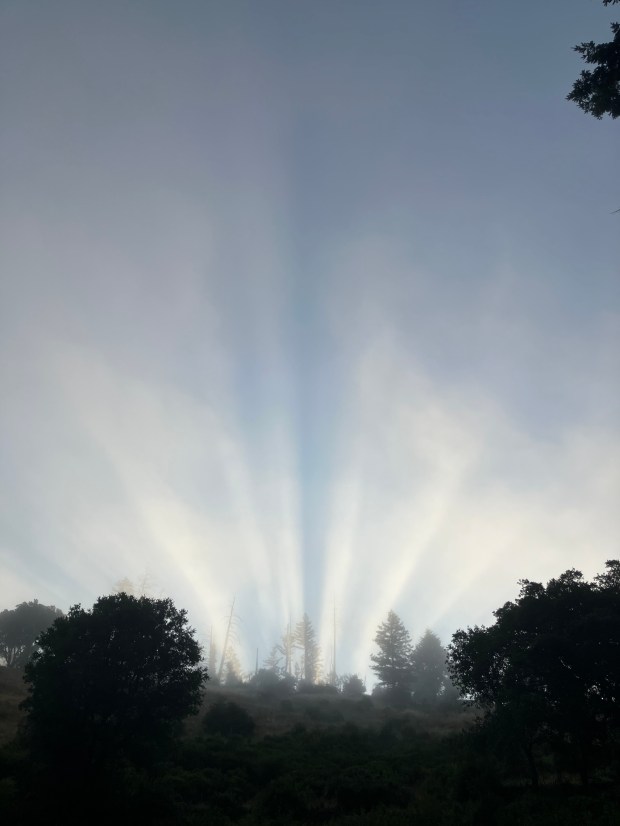
Sunny, bright sunrises are rare. Mostly there is the muteness of first light, glowing through dense fog. Wet grass. Puffed up quail sitting in pairs, barely moving. Slow motion rabbits tentatively beginning their daytime nibbling. The sun brightens, the fog grows thinner, and gradually bird songs escalate, becoming more diverse, varied, louder. The first bright rays carry sudden warmth, sending birds into the sky: hawks soaring, ravens patrolling, swallows chattering, swerve. The purple martins carry such huge wads of grass to line their nest cavities that they can barely fly.

As the sun takes full charge, it evaporates the dew, and a young coyote yaps and howls first from the forest edge, out of sight. She seems dissatisfied with her vantage point and trots out into the middle of a field to yowl and bark some more, glancing furtively about after each vocal session. This sets the neighborhood dogs to barking, and our coyote friend glances over her shoulder, seemingly annoyed at her domestic cousins’ primitive and unmusical repetition. Eventually, she moves on, and the morning noises go back to being dominated by bird song. Noon approaches.

Contrast of mowed, green and unmowed, brown

Drying

At every glance, there are contrasts between drying and still wet, gold versus green. Where we passed once with a mower through a grassy field, the cut area evaporated less water and is still wetly green whereas the surrounding tall grass absorbed the soil moisture and is already drying. Five foot tall tawny grass stands or falls over, crisscrossing, heavy with seed. A million things are hidden in that meadowy mess: snakes, rodents, bugs, spiders, and bird nests present a gallery of surprises as I collect native grass seed for restoring areas of the farm. The seed must dry in paper bags to be stored until first rains, to be tossed into the footprint of prescribed fire or along the tracks of mowers.

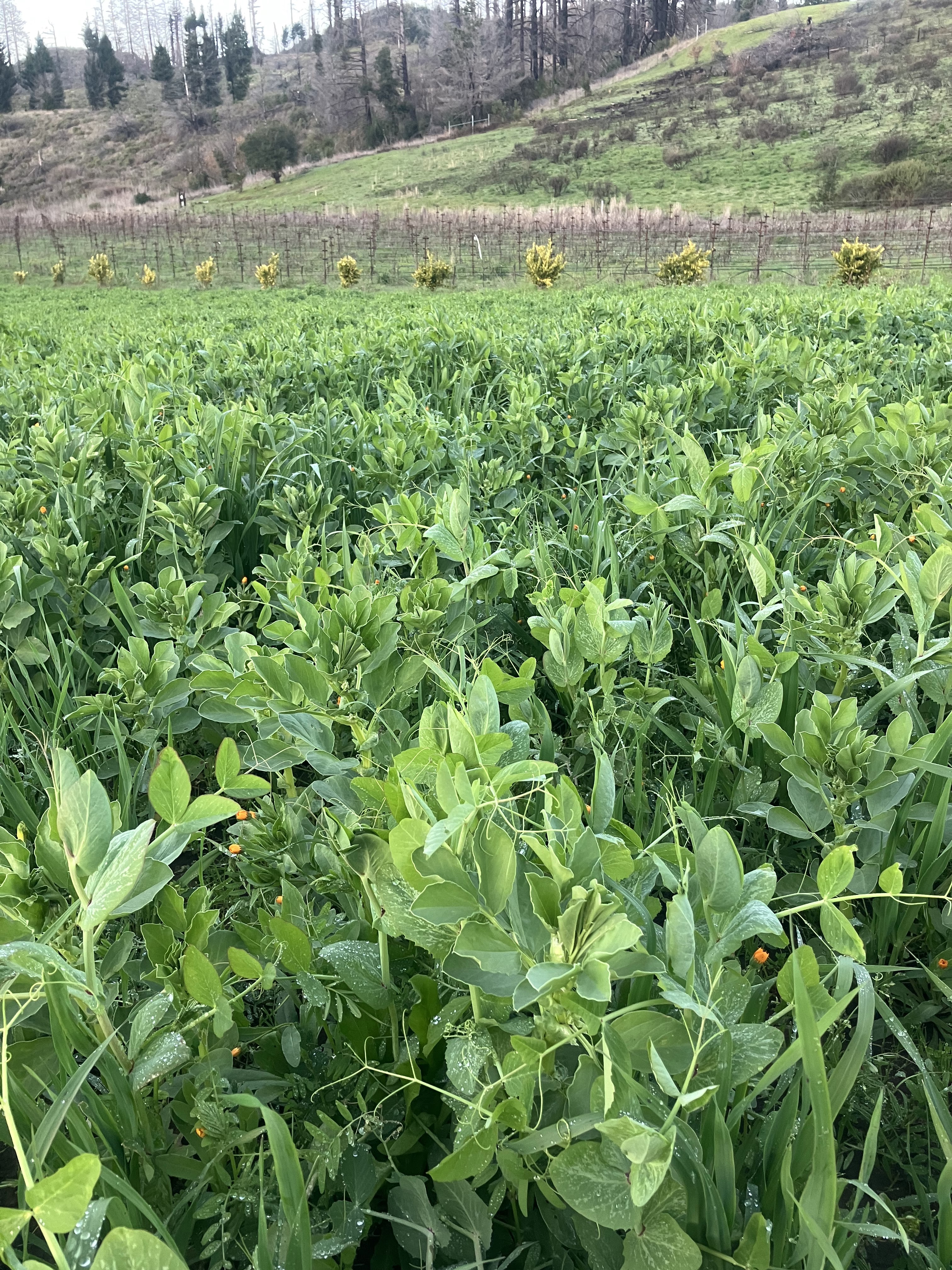
Vetch is flowering in our fallow fields

Flowers Still

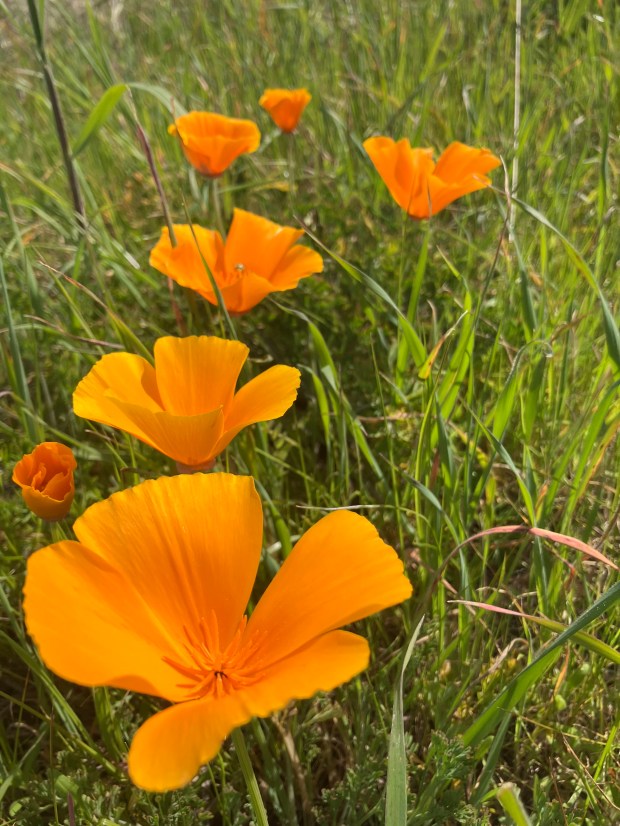
Despite the drying, it remains a very floral spring. Different types of vetch have only just entered their peak bloom. Poppies are in full display, big orange patches, rabbits eating their flowers. Monkeyflower is also in peak color, whole hillsides glowing peach-orange. Nearby, the post fire chaparral giant yellow bush poppies are blossoming, creating a peculiarly sweet, cucumber scent. That chaparral air is thick with resinous blueblossom odor accentuated sometimes by the bitter-sweet yerba santa, which is displaying clusters of lilac flowers. The forest understory is bejeweled with rosey globe lilies, bobbing and lush. The last native iris flowers are fading.

Ah, the promise of Lapins cherries for late June (nets up soon!)

Fruity Promises

The orchards are producing ripe citrus while thousands of other fruit grow marble- to golf ball-sized. We compare different types of navel oranges, contrasting them with Valencia, complimented by sweet Honey mandarins. The last of the limes are coveted. In the apple orchard, the fruit has set and is rapidly growing; it is fruit thinning time! Some of our apricot relatives are thickly laden with young fruit. The bigger patch of Lapins cherry trees will soon need netting. We peer into the canopies of avocado trees, hoping to glimpse at least some fruit set; last year was grimly non fruitful…these trees are notoriously unpredictable.

Watering

To keep the fruit fattening, we have started rounds of irrigation. That routine keeps us on our toes, especially the first cycles of water flow as the need for repairs are numerous. Inadvertent mower damage, winter rodent gnawing, or just plain mysterious breaks makes for geysers, gushers, and pouring leaks that must be detected before large tanks are drained. We seek leaks by noise more than sight. This was the first week that water flowed to most orchards as well as the 2 Dog vineyard. The irrigation will run through November, tens of thousands of gallons each week…mostly pumped silently by solar power. Irrigation efficiency has us using around half of what would be considered normal, let alone that a sizeable portion of our produce is dry farmed with no irrigation at all!

We are looking forward to the summer…and hoping not to get Too Much Heat (or fire!).

Dry, tall grass – a tangle that includes Calfifornia brome grass for restoration seed

Swarm in the Air

The air is alive with bugs and the swallows are happy. I don’t notice the tiny areal insects until dusk, by the sun’s slanting rays, but the barn swallows see them all day long. I’m sure that the swallows have learned, or always knew, which form of insect is the tastiest: maybe they dive for the biggest ones, perhaps they dart into a dense swarm of bugs with the right silvery flash, or maybe a lone moth flies in the right pattern to catch their eye from far away. Sometimes when I have the patience to watch the swallows for long enough, I see that several are crisscrossing the same patch of sky, or diving above the same patch of grass. It is hard to notice the common feeding ground because they never make tight turns, only large gradual arcs, to return to the same spot. They avoid crashing into one another by leaving a lot of margin, making it less evident that they are visiting the same feeding spot. How much of their flying antics are for feeding or just for fun makes it even more difficult to understand swallow-bug interactions.

Waves of Aphids, Troops of Predators

The slow flight of a tiny lone insect ends on the tip of a newly planted medlar. This mother aphid might soon have babies, the colony grubbing on lush new growth until it wilts. Close behind her another insect flashes red. A mother lady beetle somehow senses the right place to lay eggs where her offspring will have enough herds of aphids to feast on and grow fat. Close by, a yellow jacket wasp, aka meat bee, sips nectar at a flower; she might also be eating from aphid colonies soon – either lapping up aphid ‘honeydew’ or pinching apart their bodies or the bodies of the lady beetle larvae nearby. The acceleration of warm, long days and the lushness of plant growth is spinning up this circle of life.

The Hum of Tractor Engines

It is early morning and already a tractor is running, a farmer driving it from home base to the nearby field. The noise changes from jangling and a variable hum to a continuous deeper growl as the tiller commences row-by-row to prepare the soil for planting pepper plants, winter squash seeds and more tomato seedlings. Some tomato plants have been in the ground for weeks, and these need weeding and bed care. Bodhi recently cruised down those rows with the tiller, weeding the rows while also creating the soil mulch bed that is critical to maintaining soil moisture for dry farming. Where the tiller didn’t hit, right up against the tomato babies, a sea of the first paired leaves of weeds taunting the farmer, begging for hoe.

Jungle

Where not too long ago there were pretty patches of flowers, now it is disarray. The California poppies are buried in deep disorganized grass. Flower color has become muted, overcome by clouds of light green or even drying tawny. Where mower or cow has not touched, the meadows are 5’ tall. The overstory stems of the tallest of grasses, European oatgrass, hang thick with juicy seeds pendant and ripening. Where the soil is less productive, the grasses are already brown-dry and shorter with seeds ready to ruin your socks. Walking anywhere off trail is either a soaking experience (in the morning)(up to your knees) or a tangled, tripping, itchy experience (in the drier afternoon). Best to keep to trammeled areas, out of the jungle.

Thousands of Fruit

Apple petals have mostly fallen to be replaced by clusters of fuzzy, baby fruit. Instead of being a sea of white-pink blossoms, the orchard is fresh, light spring green with new leaves emerging from rapidly elongating shoots. Waist-high weeds have regrown where a month ago we had mowed to ground the cover crop. It is past time for another mowing. The baby plum fruit are already quarter-sized and shiny, too thick and needing immediate thinning; the apple fruit are close behind. Our regular trips to the orchard to fix and run irrigation have recently begun to include a pause to thin fruit. Soon, all attention will have to turn to thinning thousands and thousands of fruit to make room for the many fewer chosen ones.

Turkeys and the End of the Era of Fog

The last little while was so very foggy that one wondered if warmth would ever settle in. It has, but only a little. For instance today will be in the upper 60’s and the morning fog lifted by 9 a.m. The predominance of fog left its marks: taller grasses, lusher weeds, and too many patches of apple scab attacking the fruit and leaves. The fog also delayed the hatching of quail eggs, but the turkey babies couldn’t wait. Papa Turkey’s gobbling has paid off: Momma Turkey is herding a big family of babies up and down the trails and roads, out of the jungle of grass. Baby turkeys are fluffy and awkward, mother quite watchful. When she pauses and pecks, pickup off grass seed for lunch, her babies do the same.

Avocados and Oranges

Last spring was wet and rainy, and we see it with the current nonexistent avocado crop, but luckily there are oranges. If we ever get heat, the oranges will sweeten but for now they are ripe and juicy. We’ll have to wait for next year with the hope that this year’s avocado flowers get pollinated. Our 100(ish) avocado trees are growing rapidly right now. They are peculiar in that they make new leaves and shoots while shedding last year’s leaves…a kind of avocado fall. That transition leaves them vulnerable to sunburned stems; for this, we have been thankful for fog.

Environmental Education Without Civics Lessons?

There are so many opportunities for environmental education around the Monterey Bay, but all seem to avoid anything related to civic engagement. Why?

Whale Watching

The most impactful environmental education I recall was aboard a whale watching boat in the early 2000’s. We left the Moss Landing harbor with a full boat and shortly were surrounded by whales, then pods of dolphins. The captain knew where to go, aided by friendly radio chatter from fishing vessels out on the Bay. We learned a lot about the biology of the whales and dolphins, including about the history of whale populations. The whales were so dense that summer that you could smell them! The guides noted historical journal entries that spoke of that smell from the era when there were many more whales. We seemed to be returning the Bay to the dense whale populations of deep history. How exciting to be steeped in biology, history, and the hopeful story of whale recovery! The lessons didn’t stop there.

The captain noticed bad behavior of another boat, which was chasing some whales to get a better view. It is illegal and ill-advised to closely pursue whales, and our boat was radioing the other one to let them know. All aboard our boat were getting a first-hand education about the Marine Mammal Protection Act and civic engagement. Our captain shared information about how common this bad behavior was and about the inadequacy of enforcement by the responsible agencies. We were informed about how we could be involved: by supporting more responsible whale watching enterprises, through contacting the appropriate enforcement agencies, and by supporting advocacy groups working on this issue.

The owners of that whale watching business sold to someone else. Now, none of the whale watching boats educate about this important issue. Predictably, the issue of whale harassment has declined in the news and enforcement has never improved.

Museums, Parks, Aquaria, and Hikes

Think about your experiences with environmental education – do any of those include anything about civic engagement? One highlight is the advice from a local aquarium about buying responsible fish for your meals, a program which is expensive an no doubt has had a big impact. Are there any stories about how environmental advocacy groups made a difference? Are there any stories about a politician who pushed forward an environmental initiative? Are docents trained to help you to understand how you might be more engaged, civically? Do leaders of environmental education hikes tell the history of environmental struggles and how ordinary people made a difference? I’d love to hear if you have experienced any of this in any of our many local environmental education programs. I haven’t.

Terrace Point, Santa Cruz

Many people on the westside of the city of Santa Cruz take walks at Terrace Point, aka Seymour Center or the ‘coastal campus’ of UCSC. There is a trail network through swaths of habitat. There are even guided walks to view Younger Lagoon which, no doubt, avoid any discussion of the political struggles that resulted in their ability to have that experience. The trail network and the swaths of habitat are brought to you by the Terrace Point Action Network (TPAN) formed by a wide-ranging group of local residents with great leadership as well as coalitions of local environmental organizations. I doubt if anyone reading this remembers the names of any of the groups or leaders. Readers would also probably be surprised to learn the names of the leaders of the opposition: faculty of the University who proclaimed that the sprawling development for which they advocated would become the ‘Woods Hole of the West Coast.’ The delusional architects who were designing the site plans testified to the public that the site would be improved by such development, much like “castles along the Rhine (River).”

TPAN’s Good Work

The battle saw TPAN engaging the nation’s leading wetland scientist, pitted against the second best hired by the University. The areas set aside are based on a wetland delineation battle mediated by the only ecologist at the time with the Coastal Commission, who advised that agency to force the University to set aside the swaths of habitat you experience there now. The pro-access division of the Coastal Commission also exacted the trails from the University, despite those trails destroying areas of the wetlands the other division of the Coastal Commission had advised be set aside. And they also won the requirement that Younger Lagoon Reserve be opened to the public, even if it was by reservation at a scheduled tour. There are many other hilarious and telling parts of the Terrace Point story, which would make for an inspirational and entertaining docent-led walk, interpretive sign, or brochure for the site; but I doubt those will happen.

Coastal Campus Now

It is typical that these environmental battles are never over and if the activists disappear the protections slip. The Coastal Commission also required the University to only build buildings that supported ‘coastal dependent’ uses. Labs requiring use of the sea water intake system, for instance, would fit that bill. After not that many years, the entire University biology department moved to Terrace Point – classes are being held there, there are offices and meeting spaces. None of these are in the least bit coastally dependent: the University is getting away with blatant disregard to prohibitions of a much-changed, pro-development Coastal Commission.

When I ask biology professors who once helped with the opposition to the University’s development of the site, they note that the classes held at Terrace Point include environmental education about coastal ecosystems, allowing students to walk outside and participate in hands-on restoration.

Environmental Education Without Civic Engagement

UCSC has succeeded greatly with hands-on, experiential environmental education, but seemingly without much success getting students to be engaged civically. When I was a student at UCSC, professors taught about the social and political aspects of their class content, which was very much based on situations in and around the University. We were encouraged to become civically engaged in those ongoing issues. City Council and County Supervisor meetings commonly had students testifying on environmental issues and local environmental organizations recruited new generations of well-educated activists. Not so now.

I hear about environmental programs in local high schools: are these, too, lacking in any civic engagement components?

Has the rancorously divided politics of our nation made our environmental educators shy to raise political issues to the many eager learners?

How do we do this better?

-this post originally appeared at BrattonOnline.com

Advocates for Wildlife Protection: Where?

When was the last time you heard about someone advocating for wildlife protection in our Monterey Bay region? Who was it? Why?

I am disturbed by the lack of advocates for wildlife protection and I wonder why that might be. Here are some reflections.

A Plea for Help

Occasionally, I find a need to call out for help for wildlife protection advocacy. My most recent call for assistance was a seeming ‘no brainer.’ There was a clear need for wildlife advocates to ask the State of California office of the US Bureau of Land Management to consider a science-supported update of their statewide sensitive wildlife species list. The one BLM has been using doesn’t protect a bunch of State listed wildlife species, as it should. And, the BLM is required to work with our State Wildlife agency to do just that. This is one of the most straightforward issues I’ve faced: the facts are easy to illustrate and quick to research. And so, I reached out to the obvious pro-wildlife advocacy organizations. Who comes to mind when I say that? Pause, don’t read on…think: who would that be?

The Sierra Club

If you are a pro-wildlife advocate, the Sierra Club seems a great place to work. Well, it could use some help. My pleas to the Santa Cruz Group of the Ventana Chapter of the Sierra Club went unanswered. The one or two in the group who are apt to answer such requests are totally stretched. A while back, the local club was taken over by the pro-bicycle lobby, a group that has little regard for wildlife conservation. It should be telling that Santa Cruz doesn’t even have its own Sierra Club chapter: the local one is a sub-group of the Ventana Chapter, based in Monterey where most of the pro-environmental activism has been traditionally located.

The Wildlife Society, San Francisco Bay Area Chapter

Another far flung chapter of an organization that is supposed to represent Santa Cruz County’s wildlife conservation concerns is the SF Bay Chapter of the Wildlife Society. Unlike the Sierra Club, this Chapter did return my queries. However, after a long wait they wrote me that they were uncomfortable advocating for this issue. They actually told me that they weren’t an advocacy organization, despite their website saying that they “work to ensure that wildlife and habitats are conserved” by “advocating for effective wildlife policy and law.” It seems like whoever is active in the organization right now is uncomfortable being advocates. Luckily, their parent organization was a much better help.

The Western Section of the Wildlife Society

Even more far flung than the SF Bay Chapter, the Western Section of the Wildlife Society was a great help. Their leadership, though obviously overworked, were enthusiastic and helpful with the straightforward request for assistance. They did due diligence and had adult conversations about the need for advocacy and wrote an amazingly strong letter on the issue. If you want to support a good (local?) organization for wildlife advocacy, this is a logical choice. Unfortunately, they probably won’t be proactively monitoring our local situation and helping out without us asking.

Audubon Society

Not so far flung, the Santa Clara Valley Audubon Society is very active and quite influential…just over the hill. When approached, their overworked volunteers can sometimes be enticed to help with local conservation. I have to give them a call on this one.

Land Trusts

The Land Trust of Santa Cruz, Sempervirens Fund, Save the Redwoods League, Peninsula Open Space Trust and others…clearly all competing with one another with no unified messages or strategy for region-wide wildlife conservation. Instead, they are as likely to be public-forward with pitches for increased recreation in natural areas, which runs counter to wildlife conservation. With this contradiction, none of these organizations are able to build credible coalitions to advocate for wildlife conservation.

Wildlife Biologists

I have long approached local wildlife biologists for assistance, with mixed results. This time, I reached out to a few and was surprised. What I was asking experts to do was to do a bit of analysis  so that their opinions about adding species to the BLM’s list were well supported. A handful of wildlife biologists said that they would consider advocating for this cause, but only if paid for their time for analysis. One biologist, Jacob Pollock, stepped up as a volunteer. Dr. Pollock is a steadfast advocate for science-supported wildlife conservation. He has an inquisitive mind and powerful analytical abilities. He deserves recognition and thanks for his wildlife conservation volunteerism. This is apparently quite rare. He will shortly offer up a methodological approach to updating the BLM’s State Special Status Wildlife Species list with an example from a statewide analysis of the rarity of American badger, including BLM’s contribution to its recovery.

The rarity of such volunteers was recently emphasized when a community organization contacted me to speak at a public forum considering a potentially wildlife-impacting regulation. I couldn’t speak and couldn’t think of another wildlife advocate to do that speaking engagement. Have you seen an inspirational wildlife conservation advocate who regularly speaks to local threats to wildlife and solutions for conservation?

Why So Few?

What has created this dearth of local wildlife advocates? We have no reliable analysis about what has happened. One day, maybe I’ll find the time to do some investigative work about what went on with the local Sierra Club. Meanwhile, I suggest that mere intelligent leadership in our community would result in that person getting elected to the Santa Cruz Group. However, that person would be lonely without a couple or three more such people to make a majority vote happen in favor of wildlife…and, a group of such volunteers would be necessary to pick up the workload for responsible advocacy.

Cost of living might have something to do with the situation. The Monterey Bay area is very expensive to live in, so wildlife biologists must work hard to pay their bills, leaving no time for volunteer work. And, when professional wildlife biologists do advocacy, they threaten some of their employment opportunities, so there’s further disincentive.

Parallels with Environmental Educators

If there are any social scientists out there, read this other post and compare the notes with this one – I think there are parallels. Besides wildlife biologists, why are so few environmental educators meshing conservation advocacy with their work?  Is it likewise the threat to income? Or, is there something cultural going on here? There might be some redundancy with this issue as perhaps a large number of environmental educators are also wildlife biologists.

What Are We To Do?

I heard recently that progressives might be getting some funding to support a revitalization to allow improved political campaigns in Santa Cruz. Perhaps there is a similar need in wildlife advocacy. It does seem that we need a new organization to advocate for wildlife in our region. How would one go about setting it up for success? I imagine it starts with funding the set up and also creating an endowment for some staff positions. The mission would need to be building a supportive, diverse, and active public. I am looking for such change.

-this post slightly adapted from the one published by Bruce Bratton at his impactful BrattonOnline.com blog site where there is often lots of good information from some brainy characters. A great source of news.