-I post nearly weekly from Valentine’s Day until Thanksgiving a blog about Molino Creek Farm. So, this is the second to last post for 2026.
Rain. Every vignette, each part of the farm…the entire region…is being wetted. This rain drives the moisture deeper into summer-dried soil awakening new life for the winter season.
Forest Drops
The rain is captured and concentrated in the high boughs of redwoods and firs. Drizzle coalesces into big drops plummeting, sometimes making sharp smacks against limbs, shattering. Mostly, though, the raindrops are muffled quietly diffusing into deep, fluffy needle duff. Giant bananaslugs scoonch across trunks leaving silvery slime trails.
Scrub Soak
Resinous coyote bushes slump, covered with white fresh seed fluff made heavy with water. The bushes densely glisten even under cloud-capped sky. Exploring newly emerging liverworts or mushrooms, you dare not squeeze between those hulking shapes: brushing up against one instantly soaks. Edges of shrubby patches will have to do for the liverwort expeditions. Alarm squeaks resound: families of golden crowned sparrows flush deeper into cover. They are the cryptogam farmers.
Flushing Grasses
Gopher mounds bristle like alarmed hedgehogs. Although dense, the single first leaves of 2” tall grass seedling spikes haven’t covered the moist, deep brown soil. Ferny blue-green rosettes of California poppy catch droplets that magnify and distort their otherwise tidy appearance. The arched dense cover of perennial grass blades dance and bob in heavy downpours.
Tilled Mud
Furrows of loose soil, freshly plowed or harrowed flatten gradually as they saturate. Mud puddles form in tire tracks. Liquified dirt flows in rivulets, down rodent holes, backing up against obstacles, painting one color what had been complex hues of soil surface-chopped plant residue. In between showers, these tilled areas waft thick and sweet soil scent.
Puddled Roads and Trails
Cows lower their massive noses to road puddles – convenient drinking areas far from the trough. Birds delight in the ubiquitous baths, wings splashing, heads scooping, beaks open sucking up sweet fresh rainfall. Every trail and road is dotted with puddles.
End of the Season
The last Palo Alto Farmer’s Market of the season for Molino Creek Farm this Saturday. Bodhi powered the tractor across the fields, discing and planting cover crop into the night Tuesday. Orchard cover cropping progressed with whatever hours I could spare, however many hours my body could muster – alas, only half done before this week’s rainstorm! Imagining the swelling of bell bean seeds, licked by snails, prodded by earthworms in the freshly turned soil.
Strong dark wax boxes of winter squash are stacked high and curing just inside the south-facing doorway of the Two Dog Farm greenhouse.
Farmers wend their way slowly one more time down the rows of tomatoes, happily surprised to be harvesting tomatoes this close to Thanksgiving.
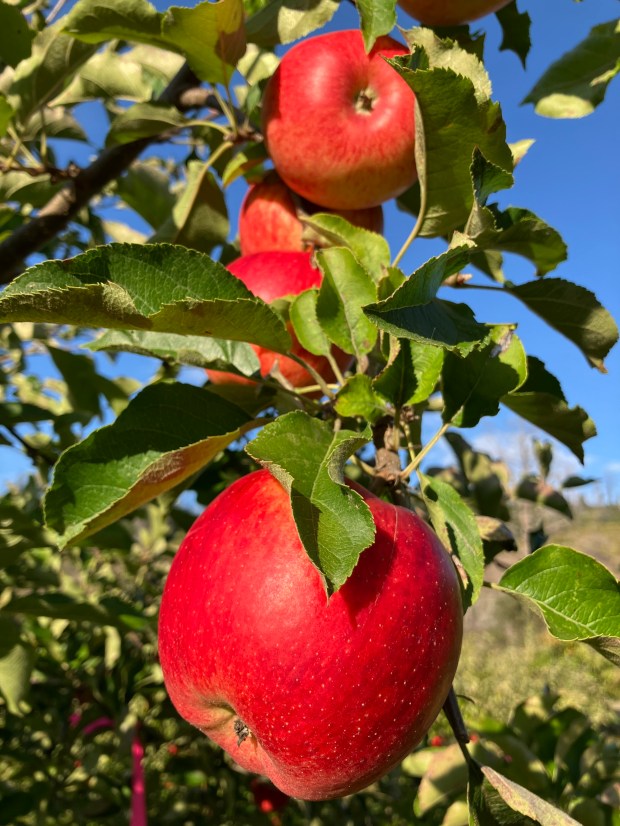
Heavy shoulder bags of apples filled on the steep orchard hillside and hoisted onto the sorting table. Fuji and Braeburn are the last varieties this year to go to market. Sweet and juicy but each having their own very unique flavor, vastly different. We will too soon miss the crunch of that wonderful fruit. A reminder to relish the appreciation of what you have before its gone. I take extra-long to finish a fresh-picked apple nowadays, making sure to chew and taste while gazing at the skin and flesh…the juice…the release of complex aroma upon each crisp bite.
This is bound to be the most talked about gift this holiday season!
Equipment
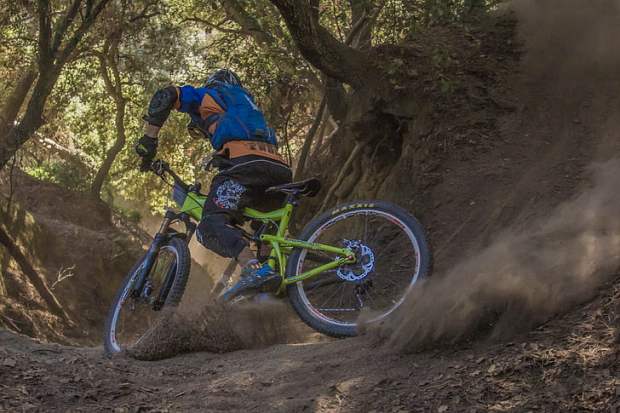
Some people choose to bring their own bikes, but why not save thousands of dollars gearing up? A membership includes professional staff assistance fitting customers with the latest in stellar machines. Our extensive stock of parts and expert technicians means that we can even customize a bike quickly and easily – just choose gear online, and the custom unit will be ready on arrival. We have partnerships with all the big names, and even many of the smaller gear shops, so anticipate profound astonishment of mounting a bike normally far, far out of financial reach. With a membership subscription, we’ll store, update, and maintain custom machines and have them at-the-ready any time a participating member wants to go for a ride.
RAD Experiences!!
Whether for first class access to all-time favorite trails or to try something new, we make mountain biking dreams come true. Our team can make it so cyclists can bomb down trails never encountering another soul, or we can deck out friends’ groups to make the next ride a highly interactive shared experience.
Are you or someone you know one of those mountain bikers that are yearning for the next new trail experience? What if we told you that we can offer thousands of new and different trails at each of our locations…and that we are creating hundreds of new trails each year? Sound too good to be true?
Our trails engineers have been keeping our work super-secret for the last decade as we tested and refined our vision. We retained the nation’s top riding experts as we drilled in on final designs. You will be amazed!
Family Friendly
Have you ever worried that you or a family member might get critically injured mountain biking? Have you wondered how the sport is affecting finances even without emergency health care costs? We’ve all heard horror stories about mountain biking injuries. And many of us know the financial secrets avid mountain bikers keep from even their closest loved ones about all the money they sink into their gear.
Our program has guaranteed, fail-safe solutions for all those worries. That’s because we are offering cutting edge virtual mountain biking experiences that even the most experienced experts say are far better than the real thing.
Gear Up!
Some have doubted the virtual reality mountain biking experience, but after just one hour they can’t get enough. Imagine a futuristic bike gym combined with an immersive virtual reality system involving all the senses. Riders feel the wind in their face, experience shockingly real changes in trail surfaces, have staff-guided customized physical activity designed to reach exercise goals, jump and turn through terrain as technical as they choose, and any wipe outs are both outstandingly realistic and virtually injury-free[1].
The Logical Next Step
Let’s face it: with the equipment mountain bikers use, the cost uncertainties of this type of recreation, and the HIGHLY limited experiences mountain bikers are all facing, our project offers the most exciting new development to hit the sport since its inception.
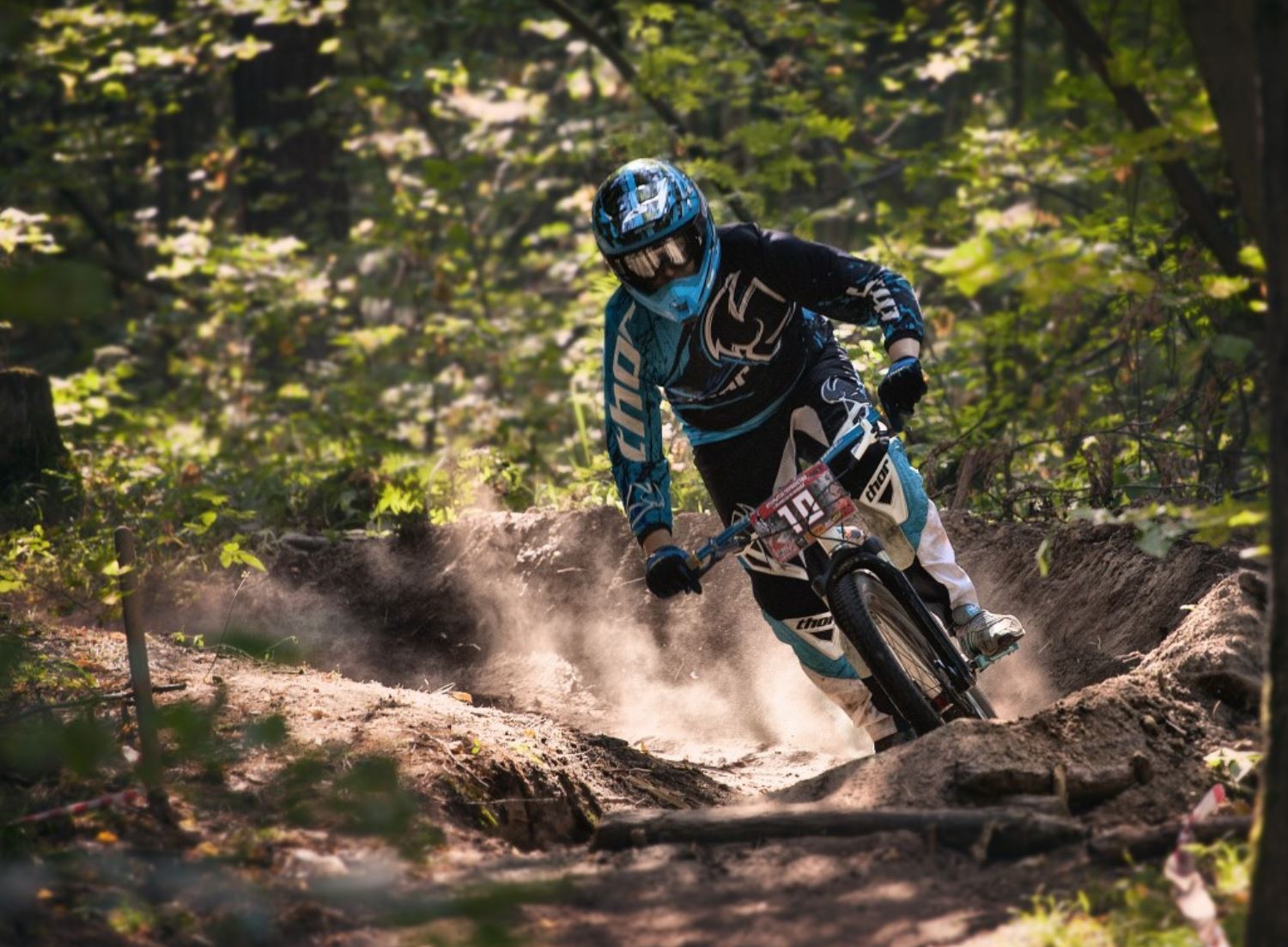
Already, many mountain bikers are decked out with full helmets and other safety gear. Changing that gear up for a virtual reality outfit not only lightens the load, but adds to agility, and makes for far more immersive environmental experiences.
As trails get more and more crowded, everyone wants to bomb downhill on narrow tracks without worrying about others!
This holiday season, give the gift that is guaranteed to keep your loved ones safer, save family money for years to come, and satisfy the most avid mountain bikers’ unending itch for new radical experiences. Purchase a gift package within the next week and save 25%!! Why not get one for the whole family?
-this post originally appeared in my regular column for Bruce Bratton’s BrattonOnline.com – why not subscribe and never miss another!
[1] Or opt for our minor injury packages with requisite waivers and insurance, still a bargain! This is a popular option for those who regularly injure themselves at the sport and so might otherwise feel something missing. Injuries created by padded devices in controlled settings still carry risk.
Here it is…suddenly the season where we reflect on what it means to be thankful and what to be thankful about. All around us, beings are ecstatically grateful every moment. But, us humans seem to segregate our thankful moments, relegating them to holidays or ceremonies. Well, we should be happy for the ability to reflect in such a way, however it occurs.
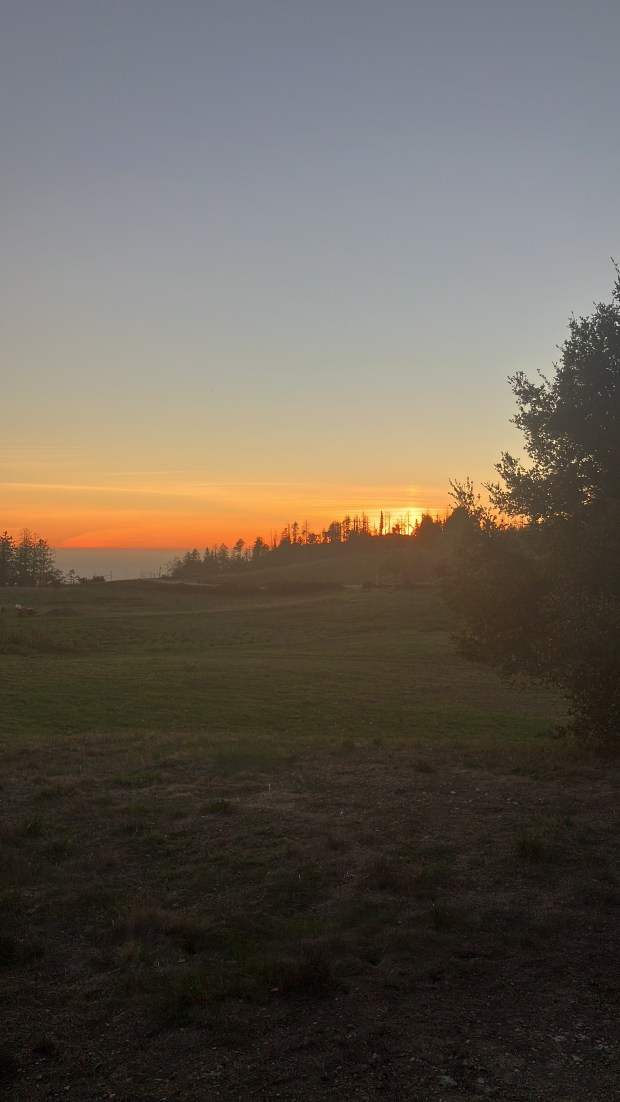
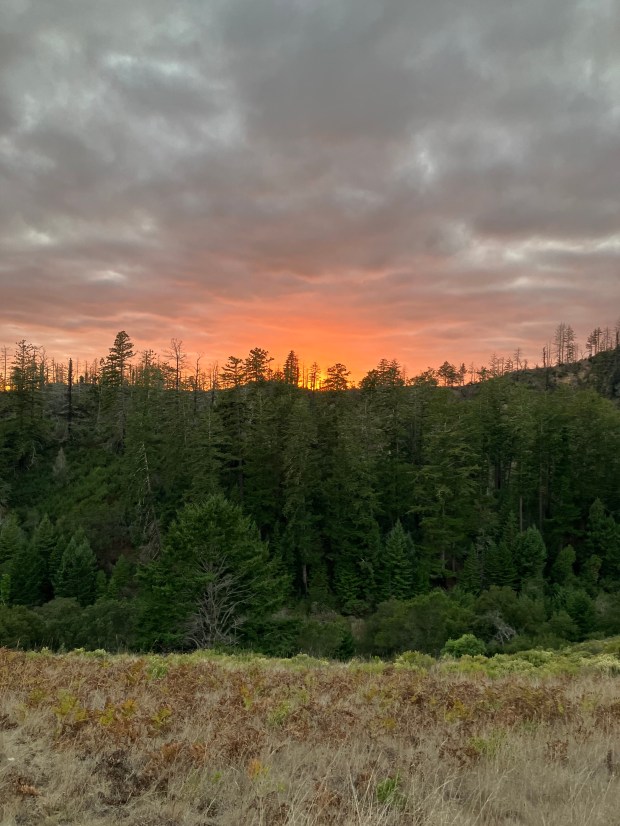
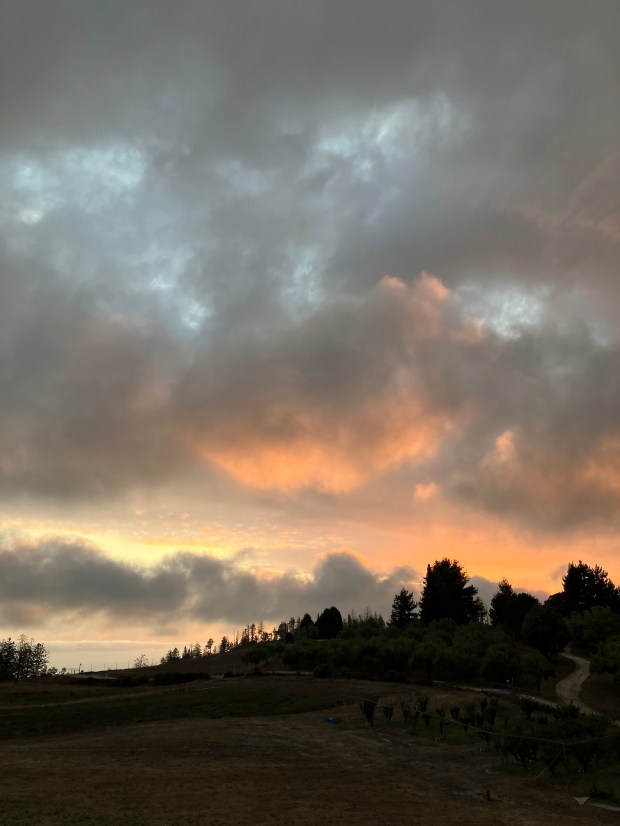
A recent sunset from Molino Creek Farm
Deep Time Thanks
Molino Creek Farm lies within the unceded territory of the Awasawas, or Santa Cruz People, in the Cotoni tribe. They lived on and cared for our land. They left lots of artifacts. There are places where seashells are still coming out of the soil. There are lots and lots of chert and some obsidian flakes. We have found bowls, mortars, and cooking stones. They were the first human inhabitants of this land and they took care of the old growth redwoods and ancient oaks that we still enjoy. Their land management made our soil rich for the crops we still grow.
The Greek Ranch and Transition
Much more recently, us Molino Creek Farm folks have The Greek Ranch and then Kay Thornley, Harlow Dougherty, Jim Pepper, Steve Gliessman, and others to thank for being here. There were years of hippies living here, wild years as we understand back in the Greek Ranch days. As the Greek Ranch transitioned to Molino Creek Farm, this contingent from UC Santa Cruz managed to purchase the land and created the organization that we have now. Many thanks to the folks who had the patience and fortitude to wade through all sorts of issues in establishing this cooperative.
A few Lisbon lemons still left on the trees
Farming
Joe Curry, Judy Low, Mark and Nibby Bartle, and many others worked very hard to establish Molino Creek Farm, which became a legend for dry farmed tomato production. The early farmers made enough money and worked hard with piles of purchased materials to put up miles of deer fence, long stretches of irrigation, and a very good agricultural well. They bought equipment – tractors, fuel tanks, implements, generators…much of which we still rely on. These intrepid farmers taught many people how to grow dry farmed tomatoes and those people started their own businesses. The Farm was the 13th certified organic farm in California…there are hundreds now. We must thank these organic farming pioneers for showing how it’s done and inspiring others to give it a go.
Intentional Community
Other work deserving thanks is from the communal spirit and willingness of those who co-own this land. Living together in such a rural place takes work. The Farm is off grid and so produces its own power and water. We live 3.5 miles up a private road, which takes a lot of maintenance. They say people used to have to drive with chains to get up a muddy hill on the way in, and even then it wasn’t certain.
We have people who manage the finances, ‘the books,’ taxes, meeting facilitation, meeting notes, work party conveners, and so much more. Some of the group maintain the farmland, others maintain the wildlands, and others the water infrastructure. There is a legal committee, a road committee, and a neighbor committee – all very necessary. It takes great generosity to make these things work and we remain grateful to one another for the things we fit into our otherwise busy lives to help keep things together.
2020 Fire
The CZU Lightning Complex Fire devastated our farm. We lost two homes and a community garage workspace, fences, parts of our water system, many orchard trees, and much more. We put out word about what happened and an accompanying call for assistance. Within a short while, we raised $80,000 to help generally and a big portion of that to revitalize what was lost in the orchard. Such Huge Generosity!! We are still awed by that support. The financial support we received is just one indication of the strength and support of the social networks that the partners in this endeavor hold and tend.
We lost quite a few of our avocados in the 2020 fire, but they are just starting to fruit again
Land Stewardship
Since the fire, we have had amazing support for tending our land. The Prescribed Burn Association has poured support into teaching our cooperative about good fire and then leading a prescribed burn last year, reducing fuels over many acres, restoring coastal prairie. They brought people here to help and keep in touch, watching with us the effects of their management. Now CalFire is offering that same kind of help!
Neighbors
Our neighbors have always been helpful. For years, the folks at the cement plant helped keep our road in good shape, the gate secure, and even supplied us with road material, rocks, and spare cement. PG&E has chipped in lots of funding and work to keep the road repaired.
The partners with the San Vicente Redwoods have also been unendingly great to us. Roadwork and weed work, fire and fuel management, security, and so much more have all been graciously a part of their contributions. We are learning together how to take better care of our lands, the non-human beings, and each other.
Community Orchardists
For 15 years, we have enjoyed the growth of our Community Orchard. We keep in touch with 225 people on email. 5 – 20 people show up to tend the orchard on many Saturday afternoons. Even though the fire took us backward a step, 5 years later we discover the orchard has surpassed that damage and is creating more and more amazing fruit, feeding more people.
This year, we needed a tractor and the community orchard network donated funds that allowed us to buy one this past week. It is amazing how the generosity continues, born out of the relationships we build by tending a beautiful orchard, creating “Fruit for the People!”
In sum, we are very thankful. We have so much to be grateful for. Thank you, each and every one of you, for the various kinds of love and support you offer this amazing place, this greater community, which we steward together.
Beavers are again being recognized by humans as creatures crucial to holding together the natural world across much of North America and Europe. Where they are able, beavers create wetlands. Those beaver wetlands do so much for so many other beings, including us. Let’s explore California’s beaver resurgence for a few minutes.
History
There once were two beaver species, then only one living alongside indigenous people, then even those were nearly wiped out. In modern time, beavers have been variously killed, ignored, restored, or coexisted with. The Big Beaver of the Pleistocene, like so many other species, winked out when humans arrived on the continent. Probably they were too tasty. Its smaller cousin, though, survived. There are names for beaver in many native people’s languages across California. But the Old World Peoples persecuted both the native peoples and the beaver. Beavers were trapped to extirpation so early in those terrible times that as records started being written, there was already doubt that beavers had ever been in most places across the State. The state’s wildlife department finally protected the few remaining of the species and then began restoring them. Beavers, farmers, water managers, and road departments had problems working it out, so the State started allowing, and still allows, beavers to be killed where they cause too big of problem.
Over the past 20 years, brilliant folks from Back East figured out a way to solve some of those problems, so beaver coexistence technology is now a thing in California. At the same time, in just the last 5 years, our wildlife officials have started translocating problem beavers to restore the species in more places. These recent pro-beaver developments come just in time for so many reasons.
Beaver Biota
Where beaver go, many follow. Three weeks ago, I saw a river otter stick its head out of the water in a pond behind a beaver dam. River otters follow beavers as do ducks, egrets, herons, kingfishers and so much more. Rare amphibians and reptiles likely were once more abundant due to beavers, including California red-legged frogs, San Francisco garter snakes, California tiger salamanders, Western pond turtles, and Santa Cruz long-toed salamanders. Mostly, those rare species rely on manmade cattle or farm ponds nowadays, but what about before those?
I have studied the landscape for 50 miles in every direction around Santa Cruz and have found very few natural ponds. Coastal ponds are either in earthquake faults, vernal pools in ancient dune declivities (e.g., Ft. Ord), or impoundments at the back of more modern dunes. These situations are all quite rare. Looking further abroad, there are more vernal pools in the Central Valley and one can imagine oxbow lakes along many of California’s rivers before modern humans messed so much by channelizing rivers. If we could restore beaver to the landscape, I’m betting we could recover frogs, snakes, turtles and salamanders…and even fish! Most agree that California’s many species of super endangered salmon once thrived in the food-rich backwaters of beaver ponds.
I could go on and on about the many other wetland species that follow beaver pond architecture, but I’m thinking you get the idea.
Fire Stop
Recently, “Smokey the Beaver” has become a meaningful meme. In the past decade Californians have witnessed catastrophic infernos raging across the landscape like no one had previously imagined was possible. Across the West and north through Canada the same pattern has been emerging: big, big fires fueled by climate-change-induced drought, heat, and winds. The solution to fire: water. When beavers dam rivers and streams, they create fire breaks. In the huge footprints of “The Big Black,” post-fire, thank the beaver for the green strips that offer refuge to whatever wildlife may have survived the blaze. I have stood my ground on the edge of two approaching wildfires and have witnessed masses of fleeing deer, rabbits, wood rats and more running from the flames. I imagine those creatures finding beaver wetlands and hunkering down, eyes wide, hearts racing as the world around them crackles, roars, and burns. Beaver firebreaks can help save human lives and infrastructure, as well.
The Wetting
Beavers make it possible to rehydrate the West. Their dams are speed bumps for floods, slowing the surge, spreading floodwaters across floodplains, and hydrating large swaths of valley bottoms. By storing rainwater behind their dams, beavers keep streams and rivers flowing farther into the season of California’s long, dry summer. As water slows down behind beaver ponds, it can more readily recharge groundwater, too. Some have suggested that restoring beavers across the mountain meadows of the Sierra Nevada could store as much water as 2 large new reservoirs. That would be cheaper…and more sustainable!
Monterey Bay’s Beavers
Beavers are in the Salinas River all the way down to the Highway One bridge. Those riverine beavers are bank burrowers…they don’t make dams in such big rivers, but they sure like to eat the willows. You’d have to go south to San Luis Obispo before you found another beaver family. And, travelling north you would have to get onto private land along Butano Creek in San Mateo County to encounter our beaver buddies. Sometimes that population makes a more public showing downstream in the Pescadero marsh, where one mysteriously died this past year. What about prime beaver habitat in the Carmel, Pajaro, and San Lorenzo rivers? When will beavers arrive in those locations? Corralitos, Soquel, and Scott creeks also offer promising beaver habitat. Perhaps one day we can find a way to offer beavers a place alongside humans in some of those rivers or streams. Help spread the word!
-this post originally published as part of the decades-long news source for the Monterey Bay and beyond at BrattonOnline.org Check it out! Subscribe!! DONATE. Support journalism, even grassroots journalism, maybe especially grassroots journalism.
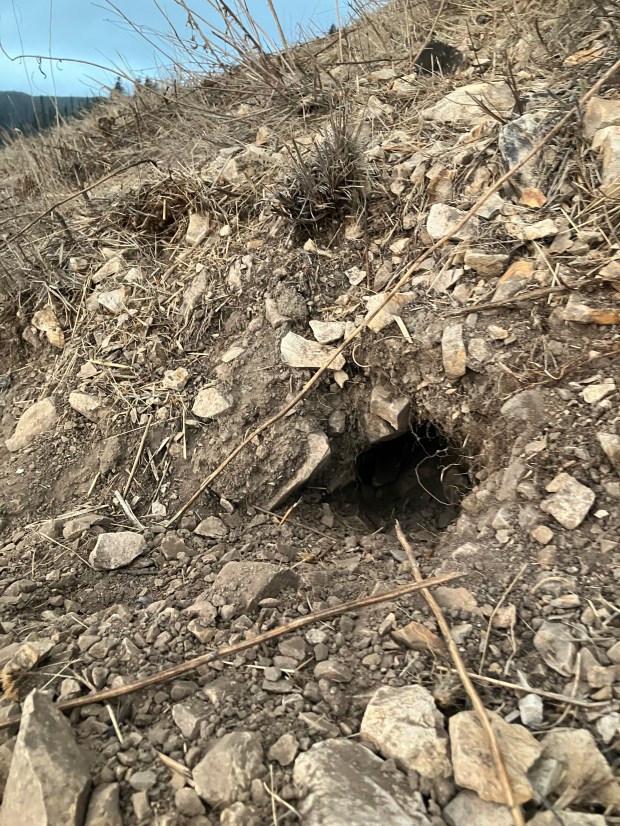
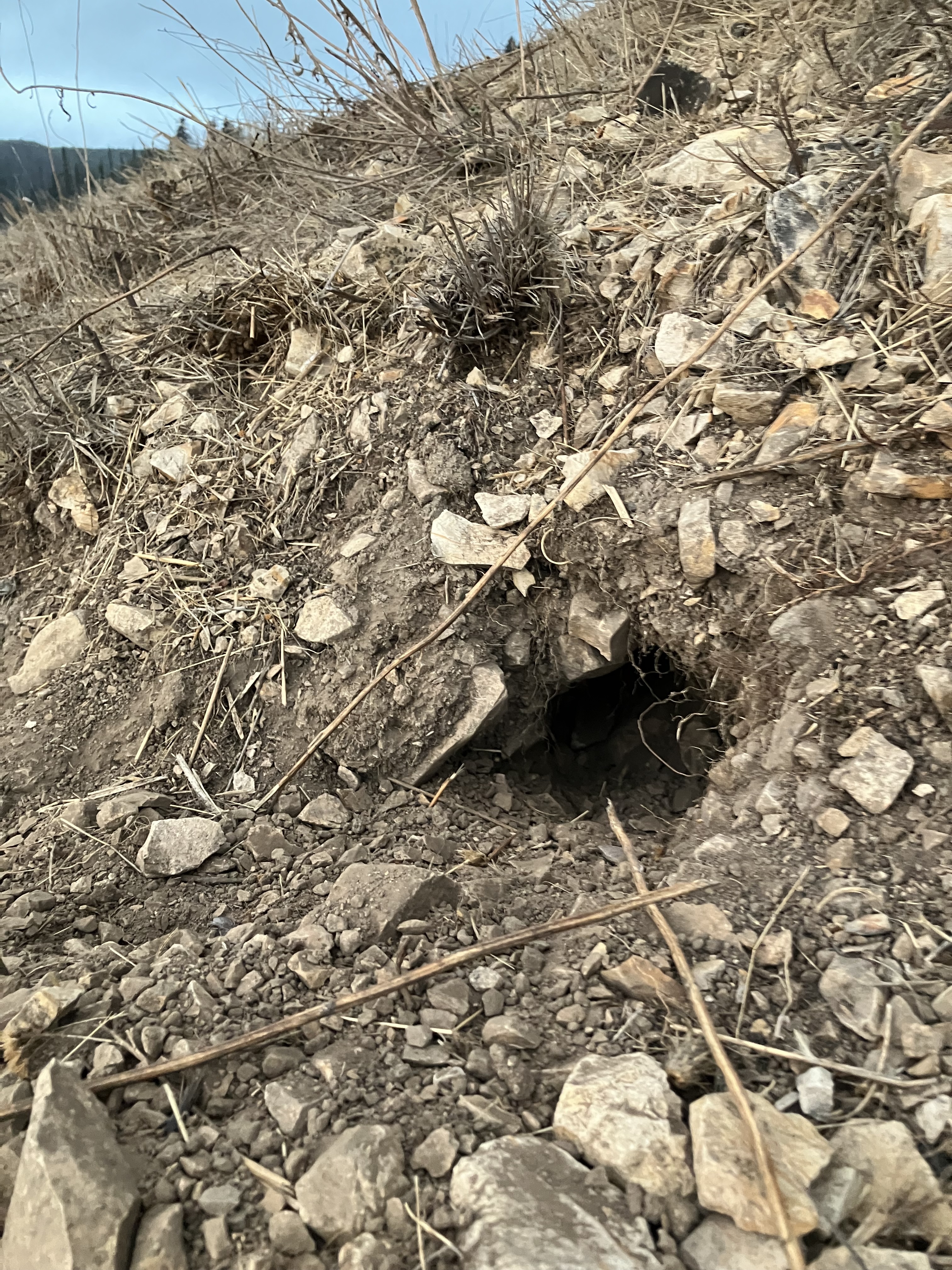
California ground squirrels are the burrowing type that are spreading across our landscape causing both harm and Great Good, sometimes in the same places.
A freshly dug California ground squirrel burrow – fresh potential for so many other creatures!
Description and Life History
This native rodent can be as long as 2 feet including its tail. They are chunky squirrels with less bushy tails than their tree-dwelling cousins. Their color is brown-gray and spotty and they have small ear flaps.
California ground squirrels have only one litter per year and can give birth to up to 8 young. The little ones are cute and out-and-about in just 6 weeks after being born.
Up until recently, most humans believed that ground squirrels were vegetarians. They thought that these chonky rodents grazed on grass in the early spring and ate seeds later in the season. I recall a professor at UCSC gleefully dispelling this notion in the 1990s, showing slides of California ground squirrels eating roadkill carcasses of their brethren in the middle of one of the campus entrance roads. Gross. Then, in 2024, researchers discovered California ground squirrels hunting and devouring meadow voles.
Down Under
California ground squirrels live in the ground making burrows sometimes six feet deep where they make separate rooms for raising their young, storing food, and sleeping. Those underground houses are connected to the surface by up to 35 feet of burrows and multiple entrances.
Some have hypothesized that these burrow complexes play an important hydrological role, replenishing groundwater and moderating flooding. The burrows certainly are crucial in supporting other biota.
Co-Creatures
Lots of other organisms rely on ground squirrel digging. For instance, burrowing owls don’t burrow – they rely on ground squirrels to create their underground shelter where they raise their chicks, sleep, and escape predators. Rare kangaroo rats use ground squirrel burrows. Snakes and salamanders use them, too. One of the snakes that are found in the burrows is the Pacific rattlesnake.
Predators of this Squirrel
Lots of things like to eat California ground squirrels. They are golden eagles’ favorite food. Pop goes the weasel, head sticking out from a ground squirrel burrow, blood and gore hanging from its chin: just ate one of those rodents, yum!
Rattlesnakes and California ground squirrels are co-evolving. Populations of ground squirrel that are in dense rattlesnake territory are more resistant to snake venom than those that aren’t as likely to be bitten.
To me, the most fascinating ground squirrel predator is the coyote-badger duo. Badger is good at digging into ground squirrel homes to feast on a whole family. BUT, if badger tried this alone she might not get fed: it takes some coyotes at each of the exits for everyone to eat. Here is an amazing video that shows how well these two animals get along. And, here is another video showing how some of this works.
Gardening
The grazing and dirt throwing of ground squirrels makes for habitat for some species that wouldn’t otherwise live in tall grass in productive soils. California poppies sometimes ring ground squirrel burrow complexes.
Damage
California ground squirrels can cause a bunch of problems. They undermine buildings and roads, eat orchard and row crops, and make holes that break horses and livestock’s legs. So, people spend a bunch of time and effort killing these creatures. A few squirrels often become a bunch of squirrels. In preparation for this column, I spoke with a particularly intrepid Costa Rican friend of mine who entirely trapped out a pestiferous population of the creatures…and ate them, preparing them in his pressure cooker. “They’re good! Lots of thin bones like sardines,” he said.
Spreading
After the 2020 CZU Lightning Complex Fire, California ground squirrels spread into new areas of Bonny Doon and the North Coast. Why did this happen? Some suggest that the species was native to those areas but had been exterminated back in the 1950’s with widespread use of rodenticide poisons. The species held out at UC Santa Cruz main campus and near Younger Lagoon through the 1990’s and along the bluffs up to Davenport, perhaps more recently. Young, dispersing ground squirrels were seen in 2021 along Swanton Road and then had successful colonies in Bonny Doon and at Molino Creek Farm in 2023. Their numbers are increasing in those areas. Did the fire create conditions that made it easier for the animal to disperse? Or, did people live trap and release squirrels from Davenport or Santa Cruz? We’ll never know.
How Much is Just Right?
With the important ecological role pairing with frightful damage, how many is the right number…and where should they be? This is an important question. It makes us challenge our notions of ‘neat-and-tidy’ versus ‘ecologically rich.’ Are we past the point of trying to eradicate this species in any one place, or will we try to do that again? Such interesting questions…
-this post originally published in BrattonOnline – check it out….lots to learn there.
Soon, (the fairly dumb) Daylight Savings Time ends and the days will seem even shorter, by a quick, artificial burst. Wildlife adjusts to Fall, changing their behavioral patterns. Fruits galore – ripening of successive apples, limes hanging thick. A new solar power array materializes. The end of Molino Creek Farm farmer’s markets. The ever-greening of fields. Thunder and fog, chill and sun.
Jonagold apples are especially bright…and quite delicious!
Bursts of Rain
We’ve had two storms so far bring precipitation, but the soil is bone dry 2’ down. It hasn’t been enough rain to stop needing to irrigate. Nevertheless, in the fallow fields and meadows – the first herbs have germinated and the green blush is growing into outright blankets of verdancy.
The GreenUp has started – germination in fallow fields
Last night in the wee hours I was awakened by the rattling of the house. Thunder! Some caught great movies of lightning strikes over the Monterey Bay. The last thunder that rattled things was back in 2020 when an orchestra of timpani rolled and rolled, ‘Rolling Thunder’ went from myth to reality. So, up from bed I was forced and off to gawk out the windows to see what was up. Alas, the flashes were too rare, the thunder had moved off and the night was calm once again. No rain then but rain rumored to be forthcoming this weekend.
Between rain storms, it has been nice, even hitting 82F this past weekend. A firefighter asked me what the relative humidity has been – ugh, not Rx fire weather: 85%!
Shorter Days
We clock the shortening days through anticipation of the last light for harvesting apples for the following day’s market. We need enough daylight to sort the apples with even the tiniest blemish from the perfect ones that go to market. That moment is 6:30 this week. For those of us with day jobs, that makes for a very tight window to harvest and sort. Today, there were 11 hours of daylight: the night is surely taking over to the glee of owls and other night time predators.
Lone Fangsters
The fiercest of predators are guarding their territory and prowling alone through the lengthening nights. Long tailed weasel mating season has been over for some months: they fend for themselves, darting up to 30 miles per hour and winding slowly through the narrowest of rodent holes. Their scat is everywhere across the farm, reminding their brethren who is who and where they’ve set up shop.
Fiercer still, mountain lions are just starting to think about pairing up with the first caterwauling a few weeks back. There was a memorable pre-fire Winter Solstice where we heard 3 lion females yowling from different ridges around the farm. That seems about the normal date for that kind of behavior, and it is a ways away. Meanwhile, massive solitary male mountain lions prowl a huge area all the while worrying about running into another male, which can be fatal or at least badly injurious. They scent mark to avoid such encounters. The urine scratch marking of Big Cats has started on the trails through the dark redwood forest along Molino Creek – signs we haven’t seen for 6 years.
Bird Season
Now that their young are on their own, the chickadees, goldfinches, and Anna’s hummingbirds are also about, cruising without immediate families. Chickadees and goldfinches flock with other unpaired tribal members, though in fairly small groups around the Farm. 6 chickadees seems like the biggest flock right now, and even that’s unusual to see. Goldfinches are hanging in similarly small groups but there are many of those tea parties.
The Anna’s hummingbirds, though – anything but social: they bomb and whistle at each other fighting for territory with what little nectar can be found, mostly around home landscapes right now. Those hummers will be the first of these non-monogamous birds to nest: in January they start gathering lichens and spider webs to weave their beautiful baby-homes. Those tiny nests will in a few months glisten with raindrops and grow transplanted mosses, cradling tiny eggs and their near torpid sheltering parent. Now, these future parents aren’t associating with one another, but instead joust for food, and try to get fat on the dwindling nectar.
Deeply Social Birds
For whatever reason, our blackbird flock is extraordinarily large this year. I counted 80 birds in one tree yesterday. Another flock came in this evening to join that one – over 100 birds. Perhaps it is because we allowed cover crops to go to seed this past spring, so there’s lots of food. I dread the bird seed predation right after the planting of cover crops. This year, we opted for only bell beans for orchard cover crop – the seeds so massive as to avoid easy bird swallowing. Late germinating bell beans are welcome salad greens for a lot of birds, though.
I ponder how the blackbirds know to stop singing all at once. Their sing-song squeaky cacophony sounds a bit more melodious than a long line of train cars squeaking and screeching on ice cold rails. All of the sudden, they all stop: not one at a time, no slow lowering of the volume. How do they do that…and why?
I would be remiss under this heading to not mention the California quail. Never fear, the coveys are numerous, the birds fat and happy. What a show!
Arkansas Black – a dark apple with a bright white inside
Harvesting
The Two Dog crew returned to Molino Creek Farm to harvest their wonderfully productive tomato patch this week. At the same time, their pepper field is knee high and hanging densely with fruit. And, 2 Dog winter squash leaves are wilting revealing rafts of colorful squash.
Molino Creek Farm tomatoes, on the other hand, are mostly picked though the plants are putting on a flush of new growth after the early rains. Zucchini plants still push out yummy food. But, the season for that business is winding down – maybe only two more weeks of farmers markets to go!
The apple ripening season is just beginning to unfold. There was an unusually low amount of Gala apples and almost no Mutsu: our early varieties. So, this week we finish gathering the Galas and look to other types next. We’ll pick Jonagold apples – big, shiny, beautiful fruit and the prizewinner of our farm’s apple tasting competitions time and again. We are lucky to have a good number of those to share this season. Braeburn are close behind. But, the big amount of fruit is in the Fuji crop, which is 3 weeks away from being ripe. Will we be harvesting Fuji apples in the dark, or how will we figure out how to harvest so many of those fruit?!
Olives are hanging – December harvest?
The see-sawing of apple abundance is a result of what is called ‘alternate bearing’ syndrome. 2021 – post fire season, nothing much to harvest, then 2022 big year…2023 little year…2024 epic year…2025 little year. The way around this is to thin, thin, thin – and clip off fruiting spurs and so forth to make harvest more steady. Let’s hope we can keep up with thinning next spring – a crucial year to break this cycle.
Granny Smith – the quintessential winter apple….not ripe for months yet!
Limes!
The Persian lime crop hangs heavy – what an abundance we will have if this all works out. We are frequently told that our limes are the best on Earth, and we agree. Someone wanted to see if we could pick them now, while they are green, to provide people with what they expect to be limes. So, off we went to squeeze and test and try to find a green Persian lime worth selling. Sample number 3- the squishiest green limes we could find and the results…NO! No juice! The vesicles, or ‘juice sacks,’ just haven’t matured: they were pungent, poppy and quite void of juice. So, we’ll have to keep explaining to folks that the yellow citrus are the best limes in the world. We’ll have about 500 pounds of them this year to share…in February – March, or thereabouts.
Persian limes are getting HEAVY
So, the shortening days doesn’t mean the end of the harvest. Nay, the harvest for our tree crops is just beginning!
While the nights are clear – get you outside to a dark area and enjoy the night time sky. We are marveling in the big, clear Milky Way from Molino Creek Farm these long, dark nights.
High in the canopy…Bacon avocados for a year from now!
“Here comes The Rain!” they said, and it poured. Scuttling long tomato harvest hours, for many days, rescuing the fruit. Waves of warmth before the chilly precipitation. Then, the wind. Ravenous deer. Big colorful sunsets.
Another magnificent sunset at Molino Creek Farm
Deluge
Stepping out of the shower, there was this massive rumbling noise from outside. Breathing deep to combat a visceral fear growing: “What IS that sound?” Brain grabs an idea: Is that a low flying big aircraft? “No, that’s not it.” I recall the adage that tornadoes sound like freight trains. It has been years since my teenage Georgia experiences with twisters close at hand. I forget the noise. A quick round of glancing out of every window, every direction: no sickly gray-green sky, no breaking tree branches…probably not a tornado. But, it is raining so hard the roof is rumbling. Blustery but not extreme, the windows rattle and bow. The air could hold no more water. The surface of every bit of flat-ish soil was everywhere a deep liquid sheen where a rough moist surface had been moments before. Rivulets feed deep moving pools carrying rafts of debris. Luckily, it lasted only a few minutes; otherwise, it would have been a major disaster. Scary.
In a few hours, the world transformed. Gone is the dust of the long, dry summer. The Fear of Fire evaporates: we are given reprieve.
Coyote Bush Female Plant About to Burst with Seed (to the wind!)
Germination
This was the Germinating Rain, an unusual phenomenon of Mediterranean California. Billions of seeds scattered at the onset of the drying tawny summer and buried by crisp dead thatch are now sprouting, turning the brown landscape to green. The verdancy blushes at first, so subtle as to make you doubt your eyes: you must look closely. It will be February before the prairies are so green as to make your eyes hurt. It takes time for the new growth to overtop the skeletons of last year’s plants.
The farmers never gave up weeding. They were at it as recently as last week. Now, they will be overwhelmed by the flush of seedlings stimulated by the rain. But the harvest is nearly over and the moist ground is better prepared for planting the Winter cover crop. There will be more purposeful germination in the dark brown, fluffy richly scented soil for the next couple of months.
A raft of radish weed seedlings has germinated in this tomato field
Fall is Here
The subtle signs of Fall are arriving. Black walnut leaves rapidly yellow. Willows, too, turn paler hues. But the most profound change is in the bracken: vast patches of hillside fronds have withered to their signature brown. The rain moistens those leaves and scents their vicinity with sweet straw bitterness.
Bracken fern fall
Turkey Tales
As Thanksgiving approaches, one would assume that the wise wild turkey would know something untoward is approaching. The scent of their roasting flesh will waft across the landscape right on schedule and they can’t have missed that for generations. Is that why they’ve become so scarce?
Then again there was the horrid sound, the screaming alarms and furtive loud complaints from the woodland two weeks ago. I took a walk in the newly moist world today down toward the forest via the Camp Road, towards the creek – yonder the way of the terrible turkey noise. No sign of problems. Not a turkey feather askew. On return, as if to bolster the ‘something’s not right’ sense: a single (male?) turkey takes a thunderous flight from one branch to another in the high-up redwood canopy. Where did the other 5 of that one’s friends go?! We wait and watch to see how this story unfolds and miss the flock which had so regularly meandered across our farm.
Two Dog Really Truly Dry Farmed Winter Squash
Sunsets and Fruit Picking
The stormy weather has produced the most remarkable sunsets, lighting the evening as the harvest winds down. As the predicted First Storm approached, every person possible took to the vines buckets in hand to pick as many tomatoes as possible. Rains can easily ruin the crop. Water starved plants, dry farmed tomato vines in particular, faced with sudden abundant moisture soak up so much that the fruit bursts. Stems and leaves suddenly moist are excellent surfaces for a rain of bacteria and fungi eager to devour cells. Melt down is commencing. As Judy says, we are lucky if the crop can last until Thanksgiving. It is a rare year when that happens. The trade off with beneficial end of Fire Season is the unfortunate commencement of the end of the tomatoes.
Meanwhile, in the orchard there is another kind of harvest underway, a harvest unaffected (we hope!) by the onset of rains: apples! It always takes such patience to await the ripening of apples, but the small harvest of the early ones (Gala) emphasizes the wait for those to come. Plus, there are no mutsu apples this year, so the next in line are Braeburn…still a ways off, but the taste of the first ones…with overtones of citrus and tropical fruit…make us excited. And the size of the Fuji crop is oh-such-a-bonanza.
Braeburn apples are slowly ripening
Onward we go…soon to the mowing and onto the harrowing-in of cover crop seeds.
The Peninsula Open Space Trust (POST) recently published an article about a 2023 regional trail user survey. The author of the article, Zionne Fox, wrote about some of the results of the study, and her writing helps gain new insights into POST’s philosophy regarding recreational use in natural areas.
Summary of the Article
Ms. Fox’s “blog,” published on August 28, 2025, announced the findings of a ‘unique’ regional study by the Santa Cruz Mountains Stewardship Network that had purported to assess parks trail user expectations. Fox reports the percentages of different user groups (equestrians, dog walkers, hikers, mountain bikers) that want more trails. She also notes that non-white respondents were statistically under represented. The article suggests (without supporting data) that demand for trails is growing and that ‘open space operators need practices that can meet rising visitor expectations while preserving natural habitat.’ There was also mention about many equestrians hailing from Santa Cruz County and (again, unsubstantiated) a need for additional accommodation for multi-day trail trips.
Reporting Issues
The POST article fails in many ways to meet the standards of responsible reporting, but that is predictable given the organization’s overall tendencies. First, note that the study referenced isn’t, as the author claims, ‘unique,’ at all: another, more professional study covering much the same material was published not that long ago. Also, notice that there is no link in the article to a report about the results of the survey. With further research I find that the survey authors, the Santa Cruz Mountains Stewardship Network, lacks a link to any reporting on the survey results on its website. Without more details about survey methodology, statistical analysis, and results it is difficult to draw one’s own conclusions.
Moreover, the article emphasizes only the survey results which correlate most with POST’s own goal of increased recreational use of ‘open space’ lands. For instance, statistics are provided for apparent unmet needs from various recreational groups, but similar statistics are not presented about the degree of concern for natural resource conservation, which is at odds with increased recreational use. In fact, in the ‘What’s Next’ portion of the article, there is no mention of POST’s or any other ‘open space operator’s’ intention to address survey respondents’ concerns about conserving and nurturing natural resources which suffer from over visitation. Similarly, POST suggests that those operators should focus on ‘preserving natural habitat,’ which curiously avoids the more concrete and pressing issue of conserving the specific species that are sensitive to natural areas recreational use. Habitat preservation is nearly meaningless to measure, whereas species conservation is much more useful and quantifiable, with a richer history of scientific rigor in informing open space management.
Note that the author of this article fails to mention any results from the portion of the survey asking about trail user’s negative experiences in open space areas. The survey asked poignant questions about negative interactions with dogs, people biking, shared trail use with other users, etc. Such conflicts are expected and are a challenge that trained park managers are used to addressing; unfortunately POST lacks staff with such expertise, so it is understandable that the author would avoid mention of this portion of the survey, which would otherwise reflect poorly on her organization.
The reporting insufficiencies and biases should not be surprising to those who follow POST. This is an organization focused on increased recreational use at the expense of species conservation. For instance, while on one hand cheerleading for the National Monument designation of Cotoni Coast Dairies, POST refused to sign onto a letter advocating that the designation include specific protections for natural resources. Peruse the organization’s website and you’ll find that species conservation is de-emphasized as opposed to an over-emphasis of recreational use of natural areas, which negatively affects nature. While being the best funded private organization working on open space issues in the Bay Area, POST has apparently never hired staff or engaged contractors that are professionals at managing visitor use in such a way that demonstrably protects the very species that require POST’s natural areas to survive. POST has published no reports or plans to address these concerns, at least none that are available to the public.
Methodological Issues
On its face value, the survey issued by the Santa Cruz Mountains Stewardship Network lacked the rigor to make the kinds of conclusions that POST suggests would be valuable. As opposed to previous, more rigorous studies the survey failed to sample the breadth of the population with interests in open space areas. POST notes that proportions of respondent self-reported ‘race’ did not reflect the population as a whole, but failed to note how the survey may have also biased certain user groups over others (mountain bikers vs. hikers, etc).
One would expect to encounter survey bias given the mode of delivery. The survey was a web-based survey distributed by social media networks. Open space organizations have recently become increasingly aligned with a vocal minority: well-funded mountain biking advocacy groups who undoubtedly circulated the survey in order to impact the results. Other trail user groups may have been under-represented because they have little exposure to those particular social media networks or because they lacked the computer technology to respond.
Cautionary Conclusions
We can learn valuable lessons from POST’s reporting on this trail user survey. Given the power of POST, we should continue to be vigilant about the group’s propensity to favor increased recreational use of open space lands at the cost of species conservation. This bias should make us question the organization’s ability to manage funding tied to protection of public trust resources. POST is a donor-funded organization, and so some degree of pressure from donors could help to steer the organization more towards conservation. We should also recognize that POST is not alone in making these types of mistakes. It appears that the Santa Cruz Mountains Stewardship Network is also allied with such thinking, and we have seen other conservation lands managers approaching open space management with similarly unbalanced methodologies. These trends must be reversed if we are to conserve the many species of wildlife which are sensitive to poorly managed recreational use in our parks.
As time passes and we stay alert to the possibilities, we will see if the poorly executed SCMSN trails user survey results are used to justify or rationalize actions by POST or other members in their network: wouldn’t it be a shame if they were?
-this post originally published in my column for BrattonOnline.com – a weekly blog with movie reviews and posts by very interesting people on matters near and far. I recommend subscribing to it and donating so we can continue this long tradition.
Behold, the peak of ripe, sweet, delicious dry-farmed tomatoes. The best in the world at the peak of the season, which will wind down soon. Lots of people are canning, drying…putting up food as the harvest rolls in, a bounty beyond any other season. Jays and acorn woodpeckers, too, rushing about, storing food like so many others.
A Ripe Molino Creek Farm Tomato: YUM!
Harvest
Tomato farmers can barely keep up, and people are buying. There are three particular crunches in the season: planting, weeding, and harvest. Each has its particularly critical moment interspersed not so much with ‘what do we do’ but more ‘how many people are necessary’ to do the work. The crunch times require more people than the weeks between, making it difficult for labor management and economics for small farms.
Soon, the Community Orchard will face that final crunch. It seems to be a year like the last one when all varieties get ripe simultaneously. Gala apples are suddenly all ripe at once and the Braeburn and Jonagolds aren’t far behind. Luckily, the Fujis are going to wait a bit…and they are the biggest crop this year. It is a scratch year for the Mutsu variety for some reason. There are ten other varieties with one tree each that will get ripe in about 2 weeks. So, we’ll start preparing for a cider pressing gathering to process 1,000 pounds of apples in 2-3 weeks.
Two Dog Farm’s pepper field is lush and green with abundant fattening fruit. Their winter squash patch is still luxuriant and green with hundreds of butternut squash peeking through the leaves. Their Chardonnay grapes are getting honey-green and close to ripe…all ~2,000 pounds.
Wild Life
Baby owl begging, distant coyotes singing, a mountain lion caterwauling, masses of quail, a morning garter snake, bright-eyed deer herds, and many, many ground squirrels.
Every now and then one of the baby birds strikes up a unique racket; this time, it is a baby great horned owl…begging. The begging goes all night long and it is loud and obnoxious. I suppose if you are the Queen of the Sky, you can make that kind of racket and not fear getting eaten. With no other baby around to mimic, a single young owl can pick whatever obnoxious voice to really bother its parents. This one ended up being half way to a barn owl screech, but louder. Mom and Dad owl hardly bother to hoot as the baby steals the show. You’d think it would get hoarse.
Sylvie reports a mountain lion caterwaul – that’s new since before the 2020 fire! Celebrations!!! Welcome back lion momma.
There are streams and rivers of quail pouring out of the brush to peck-peck-peck at masses of seeds strewn everywhere on the ground. They are fat with glossy plumage. It has been a good quail year.
Open the front door first thing and there’s a 2.5 foot long garter snake on the stoop. What luck. First snake in a long while. The other moist morning or late evening snake to see is the (common here) rubber boa…haven’t seen that one for a month.
There are a record number of deer hanging out on the farm. Deer highways pound grass flat and expose soil along hoof-rutted trails. Piles of fertile deer poop litter the ground every few feet on the north-facing grassy slopes where they graze on a mix of grass and resprouting shrubs. At night, flashlight beams illuminate more than a dozen pairs of eyes on that slope. Walking down the road to turn off evening irrigation sessions, my heart races to be too near to huge antlered bucks; hoping not to antagonize one: they seem feisty.
A flock of 60 blackbirds has gathered on the farm, a mix of Brewer’s and bicolored, singing their complex anarchistic melodies from atop bare-branched fire killed trees and then flying like wind-scattered fall leaves down into the fallow fields to feast on seeds. Their song lights up every hour of every day, a chorus that will entertain us through the winter. Their rhythm section has squeaky peeps that nearly match the repetitive, constant, mechanical ‘Chip! of ground squirrels scattered far across the Farm- between the two species it approaches cacophony.
A skein of 50 honking, white-fronted geese in a huge V flew West to East high above the Farm at 4:30 this evening.
Bills Open: Nuts!
Jay cries are muffled, acorn caps scattered. It is peak acorn season and the jays hardly have time to taunt. Their heads are down, shoulders hunched, beaks pried open carrying fat ripe green shiny acorns to-and-fro. Don’t watch them when they try to bury the nuts – they’ll get mad, pick back up the nut and fly to somewhere where you aren’t watching. They suspiciously glance about, quickly poking each nut into a hole, making a quick swipe to cover it up and it’s onto another one. Back-and-forth over and over: busy days! We are pleased that they are distracted from eating apples, leaving the fruit destruction mostly to yellow jacket wasps now.
Dahlias are a long-time specialty of Judy Low
Land Tending
Our great gratitude to one generous guy- Matthew Todd has finished his mastication work for us this year: 4 acres of brush ground to small pieces! We needed to do something about the weeds and he offered to help for a great big discount that made it possible. He resonates with our mission to keep our hillsides wild and native and tending back to coastal prairie and so he wanted to help. His wonderful skill and powerful machine took care of jubata grass, radiata pine, and French broom, which had proliferated after the 2020 fire. Now we have a better chance of tackling those scourges with other tools – excavators, pulaskis, burn piles, and broadcast burns will join a several year mastication project to reduce the broom until we can get livestock to help manage the restoration areas. Thanks, Matthew!
We’ll collect a bunch of grass and wildflower seed this next spring to hurry the restoration along.
Hoping CalFire will be able to help this Fall with another prescribed burn.











 Grey Hayes