Wild land recreation impacts

Another Trail ‘Study’

The Peninsula Open Space Trust (POST) recently published an article about a 2023 regional trail user survey. The author of the article, Zionne Fox, wrote about some of the results of the study, and her writing helps gain new insights into POST’s philosophy regarding recreational use in natural areas.

Summary of the Article

Ms. Fox’s “blog,” published on August 28, 2025, announced the findings of a ‘unique’ regional study by the Santa Cruz Mountains Stewardship Network that had purported to assess parks trail user expectations. Fox reports the percentages of different user groups (equestrians, dog walkers, hikers, mountain bikers) that want more trails. She also notes that non-white respondents were statistically under represented. The article suggests (without supporting data) that demand for trails is growing and that ‘open space operators need practices that can meet rising visitor expectations while preserving natural habitat.’ There was also mention about many equestrians hailing from Santa Cruz County and (again, unsubstantiated) a need for additional accommodation for multi-day trail trips.

Reporting Issues

The POST article fails in many ways to meet the standards of responsible reporting, but that is predictable given the organization’s overall tendencies. First, note that the study referenced isn’t, as the author claims, ‘unique,’ at all: another, more professional study covering much the same material was published not that long ago. Also, notice that there is no link in the article to a report about the results of the survey. With further research I find that the survey authors, the Santa Cruz Mountains Stewardship Network, lacks a link to any reporting on the survey results on its website. Without more details about survey methodology, statistical analysis, and results it is difficult to draw one’s own conclusions. 

Moreover, the article emphasizes only the survey results which correlate most with POST’s own goal of increased recreational use of ‘open space’ lands. For instance, statistics are provided for apparent unmet needs from various recreational groups, but similar statistics are not presented about the degree of concern for natural resource conservation, which is at odds with increased recreational use. In fact, in the ‘What’s Next’ portion of the article, there is no mention of POST’s or any other ‘open space operator’s’ intention to address survey respondents’ concerns about conserving and nurturing natural resources which suffer from over visitation. Similarly, POST suggests that those operators should focus on ‘preserving natural habitat,’ which curiously avoids the more concrete and pressing issue of conserving the specific species that are sensitive to natural areas recreational use. Habitat preservation is nearly meaningless to measure, whereas species conservation is much more useful and quantifiable, with a richer history of scientific rigor in informing open space management.

Note that the author of this article fails to mention any results from the portion of the survey asking about trail user’s negative experiences in open space areas. The survey asked poignant questions about negative interactions with dogs, people biking, shared trail use with other users, etc. Such conflicts are expected and are a challenge that trained park managers are used to addressing; unfortunately POST lacks staff with such expertise, so it is understandable that the author would avoid mention of this portion of the survey, which would otherwise reflect poorly on her organization.

The reporting insufficiencies and biases should not be surprising to those who follow POST. This is an organization focused on increased recreational use at the expense of species conservation. For instance, while on one hand cheerleading for the National Monument designation of Cotoni Coast Dairies, POST refused to sign onto a letter advocating that the designation include specific protections for natural resources. Peruse the organization’s website and you’ll find that species conservation is de-emphasized as opposed to an over-emphasis of recreational use of natural areas, which negatively affects nature. While being the best funded private organization working on open space issues in the Bay Area, POST has apparently never hired staff or engaged contractors that are professionals at managing visitor use in such a way that demonstrably protects the very species that require POST’s natural areas to survive. POST has published no reports or plans to address these concerns, at least none that are available to the public.

Methodological Issues

On its face value, the survey issued by the Santa Cruz Mountains Stewardship Network lacked the rigor to make the kinds of conclusions that POST suggests would be valuable. As opposed to previous, more rigorous studies the survey failed to sample the breadth of the population with interests in open space areas. POST notes that proportions of respondent self-reported ‘race’ did not reflect the population as a whole, but failed to note how the survey may have also biased certain user groups over others (mountain bikers vs. hikers, etc). 

One would expect to encounter survey bias given the mode of delivery. The survey was a web-based survey distributed by social media networks. Open space organizations have recently become increasingly aligned with a vocal minority: well-funded mountain biking advocacy groups who undoubtedly circulated the survey in order to impact the results. Other trail user groups may have been under-represented because they have little exposure to those particular social media networks or because they lacked the computer technology to respond.

Cautionary Conclusions

We can learn valuable lessons from POST’s reporting on this trail user survey. Given the power of POST, we should continue to be vigilant about the group’s propensity to favor increased recreational use of open space lands at the cost of species conservation. This bias should make us question the organization’s ability to manage funding tied to protection of public trust resources. POST is a donor-funded organization, and so some degree of pressure from donors could help to steer the organization more towards conservation. We should also recognize that POST is not alone in making these types of mistakes. It appears that the Santa Cruz Mountains Stewardship Network is also allied with such thinking, and we have seen other conservation lands managers approaching open space management with similarly unbalanced methodologies. These trends must be reversed if we are to conserve the many species of wildlife which are sensitive to poorly managed recreational use in our parks.

As time passes and we stay alert to the possibilities, we will see if the poorly executed SCMSN trails user survey results are used to justify or rationalize actions by POST or other members in their network: wouldn’t it be a shame if they were?

-this post originally published in my column for BrattonOnline.com – a weekly blog with movie reviews and posts by very interesting people on matters near and far. I recommend subscribing to it and donating so we can continue this long tradition.

The privatization of open space – Land Trust vs. Public Trust

elephant pict
Licensed under CC: photo by flickr user hbp_pix All rights revert to originator.

Could the rise of the ‘Land Trust Movement’ represent a retrograde change in the way we protect land for future generations? We may be experiencing a shift is from public responsibility, funding, authority and accountability to private funding and private ownership of conservation lands. Private ownership by Land Trusts –even those incorporated as nonprofits– normally has limited public accountability and transparency. In consequence, the purpose and focus of land protection is in danger of shifting from ecologically sound conservation of plants and animals to the recreational and utilitarian desires of the moneyed elite.

At its best, the Land Trust Movement is the capital economy’s response to ongoing lack of public support for funding public land protection agencies. This attitude suggests that if you want protection for public lands you’re going to have to pay for it yourself. And, this view assumes that development and maximized use is a natural or desirable condition while protection from development and overuse is reduced to a ‘special interest’ – one that should be privately funded.

At its worst, the Land Trust Movement represents a shift toward a new feudalism, widening the gap between the rich and poor via appropriation and control of land once called the American commons. At the whim of wealthy donors, Land Trusts manage and control ecosystems according only to the vicissitudes of an elite few, without regard for or accountability to the people. In essence they transform management of natural areas into a commodity, excluding the views of the relevant sciences and the general public alike.

How is the public losing control? For nearly forty years, the well-worn phrase the problem with the government is…” has been bleeding into Liberal philosophy, poisoning the public’s faith in the protections offered by the government itself. Other oft heard phrases like “State Parks is corrupt,” “the State Wildlife Agency is inept,” “US Fish and Wildlife does what??” etc. are just different ways of saying the government –the people themselves according to our democratic way of government– doesn’t work. Instead of working with and trying to fix these public agencies, the elite turn their paternalistic worldview to Land Trusts for nature conservation, avoiding those who might disagree with their ‘enlightened view.’ Land Trust lands and sponsored activities often provide outdoor experiences to like-minded people –preferably wealthy and generous. Thus, Land Trusts create ‘nature-consumers’ – distant from nature but feeling a certain privileged ownership of it. Land Trusts and their donors assume a right to use –and through willful neglect degrade– what amount to private parks, under no obligation to protect them from human excesses or the ravages of harmful invasive species. Land Trust clients (a.k.a. donors) are largely derived from social elites:  white, upper class, and educated. These donors are at times granted undue influence over land acquisition and management, reducing the importance and influence of scientifically-based conservation and forcing Land Trusts to defer to a use-based approach because someone thinks a new mountain bike trail would be neat or owns a local ATV dealership. Land Trust development officers know that donor-clients are best courted with tangible results involving humans using the land, results that give them social status…that allow for good Facebook selfies: results that can be put in glossy brochures to show that humans with money in this country are free do as they please. To grow this constituency Land Trusts carefully construct messages resonant with this resource-hungry, profit-oriented culture. This uninformed version of ‘sustainable development’ guarantees the continued flow of wealth. ‘Open space’ purchased from ‘willing sellers’ guarantees that neighbors keep their property value (or preferably increase it).

When Private Land Trusts focus on short-term goals of preserving or expanding funding there is a major contrast with Ecological Conservation prioritizing and visualizing the health of the land over time, for today and generations to come. ‘The long view’ holds the health of the land in mind as a concept –let alone a thing of value– in the act of deciding whether to log a certain slope or dam a certain river. In the U.S,. on public land, nature ‘has a say’ in large-scale land use cases, the decision-making authority long having been vested in government. The sheer scale and complex fundraising structure of Land Trusts means at times they acquire ecosystem-defining control, and act without public recourse or long-term restraint in the installation of hiking/biking trails, buffer zones for residents, protecting private interests in timber, livestock, and farming. They expertly facilitate human use and activity, but may fail to consider the long-term ecological implications of their use plans. Nobody disputes that it is a social good to acquire land that might otherwise be degraded by condos, shopping malls, or such.  And, it is also good to get people out into nature. But it is possible to ‘love nature to death’: to tread so thoughtlessly, frequently, and heavily on the land in our pursuit of short-term aims that we change it fundamentally for the worse; that we make it no longer the treasured place it was. In most places, municipal land use planning and zoning hasn’t yet addressed the spectrum of differences between the poles of wildlife conservation and open space commoditization on the privately held lands that are crucial for the future of Life.

Public Land Management is the answer. Developing policy based on informed consensus is the method of accountable public institutions. Public institutions –those entrusted with the knowledge and organizational structure to make long-term decisions– are obliged to consider what is best for all citizens in their decisions. Private Land Trusts don’t deliver better conservation results than public land use institutions. Private Land Trusts have developed a certain expertise in generating positive PR even as they obscure their decision-making processes, rely on focus groups instead of sound science in the act of attenuating or refusing community input. Public land agencies have centuries of legal precedent, procedural and environmental know-how, and long-standing, forward-thinking, public-minded mandate. They are not as easily subject to behind-the-scenes deals and ecological equivocations in response to in donor whims. Public trust agencies must adhere to open processes and regulatory application of sound science to protect wildlife and public lands. They must balance short-term interests in recreation and sustainable development with long-term protection for the health of the land and future generations.

It’s a shame in our era of manufactured austerity –when tax cuts are showered on the well-to do while roads crumble, wars get financed, and back-room deals trump common sense– public land use agencies are starved of funding for the short-term illusion of a civil society done on the cheap. Dollars that flow towards privately-controlled Land Trusts should be re-directed towards making our democratic public land management agencies better and stronger. Parallel conservation organizations aren’t what’s missing. We need to invest in our shared public future: of ecologically sound conservation. It really matters to generations and generations of happier, healthier children and well-adjusted adults who feel at home in their world.

Special thanks to Wes Harman for input and editing.

Shaping the Future of Trails in the Santa Cruz Mountains 

This article published at this link and dated 8/28/25, two years after the referenced survey was implemented. Here’s a copy of the survey.

You can also watch this video recording of a presentation about the Santa Cruz Mountains Stewardship Network’s State of the Trails Report. Note, Zionne Fox’s article above, and her presentation here, overlook the very real issues of user conflicts in natural areas. The video, unlike the article above, does mention the need to understand environmental constraints.

Trails Through the Woods

What could possibly be wrong with trails through the woods? Ad hoc, unsanctioned, illegal, illicit, unapproved…choose your adjective to precede the ‘trails through the woods’ phrase and then ask ‘what could possibly be wrong with unsanctioned trails through the woods?’ While we’re at it, let’s ask the question, ‘what type of person would build and maintain unsanctioned trails through the woods?’ Let’s hypothesize for a moment.

Law Abiding Citizen

There’s a lot going on in our nation with people’s attitudes about abiding by laws. Some people are as apt to decry a convicted felon in the White House as they are to cite the horrors of the justice system, saying it is utterly failing most of the poor souls who face the courts. How does that work, logically? I’m not sure it does. But, are we saying at the same time that we should question the laws, as well? Has ‘law abiding citizen’ become an anachronism or just plain laughable? Or, maybe our culture has become accepting of individual interpretation of laws, but not in all cases. For instance, who in their right minds would support widespread law breaking with hit and run drivers, armed robbery, or homicide? But, say how about the lesser offences of shoplifting, forgery, assault, or libel? Are we getting to your more acceptable level of crimes, yet? How about….driving 20 mph over the speed limit, selling alcohol to minors, extortion, or petty theft? And then, somewhere down the line you encounter the laws against damaging public property, trespass, entering closed areas of public land, visiting public parks when they are closed, and violating federal and state clean water laws or endangered species regulations. How are we feeling about the types of citizens who break those laws? Are we giving them a pass? Someone is. A lot of people are. Hundreds and hundreds of people in our community have decided that the criminals committing that last litany of crimes are ‘okay people’ undeserving of one iota of investigation that might result in at most a warning, and almost never prosecution.

Anarchists I know would scoff at the legal argument here. Many who know how broken the justice system is would also shrug off the legal arguments, as well, understanding that without justice there can be no reasonable pursuit of legal matters. So, perhaps we must turn to ethics to examine the truer nature of those who would participate in unsanctioned trail building and maintenance.

A Matter of Ethics

Should we consider the consequences of illegal trail building? Or, is it enough to ask if rogue trail building is good? Is building an unsanctioned trail in and of itself causing harm to other people? Is maintaining a rogue trail respectful of all people? These are the types of questions one must ask in seeking answers outside of legal context. As I have posed these questions over the years, the most common answer is “I don’t know.” So, we must ask another question of morality: is it unethical for an illicit trail builder to create new trails if they are ignorant of the consequences or context of their actions? 

Consequences, Respect

The consequences of constructing and/or maintaining rogue trails are well known, or at least readily available. The most glaring impact of rogue trails is on wildlife. Conservation lands managers have a difficult time providing for some trail access while also conserving wildlife: the two goals are mutually exclusive. Park users disturb wildlife, so one must plan around that to have healthy wildlife populations. Trails constructed outside of that planning process scuttle attempts at nature conservation. 

And so, rogue trail builders either have contempt for parks managers’ planning processes or do not care about wildlife or both.

The same sets of arguments also apply to conservation of flora, fungi, soil, and clean water. 

And again, it would stand to reason that those who construct illegal trails have contempt for park oversight personnel’s work/expertise and also do not care about conserving native plants or mushrooms and don’t care if soil erodes, that we have clean running streams, or that natural areas provide for drinking water.

Let’s extend these logical frameworks to the element of respect. Morals often refer to respecting others: their lives, their pursuits, safety, happiness, etc. All groups with which I have interacted in the past few decades readily recognize that humans need all species to continue existing for our own survival. And so, those who create and maintain unsanctioned trails score quite low on the ‘respect others’ morality scale with that first test. The majority of USA citizens support wildlife conservation; second test strikes against those who would build trails without the careful planning that parks managers use to weigh the pros and cons of new trails. We could go on…

In Sum

In kind words, how would you summarize the findings above to describe those people who make it a habit to create, or maintain, unsanctioned trails? Excluding nihilism, one would need to start with the term ‘criminal,’ but that would not be enough. The word ‘selfish’ sounds unkind, eh? And, even so, just ‘criminal, selfish…’ lacks something. 

Most of the social circles with which I have discourse include short hand lines of reference to describe types of people who love fun just a little too much. You know, when fun overrides respect for others? The term ‘fun-loving’ falls short of describing the types of people referenced in these conversations; the people being referenced generally have problems, which is why they are being discussed. Such conversations generally end in head shaking…no great solutions…sighs and ‘I hope they figure it out….’ or ‘maybe so-and-so (someone possibly close to them) can have a chat with them.’ I think we are getting closer to understanding the types of people we are dealing with. 

Next time you take a walk in nature, watch for the many trails veering from the signed, sanctioned one you are hiking. Ask yourself how much traffic that trail must get to be so well rutted and then think about how far that trail must travel, how much work it takes to chainsaw (at night) those trails open after trees fall. What a massive effort by _______ types of people (fill in the blank)! Think about the conversations they must have with one another and their networks… and how that is influencing the goodness of our community.

– this post originally published in the weekly e-news for the Monterey Bay, BrattonOnline – if you don’t already know it, now’s a good time to subscribe.

Land Atonement

Very slowly, we must move in the direction of becoming at one with the Land. All that we eat, all that we breathe, all that we drink comes from the Land.

What is your opinion of how people have treated the land around us?

Have we damaged it, or made it better? How do you know?

Big Sur: Whole or Shattered?

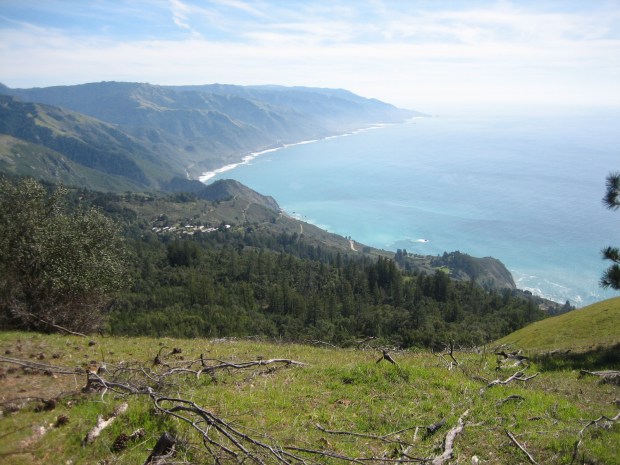
The Santa Lucia Mountains…Big Sur, to our South. On one hand, we see picturesque beauty, “wilderness,” a rugged, sparsely settled landscape, millions of flowers, huge trees, and a rich marine environment. On the other hand, there is a land devoid of much of the wildlife that once called that place habitat, the native peoples that called it home and stewarded that place are mostly gone (but still there!), wildfires ravage the landscape too hot and too frequently, roads and other development bleed soil and pollution into streams, and hordes of poorly managed visitors negatively impact the richest ecology, where the land meets the sea.

Monterey Peninsula: Zombie Ecosystems or Well-Managed Parks?

An ecological treasure, the Monterey Peninsula has rare pine and cypress forests, chaparral, and coastal prairies. Millions of humans visit to play golf, shop, drive fancy cars, visit art galleries, taste wine, or do tourism at an aquarium and historic sites. Nature there is fragmented into isolated parks which have no chance of long-term health. With lots of exposure to disease and human disturbance, with no chance of natural interactions with wildlife or fire, the parks represent zombie ecosystems, seemingly alive but really walking dead as they slowly decline with species after species winking out.

Tilled Valleys, How do You Fare?

The Salinas and Pajaro Valleys frame the central Monterey Bay, rich alluvial soils that support Agriculture, the nation’s salad bowl. Farming is an economic engine, sustaining jobs and communities and feeding people vegetables, never enough helpings per capita in any given day. The effluent flowing out of that engine creates the most polluted surface water in the US, pools of eutrophic, stinking rot. Ancient rich soil is disappearing, lost with the rain, in floods, and in the wind. Groundwater is being contaminated with pollution or by sea water intrusion caused by over pumping groundwater.

Santa Cruz and the North Coast, Loved and Smothered

On the other side of the Bay lies Big Sur North, a tamer landscape, thickly inhabited, worn. Tourism, Silicon Valley settlement, and education rule here. Surf and mountain bike culture are ‘natural’ tourism while hordes of cotton candy fueled tourists amble in the relatively cool beachy haven that contrasts so readily with the increasingly baking inland. Millions of feet pummel the beach sand substrate, crushing the food chain of flocks of would-be shorebirds; the remaining birds scatter, no longer comfortable foraging on these overrun beaches. Similarly, most meadows and canyons zip with such continual disturbance that wildlife families flee….fewer places left to hide. In the built areas, hundreds of fossil fuel formulations leak from engines, pesticides ooze from landscapes, headwater rivers and streams are diverted for toilet flushing and carwashes, downstream they receive and convey pollutants into our treasured Bay.

How do We?

How do we atone for the ongoing damage we are causing to the land around us? In ecological terms we call this restoration. In social terms, we call this reparation. In economic terms, we call this re-investment. Do you see enough of this going on? I cannot believe that you do.

Ecological Restoration

We must make room for all of the species of plants and wildlife to flourish if we ourselves are to survive. We read such things, but do we believe them? Do we act on them? Are there things individuals can do to make this happen? Many of us can vote for those who have this vision. Many of us can learn about ecological restoration and tell others about the ways forward around here. There is good fire to put back on the landscape. There are ecological linkages to restore, across roads, through development. There are invasive species to control. And, there are many species of wildlife that need to be better managed, monitored, and restored with the California Department of Fish and Wildlife at the helm.

Reparations

We live on unceded lands. We are surrounded by people displaced by greed-fueled governmental policies, including war. The nation owes its current wealth to people terribly taken advantage of for generations. What are we doing for reparations? Anything at all?

Re-Investment

The way we do it, every new home, every new development creates a heavier burden on our already strapped local municipalities. The way we have done it for generations, businesses have profited from extraction from Nature, most recently including agriculture, water use, and tourism in natural areas. Some suggest it is time to increase the taxes of landowners to enable more tourists to overrun our natural areas…’investing” in new trails and repairing old trails degraded by millions of tourists to keep local businesses thriving. How did this become part of a re-investment proposal? 

A Path Forward

Whether you take part in restoration, reparations, or re-investment, each of us must do our part. I’m sure that none of us want to leave the world worse off than it was before we enjoyed the water, the air, and the food that Nature made possible. We regularly eat meals…taking. We regularly drink water…taking. We regularly travel through Nature…taking. We regularly purchase things and throw away things…taking. What are we regularly doing to give back, to atone for all that we are taking from Nature, from each other?

I hope that you will think about that debt when you vote this Fall. And, I hope that you will plan at least one activity in the next little while that gives something back. Make such giving a regular practice, please.

-this column brought to you in part by Bruce Bratton, who graciously publishes my work weekly at BrattonOnline.com Sign up, donate, and read it- a great way to catch up on what is going on around the Monterey Bay, and beyond.

Well Managed Parks?

Some people I know are saying how ‘well managed’ our public open spaces are around the Monterey Bay. Let’s examine how one might come to such a conclusion and, at the same time, consider carefully parks managers’ roles in protecting wildlife for future generations.

Logical Fallacies

The simple, unsubstantiated statement that most of the Monterey Bay region’s public parks are ‘well managed’ is rife with logical fallacies. The people saying this are hoping that their statement will resonate because they are perceived as authorities about environmental matters. They are taking advantage of a ‘bandwagon’ building on a very publicly vocal minority of parks users who are also repeating the statement for their own purposes. Members of this bandwagon really enjoy some aspect of public parks and are suggesting that because their expectations have been met, everything else the parks managers are doing is being done well, too. They may be relying on black-or-white rationale where a park is either managed well or not, and they’d rather land on the ‘managed well’ side of that dichotomy. Building on that assertion, they purport any level of critique of parks management as personal attacks on parks managers. In the ensuing discussion, they are incredulous that anyone would suggest something isn’t right with parks management. They point out that all the credible public figures regularly praise our parks. When further pressed, the person claiming local parks are ‘well managed’ says ‘prove me wrong!’ … ‘where is there any proof that local parks are being mismanaged?’ they ask. After providing several examples of failures, the next thing I hear is “well I meant ‘generally well-managed,’ not that they can’t do better.’ If the conversation continues, the ambiguity gets wider and deeper. Why do these people continue to utter this statement?

Motives

Sunny dayists, popularity by praise, narcissism, greed, business marketing…all of these alone or combined are good explanations for the motivation of the people claiming parks are ‘well managed.’ Have you ever met someone who is always leaning into the positives around them? I had the great fortune of spending lots of time with one of those types of people. Our situation allowed us to eat at many of the region’s restaurants. When we first went out to eat, I was pleased that they expressed such praise for the food, the service, the atmosphere…everything! After a long while, I noticed that their praise was the same no matter where we ate out. I tested the hypothesis, leading us to one of the worst restaurants in the region: same level of praise! I bet you know someone like this; imagine them saying that parks are so, very ‘well managed.’ Do you believe them? On the other hand, isn’t it just easier and more fun to praise parks managers? When you are part of this bandwagon, such praise makes you popular.

Or, maybe you don’t care about that bandwagon. Maybe you get exactly what you want at local parks and so share the innocent but narcissistic reflection, ‘parks are well managed!’ A perhaps more malevolent explanation is that those declaring ‘parks are well managed’ actually do understand that parks are NOT well managed but they are getting what they want and so they greedily fight any threats to what’s working for them. For instance, perhaps those sharing the ‘well managed parks’ assertion are daredevil acrobat drone pilots who raise kids and drink beers with the parks managers families…might those be the sort of people who would declare ‘parks are well managed!”  There’s one more type that comes to mind: the businessperson. You can probably imagine the marketing lingo of any shrewd businessperson in the fields of nature education, outdoor recreation, tourism, conservation, public administration, or politics. Their statements are carefully crafted to build their personal brand, make more money, have more power. In that context, ‘parks are well managed,’ becomes what in politics is known as a “tribal statement.” One says ‘parks are well managed’ with a nod to one’s colleagues who are most likely to provide some positive business outcome. For instance, parks managers might provide support for nonprofits in the nature education space. Hearing that you are part of the bandwagon, perhaps an outdoor equipment maker will donate some gear to your organization. When a politician is reminded that you share their black-or-white jingoes, they might be especially helpful in supporting initiatives that move you towards business success. I know business-oriented conservationists who regularly say things they know aren’t true such as ‘this park is so very well managed!’ in the mistaken idea that such lies will improve their rapport and make them more powerful.

Bandwagon Patrol

Beware the bandwagon and beware the logical fallacies that accompany unsubstantiated generalities about things you know little about. Perhaps we could all benefit from changing vague generalities/assertions to more detailed personal reflections: ‘When I last visited Nisene Marks, I was pleased not to encounter any hikers.’ instead of ‘Nisene Marks is well managed.’ Let’s get more specific in general about things that affect the environment. Instead of ‘parks are well managed,’ maybe one could say ‘if Henry Cowell had a management plan, it would be easier to judge how well it is being managed.’ We can only fairly judge how well a park is being managed within the context of its management.

Context

If Natural Bridges park’s main objective was maximizing beach access, how are they doing at managing for that? Seems like we should know some details about the context of management at individual parks to better understand how well they are being managed. If Cotoni Coast Dairies’ main objective was managing for nature conservation, how would we know how well the managers are doing? We’d need access to supporting data and summary reports, of course!

Principles of Good Land Management

I suggest a framework of good land management principles. First, for land management to be judged at all, there must be a management plan that informs what happens on the ground. The plan needs to rely on the scientific method and an adaptive management framework, include citations for supporting peer-reviewed publications, and have recommendations for monitoring and managing for the ecological and social carrying capacity of the land. Next, managers should regularly be working to adapt management and the management plan using analyses informed by high quality data. Managers who are doing good work will be transparent with their decision making and focus on actively engaging with and including the public in all aspects of land management. Land managers doing good work will be able to prove how they are maintaining all species while providing access designed to maximize public benefit.

-this essay originally published in Bruce Bratton’s illuminating BrattonOnline.com weekly blog. Why not subscribe (and donate!) now?

Environmental Injustice and Accountability

Shall we all agree? Injustice shall not stand! But what are the ultimate measures of environmental injustice, and how do we make those responsible for violating those measures more accountable? Shouldn’t these be the primary questions we pose as ethical humans concerned with the welfare of future generations? As the which came first the chicken-or-the-egg statement goes, ‘no peace, no justice.’

Species Loss and Soil Loss

I posit that the loss of species is the primary measure of environmental injustice. And I would suggest that soil loss is, as a measure, just as important. It is sometimes difficult to make the case that a given species is critical to the welfare of humans. But any informed, rational conversation on the subject will eventually conclude that the most justice is served by ensuring all species survive. It is similarly difficult for most people to understand and discuss the importance of keeping soil in its rightful place. And again, if people take the time to have informed rational discussions on this matter, they will conclude that is absolutely critical that humans do everything in their power to ensure that soil is not lost…from any place.

Measuring Success

Humans have become expert at measuring things, and there are easily available metrics for monitoring species and soil health. The federal government of the United States has an Endangered Species Act and a Marine Mammal Protection Act and the State of California has its analogues. These two very powerful pieces of legislation demand a science-based approach of measuring the degree to which species are approaching extinction, publishing lists of species which have entered that trajectory, and demanding humans take the actions necessary to recover those species back to healthy populations. With those rules, we have progressed well in our species health measurements, database management, analyses, and predictions – oodles of very smart humans’ careers are spent on these issues. The US Fish and Wildlife Service, National Marine Fisheries and California Department of Fish and Wildlife are the authorities responsible for protecting species.

Similarly, both the federal government and the State of California have strong legislation to address soil loss. The federal Clean Water Act and the state Porter-Cologne Act both address soil loss where it can most easily be shown to affect human welfare: in wetlands, streams, and rivers. Again, humans have become adept at measuring soil (aka ‘sediment’) levels in our wetlands and waterways. The acting authority for both pieces of legislation is the State Water Quality Control Board, acting with Regional Water Quality Control Boards…ours being the Central Coast office based in San Luis Obispo.

Photo by Vince Duperron

Progress?

We have had some success, but mostly we are failing to address species decline and soil loss. The Monterey Bay region has excellent examples of both the limited successes and abject failures with both issues. If you get to Moss Landing or Monterey and hop on a whale watching boat (and I hope you do!), you can predictably view endangered species that, due to legal protections, measurements, and adaptive management, have recovered somewhat from extinction. Hike at the Pinnacles, and you can see California condors which most people feared would go extinct not that long ago. Walk on some of our local beaches and you might see a snowy plover…another species who owes its survival around here to the Endangered Species Act. Same with the southern sea otter, marbled murrelet, and the central coast populations of steelhead and coho salmon. If I’m convincing you of humans’ ability to reverse species extinction, you are being premature. All of those species, and dozens more endangered animal species remain on the federal and state lists of imperiled species because they have not been recovered. And, many, many more species qualify for listing under the state and federal endangered species acts but the authorities haven’t spent the time to analyze them. Locally, only the peregrine falcon has been ‘delisted’ – no small feat! The reason so many species are so tenuously holding onto their existence: lack of accountability.

Accountability

Holding people accountable begins with measuring their success. After legal action by the Center for Biological Diversity, the US Fish and Wildlife Service has been dutifully publishing 5-year reviews of the status of each federally listed species; the stories in those reports are not good, but their reports fail to go so far as to hold anyone accountable. Turning to our much-vaunted free press, The Intercept recently published an exposé that illustrates who should be held accountable for the lack of protection afforded endangered grizzly bears. That story, and similar stories I’ve documented from around the Monterey Bay, point to problems with the justice system. If you haven’t figured it out yet, the US justice system is seriously in trouble: there is no justice in the USA! As shown in that Intercept article, anyone can destroy the habitat of, or kill individuals of, any endangered species and easily get away with it.

Point Reyes Horkelia: another species about to be listed as Endangered due to bad public lands management decisions

Local Examples – Endangered Species

Whale species, snowy plovers, Ohlone tiger beetles, California red-legged frogs – all local endangered species with good documentation of legal infractions that have gone unanswered. There are films, witnesses, and reliable first-hand accounts (including by legal enforcement personnel) showing boat captains purposefully pursuing and interfering with the movement of – harassing – legally protected whales on the Monterey Bay…and these are ongoing situations. When interviewed, Federal enforcement personnel say that it is hopeless to enforce such infractions because they report to too few legal personnel and those personnel say such cases don’t stand any hope of holding up in court. Similarly, State enforcement personnel say that unless they catch, film, and have witnesses of someone in the act of killing an endangered sea otter (with ‘blood on their hands’ and a ‘body in their trunk’) there is no hope of legal enforcement of the many more frequent (and well documented) situations of human behavior negatively impacting that imperiled species. Again, they say this is due to limited legal bandwidth within their agency and the hopeless nature of the justice system in convicting anyone. In Florida, there is good legal precedent for finding parks agencies responsible for allowing visitors to trample endangered sea turtle nests. In Florida, as with California, state parks personnel are required to plan for such endangered species protection, even on popular beaches. Around the Monterey Bay, parks agencies routinely allow visitors to trample endangered snowy plover nests and squish endangered Ohlone tiger beetles: there’s documentation aplenty with both situations. As recently as this past year, park agency personnel have destroyed wetlands occupied by California red-legged frogs to ‘improve’ trails. In past years, park agencies have graded and graveled trails, destroying Ohlone tiger beetle habitat. When reports reach federal officials, they respond that they contact parks personnel, admonish them, receive apologies, and then they forget it…there is not one bit of justice served!

Local Examples – Soil Loss

I could, and will in a future essay, provide a similar litany of examples where responsible agencies have failed to enforce regulations designed to address soil loss. The San Lorenzo River is ‘listed’ as impaired by sediment- soil loss in that watershed is rampant and largely unaddressed. There is more to come on this.

Upper- and Lower-Level Accountability

What do we do? If voters don’t demand that District Attorneys enforce environmental crimes, they won’t. If we don’t demand that our politicians have environmental platforms, they won’t work to improve the justice system so that it protects species and soils. But is the fault really way up there at those ranks? Can’t we demand accountability at lower levels? After all, unless we work together at every level, we won’t succeed.

If you see something, say something. We must have compassion for the enforcement personnel who so want to do their jobs but feel disempowered. And let’s learn how to be good witnesses, how to provide the right reports, and how to help document the two primary root environmental justice issues. Evidence must mount from more people more frequently. We must also make sure that the evidence is well stewarded: I look forward to annual reports from enforcement agencies about the frequency of infractions that remain unenforced.

Finally, why do we allow parks agencies to keep operating so that visitors are destroying the endangered species that those parks were designated to protect? Why do parks personnel allow so much soil loss from roads, trails, farms, and buildings? This goes beyond enforcement. This is a political issue. No one wants such injustice.

-this essay originally posted by the wise Bruce Bratton, who aligns some of the areas’ best minds to post in his weekly blog at BrattonOnline.com – why not subscribe today?