On February 5, 2026, the upper foot of soil surrounding the Monterey Bay was dry, a week later it was wet. For weeks, during the time of year when our Mediterranean climate should have been at its wettest, the rain had stopped and the sun’s radiance warmed as if it were summer. Shallow soiled areas of prairie turned drought-stressed reds and purples, grasses stopped gaining height and started blossoming. Redwoods and pines wafted clouds of yellow pollen, carried far in the rare warm breeze. Mushrooms and mosses withered and dried. Dust blew off of unimproved roads and farm fields. And then the rains returned.
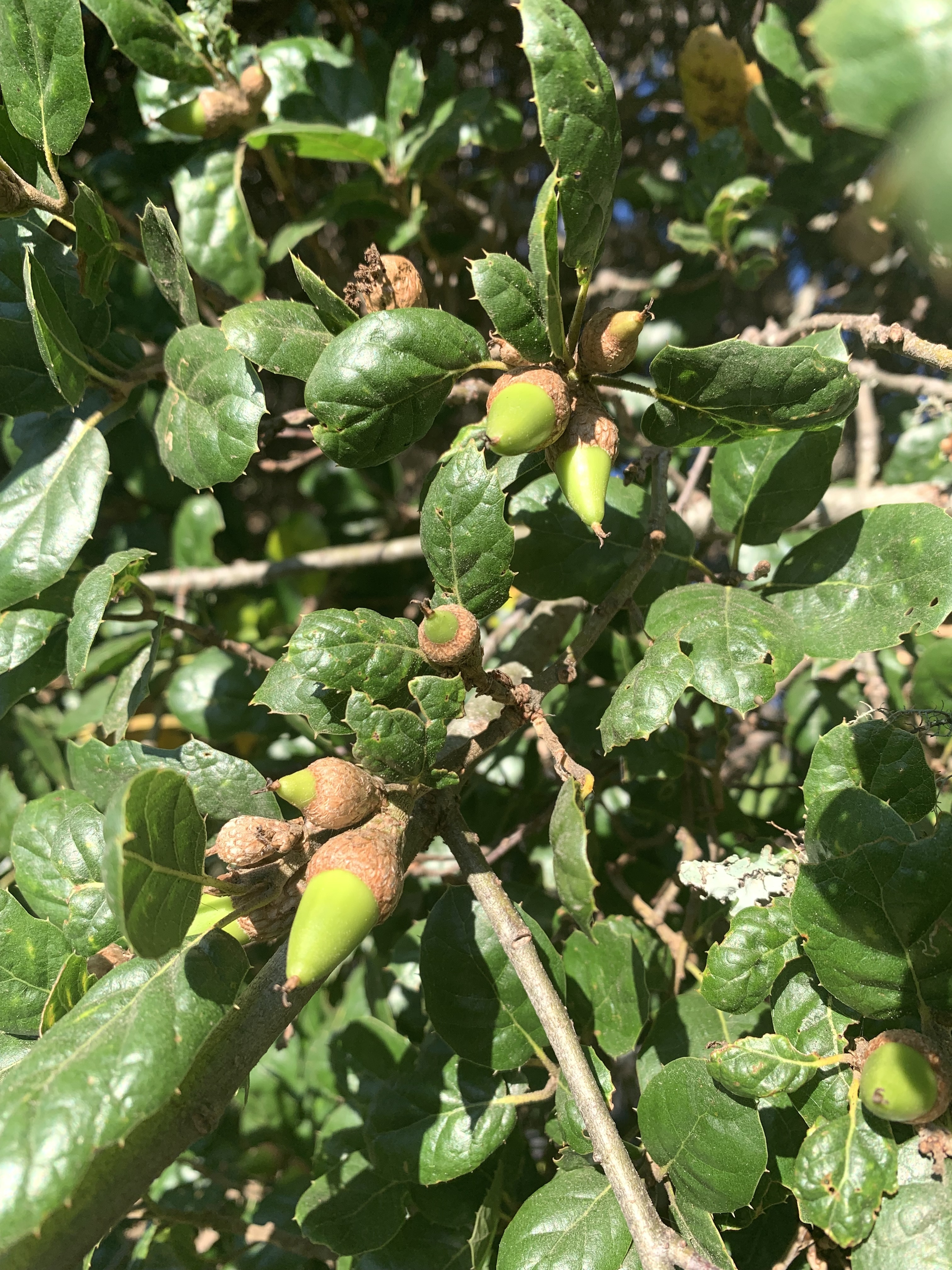
Coast live oak acorns – these trees rely on fungi for their nutrient and water uptake
Oscillating Unpredictability
Climate change models suggest that we should come to expect the unexpected, waves of hotter and hotter drought interspersed with deluge and destruction. Will being a Mediterranean climate area mean anything anymore in the future? (next time you vote, even in a local election, you are making a choice in this pro-mayhem or pro-life dichotomy) 2026 year marks the 3rd time since 1986 with such a dry hot period during the time of year when it should be the wettest and coolest. All have been recent. How does Life adapt? I wonder about the fungal webs that are crucial to the forests and shrublands around the Monterey Bay.
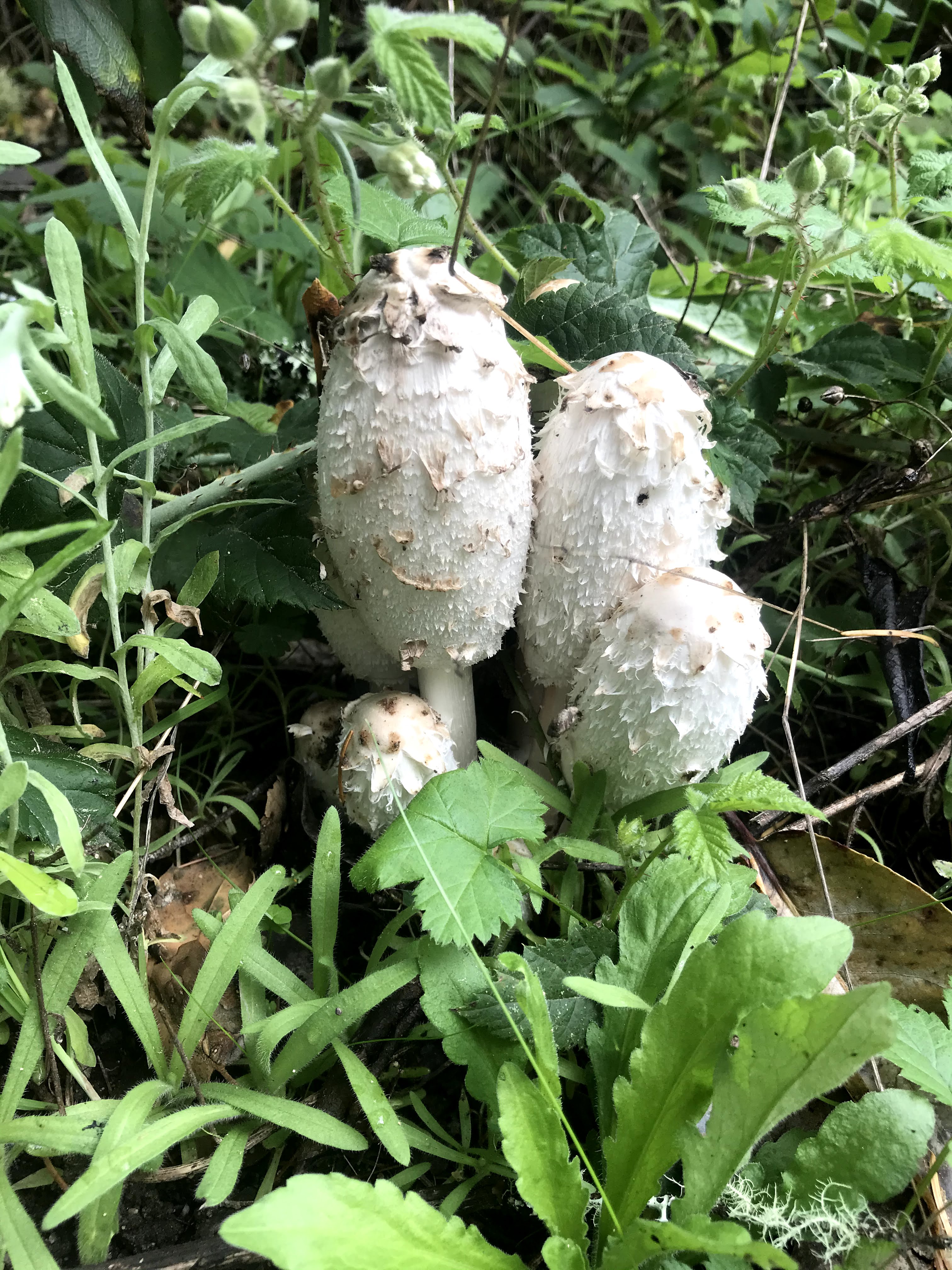
Mushrooms are just the ‘tip of the iceberg’ of sometimes extensive fungal mats running through the soil
Natural Fungal Flux
The rhythm of fungi is easy to see if only you look for chanterelles. This bright orange tasty mushroom pushes through leaf duff a while after the ground gets wet. Wetter years make for more mushrooms. Prolonged moisture and not-too-cold weather makes for the biggest crops. Eventually, they get tired and as spring progresses, they disappear until the following wet season. Other mushrooms have their time in this cycle, some preceding the rains by a bit with the shortening days…others bounce out at the first raindrops…and still others wait for the warmth and drying of summer. Peak mushroom diversity used to be typically in that middle zone, in January, when the landscape had long been very wet and the days quite short and cool.
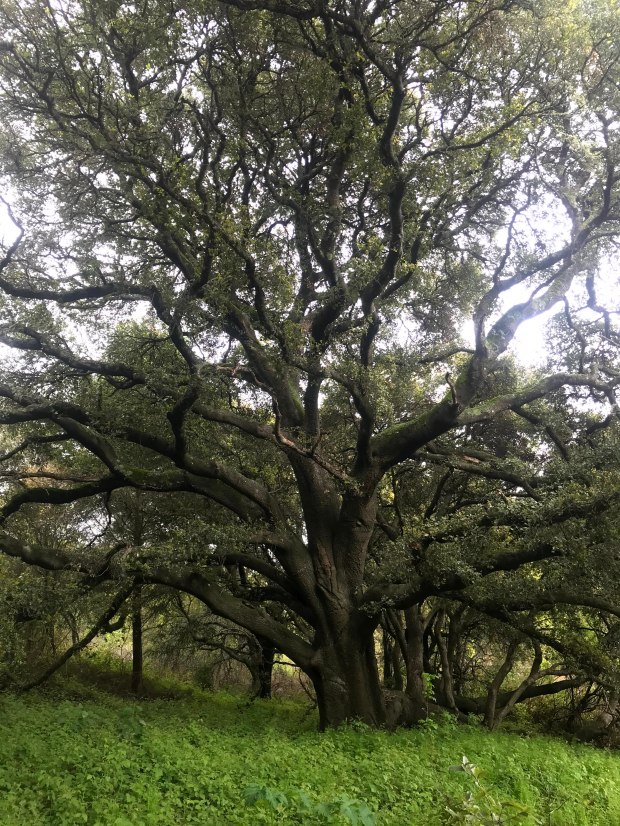
A large coast live oak
Dependency
The handful of oak species in our region along with the redwoods, pines, and firs require fungal communities to survive. So, too, do the manzanitas and madrones. In the orchards, almonds, apples, pears, hazelnuts, walnuts and so much more likewise depend on fungi to do their foraging. These trees have no root hairs to soak up nutrients and water; instead, they have evolved roots engineered to house fungi. Trees supply fungi sugars and fungal webs spread out through the ground, supplying trees nutrients and water. Dr. Tom Parker at San Francisco State University discovered 250 species of fungi under a single manzanita bush. We know very little about which fungi do what for who.
Under My Oak
I planted two coast live oaks in my yard, and one has been very evidently nurturing an interesting fungus. Dead Man’s Foot is a kind of puff bally thing that sticks a large, 6-inch or so, stumpy dark brown ugly ill-formed mass out of the leaf litter in the late spring. Some suggest a shallow burial with an emergent rotting foot, but it doesn’t smell unpleasant. As I mow grasses short each spring, this area doesn’t need much attention, except to rake up oak leaves. The grass barely grows and other weeds are missing – the place is nearly bare: the dead man’s foot is delivering every bit of nutrient to this fast-growing oak. Nearby, another oak planted at the same time doesn’t have these phenomena: it grows more slowly, is emersed in tall grass and weeds, and doesn’t have any fungi popping up in its understory (yet!).
What Happens
How will the climate change driven droughts and deluges affect fungi and the life that depends on them? There are a suite of fungi that follow wildfire, but will they withstand more frequent and more severe fires? Will the succession of winter fungi that are used to long, cool, moist winters survive winters that are less predictable? How will the forests and shrublands fare if their fungal foundations are shaken? How will we even know?
Isn’t it amazing how marketing pitches can formulate the foundations for societal dialogues? Somehow, forest management gets ridiculed with the phrase ‘raking the forest,’ aiding the politics of defunding the US Forest Service at a time when we really do need widespread restoration of prescribed fire…not raking, but effectively the same thing. And ‘forgiving student debt’ gets bandied about, helping to steer conversations/media away from the more difficult subjects of: better funding/better outcomes of public education; training young adults about contractual obligations and financial planning, and; regulating financial institutions to make student loans more affordable. I’m sure each area of human dialogue has its ‘short hand’ statements that one sector uses to manipulate others. The one I’m faced with currently is the jingo ‘healthy perennial grasses make for healthy soil.’ Let’s take a closer look at that phrase.
Bunchgrass Paradigm
Long ago, a preeminent ecologist traveled to California and ‘discovered’ something that formulated the basis of myriad dialogues continuing through today. Frederic Clements described ‘natural succession’ where nature transforms itself from one habitat to the next in a logical and predictable order. You may recall the diagram that still sticks with me where a pond becomes a marsh becomes a bog becomes a meadow becomes shrubland, culminating in the ‘climax’ community…a forest. In examining California’s grasslands, Dr. Clements found a patch of ‘pristine’ grassland, one of the few that had escaped the plow, along a railroad right of way. That ‘pristine’ grassland was dominated by a perennial bunchgrass, purple needlegrass: this, he said, was how all California’s grasslands should look. Many people still believe this. What about the hundreds of species of wildflowers, such as those cited by John Muir as creating carpets across the Central Valley, and those which provided food for indigenous peoples for generations? Those holding dear to the ‘bunchgrass paradigm’ will say those species grew only in between the bunchgrasses where weeds now proliferate.
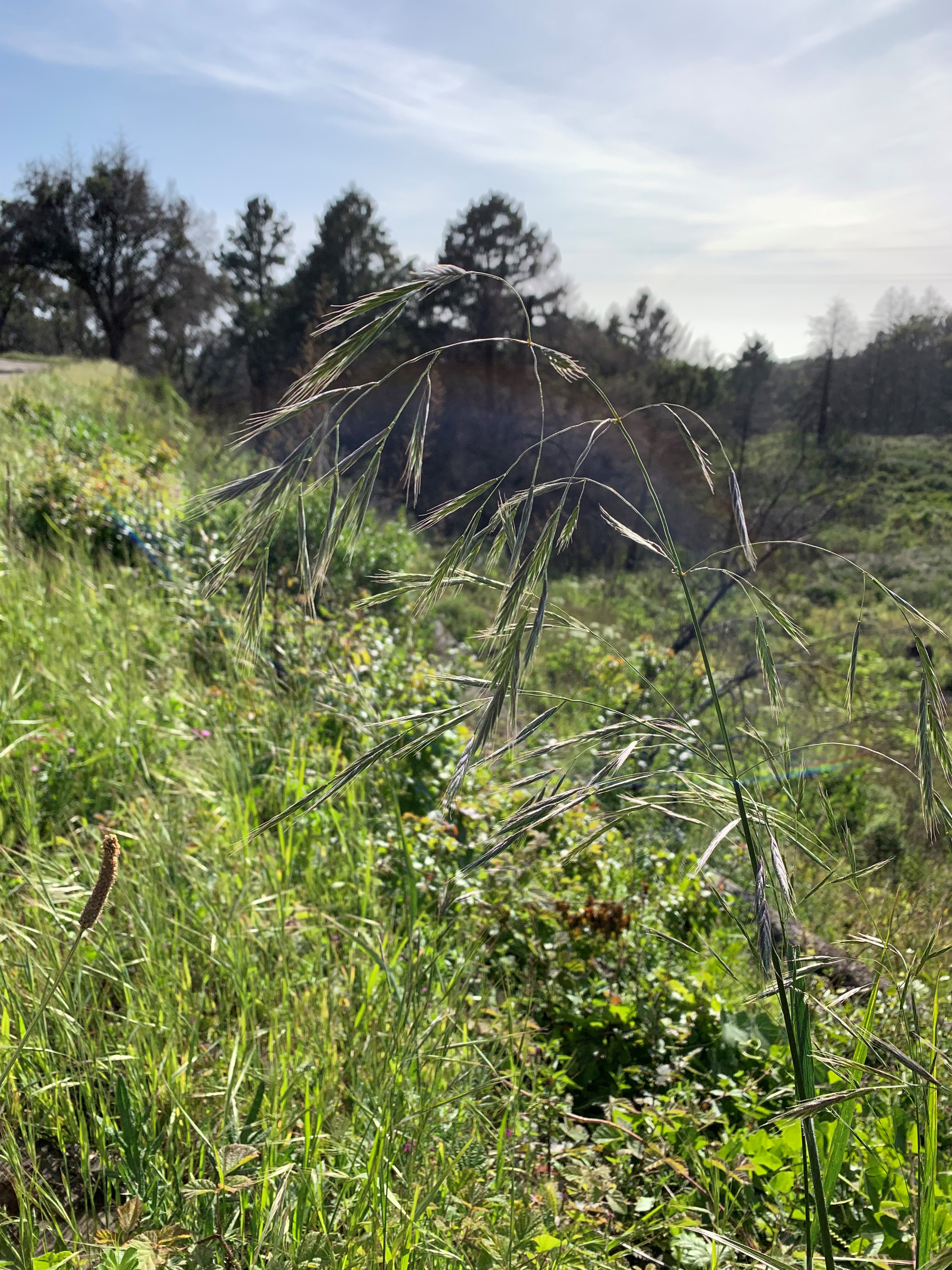
Blue wild rye, a native perennial bunchgrass common to coastal prairies in California
Perennialization Bandwagon
As the bunchgrass paradigm has been perpetuating, another popular movement has been building, a desire to transform agriculture from annual plants into perennial plants with little to no tilling, which purportedly ‘destroys’ soil health. Despite being disproven as effective over and over again, farmers are still attempting to grow lettuce, carrots, broccoli, etc, on ground without tilling. Meanwhile, rangeland managers are repeating a similarly disproven hypothesis that all California grasslands would be better off if ‘restored’ to perennial grasses. Buoyed by science papers that suggest the importance of cattle grazing to help establish/maintain perennial grasses, livestock managers have found good use of this message to gain credibility and increase their land base.
The “Perennial Grasses Have Bigger Roots” Myth
Add the two previously described popular myths together and you encounter another emergent, oft-repeated myth: perennial grasses restore soil health because they have larger masses of roots (in comparison with annual grasses). Central to this popular misconception are comparison photos from the Midwest showing profiles of annual wheat versus perennial wheat including both above and below-ground portions of the plants. The idea being promulgated is that larger root systems add more organic matter to the soil, break up soil compaction, and allow for better water infiltration. Most recently, proponents of this myth point out that the increased below ground organic matter of the larger rooted perennials means that more carbon is being sequestered, helping to address climate change.
California’s Grasslands: Not Naturally Perennial
California is mostly a Mediterranean state with a long history of ecological disturbance: grazing, fire, drought, inundation, etc. That ecological situation does not naturally produce widespread perennial grass dominated prairies. Even where there are perennial grasses present in a given area of prairie, they are rarely naturally ubiquitous: species seem specific to soils, steepness of slopes, wetness, nutrients, and so on. There are many more annual species than perennial, and many more wildflowers than grasses. Some of the most emblematic grasslands in California are naturally annual plant dominated, such as the wildflower-display rich Carizzo Plains, the rolling hills over the Altamont Pass, and the flower-filled savannahs of the southern, low-elevation Sierra Nevada. On the other hand, large swaths of the former wetlands of the Great Valley were probably once dominated in wide swaths by perennial rushes, sedges, and tall native, rhizomatous (not bunch) grasses.
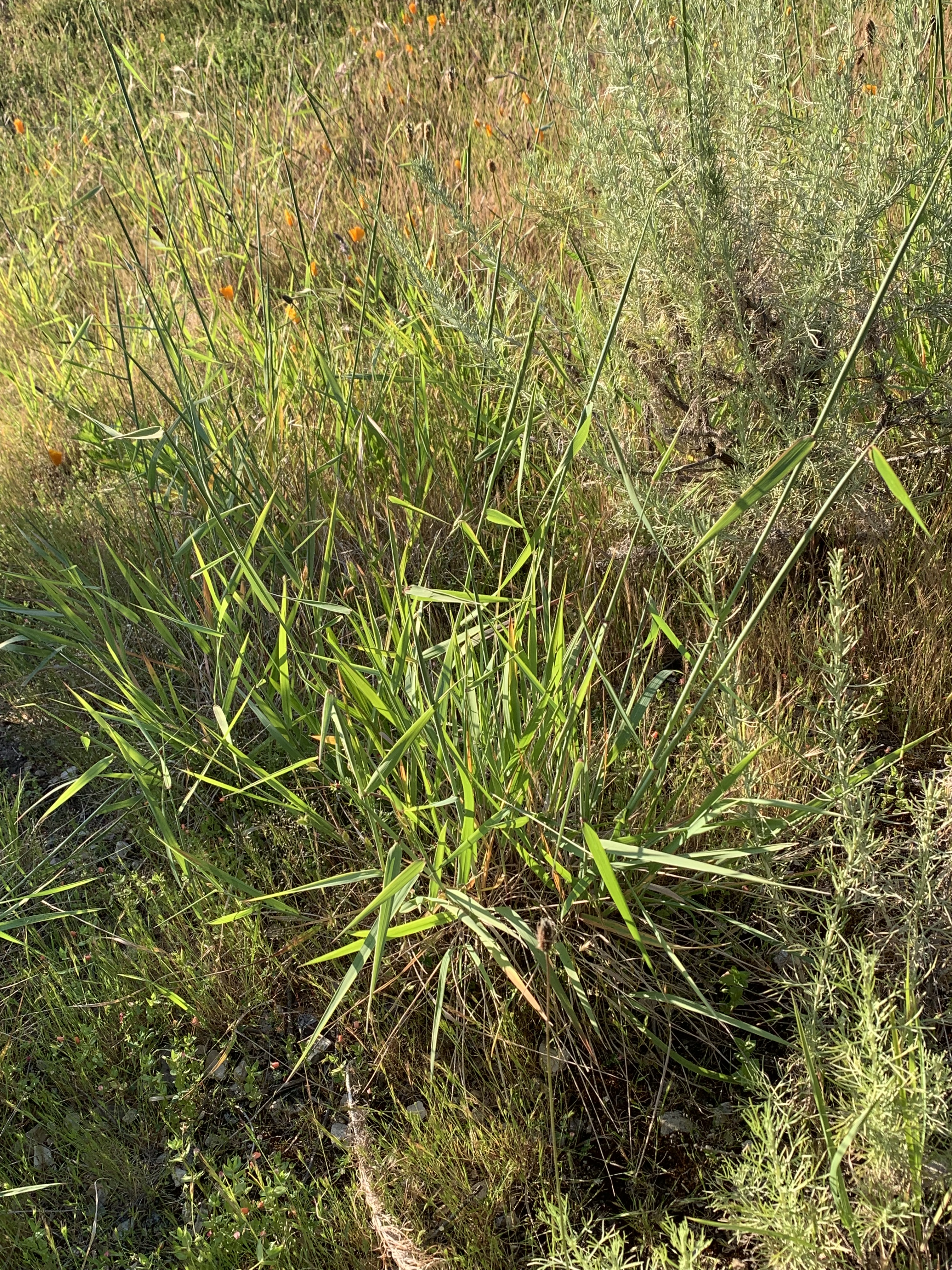
California brome grass, a perennial bunchgrass common to California’s coastal prairies
Myths of the Perennial Life Form
Let’s examine the “Perennial Grasses Have Bigger Roots” myth for a moment. The most widespread native perennial grass in California is pine bluegrass, a diminutive grass that often has leaves a mere inch or two high and a flower stalk reaching a foot or so into the air. This species likes it hot, dry, and shady, growing in interior oak savannahs. With the first rains, it turns green, later sends up flower heads, and then dries by late spring. There is no reality in which this species has longer roots, or a bigger root system, than the often 4’ tall European oatgrass. Around here, that European oatgrass is more comparable to the perennial California brome grass. This brome, in some soils, alongside European oats similarly continues growing, flowering, and seeding well into summer. In wet areas, a common native perennial grass is meadow barley. Meadow barley is relatively small and short-lived, and goes dormant very early in the season, when it is replaced by the proliferate annual Italian ryegrass, which is larger by far. Most people surveying for perennial bunchgrasses have overlooked meadow barley altogether as it disappears so early in the season.
Yes, there are smaller annual grasses and larger perennial grasses, but my point is that the generality that ‘perennial grasses have bigger roots’ is untrue and not that useful as a generality.
Regenerative Ranching: Regenerating What?
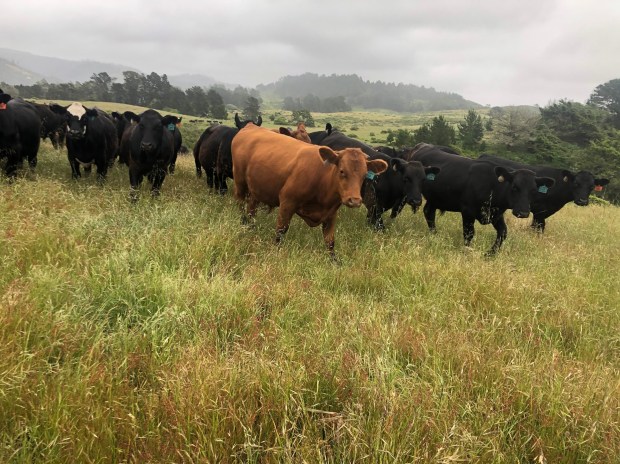
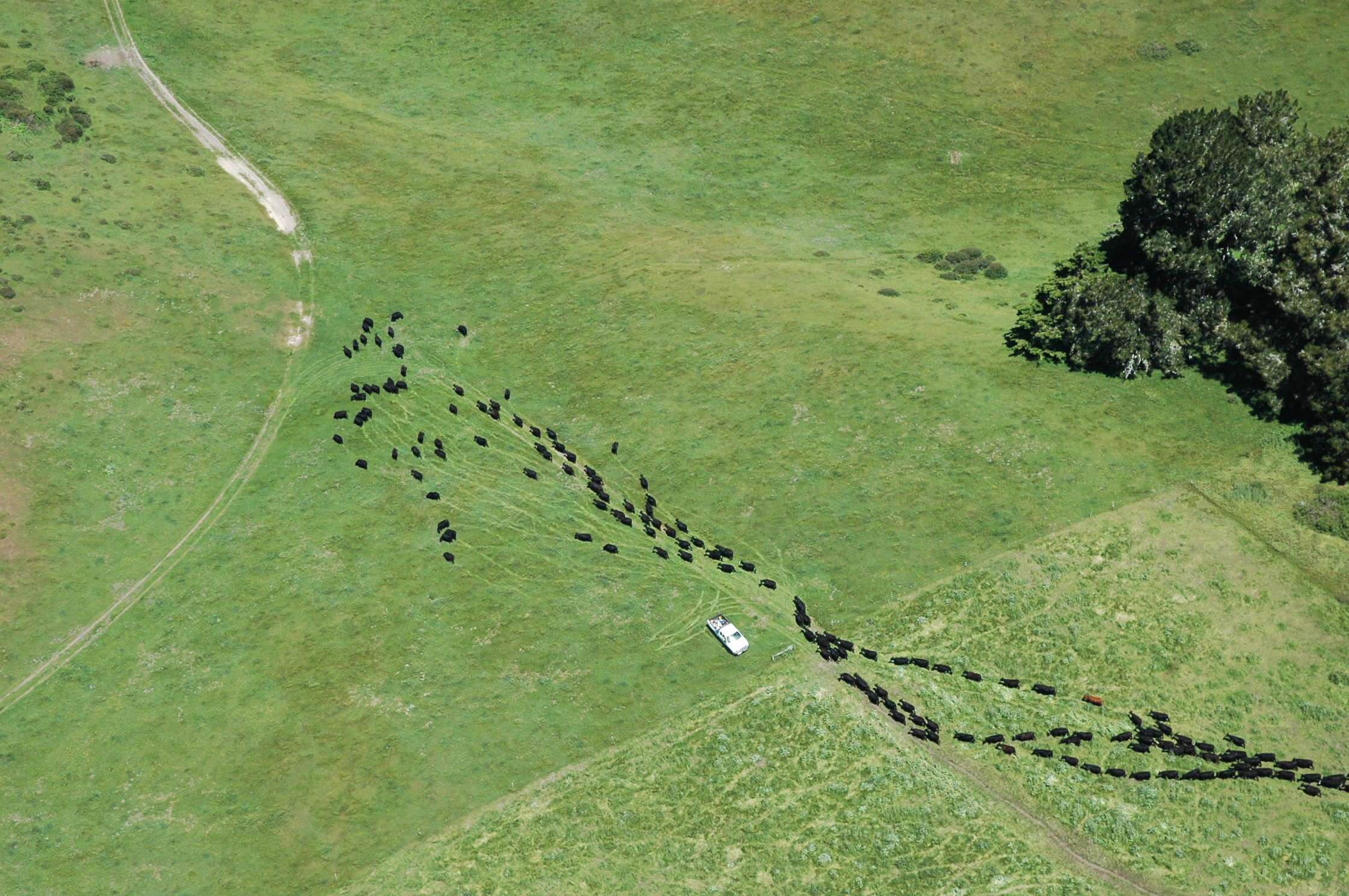
Although the definition of ‘regenerative ranching’ is elusive, it seems most proponents are gravitating towards suggesting that they are ‘restoring healthy soil.’ The idea here is that soil has been in some way degraded and must be returned to its primeval state. Often, the soil degradation concern is ‘compaction.’ To restore soil health, proponents rely heavily on the myths described above overlaid with management hypotheses that using livestock can mimic evolutionary disturbance regimes last encountered with the Pleistocene megafauna, 10,000 years ago. Regenerative ranchers really believe that such approaches work and are full of anecdotes about what they’ve witnessed, though changes in soil health are notoriously slow and always soils-specific.
Compared to What?
I’m pleased that there is a conversation about how to best manage California’s prairies, but concerned about bandwagons, slogans, and misinformation. Humans are really, really good at pairwise comparisons, but their attraction to such must be tempered. Perennial vs. annual grasses: nonsensical! Livestock grazed vs. ungrazed: not helpful! We can try really hard or spend a lot of money trying to ‘restore’ soil health, but what are we restoring it to? There is the possibility for a great collaboration in this conversation. The USDA NRCS has a long-running research project that fits nicely: their ‘ecological site description’ project would do well to help define which sites are best compared with one another, based on soil types. When having these conversations, we would do well to have great respect for the state of the science, referencing a rich literature and how it does, or doesn’t pertain. And, in our pairwise comparison analysis, let’s always try to compare what we are doing, regenerative or otherwise, with someone else’s approach: what is working better, and why? We must always make these conversations very site-specific…variability across sites is the rule.
Meanwhile, beware of definition-less terms without a systematic third party certification program: ‘natural,’ ‘grassfed,’ or ‘regenerative’ labels hope to entice you to pay more, have higher respect, adhere to brand loyalty, or just plain ‘believe’ you are doing the right thing by supporting such verbiage. With this and other jingo-based bandwagons, let’s get a tad more critical so that we support what is worth supporting with greater clarity on WHY.
-this post originally appeared as part of Bruce Bratton’s weekly blog at BrattonOnline.com
How do we leave a good legacy that will benefit future generations in a world of uncertainty? Some suggest well-raised children are a sure bet, but with this the humble must demur. We must however try. I suggest two other things that are essential: 1) species and ecosystem restoration on natural lands and 2) building soil health on agricultural lands. These are things we can each find a way to support, and they are both crucial for the future of life on Earth.
A World of Uncertainty
We live in extraordinary, unprecedented times. Humans have built a remarkable global civilization with a burgeoning population. To survive, we are in a race to shed polluting fossil fuels. But, we have no idea if and how we can replace all that petroleum has provided to fuel population growth and the civilizing of landscapes. No matter what superficial form of government seems to be in place, the “oilogarchy” is deeply entrenched, exercising economic and political control. For evidence, just watch US politics: both parties’ have an inability to act in the expeditious way that the vast majority of citizens know to be necessary. And so, life, including human life, on Earth will likely become much more difficult for the next several hundred years. Of course, we should rise up and protest as if life itself depends on it, but there are other tangible things we can do to make the world more habitable for future generations.
Species and Ecosystem Restoration
There are a variety of activities you can partake in to help restore species and ecosystems, which humans will increasingly rely on for their wellbeing. As global warming creates climate chaos, and as humans increasingly falter without boosts from cheap petro-supplies, species diversity and resilient ecosystems will become more closely tied to better standards of living.
Oil and Water
For an example, let’s consider water. Some suggest oil and water don’t mix, but the two are closely intertwined over most of the world. We might suppose that the role petroleum plays in repairing, creating, and powering our water supply will be replaced by some renewable energy supply in the future. Plastic pipes will be made from hemp, renewable energy will power our pumps, electric vehicles will transport the legions of water district workers who maintain water systems, etc. However, when rain comes in torrential bursts or not at all, we will rely on very well-tended ecosystems to absorb and meter out rainfall so that we can benefit from more dependable surface or groundwater supplies.
Dust Storms
For another example, let’s consider erosion. The stability of our infrastructure- homes, utility lines, roads, dams, communication towers, airports, etc., depends on more than just good geological anchors: that stability is deeply dependent on functioning ecosystems. Species hold our stuff together. On the coast and along rivers and streams, species protect shorelines. On hillsides, in the mountains and on the plains, species hold the land in place. Without a wealth of species supported by resilient ecosystems, everything will come unzipped – gullies, floods, landslides…infrastructure collapse. At the same time, the bared soil will start to blow and dust storms will become more frequent, destroying engines, burying buildings and roads, and darkening the sky.
Restoration Means Now
The species that currently perform best at the “holding the soil in place” function are likely not the ones that will do best in a hundred years, given the rapidly changing climate. So, we must conserve every species, and plan to allow species migration through a healthy landscape of resilient ecosystems. Right now, this very year, we must quickly turn increasingly to restoration of the land because we have degraded too many places already. You can help by volunteering with the many habitat restoration projects in our area, taking better care of your land, voting for politicians that support ecological restoration and land care, spreading the word, and/or giving money to groups that are making a difference. Many people are joining this movement, we are making a difference, and we need more help.
Bye-Bye Soil, Hello Agricultural Substrate
Since World War 2, agricultural systems have become increasingly intertwined with petroleum at great expense to the soil that humans rely on for sustenance. Petroleum-fueled mechanical cultivation has destabilized billions of tons of soil which has already washed or blown away due to recklessness. You can watch it happening, still: in the Salinas and Pajaro valleys and along Santa Cruz’ North Coast watch the soil blow or wash away, depending on the season. At the same time, cheap fertilizers and expedient pesticides have been made possible by petroleum and the application of these have destroyed ecosystems that once sustained and built topsoil. Farmers for years have acted like soil is just a substrate, something to hold a plant in place long enough to harvest a crop. And so, most agricultural land is highly degraded and production is increasingly and deeply dependent on the supply of petroleum. While we can, there is a great opportunity to build the kind of soil health that will be necessary to feed humans when petroleum-subsidized fertilizers become too expensive, and the human population is still larger than it is now.
Soil Health
Healthy agricultural soils can retain more water, provide plants more dependable nutrition, and stabilize pest outbreaks. So, why would a farmer not create more healthy soils? There are two main reasons. First, investing in healthy soil reduces profits. For example, using cover crops to cover and build the soil during the rainy season means the loss of one or more potential harvests. That also drives up food costs, which then helps to create the second reason: mandates for soil health are politically difficult. The good news is that you can help with both of these conundrums.
You Can Help Create Healthy Soil
We all purchase groceries, and the choices we make can help support soil stewardship. Already, the organic agriculture movement has been growing and makes a difference for soil health. Certified organic agriculture requires farmers to find alternatives to pesticides and fertilizers that are synthesized from petroleum. In ‘conventional’ agriculture, novel petro-created compounds working alone or as a mixed concoction are released into agricultural systems without analysis on long-term soil health. Organic farmers more often rely on soil health as a means of production, and the higher cost of those products reflects that investment. Some tell me that they can’t afford organic foods, but discussions reveal that they are unwilling to make more basic food choices, preferring to rely on processed foods or meat that are especially more expensive when certified organic. Going organic may mean dietary changes that might be more healthy, anyway.
Besides using the power of your purse to support farmers who build soil health, you might more directly create healthy soils in community orchards or gardens. You can volunteer in a school garden which has the added benefit of helping children better understand soil health and healthy foods. You might also support, by volunteering or donations, organizations that are working to improve soil health on agricultural lands.
-this piece originally published by Bruce Bratton in his extraordinary BrattonOnline.com, the place to go for movie reviews and local news…unparalleled. Sign up and get it weekly. Donate and it is money well spent.
 Grey Hayes