purple martin

Suddenly Crickets

The long days have become warm. Some people were even growly about the chill, the fog, and the drizzle that have become our most frequent visitors as this long Spring crescendo slowly approaches Summer. The complaining people were particularly happy about today, and tomorrow will even be warmer. But this cool, moist spring has spread a vibrancy rarely seen across California’s central coast. The biggest grasshopper I’ve ever seen around here plopped onto the ground in front of me today and tonight the crickets have at last begun the summer’s starlight orchestra. The warmth of the day quickly fades as the night grows dark, and cricketsong wanes, replaced by a rare silent night, peculiar to the particularly cool spring. There is no wind, no echoing waves, no trilling crickets, and only a few sporadic hoots exchanged by scattered great horned owls.

Late Morning, Fog Dispersing

Sunny, bright sunrises are rare. Mostly there is the muteness of first light, glowing through dense fog. Wet grass. Puffed up quail sitting in pairs, barely moving. Slow motion rabbits tentatively beginning their daytime nibbling. The sun brightens, the fog grows thinner, and gradually bird songs escalate, becoming more diverse, varied, louder. The first bright rays carry sudden warmth, sending birds into the sky: hawks soaring, ravens patrolling, swallows chattering, swerve. The purple martins carry such huge wads of grass to line their nest cavities that they can barely fly.

As the sun takes full charge, it evaporates the dew, and a young coyote yaps and howls first from the forest edge, out of sight. She seems dissatisfied with her vantage point and trots out into the middle of a field to yowl and bark some more, glancing furtively about after each vocal session. This sets the neighborhood dogs to barking, and our coyote friend glances over her shoulder, seemingly annoyed at her domestic cousins’ primitive and unmusical repetition. Eventually, she moves on, and the morning noises go back to being dominated by bird song. Noon approaches.

Contrast of mowed, green and unmowed, brown

Drying

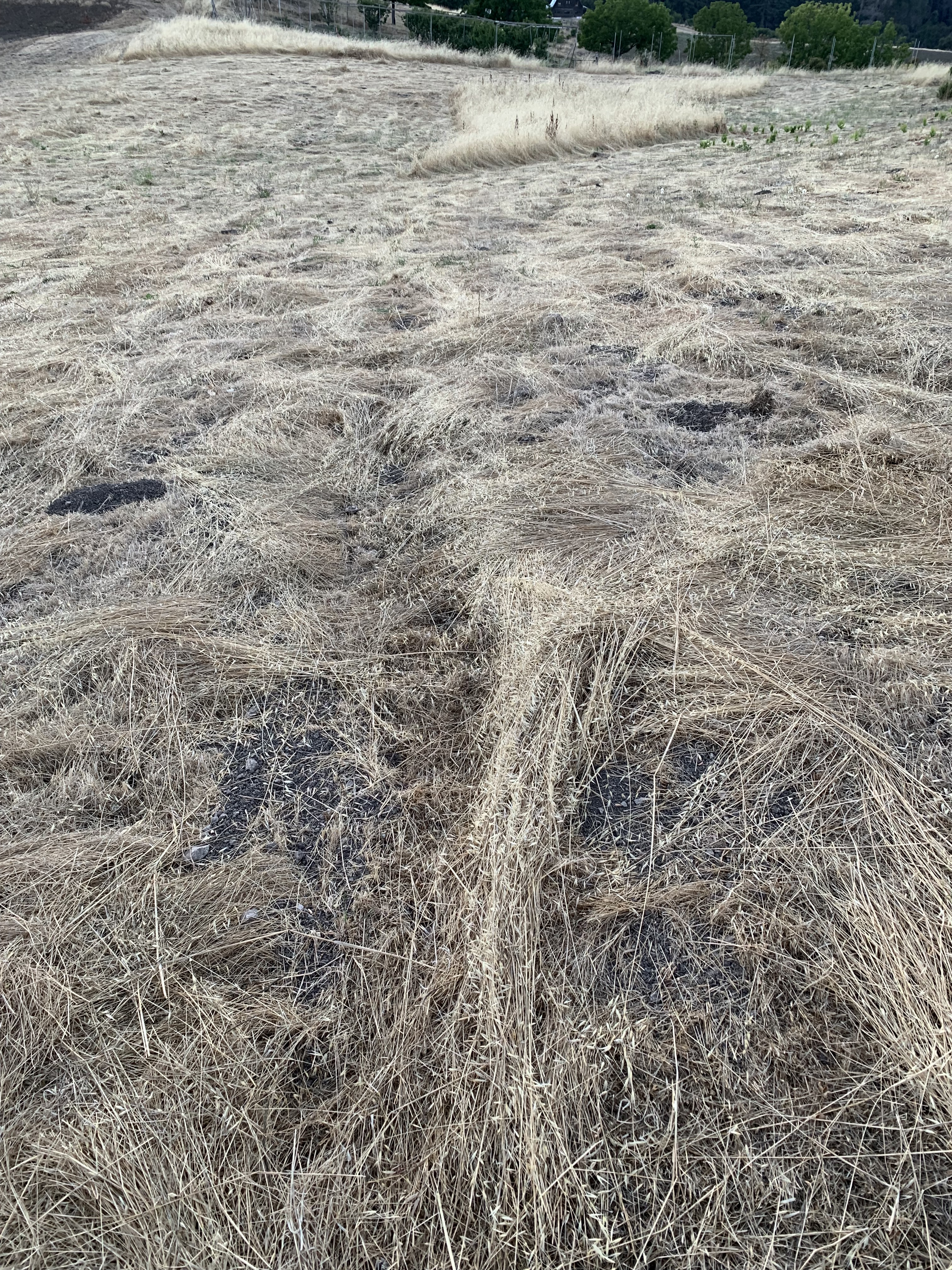
At every glance, there are contrasts between drying and still wet, gold versus green. Where we passed once with a mower through a grassy field, the cut area evaporated less water and is still wetly green whereas the surrounding tall grass absorbed the soil moisture and is already drying. Five foot tall tawny grass stands or falls over, crisscrossing, heavy with seed. A million things are hidden in that meadowy mess: snakes, rodents, bugs, spiders, and bird nests present a gallery of surprises as I collect native grass seed for restoring areas of the farm. The seed must dry in paper bags to be stored until first rains, to be tossed into the footprint of prescribed fire or along the tracks of mowers.

Vetch is flowering in our fallow fields

Flowers Still

Despite the drying, it remains a very floral spring. Different types of vetch have only just entered their peak bloom. Poppies are in full display, big orange patches, rabbits eating their flowers. Monkeyflower is also in peak color, whole hillsides glowing peach-orange. Nearby, the post fire chaparral giant yellow bush poppies are blossoming, creating a peculiarly sweet, cucumber scent. That chaparral air is thick with resinous blueblossom odor accentuated sometimes by the bitter-sweet yerba santa, which is displaying clusters of lilac flowers. The forest understory is bejeweled with rosey globe lilies, bobbing and lush. The last native iris flowers are fading.

Ah, the promise of Lapins cherries for late June (nets up soon!)

Fruity Promises

The orchards are producing ripe citrus while thousands of other fruit grow marble- to golf ball-sized. We compare different types of navel oranges, contrasting them with Valencia, complimented by sweet Honey mandarins. The last of the limes are coveted. In the apple orchard, the fruit has set and is rapidly growing; it is fruit thinning time! Some of our apricot relatives are thickly laden with young fruit. The bigger patch of Lapins cherry trees will soon need netting. We peer into the canopies of avocado trees, hoping to glimpse at least some fruit set; last year was grimly non fruitful…these trees are notoriously unpredictable.

Watering

To keep the fruit fattening, we have started rounds of irrigation. That routine keeps us on our toes, especially the first cycles of water flow as the need for repairs are numerous. Inadvertent mower damage, winter rodent gnawing, or just plain mysterious breaks makes for geysers, gushers, and pouring leaks that must be detected before large tanks are drained. We seek leaks by noise more than sight. This was the first week that water flowed to most orchards as well as the 2 Dog vineyard. The irrigation will run through November, tens of thousands of gallons each week…mostly pumped silently by solar power. Irrigation efficiency has us using around half of what would be considered normal, let alone that a sizeable portion of our produce is dry farmed with no irrigation at all!

We are looking forward to the summer…and hoping not to get Too Much Heat (or fire!).

Dry, tall grass – a tangle that includes Calfifornia brome grass for restoration seed

Lushness, Still, but Rapidly Drying

Gusty winds and cold nights faded quickly to calmer breeze and warmer days. Now, the grass bolts quickly and everything goes to bloom.  Lushness seems on the edge of fading, we don’t know how long the green will last. Already, the thinnest soils are turning tawny in the coastal facing prairies.

Freshly Tilled Soil

Fading Mud, To Dust

After the ground’s gushiness fades, the farmers work the ground. The fields are getting tilled. Cover crops are almost all gone, mowed and integrated into the soil. With the farm roads dry, in comes a compost delivery: fine organic crumbly brown piles getting distributed into some important places, including the orchards.

Gravenstein Apple Flowers

Orchard Blooming

Orchard blossoms burst forth. The earliest flowers are past, cherry petals falling like snow, the first fruit seems to be setting…same with the plums, prunes, and apricots. Now, the apple trees start blossoming. Our one old gravenstein apple tree, with the earliest apples to ripen, is aglow in full bloom. Other apple trees are coming along, a diversity of flower colors, shapes, and sizes. Meanwhile, the vines…

Two Dog Farm Chardonnay Grape Vines Springing from Dormancy

Wine!

Recently, our Two Dog Farm Wine endeavor has started returning deliciousness. The Bartles opened a bottle of their very own Chardonnay at a recent gathering and oh! the praise rang high! The promise of a larger harvest looms for this fall. The neatly pruned and tied vines are flushing leaves and flower clusters.

Elusive Wild Things

Scat is easier to see than the furries. Coyotes, bobcats, and weasels talking sh**, carefully placed to make inter- and intra-species statements, scatting. A small weasel spotted in the orchard, chicken owners worried. No bobcats for so long. Deer tracks but no deer. Skunk digging but no skunk.

Flies.

And now suddenly a hundred types of flies buzzing about. Flies on poop, flies on flowers, flies frolicking in pairs tumbling on the ground.  No face flies, yet, luckily. Clouds of midges, clouds of gnats. Different flies in the forest, different flies on the road.

Winged Friends

The purple martin colony returned from way down south. This is one of two colonies in Santa Cruz County. They have the most distinctive, amazing throaty deep chirps. Goodness, they make a lot of noise. Glad to be back, I guess.

And the stranger noises are coming from the ravens. Maw and Caw are greeting friends passing through with their cluck-clicking patterns, rolling upside down, dipping and turning playfully. Perhaps a bit of this greeting is the kids coming back to say hello. Just the pair, mostly, but then there are brief visitations. The pair stand watch in the freshly tilled fields looking for the lost or injured rodents for lunch.

Two flickers poke and explore something in the ground. The thrasher sings a most refined and eloquent soliloquy.

Flap flap flap! 40 band tailed pigeons wheel across the sky and settle back into the walnut trees. Catkin feasts! It is a good time for the flock, bigger than in recent years.

A Wild Phacelia from Roundabouts the Farm

Flowers

Walnut leaves unfurl with the droopy elongation of the catkins that survive by sheer number the feasting of the pigeons. Poppy displays wash orange across the south-facing slopes across Molino Creek and brighten the grassy balds along the highway. Whorled lupines poke up from the sea of grasses in patches around the farm.

The Harvest One Gwen avocado reminds us about the fruit that this portion of the harvest season will one day bring. One Gwen tree does not enough avocados make. Ironically, the fructification of Spring is the hungriest time of year. Pre seed. Pre fruit.

– also simultaneously published at Molino Creek Farm’s website

Two Young Deer and the Pending Summer

Two fawns are losing their spots, following their healthy mother with her shiny coat and her healthy, full, and muscular body. She watches us carefully as we traverse the farm, walking carefully to a safe distance, the young twitchy and nervous, sprinting and hopping when we approach. Often, there is food sticking out of their chewy mouths. The other day, I saw one of the fawns walking around on two feet, not just for seconds but for a good while. WHAT? Oh, that one was eating high up walnut leaves: what a trick!

Molino Creek Farm’s Dry Farmed Tomatoes

Fruit

The tomatoes, apples, onions, pears, and peppers are getting bigger and bigger by the day. The apples are gaining color.

Dry Grass: what next?

It is mowing and mulching time. The lads are swinging weed eaters a’buzzing. They protect the roadsides, the wells and generator houses. The sickle bar is on the bigger BCS walk-behind tractor, the hay is falling and curing, the mulch cart is rolling, and deep dish ’apple fritters’ of mulch a’forming under the orchard trees.

Patterns of cut hay and uncut hay (where the wasp nests are). Mulch 2 B

Drips

It rained this morning. A light sprinkle, very off-season, enough to calm the dust for a moment. A pitter patter falling from the rooflines. Birds sipped droplets from sparkling leaves as the sun broke through the clouds late morning. Beautiful.

Martins

A flock of nesting purple martins wheel and chirp high in the sky above the highest point of the farm. The fierce males’ battle cries ring out against the prowling hawks. These are rare birds around here- glad to host them in cavities in burned trees from the 2009 fire. The snags from the more recent fire will support nesting generations to come.

Wildflowers of Summer

Little white puffs emerge from drying grass, among the post-fire thistles and between resprouting coyote bush. The complexly sweet smell of the native perennial cudweeds drifts on the gentle breezes. The clusters of bright white flowers fade to straw white that feel papery when rubbed to check out their scent (recommended).

Cudweed!

We hope you are enjoying the entrance of summer with its warm spells, foggy beaches, and occasional whiffs of dry grass and resiny sagebrush.

-from my near weekly postings at Molino Creek Farm’s webpage.

Twilight, Calming Wind

The long persistent crazy wind continued along the coast this past week, but calmer nights are full of black field cricket chorus. Chip-chip-chip, chip-chip-chip, chip-chip-chip. So tireless and repetitive as individuals and as many together mesmerizing.

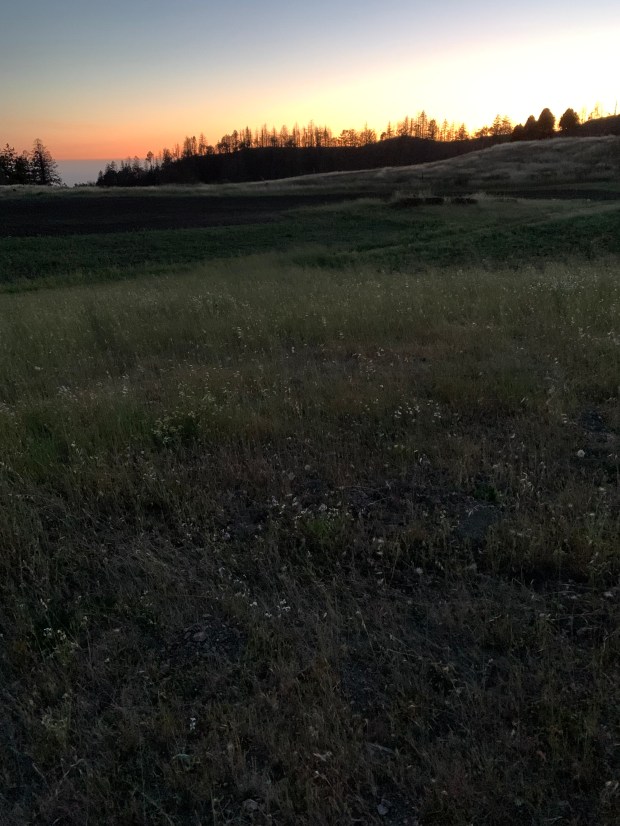
Lingering twilight as the wind calms

A long twilight with glowing colors and the calming of the wind closes each evening. Then, a big moon rises and brightens the farm in soft tones of silver and gray. Offshore, the night glows from the bright light lures of fishing boats. On the windy days, the ocean turns turquoise dotted with white caps that we glimpse from the farm. The rain has ended, but we get touched by moist fog and dew still hangs heavy on the still green grasses in the morning. Chilly legs and cold feet…wet pant legs and soaked shoes for us early morning field walkers. The damp morning air carries the early summer sweet earthy scent from the farm fields.

Grass has grown as much as it will – time to mow to prepare for fire

Mowing

It is heavy duty mowing time- the last mowing of a drying spring. I drove the brush mower over a ground wasp nest but didn’t get stung. I’ve become adept at recognizing the patterns of angry wasp flight, luckily especially evident silhouetted against the black body of the mower. There the mower sat for an hour while the wasps calmed down, and I snuck back to (heart pounding) grab the mower handle, shift it to neutral and drag it downhill rapidly away from the nest hole. Now I’m scouting more for the nests before I mow.

Rare Birds

Yes, there are no deer. Instead of those common beasts, we are surrounded by rarities. Storey heard the elusive and uncommon house wren on the farm and she and others have been watching a group of purple martins probably settling into nest holes in a dead tree near our property line. Downhill, at the gate by the highway, crowds have gathered to see a waif scissor tailed flycatcher.

Mother Hens

We have many a wary quail, fretful probably as their eggs are hatching and there are soon to be little clutzy puffball babies following them around. Nearby, there are new baby turkeys with watchful mothers herding them and showing them how to forage.

Adolescent tomato plants- much promise for the season

The Plantings

Tomatoes are getting bigger- the once weak looking seedings have settled in and want to start seriously growing. Likewise, spry onions are getting robust. When the fire came in 2020, we had just begun the Conservatory of Passion, an arbor with passionfruit vines with hope for hops. Those all needed to get replanted and we put in our first McGregor hops a few weeks back. All those vines are settling in and starting to look really good. We need to set up some strings for the hops to climb! The 2020 and 2021 avocado plantings are growing profusely. The earlier batch will get overhead this year as giant bushes and the trees from last year will turn less lanky soon.

-this is one of many of my weekly posts at the Molino Creek Farm website