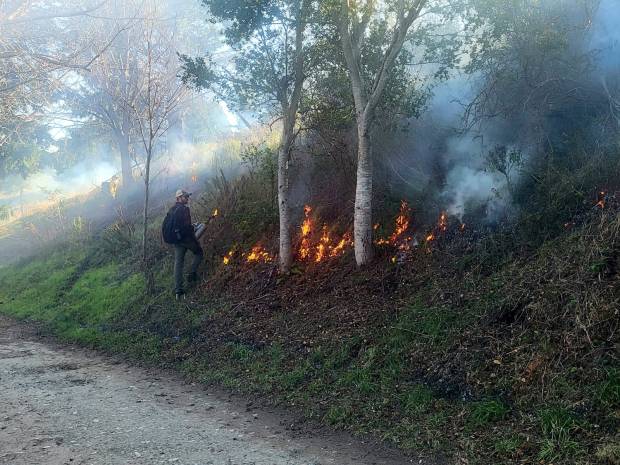
Nature around the Monterey Bay has been adjusting to changing wildfire regimes; we should expect that to continue, but how that happens is up to us in many different ways. Very recently, we are putting purposeful, good fire back onto the land. This may help restore the land while protecting human infrastructure from catastrophic damage, but there are too few projects to learn from…we must learn more!
Burning History
The Monterey Bay area has been getting hotter and drier for 20,000 years, which coincides with the era of fire-lighting humans. Laguna de las Trancas is an ancient pond that lies on a geological fault on the North Coast. Ancient ponds record the history of their place in strata. Scientists have taken sediment cores from that pond and recorded layers of pollen and volcanic ash, going back through time as the deeper sediment is older. Volcanic ash has properties that allow us to know from which volcano it originates and scientists have used various methods to chart the age of ancient volcanic eruptions. So, volcanic ash serves as milestones marking known years in the sediment’s past. This is how we know that this region changed to a much more fire-prone landscape around 12,000 years ago, consequent with the widespread archeological evidence of humans. Before that, the dominant forest trees were firs; after that, fire-adapted redwoods came to dominate. More recently, for the past 1200 years, fire scars on ancient redwoods illustrate a 4-6 year burn return interval. Indigenous people likely managed the fires sweeping frequently through redwood forests, but their fire tending of this landscape tragically ended during the genocidal colonist period. Purposeful fire has been almost entirely absent on most of this landscape for 230 years. In its place, long-interval catastrophic wildfires have caused all sorts of mayhem and loss of life.
Indigenous Pyro Management
Oral history, written accounts at the time of colonist contact, pollen records in ponds, burn scars on ancient trees, and vegetation patterns on this landscape are things that can teach us bits about thousands of years of intentional use of fire by humans. One early written account from early Old-World colonist explorers notes that many of the meadows around Monterey Bay were burned black. We know now that without burning and/or grazing all of this region’s prairies change quickly into forests, so fire must have been maintaining meadows for a very long time, in the absence of grazing and tree-pulling by the Pleistocene megafauna. The blackened meadows hampered the progress of invading Old-World explorers because they had trouble feeding their horses, which they relied on for transport. In this case, we might contemplate the use prairie fire as self-defense, but we also know that indigenous peoples used fire to cultivate native plants that served as medicine, salad greens, grain, basket materials and much more.
Good Fire Emerging Now
California’s governor has set a goal of using prescribed fire on a half million acres a year. It has been 1/10th of that for too long but indigenous folks probably burned more like 3 million acres (or more) a year previously.
Most people do not see the natural landscape as their pharmacy, grocery store, or fibershed, but many people look to the hills and know the danger of wildfire. Purposeful, good fire is starting to address this last concern and one day will help people reunite with the land in those other ways.
I was recently fortunate to interact with the Central Coast Prescribed Burn Association as they purposefully burned big patches of brush on Santa Cruz County’s North Coast. After much planning and preparation, forty volunteers gathered one Saturday to light big patches of hillside on fire. The goal was to restore coastal prairie and to train more wildland fire lighters in order to expand our region’s capacity to reintroduce fire on the landscape. These volunteer groups are growing around the world, including here in California. We have learned that their work is essential for everyone’s safety, and for the stewardship of the land, which provides us so much: water, timber, livestock, recreation, clean air, food, health, and solace.
Value-Added Fire
As we realize the importance of good fire in natural lands, entrepreneurs are envisioning profit. People are cashing in on the wildfire crisis by managing wildland fuels to power electrical generators. Some are seeing a potential to power electrical land stewardship equipment with generators fired by the fuel that equipment is removing. Others are already hauling wildland fuels to generation facilities supplying regions in Northern California with power. New technology allows burning wildland fuels to create charcoal, which is added to agricultural areas improving water holding capacity and maybe even soil fertility. That carbon is captured to mitigate greenhouse gas emissions. The machines are called ‘carbonators’ and they use thousands of gallons of water a day to keep them cool, which is the trick to making charcoal.
There was a lull for a bit, fand now there’s a rejuvenation of wood fired heaters for rural homes. The new woodstoves are engineered to be very efficient with very low air particulate output. Greenhouse gas (carbon) output is from recently grown wood rather than ancient fossil fuels.
The Future?
I envision a time when robots harvest biomass for fuel, farming every square inch of Planet Earth for energy. Imagine micro technology…ant-sized robots that prune plants in cultivated landscapes and natural areas, hauling bits of biomass back to larger robots which haul it to biomass energy production facilities…one big conveyor belt of fuel stolen from natural food webs. I do not like that future, but it seems inevitable in our ‘civilized’ world. How far off is that future? Without another way of managing wildfire, the day of that scenario is coming closer, quickly. The alternative is for more people to be involved with community groups managing purposeful, good fire across large areas, like the Monterey Bay region.
Your Role
Each of us has a role in helping Good Fire gain traction. Start with getting an air filter for your house: you need one anyway for wildfire smoke. Air pollution is a great concern, even with purposeful fires. The recent burning exercise I was a part of was delayed a week because of air quality concerns, and that week delay caused a bunch of issues with people’s schedules, wasted catering food, etc. If we can all be better prepared for smoke, it will be easier to get Good Fire on the ground. If you are able, help to figure out a way to get air filters to folks who can’t afford them!
We can’t expand Good Fire unless everyone feels safe in their homes. So, helping people get safe in their homes is an important thing. And, even when those homes are well secured against wildfire, people still need to be talked to, shown Good Fire, and helped to shed their fears. We can try to experience purposeful fire and see how well it is managed and then tell those stories to more people: there is a lot of fear about even professionally managed, purposeful fire.
The last thing I think more people might do: volunteer to help! The Prescribed Burn Associations could use more volunteers. Learning to manage purposeful fire is hard work and many people are needed.
-this column originally posted in the very informative weekly blog, BrattonOnline – please subscribe, like, and spread the word!
 Grey Hayes