oc

Falling Leaves with Swards A’Greening

from my blog for Molino Creek Farm

The meadows are turning GREEN: electric, eye straining, shiny, bright grassy green. It smells fresh and alive again. The sky seems a deeper sparkling blue and the stars shinier: it’s like the rain cleaned everything.

I’ve heard it said (with derision?) ‘back east’ – “California’s where Fall means the leaves drop and the grass turns green.” (Ironically, this is sometimes said by the same people that claim we don’t have seasons at all)

In the forest, yellowish fall colors, the scrublands dotted with brilliant red. Maples and hazelnuts are at their brightest fall pale yellow. Nestled into the mostly evergreen bushes of coastal scrub, poison oak glows brilliant crimson, leaves sometimes swirled with subtle purple or blushed with melon orange.

The honeybees have been getting hungrier as the last of the coyote bush flowers fade. A lone Australian import in my landscape, a white bell-shaped flowering Correa shrub, is now nearly being carried off by honeybees. I have never seen a single plant of any kind so buzzy.

Native wild strawberry, naturally established in our orchard understory…a rose by any other name (in a rose family orchard!)

Bonfire Time

It is bonfire time. Directly after the rain soaked the land, regulators lifted the ‘burn ban.’ With increasingly unpredictable rainfall patterns, we know better than to wait. Even after running a chipper on many piles earlier in the summer, we have around 10 tons of brush remaining to burn.

Beautiful, guilty pleasures, bonfires. With the heating of the planet, we are torn about this torching of biomass. In the few years leading up to this wildfire, I told everyone I knew that there was no feasible way of composting wood around here. Any branch over an inch diameter, I said, is just waiting to fuel the next wildfire. What does one do with the trimmings, fallen branches and trees, in that case? In the ten-year interval we expect between wildfires, we would quickly fill all of our open space with brush piles…and then they would burn anyways (as they did in the last fire). If we place branches in the forest, the forest trees will burn hotter and be more likely to die. And so, we burn piles when it is safe to do so. That means burning every time a storm is blowing in. Two piles down….20 more to go…At least we can enjoy the warmth and cheer: friends join in…bonfires by request! (selfishly, this helps us tend the fires)

Non Human Farm Mammals

The mammals love the rain-fueled regreening, too. Last night, I heard the first caterwauling of a cougar in a long time. It was yelling from near the intersection of Molino Creek Farm Road and Warrenella Road. Her sounds freak many people out as they are somewhat similar to a screaming human. The lion in the area making those noises would explain the reason our neighborhood dog, Fiona has had a few long barking sprees recently! What a terrifying sound…what a brave guard dog! Ruff! Ruff! The fierce barking echoes off the surrounding ridge lines.

Some may recall my mention of the relationship between skunks and ground wasps, aka yellow jackets, aka vespid wasps. I have seen it so many years…the first rain and the skunks dig up the wasp nests. What an amazing and guaranteed service. After this last rain, where there were once dangerous zones of sure firey stings, now there are holes, soil thrown up with scattered torn up papery honeycombs, a few upset wasps still trying to make sense of their broken homes. Somewhere there’s a skunk with a very full belly (and lots of skin welts).

Scary (and curious) Birds

One recent dusk, I was dreamily soaking in the beauty of the fading colors and the wet scents of the newly moistened landscape when the oddest sound startled me. The noise was sudden and like the horror movie sound of a hundred attack raptors – coming right at me! I almost ducked, but then realized that it was a hundred mourning doves flying as low and fast as they could, over and all around me. Their wings make a sharp swooping air-cutting noise as they come towards you with only the slightest dove wing whistle after they pass. This pattern has been repeating every evening at dusk- mourning doves jetting at tree (shrub) level downhill across the whole farm to roost somewhere at lower elevation. The conservation of elevational clines, from high to low elevation, on the western slope of Ben Lomond Mountain may be important for undocumented and mysterious reasons…We saw robins doing the same thing (though less speedily) at winter solstice a couple years ago.

Our resident ravens started an unusual bout of extreme danger warning calls, and I left my desk to go outside to ask ‘what up?!’ Whoosh- right by my door-exiting body: a norther harrier. This big acrobatic predator hunted all day long Monday, all over the farm. Late afternoon and the ravens were hoarse from alarm calls and making sad and exhausted crows; I thought maybe they lost a friend, or maybe were crying in despair that this dangerous foe would set up shop more regularly around the farm. They were probably hungry for the day of hiding.

Then, right after the raven dirge…a screaming peregrine falcon lit up the soundscape! What a drag to be on the receiving side of bird-on-bird predators! Eternal vigilance…

A more genteel bird observed…late afternoon and I hear a persistent raspy squeaky bewick’s wren call. It is most persistent, too persistent. And then I saw it, on top of a columnar cactus under my house eaves- looking up at the 3-year-old wasp nest that it had used the last two winters as a winter roost, with a mate. That wren was squeaking and flicking its wings, twitching its tail upwards, and making quite a show, over and over glancing up at the wasp nest…for 15 minutes. What was on its mind??

Harvest Season

Giant Mutsu Apples, Just Getting Ripe

Our Two Dog and Molino Creek Farm crews are still at it: lots to harvest, still! Tomatoes are still holding out, a little. Winter squash still colors the ground. Peppers hang thickly. The flowers are fading…

In the orchard, the apples are mid harvest: this is late! The Gala apples are a distant memory, and we are halfway into the Fuji harvest. We are also picking Mutsu, Braeburn, Jonagold, and Golden Delicious. Those personally passing through the orchard can eat many other varieties…Arkansas Black, Esopus Spitzenberg, and many more.

We are going to have to be quite measured and tactical to sow the cover crop seed in the apple orchard- leaving harvesting rows to last but getting seed in wherever we can- and soon!

Besides the colorful and varied crop of rain-drenched, juicy, delicious apples…the orchard is giving us the longest most colorful fall. A long while ago already the prunes started changing flaming red and orange colors, now the aprium and other stone fruits are rapidly progressing into similarly spectacular colors. Some apple branches are giving it up to their signature yellow leaves. If the past is any indication, this slow fall will continue way into January until we have bare trees. The Wassail seems to happen right as they enter their leafless dormancy.

Fall flaming stonefruit, eye candy in the orchard

Rain Awakes the Prairie

– from my 10/27/21 column at the highly recommended Bratton Online site

The rain is awakening the prairies; it is also time we awoke to the preciousness of these grassland habitats. Already, enough rain has fallen to wet the ground and trigger seed germination in the local meadows. Perennial flowers and grasses have also quickly flushed with new green shoots. The rains have brought migrating winter wildlife, increasingly threatened because, each year, there are fewer acres of grassland to which to return. It is because native peoples tended prairies that we have any prairies at all in our region. Now, together with indigenous peoples, we are relearning how to restore meadows. With attention and intention, we may one day witness the restoration of healthy populations of badger and burrowing owl living in flowered-filled meadows across the Central Coast. For this to succeed depends on more people sharing more coastal prairie wisdom. With that wisdom, together we can build and pass on new stories to future generations (and new arrivals) so that we might maintain grasslands and their many associated species.

Meadow Showers

Rain is soaking in, darkening the rich prairie soil with newfound moisture. Green patches of seedlings first appear along trails, on gopher mounds and other areas with less thatch. Soon, seedlings will also emerge from under the thick skeletons of prior years’ dead plants. Inhale the moist, cool air slowly, and you may detect new rainfall-induced scents. The first that strikes me is the pungent smell of mouse pee. Grasslands are thick with rodents and, for six months, mouse urine has been drying and concentrating on the soil surface. Now, that nutrient source has been re-wetted and is being soaked into the root zone, and it smells strongly throughout meadows. Beyond that scent, there is petrichor, the complex ‘fresh rain’ smell made up in part by compounds related to the scent essences of both cedar and beet root. With the new rain, I detect another smell…wet hay. When rain first falls, there’s a strong smell of newly moistened hay, and that scent turns quickly and sharply mushroomy. After a week of the first big rains, if you grab ahold of a thick mat of dead grass and pull- it will easily peel from the soil surface only clinging to a little soil. It will be held together with what look like bright white roots. These are fungal threads, soon to be better evidenced by their more familiar “fruiting bodies” – especially the familiar grassland types…puffballs and other fairy ring mushrooms. As if anticipating the quickly emerging life, new bird species arrived in the meadows just prior to the rains.

The Grassland’s Wet Season Birds

I had travelled a hundred times through one particular and expansive grassland and was startled to be reunited one morning with my favorite grassland bird: the meadowlark! These birds are almost as big as robins and have long stout pointy bills, yellow undersides and have long streaks combining yellow, brown, and black on their upper bodies. Their songs are loud and distinct – a signature noise of grasslands throughout the United States. Meadowlarks nest, eat, and sleep in wide open prairies. The flock I encountered that first day of their return was about 40 birds. Last I counted, three weeks into their winter stay, this tribe remained around that number. My bird guidebook’s range map suggests that western meadowlarks reside year-round around here, but that’s a national map evidently without fine enough scale for our particular rsituation. This local meadowlark group must nest elsewhere, in the spring and summer. In winter, our meadowlark clans join another very special winter-only prairie bird: the burrowing owl. Burrowing owls don’t dig, but they live in holes. Every winter, they surprise me as they flush from different kinds of holes: ground squirrel burrows, road culverts and agricultural pipes. When UCSC’s Seymour Center rat Terrace Point was still mostly surrounded by open meadows, burrowing owls could easily be seen in ground squirrel burrows on the berms piled up when someone was kind enough to try to hide the buildings. Those berms have been since bulldozed. UCSC also rousted burrowing owls from their last local nesting location when they paved the ‘remote’ parking lots. Given the chance, UCSC will continue paving over the increasingly endangered burrowing owl meadow habitat. Get it while you can, Regents! Your actions will literally pave the way for burrowing owls to become so rare they must be protected as endangered species by the State and Federal governments…saddling private landowners with even more regulatory burden. Meanwhile, we are lucky to have this owl, with tall yellow legs and huge, cute eyes; they can be found in the winter at UCSC and across the North Coast’s grasslands. Look for it vigorously bobbing its whole body while staring at you from quite a distance while it guards its precious sleeping hole.

Upland Newts??

The recent rains also bring another grassland critter to our attention: newts! Hiking over the freshly greening grass, I glanced into the mouth of a gopher hole: surprise! Looking back at me were the golden cat eyes of a rough skinned newt. Hands forward, this critter is like Dracula awaiting sun set to mosey out off its underground lair. That night, with the rain pattering down, it walked half a mile across the meadow, before sniffing out another unoccupied hole for the next day. Nocturnally travelling with uncanny directionality it joined an increasingly large group of its brethren, creating a river of newts, some of which made it across the road before sliding down the bank into a large breeding pond. Newts love the dry grasslands- that’s where they live most of the time, foraging all summer long in the cool darkness of rodent burrows. We think of them as stream or pond organisms, but mostly they are grassland creatures.

An Abbreviated Grassland Management History

Our local grasslands and their associated wildlife owe their presence to thousands of years of tending by native peoples. Without that tending, there would have been no ‘pasture’ for the invading old world cultures to graze livestock on. Indigenous cultures honed complex management activities to steward grasslands species. They used prescribed fire in small and large patches, at varying times and intensities to favor their desired outcomes. They cultivated plant species without our modern (gross) tractor tools.  They enjoyed a legendary favorite prairie feast that we can relate to involving prairie grown greens- salads full of diverse, freshly gathered tasty leaves and flowers especially from clovers. Their meadow tending created new cultivars and species. Plants provided food, medicine, basketry materials, clothing, tools, art, and so much more. Their management activities not only focused on plants but also wildlife management. Many of us would dearly love to have seen those prairie gardens.

After the Fall

After the genocide of the indigenous peoples, ranchers were responsible for maintaining open grasslands. Ranchers still manage many of the grasslands, but many are increasingly owned by public or private open space managers. Most recently, we have been moving towards relearning how to keep our prairies healthy. California native grasslands are one of the top ten most endangered ecosystems in the United States. More coastal prairie (grasslands in the fog belt) have been lost to pavement (‘urbanization’) than any other habitat in the USA. And coastal prairies are the most species-rich grasslands in North America. There are 80 plants species that only live in California’s coastal prairies. One third of all rare plant species in California are found only in grasslands. There are many plant and wildlife species in our local grasslands that are already recognized as endangered, and many more qualify for inclusion on state or federal endangered species lists.

Relearning

Amah Mutsun stewards are relearning alongside many others how to steward prairies. Far up the North Coast, the Amah Mutsun have been working with State Parks to remove shrubs and trees that have invaded ancient meadows. Elsewhere, State Parks has long had a prescribed fire program to restore prairie habitats. While the City of Santa Cruz effectively destroyed the meadows at Arana Gulch by fragmenting them with roads, City Parks staff are experimenting with prairie management regimes including grazing. The Land Trust of Santa Cruz County is working hard to restore and maintain the Scotts Valley grasslands at Glenwood Open Space Preserve. For decades, weed warriors with the Ken Moore’s Wildlands Restoration Team, the California Native Plant Society and the Land Trust have been responsible for rescuing meadows from weeds, especially French broom. We are making great progress and learning a lot. Grassland restoration is extremely rewarding because you can so quickly see a positive response. But, we must do more…

Please discuss some of this essay with someone while its fresh in your mind, say in the next week. Without more awareness, we will have no grasslands to restore and poor badger and burrowing owl, meadowlark and newt won’t have homes anymore.

Wet Season’s Roaring Arrival

-from my weekly blog at Molino Creek Farm

The Landscape Color Deepened a Few Hues: rain soaked Molino Creek Farm, freshened and dust free

Roaring wind and driving rain sent everyone to shelter in their homes Sunday and Monday. The tips of thousands of tree branches now blanket the ground with fresh green mulch. More than five inches of rain wet the soil many feet down- it all soaked into the thirsty soil. But, water rushed down dirt roads moving dirt and gravel, flowing with eroding rivulets, dumping mud into ditches, carving through storm flung debris.

Everything is soaked – mosses and lichens hydrated and springing to life with winter’s fluffy dripping lushness. In the meadow patches around the farm, perennial poppies push up fresh blue-green ferny foliage. Storksbill germinates first with millions of tiny grass seedling spikes shortly behind. The first broad and bumpy primary leaflets of lupines flush from bare brown gopher thrown soil piles. Bunchgrasses push out a half inch of new green blades from the otherwise dry brown leaves from last spring’s growth. In the forest, thick oak leaf mulch is being quickly, hungrily devoured by furiously unfurling mushroom spawn. A month from now, with a bit more rain, we’ll have chanterelles.

Basket Weaver Wisdom

The weekend also delivered us ancient knowledge. Julia Parker and her family graced the farm with a workshop on the traditional basket weaving of the indigenous peoples of central California. Julia has long been demonstrating and teaching basket making in Yosemite Valley. 15 folks learned from 4 generations of her family with people gathered for a campout then retreating indoors when the rain started coming down. We made new friends and are already looking forward to Julia’s family returning when they can. Perhaps we will tend basketry plants as part of our production…a while back we had a troop coppicing willows for just such a purpose.

Apples and Such

The gala apples are gone (except for the precious remaining ones you might buy at the Food Bin!), now its onto Fujis. Sweet, crunchy Fuji apples with rainbow colors- traditional seasonal salad apples to sweeten the arugula greens. The tomatoes are melting fast from the rains- so, we’re all out there raking them up for the last of the seasons processing- they are still going to market, but you better get them fast! Our Persian limes are swelling and dark green, a good harvest promised for January. Drake’s avocado grafts are taking off with rapid growth, giving us Great Hope in recovering our burnt avocado orchard.

Drake Bialecki Made it Happen: avocado grafts on root sprouts from burned up trees

Wildlife, Including Nut-Eating Corvids

Farm ravens Maw and Caw forage widely across the farm, scavenging farm crops. Their rounds include swoops down the driveways and entry road to see who might have run over a black walnut. These they quickly pounce upon, vigorously pecking at the solidly ensconced nutmeat, so sweet and oily. Sometimes they find a half walnut and retreat to a fence post to work at prying out food.

As hoped, the deer herd has devoured all the wormy castoff apples. In doing so, they have pounded bare the invasive Cape Ivy where we dumped the fruit: weed control while disposing of pests – no wasted fruit there! Mostly, we see deer prints, not the deer themselves, who are mainly hiding somewhere.

The turkeys have also disappeared- not even any prints, anymore.

Bob Brunie has something against chipmunks. Also, his new farm chicken flock complained loudly about the storm. (Yes, we have no squirrels)

Beachtime

This was my post from the highly recommended weekly publication Bratton Online (10/20/21 edition)

People at the Beach

I hop off my bike and lock it to a post at the entrance to the beach. I’m here to meet Juan and Ted and their dog Fluffy for an evening stroll to catch up and get some fresh air. I smile with the transition to the beach, which is a regular way to leave my busy day behind and return me to myself, my normal world and what I want to be – relaxed! Squinting through the reflective brightness off the sparkling water, I spot my friends already down by the water and jog towards them. We exchange hugs and start on our walk. We won’t turn around for a long while…this stretch of sand goes on and on, and we have an hour before we need to head back to our homes. We keep to the wet sand where its easier (and less messy) to walk. Juan uses one of those plastic scoop arms for extra lift to lob a ball for Fluffy. There’s lots to talk about, the light breeze feels invigorating, the sand cool and wet between my toes. For the breeze and noise of the lapping waves, we walk closer than we might otherwise to hear one another better. Fluffy comes crashing into us as she rough houses with another dog, now we are sandy and wet to our waists, laughing, and smiling at another group passing by. The sun is getting lower, and the clouds are turning pastel orange and magenta, a myriad of colors reflected in fractal patterns of swirling sea foam. We’re quiet for a bit, pausing on our walk to watch bottlenose dolphins pass by and to hear the lapping waves. Way down the beach we approach a party – bonfires in big metal bins and chairs around portable tables, musicians setting up for an event that will last into the night. We are at our halfway point, turning around we face into the wind and towards the setting sun. I know from our past walks that we are now each pondering what more we want to ask to make sure we are all caught up on conversations that have lasted years. Our walks are not often enough, this time together is precious. The conversation picks up pace and the walk back seems faster than the way out. We brush off the sand, towel off Fluffy, and say our goodbyes.

Nonhumans at the Beach

In parallel, the nonhuman organisms at the beach were having very different experiences during our visit. Walking in the wet sand, Ted, Juan and I crushed hundreds of living organisms and smashed the structure of the sand where critters had tunneled for breath and to filter feed…contributing to the greatly diminished diversity and abundance of such organisms with increasing recreation on beaches. Fluffy’s cavorting flushed dozens of shorebirds, already exhausted from being frightened over and over by people and their dogs. Those shorebirds also particularly need the wet sand, where they probe for food; they only get a few chances to dart into that feeding zone between the constant parade of walkers. The fires and noise from the beach party will keep nesting beach birds on high alert nearby, as they cuddle their newborn chicks; those families will not be having restful nights and will have a harder time remaining healthy. Next season, maybe they will remember not to make a nest so close to those areas of the beach where parties light up the night, but there isn’t much beach left where they can still find peace.

What Makes a Beach?

There is so much we take for granted about our beaches and few even realize what a natural beach might look like, or how nature maintains and forms it. Our best beaches are sandy, and that sand is constantly on the move, eroding and replenishing with the wind, waves, and tides. Streams and rivers are beachmakers, depositing sand into the ocean. In Santa Cruz County, the sand is driven downshore from the north with the prevailing wind and current. Promontories create sand deposition shadows- rockier areas to the north of most beaches and more sand on the south, including piles of sand up on the bluffs above the beach to the south. Where beaches are wide enough, there are low mounds of sand towards the waves and bigger and bigger dunes further onshore. Typically, the sand blocks most rivers and streams in the summer, creating still water lagoons full of life.

Natural Diversity in the Sand

Our beaches are super-diverse ecosystems, teeming with life wherever we let them thrive. Where we don’t trample them, plants establish close to the sea. Sea rocket, with its pale, simple 4-petaled lavender flowers, is notoriously resilient, establishing from seeds that are constantly floating around the ocean waiting to wash ashore. This plant is cosmopolitan, on beaches around the world. By stabilizing the blowing sand, sea rocket starts formation of the little mounds we call foredunes. Foredunes then become habitat for many other species. Further inland are taller and taller back dunes where waves rarely crash. There can be freshwater ponds in back dunes in the winter. Elephant seals rest there. North facing back dune slopes have ferns and mosses; throughout these taller dunes you can find succulent plants, shrubs flowering year-round, endangered lupines, wallflowers, paintbrush, spineflower, and gilia…as well as many species of songbirds. Around the lagoons and ‘dune slack’ (ponds) ducks breed and red legged frogs, newts, and garter snakes flourish. Raccoons, pond turtles, egrets, herons, and lots more are at home in these wet areas.

Healing Beaches and Dunes

As I mentioned above, we have loved our beaches to death but, in some places, people are trying to establish more of a balance. Across the Monterey Bay, there is just one beach that is off limits to people: Wilder Beach. We set aside this State Park beach to protect nesting endangered snowy plovers. Any regular and observant beach goer will know this story: there are signs and “symbolic” fences on many beaches to remind people not to trample their habitat. Unfortunately, fences and signs are not enough, and the species is struggling to survive in our region. What few snowy plovers are left is because of a team of conservationists associated with the nonprofit Point Blue Conservation Science who monitor the species and work with parks managers to protect them. Without those always underpaid and generous people, there would be no signs and no fences: they serve as the conscience for the species and are supported by grants and donations. Further south, in Santa Barbara County, at Coal Oil Point, a docent program has volunteers standing by the plover fences with signs and binoculars educating visitors and assuring plover safety, a program that is being duplicated elsewhere. Again, generous conservationists coming to the rescue!

Snowy plovers are an indicator species for healthy beaches and dunes, and other programs are working to restore the plants needed to sustain healthy plover habitat. From Seabright Beach through Pacific Grove’s Asilomar State Beach, parks managers and volunteers are controlling invasive species and planting dune plants. Ice plant is the most widespread and pernicious threat. Each year for the rest of eternity, people will have to comb the beaches and dunes to find iceplant and rip it up before it takes over. Thanks to years of this work, we are starting to see the return of dunes and associated vibrant rolling mounds of wildflowers.

Before Our Time

Four hundred years ago…imagine the scene at the beach. Native peoples must have had a common presence on beaches for many reasons: launching boats, fishing, clam digging, tide pool foraging, harvesting of marine algae, leisure, and play. The lowest tides of the Spring and Fall must have drawn many people to the deep rocky intertidal where there were easier to reach larger and more varied shellfish. And there would have been grizzlies, condors, and coyotes sharing that space, feasting on (stinky!) washed up marine mammals. The tiny snowy plover probably had much larger flocks scampering around. Every beach would have had intact dune communities and clean lagoons.

The Future of Beaches

Can we find a way to conserve beach and dune species for future generations? What would that entail? Biologists suggest we need more control of the main threat: beach visitation – we already have too much. We thank the California Coastal Commission for steadfastly pursuing public access to beaches, a job that never seems to be finished. But we also understand that this agency has a mandate to protect biological diversity, something that they sometimes forget when it comes to beach access. For instance, they recently required the University to provide public access to Younger Lagoon and were surprisingly acquiescent at State Parks providing nearly unregulated and completely unplanned public access to Coast Dairies beaches. The Coastal Commission doesn’t have a plan for beach and dune biological conservation in California despite this being the only ecologically sensitive habitat that is in their jurisdiction statewide! I think almost all of us would like for all the plants and animals to have a place on Earth, even if it means giving up some of our conveniences…including our ability to use every beach or every inch of every beach. We need a comprehensive plan across all California beaches if we are to realize this outcome. And people need to care enough to support parks and the Coastal Commission if they decide to do pursue beach and dune protections. Oh, and it would be good to keep our Fluffy dogs from harassing beach wildlife, our strolls up on the dry sand, and our trajectories steering wide, away from foraging shorebirds.

RAIN

-this from my weekly post for Molino Creek Farm

Tuesday, most of the day, it was sunny but noticeably cooler. There was a breeze and then it started getting colder after noon. It was 1pm and I glanced towards the ocean and was surprised to see thick fog down there. Another look at 3:30 pm- clear at the beach but a deck of clouds suddenly obscured the whole sky. It smelled like rain, but the rain didn’t start for hours. Sometime in the early dark hours of Wednesday morning, I awoke thinking a coyote was lapping water in the birdbath, but it was the pitter patter of rain dripping from my roof into the rainwater catch buckets. It’s been raining on and off all day, raindrops vying to be the teeniest of them all: a small raindrop contest! Mist was so thick it stuck to everything on all sides, wafting in from all directions. Then some bigger drops pelt down for a bit, then misty drippiness returns, again. Everything sparkles with droplets under a silver-gray sky.

This “first significant” rain started a month earlier than the past two years, when the first real rain was at Thanksgiving…following uncomfortable lengthy hot spells. What a welcome difference! Tomorrow, we’ll have petrichor, the smell of the freshly wetted soil, which takes a bit to emerge.

Thus far, Molino Creek Farm might have had a little over a half inch of rain, judging from the rain buckets and the amount of soil wetting. Our soil is ancient- more than 300,000 years old. It is hydrophobic once dry, so wetting it takes some time…droplets scoot down soil pores or sit on the soil surface or reluctantly soak in. Once the soil starts accepting water, it takes 1” of rain to saturate 1 foot of soil. If we get the expected 4” of rain between now and Sunday, the soil will be gushy four feet down!

Ten Pound Mud Boots

As one neighbor remarked, farmers must now reluctantly stop working, though there is much to do. If we steal off to try to harvest something…and there is much to harvest…we’ll end up with “ten pound mud boots.” Farm field mud is so sticky that each step adds more globs onto your shoes, making huge hunks of mess: you are quickly 4 inches taller walking on mud platforms that stick out 3” in every direction. Lifting your feet makes your pant legs muddy, very muddy.

Boots that weigh ten pounds are good if you want to exercise without moving far, but practically speaking, they are an absolute and unarguable hinderance to vegetable harvesting. We must wait for things to dry, and that’s going to be a while. “Luckily” the show goes on…we rushed and harvested enough prior to the rain to go to market, so off to market we go. Boxes and boxes of late season delicious tomatoes, glowing piles of beautiful winter squash, piles of shiny red ripe peppers will soon grace our sales tables.

Two Dog Farm’s Beautiful and Even More Tasty Red Kuri Squah

The rain has put a stopwatch to the end of the tomato season. The wetness means melt down. Already, a wave of russet mites seriously damaged the Molino Creek Farm plants. Patches of plants started turning a characteristic russetty-brown that you can see half a mile away…the patches spread quickly in all directions, vibrant deep green healthy plants folding over to this vicious pest. And now, the rain. Thousands of tomatoes remain on the plants…

Molino Creek Farm’s Dry Farmed Tomatoes…nearly end of the season

Ravens Back to Normal…and other birds

With the advent of the rainy season, Maw and Caw are back to their normal selves. Everyday inspections of the farm reveal just these two Farm Ravens without their rowdy children or their rowdy children’s proud new mates. Once this past week there were three other ravens, Maw and Caw talking loudly to them, spinning up to meet them high above the farm. Do our two friends feel they must chase away their kids to protect their territory, now? Are the playful windy days of spring the only days they feel comfortable to reunion with their more extended families? Oh, to know the dynamics of Raven Society. I love these two, they are such good friends, and I’m so happy to see them each and every time (especially when they are hopping up and down with their characteristic wing flicks).

We have a kestrel back on the farm and a (single!) sapsucker returned. The kestrel seems to be scooping up Jerusalem crickets these days, sometimes with a few accidental grass stalks. Its plumage is particularly vibrant and so seems very healthy. Why do we only ever get one individual kestrel…and only once did another show for just one week…?? Speaking of pairs, there is, once again, only one sapsucker. So, this second widow(er?) will linger how many winters in this territory before we get another year or so with none and then a pair shows again- that seems to be our story. This got me to thinking that sapsuckers might not have that large of populations…how well are they doing?

At dusk…gliding, prowling, and perching…great horned owls: easy to see around the farm right now.

No Till Orchard Crops

Back to the mud boots…are lack thereof. As we do not till our orchards, we can walk in those, still, to harvest and to harvest some more. We are 1,000 pounds into our expected 4,000 pound harvest. Almost all we have been harvesting has been Gala apples- the old trees our forebearers planted in 1998. They were laden with the most beautiful glowing red fruit, now all boxed up or as fermenting juice for next year’s cider.

You, yes YOU can get these incredibly sweet, crunchy, and beautiful Gala apples at the Food Bin, right on the main drag…Mission Street (and Laurel) in Santa Cruz. Support us Community Orchardists and go buy a bag of these gems. An apple a day….does what? (and have you done it?)

Next up…Fuji apples. In fact, we are sending Fuji, Mutsu, Gala, and Golden Delicious apples with Judy to the Palo Alto market this Saturday. So, if you are over that way…more diversity, more deliciousness. Plus, this is the run up to the last tomatoes of the season- we might not be at markets after another 3 weeks (or sooner for the mud boots).

For internal use only, us Community Orchardists are sharing the prized quince fruits. The legendary addition to apple sauce…the quince jam…the quince juice…the smell and beauty of this novel and ancient fruit. The test this year: do we need to plant more, or is 4 bush/trees enough for our needs? Already, people are suggesting we plant more, but they sit at the markets, unmoving.

Quince! Beautiful.

Stream Walks

another reprint from my weekly column for Bruce Bratton’s stupendous weekly.

The tinkling, gurgling, and bubbling sounds of local streams are especially relaxing around now, the driest part of our dry season. It is normal that it has been six months since we had any rain at all. It may be another month before storm fronts sweep from the North, drenching the parched ground for several days with an inch or more of rainfall. At present, though, streams are at their annual lowest flows. But, because our community has been generous, creeks remain flowing with clear, clean, cool water. Taking a leisurely and observant stroll along one of our many creeks will help to clear your mind and relaxed observation of streamside life can lead to delightful discoveries.

Fish, amphibians, and birds are easy to encounter with a brief streamside pause. We tend to hustle along trails, distracted in conversation or deep in thought. But you might want to stop, take a few deep breaths, listen for water sounds, smell cooler, moist air…and wait to see what happens. Ripples form where a fish captures a bug from the water’s surface. Focus your eyes down into the water, and you might glimpse a fish. It will probably be a young steelhead or maybe a coho salmon – two very rare fish that live among the stream’s cobbles, riffles and pools eating invertebrates and shining their beautiful scales in the occasional sunbeam-lit water. Creek pools may have newts or salamanders. With their yellow bellies and brown bumpy backs, two newt species (rough skinned or California) use their ‘tail fins’ to swim away if you get too close. Harder to see, the gray-silver and more uncommon California giant salamander is mostly hidden under rocks. After getting big enough, these newts and salamanders crawl out of the stream to wander the rainy winter landscape, gobbling up prey in the leaf litter or deep inside gopher burrows. These amphibians are super toxic – a single newt has enough poison in its skin to kill many people – so the they are brave and easy to find wandering trails or crossing roads near streams and rivers in the early winter. Crowds of newts make nighttime mass migrations after the first couple of rains have moistened the landscape. If you can plan not to drive at night during the second through fourth rainstorms, you’ll be saving gas, contributing to climate change solutions, be physically much safer, and potentially save many salamander lives. Encourage your friends to do the same! Post ‘newt crossing’ signs on your road. Drive slowly and avoid the many difficult to see newts.

My favorite creek birds are kingfishers and dippers (also known as ouzels). Kingfishers use their big sharp bills to spear fish. Ouzels dive into stream pools to eat underwater insects. Kingfishers are noisy, dippers silent…so, non-birders are more likely to see the kingfishers which have distinct flights and calls as well illustrated in this beautifully produced linked video. Kingfishers like to nest in holes in the soil of steep banks – they are burrow-birds! And its not easy to find that kind of habitat, but one roadcut near Elkhorn Slough is a go-to spot to see their nests. Dippers are not common in Santa Cruz County, and are elusive even where you might count on seeing them. I know they are about when there is ‘white wash’ on perching rocks midstream.

At the beginning of the essay, why do you think I said streams flow because of our generosity? Primarily I say that because we are a democracy: from the springs to the ocean, free-flowing water is publicly owned (except in the rare cases where a portion of the flow has been legally ‘allocated’ for human use). At the local level, Santa Cruzans value letting streams flow and have worked hard to protect enough land around streams so that they continue to flow. San Lorenzo Valley Water District and the City of Santa Cruz manage and protect lands to assure drinking water security. Bond funding to protect watersheds purchased the Pogonip Green Belt property near the City. Many places we could put dams to capture more water, we chosen not to. And so, we have many free-flowing streams without dams. These streams recharge groundwater, and not so many wells have run dry as they have elsewhere in the state. More than anything, it seems to me that our community’s conservation of streams and the forests around them has been instinctually generous, a big-heartedness that understands the inherent value of such things. I am so very pleased to be part of a community that acts on those values.

While we have protected many streams, the streams we have need restoration and management. Natural dams were once common- trees fell from old age and trunks floated downstream and occasionally jammed up flow, creating pools and fish and frog habitat. With forestry practices and our habit of keeping things ‘neat,’ there are fewer logs in streams (but, after the CZU fire, it looks like we might get a new wave of logs). So, in a few streams around our area, restorationists have placed big logs and boulders to help restore ‘complexity’ in streams. Also, in the past few years, there’s been a new movement to bring back beavers. Downtown Santa Cruz is built on what was most likely prior beaver ground. Beavers contributed to the creation of the deep, fertile soils of the Pajaro Valley. Wherever they could find a place, beavers would have made ponds along our streams, carefully weaving together branches into logs until they backed up water into a big pool. These pools would have been great habitat for our amphibians and would have helped recharge groundwater. These dams were porous and ephemeral enough to allow occasional salmon migration. But, beaver pelts were worth money, and trappers killed all the beavers a long time ago. When will beavers return- on their own…or with a little help from restorationists? The closest places to see beavers is just north, in Pescadero Creek, or just south, in the Salinas River…neither are that far from us, as the beaver swims. Maybe a generation or two from now will get to experience a ‘tail slap’ somewhere close by.

Getting back to the subject of streamside strolling during this dry fall…I advise taking some time to watch reflected sunlight as it sparkles and shines off of a stream. Under-lit from reflected sunshine, the normally shaded streamside tree trunks glow and rocky outcrops shine with unexpected color. Reflected light from creek ripples makes the otherwise still leaves and needles overhead seem to dance and move in fascinating patterns. If you take some time to gaze into the water, your eyes will relax your mind with the constantly changing liquid patterns: forming and collapsing pillows, effervescence bubbles flow swirling out into pools, slow eddies creating many unfolding patterns, forming and dissipating into one another, making sense, but at the same time fascinatingly unpredictable.

Streams are quieter now that the neotropical migratory songbirds flew south, but their noise will change with the coming rains. Soon, the quietest of streams will make louder sounds. Areas downstream of our pavement, roads and ditches will “flash” with higher flows and become muddy. Creeks protected by the right amount of well-managed uphill lands will rush and roar and, even after big storms, maintain clear water, pulsing after downpours and gradually flowing higher with the progressing rainy season. Through the cool, rainy winter, chickadees will miss their bright yellow and orange warbler friends but will greet and welcome them when they return next spring.

Before the rains come, you might notice branches and debris high above the water along the banks or even hanging many feet above, tangled high in the trees and bushes. That stuff tells you how the water may soon get, having been deposited there in prior years. If you take a photo or a video now of a favorite stretch of stream, think how much fun it will be to compare that with what you might record mid-winter. Creek habitats are the most obviously and dynamically changing of any of our natural areas, helping us to better plug into the changing seasons. At this point in the year, you might find a walk along a stream to be a revitalizing reprieve from the otherwise dusty and dry landscape.

Fall Schlogg

from my blog for Molino Creek Farm…

“How’s it going?” I ask my neighbors. The answer, ‘busy,’ is common. Everyone, especially since last year’s fire says just that. But this past week people answered ‘busy’ with a more heavy seriousness. For emphasis, one person shook their tense and invisibly full upward turned hands – exasperatingly exhaling ‘BUSY!’

With that answer, there are smiles. And humor. But our eyes are lined and worn. People move more slowly, a little more bent. Farmers are midway through the peak harvest, 6 weeks to go. Sharon our midwife neighbor just managed an unusually intense spate of births. Mark and Bob, furniture makers, are stretched with work. In two days, Ian will hit the second of the year’s tax deadlines. Family matters, health recovery, fire rebuilds, community business, job tasks…so much going on! And, household chores never go away: chopping, splitting, stacking, and covering the heating wood piles is a urgent priority. We all heat with wood and want warm winters.

Apple Toting Time

Orchardists are toting apples. 800 pounds picked and processed so far this season. We haul heavy shoulder-slung picking bags up the steep orchard hill. We climb carefully down tall ladders, lopsidedly laden and awkward. We roll apples from bags into sorting bins with a familiar, distinct soft percussive sound. Skilled hand-eye expertise helps dartingly sorting apples by size and condition. Only perfect apples for market. Small apples gifted to children. Blemished apples to ‘sweat’ in boxes for cider pressing.

Starting last year, Davenport neighbors and core community orchardists Mike and Charity have been taking our apples to schoolchildren. Emelia Miguel uses these and other donations, orchestrating nutritious delicious meals for the Pacific School in Davenport. Providing electric Tesla transport and endless labor, Mike and Charity have thus far this year gifted over 150 pounds (more coming!) of community orchard produced apples. Emelia’s crew cooked oodles of applesauce and packed pounds of “lunchbox” sized beautiful peak flavored Gala apples for the young down the hill in our greater community.

Putting Food Up

Industrious orchardists recently preserved a boat load of quinces, liberated from a wind- broken limb. Now there’s quince jam! Blemished apples are processed into dehydraters (schnitz!). Jacob, Eva, and John Brunie toiled last Friday to make a cider pressing…120 pounds of fruit to juice, including a bunch that turned out light yellow from quince…used to spice up the otherwise non-complex Gala juice in hard cider. I dried 30 pounds of seckel pears- after days of tending. Dried tomatoes, canned tomatoes, too!  Most recently we’re picking walnuts, keeping them tumble turned in open baskets for drying. Also, I collected the first small bowl of a mixed variety of hazelnuts, all shed this last week from bushes onto the ground; there will be many more next year as the bushes are getting big.

Squawking with Beak Full

While tending trees, I was attracted to a California scrub jay making the oddest squawk. Jays are known vocal tricksters, mimicking other birds, especially hawks. This vocalization was nasal and muted, but otherwise a normal alarm call. I searched about and finally spotted it: bobbing proudly up and down with each call from the top of an apple tree. Its beak was full of acorn! Like all those jays, once spotted with their catch, it ducked away. If they see you watching them bury their acorn, they dig it up and move it where you can’t see, always nervous about any others stealing their cache.

Other Birds

Our winter-only bird flocks continue to settle in. Thirty meadowlarks flush along our entrance road, down by the coast, if we startle them driving by. Sixty or so tricolor blackbirds are also flocking among the grazing cows down there. The nasal “squee” of the sapsucker is now common up here in our orchard- it is opening up rows of pecked ‘wells’ in the tree bark, again. The tally of band tailed pigeons: 14 in the farm flock. Hundreds of golden crowned sparrows and goldfinches still abound. Jen was delighted to encounter part of our flock of western bluebirds in her yard recently.

Morning Rainbow, offshore rain

Offshore Rain, North Wind and Sickle Moon

Rain skipped us again this past week, it is so very dry. Many people remarked about the offshore rainbows first thing one morning. That day it smelled like rain and looked like rain, but it didn’t rain. Then it blew, blew, and blew. For more than a day, wind shook our homes. Harvesting apples high int eh trees on ladders was difficult. We watched more soil blow away, our roads swept clean of any loose material. The walnut trees to show early yellow fall color were blown to bare branches. Overseeing the squalls and wind, low in the sky, a beautiful golden sickle-shaped moon was surrounded by bright fields of silver stars. The evenings darken early and the winter wet season looms.

Welcome to Santa Cruz – A Natural Perspective

This is a post that I contributed to Bruce Bratton’s online weekly on 9/28/2021

Think about our area…

Whether you are new, visiting, or have long lived in this area, how are you growing to appreciate the nature of this place to its deserving depths? Nature inspires, heals, and supports us all, and the land around Santa Cruz is as special as nature gets. And yet, I find few people prepared to describe that richness in the ways that reflect the culture, the recreational opportunities, or the human history. Will you take some time with me over the coming years to grow our appreciation of nature together, to be better able to describe this wonderful place?

I will be writing a series for Bruce’s weekly, and through this writing I hope to inspire you to appreciate our place in the world more deeply, so that you will feel more comfortable describing our ecological wealth to others. Over the longer term, I hope we can help to improve more broadly our cultural relationship to the natural world and work to restore the web of life. That way, many generations in the future, people will be proud of of our stewardship culture and benefit from the richness that we co-create. The alternative is horrifying to those of us who see the trend and love what is left of nature.

I can describe some of our natural wealth, but I encourage you to invest some time to get to know it more closely through personal experience, and to enter into more discussions about what’s going on around us. For instance, I will describe the incredible biological diversity driven by oceanic upwelling and the Grand Canyon depths of the Monterey submarine canyon. This might inspire another trip to the Monterey Bay Aquarium to learn more…there is always more to learn there. And, maybe during our next nature walks, we will move a little slower, look a little more intensely and take time to chat with someone along the trail, or docents at a park. You might also travel onto the Bay with a whale watching boat to experience firsthand the teeming of life. Patient walks along the bluffs peering oceanward also reveal hints of the Bay’s diversity. Many of us have done these things…but how often, and with how much focus? How often have we tried to inspire and teach others about the Monterey Bay? Conversations can help bring us together, deepen our appreciation, and create a better culture. For nature and for ourselves, we cannot do it often enough.

Without majestic whales, a Monterey Bay Terrarium, or (as yet) scientific institutions and economies to train and support land-based eco-tourism, it is not as easy to learn about our terrestrial natural world. And yet, the species diversity and diversity of natural habitats around the Monterey Bay offer endless fascinating experiences. In a very short trek, we can travel from sand dunes through estuaries and lagoons, along rivers and streams, into vast coastal prairies, under the canopies of so many forest types- Monterey pine, redwood, coast live oak, etc- and weaving through sagrebrush scrub and manzanita chaparral. Almost anywhere else in the nation, and even the world, one would travel hundreds of miles to visit this number of varied habitats. Each of these habitats has its own scents, critters, flowers, and seasonal changes.

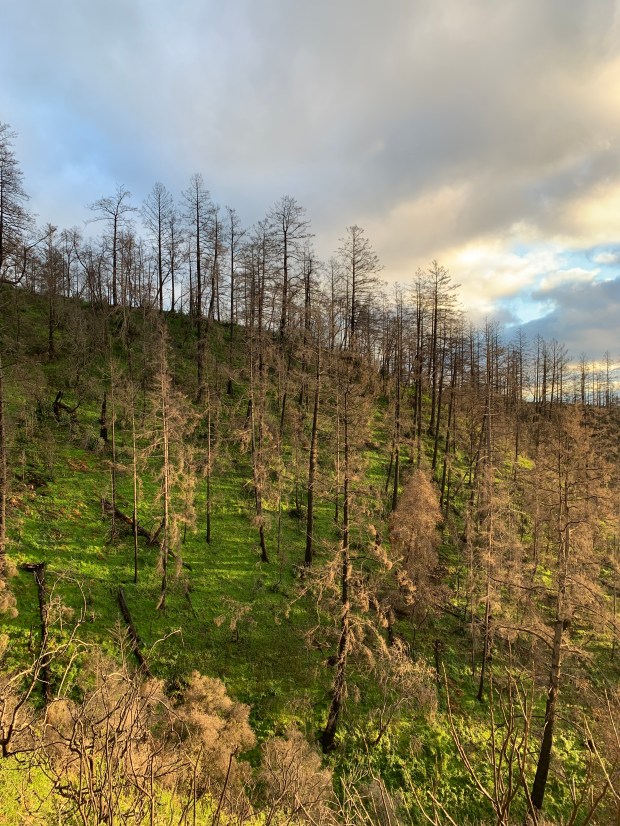
Each Fall, Winter, Spring, and Summer, I have favorite hikes to immerse myself in these various habitats to experience what they have to offer at various times of year. Recently, I walked in the understory of one of our recently burned redwood forests. The scent of charcoal and blackened redwood trunks are relatively new to me, but the ripening acorns, orange-blushed madrone berries and the cooing and loud wing flaps of band tailed pigeons remind me of the fall’s wildland harvest time. Creekside walks are especially nice right now with the sound of water, lush ferns and blossoming monkeyflowers contrasting with so much of the brittle dryness of late summer elsewhere.  Soon, there will be rain, and the manzanitas unfurl clusters of urn-shaped, honey scented flowers. The chaparral is the first habitat to erupt in bouquets with the smell of fresh rain on soil. Bees will bumble and hummingbirds will dart between the many chaparral blossoms. Rehydrated back to fluffy life, lichens and mosses will add depth to the chaparral’s colors and textures, accentuating the change brought by the annual wet season we call winter.

Through my posts at BrattonOnline, I will share notes about the places I visit and help connect you with ways to learn more. There are books, interpretive trails, guided field trips, multimedia internet resources, museums, and events that will help us continue to explore this wonderful place. Meanwhile, I hope that you will regularly remind yourself that we are living every day alongside one of the nation’s most densely diverse natural areas and that there are opportunities to explore it, real close by. Experts note that relationships last best between people who remain curious and are willing to stretch and grow; I posit the same is true for our relationship with nature. Remaining experientially and physically engaged with nature, we will be healthier emotionally and physically. Learning more about nature and having more frequent conversations about what we have experienced and learned will help to protect and steward nature.

Each week, I will present a bit of homework for specific direction to go deeper with the concepts I introduce. This week: do some ‘forest bathing’ in the redwood understory or walk near a stream. Read a bit out of Kat Anderson’s Tending the Wild, Burton Gordon’s book Natural History and Cultural Imprints of the Monterey Bay, and Ellen Bakker’s An Island Called California. Visit the Santa Cruz Museum of Natural History. Talk to someone about your personal experience with the nature around us.

And, with my posts, I will list a few of the new things I have experienced in nature the past week. Each fall, I see the arrival (from Alaska!) of golden crowned sparrows as well as (from I don’t know where) western meadowlarks; geese flew overhead geese in huge honking V’s; the sun hit its midway point moving south to north- last Wednesday was Equinox – now the nights are longer! Send me a note about something you noticed that is new in nature so that I might add it to this list in future posts.

One Year After Our Big Fire

Since the firestorm of 2020, I’ve witnessed both the rebounding resilience of nature as well as post-fire human responses that have ranged from truly awe-inspiring to bewildering. When the fire first struck, I had a harrowing 10-day amateur-firefighting experience. I well recall the panic – and the portentous moment when toasted tanoak leaves floated down from the smoke-darkened sky. Soon thereafter, the march of head-high flames incinerated everything on our farm that we couldn’t save with just us two people and our heavy fire hoses. After the smoke and flames – and through the entire year since – there’s been so much change.

This story starts last August, when we endured three days of wilting heat. Then, a hurricane hundreds of miles south of us went rogue, splitting in two, half of it raking quickly across the length of California. I woke to that half a hurricane – a massive silver-gray cloud-wall steaming and rolling north along the coast and a 10-minute-long 70-mph wind gust accompanying devilish sheets of whole sky-enveloping lightning and unbroken thunder. Soon, lightning-ignited small fires in too-remote areas joined together into a monstrously huge and fast-moving firestorm. State firefighters could not gather resources quickly enough to fight it and called for evacuations, and all but one person escaped with their lives. Non-humans fared less well. The smoke and flames took a month to dissipate, allowing thousands of evacuees to return to what, if anything, might be left of their homes.

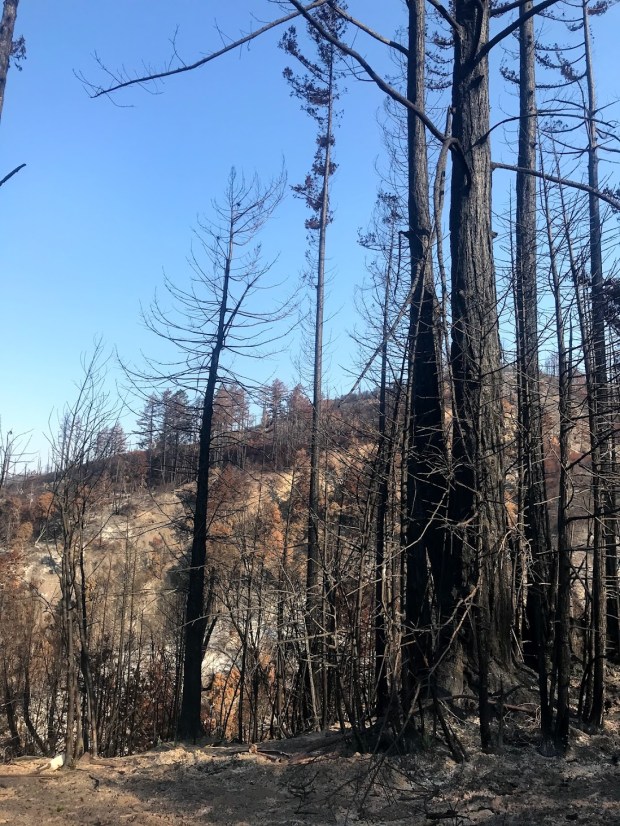
The fire left a landscape of blowing ash and a hundred shades of charcoal gray with sporadic patches of toasted brown vegetation and very few areas of green plants that somehow escaped the flames.

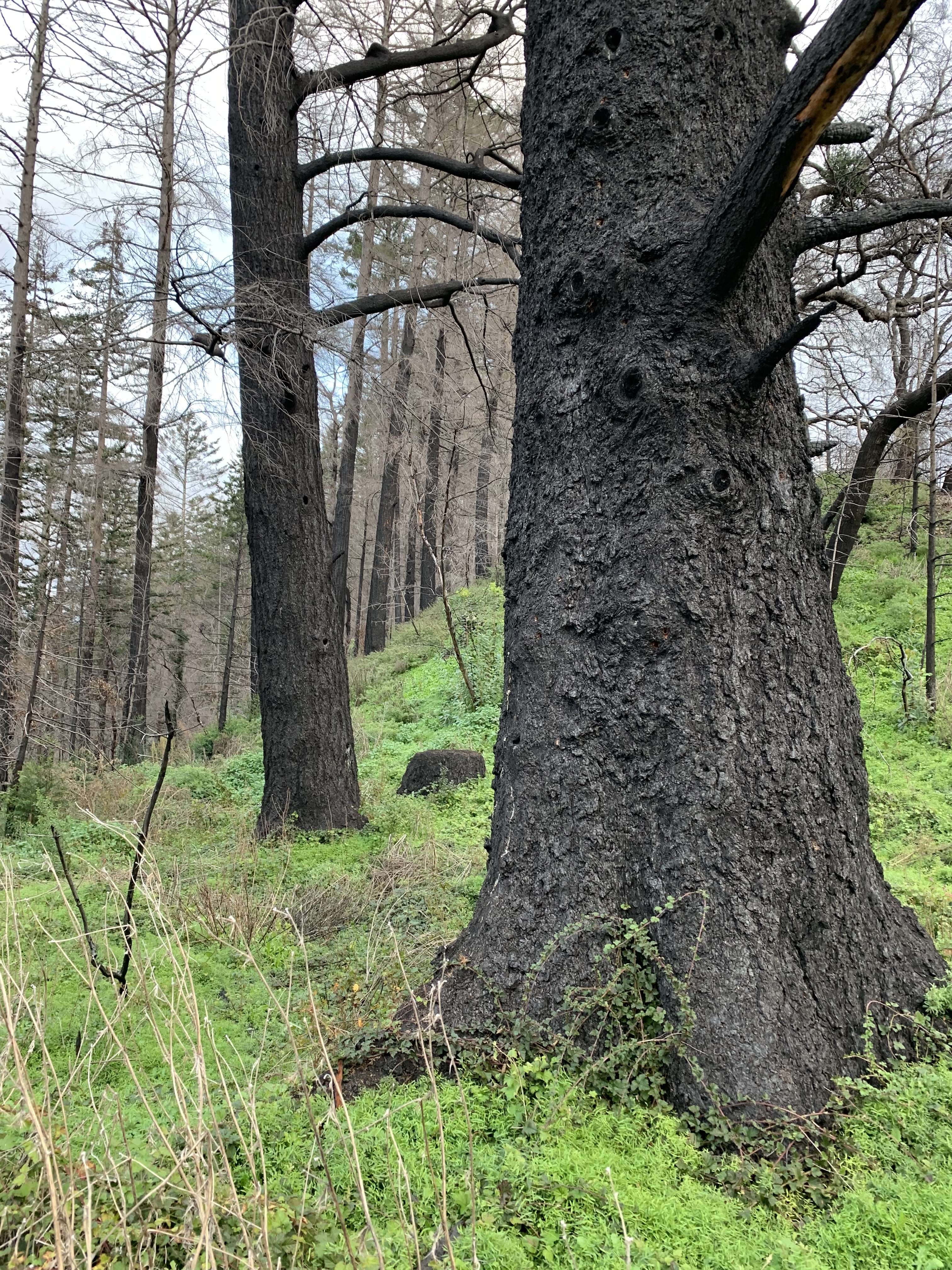
Before the fire, lush redwood forests had dripped fog onto carpets of ferns and sorrel. Under high conifer canopy, Pacific wrens whistled away the days in brilliant, wandering sunrays. Daylight transitioned into forest-hushed nights with owls hooting and woodrats rattling their fleshy tails. Those same forests, after the fire, were spires of high, blackened, tree-trunk pillars with few branches remaining. These towered over ankle-deep, white, fluffy ash and patches of crunchy charcoal. All the animals were gone … many had roasted alive.

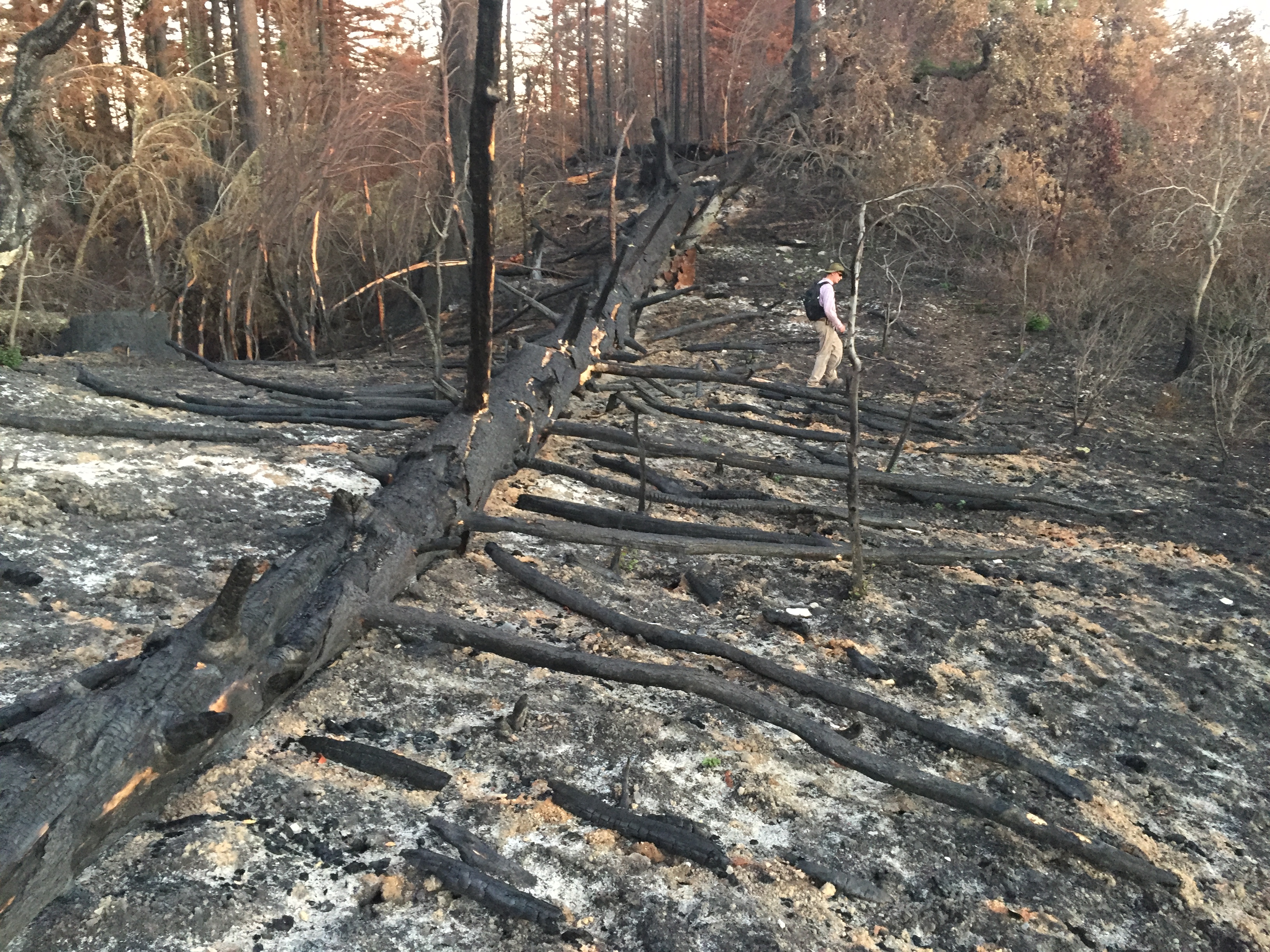
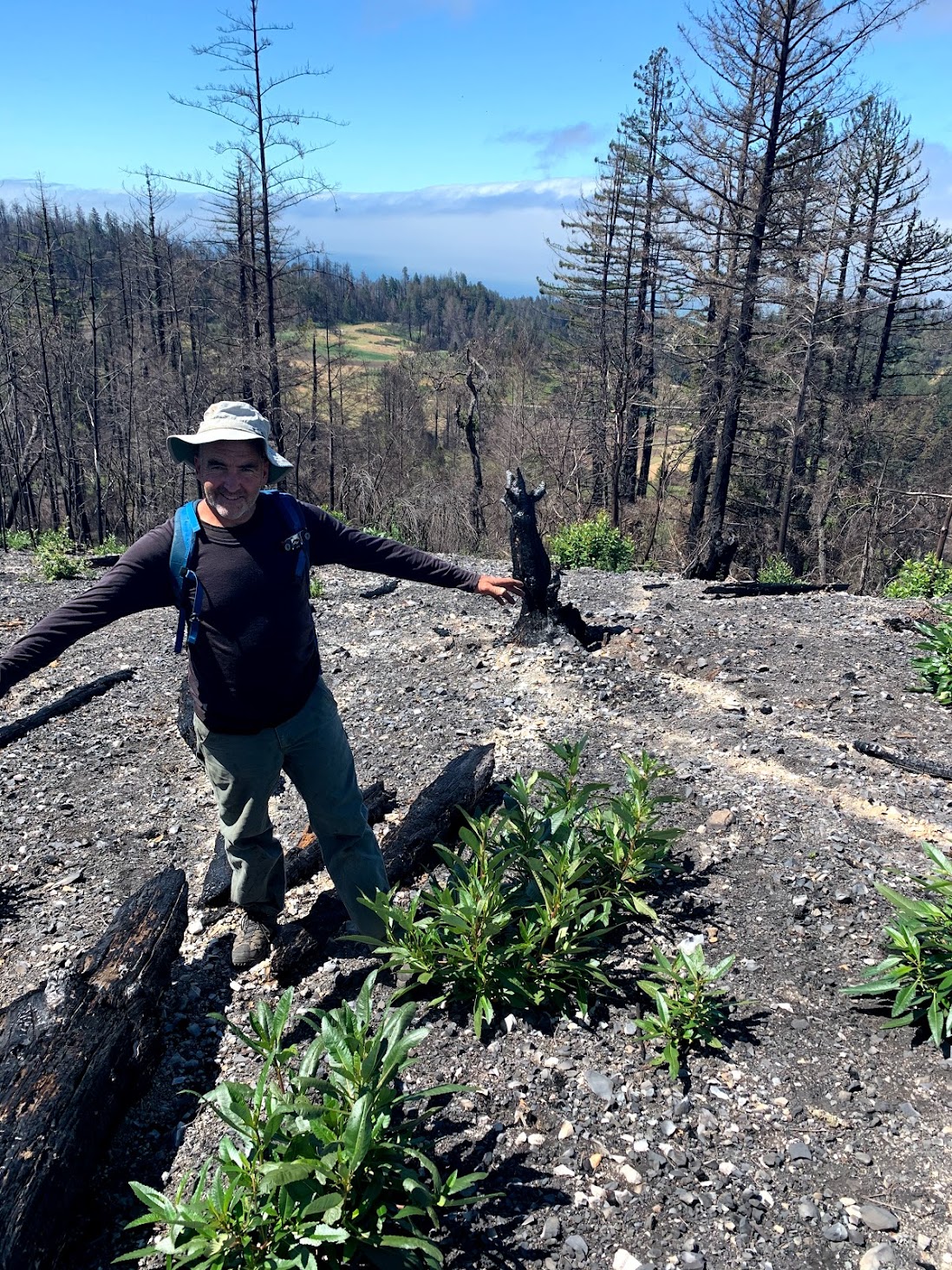
Before the fire, the ridgelines above those forests had been dense chaparral. There were millions of 10-foot-tall, lush, green pines erupting through rafts of shorter shrubs – a dazzling array of colors with resinous and sweet scents and a multitude of textures. Eleven years previous, the Lockheed Fire had burned much of this chaparral, and all this life had since rebounded. In the wake of that fire – a timebomb: criss-crossed, 6–12-inch-diameter logs from killed and gradually falling pines piled up hip-high for thousands of acres and miles around. During last year’s firestorm, those logs burned so hot they left impressions criss-crossing the hillsides, each outlined in white ash and vaporizing what little soil there was into red brick. That heat cleared ridge after ridge down to the stone we call “chalk rock,” a fractured mudstone crushing easily or making metallic, pottery-shard noises when you walk across it. For months after the fire, peering closely, nestled in piles of charred rock, you could find little fingers of burned stems and twisted fists of stump-like burls, all black, seemingly lifeless.

Among these forests and in the chaparral, people were living in neighborhoods and rural properties large and small. Since the early 1900s, neighborhoods had gradually developed, woven in between natural areas and parks set aside for redwood conservation and recreation. The fire destroyed the remote Last Chance neighborhood and badly affected other neighborhoods in the hills above Boulder Creek. The fire also tore through the Swanton community and then much of Bonny Doon. These communities contained layers of history. Generations-old families shared this landscape with the newest wave of neighbors from the wealth machine of Silicon Valley. University of California administrators and professors, along with student renters, were living alongside old hippies and back-to-the-landers of all political persuasions. There were also many blue-collar tradespeople, teachers, and retailers. This was a mixing pot of politics, perhaps with more left-leaners, and all united by a love of rural living. They found ways to be good neighbors from sharing news to clearing roads and helping newcomers figure out how to settle in comfortably with the various issues unique to this part of the Santa Cruz Mountains.

The fire burned homes new and old, whether they were owned by the super-rich or the very poor. There were dilapidated, barely habitable shacks surrounded by old cars, tattered furniture, and storage sheds with recyclables overflowing into the surrounding forest. And then there were the fancier estates – polished redwood decks, outdoor kitchens with marble countertops and brick pizza ovens, fancy hot tubs, and English gardens with statuary. These varied developments were all mixed up in the matrix of shrubs and trees, chaparral, and forest – one of the two most diverse natural landscapes of North America. The fire made the patches of human stuff into the same types of ash and waste: deep piles of charcoal and blowing nasty ash accented in places by unrecognizable twisted metal and piles of collapsed brick. New cars or old – it was hard to tell from the burned-out, fire-wasted frames. It was impossible to tell where the landscaping stopped, and the wild places began.

People’s responses to the fire were even more varied than their ways of life had been prior to the fire. During the peak of the fire and for the long period of smoldering and even longer evacuation period, the few brave and stalwart worked hard protecting their homes, their neighbors’ homes, their pets, and human friends wherever possible. On the edges of retreating flames, packs of looters swept in, stealing from houses burned and those that were spared. A standoff between the stalwart stay-behinds and looters resulted in a looter getting shot in the leg. Someone who lost nearly everything set aside some mementos at dusk, only to find them gone the next morning. A year later, strangers still lurk around the burned areas looking for stuff to steal. As if the fire itself weren’t enough.

The many who lost their homes were scattered. A few quite visible ones took up trailer homes along the highway in Davenport. Many moved to rentals or into homes with friends, adding to the crowded town. After a few, seemingly long months of waiting, the government-run cleanup started: giant machines scooping and scraping the charred piles of debris into convoys of trucks, hauling the stuff “away.” We were impatient and then happy for the efficiency, strength, and scale of this enterprise. No one asked and there was no news about where that stuff went, what the communities and land think of how we disposed of it, far away from here. After cleanup, some people sold out while others stayed put. It was a sellers’ market, but that meant those selling out faced grim realities for purchasing anything else in the area, and some were forced to leave. Slowly house trailers appeared on wrecked properties. A small fraction found the means to start rebuilding.

Between the remaining homes or the burned-up human stuff, some people (like me) were fascinated and relieved by the resilience of nature, bolstered by its ability to heal and rebound. To others, nature was too slow—they wanted a kind of speed healing and found many ways to apply Band-Aids to cover the fire’s wounds. Some know nature heals but wanted to help it along. Others had no sense of nature and acted like alien gardeners on some other planet. Others were never much at tending the land: they had never been much interested in such things. County-hired contractors hydroseeded burned building sites and surrounded them with straw bundles to contain toxic runoff. RCD employees were heroes, working ceaselessly to help stunned property owners prepare for post-fire rains, erosion, and slope failure. Meanwhile, people were tossing around native wildflower seed mixes to hopefully brighten land. Others, wanting more instant and positively perky landscapes, dug in thousands of roadside daffodil bulbs to persist and spread for centuries, a long-lasting and sad legacy spurred on by a well-meaning community leader.

Along roadsides and powerlines, orange-vested, hard-hatted officials spray-painted numbers on thousands of dead or damaged trees, and then the saws and grinders got going. Months of chainsaws and chippers whined and roared, shaking the earth and sky, filling hundreds and hundreds of trucks, hauling more stuff to yet unknown fates and destinations: “away.” People already traumatized by burn damage faced another shock as workers removed patches of forest in what was left of their yards, forever changing their historic views, removing their remaining privacy … all in the name of road or utility safety … or perhaps liability.

The first spring after the fire, the forest surged with life. Most redwood and oak trees that had burned resprouted. Some sprouted from their charred trunks, while others sprouted only from their bases. Understory herbs filled the spaces between the trees – twining vines, prickly thistles, and carpets of wildflowers. In many places, the forest floor was brighter than we had ever witnessed – dazzling flowers! Splashes of cream or blue iris bloomed profusely alongside extensive rafts of pale pink globe lilies. Animal life returned, too. Hungry deer shortened tanoak sprouts by the mouthful. Fish biologist “snorkel surveys” spotted surprising numbers of steelhead in the burnt and newly sun-brightened streams. Shortly after the fire, great horned owls hooted from recently cooled trees. A few more healing months and then pygmy owls also were cheerfully hooting away from the scorched forest.

The chaparral mostly rebounded, too. First there were many bush poppy sprouts…and many, tiny seedlings. Then, very slowly, the many fewer manzanita burls began pushing up sprouts. Chaparral oaks, madrones, and chinquapin joined the resprouting. In late April, the diverse fire-following flowers were starting their famous post-fire show. Massive patches of whispering bells carpeted hillsides – ferny foliage and pale-yellow bell-shaped flowers along with an odd scent that some people enjoy. An intrepid bunch of botanists I hiked with discovered a new population of small-flowered blazing star. And, we found previously undocumented areas of pink-purple stinging lupine, as well as sweetest-scented, tiny phacelia with yellow and pink flower mounds, and one new patch of the sapphire blue–flowered twining snapdragon. By midsummer, I could still walk easily through extensive areas of chaparral in the bare spots between resprouted 2-foot-tall shrubs and trees. Big patches of bright yellow bush poppies were feeding innumerable bees.

I could find only a very few pine and manzanita seedlings, so the chaparral will look a little different in the wake of this fire compared with the last fire. The cooler burning Lockheed Fire created massive thickets of knobcone pine seedlings – extending for miles outside of the fire footprint, where seeds were blown on the fire wind. With the very dry winter following this more recent fire, along with fewer pine cones and a short-lived seedbank, many fewer knobcone pines may regenerate this time around. With the aforementioned piles of Lockheed Fire–killed knobcone logs, the ground temperature got so hot that many ancient manzanita burls were destroyed. So, now fewer manzanitas and perhaps more open space (more weeds, more grasses or wildflowers?) will characterize the next generation of this chaparral.

Wildlife has recovered in the chaparral areas. The deer were most evident – I found bedding areas nestled into the protective, denser patches of burned-out pine shoots; they had also been browsing off the diversity of resprouting shoots. I was surprised to see gopher mounds – they must have been hungry for a long while awaiting something fresh to eat! Solitary bees were creating patches of burrows in the rare areas with soil, in between the chalk rock. Other pollinators were buzzing busily between the many post-fire wildflowers.

I am wondering now … what will happen next? In the hominid realm, I predict that this fire is in the process of creating a shift in the hill cultures. Cultural shifts occurred in Santa Cruz after the University opened in 1965, then again after the 1989 earthquake, and again after UCSC admissions policy changes in the late 1990s, and yet again with Silicon Valley gentrification accentuated by COVID remote-working policies. And, while the fire changed some minds as to attractiveness of rural living, it also has probably permanently displaced people who were economically marginal before the fire. Like downtown and the University, these rural areas are already taking a giant step towards having less “character” – the numbers of tinkerers, artists, and oddballs will plummet to be replaced by “normal” people of much greater economic means. I hope there will be enough critical mass of those people staying to continue the culture of rural, peaceful living, and cross-cultural welcoming and kindness. Already, I see people helping others in recovery, in bearing through the many jumpy instances – tedious smoke scares, power outages, and road closures. Our farm is so grateful for the outpouring of donations and physical support for recovery; many others have experienced the same generosity.

I predict that the attitude towards nature in general will shift from what has been more natural towards the more manicured, non-native, unnatural landscapes currently found more often in suburban Southern California. This trend started with the mass plantings of “cheerful” daffodils and will continue with greater numbers of fire-proof “garden beds” full of red lava rock gravel, trucked from torn apart hillsides miles away, accented by well-spaced foreign, pink-flowering daisy bushes … trellis arches of bougainvillea pouring over hummingbird feeders by tiled patios with huge propane grills and circles of ornate metal lawn furniture. More of our endangered chaparral will be bulldozed to dirt, forests will be chainsawed farther away from “civilization.” Where once red-trunked manzanitas were festooned by honey-scented clusters of pink flowers through winter, where once there were sprawling, lichen-covered live oaks full of birdsong, there will be lifeless mats of 2-inch weed stubble, the product of three or four times a year of mowing, for fire safety. These weeds will carry fire quickly nevertheless, when comes the day that fire returns.

I find the predictable response of the general population only somewhat offset by a few people with greater things in mind. This past year, I’ve seen signs of more of my community learning to live in this fire-prone place during these increasingly hot and dry times. Friends I visit are doing more safety clearance around their homes. I see Bonny Doon Firesafe Council’s and others’ advertisements of well-attended workshops for “home hardening” – an odd term that means making it harder for fire to burn your house. Across our region, volunteers are training together to use “good fire” to clear fuels that would be more dangerous during uncontrolled wildfire. The Central Coast Prescribed Burn Association has even started burning areas using well-trained volunteers who are gaining more experience. Just this past year it has become common knowledge that the only way to really live in this state is to use prescribed burns over millions of acres, and that’s going to take a lot of work.

Fire is part of ecological restoration in California, but forests that haven’t been tended since Native People’s times require a lot of fuels reduction before “good fire” can hit the ground. Conservation lands managers with the San Vicente Redwoods, State Parks, and Swanton Pacific Ranch have all been awarded State funding to prepare their forests for prescribed burns. In the coming few years, we will be able to witness the largest-scale restoration work our area has experienced in more than 200 years, since the native peoples were forcibly removed from this land.

We can all take part in this restoration effort. We can volunteer with the Prescribed Burn Association or with invasive plant control teams. Neighbors to wildlands can do their part to protect their homes and to keep fire from spreading from built areas into the wildland while still restoring native species. Through these coming times, if you have the wherewithal, it is important to document what happens. The year before this past fire, I began organizing a “ten-year retrospective” from the Lockheed Fire. I searched to find anyone who could speak to what we had learned or what (even more simply) change they had documented over that decade. I could find no scientific studies, no documentation at all. Jim West took hundreds of photos immediately post-fire in the Swanton area, but no one followed up to see how those scenes changed over time. Without documentation, without trying to learn from our experiences, how can we improve how we live on the land, how we restore nature, or how we respond the next time fire scorches the landscape?

With this fire, though, I know people who have initiated post-fire research. For instance, there are now two studies examining fire effects on our local forest soils. And, mainly because of the Montecito landslides, teams from United States Geological Survey and the California Geologic Survey mobilized quickly, before last winter’s rains, to learn how to better predict slope failure and debris flows. Ongoing marbled murrelet and mountain lion research will no doubt incorporate fire effects into their analyses. The Federal Fish People have been studying how salmonid populations changed after the fire. This post fire report after the fire is all I have seen that analyzes firefighter response; there may be other internal studies.

What’s next with our rebound from the CZU Lightning Complex Fire? Timelines for rebuilding will necessitate a continuation of the housing problems – people in trailers or displaced to rentals while they organize for rebuilding. Hundreds of people who had no prior experience with home building, and all of the permitting involved, will continue their steep learning curves and patience development. They are lucky for the leadership shown by the Community Foundation who sponsored a fire-wide debris flow study, which would have otherwise been burdens on each individual landowner to fund, separately, for each house rebuild. The County has enacted some building review and permit streamlining processes, but experiences have been mixed.

While we really want more rain this winter, we will worry about landslides. The winter rains will bring lush regrowth in the burned areas – any remaining patches left bare by the fire will be covered with luxuriant plants. Rebounding and lush, miles of newly sprouting shrubs mean lots of food for lots more deer … which will be good food for mountain lions. The blue-blossom ceanothus that sprouted from millions of seeds after the fire will bloom this spring, creating drifts of sweet-smelling lilac flowers and clouds of bees. Some woodpecker populations will skyrocket, but acorn woodpeckers will be having a hard time from the loss of all the oaks. With much of the hazardous trees removed along roads and utility lines, that kind of noise will be slowly replaced by hammering and sawing of anything that can be rebuilt.

The future is uncertain. I wish the best for nature and for those who need to heal, to rebuild, to settle into their new communities, to fall in love again with new pets, to learn to live with new neighbors and new landscapes, to learn and grow from past trauma and new fear. I also am so happy to be a part of a community of brave and stalwart protectors, skilled makers, musicians, healers, restorationists, cooks, and land-tenders. I wish my community the best, to live long healthy lives and to stick around, working together to settle into becoming indigenous with this beautiful land.

Note: if you have observations from the post fire Aug 2020-Aug 2021 to share, please leave them as a comment here. I want to collect stories of what we’ve seen.

The Monument-Worthy Birds of Cotoni-Coast Dairies: An Analysis

Introduction and Background

Obama’s Proclamation giving National Monument status to Cotoni Coast Dairies included protection for an interesting list of birds: a challenge or a nose-thumbing to preservationists? We don’t know, but in this essay I present both perspectives. First, a reminder that experts presented the President with a science-based white paper suggesting a list of sensitive natural resources worthy of protection by his Proclamation; most local conservation organizations wrote letters supporting this proposal. The white paper included 7 species of birds that are protected by the California Department of Fish and Wildlife, but not protected under the Federal Endangered Species Act (ESA)…and so, without mention in the Monument Proclamation, might not be protected on BLM lands:

  • American peregrine falcon –  Falco peregrinus anatum– CA fully protected
  • Bryant’s savannah sparrow – Passerculus sandwichensis alaudinus – CA Species of Special Concern
  • Ferruginous hawk – Buteo regalis – California Watch List (wintering)
  • Grasshopper sparrow – Ammodramus savannarum – CA Species of Special Concern (nesting)
  • Northern harrier – Circus cyaneus – CA Species of Special Concern (nesting)
  • Olive-sided flycatcher-Contopus cooperi – CA Species of Special Concern (nesting)
  • Short-eared owl –Asio flammeus – CA Species of Special Concern (nesting)
  • Tricolored blackbird – Agelaius tricolor – CA Threatened
  •  White-tailed kite – Elanus leucurus – CA Fully Protected (nesting)

The white paper also included recommendation for recognition of species that are federally protected as long as they are on California BLM’s sensitive animal list:

  • Burrowing owl – Athene cunicularia – BLM CA sensitive animal; CA Species of Special Concern
  • Golden eagle – Aquila chrysaetos – BLM CA sensitive animal; CA fully protected

And, experts mentioned two other notable bird species that frequent the property:

  • Red-tailed hawk – Buteo jamaicensis – IUCN Status: Least Concern
  • Short-eared owl – Asio flammeus – IUCN Status: Least Concern

At first glance… the Proclamation was a moderate success for bird conservation- experts proposed 11 bird species for the Proclamation, and the President’s Proclamation included 9 bird species. But, the Proclamation included just two of the species experts proposed: the white tailed kite and peregrine falcon. Besides the kite and falcon, the other species listed by the President are common and widespread enough to not warrant any conservation concern. Here are the other 7 birds listed in the President’s proclamation, along with their listing status:

  • American kestrel – Falco sparverius – IUCN Status: Least Concern
  • Black swift – Cypseloides niger – IUCN Status: Least Concern
  • Cooper’s hawk – Accipiter cooperii- IUCN Status: Least Concern
  • Downy woodpecker – Picoides pubescens – IUCN Status: Least Concern
  • Orange-crowned warbler – Oreothlypis celata – IUCN Status: Least Concern
  • Tree swallow – Tachycineta bicolor – IUCN Status: Least Concern
  • Wilson’s warbler – Cardellina pusilla – IUCN Status: Least Concern

Optimism: A Presidential Challenge?

An optimist might consider the list of birds in the President’s Proclamation could be seen as a challenge to biologists, preservationists, and BLM. The President might have been truly insightful, providing protection for species common enough across the property for scientifically sound analysis of the impacts of varying levels of future visitor use. Only when there are enough nesting attempts of a bird species can we compare nest success in areas with and without visitors, or between areas of varying visitor use types/intensities.

With all of the biota listed in the Proclamation, BLM is required to provide protections in their management plans, setting scientifically-based preservation targets, and monitoring the status of these resources over time. Establishing preservation targets for species will involve developing various hypotheses, such as:

  • What is a minimum viable population size?
  • How many individuals are necessary to maintain their ecological functions?
  • How many individuals are necessary in various parts of the property to ensure that the public has an opportunity to view them?

It is likely that at least some of these birds are common enough across the property right now, when the property is seeing very little visitor use, that experts can inventory their densities and then notice change over time in response to varying management decisions. This would not be the case with more uncommon species.

I should point out that this optimistic viewpoint is difficult to completely uphold because the President did not include the expert’s suggestion of olive-sided flycatcher in his Proclamation: this is a species common enough on the property to meet the criteria outlined above.

Pessimism: A Presidential Nose-Thumbing?

The pessimist might consider it a purposeful snub by the President when he ignored most of the birds recommended by experts for inclusion in the Proclamation. He might have various reasons for snubbing the experts.

For instance, in recent Santa Cruz County history, and with the Monument Campaign in particular, we have seen political leaders leveraging and emphasizing the divide between pro-access, maximum use, recreation advocates and conservation advocates. If the pro-access, maximum use advocates had leverage with the President, they may have advised that inclusion of the conservation community’s recommendations as something to ignore.

An additional and perhaps additive possibility is that the President’s advisers were opposed to preservation of grassland habitat on the property, possibly because of the near necessity of using livestock grazing to maintain that habitat. Despite a growing scientific consensus, some maintain that California’s coastal grasslands are largely ‘unnatural’ relicts of human management, evidenced by their ‘natural’ succession into mixed coniferous forests. And, while fire is sporadically used to maintain California’s coastal grasslands, livestock grazing is more common. Many of the bird species that experts recommended for inclusion are dependent on extensive grassland habitats; some may even require livestock grazing to maintain structure that is conducive to nesting success. The reader is no doubt cognizant of some of the environmental community’s opposition to livestock grazing on conservation lands, and this philosophy could well have been in play when advisers helped the President to draft his Proclamation. None of the birds included in the President’s Proclamation rely on grassland habitat.

A final additional and perhaps additive possibility is the Presidential adviser philosophy that the protection of grassland dependent birds might interfere with maximizing visitor use of the property. Grasslands on the property offer the easiest opportunities for access to the many visitors desiring expeditious photographic opportunities. And so, perhaps the President’s advisers refused protection of grassland birds in order to more readily allow for maximum visitor use.

Concluding Remarks

The future will help inform the prevalence of the optimistic or pessimistic interpretation of the President’s motivations for naming the Monument-worthy birds of Cotoni Coast Dairies in his Proclamation. With luck, we may be able to have conversations with the President’s Proclamation advisers to learn, first-hand their rationale. And, we may gather more clues in the advocacy of Monument Campaign organizers and others during the planning process for the property. We will share our discoveries to help science-based conservationists better engage with similar situations in the United States. And, we will use what we learn to improve our strategy moving forward with preserving the sensitive natural resources of Cotoni Coast Dairies.

Postscripts

  1.  One reviewer suggested an alternative possibility for the President’s advisers largely avoiding the experts’ list of sensitive bird species: the advisers may have not recognized the credibility or legitimacy of the source of information.
  2. Another reviewer pointed out the irony of the Proclamation recognition of indigenous peoples and yet the lack of inclusion of those peoples’ iconic birds: eagle and hummingbird.
  3. Bird experts point out that the President’s inclusion of American kestrel was cogent because of a regional decline in nesting, a phenomenon that isn’t explicable but warrants attention.
  4. Bird experts also point out that the President’s inclusion of black swift is curious because the species has never been known to nest on the property, and nesting areas anywhere nearby have long been abandoned.