A friend recently pointed out how one aspect of human behavior can provide hints about other parts of our personalities. For instance, with people who enjoy spicy foods: might it be interesting to see how they integrate endorphin rushes into other parts of their lives. Might they act in ways that invites pain, in other ways?
Similarly seeking analogs, I wonder if how people treat their pet dogs says something about their world view, in general?
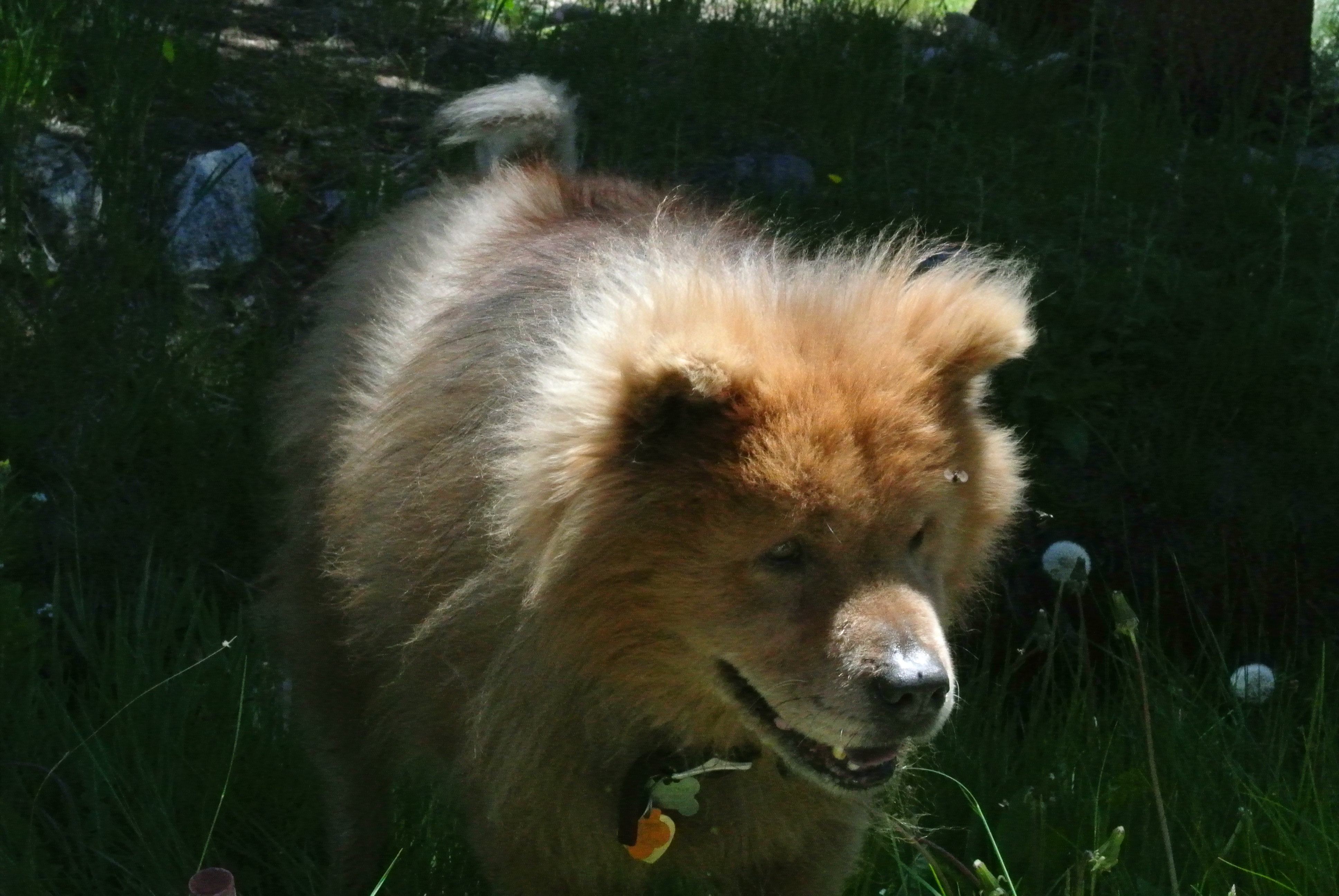
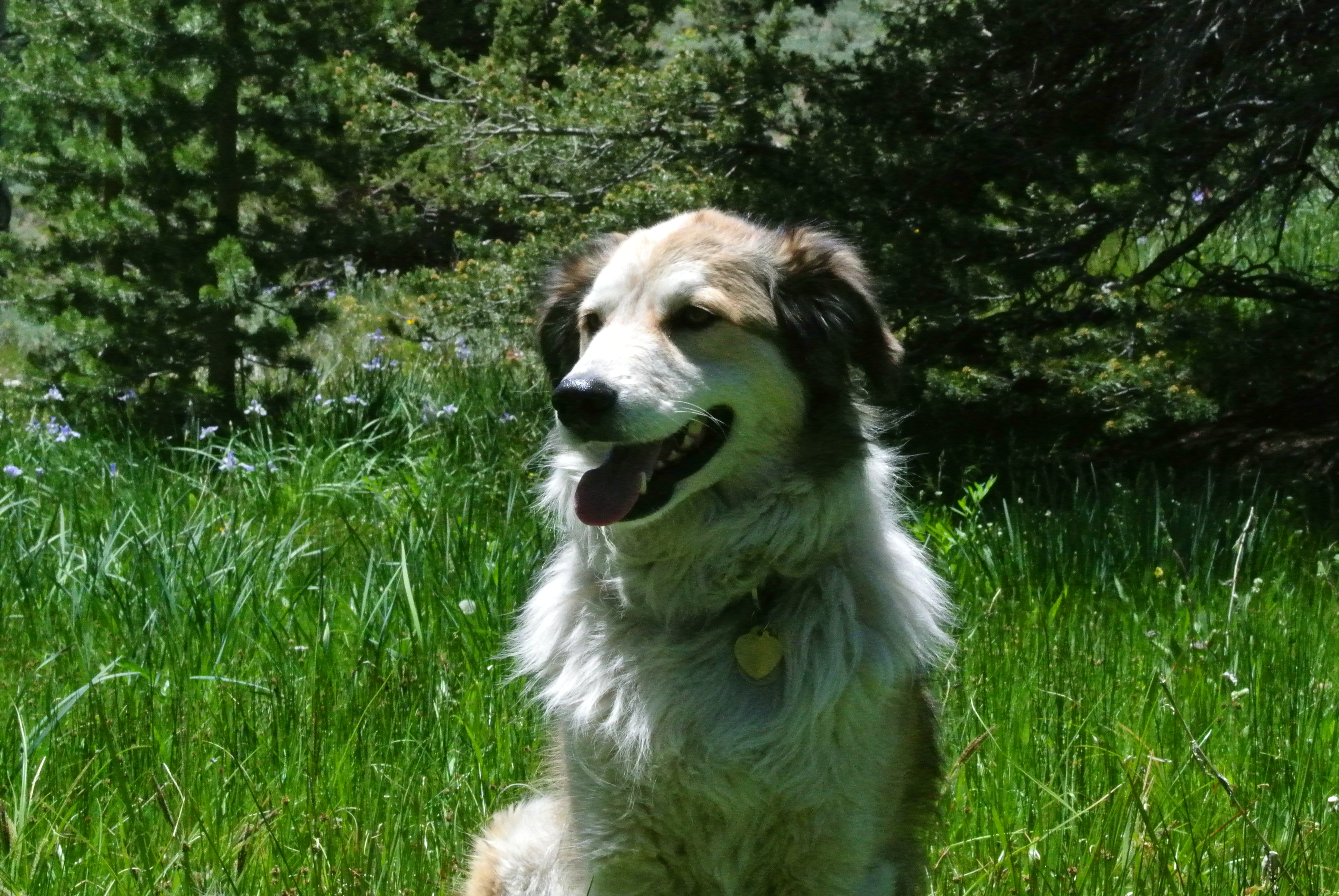
What kind of person could treat this dog poorly? He was a good pet.
Fido, Get Over HERE!
Get their attention first by yelling their name, then give them stern ‘BAD DOG’ words. Yell it again if necessary, and again. If they finally show up, then smack them.
This habit of barking orders at dogs over and over, every time that the person feels the need to control their dog makes me wonder how that person sees the world. Physical brutality on top of that, just when a dog has (finally) acted as directed, makes me very sad for those relationships. Does command and control and physical brutality make sense in the larger world to such people?
A Whistle Does It
On the other hand, I’ve seen people who have the most cooperative and loving relationships with their dogs. For instance, a certain whistle brings the dog running, tail wagging. Invariably when asked about how these people got to that point with their pet dogs, they say it took a lot of time and effort. Honing communication combined with positive reinforcement are key. Are people who arrive at such non-violent relationship building with pet dogs also apt to have a similarly well-evolved means of relating to their fellow humans?
Different dog breeds have different temperaments, to be sure, but communication is key.
What To Do?
I routinely run into this issue and it really bothers me. The Capitola DMV has it. The Davenport US Post Office has it. I bet you’ve seen it, too: signs that say something to the effect of ‘No Animals Allowed Inside.’ What are humans if not animals? Minerals?
This problem of mine also crops up regularly in social commentary and literature when some ‘smart’ person decides to add their (sometimes ‘witty’) comments about what separates humans from non-human animals. Such arguments are generally flawed and baseless.
Social Animals
How might the world be better if we learned from the science of how social animals have worked out social problems? What if our conversations turned that direction regularly? And, what if humans thought a lot about that when adopting social animals into our lives?
Learning from Nature
There is a wealth of wisdom that Nature can share. Humans have benefited greatly from many of those lessons, and additional learning can take us much further.
When we see ourselves in the dogs we are trying to acculturate into our lives, we learn both how to better mesh with the dog and better hold ourselves in human society.
We might also apply this kind of learning with other social animals in our lives: parrots/parakeets/etc, deer, crows, cows, goats, quail, etc.
The finest people have the finest pets. Do dogs really look like their owners?
Cautions and Next Steps
We taught to be cautious about ‘anthropomorphizing’ non-human animal traits. The caution goes that doing so might make you blind to important differences. How about some balance here, and the adoption of a new word? How about cautioning about ‘anthroscism’ – advancing the idea that humans are somehow wildly different than all the rest of the animals? Same kind of reasoning holds: doing so might make you blind to important similarities.
Your homework: start a conversation this week about some human reaction you see that reminds you of how non-human animals act and why that might be.
-this post originally appeared as part of the online weekly blog BrattonOnline.com – a compendium of important information from around the Monterey Bay and beyond. There are movie and TV review, historic photographs from Santa Cruz, links to great media, and columns from amazingly well informed authors. Check it out! Subscribe!! donate!!!! The Blog Needs Your Support.
Here it is…suddenly the season where we reflect on what it means to be thankful and what to be thankful about. All around us, beings are ecstatically grateful every moment. But, us humans seem to segregate our thankful moments, relegating them to holidays or ceremonies. Well, we should be happy for the ability to reflect in such a way, however it occurs.
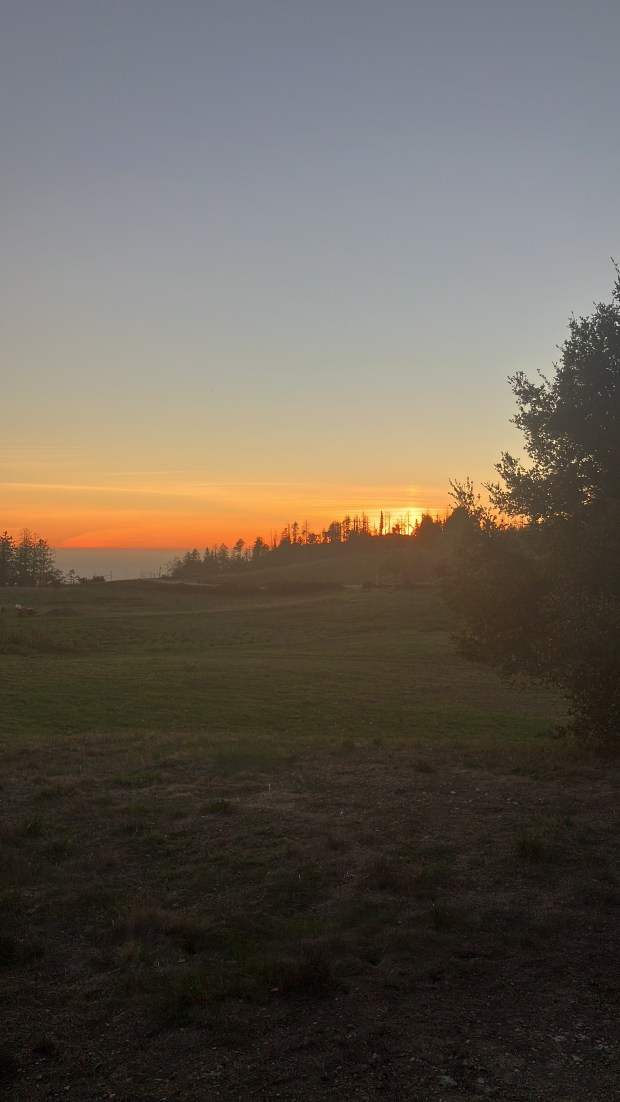
A recent sunset from Molino Creek Farm
Deep Time Thanks
Molino Creek Farm lies within the unceded territory of the Awasawas, or Santa Cruz People, in the Cotoni tribe. They lived on and cared for our land. They left lots of artifacts. There are places where seashells are still coming out of the soil. There are lots and lots of chert and some obsidian flakes. We have found bowls, mortars, and cooking stones. They were the first human inhabitants of this land and they took care of the old growth redwoods and ancient oaks that we still enjoy. Their land management made our soil rich for the crops we still grow.
The Greek Ranch and Transition
Much more recently, us Molino Creek Farm folks have The Greek Ranch and then Kay Thornley, Harlow Dougherty, Jim Pepper, Steve Gliessman, and others to thank for being here. There were years of hippies living here, wild years as we understand back in the Greek Ranch days. As the Greek Ranch transitioned to Molino Creek Farm, this contingent from UC Santa Cruz managed to purchase the land and created the organization that we have now. Many thanks to the folks who had the patience and fortitude to wade through all sorts of issues in establishing this cooperative.
A few Lisbon lemons still left on the trees
Farming
Joe Curry, Judy Low, Mark and Nibby Bartle, and many others worked very hard to establish Molino Creek Farm, which became a legend for dry farmed tomato production. The early farmers made enough money and worked hard with piles of purchased materials to put up miles of deer fence, long stretches of irrigation, and a very good agricultural well. They bought equipment – tractors, fuel tanks, implements, generators…much of which we still rely on. These intrepid farmers taught many people how to grow dry farmed tomatoes and those people started their own businesses. The Farm was the 13th certified organic farm in California…there are hundreds now. We must thank these organic farming pioneers for showing how it’s done and inspiring others to give it a go.
Intentional Community
Other work deserving thanks is from the communal spirit and willingness of those who co-own this land. Living together in such a rural place takes work. The Farm is off grid and so produces its own power and water. We live 3.5 miles up a private road, which takes a lot of maintenance. They say people used to have to drive with chains to get up a muddy hill on the way in, and even then it wasn’t certain.
We have people who manage the finances, ‘the books,’ taxes, meeting facilitation, meeting notes, work party conveners, and so much more. Some of the group maintain the farmland, others maintain the wildlands, and others the water infrastructure. There is a legal committee, a road committee, and a neighbor committee – all very necessary. It takes great generosity to make these things work and we remain grateful to one another for the things we fit into our otherwise busy lives to help keep things together.
2020 Fire
The CZU Lightning Complex Fire devastated our farm. We lost two homes and a community garage workspace, fences, parts of our water system, many orchard trees, and much more. We put out word about what happened and an accompanying call for assistance. Within a short while, we raised $80,000 to help generally and a big portion of that to revitalize what was lost in the orchard. Such Huge Generosity!! We are still awed by that support. The financial support we received is just one indication of the strength and support of the social networks that the partners in this endeavor hold and tend.
We lost quite a few of our avocados in the 2020 fire, but they are just starting to fruit again
Land Stewardship
Since the fire, we have had amazing support for tending our land. The Prescribed Burn Association has poured support into teaching our cooperative about good fire and then leading a prescribed burn last year, reducing fuels over many acres, restoring coastal prairie. They brought people here to help and keep in touch, watching with us the effects of their management. Now CalFire is offering that same kind of help!
Neighbors
Our neighbors have always been helpful. For years, the folks at the cement plant helped keep our road in good shape, the gate secure, and even supplied us with road material, rocks, and spare cement. PG&E has chipped in lots of funding and work to keep the road repaired.
The partners with the San Vicente Redwoods have also been unendingly great to us. Roadwork and weed work, fire and fuel management, security, and so much more have all been graciously a part of their contributions. We are learning together how to take better care of our lands, the non-human beings, and each other.
Community Orchardists
For 15 years, we have enjoyed the growth of our Community Orchard. We keep in touch with 225 people on email. 5 – 20 people show up to tend the orchard on many Saturday afternoons. Even though the fire took us backward a step, 5 years later we discover the orchard has surpassed that damage and is creating more and more amazing fruit, feeding more people.
This year, we needed a tractor and the community orchard network donated funds that allowed us to buy one this past week. It is amazing how the generosity continues, born out of the relationships we build by tending a beautiful orchard, creating “Fruit for the People!”
In sum, we are very thankful. We have so much to be grateful for. Thank you, each and every one of you, for the various kinds of love and support you offer this amazing place, this greater community, which we steward together.
Soon, (the fairly dumb) Daylight Savings Time ends and the days will seem even shorter, by a quick, artificial burst. Wildlife adjusts to Fall, changing their behavioral patterns. Fruits galore – ripening of successive apples, limes hanging thick. A new solar power array materializes. The end of Molino Creek Farm farmer’s markets. The ever-greening of fields. Thunder and fog, chill and sun.
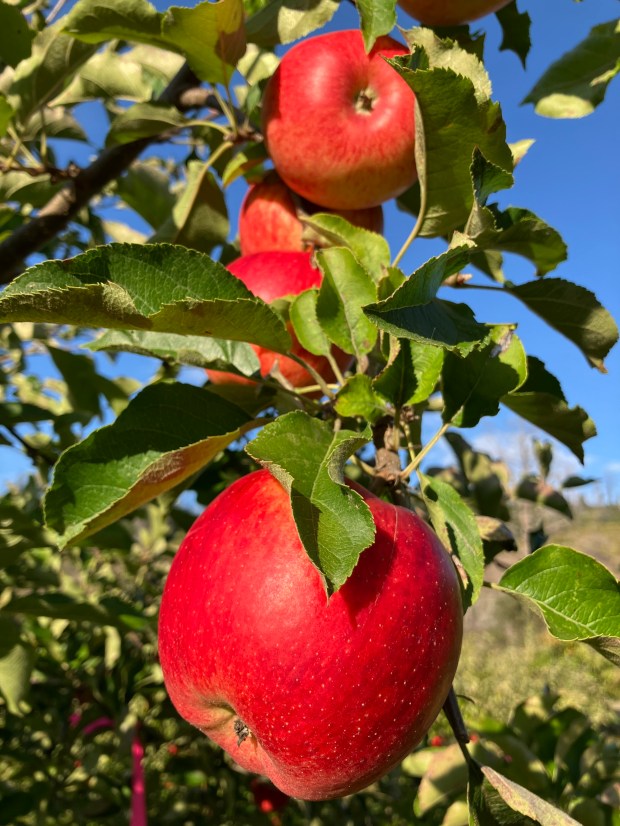
Jonagold apples are especially bright…and quite delicious!
Bursts of Rain
We’ve had two storms so far bring precipitation, but the soil is bone dry 2’ down. It hasn’t been enough rain to stop needing to irrigate. Nevertheless, in the fallow fields and meadows – the first herbs have germinated and the green blush is growing into outright blankets of verdancy.
The GreenUp has started – germination in fallow fields
Last night in the wee hours I was awakened by the rattling of the house. Thunder! Some caught great movies of lightning strikes over the Monterey Bay. The last thunder that rattled things was back in 2020 when an orchestra of timpani rolled and rolled, ‘Rolling Thunder’ went from myth to reality. So, up from bed I was forced and off to gawk out the windows to see what was up. Alas, the flashes were too rare, the thunder had moved off and the night was calm once again. No rain then but rain rumored to be forthcoming this weekend.
Between rain storms, it has been nice, even hitting 82F this past weekend. A firefighter asked me what the relative humidity has been – ugh, not Rx fire weather: 85%!
Shorter Days
We clock the shortening days through anticipation of the last light for harvesting apples for the following day’s market. We need enough daylight to sort the apples with even the tiniest blemish from the perfect ones that go to market. That moment is 6:30 this week. For those of us with day jobs, that makes for a very tight window to harvest and sort. Today, there were 11 hours of daylight: the night is surely taking over to the glee of owls and other night time predators.
Lone Fangsters
The fiercest of predators are guarding their territory and prowling alone through the lengthening nights. Long tailed weasel mating season has been over for some months: they fend for themselves, darting up to 30 miles per hour and winding slowly through the narrowest of rodent holes. Their scat is everywhere across the farm, reminding their brethren who is who and where they’ve set up shop.
Fiercer still, mountain lions are just starting to think about pairing up with the first caterwauling a few weeks back. There was a memorable pre-fire Winter Solstice where we heard 3 lion females yowling from different ridges around the farm. That seems about the normal date for that kind of behavior, and it is a ways away. Meanwhile, massive solitary male mountain lions prowl a huge area all the while worrying about running into another male, which can be fatal or at least badly injurious. They scent mark to avoid such encounters. The urine scratch marking of Big Cats has started on the trails through the dark redwood forest along Molino Creek – signs we haven’t seen for 6 years.
Bird Season
Now that their young are on their own, the chickadees, goldfinches, and Anna’s hummingbirds are also about, cruising without immediate families. Chickadees and goldfinches flock with other unpaired tribal members, though in fairly small groups around the Farm. 6 chickadees seems like the biggest flock right now, and even that’s unusual to see. Goldfinches are hanging in similarly small groups but there are many of those tea parties.
The Anna’s hummingbirds, though – anything but social: they bomb and whistle at each other fighting for territory with what little nectar can be found, mostly around home landscapes right now. Those hummers will be the first of these non-monogamous birds to nest: in January they start gathering lichens and spider webs to weave their beautiful baby-homes. Those tiny nests will in a few months glisten with raindrops and grow transplanted mosses, cradling tiny eggs and their near torpid sheltering parent. Now, these future parents aren’t associating with one another, but instead joust for food, and try to get fat on the dwindling nectar.
Deeply Social Birds
For whatever reason, our blackbird flock is extraordinarily large this year. I counted 80 birds in one tree yesterday. Another flock came in this evening to join that one – over 100 birds. Perhaps it is because we allowed cover crops to go to seed this past spring, so there’s lots of food. I dread the bird seed predation right after the planting of cover crops. This year, we opted for only bell beans for orchard cover crop – the seeds so massive as to avoid easy bird swallowing. Late germinating bell beans are welcome salad greens for a lot of birds, though.
I ponder how the blackbirds know to stop singing all at once. Their sing-song squeaky cacophony sounds a bit more melodious than a long line of train cars squeaking and screeching on ice cold rails. All of the sudden, they all stop: not one at a time, no slow lowering of the volume. How do they do that…and why?
I would be remiss under this heading to not mention the California quail. Never fear, the coveys are numerous, the birds fat and happy. What a show!
Arkansas Black – a dark apple with a bright white inside
Harvesting
The Two Dog crew returned to Molino Creek Farm to harvest their wonderfully productive tomato patch this week. At the same time, their pepper field is knee high and hanging densely with fruit. And, 2 Dog winter squash leaves are wilting revealing rafts of colorful squash.
Molino Creek Farm tomatoes, on the other hand, are mostly picked though the plants are putting on a flush of new growth after the early rains. Zucchini plants still push out yummy food. But, the season for that business is winding down – maybe only two more weeks of farmers markets to go!
The apple ripening season is just beginning to unfold. There was an unusually low amount of Gala apples and almost no Mutsu: our early varieties. So, this week we finish gathering the Galas and look to other types next. We’ll pick Jonagold apples – big, shiny, beautiful fruit and the prizewinner of our farm’s apple tasting competitions time and again. We are lucky to have a good number of those to share this season. Braeburn are close behind. But, the big amount of fruit is in the Fuji crop, which is 3 weeks away from being ripe. Will we be harvesting Fuji apples in the dark, or how will we figure out how to harvest so many of those fruit?!
Olives are hanging – December harvest?
The see-sawing of apple abundance is a result of what is called ‘alternate bearing’ syndrome. 2021 – post fire season, nothing much to harvest, then 2022 big year…2023 little year…2024 epic year…2025 little year. The way around this is to thin, thin, thin – and clip off fruiting spurs and so forth to make harvest more steady. Let’s hope we can keep up with thinning next spring – a crucial year to break this cycle.
Granny Smith – the quintessential winter apple….not ripe for months yet!
Limes!
The Persian lime crop hangs heavy – what an abundance we will have if this all works out. We are frequently told that our limes are the best on Earth, and we agree. Someone wanted to see if we could pick them now, while they are green, to provide people with what they expect to be limes. So, off we went to squeeze and test and try to find a green Persian lime worth selling. Sample number 3- the squishiest green limes we could find and the results…NO! No juice! The vesicles, or ‘juice sacks,’ just haven’t matured: they were pungent, poppy and quite void of juice. So, we’ll have to keep explaining to folks that the yellow citrus are the best limes in the world. We’ll have about 500 pounds of them this year to share…in February – March, or thereabouts.
Persian limes are getting HEAVY
So, the shortening days doesn’t mean the end of the harvest. Nay, the harvest for our tree crops is just beginning!
While the nights are clear – get you outside to a dark area and enjoy the night time sky. We are marveling in the big, clear Milky Way from Molino Creek Farm these long, dark nights.
High in the canopy…Bacon avocados for a year from now!
“Here comes The Rain!” they said, and it poured. Scuttling long tomato harvest hours, for many days, rescuing the fruit. Waves of warmth before the chilly precipitation. Then, the wind. Ravenous deer. Big colorful sunsets.
Another magnificent sunset at Molino Creek Farm
Deluge
Stepping out of the shower, there was this massive rumbling noise from outside. Breathing deep to combat a visceral fear growing: “What IS that sound?” Brain grabs an idea: Is that a low flying big aircraft? “No, that’s not it.” I recall the adage that tornadoes sound like freight trains. It has been years since my teenage Georgia experiences with twisters close at hand. I forget the noise. A quick round of glancing out of every window, every direction: no sickly gray-green sky, no breaking tree branches…probably not a tornado. But, it is raining so hard the roof is rumbling. Blustery but not extreme, the windows rattle and bow. The air could hold no more water. The surface of every bit of flat-ish soil was everywhere a deep liquid sheen where a rough moist surface had been moments before. Rivulets feed deep moving pools carrying rafts of debris. Luckily, it lasted only a few minutes; otherwise, it would have been a major disaster. Scary.
In a few hours, the world transformed. Gone is the dust of the long, dry summer. The Fear of Fire evaporates: we are given reprieve.
Coyote Bush Female Plant About to Burst with Seed (to the wind!)
Germination
This was the Germinating Rain, an unusual phenomenon of Mediterranean California. Billions of seeds scattered at the onset of the drying tawny summer and buried by crisp dead thatch are now sprouting, turning the brown landscape to green. The verdancy blushes at first, so subtle as to make you doubt your eyes: you must look closely. It will be February before the prairies are so green as to make your eyes hurt. It takes time for the new growth to overtop the skeletons of last year’s plants.
The farmers never gave up weeding. They were at it as recently as last week. Now, they will be overwhelmed by the flush of seedlings stimulated by the rain. But the harvest is nearly over and the moist ground is better prepared for planting the Winter cover crop. There will be more purposeful germination in the dark brown, fluffy richly scented soil for the next couple of months.
A raft of radish weed seedlings has germinated in this tomato field
Fall is Here
The subtle signs of Fall are arriving. Black walnut leaves rapidly yellow. Willows, too, turn paler hues. But the most profound change is in the bracken: vast patches of hillside fronds have withered to their signature brown. The rain moistens those leaves and scents their vicinity with sweet straw bitterness.
Bracken fern fall
Turkey Tales
As Thanksgiving approaches, one would assume that the wise wild turkey would know something untoward is approaching. The scent of their roasting flesh will waft across the landscape right on schedule and they can’t have missed that for generations. Is that why they’ve become so scarce?
Then again there was the horrid sound, the screaming alarms and furtive loud complaints from the woodland two weeks ago. I took a walk in the newly moist world today down toward the forest via the Camp Road, towards the creek – yonder the way of the terrible turkey noise. No sign of problems. Not a turkey feather askew. On return, as if to bolster the ‘something’s not right’ sense: a single (male?) turkey takes a thunderous flight from one branch to another in the high-up redwood canopy. Where did the other 5 of that one’s friends go?! We wait and watch to see how this story unfolds and miss the flock which had so regularly meandered across our farm.
Two Dog Really Truly Dry Farmed Winter Squash
Sunsets and Fruit Picking
The stormy weather has produced the most remarkable sunsets, lighting the evening as the harvest winds down. As the predicted First Storm approached, every person possible took to the vines buckets in hand to pick as many tomatoes as possible. Rains can easily ruin the crop. Water starved plants, dry farmed tomato vines in particular, faced with sudden abundant moisture soak up so much that the fruit bursts. Stems and leaves suddenly moist are excellent surfaces for a rain of bacteria and fungi eager to devour cells. Melt down is commencing. As Judy says, we are lucky if the crop can last until Thanksgiving. It is a rare year when that happens. The trade off with beneficial end of Fire Season is the unfortunate commencement of the end of the tomatoes.
Meanwhile, in the orchard there is another kind of harvest underway, a harvest unaffected (we hope!) by the onset of rains: apples! It always takes such patience to await the ripening of apples, but the small harvest of the early ones (Gala) emphasizes the wait for those to come. Plus, there are no mutsu apples this year, so the next in line are Braeburn…still a ways off, but the taste of the first ones…with overtones of citrus and tropical fruit…make us excited. And the size of the Fuji crop is oh-such-a-bonanza.
Braeburn apples are slowly ripening
Onward we go…soon to the mowing and onto the harrowing-in of cover crop seeds.
The Peninsula Open Space Trust (POST) recently published an article about a 2023 regional trail user survey. The author of the article, Zionne Fox, wrote about some of the results of the study, and her writing helps gain new insights into POST’s philosophy regarding recreational use in natural areas.
Summary of the Article
Ms. Fox’s “blog,” published on August 28, 2025, announced the findings of a ‘unique’ regional study by the Santa Cruz Mountains Stewardship Network that had purported to assess parks trail user expectations. Fox reports the percentages of different user groups (equestrians, dog walkers, hikers, mountain bikers) that want more trails. She also notes that non-white respondents were statistically under represented. The article suggests (without supporting data) that demand for trails is growing and that ‘open space operators need practices that can meet rising visitor expectations while preserving natural habitat.’ There was also mention about many equestrians hailing from Santa Cruz County and (again, unsubstantiated) a need for additional accommodation for multi-day trail trips.
Reporting Issues
The POST article fails in many ways to meet the standards of responsible reporting, but that is predictable given the organization’s overall tendencies. First, note that the study referenced isn’t, as the author claims, ‘unique,’ at all: another, more professional study covering much the same material was published not that long ago. Also, notice that there is no link in the article to a report about the results of the survey. With further research I find that the survey authors, the Santa Cruz Mountains Stewardship Network, lacks a link to any reporting on the survey results on its website. Without more details about survey methodology, statistical analysis, and results it is difficult to draw one’s own conclusions.
Moreover, the article emphasizes only the survey results which correlate most with POST’s own goal of increased recreational use of ‘open space’ lands. For instance, statistics are provided for apparent unmet needs from various recreational groups, but similar statistics are not presented about the degree of concern for natural resource conservation, which is at odds with increased recreational use. In fact, in the ‘What’s Next’ portion of the article, there is no mention of POST’s or any other ‘open space operator’s’ intention to address survey respondents’ concerns about conserving and nurturing natural resources which suffer from over visitation. Similarly, POST suggests that those operators should focus on ‘preserving natural habitat,’ which curiously avoids the more concrete and pressing issue of conserving the specific species that are sensitive to natural areas recreational use. Habitat preservation is nearly meaningless to measure, whereas species conservation is much more useful and quantifiable, with a richer history of scientific rigor in informing open space management.
Note that the author of this article fails to mention any results from the portion of the survey asking about trail user’s negative experiences in open space areas. The survey asked poignant questions about negative interactions with dogs, people biking, shared trail use with other users, etc. Such conflicts are expected and are a challenge that trained park managers are used to addressing; unfortunately POST lacks staff with such expertise, so it is understandable that the author would avoid mention of this portion of the survey, which would otherwise reflect poorly on her organization.
The reporting insufficiencies and biases should not be surprising to those who follow POST. This is an organization focused on increased recreational use at the expense of species conservation. For instance, while on one hand cheerleading for the National Monument designation of Cotoni Coast Dairies, POST refused to sign onto a letter advocating that the designation include specific protections for natural resources. Peruse the organization’s website and you’ll find that species conservation is de-emphasized as opposed to an over-emphasis of recreational use of natural areas, which negatively affects nature. While being the best funded private organization working on open space issues in the Bay Area, POST has apparently never hired staff or engaged contractors that are professionals at managing visitor use in such a way that demonstrably protects the very species that require POST’s natural areas to survive. POST has published no reports or plans to address these concerns, at least none that are available to the public.
Methodological Issues
On its face value, the survey issued by the Santa Cruz Mountains Stewardship Network lacked the rigor to make the kinds of conclusions that POST suggests would be valuable. As opposed to previous, more rigorous studies the survey failed to sample the breadth of the population with interests in open space areas. POST notes that proportions of respondent self-reported ‘race’ did not reflect the population as a whole, but failed to note how the survey may have also biased certain user groups over others (mountain bikers vs. hikers, etc).
One would expect to encounter survey bias given the mode of delivery. The survey was a web-based survey distributed by social media networks. Open space organizations have recently become increasingly aligned with a vocal minority: well-funded mountain biking advocacy groups who undoubtedly circulated the survey in order to impact the results. Other trail user groups may have been under-represented because they have little exposure to those particular social media networks or because they lacked the computer technology to respond.
Cautionary Conclusions
We can learn valuable lessons from POST’s reporting on this trail user survey. Given the power of POST, we should continue to be vigilant about the group’s propensity to favor increased recreational use of open space lands at the cost of species conservation. This bias should make us question the organization’s ability to manage funding tied to protection of public trust resources. POST is a donor-funded organization, and so some degree of pressure from donors could help to steer the organization more towards conservation. We should also recognize that POST is not alone in making these types of mistakes. It appears that the Santa Cruz Mountains Stewardship Network is also allied with such thinking, and we have seen other conservation lands managers approaching open space management with similarly unbalanced methodologies. These trends must be reversed if we are to conserve the many species of wildlife which are sensitive to poorly managed recreational use in our parks.
As time passes and we stay alert to the possibilities, we will see if the poorly executed SCMSN trails user survey results are used to justify or rationalize actions by POST or other members in their network: wouldn’t it be a shame if they were?
-this post originally published in my column for BrattonOnline.com – a weekly blog with movie reviews and posts by very interesting people on matters near and far. I recommend subscribing to it and donating so we can continue this long tradition.
Behold, the peak of ripe, sweet, delicious dry-farmed tomatoes. The best in the world at the peak of the season, which will wind down soon. Lots of people are canning, drying…putting up food as the harvest rolls in, a bounty beyond any other season. Jays and acorn woodpeckers, too, rushing about, storing food like so many others.
A Ripe Molino Creek Farm Tomato: YUM!
Harvest
Tomato farmers can barely keep up, and people are buying. There are three particular crunches in the season: planting, weeding, and harvest. Each has its particularly critical moment interspersed not so much with ‘what do we do’ but more ‘how many people are necessary’ to do the work. The crunch times require more people than the weeks between, making it difficult for labor management and economics for small farms.
Soon, the Community Orchard will face that final crunch. It seems to be a year like the last one when all varieties get ripe simultaneously. Gala apples are suddenly all ripe at once and the Braeburn and Jonagolds aren’t far behind. Luckily, the Fujis are going to wait a bit…and they are the biggest crop this year. It is a scratch year for the Mutsu variety for some reason. There are ten other varieties with one tree each that will get ripe in about 2 weeks. So, we’ll start preparing for a cider pressing gathering to process 1,000 pounds of apples in 2-3 weeks.
Two Dog Farm’s pepper field is lush and green with abundant fattening fruit. Their winter squash patch is still luxuriant and green with hundreds of butternut squash peeking through the leaves. Their Chardonnay grapes are getting honey-green and close to ripe…all ~2,000 pounds.
Wild Life
Baby owl begging, distant coyotes singing, a mountain lion caterwauling, masses of quail, a morning garter snake, bright-eyed deer herds, and many, many ground squirrels.
Every now and then one of the baby birds strikes up a unique racket; this time, it is a baby great horned owl…begging. The begging goes all night long and it is loud and obnoxious. I suppose if you are the Queen of the Sky, you can make that kind of racket and not fear getting eaten. With no other baby around to mimic, a single young owl can pick whatever obnoxious voice to really bother its parents. This one ended up being half way to a barn owl screech, but louder. Mom and Dad owl hardly bother to hoot as the baby steals the show. You’d think it would get hoarse.
Sylvie reports a mountain lion caterwaul – that’s new since before the 2020 fire! Celebrations!!! Welcome back lion momma.
There are streams and rivers of quail pouring out of the brush to peck-peck-peck at masses of seeds strewn everywhere on the ground. They are fat with glossy plumage. It has been a good quail year.
Open the front door first thing and there’s a 2.5 foot long garter snake on the stoop. What luck. First snake in a long while. The other moist morning or late evening snake to see is the (common here) rubber boa…haven’t seen that one for a month.
There are a record number of deer hanging out on the farm. Deer highways pound grass flat and expose soil along hoof-rutted trails. Piles of fertile deer poop litter the ground every few feet on the north-facing grassy slopes where they graze on a mix of grass and resprouting shrubs. At night, flashlight beams illuminate more than a dozen pairs of eyes on that slope. Walking down the road to turn off evening irrigation sessions, my heart races to be too near to huge antlered bucks; hoping not to antagonize one: they seem feisty.
A flock of 60 blackbirds has gathered on the farm, a mix of Brewer’s and bicolored, singing their complex anarchistic melodies from atop bare-branched fire killed trees and then flying like wind-scattered fall leaves down into the fallow fields to feast on seeds. Their song lights up every hour of every day, a chorus that will entertain us through the winter. Their rhythm section has squeaky peeps that nearly match the repetitive, constant, mechanical ‘Chip! of ground squirrels scattered far across the Farm- between the two species it approaches cacophony.
A skein of 50 honking, white-fronted geese in a huge V flew West to East high above the Farm at 4:30 this evening.
Bills Open: Nuts!
Jay cries are muffled, acorn caps scattered. It is peak acorn season and the jays hardly have time to taunt. Their heads are down, shoulders hunched, beaks pried open carrying fat ripe green shiny acorns to-and-fro. Don’t watch them when they try to bury the nuts – they’ll get mad, pick back up the nut and fly to somewhere where you aren’t watching. They suspiciously glance about, quickly poking each nut into a hole, making a quick swipe to cover it up and it’s onto another one. Back-and-forth over and over: busy days! We are pleased that they are distracted from eating apples, leaving the fruit destruction mostly to yellow jacket wasps now.
Dahlias are a long-time specialty of Judy Low
Land Tending
Our great gratitude to one generous guy- Matthew Todd has finished his mastication work for us this year: 4 acres of brush ground to small pieces! We needed to do something about the weeds and he offered to help for a great big discount that made it possible. He resonates with our mission to keep our hillsides wild and native and tending back to coastal prairie and so he wanted to help. His wonderful skill and powerful machine took care of jubata grass, radiata pine, and French broom, which had proliferated after the 2020 fire. Now we have a better chance of tackling those scourges with other tools – excavators, pulaskis, burn piles, and broadcast burns will join a several year mastication project to reduce the broom until we can get livestock to help manage the restoration areas. Thanks, Matthew!
We’ll collect a bunch of grass and wildflower seed this next spring to hurry the restoration along.
Hoping CalFire will be able to help this Fall with another prescribed burn.
It seems like the world has changed. As I write this on Tuesday 9/16/25, Tropical Storm Mario is headed towards California. Back in 2020, the CZU Lightning Complex Fire was the result of another such situation, via Tropical Storm Fausto. And, as with 2020, there is a lineup of such storms…another is predicted soon after this upcoming one. We look forward to the regular Fall rains to start, typically on October 15. Meanwhile, we wait to see where the lightning will strike and if someone can extinguish the flames before the resulting inferno.
I moved to Santa Cruz in 1986…did I somehow miss old timer stories or some other form of history that tropical storms, lightning, thunder, etc., are ‘normal’ for this part of the world??!!
Does this seem normal to you?
An ODD wall of clouds eats a North Coast ridgeline, quickly (from the South) – how unusual! Aug 2, 2017
Changing How We Live
All us country folk are changing the way we live, out here on the outskirts of towns.
Many modern Californians lived for decades in the “woods.” They had sprawling outbuildings full of canning supplies and landscaping tools, tractors, chicken coops, pet pens, toys scattered about. Their homes were ”original” architecture, funky and artful. Their gardens neat or a tangle, blended into the surrounding with the forest engulfing less tended portions. Funky. That was much of country California.
In this changing world, we can no longer afford to be that way: our ‘stuff’ is burning up and making a mess. Now, we must consolidate our things into fire resistant structures and manage the surrounding vegetation.
The Vegetation Around Us
This land is productive, which means that plants make a lot of biomass each year. In most natural areas near Santa Cruz, plants produce 4,000 – 8,000 dry pounds of biomass per acre per year: that’s 6,800 – 13,600 pounds of living biomass: literally ‘tons.’ For a house that’s 1200 square feet, clearing within the 100’ required space is managing about an acre and a half of vegetation. That means chipping, burning, mulching, composting, or hauling biomass “away” – otherwise, living or shed plant parts accumulate, add up, and pose a worse fire hazard in subsequent years.
Same goes for the thousands and thousands of acres of open space/parkland around the Monterey Bay. That open space is producing lots of fuel for future wildfire.
Some of the outfall of the 2020 CZU Lightning Complex Fire
Attitudes
Many people can’t handle this new reality of living with fire, especially in the country. Sure, if you are wealthy and live rurally, you can pay for someone to manage your property for wildfire…but still it is expensive! If you are poor, you can work to do it yourself…but it takes time, strength, and know-how! I’ve asked the folks I know who take care of their rural spaces how much time it takes to manage their (small!) home’s vegetation wildfire danger. The uncannily similar answer for my informal poll is….6 hours a week.
But most people are just plain in denial about the danger, even though everyone knows someone who’s been through one of the giant fires of the past few years. Some of those in denial actually went through the last fires and somehow think that it can’t happen again.
Perhaps we’ve become inured to the fire news and so can’t grip reality. Did you know that Chinese Camp, a small town in the Sierra was nearly completely destroyed by wildfire in early September? That was the result of another ‘monsoon’ full of lightning from the South! Too much!
City Folks
It might be easier to ignore the wildfire danger if you live in the City. But people must change the way they live in the cities, apparently: in case you don’t recall there was this thing in Santa Rosa called the Tubbs Fire that burned thousands of homes, many of which were ‘in town.’
It looks to me like a wind-driven wildfire could burn a long way into Santa Cruz with houses stacked against one another adjacent to the forested and shrubby steep canyons of Moore Creek or adjacent to the thickly vegetated and at times crispy dry San Lorenzo Valley. The towns sprinkled around Fort Ord share the same danger/fate as does Monterey and Carmel.
Wind Driven?
Do we forget about the 70 mph gusts that fanned the CZU 2020 fires? Were we watching the Santa Rosa Tubbs Fire blast on high winds? The winds are increasing…
The Cause and Effect
The changing world I have outlined here is in large part due to the burning of fossil fuels, trapping sunlight…aka ‘the greenhouse effect.’ More ‘greenhouse gasses’ cause more atmospheric energy: part of the reason we are seeing the new tropical storms headed our way. The winds, with or without the storms, are demonstrably getting more intense. Predicted outcomes of climate change include extreme heat and drought events…extremes of all sorts – big swings.
The sad changes we are struggling to manage with just plain living are probably quite minor compared to what is to come based on climate change predictions. One day, folks will look back at the one-day-a-week that it takes us now to manage our yards and say “humf! That’s nothing.” What will their struggles be like? Will they be trying to survive weeks-long dust storms…building storm proof greenhouses for food?
When will we reverse this terrible trajectory?
– this article originally appeared as part of BrattonOnline.com – check it out!
The bounty is upon us. The Horn of Plenty gushes forth a profound plethora of food as Fall begins. The Equinox returns old bird friends to the farm’s ongoing bird drama, including many galliformes. The meso-predators – fox and skunk, especially – roam and hunt each evening. Farmers sweat in frequent heat, weeding and harvesting. We are thankful the lightning has skipped us, yet, but WHAT’s WITH THE STORMS??!!
Farm Overview at Sunset – Color thanks to Tropical Storm Mario
Rumblings Afar
Last week it was Tropical Storm Mario, this week an unnamed spiraling monstor. Mario spewed a swarm of lightning bolts 30 miles offshore, jetting up the coast and not, as predicted, coming onshore. The unnamed storm spun arms of poofy clouds and hundreds of lightning bolts, mostly around Lompoc and the southern San Joaquin Valley. It, too, was predicted to come ashore with that violent weather this past Tuesday night but then, once again, it skipped us: the only a hundred or so lightning strikes were inland, in the foothills of the Central Valley. Tense times, these.
The mugginess, daytime heat, and even balmy evenings are unusual for us. Luckily, it hasn’t been scorchingly hot – the apples aren’t getting sunburn. And, happily for tomato farmers, there hasn’t been enough rain to even start to wet the ground – dry farmed tomatoes split with rain!
And, oh how those tropical storm clouds color our sky at sunrise and sunset. Brilliant orange hues are the dominant evening entertainment, dazzling near the horizon and all mixed up with purples and blues higher up, sprayed across cloud puffs or ethereal mists.
The Toil
Amidst the episodic heat, farmers work and sweat. The weeding never ends. One starts early to avoid the worst of it, but that early starts later…hoes hit the ground at 6:45 if we’re lucky. And the harvest takes hours through the day while the sun pushes prickles and wilting heat right through you. The sweat would drip except it is so very dry, salt cakes on the skin roughly mixing with dust. Harvesting tomatoes bent fully over, gingerly stepping between sprawling plants and peering into the dense foliage for hidden fruit, carefully extracted…boxes and boxes of big swelling fruit emerging from so little ground – it is an epic year! What a contrast to last year’s crop failure.
Two Dog Farm dry farmed winter squash, each year a stunning miracle from such seemingly dry ground
Fruit Ripens
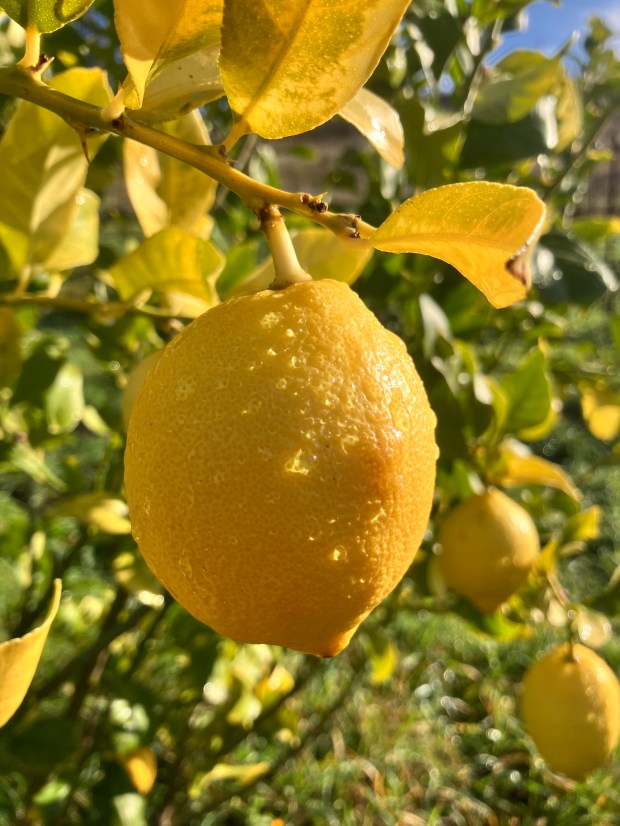
In the orchard, the apples ripen with lemon harvest still in swing. Eureka lemons get ripe by the day, our first year of sending them for weeks to market. These lemons are popular among our Community Orchardists, too – they are catching on – so, the ‘seconds’ lemons are getting claimed voraciously. About 50% of the lemons aren’t perfect enough for market, and so 25 pounds a week are getting distributed. It seems like next year we’ll have surplus for the Pacific School, once they return from the summer. Our lemon trees have just past 10’ tall, a bit lanky and need of some shaping – sharp spines make portions of the getting-dense trees hard to harvest. It is surprising how difficult it is to discern the varying shades of yellow on the fruit, sometimes with hidden tinges of green, to harvest the ripe ones as they turn ever-so-slightly deeper colored.
Gala apples are the first to ripen: we sent our first box to market out to the Community this past week. The background peach color, beneath the red streaks, is so obviously a sign of ripeness. They are gorgeous when ripe.
Ripening Gala apples in our Community Orchard
Reclaiming the Land
We are so thankful to our various partners for their assistance in restoring the natural areas of Molino Creek Farm. Last year, the Central Coast Prescribed Burn Association’s (CCPBA) massive network of volunteers and dedicated staff put Good Fire on the ground, nudging our scrub invaded systems back to coastal prairie. Their work also makes our farm safer from wildfire, which has been much on our minds of late. This fire break augments a many miles long regional firebreak that runs on our border and protects Bonny Doon and then Santa Cruz further down the fire-shed.
This week, the new President of the CCPBA, Matthew Todd, has been using his expertise and big, expensive tool to take that burning a bit further. His Bobcat runs a masticator, and he’s mowing down huge patches of the invasive French broom which sprung up after the 2020 fire. Alongside that broom are acres of brush that has taken over super-diverse prairies that were dominant in photos as recent as 1988. Matthew is a landscape artist – it is looking so great and we are much-relieved to have his help bashing broom…and jubata grass…and coyote brush. Broom control protocol calls for several years of mowing in the Fall, like we’re doing now, and we are going to do just that – maybe with a bit of Rx Fire thrown in there.
Rumor has it that CalFire will do a training burn in a few weeks (after grape harvest), so more to come.
Matthew Todd on his masticator, taking care of prairie one strip at a time: Thank YOU!
Natural Production
While our Farm Fruit is abundant, so is the fruit of the woods. Jays and Acorn Woodpeckers have turned their attention to the acorns, which have swollen and started to drop. On the ridgelines above the Farm, the manzanita bushes have their first massive berry production since the 2020 fire. The seeds have tasty dry, sweet pulp and hard as rock seeds. Some critter has been feasting on them and then pooping out the remains in our apple orchard – a long haul, but someone has a circuit.
Critterland
It is easy to see a fox at night if you just go looking. We must have a large population. They bark and yowl. You can’t hear them, but you can certainly smell them … skunks are prowling farm-wide. The hayfields are full of their nuzzling holes where they seek mice or crickets. The bunchgrasses we’ve been nurturing in our hayfields have turned green and since we didn’t harvest the hay, there is plenty of hunting ground for skunks.
Native bunchgrass, California brome (Bromus carinatus) hay field with skunk hunting sign
Welcome Back Sparrows! And…
Golden-crowned sparrows returned, as usual, with the Equinox. In the dark of the night on 9/19, hundreds of these winter birds dropped out of the sky and started feasting on what seeds remain from the entire summer of feasting of the other birds. They were quiet and shy at first, maybe a bit tired from their journey, but now they are feisty and squeaky.
At the same time, other types of birds arrived. The meadowlarks landed in the meadows lower down and closer to the ocean. And, the blackbirds – Brewer’s and bicolored – have suddenly formed their cacophonous flock at the top of the trees around the periphery of the farm fields.
Gallinaceous Bird Drama
The turkey flock was attacked in the forest, what a terrible noise, and only the male has been about. Seems like a good idea to go to that place of turkey noise and see what happened. A coyote or even a pack of coyotes would stand quite a challenge against such powerful birds: maybe it was a lion? Tracking is in order.
Massive quail coveys flush and whirr at every turn. They are Very Jumpy because there is a Very Good Hunter about: Cooper’s hawk is energetically flying about. Do kestrels eat quail? There’s one of those around, too.
At midsummer, we pass the midway point of the year, the middle of summer, and the Land changes before our eyes.
Leaves
There are drought-deciduous plants and seasonally-deciduous plants. Their sometimes-colorful leaf drop is starting to overlap. Poison oak is one of those deciduous plants that are in between: on drier slopes, crimson patches have been emerging for a month as that plant decides to drop its leaves, leaving only stems and berries. Buckeye trees are dropping medium-brown leaves, too: very little Fall color to add to the landscape’s palette. Madrone Fall has happened already, leaves littering the ground most crunchily, bark peeling on the hot days making pinking and crinkling noises. Madrone trees lose their old leaves but keep their new ones. Bare madrone trees are dead, as is too often the case with some scourge that is ravaging many trees.
I was just in the Eastern Sierra and the very first seasonal fall color was showing at 8,000 feet – branch tips of the brightest lemony yellow aspens were a treat, but very rare. Time to plan your leaf-peeping trip in a month or so. Our versions of seasonally deciduous lemony yellows will emerge in a while yet with hazelnut and big leaf maple, which mostly aren’t starting to lose their chlorophyll just yet.
Fruit
The grassland seeds have (mostly) fallen and the shrubland berries ripen while the woodland acorns grow fat. In abandoned agricultural fields, dead grass slowly sags horizontal, skeletons of radish, mustard, and hemlock rattle free their last seeds in the afternoon breezes. Perennial grasses in the more pristine prairies have dried, too, and just blue wild rye still holds a few seeds on its narrow, dense flower spikes. The bases of the bunchgrasses show a little green- real toughies! You would be lucky to find a single seed in the spent rattly seed cups of soap root and other lilies.
Side hilling strolls along the prairie-shrubland boundary reveals dark leaved coffeeberry shrubs thick with ripe purple-black juicy berries. Nearby, the mixture of ripening stages of blackberry offers a few small, seedy ripe fruit. Fruit eating birds (including band-tailed pigeons) and foxes have bellies full of these, as evidenced by their scat.
It will be a while before the acorns and buckeye nuts are ripe: they grow day-by-day. Acorn woodpeckers settle for bugs or last year’s cache of acorns for sustenance.
Migration
As the season progresses, wildlife moves. The last of the barn swallows have just fledged (this last week!) and are fast growing muscle to make their long journey south. Cooper hawk and kestrel will be free of the swallows’ vigilant fuss by the middle of September.
This year’s batch of adolescent dragonflies is patrolling the air from zero to 50’ above the dry grasslands and chaparral ecosystems, far from their natal homes. They dart about capturing the insects that have matured and taken flight after devouring leaf, shoot, and seed from the prolific biomass below. Below our feet, in the deep and complex matrix of gopher and ground squirrel burrows, newts pace back and forth stalking invertebrate prey.
On foggy days, chorus frogs that have been emerging from drying ponds climb further out on tree limbs or hop further from their wetland birthplaces to find places with richer food and fewer competitors. These talkative amphibians make their squeaky hinge croaks across the extensive canopies of Fort Ord’s live oak woodlands in the long days of misty-fog “summer.”
Big things are on the move in the ocean as well. My favorite summer whale is the giant blue whale, which is typically seen in the Monterey Bay from July – October. August sitings have been scant, but still, they are out there! Meanwhile, our population of gray whales are at the height of their arctic adventures, way, way north – feasting on krill and wondering if this year is a good one to sneak over to the Atlantic Ocean. This year is the third lowest ice sheet coverage in the last nearly 50 years… gray whales were hunted out of the Atlantic and may soon act on their yearning for those ancestral feeding grounds.
Fire Season
Monsoon season brought hundreds of lightning strikes to California last weekend ushering in the fire season across large areas of the state. We just passed the anniversary of the 2020 CZU Lightning Complex Fire and, before that, the 2009 Lockheed Fire. Mid-August has been the time for the Monterey Bay to burn recently, but September and October are historically fire months as well. Our cool July and ongoing cool nights have combined to help keep things less dry, but coastal heat waves are quickly removing any residual moisture. As interior California heats up and typical conditions prevail, the moderating effect of the ocean keeps us cooler and sometimes moister so the fire danger is less. That hasn’t stopped fires from happening, though, including a roadside fire in Davenport not long ago. There are no terrific heat waves foreseeable for the coast and no predictions of remnant tropical storms carrying thunder and lightning, so thanks for those things (for now). A reminder, though- it is Not Too Late to clear fuels and otherwise prepare. Recall from Santa Rosa that fire can carry way into town, so work to do even there. Wondering where to focus? Zone Zero- the 5 feet out from structures…nothing flammable there!
Midsummer’s challenge: crunch some madrone leaves under your feet. The crispy noise, the beautiful patterns of fallen madrone leaves, the peely bark…some deep delicious experiences are in store for you if you can get there.
The opening ceremony for public access onto the Federal Bureau of Land Management’s Cotoni Coast Dairies property was on August 15, 2025, a grim day for those who have followed this travesty, which will only worsen with the planned public access.
Many thanks to De Cinzo for this image
Building on a Tragic History
Nothing good led up to this moment. There is no one left who speaks the language of, or can show direct descendance from, the native people of this property. There are rich archeological sites illustrating that this land was settled for thousands of years. So, as with every spot in California we must see this property and how it has been and will be used as a colonialist endeavor. There is no attempt to give the land back to any coalition of First Peoples who represent those ancestors or to respect them in any way that approaches restorative justice. Oh, but there’s the name…(!)
After the genocide, the land has seen one extractive use after the next with little regard for conserving nature. The ‘Coast Dairies’ portion of the name points to cows, and cows there still are. The grazing regime has never focused on restoring the very endangered coastal prairies on the property and, even now, there is no plan to do so. This recreational use is a new, highly impactful extractive use. The property is rare for the Santa Cruz Mountains in having had very few human visitors for the last 100 years, so wildlife has been accustomed to roaming without disturbance. Cougars and badgers are especially wary of humans when setting up dens. A million visitors a year will soon be visiting and wildlife will flee.
The consortium of people responsible for so many other, better outcomes for conservation tried hard, won some concessions, but have seen great loss with how this property came to be open to the public. We tried to get anyone but the Federal Government to manage the property, but the Open Space Illuminati had other things in mind…’The Great Park’…a handful of boomers wanted their legacy in a wide swath of the area becoming a National Park. They stopped at nothing to achieve that legacy. The activists, biologists, conservationists, and regular citizens, were even sued to strike fear into them, to make them capitulate.
Money Made it Happen
The Wyss Foundation bankrolled cash-strapped ‘conservation’ organizations to create a fake grassroots campaign that culminated in Obama signing a Monument Proclamation adding 5 properties across a wide swath of coastal California to the California Coastal National Monument.
Then, the BLM routed hundreds of thousands of dollars, sole-sourcing a contract to a mountain biking advocacy organization to build the kind of trails their users wanted to see. That business quickly changed their name to a ‘trails’ organization. Instead of supporting good paying local jobs, the BLM paid this organization to rally volunteers to do the work of installing trails that were placed across a landscape without regard for the wildlife written into the President’s Proclamation for protection. When asked about how they could do such things when the property’s designation required favoring conservation over visitor use, BLM cynically snickered that the majority of the property, 51%, is set aside without public access. The rest, apparently, is a sacrifice zone.
What We Wanted and Will Pursue
Those of us who care about the native peoples, the nature of the property, and the experience of future visitors have a vision, which we will pursue despite setbacks. The land should not be Federal land – if you wonder why, you need to look at the current situation with federal lands nationwide. We always knew this, but now others are starting to understand our concerns. The current administration is selling federal land for real estate development and other extractive uses. If, after cutting the federal workforce, there are any staff remaining to manage the land at all, that will be a surprise. The Administration has said Federal lands will remain open to visitors even if there is no staffing or budgets. Oh no- could my dystopian vision for the property be closer to reality?!
If there is a chance, California should buy Cotoni Coast Dairies. Then, let’s envision taking Canada’s Indigenous Guardian’s project to this place, giving tribal people primacy in stewardship, use, and oversight. Perhaps the State could give the land back, as it has just accomplished with the Yurok.
If the property is to remain a public park with visitor access, there needs to be a radical shift in how that is approached. The regulatory designation for first managing the property for conservation needs to apply even to the areas with public access. This will require altering use patterns, even closing the trails occasionally, for the benefit of the soil, streams, wildlife and plants that Obama clearly intended to protect. There will need to be lots of monitoring and enforcement to adequately protect natural resources. The BLM will need to do a ‘carrying capacity analysis’ to determine ‘limits of acceptable change’ – thresholds that, if surpassed, trigger altered management of visitor use to bring the use into alignment with conservation.
Next Steps
It will soon be possible for visitors to monitor the situation first hand. Those of us who asked to do baseline monitoring of wildlife and plants were refused the opportunity many times. When we asked how small children and the elderly could possibly co-recreate on trails overrun by fast-moving mountain bikes, our concerns were dismissed. We will be able to help document how well BLM’s rules are working and if there is enough enforcement. We will be able to see the spread of diseases introduced by bike tires and hiking shoes ravage the amphibians, the trees, and the soil, and we will recall how BLM staff predicted those impacts in writing, with administrators choosing to ignore even the simplest measures that hundreds of other parks managers have employed to address those concerns.
-this post updated to past tense from the one posted via Bruce Bratton’s legacy site BrattonOnline.com