news

Fire Era

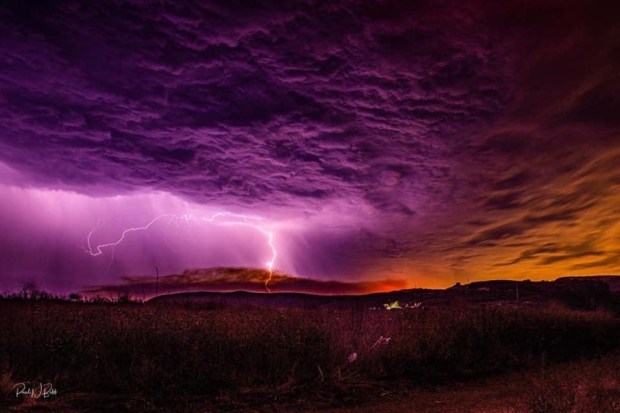
It seems like the world has changed. As I write this on Tuesday 9/16/25, Tropical Storm Mario is headed towards California. Back in 2020, the CZU Lightning Complex Fire was the result of another such situation, via Tropical Storm Fausto. And, as with 2020, there is a lineup of such storms…another is predicted soon after this upcoming one. We look forward to the regular Fall rains to start, typically on October 15. Meanwhile, we wait to see where the lightning will strike and if someone can extinguish the flames before the resulting inferno.

I moved to Santa Cruz in 1986…did I somehow miss old timer stories or some other form of history that tropical storms, lightning, thunder, etc., are ‘normal’ for this part of the world??!!

Does this seem normal to you?

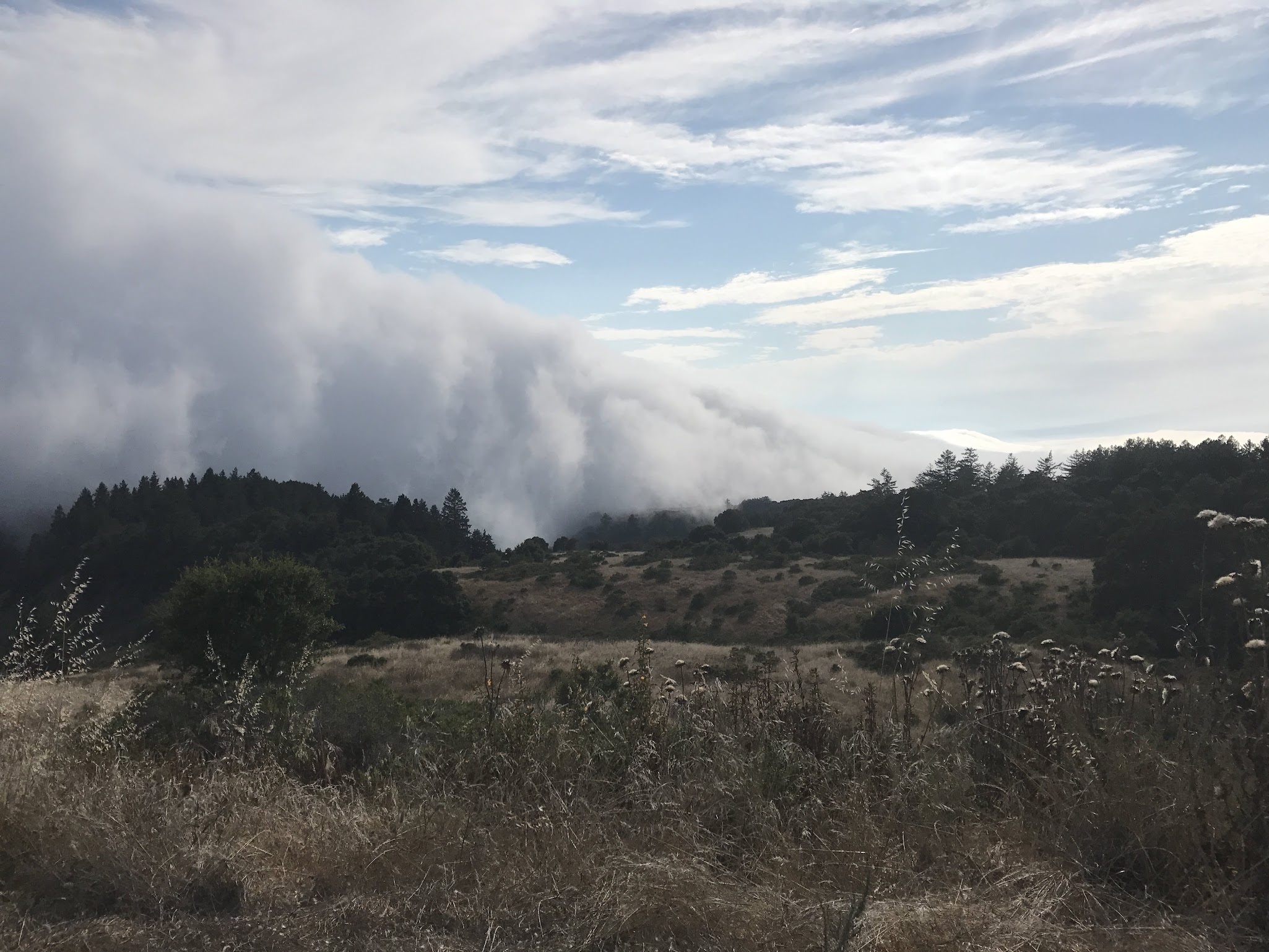
An ODD wall of clouds eats a North Coast ridgeline, quickly (from the South) – how unusual! Aug 2, 2017

Changing How We Live

All us country folk are changing the way we live, out here on the outskirts of towns. 

Many modern Californians lived for decades in the “woods.” They had sprawling outbuildings full of canning supplies and landscaping tools, tractors, chicken coops, pet pens, toys scattered about. Their homes were ”original” architecture, funky and artful. Their gardens neat or a tangle, blended into the surrounding with the forest engulfing less tended portions. Funky. That was much of country California.

In this changing world, we can no longer afford to be that way: our ‘stuff’ is burning up and making a mess. Now, we must consolidate our things into fire resistant structures and manage the surrounding vegetation. 

The Vegetation Around Us

This land is productive, which means that plants make a lot of biomass each year. In most natural areas near Santa Cruz, plants produce 4,000 – 8,000 dry pounds of biomass per acre per year: that’s 6,800 – 13,600 pounds of living biomass: literally ‘tons.’ For a house that’s 1200 square feet, clearing within the 100’ required space is managing about an acre and a half of vegetation. That means chipping, burning, mulching, composting, or hauling biomass “away” – otherwise, living or shed plant parts accumulate, add up, and pose a worse fire hazard in subsequent years.

Same goes for the thousands and thousands of acres of open space/parkland around the Monterey Bay. That open space is producing lots of fuel for future wildfire.

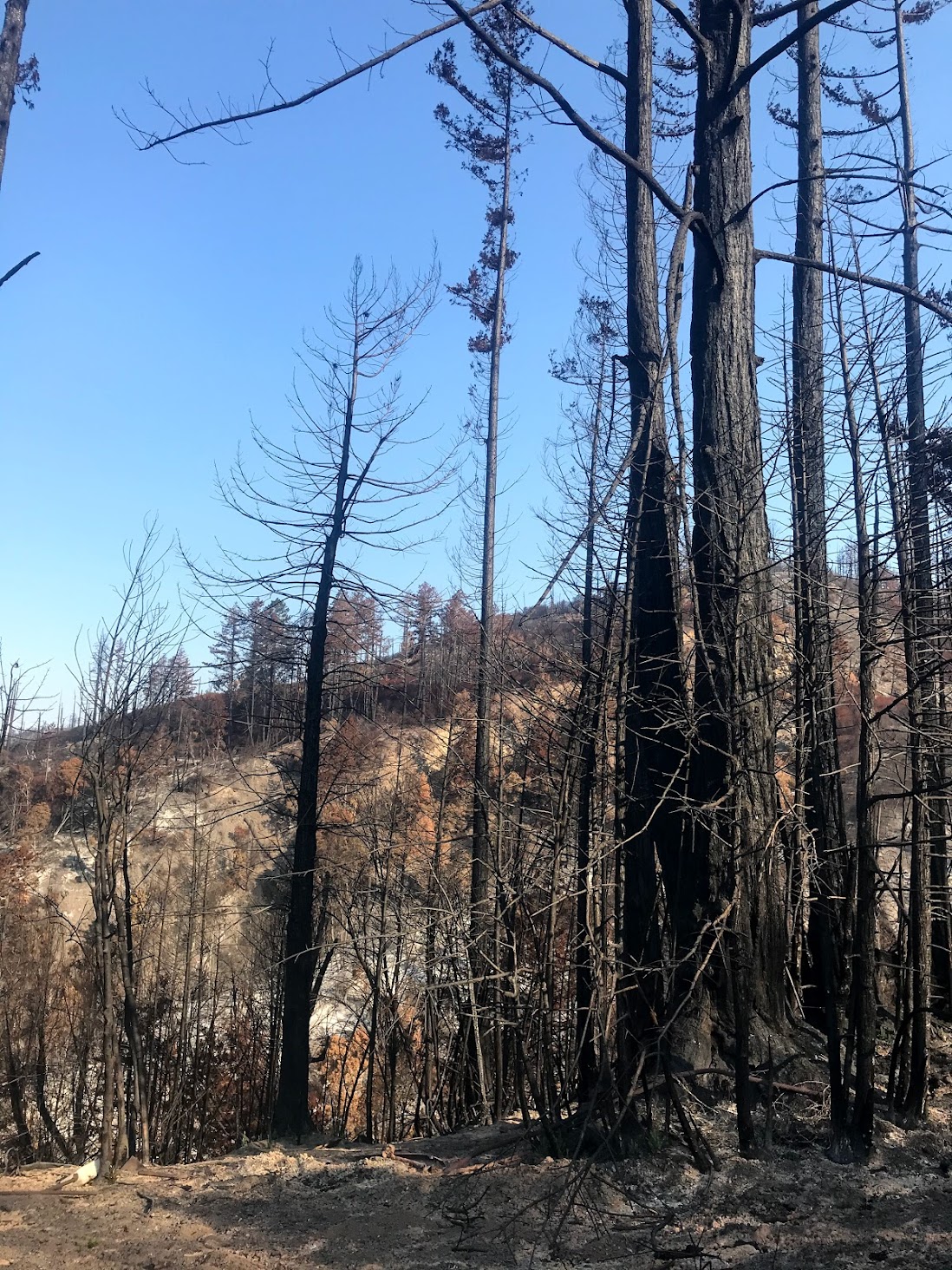
Some of the outfall of the 2020 CZU Lightning Complex Fire

Attitudes

Many people can’t handle this new reality of living with fire, especially in the country. Sure, if you are wealthy and live rurally, you can pay for someone to manage your property for wildfire…but still it is expensive! If you are poor, you can work to do it yourself…but it takes time, strength, and know-how! I’ve asked the folks I know who take care of their rural spaces how much time it takes to manage their (small!) home’s vegetation wildfire danger. The uncannily similar answer for my informal poll is….6 hours a week.

But most people are just plain in denial about the danger, even though everyone knows someone who’s been through one of the giant fires of the past few years. Some of those in denial actually went through the last fires and somehow think that it can’t happen again. 

Perhaps we’ve become inured to the fire news and so can’t grip reality. Did you know that Chinese Camp, a small town in the Sierra was nearly completely destroyed by wildfire in early September? That was the result of another ‘monsoon’ full of lightning from the South! Too much!

City Folks

It might be easier to ignore the wildfire danger if you live in the City. But people must change the way they live in the cities, apparently: in case you don’t recall there was this thing in Santa Rosa called the Tubbs Fire that burned thousands of homes, many of which were ‘in town.’

It looks to me like a wind-driven wildfire could burn a long way into Santa Cruz with houses stacked against one another adjacent to the forested and shrubby steep canyons of Moore Creek or adjacent to the thickly vegetated and at times crispy dry San Lorenzo Valley. The towns sprinkled around Fort Ord share the same danger/fate as does Monterey and Carmel.

Wind Driven?

Do we forget about the 70 mph gusts that fanned the CZU 2020 fires? Were we watching the Santa Rosa Tubbs Fire blast on high winds? The winds are increasing…

The Cause and Effect

The changing world I have outlined here is in large part due to the burning of fossil fuels, trapping sunlight…aka ‘the greenhouse effect.’ More ‘greenhouse gasses’ cause more atmospheric energy: part of the reason we are seeing the new tropical storms headed our way. The winds, with or without the storms, are demonstrably getting more intense. Predicted outcomes of climate change include extreme heat and drought events…extremes of all sorts – big swings.

The sad changes we are struggling to manage with just plain living are probably quite minor compared to what is to come based on climate change predictions. One day, folks will look back at the one-day-a-week that it takes us now to manage our yards and say “humf! That’s nothing.” What will their struggles be like? Will they be trying to survive weeks-long dust storms…building storm proof greenhouses for food? 

When will we reverse this terrible trajectory?

– this article originally appeared as part of BrattonOnline.com – check it out!

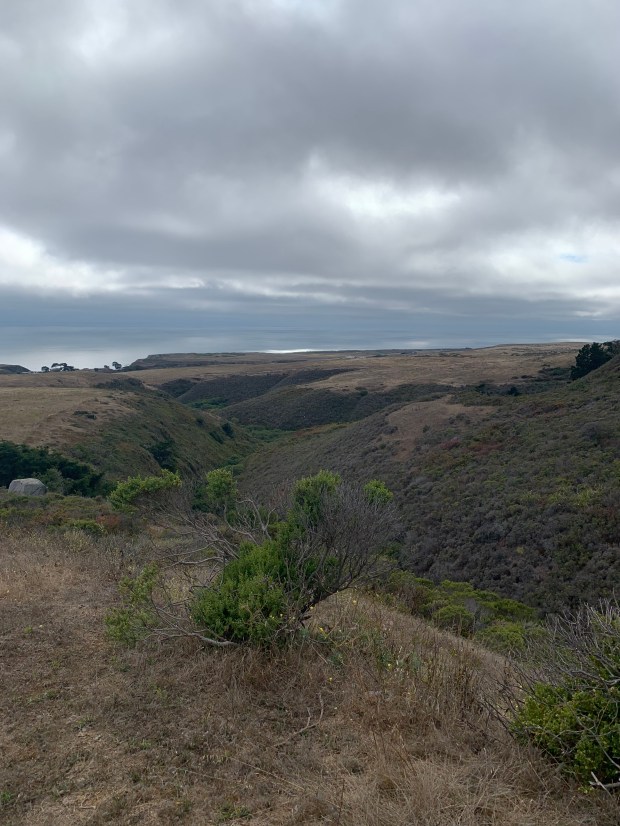
A view to the sea overlooking habitats at Cotoni Coast Dairies

Restorative Justice: Trust for Public Land and Coast Dairies

There is healing to do in my community, but no one is moving that forward with one particular travesty. We’re approaching the 7-year anniversary of a local conservation organization’s legal action against our community, including environmental hero Celia Scott and others. In 2018, the Trust for Public Land sued a group of my community. Their actions incurred long-lasting damage to personal lives and the willingness and ability for the public to remain engaged in the hard work of protecting the North Coast of Santa Cruz County. This story is a microcosm of society-wide problems. In this essay, I explore this scenario in hopes that we can heal or at least learn from the past in ways to strengthen and improve the future, in similar situations.

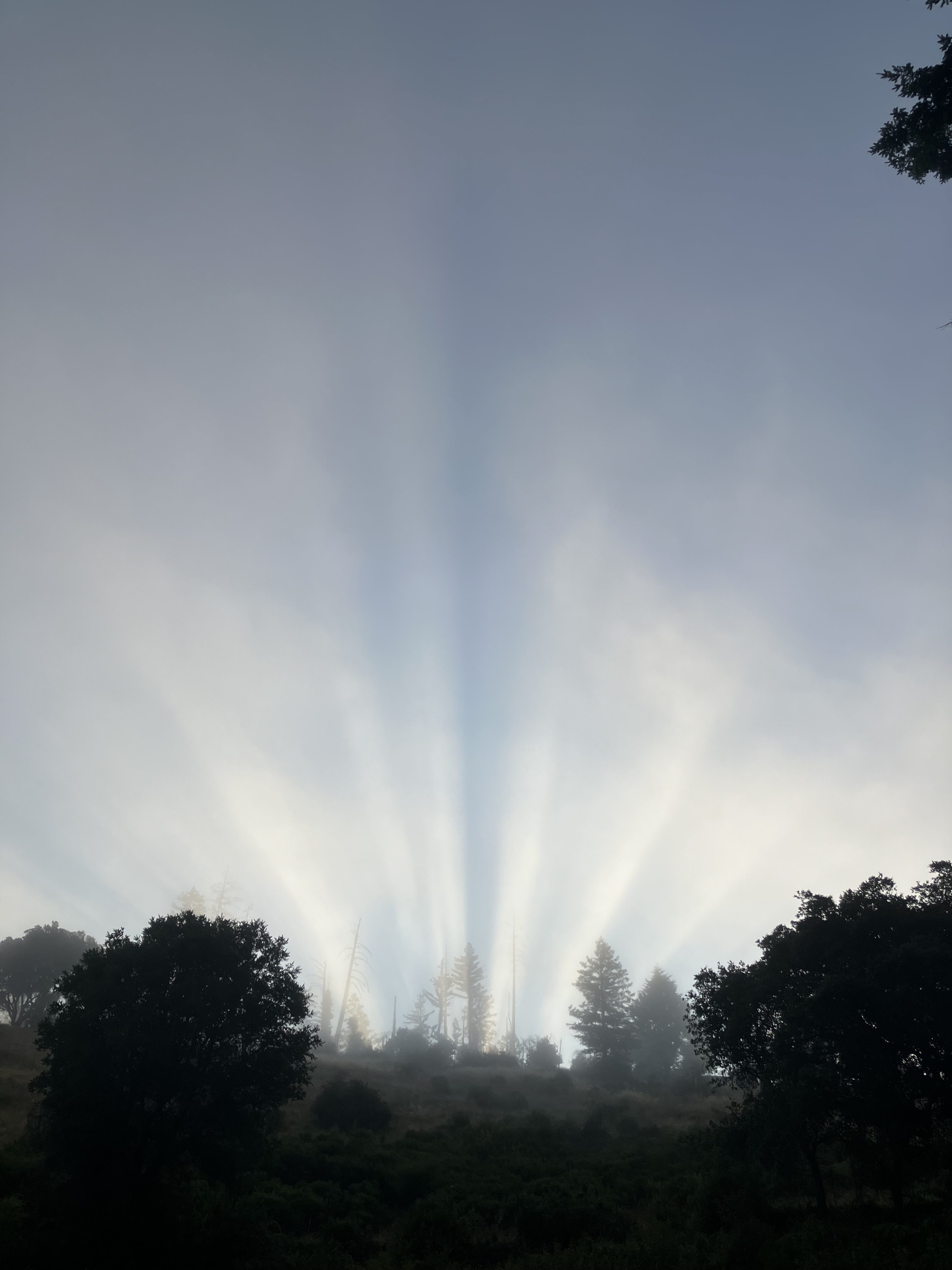
The sun rises from the fog, hope for a new era

What Happened?

In 2014, we were extremely concerned that the Trust for Public Lands chose the Bureau of Land Management (BLM) to take possession of ~5,800 acres of the ~7,000-acre Coast Lands and Dairies property. This would be the first transfer of large acreage in Santa Cruz County to the Federal Government, putting decision making, environmental review, and management oversight far afield from local influence. Moreover, the BLM is nationally recognized as being the ‘bottom of the barrel’ of public land management agencies insofar as their ability to provide adequate staffing or adequately analyze and plan for protecting natural resources and managing visitor use. ‘Don’t worry,’ the Open Space Illuminati whispered, ‘the land will go to National Parks soon enough.’ ‘The Great Park’ was their dream, a way of cementing the legacy of a very few boomers and their deep-pocketed, old school “environmentalist” funders. A dozen or so local veteran conservationists were clearer eyed and decided to fight back. 

The Sempervirens Fund’s Great Park Campaign publication cover, see this link for more.

This coalition worked with experienced legal counsel to challenge the federal lands transfer based on TPL’s need to divide the property between State, private, and Federal ownership…a process requiring County and Coastal Commission approval. When their legal action failed, TPL sued those activists, demanding a large financial settlement. TPL’s legal action also failed but not before the damage was done to individuals and their families as well as the coalition overall and my community of conservationists in general.

Outfall

TPL’s lawsuit echoed through the region, hobbling conservation and damaging community. The Open Space Illuminati felt more empowered, less humble. Family members questioned whether activism was worth the risk, fearing retribution affecting their already tenuous ability to live in an increasingly unaffordable area. Conservationists wondered how a ‘conservation’ organization like TPL could launch such an attack.   

The Bullying 

This history is but one instance of something we see unfolding nationally with greater consequence. In most political spaces we have mainstream, wealthy, influential ‘centrist’ “liberals” that are sure that they know what’s best for everyone, and they are determined to force their reality forward. They bully and demonize progressives who are often under-resourced for such battles: ‘successful’ centrists are often in wealthier circles/circumstances, and their visions often include methods of increasing their financial advantage. Do we forget progressives’ criticisms of the World Bank and US AID for their paving the way to the destruction of communities and ecosystems? Newsom is so good at bullying Trump because his centrist community are very experienced at bullying progressives, and they’ll be back at that focus soon enough. The centrists love the far right for the power that gives them to move the populace to the center where the rich get richer and the environment and the poor suffer greatly. The Coast Dairies situation is a microcosm in another way.

Microcosm

Many of us are familiar with the story of the colonialist tragedy affecting indigenous people, but can we also apply some of those lessons to the situation with TPL at Coast Dairies? We know we are on the unceded ground of indigenous people: each and every one of us reading this. At the same time, many prescribe to the philosophy of such colonialism when we celebrate the “keystone” of “successful” conservation. Cheers ring out when property is purchased for a park, and few ask who is losing when that happens. Some of us are familiar with the boundaries of parks being drawn without consultation of native peoples around the world: indigenous people displaced by ‘conservationists.’ Few of us see the parallels with such dangerous transitions in California where the ‘We can do better!’ mentality overwhelms local communities. 

Can We Do Better?

Conservationists celebrate the quick transition away from local control, yet traditional land management knowledge is lost at great peril. Those engaged in traditional forestry know how to manage land at scale, restore forests, grow trees, and reduce wildfire risks. Those engaged with traditional range management also know how to manage lands at scale, control herds of beasts to ecological benefit, and identify stewardship risks before they become catastrophic. Indigenous peoples have a much deeper and broader experience to share. Instead, the conservation community often removes these previous communities from their stewardship roles, instead entrusting land care to too few University-educated elites with their small share of experience matched by their lack of humility, and framed by their embrace of pro-forma ‘management planning and environmental review’ processes designed to protect them from public conversation, criticism, and legal challenge.

All of this is happening at Cotoni Coast Dairies. Can the situation there, including with the Trust for Public Land, help model a way to overcome this negative global spiral?

 Reconciliation

I am suggesting that we go through a truth and reconciliation process for the Coast Dairies debacle, including the TPL’s legal action against our community. 

First, we must seek to understand. Who was involved with deciding that the Coast Dairies property would best be in BLM’s hands? Let’s hear from those individuals about their decision and what they think about that nowadays. Who was involved in the decision to sue our community members? Let’s hear from those individuals about what motivated that action. Why did community members sue TPL? Let’s also hear from those individuals about what they were hoping to achieve and how they see their loss affecting the current situation. Can we also hear from the Federal decision makers: how does the machinations of federal control address the concerns of our community?

A well facilitated truth and reconciliation process can move forward from such mutual understanding towards solutions that can help to heal the past and move to a more productive future.

I predict this reconciliation process will not happen until the Open Space Illuminati and the Federal decision makers feel that they are no longer ‘winning.’ Then, they might see that they need the help of the people they have marginalized. This will require the marginalized to gain more power. Please join the movement by talking to your network about these issues.

If we don’t address these past injustices, it will not be a long wait until we see them repeat in larger and more tragic ways. Right here in our communities.

-this post originally published as part of the illuminating BrattonOnline weekly blog, featuring leading thinkers on local, regional, and global affairs…in this era of squelched free speech, it is best to keep our minds agile by reflecting on well-informed commentary and journalism. Subscribe now and SAVE (your mind- the blog is free).

Autocracy Continues to Build

I have long labored in this column to outline the frustrating situation all biologists feel in this world as our interests are destroyed by increasingly autocratic tendencies of the government. And no, I have never been partisan about this situation. Both parties are to blame in creating the country we find ourselves in right now, facing a perilous future where generations will not only not be able to enjoy the standards of living we do today but will suffer to keep a standard of living with any comfort at all. 

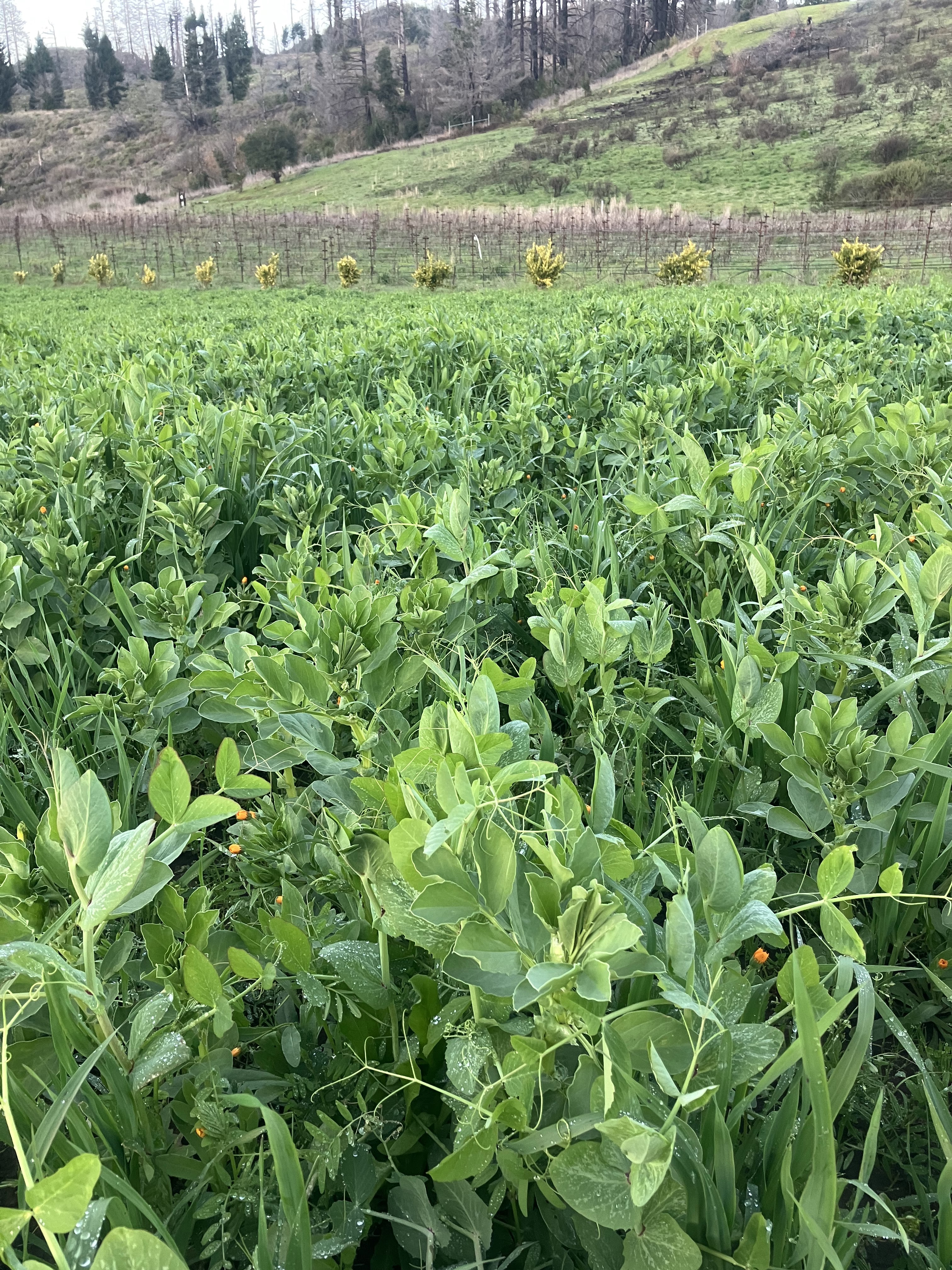
Will we see lush cover crops and small farms in the future USA?

I am not surprised, however, to find many people freaking out about a government bent on destroying social programs. After all, many voters have long been fed a thin gruel diet of small social program ‘wins,’ so that they will overlook that their future is being stolen by the 1% who are paying for both political parties, allowing them to extract wealth and power by destroying Life on Earth.

Tinkering Around the Edges

I was recently listening to the Bay Area’s own brilliant journalist Kara Swisher interviewing Rahm Emanuel, a person who seems like a reliable voice of mainstream Democratic politics. Ms. Swisher pressed Mr. Emanuel on what the Dems should do at this juncture, and his responses were along the lines of ‘messaging the voters’…’adopting a new platform or two’…etc. There was zero reflection about the way politics is using people to enrich the 1% while destroying the environment and no reflection on how to engage and involve citizens in their own governance.

All Politics Is Local

National government tactics are repeated here in California and all around the Monterey Bay. If you think that the current use of Executive Orders is unusual, check out the far-reaching litany of executive orders from California’s governor, who is proud to reduce environmental protections as part of these moves, none of which is primarily directed at environmental conservation. 

In Santa Cruz, I see politicians and government staff baselessly blaming and attacking people who are trying to protect the environment, including other columnists who write for Bratton Online. These local politicians and staff have long supported the roughshod environmental analysis of many projects before them as long as the project serves some social good and/or is economically attractive. For instance, many pointed out the inadequacy of the Regional Transportation Commission’s analysis on the estimated numbers of tourists attracted by the new North Coast Rail Trail, but politicians didn’t care enough to direct better work. I have witnessed this same political hunger for other projects that badly impact the environment at Arana Gulch (recreational development), Pogonip (recreation and agricultural developments), Glenwood (housing and school development), Santa’s Village (housing development), Seascape (housing development), Wilder Ranch (recreational development), UCSC (housing development), Terrace Point (educational buildings), Nisene Marks (recreational development), Cotoni Coast Dairies (tourism development), and Neary Lagoon (transportation development).

Up Close and Personal

I have had occasion to be privy to the autocratic decision making that creates the results where the environment, and conservationists, end up losing and here’s how it goes. First, someone who wants to develop and negatively impact nature works with an expert at navigating the review process so that they get just what they want. Second, once they have a plan for meeting regulatory demands (aka “jumping through the hoops”), they meet with one or two of the politicians whose vote they’ll need. Then, they make a deal of some sort to guarantee the votes. Then, the person proposing negatively impacting the environment meets with the bureaucrats who also get calls from the politician, and then they, too, make a deal. Finally, after everyone’s approval to the plans and approach, the project proponent goes through the motions of a public process, taking and ignoring input and moving forward with what they wanted to do in the first place. When pressed about why not do a more authentic public process, anyone that was part of those deals will tell you, “why bother?”…”it just makes more trouble”…”we know best and came up with the best solution.”

Do those trends sound familiar at a national level right now? We have far more potential to affect political change closer to home than further away.

Why Aren’t the Dems Fighting?

Some people who are concerned about the Administration’s actions nowadays ask ‘why aren’t the Democrats fighting?’ The answer is that everyone in power is in awe of what they, too, might get away with one day. Plus, some of what is being highlighted as shocking power grabbing is the same stuff that all politicians have been doing for some time now, but perhaps less bombastically.

During the first round of this administration, there was a surprising assertion that we were suddenly going to war with Iran, a country with about the same number of military as the USA. NPR picked one of their preferred retired generals to interview about the wisdom of this decision and that general said that he could not condone the action because ‘Americans have not been prepared for this war.’ That is, the military demands that politicians prepare citizens for war, presumably so that the funding will keep flowing to support the war effort once it is started.

I believe it has become equally normalized that it is the politicians’ job, in working for their biggest donors, to keep citizens constantly prepared for environmental degradation. And, it is my experience that the staff people of governmental agencies look at legally mandated disclosure and environmental review interactions with citizens as a burden and a waste with no chance of improving the agency’s work and better protecting the environment.

Is It Any Surprise?

Given what I’ve just outlined, I am not surprised by what I’m witnessing at a national level. As a nation, we have prepared ourselves well for this situation to work out excellently for the 1%. I am not happy that many more people get to experience the exasperation that conservationists have been feeling for decades, but so it goes. Perhaps this is the best chance we have had to start working together.

How can we organize an alternative in local politics where the people are prepared for a Monterey Bay that is protected by its citizens for the next 1,000 years? The answer lies with more permanence of residency, sustainable and vibrant economies, and removal of any environmental impacts of growth, but those things are at odds with our current societal structure. And yet, these things (and more) are sorely needed. If we can make it work here, the goodness will spread. It starts with developing leadership and engaging many more people. You’re right there with us, right now. 

-this essay originally posted at BrattonOnline, a weekly roundup of all thing local and sometimes global affecting the Monterey Bay. Read it and keep in touch!

Power and Pitfalls of Experiential Learning

Most people I know rejoice when they hear about students engaged with experiential learning, but what does that term mean and how far should it go? Ronald Reagan was largely responsible for making it less affordable to attend colleges and universities, and when he did many cynics muttered about industry and their political party lackies wanting cheaper, more subservient labor. This purposeful dumbing down of our society is having grave consequences, and not just in one spot on the political spectrum. Backlash is occurring, but not the kind of backlash you might hope for: increasingly close relationships between industry and university systems. Industry hungers for skilled workers. And so, we are witnessing the rise of the trade school. Well-run trade schools could nurture collaboration, fostering Democracy, but this runs counter to oligarchical aspersions of the 1%. How will we solve this tension?

California’s Public Institutions of Higher Learning

What is the difference between the 4 different public institutions of higher learning in California: the 116 “community colleges,” 3 “polytechnic state universities,” 20 other “state universities”, and 10 “UC’s?” Community colleges are sorting machines to bridge the ‘better’ students into higher division courses at the other institutions. Around 20% of lower division students in California’s universities drop out; to keep the machine running, there must be replacements in line –community colleges produce those replacements. The “mission of the California Community Colleges is to advance California’s economic growth and global competitiveness through education, training, and services that contribute to continuous work force improvement.” In other words, community colleges are the first step for students entering trade school in California’s higher education system. As such, community colleges are primarily designed to feed students into the polytechnic universities, the purest type of university trade school. The term ‘polytechnic’ refers to vocational training, aka “trade school.” For administrative efficiency as well as similarity of mission, California’s 3 polytechnic universities are administered by the California State University (CSU) system. The other 20 CSU’s are a bit more abashedly also trade schools. The UC’s are clearly distinct from trade schools by their promotion of teaching theory and nurturing critical thinking, conducting research that advances theories, not current practice – they eschew applied research.

The Danger of Trade Schools in California

Trade schools are often proud of experiential learning, a key component of skills-based training. Industry saves money if the State spends the money building skills in the soon-to-be workforce. The current overrated excitement about training grade school students in STEM is a symptom of this thinking. Skills based training, including STEM training, is a big problem when things change as rapidly as they are changing. Most skills we teach to make widgets today are not the skills that will be needed a short period of time. Despite this, trade school curricula leave little room for elective courses. By their sophomore year, students must define their major, and to succeed at that declared major a student has no room in their schedule to explore other subjects. On top of this, trade schools are teaching a narrow set of ‘soft skills,’ related to obedience to process: students who can navigate the bureaucracy are the ones that succeed. The result of this system is an emerging workforce trained narrowly in already irrelevant job skills excepting the skill to navigate protocol.

Faltering Trade Schools

Years ago, California’s trade schools hired professors with experience in private industry. After Reagan gutted public higher education funding, competition increased between colleges and universities for other revenue sources from skyrocketing student fees, public:private partnerships (industry funding), and alumni donations. This competition led trade schools to attempt to become more like UCs: “top-tier” universities. And so, trade schools turned changed the old model of hiring professors experienced in “real world” industries to hiring the same types of professors UC would hire. Lucky for them, there is a glut of academically aspiring PhDs. Trade school administrators increasingly apply the screws to faculty, who are caught in demoralizing  stress. Professors at trade schools must teach as many tuition-paying students as possible: low faculty:student ratios are more profitable. To be successful these faculty must help with fundraising, meeting with industry officials to keep up reputations of building a skilled workforce. On top of those obligations, trade school faculty play the game of courting ‘top tier’ status for their university by somehow, miraculously wedging in time for publication-quality research.

Long-Lasting, Relevant Workforce Skill: Collaboration

Instead of, or at least in addition to, training trade school students on ‘how good are you at navigating protocol,’ trade schools might also focus on collaborative skills. What if experiential learning at trade schools focused on student engagement to solve real-world problems, interacting with real world stakeholders? In this case, faculty and students would interact with the stakeholders involved in any given issue…perhaps industry representatives, regulators, policymakers, financiers, interested citizens, labor leaders, etc. Students would be reviewed by their ability to critically evaluate situations and for the feasibility of their creative solutions. Faculty would be reviewed by the quality of their student mentorship on collaboration skills. Collaborative skill training would focus on power analysis, defining success, facilitating dialogues for mutual understanding, identifying gaps in knowledge, and identifying solutions of greatest benefit.

Contextual Shift

Training a future workforce skilled in collaboration would increase productivity while creating a more peaceful citizenry, but would also likely threaten wealth inequality…and so is a major threat to industry leaders. If those entering the industrial workforce understood the regulatory context of their work, they might favor solutions that meet regulatory expectations, rather than attempting to challenge or circumvent the rules. On the other hand, if those entering regulatory workforce understood industrial context of their work, they might be less likely to apply rules inappropriately in favor or in contravention of industry. In either case, accusations of a ‘dark state’ would evaporate and the people’s will for regulations would likely be more fully realized. Core to collaboration training is the idea that we can achieve more through collaboration than trade-offs faced with compromise. Those in power like the frame where the only pathway to solution is compromise because they think they always win as much as could be won. That mistaken assumption is evident in the politics of the USA.

DEI is the Answer

Even trade schools are teaching Diversity, Equity, and Inclusion (DEI), which holds great promise as a back door to training in collaboration. The skills I outlined above are inherent to implementing a more DEI-oriented society. The question is…will DEI suffuse everything at trade schools (and beyond), or will it be siloed as yet another idea in the world of ideas? In some places, we are seeing an attack on DEI training…after reading this essay, I hope you can think more critically about why that might be.

I also hope you will consider the implications of higher education tilting towards trade schools, away from the humanities, history, critical thinking, and theory.

-this essay originally published in Bruce Bratton’s amazing BrattonOnline.com blog: sign up and get an email reminder to read each week. It is worth it…even if you donate a bit to help keep it running!