food

Appreciations

I feel gratitude for many of the actions people are doing to help nature around the Monterey Bay. In this column, I will extend praise for those actions to specific people but inevitably will overlook others to whom I apologize in advance…chalk it up to not knowing everything everyone is up to or just plain forgetfulness. I also realize that no one is perfect, so I focus on the specific actions that I appreciate, not the whole of what anybody or group of people does, which might include things that are, on the other hand, very bad for nature.
First Peoples

I lead with my appreciation for the First Peoples for their care for the Monterey Bay region. It is not hyperbole to say we owe everything we experience, the whole of nature, to the First People. The people who are and were indigenous to this place for thousands and thousands of generations took care of this land – every part of it. From squirrel to deer, from river to ridge, from the tallest oak to the tiniest wildflower – these things are here because of those people. The descendants of some of these people are still here, and we have much to learn from them and alongside them if we care to do so. They are still weaving together the fabric of this wonderful part of Earth.

Organic Farmers

I also appreciate organic farmers for caring for nature. By shunning the use of synthetic chemicals for pesticides and fertilizers, organic farmers are avoiding poisoning nature. These farmers forgo these things, pay fees for certification and inspection, and work harder to produce food that often times, to me, tastes better. Farming is not an easy career. I am so glad that I can afford organically grown food and that there is such an abundance produced in our region. There are lots of organic farmers that have inspired me, but I especially think of Phil Foster (Pinnacle Farm), Ronald Donkevoort(Windmill Farms), and Jane Friedmon and Ali Edwards (the original Dirty Girl Farm), and Jerry Thomas (Thomas Family Farm) as inspirations.

Weed Warriors

I want to give thanks to the folks who have long battled invasive plants in our area. Some of the hardest work protecting nature is done by the Monterey Bay’s weed warriors. These folks often volunteer their time to battle the worst invasive species affecting natural areas. They’ve battled French broom, jubata grass, ice plant, sticky Eupatorium, and on and on. Ken Moore was the godfather of weed warriors through his founding of the Wildland Restoration Team (interview pt. 1and pt. 2), but there have been many others. Linda Broadman worked with Ken and carries the torch through her leadership with the Habitat Restoration Team of the Santa Cruz Chapter of the California Native Plant Society. The Monterey District of State Parks deserves mention for steadfastly and regularly organizing volunteers to control invasive plants. Then, of course, there are the many volunteers who actually do much of the work…

Conservation Activists
This is where my appreciation will surely fall short as there are so many people who deserve recognition. Conservation activists often take civic engagement quite seriously. I am in awe of the many nature conservation activists who have fought and won so many important battles around the Monterey Bay. I have enjoyed learning from and sometimes working alongside Celia and Peter Scott, Bruce Bratton, Jodi Frediani, Michael Lewis and Jean Brocklebank, Corky Matthews, Gillian Greensite, Debbie and Richard Bulger, and Don Stevens. Behind and working with these good people were expert and dedicated legal support from Debbie Sivas, Jonathan Wittwer, Gary Patton, and Bill Parkin. Folks who have been affiliated with the Rural Bonny Doon Association and Friends of the North Coast also deserve recognition. Without people who are willing to donate their time, expertise, good judgement, intelligence, and skills we would not have much of the open space that species need to survive.

Tending the Fire

I have been so pleasantly surprised to see so much work with prescribed fire in our community. For me, this started years ago with Cal Fire including more recently as Angela Bernheisel led the first good fire at Soquel Demonstration State Forest. I have been thankful also to the work of the Central Coast Prescribed Burn Association, including their leaders Jared Childress and Spencer Klinefelter. State Parks’ Portia Halbert is a dynamo for putting good flames on the ground and an inspiration to so many others in moving that powerful tool forward. This prescribed fire work is tricky and takes brave people who know so much about so many sciences to get that kind of work done. Plus, they have to work well with others because it takes so many others to do that kind of work. They are restoring nature while making our communities safer. Thank you.

Politicians

For the last 35 years, there have been few politicians in our area that have openly declared nature to be central to their platforms, and I deeply appreciate those who have. Currently, there are very few indeed. State Senator John Laird seems to me to be an outstanding example of how a politician might succeed when keeping environmental conservation a publicly stated priority. Mayor of Marina, Bruce Delgado, is another example. I wish there were more than just those two, but that says something about both the need for more folks to run for office and the public’s will to prioritize such things when they vote. 

-this post originally appeared at my weekly column for BrattonOnline.com where one can subscribe and get the best local, regional, and global news from very smart and observant people.
Giving Thanks

Here it is…suddenly the season where we reflect on what it means to be thankful and what to be thankful about. All around us, beings are ecstatically grateful every moment. But, us humans seem to segregate our thankful moments, relegating them to holidays or ceremonies. Well, we should be happy for the ability to reflect in such a way, however it occurs.

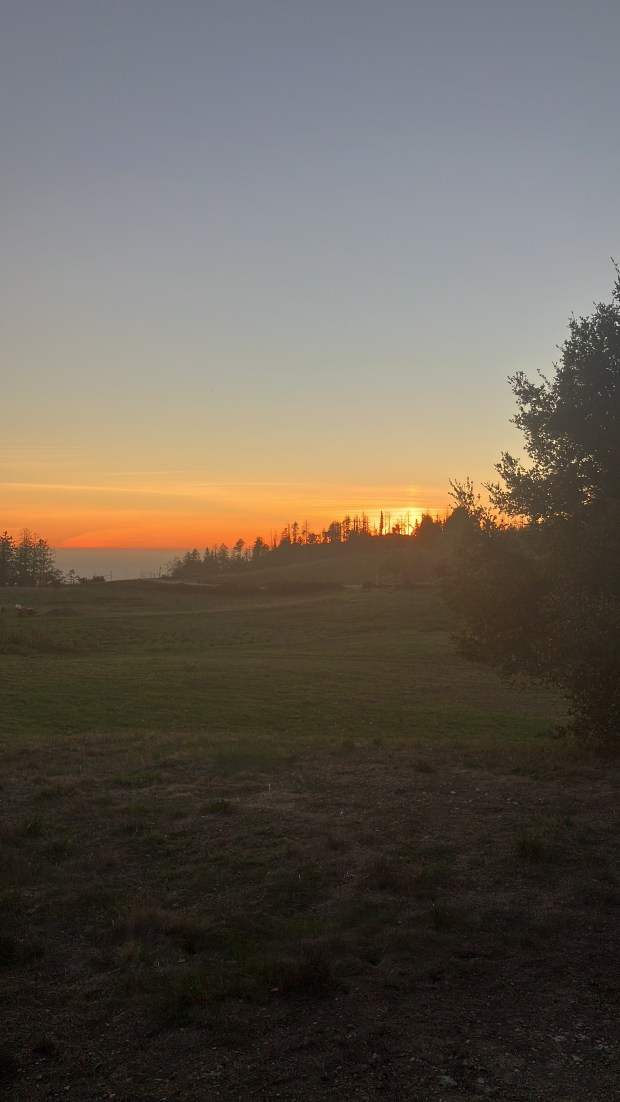
A recent sunset from Molino Creek Farm

Deep Time Thanks

Molino Creek Farm lies within the unceded territory of the Awasawas, or Santa Cruz People, in the Cotoni tribe. They lived on and cared for our land. They left lots of artifacts. There are places where seashells are still coming out of the soil. There are lots and lots of chert and some obsidian flakes. We have found bowls, mortars, and cooking stones. They were the first human inhabitants of this land and they took care of the old growth redwoods and ancient oaks that we still enjoy. Their land management made our soil rich for the crops we still grow.

The Greek Ranch and Transition

Much more recently, us Molino Creek Farm folks have The Greek Ranch and then Kay Thornley, Harlow Dougherty, Jim Pepper, Steve Gliessman, and others to thank for being here. There were years of hippies living here, wild years as we understand back in the Greek Ranch days. As the Greek Ranch transitioned to Molino Creek Farm, this contingent from UC Santa Cruz managed to purchase the land and created the organization that we have now. Many thanks to the folks who had the patience and fortitude to wade through all sorts of issues in establishing this cooperative.

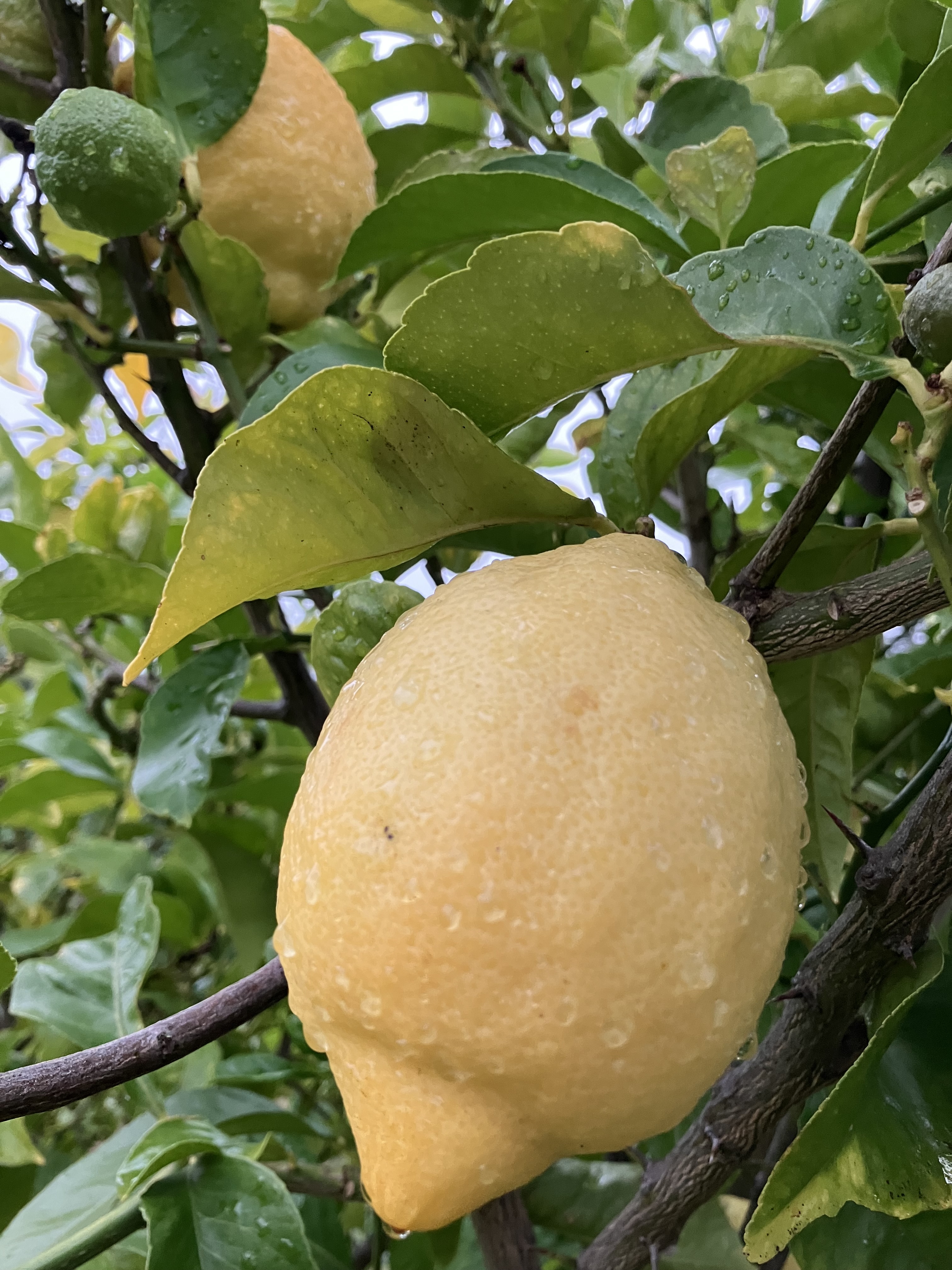
A few Lisbon lemons still left on the trees

Farming

Joe Curry, Judy Low, Mark and Nibby Bartle, and many others worked very hard to establish Molino Creek Farm, which became a legend for dry farmed tomato production. The early farmers made enough money and worked hard with piles of purchased materials to put up miles of deer fence, long stretches of irrigation, and a very good agricultural well. They bought equipment – tractors, fuel tanks, implements, generators…much of which we still rely on. These intrepid farmers taught many people how to grow dry farmed tomatoes and those people started their own businesses. The Farm was the 13th certified organic farm in California…there are hundreds now. We must thank these organic farming pioneers for showing how it’s done and inspiring others to give it a go.

Intentional Community

Other work deserving thanks is from the communal spirit and willingness of those who co-own this land. Living together in such a rural place takes work. The Farm is off grid and so produces its own power and water. We live 3.5 miles up a private road, which takes a lot of maintenance. They say people used to have to drive with chains to get up a muddy hill on the way in, and even then it wasn’t certain.

We have people who manage the finances, ‘the books,’ taxes, meeting facilitation, meeting notes, work party conveners, and so much more. Some of the group maintain the farmland, others maintain the wildlands, and others the water infrastructure. There is a legal committee, a road committee, and a neighbor committee – all very necessary. It takes great generosity to make these things work and we remain grateful to one another for the things we fit into our otherwise busy lives to help keep things together.

2020 Fire

The CZU Lightning Complex Fire devastated our farm. We lost two homes and a community garage workspace, fences, parts of our water system, many orchard trees, and much more. We put out word about what happened and an accompanying call for assistance. Within a short while, we raised $80,000 to help generally and a big portion of that to revitalize what was lost in the orchard. Such Huge Generosity!! We are still awed by that support. The financial support we received is just one indication of the strength and support of the social networks that the partners in this endeavor hold and tend.

We lost quite a few of our avocados in the 2020 fire, but they are just starting to fruit again

Land Stewardship

Since the fire, we have had amazing support for tending our land. The Prescribed Burn Association has poured support into teaching our cooperative about good fire and then leading a prescribed burn last year, reducing fuels over many acres, restoring coastal prairie. They brought people here to help and keep in touch, watching with us the effects of their management. Now CalFire is offering that same kind of help!

Neighbors

Our neighbors have always been helpful. For years, the folks at the cement plant helped keep our road in good shape, the gate secure, and even supplied us with road material, rocks, and spare cement. PG&E has chipped in lots of funding and work to keep the road repaired. 

The partners with the San Vicente Redwoods have also been unendingly great to us. Roadwork and weed work, fire and fuel management, security, and so much more have all been graciously a part of their contributions. We are learning together how to take better care of our lands, the non-human beings, and each other.

Community Orchardists

For 15 years, we have enjoyed the growth of our Community Orchard. We keep in touch with 225 people on email. 5 – 20 people show up to tend the orchard on many Saturday afternoons. Even though the fire took us backward a step, 5 years later we discover the orchard has surpassed that damage and is creating more and more amazing fruit, feeding more people. 

This year, we needed a tractor and the community orchard network donated funds that allowed us to buy one this past week. It is amazing how the generosity continues, born out of the relationships we build by tending a beautiful orchard, creating “Fruit for the People!”

In sum, we are very thankful. We have so much to be grateful for. Thank you, each and every one of you, for the various kinds of love and support you offer this amazing place, this greater community, which we steward together.

Rumblings Afar

The bounty is upon us. The Horn of Plenty gushes forth a profound plethora of food as Fall begins. The Equinox returns old bird friends to the farm’s ongoing bird drama, including many galliformes. The meso-predators – fox and skunk, especially – roam and hunt each evening. Farmers sweat in frequent heat, weeding and harvesting. We are thankful the lightning has skipped us, yet, but WHAT’s WITH THE STORMS??!!

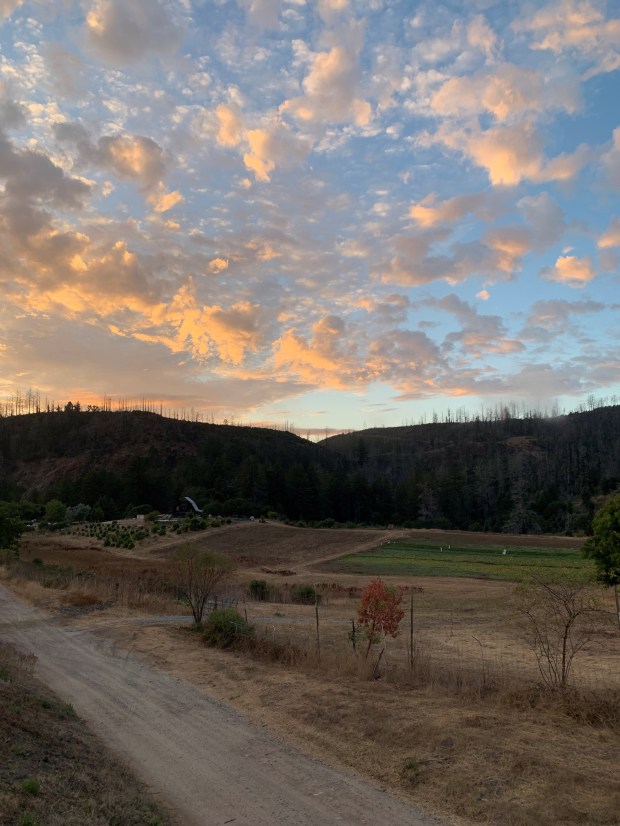
Farm Overview at Sunset – Color thanks to Tropical Storm Mario

Rumblings Afar

Last week it was Tropical Storm Mario, this week an unnamed spiraling monstor. Mario spewed a swarm of lightning bolts 30 miles offshore, jetting up the coast and not, as predicted, coming onshore. The unnamed storm spun arms of poofy clouds and hundreds of lightning bolts, mostly around Lompoc and the southern San Joaquin Valley. It, too, was predicted to come ashore with that violent weather this past Tuesday night but then, once again, it skipped us: the only a hundred or so lightning strikes were inland, in the foothills of the Central Valley. Tense times, these.

The mugginess, daytime heat, and even balmy evenings are unusual for us. Luckily, it hasn’t been scorchingly hot – the apples aren’t getting sunburn. And, happily for tomato farmers, there hasn’t been enough rain to even start to wet the ground – dry farmed tomatoes split with rain!

And, oh how those tropical storm clouds color our sky at sunrise and sunset. Brilliant orange hues are the dominant evening entertainment, dazzling near the horizon and all mixed up with purples and blues higher up, sprayed across cloud puffs or ethereal mists.

The Toil

Amidst the episodic heat, farmers work and sweat. The weeding never ends. One starts early to avoid the worst of it, but that early starts later…hoes hit the ground at 6:45 if we’re lucky. And the harvest takes hours through the day while the sun pushes prickles and wilting heat right through you. The sweat would drip except it is so very dry, salt cakes on the skin roughly mixing with dust. Harvesting tomatoes bent fully over, gingerly stepping between sprawling plants and peering into the dense foliage for hidden fruit, carefully extracted…boxes and boxes of big swelling fruit emerging from so little ground – it is an epic year! What a contrast to last year’s crop failure.

Two Dog Farm dry farmed winter squash, each year a stunning miracle from such seemingly dry ground

Fruit Ripens

In the orchard, the apples ripen with lemon harvest still in swing. Eureka lemons get ripe by the day, our first year of sending them for weeks to market. These lemons are popular among our Community Orchardists, too – they are catching on – so, the ‘seconds’ lemons are getting claimed voraciously. About 50% of the lemons aren’t perfect enough for market, and so 25 pounds a week are getting distributed. It seems like next year we’ll have surplus for the Pacific School, once they return from the summer. Our lemon trees have just past 10’ tall, a bit lanky and need of some shaping – sharp spines make portions of the getting-dense trees hard to harvest. It is surprising how difficult it is to discern the varying shades of yellow on the fruit, sometimes with hidden tinges of green, to harvest the ripe ones as they turn ever-so-slightly deeper colored.

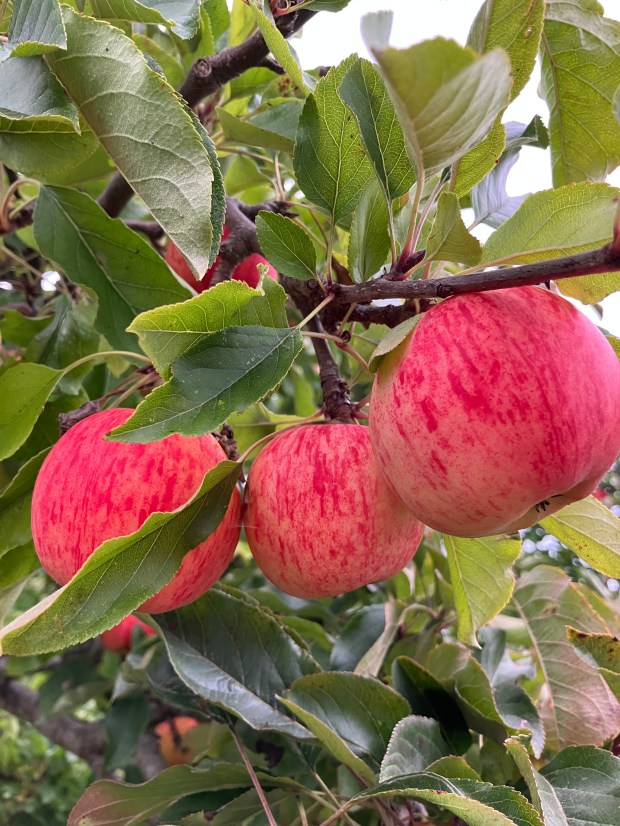
Gala apples are the first to ripen: we sent our first box to market out to the Community this past week. The background peach color, beneath the red streaks, is so obviously a sign of ripeness. They are gorgeous when ripe.

Ripening Gala apples in our Community Orchard

Reclaiming the Land

We are so thankful to our various partners for their assistance in restoring the natural areas of Molino Creek Farm. Last year, the Central Coast Prescribed Burn Association’s (CCPBA) massive network of volunteers and dedicated staff put Good Fire on the ground, nudging our scrub invaded systems back to coastal prairie. Their work also makes our farm safer from wildfire, which has been much on our minds of late. This fire break augments a many miles long regional firebreak that runs on our border and protects Bonny Doon and then Santa Cruz further down the fire-shed.

This week, the new President of the CCPBA, Matthew Todd, has been using his expertise and big, expensive tool to take that burning a bit further. His Bobcat runs a masticator, and he’s mowing down huge patches of the invasive French broom which sprung up after the 2020 fire. Alongside that broom are acres of brush that has taken over super-diverse prairies that were dominant in photos as recent as 1988. Matthew is a landscape artist – it is looking so great and we are much-relieved to have his help bashing broom…and jubata grass…and coyote brush. Broom control protocol calls for several years of mowing in the Fall, like we’re doing now, and we are going to do just that – maybe with a bit of Rx Fire thrown in there.

Rumor has it that CalFire will do a training burn in a few weeks (after grape harvest), so more to come.

Matthew Todd on his masticator, taking care of prairie one strip at a time: Thank YOU!

Natural Production

While our Farm Fruit is abundant, so is the fruit of the woods. Jays and Acorn Woodpeckers have turned their attention to the acorns, which have swollen and started to drop. On the ridgelines above the Farm, the manzanita bushes have their first massive berry production since the 2020 fire. The seeds have tasty dry, sweet pulp and hard as rock seeds. Some critter has been feasting on them and then pooping out the remains in our apple orchard – a long haul, but someone has a circuit.

Critterland

It is easy to see a fox at night if you just go looking. We must have a large population. They bark and yowl. You can’t hear them, but you can certainly smell them … skunks are prowling farm-wide. The hayfields are full of their nuzzling holes where they seek mice or crickets. The bunchgrasses we’ve been nurturing in our hayfields have turned green and since we didn’t harvest the hay, there is plenty of hunting ground for skunks.

Native bunchgrass, California brome (Bromus carinatus) hay field with skunk hunting sign

Welcome Back Sparrows! And…

Golden-crowned sparrows returned, as usual, with the Equinox. In the dark of the night on 9/19, hundreds of these winter birds dropped out of the sky and started feasting on what seeds remain from the entire summer of feasting of the other birds. They were quiet and shy at first, maybe a bit tired from their journey, but now they are feisty and squeaky. 

At the same time, other types of birds arrived. The meadowlarks landed in the meadows lower down and closer to the ocean. And, the blackbirds – Brewer’s and bicolored – have suddenly formed their cacophonous flock at the top of the trees around the periphery of the farm fields.

Gallinaceous Bird Drama

The turkey flock was attacked in the forest, what a terrible noise, and only the male has been about. Seems like a good idea to go to that place of turkey noise and see what happened. A coyote or even a pack of coyotes would stand quite a challenge against such powerful birds: maybe it was a lion? Tracking is in order.

Massive quail coveys flush and whirr at every turn. They are Very Jumpy because there is a Very Good Hunter about: Cooper’s hawk is energetically flying about. Do kestrels eat quail? There’s one of those around, too.

Swings

Prickly, skin burning sun gives way a day later to chilly overcast drizzle. As the planet warms, the extremes get more extreme; I don’t recall that kind of pendulum, but who knows? Monday’s sunny high at Molino Creek Farm was in the low 80’s, Tuesday a little cooler (but not much), and Wednesday it was in the low 60’s and drizzling. Let’s go back to the moment it switched: Saturday. We gathered our Community Orchardists just as the day went from somewhat cloudy and cool to crystal clear and warmer – the kind of beautiful where it feels like someone dropped a psychedelic dome over the big green earth, emphasizing color and clarity. Shimmering, exquisite beauty.

Cherry Blossoms

Fruit for the People!

The working bee rocked- cheerful chatter and hard workers knocking out pruning, weeding, fertilizing and cleaning branches & props. It was enough to turn around whatever doubt we might have had that this season is a turning point. We came together around food with toasts and kind words of appreciation for the community we create around growing Fruit for the People! Speaking of which…our Community Orchardists have delivered their first crop of Robertson navel oranges to our favorite outlet: the Pacific Elementary School‘s Food Lab in Davenport. Somewhat shy of 100 pounds of juicy, brightly colored, thin skinned oranges are making people happier and healthier. This kicks off 2025’s food donations to this important program.

Oh- and By the Way…many thanks to our dedicated readers and their forays to the Food Bin. They sold out of our tasty Bearss Limes and had to call us up to get more – vocal demand was the key. We are happy to help more people to shop local – this is The Locally Owned Grocery Store on this side of town. Go on back, now- they have a new batch of our limes, the best limes in town.

Aisle cover crop: bell beans; under tree permanent cover crop: Iberian comfrey

Terroir

We imagine we taste it in our limes, maybe in our oranges, too. But, the terroir comes out especially in our cider and wine. Cassandra Christine pointed it out first and now we are all grooving on the unique taste our soil imparts into our fruit. You’ll have to wait a bit to purchase Two Dog Farm’s chardonnay, but we are wishing them well in getting a big harvest this year after so carefully tending the vines.

Italian Prune Bark

This Land is Bird’s Land

There are so many birds at Molino Creek Farm right now – it is teeming with feathered friends. A few of us counted the bicolor blackbirds singing in a dead, bare-branched fir tree above the orchard. The number is the same as previously reported 35-40: that’s our flock.

There are hundreds more golden crowned sparrows, which are getting ready to take off to Alaska. I have some observations to share about these buddies. The sparrows around my home have accepted me as a friend and do not flee until I get around 5 feet away if I move slowly. As I walked around the garden the other evening, I approached the cherry tree, which had just started flowering. A golden crowned sparrow was happy about that – he was furtively plucking petals and pecking at buds, feasting away as fast as he could, ecstatic. This had mixed effects on me: on one hand, I was excited to realize that this species eats flowers; on the other hand, I wasn’t pleased that this bird was potentially causing loss of my favorite fruit. I talked to this guy about it, telling him that I really wished he wouldn’t eat my cherry flowers, but he didn’t seem to understand. I told him I’d get out the bird seed and feed his brethren seed if he let the cherry blossoms along. A moment later, he left and I haven’t seen sparrows in the tree again: good! I put seed out in the front yard and, looking out my sliding glass door this morning, I saw the flock of golden crowned sparrows, some of whom were eating the seed. I noticed that others, closer to the window, were eating weeds…and one was eating the petals of a California poppy. Just as I felt the rush of another discovery, yet another piled on: the poppy petal eating sparrow fed a luscious mouthful of petals to its friend, as if to say – “YES! It IS delicious!”

One more note…the golden crowned sparrows are also eating radish leaves, but not just any radish leaves – they find certain tasty radish plants and strip them to leaf midveins while completely ignoring a neighboring, probably less tasty plant.

We will miss these friends when they leave for Alaska…any day now.

Austrian Pea – a resprouting cover crop plant in a sea of chopped up calendula

Scents of Spring

Sweet smell of plum blossoms, pungent-bitter scent of calendula crushed underfoot, the perfume of fresh cut grass…and, the acrid-poopy smell of rotting radish. The Farm planted daikon radish as a cover crop and it does quite well. Grind it up with the mower and, well, it rots. To me, it didn’t smell so nice even as a live plant. I don’t really like that crucifery stench, but others apparently do: a recent UCSC class visit taught me that humans can have vastly different experiences with the mustard green smell. Good thing. A bit more rain (its coming!) and a bit more mowing and that rotting daikon scent will be ubiquitous. About that time, the rotting radish smell will mix with the freshly applied compost and melting down feather meal scents and the Farm will smell….richly stinky!

First Quince Flowers

The Sounds of Late Winter

Behind the bird chorus, waves pound. Finches crazy whistling, goldfinch squeaks, robin operas, junco twittering, bluebird sonnets, and so many other bird songs fill the air at dawn and dusk…and sporadically all day long. Lately, the waves have been very loud, rolling roars pulsing, occasionally cracking high on the rocks and sending an attention note into the hills. Gusts sing in the trees and whistle through the winter’s last dead hemlock stems, rocking.

Here goes another growing season, folks! We’re digging in deep.

2020 Fire starting to disappear to new redwood bark regrowth

Equinox

Three layers of clouds moving in different ways for different reasons woof in the soon-to-be rainy season. Time to put up firewood and stuff.

Sunset peach clounds dance above the barn, fields falling into darkness. The day’s last colors.

Another cool night pinches the sweetness into the many ripening apples.

This week spells big transitions for the Farm in another way. Day by day, each morning the chainsaws got closer and finally they emerged from Above to Here this week.

Burned Tree Control along Warrenella, Thanks to San Vicente Redwoods Conservation Partnership, photo by Sylvie Childress

Changes on the Land

We have made great progress each year after the 2020 CZU Lightning Complex Fire blasted its way into our lives and across the property. The Big Leap recently was the clearing of hundreds of dead trees along the most proximate stretch of Warrenella Road. Our Good Neighbors have found the capacity to clear the trees that were killed or badly damaged by the fire…each and every tree that could have otherwise fallen across our road is now on the ground. Massive numbers of tree skeletons suddenly lying on their sides. (that particular area carpeted with a kind of yellow-flowering groundcover deer brush last spring).

Several close calls with waves of rain from the North this past week help the Fear of Fire fade, but it hasn’t yet become wet enough to allow the relaxation of winter rains’ wildfire reprieve.

Tomatoes!

The lack of rain relieves the tomato growers because wet tomato plants can undergo late season fungal and other blight disease melt down. The acres of tomatoes lie heavy with juicy red ripe fruit that we can’t really keep up with harvesting: too many tons all at once, and where would we sell them all anyhow? Pots full of sauce ladled into canning jars. Humming hot blowers from dryers, trays of tomatoes shrinking. Sweet, sweet tomatoes! Our favorite season. Comparing what each other can DO with them: a tasty half-dry/reduced chopped tomato relish brightened with Calabrian pepper oil a recent favorite from fabulous cook Mark Kuempel (thanks!).

Sunset on the Farm

The Deer

The Deer are (still) busy eating up apple culls. A GIANT buck proudly stands tall with excellent contrasting patches of remarkable white and black. Sylvie’s ear caught the Most Curious of Deer noises: ‘a whirly-gig’ she said. Here’s a link to the surprising noise, in the first few seconds. OH! How odd the rutting season!! We have never had so many bucks so close up; perhaps the fire made a lot of deer food and the population is headed high.

Apples

During our regular, well-attended working bee, we had an ad hoc apple tasting last weekend and found some pretty surprising results. The Cox’s Orange Pippin was almost ripe and ripe enough to cause yummy noises as well as some picking. An offspring of hybridization of that one, the Rubinette, also to a lesser degree caused some ‘oohing’ and taking of almost ripe fruit home. Areas of Fuji were getting nearly as ripe as the Galas, both at least a week away. The frightening part of this news is….there is a good chance that most of the 9,000+ pounds of fruit we have in front of us will ripen nearly simultaneously. Here comes the juice….a jolly pressing matter.

Harvest

So, yes, this is the season of harvest. Out in the fields gathering, hauling boxes and buckets back to the Barn for packaging for market, driving vehicles weighted down with food miles and miles to sell. Out early back late, hefting sore muscles balanced by glowingly thankful faces, friends, strangers all in awe of the best food on Earth. Molino Groupies. Two Dog Groupies. Unbelievable! People with Molino Creek Farm Tee shirts from years and years ago, hefting Molino Creek bags. Cheering friends welcoming the food we continue to produce from this verdant land. The harvest won’t last long. We are lucky if the food keeps coming in until Thanksgiving: just 2 more months if the weather holds! This is why we try to preserve the season’s flavorful foods by straight up canning, or roasting and then canning. Dried or canned tomatoes shifting to dried apples or canned applesauce. The prunes, however, aren’t so numerous and the competition for the best prune desserts is ON around the Farm.

Harvest Company

Whatever one does outside, one has company. Face flies and other summer flies are at their zenith. The newly born and mother cows on our drive out are covered with them, but we are just annoyed. The buzzing buggers dive over and over into your ear or make your eyes continually squint and blink as they bombard, zig-zag, or dive for a taste of you. Battling those annoying flies are the legions of dragonflies patrolling the air in patches; we could use more to vacuum up the more annoying flies.

Full Moon, Equinox Coming

This coming Sunday at about half past 5 in the morning we will cross the line where day length is equal to the hours of night. Fall Equinox marks the turn towards night, towards the long cold, onto California’s rainy season. One more month, October 15 is the date of the average commencement of rainstorms. Sometimes we can get a lot of rain just before then. Approaching this High Holiday was the Full Moon we just passed making the sky glow like day all night long.

We hope you had a Good Full Moon and will take some time on Sunday to reflect on the changing times.