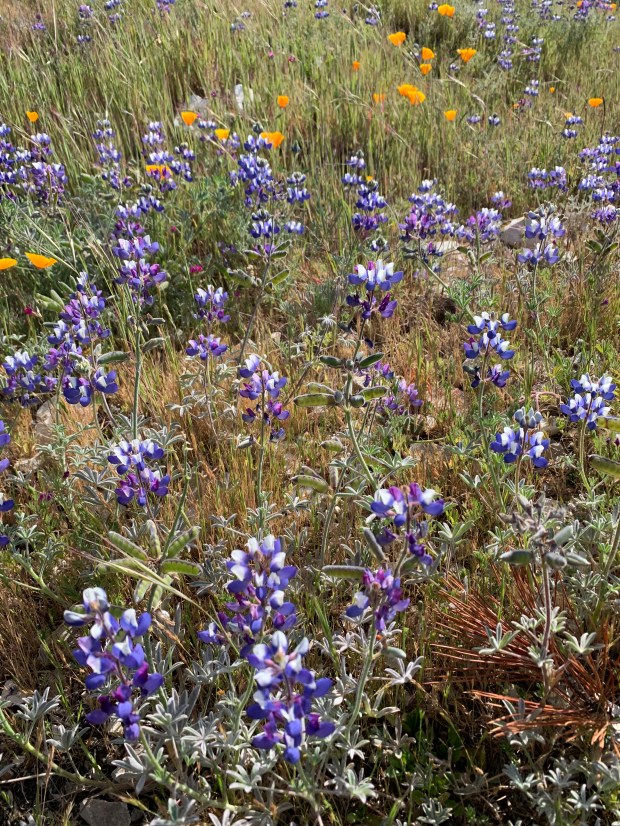
When you think of Scotts Valley, what comes to mind? What comes to my mind are hours of tedious battles to save what was left of the remarkable meadows, which are home to some fascinating species. Embedded in those memories are lessons about how other people viewed those meadows and the diversity of human perspectives.
Glenwood and Santa’s Village
Highway 17 bisected some fascinating grasslands in Scotts Valley. On the west side of the highway, one can visit what remains of the Glenwood meadows. It is called the Glenwood Open Space Preserve and is owned by the City of Scotts Valley and managed by the Land Trust of Santa Cruz County. I’m not sure how many native species are left now, but in the 1990’s when I joined the battle to save those meadows, we used R. Morgan’s statistic of an extraordinary 250 native plants on just over 200 acres. The meadows would erupt in spectacular displays of lupines and poppies, each hillslope a slightly different color with many other wildflower species.
Home to Rarities
To the east side of Highway 17 the last remaining meadow is at what was formerly known as Santa’s Village or the Polo Ranch. This smaller meadow was recently carved apart to make room for a luxury housing development by the seemingly ubiquitous Lennar Homes. Though smaller, this meadow has wonderful botanical surprises both in shallow-soiled dry rocky places and in some seepy wetlands.
These meadows are the home to the federally endangered Scotts Valley spineflower and the state-listed endangered Scotts Valley polygonum, species found nowhere else in the world. The state-listed endangered San Francisco popcornflower is awaiting better management in the seedbank in both meadows. A distinct form of Gray’s clover, if it survives, will probably one day be called the Scotts Valley clover as will a distinct form of Douglas’ sandwort – both should be listed as critically endangered and are only in the Polo Ranch meadow. A population of the State-listed rare Pacific grove clover has been found in the Glenwood meadow. The federally listed endangered Ohlone tiger beetles are also found in these meadows and in only 5 other places…all within Santa Cruz County. Opler’s long-horned moth, which should also be listed as endangered, is found feeding on cream cups in the Glenwood meadows. Western pond turtles have been found in the Glenwood pond, which would also make great habitat for the rare California red-legged frog were it not for nonnative fish which were put there a while back.
Prior Losses
Scotts Valley has a long history of destroying the things that made it a very special place and replacing those special things with poorly planned housing developments. One gets the distinct feeling that poor planning is a hallmark of that town, which has no town center and is entirely sprawl. Smells like a legacy of greed combined with lack of civic engagement and the resulting pro-developer elected official. My mentor R. Morgan lamented the loss of the marsh that was once at Camp Evers, an ancient peat bog like no other for hundreds of miles. Then there was the development at Skypark, which was an airport and now has a small fragment of the once wildflower-rich extensive meadows.
Scotts Valley High
Since the early 1990’s, as I’ve been following the more recent destruction of Scotts Valley’s ecosystems, the first to get to bulldozed was the Scotts Valley High School site. There were other sites but someone in power got their way, sacrificing rare species and permanently destroying a treasure of immense value. So powerful were the proponents that they managed to protect only tiny set aside areas for the rare species, spaces that were doomed to fail. Promises of integrating these small conservation areas with high school biology classes never materialized. Management for the endangered San Francisco popcornflower has never succeeded.
Glenwood Open Space Preserve
With great effort, the Friends of Glenwood, the California Native Plant Society and the Sierra Club managed to fend off 200+ homes and a golf course that had been proposed at the site.
Meanwhile, the Land Trust of Santa Cruz County is both succeeding and failing to manage this preserve. On one hand, they have been quite successful in managing for the most endangered species on the property- the Ohlone tiger beetle. This beautiful beetle has flourished because of their work. On the other hand, the habitat for the Pacific Grove clover seems to have been lost due to poor decisions. And, large areas of the property are being overcome by invasive species such as stinkwort and French broom.
Santa’s Village
Legal wrangling and the California Native Plant Society’s (CNPS) negotiations resulted in the protection of a small private park above 40+ homes. CNPS fought to have fewer homes, arguing that more homes would require more grading, which would threaten the hydrology of the steep terrain and its rare plants. Undeterred and supported by the ‘any development is good development’ Scotts Valley City Council, the home builders dug into the hillsides which subsequently collapsed, severely damaging the rare plant habitat. After years of delaying any management, the preserve area degraded due to brush and weed encroachment. But, after many years, the Wildlife Heritage Foundation is managing the property and trying to restore some of the rare species. Let’s wish them luck!
Lessons Learned
Scotts Valley has been, like Capitola, pro-sprawl whereas Santa Cruz is hemmed in. Just wait…one day Santa Cruz may re-think its greenbelt. Maybe I’ll get to hear another City Council person tell me that if such-and-such endangered species was in their yard they’d destroy it. Maybe I’ll once again hear a developer say something like ‘that Ohlone tiger beetle is probably the most common bug in the world!’ As pressure grows to develop around the Monterey Bay, I hope that we figure out sooner than later how to ensure that natural areas remain natural. How about third-party conservation easements on our parks? Can you not see how municipalities like the City of Santa Cruz will one day try to build housing on its greenbelt? Even State Parks will see that pressure. It seems to me that land trusts should be eyeing those opportunities with interest. They could be helping to guarantee longer-term conservation now that we’ve seen how quickly the tides can turn against conservation as the populace gets poorer and the developers get richer and more powerful.







 Grey Hayes