central coast prescribed burn association

People for Fire

Nature around the Monterey Bay has been adjusting to changing wildfire regimes; we should expect that to continue, but how that happens is up to us in many different ways. Very recently, we are putting purposeful, good fire back onto the land. This may help restore the land while protecting human infrastructure from catastrophic damage, but there are too few projects to learn from…we must learn more!

Burning History

The Monterey Bay area has been getting hotter and drier for 20,000 years, which coincides with the era of fire-lighting humans. Laguna de las Trancas is an ancient pond that lies on a geological fault on the North Coast. Ancient ponds record the history of their place in strata. Scientists have taken sediment cores from that pond and recorded layers of pollen and volcanic ash, going back through time as the deeper sediment is older. Volcanic ash has properties that allow us to know from which volcano it originates and scientists have used various methods to chart the age of ancient volcanic eruptions. So, volcanic ash serves as milestones marking known years in the sediment’s past. This is how we know that this region changed to a much more fire-prone landscape around 12,000 years ago, consequent with the widespread archeological evidence of humans. Before that, the dominant forest trees were firs; after that, fire-adapted redwoods came to dominate. More recently, for the past 1200 years, fire scars on ancient redwoods illustrate a 4-6 year burn return interval. Indigenous people likely managed the fires sweeping frequently through redwood forests, but their fire tending of this landscape tragically ended during the genocidal colonist period. Purposeful fire has been almost entirely absent on most of this landscape for 230 years. In its place, long-interval catastrophic wildfires have caused all sorts of mayhem and loss of life.

Indigenous Pyro Management 

Oral history, written accounts at the time of colonist contact, pollen records in ponds, burn scars on ancient trees, and vegetation patterns on this landscape are things that can teach us bits about thousands of years of intentional use of fire by humans. One early written account from early Old-World colonist explorers notes that many of the meadows around Monterey Bay were burned black. We know now that without burning and/or grazing all of this region’s prairies change quickly into forests, so fire must have been maintaining meadows for a very long time, in the absence of grazing and tree-pulling by the Pleistocene megafauna. The blackened meadows hampered the progress of invading Old-World explorers because they had trouble feeding their horses, which they relied on for transport. In this case, we might contemplate the use prairie fire as self-defense, but we also know that indigenous peoples used fire to cultivate native plants that served as medicine, salad greens, grain, basket materials and much more.

Good Fire Emerging Now

California’s governor has set a goal of using prescribed fire on a half million acres a year. It has been 1/10th of that for too long but indigenous folks probably burned more like 3 million acres (or more) a year previously.  

Most people do not see the natural landscape as their pharmacy, grocery store, or fibershed, but many people look to the hills and know the danger of wildfire. Purposeful, good fire is starting to address this last concern and one day will help people reunite with the land in those other ways. 

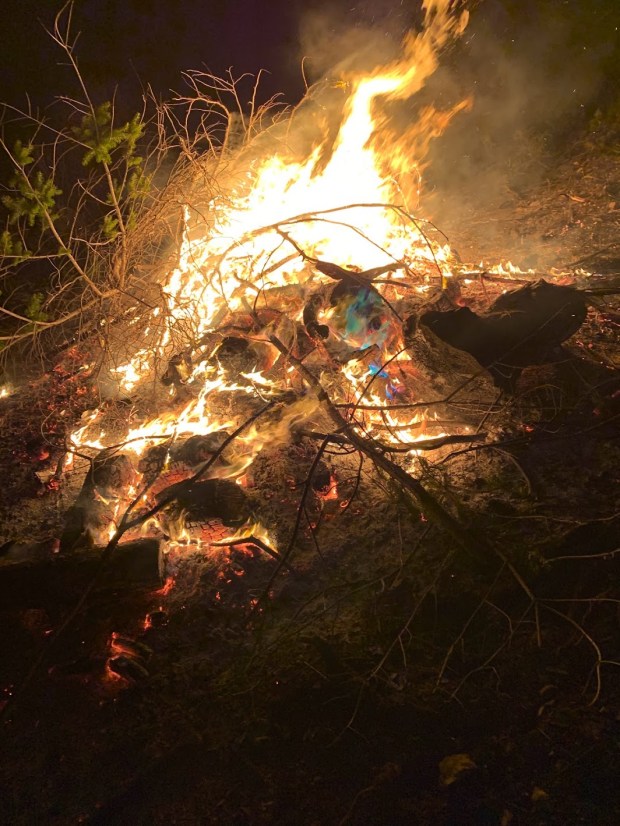
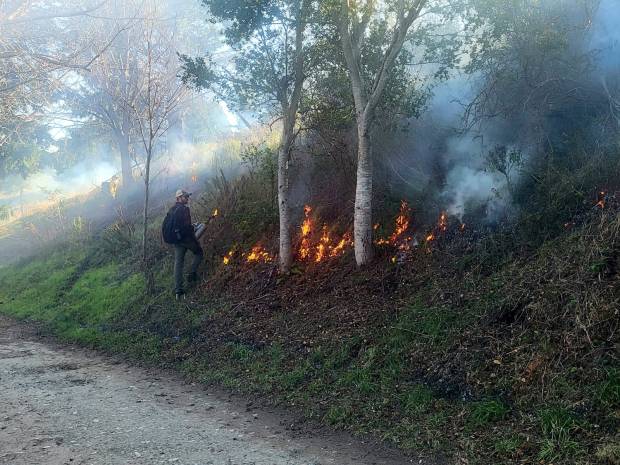
I was recently fortunate to interact with the Central Coast Prescribed Burn Association as they purposefully burned big patches of brush on Santa Cruz County’s North Coast. After much planning and preparation, forty volunteers gathered one Saturday to light big patches of hillside on fire. The goal was to restore coastal prairie and to train more wildland fire lighters in order to expand our region’s capacity to reintroduce fire on the landscape. These volunteer groups are growing around the world, including here in California. We have learned that their work is essential for everyone’s safety, and for the stewardship of the land, which provides us so much: water, timber, livestock, recreation, clean air, food, health, and solace.

Value-Added Fire

As we realize the importance of good fire in natural lands, entrepreneurs are envisioning profit. People are cashing in on the wildfire crisis by managing wildland fuels to power electrical generators. Some are seeing a potential to power electrical land stewardship equipment with generators fired by the fuel that equipment is removing. Others are already hauling wildland fuels to generation facilities supplying regions in Northern California with power. New technology allows burning wildland fuels to create charcoal, which is added to agricultural areas improving water holding capacity and maybe even soil fertility. That carbon is captured to mitigate greenhouse gas emissions. The machines are called ‘carbonators’ and they use thousands of gallons of water a day to keep them cool, which is the trick to making charcoal.

There was a lull for a bit, fand now there’s a rejuvenation of wood fired heaters for rural homes. The new woodstoves are engineered to be very efficient with very low air particulate output. Greenhouse gas (carbon) output is from recently grown wood rather than ancient fossil fuels.

The Future?

I envision a time when robots harvest biomass for fuel, farming every square inch of Planet Earth for energy. Imagine micro technology…ant-sized robots that prune plants in cultivated landscapes and natural areas, hauling bits of biomass back to larger robots which haul it to biomass energy production facilities…one big conveyor belt of fuel stolen from natural food webs. I do not like that future, but it seems inevitable in our ‘civilized’ world. How far off is that future? Without another way of managing wildfire, the day of that scenario is coming closer, quickly. The alternative is for more people to be involved with community groups managing purposeful, good fire across large areas, like the Monterey Bay region.

Your Role

Each of us has a role in helping Good Fire gain traction. Start with getting an air filter for your house: you need one anyway for wildfire smoke. Air pollution is a great concern, even with purposeful fires. The recent burning exercise I was a part of was delayed a week because of air quality concerns, and that week delay caused a bunch of issues with people’s schedules, wasted catering food, etc. If we can all be better prepared for smoke, it will be easier to get Good Fire on the ground. If you are able, help to figure out a way to get air filters to folks who can’t afford them!

We can’t expand Good Fire unless everyone feels safe in their homes. So, helping people get safe in their homes is an important thing. And, even when those homes are well secured against wildfire, people still need to be talked to, shown Good Fire, and helped to shed their fears. We can try to experience purposeful fire and see how well it is managed and then tell those stories to more people: there is a lot of fear about even professionally managed, purposeful fire.

The last thing I think more people might do: volunteer to help! The Prescribed Burn Associations could use more volunteers. Learning to manage purposeful fire is hard work and many people are needed.

-this column originally posted in the very informative weekly blog, BrattonOnline – please subscribe, like, and spread the word!
A Keen Balance of Heat and Cool (but then smoke)

The balance works out just right between night and day temperatures recently. The nights have windows open, cooling the house, providing fresh air and cricket chorus; the days are warm almost hot, almost warming too much, windows get closed….then the sun goes down and windows open, fresh air pouring in. Perfect comfort, naturally.

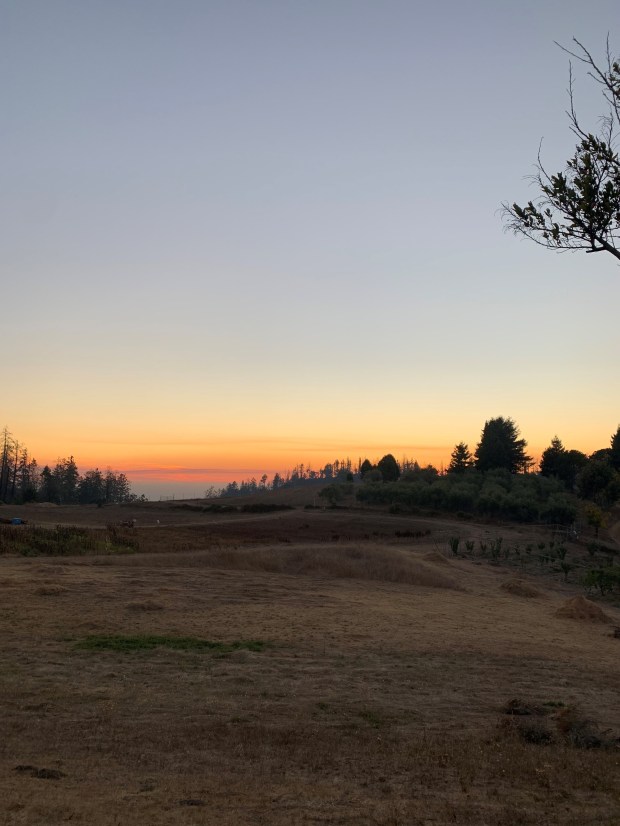
The Smoke from Prescribed Fire Makes for a Pretty Sunset

And so it was today, windows closed, an afternoon break and a glance outside reveals “OH NO!!” Smoke!!!!! The view outside was through the all-too-familiar haze that means fire somewhere: where?! Stepping outside, the characteristic smell of brush burning a ways away. Waves of denser or less dense smoke walk across the landscape, slowly – barely a breeze. Bob Brunie says he heard on the radio of a fire in Boulder Creek that had been put out, but Sylvie says it is a CAL FIRE-directed prescribed fire in the San Gregorio and Pomponio, according to the WatchDuty App on her phone. Oh good…so glad that’s what it was! And, the smoke magically changes from unwelcome and scary to welcome and thankful. So it goes. Made for an interesting sunset. Our farm will do a similar thing with the Central Coast Prescribed Burn Association soon – fuel reduction through good fire! Our smoke will cause some concern, we thinks.

What Do the Birds Think?

The smoke probably gives everyone pause, birds included. The migratory ones will recall smelling smoke and maybe even seeing flames during their journeys to our Farm this Fall: does the current smoke make them fearful? Carpets of scratching juncos and sparrows bob and hop through the churned-up dead grass, chipping and cheeping all day long, looking for food. As I approach the flocks, wrens erupt with their scratchy warning scolding alarms. Midday and coveys of quail flow from the thick patches of brush nervously crossing open spaces to sources of water, dipping and sipping, someone always keeping an eye out for danger.

Oozing holes in the orchard trees and the telltale PEENT! Gives notice that the red-breasted sapsucker(s?) have returned for the winter. Tommy Williams recently shared a photo of a burrowing owl somewhere nearby- they, too, have returned for the short-days season. As dusk dims, several poor wills flush in front of cars rolling along the very dusty road. And then, a stream of big bats sally from the barn, flapping quickly away, out of sight, a long night of foraging for bugs ahead.

Wall O’ Wickson (crab apples)

The Harvest

The flip side of the hungry, fruitless beginning of summer is right now, the middle of Fall. We are mid harvest in the orchard, which started in August and will continue through February this year. Next year, the harvest will go year-round as more avocado types make fruit. The early fruit is gone: the last of the prunes in the fridge are shriveling, the final gala apples are headed to market (and press). The middle season apples are ripening: grenadine is a favorite, as is Hudson’s golden gem, Bramley, Cox’s orange pippin, golden delicious, and so many more. Thanks to Freddie Menge for tipping us off to plant two dozen Wickson crab apples: we have the Wall O’ Wicksons now- a massive conglomerate of tiny red tartness bedecking the ‘left bank’ of the orchard. This is their First Big Year. We didn’t have enough props for them, and one ripped itself apart right into the ground with the weight of the fruit.

Quince are ripening

Quince are ripening!

The mandarins, limes, and Meyer lemons are also starting to ripen on Citrus Hill. Those types of fruit will extend the harvest into February when MAYBE we get some avocados for the first time since the 2020 fire set back so many trees.

In the Fields

In the farm fields, there are peppers. Two Dog Farm has a field with row after row of tiny bushes laden with peppers from dark green to bright red. Nearby, their winter squash abundance is tantalizing. Butternut squash makes for the best ‘pumpkin’ pie, and you could walk across an acre of those beautiful fruit. A very few tomatoes hang on in their own fields, maybe perking up from the heat waves…we hope for at least a trickle of harvest for a bit longer.

Logs Out

We LOVE our neighbors who, with the help of Nadia Hamey and her crew with Hamey Woods, have made our egress route a thousand times safer. The Big Hill was Dangerous, the Douglas firs burned up in the wildfire- then, dangerously perched on either side of the road awaiting windstorm or decay to come crashing down. A month ago, the saws revved and whirred for so long, trees crashing down, cut into logs, hauled into piles by huge machinery. This past week, the piles got picked up and hauled out: a changed and safer landscape. So much dust, so much noise…such an amazing amount of energy, work, and money. The effects of the fire are still with us, but smart and kind people are still mitigating the effects to great benefit. Thank you!

Birthday Boy

One of our newest members, Bodhi Grace, will soon celebrate his birthday by having the first party in the Barn in quite some time. He drained and cleaned the Cement Pond, wetting the periphery of the barn for dust and fire.  That old barn is about to rock. Happy Birthday Bodhi!!!

Fire Time

With the rain and cool weather, for many reasons….it is fire time. How do we weigh the balance between the benefits of burning wood for heat and wildland fuel reduction with the drawbacks of indoor and outdoor air pollution and atmospheric carbon additions/global warming?  This moment in this season is a good time to enter that reflective space.

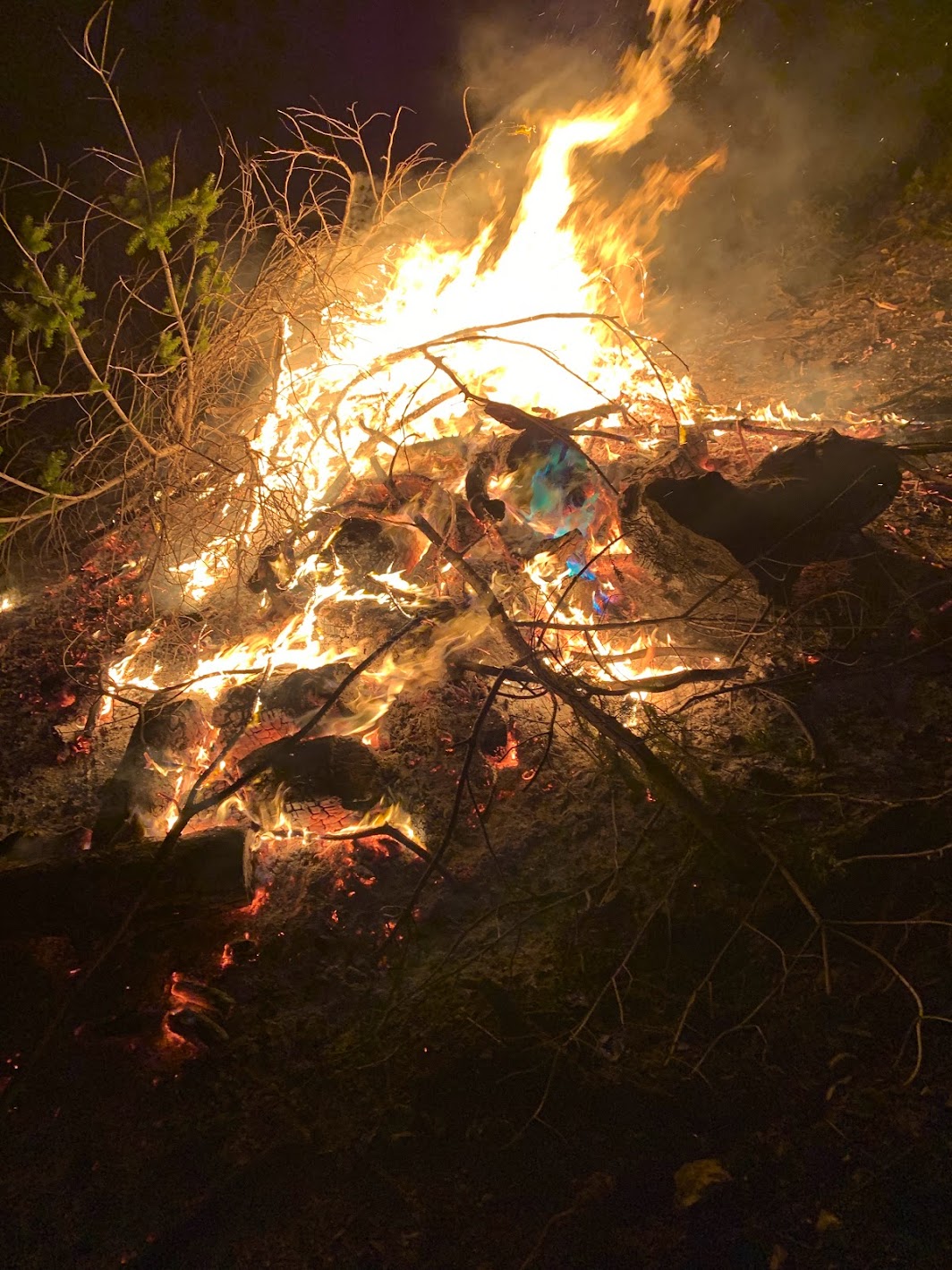
A burn pile being tended

Thinking Ahead

February is historically the wettest time of year on California’s central coast. The most rain falls in February, and the days are still short and the air is cool, keeping the environment moist between rainstorms. In just a handful of months, it will be dry and hot and fire weather will return. Anyone with responsibility to manage any vegetation must regularly plan for fire. Fire storms now march right into towns and so the smallest yard keepers have to think about the flammability of their situation. Why wait until the fiery weather is upon us? Cool days make for excellent outdoor working weather, and the wet environment opens up all sorts of opportunities for biomass processing.

Our Cultural Controls on Pile Burning

The native peoples burned dry natural vegetation, and so must we. With the rains and surrounding vegetation so moist, it has been an excellent time to do ‘pile burning.’ The CZU CAL FIRE unit, which oversees Santa Cruz and San Mateo County, started allowing rural residents to burn dry piles of vegetation starting last November 11, but how long that permission will last depends on the weather. CAL FIRE says, “Dry, natural vegetation, grown on the property may be burned outdoors in open piles unless prohibited by local ordinances.”  But first you have to apply for a CAL FIRE permit using an online system; and then you can only burn on a day that the Air Resources Board says is okay – when the smoke won’t be too much of a health hazard. You’ll need to do another permit application from them using, again, an online system. Interestingly, while CAL FIRE allowed burns a few weeks earlier, the Air Board burn season is December 1 – April 30.

Burning Assistance

This past December, and maybe again in the future, the Central Coast Prescribed Burn Association hosted workshops teaching “the foundational concepts of safe pile burning.” They offer this online resource for more guidance.

What About Composting Woody Debris for Fire Safety?

There is an understandable uprising against burning given concerns about climate change. Many people are suggesting composting biomass instead of burning it.

If you are in town, you can meter out your green waste bins by pruning out any dead or overgrown plants, a little at a time …. week by week. If you live out in the countryside and have to deal with a lot of woody biomass, you haul it to the dump or think of other solutions. How the dump manages to dispose of that much composted biomass is a conundrum.

There are permaculture folks and other Hügelkultur practitioners who suggest burying woody material beneath agricultural or horticultural beds, taking advantage of rotting wood for soil carbon benefits including increased water retention. This is a lot of work so it is applicable for only small amounts of woody debris in specific situations. Others suggest burying biomass to reduce erosion in downcutting drainages. My limited experience suggests caution with this approach as any wood that appears out of the soil will probably ignite during wildfire, burning and cooking the soil in the drainage. I share the same experience and caution for Hügelkultur: bury it well and hope it rots fast (you’ll need to keep it moist)!

What About Chipping?

With diesel or gas-guzzling chipping machines, it is questionable whether chipping is any better than burning biomass for atmospheric carbon impacts. There is also a concern about the wood chips catching fire in wildfires. One person I know had a nice pile of chips slowly disappearing into their grassy yard soil until someone built a warming fire on top of them…which ignited a few days later into a large conflagration that was difficult to extinguish. Best to bury chips, too – but not so easy to do! The same cautions apply for the practice of mastication- those big machines that chip vegetation ‘in place.’ Masticated material lying in carpets across the ground are less dangerous, but they still carry wildfire. And so, let’s turn back to the burning option.

Burning in Santa Cruz

The CZU Lightning Complex Fire burned 85,000 acres….mostly incompletely. That’s the region’s biggest, most obvious UH-OH! If you look at most of that acreage, you will see thousands and thousands of dead trees, which are slowly falling and creating a giant fire hazard. Do you recall the Creek Fire pyrocumulonimbus cloud and extreme fire behavior, including tornadoes of flames? That fire and other fires in the Sierra Nevada were greatly exacerbated by large numbers of trees killed by drought and beetles. We are facing the same danger in the footprint of the CZU Lightning Complex Fire. State Parks and other landowners have been using pile burning to reduce fuels to mitigate such a catastrophe, but a lot more needs to happen: the ‘treated landscape’ is much smaller than the untreated areas at this time. Still, I know of more than 500 burn piles having been ignited this season, so there is hope.

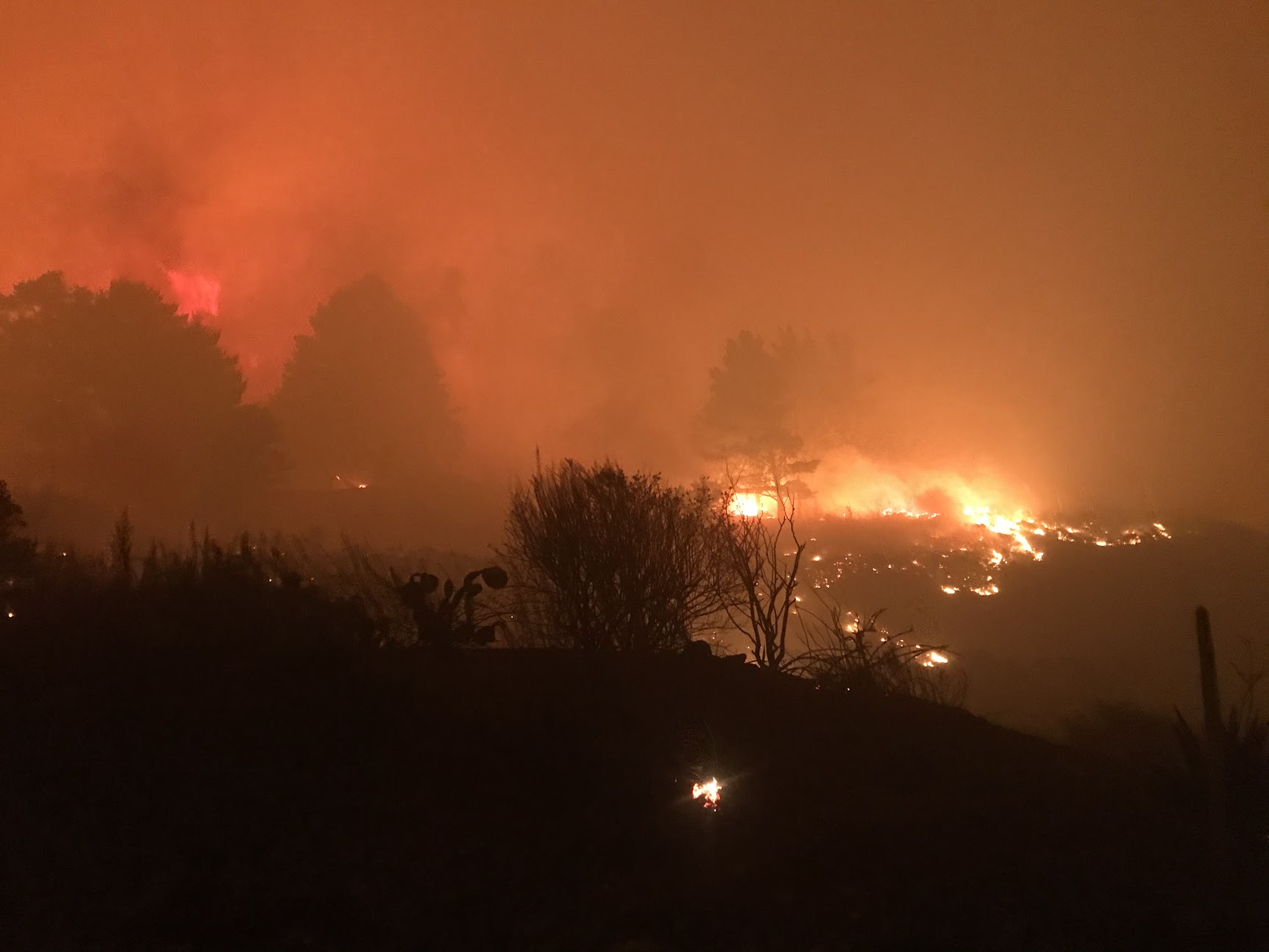
The CZU Lightning Complex Fire – Eating up vegetation a mile a minute on Wednesday August 19, 2020

Another method of burning involves using an ‘air curtain burner’ or a ‘carbonator.’ These both look like large metal shipping containers. Air curtain burners use high powered fans to contain sparks while logs get incinerated. Carbonators use more controlled air exchange so that they create ‘biochar’ – charcoal that can be used in agriculture or horticulture. Vineyards have been experimenting with biochar as a soil amendment that holds some promise for increased soil water retention. Horticulturally, biochar may substitute for carbon- and nature-unfriendly (mined) peat moss. We need to study biochar to see how long it retains carbon in the soil – long- or short term – to understand its potential for helping global warming by sequestering carbon.

Burning Wood: Carbon Neutral?

There is a movement afoot to reduce the use of wood for fuel, but to what end? In the San Lorenzo Valley and elsewhere, folks have long complained about air quality degradation due to badly managed wood heating apparatus. Unfortunately, folks use old wood fueled heaters and/or burn poor quality wood. As with burn piles, folks should be careful to burn only dry wood: there ought to be some rules for firewood sales to disclose percent moisture content in fire wood. Also, firewood needs to be stored so it doesn’t get wet after it is delivered to someone’s home. Wet firewood smokes a lot. Dry firewood burned in a modern woodstove, using smart fire building and maintenance methods can greatly reduce pollution while using a sustainable fuel source. The California Air Resources Board has a great website on cautions about, and helpful tips for, using wood for heating, and as an alternative suggests using electrical heaters.

Two thirds of California’s electricity comes from natural gas – fossil fuel! That figure is more hopeful in our region if you choose to get your power from Central Coast Community Energy, which is shooting for 60% renewable by 2025. Heating with wood is considered by many to be carbon neutral because the carbon that cycles from the atmosphere into plants, and then into wood fuel, isn’t fossil carbon but natural-cycling carbon. Plus, harvesting that woody carbon has the potential around here of being part of the solution to our current, catastrophic wildland fire fuel problem.

I hope you will carefully consider the right way to use wood for heat and take some time to manage fuels and vegetation where you can.

-this article originally posted by Bruce Bratton at his BrattonOnline.com weekly blog- get it automatically by subscription at his website…support local journalism and donate to Bruce- he could use your help!