birds

Swings

Prickly, skin burning sun gives way a day later to chilly overcast drizzle. As the planet warms, the extremes get more extreme; I don’t recall that kind of pendulum, but who knows? Monday’s sunny high at Molino Creek Farm was in the low 80’s, Tuesday a little cooler (but not much), and Wednesday it was in the low 60’s and drizzling. Let’s go back to the moment it switched: Saturday. We gathered our Community Orchardists just as the day went from somewhat cloudy and cool to crystal clear and warmer – the kind of beautiful where it feels like someone dropped a psychedelic dome over the big green earth, emphasizing color and clarity. Shimmering, exquisite beauty.

Cherry Blossoms

Fruit for the People!

The working bee rocked- cheerful chatter and hard workers knocking out pruning, weeding, fertilizing and cleaning branches & props. It was enough to turn around whatever doubt we might have had that this season is a turning point. We came together around food with toasts and kind words of appreciation for the community we create around growing Fruit for the People! Speaking of which…our Community Orchardists have delivered their first crop of Robertson navel oranges to our favorite outlet: the Pacific Elementary School‘s Food Lab in Davenport. Somewhat shy of 100 pounds of juicy, brightly colored, thin skinned oranges are making people happier and healthier. This kicks off 2025’s food donations to this important program.

Oh- and By the Way…many thanks to our dedicated readers and their forays to the Food Bin. They sold out of our tasty Bearss Limes and had to call us up to get more – vocal demand was the key. We are happy to help more people to shop local – this is The Locally Owned Grocery Store on this side of town. Go on back, now- they have a new batch of our limes, the best limes in town.

Aisle cover crop: bell beans; under tree permanent cover crop: Iberian comfrey

Terroir

We imagine we taste it in our limes, maybe in our oranges, too. But, the terroir comes out especially in our cider and wine. Cassandra Christine pointed it out first and now we are all grooving on the unique taste our soil imparts into our fruit. You’ll have to wait a bit to purchase Two Dog Farm’s chardonnay, but we are wishing them well in getting a big harvest this year after so carefully tending the vines.

Italian Prune Bark

This Land is Bird’s Land

There are so many birds at Molino Creek Farm right now – it is teeming with feathered friends. A few of us counted the bicolor blackbirds singing in a dead, bare-branched fir tree above the orchard. The number is the same as previously reported 35-40: that’s our flock.

There are hundreds more golden crowned sparrows, which are getting ready to take off to Alaska. I have some observations to share about these buddies. The sparrows around my home have accepted me as a friend and do not flee until I get around 5 feet away if I move slowly. As I walked around the garden the other evening, I approached the cherry tree, which had just started flowering. A golden crowned sparrow was happy about that – he was furtively plucking petals and pecking at buds, feasting away as fast as he could, ecstatic. This had mixed effects on me: on one hand, I was excited to realize that this species eats flowers; on the other hand, I wasn’t pleased that this bird was potentially causing loss of my favorite fruit. I talked to this guy about it, telling him that I really wished he wouldn’t eat my cherry flowers, but he didn’t seem to understand. I told him I’d get out the bird seed and feed his brethren seed if he let the cherry blossoms along. A moment later, he left and I haven’t seen sparrows in the tree again: good! I put seed out in the front yard and, looking out my sliding glass door this morning, I saw the flock of golden crowned sparrows, some of whom were eating the seed. I noticed that others, closer to the window, were eating weeds…and one was eating the petals of a California poppy. Just as I felt the rush of another discovery, yet another piled on: the poppy petal eating sparrow fed a luscious mouthful of petals to its friend, as if to say – “YES! It IS delicious!”

One more note…the golden crowned sparrows are also eating radish leaves, but not just any radish leaves – they find certain tasty radish plants and strip them to leaf midveins while completely ignoring a neighboring, probably less tasty plant.

We will miss these friends when they leave for Alaska…any day now.

Austrian Pea – a resprouting cover crop plant in a sea of chopped up calendula

Scents of Spring

Sweet smell of plum blossoms, pungent-bitter scent of calendula crushed underfoot, the perfume of fresh cut grass…and, the acrid-poopy smell of rotting radish. The Farm planted daikon radish as a cover crop and it does quite well. Grind it up with the mower and, well, it rots. To me, it didn’t smell so nice even as a live plant. I don’t really like that crucifery stench, but others apparently do: a recent UCSC class visit taught me that humans can have vastly different experiences with the mustard green smell. Good thing. A bit more rain (its coming!) and a bit more mowing and that rotting daikon scent will be ubiquitous. About that time, the rotting radish smell will mix with the freshly applied compost and melting down feather meal scents and the Farm will smell….richly stinky!

First Quince Flowers

The Sounds of Late Winter

Behind the bird chorus, waves pound. Finches crazy whistling, goldfinch squeaks, robin operas, junco twittering, bluebird sonnets, and so many other bird songs fill the air at dawn and dusk…and sporadically all day long. Lately, the waves have been very loud, rolling roars pulsing, occasionally cracking high on the rocks and sending an attention note into the hills. Gusts sing in the trees and whistle through the winter’s last dead hemlock stems, rocking.

Here goes another growing season, folks! We’re digging in deep.

2020 Fire starting to disappear to new redwood bark regrowth

Welcome Fall

We woke on the Equinox, September 22, to the song of night’s arrival – golden crowned sparrows. Somehow, they know the right day and arrive the same moment each year, ending their long travel south from Alaska. With the changing world, it seems odd that some things remain constant. These pesky birds promise hours of entertainment as their pecking order is as animated as chickens and they are far more numerous. Their aggression is correlated by the brightness of gold on their heads, but they still love each other: they have tight-knit family groups and larger tribes and they are settling into the same cluster of shrubs they called home last winter. They must be pleased to have so many seeds: last winter’s bounteous precipitation made the seeds rain more than even the huge coveys of quail can keep up with. When it rains, there will still be millions of seeds to germinate and the sparrows will start grazing the lush turf.

More Typicality

Just as last year, the winter battles summer this time of year. Some of us celebrated one more Warm Night: unusual in these parts. The warm night was sandwiched between two pretty hot days and then the Fog returned: moisture rolling off rooves at sunrise, dripping from leaf tips, coloring the dust on the road beneath wetted trees. The see-sawing of temperatures was the cue the apples needed to get that much closer to ripe, but the bouts of fog enshrouded days make it difficult to keep up with the watering…solar pumps don’t produce much when there’s too few photons. It would be better to water the orchard before it gets really hot, but the hot has recently been when the sun comes out. Dynamism and daily adaption is the way of the farmer. The question now…will it be truly typical and rain an inch, our first ‘big storm’ in the middle of October? Whoah! That’s just two weeks away!!

Dry farmed tomatoes- yum!

Fields of Tomatoes

The bouts of heat and the progression of the season coalesced to create a grand glut of tomatoes. In this house, we’ve processed a hundred pounds into jars and jars of sauce to brighten the meals in seasons far from summer. Another household dried 200 pounds. The smell of tomato fruit hangs in the air on still warm evenings. The warmth and dust-loving russet mites have ravaged many plants, leaves withered and crispy: they’re time is up, but there are many more healthy plants in some patches, especially in the ‘diagonal field’ with deeper soil, upwind of the road dust. That’s where the future lies…we need tomato production through Thanksgiving for a truly prosperous year.

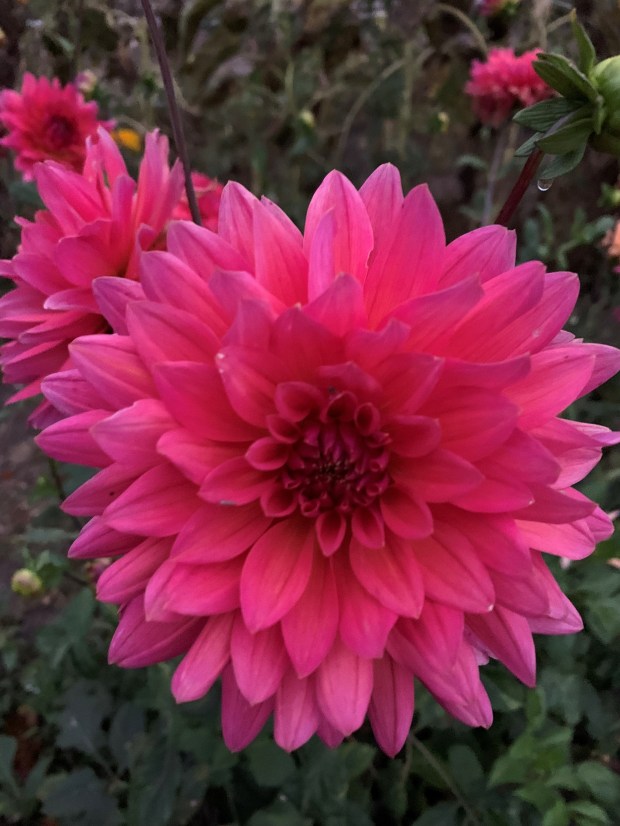
One of Judy’s wonderful dahlias

Flowers

This is truly the driest time of year as we’ve had no rain since April. The hillsides are crispy dry and most shrubs, flowers, and grasses are dormant. The exception is the unbelievably bright green pine-scented coyote bush…just starting to flower. Want to tell the girl from the boy coyote (bushes)? Now’s the time. I mark the coyote bush female plants and eradicate them preferentially- they are the existential threat to us folks who like to keep grasslands, grasslands and let the wildflowers have the wide open space. For now, the coyote bush is keeping the pollinator community well fed. Butterflies flock, flies buzz, and wasps hop from cluster to cluster of the pollen and nectar rich flowerheads.

In the irrigated garden, it is Dahlia time! Big poofy, luscious flowers of the most unbelievable colors pop and spangle in a scant row among cucumber, beans, and squash. Sunflowers are still going, cut for each of the 3 farmer’s markets we are going to nowadays (Aptos/Cabrillo-Saturday, Downtown Santa Cruz-Wednesday, and Palo Alto-Saturday).

It makes nice fall color, even if poison oak is terrible to some

Fall Color

The walnuts and garden birches have only the slightest tinge of the beginnings of yellow. Same with the maples in the wild canyons. At the edge of the forests and on steep hillsides, poison oak is further along with its remarkable streaked purple-reds. Rumor has it that the aspen leaves are turning in Eastern California where ‘leaf peepers’ are drawn to fall glory.

More Return of the Birds

Besides the golden crowned sparrows, other birds have returned from afar for their winter haunts. Cassandra and I have both seen an unusual feathered friend: Western meadowlarks visiting the Farm! Their bright yellow, black-spotted bib and dangerously long stout bills give them away. I guess our grasslands have reclaimed enough shrub ground to look like viable meadowlark habitat – that’s new!

Another bird sighting – an osprey! Around 2012 this time of year, two ospreys would fly over the farm each evening at dusk, west to east. One is flying now. Someone says that they saw it carrying a fish…a little late for fledglings, don’t you think? Still, this is an odd thing and someday someone’s going to have to follow that sea hawk and see where its going.

The beginnings of our haystacks

Hey Rick, hay rick!

Last weekend at our work party, Jen, Mike, and Roland rolled up the hay near Cherry Hill. Tons of the dry grassy stuff is cut, getting raked, and being placed in our rudimentary hay ricks. If we had pines nearby, we could put some needles in our haystacks, but as it is they are full of weeds. This is a new adaption from the bad idea of old…placing dry hay under perfectly innocent trees during fire season. Now, we stack the hay, let it molder, and wait until the end of fire season to swoosh it under the trees to suppress weeds, add nutrients and organic matter, and provide cozy homes for VOLES who do such a good job of ridding the orchards of gophers.

Perhaps we’ll rediscover the way of stacking the hayrick…a profession of years ago with expertise and methods long lost.

Real Pro Haystacks

Night shifts to dawn

At first darkness yields only very slightly and the first bird to sing is quiet, murmuring a few quizzical, uncertain, almost apologetic notes. A few minutes later, that same bird sings the same few notes, sounding a little more certain. A second bird joins a little while later, more certain still. Dark turns slowly to gray and more birds start singing. Soon, dawn rushes on, the sky lightens, and many birds start singing, no gaps between songs, many species, many notes. The cheerful Spring dawn chorus fills the chill morning air as color begins to spread across the landscape in advance of the rising sun. By the time the first rays brightly illuminate the ridges, the bird orchestra is loud across the farm and as far as you can trace sound. Each taller shrub and at the top of many trees there are tilting, perky birds, beaks outstretched, singing away.

Spring Antics

As it warms, bluebirds and black phoebes flit about, catching bugs. Barn swallows warm on perches awaiting a brighter sun before taking to the air. Towhees strut through short grass, darting at one another, chasing for fun or territoriality. As the dew dries, one of the yard bunnies hops inquisitively towards another. The wide-eyed approached one suddenly flattens itself hugging the ground, snaking forward slowly and then faster on a pathway through the low grass, ears back, while the other hops again and again over its pancaked friend: what oddness! Spring morning antics.

Big Oaks in the background, Green Fields in the foreground. Life is a Rich Green

Green

Bolting grasses dry from the tops and from the bottom. The tallest grasses turn tawny above still-green fields. The grassy understory is browning, too. A gust carries dust clouds away from the road and across the fields. Despite the drying, overall a lush green prevails. Big bushy oaks shimmer life above pulsing green fields. The morning warmth massages a sweet perfume from the grass, which changes with the drying day to the scent of dusty pollen. Middays have become quite warm, though sometimes breezy. Cheerful bird solos continue right through the day.

Birds in Air

The afternoon breeze carries soaring red-tailed hawks, loudly screaming, one following the other in broad circles, high across the sky. The ravens, too, enjoy soaring on the wind but more in long arcs from one side of the farm to the other, loudly beating their wings and furtively glancing about for something to scrounge. Something startles a flock of band tailed pigeons, and they take flight but not so high in the sky, making for one patch of trees, then suddenly veering to another. One pigeon isn’t paying attention, gets too far ahead of the others, which have turned for another destination; it panics and wheels about, making lots of strong and rapid wing beats to catch up to its family.  The standard number of pigeons is 14, but the flock was 30 for a brief bit…some apparently were just passing through. The regular flock patrols the walnut trees hoping for ripening catkins which will shortly make them fat and happy. I’m not sure what keeps them fed in the meanwhile- there doesn’t seem to be much to eat for those big birds.

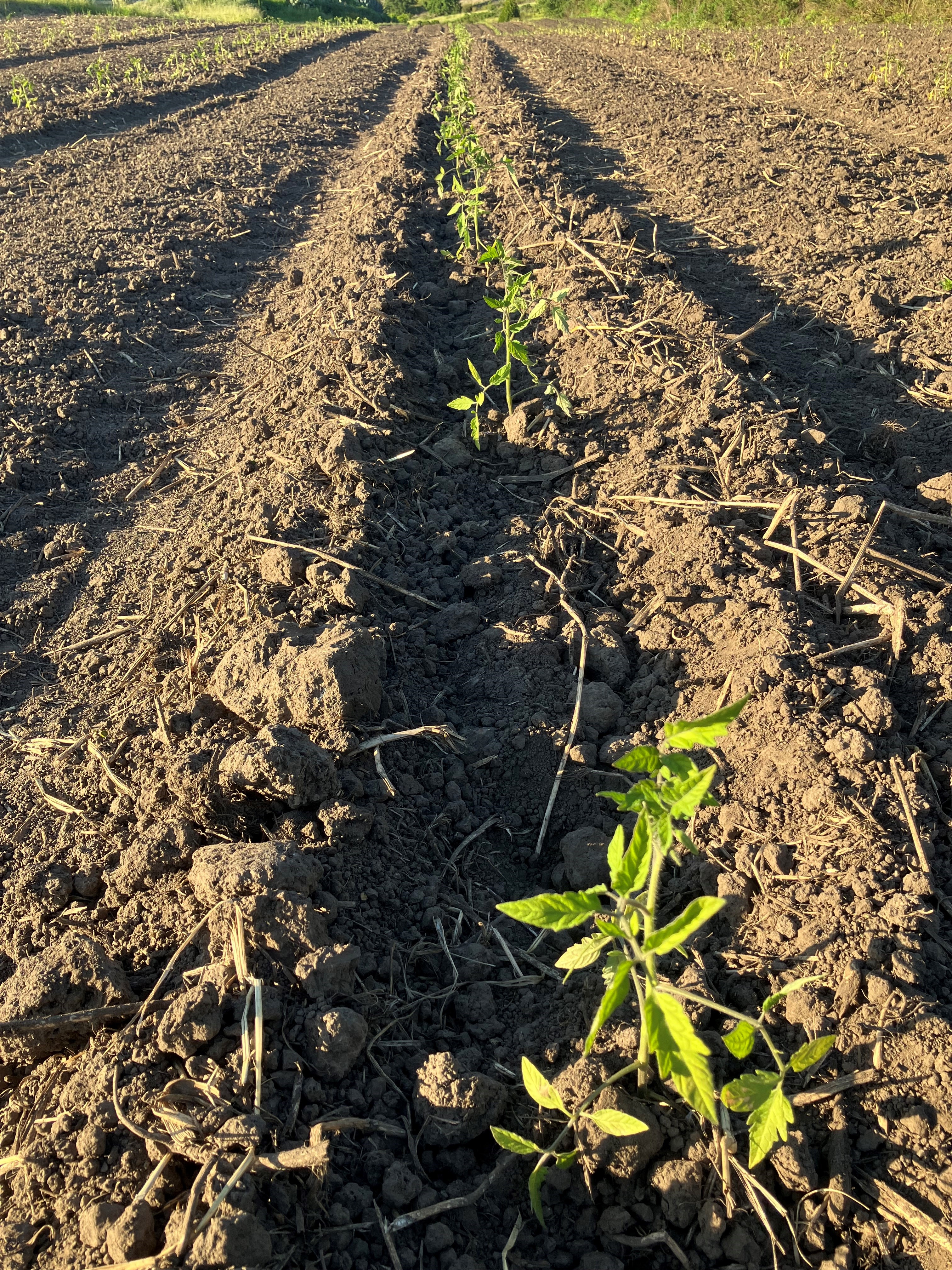
Molino Creek Farm’s Dryfarmed Tomatoes – Just planted this week

Planting

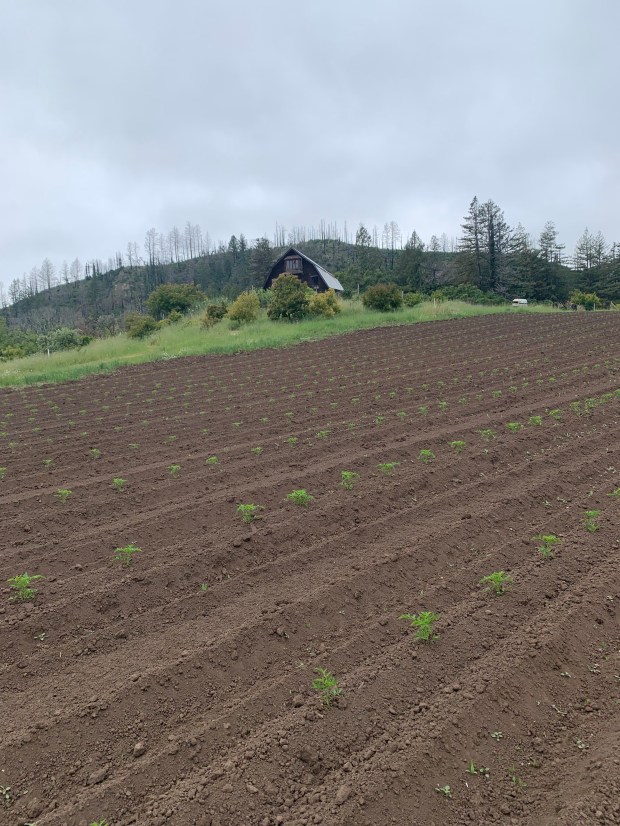
Bodhi and Judy have been planting the summer crops. Long rows of tomato seedlings are settling in nicely, in less than a week already overcoming transplant shock with perky new leaves facing skyward. Succulent leaves of freshly planted onions contrast greatly with the deep brown soil, poking up from row after freshly planted row. Green crop seedlings are hard to see in the broad swaths of brown, tilled soil, striped in rows of tractor tire tracks.

Lapins Cherry Trees – Thanks, Drake Bialecki for the grafting!

Peak Bloom

The orchards are in peak bloom. Though the cherries are just a bit past peak, on average the various varieties of other fruit trees make for the most floriferous moment in orchard bloom. With so many flowers, the trees have created a thick blanket of pink across the hillsides. The avocado spring is more subtle, but still their masses of tiny yellow-green flowers overshadow both the broad, old green leaves and the emerging spikes of purple-bronze leaflets. I was pleased to find honeybees on the avocado flower clusters today- the first time the hive has turned its attention to this essential service. Peak bloom, however it appears, is beautiful, the blossom parade a constant show of dancing pollinators one type arriving after the next. As the day progresses, the afternoon warmth waves clouds of ecstatic perfume into the aisles. Gradually, the day cools and the scent changes back to grass and mold and dew.

Two Dog Farm Chardonnay – SPRING!

Evening

The light fails and great horned owls glide silently out of the tall trees on the canyon edge, across the farm fields. They perch on fence posts and trees closer to the rodent-filled grasses and weeds. When the sun disappears behind the ridge, the evening turns quickly colder. As the setting sun finishes raking the higher hillsides with its golden glow, we retreat home for sweaters and wool hats. Chores demand further outdoor time until the light completely fails, now at almost half past eight. Burr! It turns cold with the darkness and gets chillier all night. Recently, it got down to 44F by dawn. Some fruit trees long for hundreds of chill hours, leafing out only after arriving at their total: their clocks are still gathering those hours, and the (shortening) cold nights keep them snoozing and gathering strength for their (eventual) leafy season.

Sky lupine and purple needlegrass on one of the Farm’s ridges
Bicolor lupine and more on a knoll on the Farm

Wild Flowers

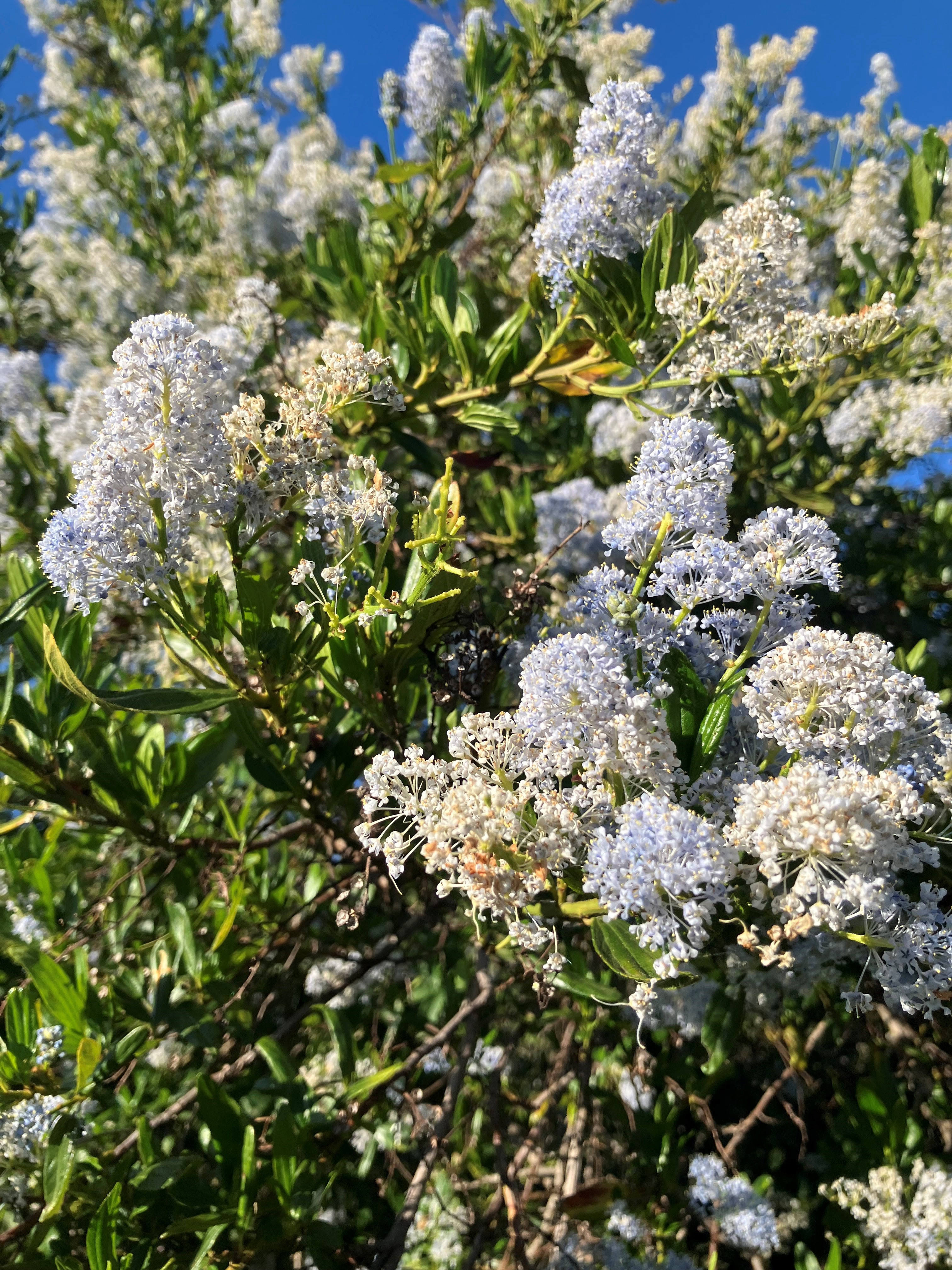
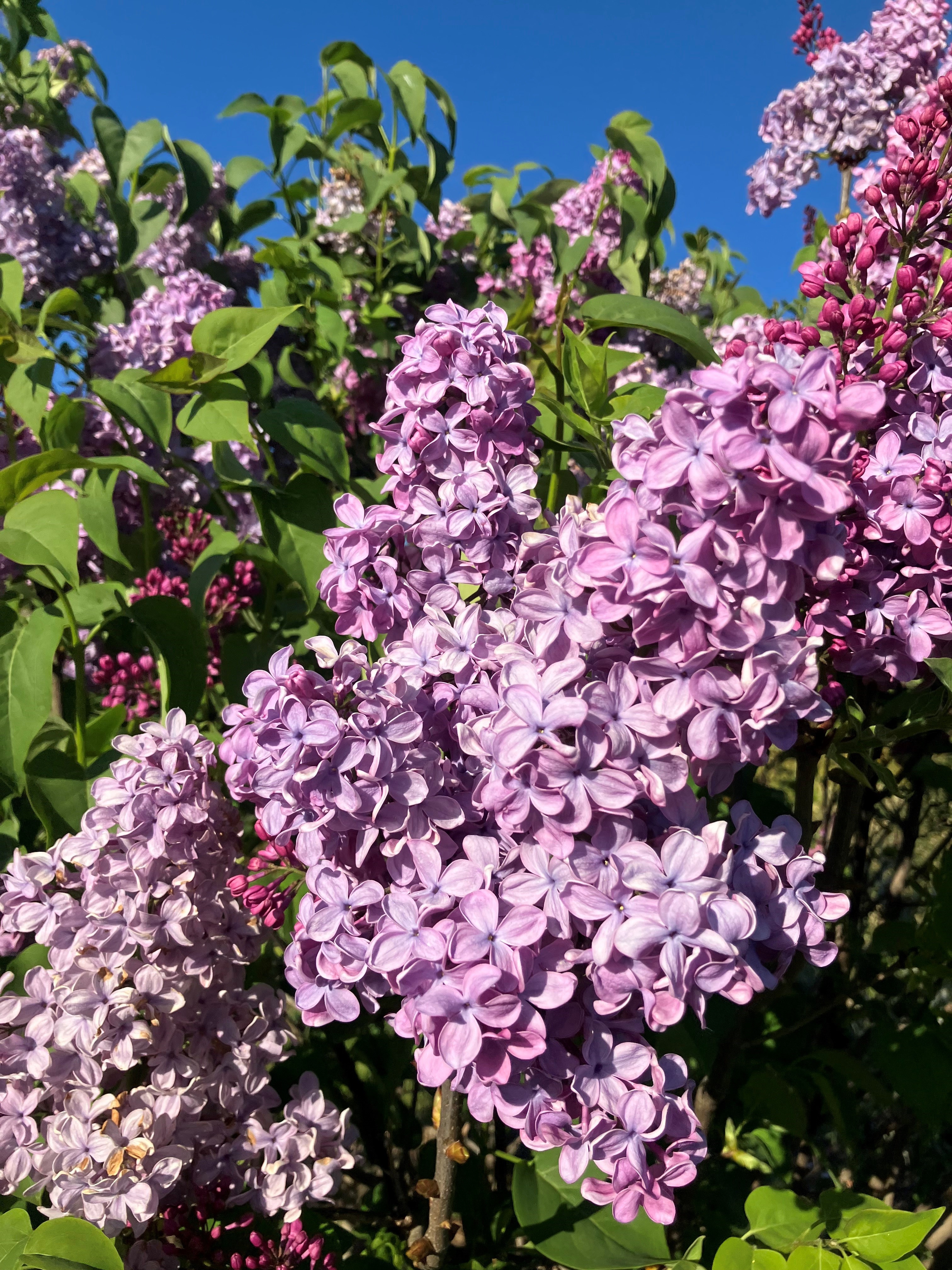
The wildlands are blooming spring. Two types of lupine, the big and the small, as well as poppy, tarplant, blue eyed grass, vetch, and purple sanicle have burst into flower and paint big patches with crazy color mixes and fascinating patterns. In the forest, white starburst panicles of fat false Solomon’s seal and the simpler four petals of purple-white milk maids brighten road cuts above Molino Creek Farm. More than anything, miles of the fire-following shrub California lilac throw rafts and sprays of pale blue blossoms, drowning out their shiny green leaves. The scent of this blueblossom is heady and sweet, but only faintly like the more-sweet perfume of the old-world traditional lilac which also has much more showy flowers.

California lilac
Old World Lilac

Rest Impending

The sun grows distant, already so far South, days so brief. Rain has moistened everywhere. Fall is sweeping the farm, triggering bright leaf colors, tree-by-tree, each evening stroll revealing new tones in new places.

The ground blushes newly green from the previous expanse of dark brown soil or gray aged thatch. Millions of seeds germinated on the much-anticipated first significant rainfall this past week. Pairs of many-patterned leaves unfurl from different types of flower seeds while single first grass leaves poke straight up.

More wetting storms are approaching, pushing southward from the distant northern horizon. Beautiful clouds appear, sometimes a skyfull of feathery patterns, other times ominous heavy gray huge pillows. Layers of clouds above oceanward fog are often accentuated by sparkling orange pulses in between them at sunset.

Muffled Song

As the winter approaches, birds become more quiet, their songs more concise. Bird-eating hawks swoop and wheel, frightening seed- and seedling-fattened flocks. Silent spells with no song signals hawk. The consistent whispered squeaks and chirps suggest hawk absence as groups of quail, sparrows, and juncos slowly emerge from cover, pecking up thousands of tasty sprouts; their favorites are abundant: clovers, filaree, medic, lupine, poppy, wild lettuce, and dock. Full bills, filling tummies, hunger satisfied peaceful birds prepare for long stormy wet nights. Each evening at sundown, flocks huddle together in dense clusters surrounded by protective thick tree or shrub canopies. They have already negotiated safe roost locations and even their individual places in the rows along branches. There are a few squabbles at dusk in the roost locations as some on the edges realize disadvantages of their relegated positions. By dark, they have become politely quiet and still.

Tree nest woven over compost-strewn soil makes for cozy beds for the coming winter

Tucking in the Trees

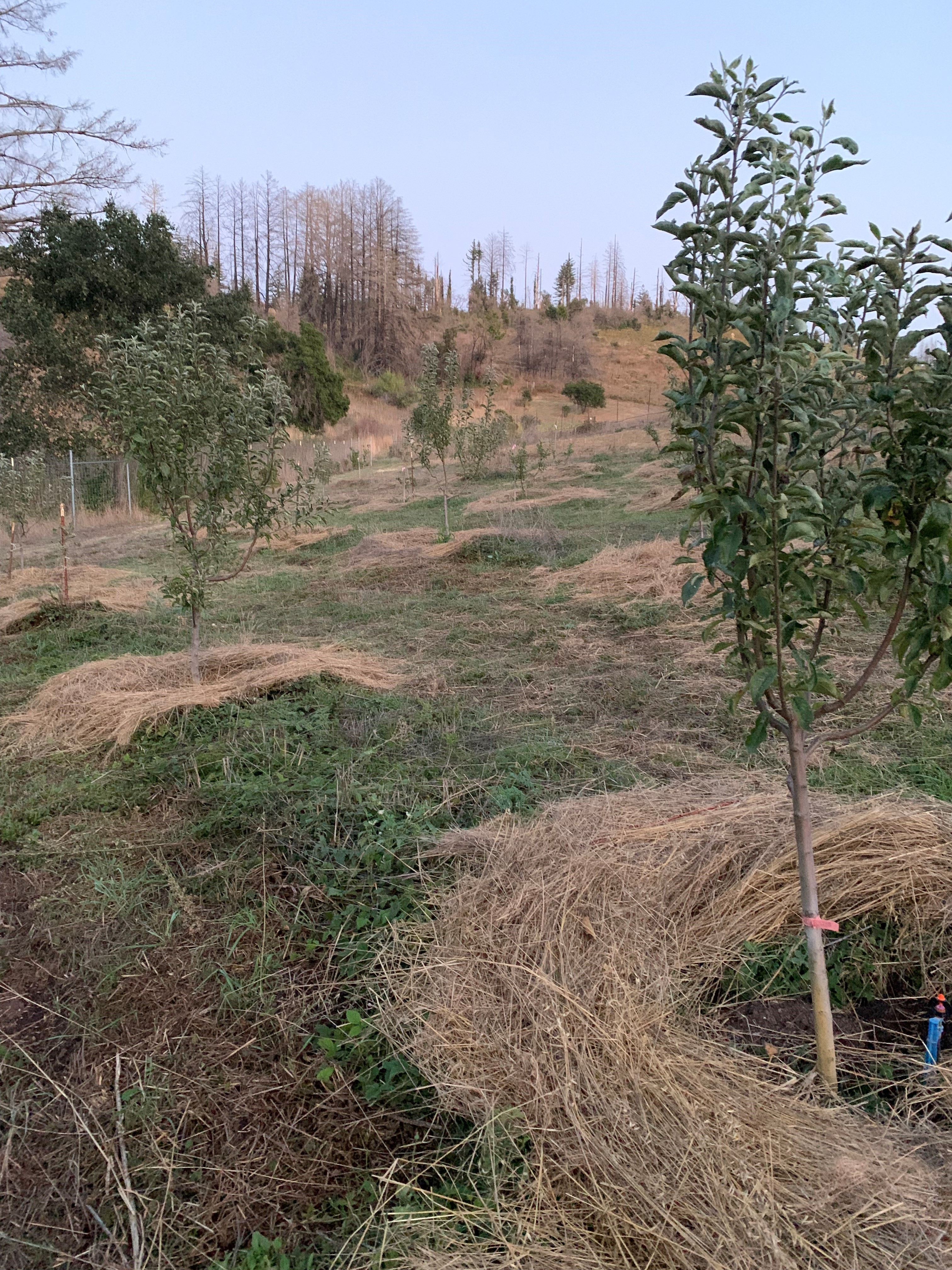
As orchard leaves begin to fall, we prepare tree beds for the long slumber. Last weekend, Community Orchardists hauled and spread the final compost and then the last windrows of dried hay. Energetic tree keepers filled and then hauled bucket after bucket scattering compost/worm castings in the understory of each tree. Following them, skilled pitchfork wielding orchardists pitched, piled, and sculpted neat circular hay nests surrounding young trees. Winter snacks and cozy blankets for our tree friends.

Stone fruit fall color

Nodding Off, Colorfully

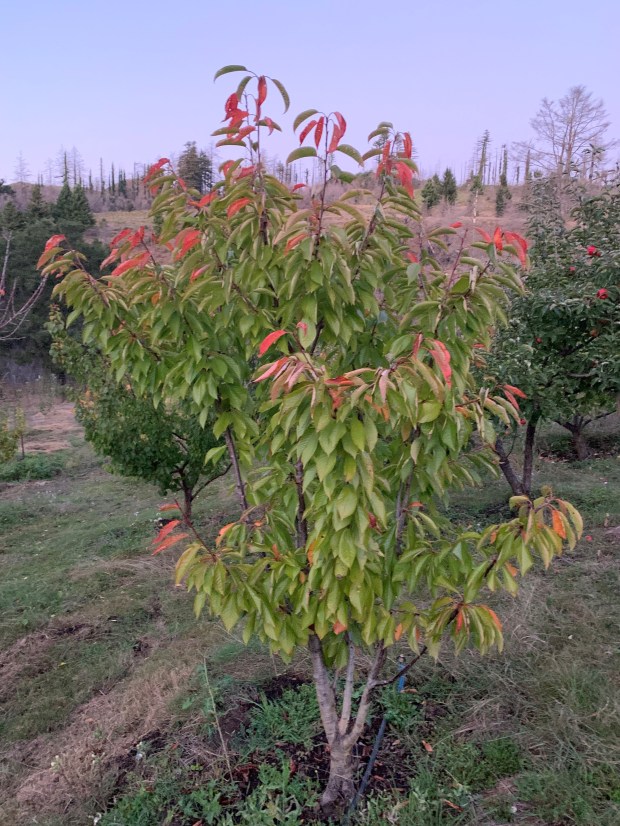
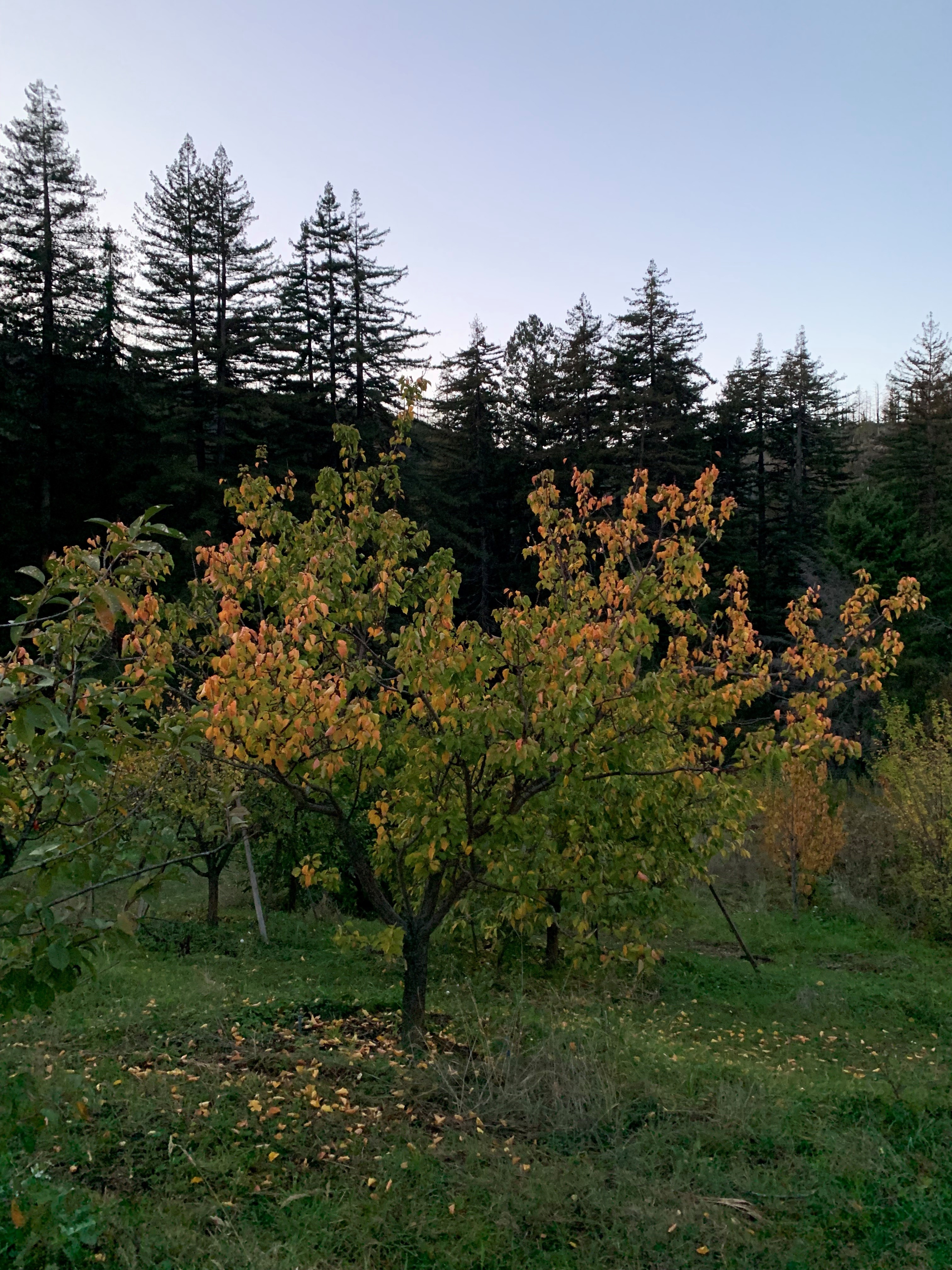
As the trees approach their sleep, leaves brighten then drop. Cherry tree leaves are turning orange-to-red, starting on the sunnier sides of each tree and day by day progressing onto the northern side of the canopy. Apricot, aprium, plums and pluots echo those cherry leaf reds but tend more orange to yellow. Apple tree fall color extends well into winter, slowly unfolding many shades of yellow through February in an extended fall. Most leaf colors change fast and fall quickly, splashing rings of color bright in circles on the ground beneath brief spells of brightness dancing across the orchard among the high held branches.

The place of deer beds and rustling

The Rustling

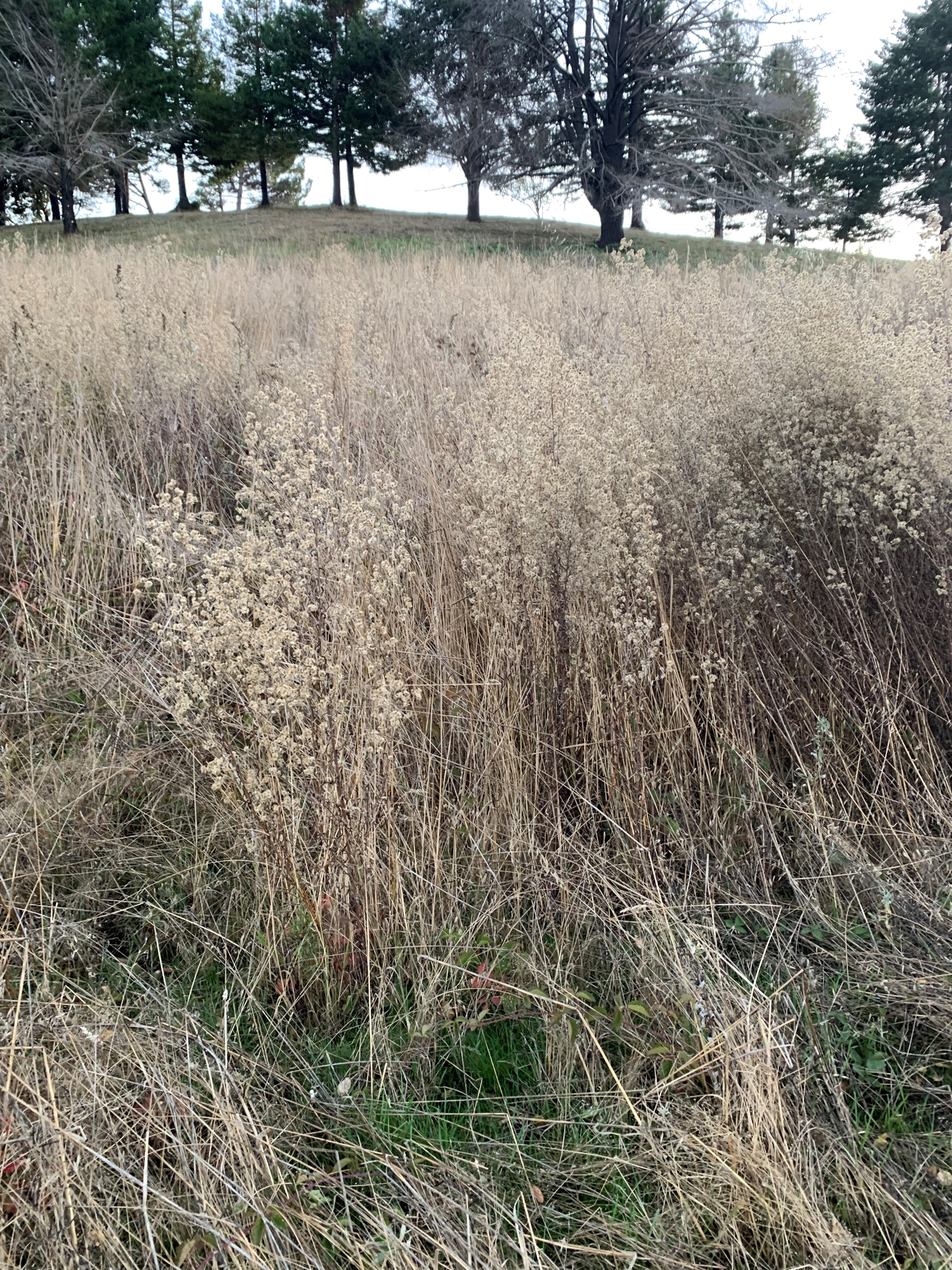
We were unable to mow every corner of the farm and in some places the dried grass and wildflowers formed thick dry swards. Deer paths wend into these stands. Following these wildlife trails, we find hidden clusters of mashed down straw – cozy deer beds. The breezes sing high schwews on the ridges with more of a full, wooing noise in the nearer conifers, but these tall dry grassy areas make scratchy, rustling noises in the winds at the onset of each storm. The deer thank us for leaving them some dense cover to shield them from the chilly gales through the dark nights.

Fuji apples held ripe while leaves change color

The Last of the Fruit

Tomato vines whither after rain; winter squash vines long spent, fruit curing; later season apples grow sweeter and crispier with the cool nights. We feel lucky again to find a ripe tomato among the melting vines. Weeds will soon occlude the deliquescent reddish fruit and then all will be tilled and cover cropped.

Molino Creek Farm’s wilting dry farmed tomatoes, slain by rain

Two Dog Farm is boxing and curing the bountiful dry farmed winter squash crop, and colorful squash still brighten the fields.

2 Dog Farm’s last dry farmed winter squash, waiting to be gathered.

Fuji apples are the last bigger harvest in the orchard. We will gather the last of the apples over the next week and press the last of the culls into the final cider of the season. Much of the orchard has had a final mowing, the harrow scratching in bell beans is close at hand.

Emerging New Tree Characteristics: a dance between species

Sunsets and Quickening Evenings

The sun speeds quickly towards the west and evenings pass suddenly to night. One moment, the beautiful array at sunset tinges the hills and the next moment colors wash and fade to gray, stars winking into sight until the night sky reveals vast constellations. There is a moment in this transition to night when my attention is drawn to the silhouettes of trees, revealing new characteristics of long familiar friends. Brushy oaks dance on the edge of regal, posturing clusters of redwoods. Then they disappear, overcome by the majesty of night.

simultaneously published at Molino Creek Farm’s website

Bluebird Chicks

Baby bird begging is almost as beguiling as human baby crying. Heads turn to see what the fuss is about. Perched near the nest, the mother holds her wings out just a bit, anxiously glancing around. I haven’t seen any fledglings, but the earliest squeakers must be close to getting out of their nests. At least two bluebird nest boxes have clutches going. There are other species of baby bird noises from nearby shrubs, from holes in cabin walls, from tree hole cavities, from anywhere there might be enough cover. The lush productive spring promises well-fed big baby birds. Next door, the jays have already been at their nasty deeds, tearing apart barn swallow nests to eat eggs for breakfast.

Orange crowned warblers! I’ve been using the Merlin bird call recognition software on my iPhone, and it has been teaching me better bird identification. I didn’t know warbler calls before using this tool, but now I can recognize orange crowned warblers, which are suddenly (for me) everywhere I hike through the forest. Some focused time recently netted several warblers, all nearby: Wilsons, orange-crowned, black throated gray, MacGilvery’s, and yellow. Most of these were close by, from the sound of them, but nearly invisible. They seemed to like darting around just under the canopy of the acres and acres of 4 foot tall, post fire California lilac. Imagine, a sea of glossy green-leaved shrubs with flashes of yellow birds and a constant sweet warbler song.

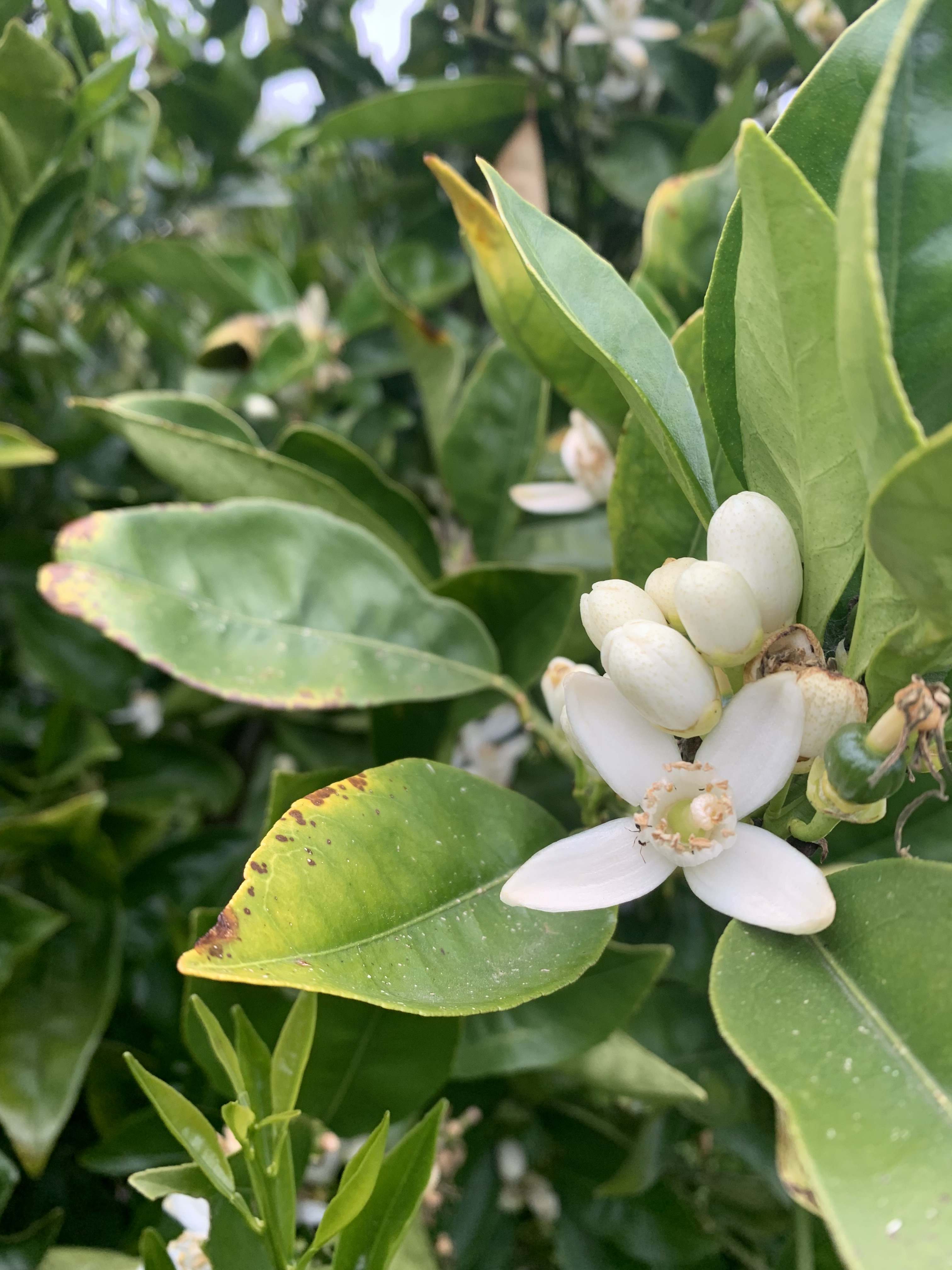
Navel orange flowers produce an amazing scent on Molino Creek Farm’s fabulous Citrus Hill

Sweetness in Scent

Song can be sweet, but so can scent. Molino Creek Farm’s citrus orchard has never had so many blossoms. It is peak citrus blossom time, especially with oranges and their particularly alluring scent. It is dizzying many yards downwind. Closer up, the pure white of their simple flowers is beautiful to look at. This flowering is brief. Soon there will be tiny dark green fruit that will get larger by the week and then slowly turn colorful. The harvest is mostly 9 months away, but still we glean the last few limes, lemons, and tangerines. As the flowers fade and the fruit forms, a new flush of leaves will create thick, sheltering canopies of glossy dark green. We put yoghurt containers of feather meal into the drip lines of the citrus orchard more than a month ago, and it seems to be helping with the generous leafing.

Farm Work

Molino Creek Farm and Two Dog have been planting many plants, and now attention turns to hoes. The last rains spur more weed germination in the dry farmed fields. In the irrigated rows, a massive weed flush threatens to overwhelm the crops. The hoeing race is on!

Molino Creek Farm’s famous dry farmed tomatoes are starting a new season in freshly tilled soil

We are irrigating again: a routine that will last until November. Up early to check the water tank level, turn on irrigation valves, hike around the orchard to see if any irrigation is amiss, fix a leak or two and go home. Lunch time (or later!)- repeat in reverse: turn off the irrigation valves, log the water use, check the storage tanks, and head home again. Big cyclical walks around the farm keep creating material for this writing project.

Half the first round of hay raking is done. Mulch for the orchard gets clipped by a sickle bar mower, then sundried (hah!), then raked, then pitchforked onto the mulch cart, hauled to The Trees, and spread around the rootzone thicker than anyone wants to place it. Really? This thick?! This is the third spring since the fire burned up all the mulch. This will be the last year that weeds come up so thick around the trees. The mulch is thick enough now to subdue seedling weeds. There are also mulch benefits of water retention, slow-release fertilizer, root cooling insulation, and wildlife (vole, lizard, snake) habitat. Long live mulch! Mulch is the key to life!! Under the mulch, worms wiggle and scoot, creating a carpet of 2” deep “castings.”

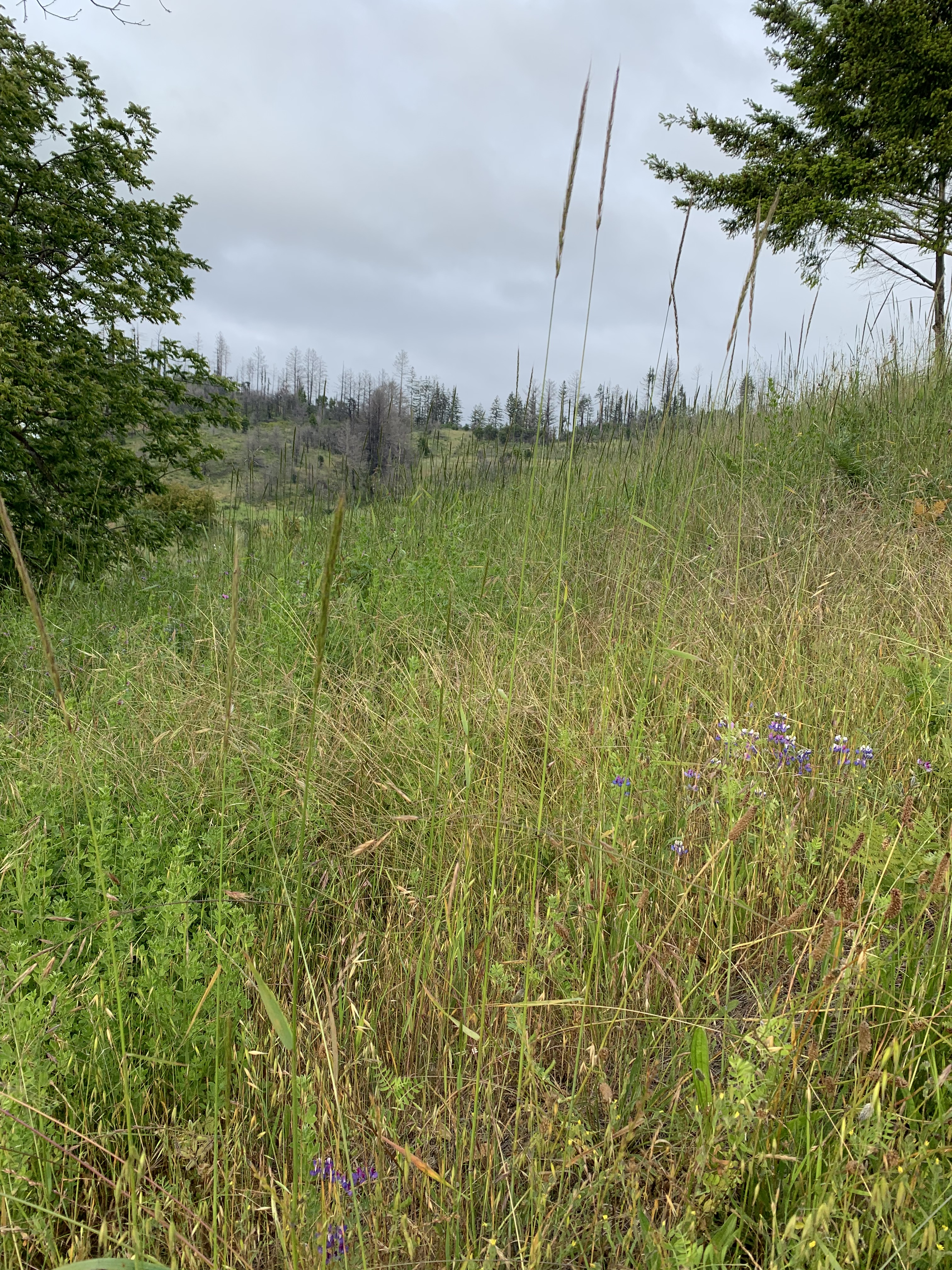
On our carefully stewarded hillsides, a menagerie of native grasses and wildflowers: Elymus glaucus (blue wild rye), lupines and other things…

-this post also placed at Molino Creek Farm’s website.

Endless Foggy Days

Day after day the fog variously seeps up the canyons, pours across the ridges, or just hangs across everything, dripping and drizzling. Droplets cover every plant, glistening. It is cool and damp, but the soil is still drying. The dust is subdued but the plants grow thirsty.

Blossoming Hillsides

This weather has prolonged the spring bloom which is entering the moment of giant patches of colorful shrubs. Lavender bush lupines and yellow-orange monkey flowers are being joined by bright yellow lizard tail, each of these gentle shrubs has its own color place on the hillsides but intermingle in the interstices in a mélange of crazy color patterns. More subtle flower patches also claim their spaces – Phacelia, bee plant, and cudweeds are also in full bloom. It is a good time to go for a walk where the coastal scrub is near, especially the post-fire coastal scrub. The fire set us up for a very colorful spring.

Snakes and Such

The extended cool spring seems to have concentrated the snakes into piles to keep warm. Last Sunday, Pete Trenham visited the farm and helped catalog 19 snakes in one walk about, including four rubber boas under one piece of roofing tin: a grip of snakes! We found gopher snakes of all sizes, a few ring neck snakes, yellow bellied racers, and garter snakes along with southern and San Francisco alligator lizards and blue bellied lizards. Down in the creek, we found California newts guarding their egg masses as a California giant salamander swam about. Molino Creek was much rearranged after the dynamic winter- now there are pools and riffles along with many beds of fresh piled rock.

Pete Trenham holding a grip of snakes: northern rubber boa to be exact

Planting Time

Farmers are planting seedlings. Baby onions are especially numerous in long rows. Adolescent sunflowers are getting bigger. Tomato plants are settling in nicely. The cool overcast weather makes for transition ease as plants move from the protection in the greenhouse out into the open air.

newly planted dry farmed tomatoes

Perennial Fruit

The orchards are lush and gorgeous. Apple trees have dark green leaves, a foot of new shoot growth, and oodles of tiny furry new fruit. Cherry trees are laden with clusters of fattening light green shiny fruit nested in curtains of deep dark green foliage. Avocado trees are perky explosions of new reddish leaves reaching for the sky with bolting new growth. Slower, the citrus trees are beginning to flush with shiny new baby leaves while buds break with stark white flowers and famously sweet scent. The grape vines have thousands of long clusters of buds nestled in bright delicate spring green leaves

More Scents and Sounds

The gentle breeze brings a faint smell of fire and a distant hum is the source: air curtain burners are disposing of hazard trees on the nearby land. That distant hum is joined by hours of closer noise: mowers! This spring in particular has called the mowers to work. Mow the 5’ grass to 2” and the next week it will be back quickly with 6” a week growth. The sweet smell of fresh cut grass permeates the air when the wind dies down. The Merlin bird app identifies the dominant dusk chorus: purple finch, song sparrow, and barn swallow fill the ears with song as the day grows dark and evening sets in.

Lushness, Still, but Rapidly Drying

Gusty winds and cold nights faded quickly to calmer breeze and warmer days. Now, the grass bolts quickly and everything goes to bloom.  Lushness seems on the edge of fading, we don’t know how long the green will last. Already, the thinnest soils are turning tawny in the coastal facing prairies.

Freshly Tilled Soil

Fading Mud, To Dust

After the ground’s gushiness fades, the farmers work the ground. The fields are getting tilled. Cover crops are almost all gone, mowed and integrated into the soil. With the farm roads dry, in comes a compost delivery: fine organic crumbly brown piles getting distributed into some important places, including the orchards.

Gravenstein Apple Flowers

Orchard Blooming

Orchard blossoms burst forth. The earliest flowers are past, cherry petals falling like snow, the first fruit seems to be setting…same with the plums, prunes, and apricots. Now, the apple trees start blossoming. Our one old gravenstein apple tree, with the earliest apples to ripen, is aglow in full bloom. Other apple trees are coming along, a diversity of flower colors, shapes, and sizes. Meanwhile, the vines…

Two Dog Farm Chardonnay Grape Vines Springing from Dormancy

Wine!

Recently, our Two Dog Farm Wine endeavor has started returning deliciousness. The Bartles opened a bottle of their very own Chardonnay at a recent gathering and oh! the praise rang high! The promise of a larger harvest looms for this fall. The neatly pruned and tied vines are flushing leaves and flower clusters.

Elusive Wild Things

Scat is easier to see than the furries. Coyotes, bobcats, and weasels talking sh**, carefully placed to make inter- and intra-species statements, scatting. A small weasel spotted in the orchard, chicken owners worried. No bobcats for so long. Deer tracks but no deer. Skunk digging but no skunk.

Flies.

And now suddenly a hundred types of flies buzzing about. Flies on poop, flies on flowers, flies frolicking in pairs tumbling on the ground.  No face flies, yet, luckily. Clouds of midges, clouds of gnats. Different flies in the forest, different flies on the road.

Winged Friends

The purple martin colony returned from way down south. This is one of two colonies in Santa Cruz County. They have the most distinctive, amazing throaty deep chirps. Goodness, they make a lot of noise. Glad to be back, I guess.

And the stranger noises are coming from the ravens. Maw and Caw are greeting friends passing through with their cluck-clicking patterns, rolling upside down, dipping and turning playfully. Perhaps a bit of this greeting is the kids coming back to say hello. Just the pair, mostly, but then there are brief visitations. The pair stand watch in the freshly tilled fields looking for the lost or injured rodents for lunch.

Two flickers poke and explore something in the ground. The thrasher sings a most refined and eloquent soliloquy.

Flap flap flap! 40 band tailed pigeons wheel across the sky and settle back into the walnut trees. Catkin feasts! It is a good time for the flock, bigger than in recent years.

A Wild Phacelia from Roundabouts the Farm

Flowers

Walnut leaves unfurl with the droopy elongation of the catkins that survive by sheer number the feasting of the pigeons. Poppy displays wash orange across the south-facing slopes across Molino Creek and brighten the grassy balds along the highway. Whorled lupines poke up from the sea of grasses in patches around the farm.

The Harvest One Gwen avocado reminds us about the fruit that this portion of the harvest season will one day bring. One Gwen tree does not enough avocados make. Ironically, the fructification of Spring is the hungriest time of year. Pre seed. Pre fruit.

– also simultaneously published at Molino Creek Farm’s website

Moderate Clime, Harvesting

Across the farm, people are awake before dawn, lights winking on while the stars still shine. We pull on our clothes, make coffee, eat a snack, and prepare to head out as soon as there is any light at all. I mosey across the farm, turning on water valves…that freak early rain was so far in the past that it is time for the once-a-week soil soak again beneath the orchard trees. I pace back and forth down each row of trees examining the micro sprinklers and irrigation tubing to check for any leaks. Mice, rabbits and gophers sometimes chew the lines: I mostly listen for gushing leaks, but sometimes I see them before I hear that awful sound. Leaks repaired, water on, I head to my paying, indoor job. Other farmers keep going as farming is their mainstay.

Midday Work

We still pull our sun hats from the peg next to the door before heading out to work the farm when the sun is up. Sun heat prickles bare skin though the air temperature is perfectly moderate. It is harvest time. Crews pick apples twice a week for markets: we navigate ladders high into trees after the ground picking crew has finished what is reachable. Shoulder-slung bags full of fruit get dumped into sorting bins and the sorters go to work: bad apples to the compost, barely okay apples to the cider press, almost perfect apples gifted to the Pacific School food program, perfect apples to 4 different farmers markets.

Apples off to Market

Farmers load, haul, and set up displays of boxes of beautiful, community-grown apples where people gather for produce at local farmers markets: Saturdays at Palo Alto and via 2 Dog in San Francisco at Alemany the “People’s Farmer’s Market” and then again on Wednesdays via 2 Dog at Heart of the City (SF) as well as Molino Creek Farm’s stand at the Wednesday market in downtown Santa Cruz. We are selling 400+ pounds a week, more than twice what we ever sold before- post fire resilience and the fruits of many people’s labor.

Evening Glow

As the sun sets, we begrudgingly wind down. There are not enough hours of light to deal with the harvest, so we often have to make lists of work to be deferred until the next morning. Harvest bags get packed into mouse proof bins, I check that gates are closed against the evening’s marauding deer, I give a final twist to shut off irrigation valves and update the watering log book, and then I clean and put away the tools. Brushing off the dust and dirt from my work pants and stomping off my boots, I head home as darkness sets in. The first crickets are singing, and an owl begins its nighttime hoots. Cold clean-smelling air settles into the low points on the farm, the higher points are still warm and smell resiny from the last sun warming the coyote brush.

Deer, No Bobcats

The male deer are sparring, and one has cracked one of the points on its antler. Three male deer, one larger, are strutting around, following the four or so does that frequent the farm nowadays. The larger buck and the larger doe are frequently at the cull apple pile in the evening: that will help them bulk up for the cold, rainy winter!

Where is bobcat, coyote, and fox? The plethora of gophers fills us with consternation. Nearly every square foot of ground has been tossed and turned. I find fresh moist subsoil piles at 100’ intervals every day. The hawks scream and reel, crisscrossing the fields. A kestrel eviscerated a gopher on top of a stump next to my office window midday the other day…he plucked its fur off as much as he could before getting to work tearing apart and swallowing the better food.

The raptors are not enough, and the snakes and lizards are slowing down. We need the mesopredators! Two foxes traipsed along the road down from the farm the other day. I haven’t seen a bobcat in a year. A wave of canine distemper is reportedly still raging across our region, which might explain why there aren’t many fox or coyote, but feline distemper hasn’t been a big issue…so why aren’t there more bobcats? They would be so well fed!

Green or Freshly Tilled Fields

The rain two weeks ago germinated millions of seeds and now seedlings are greening the landscape. Where we didn’t get to raking the last harvest in the hayfields, the grass is the tallest, growing through the thick mulch. We took advantage of that early germination to weed the fallow farm fields- disking the crop of weeds into the soil, preparing for planting the cover crop. The farm has beautiful contrasting patches of brown and green.

Jimson weed aka Datura aka thorn apple: a sacred native plant that is ‘weedy’ in our fields

Late Season Flowers

Amazingly, the bees have forage. It is ironic that it is harvest time for the humans and the bees might be hungry. Fall and early winter are starkest times for pollinators. Hummingbirds and bees flock to irrigated salvias in our gardens. But still, the coyote bush is in full bloom- but there are only a few old enough to flower- the fire spared ones are abuzz with diverse flying pollinators: flies, bees, and wasps. Evening brings the hawk moths to the jimson weed aka Datura and evening primrose, wildflowers that are also taking advantage of the garden irrigation for late season blossoming.

Early season rain helped germinate weeds, allowing us to decimate the seedbank by discing

Fall Color Commences

Each year, the obvious harbingers of fall are our many black walnut trees. Descendants of the Mother Tree in the Yard, the younger walnut trees turn lemon yellow starting from the highest, driest trees and ending with the Mother Tree. It is a count down clock to winter. The last trees to show fall color are at the very lowest elevation- in the north apple orchard, on the steep north facing slope of Molino Creek Canyon. Those apple trees turn yellow in late December and early January…slowly dropping leaves into February.

Fall color from black wa’nuts

We hope you are getting out to the fall colors of our area, in the shadier canyons where the big leaf maples, roses and hazelnuts are starting to show.

-this is from my near-weekly blog at Molino Creek Farm’s website

Golden-crowned Sparrow Returns to Central California

GoSp

Bold markings on this golden crowned sparrow indicates a ‘powerful’ individual.

Weary Willie’s distinctive call is waking up our neighborhood for the first time in five months. Last week, following an unusual big early storm sweeping in from up north, the first Golden Crowned Sparrows arrived here in Davenport from their migration to British Columbia or perhaps Alaska.

Nicknamed ‘weary Willie’ for their call – “I’m so weary,” – this sparrow is our wintertime friend here, with ~20 bird flocks returning to exactly the same small shrub patches they inhabited last year here at Molino Creek Farm.  Well, at least SOME of the birds return, and some of those with their young which were born perhaps as far north as the ‘Bering Land Bridge National Preserve.’  Way up north, the a male feeds his mate as she incubates eggs.  Between flying back and forth, making a nest, feeding each other, fledging and raising young, they’ve been very busy since they left.  I’m fascinated with them because of their social structure and their tendency, like me, to be ‘home bodies.’

Bruce Lyon, a professor at UC Santa Cruz has been studying flocks at the UCSC Arboretum.  He finds up to 50% (or more!) of the birds returning in fall migration.  He has confirmed what many have noted – ‘high site fidelity’ – with the Arboretum birds.  Bird banding makes all that possible; I wish I could recognize individual birds well enough to do that from memory.

Individual birds are recognizable, and their plumage can tell you how high on the pecking order they reside.  Lyon has also noted that the size and color of their golden crowns, the patches of yellow on their heads, varies with their status in their flock.  The bigger and more striking the yellow, the more dominant the birds…including yellow patches on females that are dominant over duller males.  Taking the time to distinguish and even name individual birds in our flock is fun and helps me to understand a little of what is going on in the yard.

In many years, I have noticed that the birds ride the first winter cold fronts around Fall Equinox, perhaps taking advantage of the winds to help carry them.  I also wonder if they migrate more during the darker moon phases that intersect with those cold fronts, though in 2023 they arrived during Full Moon.  I understand that many birds migrate mostly at night to avoid predation.  A small group of us sometimes place bets on first rain date as well as first golden crowned sparrow arrival dates.  This year, they came right on time…

Welcome back Golden Crowned Sparrows!

I’ll keep track of arrival and departure dates (with a few notes) from various years here, starting this fall:

Arrival: 9/21/15- first posted this post on that date.

Arrival: 9/21/21, full moon, day before Equinox, directly after N Cal atmospheric river event

Arrival: 9/20/22, right after a big unusual winter storm swept down from up North and brought the first significant rainfall to our area. Moon phase: waning crescent.

-whoops, missed 2023-

Arrival: 9/22/24, curiously a bright night shortly after a full moon, not really associated obviously with a big storm from the North (not around here anyway)

Arrival: 9/19/25, following the remnants of Tropical Storm Mario and a scare about a lightning swam (that moved offshore)

Monsoonal Moisture

It poured down rain yesterday and thunder rolled across the sky. This was the third warm, wet monsoonal system to whoosh up from the south across Central California this summer: very unusual for this era of our climate. With the rain came petrichor, the complex sweet odor of freshly moistened soil. For a few hours, there was no more dust. Coincidentally, this storm came on the anniversary of the 2020 fire. The weather prediction centers know our memory and assured us that this system was not like the one two years ago. Nevertheless, many people watched the sky carefully. Fire spotting helicopters combed the hills. No fires have yet erupted, but sometimes they smolder for days after a lightning strike awaiting a heatwave…

Best Weather

Inland, it has been hot but cooler on the coast: several days were in the low 80s this last week at Molino Creek Farm, but the evenings were cool and so on balance the weather has been glorious. This is the longest stretch of the most beautiful weather we’ve seen in a long, long time.

Organic, Community Orchard Grown Gala Apples – weeks from ripeness, and growing sweeter/bigger by the day

Good Pears, Apples Coming

Apples like warm days and cool nights. The pears are ripening. After a sprint from small to medium sized fruit, apples seem to have taken a break in enlarging, but perhaps it’s our patience- it will be some weeks before they are ripe. On the other hand, we literally can’t wait for the pears now: it is a race to pick them before they get too ripe on the tree. Three harvests from the Big Comice, one week apart each: the first two picks have been delicious, but the third pick is sporting many ‘water balloons’ with overripe, brown and fermenting centers. It is an art to recognize the correct coloring of each type of pear in order to know when to pick them. Fruit separation strength should also be a clue that we might heed. Live and learn! Community orchardists can’t take enough pears home, so understory fruit fall critter feasting is heavily underway. Some homes are abuzz with dehydrators, others’ fridges are stuffed with pears, counters crowded with bowls overflowing.

Bowls of Bartletts

Future Fuels for Fires Falling

Today, there was a CRACK and an extended rushing crash: another huge burn-damaged tree fell on the hillsides above the farm. It is dangerous to walk in the forest. This one fell with no breeze, just a still warm late afternoon. The hundreds of fire-killed trees are starting to fall. Their crisscrossed trunks will pile up across thousands of acres awaiting the next conflagration, which will encounter this fuel and roar hotly, cooking the soil and all life nearby. No number of termites or unusual monsoonal rains will be enough to rot those downed trees before the next fire.

Wildlife Mysteries

The mother deer who had two young not long ago is all by herself now.

The Cooper’s Hawk is still terrorizing the birds. The orchard remains quieter than normal- not so many acorn woodpeckers and jays calling as they were constantly before. This bird killing hawk has been very effective at changing the tone of the birds across the farm.

Something is assiduously killing paper wasp nests. The huge one hanging in the pony trailer- torn apart and no more wasps. Three ground dwelling paper wasp nests dug up and dead as soon as the mower cleared around them. Its funny, we don’t smell or see skunks…maybe foxes do the same? What got the hanging one?

Flowers

For now, only the goldenrod is blooming in the natural areas around the farm. The bright yellow tall pointy clusters of fuzzy blossoms bow and sway on 2’ tall flexuous leafy stems…only a few, here and there- not a very common plant and not enough to help feed the hungry bees which now swarm onto rotten fruit and into the crop fields where tomatoes, squash, and peppers are loaded with pollinators.

These Still Nights

The silent night brings out the darkness creatures. Early evening is dark and moonless. And out come the nocturnal ants- big shiny ones with a bit of dark rusty brown…also tiny shiny ones all black and with elongated sections. A gauntlet of black widows still occupies gopher holes in the unimproved roadbeds. There’s a harvest mouse sitting in the dusty road, ducking silently into a gopher hole. Black field crickets. Brown crickets. Tiny cockroaches. A barn owl screeches overhead now close, then far away. The still cool night makes clouds when I exhale. Distant waves crashing, a rhythmic pulsing, though muffled in the nighttime air.

Hoping these still quiet nights bring peace to your restful sleep.

Dark Prunes A’Ripening

-This post originally published at my weekly blog at Molino Creek Farm’s webpage and on that Facebook site