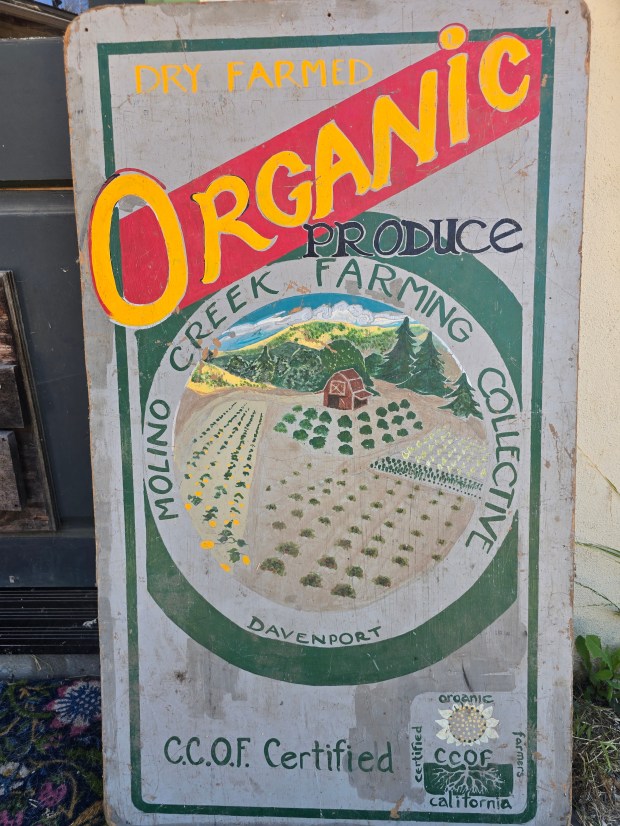
If you rely on the US EPA to adequately screen for pesticide safety, it is time to awaken to the unfortunate fact that the agency, and the USA, is far behind most other developed nations in banning dangerous pesticides. The Monterey Bay is surrounded by agriculture that uses a tremendous amount of pesticides for food production. Some of the pesticides leave residues on food, and some enter the air, water, and soil all around us. There are many stories about pesticides ending up where no one wanted them. All of the pesticide stories should have us asking: why do we buy anything except certified organic food?
The Legacy of DDT
As recently as 1995, DDT has been documented poisoning birds. It was banned on December 31, 1972. In 1995, the Pajaro River flooded into the Elkhorn Slough, stirring up soil laden with DDT and its ‘breakdown products.’ The Caspian Tern colony in the Slough failed right afterwards and the colony has not since returned. The culprit, according to Jennifer Lee Parkin’s research, was DDT. She documented the telltale thinning of the species’ eggshells that also had elevated levels of DDE, which is the even more toxic compound that DDT becomes with time in the environment.
DDT was the pesticide that Rachel Carson tracked to awaken the world to the danger of pesticides in her book Silent Spring. It appears that US citizens have, like with so many other things, given up on pursuing this major concern.
Pesticide Drift
Think agricultural pesticides don’t travel? Guess again. Many of the leaders in the organic food movement live around the Monterey Bay, including Larry Jacobs. Larry, like so many farmers, can share stories about being poisoned by pesticides before he turned to organic production. His business, Jacobs Farm/Del Cabo is probably familiar to you for its high-value herbs in ‘clam shell’ packaging…and they produce a lot of other things. In 2008, Larry won a lawsuit against a company you probably see driving around the area: Western Farm Services. Larry had sent his certified organic rosemary to Whole Foods, which (at the time) spot tested their produce for pesticides…and his rosemary didn’t pass…he lost a lot of money. ‘How could this rosemary have had pesticides on it?’ he asked. The answer was pesticide drift from fields up wind and up fog from his. He proved it, they lost, and you would hope that practices got better.
However, the issue persisted. In 2017, a landmark study illustrated the amount of pesticide drift onto children’s schoolgrounds. This led to a law banning pesticide application within a quarter mile of a school during school hours.
Pesticides going where they shouldn’t is an ongoing issue. We might ask ourselves, is it a problem of getting better at using pesticides or do we need to get better at regulating them? Or both. Because we are getting very little of either. Every time you purchase food that is not certified organic, you are supporting this kind of broken system, which is poisoning people, wildlife, and the Earth.
The Meaning of Certified Organic
I find even well-educated people don’t know what certified organic means. It means that the food with that certification was grown according to standards published by the federal government. Those standards restrict the use of synthetic chemicals, either fertilizers or pesticides. No genetically modified organisms (GMOs) can be certified organic. The idea is that novel, synthesized chemicals are unnecessary and pose a threat to humans and food systems. The certification also means that inspectors assure that the grower/producer/distributor has adhered to the federal guidelines. On our farm, an inspector comes at least once a year to look at what we are growing, how we are growing it, and examines the facilities and records of inputs into the crops. That’s 100% of certified organic farms getting inspected for compliance.
The Meaning of Not Being Certified Organic
Only a tiny percentage (some suggest 3%/year in California) of farms that are not certified organic get inspections to see if they are adhering to pesticide regulations. When they are found out of compliance, they are likely to get a warning, nothing more. When farms or the contracted pesticide applicators act outside of the law, the fines are surprisingly small. So, supporting ‘conventional’ farming with your grocery money is possibly voting to continue this lax system of pesticide use, but let’s get even more personal- what goes into your body.
Eating Pesticides
We are lucky to have Consumer Reports looking at the question of how much pesticide residue is in which foods. And, they update those data regularly. In their most recent publication, they warn against eating conventionally grown frozen blueberries, any conventionally grown potatoes, peppers, and more. The table in that hyperlink is quite graphic about the dangers of pesticide residues on certain ‘conventionally grown’ (ie., not certified organic) foods. I have met many people who are transitioning to purchasing certified organic foods by choosing carefully based on Consumer Reports’ ratings.
Dangers of Pesticides on Non-Human Life
We are lucky to have a relatively recent global analysis of the effects of pesticides on non-human life on Earth. The findings are sad. “Unless changes occur, the hazard of severe, unexpected and long-term impacts on biodiversity and ecosystem functioning will remain unacceptably high.”
What We Can Do
The USA is so far behind Europe and many other places, and that lack of leadership is hurting US farmers who find that they can’t export their crops due to pesticide residue. A Brookings Institute research brief can help lay this out in more detail. There are many reasons for us to do better, but somehow our governmental officials are more beholden to narrow-minded agricultural interests than the future of life on earth or the health of our long-term economy. How do your elected officials stand on empowering the US or CAL EPA to ban more synthetic pesticides? Let’s ask.

