The sun grows distant, already so far South, days so brief. Rain has moistened everywhere. Fall is sweeping the farm, triggering bright leaf colors, tree-by-tree, each evening stroll revealing new tones in new places.
The ground blushes newly green from the previous expanse of dark brown soil or gray aged thatch. Millions of seeds germinated on the much-anticipated first significant rainfall this past week. Pairs of many-patterned leaves unfurl from different types of flower seeds while single first grass leaves poke straight up.
More wetting storms are approaching, pushing southward from the distant northern horizon. Beautiful clouds appear, sometimes a skyfull of feathery patterns, other times ominous heavy gray huge pillows. Layers of clouds above oceanward fog are often accentuated by sparkling orange pulses in between them at sunset.
Muffled Song
As the winter approaches, birds become more quiet, their songs more concise. Bird-eating hawks swoop and wheel, frightening seed- and seedling-fattened flocks. Silent spells with no song signals hawk. The consistent whispered squeaks and chirps suggest hawk absence as groups of quail, sparrows, and juncos slowly emerge from cover, pecking up thousands of tasty sprouts; their favorites are abundant: clovers, filaree, medic, lupine, poppy, wild lettuce, and dock. Full bills, filling tummies, hunger satisfied peaceful birds prepare for long stormy wet nights. Each evening at sundown, flocks huddle together in dense clusters surrounded by protective thick tree or shrub canopies. They have already negotiated safe roost locations and even their individual places in the rows along branches. There are a few squabbles at dusk in the roost locations as some on the edges realize disadvantages of their relegated positions. By dark, they have become politely quiet and still.
Tree nest woven over compost-strewn soil makes for cozy beds for the coming winter
Tucking in the Trees
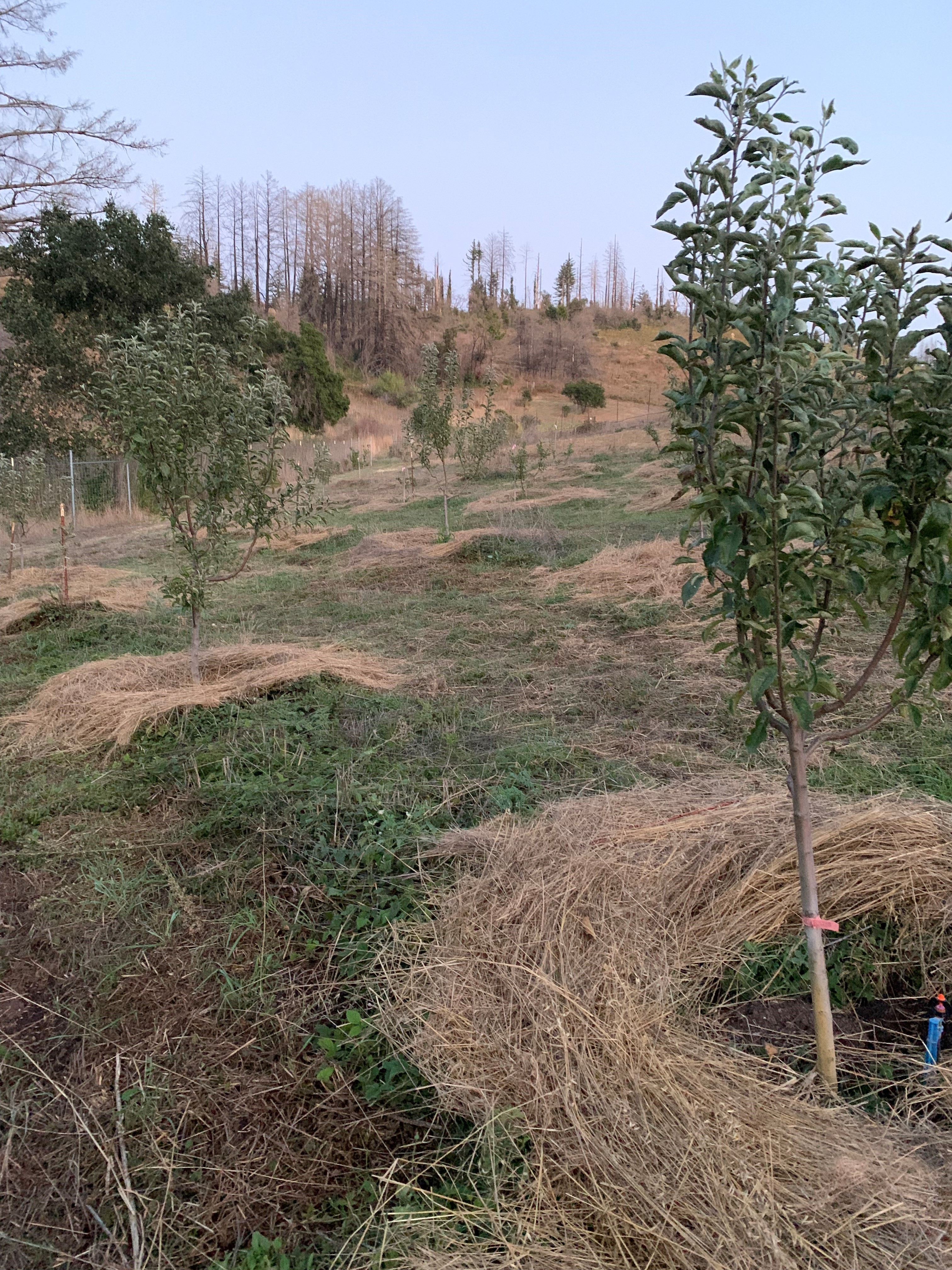
As orchard leaves begin to fall, we prepare tree beds for the long slumber. Last weekend, Community Orchardists hauled and spread the final compost and then the last windrows of dried hay. Energetic tree keepers filled and then hauled bucket after bucket scattering compost/worm castings in the understory of each tree. Following them, skilled pitchfork wielding orchardists pitched, piled, and sculpted neat circular hay nests surrounding young trees. Winter snacks and cozy blankets for our tree friends.
Stone fruit fall color
Nodding Off, Colorfully
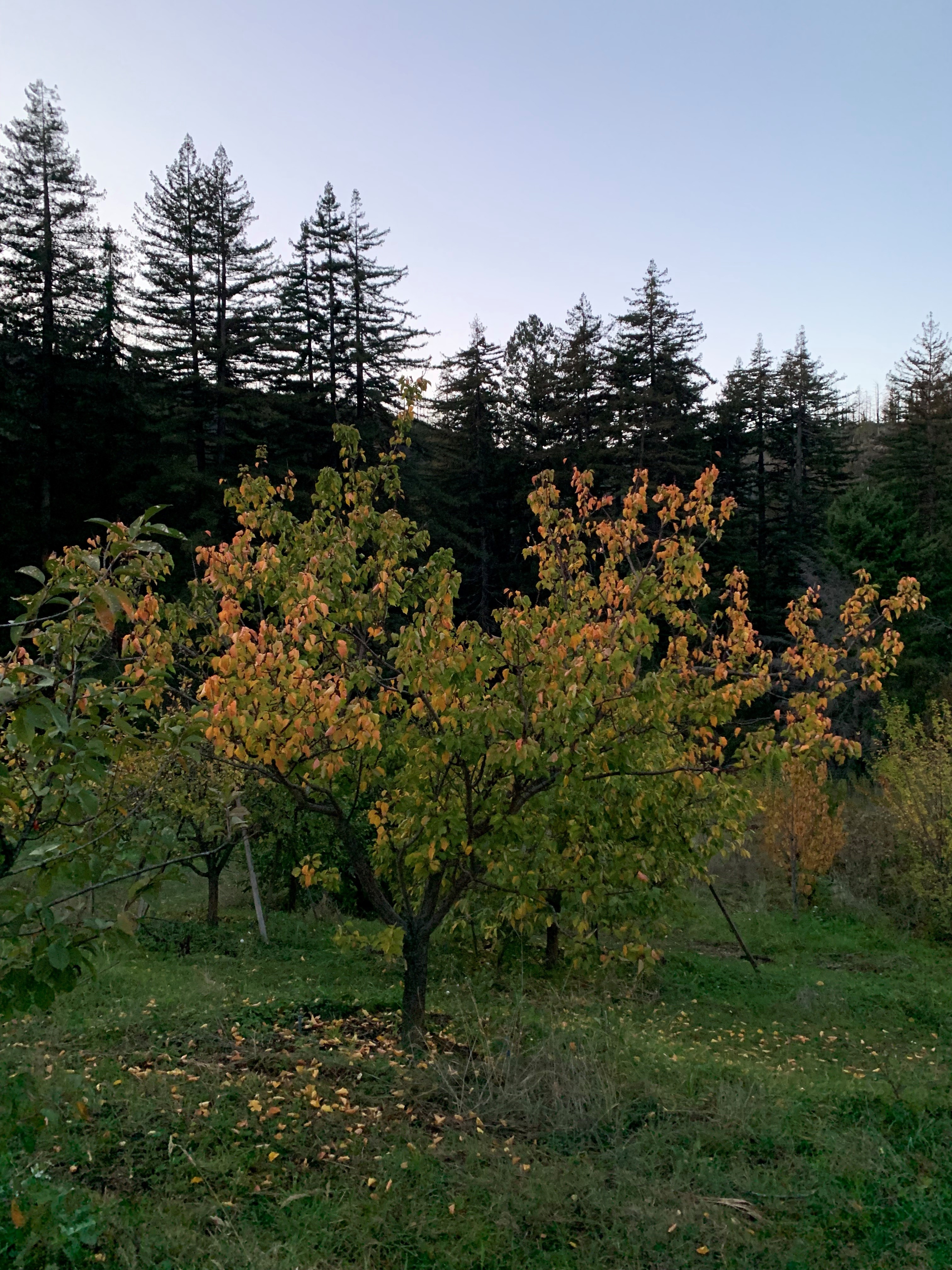
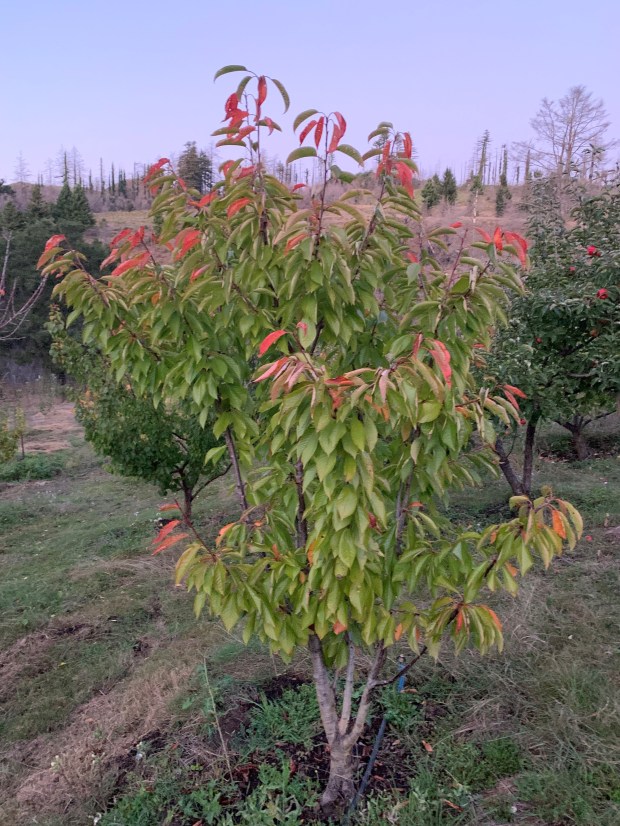
As the trees approach their sleep, leaves brighten then drop. Cherry tree leaves are turning orange-to-red, starting on the sunnier sides of each tree and day by day progressing onto the northern side of the canopy. Apricot, aprium, plums and pluots echo those cherry leaf reds but tend more orange to yellow. Apple tree fall color extends well into winter, slowly unfolding many shades of yellow through February in an extended fall. Most leaf colors change fast and fall quickly, splashing rings of color bright in circles on the ground beneath brief spells of brightness dancing across the orchard among the high held branches.
The place of deer beds and rustling
The Rustling
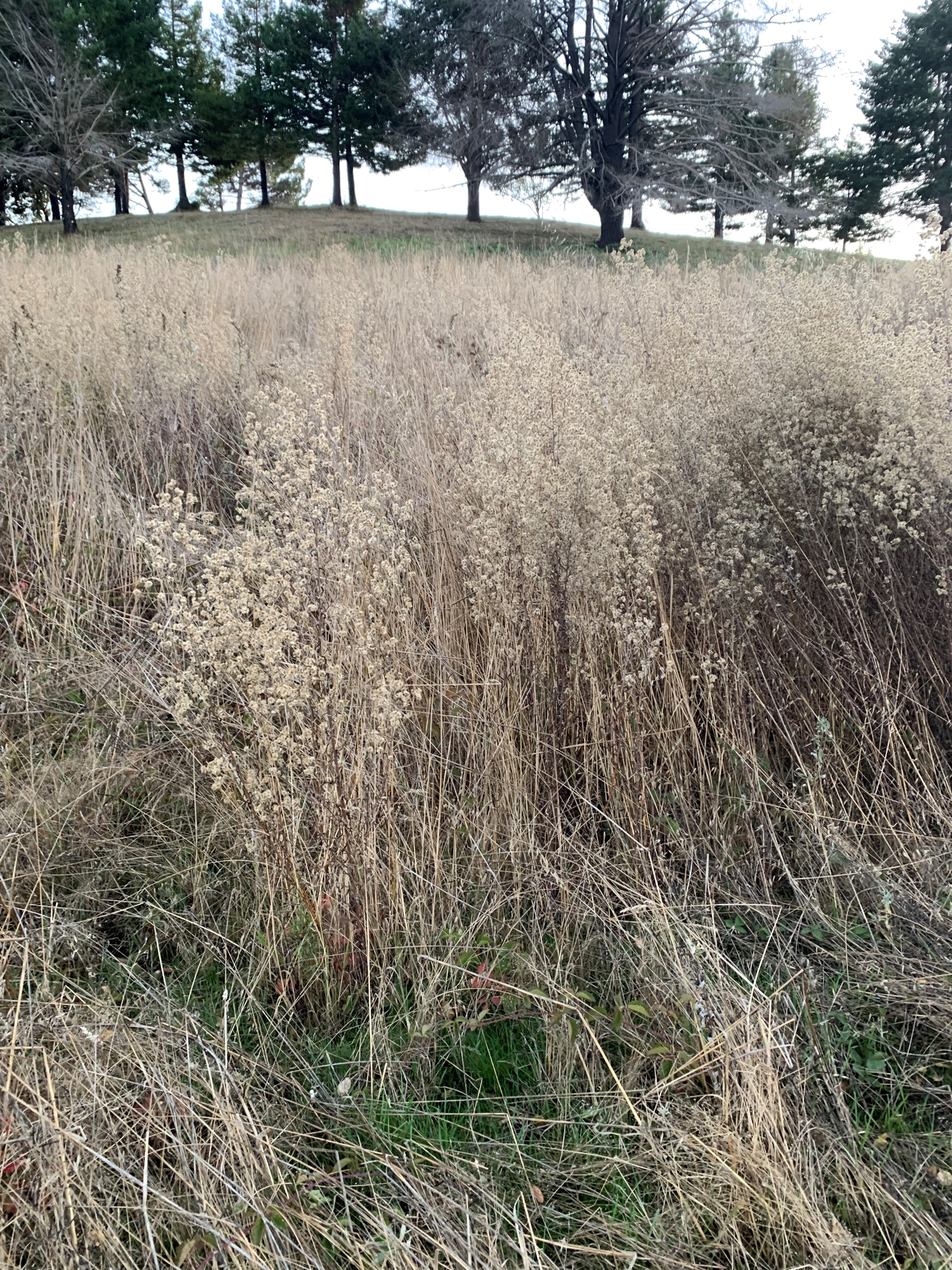
We were unable to mow every corner of the farm and in some places the dried grass and wildflowers formed thick dry swards. Deer paths wend into these stands. Following these wildlife trails, we find hidden clusters of mashed down straw – cozy deer beds. The breezes sing high schwews on the ridges with more of a full, wooing noise in the nearer conifers, but these tall dry grassy areas make scratchy, rustling noises in the winds at the onset of each storm. The deer thank us for leaving them some dense cover to shield them from the chilly gales through the dark nights.
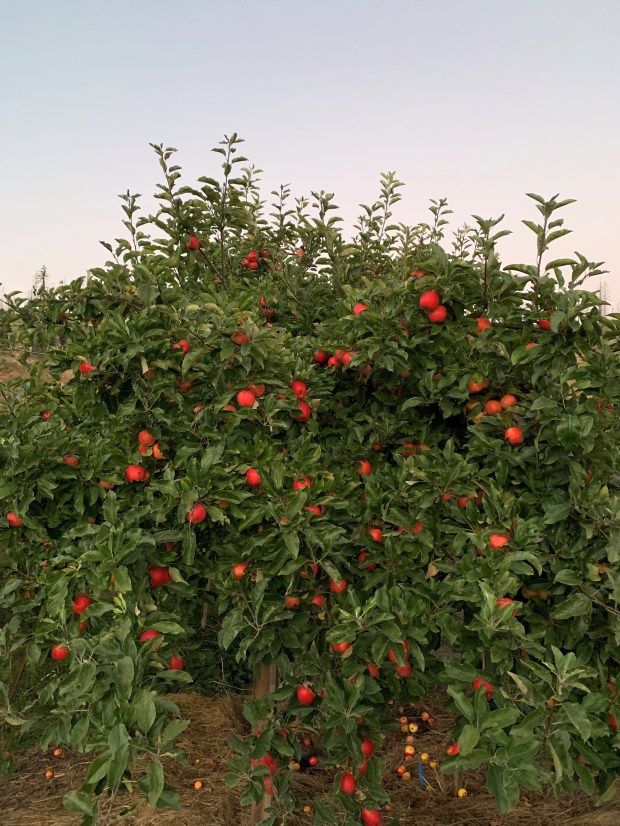
Fuji apples held ripe while leaves change color
The Last of the Fruit
Tomato vines whither after rain; winter squash vines long spent, fruit curing; later season apples grow sweeter and crispier with the cool nights. We feel lucky again to find a ripe tomato among the melting vines. Weeds will soon occlude the deliquescent reddish fruit and then all will be tilled and cover cropped.
Molino Creek Farm’s wilting dry farmed tomatoes, slain by rain
Two Dog Farm is boxing and curing the bountiful dry farmed winter squash crop, and colorful squash still brighten the fields.
2 Dog Farm’s last dry farmed winter squash, waiting to be gathered.
Fuji apples are the last bigger harvest in the orchard. We will gather the last of the apples over the next week and press the last of the culls into the final cider of the season. Much of the orchard has had a final mowing, the harrow scratching in bell beans is close at hand.
Emerging New Tree Characteristics: a dance between species
Sunsets and Quickening Evenings
The sun speeds quickly towards the west and evenings pass suddenly to night. One moment, the beautiful array at sunset tinges the hills and the next moment colors wash and fade to gray, stars winking into sight until the night sky reveals vast constellations. There is a moment in this transition to night when my attention is drawn to the silhouettes of trees, revealing new characteristics of long familiar friends. Brushy oaks dance on the edge of regal, posturing clusters of redwoods. Then they disappear, overcome by the majesty of night.
Of all the phenomenon of Fall, seeds rein. Just as humans become silent around the table as they dig in, mouths full of the bounty, so have the non-human animals across the fields and forests surrounding Molino Creek Farm. A pale blue scrub jay appears on a high perch, its beak pried wide, holding a huge acorn. It dives to a patch of grass, furtively glancing about to assure no one is watching, and buries the acorn, no pause and it’s off for the next. Our normally squawky friends are quite busy with their oak harvest, back and forth, planting hundreds each day. It is not a great acorn crop year, so the competition is high.
The tiny goldfinches disperse like confetti in small flocks, alighting in field margins or scrubby areas to harvest the oil-rich seeds of thistles, prickly lettuce, and tarplants. Their songs, too, are muted, chatter replaced by dainty beak-seed-cracking.
Just one of the many nice views on the road into Molino Creek Farm
Redwoods
Fall in the wooded canyon means redwoods shedding needle-branches and a rain of seeds from newly opened, small cones. Recent gusts broke loose short sections of the outermost branches from redwood trees. Thin-stemmed branch tips are mostly needles, which are regularly shed this time of year and carpet trails and roads. Even ‘evergreen’ trees shed needles at regular intervals, each species with its own season. And so, the forest floor transforms from last year’s now dark duff to a light, red-brown coating of fresh redwood litter. Walking our Molino Creek Canyon trail now creates a crunchy, crackly sound. On a recent walk, I glanced down to appreciate the redwood fall and saw many redwood seeds sprinkled between the scattered needle branches. A heavy breeze swayed the trees back and forth over me and in all directions, and the air was suddenly filled with redwood seeds, bigger than dust and thickly moving like sheets of drizzle.
Madrone
A beautiful element of our woodlands is the flesh-smooth orange-barked madrone, becoming bedecked with ripening fruit, held high in the canopies. Presented in diffuse clusters just above their large oval shiny dark green leaves, the ripening madrone berries are changing from hard and green to fleshy and bright orange-red. Band tailed pigeons and other birds are feasting, sometimes knocking the ripe fruit to the ground where mammals gobble them up. When I am lucky enough to find a grounded, deeper red fruit, I also pop it in my mouth, reveling in the sweetness, near strawberry flavor.
Walnut
The prominent black walnuts, the signature trees of the farm, are turning lemon yellow and dropping ripe nuts with a plunking noise to the ground. The 2” fleshy globes roll about a bit after dropping from the trees, settling in the grass or, more evidently, on road surfaces. The sound of tires used to be the scritch of gravel but is now accentuated with the resonance of the rubber drum when a run-over tough walnut pops and gets crushed into the road. Ravens and juncos line the roadside fence awaiting the freshly exposed juicy, oily, tasty nutmeat that is announced by the tire drum “poing.”
One day, we’ll make olive oil again, but it will take a lot of catch-up maintenance
Pome Pome, Pome-Pome!
The fruit that we eat (and drink) is rolling off the trees in delicious piles and buckets and boxes and carts. We are more than 2,000 pounds into the 4,000 pound harvest, down from last year. Nothing goes to waste. There are very rare instances when someone doesn’t pick up a really gooey apple from the orchard floor. Hygiene is in high swing with the worst orchard trash heading to the weed suppression wildlife feast buffet. The deer, rabbits, quail and coyotes take turns at the castings: nothing lasts more than a few days. The last tractor bucket of culled apples, 200+ pounds, was mopped up in 2 days, down to bare earth.
That leaves 3 other types of apples: sale apples, take home apples, and cider apples. The most common harvester and sorter vocalization is ‘awww!’ as they realize the rarity of the perfect fruit, the choice apple that is sent to market. That’s one in 8 this year, due to the uncontrolled apple scab of the moist spring. The other 8 apples are 30:70 take home apples versus cider apples. The take home apples are sent in boxes, buckets, and bags to the growingly extensive community orchardists; they have the most minor blemishes and there are hundreds of them. Our working bee network has been making their own juice, drying them, stewing apple (-quince) sauce, and just plain enjoying the crisp diversity of flavors from the many varieties we grow. The cider apples have a few more blemishes or even some signs of worms…the latter making work for the cider pressing party as chattering, smiling clean up crews prepare the fruit for a better juicing.
Juice!
The cider pressing last Saturday attracted 30 or so of our network, new and old pressers, taking the 500 pounds (or more) to 30 (or more) gallons of nectar – delicious juice. Much of this will become hard cider for future gatherings; many enjoyed diverse ciders from prior pressings. Most abundant fruit of this year’s press, Fuji, but also Mutsu which makes famously fine flavored juice. Mixed in here and there were true cider apples, varieties that are just starting to produce after 8 years in the ground. The cider apples add bitterness or sourness or tartness and overall complexity to the juice from what would otherwise be plainer if produced only from table apples.
The Community Orchardists sponsored a recent squeezing of fresh juice for the Pacific School in Davenport, our neighborhood! Bob Brunie schlogged the equipment and demonstrated the process to the schoolkids, some of whom were returnees and they enjoyed it a whole lot..
Bob Brunie shows off Molino Creek Farm’s Cidering Process to Pacific School kids, photo compilments of Mike Eaton
The falls’ fruit produces juice, brewed into all seasons’ mirth. With toiling gladness, we renew the stocks annually. Cycles of production and consumption – foundational in nature – quench more than mere bodily thirst, leading to deeper appreciation of Earth.
-this post also shared via Molino Creek Farm’s website, same time, same author
Fallen leaves blown across the forest path, under foot while walking, go “swoosh, swoosh, swoosh.” The sound of moist leaves (not crisply crunchy), an early rain and cool nights softened the landscape, removed the dust, made things gentle again. We are relaxing, slowly shedding the stress of the Fall’s potential for wildfire made more real these past many weeks by wind-carried smoke from prescribed fires across the entire state, even nearby at Wilder Ranch.
Breezes carry in the clouds and then clear the clouds, waves after waves of clouds and then sun alternate as the dry summer plays with the wet winter, back and forth. This week, winter won with a bit of rain, shy of an inch and not yet wetting the soil more than superficially. After the rain, some sunny warmth and then the wind, fog, and another front , and it got chilly. Tuesday evening fog piled up on the other side of the prominent ridge across Molino Creek and poured over it, falling like a ghostly waterfall backlit by the evening sun. Beautiful!
Neither the rain nor the subsequent drippy fog has been enough to release the cedar-scented petrichor, much anticipated.
we do grow olives…for locals only olive oil!
Big swell, seasonal scents
Last night’s goose bump chill sent us to close the windows, put on sweaters, and some even built their first wood stove fires. And today’s cool air reminded me of how I’ve been taking the sun’s warmth for granted and how I’ll miss that deeply warm sense for a long time soon. The cool air, moisture, and gusty breezes accentuate the piney, resinous smells of redwood, Douglas fir, and coyote brush. Winds across the ocean pushed up an epic swell recently. Roaring and thumping waves reverberated across the landscape, but now there’s just a low more consistent hum. The patterns of breezes with long lulls awaken the senses, especially when it is peaceful on the farm but the trees on the ridge start talking, telling us a big gust is coming.
Feathered visitors
Geese, Canada and white fronted, are honking their melodies overhead near sundown. They are making their way to their winter grounds.
The newest birds are blackbirds, strutting around the fields in flocks, their heads moving curiously straight back and then straight forward with every stride. This evening, the light was catching the glean off the backs of a flock of Brewer’s blackbirds, reflecting the iridescent deep purple-blue of their gorgeous plumage. They let me get close but eventually alighted to show me the bicolor blackbirds in their midst. There are around 50 of this mixed flock and more may still arrive. They love to eat the grass seeds in the cover crop. They might even be anticipating it.
Other wildlife
Otherwise, the wildlife report is all about the Very Big Buck, coyotes, and chirping bright blue bluebirds. Perhaps there’s more than one Very Big Buck, but people are talking about an extraordinarily large, very impressive male deer from here to Davenport and north to Swanton. This creature stands very smart and tall with a giant set of antlers nearly 3’ across. He stood in the roadway looking intently north where he couldn’t traverse without going around the deer fence. He hesitated, looked north again, and then sauntered uphill following the fence line, somehow seemingly begrudgingly.
Nearly nightly, the coyotes sing. They aren’t doing the long musical numbers with multiple animals yipping and howling, but rather it’s a series of solos of the one coyote couple. One evening, they were calling from way up the Molino Creek canyon. Another evening, they sang right outside the window. Each night they try making some song from a different place, perhaps checking out the acoustics: the echoes are always fun.
The throaty, watery chirps of western bluebirds grace our midst. The brilliant blue flashes from the males’ zig-zaggy flights are breathtaking. There were seven birds, up a couple from last count. With that plumage, one wonders if they are considering breeding early…
The fading row crops will soon be tilled in and cover crop will grow, instead
Fall farming
We’re not quite ready to cover crop. There are still 10 days of tomatoes to harvest and the apple harvest is in full swing. The floral crisp sweet Gala apples are almost all gone; we will pick no more for market. Last weekend, we picked all the remaining Mutsu apples which had been devastated by the apple scab disease that enjoyed our late wet warm spring. Next up are the Fuji apples, and there are plenty of those! Plus, there are Golden Delicious, an underappreciated long storing apple of extraordinary flavor. In the Barn there are hundreds of pounds of culled apples that we’ll soon be juicing for cider. And so, we pick, pick, pick…sending on the perfect apples to market. Between picking spells, we spread compost and mow to prepare for harrowing in the bell bean seeds.
those rusty brown tentacles….avocado roots poking up into the loose, month-old compost!
Tentacles in the compost
The Community Orchardists have been spending the last many weeks spreading compost under many trees. Around a month ago, we spread compost under the avocados on Citrus Hill. After that little bit of rain, I noticed those avocadoes looked particularly perky and vibrantly green. So, today I pushed around the compost to see if the avocado roots had invaded it: they had! It is so curious to me that avocado trees push pointy tenacles of roots straight up, out of the soil into mulch. How do those thick pokey roots feed off the mulch? Such a mystery.
High in a fruiting apple tree, harvest bags slung over our shoulders, we stop picking to glance up the road…gravel scrunching noise…a car winding its way down the road onto the farm. A neighbor or a visitor? We narrow our eyes to see where it goes, who is returning home? Who is visiting whom? By car, wing, or scales, we welcome all sorts of friends returning to Molino Creek Farm.
A String of Celebrations
The harvest festivals have already begun. We are pressing apples with two pressings already behind us, 40 gallons of divine apple juice in freezers, refrigerators, or in carboys fermenting. Upcoming is Samhain, the midpoint between the Fall Equinox and Winter Solstice, a time when the veil grows thin separating the ancestors with those here now. We will be attentive to the shadows, echoes and whispers of those who walked and loved this place before. John Brunie used to perform the astrological calculations of the exact date and time of these sacred holidays, but he’s gone so we seek a new calendar keeper for the Farm. Thanksgiving means some leave the farm for gatherings elsewhere and others arrive, a string of quiet days, friends roaming the fields and trails sharing stories and luxuriant first rain smells. The forest floor and roads are often littered with evergreen branches at Thanksgiving, blown about by the winter’s first storm. We weave fallen boughs into circles, recognizing the cycles of time. Winter solstice lies shortly thereafter and then the Wassail brings the string of celebrations to a temporary close. We are at the threshold of gatherings a’plenty.
We regularly hire who we can to mow down acres of flammable coastal scrub
Equinox Birds
The Fall Equinox has hellos and goodbyes. We said hello to hundreds of golden crowned sparrows who returned to this place from Alaska on the very evening of the Equinox as they have done time and time again. With strong site fidelity, these birds love this place more deeply than we can ever understand. These same families, these same clans, have potentially been returning for hundreds of thousands of years to this very spot. If we peer at them enough, we can recognize individuals; they already know each of the neighbors and maybe many of our friends. The Equinox saw the flight of the barn swallows, who returned to Central and South America. They may have spent days singing goodbye, soaring one more time past their favorite trees, and then they were off. As they left, the particularly whiny sapsucker(s?) dove into the orchard from the great migration from who knows where. We need help to see how many there are: last year there were three in the family. Sapsucker is elusive and shy, requiring some focused time searching for each individual to figure out how many will be here this winter. The changing birds greatly alters the soundscape. The dominant noise in the spring and summer were the creaky whistles and laughing chatter of swallows. Now, the dominant bird noise is the golden crowned sparrows’ forlorn call, a descending set of notes that might be, ‘Oh dear me,’ repeated from every shrub and tree. What hasn’t changed is the sheer biomass of birds inhabiting the Farm. Stepping out the door still flushes 50 birds. A walk down the roads or paths creates a continuous wake of fleeing birds. Feather flutter and alarm cheeps everywhere.
Winter Waves
The sets of roaring and breaking big winter waves have returned. Lately, there has been no still peace as the reverberations of the ocean form a white noise backdrop to a cacophony of warm night crickets interspersed with bouts of hooting owls. The waves create a mist that blankets the ocean side farms, spreading a bit up the coastal canyons. When the waves are big and there’s even the gentlest onshore breeze, we can smell the fresh sea scent from the Farm, 2 miles inland and 900’ up. When the waves get really big, it seems the ground rumbles beneath our feet. These are familiar phenomena which make this seem more like home.
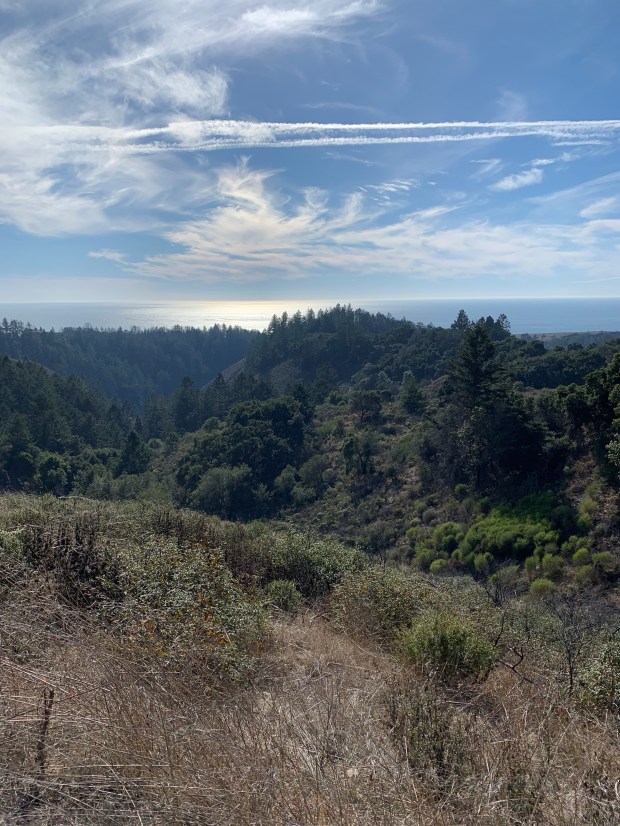
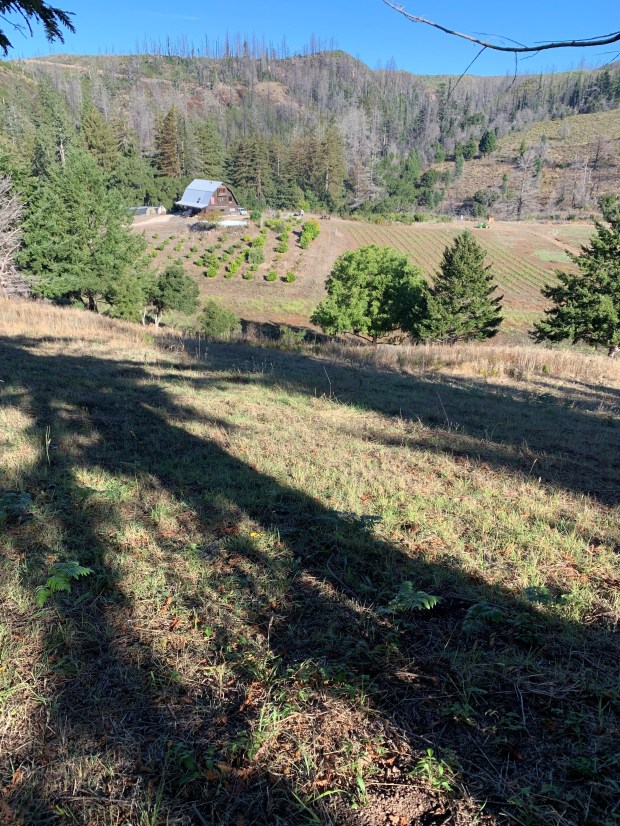
A view across the farm
Coyote Friends
In Spring, we saw a female and her pup coyote. She had a peculiar white line behind her shoulders, a ridge of brighter fur that stood up a little above the rest. She was lithe and wary, always on the move, never playing as so many of our wild dog friends had done before. The other day, I saw her again, following the large male neighbors had been talking about. We have a pair of coyote friends! May they find a fine place to have pups nearby and feast on the rabbits and gophers that are so common around the farm. From their scat, it looks like they are enjoying apples and tomatoes for now. The two sing many nights, a deeper growly staccato barking paired with a longer noted, high yipping song.
Fall Scenes
The cycle of seasons delivers us a quintessential peaceful Fall. Time slows. The sun very gradually sets into longer and longer nights. The hills are muted colors now, dry leaves rattling. Once tall upright golden grass has settled, askew and gray-brown. The fruit and nut trees show hints of yellow. In the forest, maples, thimbleberry, and hazelnut are dropping lemon yellow leaves, splashes of color in the shade of the towering redwood forest. Bright squash litter the Two Dog fields as their peppers turn deep red. The poison oak is still moist, only a few bright red patches on the drier shrubby sites. The sunset sky is streaked with smoke from prescribed fires, humans returning to their roots, stewarding the land once again.
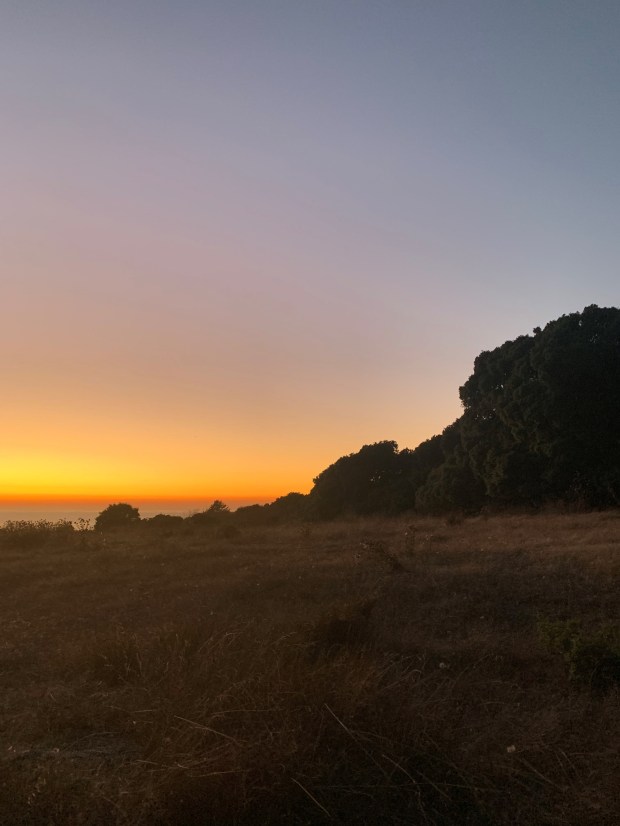
The last rays of sunset from a tall spot on the farm
May you take the time to meander about, soaking up the warm fall evenings.
Two nights ago, the lower portions of our farm dipped into the chilly 40s. Today, it was in the 80’s, tomorrow even warmer with two ‘warm’ nights not lower than 65F. Such warm nights bring a cacophony of crickets along with late summer katydids. Our ears seem to ring, and seeking the source of any one of the insect songs creates a confusing, 360° immersive dizziness. A visitor remarked, “what IS that noise?” Such sounds are not found in the City. Such sounds are not even everywhere on the farm, only in places on the farm. There are pockets of nightsong. Seek them where you can, it is a worthy experiential destination.
Sundown on the Pacific, just a short ways from the Farm
Country-style Night Show
Even where they sometimes fill the air from all directions, the insect songs fade in and out, sometimes louder and sometimes softer. Some species go quiet leaving the chorus to others and those then fade to the next song, a repeating pattern that never grows old. Some insects sing trill….trill….trill and others have a more constant chitter. Some play lower stridulations, others high, shrill ear-piercing whines. For biologists, I note black field crickets persist in lower numbers than in the early summer; now there are more brown ones. Also, the invasive green tree crickets sing with oscillating medium-toned trills from which you can calculate the temperature. The late summer, and this year in particular, features the massive laterally compressed long-legged bug-eyed katydids, a source of high-pitched, especially ear aching whining: you particularly notice when they take a break. On warm nights like tonight, there is no real silence of insects, only lulls, and always with the green tree crickets’ consistent “wee….wee….wee….wee….wee….wee….wee….wee…” Under the insect chorus, enter a baritone montage: wave sets crashing, their pulsing drone carried by the gentle onshore cool breeze. The light show for the orchestra: fields of stars and the stripe of the Spectacular Milky Way that us country dwellers get to enjoy far from the polluting night lighting which ostensibly provides increased safety and orientation in the cityscapes.
Dawn Revealing
In the East, the first glimmers of dawn cast doubt on night, but darkness at first prevails, some stars still brightly shining. The wakening mind returns to semi-slumber, the day’s return a dream (?). Another thought, eyes wider, the sky a new brighter gray and another glance brings certainty…a new day, a return to the waking life and the tasks at hand. Awakening brings smiles and gladness for the peace of country life and ease of transition into farm routines.
Watering and Harvest
Many fields are dry-farmed, and those are curiously bedecked with fading green foliage and the brightening fruit harvest. Other areas are irrigated and so still vibrant green, though the last planting of sunflowers is fading.
Those irrigated areas need regular attention during this, the driest part of the Mediterranean summer. The waves of heat alternating with cool and even drizzle make for irregular water demand. In anticipation of heat waves, we saturate the soil more. With spells of cool and drizzle, we slack off a bit and catch up. Shovels explore the soil to record the moisture condition, sometimes surprisingly dry… trees full of ripening apples are especially thirsty. We are trained to keep the soil moisture above 50%, but predicting where it will be any one day is a learning opportunity, always.
Sunflowers at Dusk
Midday Warmth
The hot days tax farmworkers and birds, alike. Tomato and pepper harvest comes midday with backs bent, sun baked and sweating; picking commences no matter the weather. Above the farmers, migrating hawks ride warm thermals higher, soaring up and then south. A very rare occurrence: there were six red-tailed hawks and another large raptor even higher over the farm today. The great migrations called “hawktober” often co-occur with the recurring shimmering heat waves so common this month. Other birds avoid the open sun, chipping lazily from the shade of shrubs. Late in the afternoon, down by the ocean, a mixed flock of various blackbirds alighted on the roadside. Their beaks were open, panting, even as the day cooled at 5pm.
Evening
If we can, we wait to harvest apples outside of the hottest part of the day, and we can stand while doing it…easier on the body. Heavy picking bags leave the shoulders achy, and we switch sides to even the ache. The hurried apple harvest races the setting sun. What started as bright sun fades to soft golden light so briefly before all sunlight retreats to muted dusk, quickly darkening. Boxes and buckets of apples go into the barn with the last available light. Overnight, boxed apples cool naturally before the market delivery the following day.
On warm evenings like today, a great emergence of moths alights. Big moths and small zip and float everywhere, and it is impossible not to get hit in the face as they flit about. The bats are getting fatter. Poor-wills clumsily flap and dart, pouncing on their insect prey.
Also at dusk, the deer arise from their folded legs to traipse about looking for forage. Lately, they’ve been munching on the leaves of freshly felled walnut tree trimmings. Someone improved our farm road tree tunnel and left piles of fallen black walnut tree branches: this is a seasonally favorite food of the deer. Momma and her adolescent offspring deer (still unnamed) are at that salad bar. A young male caught her scent and wandered onto the farm this evening, a rare sight. The wayward bucks are very flighty and he was no exception. Upon being noticed, he bounded away, alert and head held high.
The last light of dusk barely illuminates the fading sunflowers at Molino Creek Farm
Night
Great horned owls, coyotes, foxes, and more. Two great horned owls have been having regular evening hooting contests. They sit in trees not too far apart and hoot loudly, taking turns, back and forth. There’s a silent bit, then one of them starts on some odd, non-hooty noises but then returns to the hoots soon thereafter. Is this a long conversation, or do they revel in the joy of creating or exchanging subtle variations in pitch and enunciation? They do not tire. They must be day sleepers.
Coyote barks seldom. Cassandra reports seeing a particularly large one. They leave big poops full of tomatoes and apples. Sylvie reports fox feasting on her Asian pears- a tree worth. There are poops from fox, too, all across the farm. Weasels excavate gopher runs in the apple orchard, freshly dug soil mounds ending at large gopher holes each morning. There may be a weasel den under a prune tree.
Night strolls to manage irrigation reveal black widow spiders more commonly than any other spider. One striking large female complained about my opening the gate she was building a web trap at the base of.
Mice scurrying (but never seen) is another commonality.
These balmy nights bring pulses of warm air settling onto the farm from higher up the mountain. Warm blobs of air get pushed around by cooler onshore breezes, or nudged here and there by sinking chillier streams of Molino Creek canyon air. The half mile walk across the Farm sends me through boundaries of three or four contrasting temperature air masses, and the new temperature also brings new scents and different humidities.
Seasons Passing
We have already passed through several waves of harvests and are set to see the last run of this year. Last February saw baskets of citrus and then Spring brought us peas and cherries. The first tomato, not until August, was a real delight, now we are in peak production. The prune plums are nearly gone as are the early comice pears. We are entering a marathon of 6 weeks of apple harvest, and that will be the end of the harvest season with the transition back around to citrus and all that follows next year. We compare years of apple harvest and the resulting cider. We mark our annual cycles as ‘before the Fire, or since the fire.’ Rains return and we burn huge piles of cut brush then the brush piles build again to be reduced the next year. On and on. Earth whirls around the Sun and we bound through space and time.
Last Friday, Night equaled Day; it was the Equinox, and our world stood in balance. From here, things tilt rapidly towards the dominance of Night, and we share the Sun increasingly with the South for a while. There, Spring is emerging. The cooling temperature change switch is not thrown quickly; there is a lag of the Sun’s heating, and we often are assaulted by wilting, week-long heat waves in October. The return of the rainy season will likely be a way off. Meanwhile, the Harvest is in full swing at Molino Creek Farm with all of its various enterprises. Welcome to Fall.
Organic Gala apple fruit are laden on one of many trees in our older trees
The Orchard
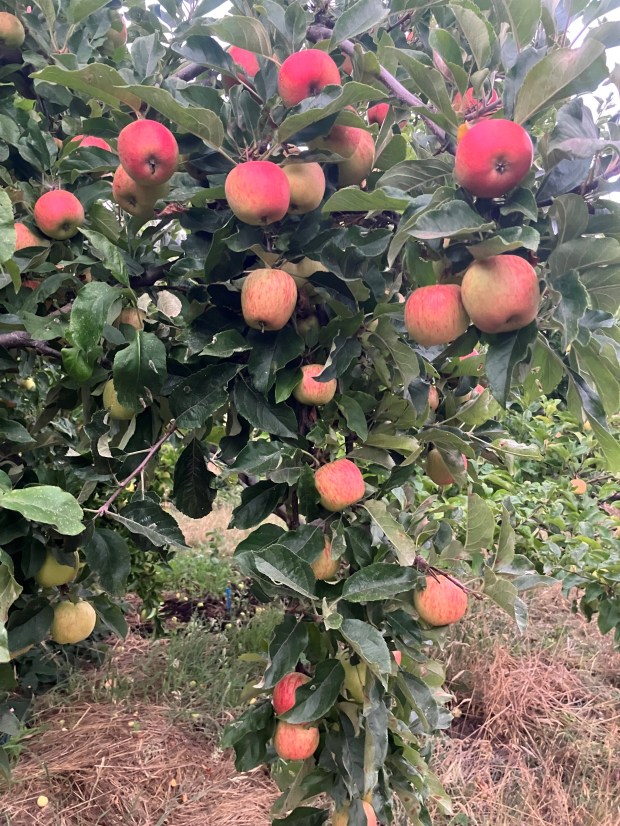
Apple trees hang heavily with giant loads of ripening fruit. The branches bend more each day as fruits get bigger, juicier, and more colorful. Gala apples are finally gaining their peachy blush, underlaying the sun-side bright red streaking, overlaying the shade-side yellows. Our much smaller crop of Mutsu apples are getting Really Big and kissed with a patch of purply red where they see the most sunshine. The Braeburn and Jonagold crops, a total failure due to apple scab, a combined result of the long, moist, cool spring and our own lack of applying sulfur to kill it. There are so many other varieties…one tree each…to taste, to give to friends to taste…to revel in the diversity of apple flavors and textures. Oh, and then there’s the patch of Wickson Crabs, which are laden with the tart poppy nuggets that will tint so many batches of hard cider, real soon.
The gold-red-purple French prune-plums are past but the yummier deep purple Italian prune plums are getting ripe now: tarts a’hoy!
Nearby, young avocado trees are stretching with late summer growth shoots, so well-tended and vigorous. And, an array of citrus also puts on pale new growth while slowly swelling their fruits toward a February harvest.
A Big Moon rises over Molino Creek Farm and its patches of dry-farmed Early Girl tomatoes
The Tomatoes
Rows and rows of tomato vines are laden with fruit of all colors. The harvest will continue for a while. There are plenty of pale green orbs from tiny younglings to larger plumpers. Pale orange fruits are transitioning to the bright reds, nestled within distinctly green foliage. Between the rows, tossed rejects of tomatoes melt into the soil and flocks of birds flit around chowing on their remains, hungry especially for the protein-rich seeds.
Quince!
Harvesting
The ripening tomatoes go into buckets only so full. The apples go into shoulder-mounted bags. Both fruit get sorted for sale. Tomatoes of varying quality go for varying prices. Only the perfect apples go to sale, the rest to home use, charity, or juice (cider!). Starting tomorrow, apple harvesters will gather a few times a week and we will be handling 6,000 pounds between now and Thanksgiving. Wow.
Seasonal Wildlife
On the drive down to the highway last Monday, I saw the Largest Buck…a real beauty with big antlers, a broad chest, and massive muscles. That large of a male is a rare sight, one I’ve experienced only three times since 1986. Back on the farm, we have a much smaller mother deer and only one of her twins from last season. Their still summer coats are shiny and light-roast coffee brown, and they appear well fed and relaxed. They have enough food to not be walking around on two legs reaching up for the Fall walnut leaves, but I smile remembering that ridiculous-looking behavior.
Like clockwork, the golden-crowned sparrows returned last Friday night. They always return on the night of the Equinox. The sound of their songs are now coloring the days; they have transformed the soundscape to mark the seasonal transition. This is somehow deeply comforting.
Scent Landscape
With the sweet sparrow song also arrives the scent of Fall. So many things contribute to the scentscape. Mostly, it is the piney-bitter smell of coyotebush, but add to it wafting sweetness of flowering domestic garden plants- angel’s trumpet, San Pedro cactus, four-o’clock and ornamental ginger. Also, the breezes bring other scent ingredients like agricultural sulfur, pungent tomato foliage, cidery apple culls, and so much more. The dry, cool air accentuates and mixes these scents and creates the Molino Creek fall perfume. Emerging from the night warmth of shelter, we breathe deeply the outdoor air to experience all that’s on the air.
When the clouds and fog clear – the minority of nights as of late – the star-filled sky is bright with the Milky Way. Tonight, a Big Moon hails and lights the farm in its blue glow, illuminating the soon-to-be walk to juggle irrigation valves once again.
Somewhere, somehow…it is all Right Now
Right, now
Posted simultaneously at the website for Molino Creek Farm.
The calendar says it is almost fall, just a couple of weeks away. But, the temperatures and dryness suggest it is more like midsummer. The days wake up mostly sleepy, fog having rolled in during the night. Everything glistens with dew in morning’s first light. Sunrises are muted with tones of gray and silver across the shadowless and chill landscape. There is no dawn chorus, only a few peeps when the birds warm, late. The morning crawls on as the fog slowly breaks. It brightens more, bit by bit, until there is mostly blue sky by about noon. Then, barn swallows take noisily to the sky. The afternoons slowly warm until the sun gradually fades, a shadow line edging across the fields as the sun disappears behind the ridge to the west. This past Friday, the fog was so heavy and long lasting that it drizzled enough moisture to wet and settle the road dust.
Pattern Recognition
Last year, we would have been about to get our first inch of rain. That September storm produced what we call the germinating rain, and the early timing was extremely unusual. After that, there was another Big Storm in October – more expected timing. A bit later, all heck broke loose in December through January when we got atmospheric river after atmospheric river. None of that was predicted. In fact, as late as October, our national weather service climate scientists were saying it was going to be a dry winter, a La Niña situation! Right now, those same experts are saying there are strong El Niño conditions and that there is a 95% chance of those continuing through February of 2024. Compared to the last 12 years of data, this year looks comparable only to 2015, a year that brought some hefty rains to our part of California. With last winter’s deluges fresh in memory, it is easier to prepare though the really rainy times should be months away. So, we are able to chip away at the chores: an armload of firewood here, a bit of road drainage improvement there.
Nature’s Patient Changes
The nature around us also patiently transitions. The monkeyflower bushes leaves fade from top to bottom from their sticky dark glossy green to a crisp and withered black. This year, even those drying bushes still sport flowers feeding hummingbirds and bumblebees as they make their daily rounds. Madrone leaves and shreds of bark fall bit by bit, day by day, refreshing a layer to keep the footpaths only a bit crunchy. The grass, once shiny golden as it started to dry, is now almost gray with age, falling over and covered with dust. It will bend still until it is all in broad arcs and pillows in the unmown areas. The mounds of dry grass resist herbivory in that elevated state. In areas we mowed and the chopped grass touches the ground, herbivores feast on hay: insects, mice, and gophers are fast eliminating this year’s productive crop. Crickets in particular are having a good year.
Cricket Families
The night walks reveal new generations of crickets alongside the older, bigger adults. There are many sizes of crickets from the tiniest of young to sub-adult adolescents to honking adults. The adults are surprisingly large, especially the black field crickets which are the bravest, barely moving from the examining beam of my flashlight. One large adult sings from every 3 square yards, and I haven’t seen two of those large adults more in proximity, so from whence the young? Ah, something more to learn…
One of our many odd comice varietie- all ripening differently though contiguous
Abundant Life
Life’s young are growing in other species. Coyote parents follow their adolescents’ lead for the yelping chorus. Judging from their plentiful and frequent scat, they are enjoying scavenging lots of farm fruit. Momma deer has two growing young in tow; they might not realize that she is pregnant again and so will share the space with a new sibling or two before very long. It has been a few weeks since I saw the latest puffball young quail, and there are currently huge groups with lots of curious nearly grown young learning the techniques to avoid being the meal of so many predators. Those quail groups are so large as to seem to flow like liquid from bush to bush as they shuffle and scuttle through their days. Tiny fence/blue bellied lizards have recently emerged, inch long babies that are much more energetic and jumpy than their older counterparts. They leap impossible distances and dart down holes at the slightest movement. There are no intermediate sizes, so a simultaneous hatching seems logical. Medium sized snakes, now that’s a thing! Foot or so long gopher snakes share paths with similarly sized yellow bellied racers. I wouldn’t want to be a mouse right now given the snake abundance.
Organic Gala Apples Hanging Heavy, Soon to Pick
Fruit Developing
The fruit are also growing up. This past week, we reached the saturation point for pears: there are 60 pounds of pears sitting under one comice pear tree waiting to be scavenged; more pears are on their way with boughs bending under the weight of so many fruit. The Gala apple crop hangs heavy, too, and has just started gaining its peachy blush that indicates ripeness. Fuji apples are farther behind, still green with the slightest of red blush just appearing where the sun hits the fruit.
Organic Fuji Apples, a ways off… until ripe!
Noticing
Fog, then sun, then night…fog ebbs and flows. The recent super blue moon fades gradually, night by night. The Milky Way gains prominence. The roar of waves crashing creates the baritone and bass notes of the cricket-filled soundscape of Molino Creek Farm. Long still nights beckon sleep. The first subtle light of dawn is the call to chores abounding. Each day flows into the next, an unending cycle of light and dark, coolness and warmth, and the chance to curiously glance up to see who else is watching the play of light as the sun travels the sky’s glorious arc.
Hurricane Hillary made national news. Many people have little idea of the geographic scope of California, so they assume all Californians are in trouble. The last Big Fire here, part of a state-wide tangle of epic lightning-sparked fires in 2020, was from half of a hurricane that peeled off our direction from landfall in Baja Mexico. A Pacific Ocean guardian low pressure gyre nudged Hurricane Hillary eastward. So, Molino Creek farm was cloudy with the tiniest of sprinkles and some brief gusts of wind, but that was that. Oh yeah, and it was muggy: weird! And the smell of rain, so delicious after months of nothing, just dust. Still, the anticipation of another hurricane was awful.
Solanaceous Aftermath
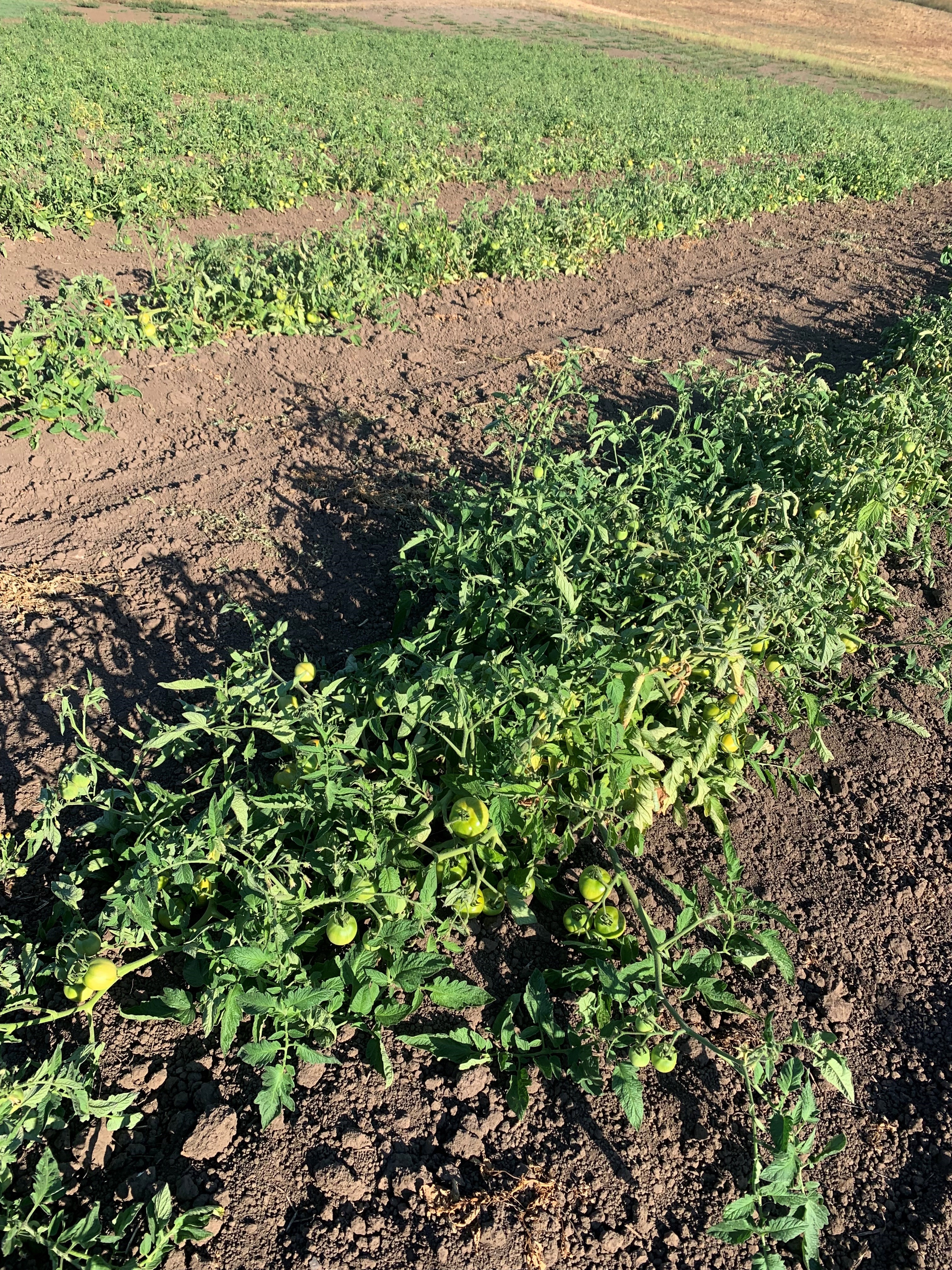
Post post-Hurricane Hillary, the farm is warm, awaiting the restarting of the upwelling and onshore breezes due in a few days. The warmth is perfect for tomatoes and the lack of much rainfall helps a lot too: they hate wet leaves! The sprawling tomato vines are loaded with big, pale green fruit. Soon, there will be so many tomatoes that it will be difficult to keep them harvested fast enough. For now, we eye each ripening fruit with glee: there aren’t that many! It is also the time when Maw and Caw, our big black farm ravens, are frequently seen carrying red, cast off tomatoes happily to some perch where they feast with gusto.
Molino Creek Farm’s dry farmed tomatoes…for the first time Not On Trellis!
Night Walks
This part of the year takes me on night walks to turn off the orchard irrigation. It is too hot during the day to run micro-sprinklers, an invention that gently eeks out water at a rate so that it soaks well into the soil without waste. The micro-sprinkled amounts would mostly evaporate in the heat of the day, so we wait until the cooler evenings and nights. That takes me abroad just before bed time on a stroll that is always full of discovery. Each year, on the warmer summer nights, I am delighted to experience the return of the Night Ants. These are big, glossy, dark brown ants which hang out in families, venturing just a few square yards from their hole. They have several morphs- some are large and powerful looking, some are more dainty, and some in between. I’ve seen them carrying their dead, so they’ve got at least one social ceremony. I don’t know what they do for a living. I’m seeking the black widow spiders I spied last summer at the mouth of some colonies of roadside gopher burrows. A few nights ago, I started a harvest mouse who decided to crouch in the grass until I passed, allowing me a good look at that tiniest of rodents. The prettiest of things on night walks: the spectacularly silver-sparkly eyes of wolf spiders, which dazzle and spark from just about everywhere. They are so very numerous. I like to check out the biggest more closely in hopes of finding a female with a hundred of her young on her back: extra creepy! The headlamp isn’t so much fun these evenings because of some flies and moths that want to crash into my glasses constantly, attracted to the light. So, the headlamp goes down to waist level, but the spider eyes don’t reflect quite so nicely from there. Owls hoot, coyotes yip, and the beautiful crescent moon barely lights the fields and ridges. Yes, it’s a chore to turn those late-night valves, but I’m happy for the motivation to get out of doors.
OH PEARS!
They won’t take care of your children for more than a few moments, but they sure are tasty. It’s pear time! Pears precede apples in our harvest cycle and the comice pears are dropping and juicy and irresistible. You can’t stand under the old pear tree or you are going to get bonked in the head by a falling pear: dangerous! I still don’t quite know when to harvest pears from the tree, but I do know that the fallen ones ripen quickly, like within a day or so. Soon, there will be 300 pounds for the orchard volunteers and Molineros to gather. The dehydrators start humming and the pots of pear butter will soon be bubbling. Yum!
What’s that Smell?
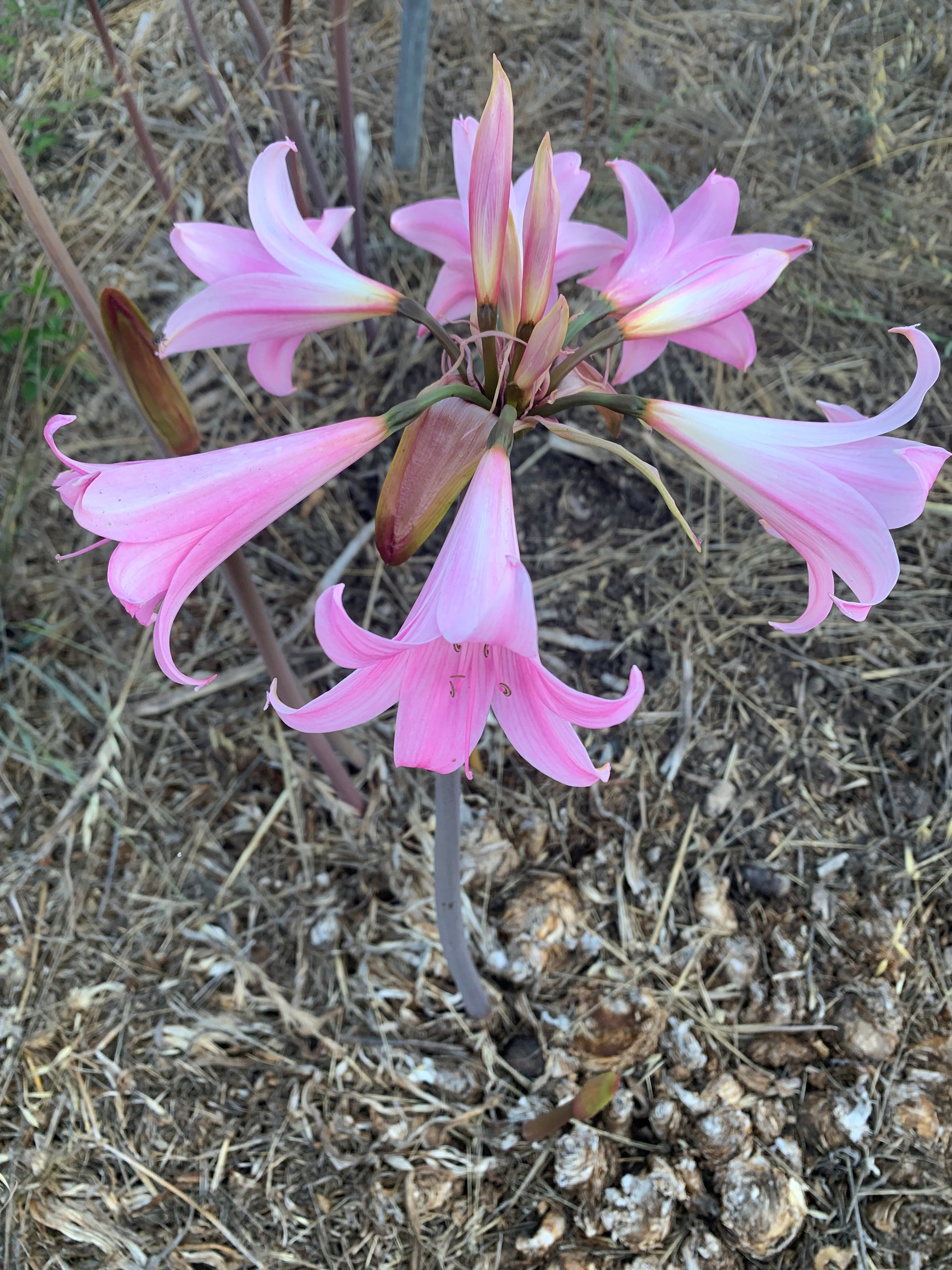
The farm is full of scent. With the storm’s weird warm winds from odd directions (east!), came the resinous, sweet smell of ceanothus…but only briefly. The orchard smells of damp earth with hints of fungus. Passing the vineyard, the smell of the devil: sulfur! Then, there are occasional sweet smells…surprising sweet smells. The latest nose candy is emanating from the Surprise Lillies aka ‘naked ladies.’ Some prior farm denizens took a liking to these Amaryllis and planted them hither and yon. They are impossible to get rid of and they smell of pink candy. But, they make striking cut flowers if you don’t mind the sweet, sweet smell.
Naked Ladies are named such because of the lack of leaves when they bloom
-this post also simultaneously posted at Molino Creek Farm’s equally amazing website.
There’s a certain relaxation that sets in when everything is going as ‘normal.’ Late at night, the fog rolls up the valley and we awaken to the silver tongue of fog lapping at the edge of the lowest points of the farm. Down there, redwoods drip and it smells piney and dank. The fog pulses in further and then back out in a morning battle against the heat, but always the fog lowers just below our elevation; but, we can feel the coolness even as the sun’s warmth prickles our skin and begs for long sleeves. At ten o’clock, a slight breeze picks up onshore with the cool ocean air. The days are sunny and in the 70s. It is dry and dust wells up when we walk, work, or drive, big or small clouds blowing predictably towards the southeast. Everything has become dusty. For many weeks, it has been a regular summer.
It has been a regular summer except very recently when high clouds streamed in from the (!) East. Other places in California have been experiencing Zeus’ playfulness, but we haven’t heard a single thunder clap, though a few large raindrops at one point, briefly. Those clouds make for spectacular sunsets.
Molino Creek Farm’s dry farmed tomatoes are getting ready!
The Ripening
Apples, tomatoes, winter squash, peppers, zucchini, pears, prune plums, hazelnuts…they are all ripening. As with the cherries recently, we must pace ourselves with the pear intake.
Looking down the long rows of lush, half-grown tomato ‘vines,’ we see the first ripening tomatoes blowing orange-red among the green boughs. One day soon, there will be so many ripe tomatoes that it will be difficult to keep up with the harvest. For now, we bide our time for the first batch of vine ripened, dry farmed tomatoes, a point where the farmers are as happy as the consumers. “Oh Boy!” people exclaim when they first see our tomatoes at the market. Sometimes, we have to limit the pounds purchased so that more of our loyal customers are pleased. It won’t be long now.
Gala apples growing and glowing
Gravenstein then Gala
We have only one large and one small Gravenstein apple tree, the first apples to get ripe each year. Sylvie reports ‘not quite ripe’ this morning, so we will wait another week to try again.
Next up, Gala apples. They aren’t half the size that they should be, but are the quickest growing apples on the block. They are catching up and will be ready to harvest the second half of September. We’ve had another round of thinning the fruit on those trees, thinning from the highest points of ladders. Propping, too!
Maw or Caw, who can tell? (Still Life with a Bird and Tree)
Wild Things
When the days are warm enough and the nights not too cool, we can listen for the night noises. There’s the rough repeated bark-yowl of a fox. There’s the odd sweet whistling call of a great horned owl along with the more normal hoots. There are also the calls of thousands of crickets. The black cricket rough sawing has been going for a while and was recently joined by the less raspy song of brown crickets; both are easy to spot at night along the farm’s many roads at night. The high twirring of the green tree cricket has joined the chorus only this past week; that’s the one you can tell the temperature from if you count the chirps right.
A walking around the farm reveals other wild visitors. Big piles of coyote poo is the most frequent scat. They rarely sing, but they sometimes do. Turkey tracks and feathers are another common sight, though the birds themselves aren’t frequently evident. Reports of a herd of deer seen frequently – no bucks but a few does and young.
And then there are the quail! Bumper crop of quail with many more being born. Clouds of quail, a profusion of quail, lots and lots of quail. I was wondering where the Cooper’s hawk was when it appeared for the first time in months this morning. Then again, the red-tailed hawks have moved on with their young one, a great relief to the wealth of bunnies also being born.
The large gopher snakes are a frequent sight. Mark Jones reports a 5 foot long fatty near the Hayfield gate. There’s one that lost the tip of its tail near the Yard water tanks. There are eerily large tracks in the dusty roadbeds. The temperature has been such that large snakes have to sun themselves to keep warm enough to hunt in the shade. I picked one up to move it off the road, and it was shivering.
Small family groups of band-tailed pigeons are feasting on elderberries, which have been ripening while still in blossom. Those large pigeons are clumsy out at the branch tips where the elderberries reside…clumsy and nervous. Those are generally pretty nervous birds, which makes sense since they narrowly escaped extinction due to overhunting not that many generations ago.
Maw and Caw are around, but not so sure about their kids, who may have flown the coop. These parents may have the literal empty nest syndrome. We don’t hear the screaming adolescents. Mostly, Maw and Caw are in proximity, poking at the ground and occasionally finding something- what? They might be eating mice…maybe Jerusalem crickets?
Our native elderberries in a hedgerow. Imagine big pigeons trying to balance and eat them
Fire Preparations
As we hear news of fires starting up around the state, we redouble our efforts for fuel management. CAL FIRE has been sending up an engine from Swanton to inspect how we are doing, encouraging us and guiding us in little ways to do a better job. Many thanks to their Captains for inspiring us to do better! They say we’re doing good jobs with the mowing, and mowing we continue to do. There never seems to be enough time for mowing….or weedeating…or hauling cut brush (or burning that cut stuff in the winter). This week, Mark Bartle jumped on his tractor and mowed some of our fallow fields, so suddenly we’re minus more acres of bad fuel: yay!

















 Grey Hayes