Cotoni Coast Dairies National Monument

What Went Wrong at Cotoni Coast Dairies?

Someone new on the scene recently asked me to explain the history of what went wrong at Cotoni Coast Dairies. After many, many years, the property still isn’t being managed for wildlife or public safety, and it still isn’t open to the public. As a prelude to this, I urge readers to read my essay on how the Bureau of Land Management (BLM) came to manage the property in the first place…a curious story, indeed. This essay compliments that prior essay with more details, especially since BLM took over managing the property. Soon, I’ll be writing the third in this series with suggestions about what is needed to improve this unfortunate situation.

Years of On the Ground Nothing, or Worse

Since its purchase for conservation, Cotoni Coast Dairies has a history of very little stewardship and management. Trust for Public Land purchased the property in 1998 and held it until 2014. During that time, managers working for the Trust for Public Land did almost nothing to maintain the property. Occasionally, someone would show up to clear some anticipated future trail. For instance, TPL contractors extensively cleared riparian vegetation along Liddell Creek, chainsawing decades-old willow trees that shaded endangered fish habitat and provided cover for the endangered California red-legged frog. They argued that the clearance was along an ‘existing road,’ and they started putting this trail on early maps as a favored future public access point. (The trail later appeared on BLM’s maps, but federal wildlife protection agency personnel demanded otherwise, so the trail disappeared from plans.) Otherwise, TPL let fences, gates, and culverts rust away, roads and trails erode, weeds spread, and fuels build up creating hazardous conditions for future wildfires.

In 2014, BLM took over management of Cotoni Coast Dairies, and those same patterns largely continued. Early on, BLM staff constructed a new trail, carving through nests of state-listed sensitive wildlife without required State consultation. Like TPL, BLM staff have either overlooked erosion issues along roads or graded long abandoned ‘existing roads’ (aka ‘future trails’) with uncannily similar detrimental impacts to rare fish and amphibians. Meanwhile, terrible weeds and immense wildfire risks continued to spread across the property. The reason BLM staff have given for such poor stewardship: ‘we don’t have an approved plan.’ That changed, but management hasn’t…except for one new stretch of cattle fence and subset of future trails being created mainly by volunteers. The trails and fence came before any work on invasive species or wildfire mitigation, so we sadly sense BLM staff priorities have been directed away from conservation towards recreational access.

Decades of Funky Planning and Community Engagement

Staff from both TPL and BLM have sporadically spent a bit of time working on poor planning processes or participating in largely perfunctory public meetings about property management  at Cotoni Coast Dairies. In the year 2000, TPL convened and facilitated a Community Advisory Group (CAG) to advise on guidelines meant to be used by future managers. A few of us on the CAG were asked to provide feedback about the biological portion of those guidelines, but we were unable to improve the largely cursory and incomplete biological assessments used to guide future property management. It is unclear if those guidelines have ever been used by BLM, or if TPL even cares.

BLM has done little to inventory the property, so it has very poor information with which to plan its management. And so, BLM’s plans have overlooked species and ecosystems that are easily identified and/or previously catalogued by reputable sources. This alienates the conservation community including the wealth of well-trained scientists that this region enjoys.

Instead of the long series of TPL’s CAG meetings, BLM staff have appeared for a very few community-engagement-style meetings, including one early on that was convened and facilitated by the Land Trust of Santa Cruz County. That Land Trust meeting surprisingly and very oddly focused on weighing pros and cons of parking lot locations, but it was never clear why public input was sought or what became of it afterwards. In the midst of this, an outside funder parachuted in hundreds of thousands of dollars so that several local organizations could mount a seemingly ‘grassroots’ Monument Campaign.

Monument Ahoy

In 2015, The Sempervirens Fund led the “Monument Campaign,” a fast-paced, highly scripted, well-funded effort to organize rallies and letter writing to show public support for National Monument designation of Cotoni Coast Dairies. In what is increasingly common “fake news,” the bulk of the Monument Campaign messaging was about opening the property for public use, while in fact Monument designation is more about improving conservation of the property…which would typically increase limitations on public access. This nonsense was compounded by campaign organizers’ refusal to address how designation would increase deed restriction protections already in place from TPL. Furthermore, organizers dismissed concerns about managing the anticipated influx of visitors drawn to something called a National Monument. How important the Monument Campaign was in Obama’s designation is unclear, but the divisions in the community were deep and lasting. Organizers were successful in coalescing well-meaning but very poorly informed people whose nonsensical byline was “Monument designation means my family will be able to visit!” On the other hand, there was a surprisingly politically diverse coalition equipped with well-informed questions and concerns that were never addressed. After that local experience, it is difficult for me to believe that any political faction is immune from using scripted ‘truthiness,’ hype, or even lies when they feel those tools necessary in attracting popular support for secret agendas. Unsurprisingly, leaders of the ephemeral Monument Campaign movement have since disappeared from involvement, leaving the aftermath for the real, long-term grassroots organizations to deal with, and we have yet to experience any conservation benefit of Monument designation.

Pop Up Trail Plans, Abandoned

As the Monument Campaign launched in 2015, BLM issued a proposal for the property’s first public access trail, aka the “Laguna Trail,” in an expedited environmental review process that showed our community how poorly equipped BLM staff were to adequately plan for the property. BLM staff relied on old, insufficient biological inventories for their analysis, failed to survey for endangered species, and did not include any analysis of how the trail would address social equity concerns in providing for visitor use. BLM staff did not respond to the many concerns raised by the public but instead completed their pro-forma circulation and approval of planning documents and rapidly deployed machinery and workers to clear the trail. Trail construction proceeded without conforming to even the nominal environmental guidelines outlined in BLM’s planning documents. The hastily constructed trail cut through state-protected wildlife habitat, degraded historical artifacts, and came very close to a native village site which BLM failed to plan for protecting. In addition, if the project had proceeded, BLM would have opened a trail beginning at Laguna Creek Road and Highway 1 without any new parking, litter, or bathroom facilities, without sufficient staffing for enforcement or interpretation, and without a recreational plan for the property as a whole to analyze how to best protect wildlife while providing public access. This pop up trail was BLM’s way of introducing themselves to the land and to our community.

Introductions to BLM Planning Procedures

As the first federal land manager in the County, it was BLM staff who introduced our community to the federal government’s environmental planning process. This introduction was surprising in many ways. We had been accustomed to public lands managers paying careful attention to protecting “environmentally sensitive habitat areas” (ESHA) according to Coastal Commission rules. Not so with this property – BLM staff didn’t even provide the public maps of those regulated habitat areas in any of their planning documents! With the promise of National Monument protections, we were hopeful that BLM staff would follow the required and highly regimented process outlined in BLM’s policy “Manual 6220,” which provides staff with guidelines on how to manage national monuments. Again, not so! In fact, BLM staff have not used the 6220 manual and have neglected any public acknowledgement of the manual, as if they do not intend to use it, at all. Moreover, BLM staff have never specifically acknowledged the many species and ecosystems protected through the monument designation process. Monument management protocol seems irrelevant to BLM staff, who are apparently bent on expediting the public access so vocally anticipated by the Monument Campaign (coincidence?).
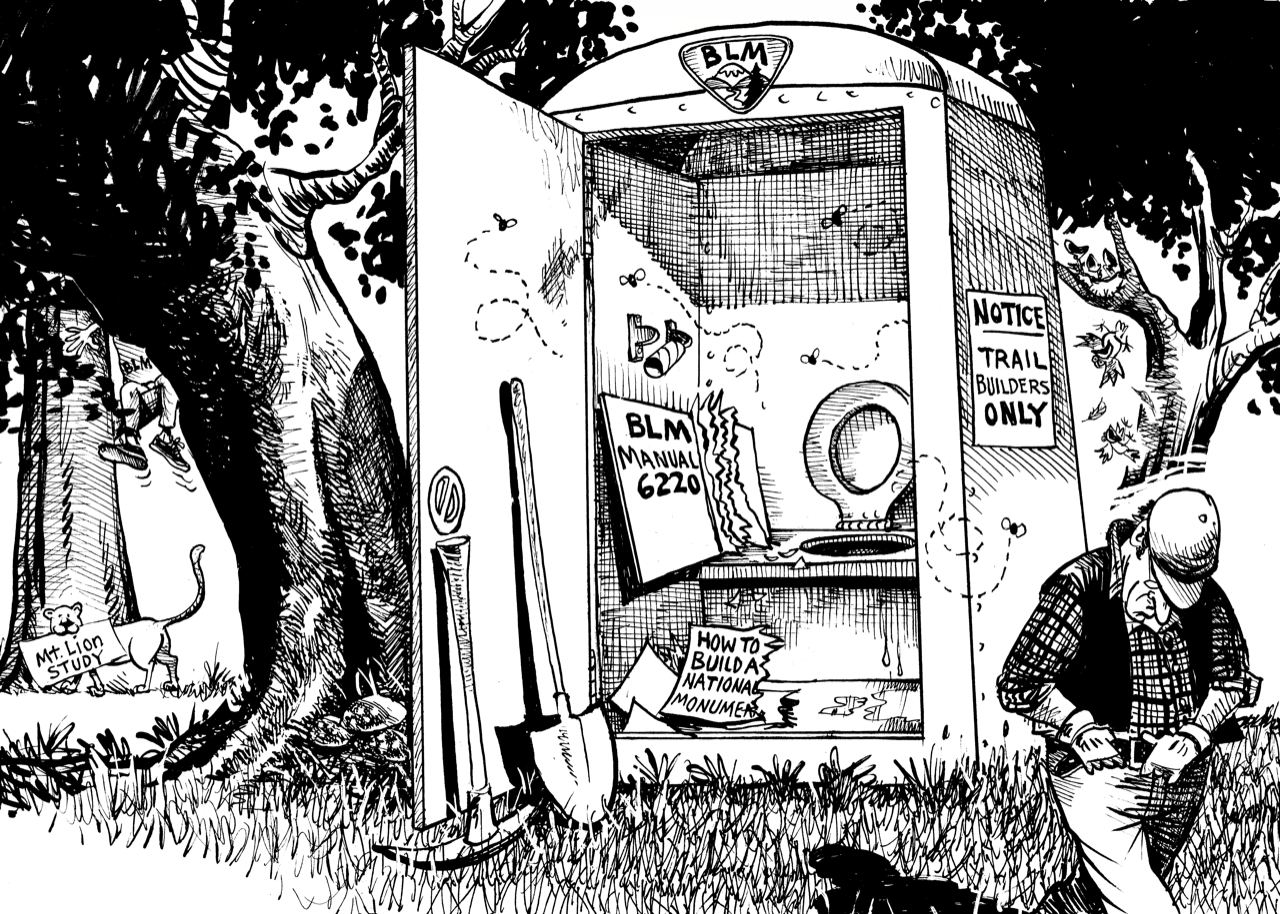
The job ain’t finished until the paperwork is done!
Cartoon compliments of DeCinzo, Caption by Grey Hayes

Expediting Public Access

BLM staff have chosen expediency over thoroughness in each of their property planning exercises. For their most recent property-wide plan, instead of data-based predictions of visitor use, BLM staff chose a largely arbitrary low-ball figure of 250,000 anticipated visitors/year for the property. Instead of the logical in-depth alternatives analysis of a full Environmental Impact Statement (EIS), BLM staff have chosen expedited Environmental Analysis (EA) processes, complete with incredible conclusions of ‘Finding of No Significant Impact (FONSI),’ despite significant contrary expert testimony that has gone unaddressed and unacknowledged. As we learned for the first time about its ‘federal consistency process,’ the Coastal Commission recently mandated that BLM use a phased approach to opening the property to public use. The Coastal Commission required that only if/when the BLM proved it could adequately manage public use could it open the full range of parking lots and trails; that proof requires monitoring and such monitoring would normally require a baseline inventory of sensitive natural resources, but we have yet to see that happen…we don’t even know the language to which the BLM and the Coastal Commission have agreed.

Nipping at the Community

My personal interactions with BLM staff have historically been less than pleasant, perhaps because those staff members are unused to much public engagement. My experience of poor interactions with BLM staff isn’t isolated. Someone suggested that this might be partly because those staff feel ‘rocked back on their heels’ because of criticism of their work, which is odd because our comments have been professional, polite, and part of what BLM should expect as public lands planning processes. A BLM staffer told me long ago that their colleagues were in for a surprise as they encountered the very actively involved communities of Santa Cruz County’s North Coast. Previously, most BLM staff working at Cotoni Coast Dairies had worked very much out of the public eye, in remote parts of California with little/no public oversight.

While we can’t ascertain why BLM staff have avoided offers for assistance, their subterfuge is as enlightening as it has been damaging. My compassion about staff feeling rocked back on their heels is limited because BLM staff have sought to discredit my work and harm my reputation, even approaching employers with false information to negatively affect my job while also giving ultimatums to conservation networks to preclude my participation. During one encounter at a public meeting, a BLM staff person told me that they would never collaborate with me or the groups with whom I worked because I was “against any public access at Cotoni Coast Dairies.” That was an incorrect statement about my position that I had likewise been hearing from a particularly activist, radical group of mountain bikers. As this BLM staff person echoed that quote, it was possible to better understand communication channels and allegiances.

My earliest interactions with BLM staff at Cotoni Coast Dairies were when I proposed assistance for biological monitoring. I and a few other biologists offered BLM free assistance with biological surveys to improve their understanding of the property. After that proposal, over a very long time, a BLM staff person strung us along through an incorrect informal process without ever encouraging us or acknowledging the potential value of such work. There was a chain of calls and emails that each ended with something like ‘well, maybe….’ By the time we subsequently discovered the correct application process and applied in that way, leadership had changed and the application was then officially refused.

Cumulative Impacts: Traffic, Trauma, Toilets and Trash (the 4 T’s)

It is important to view BLM’s problems in the context of issues related to visitor access on conservation lands throughout Santa Cruz County. As with all of the other public lands managers, BLM has been planning for visitor use and conservation in a vacuum, as if the surrounding lands don’t exist: this is a deeply flawed perspective. Much of the land from Santa Cruz City to the County line is heavily used by recreational visitors. Most weekends, parking lots overflow with cars and parked cars dangerously line the highway. There are too few trash cans and toilets to serve those visitors. Police and emergency responders are stretched to respond to the many accidents such visitation is bound to create.

County Parks, State Parks, the City of Santa Cruz, the Rail Trail, and BLM each have their own properties to manage and the same 4 T’s issues to address, but they aren’t doing it collaboratively. It is clear that none of those agencies has the resources to address those issues and so those issues are borne by our community. Visitors have come to expect trashy beaches. Emergency responders have come to expect exhaustion and insufficient support. Visitors with elderly family members or small children are avoiding parks due to dangerous or disgusting conditions. As each agency plans in isolation to provide for the maximum number of visitors, parks managers are dooming wildlife and visitor experience – the carrying capacity for the entire North Coast will be surpassed. It is no wonder that our community does not trust BLM to be able to manage their land and the visitors that they plan on attracting. BLM entered an arena of mistrust and fueled the fire with their own mistakes.

Who is Responsible?

Those of you who know me well know I don’t like the passive tense: I like clearly stating the subjects of verbs…who (specifically) is responsible for doing what (specifically). And yet, agencies like BLM are opaque…staff even refuse to specify who is specifically responsible for anything you might witness happening. But, placing the entire blame of the tragedy of Cotoni Coast Dairies on current BLM staff is unfair. Local, state and federal elected officials also bear some responsibility; good intel is that some of them have even winked behind closed doors in Washington DC, saying that local concerns needn’t be addressed. But again, placing a large amount of blame on elected officials also doesn’t seem fair: after all, they should be swayed by popular opinion (or at least election).

We saw how enough funding swayed popular opinion with the Monument Campaign, right? Apparently, no funders have been inspired to sway popular opinion in favor of wildlife protection on conservation lands in this particularly biodiverse region. Even if they did, there is a dearth of organizations who would lead that campaign. And so, in regard to the tragedies unfolding at Cotoni Coast Dairies and across Santa Cruz County’s North Coast, we must bear the brunt of blame within our community, which has long lacked leadership, energy, and focus on environmental conservation. For more on that, read my essay “Democracy and the Environment.” And, stay tuned for the third in this series of essays where I will outline steps forward out of this unfortunate predicament.

-this article adapted and updated from what appeared in late March at Bruce Bratton’s blog BrattonOnline.com

Recreation vs. Conservation in Natural Areas

We face a quandary for which there are many solutions: the northern region of Santa Cruz County is one of the nation’s top biodiversity hotspots which is increasingly facing one of the largest threats to biodiversity – recreation within conservation areas. Globally, the coast of California is recognized as one of the most important crisis areas where natural areas tourism impact overlaps with critical conservation areas called biodiversity hotspots.

Biodiversity Hotspots

Biodiversity hotspots have been scientifically catalogued in precise ways to direct conservation funding and activities. These areas have particularly high numbers of species limited to small geographic areas, correlating with large numbers of endangered species. Areas with numerous endangered species in different groups receive higher hotspot scores: Santa Cruz County has many endangered species in three groups: ‘herptiles, arthropods, and plants,’ and so is one of only two counties in the nation to receive the highest hotspot score. Similarly, with a larger lens than county boundaries, the San Francisco Bay Area, including northern Santa Cruz County, is recognized as one of the top three biodiversity hotspots in the country. The rationale for using biodiversity hotspot indices for conservation prioritization is so widely accepted that this measure has become the focus of the most funding of any other conservation initiative, a total of $750 million up to 2010. Our region has long benefited from such largesse, including the generous funding to set aside areas like the BLM’s Cotoni Coast Dairies and POST/Sempervirens Fund’s San Vicente Redwoods conservation areas. And yet, purchasing of land for conservation purposes only begins the process of conservation, which will last many lifetimes. Fortunately, there are many strong protections in place for these areas that help to guarantee that they will long be managed primarily for biodiversity protection.

Wildlife Protected at Cotoni Coast Dairies

There are a host of guarantees for biodiversity protection at the Cotoni Coast Dairies property. In 2017, Obama’s presidential proclamation making the property a part of the California Coastal Monument there are protections for such a breadth of ‘Objects of the Monument.’ Monument designation carries with it mandates for very careful planning, inventory, and adaptive management to assure natural resource protection. In addition, the property has been designated as part of the most protected lands in the Country: National Conservation Lands. In addition, BLM maintains and regularly updates lists of ‘special status’ plants and animals to guide protections on their lands. For those interested in mandates for BLM management for biodiversity on National Monuments, I encourage perusal of their Manual 6220. Using one ‘Object of the Monument’ as an example, the 6220 Manual requires that BLM inventory the dusky footed woodrat on the property and, in collaboration with experts at its National Conservation Lands Office, include in its property-wide science plan specifics about how managers will monitor and adaptively manage the property to assure the species’ protection. Regulations protecting biodiversity on the nation’s highest value conservation lands well reflect the majority of citizen’s interests in protecting wildlife, even if it means personal sacrifice. This is good news for conservation in natural areas because of the natural conflict between recreation and conservation.

Recreational Use is Contrary to Wildlife Protection

There has been much published about the negative impacts to wildlife of recreational use in natural areas, but here are a few illustrations of types of negative impacts. The following species are listed as “Objects of the Monument:” gray fox, bobcat, and mountain lion. Predators such as these three species are well recognized as extremely sensitive to recreational use in natural areas, leading to decreased density and abundance of these types of animals. Researchers working in the Santa Cruz area have noted that mountain lions are substantially sensitive to noises from humans, which reduce their use of recreational areas and lead to changes rippling through the rest of the wildlife community, including increased numbers of mice and potential increased frequency of Lyme disease. But, mammalian predators aren’t the only types of wildlife to be disturbed by recreational use.

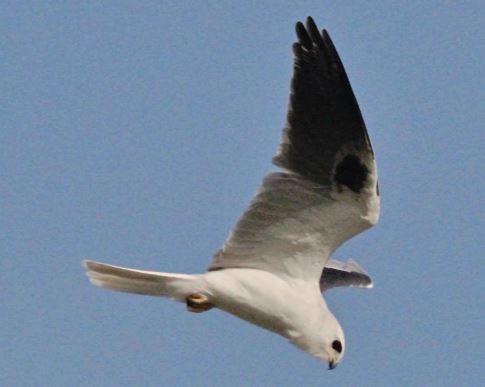
The Monument Proclamation also calls out protection for Wilson’s and orange-crowned warblers, downy woodpecker, tree swallow, Cooper’s hawk, and American kestrel. Burrowing owl, golden eagle, tricolored blackbird, and white-tailed kite are also listed as protected on BLM’s special status animals list for California. Some bird species have been shown to be especially ‘flighty’ in the face of recreational use, requiring study and specific trail design to adequately buffer distances to avoid impacts. While the effects on specific species varies, some species can be negatively affected by the mere presence of humans, so, unless specific studies can ascertain effects, scientists suggest that avoiding new trails in natural areas is the best measure for conserving sensitive birds. Grassland birds, such as the burrowing owl, are particularly sensitive to recreational disturbance, perhaps because it is so difficult for these species to hide. There are also studies that would suggest care must be taken to avoid recreational disturbance to species like the California red-legged frog, deer, and native plants.

BLM’s Dilemma

BLM managers of Cotoni Coast Dairies face the many dilemmas of managing land for conflicting visitor uses alongside the conflict between recreational access and nature conservation in an especially sensitive ecological area.  The varying types of recreational users run the gamut from mountain bikers who use trails for the physical thrill of staying upright with speed and obstacles…to more scenery- and/or exercise-oriented mountain bikers and hikers…to more passive recreational users such as wildlife viewers…to photographers and painters…to restorationists…and scientists of natural history. Each user group conflicts with the next and the ones further apart with their expectations conflict even worse. I have not seen a plan by BLM to accommodate or monitor such conflicting uses, which will lead to what is called displacement, mainly of families with children and more passive natural areas users. Instead, BLM managers have shown a personal and strong affinity with the mountain biking community, which is also the agency’s closest ally in advocating for and developing recreational trails designed for their use on the property. On the other hand, BLM managers have turned away from engagement with passive users such as wildlife viewers, restorationists and scientists of natural history. Without welcoming this engagement which would have made up for their professed lack of such capacity, BLM managers are now moving forward with little understanding of the distribution and abundance of species, including those protected by statute. The evident BLM managerial-mountain biking community conflict of interest should be a great concern of those of the public who are concerned with biological conservation.

The Collaborative Management Solution

We should be advocating for an alternate way forward where BLM public engagement staff serve as facilitators of solutions-based approaches to the conflicts between users and between recreational use and natural resource conservation. The first step would be for BLM to adhere to its policy requiring a science plan informed by a baseline inventory of the Objects of the Monument and other special status species; this plan would include a carrying capacity analysis and an adaptive management framework to assure protection of the resources. All of those steps could be done collaboratively with scientists and volunteers as is outlined in BLM’s policy guidance. There have been offers for substantive financial resources to assist with this planning. Instead of hiding its scientific studies as it does now, BLM would proudly share what science it has gathered on a public interactive website. Once completed, the science plan could then be the focus of collaborative management of the property including all interested parties working together with the common goal of conservation of biological diversity while providing recreational access to the maximum extent possible. We are lucky to have a coalition of many groups working to make this vision real, including: Rural Bonny Doon Association, Friends of the North Coast, Sempervirens Fund, and Davenport North Coast Association. Your support of those organizations will help greatly.

-this post originally appeared last week in my weekly column at Bruce Bratton’s weekly BrattonOnline.com

The Monument-Worthy Birds of Cotoni-Coast Dairies: An Analysis

Introduction and Background

Obama’s Proclamation giving National Monument status to Cotoni Coast Dairies included protection for an interesting list of birds: a challenge or a nose-thumbing to preservationists? We don’t know, but in this essay I present both perspectives. First, a reminder that experts presented the President with a science-based white paper suggesting a list of sensitive natural resources worthy of protection by his Proclamation; most local conservation organizations wrote letters supporting this proposal. The white paper included 7 species of birds that are protected by the California Department of Fish and Wildlife, but not protected under the Federal Endangered Species Act (ESA)…and so, without mention in the Monument Proclamation, might not be protected on BLM lands:

  • American peregrine falcon –  Falco peregrinus anatum– CA fully protected
  • Bryant’s savannah sparrow – Passerculus sandwichensis alaudinus – CA Species of Special Concern
  • Ferruginous hawk – Buteo regalis – California Watch List (wintering)
  • Grasshopper sparrow – Ammodramus savannarum – CA Species of Special Concern (nesting)
  • Northern harrier – Circus cyaneus – CA Species of Special Concern (nesting)
  • Olive-sided flycatcher-Contopus cooperi – CA Species of Special Concern (nesting)
  • Short-eared owl –Asio flammeus – CA Species of Special Concern (nesting)
  • Tricolored blackbird – Agelaius tricolor – CA Threatened
  •  White-tailed kite – Elanus leucurus – CA Fully Protected (nesting)

The white paper also included recommendation for recognition of species that are federally protected as long as they are on California BLM’s sensitive animal list:

  • Burrowing owl – Athene cunicularia – BLM CA sensitive animal; CA Species of Special Concern
  • Golden eagle – Aquila chrysaetos – BLM CA sensitive animal; CA fully protected

And, experts mentioned two other notable bird species that frequent the property:

  • Red-tailed hawk – Buteo jamaicensis – IUCN Status: Least Concern
  • Short-eared owl – Asio flammeus – IUCN Status: Least Concern

At first glance… the Proclamation was a moderate success for bird conservation- experts proposed 11 bird species for the Proclamation, and the President’s Proclamation included 9 bird species. But, the Proclamation included just two of the species experts proposed: the white tailed kite and peregrine falcon. Besides the kite and falcon, the other species listed by the President are common and widespread enough to not warrant any conservation concern. Here are the other 7 birds listed in the President’s proclamation, along with their listing status:

  • American kestrel – Falco sparverius – IUCN Status: Least Concern
  • Black swift – Cypseloides niger – IUCN Status: Least Concern
  • Cooper’s hawk – Accipiter cooperii- IUCN Status: Least Concern
  • Downy woodpecker – Picoides pubescens – IUCN Status: Least Concern
  • Orange-crowned warbler – Oreothlypis celata – IUCN Status: Least Concern
  • Tree swallow – Tachycineta bicolor – IUCN Status: Least Concern
  • Wilson’s warbler – Cardellina pusilla – IUCN Status: Least Concern

Optimism: A Presidential Challenge?

An optimist might consider the list of birds in the President’s Proclamation could be seen as a challenge to biologists, preservationists, and BLM. The President might have been truly insightful, providing protection for species common enough across the property for scientifically sound analysis of the impacts of varying levels of future visitor use. Only when there are enough nesting attempts of a bird species can we compare nest success in areas with and without visitors, or between areas of varying visitor use types/intensities.

With all of the biota listed in the Proclamation, BLM is required to provide protections in their management plans, setting scientifically-based preservation targets, and monitoring the status of these resources over time. Establishing preservation targets for species will involve developing various hypotheses, such as:

  • What is a minimum viable population size?
  • How many individuals are necessary to maintain their ecological functions?
  • How many individuals are necessary in various parts of the property to ensure that the public has an opportunity to view them?

It is likely that at least some of these birds are common enough across the property right now, when the property is seeing very little visitor use, that experts can inventory their densities and then notice change over time in response to varying management decisions. This would not be the case with more uncommon species.

I should point out that this optimistic viewpoint is difficult to completely uphold because the President did not include the expert’s suggestion of olive-sided flycatcher in his Proclamation: this is a species common enough on the property to meet the criteria outlined above.

Pessimism: A Presidential Nose-Thumbing?

The pessimist might consider it a purposeful snub by the President when he ignored most of the birds recommended by experts for inclusion in the Proclamation. He might have various reasons for snubbing the experts.

For instance, in recent Santa Cruz County history, and with the Monument Campaign in particular, we have seen political leaders leveraging and emphasizing the divide between pro-access, maximum use, recreation advocates and conservation advocates. If the pro-access, maximum use advocates had leverage with the President, they may have advised that inclusion of the conservation community’s recommendations as something to ignore.

An additional and perhaps additive possibility is that the President’s advisers were opposed to preservation of grassland habitat on the property, possibly because of the near necessity of using livestock grazing to maintain that habitat. Despite a growing scientific consensus, some maintain that California’s coastal grasslands are largely ‘unnatural’ relicts of human management, evidenced by their ‘natural’ succession into mixed coniferous forests. And, while fire is sporadically used to maintain California’s coastal grasslands, livestock grazing is more common. Many of the bird species that experts recommended for inclusion are dependent on extensive grassland habitats; some may even require livestock grazing to maintain structure that is conducive to nesting success. The reader is no doubt cognizant of some of the environmental community’s opposition to livestock grazing on conservation lands, and this philosophy could well have been in play when advisers helped the President to draft his Proclamation. None of the birds included in the President’s Proclamation rely on grassland habitat.

A final additional and perhaps additive possibility is the Presidential adviser philosophy that the protection of grassland dependent birds might interfere with maximizing visitor use of the property. Grasslands on the property offer the easiest opportunities for access to the many visitors desiring expeditious photographic opportunities. And so, perhaps the President’s advisers refused protection of grassland birds in order to more readily allow for maximum visitor use.

Concluding Remarks

The future will help inform the prevalence of the optimistic or pessimistic interpretation of the President’s motivations for naming the Monument-worthy birds of Cotoni Coast Dairies in his Proclamation. With luck, we may be able to have conversations with the President’s Proclamation advisers to learn, first-hand their rationale. And, we may gather more clues in the advocacy of Monument Campaign organizers and others during the planning process for the property. We will share our discoveries to help science-based conservationists better engage with similar situations in the United States. And, we will use what we learn to improve our strategy moving forward with preserving the sensitive natural resources of Cotoni Coast Dairies.

Postscripts

  1.  One reviewer suggested an alternative possibility for the President’s advisers largely avoiding the experts’ list of sensitive bird species: the advisers may have not recognized the credibility or legitimacy of the source of information.
  2. Another reviewer pointed out the irony of the Proclamation recognition of indigenous peoples and yet the lack of inclusion of those peoples’ iconic birds: eagle and hummingbird.
  3. Bird experts point out that the President’s inclusion of American kestrel was cogent because of a regional decline in nesting, a phenomenon that isn’t explicable but warrants attention.
  4. Bird experts also point out that the President’s inclusion of black swift is curious because the species has never been known to nest on the property, and nesting areas anywhere nearby have long been abandoned.

Monument Proclamation for Cotoni-Coast Dairies Adds Significant Protections for Biota

The President’s Proclamation adding the Cotoni-Coast Dairies to the California Coastal National Monument has created protections for many biota, helping to guarantee a balanced approach between public access and preservation. The property’s managers, the federal Bureau of Land Management (BLM), had previously demonstrated disregard for all but federally listed species of plants and animals, which are few on the property. The Proclamation now obligates BLM to manage for 24 species as well as 13 biotic communities that are not otherwise federally protected.  The Proclamation guarantees some public access for the property only after the completion of a management plan that is ‘consistent with the care and management’ of these resources.

The following non-federally protected species (24) probably would not have received attention by BLM had this Monument proclamation not included their mention:

  • Wilson’s warbler
  • Orange-crowned warbler
  • Downy woodpecker
  • Black swift
  • Tree swallow
  • Cooper’s hawk
  • American kestrel
  • California vole
  • Dusky footed woodrat
  • Black-tailed jackrabbit
  • Gray fox
  • Bobcat
  • Mountain lion
  • Mule deer
  • California buttercup
  • Brown-headed rush
  • Redwood sorrel
  • Elk clover
  • Madrone
  • California bay
  • Monterey pine
  • Knobcone pine
  • Douglas fir
  • Coast live oak


The following biotic groups/communities (13) must now be protected and managed for by BLM:

  • California sagebrush
  • Coyote brush scrub
  • Amphibians and reptiles
  • Bats
  • Red alder forests
  • Arroyo willow forests
  • Riparian areas
  • Riparian corridors
  • Wetlands – in riparian areas as well as meadows and floodplains
  • Grasslands
  • Scrublands
  • Woodlands
  • Forests

The following federally listed species (4)were also mentioned in the Proclamation:

  • Tidewater goby
  • Steelhead
  • Coho salmon
  • California red-legged frog

The following species (2) are listed in the Proclamation and are also listed by BLM California as requiring protection on BLM lands. These species might not have been protected in perpetuity, though, as that BLM list changes with administrations.

  • White tailed kite
  • Townsend’s big-eared bat

Wildlife Protection at the Potential Cotoni Coast Dairies Monument- The Naysayers

Preservationists have done what they can to protect natural resources at the Cotoni Coast Dairies, should it become a National Monument- but, who didn’t support that work, and why?

The Proposal

Early in 2016, a broad coalition of experts and I drafted a proposal to add natural resource protection to any Presidential declaration of the Cotoni Coast Dairies National Monument. Expert wildlife biologists, amphibian and bird experts, plant community ecologists, and others co-created a list of sensitive species and rare ecosystems that would receive more protection under a Presidential Monument declaration, should that list be included. Sensitive natural resources at other presidentially declared Monuments in California have enjoyed such protections, so there is no reason such protections shouldn’t be in place at Cotoni Coast Dairies.

Questions: Who is writing the Presidential Proclamation that will give the Cotoni Coast Dairies National Monument status? Do they know about this proposal?

Answers: The staff at the Council on Environmental Quality, an office that advises the President. As of Fall 2016, they have our proposal, and we are hoping they will include it, in its entirety.

Supporting the Proposal…

The proposal enjoyed the public support of the following organizations:

The Trust for Public Land, which owned the Coast Dairies property before handing it to BLM, wrote an especially important support letter. Their letter emphasized the importance of including our proposal because it documented species and ecosystems that had been discovered since TPL wrote the legally-binding land management plan that would otherwise serve to protect the property under BLM ownership.

Not Supporting the Proposal…

Despite repeated requests, the following organizations refused to publicly support our sound, science-based proposal to increase protections of natural resources at the Cotoni Coast Dairies:

It is ironic that all of these organizations publicly supported the proposal to make the Cotoni Coast Dairies a National Monument. And, these are all expert conservation organizations. And so, these organizations must have been aware that BLM provides less protection to the natural resources listed in our proposal without those species being included in the Presidential Monument declaration.

The various written rationales for not supporting the proposal included (paraphrased):

  • ‘it would take too much time for our organization to analyze the issue’ (two organizations)
  • ‘our policies have changed since we signed on to support the proposed Monument, now we don’t do those types of things’(one organization)
  • ‘some influential people (elected officials/Monument advocates) wouldn’t like us as much if we supported the proposal- so, it’s not worth it’ (two organizations)

What Can You Do?

If you agree that future generations deserve to enjoy healthy wildlife and clean coastal streams….

And, if you agree in science-based, policy-smart solutions to make that happen…

  • When choosing to join or support in any way an environmental organization: choose from the list of those organizations that supported our proposal.
  • Even without such support, please let the organizations listed above know what you think. Click on the organization names above- I included links to their websites.

True or False: National Monument Designation Will Confer Additional Natural Resource Protection to Cotoni Coast Dairies?


-Part 1-

Our government designates National Monuments in order to protect them, but would a National Monument designation for Cotoni Coast Dairies really better protect these lands? An informed answer requires an examination of the protections already in place, the language of the monument designation, and how the public and US Bureau of Land Management (BLM) follow through after monument designation. Today we will examine the first two of those three subjects with a subsequent essay that will cover the last subject.

Through decades of public effort, natural resource protections in place at Cotoni Coast Dairies were already very strong when the BLM took possession in 2014. The owners before BLM – the Trust for Public Land (TPL) – created two sets of deed restrictions that incorporated private and public funders’ interests as well as protections imposed by the California Coastal Commission. These deed restrictions require future managers to accommodate public recreation without sacrificing protected endangered species or endangered species habitat. The restrictions also prohibit mining, commercial timber production, and use of off-road motorized vehicles. The TPL and the California Coastal Commission both have standing to enforce these deed restrictions in perpetuity. Since these restrictions serve to protect the Cotoni Coast Dairies property’s natural resources in most of the ways Federal National Monument status normally affords, the question is: what additional natural resource protections might National Monument status afford?

Interestingly, National Monument designation doesn’t necessarily guarantee any specific types of natural resource protection. Those that exist are entirely subject to the discretion of Congress or the President. There are different regulatory guidelines for Congress versus the President in establishing National Monuments. Congress has constitutional authority to declare an area a National Monument; the Constitution allows Congress to make whatever rules it wishes for such land. For example, Congress can allow off road vehicles and commercial timber production on National Monuments, or Congress can prohibit human visitors, altogether. Alternatively, the Antiquities Act of 1906 allows Presidents to designate an area as a National Monument. The President is limited by the Antiquities Act which requires the size of the Monuments is ‘smallest area compatible with proper care and management of the objects to be protected.’

In 2015 two US Congresswomen and both US Senators from California co-sponsored a measure to add the Cotoni Coast Dairies property to the California Coastal Monument. The proposed addition lacked any substantive natural resource protections and ultimately failed to motivate sufficient support to make it to a floor vote. In accounting for the omission, aides to both the House and Senate sponsors have directly claimed that such language was ‘inappropriate’ because the representatives believe that Congress should not exert political influence on federal agencies’ land management decisions. In keeping with this policy, other Monument legislation in California from this era has contained little natural resource protection language.

As early as February 2016, in the wake of the failure of the California proposal, Congressional proponents met with the Obama administration on numerous occasions to urge designation of Cotoni Coast Dairies as a National Monument via an Executive Order under the Antiquities Act. We know little about what if any natural resource protections those Congressional offices lobbied for in their negotiations with the President, because this information is not available to the public. But when Congressional designation of National Monuments failed in the past, subsequent Presidential Antiquities Act proclamations of Monuments have had a regrettably mixed record of inclusion of natural resource protection language.

No discernible pattern exists –not one informed by policy or ‘pragmatism’– to account for the variable inclusion of natural resource protections in Presidential National Monument declarations. Most often, local grassroots conservation efforts motivated Presidents to designate lands as National Monuments. In most of those designations, grassroots organizations proactively provided Presidents with the information necessary to inform specific natural resource protection language in their Monument proclamations. This language often provided for protections above and beyond the federally listed species protected on federal lands by including mention of state-listed, rare, and unusual species.

The following Presidential Antiquities Act proclamations declaring National Monuments all had language protecting natural resources above and beyond what would have been protected had these areas not been declared Monuments:

  • Carrizo Plain
  • Berryessa Snow Mountain
  • Giant Sequoia, and
  • the Pt. Arena Stornetta boundary enlargement of the California Coastal National Monument (of particular relevance).

Presidential Antiquities Act proclamations for these Monuments each called out protections for a number of rare or state-listed species not otherwise protected on Federal lands (Appendix 1). Here is a tally of the numbers of non-federally listed plants and animals in these proclamations:

  • Carrizo Plain National Monument – 8 plants, 3 mammals
  • Berryessa Snow Mountain National Monument – 17 plants
  • Point Arena-Stornetta Unit, California Coastal Monument – 1 plant, 4 animals
  • Giant Sequoia National Monument – 3 animals

On the other hand, some Presidential monument proclamations had little or no such language. For instance, the proclamations creating the Santa Rosa/San Jacinto and Fort Ord National Monuments did not include mention of any specific non-federally listed species.

When non-federally listed species and other natural resource protection language is included in Antiquities Act proclamations of National Monuments, land managers must explicitly manage for those resources. If no natural resource protection language is included in proclamations the managers need never exceed baseline practices of natural resource protection. In my next post I will provide details on how land managers for the above listed Monuments adjusted their management to account for National Monument status, answering in the main the ‘what happens when’ question. For our purposes here suffice it to say that natural resource protection language in Monument designations has correlated with additional protection of those natural resources.

The nut of our position is this: Cotoni Coast Dairies is already largely protected in the ways that National Monument status would confer. If National Monument status is meant to increase protection of Cotoni Coast Dairies –as advocates for Monument status have suggested– the only sure way is if the President’s proclamation includes specific natural resource protections.

————————————————————————–

Appendix 1: Recent, Antiquities Act created Californian National Monuments and the sensitive natural resources that the Presidential proclamations protected.

Monument Species Listing Status
     
Carrizo Plain San Joaquin (Nelson’s) Antelope squirrel State of California Threatened
Pale‐yellow layia

Carrizo peppergrass

Lost Hills saltbush

Temblor buckwheat


California Rare Plant Rank 1B
Hoover’s woolly‐star

Forked fiddleneck

California Rare Plant Rank 4 “Watch List”


Pronghorn antelope

Tule elk


Unlisted
Berryessa Snow Mountain


Indian Valley brodiaea

Red Mountain catchfly


State of California Threatened


Bent flowered fiddleneck

Brittlescale

Brewer’s jewelflower

Snow Mountain buckwheat

Coastal bluff morning glory

Cobb Mountain lupine

Napa western flax


California Rare Plant Rank 1B
Purdy’s fringed onion

Serpentine sunflower

Bare monkeyflower

Swamp larkspur

Purdy’s fritillary


California Rare Plant Rank 4 “Watch List”


Musk brush

MacNab cypress

Leather oak


Not listed
Point Arena-Stornetta


Humboldt Bay owl’s clover


California Rare Plant Rank 1B
Black oystercatcher

Yellow warbler

Black-crowned night heron

Brown pelican


Not listed
Giant Sequoia Great gray owl


State of California Endangered


Northern goshawk


State of California

Species of Concern


American marten


Not listed


Experts Weigh in on Monument Proposal: Sensitive Natural Resources of Cotoni Coast Dairies

Introduction

The BLM-managed Cotoni Coast Dairies property is being proposed for National Monument status, but thus far proposed legislation lacks language typical in such proclamations that recognizes the natural and geologic features which make this place special. This brief proposes such language as reviewed by the region’s experts in this area and its natural resources.

Methodology

The following language about the Cotoni Coast Dairies property contains information about natural and geologic features of national significance as reviewed for accuracy by regional experts familiar with the property. Natural resources presented here include plant and animal species that are found in few other places. Bird species are included if they are suspected of breeding on the property. Because the property has historically been in private ownership and biological investigation has been largely prohibited, this list is not meant to be exhaustive. Experts who reviewed the proposed language for their areas of expertise are included in Appendix 1.

 Proposed Language

“Because of its history, topographic features, and water resources, Cotoni Coast Dairies is a property notable for its species-rich, diverse habitats as well as its sensitive plants and wildlife. The property is located in one of the richest biodiversity hot spots in North America. Many species of plants and wildlife found on the property are listed as rare, sensitive, threatened or endangered under Federal, State, and local laws. These include: Point Reyes horkelia, Choris’ popcornflower, Santa Cruz manzanita, steelhead, coho salmon, California red-legged frog, western pond turtle, white-tailed kite, northern harrier, olive-sided flycatcher, Bryant’s savannah sparrow, grasshopper sparrow, tricolored blackbird, San Francisco dusky-footed woodrat, and American badger (for a complete list, see Appendix 2).

Cotoni Coast Dairies is replete with wild and diverse landscapes and climatic micro-habitats that support unique biotic assemblages. These include deep, riparian canyons containing seven nearly undeveloped watersheds and clear-running streams that have been rarely impacted by humans. Ridges contain intact lowland maritime chaparral, a threatened and species-rich, fire adapted ecosystem endemic to low elevations along the California coast. The property’s four marine terraces contain an ecological staircase providing a unique localized profile of ancient soil development and evolution. Each of these terraces contains sensitive and unique assemblages of coastal prairie grasslands, of which more than 40 types have been documented from the vicinity. The extensive coastal scrub on the property includes species-rich rocky outcrops and large areas inaccessible to humans. The property contains numerous wetlands and springs, which are buffered by the maritime environment and fed by healthy watersheds that provide spawning, breeding, and foraging habitat for fish, amphibian and aquatic reptile species including steelhead, California red-legged frog and western pond turtle. The rare ecosystems of redwood, Shreve oak, and Monterey pine forests on the property are globally significant. The relative isolation of the property provides core wildlife habitat to a particularly diverse mammalian carnivore community including mountain lion, American badger, gray fox, long-tailed weasel, bobcat, and coyote. The grasslands on the property likewise support foraging habitat for an unusually abundant and diverse raptor community including: white-tailed kite, golden eagle, northern harrier, red-tailed hawk, ferruginous hawk, American kestrel, American peregrine falcon, short-eared owl, barn owl, and burrowing owl.”

Appendix 1: Expert Reviewers

These persons provided review of the proposed language for their areas of expertise.

Name Expertise, Affiliation
Mark Allaback Certified Wildlife biologist

Biosearch Associates


Don Alley D.W. ALLEY & Associates

Certified Fisheries Scientist


Sandra Baron Ecologist


Phil Brown


President

Santa Cruz Bird Club


Dr. Don Croll Professor, Ecology and Evolutionary Biology

University of California at Santa Cruz


Dr. Gage Dayton Ecologist

University of California at Santa Cruz


Carleton Eyster Coastal Ecologist


Steve Gerow


Past President and County Records Keeper

Santa Cruz Bird Club


D. Kim Glinka Wildlife Biologist


Dan Grout Wildlife Biologist

Grout Wildlife Research

Brett Hall


California Native Plant Program Director

UC Santa Cruz Arboretum


Grey Hayes, PhD Botanist/Restoration Ecologist


Kim Hayes Biologist/Conservation Lands Manager


Dr. David Kossack San Andreas Land Conservancy


Kerry Kriger, PhD Executive Director

SAVE THE FROGS!


Inger Marie Laursen Wildlife Ecologist


Dr. Bruce Lyon Avian Ecologist

University of California at Santa Cruz

Bryan Mori Certified Wildlife Biologist

Bryan Mori Biological Consulting

Watsonville, CA


Dylan Neubauer


Botanist
Elliot Schoenig Herpetologist


Lisa Sheridan


Conservation Officer

Santa Cruz Bird Club


Dr. Dean Taylor


Botanist

California Academy of Sciences


Jim West


Botanist


Appendix 2: Sensitive Species of the Cotoni Coast Dairies Property.

Animals
Common name Latin name Rarity Status
California red-legged frog


Rana draytonii Federally Threatened

CA Species of Special Concern


Coho salmon Oncorhynchus kisutch Federally and State Endangered

(central California coast ESU)


Steelhead Oncorhynchus mykiss irideus Federally Threatened

(central California coast DPS)


White-tailed kite Elanus leucurus


CA Fully Protected

(nesting)


Bryant’s savannah sparrow Passerculus sandwichensis alaudinus


CA Species of Special Concern
Ferruginous hawk


Buteo regalis California Watch List

(wintering)


Grasshopper sparrow Ammodramus savannarum CA Species of Special Concern (nesting)


Northern harrier Circus cyaneus


CA Species of Special Concern (nesting)


Olive-sided flycatcher


Contopus cooperi CA Species of Special Concern (nesting)


Tricolored blackbird Agelaius tricolor


CA Species of Special Concern

(nesting colony)


American badger Taxidea taxus CA Species of Special Concern


San Francisco dusky-footed woodrat Neotoma fuscipes

annectens


CA Species of Special Concern
Western pond turtle Actinemys marmorata CA Species of Special Concern


Plants
Common name Latin name Rarity Status
Choris’ popcornflower Plagiobothrys chorisianus var. chorisianus


California Rare Plant Rank (CRPR) List 1B
Point Reyes horkelia Horkelia marinensis


CRPR List 1B
Santa Cruz Manzanita Arctostaphylos andersonii


CRPR List 1B
California bottlebrush grass Elymus californicus


CRPR List 4
Michael’s rein orchid Piperia michaelii


CRPR List 4
Bolander’s goldenaster Heterotheca sessiliflora subsp. bolanderi


Locally rare1
Brownie thistle Cirsium quercetorum


Locally rare1
Cascades oregon grape Berberis nervosa


Locally rare1
Coast barberry Berberis pinnata subsp. pinnata


Locally rare1
Coastal larkspur Delphinium decorum subsp. decorum


Locally rare1
Common muilla Muilla maritime


Locally rare1
Elmer fescue Festuca elmeri


Locally rare1
Fire reedgrass Calamagrostis koelerioides


Locally rare1
Hoary bowlesia


Bowlesia incana


Locally rare1
Narrow leaved mule ears Wyethia angustifolia


Locally rare1
Round woolly marbles Psilocarphus tenellus


Locally rare1
Salmon berry Rubus spectabilis


Locally rare1
Woolly goat chicory Agoseris hirsuta


Locally rare1


1 Locally rare species were not included in the suggested language but may deserve mention; these species are recognized by experts as deserving of protection because of their local rarity.

Post Scripts:

  • I submitted the above to representatives and agencies responsible for National Monument designation including the Obama Administration, Department of Interior, Bureau of Land Management, Senators Boxer and Feinstein, Congresswomen Capps and Eshoo.
  • Letters of support for this proposal included with submission from the Trust for Public Lands, Land Trust of Santa Cruz County, Audubon California, California Native Plant Society, Sierra Club, Valley Women’s Club of San Lorenzo Valley, Save the Frogs, and the Resource Conservation District of Santa Cruz County