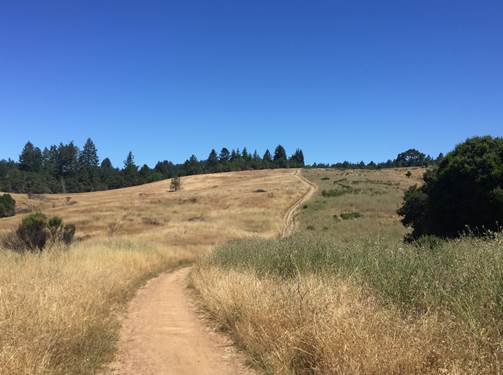
Coastal prairie

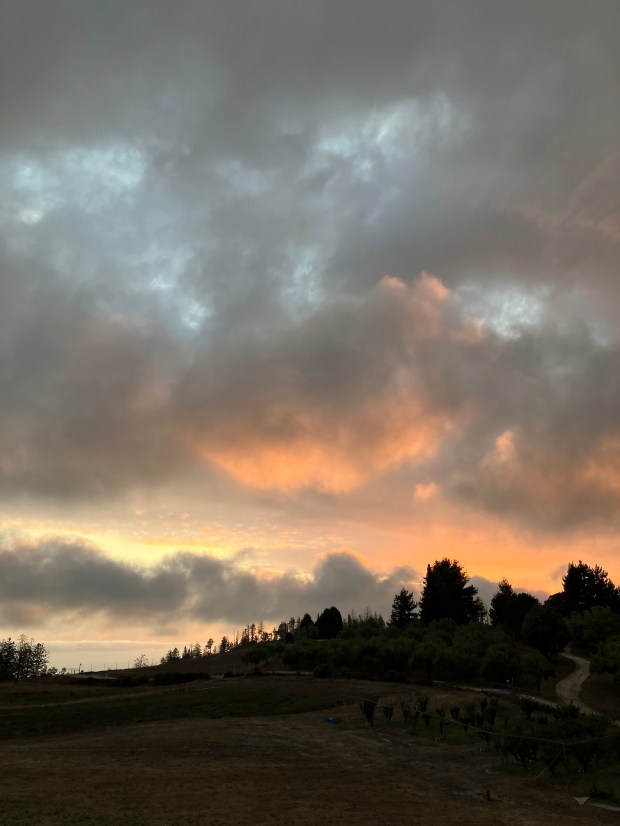
Sunset with poofy clouds over a tree-lined ridge

Behold! The Tomato!!

Behold, the peak of ripe, sweet, delicious dry-farmed tomatoes. The best in the world at the peak of the season, which will wind down soon. Lots of people are canning, drying…putting up food as the harvest rolls in, a bounty beyond any other season. Jays and acorn woodpeckers, too, rushing about, storing food like so many others.

A Ripe Molino Creek Farm Tomato: YUM!

Harvest

Tomato farmers can barely keep up, and people are buying. There are three particular crunches in the season: planting, weeding, and harvest. Each has its particularly critical moment interspersed not so much with ‘what do we do’ but more ‘how many people are necessary’ to do the work. The crunch times require more people than the weeks between, making it difficult for labor management and economics for small farms. 

Soon, the Community Orchard will face that final crunch. It seems to be a year like the last one when all varieties get ripe simultaneously. Gala apples are suddenly all ripe at once and the Braeburn and Jonagolds aren’t far behind. Luckily, the Fujis are going to wait a bit…and they are the biggest crop this year. It is a scratch year for the Mutsu variety for some reason. There are ten other varieties with one tree each that will get ripe in about 2 weeks. So, we’ll start preparing for a cider pressing gathering to process 1,000 pounds of apples in 2-3 weeks.

Two Dog Farm’s pepper field is lush and green with abundant fattening fruit. Their winter squash patch is still luxuriant and green with hundreds of butternut squash peeking through the leaves. Their Chardonnay grapes are getting honey-green and close to ripe…all ~2,000 pounds.

Wild Life

Baby owl begging, distant coyotes singing, a mountain lion caterwauling, masses of quail, a morning garter snake, bright-eyed deer herds, and many, many ground squirrels. 

Every now and then one of the baby birds strikes up a unique racket; this time, it is a baby great horned owl…begging. The begging goes all night long and it is loud and obnoxious. I suppose if you are the Queen of the Sky, you can make that kind of racket and not fear getting eaten. With no other baby around to mimic, a single young owl can pick whatever obnoxious voice to really bother its parents. This one ended up being half way to a barn owl screech, but louder. Mom and Dad owl hardly bother to hoot as the baby steals the show. You’d think it would get hoarse.

Sylvie reports a mountain lion caterwaul – that’s new since before the 2020 fire! Celebrations!!! Welcome back lion momma. 

There are streams and rivers of quail pouring out of the brush to peck-peck-peck at masses of seeds strewn everywhere on the ground. They are fat with glossy plumage. It has been a good quail year.

Open the front door first thing and there’s a 2.5 foot long garter snake on the stoop. What luck. First snake in a long while. The other moist morning or late evening snake to see is the (common here) rubber boa…haven’t seen that one for a month.

There are a record number of deer hanging out on the farm. Deer highways pound grass flat and expose soil along hoof-rutted trails. Piles of fertile deer poop litter the ground every few feet on the north-facing grassy slopes where they graze on a mix of grass and resprouting shrubs. At night, flashlight beams illuminate more than a dozen pairs of eyes on that slope. Walking down the road to turn off evening irrigation sessions, my heart races to be too near to huge antlered bucks;  hoping not to antagonize one: they seem feisty.

A  flock of 60 blackbirds has gathered on the farm, a mix of Brewer’s and bicolored, singing their complex anarchistic melodies from atop bare-branched fire killed trees and then flying like wind-scattered fall leaves down into the fallow fields to feast on seeds. Their song lights up every hour of every day, a chorus that will entertain us through the winter. Their rhythm section has squeaky peeps that nearly match the repetitive, constant, mechanical ‘Chip! of ground squirrels scattered far across the Farm- between the two species it approaches cacophony.

A skein of 50 honking, white-fronted geese in a huge V flew West to East high above the Farm at 4:30 this evening.

Bills Open: Nuts!

Jay cries are muffled, acorn caps scattered. It is peak acorn season and the jays hardly have time to taunt. Their heads are down, shoulders hunched, beaks pried open carrying fat ripe green shiny acorns to-and-fro. Don’t watch them when they try to bury the nuts – they’ll get mad, pick back up the nut and fly to somewhere where you aren’t watching. They suspiciously glance about, quickly poking each nut into a hole, making a quick swipe to cover it up and it’s onto another one. Back-and-forth over and over: busy days! We are pleased that they are distracted from eating apples, leaving the fruit destruction mostly to yellow jacket wasps now.

Dahlias are a long-time specialty of Judy Low

Land Tending

Our great gratitude to one generous guy- Matthew Todd has finished his mastication work for us this year: 4 acres of brush ground to small pieces! We needed to do something about the weeds and he offered to help for a great big discount that made it possible. He resonates with our mission to keep our hillsides wild and native and tending back to coastal prairie and so he wanted to help. His wonderful skill and powerful machine took care of jubata grass, radiata pine, and French broom, which had proliferated after the 2020 fire. Now we have a better chance of tackling those scourges with other tools – excavators, pulaskis, burn piles, and broadcast burns will join a several year mastication project to reduce the broom until we can get livestock to help manage the restoration areas. Thanks, Matthew!

We’ll collect a bunch of grass and wildflower seed this next spring to hurry the restoration along.

Hoping CalFire will be able to help this Fall with another prescribed burn.

Longer evenings make for less work time.

Enjoy the lengthening nights!

Saving the Coastal Prairie on the Santa Cruz North Coast, Thanks to California State Parks Ecologists

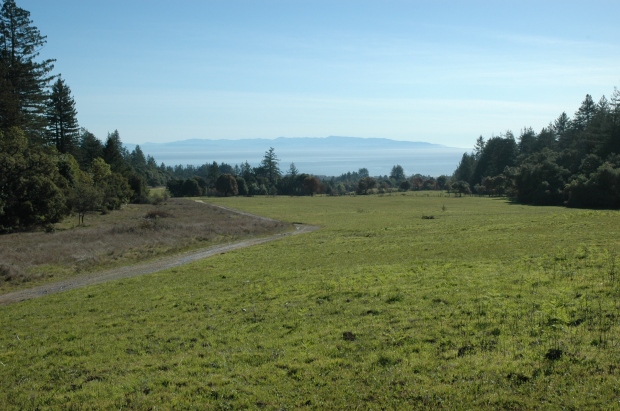
On Tuesday, December 27th I hiked onto the Gray Whale section of Wilder Ranch to see the prairies where the smoke was coming from back in October. I first visited these meadows in the late 1980’s while the property was privately owned; cattle were grazing the meadows, and there were abundant native grasses and wildflowers. Santa Cruz preservationists fought hard to protect the property from a proposed housing development, it went to State Parks, which removed the cows and took many years to start managing the prairies, which were starting to disappear to weeds, shrubs, and trees. Luckily, things were to change…

dsc_0156

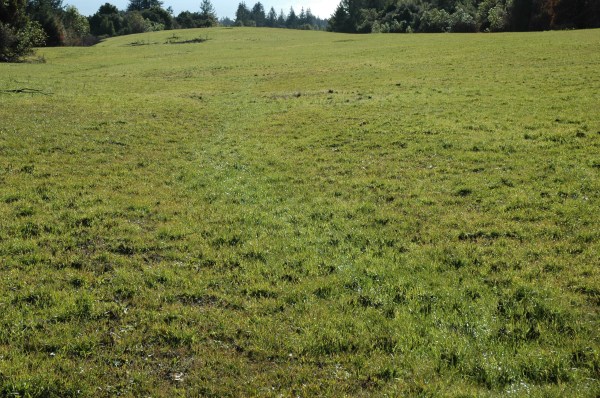
Postburn strikingly green meadows.

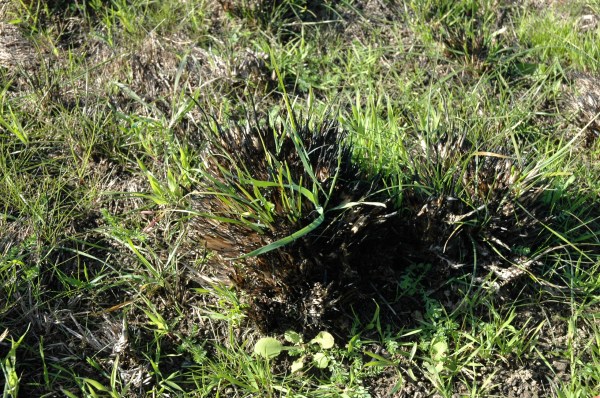
This past October, I knew that big plume of smoke I saw while driving on Highway 1 meant that State Parks was continuing their work at maintaining the meadows that I love so much. Fellow ecologist Jacob Pollock and I hiked from Twin Gates on Empire Grade down the Long Meadow ‘trail’ and into the strikingly bright green resprouting native grasses and wildflowers growing from the charcoal blackened ground. We found many types of native grass and a few wildflowers in the burned areas. Purple needlegrass, California’s State Grass, dominated the burned area, its dark green, rough leaves now 6” long and ubiquitous- a plant every square foot! These bunchgrasses promise a beautiful spring of silvery-purple flowers swaying 2’ high in the breeze. Patches of California oatgrass were less plentiful in the burn area than in the adjoining unburned area. This is the wet meadow loving indicator species of coastal prairie, and, in the many years after grazing and before the fires, it’s bunches grew taller to get to the sun- these tall bunches are susceptible to fire, but some survive.

dsc_0162

Fire recovery of California oatgrass

Patches of the leaves of wildflowers dotted the meadow and promise much more in the months ahead. Most abundant were sun cups, purple sanicle, and soap plant all long-lived perennials with nice flowers. Sun cups will be the earliest to bloom, maybe as early as late February, with simple, 4-petaled yellow flowers. Purple sanicle will be next to bloom in earl April with it’s small, purple spherical clusters of flowers. Soap plant blooms in late spring with evening blooming, white flowers that attract a variety of bumblebees.

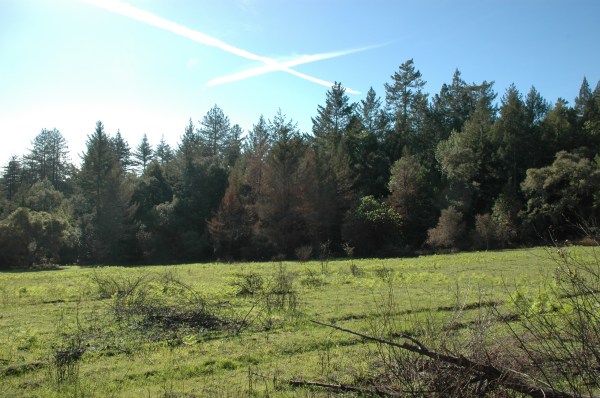
Besides the obvious revitalization of the meadow plants, we marveled at other aspects of the handiwork of State Parks’ expert ecologist land stewards. Unlike many of our area’s meadows, there wasn’t a single French broom plant, a super-invasive non-native shrub that obliterates meadows, overruns trails, and is a major fire hazard. A many year program with State Parks partnering with volunteer groups has controlled that and other weed species at the park. We also saw dead coyote brush both in and out of the burn area- this native shrub can completely overrun meadows, closing bush-to-bush canopy in 15 to 35 years, depending on the soil. State Parks killed the coyote bush to maintain the prairie, and then burned the skeletons of the bushes so that there are now wide opened expanses of meadows, which are attractive to hawks, owls, coyotes, bobcats, and prairie-loving songbirds like meadowlarks. The ecologists also sent the fire into the adjoining and invading forests, maintaining the sinuous coast live oak ecotone that so beautifully frames the meadows.

dsc_0148

Fire maintains prairie ecotone

Today, I’m celebrating environmental heroes- 2-3 State Park Ecologists who manage over 18,000 acres in Santa Cruz County. They are motivated and hardworking. They need more support, more staff, more funding- please tell your State Assemblyperson/Senator! Without their dedication, our prairies would disappear. Thank you!

June 2017 Addendum: Portia Halbert sent me this photo (from State Parks Ecologist Tim Reilly), taken recently. The unburned portion of the coastal prairie in Long Meadow turns out this year to be dominated by Italian thistle, an invasive plant, whereas the fire from last fall seems to have more-or-less obliterated the species in the adjoining meadow. Thistles are especially bad this year in many meadows that haven’t been well stewarded. This discovery, that fire might help with thistle invasion, is a complete surprise to me- it deserves some careful scientific investigation! Long meadow italian thistle

Rare wildflower: the Point Reyes Horkelia

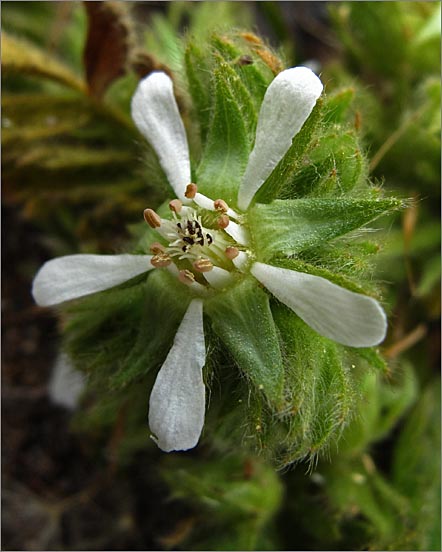
Horkelia marinensis Pt Reyes Horkelia

Licensed under CC: photo by CalFlora user Vernon Smith.  All rights revert to originator.

The Point Reyes Horkelia is a delicate rose-sister with finely fragranced foliage forming drought-hearty dark green patches in California’s remaining coastal prairies. This species, like other close relatives, has strong horticultural value; when only slightly watered in the driest of months, it forms a beautiful, resilient, fire retardant ground cover. White five-petaled flowers form starburst patterned over-stories to a leafy silver carpet. Plants are strong, long-lived microshrubs with deep, woody taproots. Given ideal conditions, mature square meter-sized Pt. Reyes Horkelia clones support extensive root systems, capturing nutrients and rainfall, sequestering carbon, and stabilizing slopes. Across the 25-odd distinct patches of coastal prairie that support this species, Horkelia clones are nurturing increased soil ecosystem diversity.

The Latin, Horkelia marinensis, references Marin County, California, the heartland of the species’ distribution. There are outlying populations elsewhere along California’s central coast.  A few plants live in a meadow on the Moore Creek Greenbelt, more live in prairies near Twin Gates, upper UCSC campus and Wilder Ranch State Park.  More recently discovered populations are at the Bonny Doon Ecological Reserve, San Vicente Redwoods, and on the Cotoni Coast Dairies Preserve.

How rare is this wildflower? Should it be given legal protection under the State or Federal Endangered Species Acts? The criteria are not transparent for awarding threatened or endangered status to this kind of widely distributed plant, which mostly grows in ‘protected’ areas including heavily-used public parks. Some have suggested that if a plant were to have fewer than 16 populations, and if a significant number of those populations are substantially threatened with extirpation, and if a petition were submitted to the government and authored by a legitimate  source…. then perhaps the bureaucracy would rule in favor of conservation.

There are dramatic swings in the annual number of new species protected under State and Federal Endangered Species Acts. Do we have a good system for adequately capturing the urgency of protecting particular species? Experts with the California Native Plant Society agree that the Point Reyes Horkelia is indeed endangered – biologically. These experts routinely reassess their recommended status for species, and make recommendations based both on close scientific observation and the knowledge of experts. Discovery of so rare a species in our hard-pressed midst merits at least an immediate population survey, without which we can’t begin to address its conservation status. Even when this rare species is on public lands there is no government botanist available to collate surveys across the range of the species. And so, surveys and documentation are left mainly to volunteers.

As just such a volunteer, I am pleased to offer what is already known about Pt. Reyes Horkelia distribution in our area. The Santa Cruz County populations of Pt. Reyes Horkelia live on many differently owned and managed lands, with varying management attention. The southern range limit for the species is currently believed to end on the Moore Creek Greenbelt. Santa Cruz City Parks Department has been spending some attention to managing the parks’ beautiful meadows, where the Pt. Reyes Horkelia and other rare wildflowers have been restored through carefully managed cattle grazing. UCSC land also includes a few patches of the species, in moist meadows mainly near Twin Gates, on both sides of Empire Grade in an area known as Marshall Field. The University occasionally does good things for those meadows, like prescribed fire and mowing to maintain native plant species, but the area with this species has been largely neglected for the past decade, so it may be declining. The BLM hasn’t really hit the ground with any kind of targeted meadow management aimed at conserving native plant species on their Cotoni Coast Dairies Preserve. The consortium of land trusts owning the San Vicente Redwoods know about the species being on their land, so they would presumably be careful with any of their timber, fire, or recreational management. The California Department of Fish and Wildlife’s Bonny Doon Ecological Reserve has a single small patch of plants, but no management or monitoring to maintain the species.

Horkelia marinensis Pt Reyes Horkelia

Licensed under CC: photo by CalFlora user Jorg Fleige. All rights revert to originator.

While some of these patches are in good hands, others are under daily threat from disuse or overuse. The impossibility of cooperation across such broad swathes of countryside renders survey work on the holdings of amenable or accessible landowners more urgent. Stunned as we may be that work of this nature is barely funded for the government agencies tasked with oversight of such matters, there are things we can do to help this plant out. For instance, join the California Native Plant Society, which is the most effective native plant conservation organization per dollar invested in the state. Also, every time you hear about plans to increase access, adding trails and visitors, to the meadows of our area…weigh in on native plant conservation with the lands managing entity involved. Mostly, those weighing in are vocal users- mountain bikers, especially…people not inclined to also care about rare native plants. By speaking for, caring about, and investing in our rarest native plant species, you will be contributing to the possibility that future generations will have the chance to experience the fine, rose scented foliage of this beautiful, rare wildflower.

Many thanks to Wes Harman for editorial assistance.