-Part 1-
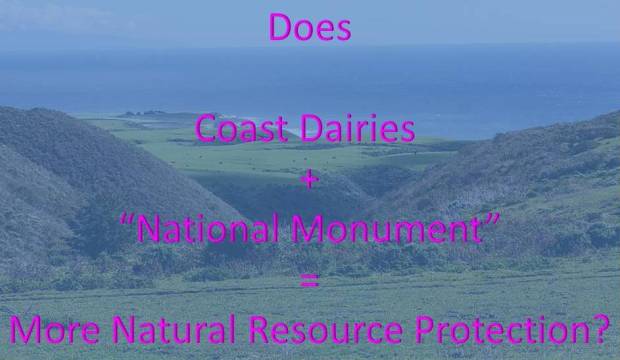
Our government designates National Monuments in order to protect them, but would a National Monument designation for Cotoni Coast Dairies really better protect these lands? An informed answer requires an examination of the protections already in place, the language of the monument designation, and how the public and US Bureau of Land Management (BLM) follow through after monument designation. Today we will examine the first two of those three subjects with a subsequent essay that will cover the last subject.
Through decades of public effort, natural resource protections in place at Cotoni Coast Dairies were already very strong when the BLM took possession in 2014. The owners before BLM – the Trust for Public Land (TPL) – created two sets of deed restrictions that incorporated private and public funders’ interests as well as protections imposed by the California Coastal Commission. These deed restrictions require future managers to accommodate public recreation without sacrificing protected endangered species or endangered species habitat. The restrictions also prohibit mining, commercial timber production, and use of off-road motorized vehicles. The TPL and the California Coastal Commission both have standing to enforce these deed restrictions in perpetuity. Since these restrictions serve to protect the Cotoni Coast Dairies property’s natural resources in most of the ways Federal National Monument status normally affords, the question is: what additional natural resource protections might National Monument status afford?
Interestingly, National Monument designation doesn’t necessarily guarantee any specific types of natural resource protection. Those that exist are entirely subject to the discretion of Congress or the President. There are different regulatory guidelines for Congress versus the President in establishing National Monuments. Congress has constitutional authority to declare an area a National Monument; the Constitution allows Congress to make whatever rules it wishes for such land. For example, Congress can allow off road vehicles and commercial timber production on National Monuments, or Congress can prohibit human visitors, altogether. Alternatively, the Antiquities Act of 1906 allows Presidents to designate an area as a National Monument. The President is limited by the Antiquities Act which requires the size of the Monuments is ‘smallest area compatible with proper care and management of the objects to be protected.’
In 2015 two US Congresswomen and both US Senators from California co-sponsored a measure to add the Cotoni Coast Dairies property to the California Coastal Monument. The proposed addition lacked any substantive natural resource protections and ultimately failed to motivate sufficient support to make it to a floor vote. In accounting for the omission, aides to both the House and Senate sponsors have directly claimed that such language was ‘inappropriate’ because the representatives believe that Congress should not exert political influence on federal agencies’ land management decisions. In keeping with this policy, other Monument legislation in California from this era has contained little natural resource protection language.
As early as February 2016, in the wake of the failure of the California proposal, Congressional proponents met with the Obama administration on numerous occasions to urge designation of Cotoni Coast Dairies as a National Monument via an Executive Order under the Antiquities Act. We know little about what if any natural resource protections those Congressional offices lobbied for in their negotiations with the President, because this information is not available to the public. But when Congressional designation of National Monuments failed in the past, subsequent Presidential Antiquities Act proclamations of Monuments have had a regrettably mixed record of inclusion of natural resource protection language.
No discernible pattern exists –not one informed by policy or ‘pragmatism’– to account for the variable inclusion of natural resource protections in Presidential National Monument declarations. Most often, local grassroots conservation efforts motivated Presidents to designate lands as National Monuments. In most of those designations, grassroots organizations proactively provided Presidents with the information necessary to inform specific natural resource protection language in their Monument proclamations. This language often provided for protections above and beyond the federally listed species protected on federal lands by including mention of state-listed, rare, and unusual species.
The following Presidential Antiquities Act proclamations declaring National Monuments all had language protecting natural resources above and beyond what would have been protected had these areas not been declared Monuments:
- Carrizo Plain
- Berryessa Snow Mountain
- Giant Sequoia, and
- the Pt. Arena Stornetta boundary enlargement of the California Coastal National Monument (of particular relevance).
Presidential Antiquities Act proclamations for these Monuments each called out protections for a number of rare or state-listed species not otherwise protected on Federal lands (Appendix 1). Here is a tally of the numbers of non-federally listed plants and animals in these proclamations:
- Carrizo Plain National Monument – 8 plants, 3 mammals
- Berryessa Snow Mountain National Monument – 17 plants
- Point Arena-Stornetta Unit, California Coastal Monument – 1 plant, 4 animals
- Giant Sequoia National Monument – 3 animals
On the other hand, some Presidential monument proclamations had little or no such language. For instance, the proclamations creating the Santa Rosa/San Jacinto and Fort Ord National Monuments did not include mention of any specific non-federally listed species.
When non-federally listed species and other natural resource protection language is included in Antiquities Act proclamations of National Monuments, land managers must explicitly manage for those resources. If no natural resource protection language is included in proclamations the managers need never exceed baseline practices of natural resource protection. In my next post I will provide details on how land managers for the above listed Monuments adjusted their management to account for National Monument status, answering in the main the ‘what happens when’ question. For our purposes here suffice it to say that natural resource protection language in Monument designations has correlated with additional protection of those natural resources.
The nut of our position is this: Cotoni Coast Dairies is already largely protected in the ways that National Monument status would confer. If National Monument status is meant to increase protection of Cotoni Coast Dairies –as advocates for Monument status have suggested– the only sure way is if the President’s proclamation includes specific natural resource protections.
————————————————————————–
Appendix 1: Recent, Antiquities Act created Californian National Monuments and the sensitive natural resources that the Presidential proclamations protected.
| Monument | Species | Listing Status |
| Carrizo Plain | San Joaquin (Nelson’s) Antelope squirrel | State of California Threatened |
| Pale‐yellow layia
Carrizo peppergrass Lost Hills saltbush Temblor buckwheat
|
California Rare Plant Rank 1B | |
| Hoover’s woolly‐star
Forked fiddleneck |
California Rare Plant Rank 4 “Watch List”
|
|
| Pronghorn antelope
Tule elk
|
Unlisted | |
| Berryessa Snow Mountain
|
Indian Valley brodiaea
Red Mountain catchfly
|
State of California Threatened
|
| Bent flowered fiddleneck
Brittlescale Brewer’s jewelflower Snow Mountain buckwheat Coastal bluff morning glory Cobb Mountain lupine Napa western flax
|
California Rare Plant Rank 1B | |
| Purdy’s fringed onion
Serpentine sunflower Bare monkeyflower Swamp larkspur Purdy’s fritillary
|
California Rare Plant Rank 4 “Watch List”
|
|
| Musk brush
MacNab cypress Leather oak
|
Not listed | |
| Point Arena-Stornetta
|
Humboldt Bay owl’s clover
|
California Rare Plant Rank 1B |
| Black oystercatcher
Yellow warbler Black-crowned night heron Brown pelican
|
Not listed | |
| Giant Sequoia | Great gray owl
|
State of California Endangered
|
| Northern goshawk
|
State of California
Species of Concern
|
|
| American marten
|
Not listed |
 Grey Hayes