Biodiversity

First Bloom, Maritime Chaparral

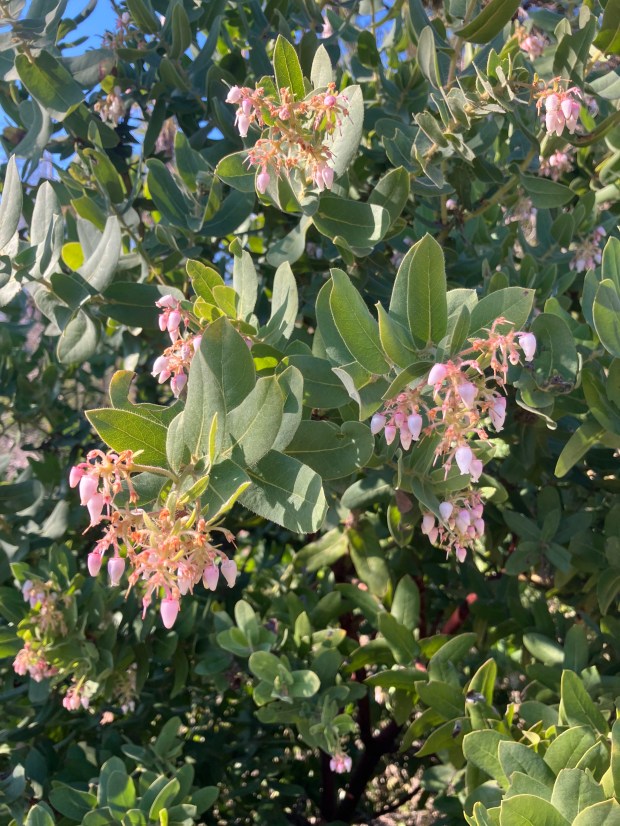
Santa Cruz manzanita in full bloom!

The ridgeline expanse of chaparral lay dormant, wafting resinous scents, clicking and crackling as the morning sun’s first rays dried the maroon, shredding bark strands which hang peeling from the skin-smooth twisty manzanita trunks. Through the late summer and fall, each day brought the same routine, sometimes hotter days, sometimes nights bringing fog, dripping and awakening lichen which festoon branches and carpet the ground, nestled into lichens and patches of rabbit poop. Then, the rain came, soaking the rocky ground. Now, months later, maritime chaparral awakens with its first bloom.

Recently, on an early morning drive to the trailhead we encountered huge white, slippery frost patches along the spine of Ben Lomond Mountain where Empire Grade bisects high chaparral, towering oak forest, and miles of burned conifer trunks. We were off to Big Basin not for lingering in the recovering redwood forest as much as to spend time in the warmth of chaparral. Once on the trail, my cheeks and nose were numb with cold, as we descended from magnificent wet old growth forest onto drier rocky ocean view ridges with a different type of snow…petalfall. 

The 3 types of manzanitas at Big Basin and Butano State Park have already been blooming since December. The best show is from a shrub that only grows in the southern part of the Santa Cruz mountains, but there are two other species of manzanita also flowering. The woodland edge manzanita, a species that can get 20’ tall, is aptly called Santa Cruz manzanita; it gets large clusters of obviously pinkish flowers. Glossy leaf manzanita with its small dark green boxwood-like leaves form the neatest of dense bushes with tiny white flowers. Giant woody burls of brittle leaf manzanita send out much less organized clusters of trunks, intertwining with other shrubs to add to the branchy complexity of impenetrable scrubland. In the chill shade below manzanita bush canopies, a carpet of white…the snow of spent blossoms covers moss mats and gravelly barrens.
undefined

More Unfolding

The manzanitas are first, but other chaparral shrubs are also awakening. We saw the first dusty, dark blue flower clusters of the pine-scented, warty-leaved wild lilac. Milk maid’s simple four petaled flowers adorned the trailsides where we walked along with the very first boisterous redwood sorrel blossoms emerging from a lush carpet of shamrock leaves. I look forward to hiking in chaparral in a month or so, when there will be an even more impressive profusion of flowers.

Next: Flowering Hillsides

We will soon encounter the 5th spring after the 2020 CZU Lightning Complex Fire, and the burned hillsides promise a Big Show. First up in the pageant: blue blossom, or wild lilac. They have just begun, but in 6 weeks there will be thousands of acres of sky blue flowers covering 10’ tall glossy leaved shrub-trees. Fire-following bush poppies are next, in June: 2” wide, cheery yellow flowers smiling from the startling silvery blue-green canopies of six foot tall leggy shrubs. Magenta flowering and very poky chaparral pea, twisty white flowers of twining wild morning glory, and white spikes of chamise. For more than half the year, maritime chaparral is a colorful show with patches of yellows, splashes of blue, rafts of white and pink, and dots of red set in cushions of diverse blue-green mounds of shrubs, sometimes towered over by occasional pines or redwoods.

Misplaced Scorn, Not Enough Love

These shrubby ecosystems are being disrespected (again) right now, but we should show them more love. News and talk shows about the fires in southern California frequently include scorn of the shrubby landscape which carries fire so fiercely. ‘Control that vegetation!’ some say. ‘Cut down those shrubs!’ others exclaim. At the top of Loma Prieta, cell phone tower owners mow down many acres of the most beautiful chaparral. Even local parks have started destroying chaparral along trails and fire roads. Few note that no matter how much energy you put into messing up that habitat, what comes up will still be flammable, and probably badly so. 

On the other hand, chaparral blankets and protects the poorest of soils allowing rain to replenish the groundwater. In places where humans have tried hard to convert chaparral to something else, they manage to create a terrible weedy patch – fine fuels that carry fire fast. And, in those places, the hillsides give way in heavy rains and fill streams with sediment, creating flooding and debris flow problems.  Where these amazingly drought tolerant chaparral shrubs are given a chance, they hold incredibly steep poor soils in place allowing rainfall to soak in without landslides. 

Now, Go!

If you can find some time to spend with chaparral, try taking a few trips to the same place in the next few months to watch the flower display change and unfold. Those ridges in Butano and Big Basin State Parks are great chaparral displays. Summit Road near Loma Prieta is also quite nice. Despite fuels management and long intervals without fire, some patches of chaparral persist in Wilder Ranch and in/around Nisene Marks, both State Parks. Montara Mountain in San Mateo County is my favorite chaparral trekking location…amazing views, too.

When you go to these places, here are some questions for the trip:

  • How many Ceanothus, aka blue blossom or wild lilac, do you see? Is there variation in flower color? What’s your favorite?
  • What kind of rock is the chaparral anchored into? Do you see any soil? How do these shrubs get water?
  • How long has it been since there was a fire in that patch of chaparral? Is there a lot of dead fuel build up? Are there young or old pines, which might indicate how old the stand is? 
  • Is the chaparral well managed by people? Are invasive plants under control or spreading? Are the roads and trails eroding or well maintained? Are the nearby houses, power lines, and roads sensitively integrated into the system?

After your return from your chaparral tour, please keep this conversation alive. Talk to your friends and family about chaparral. Read more about it. Vote as if chaparral mattered: political candidates should have opinions about how to protect rare habitats given the constant onslaught of poor human behavior.

This column originally published as part of BrattonOnline, a weekly news publication to keep our community informed about pressing matters at home and abroad – check it out! Subscribe! READ!

What Do I Want for Wildlife?

We might ask ourselves, “What do I want?” This important reflective question is a good one and becomes even more poignant in those moments of realization that we have limited time on Earth. There’s a fairly malignantly overused neural pathway of “What do I want?” used for shopping and consumption, but let’s try to dismiss that one and turn our focus on another. “What do I want” from the world around me, the world less likely to be affected by my purchases? For instance, ask yourself what do I want my experience to be when I go for a walk, or what do I want from the natural world: for the forests and streams? What do I want for wildlife? What do I want for my family and friends…for my neighbors…for my community? As we look outside of ourselves and express our desires for the larger world, we encounter our social potential: what can we do as members of a community? How can we influence the world to be a better place? Most people know that we influence those closest to us the most and come to know our circle of influence better with age. Some people work to broaden their circle of influence, some to narrow it. If we feel frustration towards the state of the world, we might explore politics at the local level to see how we grow our influence to make a better world. How does this work for what we want from Nature?

I Want Healthy Wildlife Populations

The majority of Americans want wildlife to thrive, to know that humans are well stewarding, even restoring, wildlife populations: this is something with which both liberals and conservatives agree. As I’ve addressed many times in this column before, that sentiment largely lacks evidence in local politics. Our City and County elected officials fail almost every time they are given a choice to better protect wildlife. We live in an area with a very high number of rare and endangered species, and those are only protected because State and Federal officials step in to enforce protections. How can this be the case with the local legacy of environmentalism and environmental education?

The “Teach Them and They Will Care” Fallacy

While people may say “I want healthy wildlife populations!” they apparently favor the sentiment of “I want money” as they keep electing pro-business officials who (mistakenly) believe that environmental protection comes at unacceptable costs to social welfare. And still, the local environmental education community unanimously embraces the fallacy that if you teach them about the environment, they will care enough to protect it. The corollary fallacy is ‘if you give them access to nature, they will care about nature and so nature will be protected.’ These are convenient fallacies because both allow the environmental education and trail building communities to raise funding from the wealthy, pro-business elite; that funding is crucial to keeping their organizations operable. With the “carrot or the stick” dichotomy for environmental protection, there goes the carrot. What about the stick?

Environmental Protection has Become Non-Local

Over the past 20 years, local environmental protection owes much to State and Federal legal ‘sticks.’ Twenty years ago, we made headway with environmental battles via the Coastal Commission’s authority to protect sensitive habitats at Terrace Point, the University, on City Greenbelt lands, and in State Parks. That agency has since abandoned its environmental protection arm, but the US Fish and Wildlife Service and National Oceanic and Atmospheric Administration have since helped protect what they could from a federal perspective. The California Department of Fish and Wildlife (CDFW) has only occasionally helped protect the environment on the Monterey Bay, more commonly turning a blind eye to environmental impacts that are clearly within their jurisdiction. However, even so, CDFW has done more than local authorities to protect wildlife. In short, we apparently respond more positively to ‘sticks’ than ‘carrots’ when it comes to caring for wildlife around the Monterey Bay. Ask yourself if this approach aligns with your political beliefs? Do you want more State and Federal enforcement of wildlife protections? Or, would you rather believe that people only need ‘carrots’ to do the right thing for protecting wildlife? If the latter, how do you see things changing, socially or politically, to make that happen? If the former, how is it that you are actively supporting State and Federal agencies who are using sticks to protect wildlife?

Uh-Oh, Wildlife Protections in State Parks?

A while back, Californians realized that State Parks needed better planning to protect wildlife. And so, politicians created a rule that every park must have a plan that addresses wildlife protection, even specifying that those plans have what is called a carrying capacity analysis. Carrying capacity analysis defines an approach to determining how to design park access so that wildlife populations remain healthy. Locally, because of repeated negotiations with environmentalists, State Parks has evolved its approach to such analyses, though they have more recently apparently given up on creating plans for parks, altogether. The General Plan for Castle Rock State Park illustrates how landscape architects very badly approached their mandate for good carrying capacity analysis. In that plan, planners who were inadequately trained in wildlife protection sharpened their crayons and shaded huge bubbles across the park, vaguely labeled as high, medium, and low intensity use. This vague and unenforceable planning conveniently allowed unbridled access everywhere. Now, visitors are degrading very rare wildlife habitat associated with rock outcrops and regionally unique wildlife habitat associated with a black oak forest. Because of the terrible approach outlined in the General Plan, an environmental non-profit was able to construct a visitor center in close proximity to these very sensitive wildlife habitats.

A Curious Evolution

Realizing that people wanted State Parks to do more for wildlife protection, the more recent General Plan for Big Basin State Park improved a smidge on their carrying capacity analysis. That plan well reflects the modern principles of analyzing carrying capacity for wildlife protection, but curiously falls very much short of being meaningful. The Big Basin plan rightly says that it is important to address negative impacts of visitors on wildlife by defining science-based thresholds which would be monitored and, if surpassed, would trigger management actions. However, the plan then (very curiously) fails to define such thresholds.

Aiding and Abetting

The same environmental group that built a visitor center precisely where it would be most likely to negatively impact the most sensitive wildlife habitat at Castle Rock State Park is now proudly advertising a similar approach at Big Basin. Instead of helping the People get what they want (wildlife protection), they are doing a great job of raising capital to support their organization through a campaign of increasing access to Big Basin without a viable method of protecting wildlife at that park. In such a way, the organization illustrates its embrace of the fallacy that increased access somehow increases wildlife protection. As you might suspect, this same organization also embraces the fallacy that milktoast environmental education somehow increases wildlife protection. They are funding the interpretive signs for the planned entrance at Cotoni Coast Dairies; the signs, no doubt, will fail to provide visitors with either the inspiration or information needed for them to take meaningful actions to improve the Bureau of Land Management’s stewardship of wildlife at that park. Wait and see.

What Do You Want?

As you consider Big Basin State Park, Castle Rock State Park, or Cotoni Coast Dairies, ask yourself ‘what do I want for the wildlife of these parks?’ How would you know that you are getting what you want? In no case will you, or the managers of those parks ever know…unless things drastically change. That change will only occur if enough of the right people decide that what they want is important enough to act. In the meantime, please know that all visitor use of parks causes negative impacts to wildlife. If we want to conserve wildlife in parks, it will take a new level of dedication of parks managers to perform adequate carrying capacity analysis, monitoring, and adaptive management. That dedication will only occur with the ‘sticks’ that are luckily available to the citizens who are willing to use them.

Welcome to Santa Cruz – A Natural Perspective

This is a post that I contributed to Bruce Bratton’s online weekly on 9/28/2021

Think about our area…

Whether you are new, visiting, or have long lived in this area, how are you growing to appreciate the nature of this place to its deserving depths? Nature inspires, heals, and supports us all, and the land around Santa Cruz is as special as nature gets. And yet, I find few people prepared to describe that richness in the ways that reflect the culture, the recreational opportunities, or the human history. Will you take some time with me over the coming years to grow our appreciation of nature together, to be better able to describe this wonderful place?

I will be writing a series for Bruce’s weekly, and through this writing I hope to inspire you to appreciate our place in the world more deeply, so that you will feel more comfortable describing our ecological wealth to others. Over the longer term, I hope we can help to improve more broadly our cultural relationship to the natural world and work to restore the web of life. That way, many generations in the future, people will be proud of of our stewardship culture and benefit from the richness that we co-create. The alternative is horrifying to those of us who see the trend and love what is left of nature.

I can describe some of our natural wealth, but I encourage you to invest some time to get to know it more closely through personal experience, and to enter into more discussions about what’s going on around us. For instance, I will describe the incredible biological diversity driven by oceanic upwelling and the Grand Canyon depths of the Monterey submarine canyon. This might inspire another trip to the Monterey Bay Aquarium to learn more…there is always more to learn there. And, maybe during our next nature walks, we will move a little slower, look a little more intensely and take time to chat with someone along the trail, or docents at a park. You might also travel onto the Bay with a whale watching boat to experience firsthand the teeming of life. Patient walks along the bluffs peering oceanward also reveal hints of the Bay’s diversity. Many of us have done these things…but how often, and with how much focus? How often have we tried to inspire and teach others about the Monterey Bay? Conversations can help bring us together, deepen our appreciation, and create a better culture. For nature and for ourselves, we cannot do it often enough.

Without majestic whales, a Monterey Bay Terrarium, or (as yet) scientific institutions and economies to train and support land-based eco-tourism, it is not as easy to learn about our terrestrial natural world. And yet, the species diversity and diversity of natural habitats around the Monterey Bay offer endless fascinating experiences. In a very short trek, we can travel from sand dunes through estuaries and lagoons, along rivers and streams, into vast coastal prairies, under the canopies of so many forest types- Monterey pine, redwood, coast live oak, etc- and weaving through sagrebrush scrub and manzanita chaparral. Almost anywhere else in the nation, and even the world, one would travel hundreds of miles to visit this number of varied habitats. Each of these habitats has its own scents, critters, flowers, and seasonal changes.

Each Fall, Winter, Spring, and Summer, I have favorite hikes to immerse myself in these various habitats to experience what they have to offer at various times of year. Recently, I walked in the understory of one of our recently burned redwood forests. The scent of charcoal and blackened redwood trunks are relatively new to me, but the ripening acorns, orange-blushed madrone berries and the cooing and loud wing flaps of band tailed pigeons remind me of the fall’s wildland harvest time. Creekside walks are especially nice right now with the sound of water, lush ferns and blossoming monkeyflowers contrasting with so much of the brittle dryness of late summer elsewhere.  Soon, there will be rain, and the manzanitas unfurl clusters of urn-shaped, honey scented flowers. The chaparral is the first habitat to erupt in bouquets with the smell of fresh rain on soil. Bees will bumble and hummingbirds will dart between the many chaparral blossoms. Rehydrated back to fluffy life, lichens and mosses will add depth to the chaparral’s colors and textures, accentuating the change brought by the annual wet season we call winter.

Through my posts at BrattonOnline, I will share notes about the places I visit and help connect you with ways to learn more. There are books, interpretive trails, guided field trips, multimedia internet resources, museums, and events that will help us continue to explore this wonderful place. Meanwhile, I hope that you will regularly remind yourself that we are living every day alongside one of the nation’s most densely diverse natural areas and that there are opportunities to explore it, real close by. Experts note that relationships last best between people who remain curious and are willing to stretch and grow; I posit the same is true for our relationship with nature. Remaining experientially and physically engaged with nature, we will be healthier emotionally and physically. Learning more about nature and having more frequent conversations about what we have experienced and learned will help to protect and steward nature.

Each week, I will present a bit of homework for specific direction to go deeper with the concepts I introduce. This week: do some ‘forest bathing’ in the redwood understory or walk near a stream. Read a bit out of Kat Anderson’s Tending the Wild, Burton Gordon’s book Natural History and Cultural Imprints of the Monterey Bay, and Ellen Bakker’s An Island Called California. Visit the Santa Cruz Museum of Natural History. Talk to someone about your personal experience with the nature around us.

And, with my posts, I will list a few of the new things I have experienced in nature the past week. Each fall, I see the arrival (from Alaska!) of golden crowned sparrows as well as (from I don’t know where) western meadowlarks; geese flew overhead geese in huge honking V’s; the sun hit its midway point moving south to north- last Wednesday was Equinox – now the nights are longer! Send me a note about something you noticed that is new in nature so that I might add it to this list in future posts.