
It has been a while since I gave an update on Cotoni Coast Dairies, but I have previously written much about that piece of (unfortunately) federally-owned ‘conservation’ land on Santa Cruz County’s North Coast. In August 2025, BLM staffer Zachary Ormsby had a chance to address the public about the parkland. Here, I present additional perspectives including some more recent developments.

Ch-ch-ch- Changes!
In 2025, as many of us had predicted, the Federal government made yet another of its radical political shifts, affecting the Bureau of Land Management (BLM), which oversees Cotoni Coast Dairies. Just before that transition, California’s BLM director changed. Karen Mouritsen, a Trump appointee who had lasted most of the 4 years of the Biden Administration, had been pressing to maximize public access and denying any funding to take care of the land’s pressing invasive species, wildfire, and erosion issues. Then, in 2024, Joseph Stout was appointed head of the California BLM; Joe had previously been deputy director of BLM but mysteriously left for most of Karen Mouritsen’s term. At the start of their term, the Trump Administration fired the national head of BLM and, as of March 1, 2026, has yet to replace them. Nevertheless, the leaderless BLM has turned its already understaffed offices to resource extraction rather than conservation. The staff in our BLM region now spend much of their time advertising, negotiating, and monitoring leases to extract oil. Luckily, the nonprofit conservation organization Trust for Public Land, which signed the land over to BLM, restricted the property deed, prohibiting oil extraction.
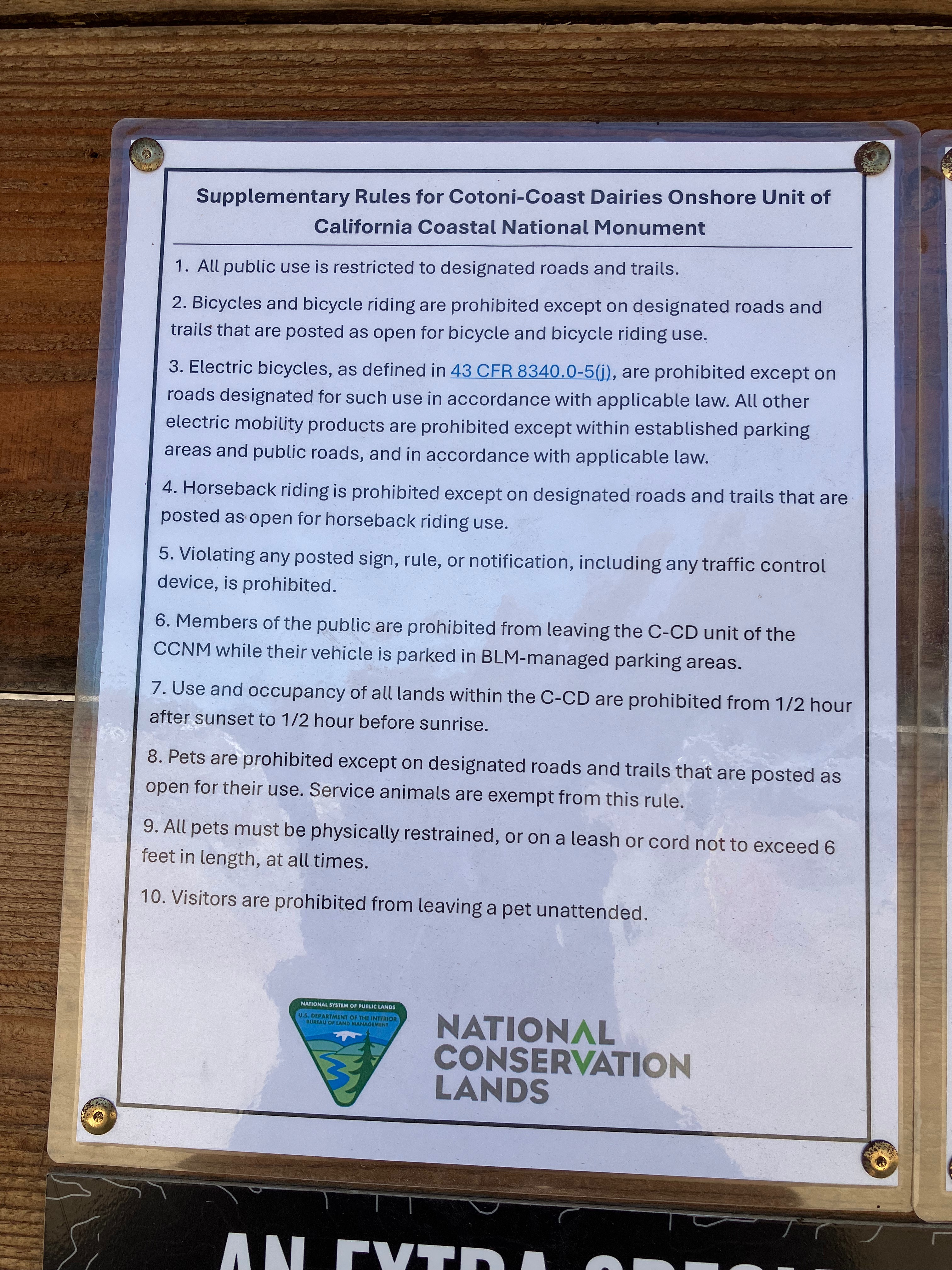
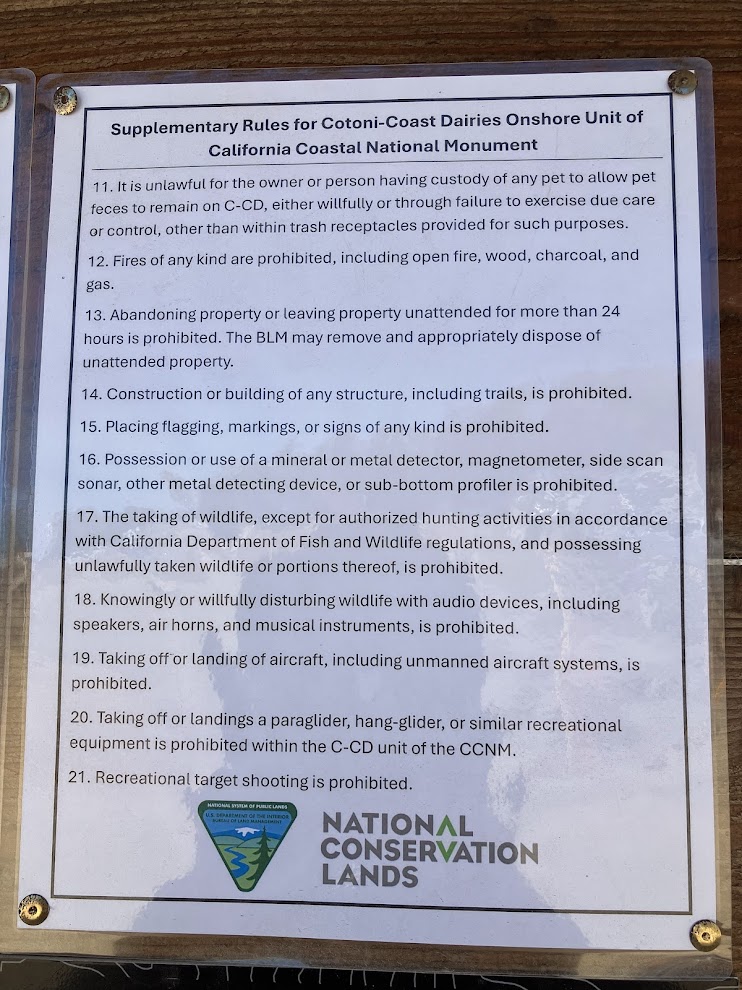
Public Access
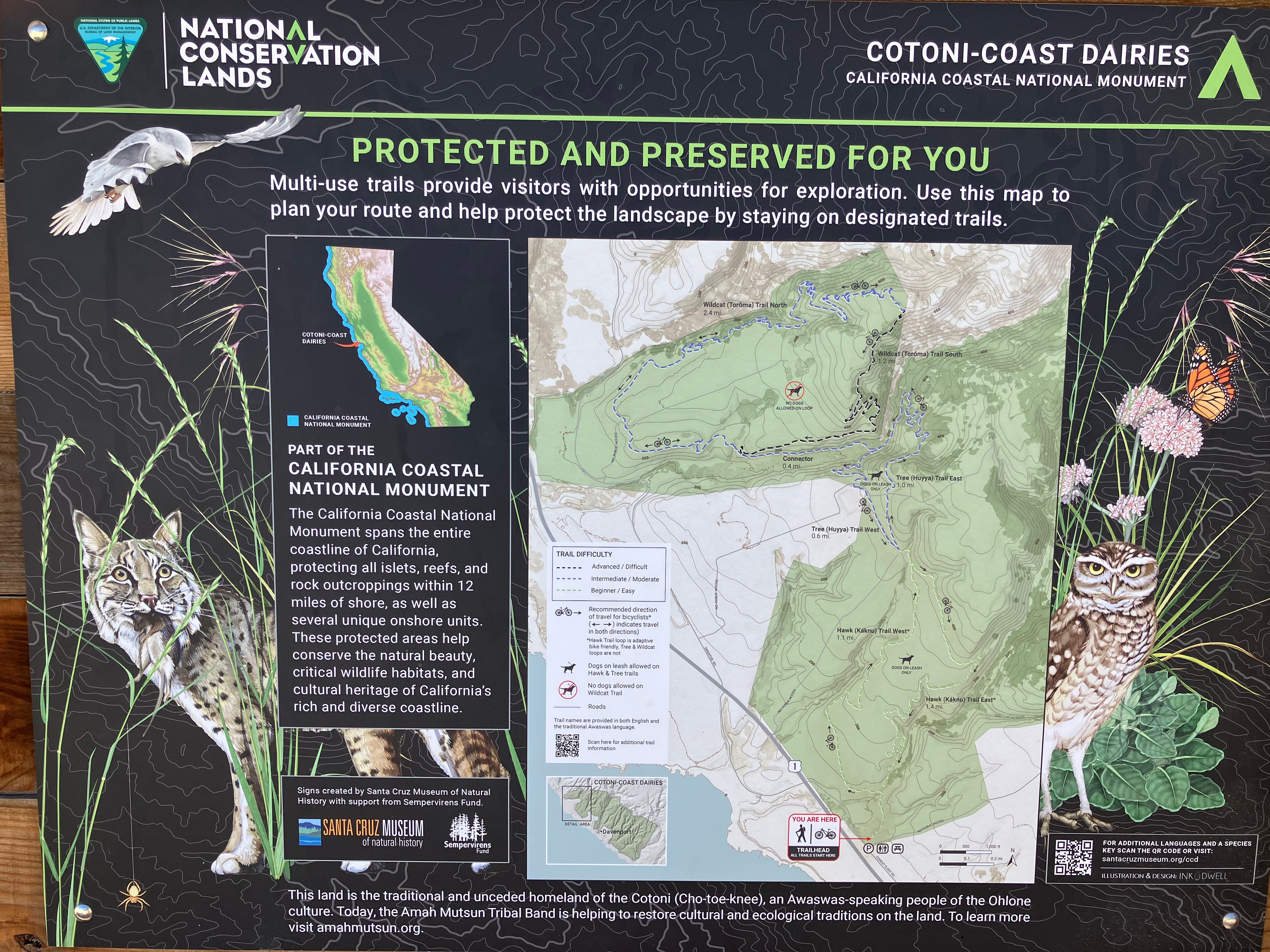
Public access is a little less extractive to open space than pumping oil out of the ground, and usually less toxic. Visitor use of natural areas has long been recognized as one of the top threats to species, globally. Nevertheless, at Cotoni Coast Dairies, an area set aside primarily for conservation, BLM (in close partnership with mountain biking sports advocates) has begun development of an extensive trail network through globally significant threatened habitats, disrupting and possibly displacing endangered wildlife species. Sole source government contracts paid these mountain bikers hundreds of thousands of dollars to organize volunteers in transforming a little-known virgin wildland into a recreational park. The nine miles of new trails emanate from a 90-car parking lot replete with two restrooms and a few interpretive signs. Despite promises to the contrary, the restrooms are often locked, even when there are lots of visitors filling the parking lot.
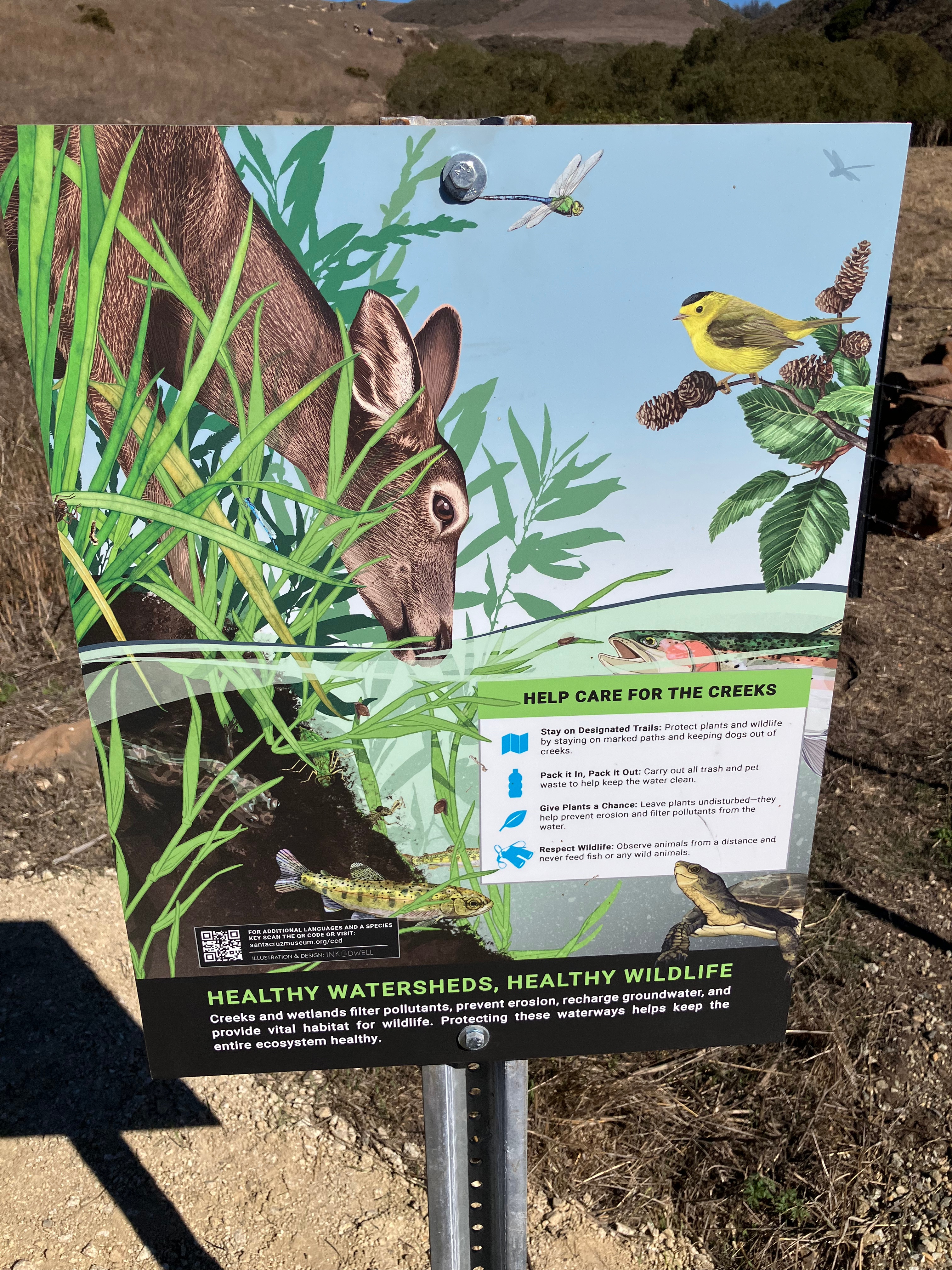
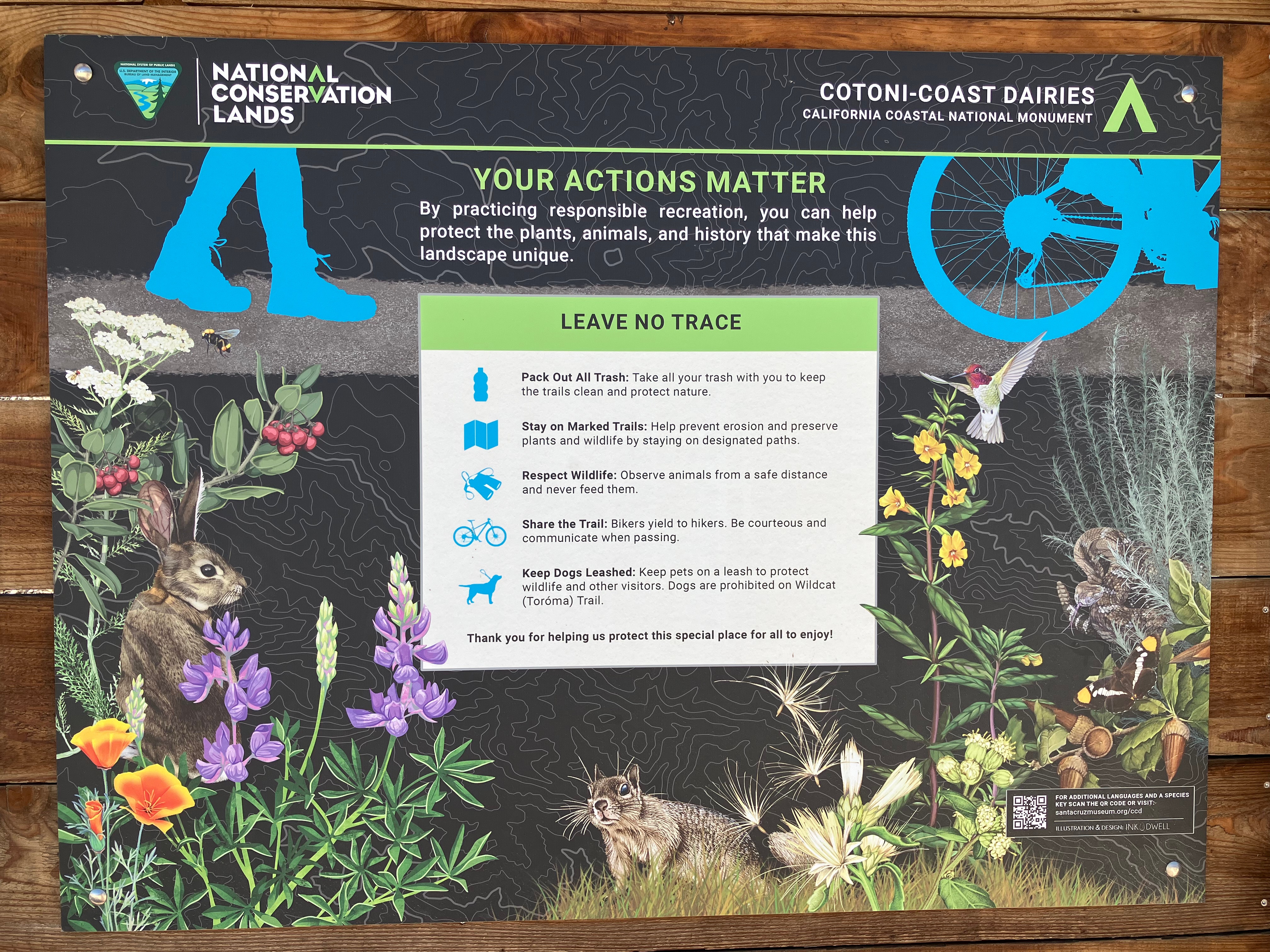
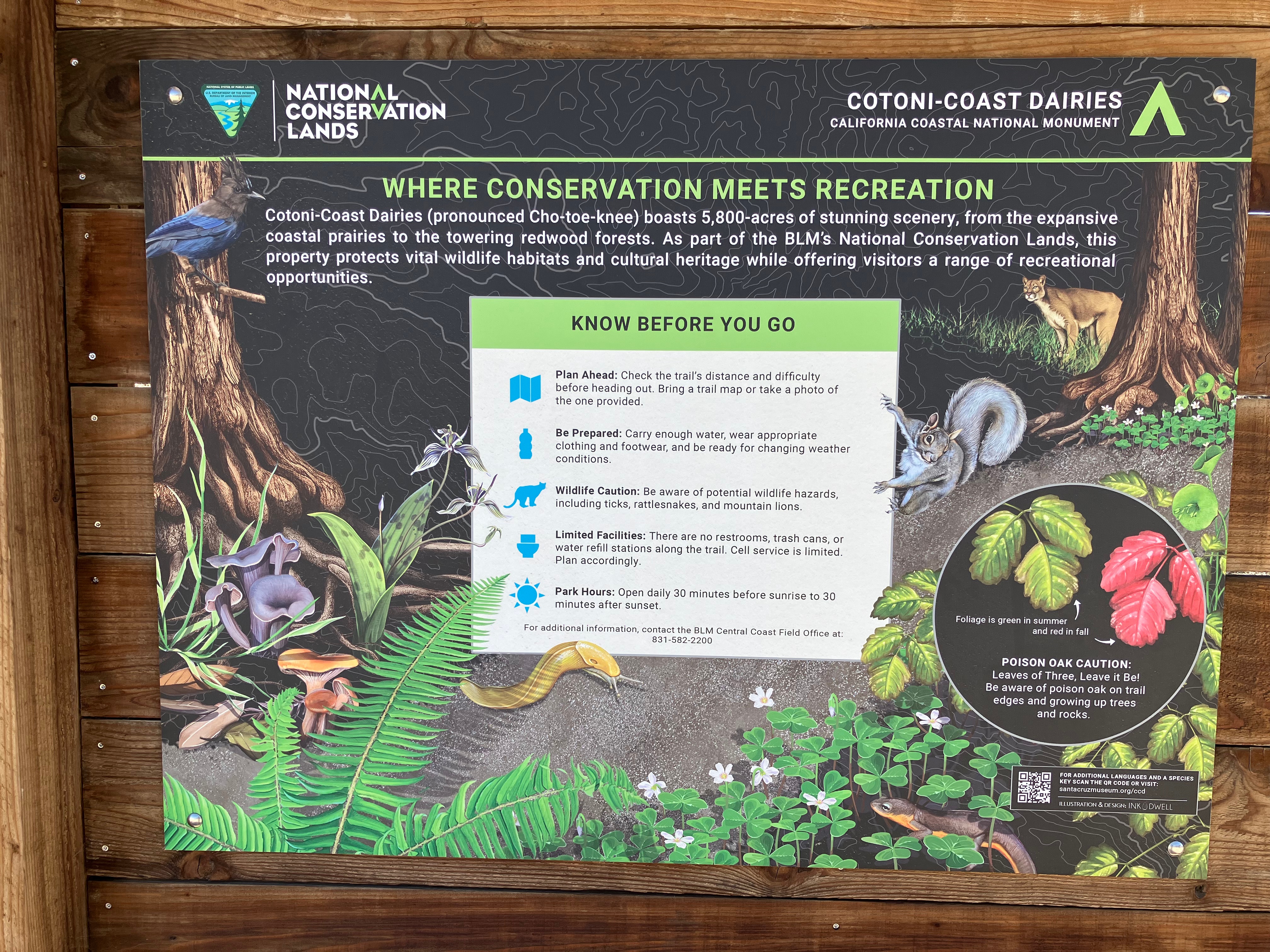
The interpretive signs have minimal interpretation of nature but lots of rules. If you don’t speak English, you better have a smart phone (and reception!) if you want to translate the signs, which don’t present even Spanish language translations. One of the rules is to stay on the marked trails, but there are well worn and often-used roads that aren’t labeled for access but frequently used by mountain bikers. The trails are too narrow and the sides too steep to accommodate mountain bikers comfortably passing hikers. During a recent visit, I experienced a mountain biker who was furious about being interrupted from bombing down the trail…there was nowhere to get off the trail– after a wave of explicatives, red faced and loud, the biker stumbled past me, his embarrassed girlfriend trailing. But, pedestrians far outnumber the barnstorming bikers who are no doubt made all the more angry because their volunteer work hasn’t panned out for their unimpeded high-speed endorphin-laden ‘rad times.’ Such glowering is occasionally interrupted by the too-frequent trailside plastic tacky signs profusely gushing about the generosity of mountain biking volunteers for everything the visitor might experience.
“Innovative” Cattle Grazing
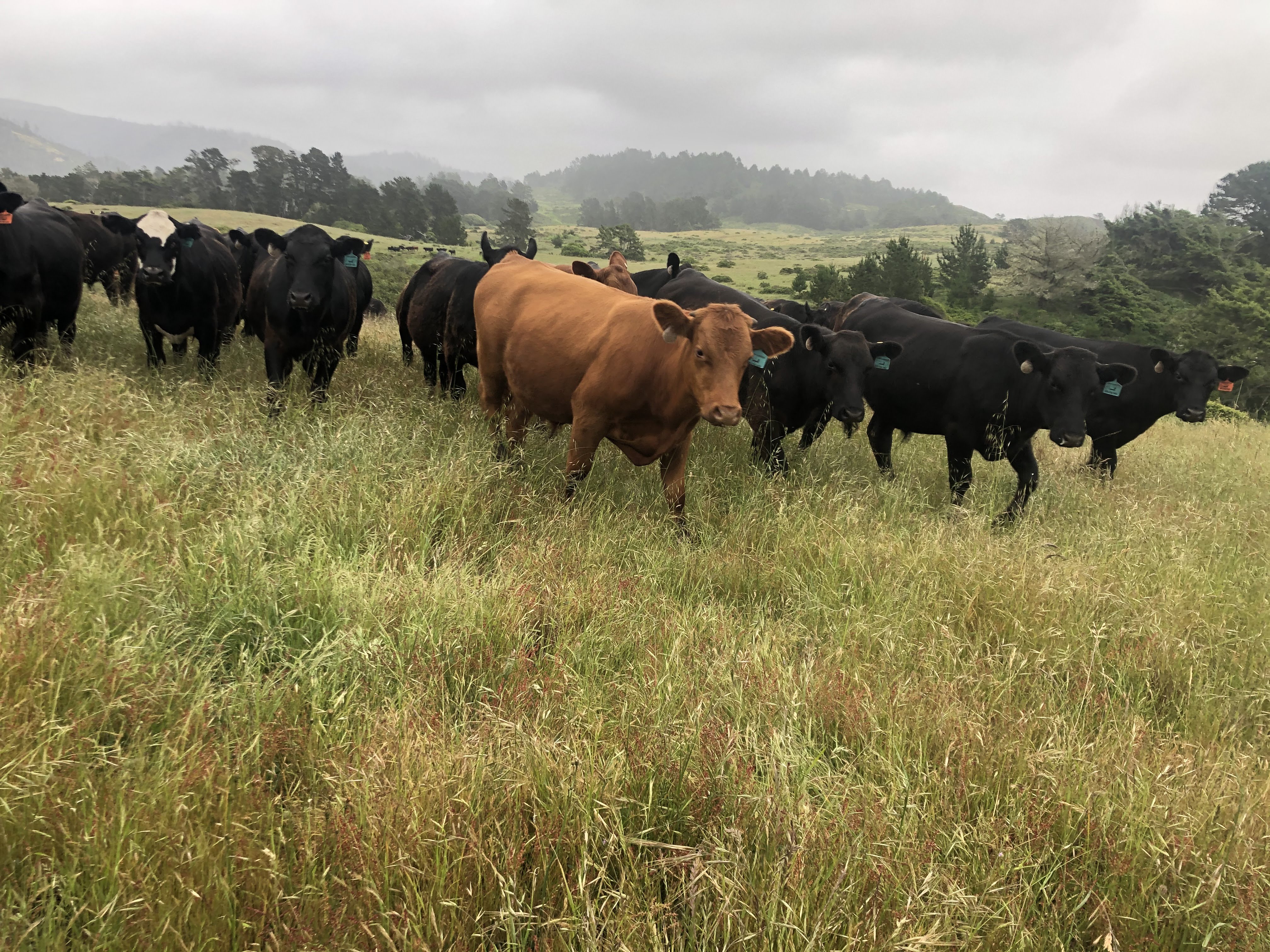
One of the mandates for BLM at Cotoni Coast Dairies was changing the historic livestock regimes to something more innovative and natural resource protection oriented. Up went super expensive high-tech antennae. Cattle were fitted with electronic shock collars designed to train them into grazing within ‘invisible fences.’ Innovative, indeed- especially if there was a grazing PLAN (there isn’t)! As of Spring 2026, this technology remains innovative in one way only: convincing the public that something innovative is happening with the livestock program: otherwise, no one has turned on the switches to make the system active. However, innovative livestock management isn’t the only thing lying dormant on the landscape…
Science-Based Land Management
At the apex of conservation lands are National Monuments, which (logically!) must publish science strategies to support their (also mandated) Management Plans. Being one of many units of the California Coastal National Monument, Cotoni Coast Dairies required BLM to publish a “science strategy;” this was completed in April 2026 with the help of experts at the US Geologic Survey, a decade and two years after BLM acquired the property…and long after the agency made seemingly permanent decisions about recreational access.
Along with such science-based strategies, BLM is required to update its California Special Status Animal Species list every 5 years. The last one was published in 2019 and the most recent update was due in 2024. Where is it? Not on their website. Have they, as required, worked with the California Department of Fish and Wildlife to collaboratively develop that updated list? Who knows? (a message back from CA BLM says that they have not updated the wildlife list as of March 2026) One thing of interest…the mountain lions on the Central Coast have recently been listed as Endangered by the State of California. As such, pumas should receive priority protection by BLM at Cotoni Coast Dairies, applying Dr. Wilmers’ (UCSC) research findings indicating the importance of protecting large areas from any human visitation whatsoever and planning for wide, forested movement corridors. The emphasis here is on forested areas, which on Cotoni Coast Dairies are being threatened by French broom invasion.
Broom Farming
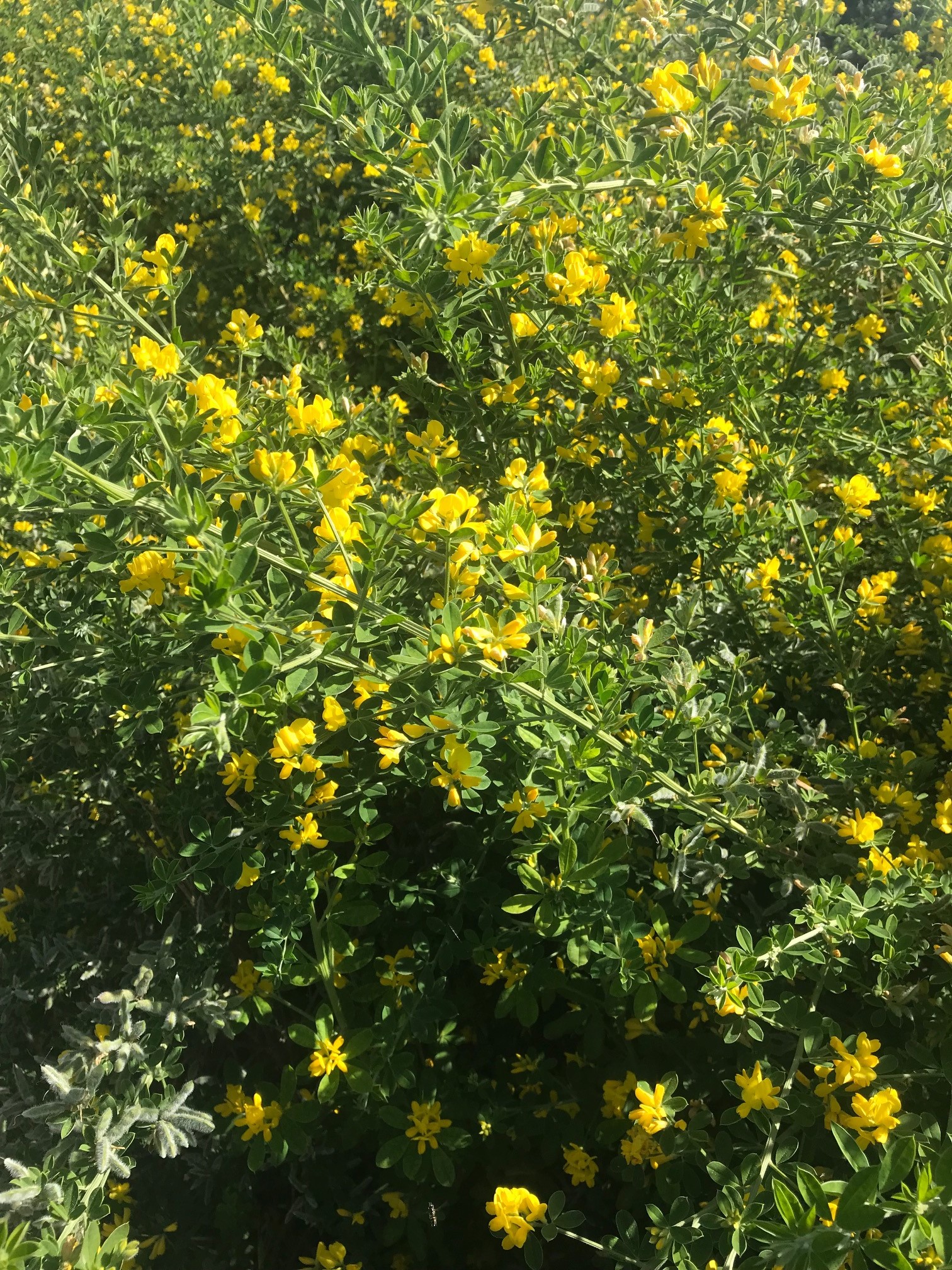
The BLM at Cotoni Coast Dairies has been officially recognized for their expertise in French broom farming by the Invasive Species Agricultural Association (ISAA). President Rex Fowler, in awarding the distinguished prize noted, “BLM has exceeded expectations both in fostering the health of, and increasing the spread of, the dreaded and most pernicious invasive species French Broom. We look forward to marveling at extensive fields of this excellently invasive pest for generations to come.”
Hillsides of once diverse prairies, stands of majestic coast live oaks, and ridgelines of coastal scrub and maritime chaparral are being overrun by monocultures of French broom at Cotoni Coast Dairies. With a seedbank that lasts 40+ years, the scope of any eventual control program is expanding rapidly. BLM managers’ unsubstantiated smokescreen for corrupt, self-serving sole-source contracts with mountain bikers for spending hundreds of thousands of dollars on visitor use access was the proclamation that ‘there shall be no land management until visitors are flooding the park.’ Well folks- what now? Visitors are flooding the park! Now we hear ‘we must drill baby drill!’

What Next?
There is an opportunity in the current Administration to solve this mess. What?! How so?? The Federal government has been murmuring about dumping federal property: why not give it back? Back to who? How about the Amah Mutsun? California’s land back movement is gaining momentum. Let’s give the land back to the tribal people! Why not?


interesting and sad
LikeLike
Yes, super sad…the saddest part about this is that the outcome was so predictable: whoever had the audacity to hand the property over to the Federal Government should tell their story about their logic. Awaiting that.
LikeLike