travel

Beavers

Beavers are again being recognized by humans as creatures crucial to holding together the natural world across much of North America and Europe. Where they are able, beavers create wetlands. Those beaver wetlands do so much for so many other beings, including us. Let’s explore California’s beaver resurgence for a few minutes.

History

There once were two beaver species, then only one living alongside indigenous people, then even those were nearly wiped out. In modern time, beavers have been variously killed, ignored, restored, or coexisted with. The Big Beaver of the Pleistocene, like so many other species, winked out when humans arrived on the continent. Probably they were too tasty. Its smaller cousin, though, survived. There are names for beaver in many native people’s languages across California. But the Old World Peoples persecuted both the native peoples and the beaver. Beavers were trapped to extirpation so early in those terrible times that as records started being written, there was already doubt that beavers had ever been in most places across the State. The state’s wildlife department finally protected the few remaining of the species and then began restoring them. Beavers, farmers, water managers, and road departments had problems working it out, so the State started allowing, and still allows, beavers to be killed where they cause too big of problem. 

Over the past 20 years, brilliant folks from Back East figured out a way to solve some of those problems, so beaver coexistence technology is now a thing in California. At the same time, in just the last 5 years, our wildlife officials have started translocating problem beavers to restore the species in more places. These recent pro-beaver developments come just in time for so many reasons.

Beaver Biota

Where beaver go, many follow. Three weeks ago, I saw a river otter stick its head out of the water in a pond behind a beaver dam. River otters follow beavers as do ducks, egrets, herons, kingfishers and so much more. Rare amphibians and reptiles likely were once more abundant due to beavers, including California red-legged frogs, San Francisco garter snakes, California tiger salamanders, Western pond turtles, and Santa Cruz long-toed salamanders. Mostly, those rare species rely on manmade cattle or farm ponds nowadays, but what about before those? 

I have studied the landscape for 50 miles in every direction around Santa Cruz and have found very few natural ponds. Coastal ponds are either in earthquake faults, vernal pools in ancient dune declivities (e.g., Ft. Ord), or impoundments at the back of more modern dunes. These situations are all quite rare. Looking further abroad, there are more vernal pools in the Central Valley and one can imagine oxbow lakes along many of California’s rivers before modern humans messed so much by channelizing rivers. If we could restore beaver to the landscape, I’m betting we could recover frogs, snakes, turtles and salamanders…and even fish! Most agree that California’s many species of super endangered salmon once thrived in the food-rich backwaters of beaver ponds.

I could go on and on about the many other wetland species that follow beaver pond architecture, but I’m thinking you get the idea.

Fire Stop

Recently, “Smokey the Beaver” has become a meaningful meme. In the past decade Californians have witnessed catastrophic infernos raging across the landscape like no one had previously imagined was possible. Across the West and north through Canada the same pattern has been emerging: big, big fires fueled by climate-change-induced drought, heat, and winds. The solution to fire: water. When beavers dam rivers and streams, they create fire breaks. In the huge footprints of “The Big Black,” post-fire, thank the beaver for the green strips that offer refuge to whatever wildlife may have survived the blaze. I have stood my ground on the edge of two approaching wildfires and have witnessed masses of fleeing deer, rabbits, wood rats and more running from the flames. I imagine those creatures finding beaver wetlands and hunkering down, eyes wide, hearts racing as the world around them crackles, roars, and burns. Beaver firebreaks can help save human lives and infrastructure, as well.

The Wetting

Beavers make it possible to rehydrate the West. Their dams are speed bumps for floods, slowing the surge, spreading floodwaters across floodplains, and hydrating large swaths of valley bottoms. By storing rainwater behind their dams, beavers keep streams and rivers flowing farther into the season of California’s long, dry summer. As water slows down behind beaver ponds, it can more readily recharge groundwater, too. Some have suggested that restoring beavers across the mountain meadows of the Sierra Nevada could store as much water as 2 large new reservoirs. That would be cheaper…and more sustainable!

Monterey Bay’s Beavers

Beavers are in the Salinas River all the way down to the Highway One bridge. Those riverine beavers are bank burrowers…they don’t make dams in such big rivers, but they sure like to eat the willows. You’d have to go south to San Luis Obispo before you found another beaver family. And, travelling north you would have to get onto private land along Butano Creek in San Mateo County to encounter our beaver buddies. Sometimes that population makes a more public showing downstream in the Pescadero marsh, where one mysteriously died this past year. What about prime beaver habitat in the Carmel, Pajaro, and San Lorenzo rivers? When will beavers arrive in those locations? Corralitos, Soquel, and Scott creeks also offer promising beaver habitat. Perhaps one day we can find a way to offer beavers a place alongside humans in some of those rivers or streams. Help spread the word!

-this post originally published as part of the decades-long news source for the Monterey Bay and beyond at BrattonOnline.org Check it out! Subscribe!! DONATE. Support journalism, even grassroots journalism, maybe especially grassroots journalism.

Another Trail ‘Study’

The Peninsula Open Space Trust (POST) recently published an article about a 2023 regional trail user survey. The author of the article, Zionne Fox, wrote about some of the results of the study, and her writing helps gain new insights into POST’s philosophy regarding recreational use in natural areas.

Summary of the Article

Ms. Fox’s “blog,” published on August 28, 2025, announced the findings of a ‘unique’ regional study by the Santa Cruz Mountains Stewardship Network that had purported to assess parks trail user expectations. Fox reports the percentages of different user groups (equestrians, dog walkers, hikers, mountain bikers) that want more trails. She also notes that non-white respondents were statistically under represented. The article suggests (without supporting data) that demand for trails is growing and that ‘open space operators need practices that can meet rising visitor expectations while preserving natural habitat.’ There was also mention about many equestrians hailing from Santa Cruz County and (again, unsubstantiated) a need for additional accommodation for multi-day trail trips.

Reporting Issues

The POST article fails in many ways to meet the standards of responsible reporting, but that is predictable given the organization’s overall tendencies. First, note that the study referenced isn’t, as the author claims, ‘unique,’ at all: another, more professional study covering much the same material was published not that long ago. Also, notice that there is no link in the article to a report about the results of the survey. With further research I find that the survey authors, the Santa Cruz Mountains Stewardship Network, lacks a link to any reporting on the survey results on its website. Without more details about survey methodology, statistical analysis, and results it is difficult to draw one’s own conclusions. 

Moreover, the article emphasizes only the survey results which correlate most with POST’s own goal of increased recreational use of ‘open space’ lands. For instance, statistics are provided for apparent unmet needs from various recreational groups, but similar statistics are not presented about the degree of concern for natural resource conservation, which is at odds with increased recreational use. In fact, in the ‘What’s Next’ portion of the article, there is no mention of POST’s or any other ‘open space operator’s’ intention to address survey respondents’ concerns about conserving and nurturing natural resources which suffer from over visitation. Similarly, POST suggests that those operators should focus on ‘preserving natural habitat,’ which curiously avoids the more concrete and pressing issue of conserving the specific species that are sensitive to natural areas recreational use. Habitat preservation is nearly meaningless to measure, whereas species conservation is much more useful and quantifiable, with a richer history of scientific rigor in informing open space management.

Note that the author of this article fails to mention any results from the portion of the survey asking about trail user’s negative experiences in open space areas. The survey asked poignant questions about negative interactions with dogs, people biking, shared trail use with other users, etc. Such conflicts are expected and are a challenge that trained park managers are used to addressing; unfortunately POST lacks staff with such expertise, so it is understandable that the author would avoid mention of this portion of the survey, which would otherwise reflect poorly on her organization.

The reporting insufficiencies and biases should not be surprising to those who follow POST. This is an organization focused on increased recreational use at the expense of species conservation. For instance, while on one hand cheerleading for the National Monument designation of Cotoni Coast Dairies, POST refused to sign onto a letter advocating that the designation include specific protections for natural resources. Peruse the organization’s website and you’ll find that species conservation is de-emphasized as opposed to an over-emphasis of recreational use of natural areas, which negatively affects nature. While being the best funded private organization working on open space issues in the Bay Area, POST has apparently never hired staff or engaged contractors that are professionals at managing visitor use in such a way that demonstrably protects the very species that require POST’s natural areas to survive. POST has published no reports or plans to address these concerns, at least none that are available to the public.

Methodological Issues

On its face value, the survey issued by the Santa Cruz Mountains Stewardship Network lacked the rigor to make the kinds of conclusions that POST suggests would be valuable. As opposed to previous, more rigorous studies the survey failed to sample the breadth of the population with interests in open space areas. POST notes that proportions of respondent self-reported ‘race’ did not reflect the population as a whole, but failed to note how the survey may have also biased certain user groups over others (mountain bikers vs. hikers, etc). 

One would expect to encounter survey bias given the mode of delivery. The survey was a web-based survey distributed by social media networks. Open space organizations have recently become increasingly aligned with a vocal minority: well-funded mountain biking advocacy groups who undoubtedly circulated the survey in order to impact the results. Other trail user groups may have been under-represented because they have little exposure to those particular social media networks or because they lacked the computer technology to respond.

Cautionary Conclusions

We can learn valuable lessons from POST’s reporting on this trail user survey. Given the power of POST, we should continue to be vigilant about the group’s propensity to favor increased recreational use of open space lands at the cost of species conservation. This bias should make us question the organization’s ability to manage funding tied to protection of public trust resources. POST is a donor-funded organization, and so some degree of pressure from donors could help to steer the organization more towards conservation. We should also recognize that POST is not alone in making these types of mistakes. It appears that the Santa Cruz Mountains Stewardship Network is also allied with such thinking, and we have seen other conservation lands managers approaching open space management with similarly unbalanced methodologies. These trends must be reversed if we are to conserve the many species of wildlife which are sensitive to poorly managed recreational use in our parks.

As time passes and we stay alert to the possibilities, we will see if the poorly executed SCMSN trails user survey results are used to justify or rationalize actions by POST or other members in their network: wouldn’t it be a shame if they were?

-this post originally published in my column for BrattonOnline.com – a weekly blog with movie reviews and posts by very interesting people on matters near and far. I recommend subscribing to it and donating so we can continue this long tradition.

Cotoni Coast Dairies BLM Land Opens to Public

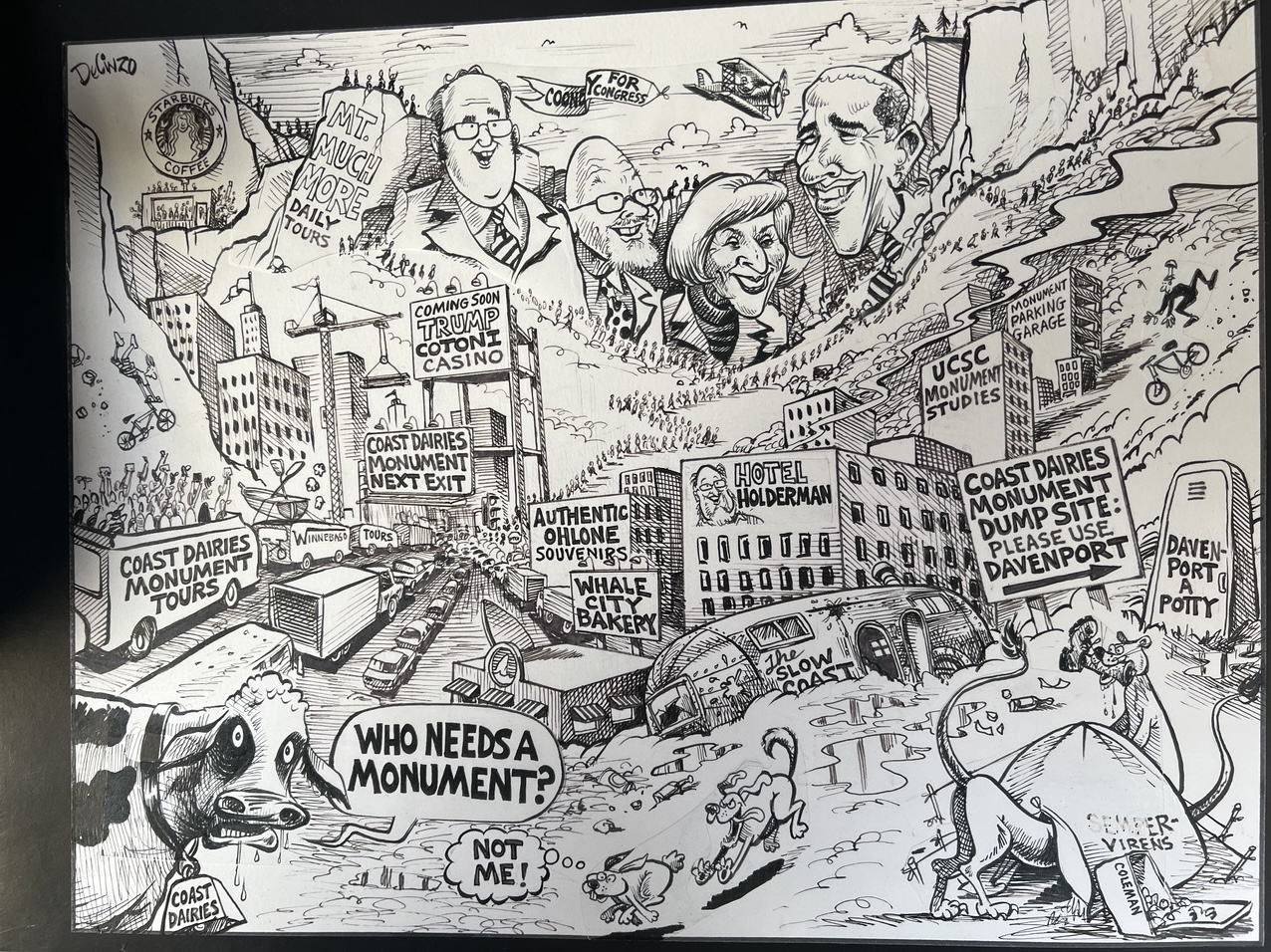
The opening ceremony for public access onto the Federal Bureau of Land Management’s Cotoni Coast Dairies property was on August 15, 2025, a grim day for those who have followed this travesty, which will only worsen with the planned public access.

Many thanks to De Cinzo for this image

Building on a Tragic History

Nothing good led up to this moment. There is no one left who speaks the language of, or can show direct descendance from, the native people of this property. There are rich archeological sites illustrating that this land was settled for thousands of years. So, as with every spot in California we must see this property and how it has been and will be used as a colonialist endeavor. There is no attempt to give the land back to any coalition of First Peoples who represent those ancestors or to respect them in any way that approaches restorative justice. Oh, but there’s the name…(!)

After the genocide, the land has seen one extractive use after the next with little regard for conserving nature. The ‘Coast Dairies’ portion of the name points to cows, and cows there still are. The grazing regime has never focused on restoring the very endangered coastal prairies on the property and, even now, there is no plan to do so. This recreational use is a new, highly impactful extractive use. The property is rare for the Santa Cruz Mountains in having had very few human visitors for the last 100 years, so wildlife has been accustomed to roaming without disturbance. Cougars and badgers are especially wary of humans when setting up dens. A million visitors a year will soon be visiting and wildlife will flee.

The consortium of people responsible for so many other, better outcomes for conservation tried hard, won some concessions, but have seen great loss with how this property came to be open to the public. We tried to get anyone but the Federal Government to manage the property, but the Open Space Illuminati had other things in mind…’The Great Park’…a handful of boomers wanted their legacy in a wide swath of the area becoming a National Park. They stopped at nothing to achieve that legacy. The activists, biologists, conservationists, and regular citizens, were even sued to strike fear into them, to make them capitulate.

Money Made it Happen

The Wyss Foundation bankrolled cash-strapped ‘conservation’ organizations to create a fake grassroots campaign that culminated in Obama signing a Monument Proclamation adding 5 properties across a wide swath of coastal California to the California Coastal National Monument. 

Then, the BLM routed hundreds of thousands of dollars, sole-sourcing a contract to a mountain biking advocacy organization to build the kind of trails their users wanted to see. That business quickly changed their name to a ‘trails’ organization. Instead of supporting good paying local jobs, the BLM paid this organization to rally volunteers to do the work of installing trails that were placed across a landscape without regard for the wildlife written into the President’s Proclamation for protection. When asked about how they could do such things when the property’s designation required favoring conservation over visitor use, BLM cynically snickered that the majority of the property, 51%, is set aside without public access. The rest, apparently, is a sacrifice zone.

What We Wanted and Will Pursue

Those of us who care about the native peoples, the nature of the property, and the experience of future visitors have a vision, which we will pursue despite setbacks. The land should not be Federal land – if you wonder why, you need to look at the current situation with federal lands nationwide. We always knew this, but now others are starting to understand our concerns. The current administration is selling federal land for real estate development and other extractive uses. If, after cutting the federal workforce, there are any staff remaining to manage the land at all, that will be a surprise. The Administration has said Federal lands will remain open to visitors even if there is no staffing or budgets. Oh no- could my dystopian vision for the property be closer to reality?!

 If there is a chance, California should buy Cotoni Coast Dairies. Then, let’s envision taking Canada’s Indigenous Guardian’s project to this place, giving tribal people primacy in stewardship, use, and oversight. Perhaps the State could give the land back, as it has just accomplished with the Yurok.

If the property is to remain a public park with visitor access, there needs to be a radical shift in how that is approached. The regulatory designation for first managing the property for conservation needs to apply even to the areas with public access. This will require altering use patterns, even closing the trails occasionally, for the benefit of the soil, streams, wildlife and plants that Obama clearly intended to protect. There will need to be lots of monitoring and enforcement to adequately protect natural resources. The BLM will need to do a ‘carrying capacity analysis’ to determine ‘limits of acceptable change’ – thresholds that, if surpassed, trigger altered management of visitor use to bring the use into alignment with conservation. 

Next Steps

It will soon be possible for visitors to monitor the situation first hand. Those of us who asked to do baseline monitoring of wildlife and plants were refused the opportunity many times. When we asked how small children and the elderly could possibly co-recreate on trails overrun by fast-moving mountain bikes, our concerns were dismissed. We will be able to help document how well BLM’s rules are working and if there is enough enforcement. We will be able to see the spread of diseases introduced by bike tires and hiking shoes ravage the amphibians, the trees, and the soil, and we will recall how BLM staff predicted those impacts in writing, with administrators choosing to ignore even the simplest measures that hundreds of other parks managers have employed to address those concerns.

-this post updated to past tense from the one posted via Bruce Bratton’s legacy site BrattonOnline.com

Protecting Our Most Precious Spots

The most highly protected terrestrial areas around California’s Monterey Bay are designated as “Natural Preserves” by the California Department of Parks and Recreation and as “Ecological Reserves” by the California Department of Fish and Wildlife. Let’s explore where those places are, and how the State’s premier land management agencies are directed to protect areas with these designations.

CDFW Ecological Reserves

The California Department of Fish and Wildlife (CDFW) manages 1.1 million acres of land in California. Unfortunately, CDFW does not publish summary statistics about how many of those acres are designated as Ecological Reserves, which have the highest protection of any state-owned public lands, as reflected in the following regulatory language:

“….ecological reserves are maintained for the primary purpose of …..protection of rare, threatened, or endangered native plants, wildlife, aquatic organisms, and specialized terrestrial or aquatic habitat types. Visitor uses are dependent upon the provisions of applicable laws and upon a determination by the commission that opening an area to such visitor use is compatible with the purposes of the property.” (Cal. Code Regs. tit. 14 § 630Additional Visitor Use Regulations on Department Lands Designated as Ecological Reserves).

Note the stress on maintaining these properties for species and habitat conservation, first and foremost. And note that it takes a vote by the California Fish and Game Commission to allow any visitors to use those properties. Any such vote must be supported by an analysis of the impacts of such visitation on the species and/or habitats that the Ecological Reserve was designated to protect.

Local Ecological Reserves

The two CDFW Ecological Reserves that people regularly visit around the Monterey Bay are the Elkhorn Slough Ecological Reserve and the Bonny Doon Ecological Reserve. The two other CDFW Ecological Reserves do not allow public access without special permission: Quail Hollow and Watsonville Slough.

The Elkhorn Slough regularly has many visitors. The Fish and Game Commission appears to have at some point voted to approve visitor use at that property. However, a Commission-approved Elkhorn Ecological Reserve Management Plan outlining how visitor use is compatible with the conservation purposes of the property is not readily available. So, unfortunately, I can’t tell you what ‘conservation purposes’ were designated when the property was afforded such a high level of protection.

The other CDFW Ecological Reserve that the public visits was founded with the conservation purposes, according to their approved management plan, from 2003:

“The Bonny Doon Ecological Reserve (BDER) contains the largest and most pristine remaining occurrences of several rare plant communities which are limited to ancient marine sand deposits in Santa Cruz County. These communities contain three plant species which are considered to be rare or endangered: Santa Cruz cypress (Cupressus abramsiana) and Santa Cruz wallflower (Erysimum teretifolium), both listed as Federal and State endangered at the time of acquisition; and Ben Lomond spineflower (Chorizanthe pungens var. hartwegiana), which has subsequently been listed as Federal endangered….The BDER acquisition represented a unique opportunity to preserve a comparatively large area of rare habitat in nearly pristine condition”

In contravention to the regulation cited above, CDFW has allowed public use despite the Fish and Game Commission never having approved visitor use according a plan analyzing the compatibility of visitor use and protection of the Bonny Doon Ecological Reserve. Moreover, such a plan would also be required to have a Coastal Development Plan, approved by the California Coastal Commission. The 2003 management plan alludes to the need for a trail plan, but it is not clear if the plan’s environmental impact sufficiently addressed issues associated with the vague plans outlined in the document. The plan did, however, require creation of a monitoring program that designed to trigger changes in visitor use and trail maintenance. {ask for monitoring reports}

State Parks Natural Preserves

The California Department of Parks and Recreation manages 1.6 million acres of land. As with CDFW, Parks does not publish how many acres are designated as Natural Preserves. Natural Preserves have the highest protection of any State Parks managed lands, as reflected in the following policy language:

“… natural preserves will be established to give full protection to environmental and ecological integrity, from the standpoints of watershed influences, scenic and visual unity, cultural values, and other appropriate environmental factors.

Developments in natural preserves are limited to trails and interpretive facilities required to make possible the visual and sensory enjoyment of the resources by visitors. Vehicle access and parking are not appropriate; visitor centers, restrooms, structures, and facilities other than signs shall be placed outside natural preserves.

Bicycles are allowed only on paved roads in…Natural Preserves.”

Note the language, as with CDFW, stressing the primary importance of these State Parks areas for ecological conservation, and how Parks adds to this designation watershed processes and areas of cultural significance.

Local Natural Preserves

There are 5 Monterey Bay spots with State Parks Natural Preserve designation: Wilder Beach Natural Preserve (small, Wilder Ranch State Park); San Lorenzo Headwaters Natural Preserve (1800 acres, Castle Rock State Park); Theodore Hoover Natural Preserve (23 acres, Big Basin State Park); Año Nuevo Coast Natural Preserve (925 acres, Año Nuevo State Park), and; Point Lobos State Natural Preserve (550 acres). A large portion of the Año Nuevo Coast Natural Preserve has restricted public access and there is no public access allowed at Wilder Beach. The other spots allow public access, but, as noted in the above policies, no one is allowed to leave trails in areas with this designation, and bicycles are not permitted except on paved roads.

One Natural Preserve is missing from State Park’s list: the one that was to be designated for the coastal prairies in upper Wilder Ranch. During the process of approving use of that part of the park, Parks was discussing designation of vast areas of the diverse grasslands as a Natural Preserve. However, it turned out that Parks never updated the Wilder Ranch General Plan and so didn’t pursue such a designation, possibly due to opposition from mountain bikers.

How Are They Doing?

Many people reading this will be familiar with at least some of the areas listed above, places afforded the highest levels of conservation protection. For each spot, ask yourself: how are the managers doing? Do those areas seem to be better managed for conservation than other places? In the case of Wilder Beach, are snowy plovers nesting there…do people get away with trespassing there? In the case of the Bonny Doon Ecological Reserve, is visitor use truly compatible with protecting the many species and habitats, which includes the most endangered ecosystem in North America? How can we tell these stories and help the managers elevate these very special places to give them the protection they deserve?

-this essay revised with new information from that which appeared in June 2024 at Bruce Bratton’s inimitable Monterey Bay news source at BrattonOnline.com