Santa Cruz

Blue Skies, Bursting Blossoms

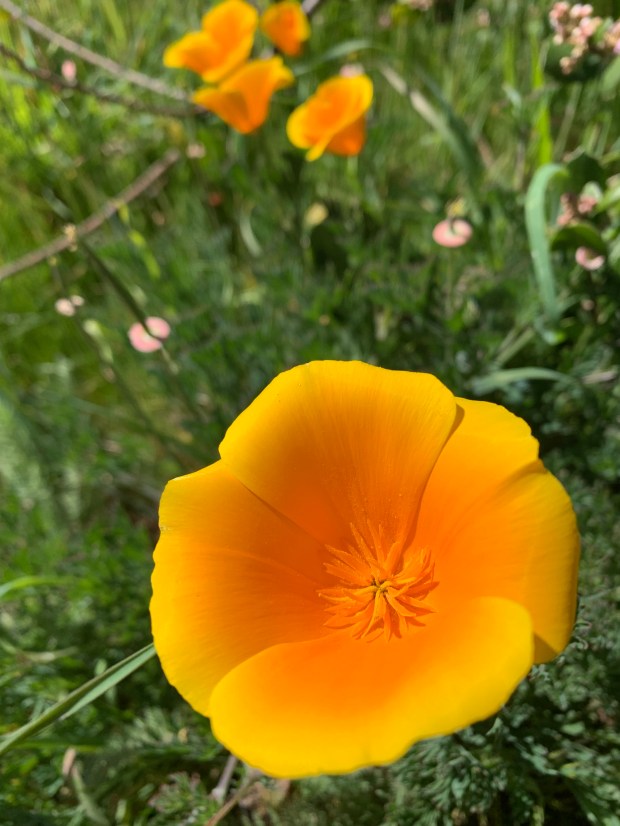
Right on time, the first tulip-sized California poppies have opened. Unusually, and a month early, the sky lupines have started blossoming, as well. The habitat areas, field margins, the hedgerow, and the orchard are starting to fill with Spring blooms. We hope for the return of rain before Spring’s beginning date arrives.

Lupinus nanus Sky Lupine Too early, but still nice

For a few nights, the air has carried a winter scent, like snow; frost decorates leaves in the grassy areas and wild radish leaves wilt from cold damage. We check the margins of avocado and citrus leaves to see if they are damaged. But, its only been evaporative frost- we still haven’t hit critical freezing temperatures! The cool temperatures are helping some fruit trees to sleep well, but others are waking up. The Santa Rosa plum popped into bloom – it only needs 250 accumulated hours of temperatures below 45 degrees Fahrenheit. Other stone fruit trees are budding and/or blooming in the orchard.

Juicy Santa Rosa Plums start with brilliant flowers

The semi-cacophony of blackbirds continues, and other birdy things are happening, too. The blackbirds mostly gather in one tree but as you look around, the party has outliers as bicolor blackbirds court one another away from the crowd. I watched for a while as one outlier male bicolor blackbird did his thing: the trilling scree song while bowing slightly, wings shrugged out, flashing his bright red wing patches. A few feet away, a female watched in rapture…it was just this pair alone at the top of an isolated tree, though they kept glancing towards their flock in the tree nearby. Buzzing by, not entirely oblivious to the blackbird antics…hummingbirds, up to their own shenanigans.

Somewhere, I heard that the blossoming of the flowering currants triggers estrous in hummingbirds. Allen’s hummingbirds returned with those blooms from somewhere Way South. I’m not sure how the year-round resident Anna’s hummingbirds like them. Bright flashing throats and aerial sparring is constant around our yards and up and down the hedgerow. Flowering currant isn’t common in the wild around here, though you can find other, less showy species in that genus in the forests surrounding the farm- the hummingbirds like those, too. With the early nesting of hummingbirds under way, it is time to closely inspect any brush we are clearing before chopping it down. There never seems to be enough time to cut out brush for fire safety, especially when being careful with nesting birds.

Ribes sanguineum glutinosum, pink flowering currant – hummingbird food!

The farm fields are sleeping…the cover crops have slowed down with so little rain. The soil surface is dry, road traffic makes dust again. Limes are ripe, tangerines and oranges have color but no sugar, yet. Meyer lemons are hanging heavy and ready to go into lemonade or pie.

The Molino Creek Canyon has changed so much since the fire of August 2020. Big trees and many burn damaged redwood branches have crashed down across the hillside around our farm’s beautiful wintertime waterfall, which is flowing and noisy still. It is difficult to hike there, but we’ll open up the paths again soon with chainsaws and muscle. I’ve been exploring Molino creek, which was heavily scoured by the big rains in December. Now, it is so much easier to walk by the creek- no vegetation and a rocky sidewalk of a path alongside the clear running stream. There are potential dunking holes for the summer and wide rocky beaches. The large expanse of sandstone bedrock has accumulated a covering of redwood seeds. Last year, the redwoods made an Epic Cone Crop, with cones much larger than anyone had seen before. The branches were heavy with cones. For the last month, those seeds have released from the opening cones: dropping and scattering onto the ground. Now there is a red-brown scattering of the delicate seeds. In moist cracks, the seeds are germinating: a new crop of redwoods, just as their mother intended- a rare sight as redwood seedlings only ever get going on bare ground following a fire.

-I published this at my regular blog at Molino Creek Farm’s webpage.
Early Spring Understory Blossoms

If you are observant, the forest’s meandering and dappled light is just now illuminating the beginning of spring’s wildflowers. Patches of bright blue, pure white, pale pink, and startling yellow are the first of the sequence of forest understory flowers that bloom now through August in the Central Coast’s many types of forests.

Hound’s Tongue’s Leaves and Flowers

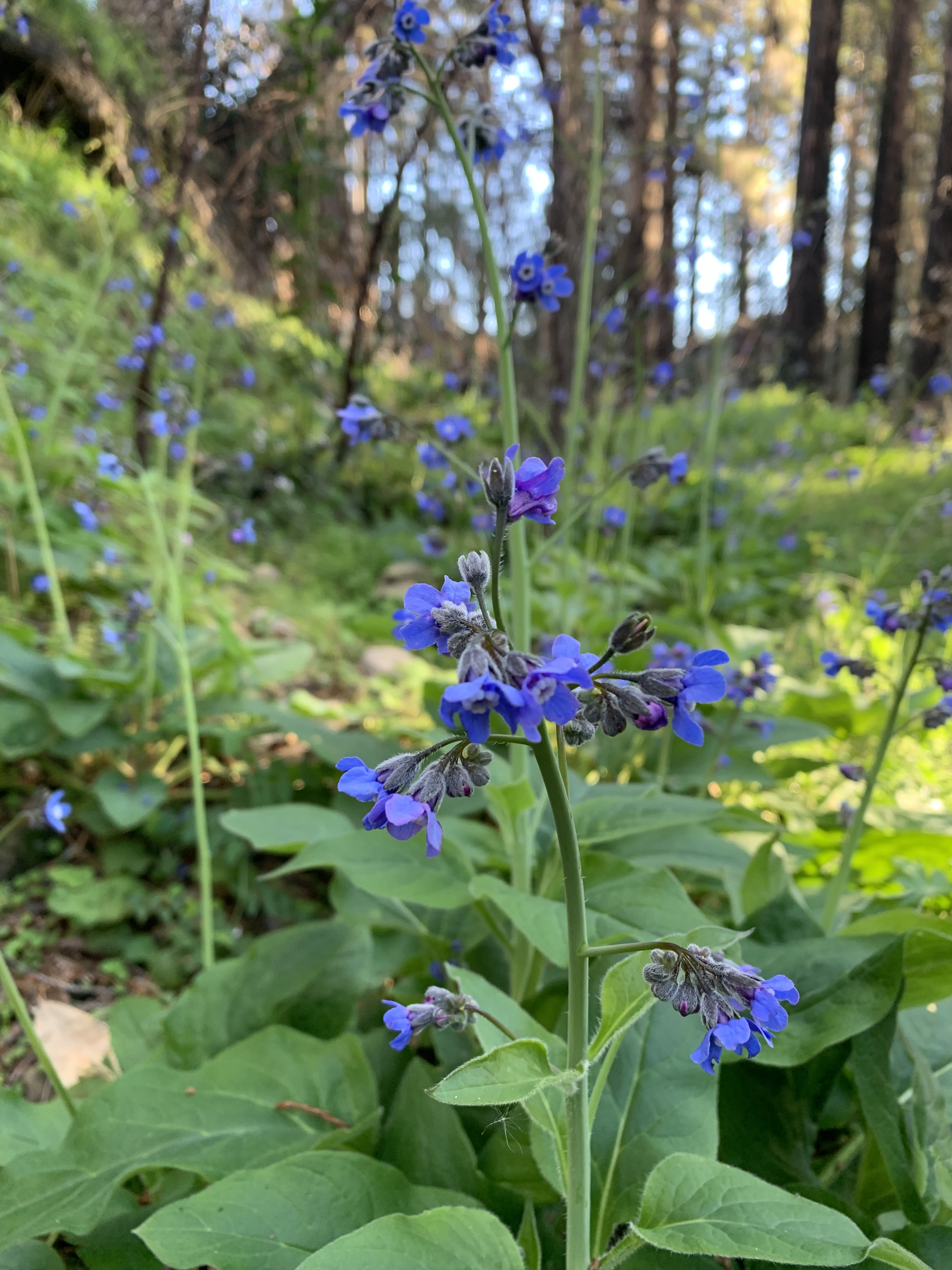
Perhaps named for the pink, in-rolled first leaves emerging from damp leaf litter, hound’s tongue provides the forest’s tallest and brightest blue bouquets. This is a perennial wildflower most commonly found in sunnier patches in forests with oaks and Douglas firs. It must taste bad because I never see it browsed by deer or rodents. A California wildflower book from 1897 says that ‘in the old days’ people thought you could put the leaves under your feet in your shoes and then dogs wouldn’t bark at you. Many gardeners are familiar with a near look-alike relative, borage. The healthiest plants make many flowers, widely spaced on a branching two-foot-tall inflorescence. Today, I saw bumble bees, honeybees, and hover flies visiting the flowers. Bumble bees were especially numerous, and when they latch onto the flowers, which are much smaller than they are, the whole plant bobs and waves, drawing attention from other pollinators. One plant in a hundred produces light purple-pink blossoms instead of the normal blue. This makes me wonder if we are witnessing the blue era of hound’s tongue…maybe one day eons from now, this species will evolve purple or red flowers.

Hooked Fruit

If they get pollinated, each hound’s tongue flower will make a cluster of 4 fruit that hang tight to the stem until they snag on a passing animal. Starting late Spring, a forest walk will make you clean your clothes, and in that mass of messy seeds pinched from your socks, you might encounter these wild borage seeds. The seeds are oval and fat with just enough hooks to grab onto someone’s fur. These hitchhiking seeds are the species’ way of establishing new patches, reducing competition with the parents. This might be especially useful when new colonies might establish in post fire areas.

Cynoglossom grande, Hound’s tongue, a bright blue understory wildflower

Catapulting Seeds

Another plant starting to bloom in the forest understory catapults its seeds for dispersal. Once ripe, the fleshy pods explode when touched, sending seeds into the air and many feet away. Since I’ve introduced this surprising behavior to many botanists, I’m guessing you’ll also be surprised about which plant has this trick: redwood sorrel! Yes, a plant with which many people are familiar performs this little-known novelty. You’ll have to get good at recognizing a ripe seed pod before you can experience it.

Sparkling Sorrel

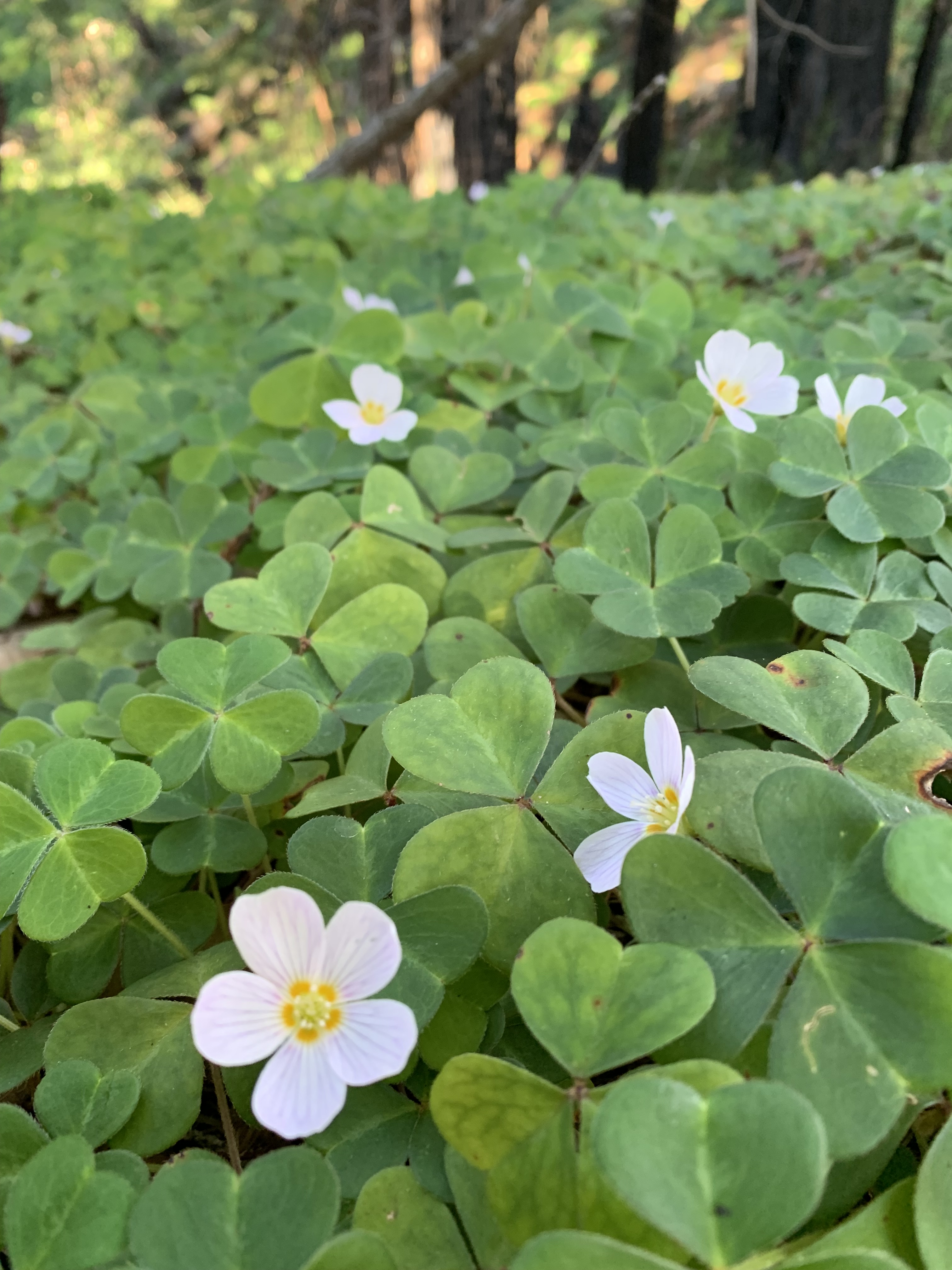
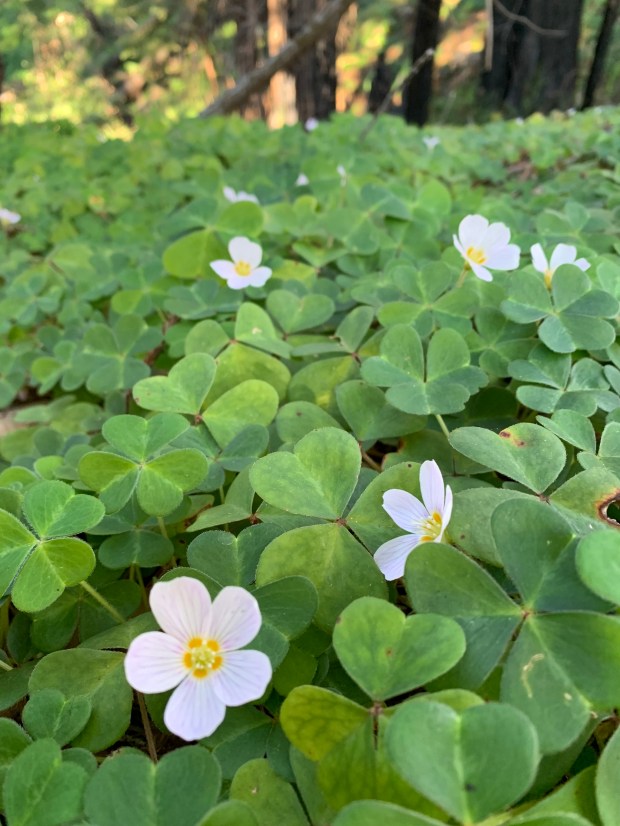
With the recent dry, warm weather, redwood sorrel has started to carpet the redwood forest understory with beautiful pink to white blossoms mixed with its lush medium green, 3-leafleted leaves. Come Saint Patrick’s Day, you might purchase sorrel or see it displayed, but you’ll never find a 4-leaved redwood sorrel (really, shamrocks are clovers, and it is possible to find a four-leaved clover!) In full sun on a hot day, redwood sorrel leaves fold down to keep from roasting. But, in the more typical cool dark understory, each leaflet tilts and turns, orienting independently to maximize light capture with the passing sun rays. The flowers open above the leaves and soon there will be so many redwood sorrel flowers that the forest floor will sparkle like the many stars of the night sky.

More White Forest Flowers

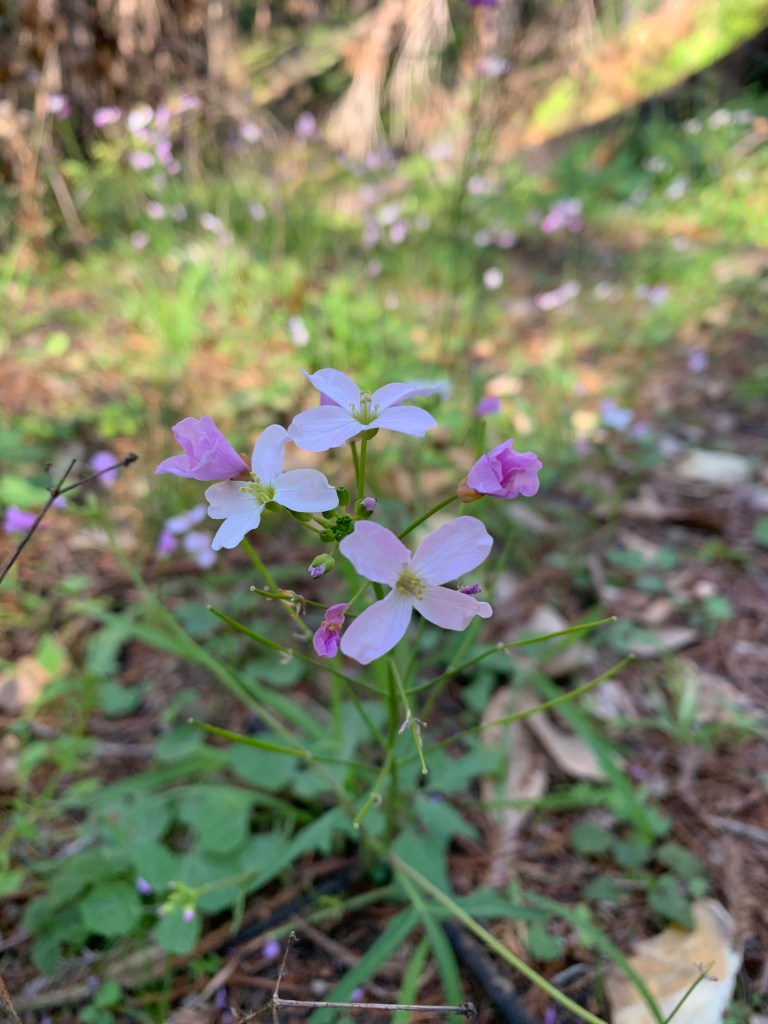
Another white to pink early spring forest flower is in full bloom right now, growing on the edge of patches of redwood and out into Douglas fir and oak groves. Milk maids is a relative of cress and has bright 4-petaled flowers, normally quite white (but ones near my house are quite pink). The description of this plant from the aforementioned 1897 book by Mary Parsons ‘The Wild Flowers of California’ deserves quoting:

“What a rapture we always feel over this first blossom of the year! – not only for its own sake, but for the hopes and promises it holds out, the visions it raises of spring, with flower-covered meadows, running brooks, buds swelling everywhere, bird-songs, and air rife with perfumes”

Milk maids is attracting a beautiful butterfly that matches its white flowers. The mustard white butterfly is the earliest butterfly you’ll see…besides the overwintering Monarchs…and you’ll almost certainly see it if you find a big patch of milk maids, upon which it lays its eggs. When the eggs hatch, the larvae will grow up feeding on milkmaid leaves. Once the larvae have pupated and grow into butterflies, they sip nectar from and pollinate milkmaid flowers. In this way, milk maids and mustard white butterflies have a close partnership.

Violá Violets!

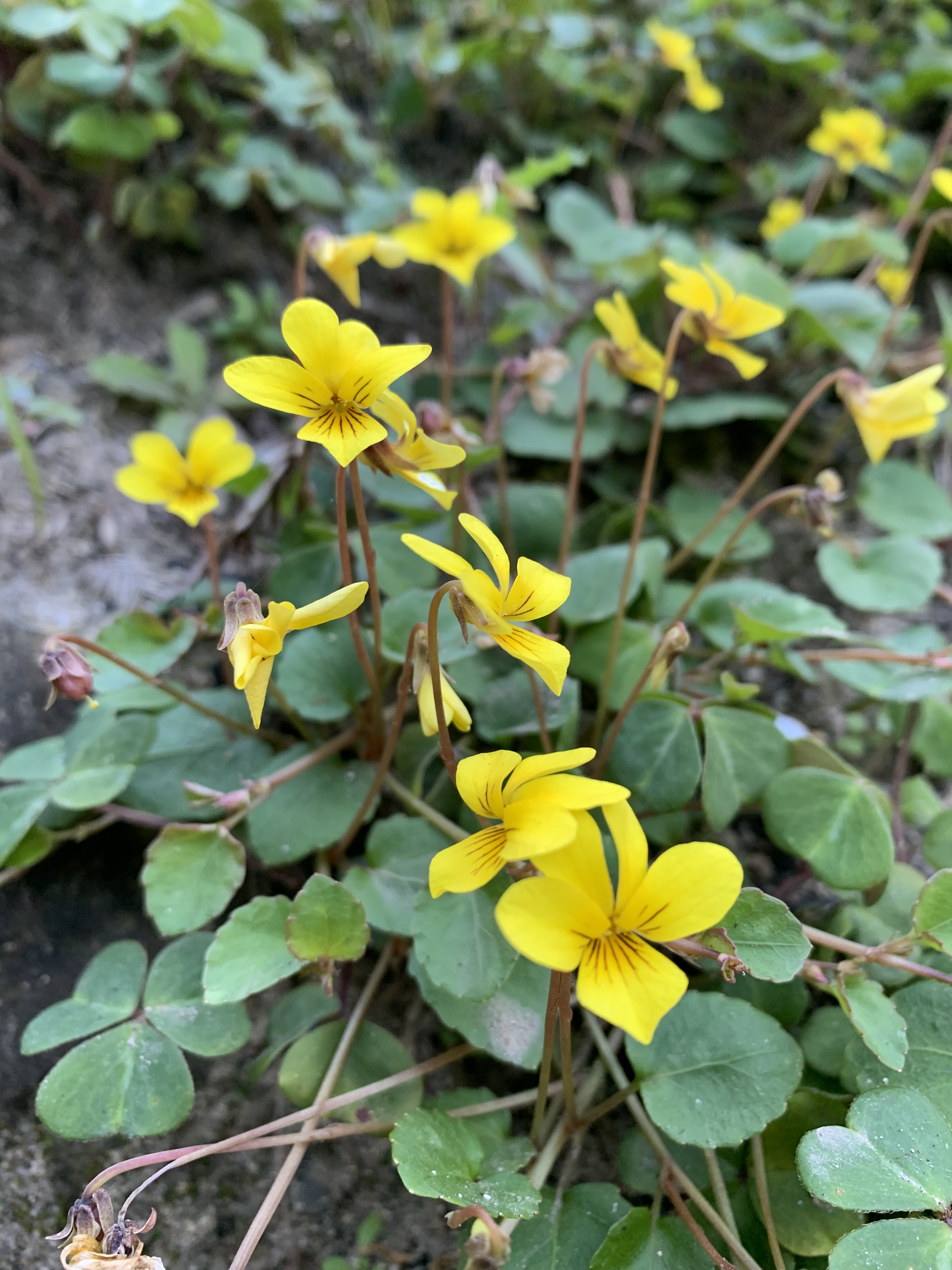
The forest violets have started blooming including my favorite, redwood violet, which makes carpets along banks and on steep slopes in many places near Bonny Doon. Redwood violet has bright yellow flowers that, like redwood sorrel, peek up well above a dense mat of leaves. If you look closely, you’ll see tiny dark red lines in the throat of the flower that lead pollinators to seek rewards inside of the flower. Redwood violet leaves are nearly round, except when you find the telltale sign of the butterfly that feeds on them.

Redwood violets with their vivid yellow blossoms bedecking the post fire understory

Violet Feeding Silverspot Butterflies

Silverspot butterfly larvae carve out semi-circular scallops in redwood violet leaves and, when you see those bite marks, that is likely the only hint that this butterfly larvae is around, because they feed at night! Arboretum Director Ray Collett alerted me about these silverspot butterflies 30 years ago. He had met a butterfly collector who pointed out Bonny Doon silverspot butterflies that matched the endangered Callipe Silverspot previously known only from San Bruno Mountain in South San Francisco. With that tip, a conservation geneticist friend of mine recently hunted our local one for a while but only caught one, which looks promising to be at least closely related to the endangered one, but more work needs to be done. Meanwhile, later in spring, we can be on the lookout for these mysterious and rapidly flying orange butterflies with silver spotted underwings that feed late at night on the beautiful yellow violet carpets of Bonny Doon.

The Parade of Spring

These early spring wildflowers are just the beginning of the succession of wildflowers brightening the shade of our forests. As the days get warmer and longer, each week will bring a new suite of species into bloom. The flowers are stewarded by pollinators in conjunction with mountain lions which chase around the deer enough so not every flower is munched. Human stewardship is helpful, too. We can help not only by controlling invasive forest species (forget-me-not, French broom, periwinkle, etc) but also by not planting what might be new invasive species, one day. In the future, perhaps we’ll appreciate the native wildflowers enough to propagate them for our gardens. With these native species come a wealth of pollinators including butterflies that rely on native wildflowers for their larval stages. Planned correctly, your forest garden will have a natural succession of flowers, bringing different colors to every season without any additional water and with little need for tending.

  • this story brought to you via my column the prior week in Bruce Bratton’s weekly blog at BrattonOnline.com

The Landscape We Need

Imagine you are a mountain lion, a badger, or a burrowing owl making your way around our region. Curiously, people often say, ‘I can’t imagine,’ but I contend that our imaginations are more powerful than that. We can imagine a lot if we have enough information to work with and give our minds the room to roam. We can put ourselves in the place of other species if we want, but only if we can face the pain that such empathetic contemplation may bring. We have left wildlife so little, but we have the power to restore healthy populations of wildlife for future generations.

Big Clever Cats

We have the great fortune to share this landscape with wild lions. To put yourself in the lion’s mind, imagine being a young male learning to walk from Aptos to Scotts Valley, getting across roads, keeping away from people, trying not to make their dogs bark, and staying under constant cover of forest. That young lion will also be learning, by scent, where girl lions are and where other murderous males have claimed territory.

Cat Map

Lions know how large to guard territories against one another to keep sufficient food for their families. Fresh deer are needed, one a week for each mature lion. A human hunter would be challenged to keep that pace up; it takes a lot of roaming. Mountain lions move under cover of trees, they shy away from moving around in the open if they can help it. They travel tree filled canyons, wooded ridges, and trails through the forests. To them, those places are like our road network- they must make mental maps as quickly as their young minds can do it, and those maps must keep receiving layer after layer of new information – especially where other lions prowl.

Badger

Two weeks ago, I was very pleased to find many badger-dug burrows in grasslands along the North Coast. Badgers look at the landscape in the opposite way that a mountain lion might. Where lions see woodlands as their comfy place, badgers prefer grasslands – maybe in part because of the lions in the forests! To imagine moving around the landscape like a badger, think about walking from the grasslands above Watsonville to the grasslands along the North Coast by staying mainly in grasslands, each night digging a burrow to sleep in, finding enough gophers and ground squirrels to eat along the way, getting across roads and never being seen by a human. That’s some tough going!

Burrowing Badgers

The burrows I saw were not fresh, and I couldn’t find a den. The badger foot tracks had been washed entirely away by a prior pouring rain. Probably this was a wandering individual, who kept moving after staying for a few weeks. Males disperse widely – even through forests. Someone was surprised to see a photo of a badger on their wildlife camera in a north coast redwood forest a few years back. I haven’t heard of anyone finding a badger burrow in a forested area.

Like vampires, badgers must be underground by daylight. Digging burrows is best done in sandy soil. And so, badgers’ mental maps include not only the network of grasslands, but also the subset of grasslands with homey sandy places where they can easily dig for food or make burrows.

Santa Cruz Badgers: Gone

There used to be badgers near Santa Cruz, not that long ago. They still occasionally happen through. When UCSC’s Chris Lay compiled local badger sightings and analyzed this species’ local disappearance, he concluded that roads explained badger demise. Roads are a big challenge to badgers. The frequent median barriers popping up on local highways have been important in saving human lives, but to badgers they are sure death. Conservationists in Great Britain, where badgers are held in perhaps higher esteem than here, have gone to great lengths to make sure badgers are now able to cross highways – laying down fences to guide badgers to the safety of underpasses.

Burrowing Owls

Burrowing owls probably see the landscape much like badgers- their homes are also in grasslands. Unlike badgers, though, burrowing owls navigate landscapes on the wing, so maybe roads aren’t so lethal. These wide-eyed, cute, bobbing, yellow-legged owls also used to frequent the meadows near Santa Cruz, but the last nesting colony was paved over by the administrators of UCSC. Now, burrowing owls are wintertime visitors only, travelling from their summer nests in inland grasslands. I wonder if burrowing owl families that once nested along the coast remember their coastal habitats and have been leading one another back to the warmer coastal grasslands each year? 

Owl Trip

To imagine a burrowing owl flight to the coast, you’d be starting probably in the grasslands east of San Jose. As the nights get chillier and shorter, something in your burrowing owl mind makes you want to fly towards the coast. One long flight across the buzzing Silicon Valley city scape blanketed by nasty air pollution and you might land in one of the few remaining grasslands on the east side of the Santa Cruz Mountains…. or you might keep flying all the way to the coast. This flight would be different than most of your flights all summer long, which have been much shorter. While you are taking this long flight, you keep alert to the increasing threat of peregrine falcons…listening for the alarm calls of other birds. As you get towards the coast, you feel anxiety as each year the available habitat has been reducing: will you find a place with good cover for the winter?

Coastal Burrows

A month or so ago, I went to UCSC’s East Meadow to see burrowing owls but couldn’t find any sign of them. I looked for the owl’s wintertime homes, but they were gone: the many ground squirrel burrows in the East Meadow are gone and I couldn’t find any. In fact, there were no ground squirrels AT ALL! Anyone know what happened to them? Please let me know if you do. Long ago, UCSC administrators destroyed the last burrowing owl nesting area in the County, and more recently they destroyed the burrowing owl wintertime burrows at Terrace Point, so I’m suspicious about this new loss. Now, the UCSC wintering owls must join their friends to hide in culverts or pipes along the North Coast for their winter homes.

Linkages

“Progressive” Santa Cruz is working on its first project expressly acknowledging the need for wildlife movement across this landscape, but much more is needed, and we can all help. Informed by much science, the Land Trust of Santa Cruz County is working on creating a wildlife tunnel near Laurel Curve on Highway 17. To work, the land on either side of the tunnel must also be wildlife friendly. This corridor is in a wooded area and designed especially for mountain lion movement…maybe badgers can find it, too! Further South and East, groups are making great progress at protecting the wildlife movement corridor between the Mount Hamilton Range and the Santa Cruz Mountains through the Coyote Valley. This corridor relies on existing bridges under Highway 101 and also envisions some improved crossings over the Monterey Highway, which has median divider in many places. Badgers need this corridor to get to our region, but many other wildlife species could use this corridor- maybe even tule elk! These efforts need our financial support. We can also help wildlife movement by supporting better planning for protected wildlands, such as opposing the Homeless Garden Project’s newly hatched plan to move into the Upper Main Meadow of the Pogonip…or the seemingly continuous push to increase the numbers of trails crisscrossing parks. I hope you will take some time to imagine how your favorite species of wildlife travels across what’s left of this highly fragmented landscape… and how you can help restore the landscape we all need.

This essay reprinted from the one I original published via Bruce Bratton at BrattonOnline.com

The Chaparral of Santa Cruz County’s Highest Neighboring Mountain: Loma Prieta

Essay originally published in Bruce Bratton’s weekly online blog BrattonOnline.com.

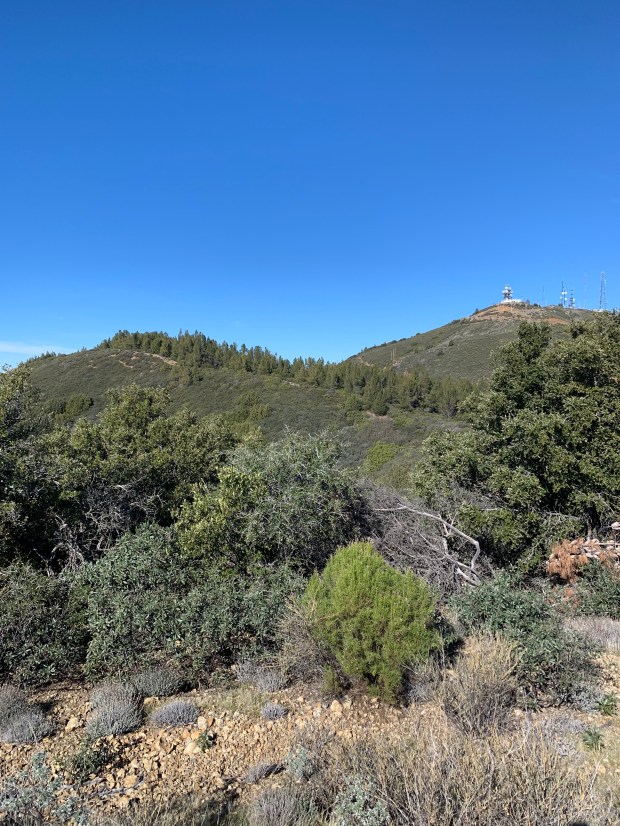
Many of us are drawn to mountain tops if not physically at least visually, some even spiritually. Botanists go to see the unique flora. Some botanists are “peak baggers” along with many others. There is no “bagging” Loma Prieta, but the flora around it is very special. And the peak has been sacred to some but has been defiled by others, now buzzing with communications towers that make you want to stay far away.

At 3,790’ Loma Prieta towers above Santa Cruz, the highest peak of the Santa Cruz Mountains. The mountain is near the Santa Clara/Santa Cruz County Line and looks over the nearby San Andreas Fault. More people know the name of the peak from 1989 Loma Prieta Earthquake – the epicenter was just west of the mountain.

Recharge

It snows up there almost every year and the rain falls in torrents because the highest peaks catch the most rain. There is little soil near Loma Prieta, but lots of well drained rock. There are patches of sandstone surrounded by a massive amount of mudstone. Craggy dark sandstone outcrops accent the slopes near Loma Prieta. Roadcuts reveal fascinating patterns formed by the nearby faulting. The mudstone and sandstone rocks were created by sediment washed into the Pacific from ancient California’s rivers, laid down in layer after layer, with different layers of slightly different colors, textures, and thicknesses. Tectonic movement has pitched those layers this way and that, sometimes in great undulating waves, other times tilted this way and that. The roadcut rock is fascinating mosaic art.

Rain soaks through these fractured stones, bubbling out below to form the headwaters of streams that provide drinking water for hundreds of thousands. Looking out from the mountain, you see the steep and thickly wooded Soquel Creek canyon or turn towards the other side and look down Uvas Creek that leads to the Uvas Reservoir and onto the Pajaro River, or gaze north into streams headed to the Lexington Reservoir.

Views

I try to visit the area’s peaks once a year to get my bearing and appreciate this place. And, I can see most of those peaks from Loma Prieta: Mount Diablo, Mount Hamilton, Fremont Peak, Devil’s Peak, and Ben Lomond Mountain are visible from there. A while back, I would visit Loma Prieta to get a good view of the region’s fireworks on July Fourth. Back then, the shoreline of the Monterey Bay was lit by many displays and there were many displays in towns all the way to San Francisco and beyond. It is a delightful place to see the entire Monterey Bay and a huge expanse of the sparkling Pacific Ocean. But really, I go for the plants.

This Chaparral’s Shrub Diversity

My favorite plants to visit up that way are two subspecies of at type of manzanita that is normally found a long ways north, but which have outlying patches on sandstone near Loma Prieta. The Hoary (A. canescens ssp. canescens)and Sonoma (A. canescens ssp. sonomensis) are beautiful silvery shrubs with smooth red bark so dark it is almost black. I visited last weekend and it was just starting to blossom, some shrubs had pure white and others very pink flowers.

This is a very shrub diverse area. In a short distance, in addition to the above, you can find three other manzanitas: Santa Cruz manzanita (A. andersonii) and brittle leaved manzanita (A. crustacea ssp. crustacea) and Rose’s manzanita (A. crustacea ssp. rosei). And, the ceanthus that normally accompany manzanitas are equally diverse with 5 species also occurring in close proximity to Loma Prieta: warty leaved ceanothus (C. papillosus); blue blossom (C. thrysiflorus var thrysiflous), wavy-leaf ceanothus (C. foliosus var. foliosus), buck brush (C. cuneatus var. cuneatus) and Jim brush (C. oliganthus var. sorediatus). More shrubs still include 3 species of silk tassel – bear brush (G. fremontii), silk tassel (G. eliptica), and ashy silk tassel (G. flavescens), mountain mahogany, pitcher sage, chaparral pea, bush poppy, coffee berry, coyote bush, and on and on. With this menagerie of chaparral shrubs, the scents are awesome as the sun warms the millions of resinous leaves.

…and Tree Diversity

Trees are super diverse up there, too. It is surprising to see a rare local conifer California nutmeg emerging from the chaparral. The canyon live oaks are everywhere in multi-trunked patches resprouting from multiple fires. There is also interior live oak, foothill pine, and knobcone pine. Some trees are odd: the madrones have paler orange bark than normal, the bay trees have more flakey bark, and the tanoaks have longer and or smaller more toothed leaves. The patches of trees are especially thickly festooned with beards of mosses and dense carpets of lichens.

Clearing the Shrubs – the March of Weeds

With the exception of a few patches managed by public parks, most of the area is privately owned, and it shows. A County Planner has told me on many occasions that the County’s policy is to not allow clearing of this rare chaparral type. And yet, you can see the expansive clearing from Highway One. There are immense mansions and squalid trailers, many with massive fire clearance zones. And, there are acres and acres of vineyards and horse corrals as well as sprawling greenhouses.

This network of development and the roads that serve them has badly fragmented this beautiful chaparral, especially in the last 15 years. Human incursions are made evident by aisles and acres of weeds: jubata grass, Scotch and French broom, and acacia are the most evident.

Even with all of the clearing but especially with the influx of flammable weeds along the roads, this area seems likely to burn badly one day.

A History of Fires

Many areas around Loma Prieta have not burned in a long, long time; but there have been recent fires. North and West of Loma Prieta, there are some of the oldest, largest knobcone pines I’ve ever seen, evidence that it has been a long time since fire. South and East of Loma Prieta, are miles of skeletons of trees and shrubs that belie more recent fires. The 2008 Summit Fire (4,200 acres), the 2009 Loma Fire (435 acres), and then the 2016 Loma Fire (4,470 acres) all have scorched areas around Loma Prieta, and all were human caused.

How to Visit

You can visit patches of this unique chaparral in a few parks. Some of this type of chaparral is at Mount Madonna County Park. The more shrub-diverse type is found in the Sierra Azul Preserve managed by the Midpeninsula Regional Open Space District at Mount Umunhum, the next peak north of, and not far from, Loma Prieta. The top of Santa Clara County Park’s Uvas Canyon County Park touches the shoulder of Loma Prieta south of the peak. This type of chaparral gets less interestingly diverse but still remains expansive in the upper areas of Nisene Marks State Park, say along the top of Aptos Fire Road.

Post Fire Early Winter Mixed Conifer Forest

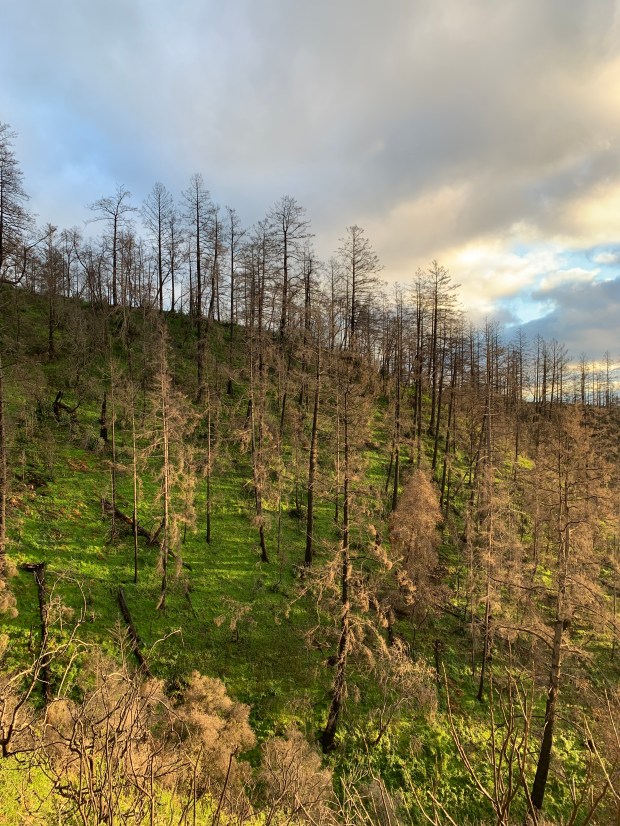
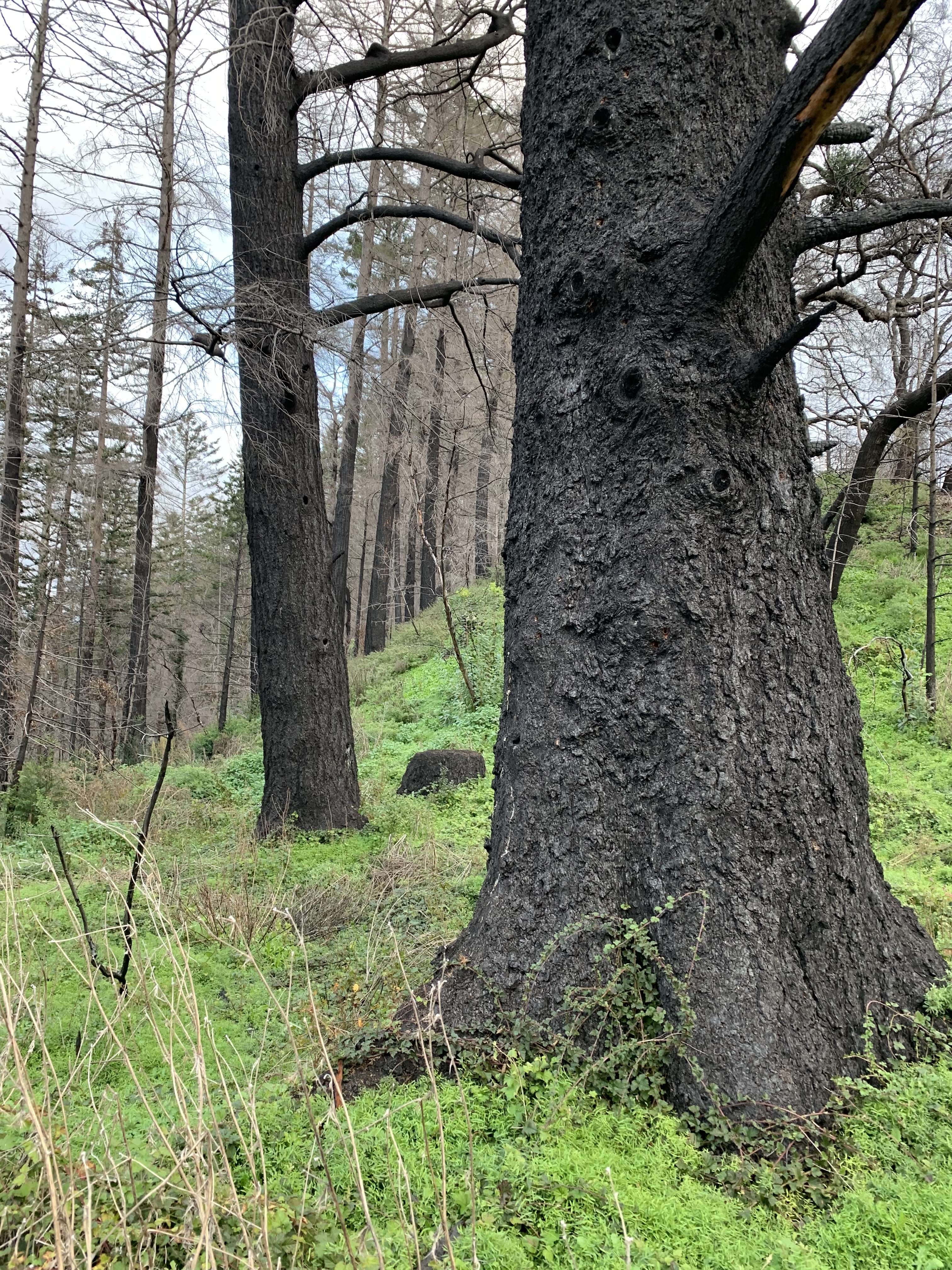
The widespread mixed conifer forest in the hills of Santa Cruz County’s North Coast is drippy wet now, even between storms. Seventeen months ago, the CZU Lightning Complex Fire devoured tens of thousands of acres of mixed conifer forest just north of Santa Cruz. Now, there are thousands and thousands of stark blackened standing dead trees. There are also living and resprouting trees. The dead and the living conifers tower over a wet, glistening, vibrantly green, and lush understory. It is slippery and hikeable now, but as the trees fall and the brush grows up it will become impossible to explore until the next fire…a decade away.

The lush post fire understory of a mixed conifer forest. Above Davenport, CA December 2021

What is Mixed Conifer Forest?

Mixed conifer forest is our most common forest type. While it is true that we have patches of redwood-dominated forest and patches of Douglas fir-dominated forest, many areas have a mix of the two. At the larger scale, peering out of an airplane at 10,000 feet, all of the local forested landscape includes a mix of conifers – redwood, Douglas fir, knobcone pine, ponderosa pine, Monterey pine, and Santa Cruz cypress. Where Douglas fir and coast redwood co-dominate, this type of mixed conifer forest hosts a mix of plants and animals that are distinct to this habitat type. Low light levels from a high, dense canopy and a preponderance of difficult to digest resinous needles are important factors determining what else can live in this habitat type.

Flaming Bark

The mixed conifer forests burned unevenly in August of 2020. Douglas fir trees take a little coaxing, but coast redwood trees take real convincing, to burn. There are many more fire-killed Douglas firs than redwoods. During the last two fires, I watched both redwood and Douglas fir trees catch on fire. Fire seemed to race up Douglas fir trunks, spewing sparks and crackling away whereas redwood trunk flames were slower to move up the tree and was less sparky and noisy.

Unlike redwood, Douglas fir trunks are covered with sticky sap that ignites easily. I heard a story about a teenager that thought it would be fun use a lighter to light some sap on fire on the side of a tree and very shortly needed the help of the fire department to put out the flaming tree, which was threatening the family home.

Glowing Holes

For weeks after the initial fire storm, glowing spots throughout the forest decorated the night. Mostly, these were the smoldering stumps of trees that had died long before the fire. In the mixed conifer forest, there were many dead or dying madrones and tan oaks that had been shaded out. These hardwood stumps made for some hot holes that burned for days. Some smaller Douglas fir trees had also died before the fire, but they burned up quicker.  There are now quite a few treacherous holes making forest hiking more interesting.

Solanum sp, Nemophila sp, Claytonia sp., and more…all covering the post fire forest floor

Understory Greens

The rains have germinated 3” deep shag carpets of lush herbs and hydrated huge patches of shorter bright mosses below blackened tree trunks. Miner’s lettuce, phacelias, and weedy forget-me-nots make the carpet. In patches, taller plants like hedge nettle, blackberry, nightshade and many other plants add to the hillsides of bright green. Many areas are already dotted with white, pink, or purple blossoms brought on by the winter rains and encouraged by warm bright days between storms. A lot more sunlight hits the forest floor now. Where there are patches of live trees, the understory is less thick. In some places, the fire left small hillside meadows, without any trees at all.

The forest soil is still black and slippery with soot and ash. During each of my recent forest hikes, I have slipped and would have tumbled a long way were it not for my grip on the very strong 4’ tall redwood basal sprouts. The soil, in the hotter burned places where the understory herb seeds were destroyed, is covered by strikingly bright mosses littered by needles and small branches blown from the few remaining live trees somewhere uphill or up wind.

Post Fire Wildlife

The burning of the mixed conifer forests means more food for more birds: redwood and Douglas fir forests normally have few seed producing plants, but that’s changed now. In mixed coniferous forest, deer have little to eat; now, the forest floor is covered with deer food. It is easy to see the birds and easy to find the deer tracks. Sharp deer hooves, forming new trails, cut through mosses and lush hillside wildflowers, exposing forest soil. The tracks crisscross the steep hills, patches of tasty miner’s lettuce chewed off. I’ve been seeing deer beds of very flattened understory plants, mostly on level spots along old logging roads. Expect healthy coats on momma deer, more big antlered bucks and spotted big eyed deer twins navigating the hills on dainty legs this spring. Mountain lions prefer dark forest to move around, but they’ll be enjoying more food while the forest canopy grows back.

Fire Makes Beaches and Bonfires

Mostly, the forest floor is healing, and little erosion has been happening. The exception is where humans created roads during the early logging days. To create roads on hills, people carved uphill and dumped the soil they removed downhill. This is called ‘cut and fill’ road engineering. Sometimes the fill side buried logs and stumps which burned under these old roads in the recent fire. Now, the uphill scar is unstable in many places, the fire having destroyed the stabilizing plants. Between burned out fill sides and steep, less vegetated cut sides…there is lots of erosion. Throughout the fire, you can find large and small scallops of hillside slumping onto the old roads or downhill from the roads towards the creeks. Besides being activated post-fire, this legacy of disturbance is most evident now that you can better see the soil surface across the hillsides.

With the couple large storms we had, streams have been carrying soil and logs. Local streams are flowing with mud, as evidenced by the ocean’s big brown plume up and down the coast right after the last storm. That mud will sort out and the sand part will become our beaches- bigger beaches after fires? We’ll see.

One local stream was more black then brown for a while- probably because of ash and soot. Streams are also carrying logs. Judging from the scouring of streamsides, streams have been blocked by post fire logs (ever encounter the term ‘logjam?’); those blockages eventually give way and are swept downstream with great force, battering and baring stream banks downstream and far up their banks. Those logs become driftwood on the fire-augmented sandy beaches. That driftwood will become the bonfires for rocking all night parties that the Coastal Commission has just sanctioned by mandating the creation of 24-hour parking lots from Santa Cruz to Davenport. So, part of the post wildfire wildlife effects will be the noisy, blazing, smoky disturbance of whatever shorebirds were counting on nocturnal refuge on those once peaceful beaches. The CZU mixed conifer forest flames will carry on for human and non-human animals alike, for better or for worse.

Douglas Fir Forests

– this is another of my weekly posts reprinted from Bruce Bratton’s admirable weekly e-news publication at brattononline.com

According to tradition, people are hauling Douglas fir trees into their homes and decorating them for annual winter rituals. Some purchase dense, pruned trees, while others harvest spindly saplings from the woods (aka “Charlie Brown trees”). Soon, strings of lights cast needle shadows on the walls and ceiling, infants gurgle and sputter with delight, wide eyed at the beauty. The unique Douglas fir scent fills the air – a bright lemony pine smell. Hallways are festooned with ribboned Douglas fir garlands and people weave fir wreaths to decorate doors. In breaks between storms, on crisp cool days, we saunter into the forest, catching fresh fir scent moist with rain, sparkling in the foggy, low-angled sun rays.

Mouse Tales

Douglas fir is not a real fir- it’s a pseudo-fir, creating cones distinguished from genuine fir cones by having “the tail ends of mice” sticking out the cone. Check it out sometime- there really are what looks like two back legs with an accompanying tail poking out, so cones look like a bevy of mice are feasting on Douglas fir seeds.

The cone decoy seems to have worked, evolutionarily speaking. From Northern California though Canada, Douglas fir is the sole home of red tree mice. These mice live high in canopies and feed on only on needles. On huge branches among the complex old growth Douglas fir canopy, they maintain long lived, wickedly well-designed homes that include rooms with specific uses. If they aren’t careful while they are out harvesting needles, a spotted owl will eat them – red tree mice are a favorite and important food for this equally endangered bird. We’re apparently too far south for the red tree mouse- Santa Cruz is the near the southern end of Douglas fir’s range, and maybe there aren’t enough thick forests, or too frequent of fire, for these little critters.

Northward Ho!

Moisture-loving conifers have been retreating northward for a few thousand years, and Douglas fir may also be headed that way. There are layers of grand fir pollen up until just 15,000 years ago in the sediments of a pond in northern Santa Cruz County. The nearest grand fir is in Sonoma County, nowadays. South of here, if you look at the forest on either side of highway one south of Freedom Boulevard, you’ll see a few widely spaced straggly Douglas firs – those trees look like similar to those in the hills above Elkhorn. And that’s as far south as they go along the coast. But, north of there you’ll notice that they don’t appear to be having trouble making thick forests.

Rock Scissors Paper (Douglas fir wins)

In the rush to capture the sun, Douglas fir quickly wins against all but the coast redwood around here. Look at most any of our majestic coast live oak forests, and you’ll see Douglas fir trees winding their flexible leaders between old oak branches. Play that forward, and those oak trees will be toast, shaded and outcompeted for water by these highly invasive conifers. Douglas firs are also invading coastal scrub and coastal prairie.

Pull ‘em Up, Chop ‘em Down

Kat Anderson reported to me documentation that tribal peoples have long pulled Douglas fir seedlings as part of their tending of oak groves. The tribal peoples took over from the tree-invasion prohibiting Pleistocene megafauna. Just north of here, a remarkable recent turn of events saw reintroduction of native people land stewardship with collaboration between the Amah Mutsun and State Parks. The Quiroste village site was once in a matrix of super diverse, well-tended coastal prairie framed by managed oak woodlands, but for the last hundred years, without stewardship, those systems succumbed to Douglas fir invasion. After careful planning, and with some controversy, the tribe and State Parks have been restoring the site by clearing Douglas firs…almost like the old days, but the trees got bigger and so it takes saws and a lot of work to remove them. With their work, the area is becoming more species rich and more fire safe.

Doug Fir, Associates

While coastal prairies and coast live oak forests are much more species rich, Douglas fir forests do have their own set of interesting species associates. Instead of tree mice harvesting Douglas fir needles around here, we get ants. Anywhere there are Douglas firs in the Santa Cruz Mountains, you’ll find 2’ tall piles of needles teaming with ants. These are Formica integroides, a mushroom farming ant, growing their fungi food in piles of Douglas fir needles. This needle harvesting critter forms armies of harvesters walking in long and sometimes wide lanes across and down human trails: watch out…don’t be rude by stepping on them!

Orchids also seem to like growing in Douglas fir forests. Also at its southern range limit, the gorgeous Calypso orchid has been documented with ephemeral populations at UCSC and near Davenport (both gone now), but has a somewhat famous large population under a north-facing Douglas fir forest in Butano State Park. Coral root orchids also seem to prefer Douglas fir forests. Curiously, ground nesting ‘yellow jacket’ wasps seem to key into coral root populations under Douglas fir. So, maybe look very carefully before walking off trail to get a closer look at the subtle but beautiful colors of coral root orchids.

Timber!

“Douglas fir doesn’t pay for itself to harvest.” That’s what local foresters tell me. By the time they do the timber harvest planning, go through the regulatory process, carefully fell the trees, trim and haul the few logs they find that aren’t damaged/diseased, mill and dry the wood, they can’t recoup their investment because someone elsewhere has produced a similar board, cheaper. The Pacific northwest and Canada, with more lax forestry regulations and healthier Douglas fir trees, are creating cheaper Douglas fir (and similar) 2x4s for sale. So, for many years, we’ve been growing some large Douglas firs on the area’s timber lands.

Then came the CZU fire…now, there are thousands of large and small standing dead Douglas fir trees: what should we do? If left, these trees will gradually fall over and create a Giant Fire Hazard. The next fire, spreading through those hundreds of acres of log piles, will be very intense, torching whatever trees tried to recover and scorching the soil badly. It will be a hot fire storm, to a great extent our fault.

Biomass Fuels?

If you have toured the CZU Lightning Complex Fire area, you have probably noticed piles and piles of logs. Burned up trees are dangerous to houses, roads, and power lines, so they must be felled and hauled away. “Away” is an odd word…mostly it means a landfill (another odd word). Ever throw something away? It is instructive to visit ‘away’ at the end of Dimeo Lane or near Buena Vista. We must find a new ‘away’ soon, but no one wants ‘away’ near their homes or over their groundwater. Piles of post fire logs will fill up landfills quickly, especially with more frequent fires. Why not use modern technology and turn those logs into electricity? There are new carbon-neutral, mobile wood-fired power plants that burn wood, make electricity, and create ‘biochar’ that has been shown to be a useful soil amendment for agriculture. Keep your fingers crossed that we might get one of these at one of our local landfills sometime soon. That way, when you throw something ‘away’ that can be safely burned, you’ll be making your own electricity and enriching agricultural soils.

Chalks Chaparral

– this is another reprint from my post to Bruce Bratton’s most insightful brattononline.com weekly.

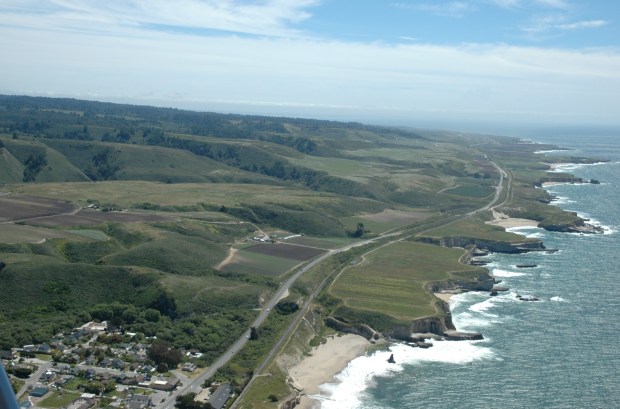
The Chalks stretches from above Año Nuevo into Big Basin south through the Lockheed property and then down many tiny ridges above Scott Creek and the Swanton community. Even before the CZU Fire, the ridges appeared from afar curiously white, like chalk. The earliest Old World explorers wrote in their log books about that striking whiteness. The barren white ridges are on account of extremely poor soil, mostly fractured rock. that limits the ability for vegetation to thrive. The vegetation that can make it is a unique type of chaparral.

Most people see The Chalks on their drive south on Highway One just north of Año Nuevo, South of Franklin Point as they pass the Coastanoa Resort. Look inland and you’ll see lots of broken ridges: those are The Chalks.

Much of The Chalks is on private property. Some is on what is known as “Lockheed Martin Space Systems” at the very end of Empire Grade. That area also contains a 1000-acre private property called “Lehi Park” a recreational and camping spot owned by the Church of Jesus Christ of Latter-day Saints. For public visitation, you’ll have to wait until Big Basin opens again…it’s still closed due to the last big fire. Meanwhile, you must settle for viewing from afar.

The Pines

At the top of the steep and erosive bluffs north of and above Waddell Creek, wind-blown, lichen strewn Monterey Pines form the chalks chaparral overstory, but their genes might make them something other than pure Monterey Pines. This is the home of one of only five native Monterey Pine stands. The others are on the Monterey Peninsula, around Cambria, and on two islands off of Baja – Cedros and Guadalupe. Monterey pines are the most planted forestry tree in the world, and the seeds of the ‘radiata pine’ created bred for those forestry plantings came from the Año Nuevo stand, where Monterey pine hybridizes with knobcone pine. Monterey pine occurs lower in elevation, and more deeply in frequent thick fog; Knobcone pine is found higher and hotter and dryer. In between, there are pines that look like both, and the globally planted forestry tree looks like one of those tweeners. As the birthplace of this confusing but useful forestry tree, The Chalks has its tree ambassador planted by the millions, all over the world. And yet, this tree isn’t the only famous bit of Chalks botany…there are also some world-famous manzanita species.

The Manzanitas

Chalks Chaparral includes 7 species of manzanitas, and there are two common, more widespread ones that dominate and two very rare species that only occur in this habitat. The most common species is brittle leaved manzanita, a widespread burl-forming species, and the subject of a previous essay. The other common species is the sensitive manzanita. Sensitive manzanita has small roundish shiny dark green leaves, making it look like the boxwood of the chaparral. Mixed in with these two species, there are two other manzanita species- two which exist nowhere else in the world: Ohlone manzanita and Schreiber’s manzanita. Each of these locally endemic manzanitas are very uncommon even in The Chalks and grow entirely on private property, so you can’t visit them outside of the UCSC Arboretum’s Conservation Garden. There might be as few as 100 Ohlone manzanita plants in the entire world!

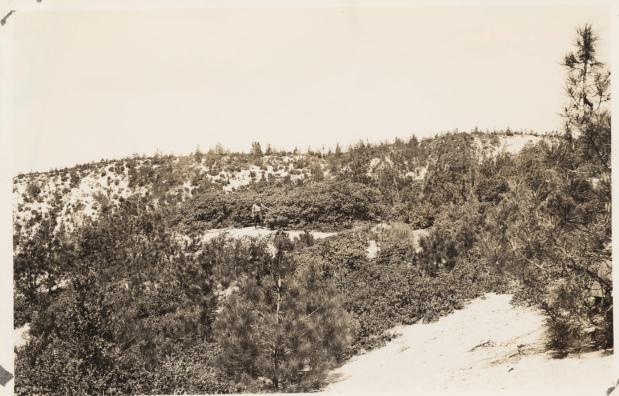
You can, however, view photos of Shreiber’s manzanita from a 1939 expedition that led to its discovery. One photo archived by UC Berkeley shows a big manzanita surrounded by knobcone pines and chamise. Another photo has an overview of the habitat showing the large amount of bare ground with sparse manzanitas, pines and few oaks; that 1935 photo suggests a fire as recent as 14 years previously. The next fire was to be 8 years later in 1948.

You might be wondering about the other three manzanitas you can find on The Chalks. They are: Santa Cruz manzanita, silver leaf manzanita, and the crinite manzanita. On a rare California Native Plant Society field trip through the Lockheed property in the 1990s, we saw all 7 species within a short walk of one of our stops.

The Trails and Views

The best places to access The Chalks are in Big Basin State Park, now closed because of the CZU Lightning Complex Fire…but, put those trails on your list when it reopens. Whether from the coast or from inland, your destination are the ridges around Chalk Mountain. The trails wind on ridgelines with gorgeous views of the ocean overlooking Año Nuevo Island and a vast expanse of the ocean. On a clear day, you can see Point Reyes and the Farallon Islands to the north and Point Sur to the South.

Another place to aim for is Eagle Rock out of Little Basin. Eagle Rock is an isolated bit of sandstone on the eastern flank of The Chalks. The views from Eagle Rock expand eastward more than you might see from Chalk Mountain. The trail goes through a kind of chaparral closely allied to The Chalks, but with less rock showing than elsewhere.

Fires and Seeds

Both the 2009 and 2020 wildfires spread initially through The Chalks chaparral, same as the 1948 Pine Mountain fire. Those watching the 2009 fire said they saw what looked like fire tornados launching from one ridge and igniting the next ridge down wind. No one was watching for the more recent fire, which spread even more quickly. Both fires triggered fire-following seeds to germinate.

The most widespread and obvious fire following seedlings are bush poppies. Most of The Chalks will still be barren next summer (as before the fire), but patches of chest high blue-green bush poppy shrubs will be flowering with their bright yellow flowers next summer. I have tried everything to germinate those bush poppy seeds, including the recommended soak in white gasoline, presumably to break down its seed coat. But, after the fire…seedlings pop up all over.

The Chalks and the Rare Human Animal

Humans are rare in The Chalks. The Lockheed facility had, at its peak, hundreds of employees visiting this chaparral regularly, for work. But then much of it burned, and it is unclear if they will continue to operate the facility in the future. The Lehi property is also mostly ephemerally visited by people. The most common place to find humans in The Chalks had been out Last Chance Road where a culture all its own had homes sprinkled around patches of beautiful chaparral. That community, also, burned in the CZU Lightning Complex Fire.

Much of what we know about the natural history of places is gleaned by humans who make habits of visiting those places and looking carefully at what’s around them. Historically, few people have wandered into The Chalks with an eye to natural history. Shreiber’s 1930’s era Chalks visit mentioned above highlighted the area to natural history enthusiasts with the discovery of a new manzanita species (and those intriguing photographs!). Then there’s Jim West, a botanist extraordinaire endemic to the Swanton area, who has brought The Chalks to the attention of many other naturalists, in part because of his discovery of the other new manzanita species. His work has led to a kind of Chalks revival with a new focus on vegetation mapping bringing a host of new naturalists’ attention to that area. There is much more to be discovered in The Chalks – who will be the next person to find something amazing up there? Post fire recovery may have many surprises…

Rest Under the Laurels

– another regular post reprinted from my weekly column with Bruce Bratton’s brattononline.com

With their shiny, fragrant leaves and pale-yellow flowers, bay laurel trees (or just ‘bay trees’) grace our forests and are a tree worth recognizing…there’s nothing with which to confuse them. If you’ve been following this column, you’ll note that I encourage you to learn at least the trees in our area. There really aren’t that many types of trees, say compared to the 80 tree species I had to learn in my 8th grade biology class in Georgia where the forests are much more tree diverse. And “back east,” most of the trees lose their leaves so you have to learn subtle bark characteristics for half of the year. Bay trees are particularly easy if only from the scent of their leaves. Still, I find many people don’t rely on their nose to identify plants- a lost opportunity. Learning to identify trees, and paying attention to the trees around you, is a gateway into ‘seeing nature’ and being more present with the world around you. Through the distribution of trees, you’ll come to better understand wildlife, soils, hydrology, and so much more.

Spot the Bay

To find them, aim for the darkest part of the forest and there you’ll find a bay tree. These evergreen trees cast deep shade, and little grows under them. Wind rustling through long, thin, waxy leaves of bay trees sounds like rain. Walking on the cast-off leaves under a tree can be slippery. With age, the leaves are often covered with black mildew, but without that the fallen leaves are ochre, fading to a light tan-brown. Please don’t pass up a tree without gathering some leaves and sniffing them: no matter how many times I do it, I never regret it. With some practice, maybe you can conjure the scent even without smelling the leaves.

On warm days, when trees are in full bloom, the sweet perfume from the flowers carries a long way with a citrus blossom aroma with a slight hint of cinnamon. They are starting to bloom right now.  I saw some new blossoms in Hageman Gulch adjacent to Arana Gulch recently. Spent flowers litter the ground as they drop off. You might still find bits and pieces of the last part of the fruit right now, too.

Where to Find Them

Some say that Swanton’s Scott Creek valley once had stands of magnificently large bay laurels and the few large remaining ones burned in the recent fire and are now resprouting. Pogonip Greenbelt as well as Wilder Ranch and Nisene Marks State Parks have stands of bay trees along many of the trails. The last ones I encountered were on moist north-facing slopes in western Wilder Ranch growing alongside live oaks; the bays and oaks there were in process of succumbing to competition with conifers, towering above them. The places bay trees thrive is where fire returns from time to time.

Fire Tree

Bay trees erupt in flames during a wildfire, and then sprout quickly back after the fire from their basal burl. One day, if you are enjoying a campfire, throw a few bay leaves on it to enliven the party. The leaves pop and crackle loudly, sending out sparks – evidence of the oils in the leaves. After our 2020 fire, bay trees were sprouting up two-foot-tall tender shoots a couple months after the fire. You often see bay trees with many trunks- probably because of the survival of more than one of those post-fire sprouts. The sprouting nature of bay trees allows them to leap up above the competing vegetation and to send out fruit in just a year or two after a fire, providing seedlings a better chance of establishment. But the seeds are a coveted cache.

Fruit

Squirrels, pack rats, mice, and jays love to eat bay “nuts,” which are also been popular with certain people. Although bay trees are relatives of avocados, and the fruit looks like a little avocado, there isn’t much flesh, which is only edible for a brief moment when ripe. The ripe fruit can be bright green or a deep purple. The nut is a better bet than the thin skin for eating, but you must roast it first. It is oily and if roasted just right tastes a bit like a roasted cocoa bean. Some people say they feel a bit wired after eating a few. No one I know has liked them so much that they repeatedly go to the effort of processing them, though native peoples are noted to have eaten them.

Medicine

After I led a barefoot friend of mine into a stand of chestnuts for a harvest (ouch!), he got even with me a year later with a bay leaf. We were hiking through a local forest, and he noted that I sounded congested, but I was in luck- he had a remedy close at hand! He handed me a bay leaf and told me to roll it up like a tube, put it in my stopped up nose and breathe in through it deeply. And so, I did. I was able to remain standing, but just barely. At first, it felt like someone had punched me hard in the nose. The burning sensation spreading deep into my sinuses wouldn’t go away quick enough. I do not recommend this kind of medicine, not even as a practical joke. But there might be ways of inhaling the leaf scent with less vigor, which might be a treatment for congestion. Native peoples used the leaves for treatment of arthritis and for clearing fleas out of houses. Wood rats also use the leaves to get rid of insects in their houses.

Life on the Bay

I first learned bay trees not only by their leaf scent but also by their shelf fungus. There’s a shelf fungus that is on almost all older bay trees. This is called Ganoderma brownii and it is tough like wood. The top of it is often the same color as the bay tree’s bark- a dark brown, though sometimes it is lighter. The underside is white to cream.

Sudden Oak Death

Bay trees have gotten a bad rap as of late as they are hosts to an invasive pathogenic organism named sudden oak death. Local evergreen oaks growing under and adjacent to bay trees are threatened by a heavy rain of sudden oak death spores of falling off bay tree leaves. If you have a stand of these oaks that you want to save, it is suggested you cut out the bay trees that grow right next to them or above them. But, if you are considering cutting them down, you might want first to contact a woodworker.

The Wood

Bay laurel trees’ light to very dark wood is very beautiful and is used for furniture and musical instruments. Some people call it myrtle wood or Oregon myrtle. I haven’t encountered recent furniture made with it, but I once saw a hundred-year-old chest of drawers made from bay wood which looked like it had been made from American chestnut. After writing that, I looked on the internet and see that there are hundreds of very fine pieces of craftsperson- made furniture and musical instruments made with bay tree wood. Sometimes, I see that people use the burl wood for an extra dashing look.

Tending Bay

Our forests would not be the same without bay trees, but I haven’t anyone restoring or planting the species in their landscapes. If you have a place for one, for the shade or for a privacy screen, you might consider planting one. Generally, it isn’t the fastest growing tree- maybe two feet a year at first but settling into one foot a year as it matures. If you keep the branches limbed up high off the ground, they might even help with the fire hazard. Bay trees serve well as part of a ‘shaded fuel break’ that is low maintenance because they suppress understory growth, reducing the need for mowing or shrub clearing. Plus, you’ll be creating food for wildlife for generations to come, and maybe a fine wood source for future craftspeople.

Brittle-leaved manzanita chaparral

– This is another of my posts from Bruce Bratton’s (highly recommended!) weekly at brattononline.com

The rains bring alive chaparral, so this is the beginning of a series featuring local types of “hard chaparral.” The term chaparral is confusing, so I use the term ‘hard chaparral’ to denote chaparral dominated by manzanitas, chamise, and ceanothus. Hard chaparral is so thick and dense and strong as to tear the clothes off of you if you are strong enough to try to walk through it. Rarely, you might crawl beneath the hard chaparral canopy. Nothing grows in the understory – there is only a light dusting of leaves – but you must squinch low while crawling…to 1 ½ feet… and wiggle down on the ground in tight spots; wearing a hat helps so that your hair doesn’t get caught and pulled out by manzanita’s stiff twigs.

Hard chaparral is different than ‘soft chaparral’ – also known as coastal scrub – which is dominated at first by coyote bush, then, later in life, poison oak, monkeyflower, and sagebrush. Soft chaparral generally grows on richer soils, closer to the coast. Hard chaparral grows on the poorest of soils, often with no discernable soil at all. Ridgelines and steep slopes mostly away from the immediate coast are home to hard chaparral.

In hard chaparral, along with the manzanitas you will find many other shrubs and an overstory of pines. Sometimes sparse, sometimes dense, knobcone pines are the more common pine, but there’s a Monterey pines overstory near Año Nuevo. Oaks and Douglas firs slowly invade brittle-leaved manzanita chaparral until you eventually get a few forlorn dying shrubs or even just old barely recognizable skeletons that tell you the chaparral is gone, for now (awaiting fire!).

Brittle-leaved Manzanita Chaparral

Brittle-leaved manzanita is the dominant species of most of Santa Cruz’ hard chaparral. Smooth maroon skin with sinewy muscle-like ripples down thick, strong stems – that’s what most people remember about brittle leaved manzanitas, but the flowers and burls also give them away.

If they aren’t already in bloom, they will be soon. They have clusters of pure white to pink jewel flowers – upside down urns with windows to capture and magnify light, so the flowers glow on even foggy-cloudy days. Bopping from one cluster of flowers to the next…hundreds of bumble bees delight in the winter nectar feast. Hummingbirds, too, zip around sipping from the flowers. On warm days in December and January, brittle leaved chaparral smells strongly of honey, a scent which enchantingly wafts far afield, down into the woody canyons below.

Burly Shrubbies

Of the nine taxa of manzanitas found in Santa Cruz County, brittle leaved manzanita (Arctostaphylos crustacea subspecies crustacea) is the most common and one of only two that have ‘basal burls’ or lignotubers. The other burly manzanita is a different subspecies of the same species (Arctostaphylos crustacea subspecies crinita), that is mostly found at the top of Ben Lomond Mountain, from the Bonny Doon Airport north to Lockheed. To see burls on these manzanitas, look at the base of the stems for a swelling, sometimes quite large, of lumpy wood. These are very easy to see after a fire, because that’s where these manzanitas sprout new shoots. That’s their magic: the ability to get hotly scorched, fire removing all of the branches, and still live. Up pop the shoots as soon as the rains come…and three years later, there’s a Big Shrub once again where the last one stood.

Locations and Co-Occurring Treats

The tops of our parks are great places to visit this type of chaparral. The top of Wilder Ranch State Park, in what used to be known as Gray Whale Ranch, and into upper UCSC, has patches of brittle leaved manzanita chaparral. The top of Nisene Marks State Park also has stands of this chaparral type. Other places include Mount Madonna County Park, as well as Big Basin and Castle Rock State Parks. From the edges of trails, a wintertime treat will also be Indian warrior, a bright maroon perennial wildflower which forms large mats. Shooting stars and various rein orchids also sprout trailside in clear patches of this type of chaparral.

Another thing about wintertime chaparral visits that is intriguing are the lichens, mosses, and liverworts that color and texture the chaparral. Liverworts, in this dry habitat?? Yes! Get off your bike and kneel at that bare-soiled edge adjacent to the chaparral…look carefully…and you’ll see liverworts (and hornworts!) hugging the ground in between mosses and ground-hugging lichens. The intrepid will get to see more and more species by counting the number of different types of tiny things in those patches, which are kept bare by the golden crowned sparrows who retreated when you came their way.

Critters

Sure, chaparral is for the birds, and that’s not a bad thing. And yet, it’s not just for birds. Wrentits are the quintessential shrub habitat bird, and I also like watching the large-curved billed California thrasher. Wrentits bop around below the canopy, mostly, but pop up out on a branch to make their subtle descending ping-pong ball bouncing song. California thrashers, also understory creepers, sometimes jet out onto a high point in a chaparral patch and sing their hearts out with operatic glory.

The San Francisco Dusky Footed Woodrat makes homes on the outer periphery of brittle leaved chaparral patches. It seems this packrat likes oaks and coffee berry more than manzanitas, but manzanitas keep coyote at bay, so having that habitat at their backs is a preferred location. Ratttlesnakes like wood rats…and the summer heat of chaparral…so, that’s a good snake species to associate with hard chaparral. Rats and rattlesnakes….?

What Good Is It?

Brittle-leaved chaparral is good for lots, but unfortunately it is getting destroyed very quickly nowadays. Nutrient poor soils lost their nutrients because they are well drained. Well drained soils are important for recharging the groundwater, keeping our streams flowing and drenching our thirst. Because this hard chaparral can thrive in nutrient poor soils, it is responsible for keeping those slopes from washing into the creeks and for keeping our groundwater infiltration areas infiltrating. Those sprouting burls…they send roots out on steep slopes after fire, preventing landslides and debris flows from destroying homes and roads.

Mowing It Down

Despite ostensibly being protected, brittle leaved manzanita chaparral is getting hacked up at an alarming rate. Now that fire has our attention, bulldozers are hard at work ripping up manzanita burls to make ‘fire safe’ areas. Crushers, masticators, and saws whittle away manzanitas as if they were enemies. When asked, County Planners have said that they have policies to protect this habitat type- they don’t allow development activities within it. The California Coastal Commission also ostensibly protects this type of ‘maritime chaparral’ as an endangered ecosystem, disallowing any destruction. And yet, even from Highway 1, you can see vast patches of chaparral being destroyed on the ridges above Watsonville. Parks organizations are mowing it down even on conservation lands to be doing ‘their part’ with fire safety. From Southern California, we have learned that treating chaparral this way isn’t a solution to wildfire: it generally grows up patches of weeds, which are even more flammable, less able to hold slopes in place, and no replacement for the habitat value of hard chaparral.

What I hope for is more people showing others how to live safely, and sustainably, alongside manzanita chaparral that is well cared for. If you know of any places, please let me know.

Coast Live Oak Woodlands

This is another weekly post I wrote for Bruce Bratton’s online weekly. You might think about subscribing!

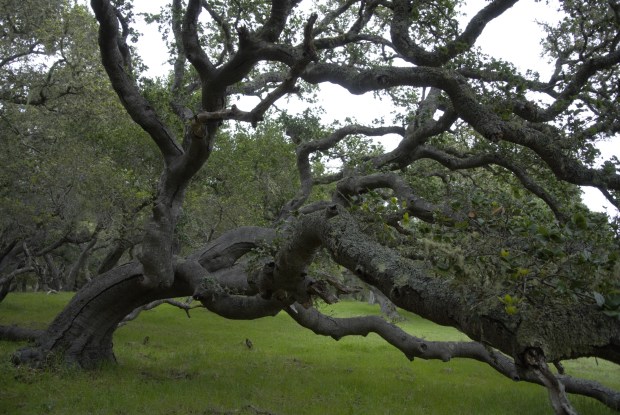
Their graceful limbs are impossibly mighty, and they hold them wide. Their branches are more outstretched, more parallel to the ground than upright. Within a short distance of the City of Santa Cruz, there are hundreds of coast live oaks large enough provide shade for 20 picnicking people. These trees invite climbing and most groves have a tree with a branch large enough, and slung low enough, to invite you to lie on its mossy arm. While you lie there, looking up through the dappled light, you will notice a world of life also sheltered by these friendly trees: clouds of insects zip and zag in and out of the shade, lichens cling and drape all around, and there are so very many birds!

To Know Them is to Love Them

The coast live oak species (Quercus agrifolia) is one of several live oaks that co-occur in our area. Live oaks are called that because they keep their leaves year-round: these are evergreen oaks. The telltale sign of coast live oak is on the underside of its leaf, where the side veins meet the midvein: there, find tufts of hairs ‘hairy armpits’ – no other oak has those. The oak that is most easily confused with coast live oak is the much rarer Shreve oak, which has dark furrowed bark and stands much more upright and has deeper green more persistent leaves. Canyon live oak has golden fuzz covering the undersides of its new leaves. Coast live oak is the only oak with that characteristic smooth, white bark in large smooth plates separated by dark cracks that aren’t very organized. Learning to identify these three live oak trees is a good and doable challenge for everyone living around here.

Planet Ord’s Oaks

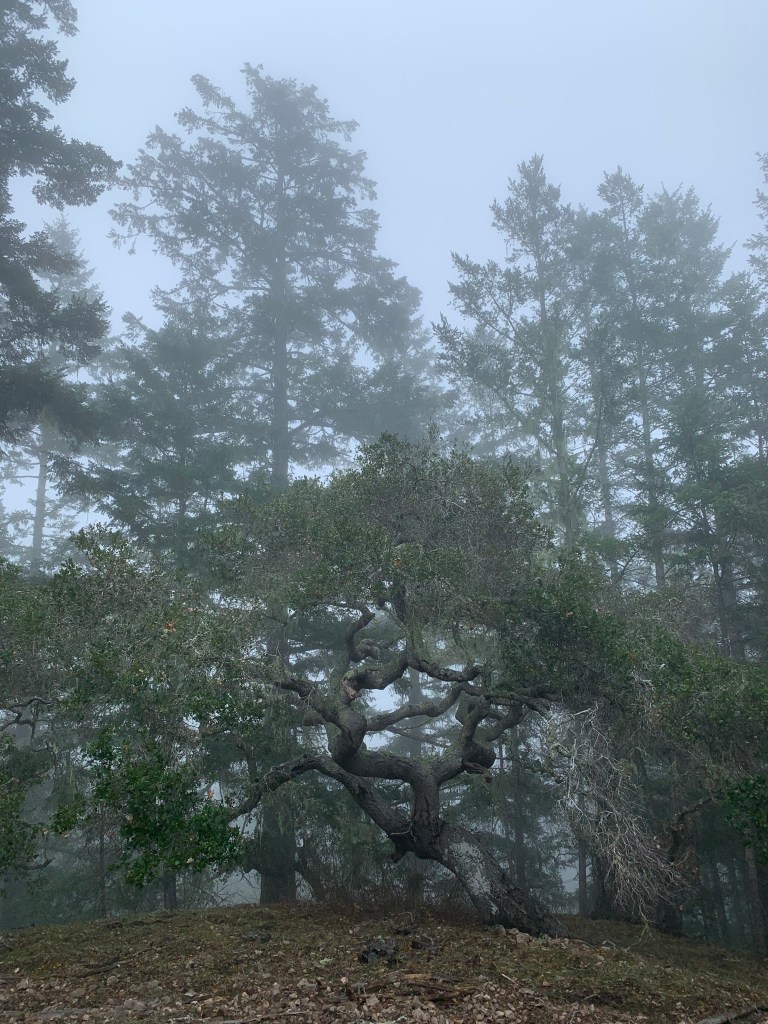
It is not hard to find coast live oak woodlands, but there are several kinds, each with its own characteristics and place. I find the most enchanting stands of coast live oaks to be behind Marina and Seaside at the Fort Ord National Monument. There, ancient rolling dunes are covered with thousands of acres of coast live oak woodland with miles of easily accessed trails. Fort Ord’s coast live oak forests are nice to visit this time of year, soon after or during a rainstorm. Dripping water falling through live oaks is particularly percussive, as drops hit the waxy tough leaves on the trees fall to the big drifts of dead crunchy leaves below. The coast live oaks at Fort Ord are relatively short and almost always have many trunks- 3 to 6 normally, sometimes more. Right about now, treefrogs are living up to their name, calling to each other with their odd croaking squinchy noise from up in the canopies of oaks. The forests there are particularly densely festooned by long draping lacy lichens.

Oaks Just North of Ord

North of there, and much less accessible to the public, similarly old sandy soils support coast live oak woodland in the hills around the Elkhorn Slough and in the foothills north of Watsonville. The Elkhorn hills aka “Prunedale Hills” have some remaining coast live oak forests where agriculture hasn’t taken them out, and the Elkhorn Slough Reserve is a great place to walk around to experience those. More north still but mostly inaccessible to the public, in the area between the Freedom Boulevard and Buena Vista exits off Highway One, there’s something called “San Andreas Oak Woodland.” Both of these types of coast live oak woodlands are taller than Fort Ord’s, though the presence of multiple trunks, a sign of previous fire, is also common.

The Majestic Oaks of Santa Cruz

Closer to Santa Cruz, in many public parks you can enjoy that relatively narrow band of majestic coast live oaks ringing most every large meadow. Sometimes, these oaks grow right out of the grasslands, so you can walk right up to their trunks without braving brambles or poison oak.

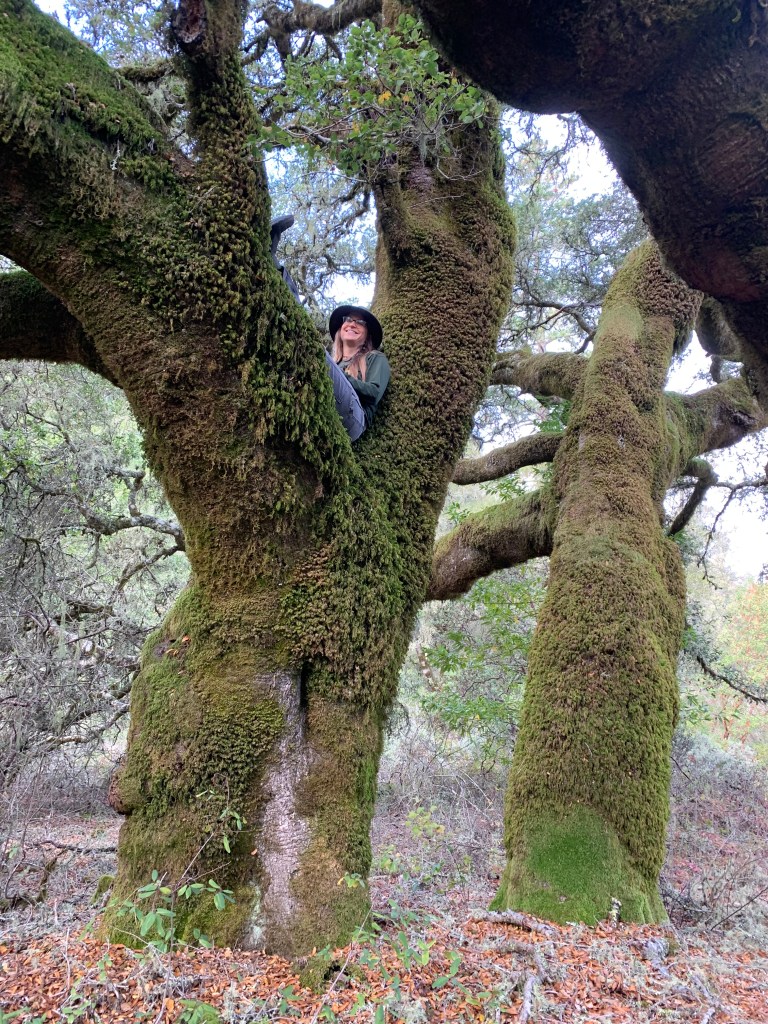
In this photo, Sylvie Childress is enjoying lounging on a large coast live oak limb. Look at all those ephiphytes!

Sadly, long gone are the once magnificent coast live oak groves in the flood plains of the San Lorenzo River and many of the larger North Coast streams. But you might still encounter a coast live oaks blanketing the bottoms of drainages, mainly in thick, upright and impenetrable thickets wound through with tall poison oak.

Roosting Birds in Fall Oaks

Like coral reefs, coast live oaks attract a vast array of other life that unfolds before you the more you keep looking. As an example, I visit a couple particularly dense teenager coast live oaks at dusk to watch a particular wildlife drama unfold. These trees are only about 20’ around, but with canopies so dense you can’t see into them, even from underneath. Each evening, golden crowned sparrows flap noisily into these trees coming solo or in twos and threes. Forty birds later, this gets quite raucous – apparently there is a pecking order for who gets to sit where through the night. Sometimes, a bird decides to go to some other roost, popping into sight again and jetting off somewhere. The sparrows come early as the sun is setting, hanging out in the middle of the tree canopy. While the last sparrows are straggling in, right after sunset, quail whir into the top of the tree, settling into the upper part of the canopy. Now the squeaky chips of the sparrows are joined by the lower chucks of fussy quail. There’s a bunch of fluttering wings bashing about in the leaves and against one another, but eventually everything calms down then goes altogether quiet just as it is getting dark. This repeats every night, same trees, same drama. The night shelter of dense oaks is only one of the many services of coast live oaks…they also make acorns!

Harvesting Acorns

Jays and acorn woodpeckers are harvesting the last of the acorn crop in the next couple of weeks. I have been watching a family of scrub jays carrying around acorns far from the nearest tree. A bird can only carry one acorn at a time, and it looks a bit silly with it…and sounds even sillier when it tries to call with its mouth full (which they do). Holding one of these oak nuts, a jay tilts its head back and forth, jumping around the ground memorizing the coordinates before it pushes it into the soil. I am careful to remain hidden watching this; if a jay sees me watching, it will shriek, dig up the acorn and disappear with it…headed to a more secret location. They are very wary of potential acorn thieves. I recall research suggesting that jays can bury hundreds of acorns a day, and they recall the location of 80% of them. Acorn woodpeckers also guard their acorns, but they do so communally. It takes a tribe to guard the cache, which they do in ‘granaries’ – often several adjacent trees that have thousands of holes pecked out that are just the right size to store acorns.

The Coming Wind

One wonders how the giant crowns and sprawling branches of coast live oaks fare in the wind. With global warming, we expect more frequent and more severe windstorms, and the windstorms of the last several years have knocked down some very old coast live oaks across the North Coast. They topple sideways and pull up a huge amount of the mudstone substrate, holding onto their root wads, which stand at least 10’ tall, full of jumbled rock and debris. Those wide roots provided for stability for more than a hundred years. May they keep the big trees upright for many more! I hope that this winter’s coming winds are not too harsh…