public land management

Cotoni Coast Dairies BLM Land Opens to Public

The opening ceremony for public access onto the Federal Bureau of Land Management’s Cotoni Coast Dairies property was on August 15, 2025, a grim day for those who have followed this travesty, which will only worsen with the planned public access.
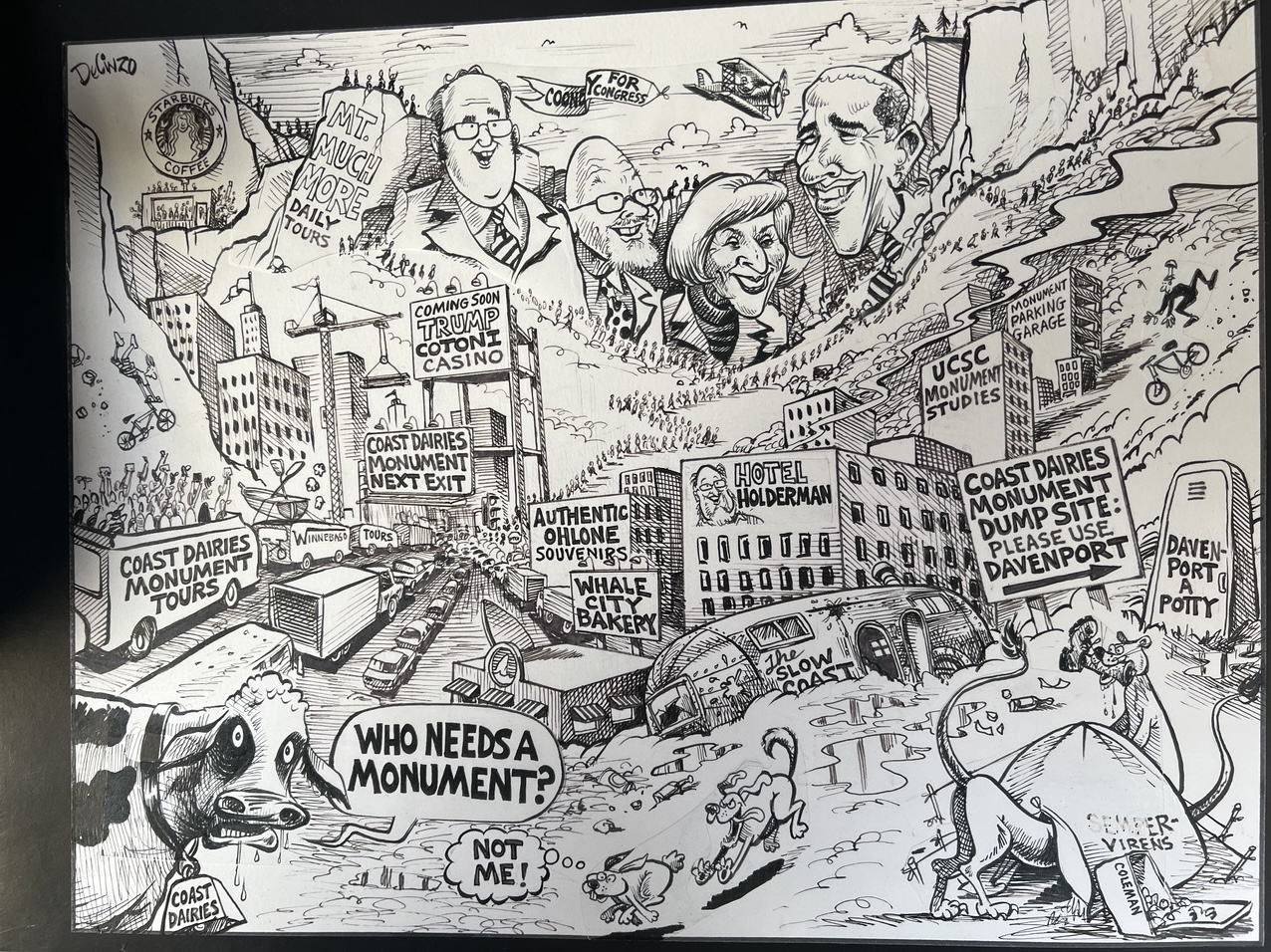
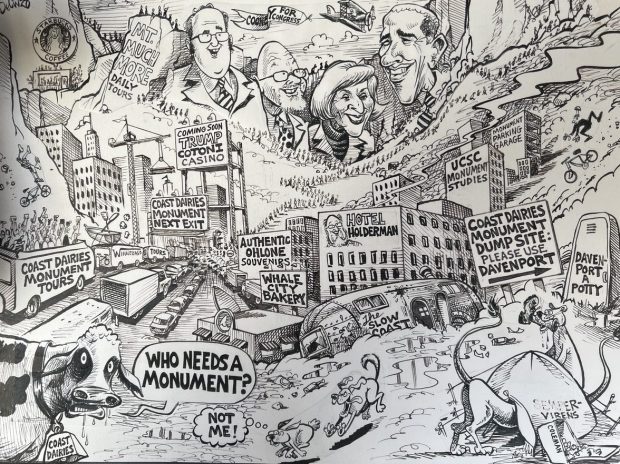
Many thanks to De Cinzo for this image

Building on a Tragic History

Nothing good led up to this moment. There is no one left who speaks the language of, or can show direct descendance from, the native people of this property. There are rich archeological sites illustrating that this land was settled for thousands of years. So, as with every spot in California we must see this property and how it has been and will be used as a colonialist endeavor. There is no attempt to give the land back to any coalition of First Peoples who represent those ancestors or to respect them in any way that approaches restorative justice. Oh, but there’s the name…(!)

After the genocide, the land has seen one extractive use after the next with little regard for conserving nature. The ‘Coast Dairies’ portion of the name points to cows, and cows there still are. The grazing regime has never focused on restoring the very endangered coastal prairies on the property and, even now, there is no plan to do so. This recreational use is a new, highly impactful extractive use. The property is rare for the Santa Cruz Mountains in having had very few human visitors for the last 100 years, so wildlife has been accustomed to roaming without disturbance. Cougars and badgers are especially wary of humans when setting up dens. A million visitors a year will soon be visiting and wildlife will flee.

The consortium of people responsible for so many other, better outcomes for conservation tried hard, won some concessions, but have seen great loss with how this property came to be open to the public. We tried to get anyone but the Federal Government to manage the property, but the Open Space Illuminati had other things in mind…’The Great Park’…a handful of boomers wanted their legacy in a wide swath of the area becoming a National Park. They stopped at nothing to achieve that legacy. The activists, biologists, conservationists, and regular citizens, were even sued to strike fear into them, to make them capitulate.

Money Made it Happen

The Wyss Foundation bankrolled cash-strapped ‘conservation’ organizations to create a fake grassroots campaign that culminated in Obama signing a Monument Proclamation adding 5 properties across a wide swath of coastal California to the California Coastal National Monument. 

Then, the BLM routed hundreds of thousands of dollars, sole-sourcing a contract to a mountain biking advocacy organization to build the kind of trails their users wanted to see. That business quickly changed their name to a ‘trails’ organization. Instead of supporting good paying local jobs, the BLM paid this organization to rally volunteers to do the work of installing trails that were placed across a landscape without regard for the wildlife written into the President’s Proclamation for protection. When asked about how they could do such things when the property’s designation required favoring conservation over visitor use, BLM cynically snickered that the majority of the property, 51%, is set aside without public access. The rest, apparently, is a sacrifice zone.

What We Wanted and Will Pursue

Those of us who care about the native peoples, the nature of the property, and the experience of future visitors have a vision, which we will pursue despite setbacks. The land should not be Federal land – if you wonder why, you need to look at the current situation with federal lands nationwide. We always knew this, but now others are starting to understand our concerns. The current administration is selling federal land for real estate development and other extractive uses. If, after cutting the federal workforce, there are any staff remaining to manage the land at all, that will be a surprise. The Administration has said Federal lands will remain open to visitors even if there is no staffing or budgets. Oh no- could my dystopian vision for the property be closer to reality?!

 If there is a chance, California should buy Cotoni Coast Dairies. Then, let’s envision taking Canada’s Indigenous Guardian’s project to this place, giving tribal people primacy in stewardship, use, and oversight. Perhaps the State could give the land back, as it has just accomplished with the Yurok.

If the property is to remain a public park with visitor access, there needs to be a radical shift in how that is approached. The regulatory designation for first managing the property for conservation needs to apply even to the areas with public access. This will require altering use patterns, even closing the trails occasionally, for the benefit of the soil, streams, wildlife and plants that Obama clearly intended to protect. There will need to be lots of monitoring and enforcement to adequately protect natural resources. The BLM will need to do a ‘carrying capacity analysis’ to determine ‘limits of acceptable change’ – thresholds that, if surpassed, trigger altered management of visitor use to bring the use into alignment with conservation. 

Next Steps

It will soon be possible for visitors to monitor the situation first hand. Those of us who asked to do baseline monitoring of wildlife and plants were refused the opportunity many times. When we asked how small children and the elderly could possibly co-recreate on trails overrun by fast-moving mountain bikes, our concerns were dismissed. We will be able to help document how well BLM’s rules are working and if there is enough enforcement. We will be able to see the spread of diseases introduced by bike tires and hiking shoes ravage the amphibians, the trees, and the soil, and we will recall how BLM staff predicted those impacts in writing, with administrators choosing to ignore even the simplest measures that hundreds of other parks managers have employed to address those concerns.

-this post updated to past tense from the one posted via Bruce Bratton’s legacy site BrattonOnline.com

Slowing Down -or- Rushing?

So much environmental degradation seems to be due to our rushing around. How can we best slow down? Each of us can do our part in creating the Great Slowdown that we need to sustain the planet.

Save More, Buy Less

The first and easiest way to help the Great Slowdown is to stop buying so much Stuff. If you haven’t watched the Story of Stuff in a while, or not at all, DO IT NOW. This 21-minute video is compelling, fun, and has changed more lives than many a 20-some minute experience otherwise. I think it’s worth watching regularly, perhaps in October just before the stuff-a-thon holiday season besets our culture. 

If you listen to the news, you will understand how important buying stuff is for our unsustainable economy. “Inflation is up, but ‘luckily’ consumer spending is cooking right along, otherwise our economy would be hosed.” A president once said in a national crisis, something like, “Just keep buying stuff!” Time is money, and by spending your money on useless crap, you are wasting your time, carelessly throwing away your life, and helping to wreck the planet. A few years ago, someone did a calculation and the transaction cost of each dollar spent was a liter of oil. I’m betting it’s worse now. Save a buck, keep a liter of oil from burning up.

Stop Rushing at Work

There is so much pressure to do more at work, but is that really helping anything? Chances are good that the more we rush, the worse off the planet is. How about we slow down? Carefully watch those who rush around with their work: why are they doing that? I’m betting that they mostly want to impress people, get others to work harder, or they are avoiding problems at home or something they might better be doing for Real Good.

The labor movement has something called ‘working by the book,’ which we might emulate to improve the planet. What is absolutely necessary to do with your work? What does the job description say? What are the metrics for success? Often, organizations keep the productivity targets elusive, to keep everyone guessing or trying to push for more. On the other hand, if productivity targets are defined, ask yourself if they are set too high. If so, it might be time to work with your colleagues to reduce them to something more manageable.

Slowing down at work is part of the solution, part of the Great Slowdown.

Working for the Planet

 The capitalist system mostly asks each worker to create efficiencies that are bad for the planet. As we learn to care more for the planet, we will find ways to sneak improvements into the workplace that will help Earth. Is there a way to reduce driving, material transport, waste? Does your workplace purchase recycled paper, organic foods, and other eco-friendly products? Maybe there’s a sustainability policy on your business’ horizon.

Beware the Fakes

If you see potential greenwashing, ask about it! I recently asked a seemingly eco-conscious caterer what they meant by “gourmet sandwiches, made from the finest local ingredients” and it turned out that they used very mainstream factory-farmed meats and conventionally grown produce distributed from warehouses far away. They soon thereafter changed their menu language. That was the third time I was able to affect that kind of change. Do we choose places that are true to their word about their products? How do we know if we don’t ask? Why would they be true to their word if folks never asked?

Buy Green

The list of businesses that are truly green is getting smaller, not larger in Santa Cruz. There are fewer restaurants serving local, organic foods than there were a few years ago. Local grocery stores are sliding further from, not closer to, sustainability. I suspect all of this is because people are not pursuing green purchases.

Keep Your Keel

How easy it is to go with the flow, but is that truly the best thing for the planet? There is a concept called ‘slippage’ where environmental policies are interpreted in ways that slip away from the intent of the policy, usually with negative environmental consequence.

If your work entails intersection with environmental policies, it is time to ask how you can help interpret those to environmental benefit, not environmental degradation. It is time also to ask what is the greatest good you can do with your work, focusing on the issues of greatest impact for environmental improvement. As I’ve said in prior posts, the metric should be species conservation: how can our work best affect that outcome? The answers are usually easy to arrive at.

Beware of False Dichotomies

Those who are most invested in slippage often use false dichotomies. Parks managers often note that they have a difficult dual mandate: to provide for public recreational access while conserving wildlife. For a large portion of Santa Cruz County, managers are leaning heavily on this false dichotomy to ‘sell’ the concept that it’s just fine for our wildlife to disappear because of their mismanagement. Trails erode tons of sediment into streams and wetlands, trash litters our beautiful beaches, and graffiti proliferates on sea cliffs because of the slippage that is embraced by the poor logic presented by parks managers’ adoption of their false dichotomies.

Parks Management Slippage

Many of these parks’ managers use other forms of slippage. The California Public Resources Code says this about State Parks: “Following classification or reclassification of a unit by the State Park and Recreation Commission, and prior to the development of any new facilities in any previously classified unit, the department shall prepare a general plan or revise any existing plan for the unit.” Look at the North Coast beaches, and Gray Whale Ranch…and, enter slippage: none of those have general plans, and all have ‘new facilities.’ I’m sure that someone, somewhere can provide some beautiful logic about how that can be possible. Has someone said ‘if anyone asks just tell them we never “classified or reclassified” those “units” and they were never “previously classified” (hardy-har-har-har, that’ll get ‘em).’ Anyone in their right mind would know that the responsible thing to do would be to create a general plan before opening a park, and that’s what was meant by that part of the Resources Code. Meanwhile, we must all ask WHY are these precious places opened to visitation without a plan to conserve wildlife on those spectacularly biodiverse places?? If you work for State Parks, you must ask yourself what place you have played in allowing such things to happen and how you might reverse this slippage. If you work for other land conservation organizations, you might have similar things to ponder: do you hold a false dichotomy promulgated by those with anti-conservation agendas? Where do you lie on the spectrum of serving Earth or serving Greed? If you are torn and in doubt, maybe it’s time to slow down and ‘work by the book.’ It might be better if you embrace the Great Slowdown in your job while you increasingly help others become aware of slippage.

-this post originally found at BrattonOnline.com

Never Cry Wolf? A Situation of Subservience

Whenever I wonder why more people aren’t protesting, I think of debt. We owe, we owe, so off to work we go. The income gap widens with constant reminders of homelessness and sick friends/relatives reminding us of the fragility of our lives and the expenses of medical care. Workplaces warn us that we represent The Corporation, even when we speak out as citizens. It is news and some laugh when a Jan 6th protester gets fired because of their illegal actions, but the same holds true for lesser, legal protests on the other side of the political spectrum. Most people find they can no longer afford to protest. The wolf is in the house…and no one is saying anything!

Submit, Move

Even if you aren’t protesting, if you are a federal employee, your work is subject to political whims.

I was working with some brilliant grants officers with the US Department of Agriculture (USDA) just before the last president was elected from the Republican side of the aisle. These employees had good experience navigating the complex Washington DC bureaucracy to help disperse and manage federal funding for the most competitive proposals. Republicans ordered that their USDA office move from DC to Kansas City, and all of those grants officers left, retiring early or finding other jobs. They couldn’t leave their communities, their homes, or their histories behind.

Similarly, but with Democrats at the helm, someone, for some reason, ordered our regional Bureau of Land Management office to move from Hollister to Marina. This put the main office many more miles distant from most of the land their staff managed and, if a BLM employee wanted to stay with the agency, now they had to move or commute a long distance to work.

You can speculate about why those administrations moved the agency offices. We are lucky to have a US Government Accountability Office report showing that the rationale for the USDA move was ludicrous, and so was clearly politically motivated. We don’t have any such study about the Central Coast BLM office, but I’m guessing that it was similarly politically motivated…but why?

Shut Up or Move!

Politically motivated office moving isn’t the only way a public employee might be ordered to pack their bags for a new location or leave. State and Federal public employees working for organizations like State and Federal Parks, the Bureau of Land Management, and State and Federal Wildlife agencies are very shy about saying anything substantive at all about their work. Saying the wrong thing to the wrong person can get you transferred to an unpleasant area doing unpleasant work.

You have to understand that in order to disentangle anything one of those employees says on record.

Puzzling Quotes

I want to present a couple of puzzling quotes from the media from some State and Federal employees working on issues crucial to conservation in California. Two things to keep in mind: 1) democracy depends on an informed citizenry, and a free press is key to that; 2) reporters sometimes get quotes wrong or use them out of context.

State Wildlife Agency Speaks

The first quote is verbatim from a recording from KCBS 740 a.m. from 6/2/2023; you can listen to it here. The story was on the remarkable documentation of one of the state’s most endangered wildlife species, a wolverine. The reporter, Holly Quan, asked how the State is monitoring the wolverine population, and this is the reply from California Department of Fish and Wildlife’s (CDFW’s) David Gammons:

“That’s the $10 million question right there. It’s a pretty difficult thing to do. Estimating the number of any wild animal is a difficult thing to do whether it’s a mule deer where there is a lot of them or something like a wolverine that’s a very rare species.”

The wolverine is protected under California’s Endangered Species Act. CDFW’s mission is to “manage California’s diverse fish, wildlife, and plant resources, and the habitats upon which they depend, for their ecological values and their use and enjoyment by the public.” CDFW has a long history of underfunded monitoring programs and too few well-trained wildlife biologists to adequately manage the State’s increasingly dwindling wildlife. Mr. Gammons not only did not answer the reporter’s question, but also failed to help the public to understand how woefully inadequate the funding is for his agency to do its job. Shame on Ms. Quan for not following up to get a better answer from him.

Federal BLM Talking

Here’s another puzzling paraphrase and quote. This is from a Lookout Santa Cruz article published on 5/30/2023 by Christopher Neely. Mr. Neely asked Zachary Ormsby, BLM’s Central Coast Field Manager, about how he plans to move forward with controversial management dilemmas, including poor access planning and, given expected high visitor numbers, a lack of a science-based approach for wildlife conservation at Cotoni Coast Dairies.

Neely paraphrases the beginning of Ormsby’s answer here:

“The federal government will consider public comment and sentiment on the plan and alternatives, but BLM has the power to unilaterally decide the path forward, Ormsby says. Ormsby says a parking lot is not guaranteed or required before BLM opens the land to the broader public.”

And this is a direct quote:

“My perspective is that we’ll come up with a plan and list of options that will allow this community to move forward with confidence and comfort without filing any more appeals,” Ormsby said. “The common element among all the groups is that we love this land. The only thing we’re trying to reconcile is that we all love it collectively.”

Huh? What Did BLM say??

The paraphrased part seems like a quote from BLM’s legal counsel, basically “We can do anything we want.” The second part is more puzzling. It says a lot that he starts with ‘my perspective,’ which gives him an out for potentially not representing BLM. That last bit about ‘love’ is impossible to disentangle- enjoy trying!

Cotoni Coast Dairies is protected as a part of a National Monument as well as being part of the National Conservation Lands network. Both designations come with a regulatory framework that provides strong protections for the primary purpose of these lands: conservation. The land in question lacks the requisite science plan, which should work in tandem with a management plan, allowing management to adapt approaches to protect wildlife from the impacts of public visitation. There are no (ZERO) staff assigned to the property. There is ample evidence that the current, overstretched staff cannot adequately manage the property, even without public use.

As with the prior CDFW example, BLM’s Mr. Ormsby lost an opportunity to stress the importance of more staffing and more funding to adequately protect the property. Instead, he intoned that it would be just fine to allow the public to access the property without those resources. His dodginess isn’t unique: it would seem that there are unwritten dodginess policies coming from at least as high as the BLM California’s state director, Trump-era appointee Karen Mouritsen. All planning documents for Cotoni Coast Dairies have been reviewed at her level and none reference key conservation policies providing National Monument or National Conservation Lands protections or other policy protections for sensitive wildlife and plants. That is considerable politics, amazing with its official subservience to even prior administrations. That’s how far this culture of fear reaches.

The Dilemma of Submission

History reflects poorly on those saying anything like “I was just doing my job.” State and Federal conservation personnel have access to great power, but they walk a tight rope with the political nature of their jobs. If either Mr. Gammons or Mr. Ormsby suggest that their agencies aren’t able to execute their mandates, there might be reprisal. On the other hand, I’m sure that both of these individuals have good intentions and want to be on the side of wildlife conservation. What can they do?

There are outside organizations that can help, but are they doing enough? I’m very impressed with the work of the nonprofit organization Forest Service Employees for Environmental Ethics. BLM has a similar organization, but one that seems a lot less functional, the Public Lands Foundation for American Heritage. CDFW’s Mr. Gammons unfortunately has nowhere similar to turn, but there are two nonprofits left that are pointed primarily to wildlife conservation in California.

Other Avenues

Defenders of Wildlife and The Wildlife Society are two organizations that might help speak out for the heartfelt concerns of public wildlife conservation employees like Mr. Gammons and Mr. Ormsby. I’m sure that many public employees who support conservation are members of these organizations. You might consider supporting them, too! If you have to choose, I suggest you support Defenders of Wildlife. At least the local chapter of the Wildlife Society has proven much more dysfunctional in my experience, refusing to advocate for what is a mandated, routine update of California BLM’s sensitive wildlife list, whereas Defenders of Wildlife has an excellent track record of tangible wildlife conservation outcomes in California.

-this column originally appeared in Bruce Bratton’s BrattonOnline.com weekly blog

Earth Management Without Data

“I don’t need to know anything more. I know all I need to know.” This is how most of the key people around us approach Earth Management. Is that frightening?

Santa Cruz County has a lot of conservation lands, and those lands are critical for our prosperity. 20% of Santa Cruz County is conservation land. We rely on those lands to provide us water, clean air, and geologically stable slopes. Conservation lands also support recreation, giving County residents reprieve and healing. Open space supports life that is intrinsically valuable and will sustain an elevated quality of life for people on this planet for generations to come. Natural area parks attract tourists, fueling an annual $1 billion income for businesses and supporting 14% of local jobs.

Does Park Management Matter?

It matters how conservation lands are managed. If natural areas recreation is mismanaged, studies have shown that wildlife will disappear, degrading parks visitor experience and the quality of life for county residents. In the long term, collectively these declines endanger the future of humans. Poorly managed recreation also makes for less safe and less pleasant parks user experiences. Mismanaged conservation lands result in eroding trails, increasing safety risk for visitors, reducing the water holding capacity of the land, and degrading habitats including filling wetlands and waterways with sediment. When conservation lands managers mismanage fuels, many are endangered by increased fire risk. If they don’t correctly manage timber operations, livestock, or farming on conservation lands, there could be increased fire risk, more spread of pathogens and weeds, erosion, and degradation of plant and animal life. Problems originating on conservation lands are a burden to surrounding landowners who are threatened by fire, weeds, reduced water quality, trespass, and poorly managed wildlife. Conservation lands were often targeted for acquisition to conserve rare species, but if those species aren’t well managed, they will increasingly deserve State or Federal endangered species status; this increases the regulatory burden of private property owners whose land has habitat for those species.

So Little Data…

Very few people make the decisions about how to manage the County’s conservation lands…these folks don’t have the necessary data to inform their decisions…and one wonders whether they want more data. There are fewer than 30 people in decision making roles for all of Santa Cruz County’s conservation lands. None to very few of those people have formal training in conservation lands management. When the folks planning the North Coast section of the Rail Trail were gathering data for recreational use of North Coast parks, they discovered that there were no reliable data for the adjoining 45,000 acres of conservation lands. They couldn’t find data about how many people were using parks where or when. They found no data on the repair status of the infrastructure (parking lots, trails, restrooms, etc) supporting those parks. Of the dozens of rare and endangered species on that landscape, only a handful have been regularly surveyed so we have no idea of the health of most species’ populations. There are no data on what visitors hope to experience versus what they actually encounter. This leads me to ask…do conservation lands managers want more data…how would we know?

The Elusive Need for Data

The first place one would expect to find conservation lands managers’ expressed data needs is on the web pages of their agencies. For example, California State Parks maintains a statewide ‘natural resource management’ webpage. On that page, the agency curiously notes: “California State Parks…supports scientific studies by universities and other researchers who use state parklands as sites for conducting studies designed to help us understand the ecological health of a park.” Note that this verbiage avoids stating that such research could help inform management. Nowhere on the webpage can you find out how Parks supports science. I have not been able to find a publicly available list of prioritized data needs nor science plans that would help to guide data collection prioritization for any conservation lands managers in the County. The Bureau of Land Management, managers of a sizeable conservation property, Cotoni Coast Dairies, apparently does not intend to complete a science plan, which is mandated for all such National Monument designated lands. With a region rife with research institutions, why would conservation lands managers not outwardly seek assistance with data collection and analysis?

The Few, The Proud

I am reflecting on the many conversations I’ve had with conservation lands managers about their priorities, or lack thereof, for data and analysis to inform their management. Many lament the need for more financial resources to support research within their agency; many have also shown suspicion about research that they do not tightly control. In the most recent conversations, two conservation lands managers told me that they had all the information they needed to manage thousands of acres of Santa Cruz County land. Their swagger suggested that they were experts and that they would notice if there was something awry with their management; if they needed to make any changes, they would know what to do. A few years ago, when another manager claimed something similar in a group with which I was a part, a wise colleague responded that humans have thought they knew the right thing to do for thousands of years only to be eventually proven wrong as science progressed. This know-it-all attitude is reflected in reports and programs such as this publication and another one from a central support organization for State Parks, where it is supposed that it is merely necessary to disseminate ‘best practices’ or to train parks employees to implement ‘tested approaches for management.’

Twisted Logic

Try to make sense of the following logical framework, which local Bureau of Land Management (BLM) conservation lands management leaders have publicly stated. Although BLM has sufficient information to inform their management…the questions they might have for researchers…whatever they might be (not stated/published)…are not expected to overlap with the interests of researchers. But, even if they could find some overlapping interest, researchers would likely not produce information that would be salient for BLM’s management.

A Beacon of Hope

As a stand-out exception to these trends, the Santa Cruz Mountains Stewardship Network, a consortium of lands managers working throughout the region, recently completed a data-driven climate adaptation project. But it is not clear if any particular land management agency has officially adopted the project’s findings, which largely either contradict current management or suggest the need for much more study/work before alternate management actions might be considered. So, perhaps there is some hope…

Support What’s Right

Meanwhile, how can we help advocate for better progress with scientific approaches to stewarding the precious conservation lands of Santa Cruz County? Your most likely leverage point is through advocacy organizations. Don’t support an organization that doesn’t align with your values. For instance, Friends of Santa Cruz State Parks has a mission that purportedly supports ‘thriving’ parks and ‘conservation’ – support them only if you find that science-based land conservation is a priority. It would be great if other groups were able to help State Parks with their stewardship issues. The California Native Plant Society has a great reputation as having a science-based approach to assisting with conservation lands management through advocacy and partnership. Occasionally, Audubon California will help with such issues. The Nature Conservancy has long been a leader helping other conservation lands managers to be more science-based and data driven with their stewardship work.

As always, please vote for the environment. Ask candidates about how they will help conservation lands managers be more scientific with their approaches to stewardship. These issues touch on elections at every level: city, county, state and federal candidates should all have clear environmental platforms for conservation lands assistance. Hundreds of thousands of acres of Santa Cruz County depend on smart practitioners of Earth Management! Let’s help move that forward.