plants

Midsummer

At midsummer, we pass the midway point of the year, the middle of summer, and the Land changes before our eyes.

Leaves

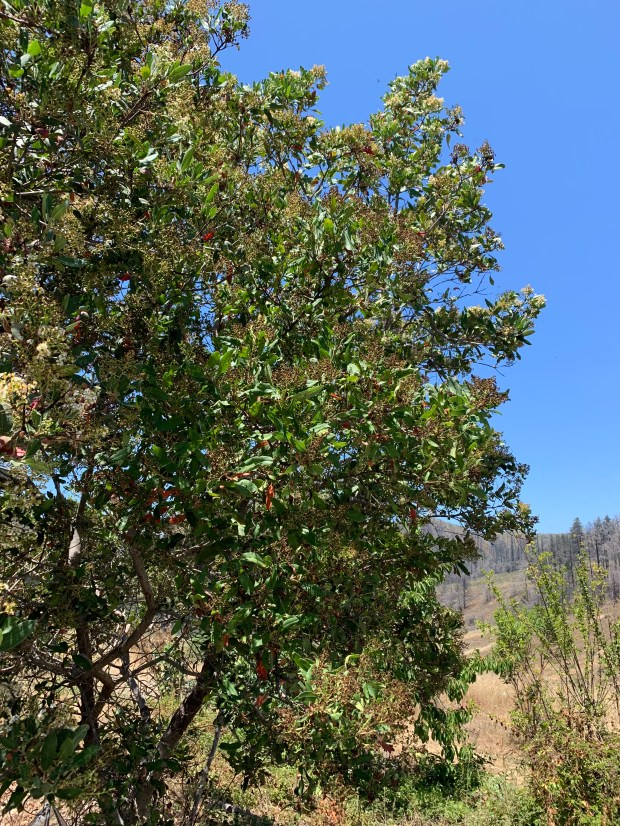
There are drought-deciduous plants and seasonally-deciduous plants. Their sometimes-colorful leaf drop is starting to overlap. Poison oak is one of those deciduous plants that are in between: on drier slopes, crimson patches have been emerging for a month as that plant decides to drop its leaves, leaving only stems and berries. Buckeye trees are dropping medium-brown leaves, too: very little Fall color to add to the landscape’s palette. Madrone Fall has happened already, leaves littering the ground most crunchily, bark peeling on the hot days making pinking and crinkling noises. Madrone trees lose their old leaves but keep their new ones. Bare madrone trees are dead, as is too often the case with some scourge that is ravaging many trees. 

I was just in the Eastern Sierra and the very first seasonal fall color was showing at 8,000 feet – branch tips of the brightest lemony yellow aspens were a treat, but very rare. Time to plan your leaf-peeping trip in a month or so. Our versions of seasonally deciduous lemony yellows will emerge in a while yet with hazelnut and big leaf maple, which mostly aren’t starting to lose their chlorophyll just yet.

Fruit

The grassland seeds have (mostly) fallen and the shrubland berries ripen while the woodland acorns grow fat. In abandoned agricultural fields, dead grass slowly sags horizontal, skeletons of radish, mustard, and hemlock rattle free their last seeds in the afternoon breezes. Perennial grasses in the more pristine prairies have dried, too, and just blue wild rye still holds a few seeds on its narrow, dense flower spikes. The bases of the bunchgrasses show a little green- real toughies! You would be lucky to find a single seed in the spent rattly seed cups of soap root and other lilies.

Side hilling strolls along the prairie-shrubland boundary reveals dark leaved coffeeberry shrubs thick with ripe purple-black juicy berries. Nearby, the mixture of ripening stages of blackberry offers a few small, seedy ripe fruit. Fruit eating birds (including band-tailed pigeons) and foxes have bellies full of these, as evidenced by their scat.

It will be a while before the acorns and buckeye nuts are ripe: they grow day-by-day. Acorn woodpeckers settle for bugs or last year’s cache of acorns for sustenance. 

Migration

As the season progresses, wildlife moves. The last of the barn swallows have just fledged (this last week!) and are fast growing muscle to make their long journey south. Cooper hawk and kestrel will be free of the swallows’ vigilant fuss by the middle of September. 

This year’s batch of adolescent dragonflies is patrolling the air from zero to 50’ above the dry grasslands and chaparral ecosystems, far from their natal homes. They dart about capturing the insects that have matured and taken flight after devouring leaf, shoot, and seed from the prolific biomass below. Below our feet, in the deep and complex matrix of gopher and ground squirrel burrows, newts pace back and forth stalking invertebrate prey. 

On foggy days, chorus frogs that have been emerging from drying ponds climb further out on tree limbs or hop further from their wetland birthplaces to find places with richer food and fewer competitors. These talkative amphibians make their squeaky hinge croaks across the extensive canopies of Fort Ord’s live oak woodlands in the long days of misty-fog “summer.”

Big things are on the move in the ocean as well. My favorite summer whale is the giant blue whale, which is typically seen in the Monterey Bay from July – October. August sitings have been scant, but still, they are out there! Meanwhile, our population of gray whales are at the height of their arctic adventures, way, way north – feasting on krill and wondering if this year is a good one to sneak over to the Atlantic Ocean. This year is the third lowest ice sheet coverage in the last nearly 50 years… gray whales were hunted out of the Atlantic and may soon act on their yearning for those ancestral feeding grounds. 

Fire Season

Monsoon season brought hundreds of lightning strikes to California last weekend ushering in the fire season across large areas of the state. We just passed the anniversary of the 2020 CZU Lightning Complex Fire and, before that, the 2009 Lockheed Fire. Mid-August has been the time for the Monterey Bay to burn recently, but September and October are historically fire months as well. Our cool July and ongoing cool nights have combined to help keep things less dry, but coastal heat waves are quickly removing any residual moisture. As interior California heats up and typical conditions prevail, the moderating effect of the ocean keeps us cooler and sometimes moister so the fire danger is less. That hasn’t stopped fires from happening, though, including a roadside fire in Davenport not long ago. There are no terrific heat waves foreseeable for the coast and no predictions of remnant tropical storms carrying thunder and lightning, so thanks for those things (for now). A reminder, though- it is Not Too Late to clear fuels and otherwise prepare. Recall from Santa Rosa that fire can carry way into town, so work to do even there. Wondering where to focus? Zone Zero- the 5 feet out from structures…nothing flammable there!

Midsummer’s challenge: crunch some madrone leaves under your feet. The crispy noise, the beautiful patterns of fallen madrone leaves, the peely bark…some deep delicious experiences are in store for you if you can get there.

Rain, Mushrooms, Fire, and More

Another round of rain enlivens the vibrant living system that is Molino Creek Farm. Citrus ripens, quince/hazels/milkmaids/houndstongue blossom, and grass and herbs thicken and deepen in every field. Sun returns, wind…the cycles back-and-forth unfold into spring and (too) soon the epic dry summer. The Earth drinks now in preparation for the long parch ahead.

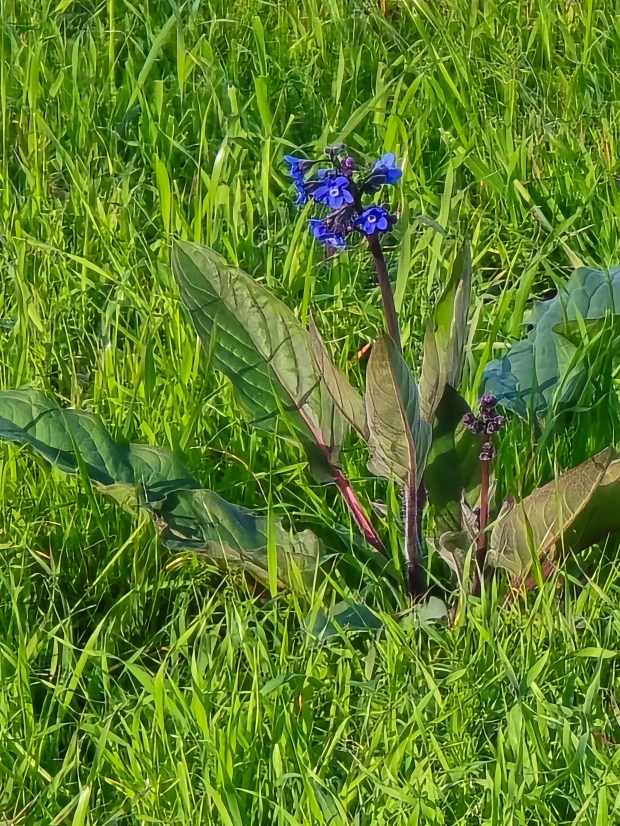
Hound’s Tongue by Cassandra Christine

Water

It rained so much a few weeks back that the Bottomlands pond quickly filled. And, it as rapidly disappeared: not long enough, or deep enough to attract the ducks of yesteryear. Then it was sunny and warm. And then the rain returned, mists and drizzle and the occasional shower. The wetting brought back the chanterelles and beaucoup mushrooms, which had previously pulsed in December only to dry and disappear during the long dry January. Parasols and puffballs poke up from grass and leaves, a variety of colors and textures. Feasts of fresh-picked mushroom risotto return to the menu. The waterfall on the unnamed tributary of Molino Creek spatters and sings, a newly reopened path leads to the overlook. A long glistening wet wall, profusely dripping, towers over the far side of the lively creek channel, hanging thick with wild ginger and ferns. Downstream, the main creek makes even louder creek noises with pool, fall, and rock pile riffles.

A LBM, Little Brown Mushroom, by Cassandra Christine

Fire

Does it ever get too old to talk about Fire? 2020 seems to be fading into the past; 4 ½ years past the catastrophic fire that destroyed so much and changed our landscape forever. Soon, we hope, the Bartles move into their rebuilt home. Our Good Neighbors at San Vicente Redwoods meanwhile continue their excellent post-fire restoration and management. This past week, their crews burned many, many piles of fuel that they had cleared alongside our shared road, including adjacent to the Big Hill. One moment there were stacks of Douglas fir longs and brush, the next moment only charcoal and ash. If a wildfire had raged up that small canyon, it would have been spectacular, dangerous, and destructive, but this controlled pile burn left a smaller footprint with more beneficial outcomes. We are safer. Nature is better off.

Restoration

Our work post fire and overall is evident with the wildflowers. Shucking seeds with our bare hands from nearby wildflowers and Hucking those seeds into the right places throughout the farm creates promise. For instance, a couple of roadside hound’s tongue plants popped up several years ago and have been seeding into the surrounding fire safety mowing zone. Now, there are 10 new seedlings…the patch is growing…the flowers beautiful and there will be more.

Elsewhere, strewn poppy seeds, ant-dispersed footsteps of spring, and grass seeds cast about are manifesting as big patches of increasing species diversity. Besides the rich hound’s tongue blue, there are already splashes of early spring yellow and loud bangs of poppy orange. Bunchgrass tufts throw up panicles of flowers above the meadow sward. Blackberry vines are flashing cascades of white star flowers along fencelines. Trimmed up oaks will survive the next fire, shading a short, fire-safe understory.

Working Fields and Orchards

Mark Bartle steered the 2 Dog tractor in rows across the Roadside Field, mowing cover crop, sending the season’s first cut grass smell to thickly scent the air. A legion of helpers cleared the youngest trees of weeds, saving them from voles. The orchard cover crop is growing tall or just plain growing, depending on whether it was sown early or late; the voles should be going into those rows and feasting on vetch, or bell bean, or oats…soon their litter strewn trails will be evident as they graze and poop and pee and serve as they key component of our regenerative animal impact integration. The owls and coyotes and hawks are thanking us, too.

The oscillating weather still allows for citrus ripening, trees hanging heavily with rain filled yellow, orange, and green fruit. New leaves are sprouting, spikey branches elongating, and older leaves falling to make dense mulch. It still amazes me that we can make this fruit, and we seem to have escaped the frosts of another potentially devastating winter.

Buds swell and the first orchard blossoms have appeared. Quince petals decorate the haphazardly growing bushes near the entrance of the orchard. Apple buds swell on some varieties while others’ buds remain tight and small. Hazelnut catkins dangle and sway in the breeze. Pointy green elderberry leaf tips begin to emerge. The multitude of orchard trees are patient overall in their response to approaching spring.

Waterfall at Molino Creek Farm by Cassandra Christine

Welcome Fall

We woke on the Equinox, September 22, to the song of night’s arrival – golden crowned sparrows. Somehow, they know the right day and arrive the same moment each year, ending their long travel south from Alaska. With the changing world, it seems odd that some things remain constant. These pesky birds promise hours of entertainment as their pecking order is as animated as chickens and they are far more numerous. Their aggression is correlated by the brightness of gold on their heads, but they still love each other: they have tight-knit family groups and larger tribes and they are settling into the same cluster of shrubs they called home last winter. They must be pleased to have so many seeds: last winter’s bounteous precipitation made the seeds rain more than even the huge coveys of quail can keep up with. When it rains, there will still be millions of seeds to germinate and the sparrows will start grazing the lush turf.

More Typicality

Just as last year, the winter battles summer this time of year. Some of us celebrated one more Warm Night: unusual in these parts. The warm night was sandwiched between two pretty hot days and then the Fog returned: moisture rolling off rooves at sunrise, dripping from leaf tips, coloring the dust on the road beneath wetted trees. The see-sawing of temperatures was the cue the apples needed to get that much closer to ripe, but the bouts of fog enshrouded days make it difficult to keep up with the watering…solar pumps don’t produce much when there’s too few photons. It would be better to water the orchard before it gets really hot, but the hot has recently been when the sun comes out. Dynamism and daily adaption is the way of the farmer. The question now…will it be truly typical and rain an inch, our first ‘big storm’ in the middle of October? Whoah! That’s just two weeks away!!

Dry farmed tomatoes- yum!

Fields of Tomatoes

The bouts of heat and the progression of the season coalesced to create a grand glut of tomatoes. In this house, we’ve processed a hundred pounds into jars and jars of sauce to brighten the meals in seasons far from summer. Another household dried 200 pounds. The smell of tomato fruit hangs in the air on still warm evenings. The warmth and dust-loving russet mites have ravaged many plants, leaves withered and crispy: they’re time is up, but there are many more healthy plants in some patches, especially in the ‘diagonal field’ with deeper soil, upwind of the road dust. That’s where the future lies…we need tomato production through Thanksgiving for a truly prosperous year.

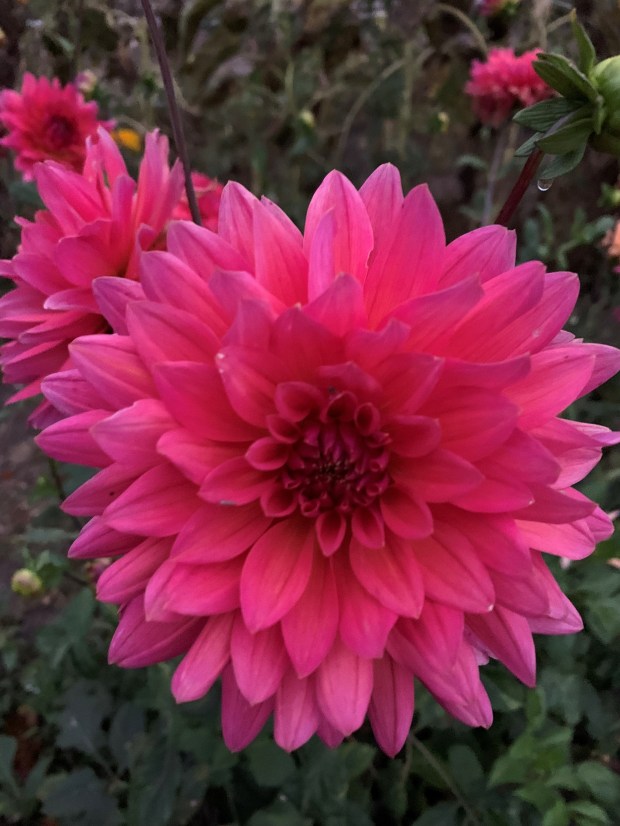
One of Judy’s wonderful dahlias

Flowers

This is truly the driest time of year as we’ve had no rain since April. The hillsides are crispy dry and most shrubs, flowers, and grasses are dormant. The exception is the unbelievably bright green pine-scented coyote bush…just starting to flower. Want to tell the girl from the boy coyote (bushes)? Now’s the time. I mark the coyote bush female plants and eradicate them preferentially- they are the existential threat to us folks who like to keep grasslands, grasslands and let the wildflowers have the wide open space. For now, the coyote bush is keeping the pollinator community well fed. Butterflies flock, flies buzz, and wasps hop from cluster to cluster of the pollen and nectar rich flowerheads.

In the irrigated garden, it is Dahlia time! Big poofy, luscious flowers of the most unbelievable colors pop and spangle in a scant row among cucumber, beans, and squash. Sunflowers are still going, cut for each of the 3 farmer’s markets we are going to nowadays (Aptos/Cabrillo-Saturday, Downtown Santa Cruz-Wednesday, and Palo Alto-Saturday).

It makes nice fall color, even if poison oak is terrible to some

Fall Color

The walnuts and garden birches have only the slightest tinge of the beginnings of yellow. Same with the maples in the wild canyons. At the edge of the forests and on steep hillsides, poison oak is further along with its remarkable streaked purple-reds. Rumor has it that the aspen leaves are turning in Eastern California where ‘leaf peepers’ are drawn to fall glory.

More Return of the Birds

Besides the golden crowned sparrows, other birds have returned from afar for their winter haunts. Cassandra and I have both seen an unusual feathered friend: Western meadowlarks visiting the Farm! Their bright yellow, black-spotted bib and dangerously long stout bills give them away. I guess our grasslands have reclaimed enough shrub ground to look like viable meadowlark habitat – that’s new!

Another bird sighting – an osprey! Around 2012 this time of year, two ospreys would fly over the farm each evening at dusk, west to east. One is flying now. Someone says that they saw it carrying a fish…a little late for fledglings, don’t you think? Still, this is an odd thing and someday someone’s going to have to follow that sea hawk and see where its going.

The beginnings of our haystacks

Hey Rick, hay rick!

Last weekend at our work party, Jen, Mike, and Roland rolled up the hay near Cherry Hill. Tons of the dry grassy stuff is cut, getting raked, and being placed in our rudimentary hay ricks. If we had pines nearby, we could put some needles in our haystacks, but as it is they are full of weeds. This is a new adaption from the bad idea of old…placing dry hay under perfectly innocent trees during fire season. Now, we stack the hay, let it molder, and wait until the end of fire season to swoosh it under the trees to suppress weeds, add nutrients and organic matter, and provide cozy homes for VOLES who do such a good job of ridding the orchards of gophers.

Perhaps we’ll rediscover the way of stacking the hayrick…a profession of years ago with expertise and methods long lost.

Real Pro Haystacks

The US Bureau of Land Management-  Species Conservationists?

The California division of the Bureau of Land Management suggests that it is concerned about rare species, but what evidence is there for those of us considering their management of Cotoni Coast Dairies? It is crucial that public land managers take care of rare wildlife and plants – doesn’t it seem like public lands are the right place for species conservation? Let’s consider what we’ve seen…

Background

The BLM has some great policies to guide its management of rare species. It has a guidance manual, Manual 6840 “Special Status Species Management,” that says that BLM will manage not only for species on the USA’s list of threatened and endangered species, but also for species that are candidates for listing as well as those which State wildlife agencies consider priorities for conservation. The manual directs each BLM State office to keep a list of State Sensitive Species (both wildlife and plants) and to update those lists every 5 years in collaboration with State wildlife agencies.

BLM California has published the following lists of sensitive plants and wildlife.

California BLM’s Sensitive Species: Problems

Although BLM’s policies are good, somehow their implementation at Cotoni Coast Dairies, designated as one of  5 onshore units of California’s Coastal National Monument, has been faulty. For instance, plant species listed by the State as rare (Rank 1B) are automatically considered sensitive according to BLM policy, but the BLM California sensitive plant list is missing three of the California rare plant Rank 1B species that have been documented at Cotoni Coast Dairies: Choris’ popcornflower, Santa Cruz manzanita, and Monterey pine. In addition, although BLM’s State Sensitive Plant List has Point Reyes Horkelia, it is not noted as occurring under the management of the Central Coast Field Office, which oversees Cotoni Coast Dairies. Moreover, the last time BLM’s sensitive wildlife list was updated was 2009; it is missing many species recognized by California Department of Fish and Wildlife as rare, including some that occur at Cotoni Coast Dairies. Here are the Cotoni Coast Dairies’ wildlife species that would have been included on BLM’s sensitive wildlife list if the BLM California State Director Karen Mouritsen were following her mandated actions under Manual 6840:

Common nameLatin nameRarity Status
   
Grasshopper sparrowAmmodramus savannarumCA Species of Special Concern (nesting)  
Northern harrierCircus cyaneus  CA Species of Special Concern (nesting)  
Olive-sided flycatcher  Contopus cooperiCA Species of Special Concern (nesting)  
American badgerTaxidea taxusCA Species of Special Concern  
San Francisco dusky-footed woodratNeotoma fuscipes annectens  CA Species of Special Concern

BLM Central Coast Field Office: Problems

 The staff at BLM’s Central Coast Field Office have described themselves as being ‘conservationists.’ If this is so, then they are prevented from carrying out their self-professed ideology by someone higher up in BLM, perhaps at the State BLM level under Director Mouritsen’s oversight. In 2021, Michael Powers is listed as the author of the “Biological Monitoring Plan, Cotoni-Coast Dairies unit of the California Coastal National Monument, Updated December 2021.” It is odd that there is a monitoring plan in absence of the science plan mandated by the 6220 Manual, which provides policy for managing units of National Monuments under BLM’s stewardship. This oddness continues when one more closely peruses Mr. Powers’ monitoring plan.

Section V of the monitoring plan is titled “Special Status Species,” but the section fails to mention the majority of wildlife and plants on California BLM’s sensitive species lists. The only species listed in this section are the California red-legged frog, steelhead trout, and coho salmon – these noted as ‘Federally Listed’ at the top of that section.  The section of the monitoring plan fails to list the monarch butterfly, which was published by the US Fish and Wildlife Service as a candidate for listing as endangered a year before the monitoring plan, in 2020. According to BLM policy in the 6840 manual, federally published candidate species are to be considered sensitive species with such monitoring plans.

BLM Natural Resource Impacts

Some would suggest that plans are just plans and lists are just lists, but how do these things really matter? Someone in one of the California BLM offices ordered candidate species monarch butterfly habitat to be destroyed at Cotoni Coast Dairies (one day, we’ll know who!). Destroying that habitat makes it more difficult to restore healthy populations of monarch butterflies on Planet Earth. The increasing rarity of monarch butterflies that BLM has created places more burden on other landowners, both public and private to help monarchs not become extinct.

More broadly, someone evidently told BLM’s Mr. Powers not to consider the entirety of California State BLM-listed sensitive species in the monitoring and, presumably, management of Cotoni Coast Dairies. Since BLM State or local officials have not asked for help with budget, there must be some other issue, but political issues don’t seem logical. BLM’s policy states the following reason for analyzing, monitoring, and planning for the conservation of sensitive species: “to promote their conservation and reduce the likelihood and need for future listing under the ESA.” The majority of Americans on either side of the political divide support wildlife conservation. It is in everyone’s interest for species not to qualify for listing under the Endangered Species Act.

Without concerted collaborative effort, it is likely that at least one of the sensitive plants or animals at Cotoni Coast Dairies will face listing under the Endangered Species Act (ESA) in the next 30 years. The Point Reyes Horkelia is probably the most likely species, but the Monarch butterfly is also quite likely. The BLM has no plans to monitor those species, so the agency won’t know if its management of Cotoni Coast Dairies is helping or hurting those species.

What You Can Do

Would you please help? Please write State Director Mouritsen and ask her to protect sensitive species at Cotoni Coast Dairies as well as throughout California. You might mention that she should:

  • Order the Central Coast Field Office to consider BLM California’s sensitive plants and wildlife at Cotoni Coast Dairies as required by BLM’s 6840 Special Status Species Manual.
  • Publish an updated State BLM sensitive wildlife list in collaboration with the California Department of Fish and Wildlife, as mandated by the BLM’s 6840 Special Status Species Manual.
  • Publish an updated State BLM sensitive plant list to include the State ranked 1B plant species documented at Cotoni Coast Dairies, as mandated by the 6840 Manual.
  • Respect those who care about natural resource protection as much as she respects those clamoring for access for mountain bikes at Cotoni Coast Dairies.
  • Publish a Science Plan for Cotoni Coast Dairies as required by BLM’s 6220 National Monuments, National Conservation Areas, and Similar Designations (Public) Manual

That could be a short email note….it would be fast to write! It could even be a cut-and-paste of the those bullets. What we need is numbers of notes to show the Director that there are lots of people who care. Here’s her email address: kmourits@blm.gov It would be great if you could cc me, so I have a record of the communications: coastalprairie@aol.com

-this article originally published in Bruce Bratton’s impactful weekly blog BrattonOnline.com

Lushness, Still, but Rapidly Drying

Gusty winds and cold nights faded quickly to calmer breeze and warmer days. Now, the grass bolts quickly and everything goes to bloom.  Lushness seems on the edge of fading, we don’t know how long the green will last. Already, the thinnest soils are turning tawny in the coastal facing prairies.

Freshly Tilled Soil

Fading Mud, To Dust

After the ground’s gushiness fades, the farmers work the ground. The fields are getting tilled. Cover crops are almost all gone, mowed and integrated into the soil. With the farm roads dry, in comes a compost delivery: fine organic crumbly brown piles getting distributed into some important places, including the orchards.

Gravenstein Apple Flowers

Orchard Blooming

Orchard blossoms burst forth. The earliest flowers are past, cherry petals falling like snow, the first fruit seems to be setting…same with the plums, prunes, and apricots. Now, the apple trees start blossoming. Our one old gravenstein apple tree, with the earliest apples to ripen, is aglow in full bloom. Other apple trees are coming along, a diversity of flower colors, shapes, and sizes. Meanwhile, the vines…

Two Dog Farm Chardonnay Grape Vines Springing from Dormancy

Wine!

Recently, our Two Dog Farm Wine endeavor has started returning deliciousness. The Bartles opened a bottle of their very own Chardonnay at a recent gathering and oh! the praise rang high! The promise of a larger harvest looms for this fall. The neatly pruned and tied vines are flushing leaves and flower clusters.

Elusive Wild Things

Scat is easier to see than the furries. Coyotes, bobcats, and weasels talking sh**, carefully placed to make inter- and intra-species statements, scatting. A small weasel spotted in the orchard, chicken owners worried. No bobcats for so long. Deer tracks but no deer. Skunk digging but no skunk.

Flies.

And now suddenly a hundred types of flies buzzing about. Flies on poop, flies on flowers, flies frolicking in pairs tumbling on the ground.  No face flies, yet, luckily. Clouds of midges, clouds of gnats. Different flies in the forest, different flies on the road.

Winged Friends

The purple martin colony returned from way down south. This is one of two colonies in Santa Cruz County. They have the most distinctive, amazing throaty deep chirps. Goodness, they make a lot of noise. Glad to be back, I guess.

And the stranger noises are coming from the ravens. Maw and Caw are greeting friends passing through with their cluck-clicking patterns, rolling upside down, dipping and turning playfully. Perhaps a bit of this greeting is the kids coming back to say hello. Just the pair, mostly, but then there are brief visitations. The pair stand watch in the freshly tilled fields looking for the lost or injured rodents for lunch.

Two flickers poke and explore something in the ground. The thrasher sings a most refined and eloquent soliloquy.

Flap flap flap! 40 band tailed pigeons wheel across the sky and settle back into the walnut trees. Catkin feasts! It is a good time for the flock, bigger than in recent years.

A Wild Phacelia from Roundabouts the Farm

Flowers

Walnut leaves unfurl with the droopy elongation of the catkins that survive by sheer number the feasting of the pigeons. Poppy displays wash orange across the south-facing slopes across Molino Creek and brighten the grassy balds along the highway. Whorled lupines poke up from the sea of grasses in patches around the farm.

The Harvest One Gwen avocado reminds us about the fruit that this portion of the harvest season will one day bring. One Gwen tree does not enough avocados make. Ironically, the fructification of Spring is the hungriest time of year. Pre seed. Pre fruit.

– also simultaneously published at Molino Creek Farm’s website

See, You Know This!

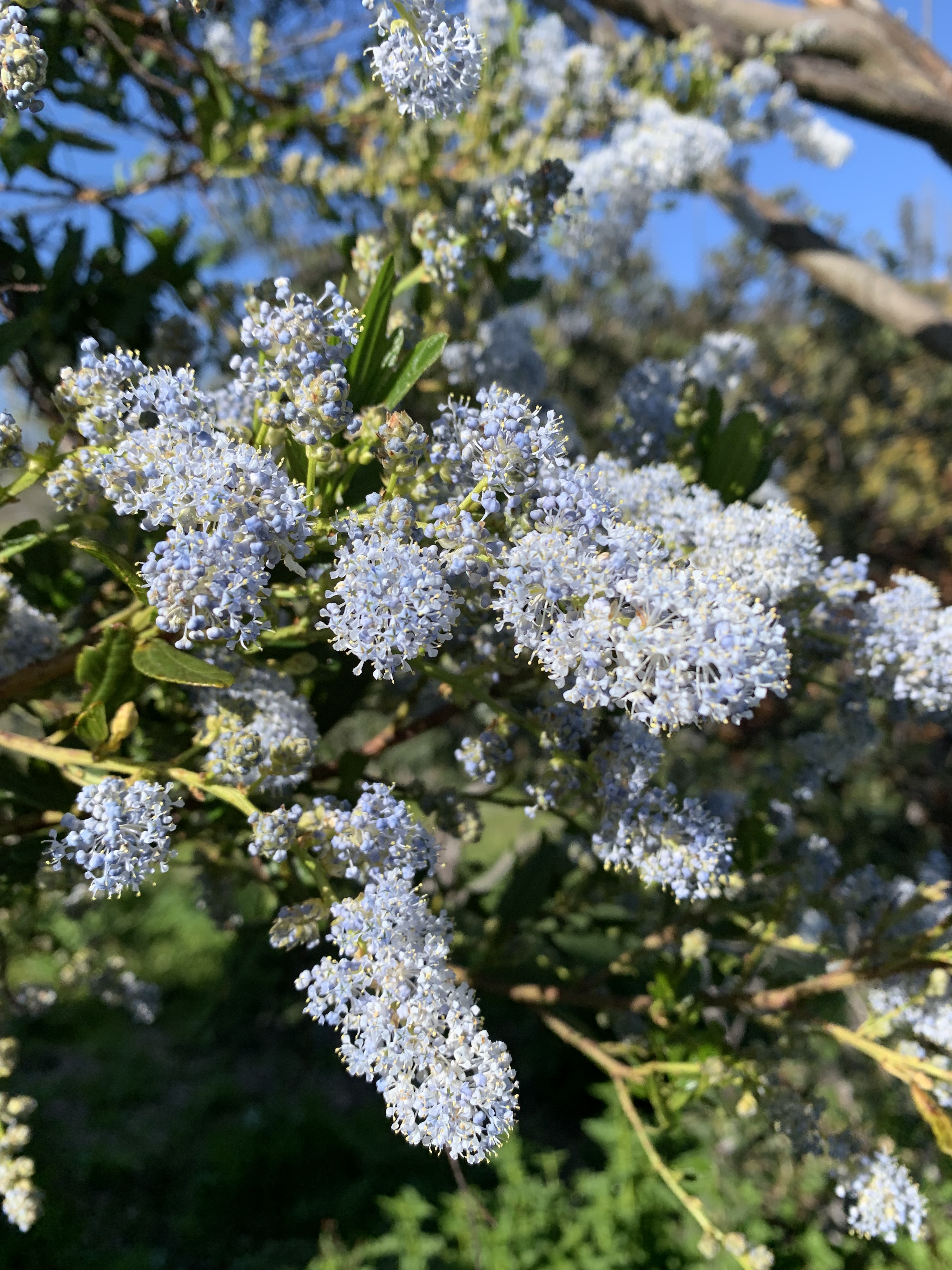
You’ll soon be familiar with one of this area’s most important native shrubs and its ecological interactions. The best poets, writers, and film makers have intimate familiarity with plants and ecosystems, enabling them to transmit their hearts and imaginations realistically. To be part of this place, to appreciate the nature around us, you might consider doing the same. Most start with the dominant trees – those are easy…aim for 10 species, and you’ll have a great start! The next step is to name and know the stories of the top 10 dominant shrubs. In this case, you’ll certainly include a shrub with a confusing array of common names: California lilac, blue blossom, wood tick bush, soap blossom, or (in yesteryear) blue myrtle (Ceanothus thyrsiflorus).

Whatever you call it, this shrub is starting to blossom right now with long fat clusters of tiny pale blue flowers, shaking with pollinators, and filling the air with incredible perfume.

Syringia vulgaris, common lilac, a denizen of gardens and native to Eastern Europe

Wild Lilac?

California lilac isn’t even closely related to the ‘normal’ lilac, but it is easily as commonly found in gardens. The European lilac is related to olives, has medium-sized leaves, and 4-petaled flowers with heady, sweet perfume. Our native wild lilac has a dusty-sweet scent, but you’ll have to squint or use a magnifying glass to see that the tiny flowers have 5 petals.

Garden Plants

There are many relatives of blue blossom, and you can even find some side-by-side in our area. My favorite is warty leaved Ceanothus, Ceanothus papillosus, which likes to grow in chaparral. This warty-leaved type has sapphire-blue flowers and a very memorable, sweet-resinous smell emanating from its leaves, especially when it is hot out. This diversity of Ceanothus types and their stunning beauty have made them very popular as garden plants. If you have well-drained soil and some space in your garden, you might consider adding one not only for their flower beauty, but for their evergreen beautiful leaves, as well as their attractiveness to wildlife. You can find forms from tight ground covers to tall and treelike with flowers from white to deep, dark blue. The flower scents are that variable, too- from very sweet to very musky.

Twenty Years Ago

Twenty years ago, it was a much more unusual treat to encounter California lilac in the natural landscape around Santa Cruz. The same can still be said of the areas that haven’t burned in anyone’s memory. Big, burly blue blossom could hardly be called a shrub back then; they seemed more like small trees, with 1’ thick, gnarly trunks and barely organized canopies festooned thickly with pale blue flowers. Those powder blue puffs stood out singly or in small groves, poking up through old manzanitas or coyotebrush, visible a half mile away for their brief flowering period and then disappearing for the remainder of the year, blending in perfectly.

And Then There Was Fire

California lilac is a pyrophile. How can life love fire, such a destructive force, cooking and searing plants and animals alike as the wind-fanned flames race across hill and valley, crackling and hissing, turning everything to smoking char? For blue blossom, there is naturally no next generation without fire and adults are lucky to live 50 years. These shrubs make a lot of seeds, which sit in the soil waiting for the winter after fire to germinate. Sleeping seeds awaken when they feel the sun and the sun-warmed soil, then seeds that have accumulated in the soil for years germinate. Carpets of blue blossom seedlings spring up, and 3 years after the fire are 6’ tall and blooming, soon raining seeds in preparation for the next fire birthing.

Getting Around

Blue blossom seeds don’t appear adapted to dispersing far from their parent shrubs. The seeds don’t have maple seed wings or dandelion fluff to disperse on the wind. And, the seeds don’t have obviously attractive fruit like acorns or avocados. But, when the seed pods explode on hot days, cracking and popping seeds loose from the mother plants, wildlife become alert to the new availability of food. Quail have been known to gobble them up, as they scratch and peck in the shrubland understory. But quail and other birds don’t digest the seeds completely: the result, perfectly viable seeds being spread across the landscape, far from mother plants.

Not Just Fire

California lilac doesn’t require fire. Any disturbance that churns up the soil and shines new sunlight onto the seeds will work just fine. So, you can find new shrubs germinating in the wake of road or trail building, logging, and even suburban gardening. There are many other sneaky species like this: ones that appear abundant after fire, almost as if they require fire to germinate. There are many fewer species that do actually require fire to germinate- many of those are triggered to sprout by chemicals leached out of charcoal in the winter rains following wildfire.

Such nice flowers on that California lilac: I wish you could smell them!

California Lilac Uses

What good is this shrub? The vigor of this species in germinating after wildfire may be important for a few reasons. First, the shrubs might help to cover and then hold soil in place after fire. Second, the species has special roots that allow it to capture atmospheric Nitrogen and make it available as a plant nutrient. Adding this fertilizer to the ecosystem may help adjacent plants to grow and recover after wildfire. Blue blossom tends to grow especially well on poor soils, so it may be assisting many other species to make it in this soil-inhospitable situation.

Moths, Butterflies and Other Insects

Besides being good bird seed, moths and butterflies depend on California lilac. Ceanothus silk moth feeds on this species (its cocoons were used ceremonially by tribal peoples); many other species of butterfly and moths likewise raise their young on blue blossom. Tortoiseshell butterflies migrate from the Sierra Nevada to raise their young on blue blossom here along the coast. Somehow, the young know how to get back to those mountains to raise their children, which in turn fly higher in the Sierra and that high-mountain-raised generation is the one that comes to the coast.

Besides the post-fire explosion of tortoiseshell butterflies, one of my favorite phenomena are the annual gatherings of what I call blue blossom dancers. Thousands of tiny beetles fly in clouds above the blossoming shrubs at sunset, their silver-shining silhouettes are fascinating to watch pulsing and undulating in their fantastic annual ritual dance. Throughout the day, you can see those dancers feasting on pollen in the flower clusters, preparing for their energetic sunset display.

Where to See Blue Blossom….and a Cleaning Trick

Head for the post-fire ecological footprint! I hear that some Big Basin trails are open as are the trails in the Fall Creek Unit of Henry Cowell State Park. Both areas have huge rafts of California lilac just starting to flower. It is worth going before the winds on a warm day to immerse yourself in the scent. Do yourself a favor and get close to the flower clusters to see the awesome diversity of pollinators. If there is water nearby, grab a big hank of flowers and get to the water. Holding the mass of flowers between your wet hands, rub them together and you can experience the sudsy nature of soap blossom. Like apricot scrub, it has just the right amount of abrasiveness to help the nicely scented suds help clean your hands.

See, you know this! Ceanothus. You are on your way.

-this post originally made available via Bruce Bratton at his BrattonOnline.com blog; check it out…weekly updates…the BEST local news source in the Monterey Bay area.

Cold and Sleet

This past week, screaming gusts and roaring big waves transformed the North Coast into a less-than-hospitable world replete with flying tree debris, whirling eye-stinging chunks, and ocean spray whipped a mile inland. The wind carried frigid air from the north with sleet and snow even down to the beaches. This morning, thousands of our neighbors along the coast woke to the rare sight of white-covered ground. Inches of snow above 1200’ and, at the Farm, a thin and gravelly crunching of rice sized hail. As the day progressed, massively tall patches of billowy clouds, dangerously dark gray at their bases, peeled across the sky dumping big wet drops mixed with sleet and hail. Patches of blue sky allowed roving beams of bright sun to briefly illuminate vibrantly green meadow terraces and silver hillsides of moist sage scrub.

Re-Wetting Welcome

There had been enough dry weather for vehicles to start making dust again along the roads. The last two years the rain stopped early and everything got dry and brown in the middle of what would normally be our rainy season. So, the return of some rain, however cold, has been especially welcome. If the wind dies, we’ll be able to burn some more brush. Meanwhile, the recent dry weather allowed for big machinery to take care of some of the fuel problem another way.

Chip Chip!

There are these agile caged tractors with brush eating drums which are designed to make chips from standing biomass. It’s a a good time to chew up brush- no nesting birds and its wet enough not to start fires if the machinery makes sparks. This past week, one such piece of machinery made a lot of brush on the Farm into tiny chips, even somewhat mixed into the soil in a few spots. The person artfully managing such transitions is Kenny Robinson, a welcome new operator in fuels management. Much of that stuff he was chipping was dead from the 2020 fire, so it was very dangerous fuel for the next wildfire. Thanks a ton, Kenny!

Year by year, we are transforming the Molino landscape back into the grasslands we see in photos prior to the 1980’s. This also makes it less dangerous for wildfire. A broad swath downhill from the barn has been our main focus. There, the forest is turning more park like- redwoods and oaks limbed up high with a carpet of sorrel and brambles 6” tall. New chip-scapes make it possible to drive around and pick up firewood and new camping spots are becoming possible.

Coyote

The orange-tipped small adult coyote snuffles and scoots between patches of weeds approaching its own height. Nose not far from the soil, it mixes nonchalance with intensity but is always on the move. We don’t have a name for this newish resident, but it has become a consistent neighbor.

Feudal Voles

The vole fiefdoms are spreading. Each week, new areas get converted from gopher strewn barrens to vole trailed fiefdoms. I pity the sleeping gophers, cuddling in their carefully crafted dens when the bug-eyed ear-nipping marauders zip in and evict them. They must squeak and complain, retreat to a less dry and comfy tunnel, shiver, starve, and perhaps die with these cold nights. Voles have been multiplying quickly but the next gopher breeding season is a bit further off. The population war is on.

Forest and Fields: Flowers

As we steward roadside oak shade, oak understory herbs are moving in. Drive through hounds tongue patches are coloring the entry. Milkmaids are also in full bloom. Deeper in the redwood forest, redwood sorrel is increasingly flowering. On the trail to the creek…checkerlily and false solomon’s seal are swelling in bud. In the meadows, the earliest poppies are blossoming alongside wild cucumber. We even have a patch of footsteps of spring- splashes of bright yellow like spilled paint signaling that the floriferous season has begun. The first buttercup blossoms have burst open. Leafy whorls of rosettes of only a few lupines suggest that this won’t be such a great lupine year. In the orchard, more plum flowers are emerging and the hazelnut catkins are waving in the wind.

-this is from Molino Creek Farm’s website, my weekly blog posted there first and then here

The Elusive California Nutmeg

When I mention the California nutmeg tree to local people, I find most folks aren’t familiar with it, so this article might serve as an introduction to one of our least-known evergreen tree neighbors.

Image thanks to: Krzysztof Ziarnek, Kenraiz, CC BY-SA 4.0 https://creativecommons.org/licenses/by-sa/4.0, via Wikimedia Commons

Needles to Say

California nutmeg has needles for leaves, and those needles hurt. Pines have needles in bundles, cypresses leaves are scales, and the local firs and redwoods look more like nutmeg in having single, short needles emanating along stems. Douglas fir stems have needles facing up and down and all around. Redwood and nutmeg trees have neater looking needles that just stick out the sides, along one horizontal plane. You can tell redwood and nutmeg needles apart because the latter have very sharp points. Because of the size and sharpness of the spines, nutmeg needles rival the painful jabs of blackberries and thistles.

Needles Afire

I was taught that redwood trees were the only conifer that could have more than half of the needles singed off a tree and still survive. I was taught wrong. The 2020 CZU Lightning Complex Fire scorched through many acres with California nutmeg- I haven’t found one that died from the blaze. Instead, just like coast redwood, the trees are either sprouting from their bases (if severely scorched) or sprouting new leaves and branches from their trunks and limbs. As an aside, I also had a Norfolk Island pine that also burned entirely but is resprouting…so, there appear to be more fire-sprouting conifers than once was thought.

The Wood

The wood of this tree is prized, but the tree is so uncommon that harvest is strictly non-commercial. The tree is not generally quick growing so it has close growth rings. And, the wood is quite different than any other wood around: it is a rich yellow-brown. I’ve heard lore that the native peoples used the wood for bows; people have mentioned to me seeing ‘bow wood trees’ where the tip of nutmeg trees have been bent over and weighted down to create a naturally curved trunk.

Conifer Fruit

This species is in the yew family. Some of you know yews, whose uses you wouldn’t guess include ewes. And, you would be right (as far as I know).

Yews are common shrubs in landscapes with bright red berry-looking fruit. Nutmegs do not make bright fruit, but their fruits are substantially odd. Perhaps the term ‘California nutmeg’ comes from examining the seed: peel off the thick rind and extract the hard nut, carve it in half and you might be looking at a nutmeg nut. California nutmeg nuts are solid and resinous like the foreign nutmeg, but our local one isn’t obviously useful as food, though some suggest the nuts may have once been used as food. Don’t eat the nut, though, it is poisonous if you don’t know how to prepare it correctly.

The coating on the nut is very interesting- watery and yet resinous and quite pungent. Squeeze the nuts and you get juicy with juice that doesn’t quite want to come off of your hand.

Medicine

Some of us recall the controversy of the cancer fighting medicine “Taxol” and the scare about losing the California nutmeg’s pacific northwest cousin the Pacific yew tree, Taxus brevifolia. Taxol keeps some types of cancer from spreading and was discovered in these yew-family trees. However, scientists figured out how to synthesize Taxol so we don’t have to rely on trees to make it, anymore.

When contemplating how to convince people that it is important to save species, I am advised to use examples like this where we have discovered life-saving drugs from wild plants. So, use this as an example.

Where to Find Native Nutmeg

I perused the herbarium records to let readers know where the public can go to see California nutmeg. It seems that the best places are in the Waddell Creek drainage from Rancho del Oso on up. One notable tree used to live near a waterfall in Big Basin- I wonder if is still there?

-this post originally published as part of my ongoing journalism in Bruce Bratton’s amazing weekly blog BrattonOnline.com

Moderate Clime, Harvesting

Across the farm, people are awake before dawn, lights winking on while the stars still shine. We pull on our clothes, make coffee, eat a snack, and prepare to head out as soon as there is any light at all. I mosey across the farm, turning on water valves…that freak early rain was so far in the past that it is time for the once-a-week soil soak again beneath the orchard trees. I pace back and forth down each row of trees examining the micro sprinklers and irrigation tubing to check for any leaks. Mice, rabbits and gophers sometimes chew the lines: I mostly listen for gushing leaks, but sometimes I see them before I hear that awful sound. Leaks repaired, water on, I head to my paying, indoor job. Other farmers keep going as farming is their mainstay.

Midday Work

We still pull our sun hats from the peg next to the door before heading out to work the farm when the sun is up. Sun heat prickles bare skin though the air temperature is perfectly moderate. It is harvest time. Crews pick apples twice a week for markets: we navigate ladders high into trees after the ground picking crew has finished what is reachable. Shoulder-slung bags full of fruit get dumped into sorting bins and the sorters go to work: bad apples to the compost, barely okay apples to the cider press, almost perfect apples gifted to the Pacific School food program, perfect apples to 4 different farmers markets.

Apples off to Market

Farmers load, haul, and set up displays of boxes of beautiful, community-grown apples where people gather for produce at local farmers markets: Saturdays at Palo Alto and via 2 Dog in San Francisco at Alemany the “People’s Farmer’s Market” and then again on Wednesdays via 2 Dog at Heart of the City (SF) as well as Molino Creek Farm’s stand at the Wednesday market in downtown Santa Cruz. We are selling 400+ pounds a week, more than twice what we ever sold before- post fire resilience and the fruits of many people’s labor.

Evening Glow

As the sun sets, we begrudgingly wind down. There are not enough hours of light to deal with the harvest, so we often have to make lists of work to be deferred until the next morning. Harvest bags get packed into mouse proof bins, I check that gates are closed against the evening’s marauding deer, I give a final twist to shut off irrigation valves and update the watering log book, and then I clean and put away the tools. Brushing off the dust and dirt from my work pants and stomping off my boots, I head home as darkness sets in. The first crickets are singing, and an owl begins its nighttime hoots. Cold clean-smelling air settles into the low points on the farm, the higher points are still warm and smell resiny from the last sun warming the coyote brush.

Deer, No Bobcats

The male deer are sparring, and one has cracked one of the points on its antler. Three male deer, one larger, are strutting around, following the four or so does that frequent the farm nowadays. The larger buck and the larger doe are frequently at the cull apple pile in the evening: that will help them bulk up for the cold, rainy winter!

Where is bobcat, coyote, and fox? The plethora of gophers fills us with consternation. Nearly every square foot of ground has been tossed and turned. I find fresh moist subsoil piles at 100’ intervals every day. The hawks scream and reel, crisscrossing the fields. A kestrel eviscerated a gopher on top of a stump next to my office window midday the other day…he plucked its fur off as much as he could before getting to work tearing apart and swallowing the better food.

The raptors are not enough, and the snakes and lizards are slowing down. We need the mesopredators! Two foxes traipsed along the road down from the farm the other day. I haven’t seen a bobcat in a year. A wave of canine distemper is reportedly still raging across our region, which might explain why there aren’t many fox or coyote, but feline distemper hasn’t been a big issue…so why aren’t there more bobcats? They would be so well fed!

Green or Freshly Tilled Fields

The rain two weeks ago germinated millions of seeds and now seedlings are greening the landscape. Where we didn’t get to raking the last harvest in the hayfields, the grass is the tallest, growing through the thick mulch. We took advantage of that early germination to weed the fallow farm fields- disking the crop of weeds into the soil, preparing for planting the cover crop. The farm has beautiful contrasting patches of brown and green.

Jimson weed aka Datura aka thorn apple: a sacred native plant that is ‘weedy’ in our fields

Late Season Flowers

Amazingly, the bees have forage. It is ironic that it is harvest time for the humans and the bees might be hungry. Fall and early winter are starkest times for pollinators. Hummingbirds and bees flock to irrigated salvias in our gardens. But still, the coyote bush is in full bloom- but there are only a few old enough to flower- the fire spared ones are abuzz with diverse flying pollinators: flies, bees, and wasps. Evening brings the hawk moths to the jimson weed aka Datura and evening primrose, wildflowers that are also taking advantage of the garden irrigation for late season blossoming.

Early season rain helped germinate weeds, allowing us to decimate the seedbank by discing

Fall Color Commences

Each year, the obvious harbingers of fall are our many black walnut trees. Descendants of the Mother Tree in the Yard, the younger walnut trees turn lemon yellow starting from the highest, driest trees and ending with the Mother Tree. It is a count down clock to winter. The last trees to show fall color are at the very lowest elevation- in the north apple orchard, on the steep north facing slope of Molino Creek Canyon. Those apple trees turn yellow in late December and early January…slowly dropping leaves into February.

Fall color from black wa’nuts

We hope you are getting out to the fall colors of our area, in the shadier canyons where the big leaf maples, roses and hazelnuts are starting to show.

-this is from my near-weekly blog at Molino Creek Farm’s website