Gusty winds and cold nights faded quickly to calmer breeze and warmer days. Now, the grass bolts quickly and everything goes to bloom. Lushness seems on the edge of fading, we don’t know how long the green will last. Already, the thinnest soils are turning tawny in the coastal facing prairies.
Freshly Tilled Soil
Fading Mud, To Dust
After the ground’s gushiness fades, the farmers work the ground. The fields are getting tilled. Cover crops are almost all gone, mowed and integrated into the soil. With the farm roads dry, in comes a compost delivery: fine organic crumbly brown piles getting distributed into some important places, including the orchards.
Gravenstein Apple Flowers
Orchard Blooming
Orchard blossoms burst forth. The earliest flowers are past, cherry petals falling like snow, the first fruit seems to be setting…same with the plums, prunes, and apricots. Now, the apple trees start blossoming. Our one old gravenstein apple tree, with the earliest apples to ripen, is aglow in full bloom. Other apple trees are coming along, a diversity of flower colors, shapes, and sizes. Meanwhile, the vines…
Two Dog Farm Chardonnay Grape Vines Springing from Dormancy
Wine!
Recently, our Two Dog Farm Wine endeavor has started returning deliciousness. The Bartles opened a bottle of their very own Chardonnay at a recent gathering and oh! the praise rang high! The promise of a larger harvest looms for this fall. The neatly pruned and tied vines are flushing leaves and flower clusters.
Elusive Wild Things
Scat is easier to see than the furries. Coyotes, bobcats, and weasels talking sh**, carefully placed to make inter- and intra-species statements, scatting. A small weasel spotted in the orchard, chicken owners worried. No bobcats for so long. Deer tracks but no deer. Skunk digging but no skunk.
Flies.
And now suddenly a hundred types of flies buzzing about. Flies on poop, flies on flowers, flies frolicking in pairs tumbling on the ground. No face flies, yet, luckily. Clouds of midges, clouds of gnats. Different flies in the forest, different flies on the road.
Winged Friends
The purple martin colony returned from way down south. This is one of two colonies in Santa Cruz County. They have the most distinctive, amazing throaty deep chirps. Goodness, they make a lot of noise. Glad to be back, I guess.
And the stranger noises are coming from the ravens. Maw and Caw are greeting friends passing through with their cluck-clicking patterns, rolling upside down, dipping and turning playfully. Perhaps a bit of this greeting is the kids coming back to say hello. Just the pair, mostly, but then there are brief visitations. The pair stand watch in the freshly tilled fields looking for the lost or injured rodents for lunch.
Two flickers poke and explore something in the ground. The thrasher sings a most refined and eloquent soliloquy.
Flap flap flap! 40 band tailed pigeons wheel across the sky and settle back into the walnut trees. Catkin feasts! It is a good time for the flock, bigger than in recent years.
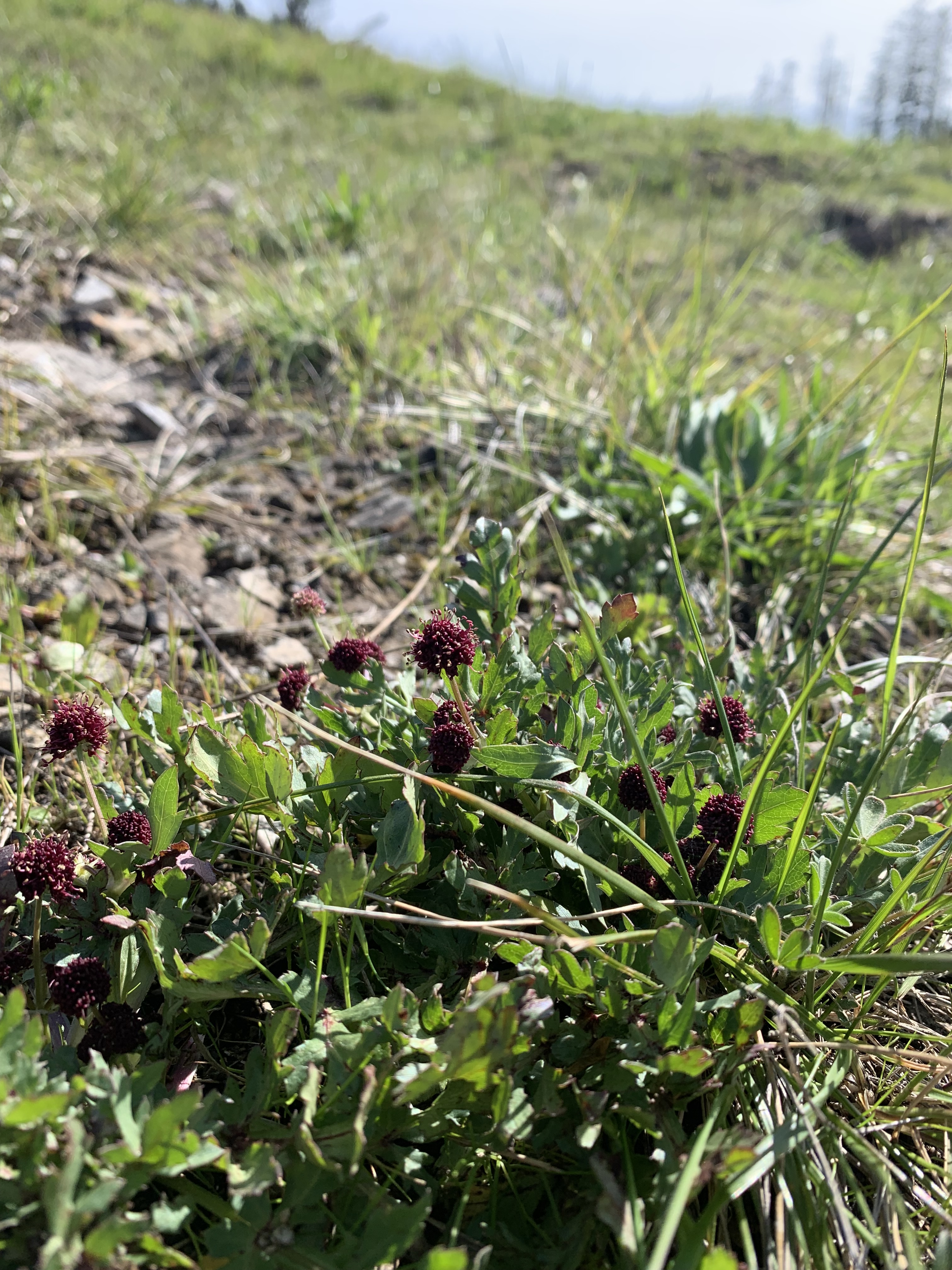
A Wild Phacelia from Roundabouts the Farm
Flowers
Walnut leaves unfurl with the droopy elongation of the catkins that survive by sheer number the feasting of the pigeons. Poppy displays wash orange across the south-facing slopes across Molino Creek and brighten the grassy balds along the highway. Whorled lupines poke up from the sea of grasses in patches around the farm.
The Harvest One Gwen avocado reminds us about the fruit that this portion of the harvest season will one day bring. One Gwen tree does not enough avocados make. Ironically, the fructification of Spring is the hungriest time of year. Pre seed. Pre fruit.
– also simultaneously published at Molino Creek Farm’s website
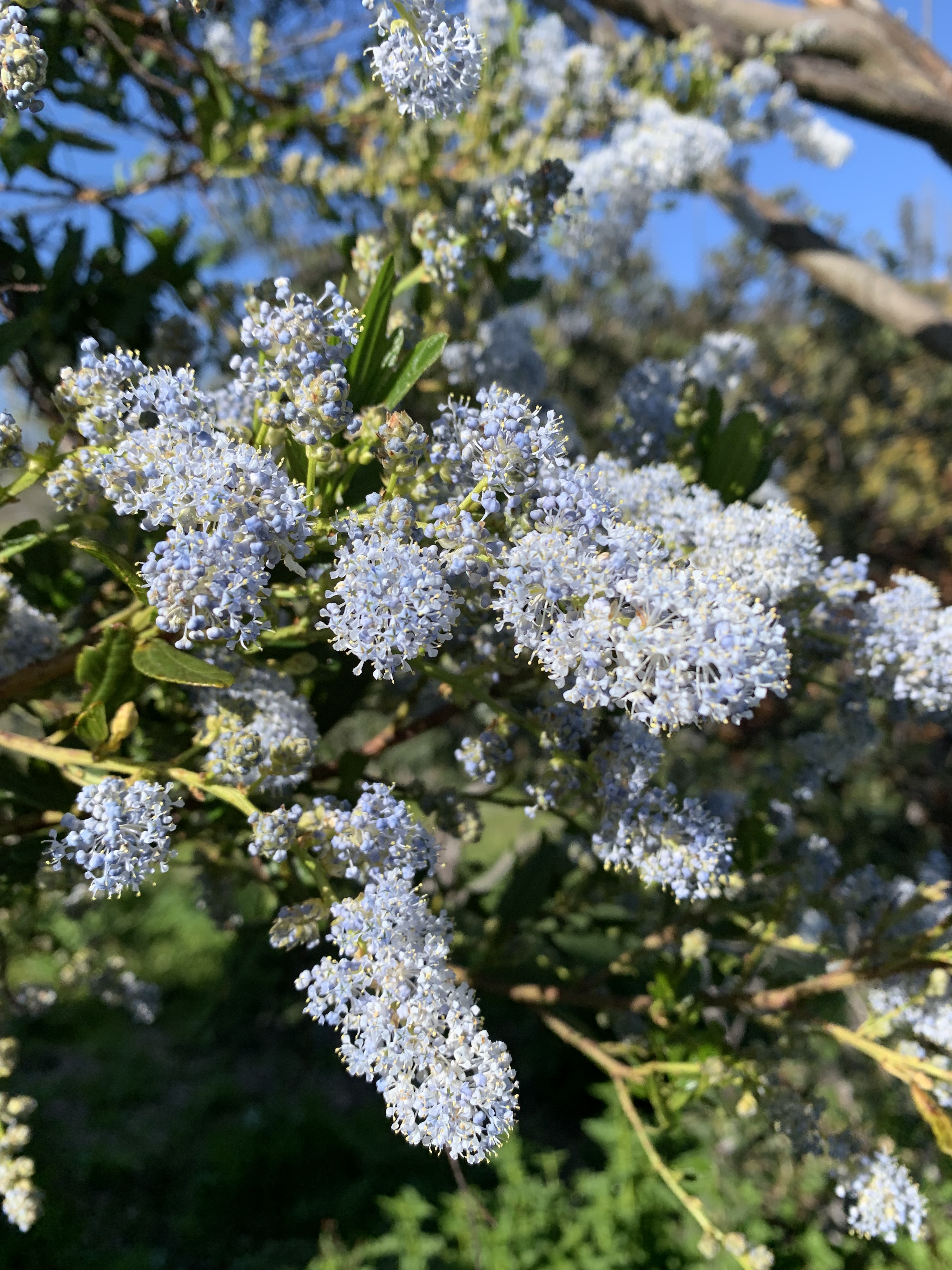
You’ll soon be familiar with one of this area’s most important native shrubs and its ecological interactions. The best poets, writers, and film makers have intimate familiarity with plants and ecosystems, enabling them to transmit their hearts and imaginations realistically. To be part of this place, to appreciate the nature around us, you might consider doing the same. Most start with the dominant trees – those are easy…aim for 10 species, and you’ll have a great start! The next step is to name and know the stories of the top 10 dominant shrubs. In this case, you’ll certainly include a shrub with a confusing array of common names: California lilac, blue blossom, wood tick bush, soap blossom, or (in yesteryear) blue myrtle (Ceanothus thyrsiflorus).
Whatever you call it, this shrub is starting to blossom right now with long fat clusters of tiny pale blue flowers, shaking with pollinators, and filling the air with incredible perfume.
Syringia vulgaris, common lilac, a denizen of gardens and native to Eastern Europe
Wild Lilac?
California lilac isn’t even closely related to the ‘normal’ lilac, but it is easily as commonly found in gardens. The European lilac is related to olives, has medium-sized leaves, and 4-petaled flowers with heady, sweet perfume. Our native wild lilac has a dusty-sweet scent, but you’ll have to squint or use a magnifying glass to see that the tiny flowers have 5 petals.
Garden Plants
There are many relatives of blue blossom, and you can even find some side-by-side in our area. My favorite is warty leaved Ceanothus, Ceanothus papillosus, which likes to grow in chaparral. This warty-leaved type has sapphire-blue flowers and a very memorable, sweet-resinous smell emanating from its leaves, especially when it is hot out. This diversity of Ceanothus types and their stunning beauty have made them very popular as garden plants. If you have well-drained soil and some space in your garden, you might consider adding one not only for their flower beauty, but for their evergreen beautiful leaves, as well as their attractiveness to wildlife. You can find forms from tight ground covers to tall and treelike with flowers from white to deep, dark blue. The flower scents are that variable, too- from very sweet to very musky.
Twenty Years Ago
Twenty years ago, it was a much more unusual treat to encounter California lilac in the natural landscape around Santa Cruz. The same can still be said of the areas that haven’t burned in anyone’s memory. Big, burly blue blossom could hardly be called a shrub back then; they seemed more like small trees, with 1’ thick, gnarly trunks and barely organized canopies festooned thickly with pale blue flowers. Those powder blue puffs stood out singly or in small groves, poking up through old manzanitas or coyotebrush, visible a half mile away for their brief flowering period and then disappearing for the remainder of the year, blending in perfectly.
And Then There Was Fire
California lilac is a pyrophile. How can life love fire, such a destructive force, cooking and searing plants and animals alike as the wind-fanned flames race across hill and valley, crackling and hissing, turning everything to smoking char? For blue blossom, there is naturally no next generation without fire and adults are lucky to live 50 years. These shrubs make a lot of seeds, which sit in the soil waiting for the winter after fire to germinate. Sleeping seeds awaken when they feel the sun and the sun-warmed soil, then seeds that have accumulated in the soil for years germinate. Carpets of blue blossom seedlings spring up, and 3 years after the fire are 6’ tall and blooming, soon raining seeds in preparation for the next fire birthing.
Getting Around
Blue blossom seeds don’t appear adapted to dispersing far from their parent shrubs. The seeds don’t have maple seed wings or dandelion fluff to disperse on the wind. And, the seeds don’t have obviously attractive fruit like acorns or avocados. But, when the seed pods explode on hot days, cracking and popping seeds loose from the mother plants, wildlife become alert to the new availability of food. Quail have been known to gobble them up, as they scratch and peck in the shrubland understory. But quail and other birds don’t digest the seeds completely: the result, perfectly viable seeds being spread across the landscape, far from mother plants.
Not Just Fire
California lilac doesn’t require fire. Any disturbance that churns up the soil and shines new sunlight onto the seeds will work just fine. So, you can find new shrubs germinating in the wake of road or trail building, logging, and even suburban gardening. There are many other sneaky species like this: ones that appear abundant after fire, almost as if they require fire to germinate. There are many fewer species that do actually require fire to germinate- many of those are triggered to sprout by chemicals leached out of charcoal in the winter rains following wildfire.
Such nice flowers on that California lilac: I wish you could smell them!
California Lilac Uses
What good is this shrub? The vigor of this species in germinating after wildfire may be important for a few reasons. First, the shrubs might help to cover and then hold soil in place after fire. Second, the species has special roots that allow it to capture atmospheric Nitrogen and make it available as a plant nutrient. Adding this fertilizer to the ecosystem may help adjacent plants to grow and recover after wildfire. Blue blossom tends to grow especially well on poor soils, so it may be assisting many other species to make it in this soil-inhospitable situation.
Moths, Butterflies and Other Insects
Besides being good bird seed, moths and butterflies depend on California lilac. Ceanothus silk moth feeds on this species (its cocoons were used ceremonially by tribal peoples); many other species of butterfly and moths likewise raise their young on blue blossom. Tortoiseshell butterflies migrate from the Sierra Nevada to raise their young on blue blossom here along the coast. Somehow, the young know how to get back to those mountains to raise their children, which in turn fly higher in the Sierra and that high-mountain-raised generation is the one that comes to the coast.
Besides the post-fire explosion of tortoiseshell butterflies, one of my favorite phenomena are the annual gatherings of what I call blue blossom dancers. Thousands of tiny beetles fly in clouds above the blossoming shrubs at sunset, their silver-shining silhouettes are fascinating to watch pulsing and undulating in their fantastic annual ritual dance. Throughout the day, you can see those dancers feasting on pollen in the flower clusters, preparing for their energetic sunset display.
Where to See Blue Blossom….and a Cleaning Trick
Head for the post-fire ecological footprint! I hear that some Big Basin trails are open as are the trails in the Fall Creek Unit of Henry Cowell State Park. Both areas have huge rafts of California lilac just starting to flower. It is worth going before the winds on a warm day to immerse yourself in the scent. Do yourself a favor and get close to the flower clusters to see the awesome diversity of pollinators. If there is water nearby, grab a big hank of flowers and get to the water. Holding the mass of flowers between your wet hands, rub them together and you can experience the sudsy nature of soap blossom. Like apricot scrub, it has just the right amount of abrasiveness to help the nicely scented suds help clean your hands.
See, you know this! Ceanothus. You are on your way.
-this post originally made available via Bruce Bratton at his BrattonOnline.com blog; check it out…weekly updates…the BEST local news source in the Monterey Bay area.
Wild blackberries are blooming big time. Their brambly tip-rooting canes are sprouting new leaves and are festooned with bright white five-petalled flowers. In rare years, they make tasty, juicy berries, but mostly the weather turns hot and dry, and the fruits are seedy/not-so juicy. Currently, they are making pollen and nectar for the emerging bumble bees, while we dream of the tasty fruit. Wild blackberries are the dominant wildflower right now on the farm, creating hedgelets along all the fences ‘cause that’s where we can’t mow them too much. They arch out from there onto our fence-side trails: trip hazards!
Rubus ursinus, literally bear blackberry…in full bloom right now
Wild Lilac
Soon, there will be more wildflowers – spring is on the verge of letting loose! Nearby, on south-facing shallow-soiled spots, the poppy displays are epic splashes of orange, bigger than any recent year. Across Molino Creek, on that steep south facing slope, a large patch of poppy orange has erupted where before the fire there had been shrubs. I’m looking forward to the woodland iris displays, though they are getting overtaken by post-fire shrubs like blue blossom (Ceanothus), which is starting to blossom as well. In about 2 weeks, there will be miles of blue blossom shrubs blooming about 5 feet high across at least half of the 85,000-acre burn footprint of the 2020 CZU Lightning Complex Fire. Imagine a sea of powder blue, framed by glossy light green leaves…thousands of acres of rolling wild lilac scent wafting headily, luring you to just stand still and gaze.
Ridge Guardians
More than a few of the noble ridge-line tree skeletons have fallen, but many remain silhouetted on the ridgelines. The redwoods have enjoyed the rain and are recovering from drought and fire with luxurious new growth; the ones that burned hotter sprouting from only their trunks…others from their branches…and all of them from the base of their trunks with 5’+ tall sprouts sprinting skyward. And everywhere, between it all, so very green and lush, but the ground is getting drier.
The ridge to the North of Molino Creek Farm
Drying Out
Even with all the rain, the ground is starting to dry out. Once the rain stops, even for a little while, the long days and the strong breezy days we’ve been having make for quick dry soil. The upper 2” of soil is dry, dry, but below it is still pretty moist. Gophers are awaking and their soil throws are starting to appear, moist piles burying the surrounding lush grass. Roots pump moisture from deep in the earth and plants grow quickly to blossom and seed before the last moisture is gone and the long dry summer sets in.
Green Manure
The most proud bolt is in cover crop land. Thick bell bean stalks sport rows of big white flowers and flapping succulent leaves. Twining ferny leaved vetch climbs up those stalks. Pert sharp leaves of oats grow in thick forests through it all, promising tons of tough stems for future spongy soil organic matter.
Bell beans, oats, and vetch – ‘soil builder mix’ – a cover crop that conserves and builds soil for organic farms
Along Come the Mowers
Back and forth, hither and yon, the mowers must mow. Behind the machines, dense mats of sweet-smelling chopped up vegetation, either to be tractored into the soil or left on top as mulch, protecting the earthworms from sunburn. We rush to mow the farm fields and the orchard understory to keep the plants from sucking up the soil moisture, to keep the water for the crops to delay irrigation for as long as we can.
It’s suddenly become a busy time around the Farm. I suspect the spring is revving everyone’s energy about now. Keep calm and plod forward!
-from my weekly blog also posted at Molino Creek Farm’s website.
I invite you to immerse yourself for a few moments into my dream of the future of Santa Cruz’ North Coast. How will Cotoni Coast Dairies fare in the future, for instance in 2064? During the past year, many things have aligned to allow my dream to be much closer to reality.
It was 2024 and Cotoni Coast Dairies’ new manager, Zacchary Ormsby was the first with the skill, knowledge and respect to manage the property according to the Bureau of Land Management’s (BLM’s) protocol for lands with National Monument and National Conservation Lands status. Zacchary was joined by a freshly hired California Coastal Monument manager, another conservation-oriented biologist, Leisyka Parrot. Congressman Jimmy Pannetta, a skilled veteran of addressing impacts in over-loved and under-stewarded wildlands of Big Sur, has been newly elected to represent Cotoni Coast Dairies’ geography. Jimmy is dedicated to helping address North Coast tourist visitation issues with his important federal government leverage. And Justin Cummings with his doctorate in multi-disciplinary environmental problem solving was newly both the County Supervisor AND the Coastal Commissioner overseeing the park. Meanwhile, many very smart coalitions were poised to work together to assure that Cotoni Coast Dairies is a park for all, well stewarded for wildlife, forever. What a hopeful moment that was!
Looking Forward
It is 2064, the 50th anniversary of Cotoni Coast Dairies becoming public land, and there are national celebrations of this unexpectedly exemplary project. The New York Times has a full color Sunday edition article featuring the park’s success. Cotoni Coast Dairies has become a global destination for accessible, multi-cultural nature tourism. Hundreds of thousands of visitors have enjoyed immersive educational experiences that are the gold standard being copies at other parks around the world. Programs at the park have changed lives of thousands of underrepresented schoolchildren from throughout the Bay Area. Tourists of many nationalities flock to Santa Cruz with this destination in mind. The park’s managers have worked closely with scientists and conservationists, succeeding in restoring the property’s teeming wildlife populations. Visitation is so well managed that many different experiences are available, no matter what ethnicity or language and no matter the financial means. Using cutting edge technology, parks administrators provide the vast array of experiences that visitors report wanting and have developed software to continuously adapt available park experiences accordingly. BLM has received recognition for their sound management through strong public as well as private funding and through the added capacity of dedicated partner organizations and volunteers.
Badgers, Burrowing Owls, and Tule Elk, Oh My!
Early on, BLM partnered with local scientists, State and Federal wildlife agencies, and conservation groups with what turned out to be highly successful reintroduction programs for American badger, western burrowing owl, beaver, and tule elk. Volunteers working with conservation groups adapted prior regional wildlife connectivity successes to create Western North America’s first badger preserve by reintroducing ground squirrels, installing drift fences to underpasses along roads to reduce badger fatalities, and creating landscape-scale habitat corridors, and badger populations recovered. Because badgers prefer sandy soils for denning, Cotoni Coast Dairies managers designed large recreation-free buffers around the best denning sites; at first, those buffers were insufficient, but monitoring refined buffer design, and the badgers responded positively with their first young born in 2040. The badger and ground squirrel burrows created habitat that made it possible to later reintroduce burrowing owls which have established several breeding colonies in the huge swaths of restored coastal prairies. These wildlife species have become an important focus for visitation.
Restored Coastal Prairie
Besides reintroduction of these keystone grassland wildlife species, BLM managers embarked on two other processes that turned out to be critical to the restoration of some of California’s last remaining coastal prairies. First, the entire property, including its prairies, became actively cared for by the descendants of the indigenous people who have tended the landscape for thousands of years. The importance of indigenous stewardship was an insight from the outset, including in the name of the property beginning with the tribal name of the first inhabitants, ‘Cotoni.’ In the process of recognizing and revitalizing their culture, native people have directed hundreds of programs attracting thousands of volunteers, school children, and others to collaborate in the large-scale restoration of the land. They reintroduced fire management and tended wildflowers and grasses, carefully relearning the best ways to nurture them to health. The native peoples have revived their internationally renowned basketry, tending plants throughout the park for materials.
At the same time, BLM managers have used cutting-edge, science-based livestock grazing management to restore coastal prairie health. They have collaborated with many other coastal prairie managers, from Humboldt to Santa Barbara, to manage cattle alongside tule elk herds, moving the animals through a matrix of patches of grasslands managed with prescribed fire and reseeding. The prairies draw visitors each spring to view stunning spring wildflower displays unrivaled in the region.
Vibrant Lagoons and Beaches
The 2050s were a decade of sea level rise adaptation made possible by the strong North Coast public lands managers partnership facilitated for decades by Santa Cruz City Parks. The first beach and Highway 1 realignment to be redesigned was at Scott Creek Beach, back in the 2030’s. Then, there were successes in restoring Lidell Creek/Bonny Doon Beach and Laguna Creek/Laguna Beach, and then the coalitions managed to redesign all the other North Coast Beaches and highway crossings. Economic development, transportation and conservation interests all converged, and every beach has moved inland of Highway 1. Multi-use bridges accommodate public transport, pedestrian, and bicycle use as well as interpretive and viewing areas which draw the highest numbers of visitors.
The redesigned bridges allowed reintroduction of beavers, which in turn restored fish habitat. Coho salmon and steelhead have been reproducing in all the newly restored streams. After 40 years, BLM wildlife biologists have succeeded in restoring California red-legged frog populations to every beaver pond and lagoon on the North Coast; this is the last place they can be reliably found, the last viable population remaining on Earth. While beachgoing recreation is no longer possible on most North Coast Beaches, the small slivers of sand now support snowy plover nests alongside elephant seal nurseries, drawing wildlife-oriented tourists to high tech, wildlife sensitive viewing opportunities.
Visitor Highlights
Cotoni Coast Dairies has become known for its approachability and accessibility. Visitors are greeted by guides who can communicate in 14 languages; interpretive information on interactive signs is available in an additional 30 languages. Guides are provided state of the art, sustainably constructed family homes attached to visitor interpretation outposts spread throughout the property, allowing 24-7 oversight.
Visitor experiences at Cotoni Coast Dairies vary with time in response to ongoing surveys of existing and potential users. While it has become necessary to limit use, a universally available reservation system assures fair distribution of tickets. Free transportation into the park is available from nearby public transit hubs. The reservation system allows park managers to adjust amount and types of use, including segregating users within the park, to accommodate visitor expectations and reduce use conflict. Families feel safe walking small children or elderly family members on tranquil trails while thrill seeking bicycle riders enjoy uncrowded downhill forays without worrying about others’ safety. If you don’t mind more crowded conditions, you won’t be surprised by what you experience. But, if you want more solitude or better wildlife viewing opportunities, parks managers have specific days, trails and destinations just for you.
One of the most popular reservation requests is for guided nighttime wildlife viewing. For this opportunity, small groups are guided into one of 10 remote viewing locations designed to minimize wildlife impacts while maximizing the opportunity to view nighttime wildlife using the latest night vision technology. Visitors enjoy these immersive experiences, with interpretation and storytelling by expert volunteer naturalists.
Digital communication has allowed active feedback about visitors’ experiences to parks managers, and data feeds into the network of universities participating in the studies and assisting with adaptive management. Management response to real time social carrying capacity analysis has become second nature to Cotoni Coast Dairies users and the vastly superior visitor use experience has resulted in a high demand for updating other park system management protocol.
Realizing the Dream
What I describe above is truly attainable if we want it bad enough and are willing to act. The key element of success is public will which is necessary to raise our capacity to succeed. We’ll need leadership, volunteers, capital, technology, and kindness. And, we need to have a common vision: I hope I began that by communicating something we can work together to hone and then aspire to. If you like this vision, let BLM, Jimmy Panetta, and Justin Cummings know by clicking those links and writing a short note referencing this essay.
-this post originally posted via Bruce Bratton on his vastly illuminating weekly blog at BrattonOnline.com: subscribe now and SAVE!
Bare twigs are erupting from buds into clusters of flowers and whorls of spring green leaves. It is bud break. Unfurling walnut leaves are the subtlest green whereas apple leaves emerge more deliciously bright. Even evergreen coast live oaks have a flush of new spring leaves – some pinker, some shiny olive green. The really stunning eye-hurting green though is from the grasslands, which haven’t been this bright due to years of drought. The last two years, the grasslands greened by December only to brown again by March. This year, the amplitude of green keeps ramping up each week and today was so shimmeringly brilliant as to in contrast dull the sky’s pure blue.
Molino Creek Farm’s Vibrant Green Returns After a Long Drought
All Weather in One Day
Sun, clouds, rain, sleet, wind, hail. We recently had a few days with everything possible in a day’s weather. The most striking part was the pea + sized hail, which pelleted the landscape, wave after wave for a long, long time…wide large storm stalling across the North Coast. The hail bruised miles of freshly emerged poison oak leaves, releasing its distinct pungent, acrid, sweet scent that soon blanketed the land, seeping through car vents and into homes.
Poison oak is emerging – an amazing color
Forest Fall
For months, we’ve had storm after storm, but only more recently have we had truly ghastly wind storms. The latest storm dwarfed the prior. Giant trees toppled, shredding through the canopy sending branches flying far. Just across Molino Creek canyon, a half-acre of trees all pitched sideways at once, roots pitched, baring the slope like a landslide. Where we had just spent a hundred hours cleaning fallen limbs to buffer from wildfire…there is now another big project to tackle once again. The entire forest is so thickly strewn with 6” + branches, it is a wonder that any branches or trees remain; it is very difficult to walk anywhere in the forest even along the trail we used to walk to the creek.
An Entire Grove of Trees Pitched Over in Windstorm
Wildlife
When the weather clears, pent up bird song erupts. The birds are singing their spring songs. Song sparrow and house finch melodious jabbering dominates the sound scape, and the whole farm is enveloped in near frenzied mating song. Calling from nooks above the farm and echoing from the canyon walls: turkey gobbling. In the meadows just below the farm, there are huge groups of turkeys with a fair number of showy, strutting toms.
Raptors are calling, as well. The eerie screech of a barn owl reminds us that they are still around: bone-filled pellets stack up below the redwoods at the water tanks complex. In the recent profound breezes, the farm kestrel hovered and dove, over and over, little need to flap. The wind seemed to agitate the red tailed hawk into frequent screaming as it darted between tree tops.
Farm partners have been mowing the cover crop- the fields dried out fast enough with the wind so tractoring was possible. I wanted to follow to gather the scent of fresh-mown grass and also found a juvenile California red-legged frog hopping across the shortened sward.
There are only 2 barn swallows just yet and those two males wheel and swerve in constant play. How soon will their kin arrive, their mates?
Flowers
The first sky lupines blossomed on the farm this week, tailing the first poppies by a few weeks. Bush lupines started blooming as well along with scarlet paintbrush and blue-eyed grass.
First flowering lupine among the Stipa pulchra, purple needlgrass
The scent across the farm comes from a series of blossoming plums, the first over a month ago but more blooming each week. Plum scent contains the highest of sweet notes and just a little low musk to add a bit of interest. The first cherry blooms also erupted this week, but more cherry blossoms are soon in store.
Quickening Farm Pulse
The greenhouse is stacked with young farm plants – Two Dog Farm’s seedlings are itching to get planted soon. Meanwhile, the fields are nearly already mowed, well in advance of nesting birds this year. Soon, the tilling will begin as it has in the brussels sprouts fields along the coast. This Spring, the plow contends with a huge hole that opened up in our lower field. That hole seems as close to a mini active sinkhole as anything we’ve seen: it is 3’ across and that deep, an odd crater that suggests a both a drain and the spigot for the artesian lake that we got twice this year.
The orchardistas must now hurry: three weeks and we’ll need to irrigate again. The soil quickly dries as the trees leaf out and the cover crop rockets skyward. The pruning is nearly done but young trees need propping! So much to do…
-shared here from my usual posts at Molino Creek Farm’s webpage.
Someone new on the scene recently asked me to explain the history of what went wrong at Cotoni Coast Dairies. After many, many years, the property still isn’t being managed for wildlife or public safety, and it still isn’t open to the public. As a prelude to this, I urge readers to read my essay on how the Bureau of Land Management (BLM) came to manage the property in the first place…a curious story, indeed. This essay compliments that prior essay with more details, especially since BLM took over managing the property. Soon, I’ll be writing the third in this series with suggestions about what is needed to improve this unfortunate situation.
Years of On the Ground Nothing, or Worse
Since its purchase for conservation, Cotoni Coast Dairies has a history of very little stewardship and management. Trust for Public Land purchased the property in 1998 and held it until 2014. During that time, managers working for the Trust for Public Land did almost nothing to maintain the property. Occasionally, someone would show up to clear some anticipated future trail. For instance, TPL contractors extensively cleared riparian vegetation along Liddell Creek, chainsawing decades-old willow trees that shaded endangered fish habitat and provided cover for the endangered California red-legged frog. They argued that the clearance was along an ‘existing road,’ and they started putting this trail on early maps as a favored future public access point. (The trail later appeared on BLM’s maps, but federal wildlife protection agency personnel demanded otherwise, so the trail disappeared from plans.) Otherwise, TPL let fences, gates, and culverts rust away, roads and trails erode, weeds spread, and fuels build up creating hazardous conditions for future wildfires.
In 2014, BLM took over management of Cotoni Coast Dairies, and those same patterns largely continued. Early on, BLM staff constructed a new trail, carving through nests of state-listed sensitive wildlife without required State consultation. Like TPL, BLM staff have either overlooked erosion issues along roads or graded long abandoned ‘existing roads’ (aka ‘future trails’) with uncannily similar detrimental impacts to rare fish and amphibians. Meanwhile, terrible weeds and immense wildfire risks continued to spread across the property. The reason BLM staff have given for such poor stewardship: ‘we don’t have an approved plan.’ That changed, but management hasn’t…except for one new stretch of cattle fence and subset of future trails being created mainly by volunteers. The trails and fence came before any work on invasive species or wildfire mitigation, so we sadly sense BLM staff priorities have been directed away from conservation towards recreational access.
Decades of Funky Planning and Community Engagement
Staff from both TPL and BLM have sporadically spent a bit of time working on poor planning processes or participating in largely perfunctory public meetings about property management at Cotoni Coast Dairies. In the year 2000, TPL convened and facilitated a Community Advisory Group (CAG) to advise on guidelines meant to be used by future managers. A few of us on the CAG were asked to provide feedback about the biological portion of those guidelines, but we were unable to improve the largely cursory and incomplete biological assessments used to guide future property management. It is unclear if those guidelines have ever been used by BLM, or if TPL even cares.
BLM has done little to inventory the property, so it has very poor information with which to plan its management. And so, BLM’s plans have overlooked species and ecosystems that are easily identified and/or previously catalogued by reputable sources. This alienates the conservation community including the wealth of well-trained scientists that this region enjoys.
Instead of the long series of TPL’s CAG meetings, BLM staff have appeared for a very few community-engagement-style meetings, including one early on that was convened and facilitated by the Land Trust of Santa Cruz County. That Land Trust meeting surprisingly and very oddly focused on weighing pros and cons of parking lot locations, but it was never clear why public input was sought or what became of it afterwards. In the midst of this, an outside funder parachuted in hundreds of thousands of dollars so that several local organizations could mount a seemingly ‘grassroots’ Monument Campaign.
Monument Ahoy
In 2015, The Sempervirens Fund led the “Monument Campaign,” a fast-paced, highly scripted, well-funded effort to organize rallies and letter writing to show public support for National Monument designation of Cotoni Coast Dairies. In what is increasingly common “fake news,” the bulk of the Monument Campaign messaging was about opening the property for public use, while in fact Monument designation is more about improving conservation of the property…which would typically increase limitations on public access. This nonsense was compounded by campaign organizers’ refusal to address how designation would increase deed restriction protections already in place from TPL. Furthermore, organizers dismissed concerns about managing the anticipated influx of visitors drawn to something called a National Monument. How important the Monument Campaign was in Obama’s designation is unclear, but the divisions in the community were deep and lasting. Organizers were successful in coalescing well-meaning but very poorly informed people whose nonsensical byline was “Monument designation means my family will be able to visit!” On the other hand, there was a surprisingly politically diverse coalition equipped with well-informed questions and concerns that were never addressed. After that local experience, it is difficult for me to believe that any political faction is immune from using scripted ‘truthiness,’ hype, or even lies when they feel those tools necessary in attracting popular support for secret agendas. Unsurprisingly, leaders of the ephemeral Monument Campaign movement have since disappeared from involvement, leaving the aftermath for the real, long-term grassroots organizations to deal with, and we have yet to experience any conservation benefit of Monument designation.
Pop Up Trail Plans, Abandoned
As the Monument Campaign launched in 2015, BLM issued a proposal for the property’s first public access trail, aka the “Laguna Trail,” in an expedited environmental review process that showed our community how poorly equipped BLM staff were to adequately plan for the property. BLM staff relied on old, insufficient biological inventories for their analysis, failed to survey for endangered species, and did not include any analysis of how the trail would address social equity concerns in providing for visitor use. BLM staff did not respond to the many concerns raised by the public but instead completed their pro-forma circulation and approval of planning documents and rapidly deployed machinery and workers to clear the trail. Trail construction proceeded without conforming to even the nominal environmental guidelines outlined in BLM’s planning documents. The hastily constructed trail cut through state-protected wildlife habitat, degraded historical artifacts, and came very close to a native village site which BLM failed to plan for protecting. In addition, if the project had proceeded, BLM would have opened a trail beginning at Laguna Creek Road and Highway 1 without any new parking, litter, or bathroom facilities, without sufficient staffing for enforcement or interpretation, and without a recreational plan for the property as a whole to analyze how to best protect wildlife while providing public access. This pop up trail was BLM’s way of introducing themselves to the land and to our community.
Introductions to BLM Planning Procedures
As the first federal land manager in the County, it was BLM staff who introduced our community to the federal government’s environmental planning process. This introduction was surprising in many ways. We had been accustomed to public lands managers paying careful attention to protecting “environmentally sensitive habitat areas” (ESHA) according to Coastal Commission rules. Not so with this property – BLM staff didn’t even provide the public maps of those regulated habitat areas in any of their planning documents! With the promise of National Monument protections, we were hopeful that BLM staff would follow the required and highly regimented process outlined in BLM’s policy “Manual 6220,” which provides staff with guidelines on how to manage national monuments. Again, not so! In fact, BLM staff have not used the 6220 manual and have neglected any public acknowledgement of the manual, as if they do not intend to use it, at all. Moreover, BLM staff have never specifically acknowledged the many species and ecosystems protected through the monument designation process. Monument management protocol seems irrelevant to BLM staff, who are apparently bent on expediting the public access so vocally anticipated by the Monument Campaign (coincidence?).
The job ain’t finished until the paperwork is done! Cartoon compliments of DeCinzo, Caption by Grey Hayes
Expediting Public Access
BLM staff have chosen expediency over thoroughness in each of their property planning exercises. For their most recent property-wide plan, instead of data-based predictions of visitor use, BLM staff chose a largely arbitrary low-ball figure of 250,000 anticipated visitors/year for the property. Instead of the logical in-depth alternatives analysis of a full Environmental Impact Statement (EIS), BLM staff have chosen expedited Environmental Analysis (EA) processes, complete with incredible conclusions of ‘Finding of No Significant Impact (FONSI),’ despite significant contrary expert testimony that has gone unaddressed and unacknowledged. As we learned for the first time about its ‘federal consistency process,’ the Coastal Commission recently mandated that BLM use a phased approach to opening the property to public use. The Coastal Commission required that only if/when the BLM proved it could adequately manage public use could it open the full range of parking lots and trails; that proof requires monitoring and such monitoring would normally require a baseline inventory of sensitive natural resources, but we have yet to see that happen…we don’t even know the language to which the BLM and the Coastal Commission have agreed.
Nipping at the Community
My personal interactions with BLM staff have historically been less than pleasant, perhaps because those staff members are unused to much public engagement. My experience of poor interactions with BLM staff isn’t isolated. Someone suggested that this might be partly because those staff feel ‘rocked back on their heels’ because of criticism of their work, which is odd because our comments have been professional, polite, and part of what BLM should expect as public lands planning processes. A BLM staffer told me long ago that their colleagues were in for a surprise as they encountered the very actively involved communities of Santa Cruz County’s North Coast. Previously, most BLM staff working at Cotoni Coast Dairies had worked very much out of the public eye, in remote parts of California with little/no public oversight.
While we can’t ascertain why BLM staff have avoided offers for assistance, their subterfuge is as enlightening as it has been damaging. My compassion about staff feeling rocked back on their heels is limited because BLM staff have sought to discredit my work and harm my reputation, even approaching employers with false information to negatively affect my job while also giving ultimatums to conservation networks to preclude my participation. During one encounter at a public meeting, a BLM staff person told me that they would never collaborate with me or the groups with whom I worked because I was “against any public access at Cotoni Coast Dairies.” That was an incorrect statement about my position that I had likewise been hearing from a particularly activist, radical group of mountain bikers. As this BLM staff person echoed that quote, it was possible to better understand communication channels and allegiances.
My earliest interactions with BLM staff at Cotoni Coast Dairies were when I proposed assistance for biological monitoring. I and a few other biologists offered BLM free assistance with biological surveys to improve their understanding of the property. After that proposal, over a very long time, a BLM staff person strung us along through an incorrect informal process without ever encouraging us or acknowledging the potential value of such work. There was a chain of calls and emails that each ended with something like ‘well, maybe….’ By the time we subsequently discovered the correct application process and applied in that way, leadership had changed and the application was then officially refused.
Cumulative Impacts: Traffic, Trauma, Toilets and Trash (the 4 T’s)
It is important to view BLM’s problems in the context of issues related to visitor access on conservation lands throughout Santa Cruz County. As with all of the other public lands managers, BLM has been planning for visitor use and conservation in a vacuum, as if the surrounding lands don’t exist: this is a deeply flawed perspective. Much of the land from Santa Cruz City to the County line is heavily used by recreational visitors. Most weekends, parking lots overflow with cars and parked cars dangerously line the highway. There are too few trash cans and toilets to serve those visitors. Police and emergency responders are stretched to respond to the many accidents such visitation is bound to create.
County Parks, State Parks, the City of Santa Cruz, the Rail Trail, and BLM each have their own properties to manage and the same 4 T’s issues to address, but they aren’t doing it collaboratively. It is clear that none of those agencies has the resources to address those issues and so those issues are borne by our community. Visitors have come to expect trashy beaches. Emergency responders have come to expect exhaustion and insufficient support. Visitors with elderly family members or small children are avoiding parks due to dangerous or disgusting conditions. As each agency plans in isolation to provide for the maximum number of visitors, parks managers are dooming wildlife and visitor experience – the carrying capacity for the entire North Coast will be surpassed. It is no wonder that our community does not trust BLM to be able to manage their land and the visitors that they plan on attracting. BLM entered an arena of mistrust and fueled the fire with their own mistakes.
Who is Responsible?
Those of you who know me well know I don’t like the passive tense: I like clearly stating the subjects of verbs…who (specifically) is responsible for doing what (specifically). And yet, agencies like BLM are opaque…staff even refuse to specify who is specifically responsible for anything you might witness happening. But, placing the entire blame of the tragedy of Cotoni Coast Dairies on current BLM staff is unfair. Local, state and federal elected officials also bear some responsibility; good intel is that some of them have even winked behind closed doors in Washington DC, saying that local concerns needn’t be addressed. But again, placing a large amount of blame on elected officials also doesn’t seem fair: after all, they should be swayed by popular opinion (or at least election).
We saw how enough funding swayed popular opinion with the Monument Campaign, right? Apparently, no funders have been inspired to sway popular opinion in favor of wildlife protection on conservation lands in this particularly biodiverse region. Even if they did, there is a dearth of organizations who would lead that campaign. And so, in regard to the tragedies unfolding at Cotoni Coast Dairies and across Santa Cruz County’s North Coast, we must bear the brunt of blame within our community, which has long lacked leadership, energy, and focus on environmental conservation. For more on that, read my essay “Democracy and the Environment.” And, stay tuned for the third in this series of essays where I will outline steps forward out of this unfortunate predicament.
-this article adapted and updated from what appeared in late March at Bruce Bratton’s blog BrattonOnline.com
Rain and storms and wind and hail and thunder, and more rain keep buffeting the landscape around Molino Creek Farm. At the same time, we welcome the new moist spring and its seasonal phenomena: wandering cats, amorous coyotes and ravens, ribbiting ponds and puddles, roaring ridges, gushing creeks, re-leafing trees, emerging forest wildflowers, and smiling tree tenders returning to their work.
The Storms
Storm after storm, trees have been snapping off and tipping over, both live and dead, previously burned trees…trees on ridges and trees in valleys, young trees and old trees.
This most recent two-eyed cyclone had the weirdest winds! Automatic reverse 911 alarms rang out: “SEEK SHELTER!” They told us to go into the middle of our houses where no hurdling window glass would cause injury. But, hours before, the weather service told us it was ‘just another’ atmospheric river that would scuttle down the coast and mainly impact southern California. Suddenly, they changed their story, we tuned into radar, and saw a west coast hurricane spinning and spinning with its center(s) stalled right over the Santa Cruz Mountains. Three giant power polls out at the ocean overlook snapped off – PG&E technicians have seen those types sway widely back and forth flexibly under higher winds, but the latest storm must have had vortexes and twisters and the like. Silver dancing sheets of rain that normally come from one direction in storms are beautiful to watch against the dark redwood canyon background. But with this last storm, that changed: my eyes bugged out, I gasped, and I saw sheets of rain passing one another in opposite directions at high speed (>40mph) in just the few hundred yards across the farm. Such things had seemed impossible!
Farm Moisture
Lake Molino is rising for the second time and the farm is WET. Every low point burbles and flows with runoff. Even days after one of the storms, the ground bubbles and burps with muffled underground light-tinkling rumors of streamlets flowing through gopher runs. Footsteps go squish….squish…squish; there is no moving fast without slipping. Roadbed puddles splash, mud-spattered vehicles advertising our country living to the urban folks. Many, many young avocado trees are tipping over in the wind, but we are staking; their rhizospheres have been freed of drought-accumulated residual soil salts from irrigation – fresh soil for an era of vigorous fresh new growth.
Roots and a Moist Rhizosphere
Rhizosphere is a good word: it means the area of soil in the vicinity of plant roots. I envision plant roots doing a different kind of foraging for nutrients washed past them during the deluge. Biomimicry of this deluge foraging phenomenon would replace your walking down aisles of food at the market, with your plopping down on nice comfy padded benches instead: food parades past, and you grab what you want when it comes within reach. For plants, rainwater is washing nutrients through the rhizosphere, presenting the smorgasbord to each plant….slurp, gobble, and grab the next nutrient molecule….yum-yum-yum…what a way to eat!
Plants are leaping skyward so fast and lush and wet that they are toppling over like couch potatoes after a(nother!) gluttonous pizza fest. We’re going to have some nice cover crop biomass, even if it grows sideways a bit. Cover crops are all about enriching the rhizosphere.
Spring Animals’ Behavior
Here’s to all the humans with November and December birthdays! Spring was in the air….As it is now with All Beings around the Farm.
Maw and Caw are bowing and nuzzling, sitting closer together and eying each other amorously. The bigger burly white saddled male coyote trots happily behind the coy, lithe female on their head-tilting then pounce-filled rodent forays.
From spring wanderlust to mewsing about the treetops: whether from antsy fierce neighbor dogs or from slyer more untamed coyotes, a farm neighbor’s domestic cat spent some nights in a tree (since rescued!).
Homing Swallows
Swallows are Good Americans – emissaries seasonally crossing geopolitical boundaries of North and South America. Flocks of these graceful songbirds knit together cultures, carrying news between the geographies of Panhispanism/Bolivarianism movements and the (likewise proud but oft-repressed) anti-capitalist bird conservation movements in the USA. Pay no attention to the mist netters…
Last Friday March 17, barn swallows returned to Molino Creek Farm from Central or South America. Meanwhile, we watch for the return of the antagonistic cliff swallows, graceful tree swallows, and other species that follow this arc.
(BTW, Golden Crowned Sparrows do not yet dare venture North, meanwhile they gorge on forbs, fattening on rain drenched salads)
Flowers Bright
The gloomy drizzly weather helps the wildflowers stand out. Bright yellows and deep purples grace Molino’s well-tended wildflower ridge. In peak flower are footsteps-of-spring, purple sanicle (aka satellite plant) and buttercups. The first tulip-sized poppy blooms are emerging, opening for the (rare) hour(s?) of sunshine. In the woodlands, houndstongue is huge – its bright blue borage flowers keeping fresh with the abundance of rain. Forest understory milk maid flowers are attracting the large white butterflies that feed on the plants’ leaves as caterpillars and the same species’ nectar when adults: beautiful near flocks of white butterflies flutter around the forest! On another of our farm ridges, 2’ tall star lilies in full bloom! And then there’s the dreaded French Broom…just starting to blossom. A better shrub and one in the dark forest is the subtle, pendulous, deep-maroon-petaled woodland currant, currently in full flower. It’s a good time to get to the forest with its drippy mosses, flowing drainages, and tipped over trees.
Pruners Galore
Farmers can do one thing on these early spring days when the ground’s too wet to do anything with the soil: pruning! The Two Dog Farm chardonnay vineyard is as tidy as can be: pruned up and weed-whipped down. The Community Orchardists have spent too few, but quite energetic sessions pruning many a tree: we’re half way done increasing the tidiness that we have been moving towards, together, for many years. We have taught each other pruning and the orchard reflects that loving care.
This blog also simultaneoulsy published at the website for Molino Creek Farm
When you visit conservation lands, how do you think critically about stewardship? There are various things to consider and ways you might help.
The Balance
Often conservation lands managers mention their obligation to balance conservation with public access. In our area, this is especially true for State Parks and the Bureau of Land Management (BLM). Here are some Mission Statements to help you understand:
State Parks Mission: “To provide for the health, inspiration and education of the people of California by helping to preserve the state’s extraordinary biological diversity, protecting its most valued natural and cultural resources, and creating opportunities for high-quality outdoor recreation.”
BLM’s mission is “to sustain the health, diversity, and productivity of America’s public lands for the use and enjoyment of present and future generations.”
The normal thing to do when analyzing how to provide a balance between recreational access and conservation is to perform a carrying capacity analysis, which defines ‘limits of acceptable change.’ Monitoring determines if limits are surpassed, and adaptive management reacts with changes to public access patterns to address any problems. If the carrying capacity analysis process were integrated into a collaborative natural resource management program that welcomed public participation, controversies about changing and limiting public access could be managed with more understanding and cooperation.
Visitor Use Expectations
If they followed state of the art management practices, conservation lands managers would consistently determine what prospective visitors expected and adjust to meet those expectations. Expectations are monitored through interviews and surveys not only of people actually visiting the conservation area, but also prospective visitors in the general population. Managers normally encounter a great deal of diversity of expectations from conservation lands visitors. Some want active recreational experiences – trails/roads to jog along or mountain bike; some mountain bikers even want “rad” experiences involving tricky terrain to navigate at high speed on single track trails. Other visitors hope for quiet, contemplative strolls, opportunities to observe wildlife, or safe places to walk with elderly or very young family members. Still other portions of the population want to recreate on motorized vehicles, fly kites or drones, or rock out with parties involving amplified music and dancing. And, other segments of the population want places to meditate, collect medicinal herbs or edible mushrooms, help with stewardship, or take photographs. Obviously, it is impossible to provide everything to all people on any given parcel of conservation land, but how can managers decide what to do?
Meeting Whose Expectations?
Conservation lands proponents are sensitive about meeting many different expectations because they perceive benefits of increasing the public’s support of conservation lands acquisition, which is expensive. Sometimes this is complicated because lobbyists for various recreationally-oriented businesses are good at amplifying their client’s voices to advocate for specific types of visitor use. Traditionally, hunter groups and off highway vehicle organizations achieved successes this way. More recently, mountain biking organizations have been similarly influencing conservation lands management. Proponents of conservation lands acquisition dodge the tricky nature of favoring some types of visitors over others by public cheerleading for ‘maximum public access’ while privately providing pressure for a small subset of visitors, usually those they think are most politically influential. This is why State Parks managers opened Wilder Ranch hiking trails to mountain biking without any analysis or planning, welcomed the public onto the Coast Dairies’ beaches without environmental review, and allowed a private organization to operate a parking lot, gift shop, and privately controlled entrance to Castle Rock State Park. This is also why the Bureau of Land Management will soon allow e-bikes to use trails at Cotoni Coast Dairies. BLM is also planning on crowding all visitors onto trails that will be so heavily used as to spurn contemplative users while disturbing wildlife enough to alienate bird watchers. Families will have their hopes dashed of viewing sensitive wildlife such as bobcats, badgers, and foxes, species that frequent the property before the public has been admitted.
Coastal Commission Cahoots
I would be remiss if I didn’t remind readers that the much-lauded California Coastal Commission has been a close party to such poor ‘maximize public access’ decisions. Politicians have long appointed Coastal Commissioners who agree to the (bogus) ‘maximize public access’ mantra and who consequently believe that protecting nature gets in the way of their political success. Likewise, staff who support this schtick are empowered and promoted…and an organizational culture has been created that knows little else. And so, our beaches, bluffs, and coastal parks are being overrun by visitors, vegetation trampled, hillsides eroding, and wildlife quickly disappearing.
Quality Experience
In our rush to maximize public access, we are losing the quality of visitor experience. Social scientists have long understood that conservation lands visitor expectations can erode based on what is “normal” to experience. As levels of trash increase, people expect trash…and become more careless about leaving trash in natural areas. With poor planning, parks become more crowded, and people lose expectation of contemplative experiences, nature becomes less healing. As over-used, badly managed trails erode into ditches with holes, elderly people stop visiting their favorite places; the average age of visitors grows younger and younger. As poorly educated conservationists work together for the ‘maximum use’ paradigm, families stop expecting to teach their children about wildlife from first-hand observation and the conservation movement loses wildlife advocates.
Oh, But Funding!
Enter into conversation with conservation lands managers with these critiques and the conversation quickly turns to lack of funding as the excuse. ‘We just don’t have the funding to….’ While I am compassionate to lands managers that they face a very dire funding situation, I posit that such poor funding is a result of bad decisions by individuals within their organization and lack of enlightened leadership in the conservation community.
When you hear complaints about funding, I encourage you to ask some follow up questions, like: ‘Have you completed “Carrying Capacity Analyses?”’ ‘Have you delineated “Limits of Acceptable Change?”’ ‘What has your monitoring revealed about the trends of sensitive plant and animal populations on your land?’ ‘How have you managed for changing visitor use and visitor expectations over time?’ If conservation lands managers prioritized addressing those questions in collaboration with the conservation community and the public at large, funding would be less of an issue. When visitor use is curtailed within the collaborative and adaptive management context, there is increased political support and funding for stewardship, planning, and improved alternatives that better address visitor expectations.
What You Can Do
See something, say something. I encourage everyone to speak up and vote for these issues. Any politician at any level must interact with these issues in some way: they should have clearly stated policies that they support to improve conservation lands management. And, they should know the term ‘carrying capacity analysis’ and support the practice as it relates to conservation lands management.
And, if your expectations are not met when you visit conservation lands, you should let the managers know. Are the trails in good shape? Did you see wildlife? Was it too crowded? Did you feel comfortable with the other kinds of users on the same trails? Was there trash? Were bathrooms adequate? Did you and your family feel safe?
Finally, ask conservation lands managers the questions posed above. Also, ask how you might help to manage and monitor within their defined carrying capacity, or how you might then advocate for increased funding for their adaptive management. These dialogues could help immensely.
-this article originally published by Bruce Bratton at his weekly BrattonOnline.com, an invaluable piece of journalism helping thousands of people keep in touch with what really matters around the Monterey Bay area of California. Subscribe today- better yet, donate to keep it going.
This past week, screaming gusts and roaring big waves transformed the North Coast into a less-than-hospitable world replete with flying tree debris, whirling eye-stinging chunks, and ocean spray whipped a mile inland. The wind carried frigid air from the north with sleet and snow even down to the beaches. This morning, thousands of our neighbors along the coast woke to the rare sight of white-covered ground. Inches of snow above 1200’ and, at the Farm, a thin and gravelly crunching of rice sized hail. As the day progressed, massively tall patches of billowy clouds, dangerously dark gray at their bases, peeled across the sky dumping big wet drops mixed with sleet and hail. Patches of blue sky allowed roving beams of bright sun to briefly illuminate vibrantly green meadow terraces and silver hillsides of moist sage scrub.
Re-Wetting Welcome
There had been enough dry weather for vehicles to start making dust again along the roads. The last two years the rain stopped early and everything got dry and brown in the middle of what would normally be our rainy season. So, the return of some rain, however cold, has been especially welcome. If the wind dies, we’ll be able to burn some more brush. Meanwhile, the recent dry weather allowed for big machinery to take care of some of the fuel problem another way.
Chip Chip!
There are these agile caged tractors with brush eating drums which are designed to make chips from standing biomass. It’s a a good time to chew up brush- no nesting birds and its wet enough not to start fires if the machinery makes sparks. This past week, one such piece of machinery made a lot of brush on the Farm into tiny chips, even somewhat mixed into the soil in a few spots. The person artfully managing such transitions is Kenny Robinson, a welcome new operator in fuels management. Much of that stuff he was chipping was dead from the 2020 fire, so it was very dangerous fuel for the next wildfire. Thanks a ton, Kenny!
Year by year, we are transforming the Molino landscape back into the grasslands we see in photos prior to the 1980’s. This also makes it less dangerous for wildfire. A broad swath downhill from the barn has been our main focus. There, the forest is turning more park like- redwoods and oaks limbed up high with a carpet of sorrel and brambles 6” tall. New chip-scapes make it possible to drive around and pick up firewood and new camping spots are becoming possible.
Coyote
The orange-tipped small adult coyote snuffles and scoots between patches of weeds approaching its own height. Nose not far from the soil, it mixes nonchalance with intensity but is always on the move. We don’t have a name for this newish resident, but it has become a consistent neighbor.
Feudal Voles
The vole fiefdoms are spreading. Each week, new areas get converted from gopher strewn barrens to vole trailed fiefdoms. I pity the sleeping gophers, cuddling in their carefully crafted dens when the bug-eyed ear-nipping marauders zip in and evict them. They must squeak and complain, retreat to a less dry and comfy tunnel, shiver, starve, and perhaps die with these cold nights. Voles have been multiplying quickly but the next gopher breeding season is a bit further off. The population war is on.
Forest and Fields: Flowers
As we steward roadside oak shade, oak understory herbs are moving in. Drive through hounds tongue patches are coloring the entry. Milkmaids are also in full bloom. Deeper in the redwood forest, redwood sorrel is increasingly flowering. On the trail to the creek…checkerlily and false solomon’s seal are swelling in bud. In the meadows, the earliest poppies are blossoming alongside wild cucumber. We even have a patch of footsteps of spring- splashes of bright yellow like spilled paint signaling that the floriferous season has begun. The first buttercup blossoms have burst open. Leafy whorls of rosettes of only a few lupines suggest that this won’t be such a great lupine year. In the orchard, more plum flowers are emerging and the hazelnut catkins are waving in the wind.
-this is from Molino Creek Farm’s website, my weekly blog posted there first and then here
With the rain and cool weather, for many reasons….it is fire time. How do we weigh the balance between the benefits of burning wood for heat and wildland fuel reduction with the drawbacks of indoor and outdoor air pollution and atmospheric carbon additions/global warming? This moment in this season is a good time to enter that reflective space.
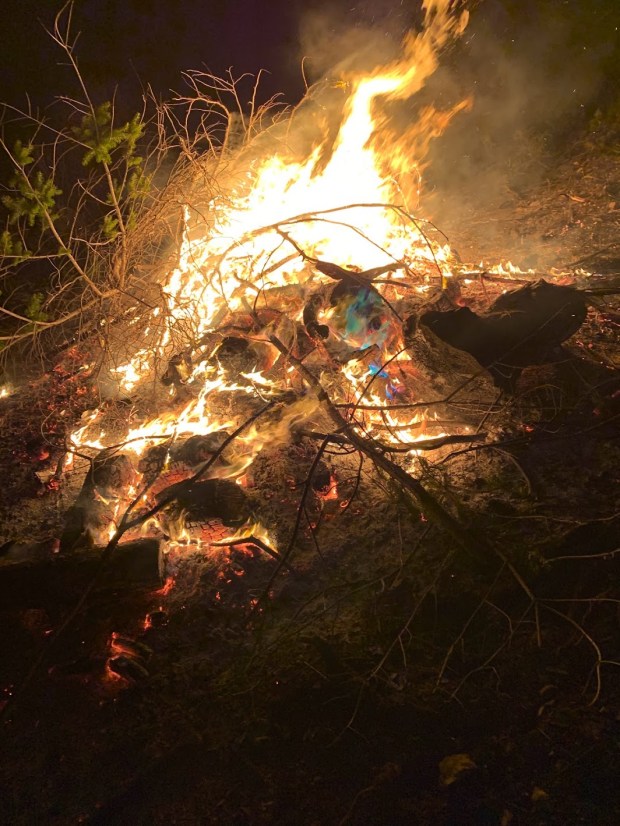
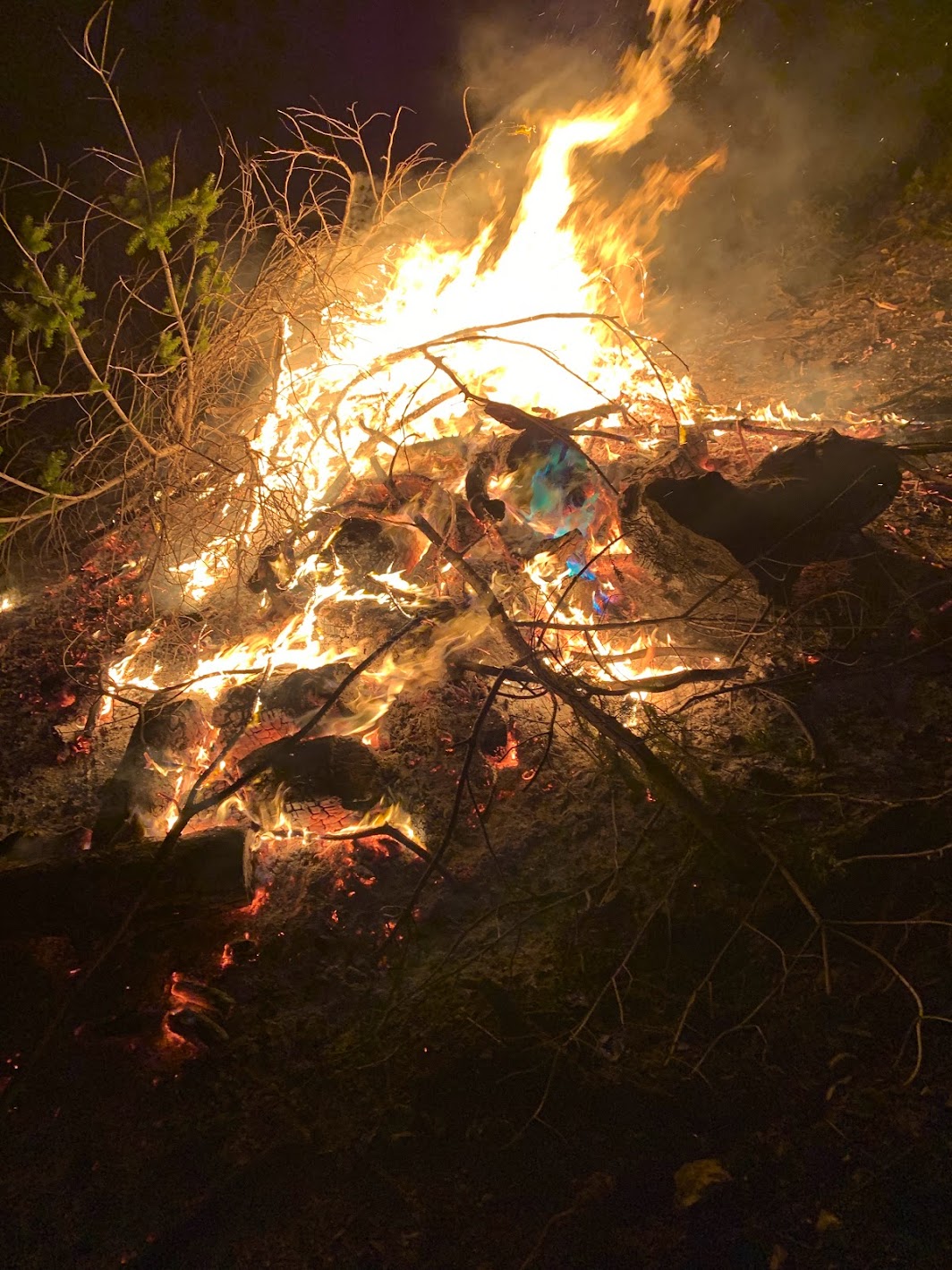
A burn pile being tended
Thinking Ahead
February is historically the wettest time of year on California’s central coast. The most rain falls in February, and the days are still short and the air is cool, keeping the environment moist between rainstorms. In just a handful of months, it will be dry and hot and fire weather will return. Anyone with responsibility to manage any vegetation must regularly plan for fire. Fire storms now march right into towns and so the smallest yard keepers have to think about the flammability of their situation. Why wait until the fiery weather is upon us? Cool days make for excellent outdoor working weather, and the wet environment opens up all sorts of opportunities for biomass processing.
Our Cultural Controls on Pile Burning
The native peoples burned dry natural vegetation, and so must we. With the rains and surrounding vegetation so moist, it has been an excellent time to do ‘pile burning.’ The CZU CAL FIRE unit, which oversees Santa Cruz and San Mateo County, started allowing rural residents to burn dry piles of vegetation starting last November 11, but how long that permission will last depends on the weather. CAL FIRE says, “Dry, natural vegetation, grown on the property may be burned outdoors in open piles unless prohibited by local ordinances.” But first you have to apply for a CAL FIRE permit using an online system; and then you can only burn on a day that the Air Resources Board says is okay – when the smoke won’t be too much of a health hazard. You’ll need to do another permit application from them using, again, an online system. Interestingly, while CAL FIRE allowed burns a few weeks earlier, the Air Board burn season is December 1 – April 30.
What About Composting Woody Debris for Fire Safety?
There is an understandable uprising against burning given concerns about climate change. Many people are suggesting composting biomass instead of burning it.
If you are in town, you can meter out your green waste bins by pruning out any dead or overgrown plants, a little at a time …. week by week. If you live out in the countryside and have to deal with a lot of woody biomass, you haul it to the dump or think of other solutions. How the dump manages to dispose of that much composted biomass is a conundrum.
There are permaculture folks and other Hügelkultur practitioners who suggest burying woody material beneath agricultural or horticultural beds, taking advantage of rotting wood for soil carbon benefits including increased water retention. This is a lot of work so it is applicable for only small amounts of woody debris in specific situations. Others suggest burying biomass to reduce erosion in downcutting drainages. My limited experience suggests caution with this approach as any wood that appears out of the soil will probably ignite during wildfire, burning and cooking the soil in the drainage. I share the same experience and caution for Hügelkultur: bury it well and hope it rots fast (you’ll need to keep it moist)!
What About Chipping?
With diesel or gas-guzzling chipping machines, it is questionable whether chipping is any better than burning biomass for atmospheric carbon impacts. There is also a concern about the wood chips catching fire in wildfires. One person I know had a nice pile of chips slowly disappearing into their grassy yard soil until someone built a warming fire on top of them…which ignited a few days later into a large conflagration that was difficult to extinguish. Best to bury chips, too – but not so easy to do! The same cautions apply for the practice of mastication- those big machines that chip vegetation ‘in place.’ Masticated material lying in carpets across the ground are less dangerous, but they still carry wildfire. And so, let’s turn back to the burning option.
Burning in Santa Cruz
The CZU Lightning Complex Fire burned 85,000 acres….mostly incompletely. That’s the region’s biggest, most obvious UH-OH! If you look at most of that acreage, you will see thousands and thousands of dead trees, which are slowly falling and creating a giant fire hazard. Do you recall the Creek Fire pyrocumulonimbus cloud and extreme fire behavior, including tornadoes of flames? That fire and other fires in the Sierra Nevada were greatly exacerbated by large numbers of trees killed by drought and beetles. We are facing the same danger in the footprint of the CZU Lightning Complex Fire. State Parks and other landowners have been using pile burning to reduce fuels to mitigate such a catastrophe, but a lot more needs to happen: the ‘treated landscape’ is much smaller than the untreated areas at this time. Still, I know of more than 500 burn piles having been ignited this season, so there is hope.
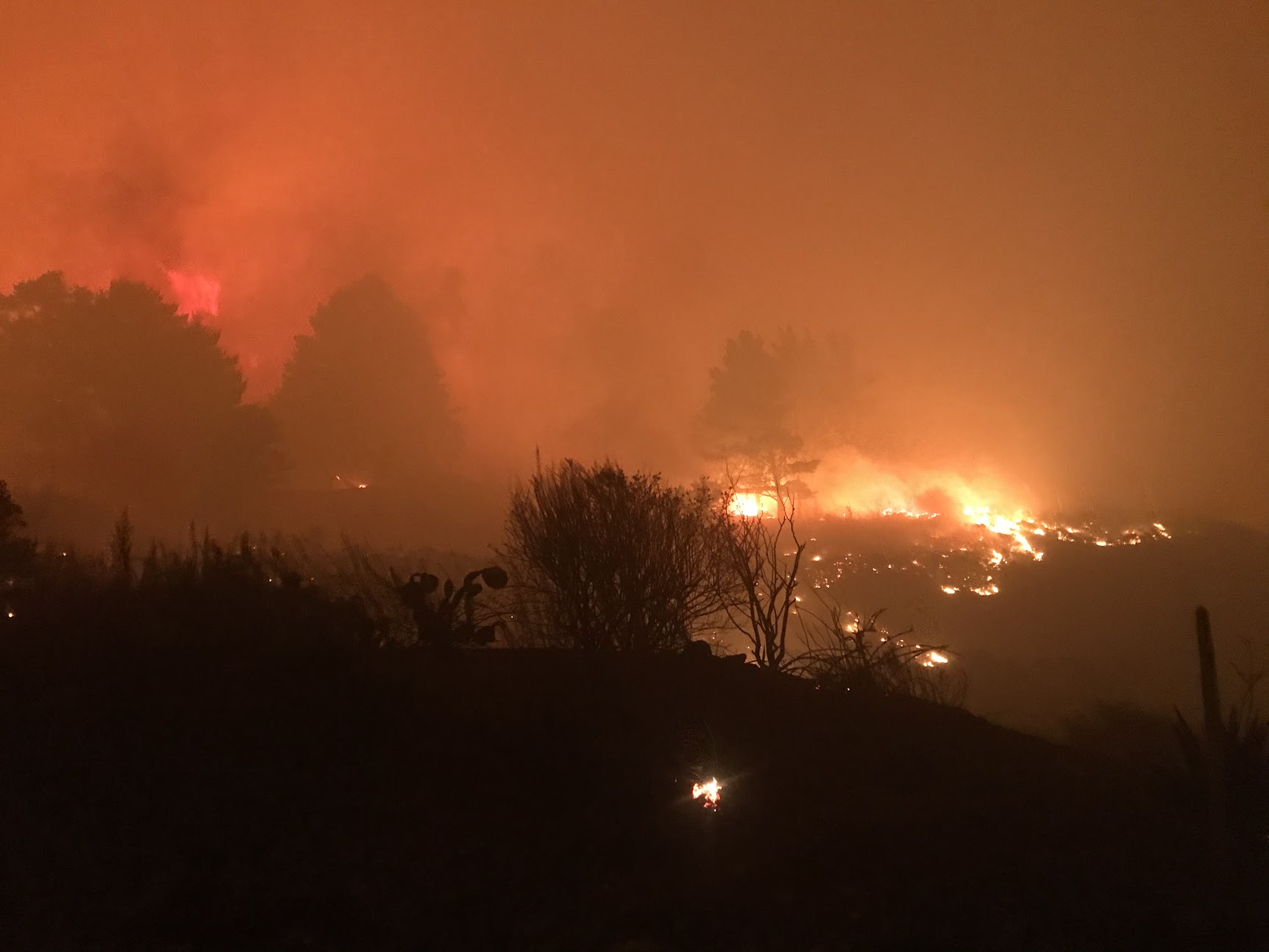
The CZU Lightning Complex Fire – Eating up vegetation a mile a minute on Wednesday August 19, 2020
Another method of burning involves using an ‘air curtain burner’ or a ‘carbonator.’ These both look like large metal shipping containers. Air curtain burners use high powered fans to contain sparks while logs get incinerated. Carbonators use more controlled air exchange so that they create ‘biochar’ – charcoal that can be used in agriculture or horticulture. Vineyards have been experimenting with biochar as a soil amendment that holds some promise for increased soil water retention. Horticulturally, biochar may substitute for carbon- and nature-unfriendly (mined) peat moss. We need to study biochar to see how long it retains carbon in the soil – long- or short term – to understand its potential for helping global warming by sequestering carbon.
Burning Wood: Carbon Neutral?
There is a movement afoot to reduce the use of wood for fuel, but to what end? In the San Lorenzo Valley and elsewhere, folks have long complained about air quality degradation due to badly managed wood heating apparatus. Unfortunately, folks use old wood fueled heaters and/or burn poor quality wood. As with burn piles, folks should be careful to burn only dry wood: there ought to be some rules for firewood sales to disclose percent moisture content in fire wood. Also, firewood needs to be stored so it doesn’t get wet after it is delivered to someone’s home. Wet firewood smokes a lot. Dry firewood burned in a modern woodstove, using smart fire building and maintenance methods can greatly reduce pollution while using a sustainable fuel source. The California Air Resources Board has a great website on cautions about, and helpful tips for, using wood for heating, and as an alternative suggests using electrical heaters.
Two thirds of California’s electricity comes from natural gas – fossil fuel! That figure is more hopeful in our region if you choose to get your power from Central Coast Community Energy, which is shooting for 60% renewable by 2025. Heating with wood is considered by many to be carbon neutral because the carbon that cycles from the atmosphere into plants, and then into wood fuel, isn’t fossil carbon but natural-cycling carbon. Plus, harvesting that woody carbon has the potential around here of being part of the solution to our current, catastrophic wildland fire fuel problem.
I hope you will carefully consider the right way to use wood for heat and take some time to manage fuels and vegetation where you can.
-this article originally posted by Bruce Bratton at his BrattonOnline.com weekly blog- get it automatically by subscription at his website…support local journalism and donate to Bruce- he could use your help!












 Grey Hayes