oc

Slowing Down -or- Rushing?

So much environmental degradation seems to be due to our rushing around. How can we best slow down? Each of us can do our part in creating the Great Slowdown that we need to sustain the planet.

Save More, Buy Less

The first and easiest way to help the Great Slowdown is to stop buying so much Stuff. If you haven’t watched the Story of Stuff in a while, or not at all, DO IT NOW. This 21-minute video is compelling, fun, and has changed more lives than many a 20-some minute experience otherwise. I think it’s worth watching regularly, perhaps in October just before the stuff-a-thon holiday season besets our culture. 

If you listen to the news, you will understand how important buying stuff is for our unsustainable economy. “Inflation is up, but ‘luckily’ consumer spending is cooking right along, otherwise our economy would be hosed.” A president once said in a national crisis, something like, “Just keep buying stuff!” Time is money, and by spending your money on useless crap, you are wasting your time, carelessly throwing away your life, and helping to wreck the planet. A few years ago, someone did a calculation and the transaction cost of each dollar spent was a liter of oil. I’m betting it’s worse now. Save a buck, keep a liter of oil from burning up.

Stop Rushing at Work

There is so much pressure to do more at work, but is that really helping anything? Chances are good that the more we rush, the worse off the planet is. How about we slow down? Carefully watch those who rush around with their work: why are they doing that? I’m betting that they mostly want to impress people, get others to work harder, or they are avoiding problems at home or something they might better be doing for Real Good.

The labor movement has something called ‘working by the book,’ which we might emulate to improve the planet. What is absolutely necessary to do with your work? What does the job description say? What are the metrics for success? Often, organizations keep the productivity targets elusive, to keep everyone guessing or trying to push for more. On the other hand, if productivity targets are defined, ask yourself if they are set too high. If so, it might be time to work with your colleagues to reduce them to something more manageable.

Slowing down at work is part of the solution, part of the Great Slowdown.

Working for the Planet

 The capitalist system mostly asks each worker to create efficiencies that are bad for the planet. As we learn to care more for the planet, we will find ways to sneak improvements into the workplace that will help Earth. Is there a way to reduce driving, material transport, waste? Does your workplace purchase recycled paper, organic foods, and other eco-friendly products? Maybe there’s a sustainability policy on your business’ horizon.

Beware the Fakes

If you see potential greenwashing, ask about it! I recently asked a seemingly eco-conscious caterer what they meant by “gourmet sandwiches, made from the finest local ingredients” and it turned out that they used very mainstream factory-farmed meats and conventionally grown produce distributed from warehouses far away. They soon thereafter changed their menu language. That was the third time I was able to affect that kind of change. Do we choose places that are true to their word about their products? How do we know if we don’t ask? Why would they be true to their word if folks never asked?

Buy Green

The list of businesses that are truly green is getting smaller, not larger in Santa Cruz. There are fewer restaurants serving local, organic foods than there were a few years ago. Local grocery stores are sliding further from, not closer to, sustainability. I suspect all of this is because people are not pursuing green purchases.

Keep Your Keel

How easy it is to go with the flow, but is that truly the best thing for the planet? There is a concept called ‘slippage’ where environmental policies are interpreted in ways that slip away from the intent of the policy, usually with negative environmental consequence.

If your work entails intersection with environmental policies, it is time to ask how you can help interpret those to environmental benefit, not environmental degradation. It is time also to ask what is the greatest good you can do with your work, focusing on the issues of greatest impact for environmental improvement. As I’ve said in prior posts, the metric should be species conservation: how can our work best affect that outcome? The answers are usually easy to arrive at.

Beware of False Dichotomies

Those who are most invested in slippage often use false dichotomies. Parks managers often note that they have a difficult dual mandate: to provide for public recreational access while conserving wildlife. For a large portion of Santa Cruz County, managers are leaning heavily on this false dichotomy to ‘sell’ the concept that it’s just fine for our wildlife to disappear because of their mismanagement. Trails erode tons of sediment into streams and wetlands, trash litters our beautiful beaches, and graffiti proliferates on sea cliffs because of the slippage that is embraced by the poor logic presented by parks managers’ adoption of their false dichotomies.

Parks Management Slippage

Many of these parks’ managers use other forms of slippage. The California Public Resources Code says this about State Parks: “Following classification or reclassification of a unit by the State Park and Recreation Commission, and prior to the development of any new facilities in any previously classified unit, the department shall prepare a general plan or revise any existing plan for the unit.” Look at the North Coast beaches, and Gray Whale Ranch…and, enter slippage: none of those have general plans, and all have ‘new facilities.’ I’m sure that someone, somewhere can provide some beautiful logic about how that can be possible. Has someone said ‘if anyone asks just tell them we never “classified or reclassified” those “units” and they were never “previously classified” (hardy-har-har-har, that’ll get ‘em).’ Anyone in their right mind would know that the responsible thing to do would be to create a general plan before opening a park, and that’s what was meant by that part of the Resources Code. Meanwhile, we must all ask WHY are these precious places opened to visitation without a plan to conserve wildlife on those spectacularly biodiverse places?? If you work for State Parks, you must ask yourself what place you have played in allowing such things to happen and how you might reverse this slippage. If you work for other land conservation organizations, you might have similar things to ponder: do you hold a false dichotomy promulgated by those with anti-conservation agendas? Where do you lie on the spectrum of serving Earth or serving Greed? If you are torn and in doubt, maybe it’s time to slow down and ‘work by the book.’ It might be better if you embrace the Great Slowdown in your job while you increasingly help others become aware of slippage.

-this post originally found at BrattonOnline.com

Winter Wrestles with Summer, Fall Progresses

Two nights ago, the lower portions of our farm dipped into the chilly 40s. Today, it was in the 80’s, tomorrow even warmer with two ‘warm’ nights not lower than 65F. Such warm nights bring a cacophony of crickets along with late summer katydids. Our ears seem to ring, and seeking the source of any one of the insect songs creates a confusing, 360° immersive dizziness. A visitor remarked, “what IS that noise?” Such sounds are not found in the City. Such sounds are not even everywhere on the farm, only in places on the farm. There are pockets of nightsong. Seek them where you can, it is a worthy experiential destination.

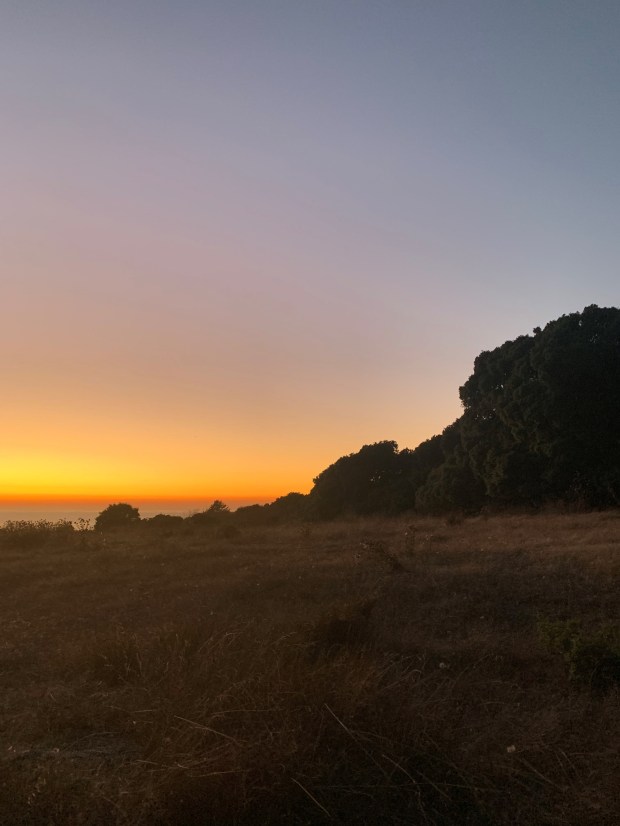
Sundown on the Pacific, just a short ways from the Farm

Country-style Night Show

Even where they sometimes fill the air from all directions, the insect songs fade in and out, sometimes louder and sometimes softer. Some species go quiet leaving the chorus to others and those then fade to the next song, a repeating pattern that never grows old. Some insects sing trill….trill….trill and others have a more constant chitter. Some play lower stridulations, others high, shrill ear-piercing whines. For biologists, I note black field crickets persist in lower numbers than in the early summer; now there are more brown ones. Also, the invasive green tree crickets sing with oscillating medium-toned trills from which you can calculate the temperature. The late summer, and this year in particular, features the massive laterally compressed long-legged bug-eyed katydids, a source of high-pitched, especially ear aching whining: you particularly notice when they take a break. On warm nights like tonight, there is no real silence of insects, only lulls, and always with the green tree crickets’ consistent “wee….wee….wee….wee….wee….wee….wee….wee…” Under the insect chorus, enter a baritone montage: wave sets crashing, their pulsing drone carried by the gentle onshore cool breeze. The light show for the orchestra: fields of stars and the stripe of the Spectacular Milky Way that us country dwellers get to enjoy far from the polluting night lighting which ostensibly provides increased safety and orientation in the cityscapes.

Dawn Revealing

In the East, the first glimmers of dawn cast doubt on night, but darkness at first prevails, some stars still brightly shining. The wakening mind returns to semi-slumber, the day’s return a dream (?). Another thought, eyes wider, the sky a new brighter gray and another glance brings certainty…a new day, a return to the waking life and the tasks at hand. Awakening brings smiles and gladness for the peace of country life and ease of transition into farm routines.

Watering and Harvest

Many fields are dry-farmed, and those are curiously bedecked with fading green foliage and the brightening fruit harvest. Other areas are irrigated and so still vibrant green, though the last planting of sunflowers is fading.

Those irrigated areas need regular attention during this, the driest part of the Mediterranean summer. The waves of heat alternating with cool and even drizzle make for irregular water demand. In anticipation of heat waves, we saturate the soil more. With spells of cool and drizzle, we slack off a bit and catch up. Shovels explore the soil to record the moisture condition, sometimes surprisingly dry… trees full of ripening apples are especially thirsty. We are trained to keep the soil moisture above 50%, but predicting where it will be any one day is a learning opportunity, always.

Sunflowers at Dusk

Midday Warmth

The hot days tax farmworkers and birds, alike. Tomato and pepper harvest comes midday with backs bent, sun baked and sweating; picking commences no matter the weather.  Above the farmers, migrating hawks ride warm thermals higher, soaring up and then south. A very rare occurrence: there were six red-tailed hawks and another large raptor even higher over the farm today. The great migrations called “hawktober” often co-occur with the recurring shimmering heat waves so common this month. Other birds avoid the open sun, chipping lazily from the shade of shrubs. Late in the afternoon, down by the ocean, a mixed flock of various blackbirds alighted on the roadside. Their beaks were open, panting, even as the day cooled at 5pm.

Evening

If we can, we wait to harvest apples outside of the hottest part of the day, and we can stand while doing it…easier on the body. Heavy picking bags leave the shoulders achy, and we switch sides to even the ache. The hurried apple harvest races the setting sun. What started as bright sun fades to soft golden light so briefly before all sunlight retreats to muted dusk, quickly darkening. Boxes and buckets of apples go into the barn with the last available light. Overnight, boxed apples cool naturally before the market delivery the following day.

On warm evenings like today, a great emergence of moths alights. Big moths and small zip and float everywhere, and it is impossible not to get hit in the face as they flit about. The bats are getting fatter. Poor-wills clumsily flap and dart, pouncing on their insect prey.

Also at dusk, the deer arise from their folded legs to traipse about looking for forage. Lately, they’ve been munching on the leaves of freshly felled walnut tree trimmings. Someone improved our farm road tree tunnel and left piles of fallen black walnut tree branches: this is a seasonally favorite food of the deer. Momma and her adolescent offspring deer (still unnamed) are at that salad bar. A young male caught her scent and wandered onto the farm this evening, a rare sight. The wayward bucks are very flighty and he was no exception. Upon being noticed, he bounded away, alert and head held high.

The last light of dusk barely illuminates the fading sunflowers at Molino Creek Farm

Night

Great horned owls, coyotes, foxes, and more. Two great horned owls have been having regular evening hooting contests. They sit in trees not too far apart and hoot loudly, taking turns, back and forth. There’s a silent bit, then one of them starts on some odd, non-hooty noises but then returns to the hoots soon thereafter. Is this a long conversation, or do they revel in the joy of creating or exchanging subtle variations in pitch and enunciation? They do not tire. They must be day sleepers.

Coyote barks seldom. Cassandra reports seeing a particularly large one. They leave big poops full of tomatoes and apples. Sylvie reports fox feasting on her Asian pears- a tree worth. There are poops from fox, too, all across the farm. Weasels excavate gopher runs in the apple orchard, freshly dug soil mounds ending at large gopher holes each morning.  There may be a weasel den under a prune tree.

Night strolls to manage irrigation reveal black widow spiders more commonly than any other spider. One striking large female complained about my opening the gate she was building a web trap at the base of.

Mice scurrying (but never seen) is another commonality.

These balmy nights bring pulses of warm air settling onto the farm from higher up the mountain. Warm blobs of air get pushed around by cooler onshore breezes, or nudged here and there by sinking chillier streams of Molino Creek canyon air. The half mile walk across the Farm sends me through boundaries of three or four contrasting temperature air masses, and the new temperature also brings new scents and different humidities.

Seasons Passing

We have already passed through several waves of harvests and are set to see the last run of this year. Last February saw baskets of citrus and then Spring brought us peas and cherries. The first tomato, not until August, was a real delight, now we are in peak production. The prune plums are nearly gone as are the early comice pears. We are entering a marathon of 6 weeks of apple harvest, and that will be the end of the harvest season with the transition back around to citrus and all that follows next year. We compare years of apple harvest and the resulting cider. We mark our annual cycles as ‘before the Fire, or since the fire.’ Rains return and we burn huge piles of cut brush then the brush piles build again to be reduced the next year. On and on. Earth whirls around the Sun and we bound through space and time.

A Fine Legacy

How do we leave a good legacy that will benefit future generations in a world of uncertainty? Some suggest well-raised children are a sure bet, but with this the humble must demur. We must however try. I suggest two other things that are essential: 1) species and ecosystem restoration on natural lands and 2) building soil health on agricultural lands. These are things we can each find a way to support, and they are both crucial for the future of life on Earth.

A World of Uncertainty

We live in extraordinary, unprecedented times. Humans have built a remarkable global civilization with a burgeoning population. To survive, we are in a race to shed polluting fossil fuels. But, we have no idea if and how we can replace all that petroleum has provided to fuel population growth and the civilizing of landscapes. No matter what superficial form of government seems to be in place, the “oilogarchy” is deeply entrenched, exercising economic and political control. For evidence, just watch US politics: both parties’ have an inability to act in the expeditious way that the vast majority of citizens know to be necessary. And so, life, including human life, on Earth will likely become much more difficult for the next several hundred years. Of course, we should rise up and protest as if life itself depends on it, but there are other tangible things we can do to make the world more habitable for future generations.

Species and Ecosystem Restoration

There are a variety of activities you can partake in to help restore species and ecosystems, which humans will increasingly rely on for their wellbeing. As global warming creates climate chaos, and as humans increasingly falter without boosts from cheap petro-supplies, species diversity and resilient ecosystems will become more closely tied to better standards of living.

Oil and Water

For an example, let’s consider water. Some suggest oil and water don’t mix, but the two are closely intertwined over most of the world. We might suppose that the role petroleum plays in repairing, creating, and powering our water supply will be replaced by some renewable energy supply in the future. Plastic pipes will be made from hemp, renewable energy will power our pumps, electric vehicles will transport the legions of water district workers who maintain water systems, etc. However, when rain comes in torrential bursts or not at all, we will rely on very well-tended ecosystems to absorb and meter out rainfall so that we can benefit from more dependable surface or groundwater supplies.

Dust Storms

For another example, let’s consider erosion. The stability of our infrastructure- homes, utility lines, roads, dams, communication towers, airports, etc., depends on more than just good geological anchors: that stability is deeply dependent on functioning ecosystems. Species hold our stuff together. On the coast and along rivers and streams, species protect shorelines. On hillsides, in the mountains and on the plains, species hold the land in place. Without a wealth of species supported by resilient ecosystems, everything will come unzipped – gullies, floods, landslides…infrastructure collapse. At the same time, the bared soil will start to blow and dust storms will become more frequent, destroying engines, burying buildings and roads, and darkening the sky.

Restoration Means Now

The species that currently perform best at the “holding the soil in place” function are likely not the ones that will do best in a hundred years, given the rapidly changing climate. So, we must conserve every species, and plan to allow species migration through a healthy landscape of resilient ecosystems. Right now, this very year, we must quickly turn increasingly to restoration of the land because we have degraded too many places already. You can help by volunteering with the many habitat restoration projects in our area, taking better care of your land, voting for politicians that support ecological restoration and land care, spreading the word, and/or giving money to groups that are making a difference. Many people are joining this movement, we are making a difference, and we need more help.

Bye-Bye Soil, Hello Agricultural Substrate

Since World War 2, agricultural systems have become increasingly intertwined with petroleum at great expense to the soil that humans rely on for sustenance. Petroleum-fueled mechanical cultivation has destabilized billions of tons of soil which has already washed or blown away due to recklessness. You can watch it happening, still: in the Salinas and Pajaro valleys and along Santa Cruz’ North Coast watch the soil blow or wash away, depending on the season. At the same time, cheap fertilizers and expedient pesticides have been made possible by petroleum and the application of these have destroyed ecosystems that once sustained and built topsoil. Farmers for years have acted like soil is just a substrate, something to hold a plant in place long enough to harvest a crop. And so, most agricultural land is highly degraded and production is increasingly and deeply dependent on the supply of petroleum. While we can, there is a great opportunity to build the kind of soil health that will be necessary to feed humans when petroleum-subsidized fertilizers become too expensive, and the human population is still larger than it is now.

Soil Health

Healthy agricultural soils can retain more water, provide plants more dependable nutrition, and stabilize pest outbreaks. So, why would a farmer not create more healthy soils? There are two main reasons. First, investing in healthy soil reduces profits. For example, using cover crops to cover and build the soil during the rainy season means the loss of one or more potential harvests. That also drives up food costs, which then helps to create the second reason: mandates for soil health are politically difficult. The good news is that you can help with both of these conundrums.

You Can Help Create Healthy Soil

We all purchase groceries, and the choices we make can help support soil stewardship. Already, the organic agriculture movement has been growing and makes a difference for soil health. Certified organic agriculture requires farmers to find alternatives to pesticides and fertilizers that are synthesized from petroleum. In ‘conventional’ agriculture, novel petro-created compounds working alone or as a mixed concoction are released into agricultural systems without analysis on long-term soil health. Organic farmers more often rely on soil health as a means of production, and the higher cost of those products reflects that investment. Some tell me that they can’t afford organic foods, but discussions reveal that they are unwilling to make more basic food choices, preferring to rely on processed foods or meat that are especially more expensive when certified organic. Going organic may mean dietary changes that might be more healthy, anyway.

Besides using the power of your purse to support farmers who build soil health, you might more directly create healthy soils in community orchards or gardens. You can volunteer in a school garden which has the added benefit of helping children better understand soil health and healthy foods. You might also support, by volunteering or donations, organizations that are working to improve soil health on agricultural lands.

-this piece originally published by Bruce Bratton in his extraordinary BrattonOnline.com, the place to go for movie reviews and local news…unparalleled. Sign up and get it weekly. Donate and it is money well spent.

The Arrival of Fall

Last Friday, Night equaled Day; it was the Equinox, and our world stood in balance. From here, things tilt rapidly towards the dominance of Night, and we share the Sun increasingly with the South for a while.  There, Spring is emerging. The cooling temperature change switch is not thrown quickly; there is a lag of the Sun’s heating, and we often are assaulted by wilting, week-long heat waves in October. The return of the rainy season will likely be a way off. Meanwhile, the Harvest is in full swing at Molino Creek Farm with all of its various enterprises. Welcome to Fall.

Organic Gala apple fruit are laden on one of many trees in our older trees

The Orchard

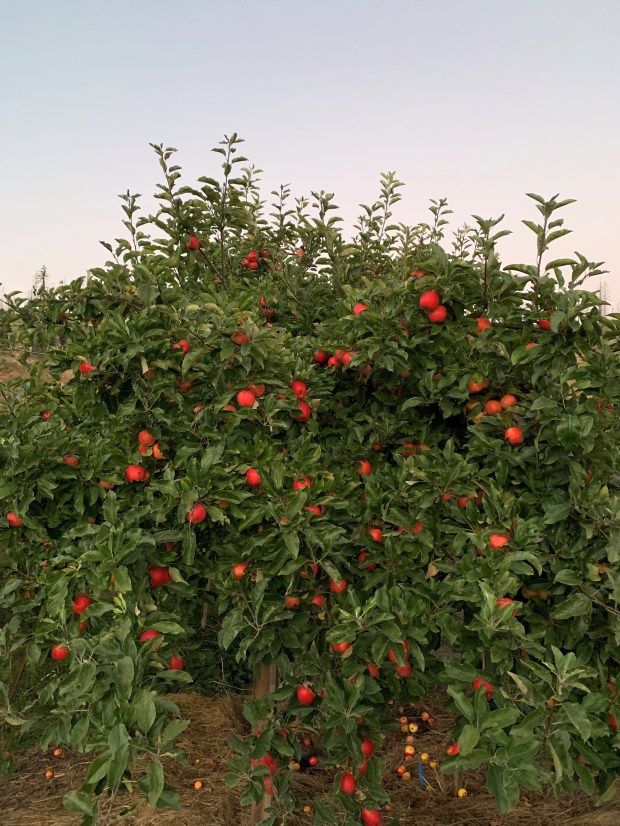
Apple trees hang heavily with giant loads of ripening fruit. The branches bend more each day as fruits get bigger, juicier, and more colorful. Gala apples are finally gaining their peachy blush, underlaying the sun-side bright red streaking, overlaying the shade-side yellows. Our much smaller crop of Mutsu apples are getting Really Big and kissed with a patch of purply red where they see the most sunshine. The Braeburn and Jonagold crops, a total failure due to apple scab, a combined result of the long, moist, cool spring and our own lack of applying sulfur to kill it. There are so many other varieties…one tree each…to taste, to give to friends to taste…to revel in the diversity of apple flavors and textures. Oh, and then there’s the patch of Wickson Crabs, which are laden with the tart poppy nuggets that will tint so many batches of hard cider, real soon.

The gold-red-purple French prune-plums are past but the yummier deep purple Italian prune plums are getting ripe now: tarts a’hoy!

Nearby, young avocado trees are stretching with late summer growth shoots, so well-tended and vigorous. And, an array of citrus also puts on pale new growth while slowly swelling their fruits toward a February harvest.

A Big Moon rises over Molino Creek Farm and its patches of dry-farmed Early Girl tomatoes

The Tomatoes

Rows and rows of tomato vines are laden with fruit of all colors. The harvest will continue for a while. There are plenty of pale green orbs from tiny younglings to larger plumpers. Pale orange fruits are transitioning to the bright reds, nestled within distinctly green foliage. Between the rows, tossed rejects of tomatoes melt into the soil and flocks of birds flit around chowing on their remains, hungry especially for the protein-rich seeds.

Quince!

Harvesting

The ripening tomatoes go into buckets only so full. The apples go into shoulder-mounted bags. Both fruit get sorted for sale. Tomatoes of varying quality go for varying prices. Only the perfect apples go to sale, the rest to home use, charity, or juice (cider!). Starting tomorrow, apple harvesters will gather a few times a week and we will be handling 6,000 pounds between now and Thanksgiving. Wow.

Seasonal Wildlife

On the drive down to the highway last Monday, I saw the Largest Buck…a real beauty with big antlers, a broad chest, and massive muscles. That large of a male is a rare sight, one I’ve experienced only three times since 1986. Back on the farm, we have a much smaller mother deer and only one of her twins from last season. Their still summer coats are shiny and light-roast coffee brown, and they appear well fed and relaxed. They have enough food to not be walking around on two legs reaching up for the Fall walnut leaves, but I smile remembering that ridiculous-looking behavior.

Like clockwork, the golden-crowned sparrows returned last Friday night. They always return on the night of the Equinox. The sound of their songs are now coloring the days; they have transformed the soundscape to mark the seasonal transition. This is somehow deeply comforting.

Scent Landscape

With the sweet sparrow song also arrives the scent of Fall. So many things contribute to the scentscape. Mostly, it is the piney-bitter smell of coyotebush, but add to it wafting sweetness of flowering domestic garden plants- angel’s trumpet, San Pedro cactus, four-o’clock and ornamental ginger. Also, the breezes bring other scent ingredients like agricultural sulfur, pungent tomato foliage, cidery apple culls, and so much more. The dry, cool air accentuates and mixes these scents and creates the Molino Creek fall perfume. Emerging from the night warmth of shelter, we breathe deeply the outdoor air to experience all that’s on the air.

When the clouds and fog clear – the minority of nights as of late – the star-filled sky is bright with the Milky Way. Tonight, a Big Moon hails and lights the farm in its blue glow, illuminating the soon-to-be walk to juggle irrigation valves once again.

Somewhere, somehow…it is all Right Now

Right, now

Posted simultaneously at the website for Molino Creek Farm.

BLM Overlooking Precious Wildlife Conservation

Santa Cruz County’s newest conservation land managers are supposed to conserve the wildlife prioritized by the State of California, but are failing to acknowledge their obligations, which means some of our area’s iconic wildlife species will disappear faster due to lack of Federal cooperation at Cotoni Coast Dairies.

Background

The Bureau of Land Management oversees management of Cotoni Coast Dairies, but it is following much-outdated wildlife conservation guidance. Land management agencies like the BLM are guided by policies and procedures that guarantee that they do a good job of managing wildlife. For instance, BLM has its 6840 Manual “Sensitive Species Management,” which notes:

“The objectives of the BLM special status species policy are:

A. To conserve and/or recover ESA-listed species and the ecosystems on which they depend so that ESA protections are no longer needed for these species.

B. To initiate proactive conservation measures that reduce or eliminate threats to Bureau sensitive species to minimize the likelihood of and need for listing of these species under the ESA.”

In other words, BLM recognizes that the agency should not be contributing to wildlife species becoming rarer and so receiving more regulatory protection, which would impact private landowners by restricting the uses of their property.

Mouritsen’s Duty, Neglected

To avoid that, BLM California’s State Director Karen Mouritsen is required to, “at least once every 5 years,” review and update the BLM-maintained list of sensitive species in coordination with the California Department of Fish and Wildlife (CDFW). It is unusual for such policy guidance to lay out a specific timeline, which adds clarity to expectations. The last time California BLM’s sensitive wildlife list was updated was in 2010, before Director Mouritsen’s tenure: 13 years ago! A lot has changed in those intervening years, and scientists have recognized that many more wildlife species are in need of protection by BLM.

Repercussions at Cotoni Coast Dairies

What happens when BLM’s sensitive wildlife species list isn’t updated? Let’s look at the Cotoni Coast Dairies example. BLM has already completed a Resource Management Plan that is meant to guide wildlife conservation on the property. Under the guidance and environmental review provided by the RMP, the agency is building miles of trails and parking lots, implementing a cattle grazing program, and allocating funding to other prioritized activities. BLM will soon embark on a Science Plan for the property. The RMP didn’t and the Science Plan will not consider conservation of wildlife species that do not appear on the BLM’s sensitive species list. And so, the following 10 rare wildlife species will receive no attention, pushing them further towards extinction: ferruginous hawk, grasshopper sparrow, Northern harrier, olive-sided flycatcher, American badger, San Francisco dusky-footed woodrat, Western pond turtle, California red-legged frog, American peregrine falcon, and short-eared owl.

A Deeper Dive – Grasshopper Sparrow

Let’s consider one of those species with a little more detail, the grasshopper sparrow. If this species is nesting in an area, under California law they are protected and our state wildlife agency, CDFW, has been charged with their conservation. According to BLM guidance, Director Mouritsen is 13 years overdue in updating the agency’s sensitive wildlife list for California to include this species. As their name suggests, grasshopper sparrows are grassland-dependent organisms. There is an abundance of nesting grasshopper sparrows at Cotoni Coast Dairies.

Without active management such as with carefully planned livestock grazing or fire, all of the grasslands at Cotoni Coast Dairies will disappear, being invaded first by brush and then by trees. This is already happening with extensive French broom and coyote brush invasion.

Already, BLM has planned its livestock grazing and recreational trail uses without consideration of preferred habitat for nesting grasshopper sparrows. Livestock grazing could be taking place to the detriment of the species, already. The construction of recreational trails and parking lots may have already destroyed important nesting habitat. When recreational visitors start using those facilities, it may occur before BLM has a baseline study of the density and location of nesting grasshopper sparrows. So, the agency will be unable to understand how land uses are impacting the species and so will be unable in an informed way to adjust its recreational or livestock management to better conserve the species.

It may well be that BLM’s management of Cotoni Coast Dairies will further reduce nesting populations of grasshopper sparrow, pushing the species closer to the point where they will need to be listed as threatened or endangered. When that occurs, private landowners whose land supports nesting grasshopper sparrows will see increased regulation and oversight by the State and/or Federal government. Their property values will be reduced and their ability to develop homes, farms, or other uses will be diminished.

An Alternative

On the other hand, if the California BLM State Director Mouritsen were to meet her regulatory obligation and update the BLM State Sensitive Wildlife Species List in the near future, a bunch of good would result. First, Cotoni Coast Dairies’ Science Plan could provide guidance for conserving those species. Second, because BLM funding is tied to the number of sensitive species on each property, Cotoni Coast Dairies would be better situated for increased conservation funding. If the Science Plan succeeded in moving forward the conservation of sensitive species like the grasshopper sparrow, BLM’s leadership on these issues could help many other land managers do the right thing for species, contributing to the potentiality of ‘delisting’ species, reducing the potential for increased regulatory burden and loss of private property values.

Do Your Part

I’ve said it before in this column, but I’ll say it again. NOW is the time to write Director Mouritsen to urge her to do her job. She hasn’t replied to any of the numerous letters she’s already received, so evidently she needs more pressure to take this seriously. Here’s some language to send to her via her email kmourits@blm.gov Please let me know (or cc me) if you send something.

Dear Director Mouritsen,

I care about wildlife and plant conservation on BLM’s Cotoni Coast Dairies property in Santa Cruz County. I write to urge you to help by adding sensitive species found on that property to the State BLM’s sensitive species lists. Only if those species are on the State’s lists will local administrators consider impacts of their management on those species in their analyses and planning for the property. So, I ask that you please:

  • Publish an updated State BLM sensitive wildlife list in collaboration with the California Department of Fish and Wildlife, as mandated by the BLM’s 6840 Special Status Species Manual.
    • This list was last updated in 2010, but you are required to update it at least every 5 years.
  • Publish an updated State BLM sensitive plant list to include the State ranked 1B plant species documented at Cotoni Coast Dairies, as mandated by the 6840 Manual.

I would appreciate a reply to this email with details about how you intend to address these issues.

Signed, xx (you!)

-this post originally appeared as part of Bruce Bratton’s amazing weekly blog at BrattonOnline.com You an sign up and receive it automatic-like if you visit this site. You will be rewarded by getting smart commentary and news that is very relevant to life in general and life on the Monterey Bay specifically.

Changes Slowly Emerging

The calendar says it is almost fall, just a couple of weeks away. But, the temperatures and dryness suggest it is more like midsummer. The days wake up mostly sleepy, fog having rolled in during the night. Everything glistens with dew in morning’s first light. Sunrises are muted with tones of gray and silver across the shadowless and chill landscape. There is no dawn chorus, only a few peeps when the birds warm, late. The morning crawls on as the fog slowly breaks. It brightens more, bit by bit, until there is mostly blue sky by about noon. Then, barn swallows take noisily to the sky. The afternoons slowly warm until the sun gradually fades, a shadow line edging across the fields as the sun disappears behind the ridge to the west. This past Friday, the fog was so heavy and long lasting that it drizzled enough moisture to wet and settle the road dust.

Pattern Recognition

Last year, we would have been about to get our first inch of rain. That September storm produced what we call the germinating rain, and the early timing was extremely unusual. After that, there was another Big Storm in October – more expected timing. A bit later, all heck broke loose in December through January when we got atmospheric river after atmospheric river. None of that was predicted. In fact, as late as October, our national weather service climate scientists were saying it was going to be a dry winter, a La Niña situation! Right now, those same experts are saying there are strong El Niño conditions and that there is a 95% chance of those continuing through February of 2024. Compared to the last 12 years of data, this year looks comparable only to 2015, a year that brought some hefty rains to our part of California. With last winter’s deluges fresh in memory, it is easier to prepare though the really rainy times should be months away. So, we are able to chip away at the chores: an armload of firewood here, a bit of road drainage improvement there.

Nature’s Patient Changes

The nature around us also patiently transitions. The monkeyflower bushes leaves fade from top to bottom from their sticky dark glossy green to a crisp and withered black. This year, even those drying bushes still sport flowers feeding hummingbirds and bumblebees as they make their daily rounds. Madrone leaves and shreds of bark fall bit by bit, day by day, refreshing a layer to keep the footpaths only a bit crunchy. The grass, once shiny golden as it started to dry, is now almost gray with age, falling over and covered with dust. It will bend still until it is all in broad arcs and pillows in the unmown areas. The mounds of dry grass resist herbivory in that elevated state. In areas we mowed and the chopped grass touches the ground, herbivores feast on hay: insects, mice, and gophers are fast eliminating this year’s productive crop. Crickets in particular are having a good year.

Cricket Families

The night walks reveal new generations of crickets alongside the older, bigger adults. There are many sizes of crickets from the tiniest of young to sub-adult adolescents to honking adults. The adults are surprisingly large, especially the black field crickets which are the bravest, barely moving from the examining beam of my flashlight. One large adult sings from every 3 square yards, and I haven’t seen two of those large adults more in proximity, so from whence the young? Ah, something more to learn…

One of our many odd comice varietie- all ripening differently though contiguous

Abundant Life

Life’s young are growing in other species. Coyote parents follow their adolescents’ lead for the yelping chorus. Judging from their plentiful and frequent scat, they are enjoying scavenging lots of farm fruit. Momma deer has two growing young in tow; they might not realize that she is pregnant again and so will share the space with a new sibling or two before very long. It has been a few weeks since I saw the latest puffball young quail, and there are currently huge groups with lots of curious nearly grown young learning the techniques to avoid being the meal of so many predators. Those quail groups are so large as to seem to flow like liquid from bush to bush as they shuffle and scuttle through their days. Tiny fence/blue bellied lizards have recently emerged, inch long babies that are much more energetic and jumpy than their older counterparts. They leap impossible distances and dart down holes at the slightest movement. There are no intermediate sizes, so a simultaneous hatching seems logical. Medium sized snakes, now that’s a thing! Foot or so long gopher snakes share paths with similarly sized yellow bellied racers. I wouldn’t want to be a mouse right now given the snake abundance.

Organic Gala Apples Hanging Heavy, Soon to Pick

Fruit Developing

The fruit are also growing up. This past week, we reached the saturation point for pears: there are 60 pounds of pears sitting under one comice pear tree waiting to be scavenged; more pears are on their way with boughs bending under the weight of so many fruit. The Gala apple crop hangs heavy, too, and has just started gaining its peachy blush that indicates ripeness. Fuji apples are farther behind, still green with the slightest of red blush just appearing where the sun hits the fruit.

Organic Fuji Apples, a ways off… until ripe!

Noticing

Fog, then sun, then night…fog ebbs and flows. The recent super blue moon fades gradually, night by night. The Milky Way gains prominence. The roar of waves crashing creates the baritone and bass notes of the cricket-filled soundscape of Molino Creek Farm. Long still nights beckon sleep. The first subtle light of dawn is the call to chores abounding. Each day flows into the next, an unending cycle of light and dark, coolness and warmth, and the chance to curiously glance up to see who else is watching the play of light as the sun travels the sky’s glorious arc.

I hope you are.

For Fruit’s Sake!

Humanity

Compassion for others in a political setting is a challenge that, as citizens, we must all ponder. As citizens in a democracy, we are active participants in the global experiment on Nature and how future generations will fare based on our individual decisions in the moment. We purchase things, we vote, and we make thousands of choices that each has an impact on other species. Each of us has our way and our reasons. A compassionate approach to others may open the many stuck doors to create a more lasting environmental conservation movement. And, we must ponder how institutions and individuals interact to enact that compassion.

The Government

Our style of democratic government reflects the will of the Nation’s people, over time. We vote directly for one of the three branches of government – the Legislative branch – and the House directly reflects representation of the majority of the population. The Senate changes the ‘majority rules’ notion to evenness of geographic representation, no matter the population, giving small numbers in sparsely populated geographies more power. Election of the Executive branch has a system of election using delegates, which also reflects an intention to create more even geographic distribution of power, but also has aspects that embed extra-democratic power relationships including freedom of delegate choice into the equation. Judicial branch members are appointed by that Executive branch and seated when confirmed by the Senate and so also reflect the problems associated with the elections of those two portions of the government.

In short, we have a system of government designed to amalgamate the geographies, popular opinions, and existing power relations in order to make choices that we are meant to respect as ‘representative.’ The way this works is particularly challenging to issues that do not raise to prominence for voters. When votes matter, politicians and the power network that supports them sway government actions. Environmental conservation is one of those issues that the power structure never wants to see come to the fore, and citizens are easily swayed in other directions. News media and social media, which are easily manipulated, herd citizens towards issues that are both divisive and convenient for those in power. Environmental conservation threatens all members of those in power, no matter what the political persuasion.

The top issues that sway US citizens’ votes are the ones that the media focus on: the economy (always first), healthcare, and safety – e.g., police (local), military (global). Environmental concerns always rank Way Down the list, despite being the single greatest element to having a sustainable economy, healthy humans, and a safe society.

When considering environmental conservation, it is the will of those in power and the government they manifest that creates the challenges to having compassion on two factions of our society: your fellow citizen, who is in some way responsible for the government, and the employees of government institutions, who act within governmental decision frameworks.

The Citizen

How do we approach compassion, to see the humanity in our fellow citizens when the government does so little for environmental conservation? It is easy to blame governmental actions on the citizens of the country, but is it fair?

It is also easy to understand why your neighbors, friends, and relatives do not prioritize environmental conservation with their actions. We are creatures of habit living in a difficult world. It is difficult to change our behaviors, even if they negatively affect the environment. It is difficult to see our individual choices as mattering and easier to blame the impacts on the environment on other people, other nations, or even evolution, fate, or a Deity. We all do these things. When we listen to the news or tune into social media, the messages there do not help us to understand elements of environmental conservation and what we can do about them. Even the supposed ‘neutral’ (really ‘centrist’) NPR rarely covers much of the breadth of environmental conservation import and then mostly with disempowering messages. Because the US has become so expensive and the pace so breakneck, citizens are afforded almost no leisure time to learn about environmental issues. And, with the decline in broad, critical thinking education, environmental conservation has become a tiny part of anything students are exposed to, favored by Science, Technology, Engineering, and Math (STEM) focus. The term ‘Science’ in STEM doesn’t mean organismal biology nor does it include any conservation elements. Highlighting this STEM education is a real success of the power structure in the US as they hope to create a (somewhat) skilled workforce.

In sum, citizens do not know, and cannot find a way to know, about environmental conservation and without such knowledge they act innocently and ignorantly in ways that collectively negatively impact the environment. Aren’t we all like that? Let’s have a little compassion for everyone and figure out where to go from there.

The Government Worker

Government workers are citizens who have even more burdens on their environmental conservation actions. Those people who work for governmental institutions that are supposed to protect the environment face all the challenges of the average citizen described above. While it is true that the government requires some of those workers to have higher levels of education to qualify for their jobs, the required bachelor’s or master’s degrees never train them for the environmental conservation elements of their jobs. The most relevant field is called ‘conservation biology.’ There are very few institutions of higher education that offer this focus, and the combined top ten programs in the US graduate fewer than 100 undergraduates, and far fewer graduate students, each year. Once out of school, these individuals have a high incentive to work in a lucrative field, environmental consulting where they can earn 5 times more than a government employee. And so, government institution personnel that are responsible for environmental conservation have not received the education they need for their jobs, have not been raised in a culture that supports inquiry, and are strained by economic and social situations that make it difficult to prioritize environmental conservation. And then they go to work in institutions with similar individuals under conditions of extreme political pressure exerted in contravention to environmental conservation.

Governmental Institutions

The government institutions that have responsibility for environmental conservation have never been designed to be effective with that responsibility. Because conservation rarely and briefly rises to the fore for politicians, consistent oversight and policy development is lacking. Instead, environmental conservation frameworks are weak and up to the interpretation of the agency. Locally, State Parks is required to have General Plans for all of their lands, but there is no required timeline for creating them, no mandate to update them (ever), and little guidance on key features of those plans such as what a ‘carrying capacity’ analysis might be. Locally, County and City Parks have no guidance at all about environmental conservation and there is none in the making. Locally, the Bureau of Land Management has guidance documents for environmental conservation, again with no timelines for enacting them and insufficient guidance to maintain the scientific integrity of those efforts.

Workers are Human, Too!

Even if they don’t recognize it and can’t hear it, the too few employees charged with environmental conservation at governmental institutions find themselves without sufficient means and support for substantive, science-based environmental conservation action. And so, they go about their jobs doing what little they can to try to make a difference. Most of them are proud of their accomplishments. Being social humans, they form bonds with their workmates and take their personal pride and form institutional pride. They are proud of the work of State Parks, they are proud of City and County Parks Department accomplishments, and they are proud to be part of the BLM team.

Many of us can relate. Many people find themselves in institutions that have elements of good and elements of bad (which sometimes we don’t want to see!); we choose to focus on the good work we are doing within those institutions. We make friendships at work and want to support those friends. Some of us work for institutions where the public believes that our work is good and just, and so it is easy to become proud of our institution and even to defend our institution when challenged. Let’s have a little compassion for the people we see who have ended up like that and figure out where to go from there so that there is better environmental conservation even by governmental institutions.

This post originally appeared in the important blog published by Bruce Bratton at BrattonOnline.com Subscribe Today!

Migrating Butterflies

Monarchs, painted ladies, and tortoise shell butterflies are three kinds of butterflies that migrate to and from the Monterey Bay area. Each has its own story.

Butterfly Life History, Reviewed

To understand the rest of what I have to tell you, you’ll have to recall some basics about butterflies. The flying creatures you see are just one of the life history stages of these insects. These flying ones are called ‘adults’ because they are the ones that are reproductive. They mate and the females attach eggs to just the right plant where their hatchlings will want to feed. The eggs sit a while before hatching. When they hatch, out comes what is called a larva, or caterpillar. The caterpillar feeds on certain kinds of plant leaves,  gets bigger, and one day finds itself yearning to change. At that miraculous point, the caterpillar morphs into an entirely different-looking thing: a chrysalis. The chrysalis hangs apparently doing nothing, but actually it is using stored food to change into an adult. A chrysalis can move a little. Once the chrysalis has developed it morphs once again, this time emerging as an adult.

Co-Evolution

Plants and butterfly larvae co-evolve, plant genetic diversity creates new generations increasingly well-guarded against caterpillars that eat them. Plants evolve caterpillar toxins, better hairs to clog the mouths or throats of larvae, changed leaf shapes or colors so that they are less recognizable to ovipositing female butterflies, and modifications for food and homes for ants that guard against caterpillars. There are countless other evolutionary strategies to avoid what is called predation by caterpillars. On the other side of the playing field, butterfly species also evolve so that new generations are better adapted to those strategies.

Food Plants

Each of the butterflies I focus on in this essay have co-evolved with plants as outlined above. Monarchs eat milkweed, a highly toxic plant that a few other closely co-evolved species can eat. Painted ladies eat a wide variety of plants with many complex adaptations to herbivory – they are super-eaters! California tortoiseshell butterflies eat Ceanothus, a widespread shrub genus with its own chemistry to ward off herbivores.

Butterfly Maps

Monarch butterflies travel west to the Monterey Bay area in large numbers for the winter to avoid inland frost. Painted ladies travel north as their food dries up in the desert and new food is still edible further north. Tortoiseshell butterflies travel west from high elevations in the Sierra Nevada, also to over winter in our more temperate clime. Those are the simple overviews, but the details are much more complex.

Monarch Life History

In Spring through Fall, four generations of monarch butterflies enjoy life across much of the US before returning to their overwintering spots in Mexico or coastal California. That means there are four batches of fattening caterpillars munching away on milkweed, metamorphosing into chrysalises, and emerging again as those beautiful orange and black, big butterflies to move north. That last generation somehow knows that it must move south (or West to CA), where to avoid the frosts that would kill them if they didn’t leave their succulent patches of milkweed.

Many monarch butterflies have been traveling to high elevation northern Mexico where the climate has been just right for their winter respite. People have been harvesting wood from those forests, reducing habitat. Also, climate change is creating hotter, drier conditions, which might be negatively impacting the quality of that habitat. The only other place that monarch butterflies know to go is coastal California.

On California’s coast, there have been approximately 400 historic overwintering locations from Mendocino County to San Diego County. Only a small subset of these overwintering spots are on land managed by conservation organizations. Most people around here know to check out Natural Bridges State Beach, but there are other spots, as well. The UCSC Arboretum’s Eucalyptus Grove has been home to large numbers of overwintering monarch butterflies in the past. And, overwintering sites #3009 and #3010 are in groves of eucalyptus near Davenport on BLM’s Cotoni Coast Dairies property.

Painted Lady Life History

Painted lady butterflies have a slightly more complex life history and some populations travel much farther than monarch butterflies. The African population flies back and forth 9,000 miles! That’s twice the monarch butterfly migration length.

One late spring, I watched as thousands of painted ladies flew by me, moving south to north in the high elevations of Big Sur’s wildlands. They had originated in the deserts near California’s border with Mexico and were headed as far as they could fly, with an ability to fly most of the length of California in about a week. When one uses up their body fat, which they made as caterpillars, they stop, mate, and lay eggs. The next generation hatches, caterpillars eat as much as they can, then they metamorphose through to chrysalis and adults, which then fly, fly, fly, towards the Pacific Northwest. Come August, wherever an adult painted lady might be, they turn to fly south again. You can see painted lady butterflies all summer long here, but they are more numerous in the Spring when you, if you are lucky and it’s a good year for this species, you can spy hundreds moving north.

California Tortoiseshell Life History

8 years after the Lockheed Fire, California lilac was head-high and abundant in the footprint of that fire. As I led a University field trip in late June, the students were tittering and I couldn’t get their attention. They gleefully pointed out that the shrubs around me were twitching and dancing. I was astonished to see the frantically wiggling chrysalises of hundreds of California tortoiseshell butterflies shaking denuded Ceanothus shrubs all around us. Above the shrubs, clouds of newly emerged California tortoiseshell butterflies were sailing about. Soon, they would be taking flight to the mid-elevation Sierra Nevada to lay eggs on a different species of Ceanothus; they’d run out of tasty leaves here on the coast! After that generation similarly denuded those patches of Ceanothus and made that same wiggle-frenzy of excited chrysalises, those adults fly to the highest elevations in the Sierra Nevada to eat yet a different species of Ceanothus. Running out of Ceanothus and elevation, it is that generation that flies all the way back to Monterey Bay to lay eggs on our Ceanothus and start the cycle again.

Originally published by Bruce Bratton in his famous BrattonOnline.com blog

Regular Summer

There’s a certain relaxation that sets in when everything is going as ‘normal.’ Late at night, the fog rolls up the valley and we awaken to the silver tongue of fog lapping at the edge of the lowest points of the farm. Down there, redwoods drip and it smells piney and dank. The fog pulses in further and then back out in a morning battle against the heat, but always the fog lowers just below our elevation; but, we can feel the coolness even as the sun’s warmth prickles our skin and begs for long sleeves. At ten o’clock, a slight breeze picks up onshore with the cool ocean air. The days are sunny and in the 70s. It is dry and dust wells up when we walk, work, or drive, big or small clouds blowing predictably towards the southeast. Everything has become dusty. For many weeks, it has been a regular summer.

It has been a regular summer except very recently when high clouds streamed in from the (!) East. Other places in California have been experiencing Zeus’ playfulness, but we haven’t heard a single thunder clap, though a few large raindrops at one point, briefly. Those clouds make for spectacular sunsets.

Molino Creek Farm’s dry farmed tomatoes are getting ready!

The Ripening

Apples, tomatoes, winter squash, peppers, zucchini, pears, prune plums, hazelnuts…they are all ripening. As with the cherries recently, we must pace ourselves with the pear intake.

Looking down the long rows of lush, half-grown tomato ‘vines,’ we see the first ripening tomatoes blowing orange-red among the green boughs. One day soon, there will be so many ripe tomatoes that it will be difficult to keep up with the harvest. For now, we bide our time for the first batch of vine ripened, dry farmed tomatoes, a point where the farmers are as happy as the consumers. “Oh Boy!” people exclaim when they first see our tomatoes at the market. Sometimes, we have to limit the pounds purchased so that more of our loyal customers are pleased. It won’t be long now.

Gala apples growing and glowing

Gravenstein then Gala

We have only one large and one small Gravenstein apple tree, the first apples to get ripe each year. Sylvie reports ‘not quite ripe’ this morning, so we will wait another week to try again.

Next up, Gala apples. They aren’t half the size that they should be, but are the quickest growing apples on the block. They are catching up and will be ready to harvest the second half of September. We’ve had another round of thinning the fruit on those trees, thinning from the highest points of ladders. Propping, too!

Maw or Caw, who can tell? (Still Life with a Bird and Tree)

Wild Things

When the days are warm enough and the nights not too cool, we can listen for the night noises. There’s the rough repeated bark-yowl of a fox. There’s the odd sweet whistling call of a great horned owl along with the more normal hoots. There are also the calls of thousands of crickets. The black cricket rough sawing has been going for a while and was recently joined by the less raspy song of brown crickets; both are easy to spot at night along the farm’s many roads at night. The high twirring of the green tree cricket has joined the chorus only this past week; that’s the one you can tell the temperature from if you count the chirps right.

A walking around the farm reveals other wild visitors. Big piles of coyote poo is the most frequent scat. They rarely sing, but they sometimes do. Turkey tracks and feathers are another common sight, though the birds themselves aren’t frequently evident. Reports of a herd of deer seen frequently – no bucks but a few does and young.

And then there are the quail! Bumper crop of quail with many more being born. Clouds of quail, a profusion of quail, lots and lots of quail. I was wondering where the Cooper’s hawk was when it appeared for the first time in months this morning. Then again, the red-tailed hawks have moved on with their young one, a great relief to the wealth of bunnies also being born.

The large gopher snakes are a frequent sight. Mark Jones reports a 5 foot long fatty near the Hayfield gate. There’s one that lost the tip of its tail near the Yard water tanks. There are eerily large tracks in the dusty roadbeds. The temperature has been such that large snakes have to sun themselves to keep warm enough to hunt in the shade. I picked one up to move it off the road, and it was shivering.

Small family groups of band-tailed pigeons are feasting on elderberries, which have been ripening while still in blossom. Those large pigeons are clumsy out at the branch tips where the elderberries reside…clumsy and nervous. Those are generally pretty nervous birds, which makes sense since they narrowly escaped extinction due to overhunting not that many generations ago.

Maw and Caw are around, but not so sure about their kids, who may have flown the coop. These parents may have the literal empty nest syndrome. We don’t hear the screaming adolescents. Mostly, Maw and Caw are in proximity, poking at the ground and occasionally finding something- what? They might be eating mice…maybe Jerusalem crickets?

Our native elderberries in a hedgerow. Imagine big pigeons trying to balance and eat them

Fire Preparations

As we hear news of fires starting up around the state, we redouble our efforts for fuel management. CAL FIRE has been sending up an engine from Swanton to inspect how we are doing, encouraging us and guiding us in little ways to do a better job. Many thanks to their Captains for inspiring us to do better! They say we’re doing good jobs with the mowing, and mowing we continue to do. There never seems to be enough time for mowing….or weedeating…or hauling cut brush (or burning that cut stuff in the winter). This week, Mark Bartle jumped on his tractor and mowed some of our fallow fields, so suddenly we’re minus more acres of bad fuel: yay!

Perfect Days, Slowing Down

We keep busy, to be sure, but the hecticness of earlier is slowly slipping by. ‘When the crops close in so much that you can’t get a tractor by them to do weeding…’ things slow down. When the grass dries and dies in the field margins, slopes, and areas around our infrastructure…and we do the last mowing of the year….things slow down. When the apples fruits are thinned and the canopy is so shady that the weeds don’t grow (much)…things slow down. Before the harvest…things slow down.

Dry, Flammable, and Gorgeous

For now, on windy hot days, we turn our heads to gaze north, fearing the sight of plumes of smoke. The quality of light has returned to a deep golden-tinged spectrum, which is beautiful AND dangerous. The late summer is fire weather. Nothing so far, and nothing too likely, but that could all change in any given 24 hours. The patient waiting for the fall rains, months away, is what our deep subconscious is doing – for a return to safety from wildfire.

Meanwhile, the skies are clear and blue, the breeze gentle, the days warm and the nights cool. Open the windows in the evening to cool the house down, and the next day is like air conditioning…until the early evening when it is hotter in than out. Repeat this exercise each evening or cook in your own house if you don’t pay attention.

Birds sing and feed their young, bunnies procreate – little ones and big ones scampering about, the fog parades down coast and downslope. There is a record number of bunnies along the road suddenly. Everything shimmers with life.

Satsuma plum – starting to ripen….loaded (needs propping!)

Early Fruit

The earliest of fruit is starting to happen. Two Dog farmers report a dozen ripe tomatoes in their field: the earliest of Early Girls. The birds are eating, or have already eaten, whole trees of plums. Soon, we may overwhelm the birds with plums and get a few ourselves…or maybe we should net them! The cherries are almost all gone, a few left for the orchard tenders if they haven’t had enough already.

In the Hedgerow, resprouted from the Fire, the many native elderberries…donated by George Work years ago…are both flowering and fruiting. Elderberry flowers are the most beautiful cream color, the dark blue berries blushed pectin white.

Our native blue elderberry, in fruit!

Tree Swallows

During the glorious bright, golden evening light and my walk-around the farm, I glanced at the big rounded canopy of the walnut tree next to our solar panel-driven well and saw something marvelous: a cloud of tree swallows foraging on something. Round and round they darted, encircling the entire edge of the walnut canopy. High squeaking, they chattered a conversational song of play or feasting or both. Some arched a little higher and then wheeled rapidly down, picking at the surface of the leaves, sucking up unseen insects. There were easily 50, perhaps many more. I stood for 15 minutes, but wasn’t there at the beginning- how long had it been going on? The flock soon moved off to some other place, but not before several individuals soared so close to me that I could see their tiny cheerful eyes glistening. They seemed to smile back at me. I suspect that they were after honeydew eating yellow jacket vespid wasps, which must have lost legions of their kin during that brief swallow feast.

The SMELL

This time of year, each year, the night air is heavy with scent. The winds calm and moisture, eased by the cooling night air, forms a shallow layer over the entire farm. Flashlight beams aimed upward reveal the 10’-20’ depth of scant haze. Throughout that dark and steamy air, a distinct scent wafts from the surrounding forests. Tanoak! Big, fat tassels of male flowers poke up from tanoak canopies giving the trees an almost silvery appearance. The tassels are grouped in many-fingered clusters at the branch ends. This is where the smell is coming from. Seminal smell. Almost too much! People feel obliged to ask, “How long will it last?” Who knows. Too long. But, it is a small price to pay for the acorns that will be produced: this promises a carpet of giant tasty nuts later this year. The smell is gone by morning, but you can get up early, close the windows, and seal the smell in your house if you really want to.

WE DON’T HAVE BUGS!

How often have I heard a Proud Coastal Californian exclaim, ‘We don’t have bugs!’ as they attempt to further glorify their admittedly lovely region. These folks must not go out much, or venture far from their urban abodes. There was a brief respite between the Spring Mosquitoes and what is currently headed to Flymaggedon. Face flies…legions of face flies…’eye, ear, nose and throat specialists’ are starting to appear. The first one explored my face this past week. Soon, they will be unbearable: no more sunbathing! Instead, the conversational wave will be the norm. You stand still, talking, and wave your hand back and forth in front of your face to be able to discuss anything while standing still outdoors.

A rare large rattlesnake!

Dangerous Animals

This past little while- two good reports. One: at the odd hour of 2 a.m., Bodhi got a good look at a small mountain lion by our downhill spring. Two: Sylvie just spotted an 8-buttoned rattler on the dirt road near the pavement – it was 2.5’ long…a fatty for our area! I tried looking for the black widow spiders at the mouths of gopher holes during one nighttime foray, but either I was too early in the night or too early in the summer for the population to have grown. Zero blackwidows! Schwew! There used to be hundreds, just last year, in every gopher hole along every road.

-also simultaneously published on the Molino Creek Farm website- check it out!