oc

Agricultural Ecosystems

This is another reprint from my weekly column at BrattonOnline.com, to which I recommend you subscribe, especially if you live near or love Santa Cruz California and want to learn more about what’s happening.

I was going to write this week about a native plant community, but someone made a comment recently that led me to change course, to focus rather on a very dominant ecosystem in our area: row crop agriculture. They said, ‘There are no animals killed in making a meatless burger.’ The statement took my breath away. Apparently, it is time for me to put my thoughts into writing on this subject, long stewing on my back burner.

Sacrifices for Veggie Burgers

Meatless burgers contain agricultural products grown on farms that have killed and are killing animals as an inherent part of their practices. The original clearing of agricultural land caused the greatest outright slaughter of animals. Many animals were crushed by the first land-clearing bulldozers or burnt alive when the natural vegetation was ignited. Some furry critters fled at first only to starve later when they were driven from one already-occupied territory to the next. Perhaps a few lucky larger quick and mobile vertebrate refugees survived. The many smaller, less mobile animals not outright crushed or burned were eventually chopped up with the plough.

After the clearing, crops are planted every year thereafter, and farmers trap, poison, or shoot ‘pests.’ In some cases, farmers fence, net, or otherwise ‘deter’ pests…sometimes entangling animals but always driving wayward animals onto roads or into the mouths of smart predators that take advantage of deterrence methods with their hunting regimes. Farmland becomes a hazard for wildlife, effectively removing agricultural lands from anything classifiable as ‘wildlife habitat.’

Yummy Bananas

Many of us have heard the tropical horror stories related to agricultural expansion. Giant farms have been expanding, destroying tropical forests, the most diverse of ecosystems, especially to produce soybeans and palm oil. Many areas have already been cleared, and the ongoing tropical agriculture is regularly killing thousands of species that are dwindling by the day. A friend told me of his first job on a tropical banana farm in the 1970’s. As a teenager trying to earn money to support his family, he took the closest job he could find as a laborer on one of the giant banana farms in Central America. His supervisor gave him small plastic cups to suspend from the banana trees and told him to fill the cups with a viscous liquid poured from a large bottle he was told to carry with him. He was told to return each day to refill the cups. Returning to those cups, he clambered over piles of a diverse array of dead bats that had ingested the poison liquid he was placing in the cups. This method of reducing the fruit pollinating bat claw marks (just aesthetic damage) on the bunches of bananas has since been replaced by covering the bunches with protective plastic bags impregnated with pesticides. But banana farms are still sprayed with deadly chemicals and are devoid of even the shadow of the tropical life found in natural systems.

Shade Grown

Even though we might turn to purchasing organic bananas and even certified organic, fair trade locally roasted coffee, those organic crops are grown on lands where tropical wildlife is largely obliterated. Organic coffee and bananas are grown in full sun, the rainforest cleared to make way for the farms. “Shade grown” coffee certification is largely a sham without defensible standards for conserving tropical forests and associated birds, except for the Smithsonian’s bird friendly coffee certification which is effectively unavailable in stores in Santa Cruz and so must be ordered over the internet.

Ranching to Vineyards

Locally, the story is little different. Agriculture is expanding in our area mostly from conversion of grazing land to vineyards, a process that does not trigger environmental review because both activities are considered agricultural. Oak woodlands and old growth grasslands that supported free-roaming wildlife and sequestered carbon are being converted to vineyards where wildlife is commonly fenced out and wildlife inside the fences trapped and killed. Tilling the converted grazing land releases long-sequestered carbon, adding to global warming.

The Local Veggie Farming Slaughter

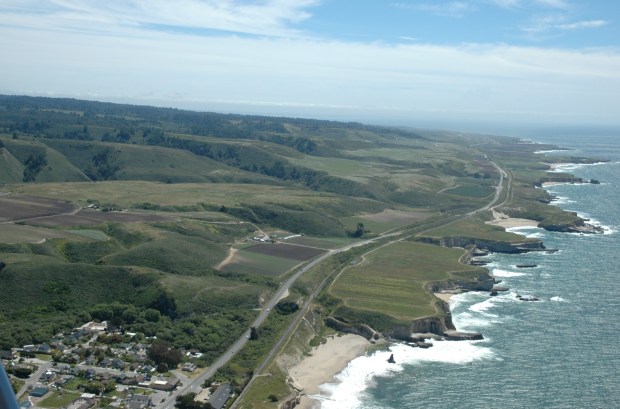
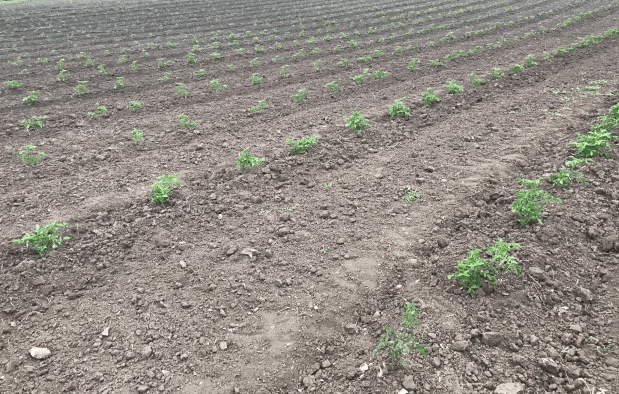
Once agricultural land is in production, routine practices actively kill or deter wildlife and passively degrade wildlife habitat. Driving through the Pajaro or Salinas Valleys, look for the upside-down white plastic Ts at the field edges: those are poison bait stations with poison designed to kill small animals that venture into the fields. Traps or poisons are used to kill any animals once they find their way further into fields. Organic farmers often use traps for gophers with regular trap patrols as part of their daily operations. Passive forms of wildlife killing may seem a little less aggressive. In both conventional and organic agriculture at any scale, the mowing and tilling of crop areas leaves mutilated (hopefully quickly killed) critters in the wake of tractors: snakes, toads, frogs, lizards, salamanders, birds, mice, moles, shrews, and voles are all decimated. Polluted runoff from both organic and conventional agriculture is another issue. Agricultural irrigation runoff into Elkhorn Slough has the highest levels of fertilizer in the US, equivalent to dumptruck load of fertilizer a day, causing terrible contamination of the state’s second largest estuary.

Ranching Conservationists

In contrast to the impacts of these cropping systems, I look to coastal prairie fed, pasture raised cattle that are managed in such a way to restore local ecosystems and provide food for those who would eat it. I’m not arguing against the need to reduce the amount of meat the world’s population eats: clearly, there is a lot of animal agriculture that is terrible. However, many ranchers locally are doing a world of good for wildlife and plant diversity with their coastal prairie stewardship. Globally, ‘abandonment’ of grazing in Spain, France, Britain, and other places with diverse grasslands has caused species loss and ecosystem degradation. Humans have been learning how to manage livestock to mimic evolutionary disturbance regimes that maintain wildlife and keep grasslands diverse and healthy. Most ranchers I know are enthusiastic about the wildlife they steward; many are working with conservationists to co-manage for biological diversity. This situation makes the contrast between veggie and beef burgers a little more interesting.

Wildlife Friendly

There is real potential for cropland management to be more sensitive to wildlife. One day our lettuce won’t come with such a legacy of wildlife displacement and death. There are only two wildlife-friendly food certifications that I know about: the Smithsonian’s certification of Bird Friendly Coffee and the relatively new Audubon Society’s certification for bird friendly beef. Taking its normal laudable step beyond the Federal guidelines for organic standards, Santa Cruz-based California Certified Organic Farmers (CCOF) requires its certified members to maintain a conservation plan to address habitat stewardship. But CCOF lacks an ecologist to review or advise on such plans, so this effort mostly falls quite short of what is needed. Let me know if you know other attempts to address these gaps! Meanwhile, what are we to do? 

Ask a Farmer

The thing to do is ask the farmer who you support about their conservation practices. Already you probably understand the importance of supporting farmers directly by shopping at a farmer’s market. When you buy from them, you might ask how they take care of wildlife on their farm. The answer should take longer than either you or the farmer wants to take; shorter answers are probably insufficient and will be quick evidence that the farmer isn’t practicing wildlife friendly agriculture. Sensitive management of irrigation, runoff, ponds, hedgerows, cover crops, fallow fields, roads, and non-crop areas should almost all be part of any wildlife-friendly farmer’s skill base. And, they would have to explain a little about what ‘sensitive management’ means in each case – the stories aren’t too complex if someone knows their stuff, but the telling will take a little time. We need those stories. We need those conversations. Future generations will depend on farmers who integrate nature with their crops.

Provocative Eucalyptus

This is reprinted from my weekly post as part of Bruce Bratton’s excellent weekly brattononline.com This post was modified from the original in response to critique by Gillian Greensite who has followed this issue for many years. My content was largely informed by a science conference on the subject, with a record of many materials here.

Many Californians have opinions about Eucalyptus. Either you are for them or against them. Its a subject like politics or religion that you hesitate to bring up at the dinner table. As with Covid-19 vaccination, you can’t predict who’ll be on what side (or why) – people of any political persuasion can surprise you with their beliefs. I’m betting that you know what I’m talking about…I didn’t even need to mention which of the hundreds of species of Eucalyptus I am talking about.

Eucalyptus Bad

The most common concern I hear about blue gum (Eucalyptus globulus) in California is how fire-dangerous it is. Locally, some recall the 2008 Trabing Fire just north of Watsonville, ignited on a hot day by a poorly running vehicle backfiring, and spitting out fire balls along Highway 1. Grass caught fire and quickly spread into nearby invasive pines, acacia and Eucalyptus (those have since regrown denser than before). That fire surprised fire-fighting professionals from how high embers were flying…hitting their fire monitoring planes at altitudes previously thought safe. They cited the architecture of Eucalyptus forests…the tall, close very vertical trunks create chimney-like conditions, hurling fiery brands much further than expected. Leaves with volatile oils and large amounts of bark and branches accumulated in the understory are other reasons for fire concern.

Eucalyptus Good

The most common defense of Eucalyptus I have encountered is its beauty. Our cityscapes have surprisingly few trees, but there are almost always huge Eucalyptus nearby. Many are fond of their massive trunks, shaggy bark, and towering, spreading canopies, shimmering with blue green leaves. I have seen many painters capturing the alluring patterns of rows of old Eucalyptus trees in many seasons, in many shades of light. A few people will dedicate their spare time and energy to protect big old Eucalyptus city trees from the too-frequent human desire to cut down trees.

What Do the Birds Say?

If birds are any indicator, Eucalyptus is good in some places and bad in other places. Birds like city trees including Eucalyptus. Eucalyptus adjacent to larger bodies of water are attractive to birds. You may have seen masses of herons and egrets using Eucalyptus as ‘rookeries’ where they raise their young. Trees near the Santa Cruz Yacht Harbor are roosting areas for herons. The Eucalyptus grove south and inland of the Elkhorn Slough Bridge in Moss Landing has a huge rookery, with so many birds that their guano is killing the trees. Peregrine falcons were using the talk Eucalyptus near the river mouth for a while. Raptors like the tallest trees for nests and perches.

Gum Gone Wild

Eucalyptus in our area is considered to have a moderate threat of invasiveness, with regionally specific higher rate of spread in foggy areas and in areas with more water availability, especially along the Central Coast. As with so many Eucalyptus issues, this was once a source of controversy before Eric Van Dyke at the Elkhorn Slough Reserve demonstrated an 8 foot per year rate of spread of groves in northern Monterey County. Since then, many other examples of the species’ ability to spread in our region have been documented. Where Eucalyptus spreads into streamside habitats, there is a particularly bad impact for bird conservation.

River Gum Bad

Riverside or streamside (aka ‘riparian’) habitats are by far the most crucial targets for bird conservation in California. Most of these habitats have been highly altered and are no longer good habitat for wildlife. Many migratory birds visiting from the tropics nest in those habitats. The loss of riparian bird habitat compounds with the loss of tropical forests, and so these birds are particularly imperiled. Riparian ecosystems host many cavity nesting birds that favor holes in the soft wood of riparian trees like willows, cottonwoods, and alders. Eucalyptus trees quickly invade and transform diverse riparian forest, and cavities become much less common. Bird conservationists say that controlling Eucalyptus in riparian areas should be a ‘no brainer.’

Euc Pests

Some types of birds have recently been newly attracted to Eucalyptus because they like at least one of its natural pests that found its way to California. The blue gum psyllid is apparently tasty for birds such as warblers. I’m less sure if birds are eating other ‘new’ Eucalyptus pests: apparently a number of blue gum eating pests recently found their way to California. It used to be that Eucalyptus leaves were perfectly shaped, no damage- nothing ate them! Now, those leaves look like someone took a paper punch to them. Eucalyptus tortoise beetle are eating blue gum leaves – does anyone know if birds like to eat it or other of the new Euc pests?

The Arrival of Eucalyptus

Eucalyptus has a long history in California. It was widely planted in the 1870’s to address the ‘hardwood famine.’ Hardwood was becoming scarce because of its use as fuel for steam engines and heat, so there was a Eucalyptus planting boom. Eucalyptus was soon advertised as the solution to many problems: a fast-growing hardwood for fuel, people thought its wood could be used for railroad ties and other lumber, people said the tree would dry up wetlands and reduce mosquitoes, and its fast growth attracted people to plant it for windbreaks. People were buying large numbers of seedlings. Some advertised, promising investors good returns from productive Eucalyptus wood lots.

Hardwood, though, eventually lost favor to petroleum in California. But, if you travel to Central or South America, where hardwood is still important for fuel, you will notice many areas managed for Eucalyptus firewood.

Heavy and Twisty

It turned out that Eucalyptus wood twists and buckles when drying, so it was eventually recognized as useless for lumber. Well, almost. 15 years ago, someone claimed they had a process for drying Eucalyptus “correctly” so that it could be used lumber, including for picnic tables. They donated one to the organization I worked for…it weighed 250 pounds and took 4 people to move! After a couple of years it was impossible to use. It was so warped that when people sat on it, it rocked wildly about, and created a balancing challenge with people bobbing around spilling their drinks at vastly different elevations.

Perhaps this would be different if the wood were kept dry, indoors. Woodlots for Eucalyptus hardwood are still around, but you are more likely to see Eucalyptus spreading from old, planted windbreaks. Look carefully for the oldest biggest trees in a row with many generations of younger trees spreading from there. One thing remains true from the old hype: Eucalyptus does well at drying wetlands!

Drink it Up

With its huge canopy thick with leaves, Eucalyptus is known globally for its thirsty nature. Deforestation in its native home in Australia led to salinization of the soil from the evaporating heightened water table. Here in California, people note the loss of springs where Eucalyptus grows. Although closer scrutiny is needed, using transpiration rates from Eucalyptus elsewhere in similar climates, it is likely that a grove of Eucalyptus drinks most of the rainfall falling on it along our coast. This is much more water than native trees use. One day, one mitigation for new development that demands more water might be investment in Eucalyptus control.

Thinning and Containing

Given the fire danger and negative ecological and water impacts of most Eucalyptus groves, it is sad that they are still proliferating. To be sure, Eucalyptus control is an expensive proposition. Having felled several large trees, I can attest to the work it takes to clean up a fallen tree properly. The wood makes great firewood and is easy to split if you split it soon after felling. But there is an enormous amount of slash to deal with…chipping or burn piles- either way a lot of work. The stand-out organization for Eucalyptus control locally is State Parks. They are ‘thinning and containing’ some groves that people like to look at while obliterating others in ecologically sensitive areas. They realize that Eucalyptus control will cost more each year they wait, so they do what they can with the (too few) resources that our elected officials budget for them.

Fer it or Agin it?

After reading this, maybe you will have a more informed opinion about this provocative tree. It is my hope that you be ‘for’ the ones that grow near bodies of water or are city trees and ‘against’ the ones in riparian areas or spreading through our other precious native ecosystems.

Post Fire Early Winter Mixed Conifer Forest

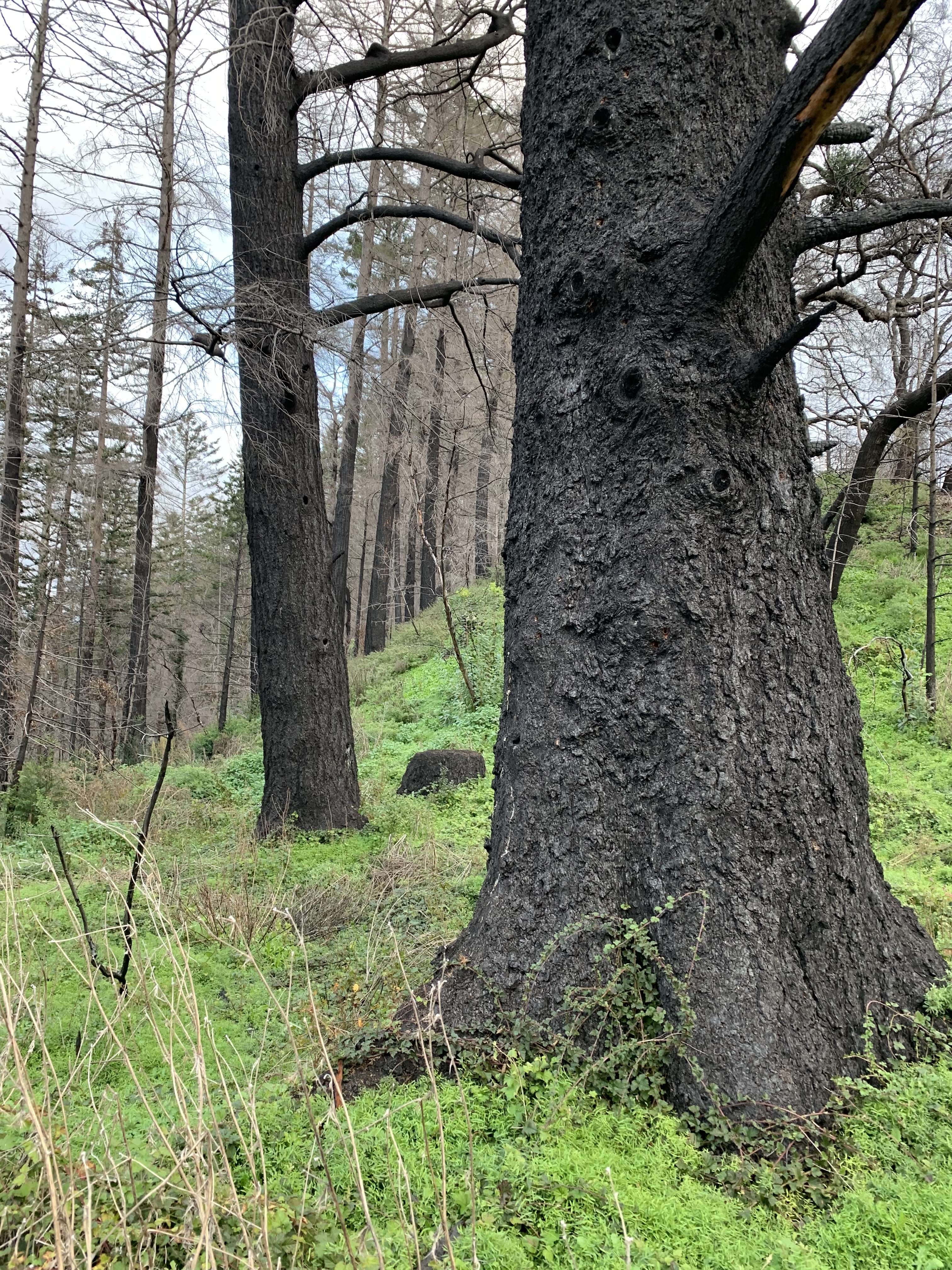
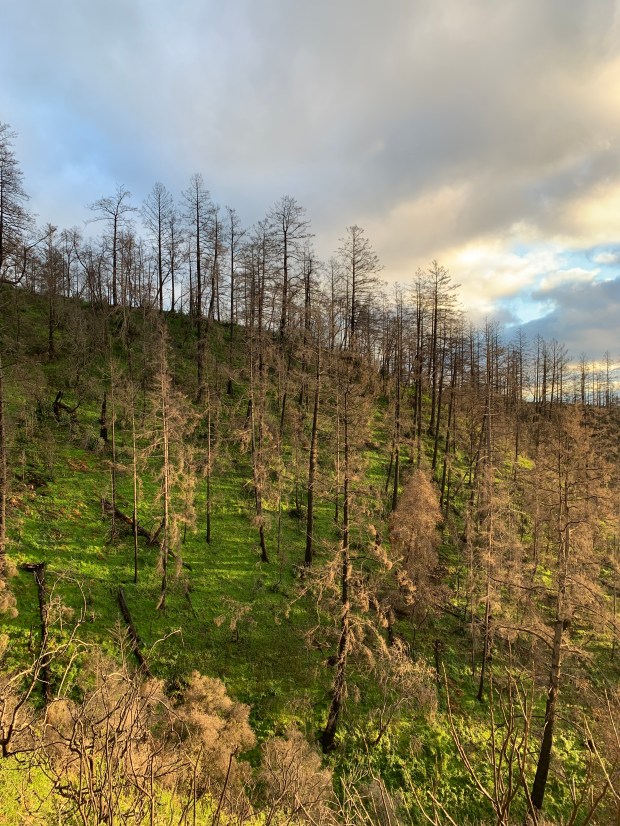
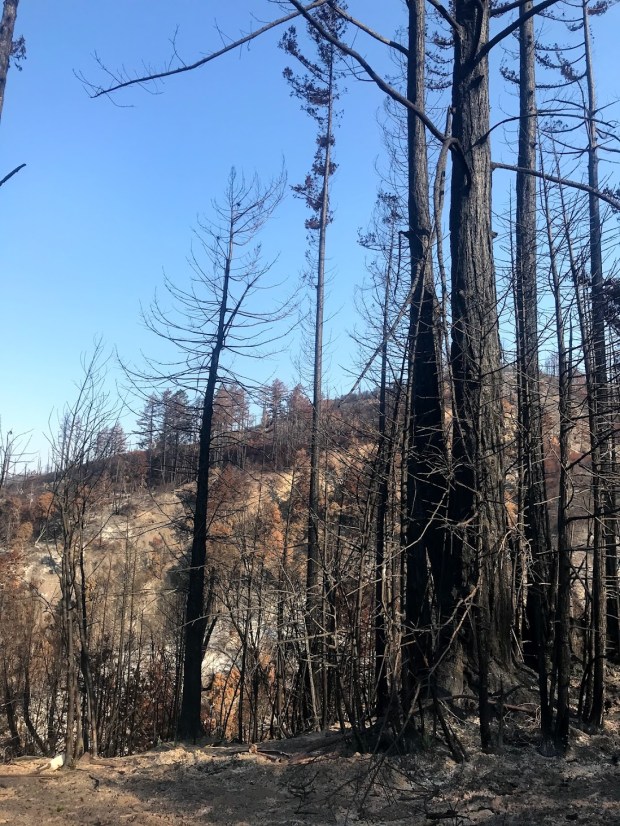
The widespread mixed conifer forest in the hills of Santa Cruz County’s North Coast is drippy wet now, even between storms. Seventeen months ago, the CZU Lightning Complex Fire devoured tens of thousands of acres of mixed conifer forest just north of Santa Cruz. Now, there are thousands and thousands of stark blackened standing dead trees. There are also living and resprouting trees. The dead and the living conifers tower over a wet, glistening, vibrantly green, and lush understory. It is slippery and hikeable now, but as the trees fall and the brush grows up it will become impossible to explore until the next fire…a decade away.

The lush post fire understory of a mixed conifer forest. Above Davenport, CA December 2021

What is Mixed Conifer Forest?

Mixed conifer forest is our most common forest type. While it is true that we have patches of redwood-dominated forest and patches of Douglas fir-dominated forest, many areas have a mix of the two. At the larger scale, peering out of an airplane at 10,000 feet, all of the local forested landscape includes a mix of conifers – redwood, Douglas fir, knobcone pine, ponderosa pine, Monterey pine, and Santa Cruz cypress. Where Douglas fir and coast redwood co-dominate, this type of mixed conifer forest hosts a mix of plants and animals that are distinct to this habitat type. Low light levels from a high, dense canopy and a preponderance of difficult to digest resinous needles are important factors determining what else can live in this habitat type.

Flaming Bark

The mixed conifer forests burned unevenly in August of 2020. Douglas fir trees take a little coaxing, but coast redwood trees take real convincing, to burn. There are many more fire-killed Douglas firs than redwoods. During the last two fires, I watched both redwood and Douglas fir trees catch on fire. Fire seemed to race up Douglas fir trunks, spewing sparks and crackling away whereas redwood trunk flames were slower to move up the tree and was less sparky and noisy.

Unlike redwood, Douglas fir trunks are covered with sticky sap that ignites easily. I heard a story about a teenager that thought it would be fun use a lighter to light some sap on fire on the side of a tree and very shortly needed the help of the fire department to put out the flaming tree, which was threatening the family home.

Glowing Holes

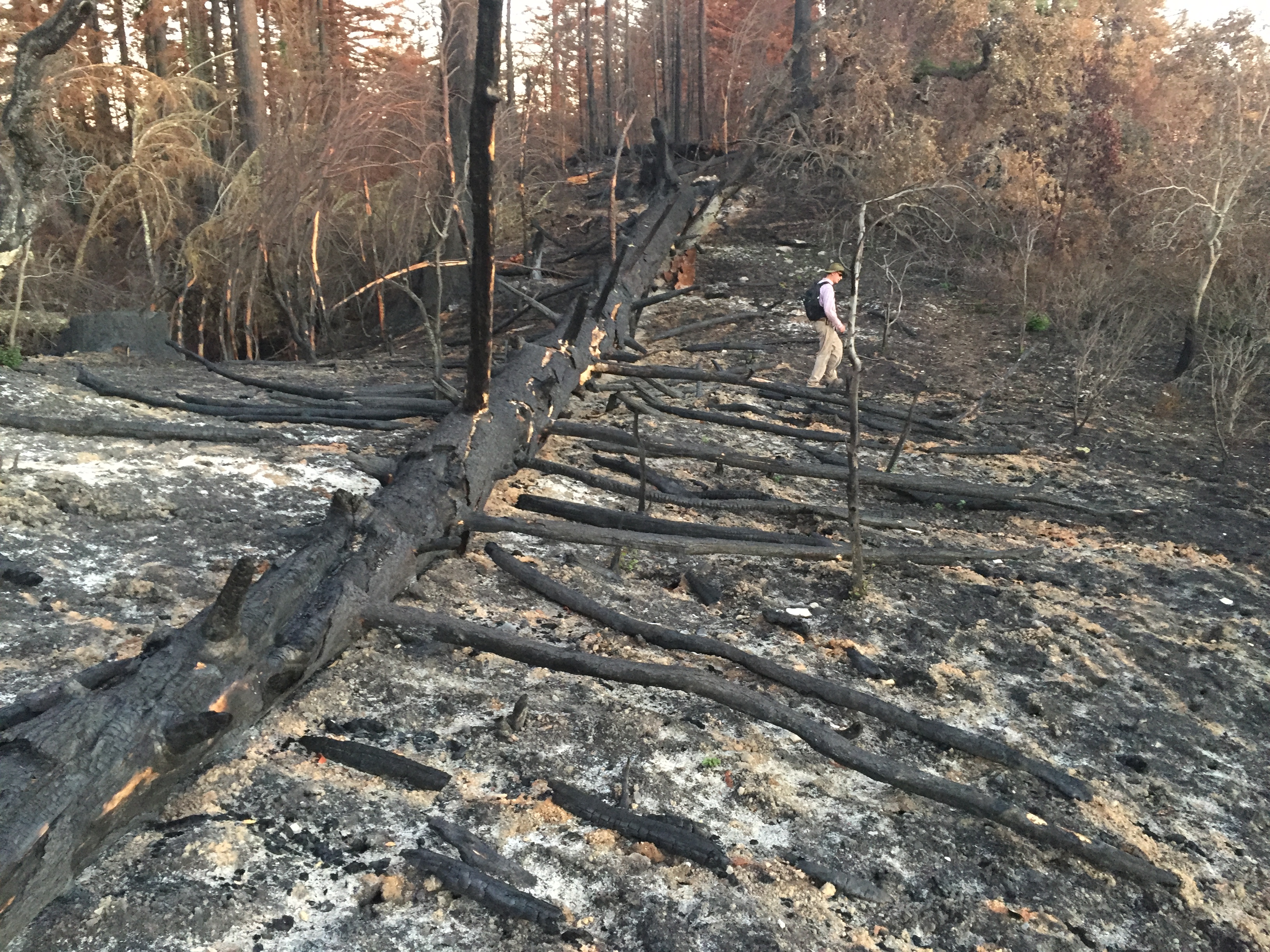
For weeks after the initial fire storm, glowing spots throughout the forest decorated the night. Mostly, these were the smoldering stumps of trees that had died long before the fire. In the mixed conifer forest, there were many dead or dying madrones and tan oaks that had been shaded out. These hardwood stumps made for some hot holes that burned for days. Some smaller Douglas fir trees had also died before the fire, but they burned up quicker.  There are now quite a few treacherous holes making forest hiking more interesting.

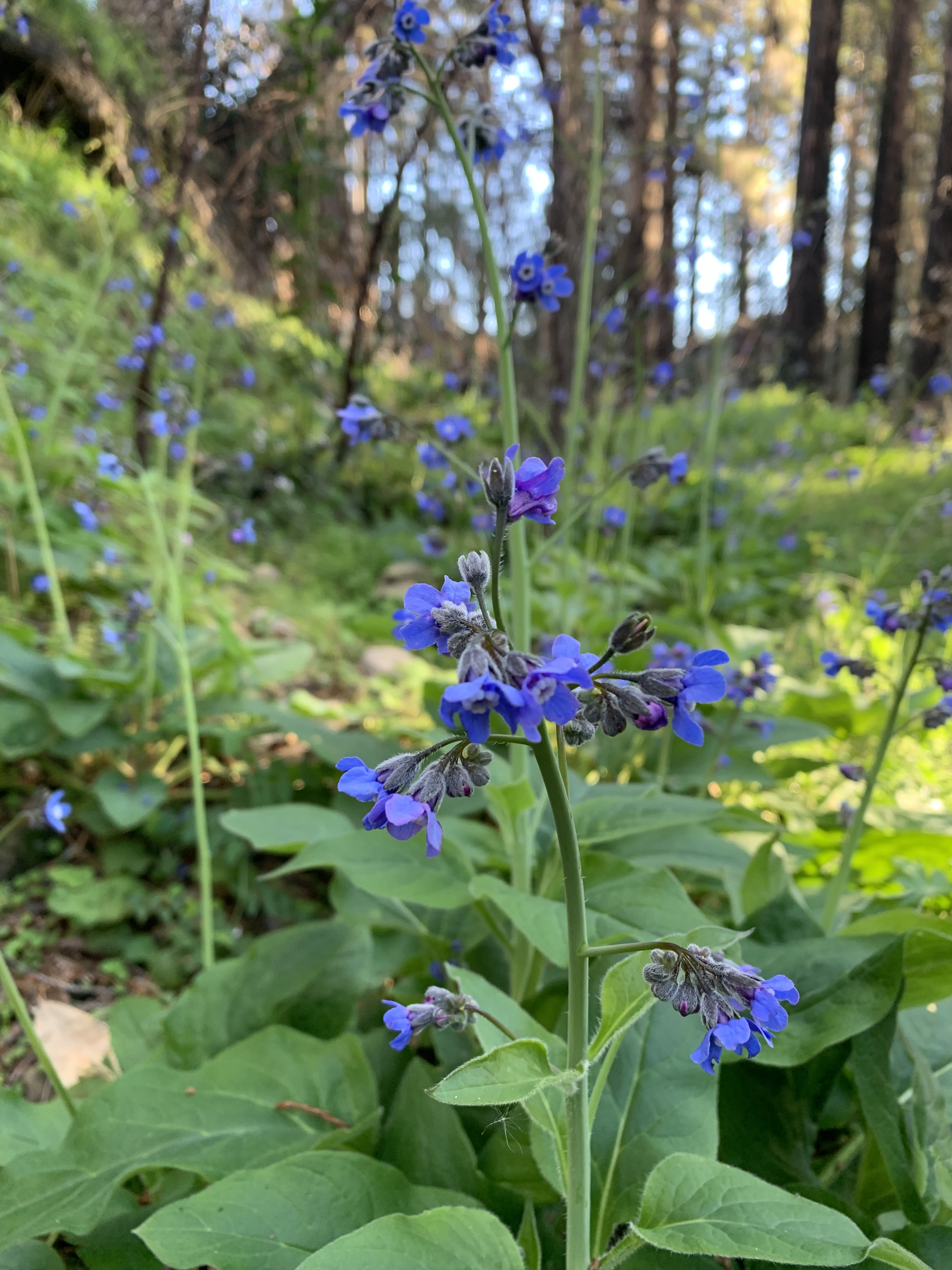
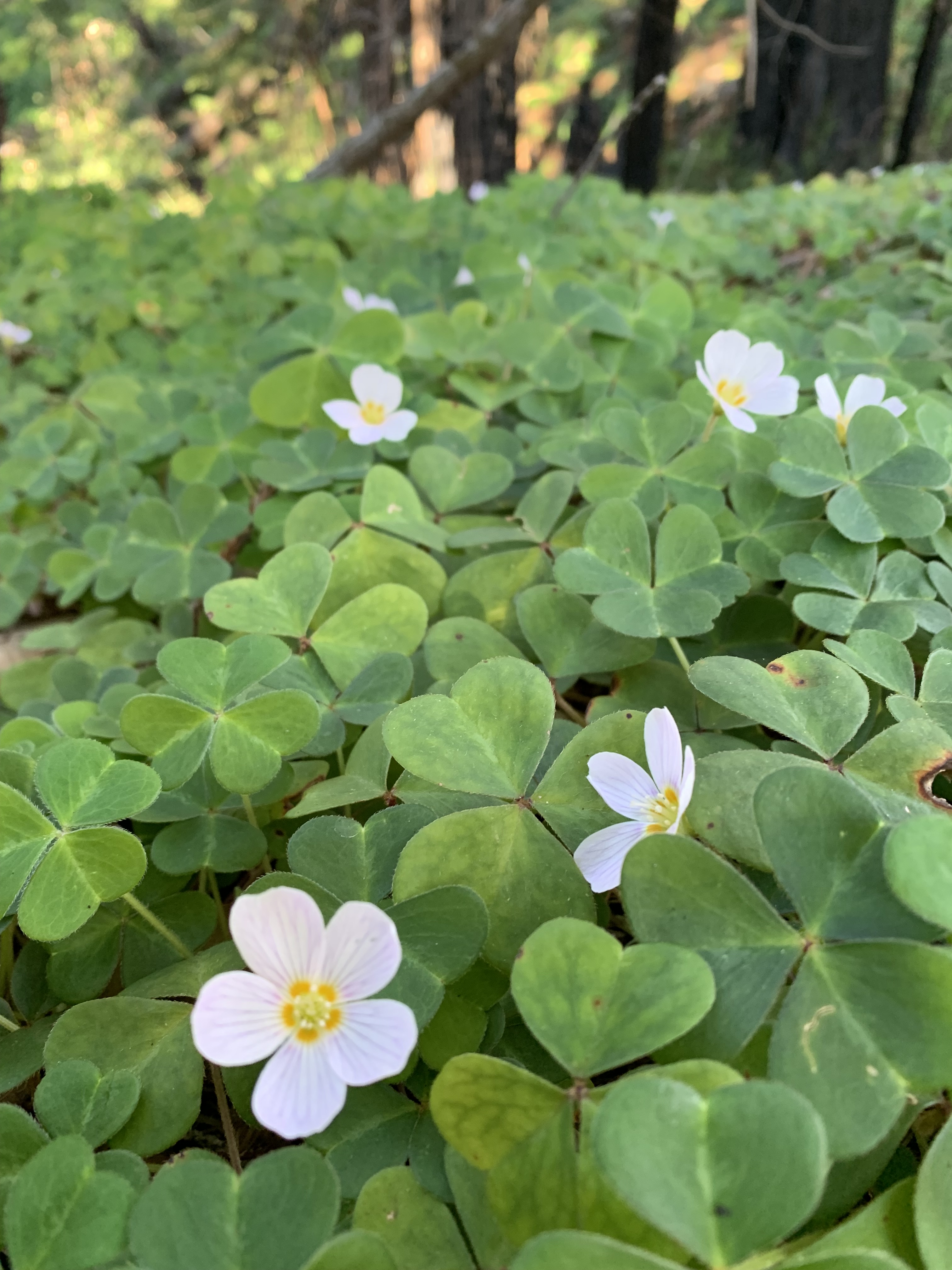
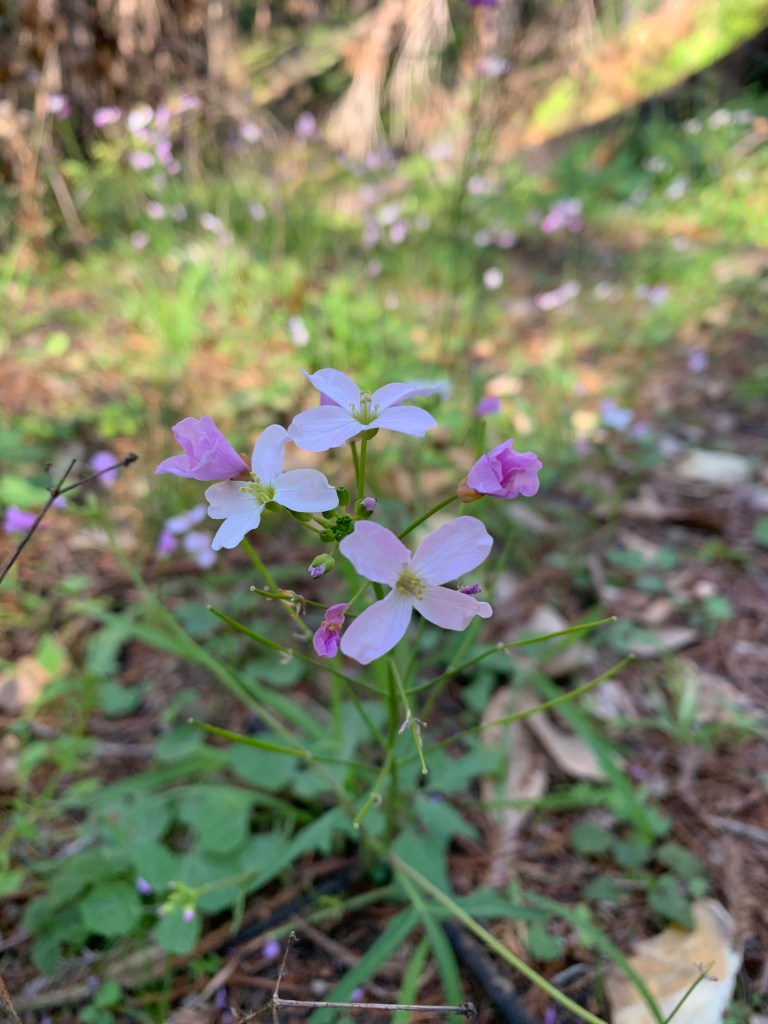
Solanum sp, Nemophila sp, Claytonia sp., and more…all covering the post fire forest floor

Understory Greens

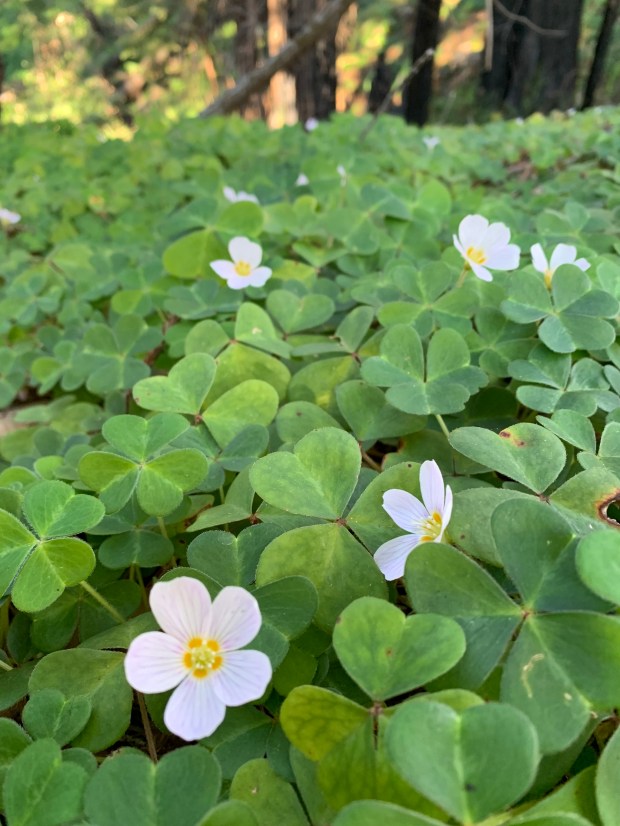
The rains have germinated 3” deep shag carpets of lush herbs and hydrated huge patches of shorter bright mosses below blackened tree trunks. Miner’s lettuce, phacelias, and weedy forget-me-nots make the carpet. In patches, taller plants like hedge nettle, blackberry, nightshade and many other plants add to the hillsides of bright green. Many areas are already dotted with white, pink, or purple blossoms brought on by the winter rains and encouraged by warm bright days between storms. A lot more sunlight hits the forest floor now. Where there are patches of live trees, the understory is less thick. In some places, the fire left small hillside meadows, without any trees at all.

The forest soil is still black and slippery with soot and ash. During each of my recent forest hikes, I have slipped and would have tumbled a long way were it not for my grip on the very strong 4’ tall redwood basal sprouts. The soil, in the hotter burned places where the understory herb seeds were destroyed, is covered by strikingly bright mosses littered by needles and small branches blown from the few remaining live trees somewhere uphill or up wind.

Post Fire Wildlife

The burning of the mixed conifer forests means more food for more birds: redwood and Douglas fir forests normally have few seed producing plants, but that’s changed now. In mixed coniferous forest, deer have little to eat; now, the forest floor is covered with deer food. It is easy to see the birds and easy to find the deer tracks. Sharp deer hooves, forming new trails, cut through mosses and lush hillside wildflowers, exposing forest soil. The tracks crisscross the steep hills, patches of tasty miner’s lettuce chewed off. I’ve been seeing deer beds of very flattened understory plants, mostly on level spots along old logging roads. Expect healthy coats on momma deer, more big antlered bucks and spotted big eyed deer twins navigating the hills on dainty legs this spring. Mountain lions prefer dark forest to move around, but they’ll be enjoying more food while the forest canopy grows back.

Fire Makes Beaches and Bonfires

Mostly, the forest floor is healing, and little erosion has been happening. The exception is where humans created roads during the early logging days. To create roads on hills, people carved uphill and dumped the soil they removed downhill. This is called ‘cut and fill’ road engineering. Sometimes the fill side buried logs and stumps which burned under these old roads in the recent fire. Now, the uphill scar is unstable in many places, the fire having destroyed the stabilizing plants. Between burned out fill sides and steep, less vegetated cut sides…there is lots of erosion. Throughout the fire, you can find large and small scallops of hillside slumping onto the old roads or downhill from the roads towards the creeks. Besides being activated post-fire, this legacy of disturbance is most evident now that you can better see the soil surface across the hillsides.

With the couple large storms we had, streams have been carrying soil and logs. Local streams are flowing with mud, as evidenced by the ocean’s big brown plume up and down the coast right after the last storm. That mud will sort out and the sand part will become our beaches- bigger beaches after fires? We’ll see.

One local stream was more black then brown for a while- probably because of ash and soot. Streams are also carrying logs. Judging from the scouring of streamsides, streams have been blocked by post fire logs (ever encounter the term ‘logjam?’); those blockages eventually give way and are swept downstream with great force, battering and baring stream banks downstream and far up their banks. Those logs become driftwood on the fire-augmented sandy beaches. That driftwood will become the bonfires for rocking all night parties that the Coastal Commission has just sanctioned by mandating the creation of 24-hour parking lots from Santa Cruz to Davenport. So, part of the post wildfire wildlife effects will be the noisy, blazing, smoky disturbance of whatever shorebirds were counting on nocturnal refuge on those once peaceful beaches. The CZU mixed conifer forest flames will carry on for human and non-human animals alike, for better or for worse.

Douglas Fir Forests

– this is another of my weekly posts reprinted from Bruce Bratton’s admirable weekly e-news publication at brattononline.com

According to tradition, people are hauling Douglas fir trees into their homes and decorating them for annual winter rituals. Some purchase dense, pruned trees, while others harvest spindly saplings from the woods (aka “Charlie Brown trees”). Soon, strings of lights cast needle shadows on the walls and ceiling, infants gurgle and sputter with delight, wide eyed at the beauty. The unique Douglas fir scent fills the air – a bright lemony pine smell. Hallways are festooned with ribboned Douglas fir garlands and people weave fir wreaths to decorate doors. In breaks between storms, on crisp cool days, we saunter into the forest, catching fresh fir scent moist with rain, sparkling in the foggy, low-angled sun rays.

Mouse Tales

Douglas fir is not a real fir- it’s a pseudo-fir, creating cones distinguished from genuine fir cones by having “the tail ends of mice” sticking out the cone. Check it out sometime- there really are what looks like two back legs with an accompanying tail poking out, so cones look like a bevy of mice are feasting on Douglas fir seeds.

The cone decoy seems to have worked, evolutionarily speaking. From Northern California though Canada, Douglas fir is the sole home of red tree mice. These mice live high in canopies and feed on only on needles. On huge branches among the complex old growth Douglas fir canopy, they maintain long lived, wickedly well-designed homes that include rooms with specific uses. If they aren’t careful while they are out harvesting needles, a spotted owl will eat them – red tree mice are a favorite and important food for this equally endangered bird. We’re apparently too far south for the red tree mouse- Santa Cruz is the near the southern end of Douglas fir’s range, and maybe there aren’t enough thick forests, or too frequent of fire, for these little critters.

Northward Ho!

Moisture-loving conifers have been retreating northward for a few thousand years, and Douglas fir may also be headed that way. There are layers of grand fir pollen up until just 15,000 years ago in the sediments of a pond in northern Santa Cruz County. The nearest grand fir is in Sonoma County, nowadays. South of here, if you look at the forest on either side of highway one south of Freedom Boulevard, you’ll see a few widely spaced straggly Douglas firs – those trees look like similar to those in the hills above Elkhorn. And that’s as far south as they go along the coast. But, north of there you’ll notice that they don’t appear to be having trouble making thick forests.

Rock Scissors Paper (Douglas fir wins)

In the rush to capture the sun, Douglas fir quickly wins against all but the coast redwood around here. Look at most any of our majestic coast live oak forests, and you’ll see Douglas fir trees winding their flexible leaders between old oak branches. Play that forward, and those oak trees will be toast, shaded and outcompeted for water by these highly invasive conifers. Douglas firs are also invading coastal scrub and coastal prairie.

Pull ‘em Up, Chop ‘em Down

Kat Anderson reported to me documentation that tribal peoples have long pulled Douglas fir seedlings as part of their tending of oak groves. The tribal peoples took over from the tree-invasion prohibiting Pleistocene megafauna. Just north of here, a remarkable recent turn of events saw reintroduction of native people land stewardship with collaboration between the Amah Mutsun and State Parks. The Quiroste village site was once in a matrix of super diverse, well-tended coastal prairie framed by managed oak woodlands, but for the last hundred years, without stewardship, those systems succumbed to Douglas fir invasion. After careful planning, and with some controversy, the tribe and State Parks have been restoring the site by clearing Douglas firs…almost like the old days, but the trees got bigger and so it takes saws and a lot of work to remove them. With their work, the area is becoming more species rich and more fire safe.

Doug Fir, Associates

While coastal prairies and coast live oak forests are much more species rich, Douglas fir forests do have their own set of interesting species associates. Instead of tree mice harvesting Douglas fir needles around here, we get ants. Anywhere there are Douglas firs in the Santa Cruz Mountains, you’ll find 2’ tall piles of needles teaming with ants. These are Formica integroides, a mushroom farming ant, growing their fungi food in piles of Douglas fir needles. This needle harvesting critter forms armies of harvesters walking in long and sometimes wide lanes across and down human trails: watch out…don’t be rude by stepping on them!

Orchids also seem to like growing in Douglas fir forests. Also at its southern range limit, the gorgeous Calypso orchid has been documented with ephemeral populations at UCSC and near Davenport (both gone now), but has a somewhat famous large population under a north-facing Douglas fir forest in Butano State Park. Coral root orchids also seem to prefer Douglas fir forests. Curiously, ground nesting ‘yellow jacket’ wasps seem to key into coral root populations under Douglas fir. So, maybe look very carefully before walking off trail to get a closer look at the subtle but beautiful colors of coral root orchids.

Timber!

“Douglas fir doesn’t pay for itself to harvest.” That’s what local foresters tell me. By the time they do the timber harvest planning, go through the regulatory process, carefully fell the trees, trim and haul the few logs they find that aren’t damaged/diseased, mill and dry the wood, they can’t recoup their investment because someone elsewhere has produced a similar board, cheaper. The Pacific northwest and Canada, with more lax forestry regulations and healthier Douglas fir trees, are creating cheaper Douglas fir (and similar) 2x4s for sale. So, for many years, we’ve been growing some large Douglas firs on the area’s timber lands.

Then came the CZU fire…now, there are thousands of large and small standing dead Douglas fir trees: what should we do? If left, these trees will gradually fall over and create a Giant Fire Hazard. The next fire, spreading through those hundreds of acres of log piles, will be very intense, torching whatever trees tried to recover and scorching the soil badly. It will be a hot fire storm, to a great extent our fault.

Biomass Fuels?

If you have toured the CZU Lightning Complex Fire area, you have probably noticed piles and piles of logs. Burned up trees are dangerous to houses, roads, and power lines, so they must be felled and hauled away. “Away” is an odd word…mostly it means a landfill (another odd word). Ever throw something away? It is instructive to visit ‘away’ at the end of Dimeo Lane or near Buena Vista. We must find a new ‘away’ soon, but no one wants ‘away’ near their homes or over their groundwater. Piles of post fire logs will fill up landfills quickly, especially with more frequent fires. Why not use modern technology and turn those logs into electricity? There are new carbon-neutral, mobile wood-fired power plants that burn wood, make electricity, and create ‘biochar’ that has been shown to be a useful soil amendment for agriculture. Keep your fingers crossed that we might get one of these at one of our local landfills sometime soon. That way, when you throw something ‘away’ that can be safely burned, you’ll be making your own electricity and enriching agricultural soils.

Chalks Chaparral

– this is another reprint from my post to Bruce Bratton’s most insightful brattononline.com weekly.

The Chalks stretches from above Año Nuevo into Big Basin south through the Lockheed property and then down many tiny ridges above Scott Creek and the Swanton community. Even before the CZU Fire, the ridges appeared from afar curiously white, like chalk. The earliest Old World explorers wrote in their log books about that striking whiteness. The barren white ridges are on account of extremely poor soil, mostly fractured rock. that limits the ability for vegetation to thrive. The vegetation that can make it is a unique type of chaparral.

Most people see The Chalks on their drive south on Highway One just north of Año Nuevo, South of Franklin Point as they pass the Coastanoa Resort. Look inland and you’ll see lots of broken ridges: those are The Chalks.

Much of The Chalks is on private property. Some is on what is known as “Lockheed Martin Space Systems” at the very end of Empire Grade. That area also contains a 1000-acre private property called “Lehi Park” a recreational and camping spot owned by the Church of Jesus Christ of Latter-day Saints. For public visitation, you’ll have to wait until Big Basin opens again…it’s still closed due to the last big fire. Meanwhile, you must settle for viewing from afar.

The Pines

At the top of the steep and erosive bluffs north of and above Waddell Creek, wind-blown, lichen strewn Monterey Pines form the chalks chaparral overstory, but their genes might make them something other than pure Monterey Pines. This is the home of one of only five native Monterey Pine stands. The others are on the Monterey Peninsula, around Cambria, and on two islands off of Baja – Cedros and Guadalupe. Monterey pines are the most planted forestry tree in the world, and the seeds of the ‘radiata pine’ created bred for those forestry plantings came from the Año Nuevo stand, where Monterey pine hybridizes with knobcone pine. Monterey pine occurs lower in elevation, and more deeply in frequent thick fog; Knobcone pine is found higher and hotter and dryer. In between, there are pines that look like both, and the globally planted forestry tree looks like one of those tweeners. As the birthplace of this confusing but useful forestry tree, The Chalks has its tree ambassador planted by the millions, all over the world. And yet, this tree isn’t the only famous bit of Chalks botany…there are also some world-famous manzanita species.

The Manzanitas

Chalks Chaparral includes 7 species of manzanitas, and there are two common, more widespread ones that dominate and two very rare species that only occur in this habitat. The most common species is brittle leaved manzanita, a widespread burl-forming species, and the subject of a previous essay. The other common species is the sensitive manzanita. Sensitive manzanita has small roundish shiny dark green leaves, making it look like the boxwood of the chaparral. Mixed in with these two species, there are two other manzanita species- two which exist nowhere else in the world: Ohlone manzanita and Schreiber’s manzanita. Each of these locally endemic manzanitas are very uncommon even in The Chalks and grow entirely on private property, so you can’t visit them outside of the UCSC Arboretum’s Conservation Garden. There might be as few as 100 Ohlone manzanita plants in the entire world!

You can, however, view photos of Shreiber’s manzanita from a 1939 expedition that led to its discovery. One photo archived by UC Berkeley shows a big manzanita surrounded by knobcone pines and chamise. Another photo has an overview of the habitat showing the large amount of bare ground with sparse manzanitas, pines and few oaks; that 1935 photo suggests a fire as recent as 14 years previously. The next fire was to be 8 years later in 1948.

You might be wondering about the other three manzanitas you can find on The Chalks. They are: Santa Cruz manzanita, silver leaf manzanita, and the crinite manzanita. On a rare California Native Plant Society field trip through the Lockheed property in the 1990s, we saw all 7 species within a short walk of one of our stops.

The Trails and Views

The best places to access The Chalks are in Big Basin State Park, now closed because of the CZU Lightning Complex Fire…but, put those trails on your list when it reopens. Whether from the coast or from inland, your destination are the ridges around Chalk Mountain. The trails wind on ridgelines with gorgeous views of the ocean overlooking Año Nuevo Island and a vast expanse of the ocean. On a clear day, you can see Point Reyes and the Farallon Islands to the north and Point Sur to the South.

Another place to aim for is Eagle Rock out of Little Basin. Eagle Rock is an isolated bit of sandstone on the eastern flank of The Chalks. The views from Eagle Rock expand eastward more than you might see from Chalk Mountain. The trail goes through a kind of chaparral closely allied to The Chalks, but with less rock showing than elsewhere.

Fires and Seeds

Both the 2009 and 2020 wildfires spread initially through The Chalks chaparral, same as the 1948 Pine Mountain fire. Those watching the 2009 fire said they saw what looked like fire tornados launching from one ridge and igniting the next ridge down wind. No one was watching for the more recent fire, which spread even more quickly. Both fires triggered fire-following seeds to germinate.

The most widespread and obvious fire following seedlings are bush poppies. Most of The Chalks will still be barren next summer (as before the fire), but patches of chest high blue-green bush poppy shrubs will be flowering with their bright yellow flowers next summer. I have tried everything to germinate those bush poppy seeds, including the recommended soak in white gasoline, presumably to break down its seed coat. But, after the fire…seedlings pop up all over.

The Chalks and the Rare Human Animal

Humans are rare in The Chalks. The Lockheed facility had, at its peak, hundreds of employees visiting this chaparral regularly, for work. But then much of it burned, and it is unclear if they will continue to operate the facility in the future. The Lehi property is also mostly ephemerally visited by people. The most common place to find humans in The Chalks had been out Last Chance Road where a culture all its own had homes sprinkled around patches of beautiful chaparral. That community, also, burned in the CZU Lightning Complex Fire.

Much of what we know about the natural history of places is gleaned by humans who make habits of visiting those places and looking carefully at what’s around them. Historically, few people have wandered into The Chalks with an eye to natural history. Shreiber’s 1930’s era Chalks visit mentioned above highlighted the area to natural history enthusiasts with the discovery of a new manzanita species (and those intriguing photographs!). Then there’s Jim West, a botanist extraordinaire endemic to the Swanton area, who has brought The Chalks to the attention of many other naturalists, in part because of his discovery of the other new manzanita species. His work has led to a kind of Chalks revival with a new focus on vegetation mapping bringing a host of new naturalists’ attention to that area. There is much more to be discovered in The Chalks – who will be the next person to find something amazing up there? Post fire recovery may have many surprises…

Rest Under the Laurels

– another regular post reprinted from my weekly column with Bruce Bratton’s brattononline.com

With their shiny, fragrant leaves and pale-yellow flowers, bay laurel trees (or just ‘bay trees’) grace our forests and are a tree worth recognizing…there’s nothing with which to confuse them. If you’ve been following this column, you’ll note that I encourage you to learn at least the trees in our area. There really aren’t that many types of trees, say compared to the 80 tree species I had to learn in my 8th grade biology class in Georgia where the forests are much more tree diverse. And “back east,” most of the trees lose their leaves so you have to learn subtle bark characteristics for half of the year. Bay trees are particularly easy if only from the scent of their leaves. Still, I find many people don’t rely on their nose to identify plants- a lost opportunity. Learning to identify trees, and paying attention to the trees around you, is a gateway into ‘seeing nature’ and being more present with the world around you. Through the distribution of trees, you’ll come to better understand wildlife, soils, hydrology, and so much more.

Spot the Bay

To find them, aim for the darkest part of the forest and there you’ll find a bay tree. These evergreen trees cast deep shade, and little grows under them. Wind rustling through long, thin, waxy leaves of bay trees sounds like rain. Walking on the cast-off leaves under a tree can be slippery. With age, the leaves are often covered with black mildew, but without that the fallen leaves are ochre, fading to a light tan-brown. Please don’t pass up a tree without gathering some leaves and sniffing them: no matter how many times I do it, I never regret it. With some practice, maybe you can conjure the scent even without smelling the leaves.

On warm days, when trees are in full bloom, the sweet perfume from the flowers carries a long way with a citrus blossom aroma with a slight hint of cinnamon. They are starting to bloom right now.  I saw some new blossoms in Hageman Gulch adjacent to Arana Gulch recently. Spent flowers litter the ground as they drop off. You might still find bits and pieces of the last part of the fruit right now, too.

Where to Find Them

Some say that Swanton’s Scott Creek valley once had stands of magnificently large bay laurels and the few large remaining ones burned in the recent fire and are now resprouting. Pogonip Greenbelt as well as Wilder Ranch and Nisene Marks State Parks have stands of bay trees along many of the trails. The last ones I encountered were on moist north-facing slopes in western Wilder Ranch growing alongside live oaks; the bays and oaks there were in process of succumbing to competition with conifers, towering above them. The places bay trees thrive is where fire returns from time to time.

Fire Tree

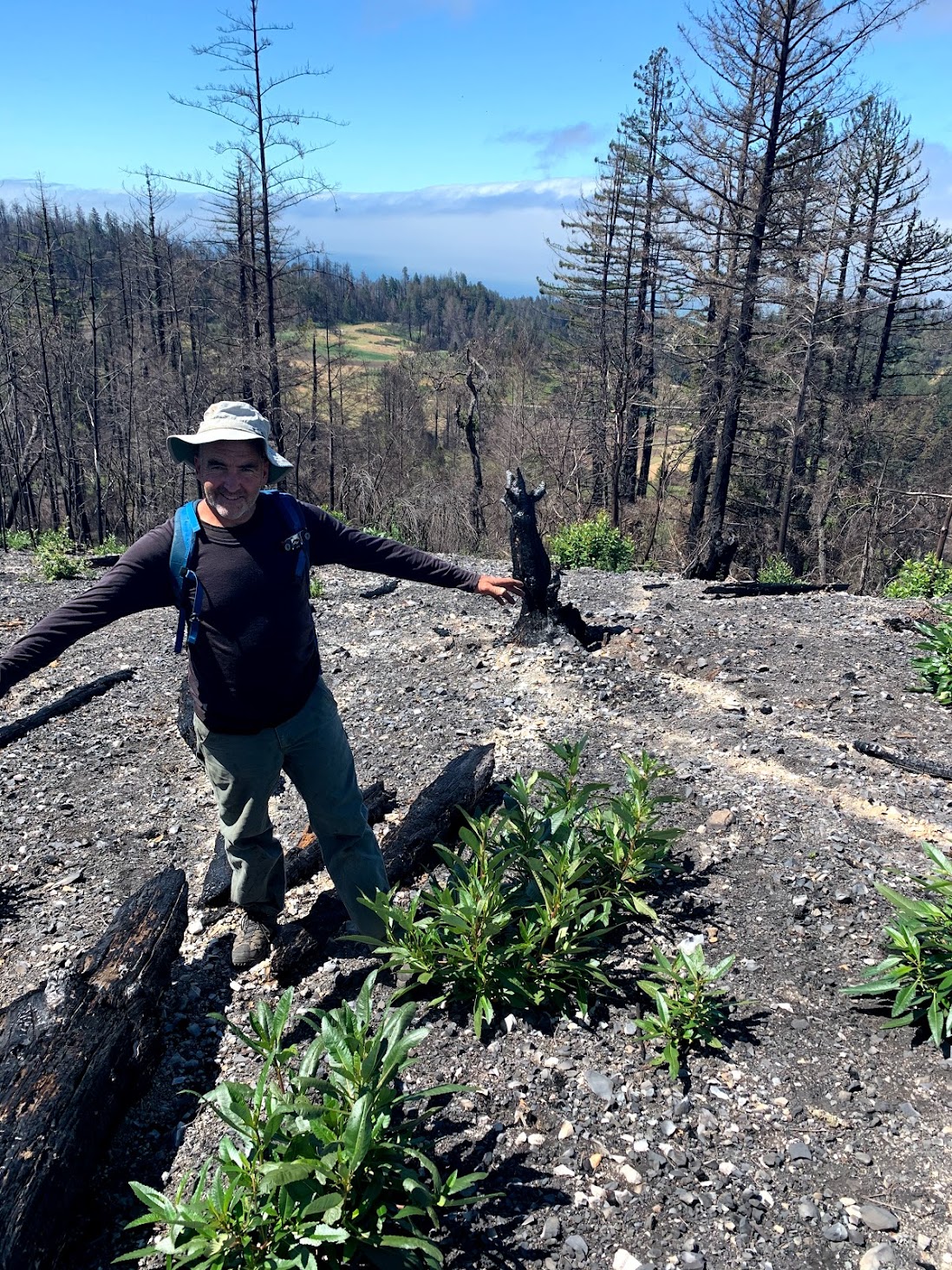
Bay trees erupt in flames during a wildfire, and then sprout quickly back after the fire from their basal burl. One day, if you are enjoying a campfire, throw a few bay leaves on it to enliven the party. The leaves pop and crackle loudly, sending out sparks – evidence of the oils in the leaves. After our 2020 fire, bay trees were sprouting up two-foot-tall tender shoots a couple months after the fire. You often see bay trees with many trunks- probably because of the survival of more than one of those post-fire sprouts. The sprouting nature of bay trees allows them to leap up above the competing vegetation and to send out fruit in just a year or two after a fire, providing seedlings a better chance of establishment. But the seeds are a coveted cache.

Fruit

Squirrels, pack rats, mice, and jays love to eat bay “nuts,” which are also been popular with certain people. Although bay trees are relatives of avocados, and the fruit looks like a little avocado, there isn’t much flesh, which is only edible for a brief moment when ripe. The ripe fruit can be bright green or a deep purple. The nut is a better bet than the thin skin for eating, but you must roast it first. It is oily and if roasted just right tastes a bit like a roasted cocoa bean. Some people say they feel a bit wired after eating a few. No one I know has liked them so much that they repeatedly go to the effort of processing them, though native peoples are noted to have eaten them.

Medicine

After I led a barefoot friend of mine into a stand of chestnuts for a harvest (ouch!), he got even with me a year later with a bay leaf. We were hiking through a local forest, and he noted that I sounded congested, but I was in luck- he had a remedy close at hand! He handed me a bay leaf and told me to roll it up like a tube, put it in my stopped up nose and breathe in through it deeply. And so, I did. I was able to remain standing, but just barely. At first, it felt like someone had punched me hard in the nose. The burning sensation spreading deep into my sinuses wouldn’t go away quick enough. I do not recommend this kind of medicine, not even as a practical joke. But there might be ways of inhaling the leaf scent with less vigor, which might be a treatment for congestion. Native peoples used the leaves for treatment of arthritis and for clearing fleas out of houses. Wood rats also use the leaves to get rid of insects in their houses.

Life on the Bay

I first learned bay trees not only by their leaf scent but also by their shelf fungus. There’s a shelf fungus that is on almost all older bay trees. This is called Ganoderma brownii and it is tough like wood. The top of it is often the same color as the bay tree’s bark- a dark brown, though sometimes it is lighter. The underside is white to cream.

Sudden Oak Death

Bay trees have gotten a bad rap as of late as they are hosts to an invasive pathogenic organism named sudden oak death. Local evergreen oaks growing under and adjacent to bay trees are threatened by a heavy rain of sudden oak death spores of falling off bay tree leaves. If you have a stand of these oaks that you want to save, it is suggested you cut out the bay trees that grow right next to them or above them. But, if you are considering cutting them down, you might want first to contact a woodworker.

The Wood

Bay laurel trees’ light to very dark wood is very beautiful and is used for furniture and musical instruments. Some people call it myrtle wood or Oregon myrtle. I haven’t encountered recent furniture made with it, but I once saw a hundred-year-old chest of drawers made from bay wood which looked like it had been made from American chestnut. After writing that, I looked on the internet and see that there are hundreds of very fine pieces of craftsperson- made furniture and musical instruments made with bay tree wood. Sometimes, I see that people use the burl wood for an extra dashing look.

Tending Bay

Our forests would not be the same without bay trees, but I haven’t anyone restoring or planting the species in their landscapes. If you have a place for one, for the shade or for a privacy screen, you might consider planting one. Generally, it isn’t the fastest growing tree- maybe two feet a year at first but settling into one foot a year as it matures. If you keep the branches limbed up high off the ground, they might even help with the fire hazard. Bay trees serve well as part of a ‘shaded fuel break’ that is low maintenance because they suppress understory growth, reducing the need for mowing or shrub clearing. Plus, you’ll be creating food for wildlife for generations to come, and maybe a fine wood source for future craftspeople.

Brittle-leaved manzanita chaparral

– This is another of my posts from Bruce Bratton’s (highly recommended!) weekly at brattononline.com

The rains bring alive chaparral, so this is the beginning of a series featuring local types of “hard chaparral.” The term chaparral is confusing, so I use the term ‘hard chaparral’ to denote chaparral dominated by manzanitas, chamise, and ceanothus. Hard chaparral is so thick and dense and strong as to tear the clothes off of you if you are strong enough to try to walk through it. Rarely, you might crawl beneath the hard chaparral canopy. Nothing grows in the understory – there is only a light dusting of leaves – but you must squinch low while crawling…to 1 ½ feet… and wiggle down on the ground in tight spots; wearing a hat helps so that your hair doesn’t get caught and pulled out by manzanita’s stiff twigs.

Hard chaparral is different than ‘soft chaparral’ – also known as coastal scrub – which is dominated at first by coyote bush, then, later in life, poison oak, monkeyflower, and sagebrush. Soft chaparral generally grows on richer soils, closer to the coast. Hard chaparral grows on the poorest of soils, often with no discernable soil at all. Ridgelines and steep slopes mostly away from the immediate coast are home to hard chaparral.

In hard chaparral, along with the manzanitas you will find many other shrubs and an overstory of pines. Sometimes sparse, sometimes dense, knobcone pines are the more common pine, but there’s a Monterey pines overstory near Año Nuevo. Oaks and Douglas firs slowly invade brittle-leaved manzanita chaparral until you eventually get a few forlorn dying shrubs or even just old barely recognizable skeletons that tell you the chaparral is gone, for now (awaiting fire!).

Brittle-leaved Manzanita Chaparral

Brittle-leaved manzanita is the dominant species of most of Santa Cruz’ hard chaparral. Smooth maroon skin with sinewy muscle-like ripples down thick, strong stems – that’s what most people remember about brittle leaved manzanitas, but the flowers and burls also give them away.

If they aren’t already in bloom, they will be soon. They have clusters of pure white to pink jewel flowers – upside down urns with windows to capture and magnify light, so the flowers glow on even foggy-cloudy days. Bopping from one cluster of flowers to the next…hundreds of bumble bees delight in the winter nectar feast. Hummingbirds, too, zip around sipping from the flowers. On warm days in December and January, brittle leaved chaparral smells strongly of honey, a scent which enchantingly wafts far afield, down into the woody canyons below.

Burly Shrubbies

Of the nine taxa of manzanitas found in Santa Cruz County, brittle leaved manzanita (Arctostaphylos crustacea subspecies crustacea) is the most common and one of only two that have ‘basal burls’ or lignotubers. The other burly manzanita is a different subspecies of the same species (Arctostaphylos crustacea subspecies crinita), that is mostly found at the top of Ben Lomond Mountain, from the Bonny Doon Airport north to Lockheed. To see burls on these manzanitas, look at the base of the stems for a swelling, sometimes quite large, of lumpy wood. These are very easy to see after a fire, because that’s where these manzanitas sprout new shoots. That’s their magic: the ability to get hotly scorched, fire removing all of the branches, and still live. Up pop the shoots as soon as the rains come…and three years later, there’s a Big Shrub once again where the last one stood.

Locations and Co-Occurring Treats

The tops of our parks are great places to visit this type of chaparral. The top of Wilder Ranch State Park, in what used to be known as Gray Whale Ranch, and into upper UCSC, has patches of brittle leaved manzanita chaparral. The top of Nisene Marks State Park also has stands of this chaparral type. Other places include Mount Madonna County Park, as well as Big Basin and Castle Rock State Parks. From the edges of trails, a wintertime treat will also be Indian warrior, a bright maroon perennial wildflower which forms large mats. Shooting stars and various rein orchids also sprout trailside in clear patches of this type of chaparral.

Another thing about wintertime chaparral visits that is intriguing are the lichens, mosses, and liverworts that color and texture the chaparral. Liverworts, in this dry habitat?? Yes! Get off your bike and kneel at that bare-soiled edge adjacent to the chaparral…look carefully…and you’ll see liverworts (and hornworts!) hugging the ground in between mosses and ground-hugging lichens. The intrepid will get to see more and more species by counting the number of different types of tiny things in those patches, which are kept bare by the golden crowned sparrows who retreated when you came their way.

Critters

Sure, chaparral is for the birds, and that’s not a bad thing. And yet, it’s not just for birds. Wrentits are the quintessential shrub habitat bird, and I also like watching the large-curved billed California thrasher. Wrentits bop around below the canopy, mostly, but pop up out on a branch to make their subtle descending ping-pong ball bouncing song. California thrashers, also understory creepers, sometimes jet out onto a high point in a chaparral patch and sing their hearts out with operatic glory.

The San Francisco Dusky Footed Woodrat makes homes on the outer periphery of brittle leaved chaparral patches. It seems this packrat likes oaks and coffee berry more than manzanitas, but manzanitas keep coyote at bay, so having that habitat at their backs is a preferred location. Ratttlesnakes like wood rats…and the summer heat of chaparral…so, that’s a good snake species to associate with hard chaparral. Rats and rattlesnakes….?

What Good Is It?

Brittle-leaved chaparral is good for lots, but unfortunately it is getting destroyed very quickly nowadays. Nutrient poor soils lost their nutrients because they are well drained. Well drained soils are important for recharging the groundwater, keeping our streams flowing and drenching our thirst. Because this hard chaparral can thrive in nutrient poor soils, it is responsible for keeping those slopes from washing into the creeks and for keeping our groundwater infiltration areas infiltrating. Those sprouting burls…they send roots out on steep slopes after fire, preventing landslides and debris flows from destroying homes and roads.

Mowing It Down

Despite ostensibly being protected, brittle leaved manzanita chaparral is getting hacked up at an alarming rate. Now that fire has our attention, bulldozers are hard at work ripping up manzanita burls to make ‘fire safe’ areas. Crushers, masticators, and saws whittle away manzanitas as if they were enemies. When asked, County Planners have said that they have policies to protect this habitat type- they don’t allow development activities within it. The California Coastal Commission also ostensibly protects this type of ‘maritime chaparral’ as an endangered ecosystem, disallowing any destruction. And yet, even from Highway 1, you can see vast patches of chaparral being destroyed on the ridges above Watsonville. Parks organizations are mowing it down even on conservation lands to be doing ‘their part’ with fire safety. From Southern California, we have learned that treating chaparral this way isn’t a solution to wildfire: it generally grows up patches of weeds, which are even more flammable, less able to hold slopes in place, and no replacement for the habitat value of hard chaparral.

What I hope for is more people showing others how to live safely, and sustainably, alongside manzanita chaparral that is well cared for. If you know of any places, please let me know.

Coast Live Oak Woodlands

This is another weekly post I wrote for Bruce Bratton’s online weekly. You might think about subscribing!

Their graceful limbs are impossibly mighty, and they hold them wide. Their branches are more outstretched, more parallel to the ground than upright. Within a short distance of the City of Santa Cruz, there are hundreds of coast live oaks large enough provide shade for 20 picnicking people. These trees invite climbing and most groves have a tree with a branch large enough, and slung low enough, to invite you to lie on its mossy arm. While you lie there, looking up through the dappled light, you will notice a world of life also sheltered by these friendly trees: clouds of insects zip and zag in and out of the shade, lichens cling and drape all around, and there are so very many birds!

To Know Them is to Love Them

The coast live oak species (Quercus agrifolia) is one of several live oaks that co-occur in our area. Live oaks are called that because they keep their leaves year-round: these are evergreen oaks. The telltale sign of coast live oak is on the underside of its leaf, where the side veins meet the midvein: there, find tufts of hairs ‘hairy armpits’ – no other oak has those. The oak that is most easily confused with coast live oak is the much rarer Shreve oak, which has dark furrowed bark and stands much more upright and has deeper green more persistent leaves. Canyon live oak has golden fuzz covering the undersides of its new leaves. Coast live oak is the only oak with that characteristic smooth, white bark in large smooth plates separated by dark cracks that aren’t very organized. Learning to identify these three live oak trees is a good and doable challenge for everyone living around here.

Planet Ord’s Oaks

It is not hard to find coast live oak woodlands, but there are several kinds, each with its own characteristics and place. I find the most enchanting stands of coast live oaks to be behind Marina and Seaside at the Fort Ord National Monument. There, ancient rolling dunes are covered with thousands of acres of coast live oak woodland with miles of easily accessed trails. Fort Ord’s coast live oak forests are nice to visit this time of year, soon after or during a rainstorm. Dripping water falling through live oaks is particularly percussive, as drops hit the waxy tough leaves on the trees fall to the big drifts of dead crunchy leaves below. The coast live oaks at Fort Ord are relatively short and almost always have many trunks- 3 to 6 normally, sometimes more. Right about now, treefrogs are living up to their name, calling to each other with their odd croaking squinchy noise from up in the canopies of oaks. The forests there are particularly densely festooned by long draping lacy lichens.

Oaks Just North of Ord

North of there, and much less accessible to the public, similarly old sandy soils support coast live oak woodland in the hills around the Elkhorn Slough and in the foothills north of Watsonville. The Elkhorn hills aka “Prunedale Hills” have some remaining coast live oak forests where agriculture hasn’t taken them out, and the Elkhorn Slough Reserve is a great place to walk around to experience those. More north still but mostly inaccessible to the public, in the area between the Freedom Boulevard and Buena Vista exits off Highway One, there’s something called “San Andreas Oak Woodland.” Both of these types of coast live oak woodlands are taller than Fort Ord’s, though the presence of multiple trunks, a sign of previous fire, is also common.

The Majestic Oaks of Santa Cruz

Closer to Santa Cruz, in many public parks you can enjoy that relatively narrow band of majestic coast live oaks ringing most every large meadow. Sometimes, these oaks grow right out of the grasslands, so you can walk right up to their trunks without braving brambles or poison oak.

In this photo, Sylvie Childress is enjoying lounging on a large coast live oak limb. Look at all those ephiphytes!

Sadly, long gone are the once magnificent coast live oak groves in the flood plains of the San Lorenzo River and many of the larger North Coast streams. But you might still encounter a coast live oaks blanketing the bottoms of drainages, mainly in thick, upright and impenetrable thickets wound through with tall poison oak.

Roosting Birds in Fall Oaks

Like coral reefs, coast live oaks attract a vast array of other life that unfolds before you the more you keep looking. As an example, I visit a couple particularly dense teenager coast live oaks at dusk to watch a particular wildlife drama unfold. These trees are only about 20’ around, but with canopies so dense you can’t see into them, even from underneath. Each evening, golden crowned sparrows flap noisily into these trees coming solo or in twos and threes. Forty birds later, this gets quite raucous – apparently there is a pecking order for who gets to sit where through the night. Sometimes, a bird decides to go to some other roost, popping into sight again and jetting off somewhere. The sparrows come early as the sun is setting, hanging out in the middle of the tree canopy. While the last sparrows are straggling in, right after sunset, quail whir into the top of the tree, settling into the upper part of the canopy. Now the squeaky chips of the sparrows are joined by the lower chucks of fussy quail. There’s a bunch of fluttering wings bashing about in the leaves and against one another, but eventually everything calms down then goes altogether quiet just as it is getting dark. This repeats every night, same trees, same drama. The night shelter of dense oaks is only one of the many services of coast live oaks…they also make acorns!

Harvesting Acorns

Jays and acorn woodpeckers are harvesting the last of the acorn crop in the next couple of weeks. I have been watching a family of scrub jays carrying around acorns far from the nearest tree. A bird can only carry one acorn at a time, and it looks a bit silly with it…and sounds even sillier when it tries to call with its mouth full (which they do). Holding one of these oak nuts, a jay tilts its head back and forth, jumping around the ground memorizing the coordinates before it pushes it into the soil. I am careful to remain hidden watching this; if a jay sees me watching, it will shriek, dig up the acorn and disappear with it…headed to a more secret location. They are very wary of potential acorn thieves. I recall research suggesting that jays can bury hundreds of acorns a day, and they recall the location of 80% of them. Acorn woodpeckers also guard their acorns, but they do so communally. It takes a tribe to guard the cache, which they do in ‘granaries’ – often several adjacent trees that have thousands of holes pecked out that are just the right size to store acorns.

The Coming Wind

One wonders how the giant crowns and sprawling branches of coast live oaks fare in the wind. With global warming, we expect more frequent and more severe windstorms, and the windstorms of the last several years have knocked down some very old coast live oaks across the North Coast. They topple sideways and pull up a huge amount of the mudstone substrate, holding onto their root wads, which stand at least 10’ tall, full of jumbled rock and debris. Those wide roots provided for stability for more than a hundred years. May they keep the big trees upright for many more! I hope that this winter’s coming winds are not too harsh…

Coyote Calling

Another of my regular posts for Molino Creek Farm’s website

She stood in the middle of a field still strewn with winter squash, yipping her higher and higher trilling song, snout pointed upwards, sweeping her head to throw her voice across the hills and ridges. She stopped, listening and peering around before starting again, facing other directions. The echoing coyote song might have been another one calling back, and it seemed she wondered, too. But these were just echoes and there was no return call. No one came to join her. She kept singing her piercing high yowls and, in the long pauses between song, she mumbled widely spaced, low hoarse growling barks. This went on for 20 minutes and then suddenly stopped. Then she paced wearily across the farm fields, pausing to glance this way and that across the ground for sign of some small mammal that might be dinner. After a long while, with the failing evening light, I turned away briefly. Looking back, she was gone.

Adan told Judy that he saw two coyotes. That was the first one I saw or heard for more than a month. They seem to be passing through but not daily lurking. Same with a big healthy looking male bobcat: it slowly walks through a field and then is gone, sometimes for many days.

Hungry

There is less prey for these predators than anytime in memory. There is little sign of voles. Gopher throws are there, but not very thick. I haven’t seen a brush bunny in months. There were only ever a couple squirrels- now none. I haven’t seen a new wood rat house assembled anywhere around the farm since the fire.  So, coyote, fox, and bobcat must have to travel widely to get enough to eat right now. And the nights get colder, the ground suddenly constantly damp and chill.

Storm Consequences

Another storm swept in this past week. Winds rattled windows, threw foam from tall ocean waves, and took half of the leaves off of the walnut trees. Showers, sometimes heavy, pelted the North Coast, making puddles and rivulets in the fields and roads. The soil is wet enough to have woken up the earthworms: open holes surrounded by round globs of earthworm frass now dot the soil everywhere.

With the series of storms this early rainy season, the grassy areas have turned green and the creeks are running again. There is no still summer nighttime silence: now the farm is serenaded by the constant rush of waterfall splashing, accented by great horned owl hooting. Just one owl, though maybe it is answering one in the next drainage that I can’t well hear.

Harvest Fading

Orchard harvesting is winding down. We have been selling 200 pounds a week of perfect apples, which means a harvest of 800 pounds to sort through with apples also going to cider and the Pacific School lunch program. We get a month of that kind of production this year, even though the Fire had damaged the trees. We are lucky to have the volume of fruit we are getting- the proceeds will pay for compost and coddling moth control, maybe a soil test, maybe some other supplies. Next year will be much bigger…from this year’s 5000 pounds to 8000 pounds and we’ll be asking once again- what do we do with all the apples? And the reply will come: More Cider! There are 70 gallons bubbling away in either Bob Brunie’s or Jacob Pollock’s ciderlairs.

In years past, we would be picking olives right about now. But, Sheri’s not on the farm anymore; no one organizes a pick this year. The fruits are few and small, anway. But the trees are still beautiful and this silvery patch is home to many birds.

Still people comb the tomato rows, the plants mere skeletons but festooned with fruit. The sunflowers have passed, as have most of the cut flowers. String beans, zucchini, cucumbers, and peppers- all fading and melting with the chill nights and soaking rains. The farm pace is plummeting, the season winding down. To thwart any ambition, the ground threatens to eat tires. Long weed-scalped tire tracks tell of spinning tires and nearly stuck trucks. Ambition to drive threatens hours of unstucking. We pulled a tractor with a pickup and a pickup with a pickup, at least, so far. Any wetter, and wheels will get so buried that vehicles will stay until drier times: the bulldozer is dead and the ultimate solution is no longer available.

Thanksgiving normally marks the end of the farming season and the beginning of a much-needed break. The days are getting shorter, and we turned back our clocks this past week. There very nearly is no time at all past our desk job’s quitting hour and the last sunlight, so afterwork chores must be hurried. Anyway, there won’t be any harvest worth harvesting in a couple more weeks. There will be a month until we turn to citrus harvest. It will be nice to rest.

Colorful Madrone Forests

Another reprint from my work contributing to Bruce Bratton’s online news publication.

No matter the time of year, madrone forests offer a distinct array of beautiful colors…and a few other surprises. Some might be confused to see my term ‘madrone forests’ because rarely are there enough madrone trees – in a large enough area – to seem like a forest. But there are such spots, a few acres in size, that are especially enchanting. If you can’t find a madrone forest, you’ll have to settle for stepping under a single large madrone tree to experience some of the phenomena that I will soon describe.

You might also be confused about the name. Madrones have many names depending on how old you are or where you live. A couple of generations ago, the trees were called by some madroño. More recently, I have seen a shift to “madrona.” When I visited Vancouver, British Columbia in the 1990’s, the people I met called madrone trees ‘arbutus,’ which is the Latin name for the genus. To further confuse things, you should know that they are close relatives of blueberry and azalea, as are manzanitas with which they are easily confused. Manzanita means ‘little apple’ in Spanish, and madrones have those same tasty ‘little apple’ fruits – mainly way up out of reach.

Berry Bright

Madrone berries are hanging especially thickly this year, such as in this photograph taken in Bonny Doon, northern Santa Cruz County, California.

Bright orange madrone berries are hanging this year thicker than anyone has ever seen. Right now, you can recognize madrone trees from a long way away, just by their fruit. The towering orange-red trees especially stand out given the common backdrop of varied dark greens of live oak, fir and redwood. The madrone fruit crop always attracts hungry birds, but many other animals are having feasts right now. I was quite happy to recently spot a noisy cedar waxwing flock in the top of a fruit-filled madrone. This and every year, I see clumsy-rowdy loudly cooing band tailed pigeons feasting at the top of fruiting madrones. The fruit hasn’t started falling much, but when it gets a bit riper the ground beneath the trees will be strewn with bright fruit, and then you can get a closer look. The berries are spherical and there are many in large clusters throughout the tree canopy. As they ripen from a plain green, they first turn a light orange and then ripen to a deep orange-red. The berry surface is very bumpy, not shiny-smooth. The flesh isn’t very thick, but it is thick enough to be worth tasting. Pick out the deepest colored fruit: like strawberries, it is sweetest right before it starts fermenting. It is nicely sweet with a taste like apple-strawberries, but watch out- there are large, rock-hard seeds inside!

Dogs and people alike enjoy madrone fruit. I used to look forward to walking with my favorite dog friend when madrone berries had fallen. When he realized that the fruit were on the ground, he smiled broadly, panting with glee before getting to work lapping up only the ripest of fruit. Off he went ahead of me on the trail looking for the next patch of fallen berries, tail spinning with delight. I imagine coyotes and foxes, and maybe more critters, will soon be doing the same thing. The fruit has long been food for people, too. When I encounter very ripe fruit on the ground, I’ll pop a few in my mouth to remind me of the season. Native Americans ate them fresh, cooked, and dried. There are reports from northwestern California of indigenous people steaming the berries and then drying them.

A Colorful and Early Fall

The fruit ripen long after madrones have completed their annual and very colorful leaf fall. In late August or early September, madrones lose a lot of leaves, but they retain enough foliage to very much be an evergreen tree, casting a signature type of shade year-round. The falling leaves are mostly a bright pale yellow, but some show a bit of orange or red, as well. The freshly fallen leaves colorfully carpet the ground and then turn light brown and get crispy dry. At this same time, the trees start shedding their thin, papery red bark. You can hear the bark crinkling away from the trees on warm days. It peels back patch by patch to reveal the smoothest of skin beneath. Sometimes, mostly on smaller branches, that skin is green and photosynthetic. Medium sized branches have skin that is smooth and deep red-brown. As the trees get big, the bark stops peeling off and is coarsely netted in tiny square patterns of a deep-dark brown.

Madrone forests are noisy places to visit. If you try to walk through a madrone forest in late summer, you will make especially a lot of noise as you step on those brittle and loudly crunching leaves. In a good stand of madrones, the freshly fallen leaves get ankle high. When the leaves are alive, they are bright and shiny green on top and whitish on their undersides. So, the leaves look bright when you are looking up through a tree’s canopy; this also makes for a different kind of shade. Native peoples had a few uses for the leaves. For instance, they placed the leaves to separate layers of food in ovens. And girls counted on good luck by tossing leaves during puberty ceremonies in the tribes of northwestern California.

Fast Growing Fine Wood

Madrones can get very tall with massive trunks and huge basal burls. They grow quicker than you might think for how dense their wood is. Two feet of growth a year is normal, and I’ve seen more rapid growth on young trees. Around my home in the footprint of the CZU fire, some madrones seemed to have survived immediately after the fire but made lots of new basal sprouts. Those sprouts are five feet tall a year after the fire, and now the parent stems are dying. So, there will soon be a lot of fine firewood to collect. Madrone trees make the best firewood around, fetching a higher price than oak. Because the wood is dense, it also makes a good charcoal, and this once made madrone the West Coast choice tree for making gunpowder. In a pile, madrone wood stores longer than oak. It is dense and dark red-brown and splits more in chunks than with the fibrous splinters you are used to seeing sticking out of the sides of wedges of firewood. Some say madrone wood is a good wood for carving. Karl Bareis made a fine-looking Japanese timber frame structure using interlaced curvy-dancing madrone beams, which was unfortunately incinerated in the recent fire.f

Fire Trees

The trees look like flames on the hillsides right now with their orange fruit, and madrone trees are adapted for fire prone landscapes. If you find a madrone seedling, it is likely to have grown out of bare soil…which is plentiful after fires. One might suspect that the prolific seed production this year was a response to the fire. But even trees too far away from the fire to have felt the flames are producing lots of fruit. So, if the heavy fruit set is related to fire, perhaps the trees are responding to the smoke and ash? The other fire adaptation that madrone trees have is a basal burl, or ‘lignotuber.’ Large madrone trees bulge greatly where their trunks meet the earth. To touch a large madrone tree trunk, you have to climb up on this burl, which has many dormant growth buds waiting for fire. When a fire runs through a forest with madrones, the madrones can sprout back from those burls, growing fast above other vegetation, competing for light. Eventually, the redwoods and firs get taller than the madrones, so often you see a madrone trunk weaving back and forth far below the conifer canopy, telling its story of chasing historic patches of sunlight. Fires give madrones a chance, but only for so long. Hot wildfires can even destroy that dense, ground-hugging madrone burl. Some of the ‘smoking holes’ in the forest in the weeks/months following wildfire are madrone roots still afire underground. You can witness the size of the pre-fire burl because it can burn so hot that the soil is cooked into gray or red brick, leaving the outline of the burl with root holes snaking down and around it in amazing starburst patterns.

Homework

Now that you know so much about madrone trees, it is time to find a madrone forest. The best places for madrone forests are at the edge of chaparral, on the lower ridges just below the tallest manzanita dominated ridges. Madrone stands might be surrounded by tanoaks. If you already know where a madrone forest might be, go to it! This is a great time to visit, especially for fall season crunchy leaf smell, sound and sight sensations or for bird watching. I suggest sidling up to a big madrone tree and give it a hug while standing on its sturdy burl.