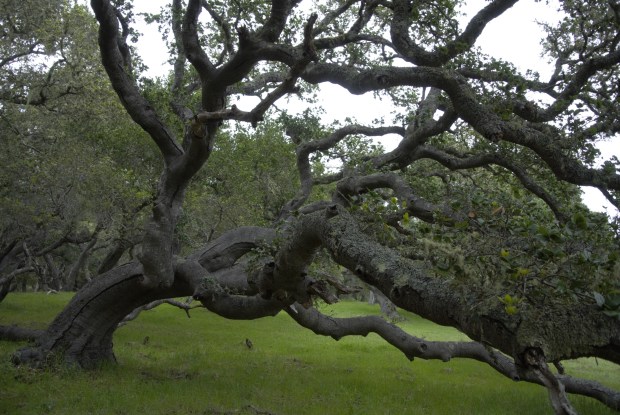
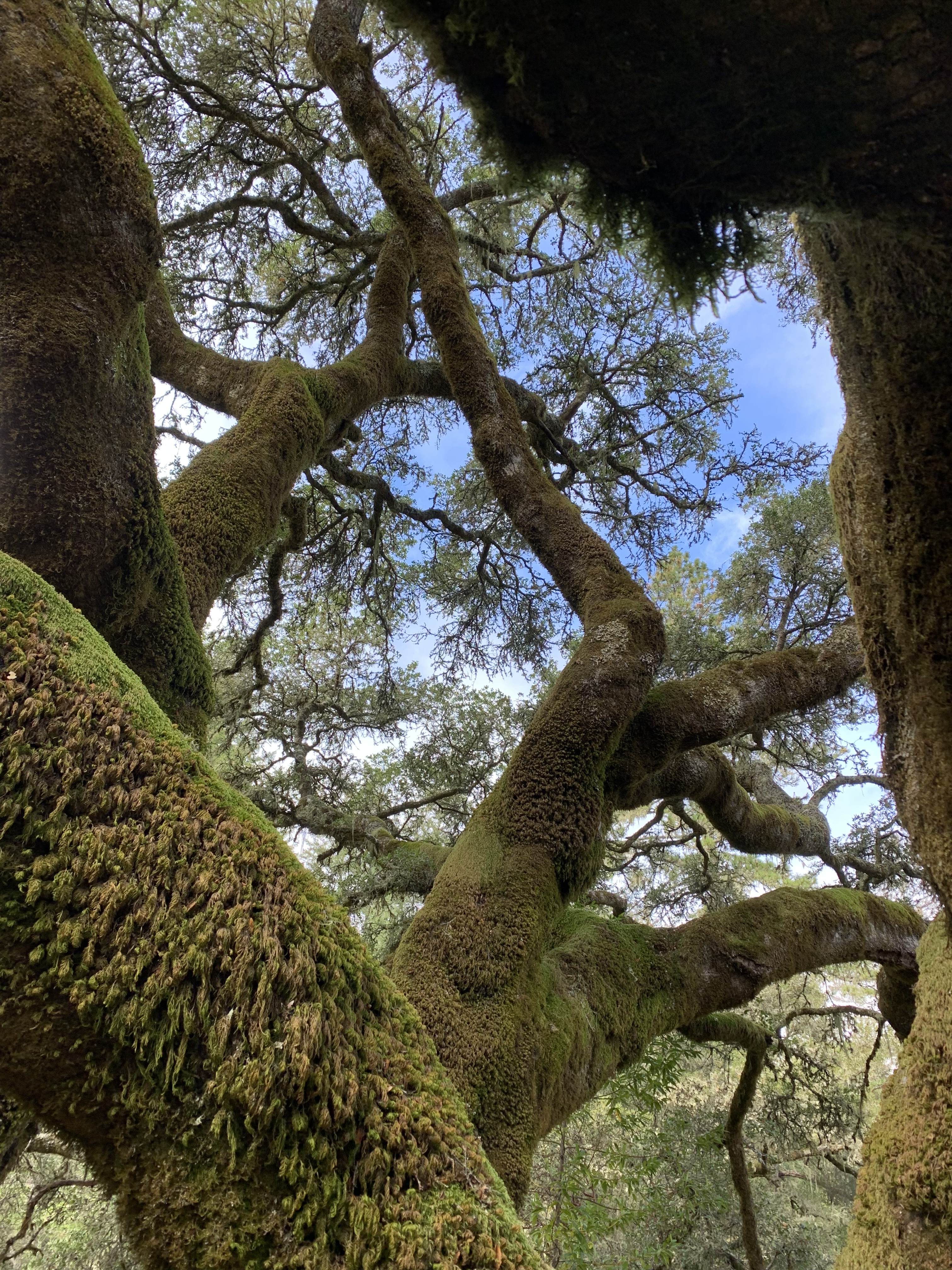
This past weekend, I had occasion to gaze for hours on end up into oak trees, reminding me of an analogy I’ve thought about where oak trees are like terrestrial coral reefs. When snorkeling around an atoll with patches of coral, I glide over vast sea grass beds, which hide flounder, conch, rays, and serve as habitat for many more species. Ahead, I see a tall, dark shadow looming and slowly coming into view is a coral patch. As I draw near, many species of colorful fish dart in and out of crevices and caves formed by the coral. Far from those tropical waters, I hike through extensive grasslands startling grasshopper and savannah sparrows, snakes, and a resting fawn. As I draw closer to the oak forest that rings the grasslands, I see new species of colorful birds and many butterflies popping out and flying back into the protection of the oak canopies.
The long-lived evergreen oaks of the central coast serve super-important roles supporting wildlife, and their canopy structure lends for spellbinding entertainment.
Our California Sister
I want to tell you about an oak-related butterfly that often catches my attention. California sister, Adelpha californica. If you spend much time around one of our live oaks right now, chances are good that you’ll see one of these strikingly beautiful butterflies. They can be very, very energetic fliers with bursts of energy followed by short glides, and lots of sudden turns. They behave more like predacious dragonflies than nectar-loving butterflies. Flying in and out of each hole in an oak canopy, they sometimes dart down the top of each branch, methodically seeming to examine every bit of structure. Why?
I have many hypotheses about this high energy ‘patrolling’ of oaks by California sister butterflies. Are they guarding their eggs or larval babies? It takes more than 60 days for an egg to reach its adult stage, growing from tiny to larger caterpillars along the way. During the caterpillar stage, they are vulnerable to predation or harassment by many things, though apparently neither the young or the adult butterflies are tasty due to concentration of toxic oak-leaf compounds. So, perhaps they are looking for just the right place, and just the right time, to glue one of their eggs to the oak. Back and forth the colorful butterflies go, flitting in and out of shade, deeper into the canopy or out from it in the full sun. Maybe they are thermoregulating through this behavior. I also wonder if they might not be clearing spider webs from their territory, to make it safer for their young to learn to fly after they emerge from chrysalis with their tender young wings and clumsy first flights.
Do the California sister butterflies fly around the trees where they grew up, or do they move around more? Are there generation after generation of the same families in the same trees? Do they guard the flower patches near their trees, to maximize their access to nectar? So many questions…
Other Oak Denizens
While watching the California sister antics, I saw a bright yellow swallowtail butterfly cruise rapidly by. Was it a coincidence that it didn’t slow down or was it wary of the danger of trespassing into California sister territory?
In the heat of the day, a high buzzing noise fills the air around the oak groves; during the morning and evening, there are clicks. Both of those sounds are cicadas. The buzzing noise are male adult cicadas. In the soil beneath the oak leaf duff, unwinged young cicadas are sucking on roots for a living. One day, they emerge as winged adults, shedding a hideous exoskeleton that you can sometimes find laying around. Female cicadas lay eggs in holes they cut into an oak tree’s pencil-thin twig bark.
Occasionally, some say especially at the onset of droughts, oak moths flitter around the canopies of oaks by the hundreds. They look like large, animated confetti. Their larvae drop so much poop in those episodic years that it sounds like it’s raining. They don’t kill the oaks, generally- perhaps they help defoliate the trees to keep them from using too much water…or perhaps they help cycle nutrients with all of their rich poop.
Still More Oak Friends
More than once, I saw dragonflies perching on the outermost tips of oak branches. So many bugs jet in and out of the oak canopy that there are plenty of chances for those dragonflies to grab one up and make a meal of it.
I recently encountered an oak tree that buzzed. Looking into the canopy, I noticed that yellow jacket wasps were animating the entire tree with buzzing movement. The wasps were eating an outbreak of oak pests, or just lapping up sweet insect exudates, from scale or aphids, I couldn’t tell – they were too high up.
Some of the oak associate insects make odd looking structures called “galls.” There are lots of different things that do that, and that previous link is a great place to explore the amazing variation of species. I add a photo of one I found this past weekend here, next to a canyon live oak acorn cup.
Birds in the Mix
Oak trees also provide for many birds. Acorns are important food to California scrub jays, which have been shown to store 7,000 acorns in the soil and subsequently forgetting about some that germinate and grow. Acorn woodpeckers store their acorns in holes in tree trunks. Lots of other birds eat acorns.
The most colorful oak bird is the Townsend’s warbler, which (unlike many other of its warbler relatives) overwinters along the coast in California. It is a real treat to see this yellow-streaked bird darting around an oak canopy in the otherwise drab winter.
As oaks get older, they drop limbs, leaving behind cavities that provide nesting locations for other colorful birds, such as the Western blue bird. Such nesting cavities are a limiting factor for the survival of many bird species.

Help the Oaks
Besides the many species of life that oaks support, oak trees make great shade, are drought tolerant, and grow nice firewood. The entertainment value of having an oak close to your home is well worth it. You can grow an oak tree almost no matter what kind of soil you have near your house. So, why not plant one? Or not…if you are lucky enough to live near oak trees, you can bet that a scrub jay will plant one for you and all you need do is help the sprouted young plant along.
If you pick a nursery oak tree, make sure that it is less than a year old and that the roots aren’t swirling around inside the pot: messed up roots are terribly detrimental. If one of those early roots goes around in a circle inside the pot, the mature root will follow its path, a disadvantage to long-term tree health.
You’ll want to water a new oak regularly through the first summer, but not thereafter. Try to avoid summer water if at all possible past the first year.
Oaks grow faster than you think! Get ready to plant one this fall by scoping out the right spot…
-this post originally published by Bruce Bratton at BrattonOnline.com
 Grey Hayes