ground squirrel

The Slowness of Extreme Heat

Happy Interdependence Day! I’m happy not to live under the tyranny of a monarchy AND I’m glad to be part of a community that recognizes the centrality of interdependence. The Molino Creek Farm Community relies on one another, exercising our various strengths to foster healthy farm life at its center. We include teachers, woodcrafters, a midwife, farmers, orchard tenders, bookkeepers and administrators, activists, road technicians, and natural lands managers. Many others join, from near and far. Together, we make this land sing: it depends on us, we depend on it, and everyone depends on each other. Nearly 4 years after the last wildfire, we feel that interconnectedness more than ever.
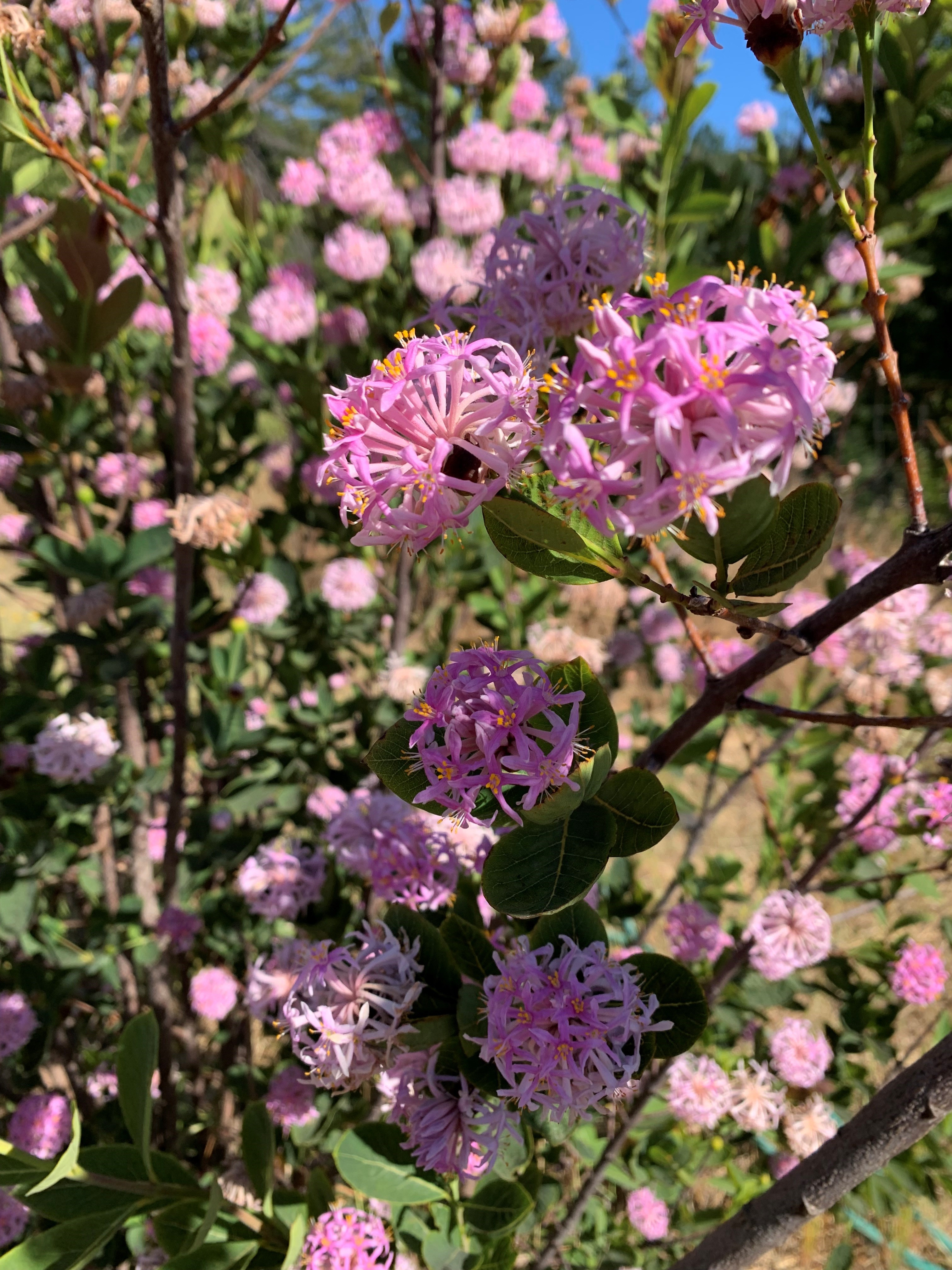
Name that shrub: one of our many hedgerow plants

Evening Scents

Each evening and early in the morning, the air is filled with the “seminal” smell of the male flowers of tanoak. It hits you strongly, suddenly: the pollen must release all at once after the evening arrives. As the sun was beginning to set, before the emanation of the heavy tanoak smell, there was a more subtle, pleasant, sweet aroma: thousands of white flowers unfurled from the field bindweed, a ground-hugging invasive morning glory- like vine of the tilled fields. There’s no detectable smell from a single bindweed flower, but en masse they sure smell pretty.

Summer Fruit

There is a pinkish blush on the first dry farmed tomatoes, but other fruits are riper. The 2 trees are young yet, but the first aprium crop is coming on: it looks like we might get 20 pounds to share among our community orchardists. They are delicious and almost make up for the lack of real apricots, which we can’t seem to produce in our cool coastal clime. The star of the show is cherries, but again too few to get to market: we anticipate 300 pounds of fat, dark red sweet cherries from the 18 trees that the fire spared. The 25 other recovering cherry trees in that block, grafted onto resprouting rootstock, will make their first sizeable harvest next year…starting in 2026, we’ll be back to ‘normal’ with 3,000 pounds plus of annual production if the stars align.

Next up this season…plums and prunes! The apples are silver dollar sized, at least, and growing. And, the avocado fruit have just set – if we can keep them moist enough, we’ll have a crop starting next January.

Sweat Investment

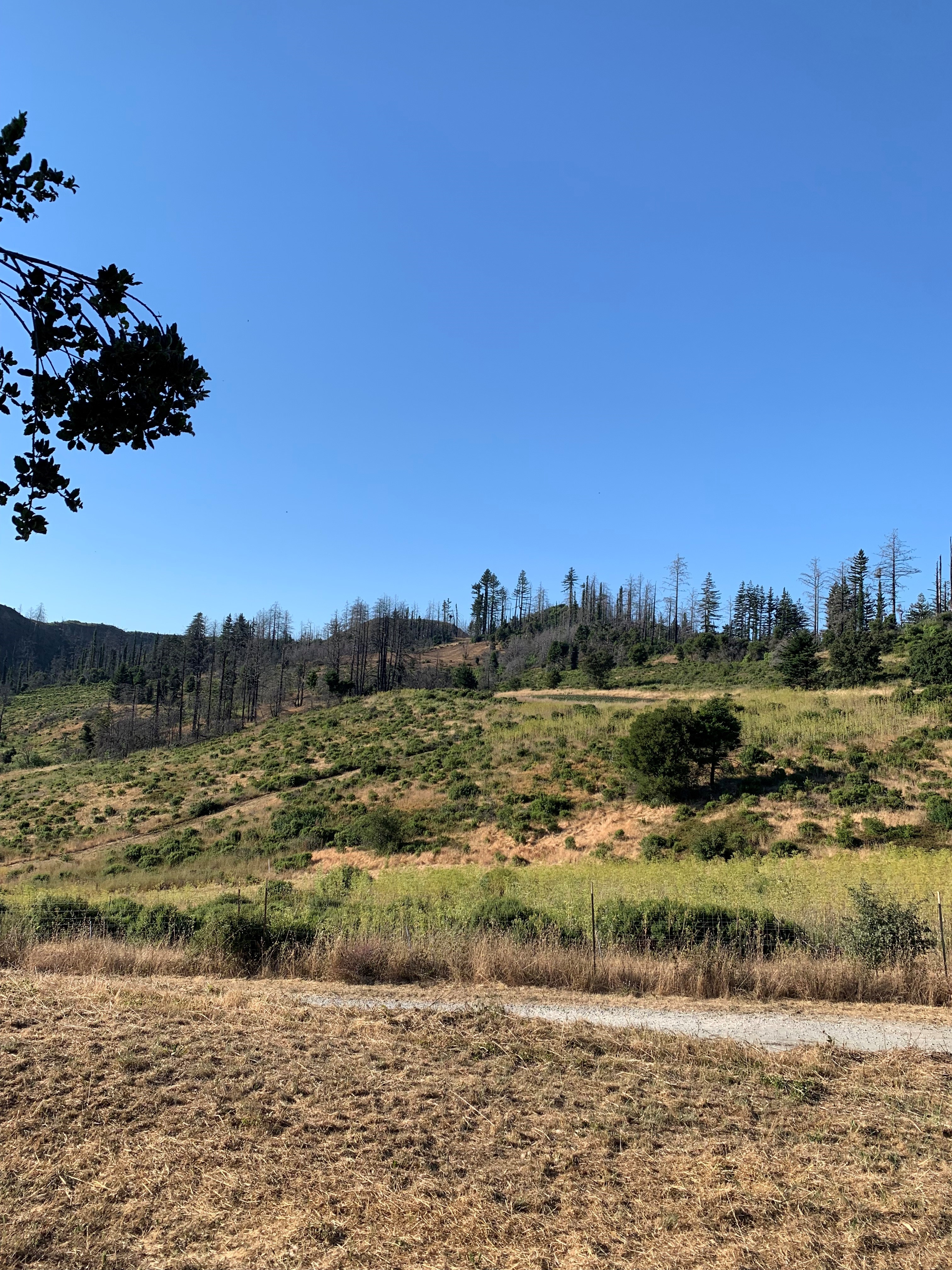
Even the mornings are hot as we greet the dawn ready for chores. First up: fuels reduction! Clipping, raking, and hauling the dry vegetation away from the buildings, water tanks, solar arrays, and pipes. Piles grow in the fields far away from danger…5 months from now and we’ll set them ablaze in the mist and drizzle. Today’s fuel will be tomorrow’s shrub-eradicating fire, each pile moved on top of a plant we want to eradicate.

The roar of mowers, whine of weedeaters, and buzz of saws soon obliterate the extended dawn bird chorus. When our own machinery isn’t running, we can still hear the neighbors working downhill towards us, maintaining the regional shaded fuel break along Warrennella Road. This past week we thank Brion Burrell for his artistic machinery management to reduce acres of French broom and other fire dangers to nothing, making the land around us healthier and more resilient.
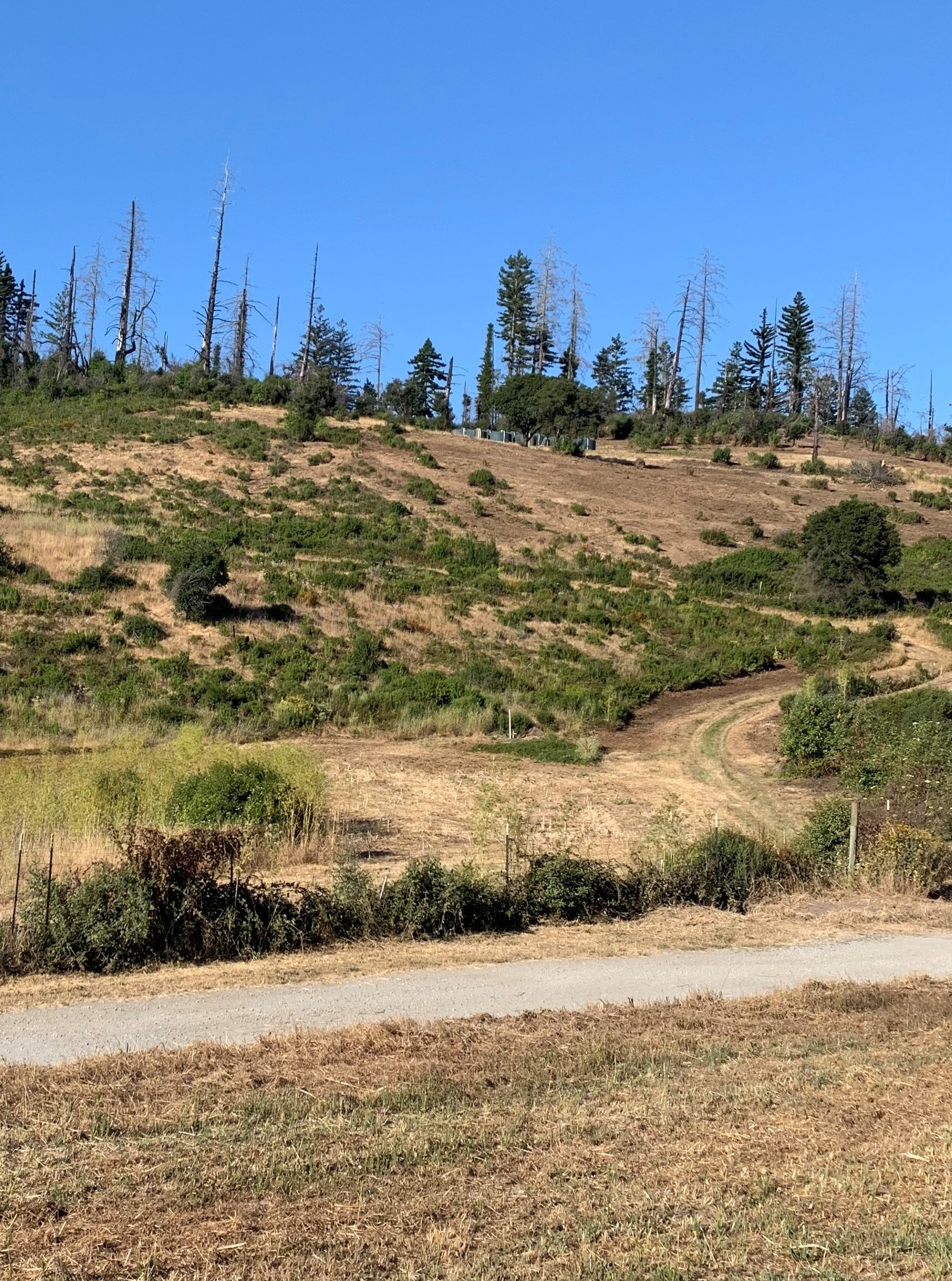
Neighbors and Farm partnered in clearing French Broom and fuels away from water tanks
San Vicente Redwoods cleared an ancient meadow of post-fire French broom pulse high above the Farm

Early morning still: trucks trundle and people amble towards the irrigation controls. We reach down to turn valves, starting water flowing. Then we pace the water lines, inspecting for leaks. Earlier, ravens or mice have made holes in the plastic irrigation tubes, and out pours too much water, hissing loudly, spitting into the air, creating mud and disaster. Repair kits, a thorough soaking, and a bit of work later things return to normal and the cycle of wetting has begun on one more patch, once again. We are applying 45,000 gallons of solar pumped irrigation water from our well each week to grow orchard trees and row crops. That water makes tens of thousands of dollars of income and thousands and thousands of pounds of delicious food. And it takes lots of attention, coordination, and work to manage.

Wild Life

Those dawn treks for irrigation reveal fresh snake tracks, coyote scat, and weasel footprints. Gone are the days when you could easily see snakes, but they are still active around the farm. This past week must have been the right moon phase for reptiles to shed their skin. Fence lizards are still flakey. Shed snake skins have appeared, always trailing into gopher holes.
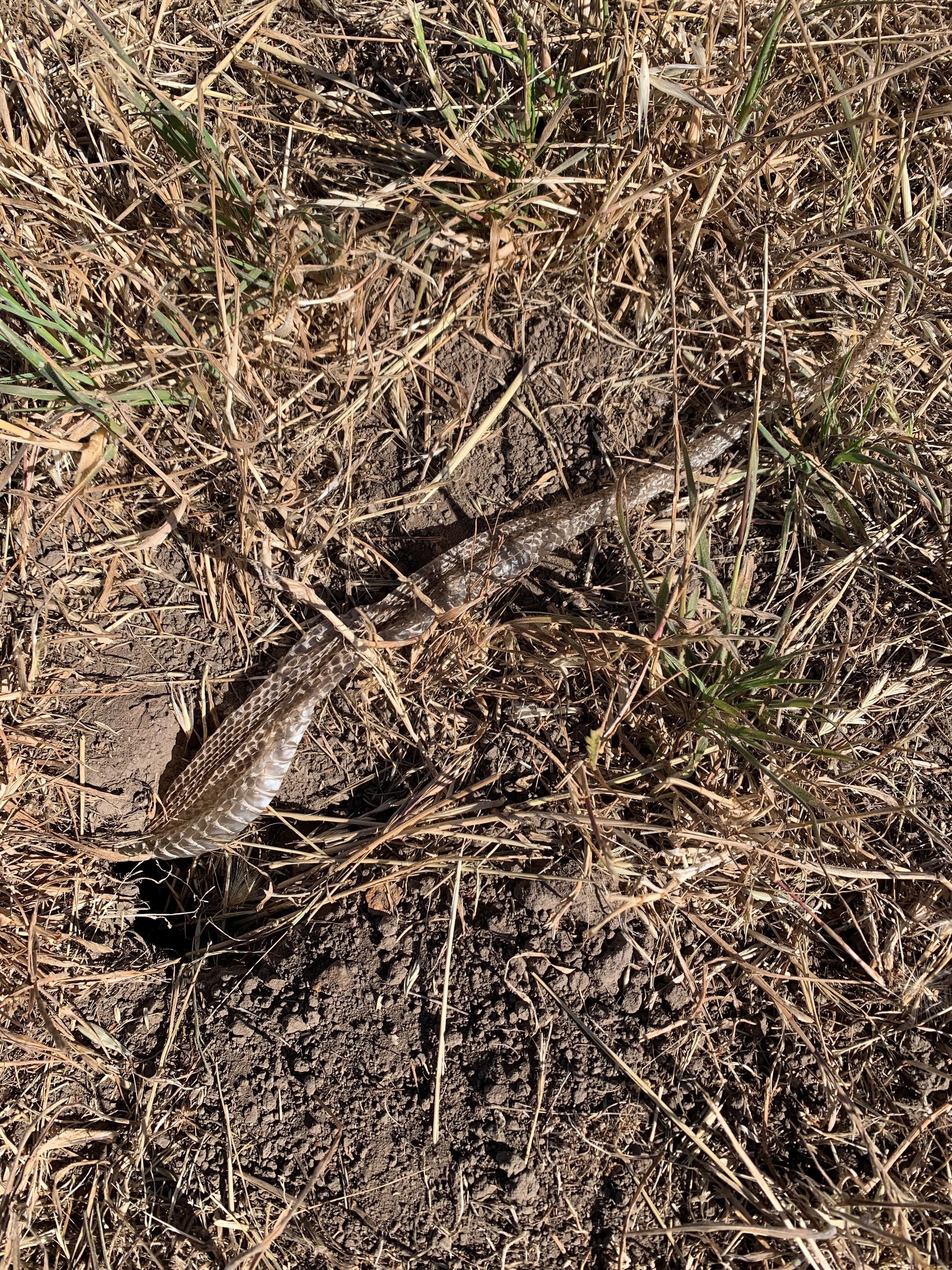
Gopher snake skin- as typical, entering gopher burrow

The regularly yipping coyotes are feasting on a big crop of juicy blackberries, as seen in their purple, seed-filled scat. Weasels are feasting on mice, and we hope they soon eat the surprising, sudden appearance of ground squirrels.

Very late but they finally appeared: dozens of California quail fluffies. The quail babies peep like easter chicks as they tumble and run along dusty trail and road, proud parents standing guard. The first younglings can fly, but most are still too young. A mother turkey is also shepherding a second round of just 3 much larger, still flightless and fluffy babies. High on the ridge, the purple martin chicks are in the air, noisy moist-sounding deep chirp-whistles give them away. They’ve done well this year. Maw and Caw greeted a third raven…a child from the past?…this morning – sometimes that one sticks around a few weeks, we’ll see.

Noise From Below

With the heat and extreme dry, we hope that no one sets the world on fire with fireworks at the beach tonight. The week leading up to this evening has been sporadic with preparatory explosions. The King Tides have made the beaches narrower, and the signs and Sheriff shoo people away, but still we wait with trepidation. May all we hear is the continued crash of the large ocean waves, lulling us to sleep with all of the windows open on these warm summer nights.
An Unusual Dreariness of Spring

Drizzle and fog surprised us this past week as dew-covered wildflowers blossomed, buried in tall soggy grass. The weather forecasters had said it would be sunny, but something changed and suddenly the outlook went to partly, and then mostly, cloudy. Gusts blew tiny misty droplets against the windows. Trees caught the mist, making showers in rings, illustrating ‘driplines’ on the previously dusty roads.

Drying

But the mist and drizzle were not enough. The soil is drying. The 2 inches of late rain two weeks ago can no longer forestall the normal drying of our Mediterranean summer. A day of stiff, dry winds from the north wicked away the moister 2” down into the soil and the drying keeps reaching deeper. The long days keep the plant transpiration pumps pumping. The prairies won’t be green much longer. The orchard trees need water starting now.

Eye Hurtingly Beautiful

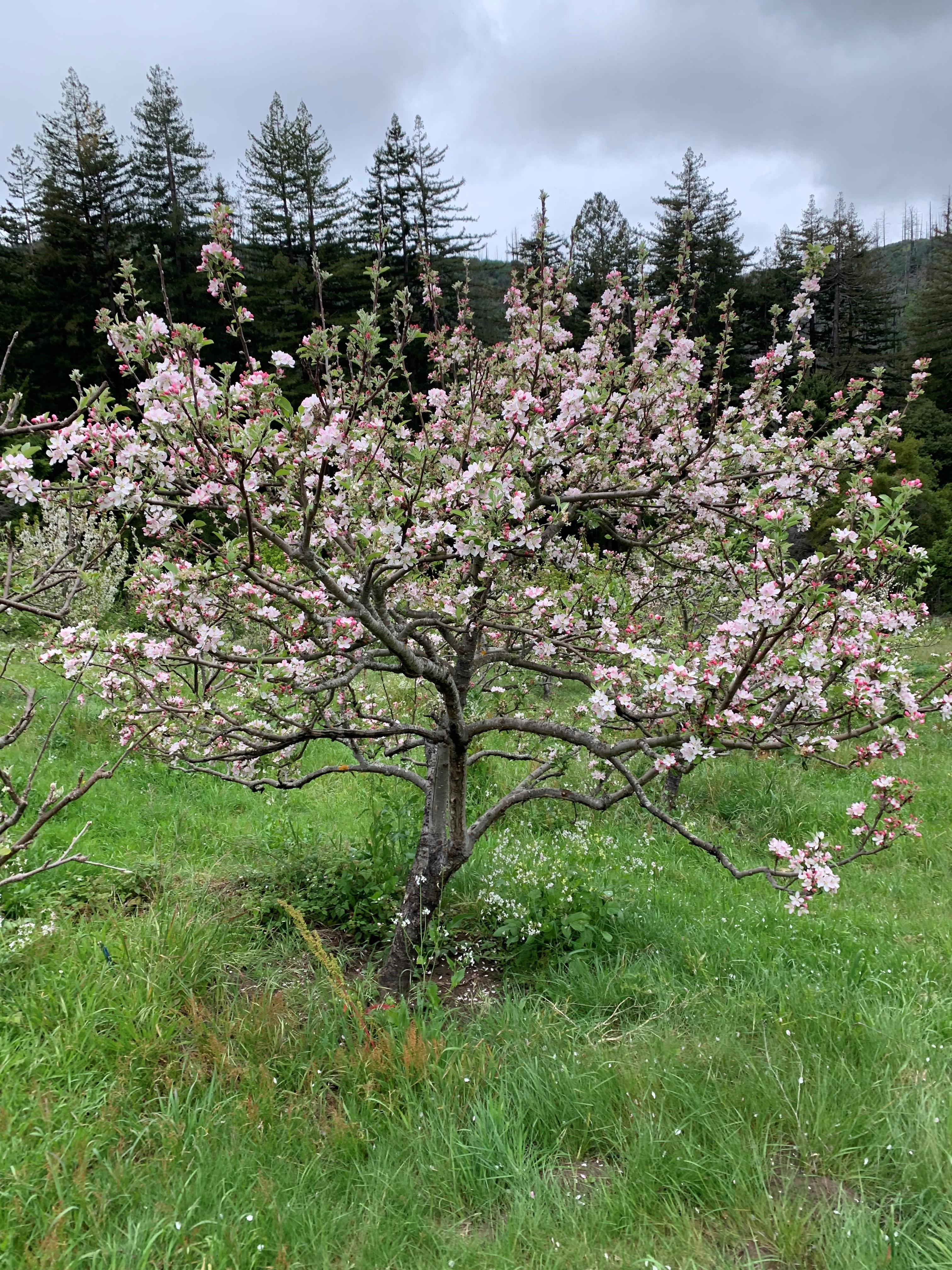
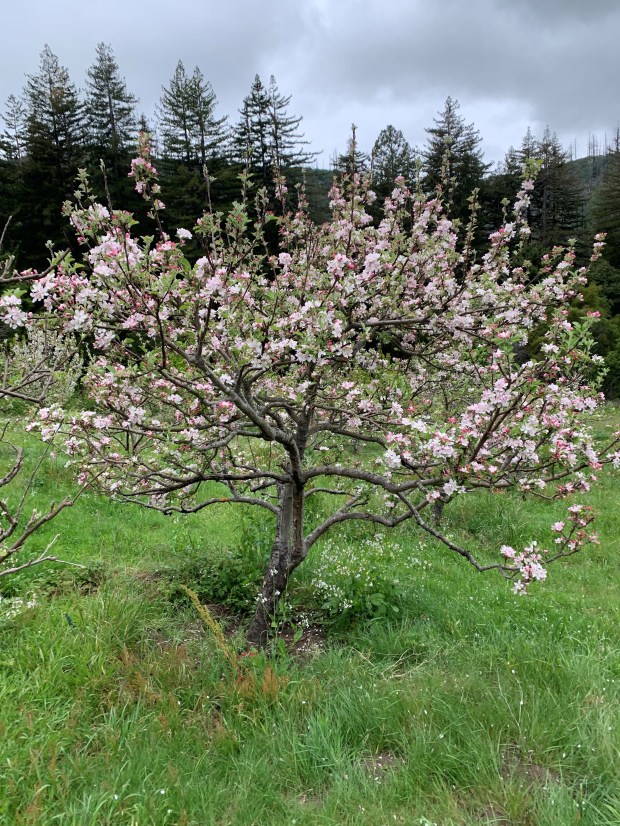
The flowers bursting forth in the apple orchard are stunning. Artists! Ganderers! It is time to bask in the dizziness that only a grove full of apple blossoms can impart. Sauntering around the farm, I take what I expect will be the normal short tangential turn into the apple orchard. Soon, I am stumbling around, not paying enough attention to footing, going from tree to tree, from one palette of pink and white and red blossoms to another, slightly more white or slightly more pink…some petals more lush, some clusters more diffuse…some flowers displayed in widely spaced massive shelf platforms…others arranged in small, tightly spaced clusters of polka-dot-like puffs for long distances along branches. Petals falling like snow on the breeze. Pale green points of new leaves poke forth from buds. Lush grass and flowers in understory tufts. Bees, hummingbirds, and flocks of tiny peeping juncos dart and dance with the beauty. An hour later, driven out by the dwindling daylight, I emerge from the orchard bedazzled and grinning from the ‘short tangent’ of my evening walk.

Soil Fields

In stark contrast to the orchard full of life are acres of brown, tilled ground. Life there is under the surface among clod and crumb where worms and millipedes and a million tinier things wriggle and crawl. It is cool and damp below the plowed surface where no plant now grows. We conserve a winter of rain by making the top foot of soil into mulch, and it takes a lot of turns of the tractor to make that happen. And so we set the stage where the drama of dry farming tomatoes is starting to take place.

First Tomato Day

The greenhouse grown tomato seedlings are tall and lanky and so take delicate hands to carefully place them in holes dug deep through the loose, tractor worked ground. The first seedlings went in the ground today, April 24, 2024! There are so many more plants to nestle into their homes. The big empty fields fill slowly, thousands of deep knee bends, hours of meditative labor, months before getting any income from this year’s crop. Such is the gamble and the hope.

Our First Ground Squirrel

Ground squirrels have been spreading across the landscape. They probably were here before and probably were effectively poisoned out when poisoning the landscape was in vogue. A single ground squirrel bounds across the road into various hiding places down by the big walnut tree many times a day, seen by many people. This squirrel is a keystone species for our prairies, making deep burrows that are critical for other creatures to make it through the hot, dry summer, and through fires, too. Burrowing owls need those holes for nests. Golden eagles’ and badgers’ favorite food is ground squirrels. Ground squirrel burrow complexes also may assist with groundwater recharge. The squirrels make habitat for wildflowers as they graze down invasive grasses. Bubonic plague is ubiquitous in ground squirrel populations, too! And, they undermine houses and roads with those burrows. Farmers and ranchers think of ground squirrels as pests for eating their crops. What are we to do with this first explorer of an astronaut squirrel?

The Individuality of Trees

Just as every apple tree has character, the live oaks too show individuality. We are fortunate to have several groves of live oaks on the farm that survived the 2020 wildfire. One grove thrived because we had mowed around it and then were vigilant with wetting them with fire hoses when the fire raged – it was too close to the barn and other buildings to allow it to burn. The various trees of this grove are displaying the range of traits typical of coast live oaks. New leaves are flushing: these ‘evergreen’ oaks nevertheless mostly replace last year’s leaves around now. The fresh leaves are emerging at different times and in different shades of green, depending on the individual tree. Some are already in bloom, long pollen bearing tassels waving in the wind. Other trees haven’t shown any blossoms yet at all. The lush new growth is forming densely green, bushy canopies, These deep-rooted trees will continue to be that kind of vibrantly alive for a few more months…long after the grass has dried brown.

Lupines!

Each year, as a result of our careful stewardship, we get more and more sky lupines. This year is the biggest year yet. Patches of sky lupines are mostly mixed with California poppies. There is something so very right about the mix of wide-petaled, fiery orange poppy flowers mixed with lines and waves of spikes of whorled blue-and-white lupine flowers. It hasn’t yet been warm and still long enough to get the grape bubble gum scent clouds emanating from the lupine patches. Between these fields of wildflowers and the orchards full of blossoming trees, the bees have lots of choices. We are glad they are getting enough food to grow big families on our farm, a haven for pollinators.