flowers

Annual Penultimate Post for Molino Creek Farm

-I post nearly weekly from Valentine’s Day until Thanksgiving a blog about Molino Creek Farm. So, this is the second to last post for 2026.

Rain. Every vignette, each part of the farm…the entire region…is being wetted. This rain drives the moisture deeper into summer-dried soil awakening new life for the winter season.

Forest Drops

The rain is captured and concentrated in the high boughs of redwoods and firs. Drizzle coalesces into big drops plummeting, sometimes making sharp smacks against limbs, shattering. Mostly, though, the raindrops are muffled quietly diffusing into deep, fluffy needle duff. Giant bananaslugs scoonch across trunks leaving silvery slime trails. 

Scrub Soak

Resinous coyote bushes slump, covered with white fresh seed fluff made heavy with water. The bushes densely glisten even under cloud-capped sky. Exploring newly emerging liverworts or mushrooms, you dare not squeeze between those hulking shapes: brushing up against one instantly soaks. Edges of shrubby patches will have to do for the liverwort expeditions. Alarm squeaks resound: families of golden crowned sparrows flush deeper into cover.  They are the cryptogam farmers.

Flushing Grasses

Gopher mounds bristle like alarmed hedgehogs. Although dense, the single first leaves of 2” tall grass seedling spikes haven’t covered the moist, deep brown soil. Ferny blue-green rosettes of California poppy catch droplets that magnify and distort their otherwise tidy appearance. The arched dense cover of perennial grass blades dance and bob in heavy downpours.

Tilled Mud

Furrows of loose soil, freshly plowed or harrowed flatten gradually as they saturate. Mud puddles form in tire tracks. Liquified dirt flows in rivulets, down rodent holes, backing up against obstacles, painting one color what had been complex hues of soil surface-chopped plant residue. In between showers, these tilled areas waft thick and sweet soil scent.

Puddled Roads and Trails

Cows lower their massive noses to road puddles – convenient drinking areas far from the trough. Birds delight in the ubiquitous baths, wings splashing, heads scooping, beaks open sucking up sweet fresh rainfall. Every trail and road is dotted with puddles.

End of the Season

The last Palo Alto Farmer’s Market of the season for Molino Creek Farm this Saturday. Bodhi powered the tractor across the fields, discing and planting cover crop into the night Tuesday. Orchard cover cropping progressed with whatever hours I could spare, however many hours my body could muster – alas, only half done before this week’s rainstorm! Imagining the swelling of bell bean seeds, licked by snails, prodded by earthworms in the freshly turned soil.

Strong dark wax boxes of winter squash are stacked high and curing just inside the south-facing doorway of the Two Dog Farm greenhouse. 

Farmers wend their way slowly one more time down the rows of tomatoes, happily surprised to be harvesting tomatoes this close to Thanksgiving.

Heavy shoulder bags of apples filled on the steep orchard hillside and hoisted onto the sorting table. Fuji and Braeburn are the last varieties this year to go to market. Sweet and juicy but each having their own very unique flavor, vastly different. We will too soon miss the crunch of that wonderful fruit. A reminder to relish the appreciation of what you have before its gone. I take extra-long to finish a fresh-picked apple nowadays, making sure to chew and taste while gazing at the skin and flesh…the juice…the release of complex aroma upon each crisp bite.
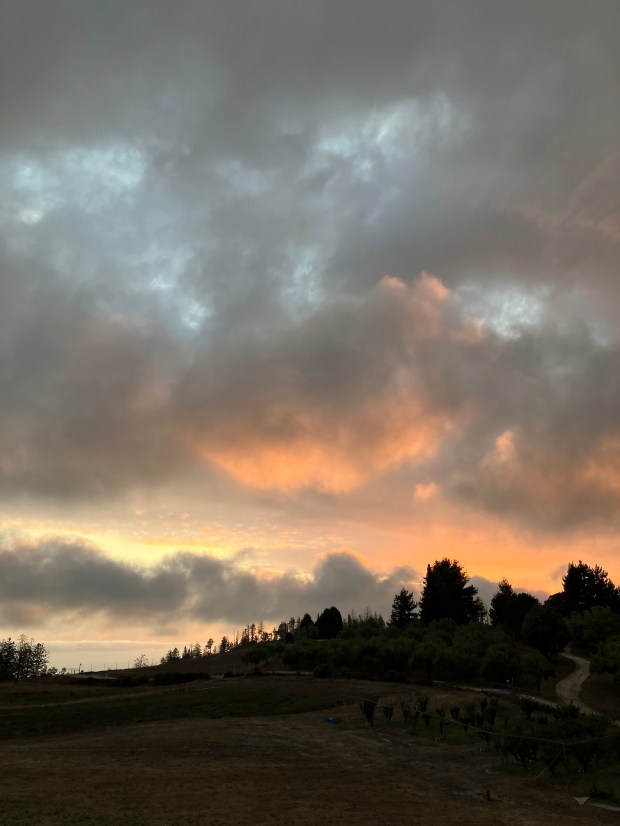
Sunset with poofy clouds over a tree-lined ridge

Behold! The Tomato!!

Behold, the peak of ripe, sweet, delicious dry-farmed tomatoes. The best in the world at the peak of the season, which will wind down soon. Lots of people are canning, drying…putting up food as the harvest rolls in, a bounty beyond any other season. Jays and acorn woodpeckers, too, rushing about, storing food like so many others.

A Ripe Molino Creek Farm Tomato: YUM!

Harvest

Tomato farmers can barely keep up, and people are buying. There are three particular crunches in the season: planting, weeding, and harvest. Each has its particularly critical moment interspersed not so much with ‘what do we do’ but more ‘how many people are necessary’ to do the work. The crunch times require more people than the weeks between, making it difficult for labor management and economics for small farms. 

Soon, the Community Orchard will face that final crunch. It seems to be a year like the last one when all varieties get ripe simultaneously. Gala apples are suddenly all ripe at once and the Braeburn and Jonagolds aren’t far behind. Luckily, the Fujis are going to wait a bit…and they are the biggest crop this year. It is a scratch year for the Mutsu variety for some reason. There are ten other varieties with one tree each that will get ripe in about 2 weeks. So, we’ll start preparing for a cider pressing gathering to process 1,000 pounds of apples in 2-3 weeks.

Two Dog Farm’s pepper field is lush and green with abundant fattening fruit. Their winter squash patch is still luxuriant and green with hundreds of butternut squash peeking through the leaves. Their Chardonnay grapes are getting honey-green and close to ripe…all ~2,000 pounds.

Wild Life

Baby owl begging, distant coyotes singing, a mountain lion caterwauling, masses of quail, a morning garter snake, bright-eyed deer herds, and many, many ground squirrels. 

Every now and then one of the baby birds strikes up a unique racket; this time, it is a baby great horned owl…begging. The begging goes all night long and it is loud and obnoxious. I suppose if you are the Queen of the Sky, you can make that kind of racket and not fear getting eaten. With no other baby around to mimic, a single young owl can pick whatever obnoxious voice to really bother its parents. This one ended up being half way to a barn owl screech, but louder. Mom and Dad owl hardly bother to hoot as the baby steals the show. You’d think it would get hoarse.

Sylvie reports a mountain lion caterwaul – that’s new since before the 2020 fire! Celebrations!!! Welcome back lion momma. 

There are streams and rivers of quail pouring out of the brush to peck-peck-peck at masses of seeds strewn everywhere on the ground. They are fat with glossy plumage. It has been a good quail year.

Open the front door first thing and there’s a 2.5 foot long garter snake on the stoop. What luck. First snake in a long while. The other moist morning or late evening snake to see is the (common here) rubber boa…haven’t seen that one for a month.

There are a record number of deer hanging out on the farm. Deer highways pound grass flat and expose soil along hoof-rutted trails. Piles of fertile deer poop litter the ground every few feet on the north-facing grassy slopes where they graze on a mix of grass and resprouting shrubs. At night, flashlight beams illuminate more than a dozen pairs of eyes on that slope. Walking down the road to turn off evening irrigation sessions, my heart races to be too near to huge antlered bucks;  hoping not to antagonize one: they seem feisty.

A  flock of 60 blackbirds has gathered on the farm, a mix of Brewer’s and bicolored, singing their complex anarchistic melodies from atop bare-branched fire killed trees and then flying like wind-scattered fall leaves down into the fallow fields to feast on seeds. Their song lights up every hour of every day, a chorus that will entertain us through the winter. Their rhythm section has squeaky peeps that nearly match the repetitive, constant, mechanical ‘Chip! of ground squirrels scattered far across the Farm- between the two species it approaches cacophony.

A skein of 50 honking, white-fronted geese in a huge V flew West to East high above the Farm at 4:30 this evening.

Bills Open: Nuts!

Jay cries are muffled, acorn caps scattered. It is peak acorn season and the jays hardly have time to taunt. Their heads are down, shoulders hunched, beaks pried open carrying fat ripe green shiny acorns to-and-fro. Don’t watch them when they try to bury the nuts – they’ll get mad, pick back up the nut and fly to somewhere where you aren’t watching. They suspiciously glance about, quickly poking each nut into a hole, making a quick swipe to cover it up and it’s onto another one. Back-and-forth over and over: busy days! We are pleased that they are distracted from eating apples, leaving the fruit destruction mostly to yellow jacket wasps now.

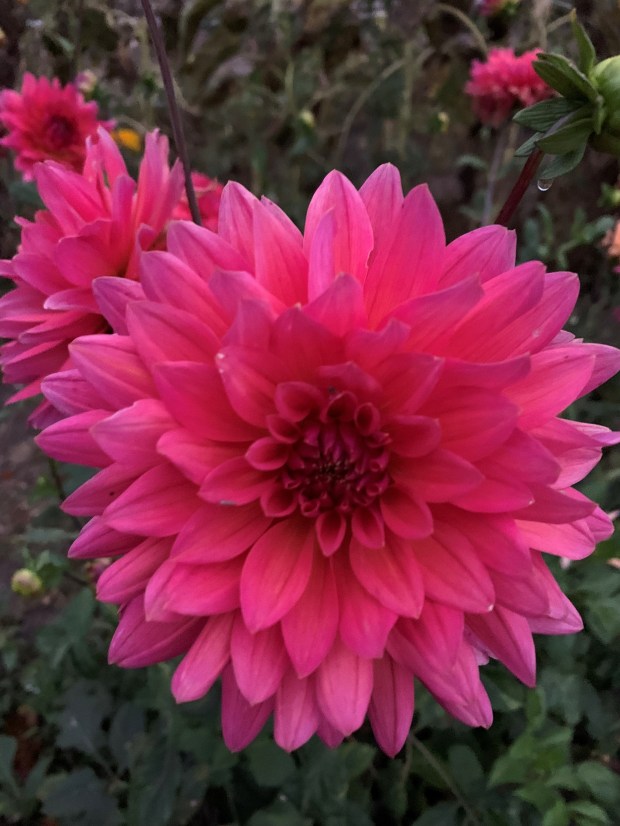
Dahlias are a long-time specialty of Judy Low

Land Tending

Our great gratitude to one generous guy- Matthew Todd has finished his mastication work for us this year: 4 acres of brush ground to small pieces! We needed to do something about the weeds and he offered to help for a great big discount that made it possible. He resonates with our mission to keep our hillsides wild and native and tending back to coastal prairie and so he wanted to help. His wonderful skill and powerful machine took care of jubata grass, radiata pine, and French broom, which had proliferated after the 2020 fire. Now we have a better chance of tackling those scourges with other tools – excavators, pulaskis, burn piles, and broadcast burns will join a several year mastication project to reduce the broom until we can get livestock to help manage the restoration areas. Thanks, Matthew!

We’ll collect a bunch of grass and wildflower seed this next spring to hurry the restoration along.

Hoping CalFire will be able to help this Fall with another prescribed burn.

Longer evenings make for less work time.

Enjoy the lengthening nights!

Welcome Fall

We woke on the Equinox, September 22, to the song of night’s arrival – golden crowned sparrows. Somehow, they know the right day and arrive the same moment each year, ending their long travel south from Alaska. With the changing world, it seems odd that some things remain constant. These pesky birds promise hours of entertainment as their pecking order is as animated as chickens and they are far more numerous. Their aggression is correlated by the brightness of gold on their heads, but they still love each other: they have tight-knit family groups and larger tribes and they are settling into the same cluster of shrubs they called home last winter. They must be pleased to have so many seeds: last winter’s bounteous precipitation made the seeds rain more than even the huge coveys of quail can keep up with. When it rains, there will still be millions of seeds to germinate and the sparrows will start grazing the lush turf.

More Typicality

Just as last year, the winter battles summer this time of year. Some of us celebrated one more Warm Night: unusual in these parts. The warm night was sandwiched between two pretty hot days and then the Fog returned: moisture rolling off rooves at sunrise, dripping from leaf tips, coloring the dust on the road beneath wetted trees. The see-sawing of temperatures was the cue the apples needed to get that much closer to ripe, but the bouts of fog enshrouded days make it difficult to keep up with the watering…solar pumps don’t produce much when there’s too few photons. It would be better to water the orchard before it gets really hot, but the hot has recently been when the sun comes out. Dynamism and daily adaption is the way of the farmer. The question now…will it be truly typical and rain an inch, our first ‘big storm’ in the middle of October? Whoah! That’s just two weeks away!!

Dry farmed tomatoes- yum!

Fields of Tomatoes

The bouts of heat and the progression of the season coalesced to create a grand glut of tomatoes. In this house, we’ve processed a hundred pounds into jars and jars of sauce to brighten the meals in seasons far from summer. Another household dried 200 pounds. The smell of tomato fruit hangs in the air on still warm evenings. The warmth and dust-loving russet mites have ravaged many plants, leaves withered and crispy: they’re time is up, but there are many more healthy plants in some patches, especially in the ‘diagonal field’ with deeper soil, upwind of the road dust. That’s where the future lies…we need tomato production through Thanksgiving for a truly prosperous year.

One of Judy’s wonderful dahlias

Flowers

This is truly the driest time of year as we’ve had no rain since April. The hillsides are crispy dry and most shrubs, flowers, and grasses are dormant. The exception is the unbelievably bright green pine-scented coyote bush…just starting to flower. Want to tell the girl from the boy coyote (bushes)? Now’s the time. I mark the coyote bush female plants and eradicate them preferentially- they are the existential threat to us folks who like to keep grasslands, grasslands and let the wildflowers have the wide open space. For now, the coyote bush is keeping the pollinator community well fed. Butterflies flock, flies buzz, and wasps hop from cluster to cluster of the pollen and nectar rich flowerheads.

In the irrigated garden, it is Dahlia time! Big poofy, luscious flowers of the most unbelievable colors pop and spangle in a scant row among cucumber, beans, and squash. Sunflowers are still going, cut for each of the 3 farmer’s markets we are going to nowadays (Aptos/Cabrillo-Saturday, Downtown Santa Cruz-Wednesday, and Palo Alto-Saturday).

It makes nice fall color, even if poison oak is terrible to some

Fall Color

The walnuts and garden birches have only the slightest tinge of the beginnings of yellow. Same with the maples in the wild canyons. At the edge of the forests and on steep hillsides, poison oak is further along with its remarkable streaked purple-reds. Rumor has it that the aspen leaves are turning in Eastern California where ‘leaf peepers’ are drawn to fall glory.

More Return of the Birds

Besides the golden crowned sparrows, other birds have returned from afar for their winter haunts. Cassandra and I have both seen an unusual feathered friend: Western meadowlarks visiting the Farm! Their bright yellow, black-spotted bib and dangerously long stout bills give them away. I guess our grasslands have reclaimed enough shrub ground to look like viable meadowlark habitat – that’s new!

Another bird sighting – an osprey! Around 2012 this time of year, two ospreys would fly over the farm each evening at dusk, west to east. One is flying now. Someone says that they saw it carrying a fish…a little late for fledglings, don’t you think? Still, this is an odd thing and someday someone’s going to have to follow that sea hawk and see where its going.

The beginnings of our haystacks

Hey Rick, hay rick!

Last weekend at our work party, Jen, Mike, and Roland rolled up the hay near Cherry Hill. Tons of the dry grassy stuff is cut, getting raked, and being placed in our rudimentary hay ricks. If we had pines nearby, we could put some needles in our haystacks, but as it is they are full of weeds. This is a new adaption from the bad idea of old…placing dry hay under perfectly innocent trees during fire season. Now, we stack the hay, let it molder, and wait until the end of fire season to swoosh it under the trees to suppress weeds, add nutrients and organic matter, and provide cozy homes for VOLES who do such a good job of ridding the orchards of gophers.

Perhaps we’ll rediscover the way of stacking the hayrick…a profession of years ago with expertise and methods long lost.

Real Pro Haystacks

Suddenly Crickets

The long days have become warm. Some people were even growly about the chill, the fog, and the drizzle that have become our most frequent visitors as this long Spring crescendo slowly approaches Summer. The complaining people were particularly happy about today, and tomorrow will even be warmer. But this cool, moist spring has spread a vibrancy rarely seen across California’s central coast. The biggest grasshopper I’ve ever seen around here plopped onto the ground in front of me today and tonight the crickets have at last begun the summer’s starlight orchestra. The warmth of the day quickly fades as the night grows dark, and cricketsong wanes, replaced by a rare silent night, peculiar to the particularly cool spring. There is no wind, no echoing waves, no trilling crickets, and only a few sporadic hoots exchanged by scattered great horned owls.

Late Morning, Fog Dispersing

Sunny, bright sunrises are rare. Mostly there is the muteness of first light, glowing through dense fog. Wet grass. Puffed up quail sitting in pairs, barely moving. Slow motion rabbits tentatively beginning their daytime nibbling. The sun brightens, the fog grows thinner, and gradually bird songs escalate, becoming more diverse, varied, louder. The first bright rays carry sudden warmth, sending birds into the sky: hawks soaring, ravens patrolling, swallows chattering, swerve. The purple martins carry such huge wads of grass to line their nest cavities that they can barely fly.

As the sun takes full charge, it evaporates the dew, and a young coyote yaps and howls first from the forest edge, out of sight. She seems dissatisfied with her vantage point and trots out into the middle of a field to yowl and bark some more, glancing furtively about after each vocal session. This sets the neighborhood dogs to barking, and our coyote friend glances over her shoulder, seemingly annoyed at her domestic cousins’ primitive and unmusical repetition. Eventually, she moves on, and the morning noises go back to being dominated by bird song. Noon approaches.

Contrast of mowed, green and unmowed, brown

Drying

At every glance, there are contrasts between drying and still wet, gold versus green. Where we passed once with a mower through a grassy field, the cut area evaporated less water and is still wetly green whereas the surrounding tall grass absorbed the soil moisture and is already drying. Five foot tall tawny grass stands or falls over, crisscrossing, heavy with seed. A million things are hidden in that meadowy mess: snakes, rodents, bugs, spiders, and bird nests present a gallery of surprises as I collect native grass seed for restoring areas of the farm. The seed must dry in paper bags to be stored until first rains, to be tossed into the footprint of prescribed fire or along the tracks of mowers.

Vetch is flowering in our fallow fields

Flowers Still

Despite the drying, it remains a very floral spring. Different types of vetch have only just entered their peak bloom. Poppies are in full display, big orange patches, rabbits eating their flowers. Monkeyflower is also in peak color, whole hillsides glowing peach-orange. Nearby, the post fire chaparral giant yellow bush poppies are blossoming, creating a peculiarly sweet, cucumber scent. That chaparral air is thick with resinous blueblossom odor accentuated sometimes by the bitter-sweet yerba santa, which is displaying clusters of lilac flowers. The forest understory is bejeweled with rosey globe lilies, bobbing and lush. The last native iris flowers are fading.

Ah, the promise of Lapins cherries for late June (nets up soon!)

Fruity Promises

The orchards are producing ripe citrus while thousands of other fruit grow marble- to golf ball-sized. We compare different types of navel oranges, contrasting them with Valencia, complimented by sweet Honey mandarins. The last of the limes are coveted. In the apple orchard, the fruit has set and is rapidly growing; it is fruit thinning time! Some of our apricot relatives are thickly laden with young fruit. The bigger patch of Lapins cherry trees will soon need netting. We peer into the canopies of avocado trees, hoping to glimpse at least some fruit set; last year was grimly non fruitful…these trees are notoriously unpredictable.

Watering

To keep the fruit fattening, we have started rounds of irrigation. That routine keeps us on our toes, especially the first cycles of water flow as the need for repairs are numerous. Inadvertent mower damage, winter rodent gnawing, or just plain mysterious breaks makes for geysers, gushers, and pouring leaks that must be detected before large tanks are drained. We seek leaks by noise more than sight. This was the first week that water flowed to most orchards as well as the 2 Dog vineyard. The irrigation will run through November, tens of thousands of gallons each week…mostly pumped silently by solar power. Irrigation efficiency has us using around half of what would be considered normal, let alone that a sizeable portion of our produce is dry farmed with no irrigation at all!

We are looking forward to the summer…and hoping not to get Too Much Heat (or fire!).

Dry, tall grass – a tangle that includes Calfifornia brome grass for restoration seed

Night shifts to dawn

At first darkness yields only very slightly and the first bird to sing is quiet, murmuring a few quizzical, uncertain, almost apologetic notes. A few minutes later, that same bird sings the same few notes, sounding a little more certain. A second bird joins a little while later, more certain still. Dark turns slowly to gray and more birds start singing. Soon, dawn rushes on, the sky lightens, and many birds start singing, no gaps between songs, many species, many notes. The cheerful Spring dawn chorus fills the chill morning air as color begins to spread across the landscape in advance of the rising sun. By the time the first rays brightly illuminate the ridges, the bird orchestra is loud across the farm and as far as you can trace sound. Each taller shrub and at the top of many trees there are tilting, perky birds, beaks outstretched, singing away.

Spring Antics

As it warms, bluebirds and black phoebes flit about, catching bugs. Barn swallows warm on perches awaiting a brighter sun before taking to the air. Towhees strut through short grass, darting at one another, chasing for fun or territoriality. As the dew dries, one of the yard bunnies hops inquisitively towards another. The wide-eyed approached one suddenly flattens itself hugging the ground, snaking forward slowly and then faster on a pathway through the low grass, ears back, while the other hops again and again over its pancaked friend: what oddness! Spring morning antics.

Big Oaks in the background, Green Fields in the foreground. Life is a Rich Green

Green

Bolting grasses dry from the tops and from the bottom. The tallest grasses turn tawny above still-green fields. The grassy understory is browning, too. A gust carries dust clouds away from the road and across the fields. Despite the drying, overall a lush green prevails. Big bushy oaks shimmer life above pulsing green fields. The morning warmth massages a sweet perfume from the grass, which changes with the drying day to the scent of dusty pollen. Middays have become quite warm, though sometimes breezy. Cheerful bird solos continue right through the day.

Birds in Air

The afternoon breeze carries soaring red-tailed hawks, loudly screaming, one following the other in broad circles, high across the sky. The ravens, too, enjoy soaring on the wind but more in long arcs from one side of the farm to the other, loudly beating their wings and furtively glancing about for something to scrounge. Something startles a flock of band tailed pigeons, and they take flight but not so high in the sky, making for one patch of trees, then suddenly veering to another. One pigeon isn’t paying attention, gets too far ahead of the others, which have turned for another destination; it panics and wheels about, making lots of strong and rapid wing beats to catch up to its family.  The standard number of pigeons is 14, but the flock was 30 for a brief bit…some apparently were just passing through. The regular flock patrols the walnut trees hoping for ripening catkins which will shortly make them fat and happy. I’m not sure what keeps them fed in the meanwhile- there doesn’t seem to be much to eat for those big birds.

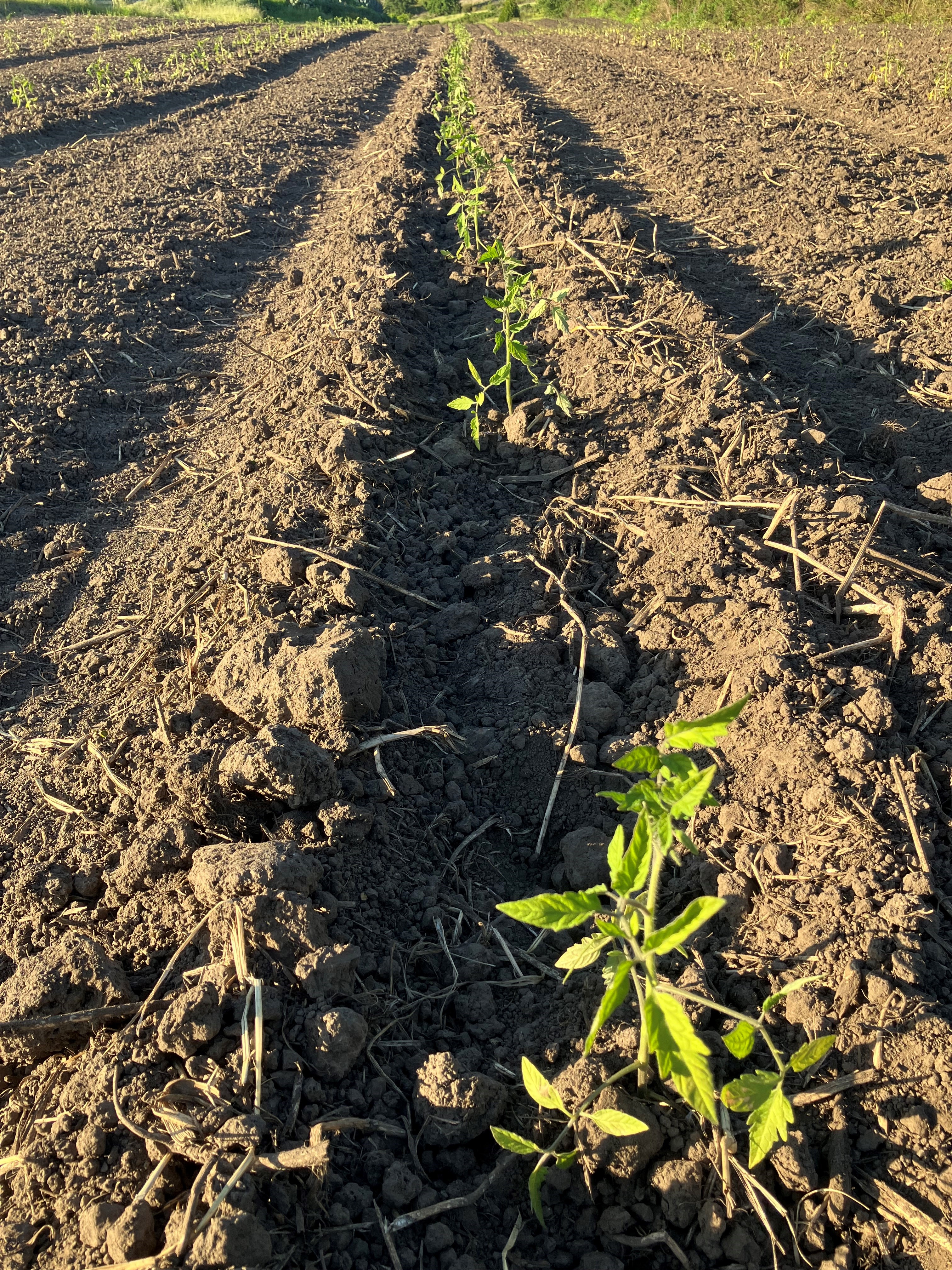
Molino Creek Farm’s Dryfarmed Tomatoes – Just planted this week

Planting

Bodhi and Judy have been planting the summer crops. Long rows of tomato seedlings are settling in nicely, in less than a week already overcoming transplant shock with perky new leaves facing skyward. Succulent leaves of freshly planted onions contrast greatly with the deep brown soil, poking up from row after freshly planted row. Green crop seedlings are hard to see in the broad swaths of brown, tilled soil, striped in rows of tractor tire tracks.

Lapins Cherry Trees – Thanks, Drake Bialecki for the grafting!

Peak Bloom

The orchards are in peak bloom. Though the cherries are just a bit past peak, on average the various varieties of other fruit trees make for the most floriferous moment in orchard bloom. With so many flowers, the trees have created a thick blanket of pink across the hillsides. The avocado spring is more subtle, but still their masses of tiny yellow-green flowers overshadow both the broad, old green leaves and the emerging spikes of purple-bronze leaflets. I was pleased to find honeybees on the avocado flower clusters today- the first time the hive has turned its attention to this essential service. Peak bloom, however it appears, is beautiful, the blossom parade a constant show of dancing pollinators one type arriving after the next. As the day progresses, the afternoon warmth waves clouds of ecstatic perfume into the aisles. Gradually, the day cools and the scent changes back to grass and mold and dew.

Two Dog Farm Chardonnay – SPRING!

Evening

The light fails and great horned owls glide silently out of the tall trees on the canyon edge, across the farm fields. They perch on fence posts and trees closer to the rodent-filled grasses and weeds. When the sun disappears behind the ridge, the evening turns quickly colder. As the setting sun finishes raking the higher hillsides with its golden glow, we retreat home for sweaters and wool hats. Chores demand further outdoor time until the light completely fails, now at almost half past eight. Burr! It turns cold with the darkness and gets chillier all night. Recently, it got down to 44F by dawn. Some fruit trees long for hundreds of chill hours, leafing out only after arriving at their total: their clocks are still gathering those hours, and the (shortening) cold nights keep them snoozing and gathering strength for their (eventual) leafy season.

Sky lupine and purple needlegrass on one of the Farm’s ridges
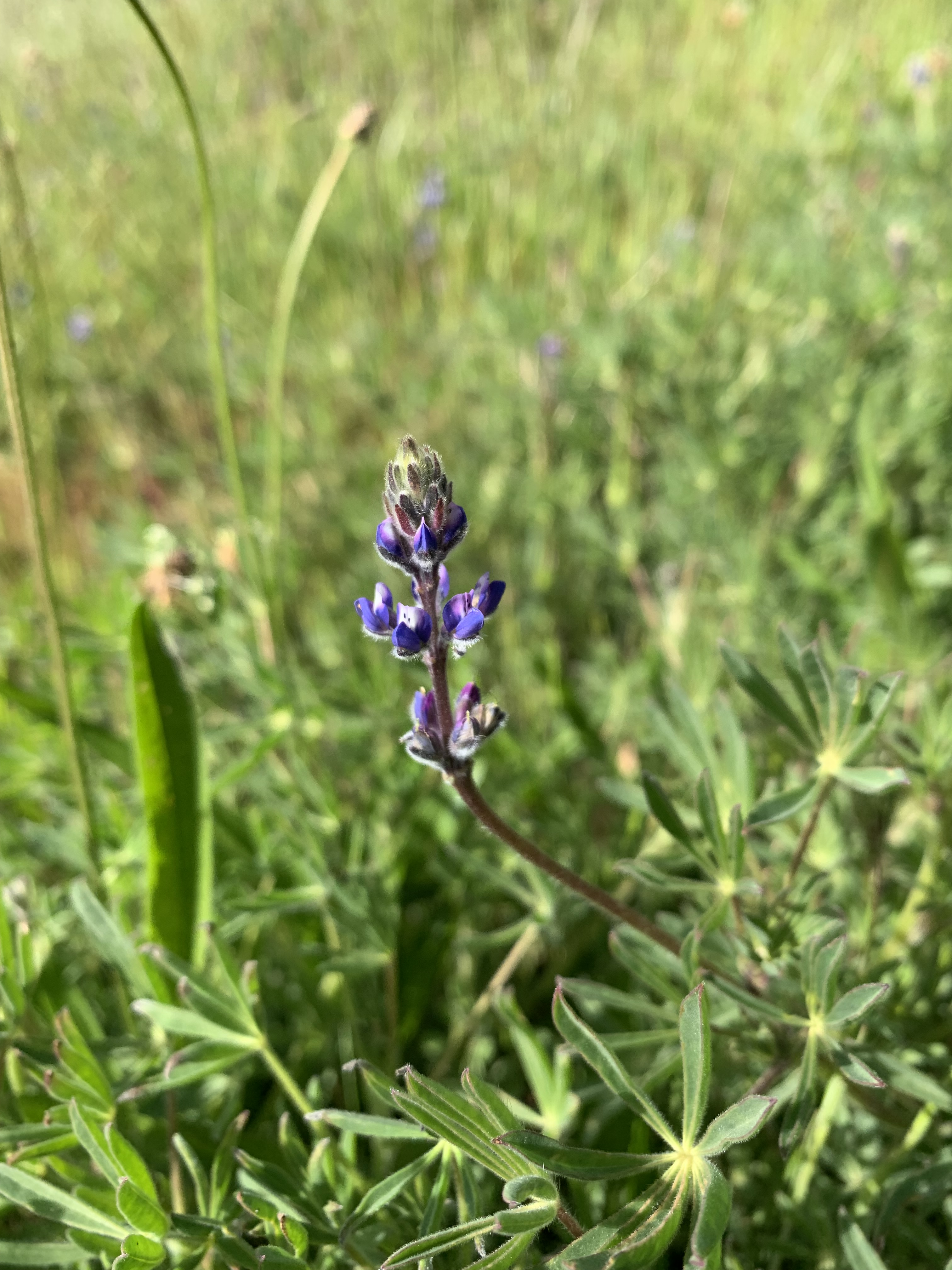
Bicolor lupine and more on a knoll on the Farm

Wild Flowers

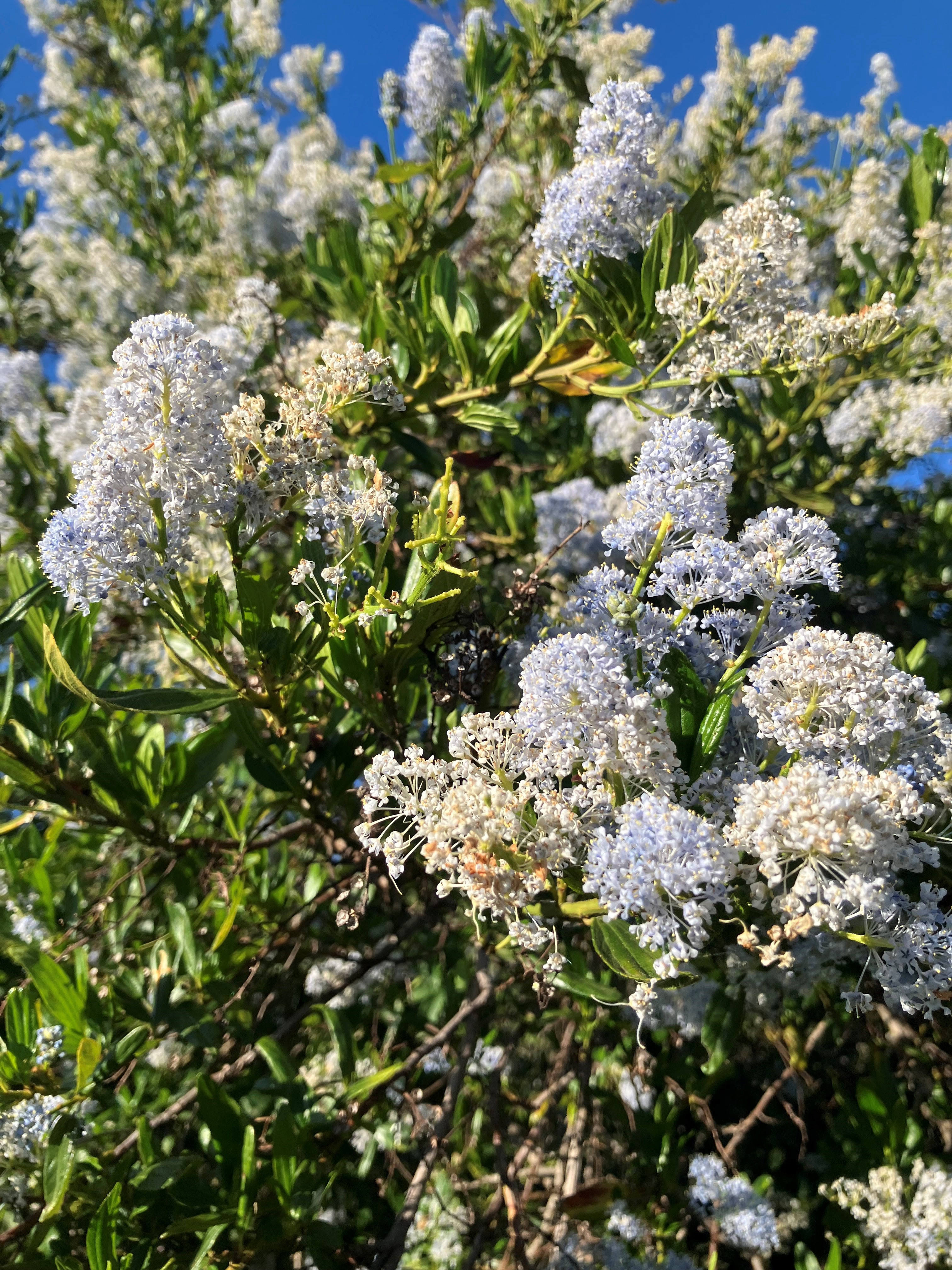
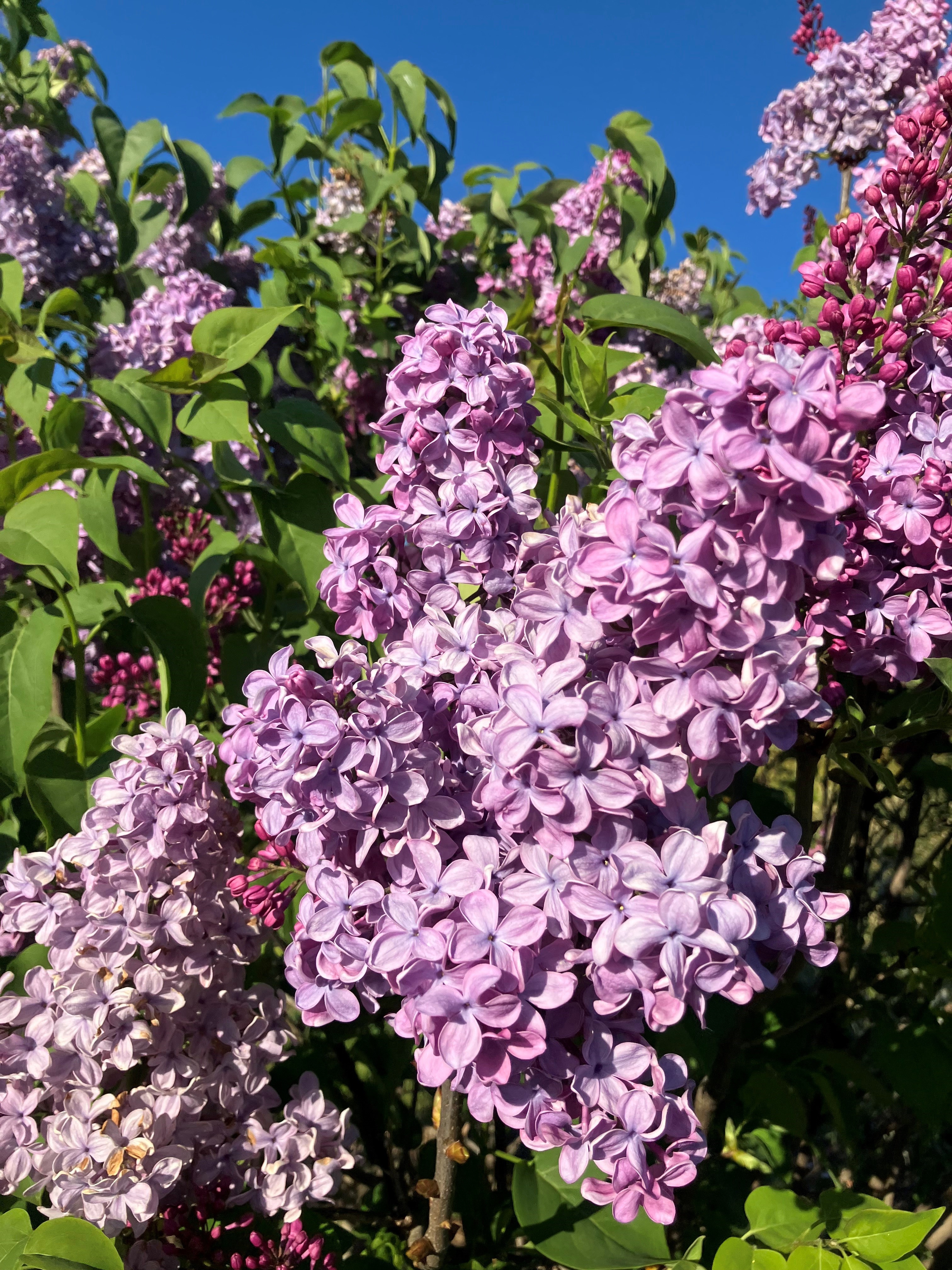
The wildlands are blooming spring. Two types of lupine, the big and the small, as well as poppy, tarplant, blue eyed grass, vetch, and purple sanicle have burst into flower and paint big patches with crazy color mixes and fascinating patterns. In the forest, white starburst panicles of fat false Solomon’s seal and the simpler four petals of purple-white milk maids brighten road cuts above Molino Creek Farm. More than anything, miles of the fire-following shrub California lilac throw rafts and sprays of pale blue blossoms, drowning out their shiny green leaves. The scent of this blueblossom is heady and sweet, but only faintly like the more-sweet perfume of the old-world traditional lilac which also has much more showy flowers.

California lilac
Old World Lilac

It’s Lupine Time

In the local prairies, it is an especially prolific lupine blossoming year. Do you have a favorite place to visit lupines? The most prolific, bright, large flowered annual lupine in our area is called sky lupine, because when it is in full bloom in large fields, it looks like someone turned the world upside down. The scent is heady- it smells purple. For those of us who grew up smelling purple in grape Kool Aid or various artificially flavored grape bubble gums, it makes sense that sky lupine smell purple. In good years, I am able to go to my favorite lupine patches at just the right time when acre upon acre are giving off that scent and making extensive mats of lupine colors.

Lupinus nanus, aka sky lupine, an annual native wildflower that grows best without grassy competition

Lupine Diversity

Lupines are pea family plants. Look carefully, and you’ll recognize that sweet pea shaped flower. Lupines typically have flowers in a spike of tightly packed whorls with older flowers turning to seed pods at the bottom and new flowers opening at the top. Lupine seed pods look like pea pods. Sky lupine pods explode on warm days pitching seeds far from the mother plant.

Sky lupine flowers and seed pods

Sky lupine isn’t the only lupine around, there are many lupine species in Santa Cruz County. It might make a good treasure hunt to try to see them all. According to Dylan Neubauer’s Annotated Checklist of the Vascular Plants of Santa Cruz County, California (every naturalist in the County should have this), there are sixteen lupine species in our tiny county. Sky lupine is the only one to make a big show in the grasslands.

A very modest lupine, Lupinus bicolor, aka ‘miniature lupine’ another of the 16 species of lupines in Santa Cruz County, California

Who Eats Lupines?

Italians eat lupines! Strains of white lupine, Lupinus albus, have been cultivated for food throughout Europe. But you have to grow the right strain- some strains are very toxic! In fact, most lupines are toxic…

Here’s a challenge: find sky lupine leaves that are being eaten by a butterfly or moth caterpillar! In researching this essay, I explored the possibility that some beautiful butterfly larva fed on sky lupine. Nope! Lupines famously have some potent toxins. Some species of lupines poison cattle, though I’ve not heard that livestock owners are concerned about sky lupine around here. There are some butterflies and moths that feed on perennial lupine bushes locally, but none that we know of that feed on sky lupine.

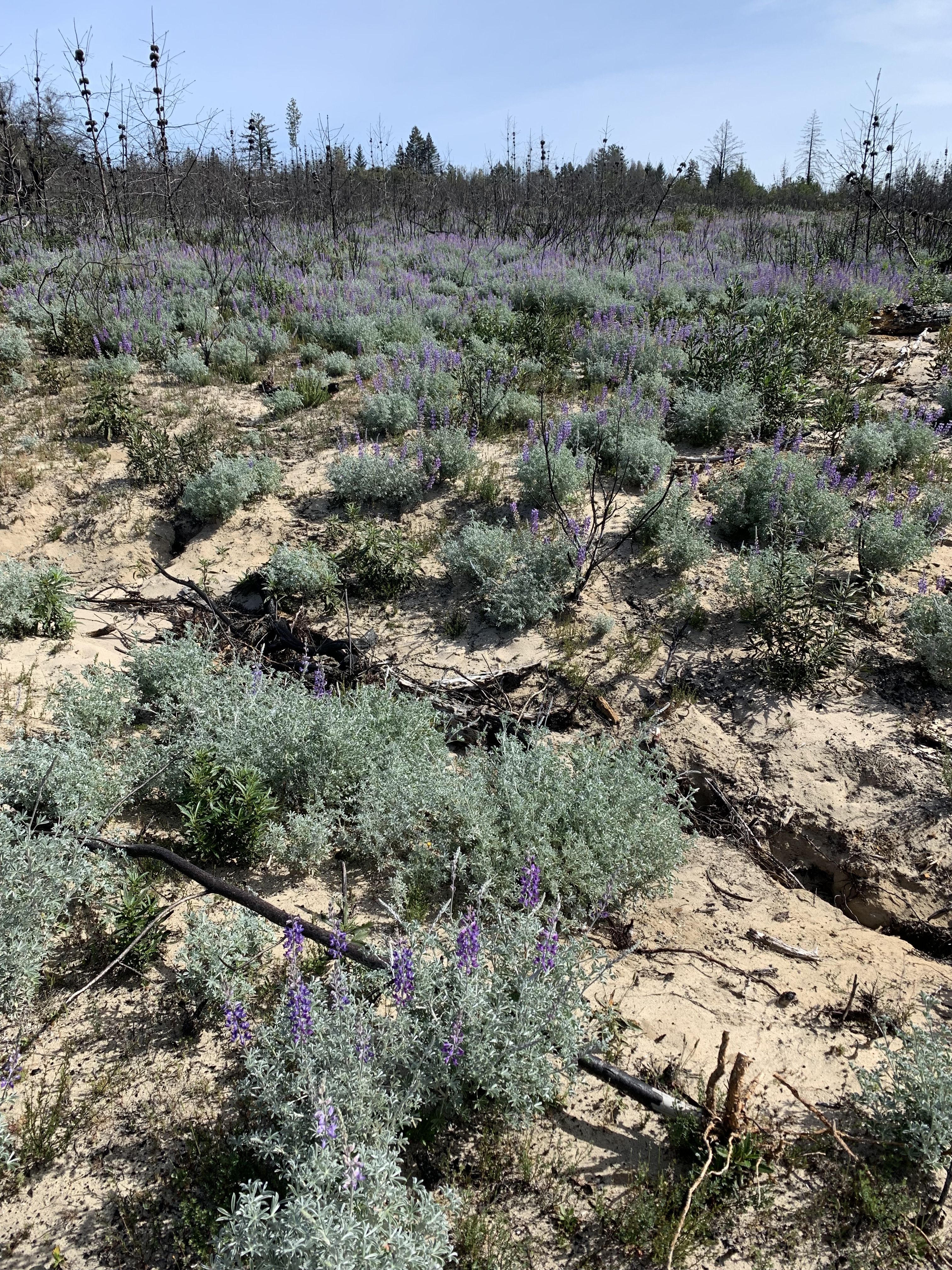
Masses of Lupine propinquus popped up after the 2020 CZU Lightning Complex Fire at Molino Creek Farm

Lupine Pollinators

It isn’t a burden to sit in a sky lupine patch to watch for pollinators. You’ll quickly realize that bumble bees love lupine flowers. And, if you look at those bumblebee legs, you’ll see the distinct yellow orange sky lupine pollen color – they collect big globs of it.

And yet, sky lupine doesn’t need a pollinator, it can self-pollinate. But sky lupine flowers make more seed if they get pollinated by bees. The species has an interesting adaptation- some tiny hairs that prevent self-pollination at first; these hairs wilt with time, allowing self-pollination if all else fails.

Sky lupine mixing it up with California poppy- a common combination and always lovely

Planting Lupines

You might be tempted to plant sky lupine- certainly expensive wildflower mixes contain this species and display its color on the fancy seed packets. However, its not that easy. Sky lupine seeds are tough and unpredictable to germinate. Friends have been sending me pictures from places they’ve never seen sky lupines before- the seeds have been in the soil for decades waiting for the right year to germinate! Check out the seeds, sometime- they are beautifully marked with a shiny, waxy seed coat. The seeds are hard as rocks, meant to last years in the soil.

There are many different types of sky lupine, each adapted to its own microclimate. So, if you really really want to get some sky lupines growing, get to a patch nearby and get local seed- collect the pods as they start to dry. Place the drying pods in a paper bag in the sun and wait. Soon, you’ll get to hear the pods exploding in the bag and you’ll know that you got some good seed. Make sure that the pods and seeds are nice and dry before storing them until next fall. As the first rain storm is predicted, cast the seeds around where you want sky lupine…rake them into the soil if you can…and wait- sometimes for years!

Lupinus albifrons, silver bush lupine, in the Bonny Doon Ecological Reserve- post 2020 fire flush

Lupine Places

Back in the early 1900’s, many regular Santa Cruz citizens would enjoy Spring wildflower trips to the North Coast grasslands to collect wildflowers. They would bring bouquets home with them and garland their hair and clothes with colorful displays. Now, with long mismanagement of many of those grasslands, there are few wildflower patches left. Anyway, if you do find wildflowers, you’re not supposed to pick them anymore. We ought to leave them for whatever remnant populations of rare pollinators might be around, waiting for us to figure out how to better manage the prairies.

Locally, two places to visit sky lupines come to mind. It used to be that the Glenwood Preserve in Scotts Valley had good sky lupine displays, but I haven’t had a report this year. A little drive to the south, and spring always brings great sky lupine displays in the grasslands and oak savannas of Fort Ord National Monument. There’s something particularly appealing to me about the large patches of sandy grasslands full of lupines surrounded by gnarly short coast live oaks at Ft. Ord. Those sky lupine patches are frequently large enough to get that lupine smell, experience that upside down world with the sky on the ground, and thousands of bumble bees bopping around the flowers.

-I originally published this post at Bruce Bratton’s weekly blog BrattonOnline.com