We woke on the Equinox, September 22, to the song of night’s arrival – golden crowned sparrows. Somehow, they know the right day and arrive the same moment each year, ending their long travel south from Alaska. With the changing world, it seems odd that some things remain constant. These pesky birds promise hours of entertainment as their pecking order is as animated as chickens and they are far more numerous. Their aggression is correlated by the brightness of gold on their heads, but they still love each other: they have tight-knit family groups and larger tribes and they are settling into the same cluster of shrubs they called home last winter. They must be pleased to have so many seeds: last winter’s bounteous precipitation made the seeds rain more than even the huge coveys of quail can keep up with. When it rains, there will still be millions of seeds to germinate and the sparrows will start grazing the lush turf.
More Typicality
Just as last year, the winter battles summer this time of year. Some of us celebrated one more Warm Night: unusual in these parts. The warm night was sandwiched between two pretty hot days and then the Fog returned: moisture rolling off rooves at sunrise, dripping from leaf tips, coloring the dust on the road beneath wetted trees. The see-sawing of temperatures was the cue the apples needed to get that much closer to ripe, but the bouts of fog enshrouded days make it difficult to keep up with the watering…solar pumps don’t produce much when there’s too few photons. It would be better to water the orchard before it gets really hot, but the hot has recently been when the sun comes out. Dynamism and daily adaption is the way of the farmer. The question now…will it be truly typical and rain an inch, our first ‘big storm’ in the middle of October? Whoah! That’s just two weeks away!!

Fields of Tomatoes
The bouts of heat and the progression of the season coalesced to create a grand glut of tomatoes. In this house, we’ve processed a hundred pounds into jars and jars of sauce to brighten the meals in seasons far from summer. Another household dried 200 pounds. The smell of tomato fruit hangs in the air on still warm evenings. The warmth and dust-loving russet mites have ravaged many plants, leaves withered and crispy: they’re time is up, but there are many more healthy plants in some patches, especially in the ‘diagonal field’ with deeper soil, upwind of the road dust. That’s where the future lies…we need tomato production through Thanksgiving for a truly prosperous year.

Flowers
This is truly the driest time of year as we’ve had no rain since April. The hillsides are crispy dry and most shrubs, flowers, and grasses are dormant. The exception is the unbelievably bright green pine-scented coyote bush…just starting to flower. Want to tell the girl from the boy coyote (bushes)? Now’s the time. I mark the coyote bush female plants and eradicate them preferentially- they are the existential threat to us folks who like to keep grasslands, grasslands and let the wildflowers have the wide open space. For now, the coyote bush is keeping the pollinator community well fed. Butterflies flock, flies buzz, and wasps hop from cluster to cluster of the pollen and nectar rich flowerheads.
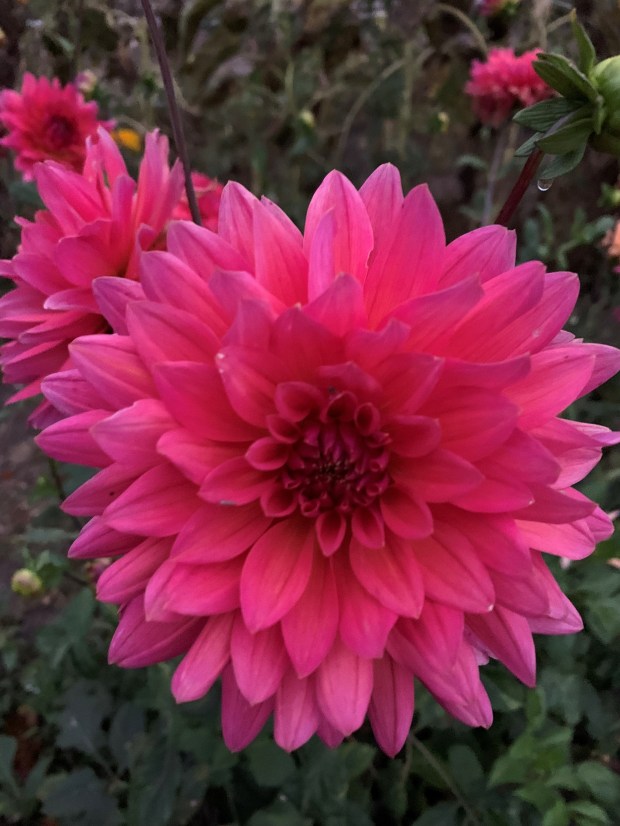
In the irrigated garden, it is Dahlia time! Big poofy, luscious flowers of the most unbelievable colors pop and spangle in a scant row among cucumber, beans, and squash. Sunflowers are still going, cut for each of the 3 farmer’s markets we are going to nowadays (Aptos/Cabrillo-Saturday, Downtown Santa Cruz-Wednesday, and Palo Alto-Saturday).

Fall Color
The walnuts and garden birches have only the slightest tinge of the beginnings of yellow. Same with the maples in the wild canyons. At the edge of the forests and on steep hillsides, poison oak is further along with its remarkable streaked purple-reds. Rumor has it that the aspen leaves are turning in Eastern California where ‘leaf peepers’ are drawn to fall glory.
More Return of the Birds
Besides the golden crowned sparrows, other birds have returned from afar for their winter haunts. Cassandra and I have both seen an unusual feathered friend: Western meadowlarks visiting the Farm! Their bright yellow, black-spotted bib and dangerously long stout bills give them away. I guess our grasslands have reclaimed enough shrub ground to look like viable meadowlark habitat – that’s new!
Another bird sighting – an osprey! Around 2012 this time of year, two ospreys would fly over the farm each evening at dusk, west to east. One is flying now. Someone says that they saw it carrying a fish…a little late for fledglings, don’t you think? Still, this is an odd thing and someday someone’s going to have to follow that sea hawk and see where its going.

Hey Rick, hay rick!
Last weekend at our work party, Jen, Mike, and Roland rolled up the hay near Cherry Hill. Tons of the dry grassy stuff is cut, getting raked, and being placed in our rudimentary hay ricks. If we had pines nearby, we could put some needles in our haystacks, but as it is they are full of weeds. This is a new adaption from the bad idea of old…placing dry hay under perfectly innocent trees during fire season. Now, we stack the hay, let it molder, and wait until the end of fire season to swoosh it under the trees to suppress weeds, add nutrients and organic matter, and provide cozy homes for VOLES who do such a good job of ridding the orchards of gophers.
Perhaps we’ll rediscover the way of stacking the hayrick…a profession of years ago with expertise and methods long lost.

 Grey Hayes