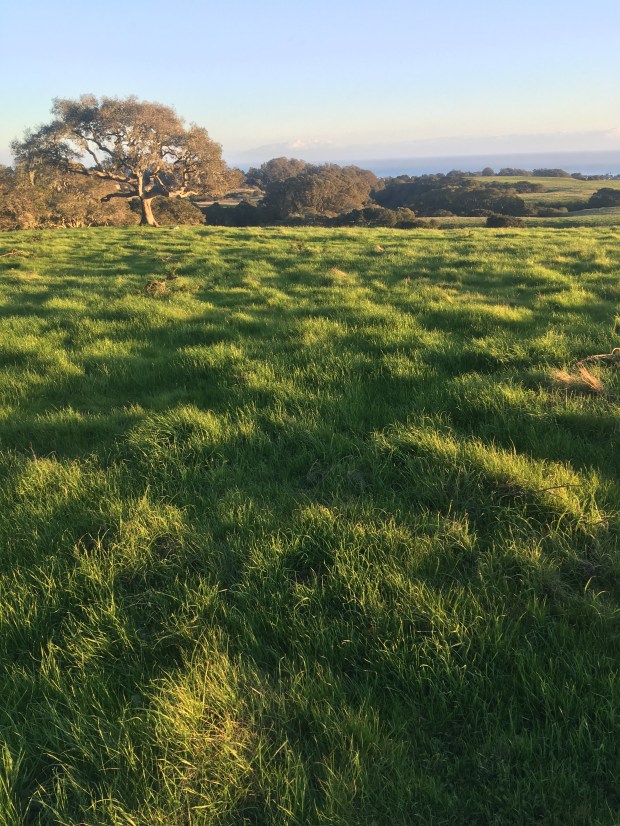
Coastal prairie

Cattle Grazing on Public Lands

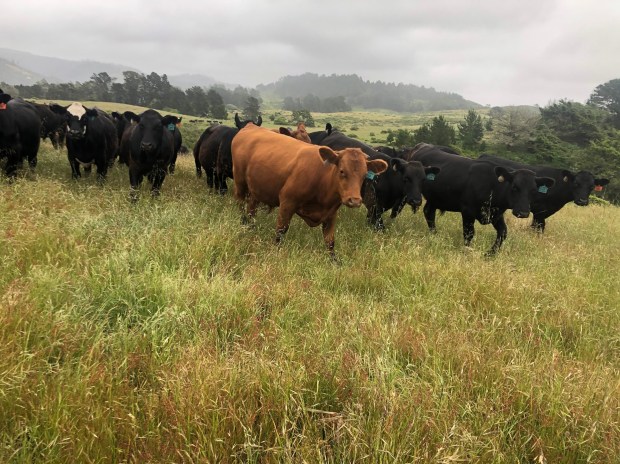
A recent negotiated settlement at Point Reyes National Seashore is the latest example of how controversy over cattle grazing on public land gets resolved. The polarity is typical. On one ‘side’ are ranchers, their families and workers, and the broad community that supports family farms, local agriculture, and organic or nowadays regenerative agriculture. On the other ‘side’ are environmentalists, pro-species, pro-clean water, pro-wildlife, and anti-livestock where there’s profit on public lands. The battle at Point Reyes is just one in this war across the U.S. West, and it has been going on for decades. At least at Point Reyes, the two sides don’t neatly align in the expected ways between the two mainstream political parties. Why did it get so bad at Point Reyes that legal action and tens of millions of dollars were needed to settle the issues? Could this kind of thing occur on public lands closer to the Monterey Bay? Let’s look closer to see.

The Vast Gulf

Conflicts with recreation, water quality concerns, and impacts on native plant and wildlife species are the issues most commonly raised when there are concerns about cattle grazing on public land. And, there is good science to support the value of carefully planned cattle grazing to reduce wildfire impacts while promoting native plant and wildlife conservation. In addition to these types of issues, there are pro- and anti- cattle advocates out there, on one hand in support of agriculture or cute critters for children to adore; and, on the other hand, wanting only native animals on the land or against meat eating, methane producing, and otherwise cruel corporate cattle corporations.

Radical Center

There are many of us who are experiencing the beauty of collaboration between livestock managers and conservationists: we are achieving more emergent success than anyone thought possible 30 years ago. Chief among these collaborative networks’ concerns has been development and sprawl…greed that replaces private ranches with housing tracks and shopping malls. In California, we also have shared concerns about the vitality of ranching economics, water provision, wildlife conservation, and catastrophic wildfire. Each of these issues has seen progress because a respectful, trusting network keeps showing up and working together. It takes everyone who has an interest in land management to create innovative solutions: ranchers, conservationists, researchers, land managers, regulatory agencies, community members, resource advisors and consultants, and planners. But, each of these groups has unique interests, different languages, different cultures. We get past these differences by gathering together and learning from one another in well planned, moderated dialogues. The Quivira Coalition is the first group I know to start these discussions, and many followed. The Central Coast Rangeland Coalition (CCRC) is working on this stuff locally, and is celebrating its 20th Anniversary in 2025. I copy here the pledge from the Quivira Coalitions website (link above), a pledge that mirrors the work of other groups like the CCRC:

“We pledge our efforts to form the `Radical Center’ where:

  • The ranching community accepts and aspires to a progressively higher standard of environmental performance;
  • The environmental community resolves to work constructively with the people who occupy and use the lands it would protect;
  • The personnel of federal and state land management agencies focus not on the defense of procedure but on the production of tangible results;
  • The research community strives to make their work more relevant to broader constituencies;
  • The land grant colleges return to their original charters, conducting and disseminating information in ways that benefit local landscapes and the communities that depend on them;
  • The consumer buys food that strengthens the bond between their own health and the health of the land;
  • The public recognizes and rewards those who maintain and improve the health of all land; and
  • All participants learn better how to share both authority and responsibility.”

Who is Showing Up, Who is Not

Where do you see cows on public land; how is it working; how do you know? There are cattle grazing on Midpeninsula Open Space, Santa Clara Open Space, State Parks (Pacheco State Park), BLM (Ft. Ord, Cotoni Coast Dairies), POST, and on City of Santa Cruz (Moore Creek, Arana Gulch). Of these, MidPen, POST, and Santa Clara regularly show up to work with the CCRC. I believe that these are the organizations that are most apt to succeed and least likely to end up in the terrible situations that Point Reyes has been experiencing. Why do some show up and not others? I suggest that the third bullet is as important as the next-to-last. It takes the oversight agency’s interest in results as well as the public’s engagement to nudge public land managers to the table.

My Experience at Point Reyes

I am an unabashed native plant conservationist, have researched and visited coastal prairie habitat at Point Reyes for many years, and I have NOT been impressed. Two of the science papers that got me started on my doctoral research were from Point Reyes. One told the story of a rare wildflower that was protected to death when cattle grazing was removed from its wetland habitat. The other illustrated how another rare wildflower thrived because of an appropriate cattle grazing regime. I consequently surveyed across fencelines at Point Reyes and found native annual wildflowers to be more diverse and abundant on the cattle grazed side of the fence, as opposed to the side where grazing had been excluded. In fact, I found the very rare San Francisco Owl’s clover in abundance in the areas with, and not so much without, cattle grazing. I have subsequently made many returns to Point Reyes to learn about what is going on. During one field trip, I found out that the cattle ranchers and park managers had only the most rudimentary ability to discuss a topic that had long been a priority, common interest: the encroachment of brush onto coastal prairies. During another excursion to explore the health of the very endangered Point Reyes Horkelia, park employees indicated that not only did they not have any data to share about the health of this species, but also that I was not permitted to monitor the species without extensive paperwork, even in areas open and easily accessible to the public (see bullet point above, re: defense of procedure vs. production of results). Nevertheless, I found that the cattle grazing regime had hammered nearly to obliteration this rare species whereas adjoining cattle excluded areas still had a few individuals which were on the verge of being obliterated by weeds, especially iceplant, a species that is relatively easy to eradicate in such instances where it is a local threat to an endangered species. I’m sure that the cattle rancher had no idea about rare species and I’m sure that the Park employees had never considered talking to the rancher about its conservation. In my experience, such communication is essential to improved success.

Where From Here?

Reflecting on my experience at Point Reyes, I am unsurprised about the recent outcome, but I am undeterred to keep helping the Central Coast Rangeland Coalition avoid such unproductive mayhem wherever possible. I challenge the Bureau of Land Management, State Parks, the City of Santa Cruz, and all other land stewardship entities to take the above pledge, joining constructive dialogues that demonstrate success at taking care of our lands. And, I challenge everyone else who is reading this to take the portion of the pledge that applies to you. I especially challenge the “Conservation Architects” (you know who you are)…including those who think highly of the concept of a “Great Park” designed to encompass most of the Santa Cruz Mountains…to now doubly consider what kind of baby-sitting federal agencies need to achieve conservation success. Together, we can make a difference. But, we need the principles of Radical Center-based collaboration (as articulated above) to take root in all places before we will see the harvests we so desperately need.

-this article originally published as part of the ongoing BrattonOnline news service, covering the Monterey Bay and Beyond. Subscribe and win!
Perennial Grasses and Healthy Soil

Isn’t it amazing how marketing pitches can formulate the foundations for societal dialogues? Somehow, forest management gets ridiculed with the phrase ‘raking the forest,’ aiding the politics of defunding the US Forest Service at a time when we really do need widespread restoration of prescribed fire…not raking, but effectively the same thing. And ‘forgiving student debt’ gets bandied about, helping to steer conversations/media away from the more difficult subjects of: better funding/better outcomes of public education; training young adults about contractual obligations and financial planning, and; regulating financial institutions to make student loans more affordable. I’m sure each area of human dialogue has its ‘short hand’ statements that one sector uses to manipulate others. The one I’m faced with currently is the jingo ‘healthy perennial grasses make for healthy soil.’ Let’s take a closer look at that phrase.

Bunchgrass Paradigm

Long ago, a preeminent ecologist traveled to California and ‘discovered’ something that formulated the basis of myriad dialogues continuing through today. Frederic Clements described ‘natural succession’ where nature transforms itself from one habitat to the next in a logical and predictable order. You may recall the diagram that still sticks with me where a pond becomes a marsh becomes a bog becomes a meadow becomes shrubland, culminating in the ‘climax’ community…a forest. In examining California’s grasslands, Dr. Clements found a patch of ‘pristine’ grassland, one of the few that had escaped the plow, along a railroad right of way. That ‘pristine’ grassland was dominated by a perennial bunchgrass, purple needlegrass: this, he said, was how all California’s grasslands should look. Many people still believe this. What about the hundreds of species of wildflowers, such as those cited by John Muir as creating carpets across the Central Valley, and those which provided food for indigenous peoples for generations? Those holding dear to the ‘bunchgrass paradigm’ will say those species grew only in between the bunchgrasses where weeds now proliferate.

Blue wild rye, a native perennial bunchgrass common to coastal prairies in California

Perennialization Bandwagon

As the bunchgrass paradigm has been perpetuating, another popular movement has been building, a desire to transform agriculture from annual plants into perennial plants with little to no tilling, which purportedly ‘destroys’ soil health. Despite being disproven as effective over and over again, farmers are still attempting to grow lettuce, carrots, broccoli, etc, on ground without tilling. Meanwhile, rangeland managers are repeating a similarly disproven hypothesis that all California grasslands would be better off if ‘restored’ to perennial grasses. Buoyed by science papers that suggest the importance of cattle grazing to help establish/maintain perennial grasses, livestock managers have found good use of this message to gain credibility and increase their land base.

The “Perennial Grasses Have Bigger Roots” Myth

Add the two previously described popular myths together and you encounter another emergent, oft-repeated myth: perennial grasses restore soil health because they have larger masses of roots (in comparison with annual grasses). Central to this popular misconception are comparison photos from the Midwest showing profiles of annual wheat versus perennial wheat including both above and below-ground portions of the plants.  The idea being promulgated is that larger root systems add more organic matter to the soil, break up soil compaction, and allow for better water infiltration. Most recently, proponents of this myth point out that the increased below ground organic matter of the larger rooted perennials means that more carbon is being sequestered, helping to address climate change.

California’s Grasslands: Not Naturally Perennial

California is mostly a Mediterranean state with a long history of ecological disturbance: grazing, fire, drought, inundation, etc. That ecological situation does not naturally produce widespread perennial grass dominated prairies. Even where there are perennial grasses present in a given area of prairie, they are rarely naturally ubiquitous: species seem specific to soils, steepness of slopes, wetness, nutrients, and so on. There are many more annual species than perennial, and many more wildflowers than grasses. Some of the most emblematic grasslands in California are naturally annual plant dominated, such as the wildflower-display rich Carizzo Plains, the rolling hills over the Altamont Pass, and the flower-filled savannahs of the southern, low-elevation Sierra Nevada. On the other hand, large swaths of the former wetlands of the Great Valley were probably once dominated in wide swaths by perennial rushes, sedges, and tall native, rhizomatous (not bunch) grasses.

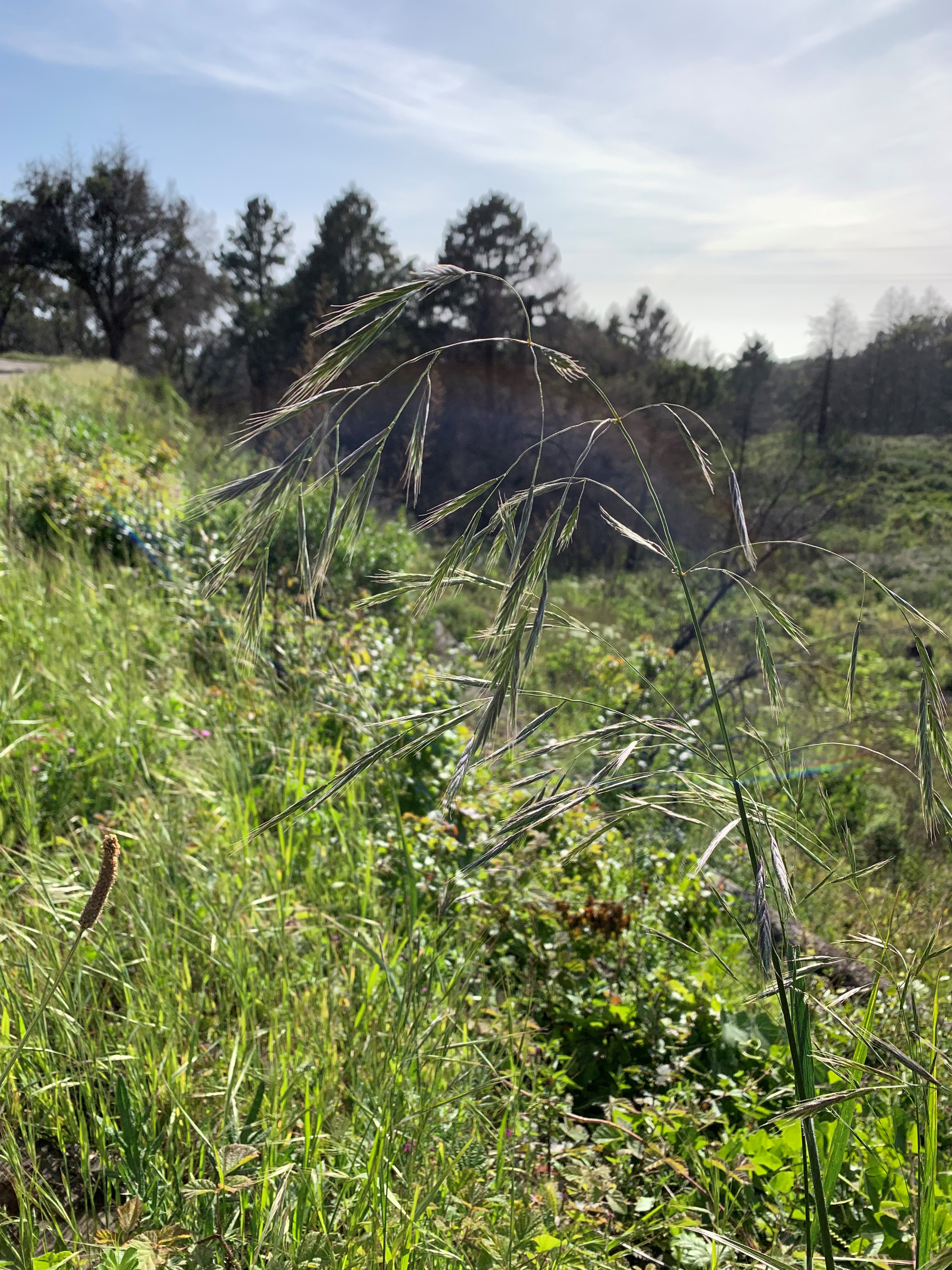
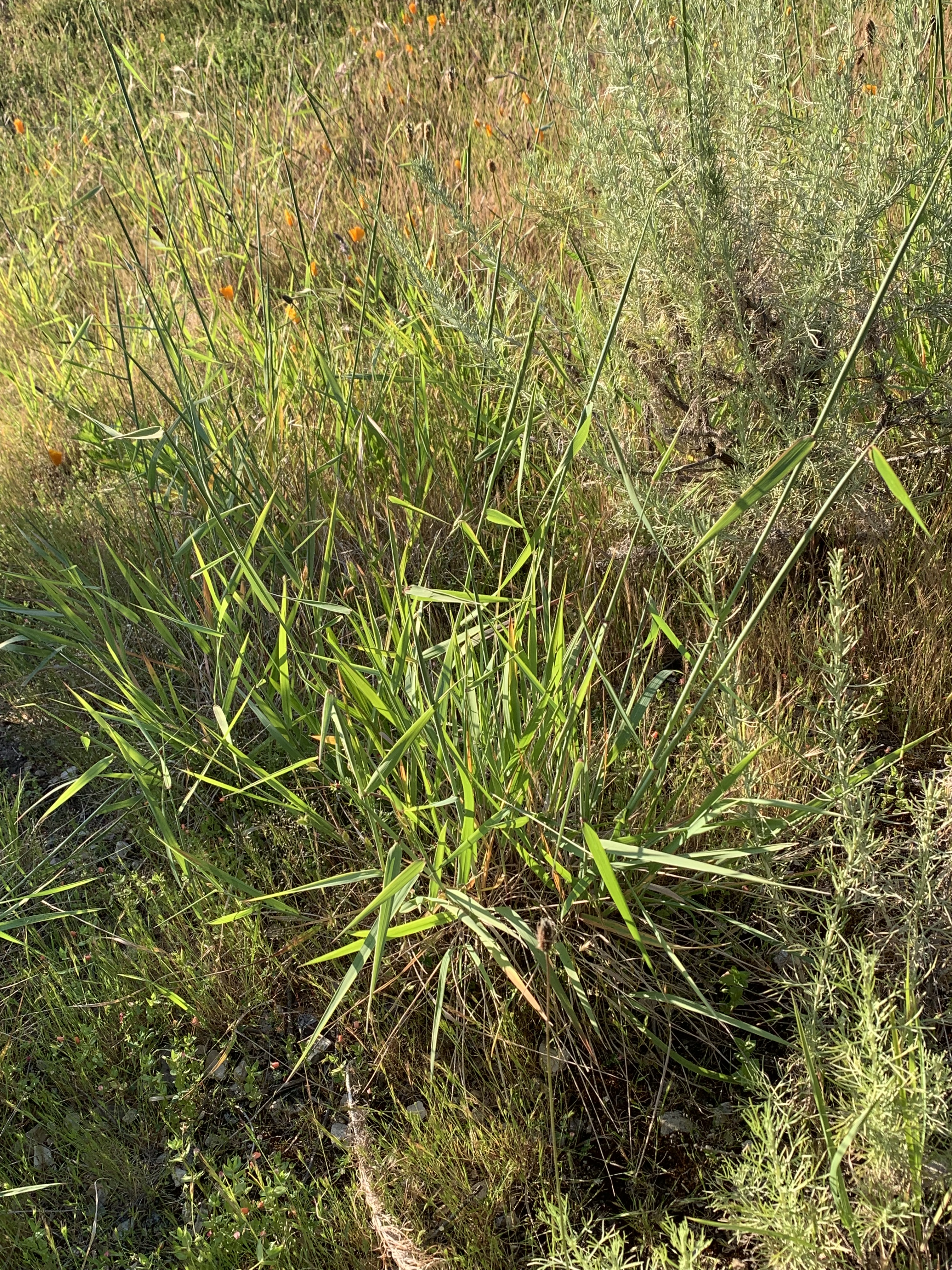
California brome grass, a perennial bunchgrass common to California’s coastal prairies

Myths of the Perennial Life Form

Let’s examine the “Perennial Grasses Have Bigger Roots” myth for a moment. The most widespread native perennial grass in California is pine bluegrass, a diminutive grass that often has leaves a mere inch or two high and a flower stalk reaching a foot or so into the air. This species likes it hot, dry, and shady, growing in interior oak savannahs. With the first rains, it turns green, later sends up flower heads, and then dries by late spring. There is no reality in which this species has longer roots, or a bigger root system, than the often 4’ tall European oatgrass. Around here, that European oatgrass is more comparable to the perennial California brome grass. This brome, in some soils, alongside European oats similarly continues growing, flowering, and seeding well into summer. In wet areas, a common native perennial grass is meadow barley. Meadow barley is relatively small and short-lived, and goes dormant very early in the season, when it is replaced by the proliferate annual Italian ryegrass, which is larger by far. Most people surveying for perennial bunchgrasses have overlooked meadow barley altogether as it disappears so early in the season.

Yes, there are smaller annual grasses and larger perennial grasses, but my point is that the generality that ‘perennial grasses have bigger roots’ is untrue and not that useful as a generality.

Regenerative Ranching: Regenerating What?

Although the definition of ‘regenerative ranching’ is elusive, it seems most proponents are gravitating towards suggesting that they are ‘restoring healthy soil.’ The idea here is that soil has been in some way degraded and must be returned to its primeval state. Often, the soil degradation concern is ‘compaction.’ To restore soil health, proponents rely heavily on the myths described above overlaid with management hypotheses that using livestock can mimic evolutionary disturbance regimes last encountered with the Pleistocene megafauna, 10,000 years ago. Regenerative ranchers really believe that such approaches work and are full of anecdotes about what they’ve witnessed, though changes in soil health are notoriously slow and always soils-specific.

Compared to What?

I’m pleased that there is a conversation about how to best manage California’s prairies, but concerned about bandwagons, slogans, and misinformation. Humans are really, really good at pairwise comparisons, but their attraction to such must be tempered. Perennial vs. annual grasses: nonsensical! Livestock grazed vs. ungrazed: not helpful! We can try really hard or spend a lot of money trying to ‘restore’ soil health, but what are we restoring it to? There is the possibility for a great collaboration in this conversation. The USDA NRCS has a long-running research project that fits nicely: their ‘ecological site description’ project would do well to help define which sites are best compared with one another, based on soil types. When having these conversations, we would do well to have great respect for the state of the science, referencing a rich literature and how it does, or doesn’t pertain. And, in our pairwise comparison analysis, let’s always try to compare what we are doing, regenerative or otherwise, with someone else’s approach: what is working better, and why? We must always make these conversations very site-specific…variability across sites is the rule.

Meanwhile, beware of definition-less terms without a systematic third party certification program: ‘natural,’ ‘grassfed,’ or ‘regenerative’ labels hope to entice you to pay more, have higher respect, adhere to brand loyalty, or just plain ‘believe’ you are doing the right thing by supporting such verbiage. With this and other jingo-based bandwagons, let’s get a tad more critical so that we support what is worth supporting with greater clarity on WHY.

-this post originally appeared as part of Bruce Bratton’s weekly blog at BrattonOnline.com

The Land We Encounter

What if there never was any wilderness? What if the story of Adam and Eve is a myth about a legendary distant wilderness, before humans were human, before animals created homes?

What if the land we encounter has always been tended by humans?

And, what if wildlife, clean running streams, pollinators, badger and fish, all need us to do that tending?

How might that change your relationship with Nature? How might that change your notions of the importance of stewardship for Mother Earth?

In My Travels

In my travels to jungles to experience Earth’s biodiversity, I find the handiwork of humans, even deep in parks. In the Andean cloud forest, on the sides of Machu Pichu, the fog clears, and the bright sun reveals the corduroy of ancient agricultural terraces across impossibly steep slopes for miles around. A guide points to hidden complex irrigation systems that kept these farmed terraces watered. On one such hillside, I discover oca plants, Oxalis tuberosa, with their buttery sweet starchy roots; these were as important a food to the Inca as potatoes. Still they hang on.

In the mountains overlooking the Caribbean on Costa Rica’s coast, I followed red and yellow variegated leaves through dense thickets after passing through a tropical-tree shaded cacao plantation. We discover a mango tree and then a patch of bananas, and then more seemingly wild forest. Along this variegated leaf-marked trail, we find a couple rubber trees scarred from tapping 50 years ago. Finally after 6 hours of hiking, the crow of a rooster, the barking of a handful of dogs, and a clearing announces my arrival at an Indian outpost, the closest one to ‘town.’

A little North, on Belize’s low coastal plain, I am guided to ‘wild’ cacao plants deep in the rainforest. It takes hours of blazing hot, sweat drenched bug-bothered hiking through dense forest to get to the first few cacaos. Along the way, on the river floodplain in a fallen tree light gap, I find diverse hot pepper plants, some with blindingly hot spherical fruit, some elongated and a little sweeter. The hill in the distance is being explored as a jungle-covered pyramid and archeological site. A giant ceiba tree we pass is cherished by the local Mayans as a bridge between the spiritual and physical worlds.

Back In the Santa Cruz Mountains

What if the expansive coastal prairies, hazelnut and buckeye groves, old growth redwood stands, patches of endangered Santa Cruz tarplant, and diversely colored iris clusters are not ‘natural?’ What if they are legacies of Native American stewardship? My eyes were once more open to that kind of encounter when traveling out of the country. Now, I am starting to look at my home landscape with the same kind of curiosity.

California’s coastal prairie on the Santa Cruz North Coast

Coastal Prairies and Endangered Tarplant

Salads of clover greens, nourishing seed cakes of red maids, sweet roasted bulbs…the prairies grew a valued diversity of foods. Digging sticks were used to remove the bigger tasty bulbs, aerating propagation beds for the following year’s bulbs. Small groups carried baskets of seeds for restoration following correctly timed prairie fires. On a few occasions, tarplant seed traded from the Central Valley is carefully sprinkled into wetter parts of the coastal meadows in hopes of providing a favorite tasty and nutritious snack.

The earliest logbooks of Old World peoples traveling along this coast described extensive coastal prairies, all burned. For generations, the dominant cultural belief of the invading people denied Indians the advanced intelligence that they clearly practiced in tending the land. Kat Anderson, who researches and writes about the complexity and expansiveness of Native Peoples’ land care, is slowly helping our culture to overcome such ignorance. She and I still encounter well educated people who have difficulty believing that the native peoples ever managed entire landscapes like these expansive coastal prairies. None of those grasslands would have been open, grassy ecosystems without regular burning, tree and shrub removal, and a wealth of other tending practices that we still must (re-)learn. Check out any patch of coastal prairie that isn’t burned, grazed, or mowed, and you’ll see it closing in from trees and shrubs: it takes just a few years.

Those coastal prairies have many rare native annual wildflowers; Santa Cruz tarplant is an especially endangered species that is barely hanging on in a few last places. Tarplants produce protein rich seeds, a staple food of the indigenous peoples of California who developed efficient techniques for harvesting large numbers of the seeds involving specialized harvesting and tote baskets. The Santa Cruz tarplant is a recently speciated taxon, a species that evolved over just the last 12,000 years – a time frame allowing for native peoples to have played an important role in its creation.

A crowd working with State Parks and the Central Coast Prescribed Burn Association, including members of local tribes, walk drip torches, starting a blaze through the grassland at Wilder Ranch. Needlegrass stands proliferate. 5th generation ranchers guide cattle through pasture gates, tinker with water troughs and maintain fences. The next spring there are immense stands of lupines, native clovers, sheets of white popcornflower, and patches of Santa Cruz tarplant.

How is it important to you that we have coastal prairies? Do you enjoy the soaring of hawks and eagles across the Monterey Bay? Are the stunning poppy displays this spring inspiring? Have you considered that prairies can help slow the spread of catastrophic wildfires, making them less intense and dangerous?

Iris fernaldii, a native iris with phenomenal floral diversity

Hazelnut and Buckeye Groves and Iris Gardens

Cracking the hard shells from hazelnuts in midsummer revealed a smooth pale nut: roasted or raw, it was a valued delicacy. The second year after burning an individual hazelnut bush, the long flexuous stems are now ready for making baskets or fish traps. Hazelnut groves must have been replanted and tended, some bushes for nuts, some for baskets. Nearby were similarly tended buckeye groves, producing nuts that were leached of toxins and ground into flour on the same grinding stones used for acorns. But, acorns were less predictable with some years yielding poor crops.

In the understory of oaks, buckeye, and hazelnut were mats of native iris plants. Each spring, vast displays of iris flowers were picked to decorate costumes for spring ritual dances. The best colored iris plants were marked and propagated the following winter. Iris beds responded well to periodic low intensity ground fires, throwing up many more blossoms and longer leaves that were a favorite for making twine and rope.

Nuts! When I find hazelnut and buckeye, if I look around enough, I’ll find remnants of Indian camps or village sites. Dark soil pitched up from gophers reveals flakes of abalone and clam or trail/road clearing reveals some flakes of worked chert. I have planted both species: they aren’t difficult to grow. Once established, they don’t seem to die. Our hedgerow of hazelnuts was only 10 years old when the 2020 fire swept through and roasted them. The following year, those hazelnut bushes rebounded vigorously; 3 years later, they are bigger than ever. This is the first year that they will make nuts. Almost all of the buckeye trees in the CZU Lightning Complex Fire footprint now have 6’ tall new stems; they will flower and make nuts in a few more years.

That 2020 fire cleared the ground for a resurgence of native iris. People throughout Bonny Doon have been reporting a surprising array of flower colors, including unexpected blues, emanating from what is supposed to be a single species (Iris fernaldii).

A Western gray squirrel forages under the canopy of an ancient hazelnut grove for one of the very few nuts produced this year. The hazelnut bushes have few leaves and few stems, the shade from the dense, young Douglas firs too much for their liking. At the base of a nearby bank, piles of buckeye fruits lie among dry leaves. The forest floor is criss-cross strewn with dead branches from the windy winter, adding dangerously to the fuel load for future wildfires. Iris leaves poke up between this array of cast off branches, a single iris seed pod rattles in the afternoon breeze.

Large, recently burned coast redwood trees

Old Growth Redwood

It took special attention to burn understory of the groves of giant redwoods. After the fires, prized morels sprung up in the spring to be followed by Prince mushrooms in the summer. The peaceful trees provided shade and peace in the hot summer. The towering trees sometimes lost easily gathered branches for firewood.

Redwoods appear in the pollen record of a local lake near Big Basin State Park around 12,000 years ago. This is the time that the native people were tending the land with fire. In the wake of their fires, the bare soil would have provided the right conditions for redwood seedlings to establish, but from where did those seeds blow? Redwood seeds do not travel far on their own. Over the last two thousand years, native peoples burned the redwood forests every 4-6 years. This was often enough to burn up the thick duff and branches while keeping the understory more open, without crowding shrubs and small trees that could add to the danger wildfires posed to the ancient trees.

Across the scar of the CZU Lightning Complex Fire, a few people struggle to clean up the fuels around the remaining redwoods. They hope to save the remaining big trees from the next wildfire, now more dangerous than ever from the immense fuel loading of hundreds of fire-killed trees. Meanwhile, prescribed fires are beginning to be lit in the understories of redwoods once again.

Reflections

If you believed in wilderness before reading this, did I change your thinking about how you see this landscape? Do you believe that humans are responsible for our diverse prairies, for Santa Cruz tarplant itself, for forming groves of hazelnuts and buckeye, for creating iris beds and a diversity of iris flower colors and for stands of old growth redwood? If you are not convinced, what evidence would you need to change your point of view? Who would you trust to provide or deliver that information? Please let me know.

-this post originally appeared in Bruce Bratton’s BrattonOnline.com blog

Conservation Grazing for Grassland Diversity

My dissertation research, others’ research, and years of observation supports a need to seriously consider conservation grazing as a tool for managing the incredibly diverse grasslands of our region.

Ancient Habitat

We owe the existence of almost every bit of our local grasslands to human management of ecological disturbance regimes. For millions of years, California’s grasslands co-evolved with megafauna. 20,000 years ago, the prairies near Santa Cruz would have had herds of mastodon, mammoth, bison, ground sloth, elk, pronghorn, as well as camel and horse relatives. There were probably mastodon and mammoth trails the size of highways; like their African kin, these critters pushed over trees when drought or fire deprived them of ground-based forage.

The biomass of those herbivores was enough to evolve some amazing predators: saber tooth cats and their bigger kin the scimitar cats, a lion very close to the African lion, wolves, short-face bears, grizzly, jaguar, coyote and cougar.

About 15,000 years ago, most of that fauna disappeared, but the native peoples were stewarding the grasslands with frequent fire. Fires kept the grasslands open.

Without fire or grazing, our coastal grasslands turn to shrublands and the shrublands to forest.

Here Come the Shrubs!

First comes the coyote bush, seeds blown on the wind way downstream. First one shrub, then the next and soon there is more coyote bush than grass. As the shrubs thicken, coast live oaks take root, and they look like shrubs for years and years until they get wide enough that the deer can’t reach the center shoot, and that becomes a tree. Meanwhile, while oaks get shrubbier, here comes the poison oak and their injector friends the blackberry vines. Now, things are getting pretty impenetrable. After about 15 years, we start to see some more diversity: coffeeberry, California sage, sticky monkeyflower, honeysuckle, and others.

All the coastal prairies that aren’t on nearly pure, soil-less rock disappear to shrubs after 15-40 years. There are fencelines and aerial photos aplenty to show you this.

And Next…the Onset of Trees

As the shrub community closes in, the tree seedlings escape deer browse. Coast live oaks and Douglas fir rocket up from the shrub layer. Some toyon start getting tree like, too. Madrones join in.

Check out a mixed hardwood/Douglas fir forest next time you happen across one. Look at the understory and see if you can see shrub skeletons- they are likely there as a reminder from whence the trees emerged.

So, What’s the Problem? Trees are GOOD! “never enough trees….” (sigh)

California’s grasslands support the vast majority of rare plant and animal species. Globally, grasslands have been underappreciated for their diversity and function. California’s coastal prairies are one of the top ten most endangered habitats in the US. These grasslands have been converted to urban areas more than any other plant community. I bet we are still more likely to see grasslands developed locally than any other habitat type. For instance, the meadows at UC Santa Cruz are constantly under threat.

Many of your favorite wildlife species love our meadows. Deer, bobcat, fox, weasel, badger, eagle, hawk, kite, falcon, kestrel, owl, and tule elk are grassland friends. Predators require the vast production of mice, voles, gophers, and moles that grasslands create.

Even if wildlife aren’t your thing (and you’d be very much in the minority there), you might appreciate the functions that grasslands play. Grasslands can break up and cool down wildfires that would otherwise move catastrophically across the landscape. Prairies can be huge carbon and water sponges, soaking up climate change pollutants and soaking in precipitation to replenish groundwater and meter out rains to keep springs, creeks, and rivers flowing later in the season. Many folks love grasslands for recreation: picnics, lying in the sun, walking through them – all worthwhile and important activities. Grassland openness makes way for many of those favorite views. Masses of spring wildflowers create giddy laughter and attract tourists.

Oh, and grasslands raise cows…

Cows on the Prairie: Moooo!

After the genocide of native peoples, after they were driven from their ancestral homes, the prairies would have disappeared were it not for cows. The next era of grassland disturbance was the ranching era. Yes, there was a prohibition against fire. No, there were no limits to grazing. The early ranchers put way too many cows on the landscape: there were famous drought incidents early in California where dead cows littered the landscape. There is a huge slug of sediment in the Monterey Bay that is thought to be erosion from poor grazing and agricultural practices of that era.

Gradually, we have adapted cattle management to this variable climate. Our grasslands create beef. Some of that is grassfed/grass finished beef where cattle live their entire lives on open range. That beef production keeps the meadows open. And the fact that cows make money keeps the land grazed.

What About Elk?

Tule elk graze much like cows, and so would keep the meadows open if they could. Studies at Point Reyes where tule elk roam show that that species does about the same thing as cows: they keep open areas where grasses and wildflowers flourish.

The trouble is, we don’t have any elk on the Monterey Bay. Why not?

There are tule elk just east and south of us- not very far if they wanted to get here. But, apparently tule elk don’t like going through forest…not like their close relatives Roosevelt elk. At the same time, some of those tule elk already crossed 101 down along Coyote Creek in the Coyote Valley south of San Jose, but they turned back. Those elk are closer than the ones across 101 from Prunedale or the ones at Ft. Hunter Liggett. If the tule elk crossed the highway in Coyote Valley and kept going westward, they would have to get around a bunch of houses here and there, but they’d have lots of good grasslands across the east range of the Santa Cruz Mountains. If they tried going more west, there isn’t a good chance that they would find a grassy corridor to our coast side grasslands. So, it will be many, many years until we get elk, unless someone finds a way to truck them here, and then they’d have to want to stay. Meanwhile, let’s find a way to support the types of grassland management we need to keep our meadows open.

-this post originally a part of Bruce Bratton’s BrattonOnline.com web blog, where I often contribute columns of ecological information from the Monterey Bay region.

Footsteps of Spring

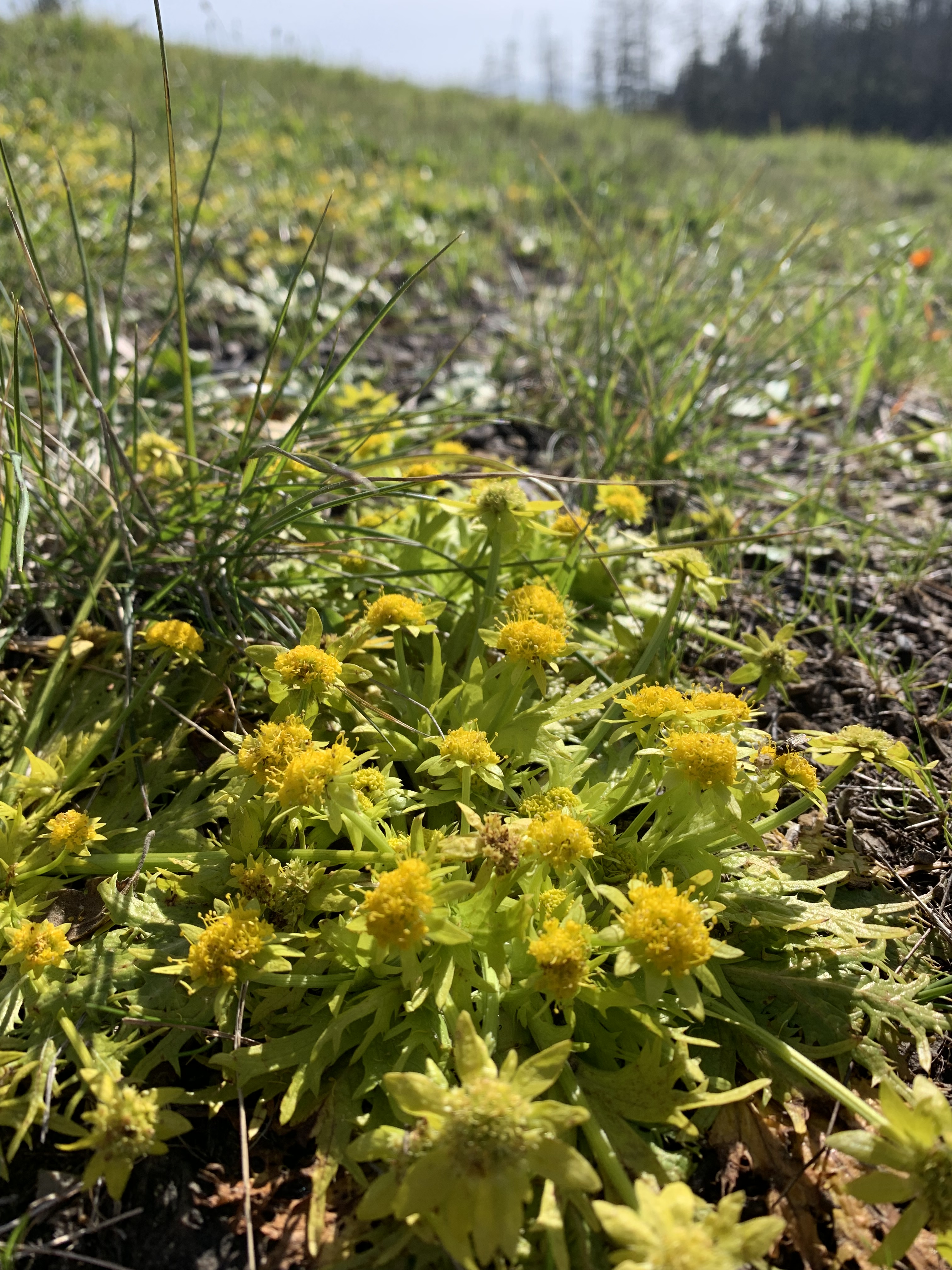
Another in my monthly series challenging readers to stay in touch with the seasons by locating one of the quintessential plants flowering at this moment in Central California. This month’s (March’s) flower: footsteps of spring.

Bare Foot Healthy

Botanists have a history of assigning ironic, sometimes deeply ironic, Latin names to plants. This one’s Latin name is Sanicula arctopoides. Some suggest that going barefoot is good for your health, others suggest caution. This plant’s Latin name does nothing to settle that score. The first name comes from the Latin “Sanus” meaning ‘healthy’ (sanitary, for instance) and its second name is a play on words: “arcto” means ‘bear’ and “poides” refers to ‘foot:’ put the two together and you start sensing the wordplay – “bear foot.” In full, the name means bear foot healthy. I’m not suggesting that the Latin name refers to the horrible and unsupported consumption of bear’s feet for health benefits. Rather, I suppose it was meant to be a twist on words. There has long been controversy over whether or not going bare foot makes for better health. I’ve had hippy friends swear to the benefits of going barefoot – I tried it myself for quite a long time with mixed results. I spent a semester of my undergraduate time in a Costa Rican cloud forest, during which I mostly went bare foot as my shoes otherwise never seemed to dry out. This led to a memorable experience where an itchy blister turned out to be full of maggots, an infection of tropical foot-burrowing flea larvae. That experience was kind of the opposite of this plant’s Latin name translation, “healthy bear (bare) foot.” But, I digress…

Magical Tracks

If there was a magical grassland Sprite calling up the advancing Spring across our meadows, she might dance from one ridge to the next, leaving her first footprints in the form of this gorgeous plant, subsequent waves of other wildflowers and color emanating from her earlier footfalls.

Yellow-Splashed Rocks

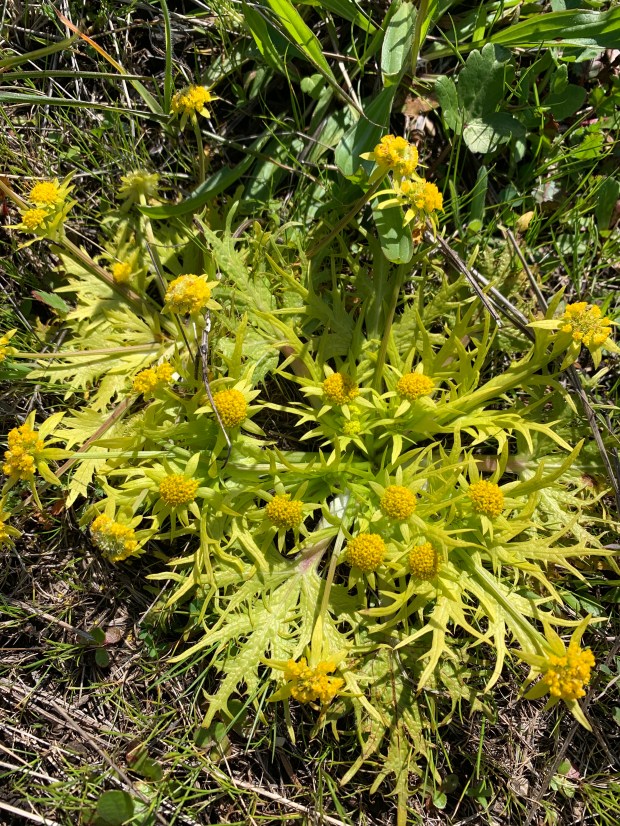
Footsteps of spring plants are the brightest of yellow, but it’s not just the flowers. As the plant starts to make flower clusters, the leaves surrounding the flowers emerge as pale, bright lemon yellow framing the likewise pale yellow flower clusters. The entire plant frames and highlights globe-like clusters of tiny flowers. This species is low-growing – ground-hugging even – and can’t take light competition from surrounding taller plants. And so, patches of footsteps of spring are found on rocky ridge tops or rocky-shelved outcrops especially where the surrounding vegetation consists of grassland species and where soil conditions aren’t conducive to taller, shading, more productive plants.

Smells Like…

I don’t want to prejudice your sniffer, but I am hoping to hear from people about what scent they get from the flowers of this plant. Also, the leaves of the close relatives of this plant normally have interesting odors…one species releases an uncannily cilantro-like scent, for instance.

Whatever scents this wildflower emits, the only types of pollinators I’ve seen visiting the flowers are different types of flies. Maybe the presence of flies as pollinators hints at the scent of the flowers…

-this essay originally published by Bruce Bratton at his weekly blog BrattonOnline.com

It’s Lupine Time

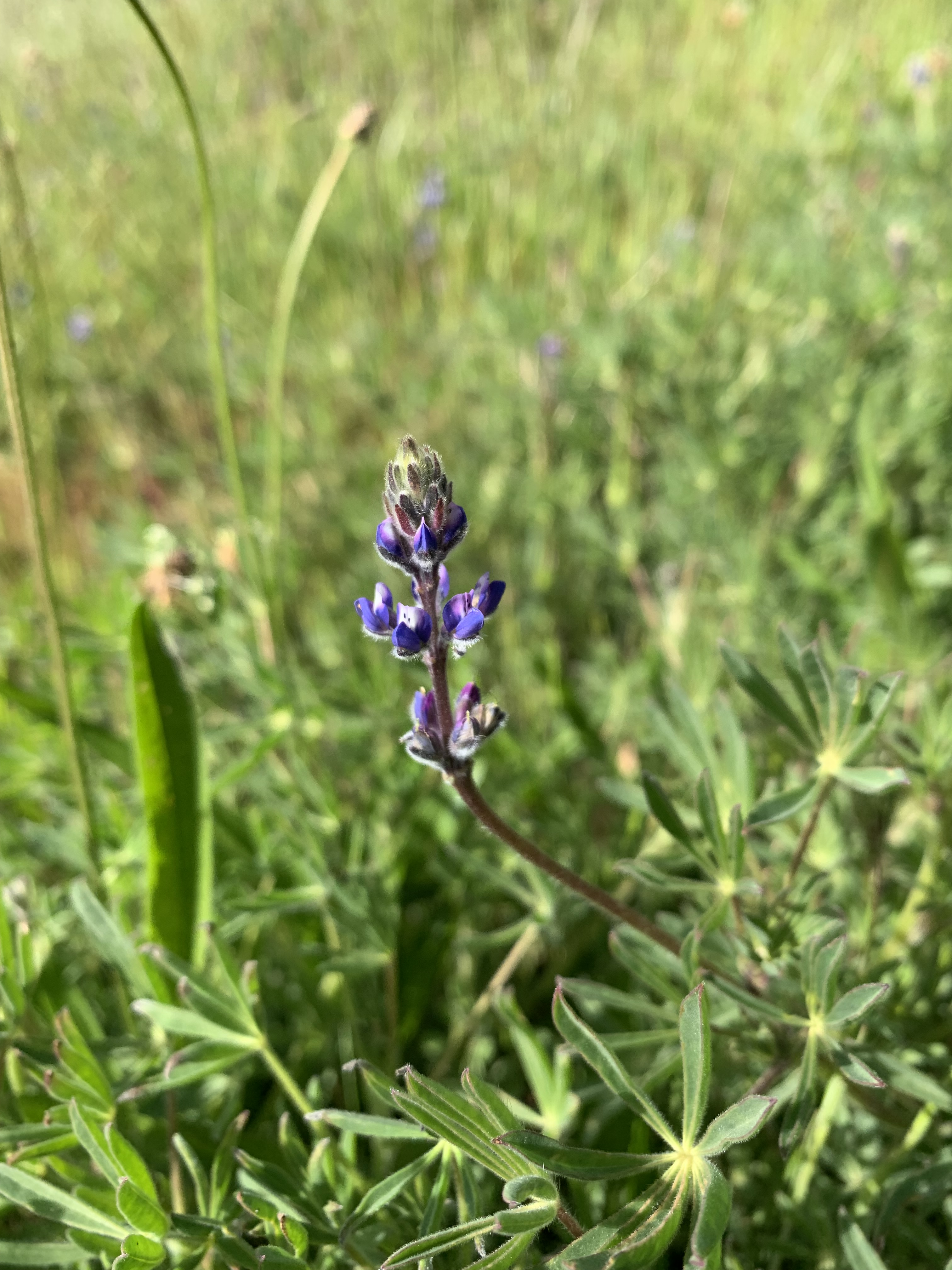
In the local prairies, it is an especially prolific lupine blossoming year. Do you have a favorite place to visit lupines? The most prolific, bright, large flowered annual lupine in our area is called sky lupine, because when it is in full bloom in large fields, it looks like someone turned the world upside down. The scent is heady- it smells purple. For those of us who grew up smelling purple in grape Kool Aid or various artificially flavored grape bubble gums, it makes sense that sky lupine smell purple. In good years, I am able to go to my favorite lupine patches at just the right time when acre upon acre are giving off that scent and making extensive mats of lupine colors.

Lupinus nanus, aka sky lupine, an annual native wildflower that grows best without grassy competition

Lupine Diversity

Lupines are pea family plants. Look carefully, and you’ll recognize that sweet pea shaped flower. Lupines typically have flowers in a spike of tightly packed whorls with older flowers turning to seed pods at the bottom and new flowers opening at the top. Lupine seed pods look like pea pods. Sky lupine pods explode on warm days pitching seeds far from the mother plant.

Sky lupine flowers and seed pods

Sky lupine isn’t the only lupine around, there are many lupine species in Santa Cruz County. It might make a good treasure hunt to try to see them all. According to Dylan Neubauer’s Annotated Checklist of the Vascular Plants of Santa Cruz County, California (every naturalist in the County should have this), there are sixteen lupine species in our tiny county. Sky lupine is the only one to make a big show in the grasslands.

A very modest lupine, Lupinus bicolor, aka ‘miniature lupine’ another of the 16 species of lupines in Santa Cruz County, California

Who Eats Lupines?

Italians eat lupines! Strains of white lupine, Lupinus albus, have been cultivated for food throughout Europe. But you have to grow the right strain- some strains are very toxic! In fact, most lupines are toxic…

Here’s a challenge: find sky lupine leaves that are being eaten by a butterfly or moth caterpillar! In researching this essay, I explored the possibility that some beautiful butterfly larva fed on sky lupine. Nope! Lupines famously have some potent toxins. Some species of lupines poison cattle, though I’ve not heard that livestock owners are concerned about sky lupine around here. There are some butterflies and moths that feed on perennial lupine bushes locally, but none that we know of that feed on sky lupine.

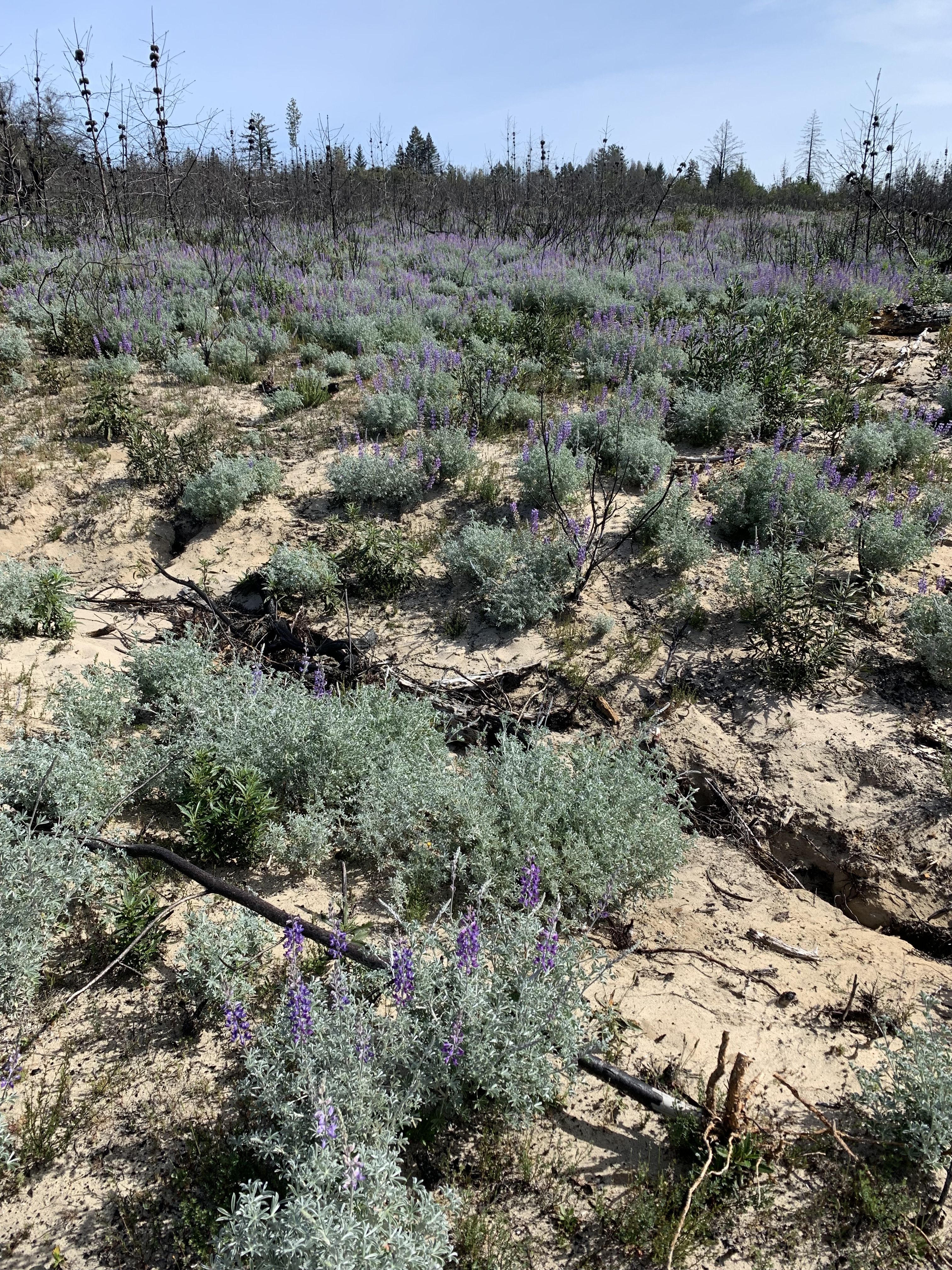
Masses of Lupine propinquus popped up after the 2020 CZU Lightning Complex Fire at Molino Creek Farm

Lupine Pollinators

It isn’t a burden to sit in a sky lupine patch to watch for pollinators. You’ll quickly realize that bumble bees love lupine flowers. And, if you look at those bumblebee legs, you’ll see the distinct yellow orange sky lupine pollen color – they collect big globs of it.

And yet, sky lupine doesn’t need a pollinator, it can self-pollinate. But sky lupine flowers make more seed if they get pollinated by bees. The species has an interesting adaptation- some tiny hairs that prevent self-pollination at first; these hairs wilt with time, allowing self-pollination if all else fails.

Sky lupine mixing it up with California poppy- a common combination and always lovely

Planting Lupines

You might be tempted to plant sky lupine- certainly expensive wildflower mixes contain this species and display its color on the fancy seed packets. However, its not that easy. Sky lupine seeds are tough and unpredictable to germinate. Friends have been sending me pictures from places they’ve never seen sky lupines before- the seeds have been in the soil for decades waiting for the right year to germinate! Check out the seeds, sometime- they are beautifully marked with a shiny, waxy seed coat. The seeds are hard as rocks, meant to last years in the soil.

There are many different types of sky lupine, each adapted to its own microclimate. So, if you really really want to get some sky lupines growing, get to a patch nearby and get local seed- collect the pods as they start to dry. Place the drying pods in a paper bag in the sun and wait. Soon, you’ll get to hear the pods exploding in the bag and you’ll know that you got some good seed. Make sure that the pods and seeds are nice and dry before storing them until next fall. As the first rain storm is predicted, cast the seeds around where you want sky lupine…rake them into the soil if you can…and wait- sometimes for years!

Lupinus albifrons, silver bush lupine, in the Bonny Doon Ecological Reserve- post 2020 fire flush

Lupine Places

Back in the early 1900’s, many regular Santa Cruz citizens would enjoy Spring wildflower trips to the North Coast grasslands to collect wildflowers. They would bring bouquets home with them and garland their hair and clothes with colorful displays. Now, with long mismanagement of many of those grasslands, there are few wildflower patches left. Anyway, if you do find wildflowers, you’re not supposed to pick them anymore. We ought to leave them for whatever remnant populations of rare pollinators might be around, waiting for us to figure out how to better manage the prairies.

Locally, two places to visit sky lupines come to mind. It used to be that the Glenwood Preserve in Scotts Valley had good sky lupine displays, but I haven’t had a report this year. A little drive to the south, and spring always brings great sky lupine displays in the grasslands and oak savannas of Fort Ord National Monument. There’s something particularly appealing to me about the large patches of sandy grasslands full of lupines surrounded by gnarly short coast live oaks at Ft. Ord. Those sky lupine patches are frequently large enough to get that lupine smell, experience that upside down world with the sky on the ground, and thousands of bumble bees bopping around the flowers.

-I originally published this post at Bruce Bratton’s weekly blog BrattonOnline.com

The Early Winter Prairie

This is a slightly edited reprint of my recent column at Bruce Bratton’s online weekly, to which I strongly suggest you subscribe.

Each season life in the coastal prairie changes in hue and character. The many inches of rain and the cold nights fashion the winter’s prairie now turning bright green with life that is gradually emerging from quiescence. Most annual plants have germinated; both annuals and perennials are growing slowly, the sward just 4 inches tall. The first flowers are blossoming, swales and pools abound with water, gophers throw muddy balls out their desperate breathing holes, and frost ices leaf edges, wilting tender new growth. Newborn calves follow their hungrily grazing mothers far to find enough food. Recreational trails through the prairies are frequently stirred muddy messes, destroying life while eroding ancient soils onto the few remaining prairies; bicyclists proudly sport their muddy equipment and clothes. Some signs of early winter prairie are ancient, while others are quite new.

Pop Goes the…

The first native coastal prairie wildflowers are related to broccoli and celery. Popweed and peppergrass are in bloom, relatives of broccoli. These are a tiny plants on shallow soil or along trails and the sparrow-grazed edges of shrubs…or on last year’s badger or gopher mounds. They have little white flowers with 4 petals that seem to twinkle almost like glitter brightening the prairie. After flowering, popweed makes elongated pods that dry and then ‘pop’ sending seeds further than you might think possible from such a small plant. The U.S. gave popweed to the rest of the world…as a pest! You are probably more likely to encounter both of these plants in sidewalk cracks or (popweed) in potted plants in town. I’ve had the unpleasant experience of getting popweed seeds in my eye more than once, a victim of the barrage of flinging seeds from one of these weeds hiding in a pot that I was moving in my nursery.

Who Spilled the Yellow Paint?

The other very early prairie wildflower is starting to show color. It is called ‘footsteps of spring.’ It has the botanical name Sanicula arctopoides – that last word of its name being a botanical pun: “arcto” for bear and “poides” for foot: barefoot (harr harr!) footsteps (guffaw!) of spring … chuckle-chuckle go those goofy botanists. The name seems right somehow if you think Spring leaves footprints when she arrives: the first really bright thing is this plant- the entire 8” across flat plant turns a surprisingly vibrant yellow framing similarly yellow clusters of flowers. These wildflowers tend to make patches on shallow-soiled ridgelets and outcrops in the prairie. And so, Spring seems to have left footprints with her arrival as she danced from ridge to ridge and across rocky pathways to awaken the prairie from its moist green wintery slumber.

Prairies as Wetlands

Many people are surprised that many of our prairies are wetlands, but if you wander out there now, you’ll become a believer. Coastal Terrace Prairies are on flat ground, mostly along the ancient wavecut and uplifted coastal terraces within a few miles of the coast. Housing and agriculture cover most of the first terrace, the one right above the ocean, but there are extensive prairies on the second, third, and fourth terraces. Look uphill and inland of Highway 1 on the North Coast, for instance. Being flat, coastal terraces don’t drain well and so are apt to have long periods of saturated soil, which is a key attribute of wetlands. In some places, there’s water pooled across the soil surface, but mostly the soil is just so wet that only plant species adapted to wetlands can survive. Walk across these areas and you’ll find shimmering rivulets snaking among the grasses downhill to add water to creeks. Along the edges of these squishy grasslands are seeps and springs oozing and gushing with plentiful water now and remaining green late into spring. In mima mounds and on rocky areas on the terraces, you might find vernal pools- small ephemeral ponds with chorus frog or toad tadpoles, festooned with curious alga and teeming with zooplankton.

Grassy Carpet

Looking broadly across the prairies, grasses are mostly what you see, but slimy things are hiding underneath. Perennial grasses, many of them million-year natives, are waking underground with only the slightest sign in their leaves; their tiny leaves are green, but their new white roots have already grown inches into the surrounding soil, quickly claiming as wide an area as possible. They compete against quicker-growing annual grasses, most of them here for just a few hundred years; these get tall faster and shade natives, inhibiting many native plants from establishing from seed. Without something like the ancient megafaunal grazing regimes, the non-native annuals create a (relatively) towering canopy protecting slugs and snails from bird. Under the grassy protection, mollusks devour the nutrient-rich native annual wildflower seedlings before they stand a chance.

Cows = Flowers

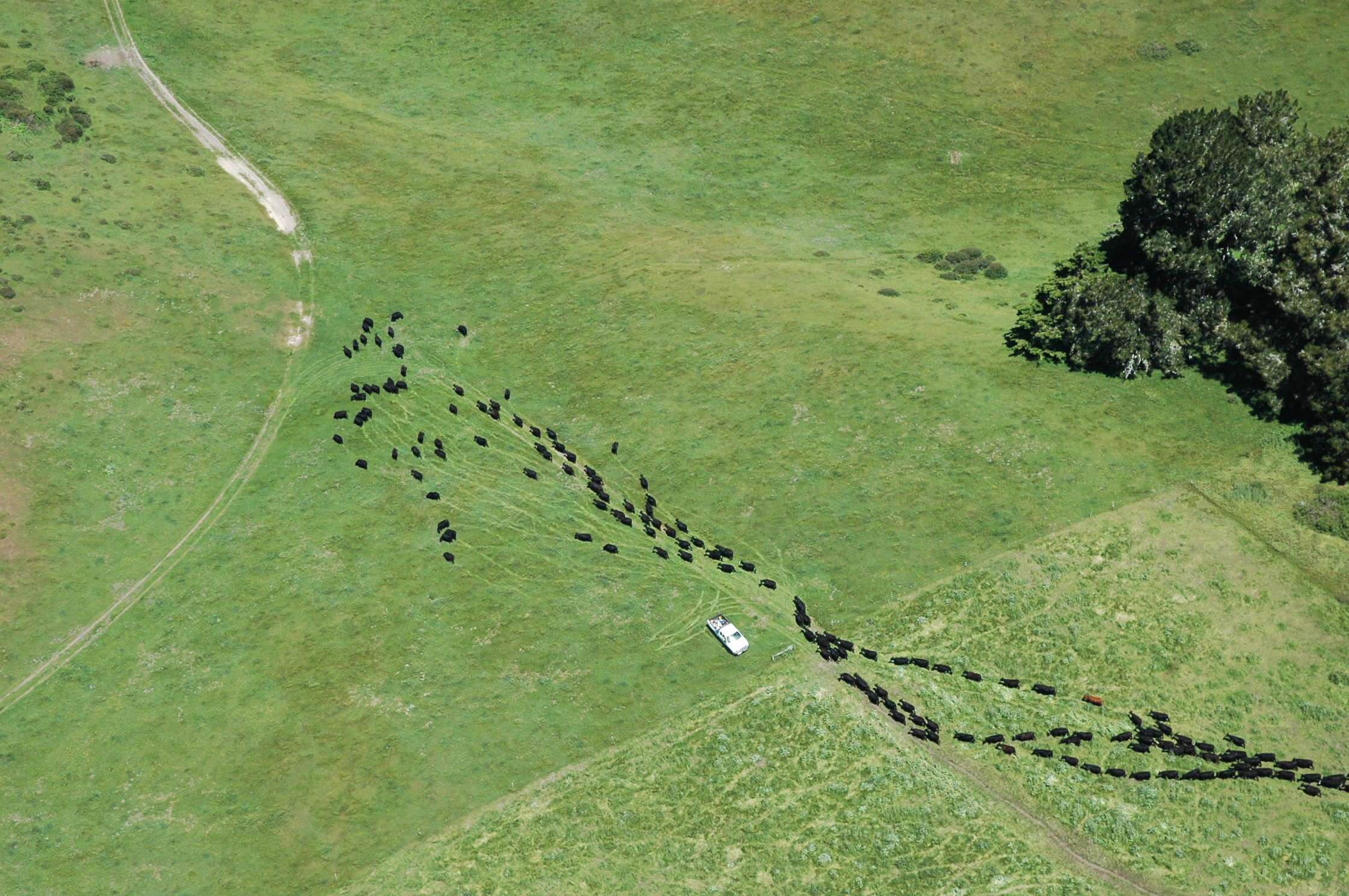
In some places, cattle graze the prairies, maintaining some semblance of the evolutionary disturbance regimes that coastal prairie diversity requires. Betting on a better yearling market, some local cattle ranchers set the bulls free among the heifers at a time that makes for calves right now. This is a difficult time for raising a calf – despite the slow growing lush grasses, there’s very little protein in those leaves. To make enough milk, the mothers must constantly graze, cropping the prairie short. Flocks of birds follow the cattle for the food they expose along the way. Research UCSC Professor Karen Holl and I have performed over the past many years has shown that cattle grazing in coastal prairie creates more abundant and more diverse native annual wildflowers than adjoining ungrazed areas. Cattle grazing, cow trails and the lightly driven ranch roads that accompany livestock also make for excellent habitat for the rarest of beetles…the Ohlone tiger beetle.

OTB

The Ohlone tiger beetle is emerging from its burrows now, bright metallic green-blue carapaces like finest jewels of our local prairies. This species is only found in a handful of grasslands near Santa Cruz. On sunny, warmer days, it forages for invertebrates along open trails in only the most diverse coastal prairies. Those sunny warm days also attract mountain bikers who cruise so swiftly along the trails – including miles of trails that are not sanctioned by the landowners – as to smash innumerable of these endangered insects. Just last week, a colleague visited the Mima Meadow at UC Santa Cruz to find many smashed, most probably killed by fast-moving bicyclists. The carcasses were on a trail not sanctioned for bicyclist use and even in an area the University, as a legal mandate from the US Fish and Wildlife Service, has set aside expressly for beetle conservation. If court cases from Florida are any precedent, the University could be held liable for the death of a federally protected endangered species…and penalized. Perhaps that’s what it would take for the University to enforce the protection of this area.

Muddy Mess

Perhaps one could understand a University’s difficulty in managing natural areas, but what about our State Park managers? Many of the coastal prairie trails at Wilder Ranch State Park once had Ohlone tiger beetles, but State Parks destroyed much of that habitat by dumping tons of gravel to ‘harden’ the trails as a ‘solution’ to allowing recreational access during the muddy winters. Parks staff subsequently decided to manage a small remnant area (successfully) for this endangered species. Even so, coastal prairie trails are a muddy mess these days, and use only stirs up that mud, loosening it so that it washes off into the surrounding grasslands. Those extra nutrients spur weedy growth and destroy wildflowers. Meanwhile the incising and eroding trails serve to drain the surrounding wet meadows, an alteration that also degrades the habitat. Shame on users and managers alike for destroying eons of evolution and a legacy for future generations! If you see the (rare) ‘trails closed’ signs…which are almost always (if present) defaced and thrown aside…please prop them back up and go for a forest walk, instead.

Rain Awakes the Prairie

– from my 10/27/21 column at the highly recommended Bratton Online site

The rain is awakening the prairies; it is also time we awoke to the preciousness of these grassland habitats. Already, enough rain has fallen to wet the ground and trigger seed germination in the local meadows. Perennial flowers and grasses have also quickly flushed with new green shoots. The rains have brought migrating winter wildlife, increasingly threatened because, each year, there are fewer acres of grassland to which to return. It is because native peoples tended prairies that we have any prairies at all in our region. Now, together with indigenous peoples, we are relearning how to restore meadows. With attention and intention, we may one day witness the restoration of healthy populations of badger and burrowing owl living in flowered-filled meadows across the Central Coast. For this to succeed depends on more people sharing more coastal prairie wisdom. With that wisdom, together we can build and pass on new stories to future generations (and new arrivals) so that we might maintain grasslands and their many associated species.

Meadow Showers

Rain is soaking in, darkening the rich prairie soil with newfound moisture. Green patches of seedlings first appear along trails, on gopher mounds and other areas with less thatch. Soon, seedlings will also emerge from under the thick skeletons of prior years’ dead plants. Inhale the moist, cool air slowly, and you may detect new rainfall-induced scents. The first that strikes me is the pungent smell of mouse pee. Grasslands are thick with rodents and, for six months, mouse urine has been drying and concentrating on the soil surface. Now, that nutrient source has been re-wetted and is being soaked into the root zone, and it smells strongly throughout meadows. Beyond that scent, there is petrichor, the complex ‘fresh rain’ smell made up in part by compounds related to the scent essences of both cedar and beet root. With the new rain, I detect another smell…wet hay. When rain first falls, there’s a strong smell of newly moistened hay, and that scent turns quickly and sharply mushroomy. After a week of the first big rains, if you grab ahold of a thick mat of dead grass and pull- it will easily peel from the soil surface only clinging to a little soil. It will be held together with what look like bright white roots. These are fungal threads, soon to be better evidenced by their more familiar “fruiting bodies” – especially the familiar grassland types…puffballs and other fairy ring mushrooms. As if anticipating the quickly emerging life, new bird species arrived in the meadows just prior to the rains.

The Grassland’s Wet Season Birds

I had travelled a hundred times through one particular and expansive grassland and was startled to be reunited one morning with my favorite grassland bird: the meadowlark! These birds are almost as big as robins and have long stout pointy bills, yellow undersides and have long streaks combining yellow, brown, and black on their upper bodies. Their songs are loud and distinct – a signature noise of grasslands throughout the United States. Meadowlarks nest, eat, and sleep in wide open prairies. The flock I encountered that first day of their return was about 40 birds. Last I counted, three weeks into their winter stay, this tribe remained around that number. My bird guidebook’s range map suggests that western meadowlarks reside year-round around here, but that’s a national map evidently without fine enough scale for our particular rsituation. This local meadowlark group must nest elsewhere, in the spring and summer. In winter, our meadowlark clans join another very special winter-only prairie bird: the burrowing owl. Burrowing owls don’t dig, but they live in holes. Every winter, they surprise me as they flush from different kinds of holes: ground squirrel burrows, road culverts and agricultural pipes. When UCSC’s Seymour Center rat Terrace Point was still mostly surrounded by open meadows, burrowing owls could easily be seen in ground squirrel burrows on the berms piled up when someone was kind enough to try to hide the buildings. Those berms have been since bulldozed. UCSC also rousted burrowing owls from their last local nesting location when they paved the ‘remote’ parking lots. Given the chance, UCSC will continue paving over the increasingly endangered burrowing owl meadow habitat. Get it while you can, Regents! Your actions will literally pave the way for burrowing owls to become so rare they must be protected as endangered species by the State and Federal governments…saddling private landowners with even more regulatory burden. Meanwhile, we are lucky to have this owl, with tall yellow legs and huge, cute eyes; they can be found in the winter at UCSC and across the North Coast’s grasslands. Look for it vigorously bobbing its whole body while staring at you from quite a distance while it guards its precious sleeping hole.

Upland Newts??

The recent rains also bring another grassland critter to our attention: newts! Hiking over the freshly greening grass, I glanced into the mouth of a gopher hole: surprise! Looking back at me were the golden cat eyes of a rough skinned newt. Hands forward, this critter is like Dracula awaiting sun set to mosey out off its underground lair. That night, with the rain pattering down, it walked half a mile across the meadow, before sniffing out another unoccupied hole for the next day. Nocturnally travelling with uncanny directionality it joined an increasingly large group of its brethren, creating a river of newts, some of which made it across the road before sliding down the bank into a large breeding pond. Newts love the dry grasslands- that’s where they live most of the time, foraging all summer long in the cool darkness of rodent burrows. We think of them as stream or pond organisms, but mostly they are grassland creatures.

An Abbreviated Grassland Management History

Our local grasslands and their associated wildlife owe their presence to thousands of years of tending by native peoples. Without that tending, there would have been no ‘pasture’ for the invading old world cultures to graze livestock on. Indigenous cultures honed complex management activities to steward grasslands species. They used prescribed fire in small and large patches, at varying times and intensities to favor their desired outcomes. They cultivated plant species without our modern (gross) tractor tools.  They enjoyed a legendary favorite prairie feast that we can relate to involving prairie grown greens- salads full of diverse, freshly gathered tasty leaves and flowers especially from clovers. Their meadow tending created new cultivars and species. Plants provided food, medicine, basketry materials, clothing, tools, art, and so much more. Their management activities not only focused on plants but also wildlife management. Many of us would dearly love to have seen those prairie gardens.

After the Fall

After the genocide of the indigenous peoples, ranchers were responsible for maintaining open grasslands. Ranchers still manage many of the grasslands, but many are increasingly owned by public or private open space managers. Most recently, we have been moving towards relearning how to keep our prairies healthy. California native grasslands are one of the top ten most endangered ecosystems in the United States. More coastal prairie (grasslands in the fog belt) have been lost to pavement (‘urbanization’) than any other habitat in the USA. And coastal prairies are the most species-rich grasslands in North America. There are 80 plants species that only live in California’s coastal prairies. One third of all rare plant species in California are found only in grasslands. There are many plant and wildlife species in our local grasslands that are already recognized as endangered, and many more qualify for inclusion on state or federal endangered species lists.

Relearning

Amah Mutsun stewards are relearning alongside many others how to steward prairies. Far up the North Coast, the Amah Mutsun have been working with State Parks to remove shrubs and trees that have invaded ancient meadows. Elsewhere, State Parks has long had a prescribed fire program to restore prairie habitats. While the City of Santa Cruz effectively destroyed the meadows at Arana Gulch by fragmenting them with roads, City Parks staff are experimenting with prairie management regimes including grazing. The Land Trust of Santa Cruz County is working hard to restore and maintain the Scotts Valley grasslands at Glenwood Open Space Preserve. For decades, weed warriors with the Ken Moore’s Wildlands Restoration Team, the California Native Plant Society and the Land Trust have been responsible for rescuing meadows from weeds, especially French broom. We are making great progress and learning a lot. Grassland restoration is extremely rewarding because you can so quickly see a positive response. But, we must do more…

Please discuss some of this essay with someone while its fresh in your mind, say in the next week. Without more awareness, we will have no grasslands to restore and poor badger and burrowing owl, meadowlark and newt won’t have homes anymore.