apples

A Keen Balance of Heat and Cool (but then smoke)

The balance works out just right between night and day temperatures recently. The nights have windows open, cooling the house, providing fresh air and cricket chorus; the days are warm almost hot, almost warming too much, windows get closed….then the sun goes down and windows open, fresh air pouring in. Perfect comfort, naturally.

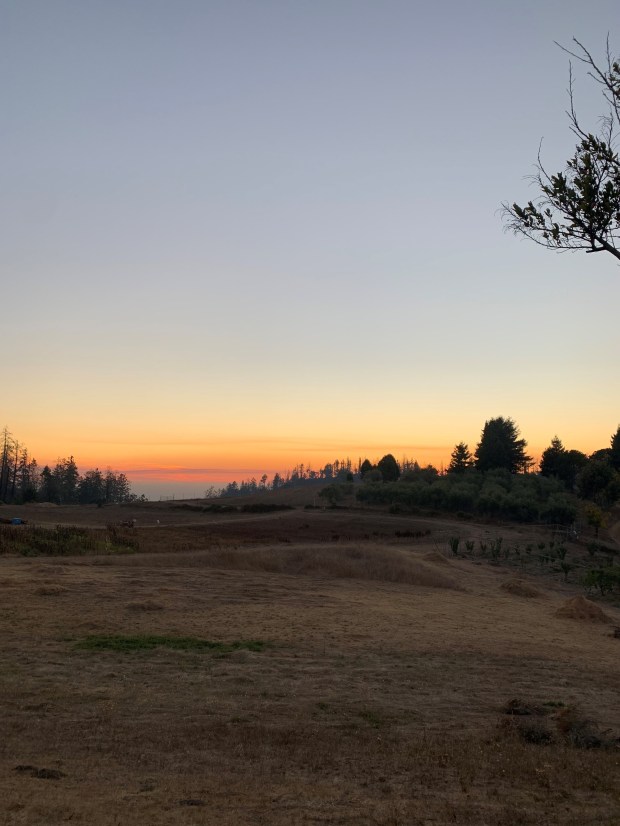
The Smoke from Prescribed Fire Makes for a Pretty Sunset

And so it was today, windows closed, an afternoon break and a glance outside reveals “OH NO!!” Smoke!!!!! The view outside was through the all-too-familiar haze that means fire somewhere: where?! Stepping outside, the characteristic smell of brush burning a ways away. Waves of denser or less dense smoke walk across the landscape, slowly – barely a breeze. Bob Brunie says he heard on the radio of a fire in Boulder Creek that had been put out, but Sylvie says it is a CAL FIRE-directed prescribed fire in the San Gregorio and Pomponio, according to the WatchDuty App on her phone. Oh good…so glad that’s what it was! And, the smoke magically changes from unwelcome and scary to welcome and thankful. So it goes. Made for an interesting sunset. Our farm will do a similar thing with the Central Coast Prescribed Burn Association soon – fuel reduction through good fire! Our smoke will cause some concern, we thinks.

What Do the Birds Think?

The smoke probably gives everyone pause, birds included. The migratory ones will recall smelling smoke and maybe even seeing flames during their journeys to our Farm this Fall: does the current smoke make them fearful? Carpets of scratching juncos and sparrows bob and hop through the churned-up dead grass, chipping and cheeping all day long, looking for food. As I approach the flocks, wrens erupt with their scratchy warning scolding alarms. Midday and coveys of quail flow from the thick patches of brush nervously crossing open spaces to sources of water, dipping and sipping, someone always keeping an eye out for danger.

Oozing holes in the orchard trees and the telltale PEENT! Gives notice that the red-breasted sapsucker(s?) have returned for the winter. Tommy Williams recently shared a photo of a burrowing owl somewhere nearby- they, too, have returned for the short-days season. As dusk dims, several poor wills flush in front of cars rolling along the very dusty road. And then, a stream of big bats sally from the barn, flapping quickly away, out of sight, a long night of foraging for bugs ahead.

Wall O’ Wickson (crab apples)

The Harvest

The flip side of the hungry, fruitless beginning of summer is right now, the middle of Fall. We are mid harvest in the orchard, which started in August and will continue through February this year. Next year, the harvest will go year-round as more avocado types make fruit. The early fruit is gone: the last of the prunes in the fridge are shriveling, the final gala apples are headed to market (and press). The middle season apples are ripening: grenadine is a favorite, as is Hudson’s golden gem, Bramley, Cox’s orange pippin, golden delicious, and so many more. Thanks to Freddie Menge for tipping us off to plant two dozen Wickson crab apples: we have the Wall O’ Wicksons now- a massive conglomerate of tiny red tartness bedecking the ‘left bank’ of the orchard. This is their First Big Year. We didn’t have enough props for them, and one ripped itself apart right into the ground with the weight of the fruit.

Quince are ripening

Quince are ripening!

The mandarins, limes, and Meyer lemons are also starting to ripen on Citrus Hill. Those types of fruit will extend the harvest into February when MAYBE we get some avocados for the first time since the 2020 fire set back so many trees.

In the Fields

In the farm fields, there are peppers. Two Dog Farm has a field with row after row of tiny bushes laden with peppers from dark green to bright red. Nearby, their winter squash abundance is tantalizing. Butternut squash makes for the best ‘pumpkin’ pie, and you could walk across an acre of those beautiful fruit. A very few tomatoes hang on in their own fields, maybe perking up from the heat waves…we hope for at least a trickle of harvest for a bit longer.

Logs Out

We LOVE our neighbors who, with the help of Nadia Hamey and her crew with Hamey Woods, have made our egress route a thousand times safer. The Big Hill was Dangerous, the Douglas firs burned up in the wildfire- then, dangerously perched on either side of the road awaiting windstorm or decay to come crashing down. A month ago, the saws revved and whirred for so long, trees crashing down, cut into logs, hauled into piles by huge machinery. This past week, the piles got picked up and hauled out: a changed and safer landscape. So much dust, so much noise…such an amazing amount of energy, work, and money. The effects of the fire are still with us, but smart and kind people are still mitigating the effects to great benefit. Thank you!

Birthday Boy

One of our newest members, Bodhi Grace, will soon celebrate his birthday by having the first party in the Barn in quite some time. He drained and cleaned the Cement Pond, wetting the periphery of the barn for dust and fire.  That old barn is about to rock. Happy Birthday Bodhi!!!
Equinox

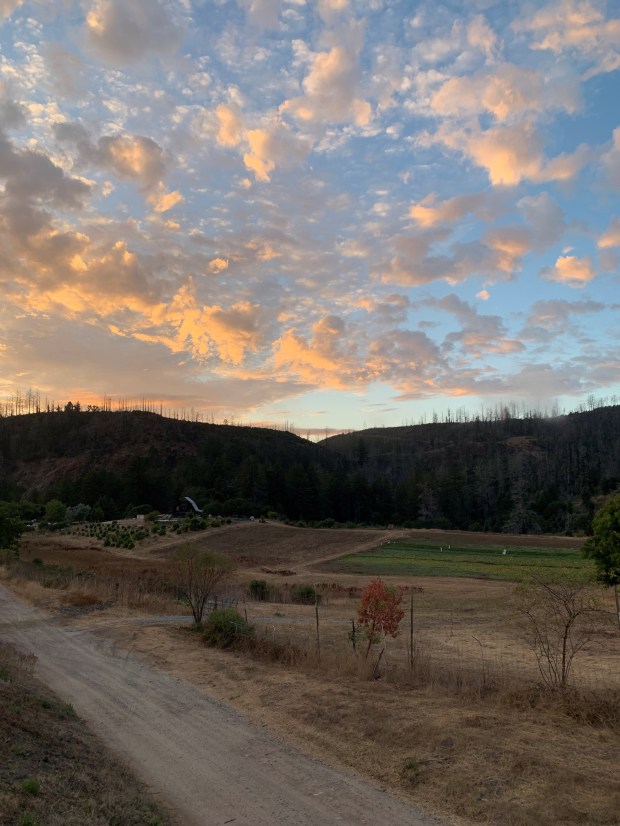
Three layers of clouds moving in different ways for different reasons woof in the soon-to-be rainy season. Time to put up firewood and stuff.

Sunset peach clounds dance above the barn, fields falling into darkness. The day’s last colors.

Another cool night pinches the sweetness into the many ripening apples.

This week spells big transitions for the Farm in another way. Day by day, each morning the chainsaws got closer and finally they emerged from Above to Here this week.

Burned Tree Control along Warrenella, Thanks to San Vicente Redwoods Conservation Partnership, photo by Sylvie Childress

Changes on the Land

We have made great progress each year after the 2020 CZU Lightning Complex Fire blasted its way into our lives and across the property. The Big Leap recently was the clearing of hundreds of dead trees along the most proximate stretch of Warrenella Road. Our Good Neighbors have found the capacity to clear the trees that were killed or badly damaged by the fire…each and every tree that could have otherwise fallen across our road is now on the ground. Massive numbers of tree skeletons suddenly lying on their sides. (that particular area carpeted with a kind of yellow-flowering groundcover deer brush last spring).

Several close calls with waves of rain from the North this past week help the Fear of Fire fade, but it hasn’t yet become wet enough to allow the relaxation of winter rains’ wildfire reprieve.

Tomatoes!

The lack of rain relieves the tomato growers because wet tomato plants can undergo late season fungal and other blight disease melt down. The acres of tomatoes lie heavy with juicy red ripe fruit that we can’t really keep up with harvesting: too many tons all at once, and where would we sell them all anyhow? Pots full of sauce ladled into canning jars. Humming hot blowers from dryers, trays of tomatoes shrinking. Sweet, sweet tomatoes! Our favorite season. Comparing what each other can DO with them: a tasty half-dry/reduced chopped tomato relish brightened with Calabrian pepper oil a recent favorite from fabulous cook Mark Kuempel (thanks!).

Sunset on the Farm

The Deer

The Deer are (still) busy eating up apple culls. A GIANT buck proudly stands tall with excellent contrasting patches of remarkable white and black. Sylvie’s ear caught the Most Curious of Deer noises: ‘a whirly-gig’ she said. Here’s a link to the surprising noise, in the first few seconds. OH! How odd the rutting season!! We have never had so many bucks so close up; perhaps the fire made a lot of deer food and the population is headed high.

Apples

During our regular, well-attended working bee, we had an ad hoc apple tasting last weekend and found some pretty surprising results. The Cox’s Orange Pippin was almost ripe and ripe enough to cause yummy noises as well as some picking. An offspring of hybridization of that one, the Rubinette, also to a lesser degree caused some ‘oohing’ and taking of almost ripe fruit home. Areas of Fuji were getting nearly as ripe as the Galas, both at least a week away. The frightening part of this news is….there is a good chance that most of the 9,000+ pounds of fruit we have in front of us will ripen nearly simultaneously. Here comes the juice….a jolly pressing matter.

Harvest

So, yes, this is the season of harvest. Out in the fields gathering, hauling boxes and buckets back to the Barn for packaging for market, driving vehicles weighted down with food miles and miles to sell. Out early back late, hefting sore muscles balanced by glowingly thankful faces, friends, strangers all in awe of the best food on Earth. Molino Groupies. Two Dog Groupies. Unbelievable! People with Molino Creek Farm Tee shirts from years and years ago, hefting Molino Creek bags. Cheering friends welcoming the food we continue to produce from this verdant land. The harvest won’t last long. We are lucky if the food keeps coming in until Thanksgiving: just 2 more months if the weather holds! This is why we try to preserve the season’s flavorful foods by straight up canning, or roasting and then canning. Dried or canned tomatoes shifting to dried apples or canned applesauce. The prunes, however, aren’t so numerous and the competition for the best prune desserts is ON around the Farm.

Harvest Company

Whatever one does outside, one has company. Face flies and other summer flies are at their zenith. The newly born and mother cows on our drive out are covered with them, but we are just annoyed. The buzzing buggers dive over and over into your ear or make your eyes continually squint and blink as they bombard, zig-zag, or dive for a taste of you. Battling those annoying flies are the legions of dragonflies patrolling the air in patches; we could use more to vacuum up the more annoying flies.

Full Moon, Equinox Coming

This coming Sunday at about half past 5 in the morning we will cross the line where day length is equal to the hours of night. Fall Equinox marks the turn towards night, towards the long cold, onto California’s rainy season. One more month, October 15 is the date of the average commencement of rainstorms. Sometimes we can get a lot of rain just before then. Approaching this High Holiday was the Full Moon we just passed making the sky glow like day all night long.

We hope you had a Good Full Moon and will take some time on Sunday to reflect on the changing times.

An Unusual Dreariness of Spring

Drizzle and fog surprised us this past week as dew-covered wildflowers blossomed, buried in tall soggy grass. The weather forecasters had said it would be sunny, but something changed and suddenly the outlook went to partly, and then mostly, cloudy. Gusts blew tiny misty droplets against the windows. Trees caught the mist, making showers in rings, illustrating ‘driplines’ on the previously dusty roads.

Drying

But the mist and drizzle were not enough. The soil is drying. The 2 inches of late rain two weeks ago can no longer forestall the normal drying of our Mediterranean summer. A day of stiff, dry winds from the north wicked away the moister 2” down into the soil and the drying keeps reaching deeper. The long days keep the plant transpiration pumps pumping. The prairies won’t be green much longer. The orchard trees need water starting now.

Eye Hurtingly Beautiful

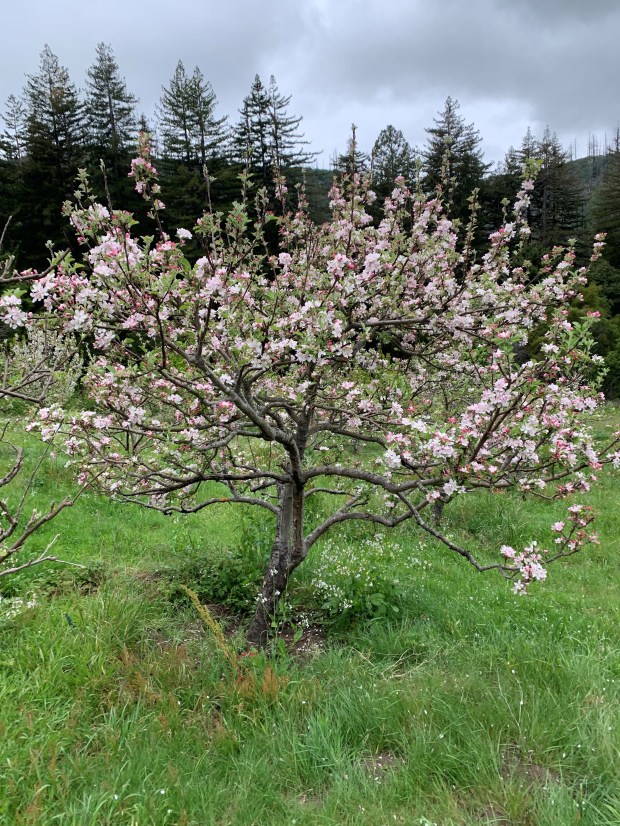
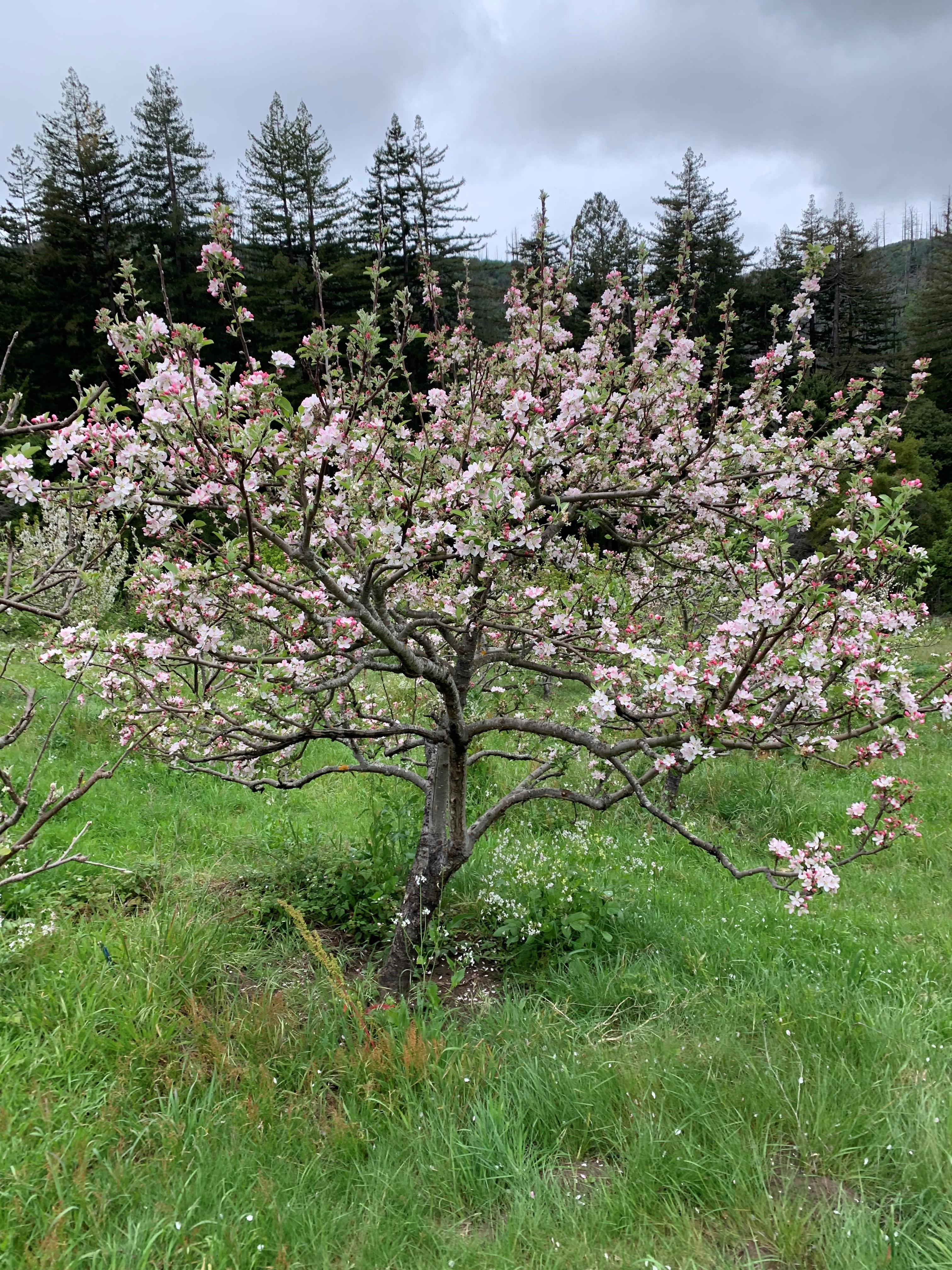
The flowers bursting forth in the apple orchard are stunning. Artists! Ganderers! It is time to bask in the dizziness that only a grove full of apple blossoms can impart. Sauntering around the farm, I take what I expect will be the normal short tangential turn into the apple orchard. Soon, I am stumbling around, not paying enough attention to footing, going from tree to tree, from one palette of pink and white and red blossoms to another, slightly more white or slightly more pink…some petals more lush, some clusters more diffuse…some flowers displayed in widely spaced massive shelf platforms…others arranged in small, tightly spaced clusters of polka-dot-like puffs for long distances along branches. Petals falling like snow on the breeze. Pale green points of new leaves poke forth from buds. Lush grass and flowers in understory tufts. Bees, hummingbirds, and flocks of tiny peeping juncos dart and dance with the beauty. An hour later, driven out by the dwindling daylight, I emerge from the orchard bedazzled and grinning from the ‘short tangent’ of my evening walk.

Soil Fields

In stark contrast to the orchard full of life are acres of brown, tilled ground. Life there is under the surface among clod and crumb where worms and millipedes and a million tinier things wriggle and crawl. It is cool and damp below the plowed surface where no plant now grows. We conserve a winter of rain by making the top foot of soil into mulch, and it takes a lot of turns of the tractor to make that happen. And so we set the stage where the drama of dry farming tomatoes is starting to take place.

First Tomato Day

The greenhouse grown tomato seedlings are tall and lanky and so take delicate hands to carefully place them in holes dug deep through the loose, tractor worked ground. The first seedlings went in the ground today, April 24, 2024! There are so many more plants to nestle into their homes. The big empty fields fill slowly, thousands of deep knee bends, hours of meditative labor, months before getting any income from this year’s crop. Such is the gamble and the hope.

Our First Ground Squirrel

Ground squirrels have been spreading across the landscape. They probably were here before and probably were effectively poisoned out when poisoning the landscape was in vogue. A single ground squirrel bounds across the road into various hiding places down by the big walnut tree many times a day, seen by many people. This squirrel is a keystone species for our prairies, making deep burrows that are critical for other creatures to make it through the hot, dry summer, and through fires, too. Burrowing owls need those holes for nests. Golden eagles’ and badgers’ favorite food is ground squirrels. Ground squirrel burrow complexes also may assist with groundwater recharge. The squirrels make habitat for wildflowers as they graze down invasive grasses. Bubonic plague is ubiquitous in ground squirrel populations, too! And, they undermine houses and roads with those burrows. Farmers and ranchers think of ground squirrels as pests for eating their crops. What are we to do with this first explorer of an astronaut squirrel?

The Individuality of Trees

Just as every apple tree has character, the live oaks too show individuality. We are fortunate to have several groves of live oaks on the farm that survived the 2020 wildfire. One grove thrived because we had mowed around it and then were vigilant with wetting them with fire hoses when the fire raged – it was too close to the barn and other buildings to allow it to burn. The various trees of this grove are displaying the range of traits typical of coast live oaks. New leaves are flushing: these ‘evergreen’ oaks nevertheless mostly replace last year’s leaves around now. The fresh leaves are emerging at different times and in different shades of green, depending on the individual tree. Some are already in bloom, long pollen bearing tassels waving in the wind. Other trees haven’t shown any blossoms yet at all. The lush new growth is forming densely green, bushy canopies, These deep-rooted trees will continue to be that kind of vibrantly alive for a few more months…long after the grass has dried brown.

Lupines!

Each year, as a result of our careful stewardship, we get more and more sky lupines. This year is the biggest year yet. Patches of sky lupines are mostly mixed with California poppies. There is something so very right about the mix of wide-petaled, fiery orange poppy flowers mixed with lines and waves of spikes of whorled blue-and-white lupine flowers. It hasn’t yet been warm and still long enough to get the grape bubble gum scent clouds emanating from the lupine patches. Between these fields of wildflowers and the orchards full of blossoming trees, the bees have lots of choices. We are glad they are getting enough food to grow big families on our farm, a haven for pollinators.

Rest Impending

The sun grows distant, already so far South, days so brief. Rain has moistened everywhere. Fall is sweeping the farm, triggering bright leaf colors, tree-by-tree, each evening stroll revealing new tones in new places.

The ground blushes newly green from the previous expanse of dark brown soil or gray aged thatch. Millions of seeds germinated on the much-anticipated first significant rainfall this past week. Pairs of many-patterned leaves unfurl from different types of flower seeds while single first grass leaves poke straight up.

More wetting storms are approaching, pushing southward from the distant northern horizon. Beautiful clouds appear, sometimes a skyfull of feathery patterns, other times ominous heavy gray huge pillows. Layers of clouds above oceanward fog are often accentuated by sparkling orange pulses in between them at sunset.

Muffled Song

As the winter approaches, birds become more quiet, their songs more concise. Bird-eating hawks swoop and wheel, frightening seed- and seedling-fattened flocks. Silent spells with no song signals hawk. The consistent whispered squeaks and chirps suggest hawk absence as groups of quail, sparrows, and juncos slowly emerge from cover, pecking up thousands of tasty sprouts; their favorites are abundant: clovers, filaree, medic, lupine, poppy, wild lettuce, and dock. Full bills, filling tummies, hunger satisfied peaceful birds prepare for long stormy wet nights. Each evening at sundown, flocks huddle together in dense clusters surrounded by protective thick tree or shrub canopies. They have already negotiated safe roost locations and even their individual places in the rows along branches. There are a few squabbles at dusk in the roost locations as some on the edges realize disadvantages of their relegated positions. By dark, they have become politely quiet and still.

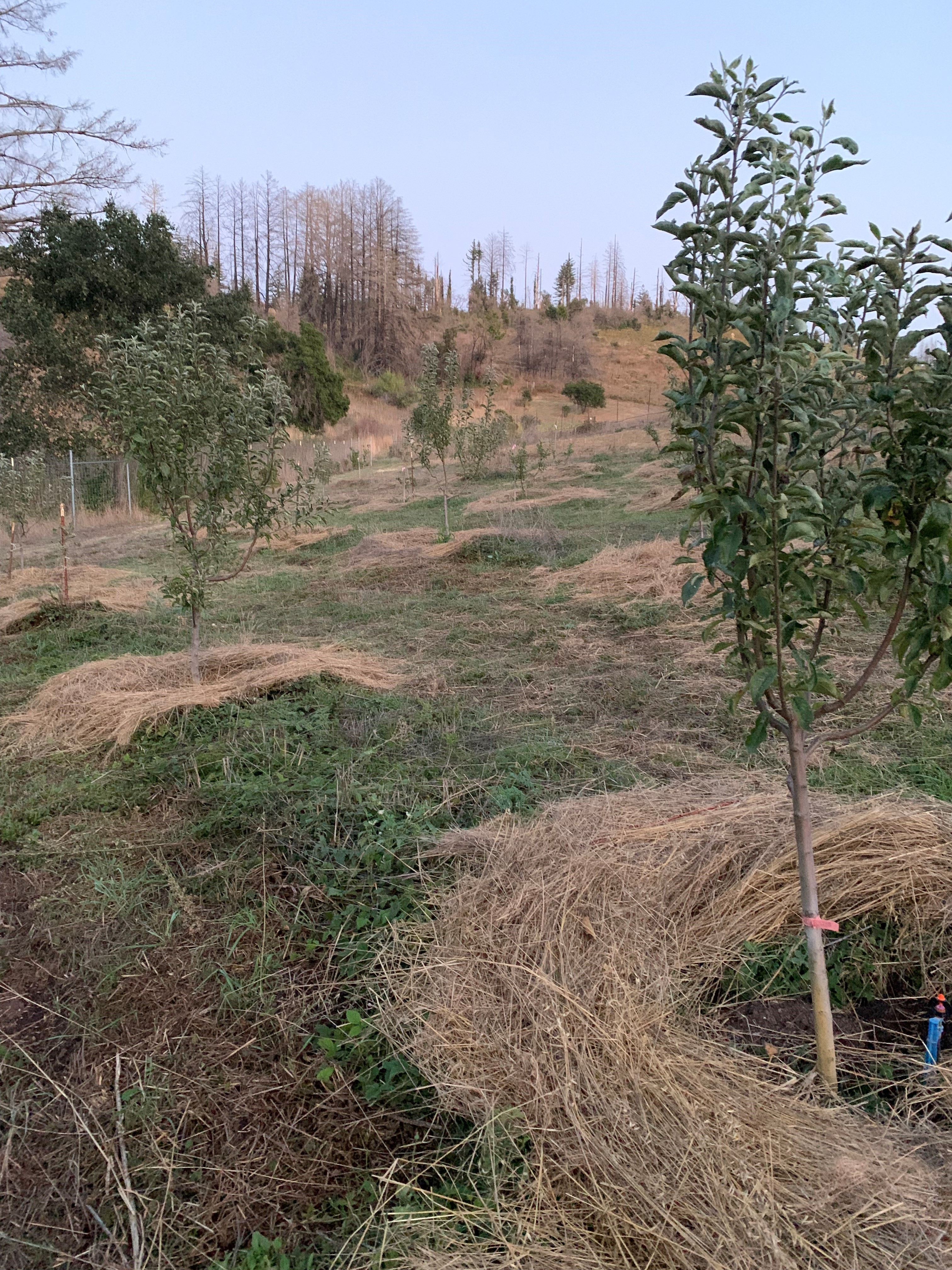
Tree nest woven over compost-strewn soil makes for cozy beds for the coming winter

Tucking in the Trees

As orchard leaves begin to fall, we prepare tree beds for the long slumber. Last weekend, Community Orchardists hauled and spread the final compost and then the last windrows of dried hay. Energetic tree keepers filled and then hauled bucket after bucket scattering compost/worm castings in the understory of each tree. Following them, skilled pitchfork wielding orchardists pitched, piled, and sculpted neat circular hay nests surrounding young trees. Winter snacks and cozy blankets for our tree friends.

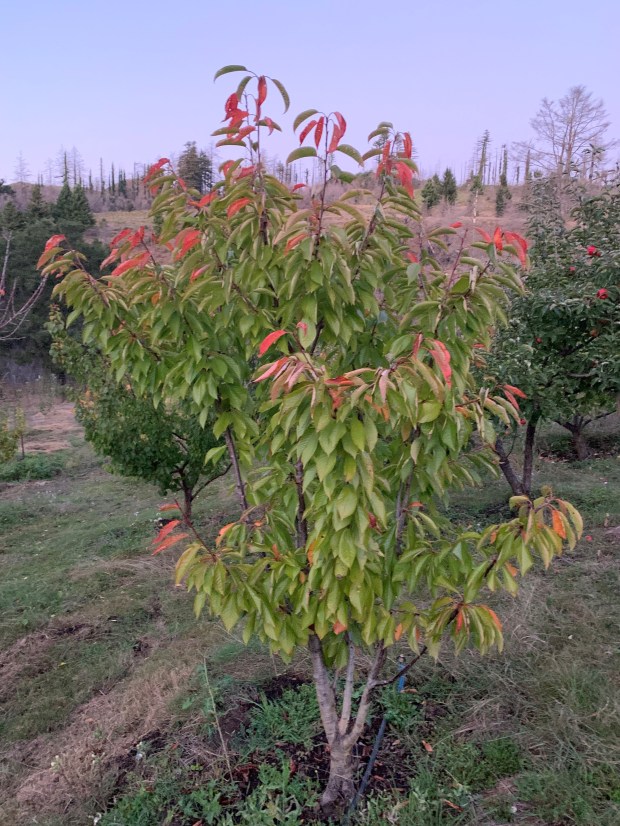
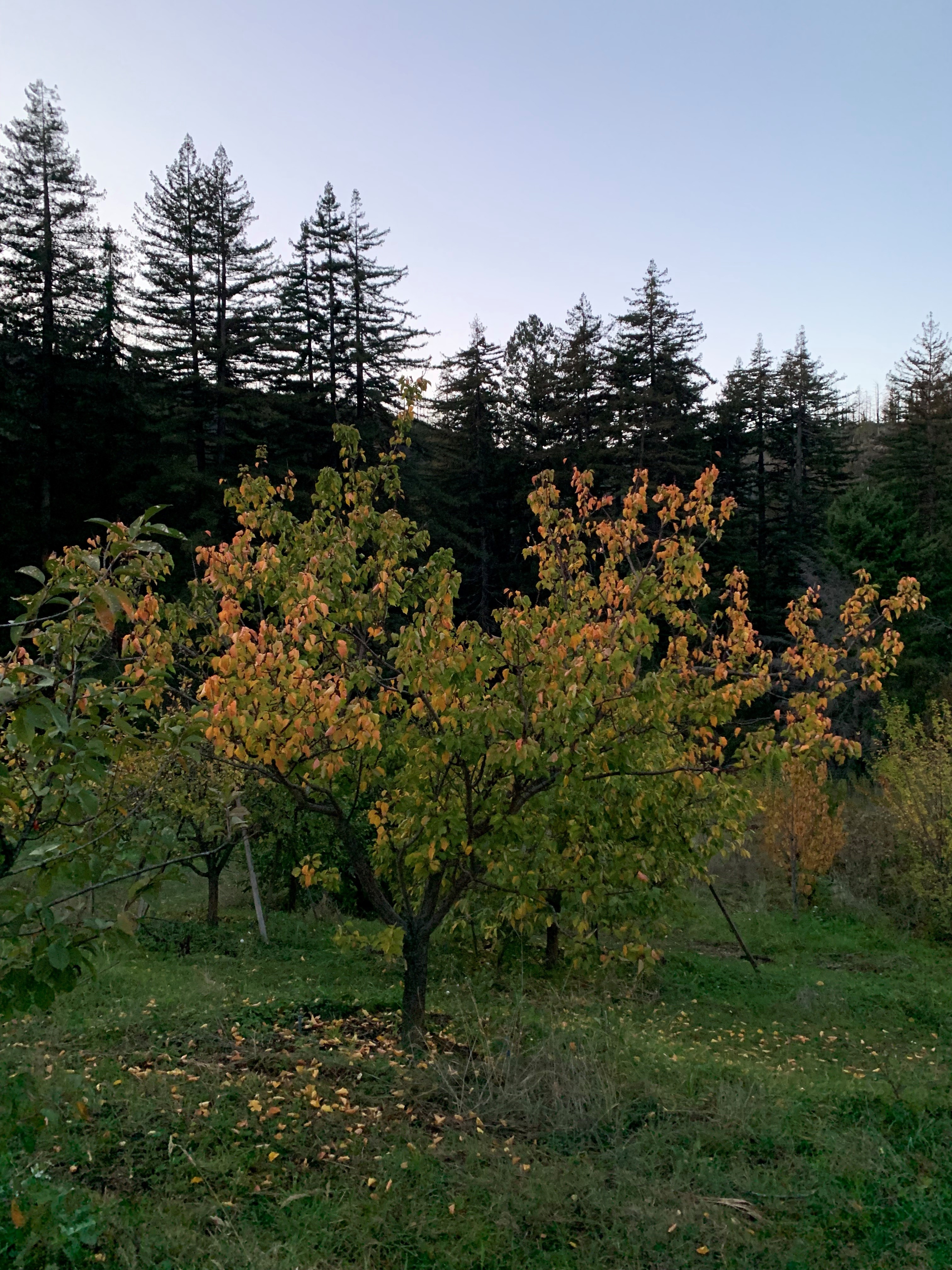
Stone fruit fall color

Nodding Off, Colorfully

As the trees approach their sleep, leaves brighten then drop. Cherry tree leaves are turning orange-to-red, starting on the sunnier sides of each tree and day by day progressing onto the northern side of the canopy. Apricot, aprium, plums and pluots echo those cherry leaf reds but tend more orange to yellow. Apple tree fall color extends well into winter, slowly unfolding many shades of yellow through February in an extended fall. Most leaf colors change fast and fall quickly, splashing rings of color bright in circles on the ground beneath brief spells of brightness dancing across the orchard among the high held branches.

The place of deer beds and rustling

The Rustling

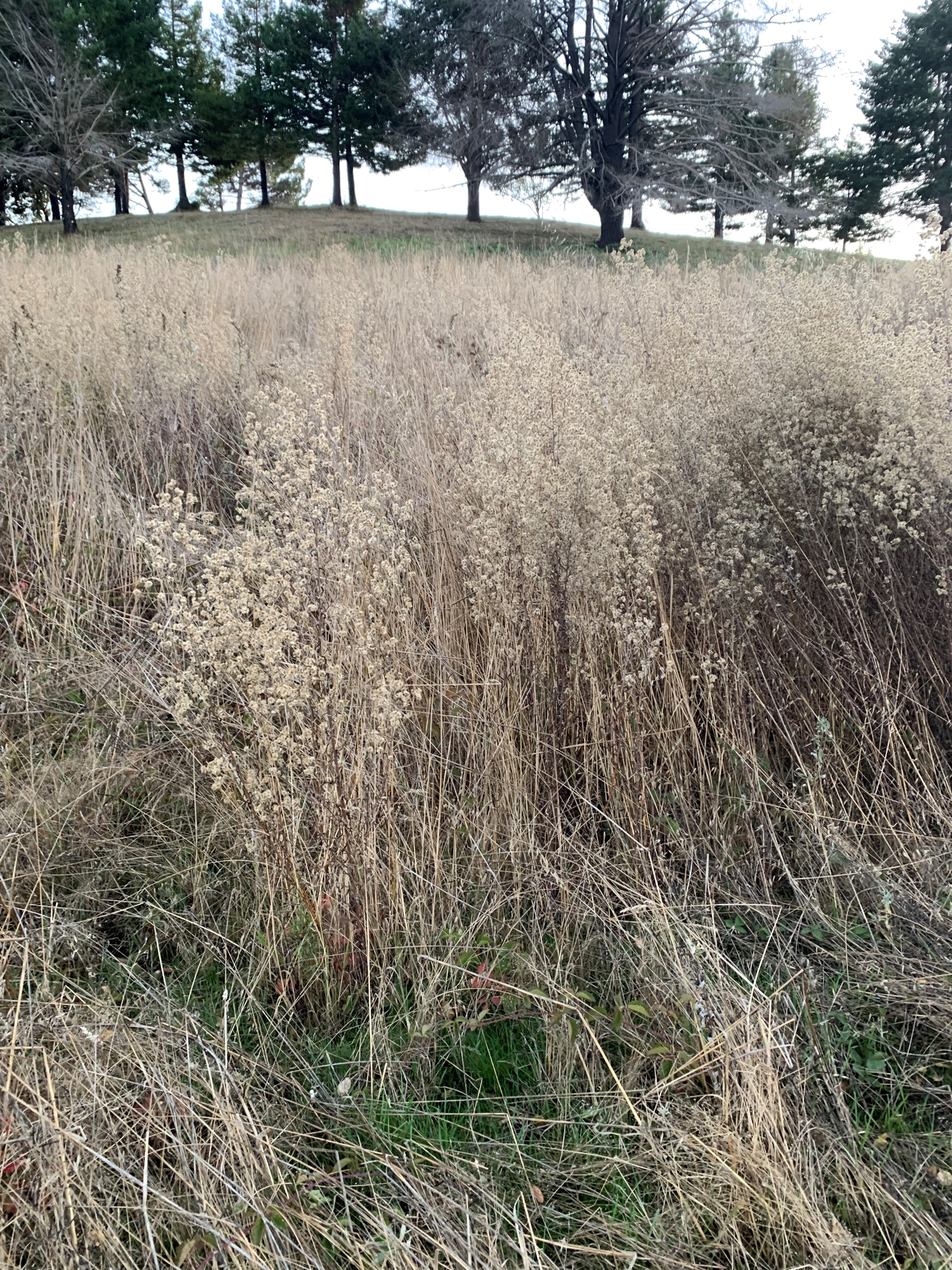
We were unable to mow every corner of the farm and in some places the dried grass and wildflowers formed thick dry swards. Deer paths wend into these stands. Following these wildlife trails, we find hidden clusters of mashed down straw – cozy deer beds. The breezes sing high schwews on the ridges with more of a full, wooing noise in the nearer conifers, but these tall dry grassy areas make scratchy, rustling noises in the winds at the onset of each storm. The deer thank us for leaving them some dense cover to shield them from the chilly gales through the dark nights.

Fuji apples held ripe while leaves change color

The Last of the Fruit

Tomato vines whither after rain; winter squash vines long spent, fruit curing; later season apples grow sweeter and crispier with the cool nights. We feel lucky again to find a ripe tomato among the melting vines. Weeds will soon occlude the deliquescent reddish fruit and then all will be tilled and cover cropped.

Molino Creek Farm’s wilting dry farmed tomatoes, slain by rain

Two Dog Farm is boxing and curing the bountiful dry farmed winter squash crop, and colorful squash still brighten the fields.

2 Dog Farm’s last dry farmed winter squash, waiting to be gathered.

Fuji apples are the last bigger harvest in the orchard. We will gather the last of the apples over the next week and press the last of the culls into the final cider of the season. Much of the orchard has had a final mowing, the harrow scratching in bell beans is close at hand.

Emerging New Tree Characteristics: a dance between species

Sunsets and Quickening Evenings

The sun speeds quickly towards the west and evenings pass suddenly to night. One moment, the beautiful array at sunset tinges the hills and the next moment colors wash and fade to gray, stars winking into sight until the night sky reveals vast constellations. There is a moment in this transition to night when my attention is drawn to the silhouettes of trees, revealing new characteristics of long familiar friends. Brushy oaks dance on the edge of regal, posturing clusters of redwoods. Then they disappear, overcome by the majesty of night.

simultaneously published at Molino Creek Farm’s website

Oh Deer, What a Year!

The deer have had a good few seasons. Before the CZU Lightning Complex Fire of August 2020, the forest had grown back shady and dense after the prior fire of 2009. Between the shade and the passing of time allowing shrubs to get tall, deer food had slackened off quite a bit. Shrubs are the deer’s favorite food. Also, that extensive shady forest provided just the kind of cover mountain lions like best; they might have been taking out quite a bit of the deer population. Nowadays, there’s not so much mountain lion sign, but lots of post-fire small shrubs, and a burgeoning deer population. Several healthy bucks are roaming in and around the farm. At least one of our does seems to be getting pretty big around the tummy right now, so more are on their way. All the deer are looking quite healthy: there are at last 8 here and there nearby…back to our old record number.

Slack’n Lion

Another sign that the cougar population has slackened…coyotes! I heard a coyote calling again the other night, very nearby. 2008 was the last year the farm had any regular yipping coyotes, but they returned after the 2020 fire and have been regular visitors ever since. Coyotes are a good sign of few (if any) lions in the vicinity. I’d rather have lions, but the coyotes are nice visitors, too.

Hawktober

Winged predators are also doing well: hawks seem quite numerous and healthy. I see the resident Cooper’s hawk and kestrel frequently resting between what must have been successful hunting sprees. The 2-3 red tailed hawks likewise have some down time. There are nearly always hawks wheeling lazily overhead now that the breezes have returned. Oh yeah…it’s hawk migration time along California’s coast! Some are just passing through.

Pomologically Speaking

The apple harvest this Fall has been surprising in many ways. ‘Normally’ the Community Orchardists gather just once a week for the working bee: on Saturday afternoons. During those gatherings, we saw the apple crop growing and growing. We thinned the fruit 3 times to make sure the fruit were fewer and far enough apart to nurture bigger, more pest free apples. The turnout at the working bees was great through the Spring and Summer. As the well-spaced fruit started swelling, we went from weeding to propping branches. We did not expect so many apples to survive the thinning and the pests, including 25 jays and woodpeckers which pecked hundreds of fruits mercilessly. We kept testing apples for ripeness every day until they started ripening the second week of September. For the last 5 weeks, we have harvested a record crop and it has required many extra hands on so many levels.

Two Tons of Fun (for starters)

Mind you, we are very part time apple farmers. The Apple Corps are a couple of focalizers, a few dedicated regulars, and a whole lot of others sporadically joining to nurture the Molino Creek Farm Community Orchard. We have sent around 1500 pounds of apples to farmers markets, 500 pounds to Davenport’s Pacific School food program, and 2000 pounds to the cider press. And, we aren’t even done…

Mountains of Fuji

The last part of our apple harvest are from the orchard’s original planting of Fuji apple trees. Fuji apples are half Red Delicious and half Virginia Ralls Janet. They were so named because of the town near the agricultural research station where they were developed: Fujisaki, Japan. Dense, sweet flesh and great storage potential makes this a very popular apple. We sent 200 pounds of those to Saturday farmers markets this week. They will sell out.

Green Manure

When I first learned about organic farming, cover crops were called ‘green manure,’ a term I haven’t heard much more recently. The idea is that you don’t need farm animal dung to fertilize your crops- nitrogen fixing legumes can do the trick if you manage them right.

We’re planting cover crops now across the farm. This evening, I finished harrowing the sixth of 50 rows in the apple orchard: 3 rows to the hour to spread the seed and then run the tractor implement called a harrow to cover the seed with soil. There are many hours yet to go, but it is nice to chip away at the project. Bell bean seeds are big and shiny and fun to throw, like casting marbles around the trees. Tossing about oat seeds has its rhythm, too, and the seeds are bright blond and easy to see how evenly they are landing on the dark soil. Vetch seeds are jet black, perfectly round, and it is impossible to know how well you are casting them about, handful after handful.

A Harrowing Experience

The harrow leaves a pleasant looking seed bed consisting of bits of leaf litter and chopped up plants mixed with soil and rolled flat. Perennial plants are spared (they sprout back right away), and earthworms and other soil organisms mostly survive. We use a BCS Italian-made walk-behind tractor. The harrow is mounted such that you have to back up the whole time while running it, always looking over your shoulder. That’s a harrowing experience!

Fall Report

Fall is progressing in both the wild and cultivated areas. Poison oak still wins the award for the most colorful native plant display: crimson patches brighten hillsides in forests and shrublands everywhere you glance along the coast nearby. The orchard’s apricot relatives and hazelnuts are the latest things to add to the fall color palette with their menagerie of yellows, oranges, and everything in between. Breezes have returned, but the fall leaves are most thick just under the trees’ canopies. Colorful leaves, thickly strewn in tree understories are delightful, each orchard visit presenting a new display.

-original post at my blog on Molino Creek Farm’s webpage, Facebook page, etc.

Stillness and Contrast

Stillness. The air barely moves, and each day darkens into hushed, unstirred nights. The still air phenomenon carries from one day to the next so that now it seems normal, almost beyond comment. It has been weeks since any kind of substantive breeze has blown across the farm. Fall leaves pile directly below trees. Dust hangs along gravel roads for long moments after a farm truck interrupts the windless tranquility.

Dark = Chill

Monday evening, the fog retreated offshore and bright stars twinkled by the billions in the suddenly clear sky. There had been days of fog, sometimes drizzly fog where subdued daylight was muffled by blankets of thick, low clouds. Downtown and at the farm, people stoked the season’s first wood fires to ward off the dank chill.

The chill and darkness combined with the harvest of many apples gifted us our first taste of reprieve from watering the orchard. Once trees lose their fruit, they aren’t as thirsty. This is especially welcome because we pump water with solar power, and there was no pumping potential with the days with such limited sunshine.

Solar powered well water – sustains our homes, orchards, and crops…so glad for good water!

Talon

How does the lack of rustling wind affect raptor hunting? The kestrel reels and screams. The Cooper’s hawk more stealthily turns acrobatically around trees and shrubs, sending our big quail coveys scurrying. Two red tailed hawks have little lift from updrafts; they sit on low perches hoping to pounce on nearby prey. The vultures haven’t been sailing by.

Placid nights echo across the landscape with many great horned owl hoots and barks. Owls scamper and hop on my roof through the night, scanning the rodent filled yard for their meals. Some neighbors suggest the rodent population has (finally!) started declining, but I’m less sure. There is a new, the first, bunny burrow nearby and a new bunny joined the last old and skinny individual remaining. Last year, there were 10 brush bunnies in that same space.

Ripening Harvests

Apples become ripe with surprising suddenness. We bite and compare: is this type ripe enough for harvest? Plewy- the arguments sputter! ‘That Braeburn is a week or more off!’ ‘No it isn’t’ ‘Here, try another one!’ ‘The skin is bitter and tough, its not sweet enough yet…look the seeds are still light brown’ We settle down and wait if anyone is adamant enough. Then, three days later, the Braeburn is indeed inarguably ripe. Same with the Fuji apples. Suddenly, when we thought there was a lull in the harvest and we’d have to skip markets…there are lots of ripe apples again.

Gone are the Gala, Jonagold, Wickson Crab, and Mutsu. Here come the Fuji and Braeburn! After those…we’ll get some rest: three more weeks of bigger harvests!

Meanwhile, 2 Dog Farm eyes its ripening dry farmed winter squash, increasingly coloring the fields. Squash with no irrigation?! Yes! Yummmm!!!

Two Dog Farm Dry Farmed Butternut Squash – the Very Best…and at the market soon!

Orchard Hygiene

A key to successful apple growing is keeping the orchard clean. Stand quietly in the orchard for 15 minutes even on these still days and…thump! There goes another apple falling from a tree. Quickly, the ground is covered with bruised windfall apples. Gophers drag the fruit nearer their holes, gnaw into the flesh, hollowing out the orb from below. Dwayne Shaw from Maine visited and neatly stacked the better windfalls in piles and we haul them to the press. He pitched the nastier ones into the wheelbarrow for disposal; soon, the barrow was teeming with yellow jacket wasps, which clean up the apples as quickly as possible. Those wasps also like to eat soft bodied insects, so mop up the apple pests, the core of the problem which spurs us to clean things up. Thanks waspies!

Chill Turns to Heat

With the clearing fog came a sudden heat. For weeks it barely crested 70F but today it was 85F. At dusk, toasty warm air wafted (slowly) in from the east. Crickets sing again this warm evening. Three days of warmth and it is time to water the orchard again. May the solar array help pump water once again!

The past 2 years have produced an October and then a November heat wave. The heat broke both years when the first real rainy storm soaked things on Thanksgiving. Will we wait that long this fall? It calls for sprinkles next week…fingers crossed! It would be nice to keep the grass greening and the fires at bay.

Moderate Clime, Harvesting

Across the farm, people are awake before dawn, lights winking on while the stars still shine. We pull on our clothes, make coffee, eat a snack, and prepare to head out as soon as there is any light at all. I mosey across the farm, turning on water valves…that freak early rain was so far in the past that it is time for the once-a-week soil soak again beneath the orchard trees. I pace back and forth down each row of trees examining the micro sprinklers and irrigation tubing to check for any leaks. Mice, rabbits and gophers sometimes chew the lines: I mostly listen for gushing leaks, but sometimes I see them before I hear that awful sound. Leaks repaired, water on, I head to my paying, indoor job. Other farmers keep going as farming is their mainstay.

Midday Work

We still pull our sun hats from the peg next to the door before heading out to work the farm when the sun is up. Sun heat prickles bare skin though the air temperature is perfectly moderate. It is harvest time. Crews pick apples twice a week for markets: we navigate ladders high into trees after the ground picking crew has finished what is reachable. Shoulder-slung bags full of fruit get dumped into sorting bins and the sorters go to work: bad apples to the compost, barely okay apples to the cider press, almost perfect apples gifted to the Pacific School food program, perfect apples to 4 different farmers markets.

Apples off to Market

Farmers load, haul, and set up displays of boxes of beautiful, community-grown apples where people gather for produce at local farmers markets: Saturdays at Palo Alto and via 2 Dog in San Francisco at Alemany the “People’s Farmer’s Market” and then again on Wednesdays via 2 Dog at Heart of the City (SF) as well as Molino Creek Farm’s stand at the Wednesday market in downtown Santa Cruz. We are selling 400+ pounds a week, more than twice what we ever sold before- post fire resilience and the fruits of many people’s labor.

Evening Glow

As the sun sets, we begrudgingly wind down. There are not enough hours of light to deal with the harvest, so we often have to make lists of work to be deferred until the next morning. Harvest bags get packed into mouse proof bins, I check that gates are closed against the evening’s marauding deer, I give a final twist to shut off irrigation valves and update the watering log book, and then I clean and put away the tools. Brushing off the dust and dirt from my work pants and stomping off my boots, I head home as darkness sets in. The first crickets are singing, and an owl begins its nighttime hoots. Cold clean-smelling air settles into the low points on the farm, the higher points are still warm and smell resiny from the last sun warming the coyote brush.

Deer, No Bobcats

The male deer are sparring, and one has cracked one of the points on its antler. Three male deer, one larger, are strutting around, following the four or so does that frequent the farm nowadays. The larger buck and the larger doe are frequently at the cull apple pile in the evening: that will help them bulk up for the cold, rainy winter!

Where is bobcat, coyote, and fox? The plethora of gophers fills us with consternation. Nearly every square foot of ground has been tossed and turned. I find fresh moist subsoil piles at 100’ intervals every day. The hawks scream and reel, crisscrossing the fields. A kestrel eviscerated a gopher on top of a stump next to my office window midday the other day…he plucked its fur off as much as he could before getting to work tearing apart and swallowing the better food.

The raptors are not enough, and the snakes and lizards are slowing down. We need the mesopredators! Two foxes traipsed along the road down from the farm the other day. I haven’t seen a bobcat in a year. A wave of canine distemper is reportedly still raging across our region, which might explain why there aren’t many fox or coyote, but feline distemper hasn’t been a big issue…so why aren’t there more bobcats? They would be so well fed!

Green or Freshly Tilled Fields

The rain two weeks ago germinated millions of seeds and now seedlings are greening the landscape. Where we didn’t get to raking the last harvest in the hayfields, the grass is the tallest, growing through the thick mulch. We took advantage of that early germination to weed the fallow farm fields- disking the crop of weeds into the soil, preparing for planting the cover crop. The farm has beautiful contrasting patches of brown and green.

Jimson weed aka Datura aka thorn apple: a sacred native plant that is ‘weedy’ in our fields

Late Season Flowers

Amazingly, the bees have forage. It is ironic that it is harvest time for the humans and the bees might be hungry. Fall and early winter are starkest times for pollinators. Hummingbirds and bees flock to irrigated salvias in our gardens. But still, the coyote bush is in full bloom- but there are only a few old enough to flower- the fire spared ones are abuzz with diverse flying pollinators: flies, bees, and wasps. Evening brings the hawk moths to the jimson weed aka Datura and evening primrose, wildflowers that are also taking advantage of the garden irrigation for late season blossoming.

Early season rain helped germinate weeds, allowing us to decimate the seedbank by discing

Fall Color Commences

Each year, the obvious harbingers of fall are our many black walnut trees. Descendants of the Mother Tree in the Yard, the younger walnut trees turn lemon yellow starting from the highest, driest trees and ending with the Mother Tree. It is a count down clock to winter. The last trees to show fall color are at the very lowest elevation- in the north apple orchard, on the steep north facing slope of Molino Creek Canyon. Those apple trees turn yellow in late December and early January…slowly dropping leaves into February.

Fall color from black wa’nuts

We hope you are getting out to the fall colors of our area, in the shadier canyons where the big leaf maples, roses and hazelnuts are starting to show.

-this is from my near-weekly blog at Molino Creek Farm’s website

Drippy Fog and Fall Color

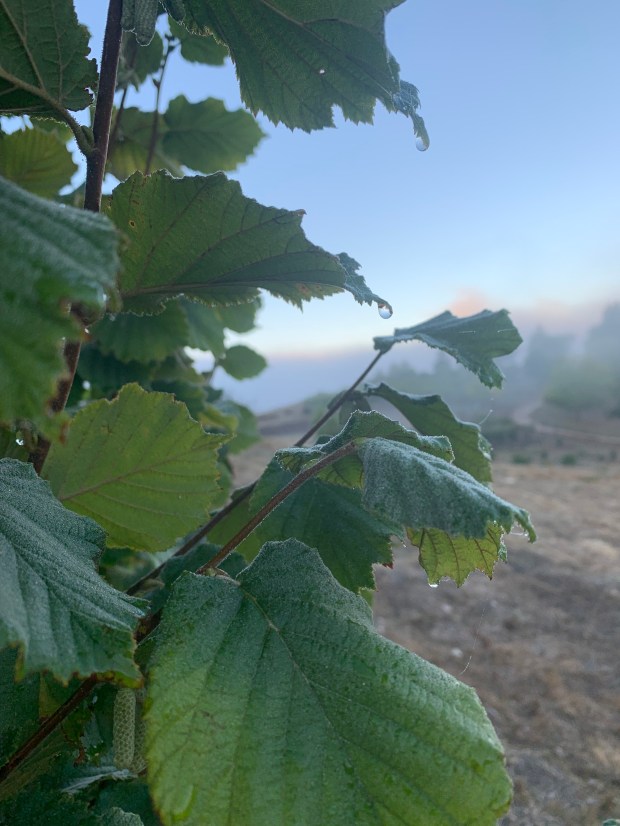
The fog rolled in thickly, the second drippy session of the season. Most fog has been ‘dry’ this summer- an unusual phenomenon not previously broadly recognized as ‘normal’ in our culture. For two mornings, the whole world went gently pitterpat, rooflines and gutters a constant spatter. Then the sun started winking through in silvery streaming rays lighting droplets on leaf tips, sparkling. The fine breezy dust particles stuck together and the wet smell of fall let us breathe deep and clean air once again.

Fog makes leaf tip drips on our hazelnut plants

Bird Friends

We wake each morning to the high shrill peeps of black phoebes, insistent and fierce. Peep, PEEEEEP, peeep! …. flutter, Snap! They nab flying insects expertly out of the air. And then they perch on the roof line, their glistening knowing dark black eyes gaze back at me when I say my hellos. Off they go, flitting arcs from many perches hunting.

The quail have done well this year. The smaller clan coveys have melded into massive tribal gatherings. Seventy plus birds thickly dot grassy hillocks and across fallow farm fields. Three and four birds peck shoulder to shoulder, others only a couple feet away. They must be finding lots of food as these groups don’t move far, satisfied to stay put for an hour or more. When startled, the whir of those many wings is loud and invigorating.

The Brewer’s blackbirds returned en masse, fluttering like fallen leaves from high in the sky. Now their staccato chips, squeaks, and trills brighten the farm soundscape. They strut proudly forward unidirectionally in flocks herding and frightening ground bugs to supplement their diets.

fog streams in above Molino Creek canyon

Ripening Time

In the lush forest of fruit trees, it is apple ripening time. Galas are peak flavor and earnestly moving to harvest bags. Also, Jonagold apples, the tastiest crop, arrived at their best this week – off they went to market, too! Next up…Mutsu and Golden Delicious. After that, Braeburn apples are in line for ripening…and there are quite a few big, beautiful apples on those trees. It is interesting to see the fruits of our labors: bigger apples hanging low on the trees ‘cause that’s where we could most easily reach to do the fruit thinning!

On the ground where Two Dog Farm has been cultivating dry farmed winter squash, the vines are withering and revealing and understory of acres of big yummy squash. The pale yellow of butternut squashes dot the ground on the undulating rich soil of our Roadside Field. The dark green acorn squash are all sidled up against their bushy main stems high up in Vandenberg Field.

Fall Color

Fall color is erupting all around the farm. The big bushy walnut trees are brightening to pure yellow. Poison oak, resprouted after the 2020 fire, is 3’ tall and startling crimson and violet. Wild roses are also turning towards the yellows in the understory of the forest where the fire burned. There is more fall color to come- our apples wait until December or even January to change color!

We hope you are having a spectacular fall enjoying bountiful harvests of healthy organic food raised by small farmers taking great care of their wildlife filled land.

-from my weekly blog at Molino Creek Farm’s webpage

Transitions Between Light and Dark…Day and Night

Each evening there’s a dancing art show: swallows soar and weave higher and higher, snapping up insects, following the intersection of sun and shade as the sun slowly dips behind the ridge across Molino Creek. The disappearance of the sun takes more than an hour to make its way across the farm; the last light glows a deepening gold from the west-facing ridges studded still with many tall black spires of the trees burned by the 2020 wildfire.

Evening

I sit at the end of the days watching sunset transitions, noticing the many familiar but always fascinating evening routines. The world slows down and the stage provides each actor enough time. The raven pair trade an intermittent ‘caw’ tracking one another’s whereabouts as if to say ‘almost time’ before following one another with noisy slow powerful wingbeats, as they sneak off to their mysterious and distant night roost. Clouds of tiny beetles dance silently in dense clouds on the cooler sides of shrubs, backlit by the sun, lighting shiny wings. The flicker family swoops in for one last drink at the bird bath. First one, then the next and soon a hundred crickets are chirping- more when its warmer than cooler. With the increasing crickets, more and more stars shine. The western sky glows long after the sun has set.

Padrones

The long days are fueling burgeoning crop production. The peppers and tomatoes are deep dark green with suddenly stout stems and elongating root systems pushing farther out in the rich, dark, beautiful soil. Two Dog Farm’s padrone peppers have fruit and are lighting up with constellations of bright white star-shaped flowers.

Two Dog Farm’s Padrone Peppers- getting ready to start picking!

The warm days have been followed mostly by cool nights. Plants that wilted slightly during the day return to vigor as the sun rides lower in the sky. At night, those same plants are tall upright and luxuriant. Apples are still small, now 1 ½ inch across; the plums are growing quickly and starting to color. The tops of these trees rise up into the warm summer air; under the trees it is cool and slightly humid, no scent yet from any of the fruit- its too young! As its too soon to have enough food to take to market, Judy’s delivering the season’s first zucchini in neat small paper bags to farm neighbors, and we welcome these tasty treats as the first sign of summer. It’s cool enough to still have some sweet garden lettuce to be combined with geranium and salvia blossoms, baby kale and other greens, for a wealth of home-grown salads.

Comice Pears: Brought to you by a community of Orchardists

Thank You, Friends

We have deep gratitude for the various skilled community members that help our Farm along. Most recently the incredibly talented duo from the Last Chance community, Steve Barnes and Ian Kapostins, have been piecing together a bunch of new water tanks- 30,000 gallons worth- to replace some we lost in the fire. Their artistry and skill combine with nice equipment to create a much-needed bank of drinking and firefighting water. These guys have been sweating out the days with pipe and saws, glue and wrenches, on the side of a hot hill and in and out of dirty dusty trenches. How lucky we are that they are willing to help us way out in the country in less than favorable conditions! It takes a community to afford us the possibility of living and farming in this beautiful place. Thanks, guys…we really appreciate your work!

Dawn

The sunrise dawn chorus has been mysteriously quiet: is there a hawk near the yard? At 3000’ in the Sierra last weekend, I awoke on several mornings to a signature dawn chorus filled with sweet, almost liquidy flycatcher song, so different than our sometimes sharp-peeping orchestra. Each place has its song. There, the chorus was short- half an hour before and up to dawn then quickly quieter. I’m hoping that our dawn chorus song returns soon.

Over to You

I’m hoping you step outside, leave your windows open, turn off anything noisy, and immerse yourselves in these long transitions of dawns and dusks. What is unfolding around you? Whose watching you listen for them? Are there repeating themes in your part of the world?

-post copied from the Molino Creek Farm website where I also publish regularly

Dusk

– this another post from my regular weekly blog at Molino Creek Farm’s website.

A fleeting breath of the gentlest breeze brushes through the few remaining walnut leaves, so slight and brief as to barely rustle, plucking only one leaf to add to the fall. Then it is still again.

We inhale the moist air, walk on wet ground and change our clothes to the wavering between balmy and slightly chilly days. The air is thick with winter scent – the smell of fungus and fresh grass. The farm is becoming quieter with the shortening days and the winding down of harvest clamor. The still night silence is rarely broken and then mostly by startling echoes of owl hoots that soon abate – even the night birds are hushed.

The Muffling

The early, warm and ample rain sprouted millions of seeds, now a green blanket everywhere where just a month ago there was bare dirt or straggly dry dusty dead plants. This lush living cover muffles sounds like snowfall and allows my eyes to soften and relax, as I breathe easier for the cooler, cleaner air and the now distant fear of smoke and fire. We are all relaxing into the wet season, the down time.

The moon will soon be full- the bright nights might be adding to the stillness and quiet as critters hunker down in fear of being spotted by Great Horned Owl or Coyote. Great wings outstretched, the perched owls swoop in low arcs lit well by moonlight. Coyote is more frequently yapping and slinking around on the hunt.

The bright days have begun with fog here or below the farm. This late fall fog is not normal. Varied patterns of high clouds take turns with a clear cloudless sky. The sunsets have often been magnificent.

Chittering-chat

The cacophonous whistle, click and squeak of a sixty-strong (and growing!) mixed flock of blackbirds has grown into high entertainment. Like a mysterious whirlwind of blown leaves, the fluttering flock scatters 50 feet up and then settles again on the lush ground. They strut and chatter, shoulder-nudging one another or stab at things on the ground. Our attention is drawn to this great and complex social milieu – yellow eyed Brewer’s blackbirds and larger red-epauleted bi-colored blackbirds mixed and awaiting the arrival of some straggling very rare tri-colored blackbirds. The bustle moves across our farm fields; their departure returning the quiet and stillness as fast as their arrival had quickened our breath.

One of Molino Creek Farm’s many majestic black walnut trees

Yellowing Leaves

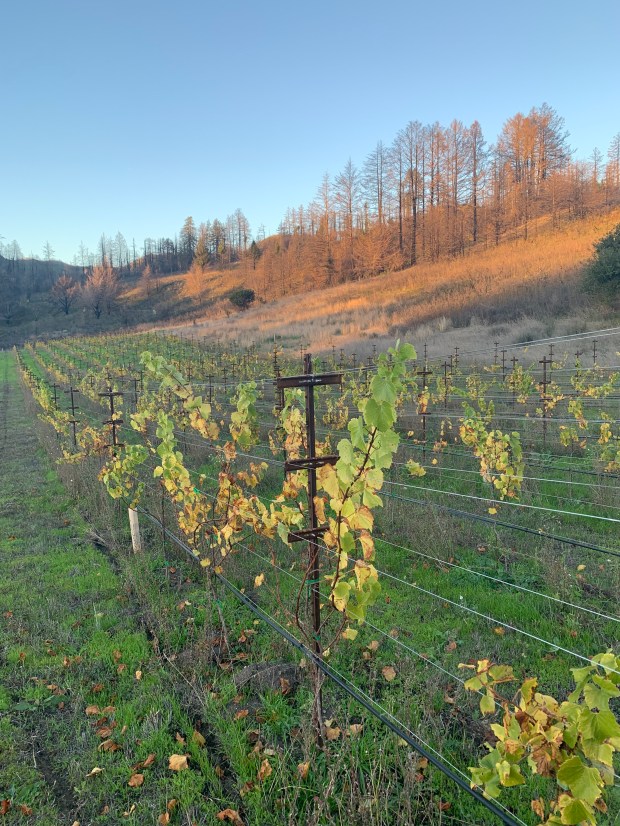
The 2-year-old vineyard is also showing that muted yellow fall color as the leaves slowly drop. There might be a few dozen apples left on the trees with leaves also quickly changing yellow. The orchard cover crop we sowed 2 weeks ago is two inches high, vetch unfurling tendrilly leaves, the oats poking up single thin-rolled leaves. The morning dewdrops hang on the tips of these sprouts well into the day.

Chardonnay Vines: a second Fall for 2 Dog Farm’s Vineyard

Winter Fruits

One of the Farm’s greatest ironies…just when the cropping seems done – the citrus ripens! Our 6 Persian lime trees are hanging heavy with large green fruit, the spikey Lisbon lemon trees also are bearing. The navel oranges are further behind and less fruitful this year. The tangerines are far behind but growing quickly as are the Meyer lemon trees. Citrus Hill is filling in with the 20 trees we planted 4 years ago joining some larger, older plantings by Chuck and others.

Persian Limes will be ripe in January