copied here from The Four Seasons, Volume 10, Number 4

copied here from The Four Seasons, Volume 10, Number 4

A fundamental issue related to the inter-connectedness between humans and between humans and Nature is how we move. How often do we change homes? When we are doing errands or our work, how quickly do we move around the landscape, in cars, bikes, buses, or on foot? When we visit nature, how do we move…and how fast?
According to surveys, US citizens move from one house to another 18 times. On average, they move every 6-11 years, depending on region and economic status. In other parts of the world, such as China, there are millions of itinerant workers who are on the move all of the time. Refugees from war, climate disasters, cartel/mob threats, etc., are numerous. Is this natural?
Some would suggest humans are naturally nomadic. Long lived civilizations are very rare, and I’d be interested in knowing how long pre-industrial indigenous group are thought to have remained in the same territory.
Neighbors are a very long type of human relationship. Some people don’t know their neighbors. Some even don’t want to. The throng of cities provide anonymity that some crave. Rural areas lay bare the need to interact with neighbors. Some loner rural denizens stand out in their desire for isolation, leaving the rest of the neighborhood wondering and curious. That spectrum means there is a wide variety of meaning when we move away from the social fabric of our neighborhoods. When we move farther still, we leave behind those we chose to interact with, our communities, our friends. How have those moves affected you, your family, your friends?
I posit that the frequency of people moving is negatively affecting the quality of communities. If people stayed put more, wouldn’t they come to better understand the things that affect their community? Even if they aren’t particularly interested, it seems like people gradually come to understand housing issues, strains on water sources, the health of the public transit systems, who has power and who doesn’t, how weather affects people, social norms, and history. Each of those types of understanding influences our relationships with others in our community and can affect the political parties and politicians we choose. When we move, our votes make less sense, and our communities suffer the consequences.
Closer to home, how do we move about in our daily lives? I am amazed at rush hour traffic and suppose that most of those people can’t afford not to be moving so slowly, breathing thick exhaust. For a long time, as a commuter, I tallied the very expensive vehicles on the road at various times of day. Not surprisingly, the rich are better able to avoid rush hour. So, how and when we move around is highly affected by how much money we have. But, everyone moving in cars on the road share the experience of isolation from each other and from the world as a whole. The more time people spend in their cars, the more isolated they are.
Economic conditions notwithstanding, Covid lockdowns changed many people’s movement patterns. People looked at their homes differently. For instance, people started cultivating many more houseplants. As the urban bustle subsided, wildlife started edging further into the built environment. We noticed the world around us a lot more. It was quieter both on the streets and in the air. Air pollution declined. Some of our movement patterns remain curtailed despite city governments’ attempts to get businesses to reverse work-from-home policies.
A ‘avid’ mountain bike enthusiast once told me that they rode carefully so as to avoid running over newts. For those who read my column regularly, you know I have an affinity with newts. When I walk in the forest, avoiding stepping on newts is something that keeps my attention. It is not easy. Newts blend into the forest floor easily, are varying sizes and move at varying speeds, and are sometimes so numerous that you have to walk ever so gingerly to avoid them. It is even more difficult for a bicyclist to avoid smashing newts, and that example serves for a world of other nature interactions. The faster you move around nature, the less likely it is that you will see the nature around you. Also, bicyclists, by covering more ground than those on foot, also disturb more wildlife than other, slower-moving parks visitors. If we are looking to increase the nature sense of humans, we must work to get mountain bikers off of their bikes, so they move more slowly and experience nature more deeply. The same goes for joggers. Parents who care about helping their children connect with nature have a challenge to show their kids how nature is exciting even if you aren’t on a bike or running through a park.
‘Stay on the trails’ is an increasingly common park visitation rule. It wasn’t that way very long ago. Technically, State Parks has to formally designate an area as a natural reserve to legally restrict use to trails. At Cotoni Coast Dairies, the land managers have to go through an arduous rulemaking procedure to restrict future visitors to trails. Staying on trails changes the way you experience nature. Wildlife avoid trails. The vegetation surrounding trails is different. Your chance of encountering other people on the trails changes your experience. And, most trails are designed as straight lines, as if we are all in a hurry to get from one place to the next when we visit nature. Trail builders with parks agencies think that people want ‘loops’ and are averse to ‘out-and-back’ trails. Turn offs from the main trail better end in some giant attraction, like an incredible view. Those straight lines and loops create a certain type of experience for parks visitors. I suggest those designs enforce a more fleeting and more separate interaction with nature. What would it be like if more trails led one way to nothing obviously spectacular? What if parks managers designed in slow, immersive experiences into their ‘infrastructure?’
If people slowed down, looked around, and took more time to experience nature, wouldn’t that connect them more with the natural environment? Wouldn’t that connection make them care more about protecting the environment? Just as people moving less increases the possibility of caring more for their neighbors and human community, people moving more slowly in parks should increase their caring for the non-human world.
-this post originally published by Bruce Bratton in his highly engaging and enlightening weekly blog found at BrattonOnline.com, where you can turn for the most meaningful news for the Monterey Bay area.

We each come to loving non-human wildlife for our own reasons, and we want to assure that all species are thriving for future generations. Among the many people with whom I interact, their answer to an intriguing question is uncannily and increasingly resolute.
“How many species do you need to maintain the quality of life you desire?”
“All of them” is the answer more and more people are giving me.
How does that work?
Only through the goodness of our hearts will we conserve wildlife. What doors open our hearts enough that we are willing to act to restore wildlife?
As children, we are fascinated and kind towards non-human animals. Often, what we glean from children is that they find wildlife to be ‘cute.’ Whether they are stuffed plush toys or animated cartoons, we indulge our youngest children’s inherent love of wildlife. They have pets, or visit friends’ pets, and develop relationships with non-human species. Children learn to cuddle and stroke pet fur, and the pets purr and roll, and show pleasure, giving love back. Humans and non-humans give and receive love, reducing stress and building trust. We expand the community from our core human families to include non-humans.
As adults, we carry with us that love of cuteness, the desire for connection with non-humans, the tactile pleasure of the furry cuddling interaction. And we develop still other ways to connect with non-human animals.
The friendships we create with non-human species are complex, and we each have our own approach. Many share a basic understanding that has developed with our non-human pet species. There are troves of common wisdom about dog and cat behavior towards, and expectations of, humans, which I will not repeat. I’m sure you have plenty of material to reference, as this is a deeply cultural realm and the subject of many conversations, especially when extended family gathers and ‘pet talk’ is a relatively safe space for discussion.
As those pet conversations get more personal, it becomes clear that many humans rely on non-humans (and vice versa) for friendship. Our pets go with us on adventures and reveal to us much that we may not have otherwise experienced. Our pets recognize our ups and downs and participate actively with all of our emotional territory.
It’s not only pets: some people recognize friendship with wild creatures. The stand-out crowd are those who feed or provide water for wild birds. This bunch is so numerous as to have a sizeable economy surrounding these connections. People buy and maintain hummingbird feeders, bird baths, bird feeders, suet cages…some even invest in specialized foods such as worms or fruit jellies for their favorite bird species. There is an emerging movement in gardening for wild birds.
Still others connect with the wild furry animals that they frequently encounter in parks or in their yards…squirrels, deer, and foxes are the ones I hear about the most. People put out squirrel food, some even getting to know a squirrel well enough to feed it out of their hands. Some folks get to know a certain local doe and her fawns, watching her through the year as she raises them from spots to adolescents. The doe may very well know about the safety net provided by their proximity to a friendly human’s habitation. She and her fawns will feel comfortable near the humans they recognize. Being very sound-centric, they respond attentively and curiously when we talk to them. The very habitual fox, trotting the same paths at the same times each day, will know just how to avoid human encounters but we catch glances of them when we break our rhythms. They poop on our shoes outside the door as a way of saying hello. For a while, foxes were so regularly seen in Bonny Doon that when their populations dipped a whole community was saddened.
Many of us are falling in love with more and more species of wildlife. We call ourselves naturalists or wildlife viewers. We study the critters we encounter in order to learn new stories. Domesticated dogs provide a gateway into the natural world…through our regular ‘dog walks’ and through our observation of their sniffing around and explorations. Wild animals do those things, too, in many more ways. They draw us out of our cozy homes to visit them and see what they are up to. Observing their behavior, we learn new things about the natural world. As our curiosity grows, we find ourselves in places we wouldn’t otherwise venture, at times of day we might not otherwise get out. Wildlife viewers must get up very early sometimes. To see a river otter, they go to the riverside; to see whales, they go out in boats; to see pond turtles, they spend time gazing at logs in ponds; to see snowy plovers, they squint into binoculars on a wind-blown beach; to hear owls, they stay up late and scritch gravel to goad them to calling.
A significant and important segment of the human population connects with wildlife as part of the hunt. Sometimes, hunting provides important food for subsistence; historically, this was even more so. Other times, hunters enjoy the sport as well as the food. Hunters and people who fish get to know the species they pursue and the habitats those species rely on. And, their love of wildlife for hunting has actualized incredible conservation successes. Ducks Unlimited and Trout Unlimited are two of the many organizations supported by hunters which have helped steward wildlife habitat and recover species.
Statistics suggest that the vast majority of humans, even here in the apparently divided USA, strongly support wildlife conservation. When we realize the importance of wildlife to our standard of living, we are compelled to learn more about what wildlife need to survive. When we connect with wildlife, we realize we are part of something greater than ourselves, bigger than our simplified human-oriented world. When we see wildlife make a connection with us, we feel part of the natural world, and our basic selves become more grounded and real. When we work to conserve wildlife, we are at our best…serving the world that serves us. Three ways we can be effective at wildlife conservation:
-this post originally part of a Bruce Bratton weekly blog at BrattonOnline.com, read it and be enlightened!
-to be further enlightened on this subject, see the recording of my recent presentation about local wildlife by clicking here.

As the Great Marvel occurs, the sounds so change also. The Great Marvel is the onset of winter rains. As citizens of a Mediterranean climate, this should be as monumental as it is for the other living beings around us. Simultaneously, the sounds of winter set in. Are you listening?
Humans are very visual, but we have other senses that would be good to emphasize. Let’s call this next week “Sound Awareness Week.” This will have particular meaning for those who can’t hear at all or hear well: for those of you, perhaps your gift this next week is to help more people describe what they are hearing, a two-for-one kind of experience. For those of you who are already acutely aware of sound…there is always more to explore!

Everywhere you go, there are always a few noises no matter what season. Airplanes: more so on weekends with recreational aircraft. Roaring motorcycles: replete with accentuating noise apparatus, illegal, but unenforced! Barking domestic dogs, a seemingly Universal human mishap: some dog owners can’t seem to hear their own hounds (or don’t care)!

As many readers are situated in urban or near-urban areas, let’s first sift through the background sounds that a realtor once told me (mistakenly) that I would ‘get used to’ so that one day I ‘won’t even notice.’ Traffic: the hum or revving of engines, the squealing of tires. Car stereos played so loudly as to accelerate deafness. Sirens. Fighting domestic cats. Crows, hundreds of crows cawing. Pigeons cooing. The mechanical noises of Boardwalk rides and the accompanying screaming.
A few birds and coyotes sing the same all year round. Dark eyed junco, spotted towhee, Stellars and California scrub jay, great horned owl…all birds that seem to go on and on with similar calls all year round. Many other birds clearly vary their songs more seasonally. Coyotes yap and chortle-howl most any time during the year.
Think about those prior non-seasonal noises, review them and visit them in your mental soundscape…then think about what you are hearing these days that’s different than say a month ago.
The three big noises that mean winter most to me: rainfall, wind, and waves.

The many sounds of rain make me smile whenever I stop long enough to enjoy them. The sound of urban rain – on pavement, bouncing off cars, pouring off of roofs, rushing down storm drains. In the City, its like you are part of a giant cement fountain where all of the water is guided this way and that, popping out here and there by design.
In the country, you can enjoy the very varied sound of rain hitting different plant communities. Grassland rain is very quiet as millions of grass blades expertly catch and lower raindrops, springing back for the next one, dancing on and on, up and down. Conifer forest rain is quiet at first, too: needles delicately capture the oncoming rains. After a bit, the sound changes as the needles let loose big droplets that clamor as they pass down through the canopy and onto the ground. Waxy leaved plant communities, oak and madrone forests and chaparral have particularly rattly-noisy rain sounds. Raindrops pop when they hit those leaves, spattering and spraying with more noise still. Rain on the ocean, in lagoons and estuaries, and on ponds has the most soothing sound, where you can really get a sense of the minute changes in rainfall intensity and duration.

City and country wind sounds are different, too; either way, the wind noise is significantly heightened with the onset of winter storms. Tuning into wind noises in either place, you can visualize zephyrs and gust fronts as they pass by, come towards you, or after they retreat.
In the City, wind makes varied and unique high whistling noises as it passes through wires; there are wires everywhere in the City. If you live near a tree that catches the wind, you come to know its song. Palm trees rattle and bark. Conifers roar with different pitches. Bare branches of the many street trees also sing songs.
In the Country, the ridge top forests are often talking through the winter. Depending on the wind direction, each ridge and forest type has its own distant hum-roar-swoosh. If you are in the forest when its windy, you get to hear the groan and sometimes pop of trees swaying. Leafy evergreen live oaks make a noise in the wind that makes you wonder if its raining.

Big wave events are common around the Bay through the winter, and those waves make big noises. Besides bird song, listening for the waves is what most frequently brings me back to the moment. When I catch the wave noise and pause, I try to pick out individual waves even from far away. I try to follow that wave as its crashing progresses directionally. Then, I listen for the crescendo or the lulls of the varying sets. I pay attention to my breath to compare the tempo. Sometimes, I think I can feel the waves through the ground, perhaps the big noise reverberating into the ridges and terraces. After a particularly long lull, I pick up the spray off of the first big wave before the subsequent waves drown out that higher note. I’m thinking of late that long sets of big waves make tones like singing: listen for the notes, am I right?

There are a few other winter noises that are unique to the city or countryside.
In the City, the sound of traffic changes as rolling tires are louder, making wet and splashing noises. The Boardwalk makes less noise.
In the Country, the ephemeral streams start their chorus. Post-storm waterfalls sing. Under the redwoods in the mountains, you can hear the flute-like call of the varied thrush, a winter denizen. In orchards and in riparian forests, you might hear the distinct whiney ‘weeent’ of the red-bellied sapsucker, another species only around in the rainy season.
Its over to you…check it out…report back on the onset of uniquely winter sounds. Tell me, tell your family, tell your friends what’s all that noise about? Compare notes.

-this originally posted by Bruce Bratton in his outstanding weekly blog BrattonOnline.com – check it out, donate…and read it!
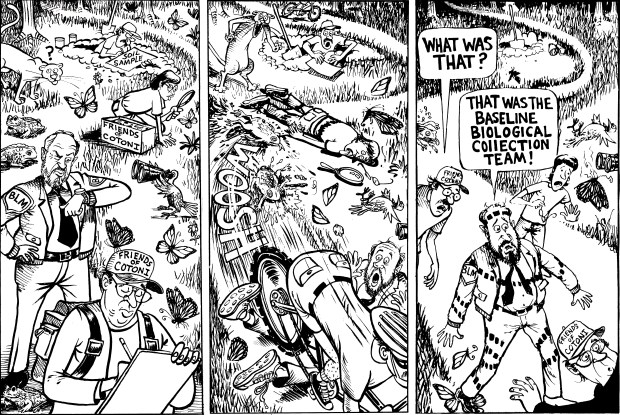
“Shifting baselines” is a term used to illustrate how humans acculturate to reduced wildlife, thinking that what they experience is normal and good. “Good enough” is perhaps a better term. Too many people measure success by saying ‘good enough!’ With species diversity in general and wildlife population health specifically, ‘good enough’ for some people is probably not what most people deserve and ‘shifting baselines’ is the problem at hand for large areas of Santa Cruz County.
Fifteen thousand years ago, a combination of poor human stewardship and climate change created a mass extinction event in California. Dire wolf, mastodon, mammoth, lion and other big cats, camel and horse relatives, the California turkey, a flightless duck in the lagoon at Laguna Creek, ground sloth, short-faced bear, and a host of other critters disappeared in a very short period of time. We don’t miss those species – they aren’t part of our cultural memory. But, we do seem to reminisce about beaver, gray wolf, tule elk, the California grizzly, badger and pronghorn…species that disappeared from the Central Coast more recently. Well, I’m not sure how many people really think about those species and ‘miss’ them. I do. The miracle recovery of some whale species seems to excite people, but those same people generally don’t consider the vastly reduced numbers of those species. In sum, our current wildlife situation is what is known as ‘depauperate’ – much reduced from historical numbers. And yet, most people think that what occurs today is ‘normal’ and they don’t much think about the opportunities to recover wildlife to more healthy populations on at least public lands in the Central Coast. Our experience of our “biological baseline” is greatly different than humans 15,000 years ago.
What will future generations of humans come to think of as normal? Will they one day realize that California is down to three species of wildlife, all cockroaches, and form some sort of cultural pride to recover the last remaining wild species? This is the trajectory we are moving towards because no one seems to care about the situation with the Central Coast’s wildlife, right now. If they did, local parks managers would hear about it and politicians would hold them accountable.
Whether we are thinking about State Parks or land managed by the Bureau of Land Management (BLM), the officials in charge of more than 20% of Santa Cruz County have a responsibility to monitor the impact of their management choices and to maintain wildlife populations for future generations. Specifically, all State Parks are required to have a General Plan and, in those plans, to outline how they will manage responsibly to maintain healthy wildlife populations. Similarly, the BLM is required to manage Cotoni Coast Dairies first and foremost for conservation, which requires wildlife surveys be conducted that can inform the agency’s management of livestock, ecosystems, and recreation.
What makes BLM’s management of Cotoni Coast Dairies a grandly special opportunity is that the property has not yet been opened to the public, so BLM can collect wildlife data before recreational activities begin to impact species. The wildlife of all other parks has already been negatively impacted by recreational use and so we can’t as easily understand how to improve the management of recreation in those places. Perhaps trail use on the trails BLM has already built will have no impact on wildlife – that would be extremely unusual! Chances are good that recreational use will negatively affect wildlife even hundreds of feet away from the trails. We won’t know how significant those effects will be unless data are collected before recreational use of the trails. And, we won’t learn which species are impacted by what numbers, timing and types of recreational use: those things would be very relevant to BLM and other regional parks managers in order to accomplish their mandates.
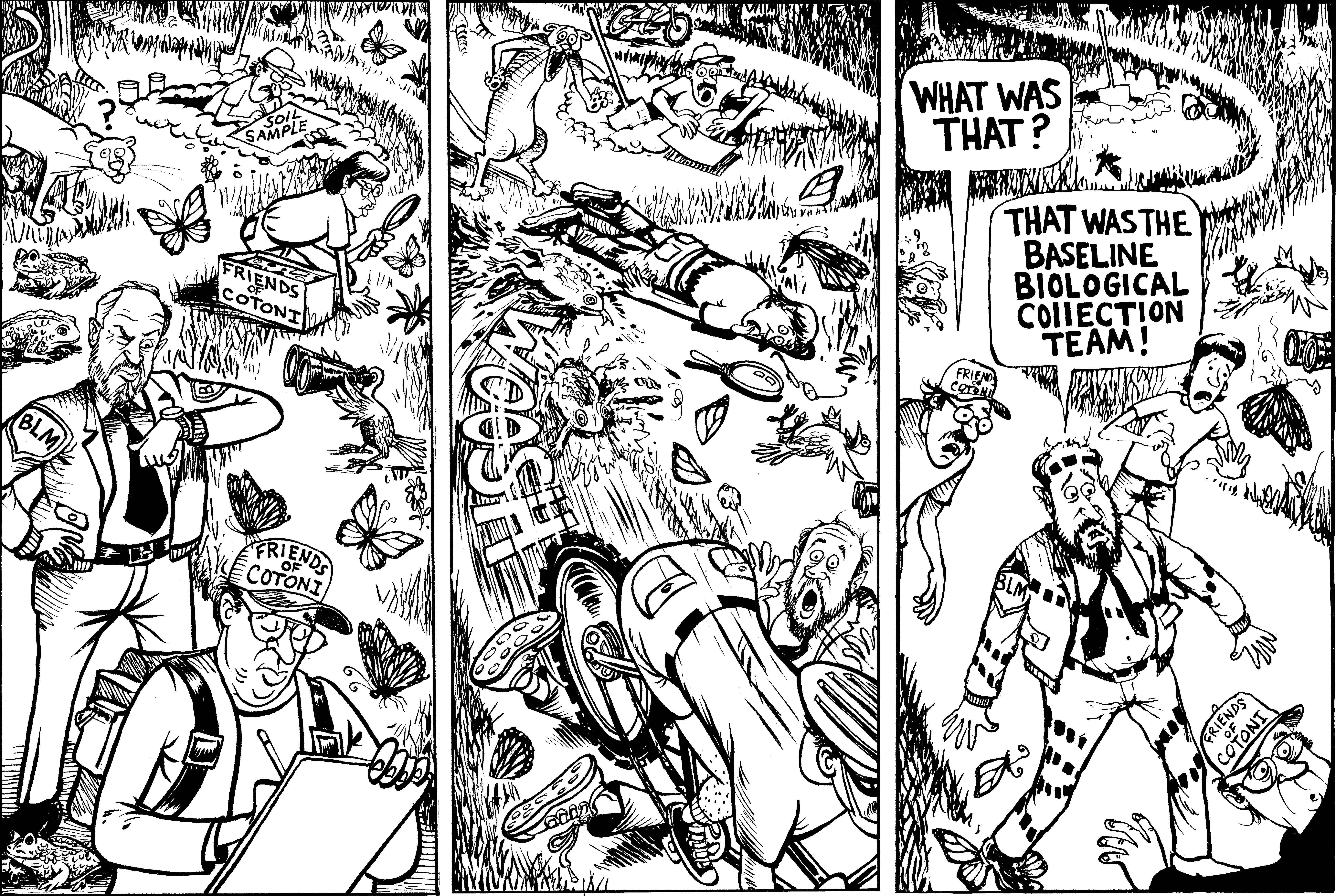
Here’s some of the things I’ve heard about biological baselines to inform land management in Santa Cruz County. Mostly, land managers say that they have enough information to make good decisions. This is important for them to say because they are required to use the best available science. If they say that they don’t have sufficient science, they are admitting fault and might be held liable, so they can’t say anything but that they have enough science already.
When pressed, they say something akin to “Just look! Habitat!” You dare not suggest species are a better measure of management success because they have a world of arguments against that approach. Their argument goes…if you have a grassland, you have done all you can to protect grassland species…a redwood forest! Violà! Redwood forest species all taken care of! If the species aren’t there, they say something like “well, that’s beyond our control” or “they’ll show up some day.” In short…some vague habitat description and a map of the presence of said habitat is ‘good enough.’ The fact is that species are much more sensitive to management of those habitats than manager’s broad brush would suggest. The problem is…any more refined monitoring might be either expensive and/or could hold managers accountable.
What if you had rare wildlife species on the land you managed, what would you do? Might you consult with the agency that is responsible for recovering those species? The California Department of Fish and Wildlife has good wildlife biologists, and they have survey protocols that are useful in documenting a species’ presence/abundance. Same with the US Fish and Wildlife Service and the National Marine Fisheries Service.
Would you want to make the public aware of the conservation work you are performing, and how successful it has been? Would you be worried about negative publicity?
Do you think lands managers feel accountable about more than their conservation mandates? Do you think that they feel accountable to certain recreational user groups? How would you know which type of accountability they feel more concerned about?
I hope that you have joined a pro-wildlife advocacy group. Working together, we can make sure that the wildlife our children’s children experience is more diverse, and more plentiful, than what we experience now. The alternative is bleak: children fascinated by the last species, raising cockroaches in cages and hoping that their offspring might live in the impoverished ecology resulting from a world of shifting baselines. I don’t think that is good enough.
– this article published in Bruce Bratton’s fabulous weekly blog BrattonOnline.com Sign up at that site to get the alert that it is out and then enjoy some quality time reflecting on news that matters…as well as excellent film/media reviews.

Now newts arise from dry grassland tunnels wetted by fresh winter rain,
ecstatic, star-guided, stretching towards far away ponds.
Now dust washes from every needle and leaf.
Wind gusts. Torrents. Then blue sky.
Nights dominate – deep rest, many dreams.
Now owl hoots with raindrop percussion –
raindrops, millions, each with its own tone.
Sharp snares – bouncing splashes explode from waxy madrone leaves.
Muffled droplets sink silently through softened turf.

Crop fields tilled and rested.
Brown, crumbly, bared soil,
winter seeds, absorbing.

Now the rumbling, crashing, hissing roar,
musical hum of waves.
Reverberating waves echoing notes like distant Tuvan throat singing.
Now the wind howls.
Centipedes, pill bugs, beetles,
burrow deeper into the wetting duff.
Leaves shake loose, settle, sheltering myriad ground critters.

White, yellow, brown…fine fungal roots spawn through the complex of soil and leaflitter salad,
buttons, parasols push and unfold.
Banana slugs slither trailing tracks, silver mucous crossing leaves, clearing algae off dank windows, slime traversing the furry, rough bark plates of redwoods.
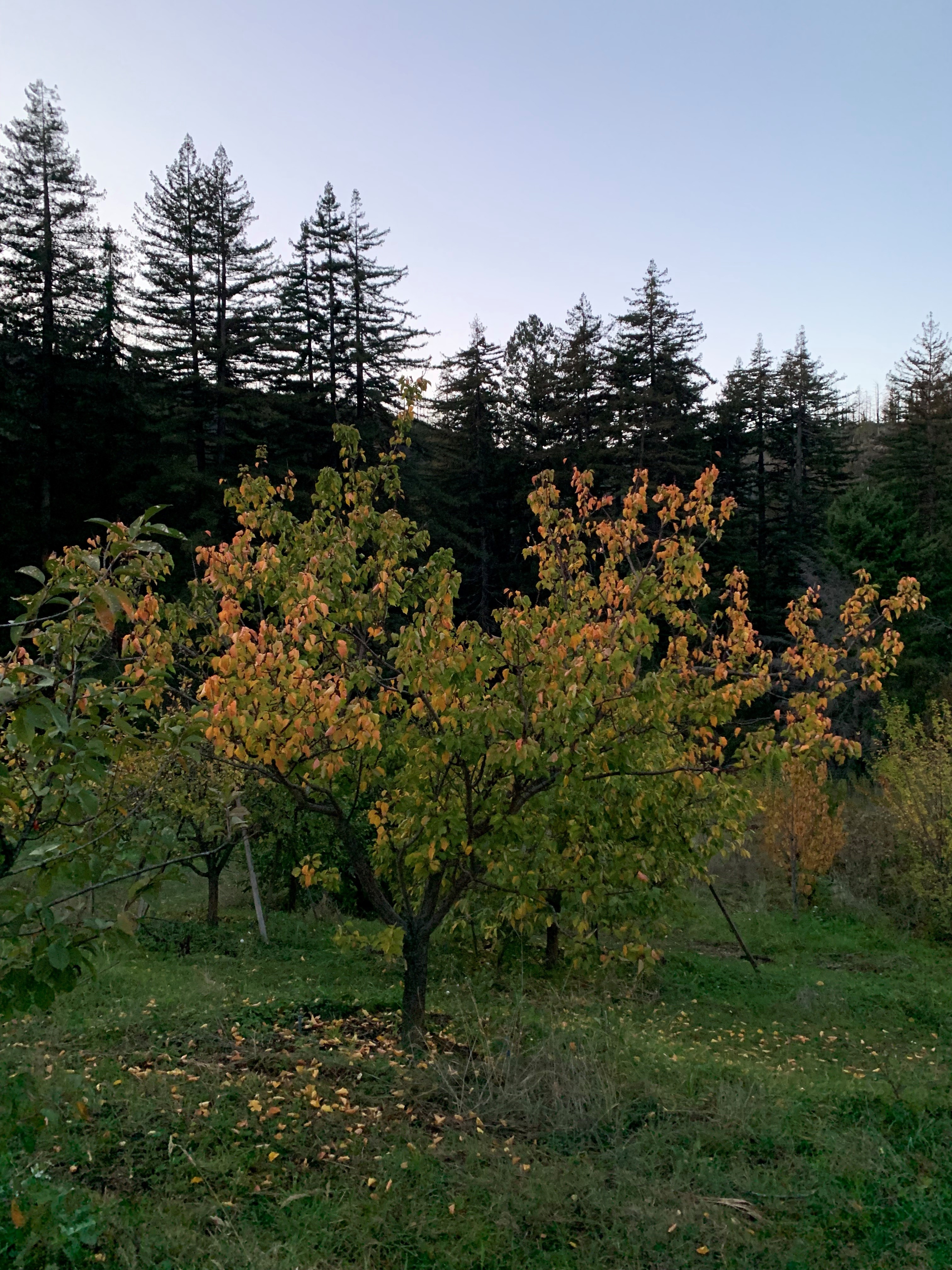
Sun rises after storm.
Vast glittering sparkles shine and twinkle across the landscape.
Celebration of rain,
so begins a new season of growth.
So begins the long dark wet muddy winter.

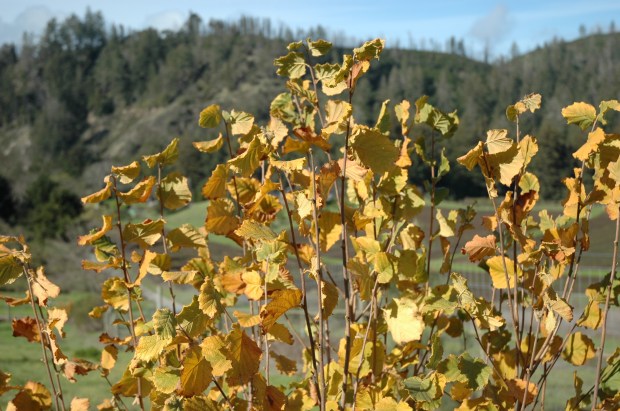
The short days and chill nights have arrived, and there is much more about Nature’s Fall to take a moment to appreciate.
Mediterranean fall is the transition between the hot, dry season and the cool, wet season. We must thank the Rocky Mountains and the Sierra Nevada, and a variety of other factors for the lack of summer rainfall in much of California, including right here on the Central Coast. Mediterranean spots are very rare on Planet Earth, and their unique climates make for very interesting, species-diverse places. The “rainfall season” starts October 1st. If you manage property, your target date to be prepared for significant rain is October 15: if you are prepared by that date, you will almost always be in time for the first big storm.
The rain-carrying wintertime storms are starting to sneak our way, but we aren’t quite there. Meanwhile, it is the driest time of year. The tiny rains we’ve seen so far have only wet the soil surface; the soil is bone dry as deep as it goes over most of our landscape. The last significant rains were from a storm that ended on May 3rd and, prior to that, a wetter storm on March 21st!
The first significant rain is one inch of precipitation, which usually wets the soil enough that it won’t dry out again until Spring. Although there are many soil types across our region, one of the dominant ones is sandy loam. Each inch of rain saturates about 1 foot of soil. I count the inches and imagine the soil getting saturated deeper and deeper, eventually pouring through to the bedrock and recharging the water table, raising the level of groundwater, feeding the springs, streams, and rivers.
If we are fortunate enough to have a rainy winter, the rain brings so much life. First comes the petrichor, the smell of the newly soaked ground, a chemical that has been shown to be akin to cedar scent, but you know it when you smell it. Fungus gatherers delight in the seasonal parade of edible treats from boletes to oyster mushrooms to chanterelles (and many more). The mosses and lichens brighten, coating and dangling from every limb of every tree. The dust settles and the seeds produced last Spring start to germinate, the golden hills blushing with green.
The dry summer means few biting insects, but there are lots of other interesting insects around in Fall. Over the summer, dragonflies went through metamorphosis in streams and ponds and now the young adults are hunting in the uplands, far from their watery birthing places. Watch for them in meadows, over farms, and even in towns. They are gobbling up flying insects, including the rafts of flying ants that came out when it rained a bit a week or so ago.
Each of the first rains triggers some insect or another to explode. This last rain produced millions of flying ants on the North Coast. The air was thick with them as they floated on the breeze, more like tiny butterflies than the bees that they are closely related to. One of these early rains will also trigger termites to fly. Both ants and termites nurture winged males and females that disperse to new territories. Different species seem to prefer to take wing with different cues.
Another insect flies with the first rains: rain beetles. These are extremely hard to see, but especially rewarding. Many of us celebrate the season’s first significant storm by going outside and getting soaking wet. Rain beetles are no exception. The male beetles make a loud humming-buzz as they seem to float around during the first big storm of the season, right at dusk, and always near chaparral with manzanitas and pines.
The first rain obliterates the very annoying canyon flies but also sets in motion the birthing of the season’s first mosquitoes. Canyon flies, aka ‘face flies,’ are the miniature flies that invade your eyes and ears and somehow make it into your throats, hack hack! They like the dry summer and even that last small rain made them disappear. However, whenever the soil gets wet, the soil-borne mosquitoes will hatch.
The first big storm also brings out amphibians. And here’s something you can do to help. I believe we are all pretty attuned to the first big rainfall, either by following the weather report or relying on a friend that does. As the forecast settles on the first storm of the season, stock up on your groceries and cancel your evening appointments. You’ll be safer and the critters that move around for the first deluge won’t die under your vehicle’s tires. Newts and salamanders await the first big rain and then they move around at night. They’ve been holed up in some burrow complex, pacing back and forth all summer eating beetles and grubs along a set of tunnels they have become quite familiar with. The night with the downpour means that they can move out of that familiar territory towards their breeding pools. And, move they do: in mass, across roads, in straight lines to their favorite pond.
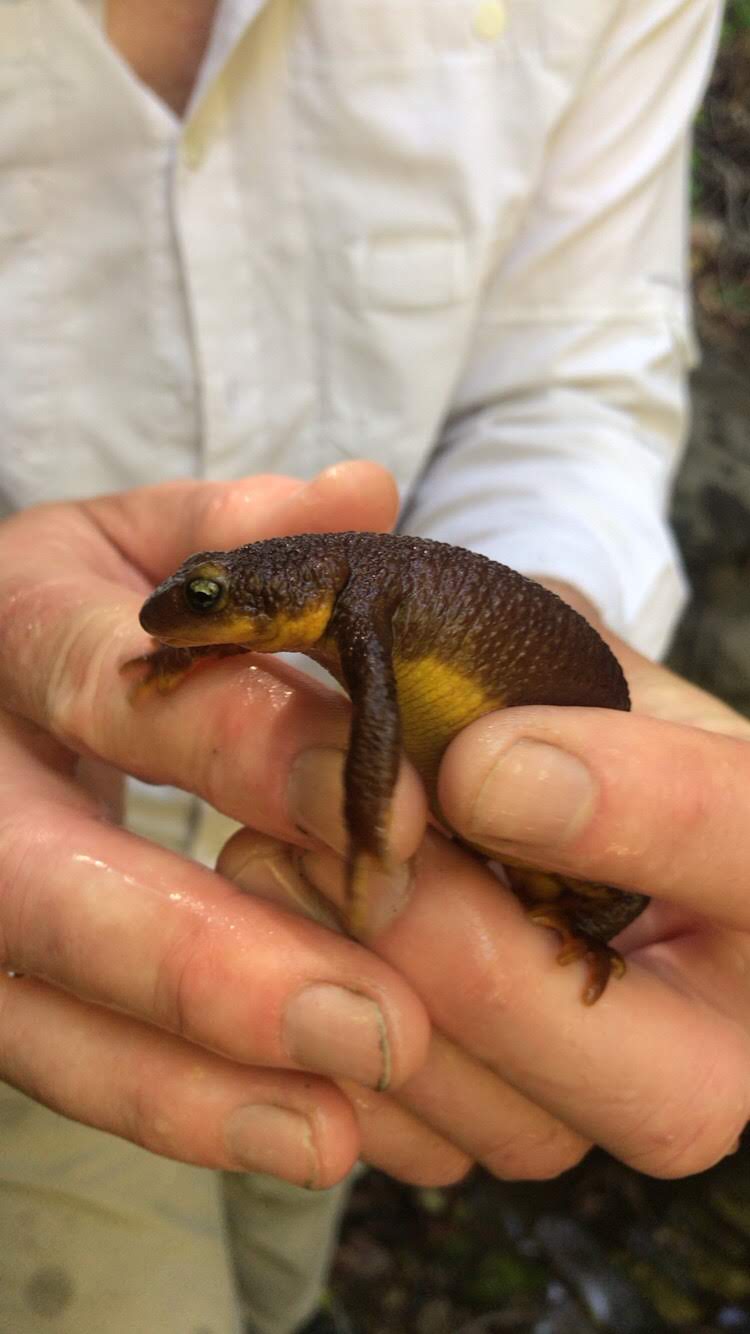
The first few rains also set loose a host of pollutants that have been concentrating during the dry season. Another reason to not drive on those first few nights of the Big Rain is that the roads are particularly slippery due to the concentration of oils that have leaked out of cars and plastered themselves to the roadways. After making the roadway treacherously slippery, those vehicle fluids then wash into the streams and rivers and flow out to the ocean. I have a habit of looking at the water flowing down the sides of roads in the City of Santa Cruz during the first rains and noting the continuous normally iridescent, oil sheen that is destined to the San Lorenzo and our precious Bay….so sad. If it is your job or you have any means of cleaning up the roads or other pollutant areas for that first flush of rain, I wish you luck in preparing for that, which is right around the corner. This also means you must pay attention if you have made any bare soil by gardening or farming- sediment loss is soil loss, and soils are a non-renewable resources, taking a long, long time to create.
-this column appeared in Bruce Bratton’s blog BrattonOnline.com, a place you should bookmark for the best coverage of local, regional, and international news.
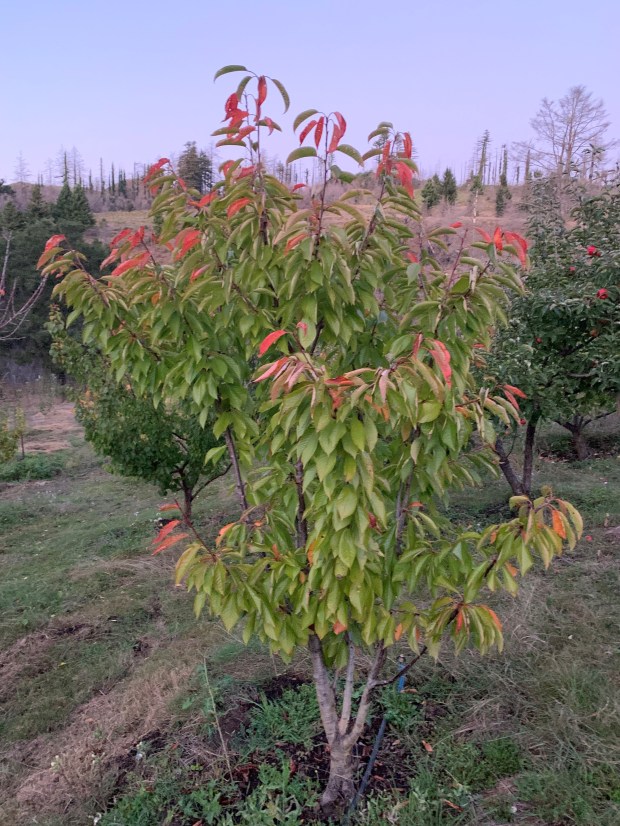
The sun grows distant, already so far South, days so brief. Rain has moistened everywhere. Fall is sweeping the farm, triggering bright leaf colors, tree-by-tree, each evening stroll revealing new tones in new places.
The ground blushes newly green from the previous expanse of dark brown soil or gray aged thatch. Millions of seeds germinated on the much-anticipated first significant rainfall this past week. Pairs of many-patterned leaves unfurl from different types of flower seeds while single first grass leaves poke straight up.
More wetting storms are approaching, pushing southward from the distant northern horizon. Beautiful clouds appear, sometimes a skyfull of feathery patterns, other times ominous heavy gray huge pillows. Layers of clouds above oceanward fog are often accentuated by sparkling orange pulses in between them at sunset.
As the winter approaches, birds become more quiet, their songs more concise. Bird-eating hawks swoop and wheel, frightening seed- and seedling-fattened flocks. Silent spells with no song signals hawk. The consistent whispered squeaks and chirps suggest hawk absence as groups of quail, sparrows, and juncos slowly emerge from cover, pecking up thousands of tasty sprouts; their favorites are abundant: clovers, filaree, medic, lupine, poppy, wild lettuce, and dock. Full bills, filling tummies, hunger satisfied peaceful birds prepare for long stormy wet nights. Each evening at sundown, flocks huddle together in dense clusters surrounded by protective thick tree or shrub canopies. They have already negotiated safe roost locations and even their individual places in the rows along branches. There are a few squabbles at dusk in the roost locations as some on the edges realize disadvantages of their relegated positions. By dark, they have become politely quiet and still.
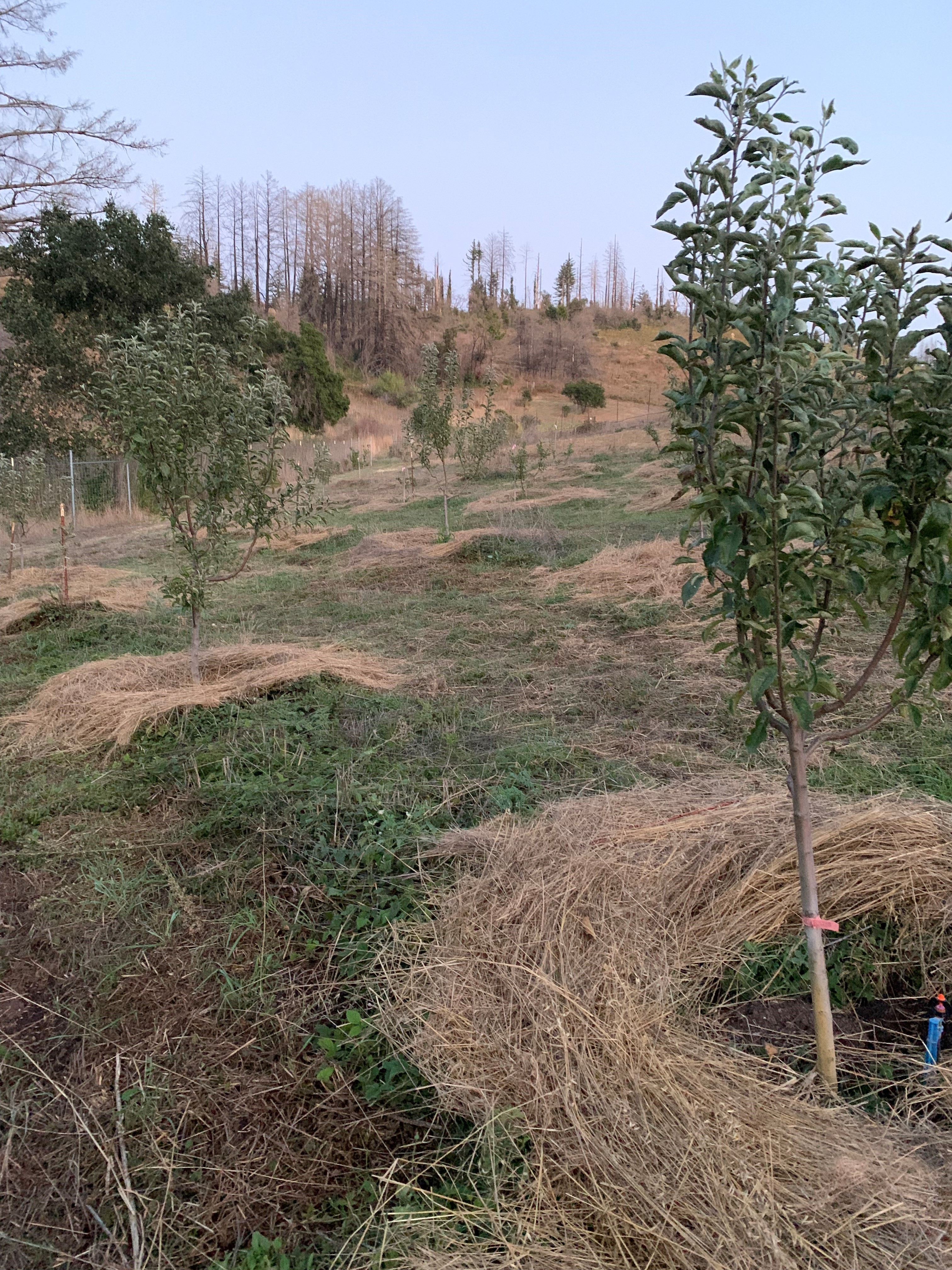
As orchard leaves begin to fall, we prepare tree beds for the long slumber. Last weekend, Community Orchardists hauled and spread the final compost and then the last windrows of dried hay. Energetic tree keepers filled and then hauled bucket after bucket scattering compost/worm castings in the understory of each tree. Following them, skilled pitchfork wielding orchardists pitched, piled, and sculpted neat circular hay nests surrounding young trees. Winter snacks and cozy blankets for our tree friends.
As the trees approach their sleep, leaves brighten then drop. Cherry tree leaves are turning orange-to-red, starting on the sunnier sides of each tree and day by day progressing onto the northern side of the canopy. Apricot, aprium, plums and pluots echo those cherry leaf reds but tend more orange to yellow. Apple tree fall color extends well into winter, slowly unfolding many shades of yellow through February in an extended fall. Most leaf colors change fast and fall quickly, splashing rings of color bright in circles on the ground beneath brief spells of brightness dancing across the orchard among the high held branches.
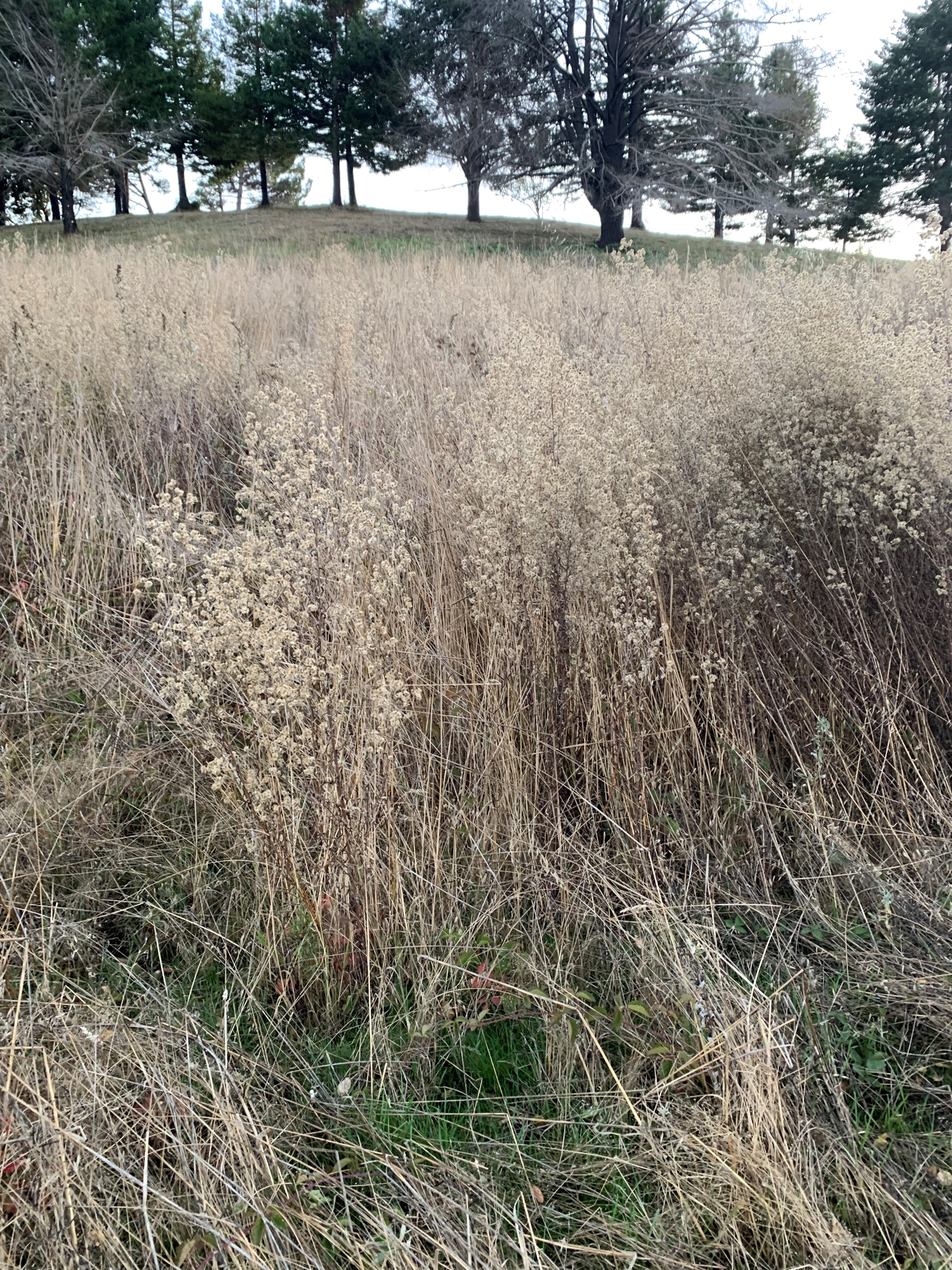
We were unable to mow every corner of the farm and in some places the dried grass and wildflowers formed thick dry swards. Deer paths wend into these stands. Following these wildlife trails, we find hidden clusters of mashed down straw – cozy deer beds. The breezes sing high schwews on the ridges with more of a full, wooing noise in the nearer conifers, but these tall dry grassy areas make scratchy, rustling noises in the winds at the onset of each storm. The deer thank us for leaving them some dense cover to shield them from the chilly gales through the dark nights.

Tomato vines whither after rain; winter squash vines long spent, fruit curing; later season apples grow sweeter and crispier with the cool nights. We feel lucky again to find a ripe tomato among the melting vines. Weeds will soon occlude the deliquescent reddish fruit and then all will be tilled and cover cropped.

Two Dog Farm is boxing and curing the bountiful dry farmed winter squash crop, and colorful squash still brighten the fields.

Fuji apples are the last bigger harvest in the orchard. We will gather the last of the apples over the next week and press the last of the culls into the final cider of the season. Much of the orchard has had a final mowing, the harrow scratching in bell beans is close at hand.

The sun speeds quickly towards the west and evenings pass suddenly to night. One moment, the beautiful array at sunset tinges the hills and the next moment colors wash and fade to gray, stars winking into sight until the night sky reveals vast constellations. There is a moment in this transition to night when my attention is drawn to the silhouettes of trees, revealing new characteristics of long familiar friends. Brushy oaks dance on the edge of regal, posturing clusters of redwoods. Then they disappear, overcome by the majesty of night.
simultaneously published at Molino Creek Farm’s website

Note that I contest these statistics separately using publicly available data, at this link. This group has since changed its name to Santa Cruz Mountains Trails Stewardship, although their advocacy for stewardship writ large is about nonexistant.
 Grey Hayes